#linear-algebra
2 messages · Page 91 of 1
 pallid rampart
 wintry steppe
but i think, the usual definition is how many entries in the vector

 stoic pythonBOT
Whoever:
 torn hornet
defining n as the number of dimention is probably cyclic
pallid rampart
well you can call it specifically for R^n first, then show that R^n is a vector space and the name is consistent with the dimension of a vector spce
but yeah it's probably circular
wintry steppe
we live in the matrix
 eternal finch
@wintry steppe Anyways, as a very specific example of a set of vectors spanning a space, suppose you want to see if {(1, 2, 3), (4, 5, 0), (6, 0, 0)} span R^3. Then you need to see if each vector in R^3 can be written as a linear combination of (1, 2, 3), (4, 5, 0), and (6, 0, 0).
To do that, you would consider an arbitrary vector (a, b, c) and see if x * (1, 2, 3) + y * (4, 5, 0) + z * (6, 0, 0) = (a, b, c) has a solution.
Indeed, you'd see that it does have a solution, so the set we considered spans R^3.
torn hornet
also for 1 thing of clarity, the notation $(x_1\dots x_n)$ is the same thing as $\begin{bmatrix} x_1 \ \dots \ x_n \end{bmatrix}$ which might be the "column" you are referring too
stoic pythonBOT
JohnDoeSmith:
pallid rampart
It is enough to show that x * (1, 2, 3) + y * (4, 5, 0) + z * (6, 0, 0) = (0, 0, 0) only has 1 solution, namely x=y=z=0
eternal finch
It is.
Kind of a minor point, it's usually easier to stick as close to a definition as possible when somebody is confused.
pallid rampart
I agree
eternal finch
For example, as you said earlier, a basis always has a length equal to the dimension of the space.
I'd definitely use linear independence + that fact over span + some other fact normally.
torn hornet
(this is the defination of dimension btw)
pallid rampart
defination
pallid rampart
what's n
wintry steppe
number of columns
torn hornet
it might be useful to note this is an iff condition
wintry steppe
i know what a basis is
eternal finch
I think I learned what rank and nullity were before bases.
In my first course in linear algebra.
torn hornet
thats bad imo
pallid rampart
Ughhh
eternal finch
It really is.
pallid rampart
How can you talk about dimension without basis
wintry steppe
but i didn't understand the sentence they said about span of H
pallid rampart
Da fuk
torn hornet
defining dimentions as "number of columns" or something i imagine
pallid rampart
Ok
torn hornet
which is kinda bad
wintry steppe
usually a matrix is m * n
right?
so it can get confusing
if they use the same n
pallid rampart
Yes, but you shouldn't be too fixed on notation stuff
wintry steppe
they should use something like "x"
torn hornet
in math you will see tons of different results use the same variables
you have to get comfortable with it
pallid rampart
yeah
torn hornet
its a kind of abstractization
but anyhow i think we should solve your problem first lol
wintry steppe
but yeah if a matrix is m by n right? when they say that the columns of A span R^m, they mean the number of rows, because if u have a 3 by 2 matrix for example, and they say that the columns of A span R^m, they also mean that there's a pivot position in every row, and there are 3 rows, each individual "vector" in the columns of A has 3 entries
@pallid rampart the set of all linear combinations
pallid rampart
Ok so a set spans H means that the span of the set of vectors is H.
Also I have no idea what you are trying to say
wintry steppe
when they say the columns of A span R^m, m is equal to the the number of rows
of the matrix
wintry steppe
so as u can see, it can get confusing
pallid rampart
You mean it can get confusing whether it spans R^n or R^m?
wintry steppe
when it says that it spans R^(something)
and they use n or m
because sometimes, it does mean the number of rows
pallid rampart
Yes
In the specific situation, it should make sense
When you're talking about matrices, and the letter n is already used, then they will not say the columns of the matrix spans R^n
wintry steppe
so when does it not mean the number of rows or columns?
pallid rampart
m and n are the most common letters to denote the number of rows of columns
It of course does not mean that m and n are always the number of rows and columns
wintry steppe
do u have a general rule?
pallid rampart
For?
eternal finch
Dude, my numerical analysis textbook says "n-by-m" matrix. Threw me off hecka.
wintry steppe
for when they talk about Span, and they use R^n or R^m, when, in general, do they not also mean the number of columns/rows
pallid rampart
Then n and m are just some arbitrary positive number
 elfin ingot
whats the question
 clear vessel
let T be the linear transformation from R^2 to itself so that:
if v is a vector on the line y = 2x, then T(v) = 2v
if v is a vector on the line y = -2x, then T(v) = 0
let A be the standard matrix for T, find the eigenvalues for A, and give a basis for each eigenspace
someone said:
a vector along y = 2x is an eigenvector so (1,2) is an eigenvector with eigenvalue 2
also a vector along y = -2x is in the nullspace as T(v) = 0, so the vector (1, -2) has an eigenvalue of 0
the basis for the eigenspace can just be the set of the eigenvectors
so the eigenvalues are 2 and 0, but how do i give the basis for each eigenspace
elfin ingot
whats eigenvalues
 dusky epoch
@clear vessel you already have the eigenspace bases
{(1,2)} for the eigenspace for λ=2, and {(1,-2)} for the eigenspace for λ=0
clear vessel
oh is dat it
dusky epoch
yes that is it
 cyan siren
I know about eigenvalues, but have no idea what an eigenvector is
Wait is it just a vector of eigenvalues?
eternal finch
An eigenvector v of a linear transformation T corresponding to an eigenvalue k is a nonzero vector such that Tv = kv.
wintry steppe
for example the nulspace is a subspace of R^n, and the column space is a subspace of R^m
it does mean the number of columns and rows
cuz when u find nulA, you will get vectors that have number of entries = # of columns of A, and when u find ColA,you will get vectors that have number of entries = # of rows of A, and the same applies to the basis
elfin ingot
isnt the nullspace all vectors t(v) = 0
how can i find that in a matrix?
im p new and learning hre
wintry steppe
nullspace for an invertible matrix = 0
but generally, to find the nullspace
Ax = 0, solve for x
wintry steppe
Np
i have a linear algebra midterm tmr
the questions that have us solve stuff are easy, but if it gets too conceptual, i might have some problems
wintry steppe
Tough scene
 coral acorn
anyone know how to do transition matrix stuff? I'm pretty stuck on a question :((
coral acorn
how are you supposed to prove an rref?
 latent marten
hi is det(ABA^T)= det(A) * det(B) * det(A^T)
stoic pythonBOT
mart:
wintry steppe
@latent marten
latent marten
thx bro
 fossil quest
Can someone tell me the subspace of the underlined term
K is a field and i have to find out the subspace for the inverse of it which i dont fully understand
Same for F2^2
Noone? :/
clear vessel
"suppose that A is a 5 x 3 matrix so that for all b in R^5, the equation Ax = b has at most one solution. write down the reduced row echelon form of A, and prove your answer."
i think the rref(A) is
1️⃣0️⃣0️⃣
0️⃣1️⃣0️⃣
0️⃣0️⃣1️⃣
0️⃣0️⃣0️⃣
0️⃣0️⃣0️⃣
but idk how to go about "proving the rref"???
 sour jetty
I'm trying to find the limit of this series of n going to +infinity. The answer is 1/4, but I keep getting zero with all my attempts, because I feel like the 1/(n^4) in the front would make the whole thing equal to zero when n goes to +infinity. Anyone has a clue on how to properly find the answer of 1/4?
dusky epoch
how are you getting zero exactly
sour jetty
If n goes to +infinity, then I believe 1/(n^4) must go to 0
And then I'm just seeing 0 * (a sum of integers)
which would also be 0
dusky epoch
$\sum_{k=1}^n k^3$ approaches $+\infty$.
stoic pythonBOT
Ann:
dusky epoch
no, 0 * +∞ is indeterminate.
clear vessel
eternal finch
You never said what you were aiming to prove.
clear vessel
proving the rref of A, but like what does that even mean
eternal finch
Yeah, dunno. Like, prove that the RREF must be that, I guess?
clear vessel
ye but idk how to prove 
latent marten
thats what im stuck on
 sick dragon
Exam tomorrow boys, gonna be annoying and ask a ton of questions today 🙂
 shrewd mortar
So let P be
c+b a
a c-b
since symmetric (we can take c+b c-b WLOG)
We know det P = 0, that is, c^2 - b^2 = a^2
c^2 = a^2 + b^2
and c+b - (c-b) = 2b, b > a
Anyways let c = s/2, b = k/2, so 2k/2 = 2b => k = 2b or that b is an integer
since c+b is an integer, c is an integer as well
hence we are done
@latent marten
(Showing c and b are integers is necessary because when we take c+b c-b to be arbitrary integers i, j we are really taking c to be the average of them and b half the difference)
wintry steppe
Midterm was ez
We had to find RREF for 4/5 problems, that was the only thing tiring
 dreamy depot
Anyone care to check this subspace proof I think I did something wrong: http://mathb.in/42036
I think I need to define addition but i'm not sure
 quartz compass
@real plaza yeah if it's diagonalizeable you have B = EDE^-1 and so A = PBP^-1 = (PE)D(PE)^-1 has the same diagonal matrix, which are the eigenvalues
 slow scroll
well you can have similar matrices that are not diagonalizable. A matrix is diagonalizable if it is similar to a diagonal matrix. Also, while similar matrices do have the same eigenvalues, im fairly sure there exists matrices which are not similar, but just so happen to have the same eigenvalues
i.e. what you said here
Is it just that, two matrices are similar if they have the same eigenvalues...
is not true
 void sinew
been stuck on this for a while can someone point me in the right direction?
void sinew
thanks heaps i think i got it
wintry steppe
that looks like a quadratic function
void sinew
might be a bit hard to read but
quartz compass
not quite
well what you wrote in your paper I think I see is right
oh I was thinking rent free was the same person
@void sinew what you have is right
void sinew
sweet thank you
 river jasper
is there a method to find a second eigenvector from a eigenvalue by squaring the matrix?
sick dragon
forgot how to parameterize: could I rewrite it as ((1-2t), t, t) or (t, t, (1-2t)) ?
wintry steppe
do those solve the equation?
 light herald
does the length of the vectors in an orthogonal matrix have to be 1?
wintry steppe
yes by the definition of orthogonal matrix
light herald
and the determinant will always be 1
wintry steppe
I think it could be -1
light herald
why isnt an orthogonal matrix called orthonormal matrix?
seems kind of misleading to just call it a orthogonal matrix if its also orthonormal
 subtle walrus
probably historic reasons
matrices where the rows/columns are just orthogonal (not orthonormal) are not very useful
so its not very useful to think about it
and the term orthogonal is probably older
so it stuck
clear vessel
 subtle walrus
and orthogonal matrices are just the linear transformations that preserve the dot product, so it makes sense to call them orthogonal i guess
sick dragon
I mean why do they choose x here to be that and not y or z?
it doesnt matter does it
wintry steppe
this isn't the same problem, is it?
x y z are basically the same things here
so you can freely swap the names
but were they in your other problem?
you could for example choose x=t y=w and z=1-t-w here, yes
sick dragon
so if you have 2 variables, you decide one is t but if you have 3 you decide one is t and the other is w?
wintry steppe
it depends on the number of equations and number of unknowns
not just the number of variables (unknowns)
"could I rewrite it as ((1-2t), t, t) or (t, t, (1-2t))"
no because you are not meeting the x=z condition imposed on the system
dreamy depot
For the question at hand would taking $\big{(-x, -y, -x+-y, -x+-y, 2x , x,y \in \mathbb{F^{4}} \big}$ work as a good example
stoic pythonBOT
Zophike1:
elfin ingot
isnt U (+) W = { u+w | u in U w in W }?
wouldnt ur rexample result in a 0 in the first entry always?
dreamy depot
all right sweet just wanted to be sure I had the right idea
elfin ingot
i am just eyeballing it lol
dreamy depot
@elfin ingot does it have to be zero for all entrys have to be zero I think the above example I gave is wrong it -x+-y should be -x+y
@elfin ingot u there ?
elfin ingot
u need to have the zero vector thats forsure
dreamy depot
ahhh okay is that because of the direct sum condition ?
sick dragon
A linear system with more equations than unknowns is NOT always inconsistent.
Is this because you'll end up with a free variable?
dreamy depot
I only had that in mind when doing this problem
wintry steppe
um
dreamy depot
@elfin ingot ?
wintry steppe
@sick dragon an inconsistent system is one with no solution
parameters aren't important there
dreamy depot
@elfin ingot by idenity vector you mean the identity matrix ?
So is my example incorrect ? @elfin ingot
wintry steppe
more unknowns than equations is where parameters come into play
 cold crypt
for this question, what does part d even mean? help would be apprecated. thanks
wintry steppe
if you have more equations than unknowns, you might find that if a solution were to exist for a particular system, then something like 0=5 would have to be true
dreamy depot
@elfin ingot u there ?
dreamy depot
Ahhh okay that makes sense I also considered that as well but my example is correct right ?
I just want to make sure before I get off and play some games
@elfin ingot ?
@elfin ingot u there mate ?
elfin ingot
whats ur example again
dreamy depot
hold on let me latex it
$\big{(-x, -y, -x+-y, -x+-y, 2x , x,y \in \mathbb{F}^{4} \big}$
^ This
stoic pythonBOT
Zophike1:
dreamy depot
@elfin ingot ^
elfin ingot
yea
dreamy depot
thx bro
elfin ingot
np
 static bison
this is a study guide question
 hallow cliff
You still need help?
hallow cliff
Do you know how to find W^perp?
If not make a matrix with u and v as row vectors and find it's null space
For the second part, this is an eigenvector/ value problem
I'm assuming you know what diagonalizing a matrix is, we are going to do this but in reverse
$ A = PDP^{-1}$
stoic pythonBOT
magnusChadson:
hallow cliff
Have the first two columns of P be u and v and the second two columns be the vectors you found in part 1
D is going to be the diagonal matrix with -1 -1 1 1 on its main diagonal
Then find P^{-1}
Then multiply them all together
@static bison
static bison
my bad was working on anothe rproblem
is that all the steps @hallow cliff
I'll attempt it as soon as i finish doing a test vector space problem. I don't want to lose my train of thought
hallow cliff
Yep
 cold topaz
to calculate tr(U^T V), I do it manually. Like I wirte U^T, then do matrix multiplication by V, then add the diagonal of the matrix, instead of the way the book did. I shouldnt have any problems in the future. RIght?
hallow cliff
What's tr???
 gray dust
trace
hallow cliff
Oh lol, never seen that notation before
cold topaz
trace
 cursive narwhal
hallow cliff
cursive narwhal
hallow cliff
Any time
clear vessel
T/F: "If v is an eigenvector of A and of B, then it’s also an eigenvector of AB"
is this an ok way of proving it true?:
Av = (λ_1)v , Bv = (λ_2)v, (AB)v = A(Bv) = A(λ_2)v = (λ_2)Av = (λ_2)(λ_1)v, so v is an eigenvector cuz it follows that ABv=λv form
gray dust
looks ok
hallow cliff
^
quartz compass
looks perfect, not only did you show it's an eigenvector but you also were able to give its eigenvalue
hallow cliff
Yep
You can try multiplying it by vectors in W and W^perp and see if it gives you the right values I guess
clear vessel
"suppose A is an n x n matrix with n > 1 and A^2 = In, the n x n identity matrix. what are the possible eigenvalues of A?"
so i was thinking, v = Iv = (A^2)v = A(Av) = Aλv = λAv = (λ^2)v, so λ^2 = 1, so λ is ±1.
the second part of the question says: "is the matrix A + 42In invertible?" (In is identity matrix) and idk how to go about answering without trying to find like an explicit example, or if its case by case?
slow scroll
quirky alternative proof: (A+42I)(A - 42I) = A^2 - 42^2 I = (1 - 42^2)I so
(A - 42I)/(1 - 42^2) is the inverse to (A+42I)
clear vessel
wait if the eigenvalue is 0 is it not invertible
hallow cliff
Correct
clear vessel
osht 
static bison
wait so for 13, we do det(A-lambdaI), we'll get some like ax^3 + bx^2 + cx +d.
for B = 1/c(A^2 + aA + bI), we're constructing a match based on the matrix A and the coefficients of det(A-lambda*I)'s polynomial? then just take the inverse of A and check if that equals B?
hmm
slow scroll
no, don't take the inverse of A.
static bison
inverse of B?
hallow cliff
Yeah but it should be easer to just multiply AB
slow scroll
Just check that BA =AB = I
static bison
ah okay
hallow cliff
^
 agile gyro
notice that A = BAB^{-1} and A diag
static bison
yo
i didn't spot that
thank you
wait
hmm
When I think of diagonalizing matrix M, i think Q^1 * MQ = D, so wouldn't it have to be something like AB = BA => B = A^-1 * BA @agile gyro
agile gyro
hmm
yeah sorry i forgot the definition of similar matrices
i thought that showed that A ~ B
agile gyro
try showing that every eigenvector for A is an eigenvector for B
wintry steppe
think you mean eigenvalue
similar matrices have the same eigenvalues but not the same eigenvectors, necessarily
noticing that is enough to do 14 here
static bison
so using B = A^-1 * BA, I made the conclusions that B is a diagonal of any combination and A is the Identity matrix because the eigenvectors of a diagonal matrix will always equal the identity matrix.
so B = A^-1 * BA => B = I * B * I, where b can be kI or have a diagonal of (a,b,c)
i won't know if I'm right until he posts the study guide answers in like two days
wait does "Suppose A has n distinct real eigenvalues" mean that there is no multiplicity among the the eigenvalues?
meaning that A can't be I because I's eigenvalues are all 1
wintry steppe
because A is nxn, yes
static bison
?
wintry steppe
because A is nxn, the statement "A has n distinct eigenvalues" means that each eigenvalue has multiplicity 1
wintry steppe
A and B are similar, so they have the same eigenvalues, and in particular B is an nxn matrix with n distinct eigenvalues
then you're done, really
can you finish from there?
static bison
i'm thinking
agile gyro
@wintry steppe i dont think that shows A is similar to B
agile gyro
because A similar to B means that exists P such that A = P^{-1}BP. But we only have that A = BAB^{-1} which is just another way of writing that the matrices commute
yeah thats what i was thinking at first
wintry steppe
oops my bad
agile gyro
but every eigenvector of A is an eigenvector of B
because BAv = Bkv = kBv
since v\neq 0 and B inv, Bv\neq 0
hm wait
lol
wintry steppe
yeah i totally read the question wrong, sorry if i confused you djcum2quick
let me think about it some more
static bison
yeah, I was confused way before your input
yeah me too
by the way
thank you everyone
XOxo
agile gyro
Bv is an eigenvector of A
wintry steppe
i remember some first year linalg exercises about simultaneous diagonalization of commuting matrices, which is whats going on here
best bet is probably to use commutativity to produce a basis of eigenvectors for B, which i believe is what wasd is trying to do
agile gyro
yeah thats what i was trying
i think A,B are simultaneously diagonalizable if and only if they commute
wintry steppe
i haven't done diagonalization seriously in over a year so unfortunately im not instantly seeing the solution
that is true
agile gyro
but i was too lazy to read about simultaneous diagonalizablility lol
if you look at the proof of that you will probably get an idea for this
wintry steppe
haha then you might not want to listen too much to us
although you still might get something out of looking at the proof of what wasd mentioned
im gonna sit down in a min and try to work this one out
static bison
for a second I thought I was onto something but it turned out to so wrong
wintry steppe
if $v$ is an eigenvector of $A$ with eigenvalue $\lambda$ then commutativity of the matrices gives you that $Bv$ is an eigenvector of $A$ with eigenvalue $\lambda$, and since the eigenspace is one dimensional, there is a scalar $\lambda^\prime$ with $Bv = \lambda^\prime v$
wtf
dusky epoch
use single dollars
stoic pythonBOT
TTerra:
wintry steppe
ty ann
anyways, that's probably a good starting point
yeah, i think that's the approach you were supposed to make
i apologize if i confused anyone with anything
and yes, this is simultaneous diagonalization, at least a special case of it
static bison
yeah, I'm not going to pretend like I understand that
I'm kinda exhausting from studying fro=om nonstop all day
i'm going to copy the important bits of this convo then return to this tomorrow
I want to understand this
thank you
XoxO
clear vessel
T/F (+ proof): "if w in R^2 is a linear combination of u and v, then u is a linear combination of v and w"
my initial thought was w = c1u + c2v, so u = (w - c2v)/c1, and thought i could prove it that way, but then i realized if c1 was 0, there was no way to write u as a linear combination of v and w. idk how i'd prove false; should i do an explicit counter example?
elfin ingot
yea
by trying to prove it u found like
the thing thats not making thiis true
now use this knnowledge to find ur counterexample
@clear vessel
dusky epoch
@clear vessel consider the case where w = v and {u,v} is linearly independent
clear vessel
ooooh yes good thanks you
dusky epoch
of course you would need to prove that a linearly independent set {u,v} exists
clear vessel
 bruh im slow
dusky epoch
this is R^2 and of course linearly independent sets of two vectors exist in R^2
{(1,0),(0,1)} is one example
clear vessel
but what if like u = 2v
dusky epoch
that is not linearly independent
i mean
if u = 2v then {u,v} will not be linearly independent
clear vessel
ye so how do i know that {u,v} is linearly independent
wait or am i just saying that "because we are in R^2, there exists a linearly independent set {u,v}"
dusky epoch
ye so how do i know that {u,v} is linearly independent
you don't
i am saying that there exists a counterexample to your statement
take any linearly independent set {u,v} in R^2 (and at least one such set exists) and set w = v
clear vessel
so like could i say, "Let there be a linearly independent set {u,v} in R^2 and a vector w in R^2. Let w be a linear combination of u and v. Then there exists a c1 and c2 such that w = c1u + c2v, and therefore u is a linear combination of v and w where u = (1/c1)w - (c1/c2)v. Let w = v. So, c1 = 0 and c2 = 1, and u would have to be the zero vector. This is inconsistent with statement that {u,v} is linearly independent, and thus u is not a linear combination of v and w" or am i just overly complicating something / need to reword for it to be a good proof
dusky epoch
overcomplicating
original statement: "if w in R^2 is a linear combination of u and v, then u is a linear combination of v and w"
dusky epoch
no, i mean that this is what you were asked to determine the truth of
response: "false. consider any linearly independent set {u,v} in R^2 and let w = v (= 1u + 0v). then u will not be a linear combination of v and w, as any linear combination of v and w will be a scalar multiple of v, which u isn't."
clear vessel
oh frick yes, i think i've gotten myself in the mindset of a certain structure of proofs cuz i taught myself, yes thank you sm and sorry for my ignorance
clear vessel
T/F (+ proof): "For any natural number n > 1, Let V be the vector space of n x n matrices, with respect to the usual addition and scalar multiplication operations of matrices. Then there exists a basis of V consisting of 3n matrices." So like would the vector space of 2x2 matrices have 4 matrices, and if a vector space V has a basis of n vectors, then every basis of V must consist of exactly n vectors., so a 2x2 gotta have 4. so that means a 4x4 matrix vector space gotta have a basis of 16 matrices, so every basis of B gotta have 16, but here n=4 and 3n = 3(4) = 12 ≠ 16 so is that statement not true, and i prove by counterexample? my issue is how do i know that a vector space of of nxn matrices has a basis that needs n^2 matrices?
 hot vessel
for matrices in R^(nxn), why is A + A^T always orthogonally diagonalizable
slow scroll
@clear vessel choose what you think should be a basis and show its a basis i guess?
@hot vessel any symmetric matrix is orthogonally diagonalizable
try taking its transpose
dusky epoch
$(A+A^T)^T = A^T + (A^T)^T = A^T + A$
stoic pythonBOT
Ann:
clear vessel
@slow scroll it seems weird writing out 16 matrices to prove that they are the basis of the vector space of 4x4 matrices tho
dusky epoch
my issue is how do i know that a vector space of of nxn matrices has a basis that needs n^2 matrices?
the dimension of R^(n×n) is n^2
you can prove this by making an isomorphism between $\bR^{n \times n}$ and $\bR^{n^2}$ in one of a number of relatively obvious ways
stoic pythonBOT
Ann:
clear vessel
i don't really know what an isomorphism is 
shid im dense
stoic pythonBOT
Ann:
dusky epoch
by asserting that there is a basis for R^n×n consisting of n^2 matrices
each with a 1 in one position and 0s elsewhere
clear vessel
do i have to like write them out or just say that rigorously
dusky epoch
the latter
i mean
there is a basis for R^n×n consisting of n^2 matrices
each with a 1 in one position and 0s elsewhere
this is rigorous enough imo
clear vessel
oh ye it is, maybe i'll say something to affect of "each with a 1 in one difference position" but ye ok yes thank you, i am quickly losing ability to think straight this late at night and apologize and thank you 
 gaunt gulch
Hey dumb question: if i have a 2D vector is it possible to represent any shear operation as a combination of rotations and stretches, and if so do i need more than 1 of each?
quartz compass
no it's not possible
it's possible to represent rotations with shears though
an easy way to see why, think about complex number multiplication, it allows you to rotate and scale and multiplication is commutative
but shearing is not commutative in general so it's not something you can access by just playing with complex numbers alone
 gritty frigate
Guys
sick dragon
Is this all correct?
gritty frigate
Do you guys know about Markov chains ?
sick dragon
x3 is free, right
i can sub anything for x3 into either of those equations, so that checks out
cold topaz
is this an inner product?
a^2 u1 v1 + b^2 u2 b2 + c^2 u3 v3
pallid rampart
$(a^2,b^2,c^3)\cdot\begin{bmatrix}u_1v_1\u_2b_2\u_3v_3\end{bmatrix}=a^2u_1v_2+b^2u_2b_2+c^3u_3v_3$
stoic pythonBOT
Whoever:
pallid rampart
Yeah but like
You can then argue every number is the inner product of some vectors
So the question is a bit weird
 dense spindle
Do you guys have room for helping me out?
pallid rampart
You could've also just wrote
$(1,0,0)\cdot\begin{bmatrix}a^2u_1v_2+b^2u_2b_2+c^3u_3v_3\0\0\end{bmatrix}=a^2u_1v_2+b^2u_2b_2+c^3u_3v_3$
stoic pythonBOT
Whoever:
cold topaz
the problem says u and v are in 3D. a,b,c are real numbers. is the following statemen an inner product in 3D? that's it.
dense spindle
@pallid rampart could you help me out?
cold topaz
I made a mistakeeeeeeeeeeeee
@pallid rampart
a and b and c are squared. neither are qubed.
sorry
so this is the statement.
a^2 u1 v1 + b^2 u2 b2 + c^2 u3 v3
 mellow panther
Write T(v) as a linear combination of the given basis vectors?
pallid rampart
well
still
i don't know if that expression can be written as the inner product of v and u
cold topaz
still depends on that values of a, b and c?
pallid rampart
yeah
cold topaz
so it forms an inner product if and only if their square has the same value?
or there is something else?
mellow panther
Yeah I think it's asking you to write T(v) like that
cold topaz
but then there are cases where we have 2u1v1+3u2v2
How is that an inner product when we have 2 and 3?
and not the same value
pallid rampart
Probably not
cold topaz
what do u mean probably not? i have such examplles of inner product in my book.
lol
pallid rampart
damn
what is it?
it kinda doesn't make sense to me what the question is asking for
i'll probably get it if you show me this example
@cold topaz
cold topaz
 cold topaz
im just saying that we can get an inner product that have different values for a and b
then how come in my problem, there must be equal?
pallid rampart
Yeah I understood your problem incorrectly
Idk the answer
Lemme see
Well ok I see
$u^T\begin{bmatrix}a^2&0&0\0&b^2&0\0&0&c^2\end{bmatrix}v$
stoic pythonBOT
Whoever:
cold topaz
i suck at explaining. but my main problem doesnt ask or talk about the weighted inner product. This is all i have as my problem:
the problem says u and v are in 3D. a,b,c are real numbers. is the following statemen an inner product in 3D?
cold topaz
u,v ∈ R^3 and a,b,c are real numbers.
<u,v> = a^2 u1 v1 + b^2 u2 b2 + c^2 u3 v3
@pallid rampart
pallid rampart
I would say yes
So it’s a weighted inner product because each ui is multiplied with vi
cold topaz
hmmmmmmmmmmm
quartz compass
doesn't say a,b,c are nonzero
so you will have things other than the 0 vector mapping to 0, so by technicality it may not be an inner product
cold topaz
but the the satement has a and b and c squared.
cold topaz
if I make it clear from the begining that a and b and c must NOT 0, and then proceed to prove the axioms, that'll do it?
@quartz compass
how about this?
Let a, b, c ≠ 0 then prove the axioms....
quartz compass
yeah try it
 solar osprey
How do we show that two matrices are not similar
cold topaz
it has something to do with their transpose i guess.. @solar osprey
solar osprey
mmm
cold topaz
oh!
when u get the matrix's transpose it it is the same matrix, then they are similar.
But please double check that.
eternal finch
A matrix is similar to another matrix if they represent the same linear operator but in different bases.
People usually state this by saying that a matrix A is similar to a matrix B when A = P^-1 B P for some P.
You can show that two matrices are not similar by examining some property that similar matrices should share.
Such as determinant, eigenvalues, rank, trace.
You should look at these things because they are independent of bases.
eternal finch
Sure, that's another thing you could check.
If you suspect two matrices aren't similar, then you only need to check one, tho. So, you should choose the easiest to compute.
solar osprey
What knowledge do u need to prove that real symmetric matrices are always diagonalizable
Im guessing it wouldnt if ur working in R
cold topaz
im working in R^3
eternal finch
Ha ha, I couldn't really explain it cleanly, so I had to go back to my book.
The result you are interested in proving is part of the spectral theorem. The proof I learned relied on choosing an eigenvector v of your operator T, which is possible because T can be represented by a real symmetric matrix; showing that T restricted to the orthogonal complement of the span of v can be represented by a real symmetric matrix. You can then get another eigenvector and repeat the argument.
In the pictures below, self-adjoint is the same as representable by a real symmetric matrix.
@solar osprey If you're interested in it.
cold topaz
@eternal finch i read the whole thing just to find out it is not directed at me. lol
eternal finch
let's say it doesnt matter. This is how i did a):
I got 2u and 3v first.
Then got 2u-3v=<x, y, z>.
Then <2u-3v, 2u-3v>.
So
(x^2 + 3y^2 + 2z^2)= result.
And at the end:
sqrt(result)
That's how u would do it if the bar didnt matter. right?
I mean, the steps are ok, but if you say 2u - 3v = (x, y ,z), then <2u - 3v, 2u - 3v> is not x^2 + 3y^2 + 2z^2.
cold topaz
how about <2u - 3v, 2u - 3v, 2u-3v>?
eternal finch
But why would you want that?
Also, doesn't make any sense.
Three arguments?
Oh, my bad.
Sorry, I didn't read all of the directions.
No, you're right.
Didn't see that a different inner product was being used.
eternal finch
Yeah. If the bar did matter, then you'd just compute what bar(2u - 3v) and then do the same thing.
cold topaz
what's bar(2u-3v)???
eternal finch
As 9029 said, the bar doesn't matter because you have real-valued vectors.
conjugate(2u - 3v)
cold topaz
so for onee final time, i know im being annoying...
SHould i ignore the bar in this case?
since it is in R^3
eternal finch
Yeah.
cold topaz
phew!
eternal finch
You should know how to do it if you had complex-valued vectors anyways, tho.
cold topaz
maybe i havent learned it yet
eternal finch
Perhaps.
 grizzled tapir
anyone have a clue what trace_2 is? I couldn't find anything googling
 quasi vale
yes
 gaunt briar
so if i have a parabola and use that formula on it will i get the xvalue of the vertex
oor the y
nvm
its te axis of symmetry
clear vessel
So i got a 2x2 matrix
[2 3
5 k], and it asks me for which values of k is this matrix invertible ( k = 7.5, detA = 0 ), but it also asks for which values of k will every entry of A^-1 be an integer? I can solve this feasibly using desmos and trial and error, but I was wondering if theres a better by-hand method i can use to solve this
clear vessel
but if detA = ±2, A^-1 isn't an integer matrix, but if detA = ±3, then it is an integer matrix
and detA = ±4 doesn't work, but detA = ±5 works, but detA = ±6 doesn't work, when do i know this ends
wintry steppe
How can I find a vector parallel to (2, 1, -3) ? I know 2 vectors are parallel if their cross product is 0, but I'm kind of lost.
 odd kite
@wintry steppe parallel vectors are all along the same line
what happens if you scale a vector by a constant?
elfin ingot
i dont understand the proof of L(V,W) is finite dimensional and has dimension mn
oh taken
odd kite
@elfin ingot well you left out the part about V having dimension m and W having dim n
wintry steppe
what happens if you scale a vector by a constant?
@odd kite it gets either longer or shorter
odd kite
but it's still on the same line, right?
wintry steppe
I suppose but it's not parallel then ?
My goal is to find the symmetric and parametric equation of the vector (2, 1, -3)
odd kite
@elfin ingot suppose f: V-> W is a linear function and W is n dimensional. We can describe this by n linear functions, 1 for each component of the output. Each of these evaluates to a scalar, and takes m parameters as input. Okay so far?
odd kite
okay now each of these functions can be uniquely described by m constants
a linear function which returns a scalar must look like $c_1 x_1 + c_2x_2+\dots$
stoic pythonBOT
Timon:
odd kite
does that make sense?
so we have m constants $c_i$ for each component of the output, and the output has n components
stoic pythonBOT
Timon:
odd kite
so overall we need mn constants
to describe the linear operator uniquely
We write this as an n x m matrix
wintry steppe
I don't get why scaling a vector gives us a colinear vector
The website is showing an illustration where multiplying a vector by a constant creates another one above/below
But I thought multiplying by a constant just made it shorter/longer
odd kite
@wintry steppe remember vectors don't have a location, just direction and magnitude
the "base" point location isn't part of the vector, they just moved them side by side so you could see them
all parallel vectors are colinear and scale multiples of one another
wintry steppe
Okay, thanks
 distant granite
yeah but you can transform it that way

Wolfram|Alpha brings expert-level knowledge and capabilities to the broadest possible range of people—spanning all professions and education levels.
considering b is the null vector
odd kite
@distant granite there's always a solution to Wx = 0
namely x= 0
there can be others depending on W
distant granite
i see thanks a lot
what is the term used to call the system of vectors i've sent ?
distant granite
i'm sorry i have another question pls hehe
so if you look for the common linear subspace of two under linear spaces $R^4$ is it a linear subspace of $R^3$?
stoic pythonBOT
Kasadraf:
distant granite
<@&286206848099549185>
eternal finch
Could you restate your question? To address a bit of your question, a subspace of R^4 can not be a subspace of R^3.
distant granite
that's what i was looking for. thanks.
clear vessel
So i got a 2x2 matrix
[2 3
5 k], and it asks me for which values of k is this matrix invertible ( k = 7.5, detA = 0 ), but it also asks for which values of k will every entry of A^-1 be an integer? I can solve this feasibly using desmos and trial and error, but I was wondering if theres a better by-hand method i can use to solve this
slimvesus said "If detA = ±1, clearly A^-1 is an integer matrix, and if A^-1 is an integer matrix, then A divides 2, 3, 5, and k. But then (detA)^2 must also divide detA, so detA = ±1"
so when detA = ±1, k = 7 or 8, which yields in an integer inverse matrix
but I got confused because, if detA = ±1/2, A^-1 isn't an integer matrix, but if detA = ±1/3, then it is an integer matrix, and detA = ±1/4 doesn't work, but detA = ±1/5 works, but detA = ±1/6 doesn't work, so when do i know this ends?
 gloomy arrow
Does anyone have a linear algebra study guide/cheat sheet with all the things I would need to know for a final exam?
stoic pythonBOT
slimvesus:
odd kite
@gloomy arrow different courses cover different things and may have a different focus, so maybe you should look at what your HW problems were or ask your prof. about what kinds of things will be on the exam.
clear vessel
@wintry steppe but like idk how to find those values without graphing 2/2x-15 3/2x-15, 5/2x-15 x/2x-15 and seeing where they are integers by trial and error
ye detA = 1/3 works cuz k would equal 23/3 which makes it invertible
but like detA = 1/2 doesn't work cuz k would equal 31/4 and multiplied by 1/detA wouldn't get rid of the fraction
gloomy arrow
@odd kite True. I have been spending all day reviewing hw and old tests
distant granite
are the two space vectors u1 = (a) and u2 = (-a) contained in the same linear subspace ?
odd kite
what do you think?
distant granite
me ?
odd kite
yes
distant granite
i say no
but i don t know what rules to apply
so that i decide
it's just intuition
timon pls help me out xD i m struggling here
clear vessel
it seems to only work when the determinant is 1/n where n has to be an odd number, so if 2k-15=±1/n, i got 15n/n ± 1/n, so k = (15n±1)/2n, where n is an odd number (or would it be better to say 2n-1 instead of n to guarantee an odd number), so would an ok answer instead of listing out all the possibilities for k (Cuz they infinite), could i say k = 7.5 ±1/2n, where n is an odd integer (or k = 7.5 ± 1/(4x-2) where x is any integer)? @wintry steppe
odd kite
@distant granite just to be clear, is 'a' a vector or a component
odd kite
@distant granite is (-a) in span( (a) ) ?
distant granite
yes
odd kite
well, we established they are in the same vector space span( (a)) , so how many dimensions is that space?
distant granite
so they are in the same subspace ?
we know that they are linear
and -a is in the span of a
odd kite
we've established they are in the same 1d vector space. Is the word subspace confusing you?
clear vessel
@wintry steppe well we know that 1/det(A) has to equal an integer, cuz theres no GCF of 2, 3, 5, and k that we can divide them by, but the issue is proving that 1/det(A) is an odd integer
distant granite
yes
odd kite
it's pretty meaningless in this case, since they didn't specify subspace of what
every vector space is also a subspace of something
distant granite
this was not the question they proposed. Here it is
so basically we have u1 and u2 ,both vectors
odd kite
my Deutsche isn't great
distant granite
i want to find an example disproving 1
haha
tell me if u don't get smth
so i said if we have u1=a and u2=-a
then u1+u2 =0
which is included in U
but u1 and u2 are in separate linear subspaces
stoic pythonBOT
slimvesus:
clear vessel
oh yeah, then write 2k - 15 = ±(2m - 1) if det A = 2k -15 is odd, then k = 15/2 ± 1/2 ± m which is an integer
wait no
cold topaz
if we can find the cos of an angle using the "classic" way, and if we use inner product for the same reason, we should get the same answer. right?
stoic pythonBOT
slimvesus:
eternal finch
@distant granite Your problem, roughly translated to English using a dictionary and machine translation, is this.
Let K be a field, V be a vector space over K, U, W, and W' be subspaces of V, and u_1, u_2 be in V. Which of the following statements are true for any choice of K, V, U, W, W', u_1, and u_2? Provide a brief justification or a counterexample.
(a) u_1 + u_2 not being in U implies u_1 + u_2 is not in U.
Btw, linear space and linear subspace are the same as vector space and subspace, respectively.
eternal finch
Nah, state your question. Although, yah, it'd be preferable if you went in a question channel.
 ocean sequoia
i thought you were allowed to ask on topic questions here?
eternal finch
I think the etiquette is that if the channel seems occupied, then you should go find an unoccupied channel.
Btw, I think you'll very much enjoy Axler's book. It's very clean.
And easy to follow.
ocean sequoia
yea ive been enjoying it alot so far
clear vessel
@wintry steppe im not trying to find whether k is an integer, but rather, is its inverse equivalent (k/det(A)) is an integer, i think im almost there
ocean sequoia
i figured my thing out
shrewd mortar
@eternal finch are you an undergrad?
gaunt gulch
@quartz compass hmm interesting, what about scale, rotation, and another scale? I feel like i should be able to get any 2d point from a unit vector in some direction by rotating and stretching, right? If so, just need to stretch down to unit length vec first
eternal finch
@shrewd mortar Yes, I am, but in terms of mathematical maturity, I'm probably below a lot of high school and early undergrad students. My mind tends to not be very malleable.
ocean sequoia
isnt that literally what the SVD is? Scale Rotation Scale?
 clear vessel
T/F (+ proof): "Let Pn(R) denote the vector space of polynomials with real coefficients, of degree at most n. There exists a linear transformation T : P8(R) -> P5(R) so that the kernel of T has dimension 2"
The kernel of T is the set of all u in V such that Tu=0 (zero vector in W) right? so the kernel of this T is the set of all polynomials in P8(R) such that Tu = 0 in P5(R)? idk what to do with this
elfin ingot
i think theres rank nulltiy in this idk why
id try looking at the possible values of rank(T) ( dimension of img of T )
nvm im stupid idk
clear vessel

odd kite
oh
it says T/F
and I just gave the answer
oops
@clear vessel yes use the rank nullity theorem
clear vessel
Rank(T) + Nullity(T) = dim(V)
so to solve for the nullity(T) which is the kernel of T
dim(V) - Rank(T) = Nullity(T)
odd kite
@clear vessel the question is asking, can the nullity be 2. So what is dim(V) here? What are the possibilities for Rank(T) ?
clear vessel
is dim V 9 and rank T 6
odd kite
no, rank(T) <= 6
clear vessel
how do i know that
wait lemme see my textbook
"The rank of A is the dimension of the column space of A." k that didn't help me
odd kite
the codomain has dimension 6. The image can be at most the dimension of the codomain but it can be less
clear vessel
ok hmmmmmmm
i know P8(R) has dimension 9 because you can have 9 diff coefficients in a polynomial
cuz the 9th comes from the zero vector
odd kite
you're right that PR5(R) has dimension 6. But not all of that is necessarily mapped to
does that make sense
there could be polynomials that are never reached regardless of what input you choose
clear vessel
ye eyeyeyeye ok i got that but am i right to say that the dimension of P8(R) is 9, cuz the question says its degree at most n, but you can represent a polynomial of degree 8 with 9 coefficients
odd kite
yes
clear vessel
T/F (+ proof): "Suppose {v1,...,vn} is an orthogonal basis of R^n, and let W = span(v1,...,vk). Then W^perp = span(vk+1, ..., vn)."
ik two vectors u and v in R^n are orthogonal if u*v=0
and ik a vector x is in W^perp if and only if x is orthogonal to every vector set that spans W (and that W^perp is a subspace of R^n but idk if that helps me prove it true/false
odd kite
what I mean is you have the right starting points for your proof
dusky epoch
let $x = \sum_{i=1}^n c_i v_i$ be an arbitrary vector in $\bR^n$. show that $x \in W^\perp$ iff $c_i = 0$ for $i=1,2,\dots,k$
stoic pythonBOT
Ann:
clear vessel
uhh
wintry steppe
Can someone explain what does the following mean and how would it affect the table overtime will be required for the last 25% of production capacity available in Plant A to make product 1, and the last 50% of capacity in Plant B to make product 2???
clear vessel
@dusky epoch if {v1,...,vn} is an orthogonal basis of R^n, and if c1, c2, ... ck is 0, x dotted with v1,...,vk is 0, and therefore orthogonal to those vectors, so x is in W^perp because it is orthogonal to every vector that spans W (v1,...,vk) ?
dusky epoch
that proves the <= part
clear vessel
@dusky epoch wdym ≤ ?
dusky epoch
no
i mean <=, not ≤
you proved that if c_i = 0 for i = 1,2,...,k then x in W^perp
now you need to prove the other direction
if x in W^perp then c_i = 0 for i = 1, 2, ..., k
clear vessel
if x is in W^perp, it is orthogonal to every vector set that spans W, which means its dot prodcut with v1,...,vk is 0... @dusky epoch how is it not the same thing in reverse
dusky epoch
it kinda is but you still gotta say it to be rigorous
clear vessel
ok but idk how that gets me to W^perp = span(vk+1,...,vn)
like it makes sense why but idk how to write that rigorously
dusky epoch
$x \in W^{\perp}$ iff the coefficients of $v_1, v_2, ..., v_k$ in the decomposition of $x$ in your basis are zero
stoic pythonBOT
Ann:
clear vessel
but ik that already isn't that what i just proved
clear vessel
dusky epoch
sorry, i'm in an online class rn
clear vessel
oki
cyan siren
Hi @latent marten, I haven't done eigenvectors yet, but I read an article a few days ago about these guys who discovered a new way to compute eigenvectors. It involves removing rows and coloums from the "parent" transformation matrix to find eigenvectors.
It was discovered in 2019, so your syllabus probably doesn't take into account the method
(I don't know much about it at all, but you may want to look into it further)
 torn silo
@cyan siren bro 🤣
@latent marten you start by looking for the characteristic polynomial
cyan siren
what @torn silo
torn silo
you should learn the basic methods before searching the internet for new and improved methods
cyan siren
I didn't search the internet for new and improved methods, I stumbled across it accidentally : )
and from there looked into eigenvectors
torn silo
it's fun topic definitely
solar osprey
@dusky epoch Hello, first of all hope you are doing fine and sorry for tagging.
solar osprey
You helped me last time
So I was wondering if u can help rn but i didnt know u had a class
sorry
dusky epoch
just post your question
solar osprey
torn silo
Well both are pretty simple
torn silo
lets start with the first one
solar osprey
sure
torn silo
what would need to happen so you can diag it
solar osprey
each eigenspace has a dimension equal to the multiplicity
torn silo
yes but in this we only have dimensions
so we have a 5x5 matrix
which means we need 5 eigenvectors to get a diag matrix
solar osprey
yes
torn silo
so lambda 1 gives one and lambda 2 gives us 2
we have another eigenvalue
so how many dimensions would that eigenspace need
solar osprey
2
torn silo
yes
that would be the answer for that one
assuming lamda 3 has an eigenspace with dim 2 you can diag otherwise not
now the b
considering what we just talked about can we diag that Matrix
solar osprey
we have 4 eigenvalues
2 of them take up 4 dimensions
we have one dimension left and two eigen values
since dim of an eigen space is at least
is that impossible
torn silo
ya I would make sure to write it up cleanly
solar osprey
so we have 2 eigens that pop up twice
torn silo
to communicate that you understand the relationship between eigenspaces eigenvalues and diag matrices
exactly
so we've four eigenvectors
how many do we need?
solar osprey
we have four eigen vectors?
torn silo
$dim_{V_\lambda_1} = 2$ and $dim_{V_\lambda_2} = 2$
stoic pythonBOT
deekaan:
Compile Error! Click the  reaction for details. (You may edit your message)
torn silo
$dim_{V_\lambda_1}$ is the dimension of your Eigenspace to eigenvalue $\lambda_1$
stoic pythonBOT
deekaan:
Compile Error! Click the reaction for details. (You may edit your message)
torn silo
exactly
solar osprey
another with dim 2 so that makes 4
solar osprey
1 more
solar osprey
ohhh
I think ill review a little
multiplicities and dimension of eigenspace
I believe this is what confusing me
but I understood the exercise now
thank you
torn silo
what does $\lambda$ being an eigenvalue mean
stoic pythonBOT
deekaan:
solar osprey
I tried to prove that
the only eigenvalues are 1 and -1
Assume C is an eigen val of A
then the exist a non zero vector v such that
Av = Cv
write A^2 V = A(Av) = C^2v
but A^2 = I
so C^2V = V
wait
so C has to be -1 or 1
solar osprey
but I am not 100% convinced because I took a detour to answerr the question
I am just wondering if there is a more direct proof
torn silo
what detour?
solar osprey
I had to find the eigen vals to show that if lambda is an eigen val then 1/lamdba is an eigen val
I didnt show it directly, I am wondering if its possible to derive the result from lambda
torn silo
I mean what you did there is a direct proof
solar osprey
Oh alright lol
Do you know any determinants I can compute as practice
Or like any 'famous' determinants
Something like Vandermonde's matrix
torn silo
no worries
solar osprey
bro
this is some crazy stuff
I like that
@torn silo Btw btw.
In the first problem I sent u up
You said that they didnt mention multiplicities
torn silo
Ya in the a) the algebraic multiplicities aren't clear, the dimension of the eigenspace gives you geometric multiplicities
I didn't express the idea correctly sorry
solar osprey
so for the first part
is it correct to say that
- the multiplicities sum to 5
so this is why we cannot be sure if A is diagonalizable
because we could have multiplicity of Lambda 1 = 2
for instance
torn silo
I would make a clear distinction between algebraic and geometrical multiplicities
The issue with the a is you have three eigenvalues a b and c
solar osprey
im talking about algebraic, i havent heard of geometric
torn silo
geometric is what you're dealing with in this exercise
you're learning that the algebraic multiplicities have to be equal to the geometric multiplicities to diag a matrix
So if you have the eigenvalue 2 times you have the algebraic multiplicity 2 for eigenvalue
now you need to check how many dimensions the eigenspace has (geometric multiplicities)
torn silo
So in the a you have three eigenvalues
a b and c
for a you know the eigenspace is 1 dimensional
for b you know the eigenspace is 2 dimensional
for c you don't know what's going on (I would ask the teacher or whoever is in charge of that to clarify whats happening there)
now if c has an eigenspace of dimension 2 you're clear and can diag
but if c has only dimension 1, then you're missing a vector to create a diag matrix
because to diag a matrix of size n x n you need n eigenvectors
solar osprey
wait
if c has dimension 2 eigenspace
is that really enough?
shouldnt we have multiplcities (algebraic) = dimension of eigenspaces
can we guarantee that from what we have
yes we can
I just thought about it
torn silo
good
solar osprey
m1 >= dim(lambda 1) >=1
m2 >= 2
m3 >= 2 (if dim(lamda 3) = 2)
sum
u get >= 5
which has to be 5
torn silo
but like I said, I would ask the professor to clarify, because right now the question isn't clear and in math precision is kinda important
torn silo
no worries
 merry jewel
wintry steppe
merry jewel
wintry steppe
I can verify if 2 lines intersect by checking if the angle between them is between 0 and pi/2 ?
Eh, I don't even have an angle in this case do I?
 dire thunder
no, angle between lines exists always
but it does not show anything
what you've to do is to show that at some point equations describing them are equal
 severe magnet

I wanted to argue that by looking at the linear system of equations Ax=b
which works fine for when Ax has one solution because then $| | Ax-b | | = 0$ for particularly one x
stoic pythonBOT
Nabil:
severe magnet
but idk how to argue that if Ax=b has no solution (because that can also be a case)
would anyone know how I could argue that/make a better approach?
slow scroll
this looks like least squares. probably think projections
odd kite
I think a brute force approach should work. Write out | | Ax-b | | in terms of components and apply 1st and 2nd derivative test, and examine limits as components go to infinity
slow scroll
ew
 neat halo
Is it true that the number of free variables you will get for a system of n independent equations with m unknowns is equal to m-n?
Is this true for polynomial systems as well?
odd kite
@neat halo no, only linear systems
neat halo
Why?
odd kite
@neat halo you can construct a counter-example. For example consider the system z = -x^2, z = x^2+ y^2. It has only one solution at (0, 0, 0). two equations, three unknowns, no free variable
neat halo
Idk where to ask this really... These are the equations I'm looking at
https://m.imgur.com/a/QFQf6G0
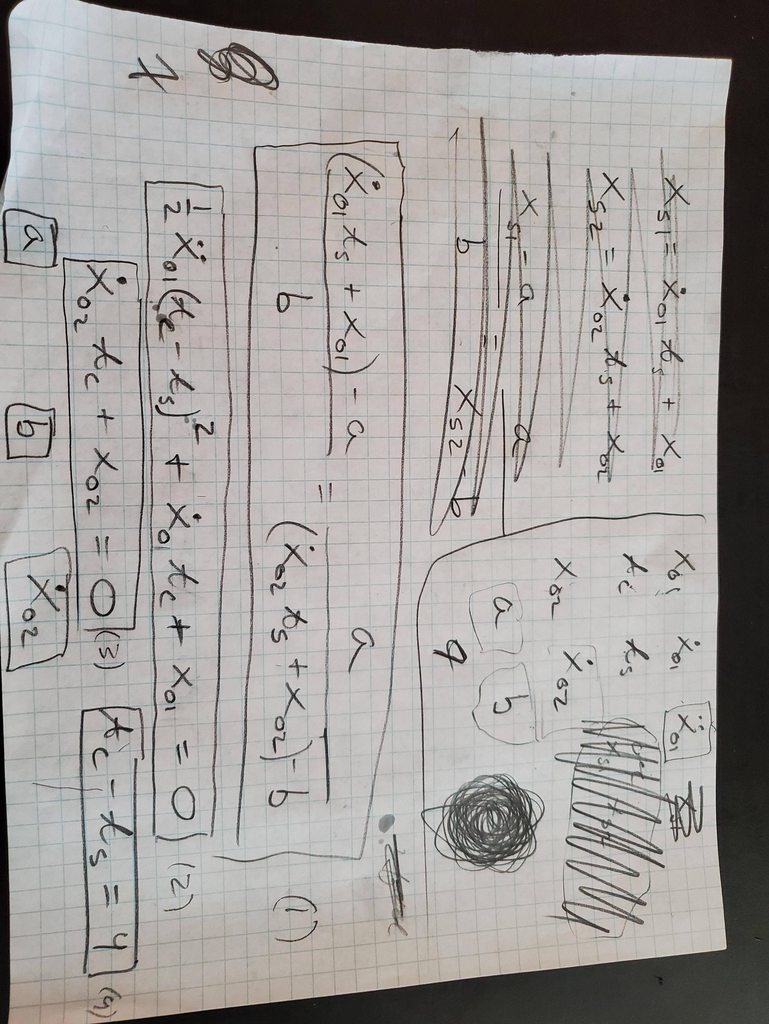
 odd kite
what's the goal? find solutions?
neat halo
I want an expression for the x with the two dots