#linear-algebra
2 messages · Page 85 of 1
 steady fiber
 icy osprey
So in your case, lamba and D are the same thing
my prof just uses fancy letters
noice
icy osprey
no I'm talking in your case
steady fiber
I dont have any other case
I only ever mentioned diagonalization
someone else talked about using identity to solve it trivially
which is pretty smart tbh
 smoky lagoon
I know that lambda = 2 with multiplicity of 2, but there's only one eigenvector
what am i supposed to do here
 ionic dust
Can someone describe what is meant in the last sentence of this paragraph that states "E2 whose elements are the isometries of the plane which send a given pattern to itself."
Here is figure 25.1 which is what they refer to
and the shading portion of 25.2
 ocean sequoia
First suppose U1 +...+ Um is a direct sum. Then the definition of direct sum implies that the only way to write 0 as a sum u1+...+ um, where each uj is inUj, is by taking each uj equal to 0.
im kinda confused as to what this is saying
what does it mean for each each uj is inUj, is by taking each uj equal to 0? Does that mean each element of the subspace U is the 0 vector? That cant be right cause then its not a direct sum right?
Or is it saying if you sum up the parts for the elements of Uj you get 0 this U1 +...+Um is 0
 odd kite
it's saying that once you pick one nonzero vector from one of the subspaces, there's no way to completely cancel it with any sum of vectors from the other subspaces
@ionic dust E2 is the set of all rotations, translations, and reflections. They are talking about the subset of these transformations which leaves the lattice looking the same
(2 stands for 2 dimensions)
ocean sequoia
So the only way to get zero is a unique combination which is what we want?
odd kite
well it's a property of a direct sum
ocean sequoia
First suppose that U + W is a direct sum. If v is in the intersection of U and W then 0 = v + (-v) where v is in U and -v is in W thus U + W is a direct sum by By the unique representation of 0 as the sum of a vector in U and a vector in W,we have v = 0. Thus the intersection of U and W is {0}.
Im confused as to how/why we know -v is in W? Why couldnt it be in U?
Also how do we know v is 0? Why couldnt it be 1,-1?
odd kite
because elements of a direct sum are sums of one vector from each subspace. Since v is in U, the other vector has to be in W.
it has to be the zero vector because if it wasn't then U+W wouldn't be a direct sum
because there would be v from U and w from W such that v+w=0 for nonzero v or w
which is against the defn. of direct sum
ocean sequoia
because elements of a direct sum are sums of one vector from each subspace. Since v is in U, the other vector has to be in W.
@odd kite thank you that makes sense!
it has to be the zero vector because if it wasn't then U+W wouldn't be a direct sum
because there would be v from U and w from W such that v+w=0 for nonzero v or w
I think i might be confused on the definition of direct sum. The way i understood was that if you add two subspaces each sum could only be expressed in a unique way
even if v is 0 couldnt we also have some other vector j where j is in the intersection of U and W so that j + -j = 0?
of no cause then we are against the definition of direct sum
 spiral sonnet
would this be considered a subspace of R^3?
 limber sierra
check the axioms
spiral sonnet
yeah I got it!
limber sierra
or rather, the required properties
i.e. closure under addition and scalar multiplication
[also existence of 0 vector but thats obvious here]
wdym "I got it"?
spiral sonnet
Yeah I forgot that all axioms have to be true in order for it to be a subspace, but I know how to do it from there
Well nevermind guess I have no idea what I'm damn doing
If a set S1 consists of all vectors [a, b, c] such that a, b, c are integers. Shouldn't this be a subspace?
So it has the zero vector. If I choose any two vectors in S1, it will still add up to a vector that's in S1. And if I choose any scalar and multiply it with a vector in S1 I'll still get a vector in S1
spiral sonnet
I'm also not talking about the a,b,c >= 0 problem anymore. This is the problem I'm on now If a set S1 consists of all vectors [a, b, c] such that a, b, c are integers. Shouldn't this be a subspace? But for the problem I'm talking about it should
limber sierra
ah okay
but i'd still check scalar multiplication there
hint: you have "more" possibilities for scalars than possibilities for vector entries
that is, your scalars take possibilities from R, but your entries are all from Z
can you use this in any way?
spiral sonnet
so a scalar can be any real number. so fractions o.o
I thought it was just integers since that's what I've been using
limber sierra
well, youre talking about being a subspace of R^3 right?
 spiral thistle
Generally this is specified as the underlying field of the vector space in the problem.
limber sierra
the scalar field of R^3 is the real numbers
if your scalar field is restricted (e.g. you're taking R^3 over Z) that'll usually be specifically stated
spiral sonnet
okay cool!
spiral thistle
You don't generally do a ton of linear algebra over integers because integers aren't algebraically closed over multiplication/division
limber sierra
[oh yeah, i shouldnt use the word "field" here]
[habit, sorry]
[indeed in such a setting they'd actually say "the module R^3 over Z" but... beyond the scope of this convo]
[or just "the Z-module" or whatever]
the real chad move is to say "the abelian group" instead of "the Z-module"
spiral thistle
If we're not talking about fields in their mathematical context, then I find it useful to sometimes use the layman definition of the word field like you did. 🙂
spiral sonnet
I'm convinced I'll never be able to fully understand math even though I want to. Too many terms that are way too confusing
limber sierra
don't worry, as i said, beyond the scope of this convo
just addressing potential nitpickers
[not robert]
spiral thistle
@spiral sonnet you'd be surprised at how things just click after awhile.
spiral sonnet
I just had my 3rd exam today and I can't even do addition and subtraction correctly with a calculator 😦
limber sierra
honestly, I don't think I've ever "understood" math while i was learning it
but like 2-3 months after
it's second nature
spiral sonnet
math makes my blood boil!
limber sierra
it just somehow mentally coalesces into a coherent picture
(with enough practice)
if that makes sense
spiral thistle
I think one thing that gets in the way is the inaccessible nature of all of the notation and jargon
limber sierra
jargon is mostly intimidation tbh
i think that's why it continues to be so widespread, like
once you've actually had a chance to work with it, everything sort of fits together
so people writing textbooks/teaching courses are like
"yeah it's a big jargony but it's not too bad, really the terms are simple"
because they've forgotten how it was like before it all "fit"
once it does click, the intimidation factor is gone
i've fallen guilty to this before
[and continue to, regularly]
spiral sonnet
In what case will a set of vectors not span R^3?
limber sierra
consider the vector $\begin{pmatrix}1\1\1\end{pmatrix}$; does this span $\bR^3$?
 stoic pythonBOT
Namington:
spiral sonnet
uhhh you can scale it so can you say it's a line that spans R^3?
limber sierra
can i get $\begin{pmatrix}2\1\1\end{pmatrix}$ using linear multiples of that vector?
stoic pythonBOT
Namington:
spiral sonnet
nope
limber sierra
so it doesnt span R^3
but it DOES span the subspace of $\bR^3$ that is all vectors of the form $\begin{pmatrix}a\a\a\end{pmatrix}$ for real $a$
stoic pythonBOT
Namington:
limber sierra
there's a slick condition for whether a set spans a space R^n: a set of n linearly independent vectors spans R^n
so if you have a set of vectors from R^3, and a size 3 subset is linearly independent, then the set spans R^3
spiral thistle
@spiral sonnet I like to think about this graphically. You need at least n linearly independent vectors to span a space of n dimensions.
To span 2D space, you need two non-colinear vectors.
To span 3D space, you need three non-coplanar vectors.
spiral sonnet
So if you want a set to span R^3, would you need atleast 3 vectors in the set?
limber sierra
for example, the set $\left{\begin{pmatrix}1\1\1\end{pmatrix}, \begin{pmatrix}2\2\2\end{pmatrix}, \begin{pmatrix}5\5\5\end{pmatrix}\right}$ would not span $\bR^3$
stoic pythonBOT
Namington:
limber sierra
in fact, its span is the same as the span of $\left{\begin{pmatrix}1\1\1\end{pmatrix}\right}$
stoic pythonBOT
Namington:
spiral sonnet
okay got it!
spiral sonnet
What does P_d<-b mean? I know P is the change of coordinates matrix
 daring solstice
The answer given was to check if the dot product is 0 when checking each of them with each other but could I also just check if one is the cross product of the other two?
It seems standard way is to check dot products becasue it is easier to compute by hand
steady fiber
- doing cross product of 2 vectors giving the third vector does not imply they are orthogonal. You know nothing about the two vectors that you cross product-ed with each other. You would need to do at least 2 cross products, which is definitely not easier than 3 dot products
- the cross product is almost definitely not going to be the third vector, even if they are orthogonal. Even if they're orthogonal, you'll get a vector that is a constant multiple of the third vector, so you have to do a harder check as well
2 cross products + 2 harder checks
or 3 dot products and checking if it's 0
I'd say the dot product method is far easier
daring solstice
Ah that makes sense thanks for clarifying
steady fiber
also the dot product method can be generalized to n-dimensions
there is no cross product in most dimensions
daring solstice
That too. That makes a lot of sense
steady fiber
there is an exterior product but like it's weird
daring solstice
(u and v are vectors)
I don't quite understand how to expand (u + v) dot (u + v) here
spiral sonnet
anyone know how I would do this?
I setup an augmented matrix with [b1 b2 b3 | d1] then used d2 then d3
daring solstice
oh oh yea that makes sense that I wouldnt understand how to do it as I haven't touched inner products in depth yet
it kinda makes sense now but coming from scalar mutiplication it does take a bit of getting used to intuitively
wait no it's the same as scalar mutiplication i overthink iy
I think. I just didn't know I can 'expand' a dot like that cumulatively same as (a + b) * (a + b)
 eager locust
Sorry to answer this late, but for those still interested, this is how this inequality is proven:
[By the way, this is the C2 [a, b] integral norm.]
smoky lagoon
you're not late at all
the thing that was tripping me up was that everything I was reading was using another y(x) as a second integral but it didn't include the b-a
and then I realized that b-a is the bohring integral so y(x) = 1 and since f(x)=ky(x) whjere k is a constant, that f(x) can equal any constant term
but your way looks more like the way they wanted me to approach it
eager locust
Sometimes, simple functions and concepts have surprising implications, I guess.
It did take me a bit of trial-and-error (and to see your answer) to get to the form they probably wanted, but I assume that this is what Math is all about.
smoky lagoon
unfortunately vectors never have and probably never will make sense in my chimp brain
eager locust
Don't worry, I bet they will sooner than you think.
smoky lagoon
meh I'm not all that interested in vectors at this point
i just want my baby infinite series back
eager locust
Honestly, one of the things that quite surprised me about Linear Algebra is how it could be applied to sets that aren't just ordered co-ordinates, but more generally, like with integrals, and how you can use such concepts in analysis.
And even if it's "just co-ordinates," there are still norms defined for infinite series, and the CS inequality applies for them as well.
eager locust
You should be. It is a lovely topic, and it seems to be the most "intuitively useful" in Math.
smoky lagoon
I've heard it's really hard as well so hopefully that doesn't hurt me too much
I'm sort of struggling in multivariable calc but I bullshit through and get Bs on everthing but I don't really get whats happening
i have no clue what a line integral
even is
eager locust
Google Images is God's gift, I tell you.
I genuinely learned a lot just from Googling stuff.
I also use Google Images for my notes I make in class.
 golden cloak
lets say that l: V --> R (l is a linear functional on V). Im just trying to "see" one of them exactly.
So, we define that l(x) = a_1 x_1 + ... + a_n x_n. RHS is so called "linear form" of that functional, and functional and its linear form are not the same, but are isomorphic. Ok. So what I want to know is the following:
Say l: R^3 --> R. So l = {(x, k) | x in R^3, k in R} = {(x, k) in R^3 x R}, does that mean that elements of R^3' look like ((1, 3, 2), 6))?
 dusky epoch
RHS is so called "linear form" of that functional, and functional and its linear form are not the same, but are isomorphic.
sounds like a stupid distinction to make if you ask me
golden cloak
well I thought so, but think not so stupid
but ok, I get your point
because, elements of that set Im asking about are sure different animals from sum of some numbers
but nvm, that is not so important
am I right with construction of that set and its elements, thats the main question?
dusky epoch
not really
$l = {(x, l(x)) \in \bR^3 \times \bR \mid x \in \bR^3}$ i guess if you wanna go formal
stoic pythonBOT
Ann:
 idle osprey
is reflection over line x=y=z the same as reflection over origin (0,0,0)?
dusky epoch
no
 quartz compass
in 3d space those don't seem to make much sense
you can rotate around a line by an angle
you can reflect through a plane
you can have an inversion through a point
quartz compass
I said you can rotate by an angle, but I wouldn't consider rotating by 180 degrees to be a reflection generically speaking
I'm not my own reflection when I rotate by 180 degrees
golden cloak
actually you are right
idle osprey
oh okay thanks
golden cloak
yeah, if you have a line in 3D and say a square which side is perpendicular to that line, you won't be reflecting over that line, but inverting through the point on that line
spiral sonnet
Anyone know how I'm suppose to solve this problem?
So I tried [B | D1], [B | D2], [B | D3] to find the columns of the change of coordinates matrix, but that didn't seem to work
 lilac iron
its B
spiral sonnet
Isn't B just the change of coordinates matrix from B to a standard basis?
 gray dust
the cols of $P_{\mathcal D\leftarrow\mathcal B}$ are the coordinates of $\mathcal B$'s vectors wrt $\mathcal D$
stoic pythonBOT
RokettoJanpu:
spiral sonnet
maybe I did the calculations wrong or had a number incorrect. I did that
oh wait
I think I mixed up the matrices
 gritty sorrel
does dim V = dim null T imply that T is the zero map?
 broken hawk
try proving it
gritty sorrel
well I know from this that dim range T = 0 which means that range T = {0}
still I don't know why this implies T=0
gritty sorrel
T(v)=0 for all v in V if T : V-->W
broken hawk
yea. so if range T is {0}, then what is T(v) for some v∈V?
gritty sorrel
what if for example T was the differentiation of all constants?
T(v) = 0 for arbitrary v yes
broken hawk
so you’re done
what if for example T was the differentiation of all constants?
what are the vector spaces here?
broken hawk
you can identify it with that but strictly speaking it’s a different space
V here would be the space of constant functions ℝ→ℝ
but you can obviously just identify those with the actual constants
but then the notion of “derivative” doesn’t make sense
you can’t differentiate a number
gritty sorrel
oh ok got it
broken hawk
but yes on this space the derivative is just the 0-function
 low plank
steady fiber
low plank
steady fiber
find determinant
find what k make the determinant 0
those k don't work
all the other k work
smoky lagoon
basically, what ks gives you a free variable or zero row
and your answer is all k other than those
 wintry steppe
what book do you rec for linear algebra? Lang, Hoffman Kunze or ?
smoky lagoon
my class uses Linear Algebra and its Applications by David Lay which I have liked for what I've needed it for
granted I'm not using as a method of learning but a resource but it's still pretty good and clear about things
 we don't do that here
 mild pike
So where can I post it ?
golden cloak
Can anyone give me some fine explanation of second dual? I really can't grasp it rn
wintry steppe
silly and not rigorous explanation:
in finite dimensions taking the dual gives you the transpose of a vector, acting on vectors by left multiplication
taking the dual twice gives you the original vector, acting on functionals
how should a vector act on a functional? evaluation!
that's how i usually think of it, although the double dual hasn't really come up so i haven't had to think about it much
golden cloak
Is it like, in V'' are functionals that vectors in V can hire like "go through functionals in V' and spit its value for me?
ohhhhhhhhhh every vector can be thought of as a linear transformation itself
ty!
wintry steppe
for a more formal version of what i said, lemme find a pdf of my first year linalg textbook
i think it explained the finite dimensional dual and double dual well
wintry steppe
golden cloak
a fat one 😄 just as I like it 😄
wintry steppe
page 122
it kind of just powers through the definitions to give you the canonical isomorphism between V and V^**
golden cloak
yeah I'm going through it rn in my book
wintry steppe
but it kind of makes rigorous the silly expanation (which may or may not be helpful) i gave earlier
what book?
golden cloak
oh im from Serbia so... I don't think it will matter to you 😄
but that proffesor (Ljubisha Kochinac)
he was really well known world wide
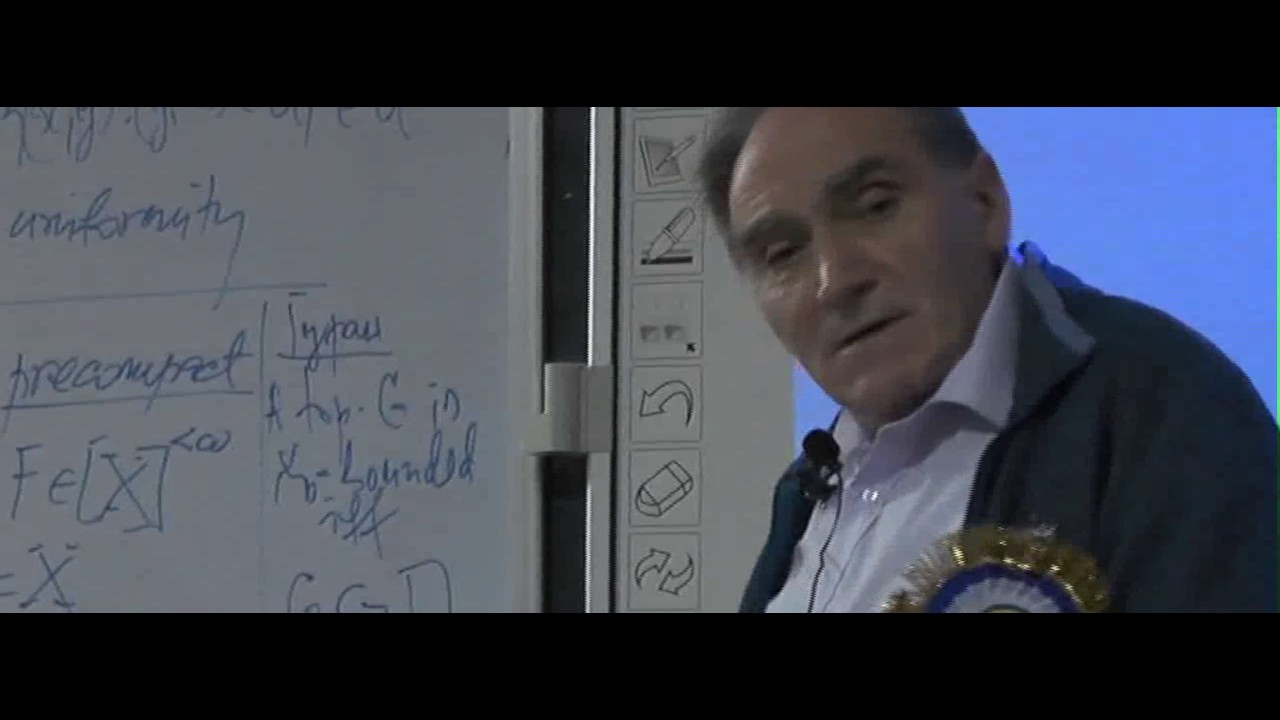
International Seminar on Topology, Analysis and Algebra
Date: 11,12 February , 2017
Venue : Department of Mathematics,University of North Bengal , INDIA
Speakers include:
Prof. Djamila Seba
Prof. Ljubisa Kocinac
Prof. Pratulananda Das
Prof. K C Chattopadhyay
Prof. Indrajit Lah...
this guy
when he got old, he went to countryside, planting herbs, fishing and doing math
only now and then he will go worldwide to give lectures
really fine prof.
 sharp merlin
wait none of these are in row echelon form right
bc leadering entrys arent 1
nvm
limber sierra
row echelon form does not require leading entries of 1
reduced row echelon form does
sharp merlin
ok
 celest bridge
god my lin alg is so rusty. how do I go about finding B here? I don't even know how the info about the trace and det are going to help me here.
or how I'm supposed to "use" eigenvectors to find it
celest bridge
I get that A and U are supposed to be similar matrices, so there exists P s.t. P^-1 A P = U, but I can't find how you can find P anywhere in my notes or looking online.
 hollow finch
Is there a term for the minor of a minor? So if I have a 4x4 matrix, taking the determinant of the matrix where I removed column/row 1 and column/row 3
Is it like a hyperminor? lol
 brittle juniper
why would you think it would be illegal? why would you think it would be legal?
what kind of matrices are you working with?
 left hill
I'm not sure
I heard someone say something about real numbers only but maybe I misunderstood
And this is the type of problem I'm working on
😳👉👈
hollow finch
e and its (real) powers are real
but you could scale it by 'i' i guess. not sure why you would though.
from what you sent, you could multiply both rows by e^3 and it would simplify things greatly
Although hold up
$\begin{bmatrix}1&3\1&3 \end{bmatrix}\begin{bmatrix}u_1\u_2 \end{bmatrix}=\begin{bmatrix}-3\1 \end{bmatrix}$
stoic pythonBOT
nix:
hollow finch
That is an inconsistent system
left hill
it's what I got for my repeated eigenvalue 
hollow finch
@left hill What was the original matrix, eigenvalue, and eigenvector?
left hill
@hollow finch
hollow finch
(-3,1) is the correct eigenvector
The system you're looking for is
$(A+\frac{3}{2}I)\vec{v}_1=\vec{v}_2$
stoic pythonBOT
nix:
hollow finch
You simplified the matrix before you set up the system
So I believe it would be
$$\begin{bmatrix}\frac{1}{2}&\frac{3}{2}\-\frac{1}{6}&-\frac{1}{2} \end{bmatrix}\begin{bmatrix}u_1\u_2 \end{bmatrix}=\begin{bmatrix}-3\1 \end{bmatrix}$$
stoic pythonBOT
nix:
hollow finch
The system will always be consistent if you set it up correctly
So if you get something like $$\begin{bmatrix}1&3\0&0\end{bmatrix}\begin{bmatrix}u_1\u_2 \end{bmatrix}=\begin{bmatrix}0\1 \end{bmatrix}$$
stoic pythonBOT
nix:
 hollow finch
You set up the system incorrectly
left hill
is my mistake in the second column?
like the very first line? or after that
sharp merlin
Anyone understand this
i dont get why the first two on the left dont work if the * are 0's
left hill
hollow finch
@left hill
$(A-\lambda I)\vec{v}_1=\vec{v}_2$
stoic pythonBOT
nix:
 storm python
uh yeh you forgot to minus the lambda I
hollow finch
In your case, $A=\begin{bmatrix}-1&3/2\-1/6&-2\end{bmatrix}$
stoic pythonBOT
nix:
hollow finch
$\lambda=-\frac{3}{2}$
stoic pythonBOT
nix:
hollow finch
$\vec{v}_1=\begin{bmatrix}-3\1\end{bmatrix}$
stoic pythonBOT
nix:
left hill
I'm lost
hollow finch
Oops
hollow finch
Okay first things first, what is $A-\lambda I$
stoic pythonBOT
nix:
left hill
$A=\begin{bmatrix}1&3/2\1/3&-2\end{bmatrix}$
stoic pythonBOT
Cobb:
Compile Error! Click the  reaction for details. (You may edit your message)
hollow finch
$\begin{bmatrix}-1&3/2\-1/6&-2\end{bmatrix}-\left(-\frac{3}{2}\right)\begin{bmatrix} 1&0\0&1\end{bmatrix}$
stoic pythonBOT
nix:
hollow finch
I've never seen 3/2 just turn into 3 before
hollow finch
If you're trying to solve Ax=b, and you change A before you start solving the system, you aren't going to get the correct answer.
First do the matrix addition, then solve the system
hollow finch
No that was my bad
Your first eigenvector goes on the right hand side of the equation
left hill
Is it like this? 
storm python
yes but you should probably put an equal sign
left hill
 ty
ty
storm python
cute.
storm python

hollow finch
Yeah very nice. Notice that this system has a solution 😛

 stoic pythonBOT
nix:
hollow finch
So then $(v_1,v_2)=(-3v_2-6,v_2)$
stoic pythonBOT
nix:
hollow finch
Have you ever solved a system of equations with a free variable?
hollow finch
Aha I see
The idea is to separate the vectors and factor out the free variable.
So $\begin{bmatrix}-3v_2-6\v_2\end{bmatrix}=\begin{bmatrix}-6\0\end{bmatrix}+\begin{bmatrix}-3v_2\v_2\end{bmatrix}$
stoic pythonBOT
nix:
hollow finch
$=\begin{bmatrix}-6\0\end{bmatrix}+v_2\begin{bmatrix}-3\1\end{bmatrix}$
stoic pythonBOT
nix:
hollow finch
Notice that second vector is your original eigenvector
hollow finch
It is a great sign
In fact, you've found your second solution for your system of DE's. You just need to put it into the right form (which is a bit tricky at least imo)
I would definitely look back at your notes
hollow finch
Yes, exactly. $\vec{y}_2=\vec{v}_1te^{\lambda t}+\vec{v}_2e^{\lambda t}$
stoic pythonBOT
nix:
hollow finch
Very nice 🙂
storm python
looks gud
 hollow finch
Yikes. that's a rough system but it should give you the right answer.
left hill
I can scale everything by e^3 right?
hollow finch
Yes
left hill
Uwu
hollow finch
I wonder if instead you could write your solution instead as
$$\vec{y}=c_1\begin{bmatrix}-3\1\end{bmatrix}e^{-\frac{3}{2}(t-2)}+c_2\left(\begin{bmatrix}-3\1\end{bmatrix}(t-2)+\begin{bmatrix}-6\0\end{bmatrix}\right)e^{-\frac{3}{2}(t-2)}$$
stoic pythonBOT
nix:
hollow finch
Because then c1 and c2 would be very easy to find
left hill
this is getting gross
hollow finch
But plug in $t=2$ to that and you get
$\begin{bmatrix}1\0\end{bmatrix}=c_1\begin{bmatrix}-3\1\end{bmatrix}+c_2\begin{bmatrix}-6\0\end{bmatrix}$
stoic pythonBOT
nix:
hollow finch
Which is solvable by inspection
c1=0, c2=-1/6
Not 100% sure you could do that, but I don't see anything wrong immediately
hollow finch
It's -1/6 e^3 but otherwise yes
left hill
pinky promise? 😳 👉 👈
hollow finch
Yeah I put it into a calculator. And it's also equivalent to the solution I got to my system above.
left hill
Final answer? 😳
hollow finch
@left hill You're missing the e term on the second part
left hill
Oh yeah
-e^3/6 right?
wintry steppe
is anyone able to help me with this ?
It is in the linear algebra by cambridge textbok exercise 10.16
 solar osprey
I was thinking adding -1 times the first row to the second row
then adding -1 time the last row to the before last row
then adding -1 times before last row to the second row
we obtain a row full of zeros
thus det = 0
dusky epoch
yup
solar osprey
idk I feel like this chapter is all about smart matrix manipulation
solar osprey
ok this one is giving me a headache
I thought maybe turn it into upper tri
but its a tedious matter
broken hawk
oh that’s a classic
I don’t actually remember how you do it tho
but it’s a useful result
broken hawk
(well really the useful result is knowing that it’s nonzero if the a_i are all distinct)
solar osprey
into two matrices multiplcation
Dont spoil the answer
I just wanna know if Im on the right track
lol
broken hawk
the answer is “how to do it” not what comes out in the end, imo
solar osprey
mmmm
let me give it some extra thought and see what happens
will try looking for patterns or smt with 2x2 and 3x3
broken hawk
the class I’m tutoring had it as an exercise last semester apparently. in their exercise they got told what the determinant will be and just had to prove it
broken hawk
looking for patterns is definitely a good approach
looking at the solution, it’s actually not that hard once you know what it should be
okay well it does require a trick of sorts I guess
broken hawk
I’ll put a tip in spoilers here if you wanna glance at it ||figure out the pattern, then prove it by induction on the size of the matrix||
broken hawk
I have the solution here so if you need more ping me
solar osprey
sure
@broken hawk I have an idea
but I have a question first
Does Type 3 column operation preserve determinant too? My book only mentions rows, and cofactor expansions along rows only?
broken hawk
which are type 3?
adding multiple of one column to another column?
if so, yes
they do
solar osprey
yes
broken hawk
(proof: det(A) = det(Aᵀ))
solar osprey
yes yes
is the answer 0 by any chance? @broken hawk
My approach yields to that result
broken hawk
if and only if some of the aᵢ are identical
what pattern did you find in dimensions 2/3?
solar osprey
some sort of power expansion
and alternating indices
I thought maybe
if we add
for each column j
we add all other columns to it
we get a geometric series
in each entry
 torn silo
Stupid question but the normal matrix addition + mutliplication defines an associative algebra?
torn silo
okay thank you very much
solar osprey
@broken hawk I FINALLY FOUND the pattern
its basically the product of every goddamn pair
but like im trying to think of a straighforward proof
solar osprey
yes
 flat depot
Okay, so I just proved that set of all real functions is direct sum of set of odd real functions and even real function. That implies that every real function can be decomposed as sum of odd and even functions. But I have no idea how that decomposition would look like. Is there any kind of procedure for such decomposition?
 cursive narwhal
$f(x) = \frac{f(x)+f(-x)}{2}+\frac{f(x)-f(-x)}{2}$
stoic pythonBOT
Abhijeet Vats:
flat depot
Okay, so I can make even/odd function out of any given function with some combinations. That's interesting.
cursive narwhal
Indeed
 torn hornet
this is p useful
its been a while since i have done QM, but essentially for odd/even potentials in 1d
the shroedinger eqn is p trivial
steady fiber
Fourier also technically decomposes functions into odd and even
torn hornet
so doing this can make solving shroedingers eqns in 1d p easy
steady fiber
if you only look at the sine terms and cosine terms separately (or if you only look at the real and imaginary parts separately for complex Fourier)
dusky epoch
if you do this to the function e^x, you get cosh and sinh
flat depot
There is also another thing. I kinda tried to research on my own if set of period functions is subspace of vectors space of all real-valued functions. My results were inconclusive, but I get the feeling that entire set is not vector space, but any "class" of functions with fixed period p is vector space. Is my intuition correct?
dusky epoch
yes
flat depot
Great, thanks for confirmation.
dusky epoch
no
golden cloak
why?
dusky epoch
what even is that first step
{a ∈ P | x-a ∈ P} is either all of P or empty depending on whether x itself is in P
and why not use words instead of this formal mumbo jumbo
golden cloak
its a ∈ V, my mistake
typo
hm that typo ruined my "proof" 😦
its not formal mumbo jumbo its just formal
whats wrong with trying to be formal?
dusky epoch
you're obscuring your point
flat depot
My teacher used to say that intuition is more important than being formal, and using words is intuitive
dusky epoch
there's a healthy mix of prose and formality that makes for good proofs that are enjoyable to read
flat depot
You can refine intuitive reasoning with formality, but it's hard to start from formality, at least in the beginning of being a mathematician
torn hornet
using too much set notation when it can be said in words just make ur writing hard for ppl to read
including yourself lol. Its better to write things out in english so that its more clear/immediate
dusky epoch
using too much set notation when it can be said in words just make ur writing hard for ppl to read
yeah that was my point kinda
torn hornet
like a complex statement could be absolutely disgusting using logical things, with multiple nested stuff, but easy enough to read with words
i dont have an example readily avalaible for this, but im sure u can imagine this lol
 pale shell
If a linear map has only the trivial solution for the zero vector, does that imply that it is injective?
torn hornet
yes, try proving it
cursive narwhal
Why not just try proving it lmao
gray dust
you're talking injectivity? not long ago you didn't know what a codomain was. very nice, keep it up
 pale shell
Thanks Rokabe!
pale shell
Im basically trying to assume there is only the trivial solution and that it isn’t injective
 half ice
Best way to go about the proof is by the contrapositive.
Assume the linear map is not injective. Show that f(something) = 0, for a non-zero something
.
You may not know what the contrapositive is, now that I think about it.
If you want to prove something of the form A → B, you can instead prove ~B → ~A, and that's the same thing. This strategy works well here
pale shell
I know about a contrapositive
So basically if T not injective then there is not only the trivial solution
half ice
If T is not injective, then Ker(T) is not trivial
pale shell
Sure
gray dust
it's actually not absolutely needed to prove the contrapositive
cursive narwhal
You can show it directly
T(x) = T(y) so T(x-y) = 0. x-y belongs to the kernel of T and since that is just the zero subspace, x=y
gray dust
let $A$ be a matrix and let $T$ be a linear map defined by
$$T(x)=Ax$$
suppose $T(x)=Ax=0\implies x=0$. we can show $T$ is injective
$$T(x_1)=T(x_2)$$
$$Ax_1=Ax_2$$
$$Ax_1-Ax_2=0$$
$$A(x_1-x_2)=0$$
we now use $T(x)=Ax=0\implies x=0$ to say that
$$x_1-x_2=0$$
$$x_1=x_2$$
therefore, $T$ is injective $\qed$
stoic pythonBOT
RokettoJanpu:
cursive narwhal
^of course, just fix the argument above with the relevant terminology etc
torn hornet
to add here this is true for homomorphisms in general algebraic structures, that kernal=0 implies injective. proof follows in much the same way
(linear maps are homomorphisms of vector spaces)
cursive narwhal
Jintarou, you don’t need matrices for this. You just need the linearity of the map.
gray dust
it's for earl, not you
if you really want this w/o A then ok
let $T$ be a linear map. suppose $T(x)=0\implies x=0$
$$T(x_1)=T(x_2)\implies T(x_1)-T(x_2)=T(x_1-x_2)=0$$
we now use $T(x)=0\implies x=0$ to say that
$$x_1-x_2=0\implies x_1=x_2$$
therefore, $T$ is injective $\qed$
stoic pythonBOT
RokettoJanpu:
cursive narwhal
I mean, i gave it earlier so w/e lol
gray dust
mb 
odd kite
if $A \begin{bmatrix}x1 \ x2\end{bmatrix} = \begin{bmatrix}b1 \ b2\end{bmatrix}$ and A is invertible, then $\begin{bmatrix}x1 \ x2\end{bmatrix} = A^{-1} \begin{bmatrix}b1 \ b2\end{bmatrix}$
stoic pythonBOT
Timon:
sharp merlin
oh thanks
ocean sequoia
Verify whether this is a subspace of F^3
yes right? It contains the zero vector, and its closed under both addition and multiplication?
(f + g )(x) = 0 = f(x) + g(x) = 0
f(cx) = 0 =cf(x)
dusky epoch
uh
(f + g )(x) = 0 = f(x) + g(x) = 0
f(cx) = 0 =cf(x)
what are f and g
and what's x
your set is in fact not closed under addition
(1,1,0) and (0,0,1) are both in the set, but their sum (1,1,1) is not
ocean sequoia
Oh i think im misunderstanding how you were suppose to add them
hang on I thought that f(x) = x1 * x2 * x3
and that g(x) = x1 * x2 * x3
dusky epoch
uh
...
ok so you've given two different names to the same function
dunno why you'd even consider it
dusky epoch
like
ocean sequoia
no
ocean sequoia
yea
fuck.
thanks
ugh i got so caught up in trying figuring it had to be provable i did mental gymnastics
 elder robin
I though I knew how to do this, but the way I solved it makes it seem like any h would make it linear dependent. I start by writing the augmented matrix with {v_1, v_2, v_3, 0}, then get it into RREF which gets me {{1, -2, 0, 0}. {0, 0, 1, 0}, {0, 0, 0, 0}.
Which leaves x_3 as a free variable, and h is nowhere in the solution set, so any h would work. I must be doing something wrong, right?
half ice
@elder robin
In your steps, pay attention to when you divide. Remember that you can't divide by 0
Wait why an augmented matrix? Lol
elder robin
I used wolfram alpha to row reduce tbh
half ice
Wolfram will probably give you a condition on h
half ice
That's true haha, we just normally drop the augmented part @elder robin
elder robin
c_1(v_1) + ... + c_n(v_n) = 0 is linear dependence, as long as it isn't trivial solution
Oh ok
stoic pythonBOT
 Requested by Kaynex#7520
half ice
Requested by Kaynex#7520
half ice
Oh huh. It's always dependent
elder robin
Maybe it's just a weird question?
elder robin
Nice, ty
half ice
@sharp merlin
If AD = I
Then D is A's inverse.
Then finally, AD = DA
sharp merlin
Yeah i got that one
half ice
So C = D in that case
sharp merlin
mhm
half ice
You're correct with D
A square matrix will always map Rⁿ to Rⁿ
But that map won't be injective/surjective unless the matrix is invertible
half ice
@sharp merlin
The answer is using the word "onto" is means the same thing as surjective.
sharp merlin
oh ok
half ice
Worth knowing is the difference between a map "into" or a map "onto" Rn
sharp merlin
yeah
Also what does linear combination of columns have to do with making a matrix linear dependent
@half ice
half ice
A set of vectors is independent/dependent
A matrix is not
Now, we sometimes just take the columns of a matrix to be the set of vectors.
sharp merlin
how do we just the columsn to tell if its dependent
i see that if there is a linear combination with atleast 2 columns it becomes linear dependent
why is that
oh wait i see now
nvm got it
ocean sequoia
ok hopefully i didnt over think this one
it does contain the zero vector
if f(x) = x1 + 2x2 + 3x3 and g(x) = x4 + 2x5 +3x6
then f(x) + g(x) = 0 (f + g)(x)
because if f(x) is zero and g(x) is zero than a combination of them must be zero because addition is associative
and its closed under multiplication for sure because if f(x) is 0 then cf(x) = 0 = f(cx)
 subtle walrus
and what does it mean
 errant imp
Maybe it's the function that is equivalent to f(x)+g(x)
subtle walrus
and what is x
subtle walrus
so an element of F^3?
ocean sequoia
yes
subtle walrus
why does it have x_1, x_2, x_3, x_4, x_5 and x_6 components
because otherwise f and g make no sense
ocean sequoia
wouldnt f and g have to have different elements in the function?
subtle walrus
what does that mean
ok so
i can see what you are trying to do
f and g are the same function
so i will just use f
and you are trying to define a function f: F^3 -> F, such that x is in the subspace iff f(x) = 0
which is fine
and the argument for being closed under scalar multiplication is then fine as well (although i doubt you understand that)
for closed under addition you would have to show that f(x+y) = 0 if f(x) = 0 = f(y)
but tbh there is not much reason to even introduce a function like that
ocean sequoia
Ok but because we know that f(x) = 0 and f(y) = 0 then by the associate property doesnt f(x+y) = 0?
subtle walrus
it does not follow from the associative property
 sonic osprey
if f(x) = x^2 - 3x + 2, then f(1) = 0 and f(2) = 0, but f(3) = 2
subtle walrus
just write it down explicitly
compute the sum of 2 arbitrary vectors
and plug that into f
ocean sequoia
so instead do <x1,x2,x3> + <y1,y2,y3> = <x1 + y1, x2+y2, x3+y3> ?
subtle walrus
yes
ocean sequoia
i think this is where im getting confused
So I have this <x1 + y1, x2+y2, x3+y3> and i know that both of these function individually are 0
subtle walrus
<x1 + y1, x2+y2, x3+y3> is not a function
subtle walrus
its a vector
subtle walrus
ok, so you want to check if this vector is in your subspace
ocean sequoia
yea
subtle walrus
it might be easier if you do something like
z_1 = x_1 + y_1 and so on
then your vector becomes z = (z_1, z_2, z_3)
now can you check if z is in the subset?
ocean sequoia
so f(z) = x1 + y1 + x2 + y2 + x3 + y3?
subtle walrus
no
forget about the function f for now
just look at the definition of the subset
ocean sequoia
so all the members are elements of F^3? where thier sum is 0?
subtle walrus
well
an element of F^3 is in the subset
if and only if it satisfies
so just plug in z instead
ocean sequoia
z1 + 2z2 + 3z3
subtle walrus
yeah
subtle walrus
exactly
ocean sequoia
and thats zero
because
x1 + y1 + 2(x2 + y2) + 3(x3 + y3) = x1 + 2x2 + 3x3 + y1 + 2y2 + 3y3 = 0
subtle walrus
i mean yeah
subtle walrus
i dont know, i am not grading your homework
you should understand why its true
i.e. you can rearrange x1 + 2x2 + 3x3 + y1 + 2y2 + 3y3
to
wait nvm
you did that
so yeah, this is fine imo
i would mention that both x and y are in the subset and thus satisfy the equation, so 0 + 0 = 0
ocean sequoia
ok and if you have a minute i think you were right about
and the argument for being closed under scalar multiplication is then fine as well (although i doubt you understand that)
the doubting i understand it part
subtle walrus
(notice that you used the commutative law, not the associative law)
subtle walrus
you can do exactly the same thing you just did but with scalar multiplication
ocean sequoia
ok cool
subtle walrus
i.e. take a vector x, multiply by scalar a
(set the new vector to z, so ax=z if that helps)
ocean sequoia
so basically c(x1 + 2x2 + 3x3) = cx1 + c2x2 + c3x3 = 0
and obviously if f(x) = 0 then cf(x) = 0
subtle walrus
you still have to check the equation that defines the subset
ocean sequoia
i keep typing to in wrong im not sure why
ocean sequoia
yea im not sure why i keep doing that
but is this ok c(x_1 + 2x_2 + 3x3) = cx_1 + c2x_2 + c3x_3 = 0
subtle walrus
you are still kinda trying to do this too fast
you would compute c(x_1, x_2, x_3) = (cx_1, cx_2, cx_3)
and then check if cx_1 + 2cx_2 + 3cx_3 = 0
ocean sequoia
ohhhh i see
subtle walrus
yes
subtle walrus
you always want to compute arbitrary sums / scalar products first
and then check if they are in the subset
ocean sequoia
cool thanks man i really appreciate all the help
ocean sequoia
ok so i dont even need to check closure under addition or multiplication because it doesnt contain the zero vector
therefore its not a subspace of F^3
 pallid rampart
Yes
 molten mica
does anyone know how to do this?
wintry steppe
this is not linear algebra #prealg-and-algebra
molten mica
oh is it pre alg?
steady fiber
yes
 cold topaz
which one is correct? [T1][T2] = T1 circle T2 or
[T1][T2] = T2 circle T1?
 eternal finch
The former.
ocean sequoia
Ok so the trick on this problem is to show the sum of a differentiable functions is also differentiable
Ok so the trick on this problem is to show the sum of a differentiable functions is also differentiable
the f'(-1) = 3f(2) is "unimportant"
ocean sequoia
nope just double checking sorry
this is like the first proofs ive done on my own and im trying to avoid mental misteps and i made a big one earlier thanks for asking
wintry steppe
hey, guys, just wondering why and how is that for finite groups of order "prime number" we only get just the cyclic group of that prime number?
dusky epoch
for any finite group G and for any g ∈ G we have that ord(g) divides |G|
if |G| is a prime p then ord(g) can only ever be 1 or p
wintry steppe
thanks, is there a way to count number of groups for order of even numbers and non-prime odd?
wintry steppe
@sonic osprey i guess there must be some relation to prime factorization in some way🤔
sonic osprey
There's really not
Unless you're only working with abelian groups
Maybe as an example, there are 1,774,274,116,992,170 groups of order 2048
wintry steppe
jesus😲
sonic osprey
There really hasn't been an easy way to calculate the number of groups of a certain order
This is easy when you're only working with abelian groups but
wintry steppe
and then you see this monster group thing, what that all about?🤔 like how do they even find these lol
sonic osprey
I'm actually doing research on the monster group right now
Usually big groups are constructed as automorphism groups of certain objects
wintry steppe
oh, i just realized i was asking q's in the wrong chat lol
@sonic osprey you mean like the symmetries of some weird n-dimensional shapes for example?
sonic osprey
eh, you can take the symmetries of things that aren't always geometric
like you can take the symmetries of graphs, or the automorphism groups of groups
or the automorphism groups of vector spaces
wintry steppe
might seem like a stupid question but is there a notion for like a continuous number of elements in there group? like for infinite groups, is the order of group equal to aleph-null or aleph-one?🤔
would there be any difference anyway?
sonic osprey
I mean, you have infinite groups?
And you have infinite groups of different cardinalities?
And they can't be isomorphic?
I'm not really sure what you're trying to ask
wintry steppe
sorry, i think i meant to ask whether there exists things like Lie groups, where there is sort of continuous symmetry
sonic osprey
Ah yeah that's a bit different
The first step to Lie groups is to consider topological groups
Where basically the operation of multiplication of your group, and the operation of inverses have to be continuous functions
and you can use topology things to say certain things about your group
The unit circle S^1 is the classic example of a topological group (and also a Lie group)
where the elements are e^{ix} and the operation is multiplication
subtle walrus
(in a more geometrical fashion this group is actually SO(2), the rotations of the plane)
 viscid kernel
What does the adjoint of a matrix mean ( geometrically )
quartz compass
I think I have an answer for that but I'm too lazy to work it out right now so I could be wrong stating these two things from memory
gray dust
it represents the inverse linear map, except off by a scaling factor
quartz compass
I think it's the derivative of the determinant with respect to a specific entry of the matrix
sonic osprey
Wait, adjoint here is just the hermitian right
quartz compass
or can be seen as like components of the vectors that are orthogonal
to the original matrix
I'm thinking adjugate maybe
sonic osprey
I think both of you are
viscid kernel
Hmm Im now starting to get an intuition., but Im still not 100%. Cuz Im actuallt trying to understand the formula of the inverse of a martrix. Inverse(A) = adjoint(A)/determinant
sonic osprey
Oh nope that's the adjugate alright
steady fiber
(very) few people call it the adjoint, usually the classical adjoint for some reason
viscid kernel
@gray glen oh Im sorry I mean that one. I mean adjugate, not adjoint
steady fiber
but ya, call it the adjugate
quartz compass
the second thing I said is sort of the geometric idea I have in mind
if I remember correctly it's like basically the entries are like looking at cramer's rule
and dividing by the determinant is like normalizing the vectors
I think the main thing to focus on is what the inverse looks like geometrically compared to the original matrix
it's taking column vectors of A and making a matrix of row vectors which have a dot product with them that is either 1 or 0
that being the identity matrix when multiplied
maybe I'm being too hand wavy and lazy to be helpful if you're not willing to try to play around with this yourself but
kind of like how the cross product is constructed, and how it's normal to the other vectors in the determinant
this is either too vague or not, to see why the determinant would normalize this
thinking of a determinant with a single row removed but filled with the basis vectors in the spots turns it into a kind of determinant operator waiting for a single vector
given that they're linearly independent, there's only a single possible vector that can fill this spot when dotted with it and when it does it becomes the determinant itself
it's probably more insightful if I draw pictures of the matrices lol
viscid kernel
@quartz compass wow. Thanks for the explanation. Im now understanding it a bit.
quartz compass
cool
probably a good thing to focus on as well is just the dot product, like projections in particular since they are kind of a building block for making linear transformations
ocean sequoia
I have a quick question regarding subspaces... if have a subspace of R^2 does the subspace have to be able to describe every point in R^2
dusky epoch
wdym by "able to describe every point in R^2"
ocean sequoia
can every vector in R^2 can be described by the function?
like is that a requirement for it to be a subspace of R^2
dusky epoch
what function
ocean sequoia
I guess another way to ask it is could R^2 contain a vector that is not in the subspace of R^2?
dusky epoch
you're not making much sense rn sorry
gray dust
you may not know the definition of subspace
ocean sequoia
and im trying to straigten it out
The way I understand subspaces is that its closed under addition/ scalar multiplication, contains the zero vector
and has an additive identity
but some how i got the idea in my head that if U is a subspace of V every point in V also must be in U?
which might be a better way to say it?
dusky epoch
that idea is wrong
gray dust
a subspace is a subset of the given vector space that is...
closed under addition/ scalar multiplication, contains the zero vector
dusky epoch
if U is a subspace of V then U ⊆ V by definition
and if you also require V ⊆ U then U ends up being equal to V
ocean sequoia
Thanks Ann that makes sense
viscid kernel
What does transposing a 2x2 matrix geometrically mean ?
I know how you transpose it but. The problem is that Im now trying to prove that. Det(A) = det(A^t)
ocean sequoia
you can just show it A = [A,B|C,D] the det(A) is 1/ad - bc when you take the transpose of a matrix all you are doing is turning columns into rows so you get [AC|BD] detA^t = 1/ad-cb = 1/ad-bc by the commutative property
 hoary agate
yeah, algebraically thats all
ocean sequoia
and that kinda makes sense too if you think about the fact that a matrix is a linear transformation and det(A) is a scalar factor for the parallelipiped when you apply the matrix
so if you like flipped Length and Width for a Rectangle you would still have the same area from an intutive perspective
hopefully someone can make sure that is right for you
viscid kernel
Im still confused. 😦 so lets say you are transposing the identity matrix does that mean your i-hat becomes j-hat and j-hat becomes i-hat
ocean sequoia
you flip the rows and columns
viscid kernel
Yeah but I dont get the example you have given with the paraleliped. I know that the determinent of your three by three matrix is actually the width of the paraleliped, but then I got confused.
ocean sequoia
someone might be able to correct me here but i dont think its the width of the paraleliped its the scale factor by which the volume would change
viscid kernel
Hmm alright, still thanks for your explanation tho. It means a lot.
 glacial grove
basic question: how is a vector u - some real number defined in linear algebra
dusky epoch
what
glacial grove
like v - 3
glacial grove
yea that's what i thought, just wanted to make sure I want blanking
dusky epoch
i'm curious now tho. where did you see it
glacial grove
was thinking how R does element-wise execution on some vector - 1 and was trying to remember if that was defined in linear algebra
half ice
If your vectors are real numbers, then it can happen
But your vectors are probably not real numbers
glacial grove
yea
 glass harness
hello
to calculate the adjugate matrix of a matrix, do you find the determinant of the adjugate matrix associated with each element?
and assign the resultant determinant of the adjugate matrix associated with each element as the new element for the adjugate matrix of the matrix?
gray dust
the roadmap is matrix of minors -> matrix of cofactors -> adjugate, which are the first 3 steps given at https://www.mathsisfun.com/algebra/matrix-inverse-minors-cofactors-adjugate.html
glass harness
youre a god
 vital swallow
does anyone know if the concept https://en.wikipedia.org/wiki/Frame_bundle is related to https://en.wikipedia.org/wiki/Frame_(linear_algebra) ? I need to learn about the first, but don't know where to go (and have found an accessible book for the second)
In mathematics, a frame bundle is a principal fiber bundle F(E) associated to any vector bundle E. The fiber of F(E) over a point x is the set of all ordered bases, or frames, for Ex. The general linear group acts naturally on F(E) via a change of basis, giving the frame bundl...
In linear algebra, a frame of an inner product space is a generalization of a basis of a vector space to sets that may be linearly dependent. In the terminology of signal processing, a frame provides a redundant, stable way of representing a signal. Frames are used in error de...
hollow finch
If a nonsquare matrix transformation has a kernel of only the zero vector, then is the transformation injective?
 nocturne arch
how to find the basis of the null space of a matrix modulo n, idk how sage math is doing it. help please 🙏
hollow finch
The matrix is not square so im pretty sure its definitely not bijective
$Ax_1=Ax_2 \implies A(x_1-x_2)=0 \implies x_1-x_2\in null(A) \implies x_1-x_2=0 \implies x_1=x_2$
stoic pythonBOT
nix:
vital swallow
kernel = 0 <==> injective. doesn't matter if matrix is square or not
sharp merlin
is there a way to check is something in the span without having to think about it
like can u do matrices
to figure out the coefficients
nocturne arch
one way
for the example u have
is to notice that 3 non scalar multiples of each other 2d vectors are guaranteed to span all of 2d space
gray dust
you can set up a matrix A whose columns are v1,v2,v3 and solve Ax=(-3,-8) if you want smth more "mindless", though perhaps a bit more tedious work
sharp merlin
@nocturne arch but how do u find coefficients
nocturne arch
oh
 west spade
That just requires the grunt work
nocturne arch
i just thought u wanted to know if it was in the span
gray dust
is provided a way to mindlessly obtain coefficients
ignores it
nocturne arch
also there are many coeffiecent that would solve it
do u want all solutions or only 1?
@sharp merlin
sharp merlin
1
gray dust
it's sufficient to show there exists at least one set of coeffs
west spade
So you could have infinitely many solutions
gray dust
AT LEAST one solution means the vector lies in the span, you realize that?
sharp merlin
yeah hold on
gray dust
infinitely many solutions doesn't change that one bit
sharp merlin
how do i even solve this
1 0 5 -3
0 -1 -5 14
and then
1 0 5 -3
0 1 5 -14
what do i do from here?
to get rid of 5
nocturne arch
u can't
sharp merlin
what do i from that step then
nocturne arch
u are already in row echelon form
sharp merlin
oh
nocturne arch
so u can write the solution in vector form
sharp merlin
so do i just make c3 = 0
nocturne arch
u can write ur infite solutions as a parameterized vector function
gray dust
look, you just need to show a solution exists. you're not there to get em all
nocturne arch
sharp merlin
x1 + 5x3 = -3 and 1x2 + 5x3 = -14
nocturne arch
@sharp merlin
gray dust
set the free var to whatever you like, then you got a set of fine coefficients
sharp merlin
nvm got it
nocturne arch
how to find the basis of the null space of a matrix modulo n, n can be a non prime. help please 🙏
pale shell
Does anyone know a resource
With linear algebra practice problems
Including proofs and computation
 slow scroll
I think there used to be a website like that for algebra, but i can't remember the name. Just pick problems from a book or something.
cursive narwhal
Linear Algebra Problems and Solutions. Popular topics in Linear Algebra are Vector Space Linear Transformation Diagonalization
^Try this, perhaps?
The problems aren't very difficult but they're good as practice.
@pale shell
 safe garnet