#linear-algebra
2 messages · Page 80 of 1
 long blade
just a bit confused
why zero vector doesnt work
ohh
nvm
i think its referring to a5 about u + (-u) = 0
do u think it meant that?
 dusky epoch
uh
 gilded nebula
it asks if the set of polynomials with positive coefficients is a vector space
the zero polynomial, while is a zero vector for the standard polynomial space, is not in this space
dusky epoch
yeah ok so
i was wrong with saying our set had 0
if anything, x^2 + 1 wouldn't be in V either because it has a zero coefficient and zero isn't positive
sorry for misleading you there
long blade
??
why wouldnt x^2 + 1
not be in V
isnt all the coeff positive?
oh
do u mean
like
x^2 + ox + 1??
that 0??
@dusky epoch?
dusky epoch
yes that's exactly what i'm talking about
long blade
hmm
but
isnt that a bit strange
i mean
if it was like that then
we can assume
0x^3 + x^2 + x + 1
wouldnt work
either
since theres a 0
long blade
kk
i was just thinking
maybe its becasue
0 isnt considered a positive
number
and it fails no 4 because it says object 0 in V which it fails
but anyway ty
i gained a better
understand
ing
 sour jetty
Hello, I'm having trouble understanding how they get rid of second column, first row and change it by multiplying the determinant with -(-1). Could anyone tell me what this technique is called in English? I can't find any helpful resources about it online, not sure what to search for
 storm python
cofactor or laplace expansion
sour jetty
Appreciated!
storm python
np
 keen kiln
See of yo can understand
Wait. Wait ..
Here you go
See if you can understand
storm python
i mean. you showed a bunch of work but without actually stating the method
keen kiln
Ooouu
Wait a bit...
Basically solve it using the basic 4*4 expandion
Then you get 3 matrix with zeros as a column which equals 0
This u remain only the one with no columns zero
Got in?
 minor rose
storm python
minor rose
storm python
no
storm python
read #❓how-to-get-help and #rules
 viscid kernel
@wary terrace do you need to use Parseval’s formula, I think I found another way for solving, however Im not 100 percent sure cuz Im not an expert at linear algebra
 wary terrace
nah i dont need to
but i think its jsut a hint that it could be easiesr if i do use it ya know @viscid kernel
viscid kernel
Hmm ok wait let me write my “ way of solving it “ Ill send a picture of it
wary terrace
thanks @viscid kernel
 icy osprey
Can anyone help me with this one?
dusky epoch
what's giving you trouble here
wary terrace
also need help with this one haha
icy osprey
I honestly have no idea where to start @dusky epoch
dusky epoch
@wary terrace @viscid kernel you two please move to another channel
viscid kernel
Now you have to do substition.... and the norm of w is the square root of 270
dusky epoch
@icy osprey do you know the list of axioms for a vector space
viscid kernel
@dusky epoch ok
viscid kernel
Ah I see
icy osprey
i googled these ann
dusky epoch
did you not get taught these in class
viscid kernel
@wary terrace I made a mistake. I thought it was on R^4
icy osprey
not really, I am doing a midterm review rn
dusky epoch

dusky epoch
i mean
okay so
this isn't shown in that list
but your S is not closed under addition
(1,0,0) and (0,1,0) are both in S but their sum (1,1,0) is not
wary terrace
oh
icy osprey
so that is specific to my problem right
the one i originally sent
how did you get (1,0,0) and (0,1,0)
 gray dust
take 5secs to verify that (1,0,0) and (0,1,0) are vectors in S
take another 5secs to verify that (1,0,0)+(0,1,0) is NOT in S
icy osprey
im confused what you are saying
i understand the sum is not s
but how did you get (1,0,0) and (0,1,0) when S is not a vector space
gray dust
my point is are you able to check that (1,0,0) and (0,1,0) are in S?
icy osprey
no you are not
gray dust
you very much can
icy osprey
whaaaat
 half ice
S is a set that contains elements of the form (a,b,c) where a,b,c follow a certain rule.
But S is not a vector space
icy osprey
ok understood
gray dust
S is defined as the set of 3 tuples where the sum of the squares of each component is less than or equal to 1
gray dust
no that is NOT the set S itself. (1,0,0) and (0,1,0) are members of S
half ice
I like to think of it as "all points within the sphere of radius 1"
icy osprey
ok
half ice
Clearly (1,0,0) and (0,1,0) are in the sphere, as well as (0.5, 0.5, 0.5)
icy osprey
so since the sum of the members is not equal to s itself it fails addition
gray dust
that's poor wording. you'd say the sum of those two vectors is not in S
half ice
The sum of two elements of S is not in S, so S is not closed under addition.
icy osprey
ok, now I understand
so i can literally just write that as the answer?
i could also show the addition
half ice
Yeah pree much lol. Every vector space needs to be closed under addition, and S isn't, so it's not a vector space
icy osprey
ok cool
I have more midterm review questions I will ask later if you all are around
I appreciate the help
half ice
Np! Feel free to ask
gray dust
@wary terrace just bash through the computations for vector projections
for vectors $a,b\in V$, $\proj ab=\frac{\ip{a}{b}}{\ip{b}{b}}b$
 stoic pythonBOT
RokettoJanpu:
icy osprey
for this problem, can I do rref and find where the pivots are
and those vectors will be the basis
gray dust
that'll get you a basis but the q also wants the basis vectors to be orthogonal
icy osprey
i would have to use gram-Schmidt right?
gray dust
sure
gray dust
orthonormal is also orthogonal
icy osprey
ok, gotcha
gray dust
also you don’t need to normalize in the GS process
icy osprey
ok
 quartz compass
I abnormalize
gray dust
i did say orthonormal is also orthogonal
icy osprey
so we good to normalize!
gray dust
i wont stop you

 pallid rampart
Ok
pallid rampart
I don’t remember
pallid rampart
Damn
 grizzled jasper
F
icy osprey
Assistance very much necessary
gray dust
write a 3x3 example
icy osprey
ok let me come up with one
lets do... [1 5 2;6 9 4]
sorry that it is in matlab form
then I will do A^tA
oops i need another row
gray dust
make the cols mutually orthogonal
icy osprey
nvm i think i figured it out
 junior agate
Describe geometrically (linear, plane or 3-space)
(1,0,0) and (0,2,3)
As per me it should be 3-space
2,3 in y-z plane and 1 will give the 3-space
But the book answer says it's a plane. How? 👀
half ice
Are they asking you about the two vectors, or are they asking you about the space that the two vectors span?
Each vector is in three space, yes. Together they span a 2D subspace @junior agate
 steady fiber
ya, it's a 2D subspace embedded in 3-space
 wintry steppe
whats the difference between a module and a vector space?
is it just that one is over a ring and another is over a field?
 sonic osprey
Yes
But it's better to think of vector spaces as being modules
Since fields are special types of rings
wintry steppe
ok
 quartz elk
Am I being slow or should the rotation not be in the opposite direction
 uneven wadi
damn im in my first semester of linear rn and reading this chat makes me feel even more out of touch with the subject rip
 bitter glade
Don't worry about it, linear algebra is like the first abstract class
a lot of the ideas sound very foreign at first, but if you haven't yet i highly reccommend 3blue1browns essence of linear algebra videos @uneven wadi
uneven wadi
yeah ive watched that a lot, he makes great videos. he really helped me out back in the day when learning calc
idk when discussing the concepts i feel like i understand but when it comes to doing a proof or problem on my own its rough haha
ik i just need more practice, linear just aint my thing so its not coming as quickly as other math
 shadow drift
They asked me suppose A is a 3x5 matrix. How many solutions are there for Ax = 0 (which is homogenous)
And I said "zero or infinite", depends on the matrix
But apparently the answer was "infinite"
 slow scroll
well its not zero. there is always at least one solution
wintry steppe
yea
wintry steppe
no
but if the number of rows is less then the number of colums
there is always a solution
slow scroll
*non trivial solutions
shadow drift
so if number of rows is less than columns, its infinite?
wintry steppe
yeah
wintry steppe
yes because the rank of A is 3
which means the null space has dimension 2
well actaullly
*less than or equal to 3
wintry steppe
so the null space is greater than or equal to 2
which implies there are infinite solutions
wintry steppe
non trivial
shadow drift
Rip, so if my thinking is correct.
There is 1 trivial
And
Since we have essentially 2 free variables
We now have infinite
Because of the two empty rows
wintry steppe
at least 2 free variables yes
 viscid vale
(both pages are the same problem, 2nd pic is just a continuation)
so im trying to diagonalize this symmetric matrix and somewhere along the way i think either my normalizing or my forming an orthogonal eigenbasis step went wrong (my eigenvectors are for sure correct)
but i have no clue what went wrong, because each step makes sense to me here
wintry steppe
quick question, a linear map between $\wedge^m V \rightarrow \wedge^m V$ is the same as a multilinear alternating map between $V\times ... \times V \rightarrow \wedge^m V$
stoic pythonBOT
David Kubin:
long blade
hello
i just started learning about vector space
and im still struggling understanding the aspects about it
if someone could guide through me this question
it would be helpful
dusky epoch
ok well
dusky epoch
you're gonna want the list of axioms handy again
dusky epoch
bc this is, once again, a matter of going through them all
dusky epoch
what do you mean
dusky epoch
those are the definitions of $\oplus$ and $\odot$
stoic pythonBOT
Ann:
dusky epoch
what do you mean
dusky epoch
no it's not a general rule.
dusky epoch
these are specific to this one problem
long blade
ohh kk
dusky epoch
and do not exist outside it
dusky epoch
so axiom 1, closure under funky addition
long blade
im just posting the question so we dont need to scroll up
dusky epoch
and it's just as clear, then, that this axiom is satisfied
dusky epoch
what if i said "if $x \in V$ and $y \in V$, then $x \oplus y \in V$"
stoic pythonBOT
Ann:
long blade
yeah
dusky epoch
V here is defined as the set of positive real numbers
long blade
yeah
dusky epoch
y ∈ V
dusky epoch
means y is a positive real number
dusky epoch
ok
long blade
 dusky epoch
axioms 2 and 3 boil down to the commutative and associative laws respectively for real number multiplication
is that clear
long blade
yeah
dusky epoch
ok now the zero vector
this is the interesting part
if our "funky addition" is actually multiplication, what's the identity element
i.e. what can you funky-add to something to leave it unchanged
dusky epoch
$x \oplus y := xy$...
stoic pythonBOT
Ann:
dusky epoch
$1 \oplus x = x$
long blade
like why did we suddenly
stoic pythonBOT
Ann:
dusky epoch
so the real number 1 is actually the zero vector here.
dusky epoch
the zero vector is the vector that when added to anything else in the vector space leaves that thing unchanged.
where "added" is to be understood in terms of the operation that the vector space calls addition.
dusky epoch
is it clear that funky-adding 1 to something leaves it unchanged
dusky epoch
great
so now axiom 5
additive inverses
what can you multiply x by to get our zero vector, a.k.a. 1
dusky epoch
x^-1 there we go
you've also answered the two additional questions in the problem along the way
long blade
ohh
dusky epoch
okay so can you check the other five axioms on your own? they will each boil down to a law of real number algebra so it should not be terribly hard
long blade
in the
axioms
it said
that
u + (-u) = 0
but its not actually - u
were meant
find the vector that multiply it becomes teh zero vector
dusky epoch
the - is not to be interpreted as the real number additive inverse
and the + sign should, in your case, be replaced by the funky plus sign that the problem used
long blade
okay
just one thing
u konw the second equation
um
k * x = x^k
what were we meant to use this for
we didnt seem to use this equation did we
dusky epoch
well we didn't get to any of the scaling axioms yet.
so of course we didn't talk about scaling at all.
long blade
ohh okay
ty
for ur help
much appreciated
@dusky epoch i have one question
u know in the axioms
they bring in um other vectors
for example
w
how to check those
dusky epoch
wdym
long blade
axioms
dusky epoch
all the boldface letters in the axioms denote vectors
long blade
dusky epoch
arbitrary vectors from your vector space
dusky epoch
there is nothing special about the name w
long blade
yeah i just mean
dusky epoch
it's just another arbitrary vector from the space
 fading lily
Let's say we have a linear map $$T: V \rightarrow V$$
stoic pythonBOT
Circulation:
dusky epoch
uh huh
fading lily
give me a moment i need time to formulate this coherently lol
dusky epoch
ok
fading lily
We also have the linear map $$P:V \rightarrow V$$.
stoic pythonBOT
Circulation:
fading lily
Denote the null space of T and P as $$N_T, N_P$$ respectively
stoic pythonBOT
Circulation:
fading lily
Let the set $$T(N_P) = {T(v) : v \in N_P}$$
stoic pythonBOT
Circulation:
fading lily
I want to prove that $$dim(T(N_P)) \leq dim(N_P)$$
stoic pythonBOT
Circulation:
fading lily
what i actually want to show is that $$dim(N_T) = dim(N_P)$$ but this is one part of the puzzle
stoic pythonBOT
Circulation:
dusky epoch
$\dim T(W) \leq \dim(W)$ is true no matter what kind of subspace $W$ is
stoic pythonBOT
Ann:
dusky epoch
just pick a basis of T(W) and pull back along T to get a LI set in W
in your case W = N_P aka ker(P) i guess
fading lily
what does pull back along T mean?
let's define a basis of T(W) to be ${v_1, v_2, \cdots, v_n}$
dusky epoch
ok that was a bit of a fancy turn of phrase where i pretended to be an algebra professor
fading lily
how would i go from there
fading lily
lmao
dusky epoch
a space has many bases
fading lily
a basis
dusky epoch
anyway
stoic pythonBOT
Circulation:
dusky epoch
for each i between 1 and n, let w_i be such that Tw_i = v_i
{w_1, ..., w_n} will then be LI in W
fading lily
yes
but how do i know that that is a basis?
i dont know the dim of W
or N_T in this case
dusky epoch
you don't need to know that it's a basis just to prove dim(T(W)) ≤ dim(W)
dusky epoch
also, if all you have are two arbitrary linear transformations T and P with seemingly no relation between them, then proving dim(ker(T)) = dim(ker(P)) will be impossible
no, a basis is a maximal LI set.
fading lily
what does maximal mean
{w_1, ..., w_n} will then be LI in W
@dusky epoch also why would this be LI exactly?
dusky epoch
why don't you try to prove it yourself lol
fading lily
because if it wasnt LI then ${v_1, \cdots, v_n}$ wouldn't be LI?
stoic pythonBOT
Circulation:
fading lily
ok it took me a hot minute lol
and we aren't sure if ${w_1, \cdots, w_n}$ generates $N_T$
stoic pythonBOT
Circulation:
fading lily
but $n \leq dim(N_T) $
stoic pythonBOT
Circulation:
fading lily
oh i get why u said maximal
wintry steppe
yoooooo I need help rn my h.w is due in 13 minutes
and this stupid discord made me wait 10 minutes to talk
is there quick easy way to do this
pallid rampart
Just, use the definition
pallid rampart
Set of continuous functions on [a,b]
dusky epoch
C[a,b] is the vector space of all continuous functions on [a,b]
dusky epoch
you're overthinking it
you need to prove that if int[a,b] f(x) dx = 0 and int[a,b] g(x) dx = 0 then int[a,b] (c1f(x) + c2g(x)) dx = 0
for any scalars a and b
wintry steppe
so uh
dusky epoch
don't overthink it
wintry steppe
how about you show me what to do, i turn it in, then u explain it
clock is ticking
dusky epoch
do you know anything at all about integrals
seriously
like
integration is linear
wintry steppe
yes
dusky epoch
okay bad choice of constants
wintry steppe
g(x) is just another continuous function
dusky epoch
$\int_a^b (c_1f(x) + c_2g(x)) \dd{x} = c_1 \int_a^b f(x) \dd{x} + c_2 \int_a^b g(x) \dd{x}$
stoic pythonBOT
Ann:
wintry steppe
oh
dusky epoch
were you not able to arrive here on your own
wintry steppe
the problem never mentioned g(x)
dusky epoch
did you even read what i wrote.
you need to prove that if int[a,b] f(x) dx = 0 and int[a,b] g(x) dx = 0 then int[a,b] (c1f(x) + c2g(x)) dx = 0
wintry steppe
it was hard to decipher
dusky epoch
how
dusky epoch
you need to prove that \textbf{IF} $\int_a^b f(x) \dd{x} = 0$ and $\int_a^b g(x) \dd{x} = 0$ \textbf{THEN} $\int_a^b (c_1f(x) + c_2g(x)) \dd{x} = 0$ for any scalars $c_1, c_2$
stoic pythonBOT
Ann:
dusky epoch
there. happy?
wintry steppe
yes, thanks
fading lily
is this a logically sound proof to the question i was asking earlier?
Let the basis for $T(N_P)$ be defined as
[\alpha = {w_1, w_2, \cdots, w_n}]
Let $v_i \in N_P$ be such that $T(v_i) = w_i$. Define
[\beta = {v_1, v_2, \cdots, v_n}]
Notice that $\beta$ is a linearly independent set in $N_P$.
This is because if $\beta$ was not linearly independent, then $\alpha$
would not be not linearly independent. Furthermore, $|\beta|= n \leq dim (N_{P})$
because the basis for $N_{P}$ is a maximal linearly independent set.
Therefore, $dim(T(N_{P}))\leq dim (N_{P})$.
stoic pythonBOT
Circulation:
fading lily
@dusky epoch
fading lily
lol you dont sound very convinced
dusky epoch
i don't feel like wading through jargon rn. i'm too tired for that
fading lily
okay thanks for the help 🙂
quartz compass
set a=1 and the rest to 0
then if you imagine the matrix multiplication, that will just give you the first column
walk through it a bit, write it out and see for yourself
 agile wolf
Alright thanks
One question, will the matrix have components that use the variables a,b,c,d,e?
oh nevermind
Could I get a tip for solving this problem? I'm not sure how a matrix can manipulate the X variable, rather than just the coefficients
quartz compass
just try stuff first
 spiral sonnet
How can I tell if a matrix is one to one and on to?
 keen mirage
using the definitions of one-to-one and onto
and you say the linear transformation represented by the matrix is 1to1/onto
a matrix is just an array of numbers
spiral sonnet
okay so I think I know how to tell if it's one to one, but I'm not sure exactly what on to is
keen mirage
onto means everything in the codomain has a preimage
say T: R^n -> R^m is our function, then T is onto if for every v in R^m, there exists a u in R^n such that T(u) = v
viscid kernel
So as I was rewatching the series of " the escence of linear algebra the second time ". I kind of got confused at some point.
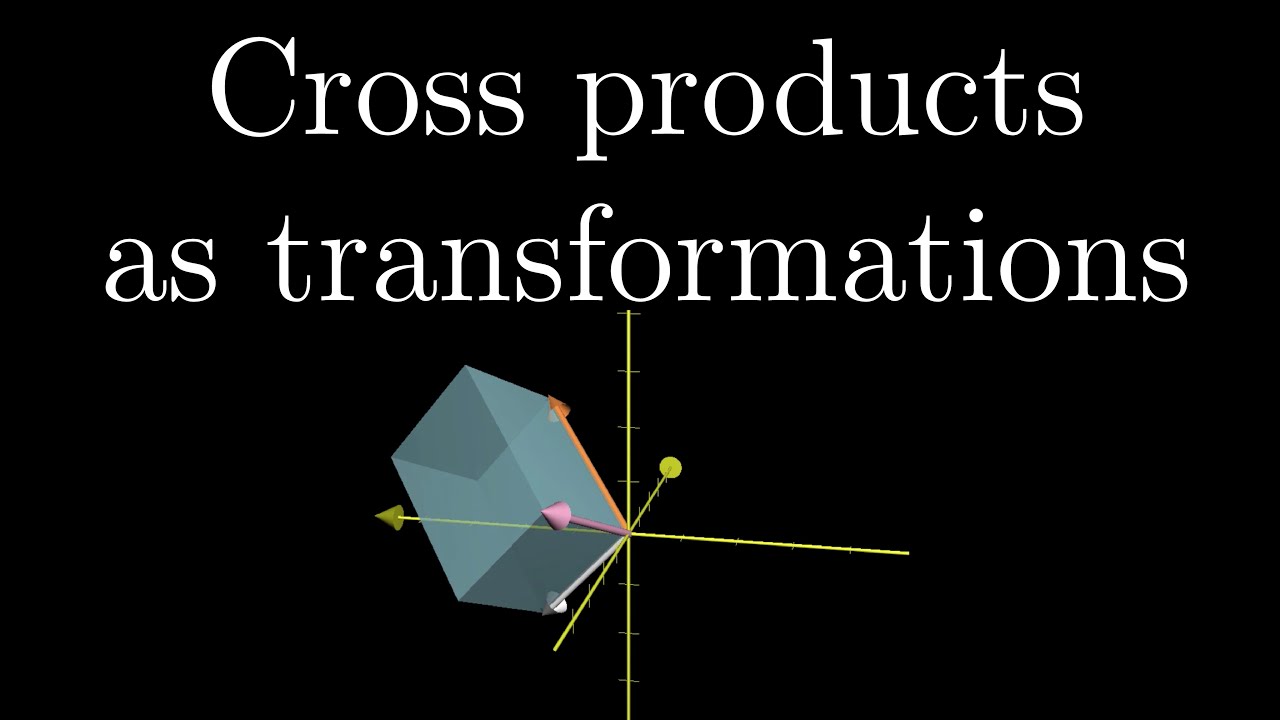
Home page: https://www.3blue1brown.com/
For anyone who wants to understand the cross product more deeply, this video shows how it relates to a certain linear transformation via duality. This perspective gives a very elegant explanation of why the traditional computation of a ...
Why do those coordinates P1 P2 and P3 correspond with the unitvectors ?
yall can watch from 8:05
dusky epoch
are you asking why these equations are true
viscid kernel
yup
I knew the answer but I forgot since its been a long time I watched that video
dusky epoch
$p_1x + p_2y + p_3z = (v_2w_3 - w_3v_2)x + (v_3w_1 - v_1w_3)y + (v_1w_2 - v_2w_1)z$ is an equality meant to hold for \textbf{ALL} possible values of $x, y$ and $z$
stoic pythonBOT
Ann:
dusky epoch
so in particular you can set x=1, y=0, z=0 and get the first equation
x=0, y=1, z=0 to get the second
and i'll leave it to you to see what values of x, y and z will give you the third equation directly in the same way
viscid kernel
ur my hero
@dusky epoch do you know any simulation in which I can like create vectorspaces ( like 3blue1brown ) in a 3D dimensional space ?
dusky epoch
uhh
you mean his illustrations?
i think he put out a library or something called manim
but i've never used it so idk
viscid kernel
Hmm
 slender yarrow
yeah it's on github https://github.com/3b1b/manim
GitHub
Animation engine for explanatory math videos. Contribute to 3b1b/manim development by creating an account on GitHub.
viscid kernel
@slender yarrow thanks
Hmm I clicked on that link, everything looks different. Idk what to do? @slender yarrow may you help me out ?
slender yarrow
i never used it myself so i don't really know either
but yeah you gotta code the scenes yourself
 limber sierra
it's a github page
it includes installation instructions, but assumes youre familiar with programming stuff
it relies on python, conda, and latex iirc
viscid kernel
lib ?
slender yarrow
the library, manim
viscid kernel
aight
 smoky lagoon
is the dimension of the corresponding set of eigenvectors for a certain eigenvalue just the number of free variables if i were to set up a matrix using each eigenvector?
so if i had vector (1,0) and vector (0,1) the dimension would be 2?
smoky lagoon
figured it out realized i already knew the answer
half ice
I get that e_i is a list where each component is a basis vector of V.
In the lemma they say for I = J and I have zero idea what equality for a multi-index notation means
a^I is the wedge of every member of the dual basis. So a^I seems to be like it can only be one thing. But they go on to say there's many of these?
 covert skiff
woah, that looks like some pretty difficult linear algebra. Here I am, can't figure out how to find out a determinant of a 4*4 matrix 🤦♂️
half ice
The course is really differential geometry, but this part is all vectors
covert skiff
lol, i hate vectors tbh
half ice
Looked on Wikipedia, and it is able to state what the basis is in a way that was clear and made sense to me. I still don't understand what this part of the book is trying to say. How horrible.
 grizzled jasper
shhh
storm python
 dry spear
im trying to take the determinant to find the eigenvectors
but i can't find anything that simplifies it
other than a 0
then i just get a huge expression
 quaint marlin
Lol
covert skiff
Can someone tell me if this is in REF?
Ah, should've rotated it
My b
Row echelon form
i want to find out the determinant, by doing REF
 loud flame
No, you can't have non-zero on the bottom row except for the number farthest to the right
covert skiff
hmm
how do i make it that? I can't think of a way
and i've been told that 4 in the first row needs to be 1
I can do R1-4R4 for that
but can't think of a way about row 4
loud flame
Some say that the first number of each row must be 1, but I'm not sure if this is an official requirement
You have to use multiple operations
R1-4R4, then newR4-5R2, then newnewR4-R2/2
for example
covert skiff
I said it rong, if we do R1-4R4, the first element of the matrix becomes 0
why R4-5R2?
loud flame
Do all that for the last row
to get 0 on the first three places on that row
To get 1 one the first row, you can just divide it by 4
covert skiff
all three for R4?
loud flame
yep
covert skiff
Alright. It's just, I can't wrap my head around this. I can do like max 2 calculation in my head
Ok, I'll do that rn, and let you know how it goes. Thanks for the help
covert skiff
1 2 0 1
for my last row
no, my bad
3 11 9 -7
and then i did R4-5R2, after which i got 3 6 -1 18
loud flame
You need to remember to multiply the last row with 4 before you subtract it from the first row
covert skiff
0 5 9 -10 is what I get after doing that for the fourth row
loud flame
that seems right
Now you have to find a way to get the second number of that row to be 0
covert skiff
R4-5R2
loud flame
that's right
loud flame
yep
loud flame
yes, but look out for the sign on your last number during the operations
It seems like you mixed up the 3rd and 2nd row for the last number during the R4-5R2 operation
loud flame
In this exercise you will get the same result either way as the last row will be reduced to one number in the end. But this is not usually the case, it is very easy to do small mistakes like that
covert skiff
yeah, tbh I hate REF, and RREF
thanks for the help. I made another mistake but caught it 🙂
loud flame
nice
covert skiff
So, I've got another question that I can't seem to solve 😦
I've found that the determinant of I2 = 1; -3I2= -3
Determinant of I3 = 1; -3I3 = -3
Where I is the Identity matrix
can you conclude about det (−3𝐼n) an, in general, det (𝑘I𝑛) for any 𝑘ER ?
kER = k is an element of real number
dry spear
anyone here good with eigenvectors/values?
half ice
@covert skiff
There's definitely a pattern in those four examples
covert skiff
There's a pattern, like whatever you multiply it by the answer is the same what you'll get
stoic pythonBOT
Spectex:
half ice
A is a matrix, λ is a scalar
half ice
No, usually not
x is a vector and has no inverse, so you can't "divide both sides by x"
half ice
"If λ is an eigenvalue of A"
Can you write that as an equation?
dry spear
$A\vec{x}=\lambda\vec{x}$
stoic pythonBOT
Spectex:
dry spear
is that what you were asking?
half ice
Yes exactly!
"Then 2 - 3λ + 5λ² is an eigenvector of 2I - 3A + 5A²"
Is the statement
(2I - 3A + 5A²)x = (2 - 3λ + 5λ²)x
You have the first statement, you want to prove the second one is true
covert skiff
kaynex @cosmic dune when you're done helping spectex. Sorry for interrupting
covert skiff
Hmm, so I got 9 as the determinant when I do -3I2
For -3I3 i don't get it. Since it is both an upper and lower triangle, how do we calculate the determinant then?
Can we do, the product of the diagonal?
For -3I3:
-3 0 0
0 -3 0
0 0 -3
How to calc det? And I can't figure out what the pattern could be
loud flame

Khan Academy
Sal shows a "shortcut" method for finding the determinant of a 3x3 matrix.
Shortcut for calculating determinants of 3x3s
slow scroll
im not really sure what this question is asking, but to compute the last eigenvalue, you can just use the fact that the sum of eigenvalues equals the trace of the matrix
dry spear
yeah i figured i had to compute it
I just showed that all of the given eigenspaces are eigenspaces for A
for this one how would I find C, if there is a C that holds this statement true
covert skiff
@loud flame ok, I got it. So, I get the det = -27
Now, can you tell me the pattern?
For even number it's the square which results in a positivie (for I2), for odd numbers its the exponent to the number it is (for I3).
Uhh, too confusing. Can someone tell me some clear explanation?
limber sierra
the determinant of a triangular matrix is the product of its diagonal entries
that's the whole pattern
note that this only works for triangular matrices (otherwise calculating determinants would be much easier)
but of course, scalar multiples of the identity matrix are always triangular
dry spear
waxwing could you help me with mine?
limber sierra
do you have any theorems on similarity?
there are a lot of theorems that make your life easier
but if you havent seen those yet, then just
set up a system and reason on what the values must be
dry spear
the only thing we learned about this was how to diagonalize a matrix and find the other ones
but B isn't a diagonlized matrix
limber sierra
then yeah, you can suppose a $C = \begin{pmatrix}c_1&c_2&c_3\c_4&c_5&c_6\c_7&c_8&c_9\end{pmatrix}$ exists
stoic pythonBOT
Namington:
limber sierra
and then figure out what the system $A = CBC^{-1}$ would be then
stoic pythonBOT
Namington:
dry spear
the C^-1 is throwing me off though
limber sierra
(hint: multiply by C on the right to make your life easier)
dry spear
how do you know if it goes on the right or left
limber sierra
$A = CBC^{-1}$ implies $AC = CBC^{-1} C = CB$
stoic pythonBOT
Namington:
stoic pythonBOT
Spectex:
limber sierra
right
limber sierra
[and note that, if a solution matrix for C exists, it needs to be invertible]
 gloomy arrow
Because it has to be less than or equal to
 raven tiger
anyone know anything about the union and intersection of intervals?
slow scroll
what does that have to do with linear algebra lol?
raven tiger
i dont know which one to ask it to so i just keep clicking algebra lol
pallid rampart
Correct
The theorem is: if V is a finite dimensional space and H is a subspace, then H is finite dimensional with dimension less than or equal to the dimension of V
gloomy arrow
Is there a quick way to do this one?
There are 8 pivot columns right?
So would the dimmension bew 8
half ice
Yes
 pliant fox
<@&286206848099549185> know how matrix inversion can be done with series of matrix multiplication? is there a way to get matrix transposal via matrix multiplication/addition, or is it not possible?.
steady fiber
first you say inversion, then you say transpose
pick an operation first
also don't ping before 15 min
pliant fox
transposal. can it be obtained with matrix multiplication?
 warm stirrup
Think of it as a linear transformation
pliant fox
?
 gaunt geyser
hey I don't get their little statement about assuming A is symmetric here
they say "if not, we can replace A by (A+A')/2"
isnt this only true if A is symmetric
dusky epoch
they aren't claiming that A = (A+A')/2
they're claiming that $x'Ax = x' \paren{\frac{A+A'}{2}}x$
stoic pythonBOT
Ann:
gaunt geyser
hmm how does that work out if A =/= (A+A')/2
dusky epoch
$x' \paren{\frac{A+A'}{2}}x = \frac12 (x'Ax + x'A'x) $
stoic pythonBOT
Ann:
gaunt geyser
@quartz compass it should be a single equation right?
quartz compass
?
x'Ax is a matrix
what are the dimensions of this matrix?
it's an m by n matrix
what's m, what's n?
gaunt geyser
I mean the dimensions of A are nxn
I believe x would then be nx1
and x' would be 1xn
quartz compass
and so their product is a matrix
gaunt geyser
oh yeah
quartz compass
so are 1x1 matrices symmetric?
gaunt geyser
yes
quartz compass
x'Ax = (x'Ax)'
must be
now A is not A' necessarily
but x'Ax = (x'Ax)' is
now work through (x'Ax)' by rules of transpose to try to simplify that a bit
gaunt geyser
there I just get (x'Ax)' = xA'x'
quartz compass
yeah
and since that thing on the right is x'Ax
we have x'Ax=x'A'x
so now we can add it to itself since it's the same thing, and divide by 2
gaunt geyser
ah I see
thats just really weird intuitively
that any square matrix in linear form can be assumed symmetric
quartz compass
the end result being a scalar (1x1 matrix) is why we can do this
multiplying by x and x' is basically "erasing" any kind of extra information about the matrix's structure
since it's the same vector multiplying both sides
gaunt geyser
right
quartz compass
like if you look at the result, it's gonna be some quadratic form like
Ax^2+Bxy+Cy^2
which would come from a 2x2 matrix which has 4 entries
but here there are only 3, which correspond to the fact again
just slightly different perspective on it
err here A,B,C are scalars and x,y are scalars as components of the vector x earlier
maybe I overloaded the notation a bit too much my bad
gaunt geyser
yeah I just did the multiplication for a 2x2 matrix [[1,2],[3,4]]
because the 2 and 3 end up 2xy+3xy
quartz compass
yeah
quartz compass
it's nice because now this gives an actual reason to care about symmetric matrices
they're not just "looks nice when flip flop"
it will turn out symmetric matrices have real eigenvalues with orthogonal eigenvectors
and you can then do stuff like diagonalize the matrix representing your quadratic form so that you can get a change of basis so your quadratic form has no cross terms, it'll just be like Ax^2+By^2
and this sort of thing will generalize to the complex case with hermitian matrices and so on
gaunt geyser
ah I see
I took a linear algebra class that was very calculation based
running through this textbook
as a more fleshed out overview of linear algebra
quartz compass
sure looks good
gaunt geyser
any intuition on why B*B' or the reverse in quadratic form is always positive semidefinite
been playing with the math for a bit now
with a 2x3 matrix B
gaunt geyser
where
stoic pythonBOT
gREEnOnions:
stoic pythonBOT
gREEnOnions:
gaunt geyser
for negative b
I've found this
but don't know why the left hand side is always true
right*
dusky epoch
presumably A^Tx is known not to be the zero vector?
gaunt geyser
why can't it be less than zero
gaunt geyser
yeah
dusky epoch
it's equal to $|A^Tx|^2$
stoic pythonBOT
Ann:
gaunt geyser
oh I see
agile wolf
does the linear transformation that reflects a vector in a 3d plane have eigenvectors?
dusky epoch
sure
any vector in the plane is an eigenvector with eigenvalue 1
and any vector perpendicular to the plane is an eigenvector with eigenvalue -1
agile wolf
So would the transformation have eigenvalue of only -1?
dusky epoch
reread what i just wrote
agile wolf
Oh. Correct me if I'm wrong the eigen value of 1 is just like a 2d reflection? I'm a bit confused by that
dusky epoch
the eigenvalue of 1 is an eigenvalue of 1.
agile wolf
Oh nevermind I was confusing myself
tyty
Can I say Tv = T x e1+T y e2? Where T is some transformation matrix
Or does this only hold for certain transformations
dusky epoch
is T a linear transformation
agile wolf
yeah this is the entire problem
dusky epoch
well
$T(xe_1 + ye_2) = T(xe_1) + T(ye_2)$ is simply an instance of the DEFINITION of linearity, is it not?
stoic pythonBOT
Ann:
 hollow finch
How can I prove that for any real nxn matrix A, the matrices I,A,A^2,... are linearly dependent? This is apparently possible without knowledge of eigenvalues/the characteristic equation.
viscid kernel
This is the first dimension theorem. I was able to prove this in 3D, but the amount of basis vectors tell me that this is also valid in 3 + n dimensions. Why can you assume that this is also valid in 3 + n dimensions ?
hollow finch
@dusky epoch It is not specified. This is the problem. It is from an Abstract Algebra textbook, but I think this is more of a linear problem than an abstract one.
stoic pythonBOT
Ann:
dusky epoch
so ${ I, A, A^2, \cdots, A^{n^2+1} }$, a set containing $n^2+1$ matrices, is guaranteed LD.
stoic pythonBOT
Ann:
hollow finch
Well
That's a lot easier than I expected
It did not specify a degree so yeah if we have a set with more elements than the dimension of the space the set cannot be LI.
Thanks
wintry steppe
I, A, A^2, ..., A^{n^2+1} is n^2 + 2 matrices
you can just do I, A, A^2, ..., A^{n^2} as well i suppose
hollow finch
As well as A^{n^n} too, but yeah up to A^{n^2} would be the minimum to guarantee LD.
 barren void
$\pi = {(x,y,z)\in \mathbb{R}^{3} : x - y - 1 =0 }$
stoic pythonBOT
Tomás Sentagne:
barren void
I have this implicit equation of a plane and I need to find an lets sey explicit function z = z(x,y) wich graph is the plane
$z = z(x,y)$
stoic pythonBOT
Tomás Sentagne:
barren void
Any idea?
 vital swallow
but z is a free variable there. e.g. the points (2,1,0) and (2,1,5) both satisfy the implicit equation
so z = z(x,y) would not be a function
vital swallow
normally you would just solve for z
ax+by+cz = d --> z = (d-ax-by)/c is your function
barren void
Thats right
wintry steppe
I need help understanding if I'm doing solving one of my hw questions properly
They want us to determine if a given set is a subspace of Pn for an appropriate value of n. (I don't really understand what they mean by an appropriate value of n)
I think they're talking about polynomials when they say a a given set is a subspace of P sub n
The question gives us an example...
Oh, hello kevypoo
how is this computed
I seen you in typology, sup
hello peepee
NinjaPeeps
y r u in doge server
Was just looking for an MBTI server to chill in
uh, going back to Linear Algebra. They gave us an example that reads "All polynomials of the form p(t) = at^2, where a is in R"
wintry steppe
gloomy arrow
8 because 8 pivots?
 coral tinsel
what's the relation between Simplex, Gaussian Elimination, and LU Decomposition?
Are the first two the same while the last is one possible algorithm to solve the first two?
feel free to ping me if you can help
agile wolf
What will a matrix for a linear transformation look like if the basis consists entirely of eigenvectors?
agile wolf
Like an identity matrix but instead of 1s theres the eigenvalues?
stoic pythonBOT
RestlessQ:
dusky epoch
??
 fathom flax
gray dust
fathom flax
gray dust
show work for computing f(v)
 flint flicker
https://youtu.be/kYB8IZa5AuE @covert skiff
Home page: https://www.3blue1brown.com/
Matrices can be thought of as transforming space, and understanding how this work is crucial for understanding many other ideas that follow in linear algebra.
Full series: http://3b1b.co/eola
Future series like this are funded by the c...
I remember this video being really good
 magic light


 flint flicker
I'm pretty sure that means the set of all m by n matrices of real numbers
 ocean flame
@covert skiff Do you speak any other languages than english? I believe I have pdfs in swedish regarding transformations
quartz compass
a couple nitpicks first
it's not equating it, it's making an augmented matrix
and this works for n*n not just 4*4
you can do the exact same thing without the matrices and with variables
it's very cumbersome but
what it basically amounts to is doing elimination on a system of equations
since you have both matrices what you're doing is kind of like taking your steps of how to turn a matrix into the identity matrix and at the same time doing those on an identity matrix
to give you the reverse steps
so that's what's giving you that [A | I] to [I | A^-1] trick
depends on what better means
computationally speaking, doing the row reduction is pretty much the fastest
although algebraically it's nice to have things like the cofactor and determinant stuff floating around
sometimes there are algebraic tricks to exploit the form that allows you to skip actually computing certain things
like a diagonal matrix, to invert that you just have to take the reciprocals of all the entries
just saying there are sometimes tricks, roughly like this or more complicated
yep
 vague fulcrum
can anyone help me prove this identity
i cant seem to get it
im trying to prove that ker(BC) is a subset of ker(B) + ker(C)
so i let x be in ker(BC)
so (BC)(x) = 0
and i know i need to show that x = b + c such that b is in kerB and c is in kerC
but idk how
dusky epoch
is ker(BC) ⊆ ker(B) + ker(C) even true