#linear-algebra
2 messages · Page 73 of 1
 vast torrent
 solar osprey
How can we even asses the dimension of a transformation
solar osprey
Same dim
vast torrent
L(V,W) has dimension dim(V)dim(W) for finite dimensional vector spaces
 vast torrent
but yeah what Rixia said
 crystal pagoda
yeah but it's easier to consider M mxn
vast torrent
but in general $\dim \mathcal L(V,W) = (\dim V)(\dim W)$ for finite dimensional spaces
 stoic pythonBOT
gfauxpas:
crystal pagoda
finite dimensional is always nice...
solar osprey
Saying that any vector X can be written as a linear combination of the columns of some vector A
 solar osprey
Speaking of finite
The rank-nullity theorem
Stating that dim(V) = rank(L) + nullity(L)
crystal pagoda
what about it
solar osprey
Ive been thinking about how to prove it doesnt hold for infinite dimension
vast torrent
you have to set up rules for addition of infinite numbers
crystal pagoda
yes
solar osprey
it doesnt hold for infinite dimension
crystal pagoda
ImL=V
vast torrent
if you say that $(+\infty) + (+\infty) = +\infty$ then okay things should be fine but it's not very yseful as Rixia said
stoic pythonBOT
gfauxpas:
crystal pagoda
you would also have n+inf=inf
vast torrent
sure why not
vast torrent
just don't try to subtract infinite from itself, that breaks things
in this naive system we just discussed
crystal pagoda
now of course you need axiom of choice to say that it holds
but i would say that's almost always assumed
vast torrent
if you don't assume a.o.c. then dimension isn't well defined for all spaces
crystal pagoda
finite dimensional vector spaces are still fine
infinite ones break to an extent
but back on the topic
basic idea of the proof is the same as the finite dimensional case
you consider a basis of ker T, a basis of imT
crystal pagoda
then the union of basis for ker T and basis for preimage of imT forms a basis for V
solar osprey
Part 5-6
crystal pagoda
infinite dimensional vector space breaks the implication that kerT={0} implies surjective
vast torrent
they tell you which spaces you should use for your coutnerexamples you just have to figure out what operators are linear that break it
do you know the notation
crystal pagoda
consider T{x_i}={x_i-1}
then consider T{x_1,x_2,..}
T is surjective but kerT is not {0}
vast torrent
wait who asked the question I lost track
crystal pagoda
hm?
vast torrent
that's the converse rixia
crystal pagoda
ah right
vast torrent
im saying who is helping the question asker and who is asking the question I lost track
crystal pagoda
im trying to help
solar osprey
1-1
its a double implication
if its finite dimensional
wait wtf am I even saying
1:00 am
x (
crystal pagoda
ok let me clear my thoughts
crystal pagoda
part 3 and 4 tells you in the finite dimensional case, injective implies surjective
and the other way
but that's not true in infinite dimensional vector space
that should be enough to say that it breaks
use the left shift example i stated earlier
or right shift, if you so wish
ohhhhhhhhh hold up
i think i know what your professor is getting at
@solar osprey consider derivative and integration as linear operators
in R[x]
 tulip oasis
does anyone know what the U is?
found it in the book:
Actually I will zoom in:
do I just treat U as B?
solar osprey
Im back to strike again
Let V be a vector space of dimension n. Show that V is isomorphic to R^n
tulip oasis
okay cool
 steady fiber
if dim(V)=n, then it has a basis of n vectors, {x1, x2, ... , xn}
tulip oasis
can I show my work?
solar osprey
x1e1 + ....+ xnen
steady fiber
mapping one basis to another of the same size is an isomorphic map
you should probably word it better
solar osprey
Yes I should
steady fiber
but that's the essence of the solution
 fallow jolt
How do you prove that Null(a) is orthogonal to Rowspace(a)?
 barren panther
thats an interesting question
is the row space the same as the transpose of the column space
steady fiber
no
barren panther
sorry I meant column space of the transpose of the matrix*
fallow jolt
Row(a) = Col(A^T)?
steady fiber
assume x in null(A), then Ax=0
let a_1, a_2, ..., a_m be the rows of A, then Ax=0 implies a_1 * x = 0, a_2 * x = 0, etc. So each vector in the basis of the row space is orthogonal to any vector in the nullspace
so Null(A) is orthogonal to Row(A)
barren panther
ok
and can I modify this slightly to say that the null space of the transpose is orthogonal to the column space?
fallow jolt
intriguing proposition...
steady fiber
ya
fallow jolt
I believe so! @steady fiber, do you concur?
steady fiber
null space of the transpose is orthogonal to the row space of the transpose, and row(A^T)=col(A), so ya
fallow jolt
@steady fiber, what if instead of Row(a), we had col(conjugatetranspose(A))?
Would this still hold?
steady fiber
for a real matrix yes :^)
barren panther
what if there were complex numbers?
fallow jolt
in A?
barren panther
yea
steady fiber
ya idk, I'd have to think about that
fallow jolt
ooo, that tickles my brain...
steady fiber
idk my conj transpose properties
steady fiber
ya I know what it is
just haven't used it in forever
definitely haven't used it in a pure math context in a hot minute
physicslife
nah I dont think it holds
barren panther
why dont you think so?
fallow jolt
It was on my homework a while ago, I do think it holds
They said "prove" not "disprove"
crystal pagoda
Consider it in an inner product space?
Then conjugate transpose is the adjoint operator
But that only applies to linear operators
Hmm
solar osprey
Good night
barren panther
goodnight
crystal pagoda
@fallow jolt i think i got it.
consider <x,A*y> for x in null A
<x,A*y>=<Ax,y>=0 since Ax=0
then <x,A*y>=0 for all x in Null A and y in V
fallow jolt
What is this < > notation?
crystal pagoda
inner product
then Null A is orthogonal to Im A*
but Col(A*) is Im A*
thus we are done
tulip oasis
I think I made a mistake in calculating an invertible matrix
Here's what I got:
actually nvm
here we go
I get this strange thing
k = l and k = -l
or k = +- l
so then I get an S matrix of just 1's
but I checked this on wolfram and I saw that it wasn't suppose to be this
Did I make a mistake in my computation?
 shrewd slate
If T is a linear map from V to W, is it always possible to define a basis B = {v_1, ..., v_n} for V s.t
T(a_1 v_1 + ... + a_n v_n) = a_1 w_1 + ... + a_n w_n
∀a_j and for some w_j ∈ W
I’m asking for a proof I’m trying to cook up
I suspect the answer is yes, but I worry that I suspect that out of convenience for myself
crystal pagoda
yeah
you can do that
check your dimensions though
might not be a basis after the transformation
shrewd slate
You mean it might not be a basis for W?
I don’t mind that
If that’s what you mean
crystal pagoda
yeah
shrewd slate
Epic, thanks
crystal pagoda
you can always split a vector into a linear combination of basis vectors
and T is linear, so everything is convenient
shrewd slate
So it works out for all a_j, that’s p neat
crystal pagoda
a_j are scalar so they just get pulled out anyway
shrewd slate
Ahhh
 slow scroll
you want to show that if Tx = Ty then x = y.
what is the natural thing to do, starting with Tx = Ty
yep
npnp
 bold blade
slow scroll
bold blade
slow scroll
@pastel saffron R(T) = N(T) is definitely not true in general: i.e. when dim(V) is odd since you necessarily have R(T) != N(T)
np
 half ice
That is, |u| = √[u•u]
@bold blade
slow scroll
.. and thats because of rank nullity, dim R(T) + dim N(T) = dim(V)
half ice
What are R(T) and N(T)?
slow scroll
R(T) is Im(T) and N(T) is ker(T) i believe
half ice
Ker(T) is a subset of the domain
Im(T) is a subset of the codomain
Unless the domain and codomain are the same, it doesn't make sense to ask about relations between ker(T) and im(T)
slow scroll
well in inyhaks case, T^2 = 0 which would imply im(T) \subset ker(T)
do you know that <v, w> = 0 for all w in V implies that v = 0?
yeah, as long as T is an operator.
im not sure i see what the "for all" quantifier is for here. It seems like as long as there is a non zero vector a for which <a, Ta> = 0, then Ta = 0 and a is in the null space.
This would hold on arbitrary fields, yes
and umm, by operator, i mean T maps from a vector space V back onto itself.
wdym both instances?
well, i shouldn't say arbitrary fields, since we are talking about inner product spaces, but we didn't assume one or the other here, so it should work for both
@pastel saffron no im wrong
<a, Ta> = 0 for all a in V says nothing about the null space. The situation we have is not the same as the "<v, w> = 0 for all w in V" situation i described earlier
probably, yea.
Ta is orthogonal to a, but not to V. (think about it, a cant be in V and be orthogonal to V, unless ofc a = 0)
i thought it might help to check the case when a is an eigenvector (these always exist when T operates on a complex space), but i don't see it going anywhere hm
if no one else helps in 15 minutes, you can ping @ Helpers 🤷♂️
 slim laurel
Hey guys, could someone explain to me why this is true?
a bit unsure of why the last bit is true
slow scroll
AA^T qi = 0
qi^T AA^T qi = qi^T 0 = 0
slow scroll
np
 wintry steppe
I fail to see how an arbitrary inner product can say anything about invertibility
 quartz compass
sorry you feel that way
 bold hearth
If i have this matrix
and i have to find the eigenvalues
can i get it to upper or lower triangular form
or does it have to start out that way
can't quite figure it out
leaning towards it having to start as this
bold hearth
Because the eigenvalues of a triangular matrix are its diagonal elements, for general matrices there is no finite method like gaussian elimination to convert a matrix to triangular form while preserving eigenvalues
 silent dune
Going based off my notes from last semester just wondering if you do make it a upper triangular matrix per say and then get the determinant to use to solve for the eigenvalues?
@bold hearth
silent dune
one sec
So for example this matrix we wanna figure out the real eigenvalues so we do this
Any of this look familiar?
silent dune
ye one sec
bold hearth
does that not alter the values of the determinant
silent dune
Ye thats why I was thinking you were maybe shown a different way
bold hearth
if its a really large matrix
ok now i understand
the (greek letter - 1) part was clever
i hadn't thought of that
silent dune
ye subtracting the greek letter multiplied by the identity matrix
bold hearth
that one is obv ofc but the row operation one was the one i was wondering about
Ok so its always possible to get it to this form
but i may take infinite number of steps
i think
if its super large
or not finite
silent dune
but yea it seems long so just maybe see if there is another way 😂
bold hearth
Because the eigenvalues of a triangular matrix are its diagonal elements, for general matrices there is no finite method like gaussian elimination to convert a matrix to triangular form while preserving eigenvalues
yeah since i had a question i was trying to answer
if its always this easy (as a upper triangular matrix) to find the eigenvalues
and i thought yeah its always this "easy" you just get it to this form, which may be very hard, but once that is done its easy to find the eigenvalues
crystal pagoda
You can resort to finding the minimal polynomial of the matrix
 pseudo stone
how do we determine the uniqueness of a function?
crystal pagoda
Depends on context
But usually you assume they're not unique and say f1 and f2 both qualify
And show f1=f2
 real sable
In the real vector space V of the continuous functions of R on R, we study the linear map A taking any function f in V to the function A(f) defined by (see picture).
What are the eigenvalues and eigenvectors of A?
How can I approach such a problem?
 pallid rampart
Well, a function $f$ is an eigenvector of $A$ if $Af=\lambda f$ for some $\lambda$. Therefore we can write that $\int_0^xf(t)\dd{t}=\lambda f(x)$. Now notice a few things: substituting $x=0$ yields $f(0)=0$; the left hand side is differentiable by fundamental theorem of calculus therefore any eingenvector $f$ must be differentiable; differentiate both sides and obtain a differential equation with initial conditions
stoic pythonBOT
Whoever:
 limber sierra
this is not linear algebra
see #prealg-and-algebra or a generic questions channel
linear algebra is the study of vector spaces
so vectors, matrices, linear systems, norms, eigenstuff, determinants

 torn hornet
lol that eqn isnt even linear
pallid rampart
Lmao
wintry steppe
my bad lol
slow scroll
two in a day within 15 minutes of each other whoop
 keen frigate
How do I do question 1?
slow scroll
this is also... not linear algebra xd
slow scroll
its in y=mx+b form, just compare the m's.
a+2 = 3a - 1
i.e. since they're parallel their slopes are the same
keen frigate
Ohh
pallid rampart
Ok fine
slow scroll

torn hornet
lmfao
 ivory tulip
Hey, guys, if v is a unit vector, would ∥(−1)v∥ just be 1?
pallid rampart
👀
slow scroll
y=mx is linear. y=mx+b is affine
pallid rampart
I mean yeah, ||-v||=sqrt(<-v,-v>)
and you take out the -1
@slow scroll where b≠0
slow scroll
yep, thnx
keen frigate
No ones on the pre algebra section so can I ask my question here ?
 fair light
Reading up on vector transform. How would I go about getting the transformed point given an angle
Say.... transforming a point 90 deg
 shy atlas
u can think of that point(lets say in 2D) as a vector
u can multiply it by the rotation matrix
theta is the angle u wanna rotate ur vector by
u multiply by R and u get a new vector which is gonna be rotated by theta
@fair light
fair light
if the question asks... (1, 2) rotated ccw 90deg. how should I do that?
cos(90) -sin(90)?
fair light
R x that matrix?
shy atlas
that matrix is R
shy atlas
the dotted stuf fis ur R
if u multiply these together, its gonna yield another vector which is gonna be rotated 90 degrees
fair light
I have a particle and I wanna rotate it. Unfortunately I have a single line input
shy atlas
wdym a single line input ?
fair light
The "textbox" where I can add the formula
shy atlas
as i said, the end result of this matrix multiplication is gonna produce a vector in 2D
like (3, 5) lets say
u shouldnt have any problems inputing that

 cursive narwhal
"I have a particle and i wanna rotate it." What is the general context for this? If you're working with a particle, you don't care about the rotation of the particle no?
fair light
shy atlas

fair light
lol.. sorry.. it's for visual effects
So I would have to write it as : 2x0 + 1x-1 for X
I think I got it
Thanks @shy atlas
shy atlas

fair light
How would that matrix change if it's 90 cw?
slow scroll
rotate -90
fair light
ahh.. coolz thanks!
slow scroll
npnp
slow scroll
its more complicated. It depends on the axis of rotation
fair light
oh ok. What is this called? How would I look it up?
I don't need a 3d point, I'm just wondering
😅
slow scroll
In linear algebra, a rotation matrix is a matrix that is used to perform a rotation in Euclidean space. For example, using the convention below, the matrix
    R
    =


        [


  ...
kxrider:
Compile Error! Click the  reaction for details. (You may edit your message)
slow scroll
in general, you need a few more rotations beforehand that will "align" the axis of rotation with one of the x, y, or z axes so that you can apply one of the rotation matrices I listed above (R_x, R_y, or R_z)
and then you have to apply the inverse of those initial rotations to get the axis of rotation "back where it belongs"
slow scroll
np np.
@fair light ah yea i found the part of the wikipedia article that talks about this
but as you can see, the matrix is nasty in general lol
fair light
Sweet.. I was just reading through it 😃
limber sierra
how are you defining dimension?
actually wait
thats probably not the best question to ask here
first off, you can assume that every vector space has a basis, right?
and if it's f.d. then it has finite basis
well ive got to go soon but i'll give a vague, but hopefully helpful, hint
consider row operations on a given basis (particularly helpful for intuition may be to consider a standard basis)
intuitively, you want to, for every vector
find a basis such that removing any vector from that basis
now excludes your original vector
[this works because basis vectors are linearly independent]
 slate mauve
basic question: if I have two vectors A and B in R2, how do I represent the line formed by A and B?
quartz compass
"the" line?
two vectors generically will span a plane so long as they're not parallel
or oh maybe I see a way, like you mean pick the two points defined by the vectors A and B and use that to define a line?
draw a picture I think that will help. Take one point on the line, such as A, and then take all multiples of the vector parallel to your line to it, like this:
(B-A)t+A
 south wadi
how did they say 4A - 9 * that matrix = 2A - 5 * that matrix
see how they switched the 4A -9 with the 2A - 5
on the 2nd line
south wadi
oh ok
i see that
how bout here now
so they just set
2A - 5 * that matrix = 4A - 9 * that matrix
then solved for A right
 slender yarrow
yeah
south wadi
yeah ok
also
I don't really understand this I stuff
so they took the inverse
i understand
then wehere did the I go?
and also
cursive narwhal
It's just matrix addition
stoic pythonBOT
emeric75:
slender yarrow
yeah sounds like they fucked up
stoic pythonBOT
PeakThePenny:
Compile Error! Click the reaction for details. (You may edit your message)
slender yarrow
there's double backslashes in the middle
and they disappear when you copy paste
$I$ is just $\begin{bmatrix} 1&0\\0&1\end{bmatrix}$
south wadi
$I$ is just $\begin{bmatrix}\ 1&0\0&1\end{bmatrix}$
stoic pythonBOT
emeric75:
slender yarrow
well it could be of another dimension
 light fable
can someone help me
they didnt teach this yet since we are in quarantine
imma solve the first one but idk if im right
so what i think the answer for number 1 is a = 5 square root of 2 and b = square root of 46
pallid rampart
So what is the dot product?
pallid rampart
Lol yeah
light fable
so the comma is meant for the dot product
pallid rampart
Don’t you see? $\norm{a}=\sqrt{a\cdot a}$
stoic pythonBOT
Whoever:
pallid rampart
The dot there is the dot product between a
Oh sorry I didn’t mean to be aggressive
light fable
sorry im more of a hands on
they teach this usually like normal but classes are suspended
so my problem is, what approach should i take
to solve it
 gray dust
do you know how to compute dot products
light fable
am i in the right track? or what am i suppose to do with the exercise above
not yet
all i got is this
gray dust
that's the one
if $a=(a_1,a_2)$ and $b=(b_1,b_2)$ then their dot product is given by
$$a\cdot b=a_1b_1+a_2b_2$$
stoic pythonBOT
RokettoJanpu:
light fable
so the first element multiplied and added to the second elements of both?
until to n
is that right?
gray dust
sorry your wording is just butchering what i typed above
light fable
lol sorry
gray dust
here's an example
light fable
can you do an 3dimensional one as example
gray dust
let $a=(1,2,3)$ and $b=(4,5,6)$ then their dot product is computed as
$$a\cdot b=1(4)+2(5)+3(6)=32$$
stoic pythonBOT
RokettoJanpu:
light fable
ok that make sense but how do i get the | |a| | and | |b| |
stoic pythonBOT
RokettoJanpu:
light fable
so in your example will that a*a be a 32 * 32
so that it gets a nonnegative
sorry if im bad at this
gray dust
no what i did previously was take the dot product of a & b
in the definition of norm of a, inside the square root you dot a with itself
gray dust
for now, for you there's no reason why there's a square root, you were just given a formula and your hw is to follow it
to find the norm of a, you take a dot a, then square root the resulting product
gray dust
you should tell me when you're doing the hw, you just threw a pile of numbers at me
and especially since i already used a in my example
light fable
oh ok
ok let me use your example then
from a={1,2,3} and b ={4,5,6,} becomes 1(4)+2(5)+3(6)
then square root?
light fable
idk, the exerices only states find | | a | | and | | b | |
i wish it has more exact intructions
gray dust
i'd say you were given everything needed to do the hw
i'll repeat the definition of norm
$\norm{a}=\sqrt{a\cdot a}$
stoic pythonBOT
RokettoJanpu:
gray dust
to find ||a|| which is called the norm of a, you first dot a with itself ie take a dot a, then square root the resulting number
quartz compass
@light fable you're not fishing for answers are you, hoping that he'll eventually get exhausted and give you the solution
light fable
yep sorry im just so confused
pallid rampart
Well
quartz compass
I think you're thinking too hard and reading too little
pallid rampart
Here is a super quick example of how to calculate norm product
pallid rampart
$\norm{(1,2,3)}=\sqrt{(1,2,3)\cdot(1,2,3)}=\sqrt{1\cdot1+2\cdot2+3\cdot3}=\sqrt{1+4+9}=\sqrt{14}$
stoic pythonBOT
Whoever:
quartz compass
show your best guess and working if you're unsure, it's nicer to the people helping you if you put forth the effort of at least making some attempt
light fable
my only question is, will a and b separated since it says find | | a | | and | | b | |
gray dust
you find those separately
light fable
oh ok
then i thinks thats about it
i think the first one is a = 5 square root of 2 and b is square root of 46
welp thats what i think
9+25+16 = 50
then squareroot it it becomes 5 squareroot of 2
idk
is that the end
gray dust
we'd say "||a||=5sqrt(2)" not "a=5sqrt(2)"
gray dust
don't worry, but what i'd do is read over everything i just said a little more thoroughly, and if you can help it, don't overthink most things
light fable
im just so confused with the second part
it says to show a new vector to be a unit vector
gray dust
a vector is called a unit vector if its norm is 1
if a is a nonzero vector, then a/||a|| (which is a divided by its own norm) is a unit vector, and your notes gives a hint on how to show that
gray dust
you're very welcome, have a good night
gray dust
go ahead
 grave anvil
im trying to get a matrix <x_1,x_2,x_3> and im starting off with \begin{pmatrix} x_1 \ x_2 \ x_3 \end{pmatrix}
stoic pythonBOT
Lino:
Compile Error! Click the reaction for details. (You may edit your message)
 gray dust
try surrounding the line with dollar signs?
$$\begin{pmatrix} x_1 \ x_2 \ x_3 \end{pmatrix}$$
stoic pythonBOT
RokettoJanpu:
 slender yarrow
sounds like you didn't close the math mode or something
gray dust
enter math mode iirc
slender yarrow
same as \[ pmuch
grave anvil
tbh i dont know what [ does either
slender yarrow
well you didn't have a \] closing math mode tho before
grave anvil
im taking it from a really confusing guide
would you have any recommendations on how to learn latex
seems my knowledge gap may be too big
grave anvil
alright thank you i'll try use this
slender yarrow
but yeah try $$\Pi_1 : \begin{pmatrix} x_1 \\ x_2 \\ x_3 \end{pmatrix}$$
stoic pythonBOT
emeric75:
 slender yarrow
hmm
what's your preamble?
maybe you don't have amsmath imported or shit like that
 slender yarrow
yeah the beginning
slender yarrow
yeah add \usepackage{amsmath} in the beginning
it's just to import a library in your document
and those matrix thingies are in amsmath
grave anvil
do you know what utf8 would be?
slender yarrow
it's just the encoding you use in your text
if you want to support french accents,etc..
grave anvil
ok the switch worked
thank you very much
for future, do you know where i should ask for latex help?
im assuming linear alg channel is bordering on misuse
slender yarrow
usually ppl just go in #computing-software (or #math-discussion sometimes)
or just plain #❓how-to-get-help channels
south wadi
how the fuck is this wrong
this makes no sens
e
i am trying to get determinant of this
i reduce
1 1 1 1
0 2 0 0
1 1 -1 1
1 1 1 -1
R1 - R2
but aparently
that 2 has to be ngative
because u only get the right answer
 hoary agate
yeah it should
hoary agate
you're doing R2 -> R2- R1
south wadi
No i did R1 - R2
hoary agate
-1-(+1)=-1-1=-2
south wadi
why cant u do that?
Why cant u do R1 -R2
why does doing R1 - R2 get u the wrong answer
hoary agate
because you're multiplying R2 by -1 first
south wadi
shit makes no sense so frsutrating
hoary agate
that means the determinant changes sign
instead if you do R2-> R2-R1, there's no sign changes
and everything's k
south wadi
I never multiplied by -1
I'm just getting it into REF
and aparently u cant do R1 - R2
because that gets u the wrong answer
like wtf is this shit class
hoary agate
you're doing R2-> R1-R2 which is actually two manipulations R2-> -1×R2 and then R2-> R1+R2
you're implicitly multiplying a single row by -1
resulting in the determinant changing sign
so if u keep ur manipulations with only positive coefficients of each row, then you won't face such errors
south wadi
huh
hoary agate
or you should do R1-> R1-R2
in which case you'd get 0 +2 0 0 in first row
and you can simplify
hoary agate
see you're multiplying R2 by a -1 in that row transformation
south wadi
im subtracting it
south wadi
yeah ok
hoary agate
there's a ×-1 which crept in there
hoary agate
if you change sign of one row, you flip sign of the determinant
only multiply with positive numbers, to preserve determinant
that's why R2-> R2-R1 works
because R2 sign isn't being changed
south wadi
but it's the same shit
hoary agate
it's not..
south wadi
ur multiply R1 by -1
hoary agate
but I'm not transforming R1
I'm transforming R2 - > R2 - R1 but R2 sign isn't changed
south wadi
holy shit this class sucks
south wadi
nah it's just some stupid rules
hoary agate
and how it affects the determinant
it's not just random rules, it's derived results from the properties of determinants
you could figure them out yourself
by testing on simple matrices like 3x3
hoary agate
yeah then don't blame the class for your apathy
hoary agate
put effort get results man that is all it is
hoary agate
rip
hoary agate
linalg is useful in QM
and all the application oriented extensions
quantum computing
ML in general too
south wadi
half the stuff that comes out of my profs mouth is bs
never will i use this crap
after i graduate
hoary agate
what are you majoring in?
south wadi
Engineering
hoary agate
oh rip
south wadi
yeah this is just plain useless to us
hoary agate
oh
ye then
they must be
except if any entry is 0
if one row is all 0s
and the other is all 2s
you can't write the row of 2s as a scalar multiple of the row of 0s
idk
wintry steppe
uh
linear algebra useless in engineering?
yikes
not just ML and quantum computing; there's electrical engineering, where it's used extensively to analyze circuits, statistics, control theory, mechanical engineering
cursive narwhal
Yo mamma wasn't aware of the EEE applications
hoary agate
well, yeah that too
cursive narwhal
$T(a_2x^2+a_1x+a_0) = (x^2-1) \cdot 2a_2 + x(2a_2 x +a_1) +a_2x^2+a_1x+a_0$
$T(a_2x^2+a_1x+a_0) = 5a_2x^2 + 2a_1 x + (a_0-2a_2)$
stoic pythonBOT
Abhijeet Vats:
cursive narwhal
So, that's your new polynomial after applying the transformation
 smoky lagoon
OH I see that
cursive narwhal
In other words:
$T(a_0,a_1,a_2) = (a_0-2a_2,2a_1,5a_2)$
smoky lagoon
but I don't see how I can get a matrix out of that
stoic pythonBOT
Abhijeet Vats:
smoky lagoon
I know you can but i'm slow
cursive narwhal
So, find the images of the standard basis vectors and they'll form the columns of your matrix
@smoky lagoon Do you understand that?
smoky lagoon
oriented differently obviously
cursive narwhal
Wait what the fuck
smoky lagoon
so would I just put that basis in r3 into the polynomial?
stoic pythonBOT
Abhijeet Vats:
cursive narwhal
No, you already have a formula describing the transformation
smoky lagoon
okay so what's my next move
cursive narwhal
Like, you know exactly how the coefficients change, by virtue of the derivation I did earlier
smoky lagoon
right right that makes sense
cursive narwhal
So, find out how the basis vectors change and you're done. You don't have to worry about the polynomials they make up
As far as we're concerned, those polynomials are entirely described by the coefficient vectors.
cursive narwhal
T(1,0,0) = (1-0,0,0) = (1,0,0)
smoky lagoon
hold on
cursive narwhal
Sure.
cursive narwhal
I mean, you're using the formula above, right? So just make sure you're computing things correctly and it should be correct
smoky lagoon
cool! could you explain the logic on finding the polynomial in the first place?
cursive narwhal
Now, just check if the initial transformation was correct. I did it rather quickly and it's 3am here, with me falling asleep so try to check it through thoroughly.
Finding the polynomial?
hoary agate
sleep mate, sleep
smoky lagoon
the inital transformation
cursive narwhal
Well, a transformation is nothing but a function
That's all it really is
So, your function was defined in a particular way in the problem above
smoky lagoon
ah you use the transformation as your y and then do the derivatives as such
and t hen put it in for y* and y**
cursive narwhal
I took the most general polynomial that I was allowed to use and found the image of that general polynomial.
Yes, precisely.
smoky lagoon
interesting
cursive narwhal
That allowed me to get the polynomial at the very end. Now, we initially agreed to talk about polynomials in terms of a vector that would have the coefficients of the polynomial as its components
So, that's why I got the transformation into the vector format above
Once that happens, finding the columns is easy
smoky lagoon
the first COLUMN is (1,0,0) and the second would be (0,20) and the third would be (-2,0,5)
or would those be the rows?
cursive narwhal
The former
There's a beautiful treatment of precisely this topic in Klaus Janich's Linear Algebra textbook, where he derives the fact that the images of the basis vectors form the columns of the associated matrix. That discussion was a delight and you should definitely check it out.
smoky lagoon
I might have to check it out then
what's my game plan here?
wait
I can use the original transformation
I know that a0=1, a1=1, and a2=1
cursive narwhal

 tulip reef

gray dust
it's a rare hankel
let the unknown quadratic be y=a_2x^2+a_1x+a_0. rewrite y as the column vector (a_0,a_1,a_2) and x^2+x+1 as (1,1,1) (imagine these are column vectors). let A be the standard matrix of the map T. part c is solving the system T(a_0,a_1,a_2)=A(1,1,1)
shrewd slate
If the quotient space V/U of a vector space V with respect to subspace U is finite dimensional, can we assume that V is also finite dimensional?
Probably, right?
Might just say that it’s clear and call it a day tbh
slow scroll
It feels pretty false to me, but idk
pseudo stone
Guys i dont understand why Det (u - xIn) = 0 is equivalent to X belongs to sp(u) ?
shrewd slate
Uhh idk I feel like V/U couldn’t be fin dim if V wasn’t
I think V/U would have to fill up all the infinite dimensions if that were the case?
pseudo stone
HELP
 brittle juniper
If U is a vector hyperplane of V, dim(V/U) will be 1 @shrewd slate
regardless of dim(V)
brittle juniper
You're welcome
 brittle juniper
idk what you're calling Jordan, but the minimal polynomial of T divides X²-1, so it has only simple roots @pastel saffron
steady fiber
ya, that works as a pretty simple proof
you do have to specify that the minimal polynomial of T has distinct roots so it's diagonalizable
slow scroll
yeah, i mean, invertibility doesn't really say much about diagonalizability.
shrewd slate
Back to Bunchuong’s example where dim(V/U) = 1, would it be appropriate to say that if B_1 is a basis for U and B_2 is a basis for V, then
B_2 = B_1 ∪ {v}
For some v ∈ V?
brittle juniper
if you take two arbitrary bases like this, it's very unlikely that B_2 has all the vectors of B_1
from U being a hyperplane of V, you can have the existence of v in V such that B_1∪{v} is a basis of V
shrewd slate
I was thinking of B_2 as an extension of B_1, I should’ve mentioned they’re not both arbitrary
But yea, what you said is what I meant, thanks!
Looks like my proof can be saved after all
 novel ether
help pls do I just dot product them, then what do i do with the dt
 dusky epoch
do you know what a derivative is
dusky epoch
...
are you not able to take the derivative of a scalar quantity
$A \cdot B = 5t^2 \sin(t) - t \cos(t)$
stoic pythonBOT
Ann:
dusky epoch
$\dv{t} (5t^2 \sin(t) - t \cos(t)) = ; ?$
stoic pythonBOT
Ann:
 sonic osprey
what exactly are you asking?
If that is true for all vectors a, then T must be self-adjoint
what are you even asking
dusky epoch
on the field of R, is <a, Ta> = <Ta, a>
inner product is symmetric
so yes, <a, Ta> = <Ta, a> for all vectors a and operators T
wintry steppe
this is fun for making machine learning algos
 long lion
Need help
slow scroll
long lion
This algebra 2
slow scroll
yea. its not linear algebra tho
slow scroll
#prealg-and-algebra or #precalculus
@slow scroll
slow scroll
those channels are where high school algebra goes, yes
 maiden silo
yo can somebody help me with linear algebra
slow scroll

maiden silo
who??
slow scroll
type your question in the channel, and someone might help
maiden silo
Does every nonzero linear transformation from Rn to itself has at least one nonzero eigenvalue?
slow scroll
what are the eigenvalues of a rotation matrix?
slow scroll
think about it: what points are fixed under rotation about the origin in R2
maiden silo
the origin
slow scroll
so.. 0 is an eigenvalue. are there any others?
maiden silo
uhhh
slow scroll
thats it. So a rotation matrix from R2 to R2 has only one eigenvalue: 0
maiden silo
this is the rotation matrix
to get the eigenvalues, you do the rotation matrix subtracted by yI
then set the determinant equal to 0
correct
slow scroll
yes. Note: it DOES have eigenvalues in C, but not in R\{0}
maiden silo
that means
y^2 - 2ycos +1 =0
0 can't be an eigenvalue
there are no eigenvalues in the rotation matrix
@slow scroll
slow scroll
yeah youre right. I was assuming 0 could be an eigenvector, which is false.
but yeah, you can show that the characteristic polynomial never has real roots.
maiden silo
Let A=PDP−1, where D is a diagonal n×n matrix. If B is the basis for Rn formed from the columns of P, then D is the B-matrix for the transformation given by left multiplication by A.
What does this question even mean
slow scroll
I don't see a question, but its talking about diagonalization. Have you heard of that?
slow scroll
yeah, on second look, im not really sure what its talking about either 🤷♂️
it could be saying that D is just A in the basis of B, which would be true
maiden silo
Can Two matrix representations A and B of a linear transformation T can have different eigenvalues?
@everyone
limber sierra
could you give an example of a linear transformation T with two distinct matrix representations?
slow scroll
let $\begin{pmatrix}a&b\c&d \end{pmatrix}$ be some real matrix without complex eigenvalues. Then let $z = a + bi$ and $w = c + di$.
maiden silo
@slow scroll what
stoic pythonBOT
kxrider:
slow scroll
wat?
slow scroll
Look closely at what I wrote: in other words, the problem is reduced to: is there a matrix with real entries (nonzero in the second column) that has no complex eigenvalues?
slow scroll
So... lets take a matrix like $\begin{pmatrix}1&1\1&1 \end{pmatrix}$ and compute its characteristic polynomial.
stoic pythonBOT
kxrider:
slow scroll
what would its eigenvalues be/
slow scroll
hmm that aint right
maiden silo
what..
slow scroll
what did you get for its characteristic polynomial?
pallid rampart

slow scroll
npnp. so there are no complex eigenvalues.
All that is left to do is let z = 1 + i and w = 1 + i and there is your counterexample
slow scroll
So recall this. Re(z) = 1, Im(z) = 1 and Re(w) = 1 and Im(w) = 1
Re(z) and Im(w) are always real numbers
slow scroll
Re(z) = real part of a complex number z
Im(z) = imaginary part of a complex number z
so if z = a+bi
then Re(z) = a and Im(z) = b
slow scroll
nah, Im and Re are always real numbers
slow scroll
yea, but any complex number has the form a + bi where a and b are real.
maiden silo
oh
so the answer is false
because if you have a matrix filled with 1s
then you get eigenvalues 0 and 2
slow scroll
yep i.e. it fails when z = w = 1 + i
slow scroll
you just need to find a basis of eigenvectors of A. Then Q is the matrix which takes vectors from the standard basis to that basis of eigenvectors
maiden silo
i hate coronavirus no teachers to help me
slow scroll
this is because you have $\vec y_{k+1} = D\vec y_k = DQ \vec x_k$ where $D$ is diagonal. It should at least remind you of $PDP^{-1}$ diagonalization stuff.
stoic pythonBOT
kxrider:
slow scroll
how did you get that?
maiden silo
the eigen vectors are 1, 0
and 1, 1
standard basis vectors are 1, 0
0, 1
so i just formed the transformation matrix with that
slow scroll
close: that is the matrix that sends vectors in eigen basis to the standard basis: i.e. that would be Qy = x. You need Qx = y.
all you have to do is take the matrix you came up with and invert it. Then that matrix would send vectors in the standard basis to vectors in the eigenbasis (1,1), (1,0)
slow scroll
i agree
stoic pythonBOT
kxrider:
slow scroll
i suggest watching this video as well https://www.youtube.com/watch?v=P2LTAUO1TdA&t=
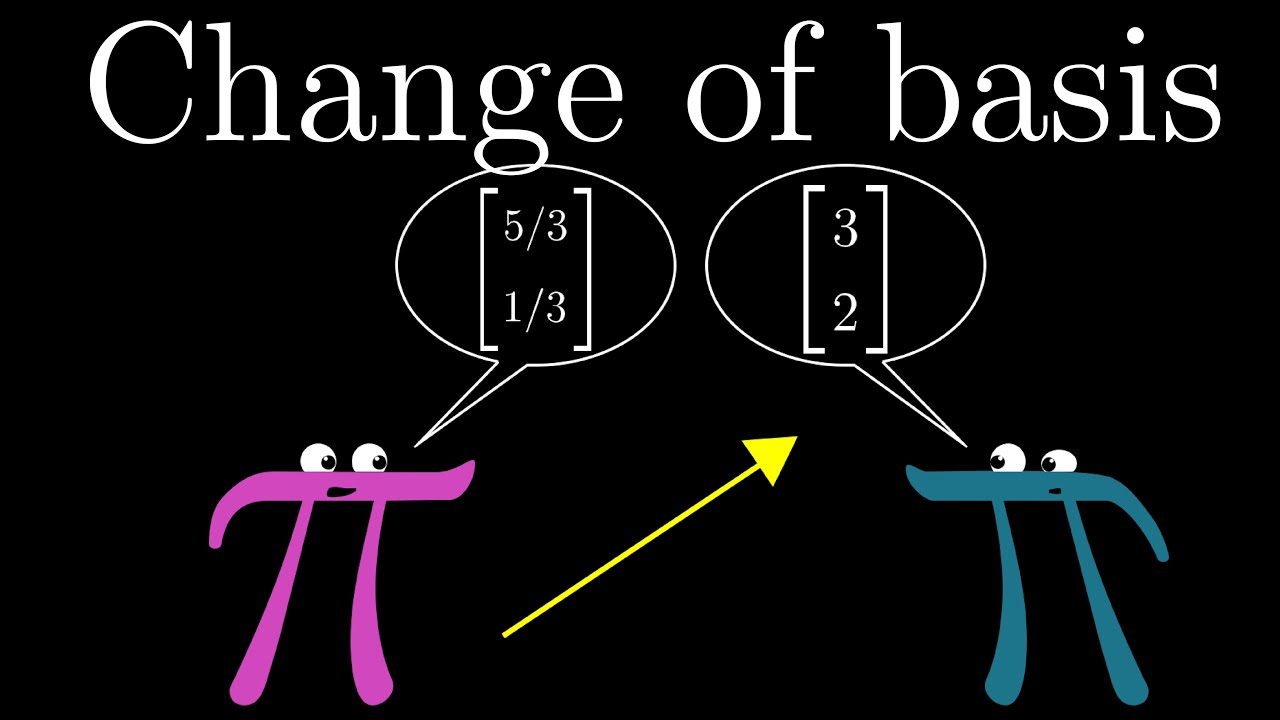
Home page: https://www.3blue1brown.com/
How do you translate back and forth between coordinate systems that use different basis vectors?
Full series: http://3b1b.co/eola
Future series like this are funded by the community, through Patreon, where supporters get early access a...
maiden silo
I think the fourth one is wrong
But can anybody help confirm that the answers to these are
T, T, T, F, T
I think I've logic-ed through it but I may have made some mistakes in my thinking
<@&286206848099549185> I didn't know you couldn't ping helpers until after 15 minutes until I just looked over the faq again, so I removed my original tag. Sorry guys
novel ether
hey team i have set up the intergral but I dont know what to make the intergral limits, was looking for some help
 hidden arch
hi, I am new here and my math is very basic(I presume) where do I send it ?
novel ether
@dusky epoch i have no idea
dusky epoch
(0,0,0) corresponds to t=0, (1,1,1) to t=1.
@hidden arch if you're not sure, send it in one of the ten questions channels that aren't occupied
hidden arch
Thank you and sorry for doing that here
novel ether
@dusky epoch if the second point was say (1 , 2, 1) would it sitll be t= 1
i dont understand the second part
dusky epoch
it wouldn't even be on the curve {x=t,y=t^2,z=t^3}
novel ether
o right i kind of see what you mean now