#linear-algebra
2 messages · Page 69 of 1
 limber sierra
right
 remote elm
a + b is not equal to b + a
limber sierra
the question asks you to give a counterexample
remote elm
in this case
remote elm
would it be any a + b considering it says [a1 + a2, b1 + 1]?
so [5,2] + [3,2] is not equal to [3,2] + [5,2]
limber sierra
not quite any, but most, correct
limber sierra
in this case, your counterexample actually doesnt work
$\begin{pmatrix}5\2\end{pmatrix} \oplus \begin{pmatrix}3\2\end{pmatrix} = \begin{pmatrix}5+3\2+1\end{pmatrix} = \begin{pmatrix}8\3\end{pmatrix} = \begin{pmatrix}3+5\2+1\end{pmatrix} = \begin{pmatrix}3\2\end{pmatrix} \oplus \begin{pmatrix}5\2\end{pmatrix}$
 stoic pythonBOT
Namington:
limber sierra
but let's say we changed one of the b values
$\begin{pmatrix}5\2\end{pmatrix} \oplus \begin{pmatrix}3\3\end{pmatrix} = \begin{pmatrix}8\3\end{pmatrix}$
stoic pythonBOT
Namington:
limber sierra
$\begin{pmatrix}3\3\end{pmatrix} \oplus \begin{pmatrix}5\2\end{pmatrix} = \begin{pmatrix}8\4\end{pmatrix}$
stoic pythonBOT
Namington:
limber sierra
and, of course, $\begin{pmatrix}8\3\end{pmatrix} \neq \begin{pmatrix}8\4\end{pmatrix}$
stoic pythonBOT
Namington:
remote elm
right
limber sierra
so $\begin{pmatrix}5\2\end{pmatrix}, \begin{pmatrix}3\3\end{pmatrix}$ are a counterexample
stoic pythonBOT
Namington:
limber sierra
(and you'd show why they're a counterexample - i.e. show that a+b and b+a are not equal, as I did)
that said, you did make an observation that, if the bottom entries are both 1, then they do follow the rules - so that means that, while the entire set isn't a vector space
part of it does follow the rule
in order to show something isn't a vector space, you just need to find one counterexample
as it turns out for this problem, most pairs of vectors will be a counterexample
if b_1 =/= b_2, then their sums won't commute (hence breaking the rule).
remote elm
right
remote elm
thank you, i appreciate it, i think the general idea of it makes sense, i'm going to try more problems to practice.
 shrewd slate
Namington more like epicton
limber sierra
we know regular vector addition and scalar multiplication in R^n
is fairly well-behaved
and we can do a lot of fancy things with it, as you might've already seen (or if not, you'll see later in your course)
but it feels kind of... restrictive to only talk about "known examples" like R^n with basic addition/multiplication
and, indeed, by thinking about how we can "generalize this"
by establishing a few rules (10 or so) that we expect all vector spaces to follow
we can apply many of these "powerful results" to far more abstract structures
this has plenty of applications, both in mathematics and in the sciences
one example provided by your note is the vector space of polynomials of degree n
shrewd slate
At most n?
limber sierra
right, sorry
degree at most n
otherwise it's not a vector space!
consider for counterexample, the set of polynomials of degree 2
and the vectors x^2 + 1 and -x^2
then, (x^2 + 1) + (-x^2) = 1
but 1 isnt a polynomial of degree 2
so this set isnt closed under addition
and hence not a vector space
so yeah, thanks for the correction
shrewd slate
Does degree 0 work? I think in my course we defined 0 to have deg -∞
limber sierra
we often define 0 to have a degree of -infty, yes
if you use this definition, "vector space of polynomials of degree 0" doesnt make sense
as 0 isnt in that set
but uh... idk why you'd talk about $\mathcal{P}_0$
stoic pythonBOT
Namington:
shrewd slate
True
limber sierra
just talk about $\bR$ like a normal person
stoic pythonBOT
Namington:
limber sierra
(or whatever scalar field you're using)
shrewd slate
I was just wondering if it really was the case that it always has to be AT MOST
limber sierra
i believe so, yes
shrewd slate
Does seem like it
stoic pythonBOT
Namington:
limber sierra
this is just the vector space consisting of only the 0 vector
which is trivially a vector space
but also yuck
shrewd slate
That seems kinda silly with - ∞
shrewd slate
Yea
limber sierra
if you see someone write $\mathcal{P}_{-\infty}$, you hereby have Namington's executive permission to bash them on the head
stoic pythonBOT
Namington:
limber sierra
sadly, my permission does not transcend legal ramifications, although I'm sure if you tell the judge they'll be understanding.
shrewd slate
Namington, what’s the deal with direct sums of more than two subspaces
limber sierra
"How do you plead?"
"Guilty, but I deserve a pardon because the guy totally deserved it; he said 'consider the vector space of polynomials of degree -infinity!'"
"Ah, justified then. Court dismissed"
 sonic osprey
It's just (U ⊕ V) ⊕ W
sonic osprey
or equivalently, U ⊕ (V ⊕ W)
limber sierra
it works exactly the same as a direct sum of two subspaces
shrewd slate
Yea that’s what I assumed
It’s weird that it’s not mentioned in my book
Just for two
sonic osprey
because all operations extend in this way
limber sierra
i dont think theres anything interesting to say
sonic osprey
(all associative operations)
shrewd slate
It’s just that in a later chapter (the most recent one we’re on), they mention that a sum is direct ⟺ their dimensions add up normally
Then they prove that using Rank-Nullity’s and products of vectors
sonic osprey
What's your point?
shrewd slate
It should be able to be proven using the dimension of a sum + the fact that the intersection of direct sums is 0 and the dim of that is 0
And in a much earlier chapter
Ok like 1 chapter earlier but still
limber sierra
proving anything with rank-nullity is cooler
since i mean, "rank-nullity" is a snazzy term
sonic osprey
Also what you're saying only goes one direction I think
sonic osprey
Or maybe its that you might have to use rank-nullity to prove the fact you stated?
shrewd slate
The dimension of a sum of subspaces?
I guess it doesn’t matter much anyway as long as I know
 dusky epoch
they each used their own basis in specifying the locations of the mug and the plate
the confusion resulted from max specifying a pair of coordinates in his basis that lily interpreted as the same pair of coordinates in her basis, which translates to a different location on the table
 wintry steppe
should I specify using e1 and e2
because this is in R^2
How would I mention their difference in basis vectors tho?
 lethal bough
I need some extensive help and explaining with an assignment
If you have time, toss a dm
 pallid rampart
🤔
wintry steppe
Under which assumptions is a symmetric (not hermitian!) complex matrix $Z\in\mathbb{C}^{n\times n}$ diagonalizable? $\left[ \begin{array}{cc} 1 & i \ i & -1 \end{array} \right]$ is a counter-example I've seen quite often, but its eigenvalues are both zero. So what if we assume that all eigenvalues have positive imaginary part, i.e. $Z$ is invertible?
stoic pythonBOT
mathDE:
 spiral sonnet
For the rotation transformation matrix, if the direction is specified the sign doesn't matter rght?
If I wanna solve an augmented matrix does it have to be in reduced echelon form?
 pallid swallow
You mean, solve a linear system represented in an augmented matrix?
reduced row echelon form would help
spiral sonnet
Yeah
that's what I mean
1   3 -2
-4  h  8
how would I solve for h?
I ended up reducing to this
1     3   -2
0 (-12+ h) 0
would I need to turn 3 into 0?
dusky epoch
what is the question you're asked
spiral sonnet
determine the values of h such that the matrix is the augmented matrix of a consistent system
dusky epoch
okay great
this is the key piece of information
and yet you omitted it at the start
but ok
the -12+h should have been 12+h
and as written this system seems to be consistent no matter the value of h
dusky epoch
that does not make any sense
spiral sonnet
I'm always use to reducing a matrix into reduced row echelon form
If you don't reduce it fully can you still find x1 and x2?
dusky epoch
why couldn't you
it'll take a little bit more work but you can do it no problem.
unless you're allergic to basic algebra ig
spiral sonnet
1 h | 2
4 8 | k
What values would h and k have to be for the solution to be a) inconsistent b) unique c) have many solutions
I can reduce the matrix to this, but not exactly sure what to do after
1 h | 2
1 2 | k/4
I think I understand how it can be inconsistent. if h is 2 and k/4 isn't 8 then it's inconsistent
Not sure about unique and have many solutions
 rotund jetty
that would be really appreciated!
dusky epoch
consider a basis of W
rotund jetty
aight some basis ${v_1, ..., v_k}$
stoic pythonBOT
Nicholas:
rotund jetty
oh fuck @dusky epoch thank you so much. That was a trivial observation, I'm a dumbass
spiral sonnet
Find the transformation matrix of T, where T: R^2 -> R^2. Where T rotates points (about the origin) through -pi/4 radians (clockwise)
the rotation should be in counterclock wise, but I'm not sure where -pi/4 would be
 half osprey
is it ok to post memes here?
half osprey
ok thanks
wintry steppe
How's Linear Algebra is it hard?
wintry steppe
if you have that condition to be true for all eigenvalues then you can diagonalize your matrix
wintry steppe
What are you asking then?
pallid rampart
I would say for anything, doing it yourself is always the best way to learn it
 half ice
As with most math, doing your own investigations is usually the best way to learn. Linear algebra has some amazing theorems, try to reason them out. Notably, every vector space has a dimension. Why?
And stuff like that
You maybe haven't seen exotic examples of vector spaces, and that may be your confusion
You invent whatever scalar multiplication and vector addition you want. It just has to obey those 8 axioms
I'll invent a strange one right now. Do you know modular arithmetic by chance?
Yeah! So let's say we work with the integers {0,1,2,3,4} in mod 5 arithmetic. This actually fits all of the axioms that scalars need to satisfy
For the vectors, let's say we have a list of 3 numbers mod 5. So something like (2,4,0)
This all comes together to form a vector space
However, if I did the same stuff all mod 4, it would not be a vector space because the scalar 2 has no multiplicative inverse
I know this might be a little bit much to take in lol. Abstract algebra gives a lot of great examples to make vector spaces with
Basically, these properties are not assumed - they come from the algebra stuff you are working with. It's very easy to choose similar stuff and NOT make a vector space with it
That's a much better way to say it, yeah
Sadly, for the "regular" vector space on R, you can't prove these properties. They are pretty well assumed
That shouldn't be how it is, but R is too complicated to really prove things with at this level
Ha ha, nice pun
R is difficult to construct. The worst part of any analysis course is actually defining R, then discussing addition and multiplication on it.
In this sense, C is simple. Once you have R, you create C by an algebraic extension. Simply take R, say i² = -1, and you have C
limber sierra
well you need to do a little more
but yeah
(you can also define C linear algebraically by considering matrices {a&b\-b&a})
but yeah, constructing R properly is hard
and showing it has all these properties
that we expect the reals to have
for example, how do you define real exponentation?
like $\pi^{\sqrt{2+e}}$
stoic pythonBOT
Namington:
limber sierra
how do you know this "works"?
how do you know it "behaves"?
eg $\pi^{\sqrt{2+e}} \cdot \pi^{5} = \pi^{\sqrt{2+e}+5}$
stoic pythonBOT
Namington:
limber sierra
all of these properties, you cant exactly take for granted
they're generally left out of a linear algebra course though
constructing R and proving basic properties is usually reserved for introductory real analysis
once you have R, R^2 and R^3 and whatnot are all trivial
but getting up to R is tough.
half ice
Off the tangent, this is a let down of your Lin Alg course right now. It's hard to see why the 8 axioms may fail, because you are always working on an algebra where they just assume that they hold.
limber sierra
as an example of a vector space thats a bit more abstract, but is actually useful
consider the set of polynomials with rational coefficients
half ice
Oh yeah, should have brought up polynomials
limber sierra
we often denote this $\bQ[x]$
stoic pythonBOT
Namington:
limber sierra
as it turns out, these polynomials form vectors
with rational numbers being scalars
and indeed, this behaves perfectly well as a vector space
even if its a bit esoteric, arithmetic behaves exactly as you'd expect
but what if, instead, we talked about the polynomials with natural coefficients? say $\bN[x]$
stoic pythonBOT
Namington:
limber sierra
here I'm taking $\bN$ to include $0$
stoic pythonBOT
Namington:
limber sierra
but even then, we don't have a vector space structure, because most polynomials dont have a negative
like x^2 + ??? = 0
clearly, that'd be -x^2, but -1 isnt natural
so -x^2 isnt in our set
hence, $\bN[x]$ isnt a vector space
stoic pythonBOT
Namington:
limber sierra
alright, so that was an example where addition and multiplication still worked
"as we expect"
but this doesnt necessarily always hold, either
let me think of an example
yes
$\bR[x]$, for exmaple, forms a vector space
stoic pythonBOT
Namington:
limber sierra
because we're allowed negative coefficients now
-x^2 is in R[x]
but -x^2 is NOT in N[x]
so N[x] is not a vector space
R[x], as it turns out, is.
(in fact, if youve taken some calculus, we can talk about vector spaces of power series, R[[x]])
x^2 would be a vector
R[x] is the vector space
it's not a subspace because its not a vector space
it's a subset that does not form a subspace
yes
they need to have internal vector space structure
half ice
I'm a huge fan of mental shortcuts. Understand the rigor, but "vectors space within vector space" is bae
limber sierra
x^2 is not a vector space
as i said
it's a vector
in the vector space R[x]
(or in N[x] or similar)
dusky epoch
N[x] isn't a vector space
half ice
There is the vector space of all quadratics in R[x]
limber sierra
uh
half ice
Which is a subspace of R[x]
half ice
Yes
limber sierra
ok good
half ice
Oop should have been more clear
half ice
All polynomials of degree ≤ 2 is a subspace of R[x]
limber sierra
form a vector space
ok, let me refocus a bit
the general theme is
you're kind of taking the nice properties of R, R^2, etcetc "for granted" a bit
but mathematicians often want to apply tools from the study of one area of mathematics
to the study of another area
to do this, mathematicians generalize
we see that R^n obeys all these nice properties
but we also see some similarities between these properties and, say
the structure made by considering certain functions on a set to a field
as it turns out, these structural similarities can be unified under the definition of a "vector space"
this is far from the only structure mathematicians do this with, but it's generally the one students encounter first (for historical reasons)
the advantage is that, if we prove something about an arbitrary, abstract vector space
it now applies to anything that follows the same rules as a vector space
for example, an injective linear map (a well-behaved function between vector spaces) from F^n to k^n is always surjective
this holds regardless of what vector spaces we're considering
and indeed, this is a bit more powerful in that (assuming finite dimensional) we can represent these linear maps as a matrix
cutely enough, this applies to any linear map between vector spaces
which means we can find a matrix representing... well, differentiation
as a nice, calculus-ey example
indeed, if we consider the space of polynomials of degree at most n, denoted $\mathcal{P}_n$
stoic pythonBOT
Namington:
limber sierra
the matrix of the derivative operator in $\mathcal{P}_2$ is $\begin{pmatrix}0&1&0\0&0&2\0&0&0\end{pmatrix}$
stoic pythonBOT
Namington:
limber sierra
in $\mathcal{P}_3$, it's $\begin{pmatrix}0&1&0&0\0&0&2&0\0&0&0&3\0&0&0&0\end{pmatrix}$
stoic pythonBOT
Namington:
limber sierra
the pattern continues from there
this might seem like an overcomplicated way to talk about the polynomial derivative
but it's nice, because now if we know theorems about general matrices in a vector space
those theorems apply to the derivative!
(at least the polynomial derivative)
as a quick example, one can find that these matrices are noninvertible
hence the derivative doesnt have an inverse
we "fix" this problem when taking antiderivatives by adding a +C
we can also find matrices representing repeated differentiation by taking higher powers of these matrices, etc.etc.
anyway, thats a bit of a side tangent
I was just kind of trying to "motivate" this abstraction
the basic idea is, the "rules" of a vector space let us know what "rules" we can use in proving theorems
and because all vector spaces follow the same "rules"
we know that our theorems appl yto anything that can be regarded as a vector space
if you take some higher-level math or physics, youll probably hear the term "hilbert space"
which is a very important object in physics
and part of the reason it's so important is that, well, it's a vector space
which means we know a lot about it
just from knowing that it obeys these 8 basic rules
of course, we can study it further in its own right
(e.g. we talk about inner products, we talk about completeness and calculus, etc.etc. which something like (Z/nZ)^3 wouldnt have)
but these linear algebra connections give us some very deep reasoning ability
as well as letting us easily compare different vector spaces and potentially find connections
for example, the space of complex numbers $\bC$ can be thought of as the space of matrices ${\begin{pmatrix}a&b\-b&a\end{pmatrix}\mid a, b \in \bR}$
stoic pythonBOT
Namington:
limber sierra
with standard addition/multiplication
so this gives us a relationship between a specific subspace of $\bR^{2\times 2}$ and the very important structure $\bC$!
stoic pythonBOT
Namington:
limber sierra
(we call such a relationship an "isomorphism")
anyway, i kind of threw a lot of information at you
and its probably more "abstract motivations" than "concrete useful stuff"
but I hope this helps contextualize why we care about whether something is a vector space
vector spaces have a lot of really nice structure
in fact, it's often quipped that "No one understands modern mathematics. Because of this, mathematicians spend all their time trying to reduce math problems to linear algebra problems. Linear algebra is the only math anybody really understands."
this is obviously said in a joking tone, but there's some truth to it
if you can reduce a problem to a linear algebra problem, it becomes a lot easier to solve, generally speaking
we know a lot about vector spaces
Indeed, the standard model of subatomic physics is built using groups (another type of mathematical structure) of matrices from certain vector (sub)spaces.
not always, but it's a common "tool" in a mathematician's (and physicist's) toolkit.
dusky epoch
in a sense heavily dependent on context, yes
limber sierra
and the reason is that vector spaces have a lot of deep, nicely-behaved, well-studied structure
so rather than developing a whole new theory from scratch
see "can i talk about this in terms of vector spaces, and use what i already know about those?"
im simplifying the process radically, of course
but thats the broad motivation.
[indeed, in order to apply vector spaces to more settings, we often imbue them with some additional structure - such as an inner product, a norm, a topology]
[for example, the euclidean norm lets us do geometry on R^n by formalizing the concept of "lengths".]
dusky epoch
bc sometimes your problem necessitates seeing if your nonhomog system even has a solution in the first place
dusky epoch
,,,, i feel you're ever so slightly overthinking all this and i'm too tired to properly address that overthinking
 novel ether
does anyone know how to do these?
 gray dust
In this chapter we will look at solving systems of differential equations. We will restrict ourselves to systems of two linear differential equations for the purposes of the discussion but many of the techniques will extend to larger systems of linear differential equations. ...
novel ether
i need help im doing question a and i got a repeated eigevn value, not sure how to find both eigen values
 austere cedar
It does have a section on repeated eigenvalues
uses guess like in the single case... multiplying one solution by t to get the second LI one
 chilly dragon
hello
i'm trying to wrap my head around eigenvalues
specifically: a matrix must be non invertible to have an eigenvalue
wait
it's
$ A - \lambda I $
stoic pythonBOT
Fibbba:
chilly dragon
that must be singular
so, why do we want that 🤔
because if a matrix is singular, then the system has no solutions
dusky epoch
no
chilly dragon
this is what's confusing me
dusky epoch
you want Ax = λx to have a nonzero solution for x. yes?
chilly dragon
yes
dusky epoch
do you see why Ax = λx is equivalent to (A - λI)x = 0
chilly dragon
actually i don't
dusky epoch
okay
chilly dragon
specifically multiplying lambda with I
dusky epoch
I is the identity matrix
chilly dragon
yes i know
dusky epoch
λI is the matrix for the transformation that scales its input by λ
chilly dragon
by scales you mean make it longer ?
dusky epoch
no, by scale i mean scale
scalar vector multiplication yknow
that shit
there may not even be a notion of length in your space
dusky epoch
all i mean is the transformation that sends x to λx, and you keep overthinking it
chilly dragon
say we're in 2x2 space
dusky epoch
what do you mean
chilly dragon
λI scales it because it changes e_0 by λ and e_1 by λ
dusky epoch
if you absolutely insist
chilly dragon
ok that helps
so we multiply λ by I
to try to reverse the equation
right ?
kinda like working backwards
chilly dragon
Ax = λx is equivalent to (A - λI)x = 0
dusky epoch
we could subtract λx from both sides to get Ax - λx = 0
chilly dragon
that is clear
dusky epoch
but the step that seems to be giving you trouble is turning the scalar vector product into a matrix vector product
namely that λx = (λI)x
chilly dragon
ah we multiply so we subtract the values only from the basis vectors
dusky epoch
no you're overthinking again
chilly dragon
🙆
dusky epoch
we rewrite it in this way so that we can write the equation as (matrix)*x = 0
the matrix in this case being A-λI
because we have our equation as Ax - (λI)x = 0
chilly dragon
😮 i see now
chilly dragon
yes
dusky epoch
wonderful
so
you still want a nonzero solution for x
if A-λI is nonsingular then this system doesn't have any of those
that make sense?
chilly dragon
why
if the first row of A-λI equals the last row of A-λI and first value of x is -1 and the last is 1
isn't that a solution
wait no
if A-λI is nonsingular, the system has a solution
isn't that what we're interested in
chilly dragon
ok
dusky epoch
but x=0 is NOT what we are interested in.
chilly dragon
ah because we want to solve for lambda
dusky epoch
but if A-λI is NONSINGULAR, then x=0 is the ONLY solution.
chilly dragon
oof
so basically we want to find lambdas that make A-λI singular ?
because then x will not be a zero vector
🤔
dusky epoch
because then we will have nonzero solutions for x
and those solutions are called eigenvectors
chilly dragon
so basically i interpreted A-λI is singular wrong
what it says is: we want to find λ so that A-λI is singular ?
dusky epoch
if your goal is to find the eigenvalues of A, then yes, they are precisely those lambdas
chilly dragon
ok i got it, big thanks
dusky epoch
multiply the matricies for each one
what's that even supposed to mean
gray dust
multiply what matrices
 smoky lagoon
the thing thats tripping me up is the (x1+x2) and (x2-x3)
it doesn't matter because the dimensions are wrong
dusky epoch
do you know, in general, how to find the STANDARD MATRIX of a linear transformation
smoky lagoon
I think so
if it was just x1 and x2 and not their sums and difference in front it wouldn't be from r3 ro r3 but
that's obviously not the solution to the problem because it needs to be a 3x3 matrix
gray dust
Try finding where T maps the standard basis vectors of R^3
dusky epoch
i think so
there's no "i think so", either you do or you don't
and it looks like you do not know that to find the STANDARD MATRIX of a transformation, one needs to calculate the vectors to which your transformation takes the vectors of the STANDARD BASIS of R^3, and assemble your matrix out of those vectors as COLUMNS.
or didn't know until now.
smoky lagoon
how do i do that
dusky epoch
do what
gray dust
compute T(e1), T(e2), T(e3)
smoky lagoon
what you just said i need to do i'm not sure how to do that
dusky epoch
are you able to compute T(e_1), T(e_2) and T(e_3)?
smoky lagoon
i don't know what that means
dusky epoch
$e_1 = \mat{1 \ 0 \ 0}, e_2 = \mat{0 \ 1 \ 0}, e_3 = \mat{0 \ 0 \ 1}$
stoic pythonBOT
Ann:
dusky epoch
are you able to evaluate T at each one of these?
smoky lagoon
what is T here
dusky epoch
are you able to
yknow
ok
great
then are you able to take the results and assemble them into a matrix
smoky lagoon
ok maybe i dont know how to evaluate at T
smoky lagoon
it would just be T in front of each 3x1 vector
stoic pythonBOT
Ann:
smoky lagoon
T
dusky epoch
...
dusky epoch
...
...
bruh
what do you think T is
is it a number, is it a vector, is it a matrix
what kind of object even is it
smoky lagoon
it's a transformation but i don't know what that means
dusky epoch

smoky lagoon
"transpose"
dusky epoch
how can you,,, be in a linalg class and not know what a (linear) transformation is
smoky lagoon
very good question
dusky epoch
T is, first and foremost, a FUNCTION. in this case, a function from R^3 to R^3.
smoky lagoon
okay
smoky lagoon
that's great but I'm just trying to understand it
dusky epoch
yeah well this is like trying to understand how to solve a quadratic equation when you can barely grasp how to add two double-digit numbers
in terms of conceptual leaps
so you'd be spending a long long while
i recommend you to revisit your linear algebra class notes. borrow some from a friend or your lecturer if need be
smoky lagoon
I don't know anyone in my class
I can't read my own writing
and my lecturer is not helpful
he doesn't write most stuff down so im trying to imagine what hes talking about and in doing that
i miss most of the stuff because i dont think quickyl
smoky lagoon
like i'm looking at the book now
and it's not actually explaining anything
just jargon
 cursive narwhal
It's just a function
cursive narwhal
They just refer to it by a different name. But $T:\bR^n \to \bR^m$ is just a function.
stoic pythonBOT
Abhijeet Vats:
dusky epoch
well given that you didn't know what a transformation was until a few minutes ago, i would not expect you to know the construction of the standard matrix of a transformation
smoky lagoon
I'm just doing problems out of the book because I know I don't understand this stuff
cursive narwhal
Anyways, just study what it is from your textbook first. Work through it slowly, no need to rush
dusky epoch
the first column of the standard matrix of T is T(e1)
the second column of the standard matrix of T is T(e2)
the third column of the standard matrix of T is T(e3)
smoky lagoon
i know that e1 is
cursive narwhal
Naz, just read through your text and understand this stuff first
dusky epoch
yeah great so well
naz
you're literally given a formula for T
you're literally told in the most direct of ways what the value of T is for every input vector (x1, x2, x3)
smoky lagoon
dunno
dusky epoch
well loo
k
lemme make this real simple for you
dumbed down to the min
$T \mat{x_1 \ x_2 \ x_3} = (x_1 + x_2) \mat{1 \ -1 \ 0} + (x_2 - x_3) \mat{2 \ -1 \ 1} \ \ T \mat{{\color{red}1} \ {\color{green}0} \ {\color{blue}0}} = ({\color{red}1} + {\color{green}0}) \mat{1 \ -1 \ 0} + ({\color{green}0} - {\color{blue}0}) \mat{2 \ -1 \ 1}$
stoic pythonBOT
Ann:
dusky epoch
$T\mat{1 \ 0 \ 0} = \mat{1 \ -1 \ 0}$
stoic pythonBOT
Ann:
dusky epoch
for the other two STANDARD BASIS VECTORS, yes.
smoky lagoon
and those give me the columns of my standard matrix, no?
dusky epoch
that's exactly what i've been saying
smoky lagoon
remember when I said earlier I think very slowly
so this is what I got in the end
 smoky lagoon
to tell if its one to one
i just need to see if has a zero row or a free variable
cuz square matrix one implies the other
well\
I know if its one to one if the columns of the matrix are linearly indepndent
and they are not
so
how was i so STUPID
 cold topaz
when is says find A^-2, doesn't it mean (A^2)^-1???
 quartz compass
try seeing if you can prove (A^2)^-1 = (A^-1)^2
 novel sapphire
is the determinant of a 3x3 matrix its cross product?
sonic osprey
What does it mean to take the cross product of a matrix?
limber sierra
that sentence doesnt make sense, but there is a relationship between determinants of real matrices and cross produts
indeed, let $u, v \in \bR^3$; then we can define $u \times v$ to be the vector such that, for all $w \in \bR^3$, $(u \times v) \cdot w = \det\begin{pmatrix}\vline&\vline&\vline\u&v&w\\vline&\vline&\vline\end{pmatrix}$
not sure if this was the kind of connection you were thinking of.
stoic pythonBOT
Namington:
limber sierra
uh
well no
this is a way of defining the cross product of two vectors, not of defining the determinant
novel sapphire
ah
limber sierra
like there are some connections but most of those are just "the algebra happens to work out nicely"
novel sapphire
oh ok thanks
 slim laurel
Hey guys, could someone give me a starting point to disprove/prove
The column space of the RREF of a matrix A is the same as the column space of A.
I have a hunch that the row operations will affect the column space but no reason behind it...
 mild tiger
@slim laurel I'm currently learning this stuff too, but idrk if i'm right
i'm gonna guess u need to
know that rref is sorta combinations of rows of A
span of both columns are the same
i'm not very good at lin alg, so... wait for someone better lol :P
slim laurel
hmm I think the column space are different for RREF(A) and A though
I know row operations does not affect the row space but I believe they do affect the column space
i'm just not sure how to prove it...
limber sierra
well, if you find a matrix such that CS(A) is not equal to CS(RREF(A))
you're done
limber sierra
this gives some immediate ideas
for example consider $\begin{bmatrix}1&0\1&0\end{bmatrix} \in \bR^{2\times 2}$
stoic pythonBOT
Namington:
mild tiger
@limber sierra can u plz helps with T/F question in #help-1
oh nvm i think someone answered
limber sierra
the column space of this is the span of the vector (1 1), while the column space of its RREF is the span of (1 0)
which are clearly different
for example, (5 5) is in the former, but not the latter.
 radiant meteor
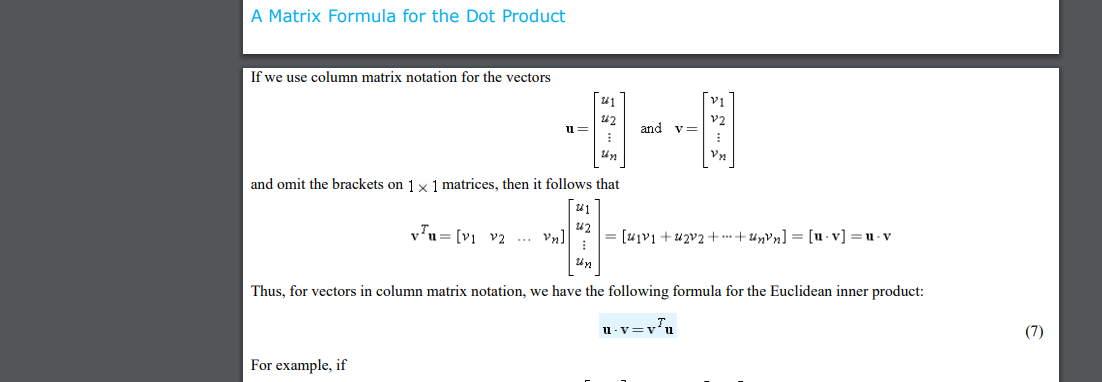

what about omitting the brackets on the 1 x 1 matrices ?
where are those lol
on the very far rhs?
u dot v ?
feel free to at me cuz im looking at the book lol
limber sierra
this is a 1*1 matrix
@radiant meteor
indeed, you can verify this
you're multiplying a 1*n matrix with an n*1 matrix
so you end up with a 1*1 matrix
radiant meteor
ahh
limber sierra
and its only entry corresponds with the dot product uv
radiant meteor
so when they omit the brackets they're talking about the rhs
limber sierra
yep.
radiant meteor
thanks xD
 swift frost
this might not be the right channel for this, but does anyone know of an online course I could take with other people for linear algebra? coursera, udacity are a bust
half ice
3b1b has a linear algebra "assist" playlist. It's not an entire course, but if watched alongside a course, will make you better at LA. It's very good
I would be suprised if professor leonard didn't have a full course
I know KahnAcademy does
swift frost
I more meant with other people where everyone works on the same problems at the same time, etc.
half ice
Oh I have no clue haha
swift frost
I know harvard extension school has courses but they cost a lot of $$$
 final forge
Hello! May I ask if somebody could tell me what 'margin' in context of matrices means? I'm not a native English speaker.
limber sierra
no clue; do you have the full context?
wintry steppe
lets say x is an eigenvector of some matrix corresponding to a lamda. then cx is an eigenvector of that matrix where c =/= 0 and c is a member of the (integers or reals?)
pallid rampart
the scalar field
dusky epoch
@final forge where are you seeing this term
cold topaz
when we want to write a matrix in reduced row echelon form, that mean we have simplify the elements as much as possible. Correct?
dusky epoch
no
gray dust
simplify the elements as much as possible
is not tightly worded. the criteria for a matrix to be in RREF are easily google-able
dusky epoch
too vague
final forge
@dusky epoch, one example I remember is here:https://math.stackexchange.com/questions/3233487/states-of-the-world-game-theory-and-beliefs
The part:
'with semicolons representing block margin'

Mathematics Stack Exchange
This post consists on 3 parts: the question itself, hint and a table.
The question will make sense to you only after you have read the tables and the hint attached. The problem is about beliefs of a
cold topaz
@gray dust I have gotten up to this point. Why isnt this enough? why should i go further?
thats what i meant by simplifying.
oh. is it because it must be 0 above 1?
i'm talking about the second leading 1.
gray dust
one of the RREF criteria is that each leading entry must be the only nonzero entry in its column
dusky epoch
the criteria for a matrix to be in RREF are easily google-able
cold topaz
ive already googled. its more confusing. Didn't I figure it out correctly though?
i mean i should get -1/6 to zero and thats it.
arent i correct?
gray dust
one of the RREF criteria is that each leading entry must be the only nonzero entry in its column
cold topaz
i dont see how whatever ur saying is different from mine...
limber sierra
so yes, you need to reduce the -1/6 to 0.
cold topaz
cool
mild tiger
i said "the first one is obvious since Col(A) is span of columns and 0 vector is in any span AND same with Null space"
but its actually not the same for null right?
wait
nvm A0 = 0
lol
dusky epoch
i mean
the nullspace of any matrix is a subspace
of R^n where n is the matrix's col count
mild tiger
right...
 vast torrent
The set of all functions with domain N and codomain R
limber sierra
yeah, with no further context there's no reason to assume linearity here
or to assume that N and R are vector spaces
rather than just sets
vast torrent
And such functions are real-valued sequences,
 brittle fog
Hello. can someone talk to me about inner and outer products? Inner products of vectors are numbers and their outer products are matricies. I like that symmetry. But the inner and outer products of (square) matricies are still square matricies. So whats the big difference? Why does A^TA help solve the least squares problem? Is it just because A^TA is going to be invertible?
vast torrent
Inner products should always be numbers
brittle fog
Ok, so is A^TA not an inner product?
quartz compass
idk if I'd say that exactly
the entries of A^TA are going to be every possible combination of inner products of the columns of A
like effectively A^TA can be used as something called a Gram matrix which is used to define an inner product, really just like a kind of way of writing a metric tensor
strictly speaking no ok, A^TA is just a matrix lol
brittle fog
Alright. So why does it help solve the least squares problem?
quartz compass
what do you know about it already? you can find derivations of it and lectures about it
it doesn't come out of thin air
brittle fog
Like I get that its square, symmetric, invertible, etc. Which allows a solution to the Normal equations. But, it just seems very convenient that the psuedoinverse*b results in a vector x that gets Ax = b as close as possible
 unkempt robin
Do you mean like this sort of formula: $\hat{x} = (A^T b) (A^T A)^{-1}$
stoic pythonBOT
skippi:
brittle fog
yes but for me in the context of the class I'm in it is $\hat{x} = (A^T A)^{-1}(A^T b) $
stoic pythonBOT
RamJam413:
brittle fog
where (A^T A)^{-1}(A^T) = A dagger, the psuedoinverse
 gloomy arrow
it doesnt depend on the pivots right? Just if the determinant is non zero?
 feral grove
what do pivots tell us about the column vectors of a matrix
and what do the column vectors tell us about the determinant
gloomy arrow
Just tells you about the solutions
I mean the pivots wouldnt matter to invertibility
Oh wait it would it would
You would need exactly n pivots for an n by n matrix to be invertible
unkempt robin
@brittle fog I'm just being dumb, what you wrote is the correct formula
The intuition I was taught in class was to compare it to vector projection.
brittle fog
Oh, wait. Does it just put it where vector b would be if it had (m-n) fewer dimensions?
feral grove
uh @gloomy arrow yes but why
unkempt robin
Uh... I don't understand
brittle fog
Does it project b onto the column space of A and then solve for that?
gloomy arrow
@feral grove I was looking at my notes and remembered the invertible matrix theorem
unkempt robin
RamJam: I had to do some reading, but yes that sounds correct
feral grove
ah i mean ok, appealing to a theorem is an answer i suppose
gloomy arrow
@feral grove What were you looking for?
feral grove
i mean idk i was just wondering if you had some intuition for why this should be true
cold topaz
what does this sentence mean?
columns```?I think they just mean one row that's a scalar multiple of another row
dusky epoch
or ditto for columns
wintry steppe
okay bois I'm at the airport, and I don't have pen and paper, and I'm just trying to code something up really quickly
So here goes my question:
I have a vector in R^3. I want to find an orthonormal basis for its orthogonal complement. Is there a closed-form expression for this orthonormal basis that I can translate straight to code?
Obviously, I could write a rather mundane procedure:
- Determine a basis for the null space of v^T.
- Use Gram-Schmidt to find the orthonormal basis.
but I'm just a bit lazy
cold topaz
what about 3x3 matrix? should all three be multiple of each other or only two?
wintry steppe
for a 3x3 matrix, linear independence is not as simple
spiral sonnet
Can you subtract a matrix with a scalar?
gray dust
can you show me what that operation would look like?
spiral sonnet
Oh I meant a vector not a matrix
gray dust
can you show me what that operation would look like?
spiral sonnet
I have no clue what it would look like
I believe it works when I'm using python so every value in the matrix just gets subtracted using the scalar
gray dust
if A is a matrix and c is a scalar then this operation
every value in the matrix just gets subtracted using the scalar
can be written as A-(matrix of same size as A, with all entries being c)
 vapid copper
Hey guys!
I'm a bit lost on how to decide which are linear
Would love some help ^^
gray dust
hit up the defn of linear map
vapid copper
I understand that they must preserve the operations of addition and scalar multiplication to be a linear map
but I'm not sure how you can check that
dusky epoch
write out h(u+v) and h(u) + h(v), where u and v are vectors
vapid copper
Could you show me once so that I may do the others?
gray dust
u,v are vectors in R^3. let u=(u1,u2,u3), v=(v1,v2,v3). compute h(u+v) & h(u)+h(v)
vapid copper
so u would be (x, y, z) and v would be (x, x+y+z, 0)?
and then you have to show that the computation h(u+v) is the same as h(u) + h(v)?
in the case for exercise A)
gray dust
let u=(u1,u2,u3), v=(v1,v2,v3)
vapid copper
i don't get it
gray dust
u1,u2,u3 are the components of u
how to read h's defn: for a vector in R^3 which has components x, y, and z, its image under h is given by h(x,y,z)=(x,x+y+z)
vapid copper
i still don't understand how to compute it
gray dust
h(1,2,3)=(1,1+2+3)=(1,6)
gray dust
u,v are vectors in R^3. let u=(u1,u2,u3), v=(v1,v2,v3). compute h(u+v) & h(u)+h(v)
gray dust
that's to demonstrate to how to plug a particular vector into h
vapid copper
So you just do the same but with variables u1, u2 and u3?
gray dust
u,v are vectors in R^3. let u=(u1,u2,u3), v=(v1,v2,v3)
this is saying let u be a vector in R^3 with components u1, u2, and u3
one would compute h(u) exactly as i did for h(1,2,3)
vapid copper
so h(u) = (u1, u1 + u2 + u3)?
gray dust
yes
vapid copper
How does that help me determine whether it's linear?
If I do it for V, i'd just get the same thing but for v
gray dust
show h(u+v)=h(u)+h(v)
vapid copper
So u + v is just regular vectors additions?
(u1 + v1)
(u2 + v2)
(u3 + v3) or (u1 + v1, u2 + v2, u3 + v3)
for x, y, z components
and then plug that into h?
gray dust
sure
vapid copper
yeah i know
that's what i was gonna do now
Sorry i'm doing this in a weird order, first time
oh my god it's the same!!
thanks @dusky epoch and @gray dust
stoic pythonBOT
Pattrigue:
vapid copper
do you have to show it for scalars too?
dusky epoch
i mean yeah you've only shown additivity so far
vapid copper
alright, i got that part down, how do you do with scalars?
show r * h(u) = h(r * u)?
where u is a vector and r the scalar
gray dust
yes
vapid copper
alright thanks
glad you helped, this made it much clearer than the textbook and videos did
correct? for scalars
gray dust
👍🏾
vapid copper
thank you!!
 burnt pelican
why is linear algebra so hard 
vapid copper
did you mean: discrete math
burnt pelican
no, discrete math is easy
dusky epoch
maybe because it's unfamiliar to you
gray dust
maybe, but i'd still go through the motions of showing h is linear for practice
gray dust
yes
gray dust
this is another way to write a function
gray dust
for example the function $z\mapsto z^2$ takes an input $z$ and returns $z^2$
stoic pythonBOT
RokettoJanpu:
limber sierra
that function would be $f\begin{pmatrix}x\y\z\end{pmatrix} = 3x - y - z$
stoic pythonBOT
Namington:
limber sierra
in other words, it maps a matrix (x y z) to 3x - y - z
the symbol $\mapsto$ represents the ``mapping rule"
stoic pythonBOT
Namington:
vapid copper
i see, what's with the dot product part then?
limber sierra
an alternate way of writing it
vapid copper
ohhhhh
limber sierra
$\begin{pmatrix}x\y\z\end{pmatrix}\cdot \begin{pmatrix}3\-1\-1\end{pmatrix} = 3x - y - z$
stoic pythonBOT
Namington:
limber sierra
by definition of the dot product
vapid copper
yeah they're the same, i see
limber sierra
its just showing 2 alternate ways to represent it
vapid copper
so essentially, show that
f(x1, y1, z1) + f(x2, y2, z2) = f(x1 + x2, y1 + y2, z1 + z2)?
for the addition rule
limber sierra
yes
vapid copper
got it, thanks
gray dust
To fix up your vocab, a set of vectors S, such that span(S) equals some given vector space V, is called a spanning set for V. If S is linearly dependent, there exists a proper subset of S, let’s call it W, ie we can toss out some elements of S to make W, such that W is linearly independent and span(W) is also equal to V. We call W a minimal spanning set for V or a basis for V
my response to you in #help-1 which you apparently haven't ignored but failed to acknowledge. your answer lies here:
We call W a minimal spanning set for V or a basis for V
stoic pythonBOT
work:
gray dust
asking for clarification is encouraged, but failure to acknowledge responses isn't
dusky epoch
preach
 mellow stratus
if I decompose a 2x2 tensor into symmetric and antisymmetric components
can I express the antisymmetric component as Tik=eplision ijk omegaj
austere cedar
To the best of my knowledge as a result of Cramer's rule
The system you could make can only be solved if the determinant of A is non zero
If you write it in the for
Ab=c
b= [x,y,z]^T
c = [1, 3, 2]^T
[T means transpose, so the actual (1x3) matrix ]
 thorn prairie
me?
gray dust
you can alternatively find the value(s) of k that make the rows of the system's augmented matrix linearly dependent
gray dust
note that row 1+row 3=row 2 but only for a certain value of k
gray dust
and what if k!=2?
austere cedar
Yeah, it's probably best to do it ^'s way for understanding, maybe Cramer's rule is cheating 🙂
thorn prairie
if k !=2 we have a solution?
gray dust
how many solns?
thorn prairie
basically it says a find k for 1 solution , b) find k for infinite solutions and c) find k for no solutions
um just one since its 3 row 3 col
matrix
gray dust
yeah, the reason being any k!=2 makes the rows of the system's augmented matrix linearly independent
thorn prairie
yep
the thing that confused me is that its a bit vague what you get on the matrix
on what k must be equal to
so yeah you had to see for infinite that for k = 2 2nd and 3rd rows are equal
but for no solutions?
i think you can never have no solutions
cant
gray dust
that's it
austere cedar
I can only get k not equal to 2 by using the row operations 😢
austere cedar
k ≠ -3 should be one too?
austere cedar
Well Cramer's rule gave me k ≠ 2 and k ≠ -3 to make the system solvable
thorn prairie
let me see
austere cedar
I even checked online calculator for inputting k = -3 in the place of k
thorn prairie
yeah you are right
x = -3 gives 2nd row
0 1 -1 1
and 3rd
0 -5 5 0
so we end up with
0 0 0 5
which is impossible
so with k = -3 we get no solutions
austere cedar
That should be complete now
thorn prairie
yep
so i got :
1 0 0 1
0 1 0 1
0 0 1 1
a b c 0
for which a b c 's i get 1 , infinite and 0 solutions
a b c = 0 its 1 solution right?
any a b or c != 0 is infinite
austere cedar
I don't know I'm still trying to find the k = -3 one using row operation
thorn prairie
oh lol
wintry steppe
how would I find the basis for the equation x-2y+3x=0
gray dust
we can say a vector in the plane x-2y+3z=0 (that's what i assume you meant to say) has the form (x,y,z)
we can do some algebra to get x=2y-3z and let y,z be free variables. plugging this into (x,y,z) and doing a bit more algebra should reveal a nice basis for the plane
wintry steppe
@gray dust so i'm not sure what to do after.
stoic pythonBOT
hehexd lol:
gray dust
the aim is to represent an arbitrary vector in the plane as a linear combo of some vectors. rewrite (2y-3z, y,z) as a linear combo of some vectors
cold topaz
if columns of a matrix are multiple of each other, is that a sign that the determinant will be zero? Somebody said that on slader, and got -7 rating.
limber sierra
yes
if $A$ has two columns that are multiples of each other, then $A^{T}$ has two rows that are multiples of each other
stoic pythonBOT
Namington:
limber sierra
hence $A^T$ can be row reduced into a matrix with a zero row, i.e. $A^T$ is not invertible and so $\det(A^T) = 0$
stoic pythonBOT
Namington:
limber sierra
and since $\det(A) = \det(A^T)$, the conclusion follows
stoic pythonBOT
Namington:
quartz compass
it's also nice to know the interpretation of the determinant as gives you the volume of a parallelpiped with the vectors as sidelenths, so if they share two vectors in common it has 0 volume
cold topaz
thankssssssssss
wintry steppe
could someone explain 3b) to me
i'm very confused
on how to do it for another bases..
wintry steppe
I did a)
so we know the basis vectors in E is 1,0 0,1
it says 90 degrees clockwise
so after its rotate it becomes (0,1) and (-1,0)
and then just write down a matrix for that
dusky epoch
(1,0) rotated by 90 degrees ccw is not (1,0)
dusky epoch
i mean
exactly the same way? you still plug the vectors of B into R
and write the outputs in B too
 hardy island
i understand how c) was done, but could someone explain how they did d)? its completely going over my mind
first of all, the origin translated from F_A, shouldnt that be O_B(-3,2)?
why is it (-1,3)?
novel ether
Hey im stuck on what the question is asking and how to do it
gray dust
in a system of linear DEs, ie x'=Ax where x is a column vector and A is a constant square matrix, we classify the fixed points of the system by examining the eigenvalues of A
thorn prairie
Im having a test on the basic algebra like first chapters with just matrix multiplications , finding the inverse , solving the matrix and writting it in vector also finding if its 1-1 etc. Whats like the hardest exercise i could have?
also the T(x,y,z) = (2x-y,x-2z)
i think i covered everything
dusky epoch
well computational complexity can be cranked arbitrarily high
thorn prairie
@dusky epoch for the theory i mentioned what would be a hard exercise?
dusky epoch
idk lmao like
"here's two 10 by 10 matrices, find their product"
gray dust
solving the matrix
you mean solving a linear system of eqns by working with its related augmented matrix
finding if its 1-1
by this do you mean determining if a linear map is injective?
 solar osprey
I need help with this
I was thinking of writing A1 A2 ... An in terms of coefficients
then multiplying by V
solar osprey
and then saying that since A1V.... etc are lin independent
then the coefficients are zeroes
How will u prove it
ahh I see
quartz compass
cool
solar osprey
what about part 2
My classmates are saying its false
I kind of see it as true
idk why
quartz compass
try thinking up some examples maybe
solar osprey
its hard no?
They're saying there exists
It means that if it doesnt work for one vector
it might work for another
quartz compass
look at 1x2 matrices
solar osprey
mmmm
 void relic
minimal polynomial @lime bobcat
void relic
ye
wintry steppe
what if its
set B= [(1,1,0), (2,1,0), and (4,1,0) ]
then this doesn't span R^3 right
what does it span?
i know its on the x-y axis
but it's in R^3, but what else
void relic
that spans R2, the x-y plane yea
it doesn't span R3 because it doesn't go some places
wintry steppe
but it spans R^2?
i mean yea i can tell it doesn't span R^3 because there can't be a lin combination when the third coorinate (z-axis) is 0
 sage temple
"es, each linear equation determines a plane in three-dimensional
space. When we intersect these planes, i.e., satisfy all linear equations at
the same time, we can obtain a solution set that is a plane, a line, a point
or empty (when the planes have no common intersection). "
How could two planes intersect to a point?
 coral ferry
how would i find the basis for the vectors?
idk how to do it for complex numbers
because i would have 10 components, 2 for each vector
and would become a mess
cause i cant manipulate them to cancel out or anything
sonic osprey
how would you do it if this was over R instead of C?