#linear-algebra
2 messages · Page 63 of 1
 gray dust
$\brc{x\in\bZ\mid\text{x is odd}}$
 stoic pythonBOT
RokettoJanpu:
 round hinge
This isn't answering my question
I'm asking why does it sometimes come before | and sometimes after
I can't find a pattern
and if I were asked to do it one a test
I wouldn't know which to do
 quartz compass
this is redundant, {x ∈ Z ∣ x = 2 m + 1, m ∈ Z} you can write just {x ∣ x = 2 m + 1, m ∈ Z}
round hinge
I understand that it's redundant, because integers are closed for multiplication and addition
But why does it comes before the |
whereas sometimes it comes after
I'm using it as an example
I don't care about anything in that example other than explicitly why the x ∈ Z comes before the pipe
 vast torrent
There's no one canonical form on how to write sets defined by properties
quartz compass
you want the "one and only correct way"
round hinge
in this example it comes after
in this one its before
So is the answer "it doesn't matter?"
Because that would help
round hinge
So are both { x | x ∈ Z } and { x ∈ Z } correct?
vast torrent
The most important thing is that it's crystal clear to the reader what you mean , unambiguously
quartz compass
for those specific sets those would probably be considered wrong
because the set is just Z itself
quartz compass
so it's like writing the definition of a set in terms of a set itself which is foolish
those are fine
round hinge
are they both correct?
quartz compass
ask your teacher since they're the one grading it
round hinge
Ok
quartz compass
most people aren't going to nitpick this
 sonic osprey
Like its just a way to communicate an idea, and either way, people are going to understand what you're writing so
round hinge
This was just a topic that I was never taught and thought I'd be given the rundown in linear and he just started using it without explaining it so now I'm trying to make sure I'm not missing anything while learning it myself
vast torrent
There's no one canonical form on how to write sets defined by properties
round hinge
Ty
quartz compass
you could even denote the set of odd integers as 2Z+1
as long as everyone else agrees with you... lol
round hinge
Ok
round hinge
Does anyone have a good source for an explanation as to why the method of checking if a transformation is onto is checking if every row of the RREF of the matrix representing the transformation has a pivot?
I can't seem to find one
 odd kite
looks like the formula for slope from simple linear regression, @acoustic latch , but context might help
 acoustic latch
im trying to understand how this formula works
i think i got it, thanks to Namington
if this is right, i understand it
vast torrent
Where'd your summation symbols go
vast torrent
You have a summation index i with no summation
acoustic latch
yea
vast torrent
So what's the question
acoustic latch
but my teacher is gonna ask me questionaa bout my assignemt
and she might ask "why does this work"
look this
vast torrent
Khan academy has videos on it but you need to know how projections work
But idk it well enough to do it by heart, it's been too long
acoustic latch
projections of vectors in 3D?
vast torrent
Yes except here
You have an inconsistent linear system
You're approximating a solution by considering the projection of the data into a consistent solution space
vast torrent
That's the idea behind linear regression
Okay so
If you have 3 points
They lie on a plane, ya?
acoustic latch
ye
vast torrent
4 points generally wont
acoustic latch
we did it with 4
vast torrent
Least squares projects the 4 points onto a plane so that the projections of the points are on the same plane
acoustic latch
ye
but honestly
our teacher gave us a pdf showing how to do it, but not explaining why it works
vast torrent
Khan academy
acoustic latch
she cant expect us how to do it
vast torrent
Np
acoustic latch
cheers
 short portal
So wait I'm getting something confused here
I have a transformation described by T(1,0,0) = (1,0), T(0,1,0)=(1,1) and T(0,0,1) = (1,1)
The correct way to write this as a matrix would be this, right?
1 1 1
0 1 1
 nimble egret
Yeah
short portal
And if we have a transformation described as U(x,y,z)=(y+z, x-y-2z, 2x-y-3z), for example
The correct way to describe it would be this, right?
0 1 1
1 -1 -2
2 -1 -3
 obsidian bluff
 proven garden
How do you describe the span of all the linear combination for two vectors?
And how would you find them mathematically?
nimble egret
🤔
proven garden
Like
One of my homework problem ask me to describe all the lienar combination of [1,0,0] and [0,2,3]
Either it is a line, a plane, or all R^3
I know it is realted to the span of those two vectors
But I just couldn't figure out how to prove
It is a plane
nimble egret
I mean
proven garden
Or it is R^3
nimble egret
They're clearly linearly independent
nimble egret
3 linearly independent vectors
nimble egret
Yes, it is a plane
proven garden
Do you mind if you take a look at my logic
nimble egret
Ok
proven garden
Like what I'm going to write is that if you write the linear combination of those two vectors
x[1 0 0]+y[0 2 3]
and you do the multipication
you end up with the vector [x 2y 3y]
You can only pick 2 values
X and Y
Which only allow you to span across a plane
Do you think ti is logical?
nimble egret
What do you mean?
proven garden
Like
With two linearly independent vectors
You cannot reach all the 3d spaces
RIght?'
nimble egret
That's correct
proven garden
But with
3 linearly indepeddent vecotrs
then you can reach all the points in 3d space?
nimble egret
Yes
proven garden
Gotcha!
Now I understand
My bad
I just started
Linear algebra
I have zero clue what I'm doing
nimble egret
Same
nimble egret
I haven't done linear algebra
round hinge
If I had a system like this:
would I say the solution set is {(x, y, z) | x + 2y = 2/3, z = -5/2}?
 alpine echo
https://math.stackexchange.com/q/3533565/525644
Can someone please take a look? It's a question about iterative methods for solving a system of equations.

Mathematics Stack Exchange
-
How does assuming any point as an initial approximation narrow down to the correct solutions?
-
why should the coefficient matrix be diagonally dominant?
-
if I were to think of such a method,
 smoky lagoon
im struggling with this part of a problem
its not due or anything im just trying to figure it out
 paper egret
what's u and v
smoky lagoon
V is AB-> and and u is AC->
I think I figured out A0-> = 1/3(v+u)
can someone verify that or do I need to check with prof in office hours tomorrow
gray dust
S is a square root of A if S^2=A
this
gray dust

 icy osprey
So this is just a multiplication problem?
gray dust
ya
 prime knoll
What matrix would I multiply $\begin{bmatrix}x&y&z\end{bmatrix}^{\top}$ by to rotate by θ on the xy plane?
stoic pythonBOT
Nitrousoxide:
gray dust
you're looking for the rotation matrix corresponding to rotation about the z axis which is the 3rd one on this list: https://2.bp.blogspot.com/-pvsscvqsgyI/T3PI0RKnIRI/AAAAAAAAHes/7CYrgpARnME/s1600/Screen%2Bshot%2B2012-03-28%2Bat%2B10.27.57%2BPM.png
 prime knoll
Oh okay thank you
Q_y is surprising
I don't know too much about matricies but that's really interesting
 hollow ridge
any1 on?
quick question
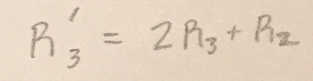
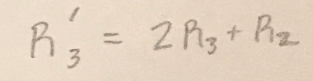
what if 2R3 + R2 instead of 0.5R2 + R3
then it would be -2 for L
the blue circle*
<@&286206848099549185>
oops 2 mins early
gray dust
the exact steps don't matter as long as you turn A into an upper triangular
hollow ridge
but the result is different from A if 2R3 + R2
gray dust
wdym
 gray dust
the exact steps don't matter as long as you turn A into an upper triangular
i still stand by this
hollow ridge
i guess this operation, 3R3 + R2 fails
gray dust
your new L is wrong though
hollow ridge
how so?
gray dust
i think it best if you don't do multiple row ops in one step
hollow ridge
hmm can you point?
gray dust
in the new way, you scaled R3 by 2 THEN added R2 to R3
hollow ridge
i tho the goal was to get a zero
gray dust
the goal is turn A into an upper triangular matrix
hollow ridge
Okay
gray dust
but it's also very important that you record what row ops you did and in what order, you use em to set up L later
gray dust
list the row ops you did on A to get U, in order, step by step (only 1 row op per step)
hollow ridge
i did
gray dust
only 1 row op per step
you don't understand this
hollow ridge
can you show me?
gray dust
you wrote that scaling R3 by 2, then adding R2 to R3 is a single step. but that's two separate row ops!
hollow ridge
i am so confused
 hollow ridge
how is two?
gray dust
scaling R3 by 2
1
then adding R2 to R3
2
gray dust
you don't seem to get what i'm saying
gray dust
recall what elementary row ops are allowed in LU decomp
gray dust
you just need to list out each step as a single elementary row op, not multiple ops
 wintry steppe
how is -4^2=-16 i thought the powered by means: -4*-4 which equals to 16
 cursive narwhal
Firstly, that isn't a question for this channel.
Secondly, there's a difference between $-4^2 = -(4)^2 = -(4 \cdot 4) = -16$ and $(-4)^2 = 16$.
stoic pythonBOT
Abhijeet Vats:
cursive narwhal
Notice that the placement of the parentheses matters.
wintry steppe
ty and sry
cursive narwhal
Don't worry about it.
 high thicket
Hey, I don't understand this part of the proof of Jordan normal form, could someone help me?
 dusky epoch
define "indecomposable map"
high thicket
 high thicket
Why?
high thicket
Hum...
 pliant harbor
Also, that proof of decomposability doesn't show uniqueness, which the FTA guarantees for integers.
high thicket
But I don't think uniqueness is necessary for the proof
 magic light
Hello, can someone help me check this proof?
Let B = {b_1, ... b_n} be a basis for V
Let w_1 ... w_n belong to W
Prove: There exists a single linear transformation T:V->W s.t T(b_i) = W_i for all i: 1 <= i <= n
I assumed by contradiction there is more than a single transformation. Therefore for some k and j:
T(b_k) = T(b_j)
However, because B is a basis then:
a_1b_1 ... a_nb_n = 0 when a1 to an = 0, and b1 to bn != 0, as they are linearly independent
Thus T(a_1b_1... a_nb_n) = T(0) = 0
Or a_1T(b_1) ... a_nT(b_n) = 0
Because we know a_1 to a_n =0
and b_1 to b_n are not 0, then
T(b_1) to T(b_n) are also linearly independent, contradiction to the assumption that T(b_k) = T(b_j)
Is the assumption correct?
that there being more than a single transformation s.t T(b_i) = W_i means T(b_k) = T(b_j) for some k, j between 1 and n?
magic light
okay I tried writing it like you do
idk what's better lol
a1b1 + a2b2... anbn
formatting math on discord sux
need to get this proof right so I know I'm on top of the definitions and what not
dusky epoch
a_1b_1 + a_2b_2 + ... + a_n b_n
magic light
ok
dusky epoch
I assumed by contradiction there is more than a single transformation.
the negation of "there is a single blah" isn't "there is more than one blah"
magic light
hm?
magic light
didn't think of that
dusky epoch
shame
magic light
well but actually it doesn't matter
I need to prove that there exists a single one such that T(b_i) = W_i
if there is none that exists then... that's a different question? no?
dusky epoch
no
look
have you proven that AT LEAST ONE transformation exists with Tb_i = w_i
have you CONSTRUCTED one yet
magic light
No...
so to prove there exists at least one I need to just construct one
like as the basis
So T:R^2 -> R^2
T[x, y] = [ { 1, 1} , {2, 1} ]
T[x, y] = [x + y, 2x + y]
So for the vector b_i (1, 1), there exists a transformation T(1, 1) = (2, 3)
therefore at least one exists?
dusky epoch
you're either overthinking it or just straight up don't know what you're doing and i can't tell which
magic light
Probably the latter
How else do I show one exists at all without just giving an example
once I show one exists then I can show it has to be a single one via the proof above
that's my thinking
dusky epoch
ok no like look let's start over from the beginning
magic light
o
dusky epoch
you have
two vector spaces V and W
a basis {v_1, v_2, ..., v_n} for V
n vectors w_1, w_2, ..., w_n in W
you want to construct a LINEAR map T: V -> W such that T(v_i) = w_i for i = 1, 2, ..., n.
magic light
okay
dusky epoch
recall what a basis actually is
magic light
I, just a second
dusky epoch
...ok ping me when you're back
magic light
so whyd o we want to construct a linear map
No I'm here just want to make something clear
dusky epoch
...
well the thing you originally set out to prove
is the existence and uniqueness of a linear map
satisfying certain properties
so SURELY we'd want to do the existence part first
which is
magic light
okay
dusky epoch
yknow
magic light
I'm with you
magic light
a basis
it's basically all the vectors that can construct all other vectors in the vector space, iirc
dusky epoch
too vague
magic light
that are linearly independent
dusky epoch
too vague.
magic light
ok I'm jsut gonna let you write I suppose
dusky epoch
argh gdi sorry
new keyboard
trying to type backslash but keep hitting enter
whatever
since $B = {v_1, v_2, ..., v_n}$ is a basis for $V$, it means that every vector $v \in V$ can be expressed, in a UNIQUE way, as a linear combination of the vectors in $B$; i.e. there exists one and only one list of constants $(a_1, a_2, \dots, a_n)$ such that $v = a_1v_1 + a_2v_2 + \cdots + a_nv_n$.
stoic pythonBOT
Ann:
magic light
okay
dusky epoch
so now given this i can use the a_i in my definition of T
since they are determined uniquely by v and so no matter what i do to them it'll be well-defined
so now
i define
$T(v) = a_1w_1 + a_2w_2 + \dots + a_nw_n$
stoic pythonBOT
Ann:
dusky epoch
or to write it out more explicitly
$T\paren{\sum_{i=1}^n a_iv_i} := \sum_{i=1}^n a_iw_i$
stoic pythonBOT
Ann:
dusky epoch
i invite you to verify, on your own, that this is linear, and then come back to me
magic light
:= means?
I'm a bit confused on the equality here
o it's vi and wi
nevermind got it
dusky epoch
:= means "is defined as"
magic light
is it okay to just define it like that?
dusky epoch
well i'm constructing my own linear transformation
dusky epoch
prove it's a LINEAR transformation
the "linear" is more important than the "transformation"
magic light
okay gotcha
is it correct to write that T(v_k) = w_k?
$T\paren{\sum_{i=1}^n vi} := \sum{i=1}^n w_i$
woopsie 😄
$T\paren{\sum_{i=1}^n v_i} := \sum{i=1}^n w_i$
stoic pythonBOT
blackmamba[Beatrix Kiddo]:
Compile Error! Click the  reaction for details. (You may edit your message)
magic light
nvm I don't know how to do that
Anyways, we take the sum out, therefore T(v_k) = w_k
dividing the sums, since they are constant
fk this proof is way harder than I thought
 magic light
the constant sums
alright...
I meant a1 to an are constants
so we can take them out of both sides, and then we get the sum of vi = sum of wi
vast torrent
$T(v) = a_1w_1 + a_2w_2 + \dots + a_nw_n$ @magic light
stoic pythonBOT
gfauxpas:
vast torrent
Do you get this part
 dense saffron
when using Gram Schmidt to orthogonalize vectors can i normalize at the end or do i need to normalize every step ?
sonic osprey
you can normalize at the end
 obsidian jackal
I have a question
If AX=b is IX=A^(-1)b, then why is reducing A to I in the augmented matrix [A|b] results in [I|X]?
Is there a rule or a specific theorem for this?
gray dust
forget augmented matrices for a sec
if $A$ is invertible, do you know how to get from $AX=b$ to $IX=A\inv b$?
stoic pythonBOT
RokettoJanpu:
obsidian jackal
Yeah @gray dust
By getting the inverse of A then multiplying that to the left of b
gray dust
cool, now separately we try to understand why the augmentation [A|b] works
obsidian jackal
Okay
gray dust
you know what elementary row ops are?
gray dust
and you know in [A|b] whatever row ops you do on A, you also to do b
obsidian jackal
Yes
gray dust
do you know that row ops can be represented by left multiplication by an "elementary matrix"?
gray dust
do you actually understand the stuff
obsidian jackal
Yes I do. I'm familiar.
stoic pythonBOT
RokettoJanpu:
gray dust
got this?
obsidian jackal
Yes
gray dust
now [A|b], each row op you do on A can be written as left multiplying A by the row op's corresponding elementary matrix
obsidian jackal
Okay
gray dust
let A be invertible. let P be the product of enough elementary matrices to reduce A to the identity I, so PA=I. got it?
obsidian jackal
Yes
gray dust
is it obvious $P=A\inv$?
stoic pythonBOT
RokettoJanpu:
obsidian jackal
Yes
gray dust
so we're really multiplying A by A^-1. that's how to turn A into I
remember in [A|b] whatever we do to A, we also do to b, so we're doing the same row ops on b, aka left multiplying b by P
gray dust
so row reducing [A|b] is equivalent to doing [PA|Pb]
that's not relevant
remember P=A^-1, so we have [A^-1 A|A^-1 b]
obsidian jackal
Ahhh now i get it
gray dust
simplify to [I|A^-1b]... [I|X]
obsidian jackal
A^-1 is the product of elementary matrices to reduce A into I and so we also use this same operations on b when performing eliminations
gray dust
yes that's it
gray dust
you're welcome 
 craggy crag
Problem statement: Given $A=\left(\begin{array}{ccc}{3} & {2} & {0} \ {0} & {1} & {-1} \ {1} & {1} & {1}\end{array}\right)$, decompose the vector $v=\left(\begin{array}{l}{1} \ {1} \ {3}\end{array}\right)$ into a sum of generalized eigenvectors of $A$.
stoic pythonBOT
Icohedron:
craggy crag
So far I have that the characteristic polynomial of $A$ is $P_A(T) = (T-2)^2(T-1)$.
stoic pythonBOT
Icohedron:
craggy crag
Now I want to find polynomials $k_1(T), k_2(T)$ such that $1 = k_1(T)(T-2)^2 + k_2(T)(T-1)$.
stoic pythonBOT
Icohedron:
craggy crag
So that I can substitute in A for T in the equations and then right-multiply by v to get a decomposition into generalized eigenvectors
But the thing is I'm having trouble solving for k1(T) and k2(T)
One equation but two unknowns, which are themselves polynomials . How do I solve that?
Kind of just trying guesses right now
maybe something like $a(T-2)^2 + (bT)(T-1) = 1$
stoic pythonBOT
Icohedron:
craggy crag
Which simplifies down to $T^2(a+b) - T(4a+b) + 4a = 1$
stoic pythonBOT
Icohedron:
 wise furnace
Icohedron:
So if you have polynomials to solve for, I think you can try to compare constant factors, factors of T, of T^2, etc. So if you make k_1(T) and k_2(T) intro arbitrary large polynomials, you should see how the constant terms of these polynomials when multiplied by (T-2)^2 and (T - 1) gives 1, and the rest give 0. I think it should be solvable from there?
craggy crag
I will try that
 devout pine
craggy crag
devout pine
craggy crag
Solutions to Ax=0, by definition, lie in the kernel/null space of A.
Perhaps refer to the rank-nullity theorem?
Thanks dinobear32 . I guessed k_1(T) = 1 and k_2(T) = (c - T) and found that a solution to the equation exists for c = 3
wise furnace
No problem, just know that usually for these sort of things one can analytically do it by comparing the coefficient values of 1, x, x^2, ... (think of it as finding constants for particular integral guess for ODEs)
 bold hearth
I really need help with this (easy?) task
Solve the equation Ax = b for:
i am so lost
nimble egret
do you know how to set it up?
bold hearth
Hmm, aren't there many ways?
nimble egret
well yes
bold hearth
What do you mean?
nimble egret
for gaussian elimination
bold hearth
I'm just starting over since i think i did something wrong
if thats what u meant how far i had came
hmm i did online solver and it said it had solution with a lot of the numbers i ended up with
but i didnt think it was solvable
 spiral sonnet
can anyone explain how a vector can have direction?
a vector seems like just a point on a plane
bold hearth
a line from origo to the point?
nimble egret
^
spiral sonnet
oh okay
gotcha
is the length of a vector the distance from the origin to that point?
nimble egret
yes
bold hearth
The problem with my gauss elim
is i get like two lines like this:
0 0 -487 | -105
0 0 -215 | -156
like is this not contradiction??
bold hearth
hmm this is so hard
Whatever way i start this i end with some sort of contradiction
but computah says it has answer
computer doesnt say no :/
If there are 4 equations and 3 unknowns am i incorrect to think two of the equations are the same?
nimble egret
you should not think of them as the same
bold hearth
ok i am the stuckest i have been in a long time
this was supposed to be easy idk
i see they are not equal but thats why i am confused
 robust plaza
For these questions, would I be correct in saying that you would find x1 and x2 by calculating A^-1 * u1 and A^-1 * (u2 - u1) respectively?
nimble egret
yeah
robust plaza
Okay cool, thanks
nimble egret
yes
nimble egret
yes
 dry spear
how would I find the imaginary part?
nimble egret
do you need it?
dry spear
nope
nimble egret
🤔
dry spear
(x + yi) - (x - yi) = 2yi
nimble egret
what question is this even
 warm flicker
hii
i have a question
so if there is an augmented matrix [1 -1 0], what would the basic and free variables be?
because x1=x2
please tag me uwu
warm flicker
yes
vast torrent
So you tell me
warm flicker
so it doesn't matter if their values are equal?
vast torrent
What do you mean by mattering?
The order of the variables is something you fixed to do the problem
If you called x1=y2 and x2=y1
And considered y1 and y2
warm flicker
so far, we are using matrices to represent linear equations (just started the class), and each column represents the coefficient of a different value.
vast torrent
Yes and
If you renamed the variables to be in a different order
It would be the same solution space
That's a good thing
Does that make sense?
 austere cedar
(uwu)
vast torrent
Depends on which order you started with even though x1=x2
austere cedar
This is augmented matrix
warm flicker
ok...
vast torrent
So the basic variable is x1 and the free variable is x2
round hinge
The way a textbook I've been using on my own explains this pretty well
If you were to describe the solutions of that system represented by the matrix
[1 -1 0]
representing x - y = 0, or x = y
you would say that y is free and x has to be equal to y
damn I wish I knew latex so I could write this properly
sonic osprey
${ \begin{pmatrix} 1 \ 1 \end{pmatrix} y \mid y \in \mathbb{R} }$
stoic pythonBOT
Zopherus:
sonic osprey
$\{ \begin{pmatrix} 1 \\ 1 \end{pmatrix} y \mid y \in \mathbb{R} \}$
round hinge
Or, more clearly for someone new to this syntax, {(y, y) | y ∈ R}
@warm flicker does that help?
I think this makes it more clear that x is dependent on y and y is free
warm flicker
ah i get it! so x is the basic variable regardless
round hinge
I'm not familiar with the term basic variable (I'm also learning right now, maybe my professor just didn't use that term) but I guess?
warm flicker
they can be found from the pivots in each row
round hinge
Ok yes. That makes sense
 warm flicker
what does this mean?
round hinge
so the weird E thing means "the thing to the left is in the set of the thing in the right"
y ∈ R is read as "y is in the set of all real numbers"
the middle bar thing means "such that"
so [1 1] y means the vector [1 1] multiplied by y
and the whole thing means "the set of all vectors [1 1] multiplied by y, such that y is a real number"
I'm in week 5 right now, and I was having trouble understanding some topics, so I've spent a few hours catching up to where I am but using a different textbook, and it's been amazingly helpful
http://joshua.smcvt.edu/linearalgebra/book.pdf <-- textbook
warm flicker
ooh
round hinge
round hinge
My point is, if you keep up with your lessons but using this textbook, you should be great
Sure lol
This textbook is really amazing
warm flicker
okay ! we use the david c. lay one in our class
round hinge
idek what we use
I'll check the syllabus
BRUH
same textbook
I tried it, hated it
Basically, the one I linked can be used to self study, so it doesn't expect you to have a professor. It explains everything without needed outside lectures
warm flicker
ahh
that is very useful
our instructor just explains how to solve the problems so we don't end up understanding much :<
round hinge
That sucks
Trust me, try reading this textbook
It's actually interesting too
it makes you think
warm flicker
i always hated how math becomes disconnected from our perceptions the more complicated it gets
round hinge
But once you understand it, it can be so useful
the textbook I linked feels more like a conversation you're having with the author
than being lectured to by written wrods
round hinge
even though I'm in week five I started from the beginning and just reading about rref and stuff has helped even though I thought I fully understood it before
Good luck lol
dry spear
lmao
round hinge
is this symbol just "greater than or equal to?"
This textbook uses it a lot and I've just never seen it written that way before
 junior nacelle
Yes
vast torrent
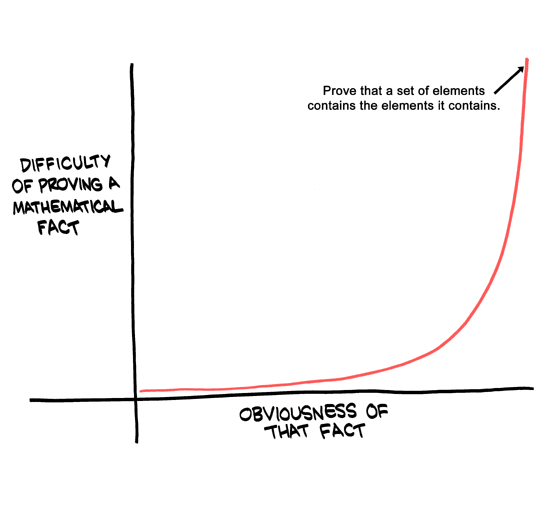
Saturday Morning Breakfast Cereal -
 cloud meadow
I got these results for these questions but I don't know what to input to WolframAlpha to check their correctness. Therefore, could someone tell whether they're correct or how to use WolframAlpha with this kind of question?
Also not sure whether this is the correct chat :D The topic matches but the level might not.
dusky epoch
3^3 * 1/3 is not 3
cloud meadow
true
dusky epoch
it's 9
dusky epoch
everything else is okay.
cloud meadow
thanks!
 clear otter
If I have a homogeneous linear system of rank 1, what is the space of solutions?
odd kite
@clear otter what does that imply about what is excluded from being a solution? How does that relate to the image and kernel of the matrix?
clear otter
@odd kite Doesn't that depend on where my leading variable is?
If it's a homogeneous system, isn't the image always 0?
odd kite
no, the homogeneous system is a constraint on the solutions. It's not saying Lv = 0 for all v. We're asking for what v is that true
clear otter
and the v that it holds true for would be the kernel wouldn't it?
odd kite
yes
clear otter
So wouldn't that make the image of L 0?
Oh wait, no, I see what you're saying.
Image of L =/= 0.
odd kite
yeah
clear otter
It would be the quotient of the domain and the kernel.
odd kite
yeah
clear otter
But how does that answer what the space of solutions is?
odd kite
Well you already established the space of solutions is the kernel. So all we need is what does rank 1 imply about the kernel
odd kite
yup, it's a subspace of the domain that's 1 dimension less than the dimension of the domain
clear otter
ah, so on a dimension n domain, it's an (n-1)-plane
clear otter
This makes perfect sense; thank you!
odd kite
yw
 autumn oar
Why does an orthonormal matrix A times its transpose equal the identity?
quartz compass
well when you transpose it you're basically taking a bunch of dot products of all the columns
so they're either 1 because normal, or 0 cause orthogonal
 drowsy ferry
in an orthonormal matrix, the columns are orthogonal to each other; when you multiply an orthonormal matrix by it's transpose, you will have a square matrix of dot products, which by orthogonality are all 0, except on the diagonal, where they are 1 because the vectors are normal (the dot product of a vector with itself will be the square of the magnitude)
autumn oar
Ohhhh i see
 rotund jetty
x + 2y + 4z = 1
-2x + 4y - 6z = -2
x -2y + 3z = 1
You can see if the solution to the system is a plane, a line, or a point.
drowsy ferry
the answer will depend on how many degrees of freedom you have in your solution
wintry steppe
wdym by freedom
gray dust
How many free variables does the system have
drowsy ferry
sorry I don't know if that's standard notation that's what we called it
drowsy ferry
thats one way for sure
drowsy ferry
oh i see, my professor always just called them degrees of freedom
rotund jetty
note that equation 2 = -2 * equation 3. You have 2 distinct equations and 3 variables.
@wintry steppe is that enough, or do you need some more help?
drowsy ferry
if you want some intuition, do you know about what the rank of a linear system of equations tells you about the solution space?
rotund jetty
@wintry steppe you can think of it this way
ax + by + cz = d is the equation of a plane right?
here, you have two distinct planes
what does the intersection of two planes look like?
autumn oar
uh, my book said that if A is singular then the determinant of A is 0... i don't think that's true tho
drowsy ferry
to sum it up shortly but a bit more technically:
-the rank of a matrix is the dimension of the space spanned by the rows / columns of linear combinations of that matrix' rows / columns
-in our case, since the first two rows are linearly independent, the rank is at least 2
-but since as nicholas showed, the last two rows are linearly dependent, the rank is less than 3
-therefore the rank of our system is 2, meaning that the space of solutions is 2-dimensional
--
a matrix is singular if and only if it's determinant is zero
autumn oar
does that mean only rank one matrices are singular
drowsy ferry
no o:
autumn oar
what if we have a rank 2 matrix in dimension 3
why is the determinant 0
wouldn't it just be the area of the parallelogram formed by the two linearly independent vectors
like bruh what's the intuition here
odd kite
no, it's related to the volume of the 3D parallellpiped from the 3 vectors
autumn oar
but i mean that's obvious if there are three linearly independent vectors, but what if only two out of the three are linearly independent?
cause if you have a rank 2 matrix in the 2nd dimension then it's the area of the parallelogram made by the two vectors
why is it not the same in the 3rd dimension?
drowsy ferry
suppose you are in 3 dimensions right? if we look at some matrix A and look at what it does to a cube in 3d, the determinant basically encodes how much the volume of this object changes after applying the matrix A
if A has rank less than 3, it squishes the cube down into something flat, since it reduces the dimension by definition
and something flat has no volume
there's an explanation involving eigenvalues but that's not a very intuitive one..
autumn oar
but i mean why is the determinant always the space taken up in the dimension we are working in? as in you can only find the area in dimension 2, the volume in dimension 3, and so on
odd kite
yes
autumn oar
i asked why xD
drowsy ferry
so basically the value of the determinant is the volume of the parallelepiped spanned by the columns / rows of the matrix right
autumn oar
also im not at eigenvalues yet, does getting there clear this up?
odd kite
it's basically the definition of the determinant
gray dust
eigens? somewhat
autumn oar
but why does it just become equal to 0 if you have a matrix that's not full rank
he did
he has a video called "what really is the determinant" or something
drowsy ferry
suppose we have a 3x3 matrix
so if you have a non-full rank matrix, the parallelepiped will not be a 3d object
autumn oar
which i'd watch but i dont have headphones rn
odd kite
@autumn oar because it squashes at least one dimension so the n-volume is 0
autumn oar
i guess im asking for a more analytic answer
drowsy ferry
because by definition, the columns will not all be linearly dependent, and therefore not span a 3d object
at most a 2 or 1d object
but those do not have a volume in 3d space, which is what the matrix operates on
gray dust
everything 3b1b does in his LA series is intentionally meant as a supplement, not a full course
drowsy ferry
how do you mean analytic?
autumn oar
like what happens when calculating the determinant that just makes the determinant with, say, 2 out of 3 vectors being linearly independent just become 0
odd kite
You don't really need eignevectors
drowsy ferry
to not spoil too much, the determinant is the product of the eigenvalues, and a non-full rank matrix has at least one zero eigenvalue
so the determinant will be zero
i think the geometric explanation is more intuitive though
odd kite
you don't need eigenvalues at all, there are multiple ways to do it
autumn oar
i mean the geometric explanation makes sense if you fully believe that the determinant is just the parallelepiped made with the vectors, but i don't see where that definition of the determinant comes from yet
autumn oar
can anyone explain 3b1b's explanation real quick or is it too long
drowsy ferry
its mostly a visual one i believe, better to just watch it when you get some time
rotund jetty
yeah^
I think the rough argument was that a matrix can be thought of as a transformation of space, and the determinant of the matrix tells you how much you shifted space by, which is equivalent to a volume or smth? it's been a while for me
@autumn oar you good if I ask a question?
odd kite
If you imagine at least one column or one row is all zeros you should be able to see from the formula the det is 0. Non full rank matrices can be rearranged into that state without changing the determinant
autumn oar
oh
drowsy ferry
basically you look at the basis vectors (the basis cube in 3d) and consider the volume of the object spanned by the vectors after the transformation
autumn oar
timon idk the formula to calculate a determinant yet
nicholas can ask a question tho
i think i'll just watch 3b1b's video
odd kite
you don't know the formula, and won't accept the geometric definition
so what IS your definition?
rotund jetty
I'm having uhhhh trouble with this to say the least
my brain might just be farting since I've been doing this assignment for a bit, but I'm not sure how to determine the basis of the null space
autumn oar
i knew the geometric definition and was trying to find the intuition for it, i didn't even know there was a general formula
odd kite
Intuition is it's a useful definition
because it tells us if the matrix is invertible for one
rotund jetty
any matrix with a diagonal that is any combination of 0's, and an equal number of a and -a for an arbitrary a is in the null space, so it feels like taking a = 1 should be a starting point for finding that basis, but beyond there, I'm honestly not sure
this is a graded assignment so don't give me a full solution, just somewhere further to go
odd kite
anyway determinants have a lot of uses
quartz compass
I think the answer is going to depend on the characteristic of the field @rotund jetty
odd kite
use the fact that it's a vector space
and consider what the effect the constraint of being traceless has
that's just a linear equation, right?
autumn oar
wait my textbook is asking me what is the chance that a square matrix populated by random real numbers is singular, but isn't that just 100%
drowsy ferry
the chance that a singular square matrix is singular?..
odd kite
I think that works
autumn oar
oops fixed that
rotund jetty
@odd kite what do you mean by traceless?
autumn oar
but yeh wouldn't it be 100% for every matrix of dimension greater than 1, and 0% for a matrix of dimension 1
odd kite
If Tr(A) = 0, then A is traceless, and in the null space of T. I think I'm reading the problem right.
just a word for have zero trace
rotund jetty
yeah, I figured, but I wanted to make sure
odd kite
I only know about fields R and C though 😦
drowsy ferry
i think it turns out to be 0% in the case of real numbers phx
mathematically at least
autumn oar
that would be that every square matrix with random real numbers is not singular
which i dont think is correct
wait
i lied
i get it
yeh that makes sense
it seems to just be always 0%
autumn oar
i mean we know that if we pick a random real number it would never be rational
and at that point you can't have linearly dependent vectors that have irrational numbers
wait that's wrong
idk how to prove it but idk see why it wouldn't be 0%
no matter how u define random
vast torrent
you might be saying
that if there's a random variable that takes on values in a real interval with uniform distribution
odd kite
search should turn up more than a few arguments, like this one https://math.stackexchange.com/a/226156/79083
Mathematics Stack Exchange
Given a matrix $A_{n \times n}$, which has elements $a_{i,j} \sim \mathrm{unif} \left[a,b\right]$, what is the probablity of $\det(A)$ being zero?
What if $a_{i,j}$ have any other distribution?
A...
rotund jetty
is it possible to pick a random real number?
odd kite
I think so, but it doesn't have an expectation value
I assume we are talking uniform here
drowsy ferry
realistically, I don't think you can
drowsy ferry
how would you pick a uniformly distributed irrational number? an infinite number of coin flips
odd kite
I have never had a much reason to think about matrices over an arbitrary field
in an applied setting
sonic osprey
You can't do it mathematically either
odd kite
tell that to a physicist 😜
sonic osprey
physicists don't do this
sonic osprey
Yeah but you can do this rigorously
vast torrent
draw a square and throw a dart
that approximates U([0,1]x[0,1])
make sure to sharpen the needle first
odd kite
lol


 vivid fiber
- B
show that (e1,e2) is a basis of R2
and determine the components of u with respect to the basis
is this correct? or it’s totally wrong :3
vast torrent
Looks right
vivid fiber
okay thanks man!
nimble egret
What about it?
dry spear
how does the dot product give the cosine of the angle between 2 vectors
dry spear
I want to understand how it works though
dry spear
thank you
vivid fiber

vast torrent
Yes
vast torrent
Often the single bar is used for numbers and the double bars for vectors



 sleek vessel
Without a doubt linear algebra was the hardest course for me so far
I hope its not just me
Feels more abstract than abstract algebra
Lol
dry spear
way more
for this question the span of a and b is c_1*a + c_2b right?
so it becomes the vector (18c_1 + 21c_2, -16c_1 - 13c_2, 10c_1 + 13c_2)
ohh
they're parallel that's why
so if I make sure the values for c_1 and c_2 are different from each other the lines won't be parallel right?
nimble egret
Ehh
You can have c1 and c2 equal
That's fine
But you don't want like
c1 = c2 = 1 for one vector
and c1 = c2 = 2 for the other
Or something like
c1 = 1, c2 = 2
And c1 = 2, c2 = 4
@dry spear
dry spear
yeah that's what I meant
c_1 and c_2 need to be different from each other
how is this wrong?
dry spear
l(t) = (x_1, x_2, x_3) + t(y_1, y_2, y_3)
l(-6) = (18, 14, 19) = (x_1 - 6y_1, x_2 - 6y_2, x_3 - 6y_3)
then I did that for Q too
and solved the equations
like 18 = x_1 - 6y_1
and 44 = x_1 + 6y_1
 boreal crescent
hello boys
Cold is back
i got through a to c
part d im confused
so the basis for P would just be {1, x, x^2, x^3, ..... }
and i the series of expansion can therefore be written in terms of the basis
with the coefficient matrix being {1, 1/k, ...}
but im not sure if that is right or wrong
sonic osprey
Look at the definition of linear combination
boreal crescent
its essentially all the vectors in a set multiplied with scalars and added to each other such that those scalars are real numbers right
sonic osprey
yeah but how many vectors can you use
boreal crescent
well..
like i guess if im writing the definition out, id define a set such as {v1, ..., vm}
and then multiply all of them with c1 through cm
m can be any number, so any number of vectors?
sonic osprey
Even infinitely many?
boreal crescent
that's what idk 😓
is it in the definition of a linear combination to not have infinitely many vectors?
sonic osprey
Correct
dry spear


l(t) = (x_1, x_2, x_3) + t(y_1, y_2, y_3)
l(-6) = (18, 14, 19) = (x_1 - 6y_1, x_2 - 6y_2, x_3 - 6y_3)
then I did that for Q too
and solved the equations
like 18 = x_1 - 6y_1
and 44 = x_1 + 6y_1
rotund jetty
What does V\W represent, when V is a vector space and W is a distinct vector space (in this case, a subspace of V)?
rotund jetty
oh OOP I'm dumbo
dry spear
fauxpas I need ur help pls
vast torrent
your question is hard to help with because
well, hard to read all the symbols on discord
for my lazy self who is used to latex
I don't know, honestly I was planning on taking a break from math for the moment, sorry
maybe tomorrow
warm flicker
is there any rigorous proof/reason that a matrix can only be row reduced into one rref?
warm flicker
i mean yeah looks about right
the picture is too blurry at the top to verify if your calculations are correct or not but you have to do something to this effect.
 errant dirge
Thanks!
dry spear
where do they get w_3 from?
and why do they multiply the solution by w_3 and w_3^2? Aren't you supposed to find w_3, w_3^2, and w_3^3?
dusky epoch
DON'T MULTIPOST 
dry spear
ok