#linear-algebra
2 messages · Page 55 of 1
 steady fiber
then the determinant is $\left(x^{3}-x+a\right)\left(x^{3}-x+d\right)-bc$
 stoic pythonBOT
PorosInMyAshe:
steady fiber
also my bad, I made a mistake before
it's this
so you can indeed set a=d=0
and keep it invertible
 vast torrent
ah
steady fiber
and so it reduces to $x^{2}\left(x^{2}-1\right)^{2}-bc$
stoic pythonBOT
PorosInMyAshe:
vast torrent
oh nice
steady fiber
and the first term is always positive
always non-negative*
so if -bc is positive, it cannot have a root
so just b=-c, c=1 works
vast torrent
very nice
steady fiber
A=B=I, C= [0 -1; 1 0]
basically also identity
with an extra negative sign
and flipped
steady fiber
an anti-diagonal matrix would've been a good assumption
for C
instead of diagonal
but ya, I guess you can just do a lot of problems like this
and build up an intuition
next time you see a problem similar to this you'd know which guesses to make
vast torrent
okay, can you help me with one more thing?
steady fiber
sure
vast torrent
find a matrix A with eigenvalues <=1 such that for some x
square
$\Vert A^n x \Vert \to \infty \text { as } n \to \infty$
stoic pythonBOT
gfauxpas:
vast torrent
<= in magnitude
or modulus I guess
it doesnt say whether to use real or complex eigenvalues
just that the matrix is of real entries
steady fiber
okay, so if it's diagonalizable, this is not possible
vast torrent
agreed
steady fiber
so we just have to look at non-diagonalizable matrices
vast torrent
so let's find a matrix of the form
steady fiber
and find an example from that
vast torrent
$\begin{bmatrix} a & 1 \ 0 & b \end{bmatrix}$
stoic pythonBOT
gfauxpas:
vast torrent
the simplest non-diagonable 2x2 matrix
vast torrent
agreed
steady fiber
so both have to be < 1
vast torrent
or equal to
steady fiber
oh or equal to
steady fiber
ya
that's what I was thinking
just [1 1; 0 1]
try that out
that squared is [1 2; 0 1]
oh ok, [1 1; 0 1]^n = [1 n; 0 1]
vast torrent
the upper right entry will grow without bound
nice
thanks Poros
can I @ you in the future?
steady fiber
np
 thorn prairie
Is linear algebra a difficult subject? Il have it in my next semester and was just wandering
 wintry steppe
Well I had it this semester
And it was really tough
My exam is tomorrow and I’m really nervous
Calculus was much much better than linear
I don’t care what anyone says, integral and differential calculus is so much damn easier
Linear is just too dense and limp between sky and ground
 terse mirage
Calculus is more about mechanics
although, i suppose you could teach LA mechnically
 cursive narwhal
Depends on the viewpoint you approach it from tbh
I couldn't understand LA when matrices were introduced first
vast torrent
what doe sit mean to be too dense and limp between sky and ground
wintry steppe
Anyone could anyone fill me in on how important duality and products/quotients of vector spaces are? I just realized my books skips those topics, wondering how bad it'll be if I just try and learn em later.
 heavy glacier
So I was trying to understand tensor products yesterday (i.e. looking for a clear definition) and a dude on youtube said 'the construction of tensor products is kind of problematic' can someone explain why?
 scarlet ermine
i'm trying to finish up these problems
rn im working on a probability matrix but i can't get it to not explode
i thought i either multiply the probablilty matrix by itself to get it in the long term or by the starting conditions
but neither are working
i have 6 hours to get to 95% correct for these homework problems for an A and im currently at 72%
 gleaming topaz
If you put format rat at the top of the script and then take the transition matrix to the 4th power, what do you get?
gleaming topaz
when you do a.^4 it takes each element individually and raises it to the power of 4
it doesnt multiply the matrix by itself 4 times
scarlet ermine
hm i seem to have gotten it wrong
gleaming topaz
Well, you weren't working with exact values that's why
scarlet ermine
nvm i misread my output the first time
gleaming topaz
And then for the one where you need to find out if it's raining on thursday if it was sunny on sunday, you take P^4*x where x is the vector [1;0;0] or wherever the position for sunny is
gleaming topaz
?
scarlet ermine
yeah
now im on lu factorization which i can't seem to figure out, matlabs answer isn't being accepted
i thought lu(a) is the correct function, but the answer im getting and the stuff they expected seems to be entirely different
gleaming topaz
what does that star even mean?
scarlet ermine
i don't know
i also used several online calculators that matched matlab but don't match these people
steady fiber
there's multiple ways to do LU decomp
it's not like a single correct answer to it
as long as you get an L and a U
that's good enough
steady fiber
does it give an L and a U matrix
that multiply to the correct matrix
in which case that's a correct decomposition
 half ice
What's *
scarlet ermine
how do i do this sort of problem?
 gray dust
reword the q in your mind so that it becomes clearer what computation should be done
scarlet ermine
@gray dust i'm lost
i see this post here for the same problem but im not sure what the math is
gray dust
does it make sense that S is a plane in R^3?
scarlet ermine
barely
gray dust
S is the span of two linearly independent vectors, ie a 2d subspace of R^3
scarlet ermine
alright
gray dust
we seek to find p, a vector inside S, so that the tip of p is as close to w's tip as possible
does it make intuitive sense that this means ||w-p|| is minimized and that w-p is orthogonal to the plane S?
scarlet ermine
unfortunately no
ii get the first part, we want to make a vector p thats as close to the plane as possible
but the math behind it i don't understand
gray dust
no, p is IN the plane
and as close to w (which isn't in the plane) as possible
we can split w into two components, or the sum of two other vectors: one that lies inside S, and one that is orthogonal to S. we call the former component the projection of w onto S
gray dust
aka orthogonal
gray dust
you should learn how to project a vector onto a subspace
scarlet ermine
alright, how do i do that
gray dust
@scarlet ermine i suggest looking it up in your notes or online
scarlet ermine
yeah i've been trying that
unfortunately i'm sort of running up short, i'm about 5 weeks behind in the class so actually understanding the notes has been pretty difficult
thankfully, the abysmal grading system lets me get an A in the course despite my 55% on the final if i get a 95% or higher on these do-at-home problems, so i'm more or less just trying to do them regardless of my understanding, but its proving a bit difficult on this theory heavy stuff
gray dust
KA's linalg series isn't the best but it'll do in a pinch: https://www.khanacademy.org/math/linear-algebra/alternate-bases/orthogonal-projections/v/linear-algebra-subspace-projection-matrix-example

Khan Academy
Example of a transformation matrix for a projection onto a subspace
scarlet ermine
also do you know how to do this kind of stuff?
scarlet ermine
alright well i think im just going to call it
i've been working on this for literally 6 hours straight
by my math i should have a 90.027%
 atomic junco
Can someone help me with LADR questions?
 native lodge
LADR?
cursive narwhal
linear algebra done right, i think
 dusky epoch
"non-linear algebra"? 
cursive narwhal
That's an actual area of research though
@wintry steppe Might wanna check the website out above if you wanna get a sense of the applications of the subject
Sure
Hmm, i'm not too sure what you're looking for. Another thing you could do is to have a look at the lecture series on nonlinear algebra by bernd sturmfels on youtube
You should get a sense of the applications of the subject from the lecture video titles
 south wadi
Hey first day learning linear algebra confused what they did here
How they got the zero on the bottom in the 2nd column
3rd column and 4th
 viral mason
they made the bottom row in second column 0
they applied this operation to it
-3(2) +2(3)
= 0
they took -3 of row 2 column 2 (+) 2 row 3 column 2
south wadi
wouldnt u just be able to multiply the 3rd row by 3
south wadi
wouldnti t though
viral mason
u have to specify that
then sure
that works
but u have to explicility add the whole row by -9
every single entry i mean
in row 3
south wadi
yea
viral mason
they even stated
"we add -3/2 times the middle row to the row below"
which is equivalent to a common multiple of -3(2) + 2(3)
in terms of row operations
viral mason
which ever is easier in ur head as long as u dont lose track
ull learn soon that no matter way u choose
ull get same answer
if done properly
you'll hear or read the term (Reduced Row Ecehlon Form)
south wadi
ok yeah its my first day doing this stuff
viral mason
no worries, just practice
viral mason
awesome
south wadi
is this a good textbook
viral mason
many people fail this course due to not getting this done perfectly
everything in the rest of linear algebra is based on RREF
not sure, what book is it
south wadi
im sending it now
viral mason
ok
viral mason
ah okay
viral mason
lolll
south wadi
im going home exams are done
viral mason
ah i see
south wadi
viral mason
im in no rush lol
viral mason
cover is blue?
south wadi
yes
viral mason
do u have syllabus
south wadi
not yet
south wadi
its 4 months
south wadi
alright
viral mason
weird that the textbook doesnt cover complex numbers
but i guess thats to ur benefit
but yeah looks good
yeah just ask questions here throughout the term
if u practice you'll be fine
south wadi
Alright thanks
viral mason
i don't think theres anything uniquely hard to it
south wadi
The math i've doen so far is Calculus I and some bits of calculus II
viral mason
just like any math course u need to reread to understand concepts
if u could do Calc l then you can do well
anyone who says otherwise is lazy or fearmongering
south wadi
Yeah Calc 1 was a breeze
but they added calc II to our stuff
then the integrals got a little tricky
viral mason
yeah no worries
i hardely see any proofs and lemmas in the book
so just computation
south wadi
im not a math major so i doubt they will make us do proofs
 livid yarrow
Why are some of the things in linear algebra
Ie, why were they natural to define
I hope this doesn't make me sound slightly out of touch but
With matrices
I do not understand why someone decided to define the determinant the way it is defined
Or even define it at all
It was just a definition that was given to us as 'something to compute as well as being able to tell us information about scaling and orientation of transformation'
But why?
Why do we work out a determinant the way we do?
There's no way it happened by accident
viral mason

A lecture for college teachers where I define the determinant geometrically and show that it matches with the usual algebraic definitions.
enjoy
geometrically speaking determinants are challenging and not needed to understand in order to solve other lin alg problems
thats why they are never explained in depth in intro classes
(i presume)
gleaming topaz
A transformation T: R3 -> R3 is given by a projection in the plane x+z=0. I'm not sure how to work with these kinds of problems, say if I have a set of vectors (x,y,z) does this mean that when transformed it becomes (x,0,z) or how am I supposed to work with this?
<@&286206848099549185>
viral mason
is the equation of the plane x + z = 0?
 magic slate
so is $T(\vec{x})=\text{proj}_{P}(\vec{x})$, where $\vec{x}\in R^{3}$ and $P$ is the plane $x+z=0$
stoic pythonBOT
l spacebaR l:
gleaming topaz
I'm here
I'm trying to understand, so T is the projection of (x,y,z) onto (1,0,1)?
magic slate
well, i would interpret that as T is the projection of a vector in R^3 onto the subspace spanned by {<-1,0,1>, <0,1,0>
because that subspace is the plane x+z=0
actually
i thought it was that
<-1,0,1> is in the plane
viral mason
ur right
wtf am i on about
its an arbitrary point on the plane
since it satisfies the equation
gleaming topaz
Wait, is the normal vector not (1,0,1)? I understand where (1,0,-1) or (-1,0,1) is coming from since x+z=0 but isn't the normal given by the coefficients?
viral mason
it is
normal is
(1,0,1).
and the other two are points on the plane
i dont get the wording of the quation
"A transformation T: R3 -> R3 is given by a projection in the plane x+z=0."
gleaming topaz
So, if I'm looking for a vectors projection on the plane I take the projection of (x+1,0,y-1) onto (1,0,1)?
magic slate
so $T(\vec{r})=\frac{\vec{r}\cdot [-1,0,1]^{T}}{|[-1,0,1]^{T}|^{2}}[-1,0,1]^{T}+\frac{\vec{r}\cdot [0,1,0]^{T}}{|[0,1,0]^{T}|^{2}}[0,1,0]^{T}$ where $\vec{r}\in R^{3}$
steady fiber
it's a transformation from R^3 to R^3, and that transformation is that projection
viral mason
s[1,0,0] -t[0,0,1] is any point on the plane
steady fiber
it's just finding the projection onto the plane
you can subtract the projection onto the normal from the vector
and that's it
that's the easiest way to do the transformation
stoic pythonBOT
l spacebaR l:
viral mason
wow u wrote the equation of projectin in latex, are u a psychopath
gleaming topaz
@magic slate How come we need to take r's projection onto (0,1,0) as well? I get the first part, but not the second.
Or does y even change?
 gleaming knot
A true psychopath would’ve written that equation in latex on phone
steady fiber
$T(\vec{r})=\vec{r}-\frac{\vec{r}\cdot [1,0,1]}{2}[1,0,1]$
stoic pythonBOT
PorosInMyAshe:
steady fiber
that's the transformation
the projection onto the normal subtracted from the vector itself
gives the projection onto the plane
it's simply thinking about the problem in a different coordinate system, and removing the normal component in that system
so whatever you are left with is in the plane
so effectively a projection onto the plane
it's no different than if you just "removed" the z-component of a vector in order to project it onto the xy plane
gleaming topaz
Okay thanks, this helps me. So just the formula for projection gives the parallell projection into the plane and subtracting it from the vector which is projected gives us the orthogonal vector that is projected onto the plane?
That might be messy but I think I've got it right?
vast torrent
if you're trying to memorize the formula, here's how to remember it
steady fiber
oh that one
vast torrent
$\frac{\langle u, v \rangle}{\langle v, v \rangle} v = \frac{\langle u, \frac{v}{\Vert v \Vert }\rangle} \langle u, \hat{v} \rangle} \hat v \rangle$
damn
was hoping for a first try there
one sec
vast torrent
aaaaa
stoic pythonBOT
gfauxpas:
Compile Error! Click the  reaction for details. (You may edit your message)
vast torrent
let me start from scratth
$\frac{\langle u, v \rangle}{\langle v, v \rangle} v = \left \langle u, \frac{v}{\Vert v \Vert} \right\rangle \frac{v}{\Vert v \Vert} = \langle u, \hat v \rangle \hat v$
steady fiber
almost there
stoic pythonBOT
gfauxpas:
vast torrent
there we go
that's how I remember it
because the one on the right hand side is easier to remember than the original form
you just normalize v before projecting onto v
for me that's easier at least
gleaming topaz
Yeah thanks, and say that v is a normal to a plane then the projection of u onto v gives us the vector lying in the plane right?
magic slate
isnt <0,1,0> in the span of that plane
and its orthogonal to <-1,0,1>
so those two make a basis of the plane
cause y can be any number and itll still satisfy the equation of the plane
i could be wrong here though
vast torrent
and the formula for projecting onto a span of vectors
is you put the column vectors into a matrix M
and it's
$\text{Proj}_A(v) = A(A^\top A)^{-1}A^\top v$
whoa
stoic pythonBOT
gfauxpas:
stoic pythonBOT
RokettoJanpu:
vast torrent
\langle \rangle
anyway I just memorized it, I dont have a mnemonic, if someone has one feel free to say it
well
if A is a single column
gleaming topaz
but Oily if the plane is x+z=0 and you say that (0,1,0) is in the span of the plane, that means that any (x,y,-x) is a point on that plane right? What does the lack of y in the equation for the plane given by x+z=0 represent then?
vast torrent
it does reduce to the formula for projection onto a vector
gray dust
@magic slate in my eyes, no difference
gleaming topaz
Does it mean that the plane contains all possible y's for any point where x=-z?
magic slate
ok, im not familiar with it yet. i just thought it might be different
and yes any y can satisfy it
what matters is that x=-z
gray dust
Comes down to if you like midlines or commas
magic slate
to find the basis just let x=s then z=-s and let y =t
then $[x,y,z]^{T}=s[1,0,-1]^{T} +t[0,1,0]^{T}$
stoic pythonBOT
l spacebaR l:
magic slate
so the plane is defined by the span of those two vectors
gleaming topaz
So if the blue part is the plane given by x-y+2z=0 and I'm looking for P(v), is it just the projection of v onto (1,-1,2)?
So ((V . (1,-1,2)) / 6) * (1,-1,2)?

 obsidian rapids
Hey ya'll, not really sure where to head on this one
gray dust
remember the effects of row ops on the det of a matrix
in particular, what happens when you multiply a row/col by a scalar
gray dust
no
gleaming topaz
@magic slate Yeah I understand, but I'm looking at an answer sheet that shows this. Notice the arrows, shouldn't they be reversed? https://gyazo.com/374ea040787d5468299e0a0552d1dc84
 obsidian rapids
The addition of the scalar 7 is whats throwing me off haha
magic slate
they should be
gleaming topaz
Shouldnt proj(v) onto n give me the vector lying in the plane and v-proj(v) onto n give me the vector orthogonal to the plane?
magic slate
yes youre right
email your prof or something
cause that doesnt seem right
unless its the proj onto the normal vector or something weird
gray dust
this shouldn't make sense bc you didn't define A,B,k but ik what you're getting at. that's it
gleaming topaz
Thank you, that had me a bit confused. Guess, I'll ask him after the winter break
obsidian rapids
yeah mymathlab sucks at labeling things. The top would be A, bottom would be B. K would be the scalar used in B.
gray dust
better 👍
obsidian rapids
With that cleared up does it sound accurate?
gray dust
ik what you were getting at anyway but it's poor practice to talk of A,B,k without defining them prior
gleaming topaz
@magic slate Yeah, it was projection onto the normal vector. But what does your method do? You project the vector V on the two vectors that span the plane and get the transformation of V lying in the plane?
gray dust
@obsidian rapids show whatcha did so far
magic slate
yeah i thought it was the transformation that take v onto the plane
i just solved for x,y,z given the equation of the plane
which gave a basis for the plane
then just projected the vector v onto that basis
obsidian rapids
i've got pretty much nothing that I think is in the right direction on this. But, first thought was to subtract the scalar from the matrix
man the cut off on this is annoying, but there is a bracket on the right side
Oh, I found a good youtube video to walk me through this.
gray dust
K so
Find a basis for the nullspace of this new guy
The 1st eqn gives you x_1=x_3 which you can use in other eqns
obsidian rapids
Yeah okay. So then x_2 = 3/4x_1 + 1/4x_3 ?
gray dust
The 1st eqn gives you x_1=x_3 which you can use in other eqns
Use this to make a sub
obsidian rapids
long day sorry, hold on lol
so x_2=x_3 as well
so x_1 = x_2 = x_3. x_4 is free. Would that make my eigenspace be {0,0,0,1}? (arbitrary 1 because it's free)
gray dust
so x_1 = x_2 = x_3. x_4 is free.
The eigenvectors take the form (x_1,x_2,x_3,x_4). Use the above to make subs
obsidian rapids
Well see I guess this is somewhere i'm lost. none of these eigenvectors take the form of a number.
gray dust
They’re vectors
obsidian rapids
that doesn't help me
gray dust
Not scalars
obsidian rapids
all of my course work has one of them equal to a number to solve with, this one doesn't.
magic slate
did you put the matrix in rref
cause that always helps me solve this sort of problem
gray dust
Rewrite the form (x_1,x_2,x_3,x_4) so that it only depends on two free variables. Use your above work to make subs
obsidian rapids
rref?
All i've got so far is that x_1 = x_3, x_2 = x_3, and x_3 = x_3. x_4 is free.
gray dust
So now you can replace x_1 with x_3, etc
What does the eigenvector form take afterward?
obsidian rapids
what do you mean?
gray dust
The eigenvectors have the form (x_1,x_2,x_3,x_4). What’s that become after making subs?
obsidian rapids
{x_3, x_3, x_3, x_4} no?
gray dust
Yes
obsidian rapids
okay, I get that.
But where do I get actual numbers out of this besides x_4 being whatever I choose?
gray dust
I like to “separate” free vars by rewriting the form as a sum of vectors
For example, (a,a,b) = (a,a,0) + (0,0,b)
obsidian rapids
that actually helps me understand more than the other way
obsidian rapids
negative.
gray dust
How would you rewrite the form as such a sum?
obsidian rapids
I assume such a maccaroni put it
obsidian rapids
ohhhhhhh
x_3 being equal to itself makes it free
duh
So my basis could be {1,1,1,1} correct?
Thanks for that walk through. I'm sure it was painful lol. Up for another?
 gleaming topaz
Wouldn't your basis be the span of {(1,1,1,0),(0,0,0,1)}
gray dust
I focused on rewriting the eigenvector form as a sum for a reason
obsidian rapids
@gleaming topaz That's what I thought, but they told me otherwise.
gleaming topaz
I don't they did but your null-space is given by E(5)=x1(1,1,1,0) + x2(0,0,0,1) and as Sanketto said choose any non zero scalar for x1 and x2 to get a basis
gray dust
I wrote as a sum to show that
The eigenspace is the set of all linear combos of (1,1,1,0) & (0,0,0,1), aka their span
obsidian rapids
So then it would be (1,1,1,1) ?
gleaming topaz
(1,1,1,1) is just a point in that basis
native lodge
You can always write:
span{eigenvector 1, eigenvector 2}
as your answer
obsidian rapids
yeah thats what I did.
Here is my next headache
oh nevermind
Lol. This is simple enough.
 slow scroll
👍
obsidian rapids
Just taking the left matrix to whatever power I want
slow scroll
well, you use the fact that (PDP^-1)^n = PD^nP^-1
slow scroll
no one wants to mess with that computation stuff 
native lodge
What are you trying to do?
gleaming topaz
You get why it becomes P(D^k)P here when you want to calculate A^k and why this is the prefered method of calculating a power of a non diagonal matrix?
You shouldn't just try to get the answer without understanding the problem
No, they want you to give a general matrix to calculate A^k using A=PDP^-1
obsidian rapids
I'm just trying to make sure I understand and am doing things right lol
slow scroll
do u see what eddy is saying tho?
gleaming topaz
What happens to (PDP^-1) when you raise it to a power say 3?
You get (PDP^-1)(PDP^-1)(PDP^-1) right
obsidian rapids
right
gleaming topaz
Can that be simplified in any way?
Could you with the help of that see what happens for (PDP^-1)^k to help you give a matrix for A^k?
obsidian rapids
probably?
Never seen a problem like this so i'm not real sure of anything.
i've done simple versions where i'm given PD and do PDP^-1 but nothing to do with A^k
gleaming topaz
Well what happens with (PDP^-1 )when it's raised to a power?
obsidian rapids
It's multiplied against itself however many times specified
gleaming topaz
Lol sure, but going back to what I said before say you have (PDP^-1)^3, you get
(PDP^-1)(PDP^-1)(PDP^-1) right?
Can you see how that could be simplified?
obsidian rapids
I guess I don't see what you are getting at
gleaming topaz
What is the inverse matrix multiplied by the matrix its a inverse of?
A multiplied by A^-1
slow scroll
*think associativity
obsidian rapids
You should get an identity matrix
gleaming topaz
Yes and what is the identity matrix multiplied by say a matrix B? I * B?
And you know that matrix multiplication is associative right such as ABC = A(BC) = (AB)C
obsidian rapids
Right
gleaming topaz
So with everything I just said in mind, do you see how this could be simplified?
(PDP^-1)(PDP^-1)(PDP^-1)
If not, does this help you?
PD(P^-1P)D(P^-1P)DP^-1
P^-1P is supposed to be mean the inverse of P multiplied by P, I just don't know latex
obsidian rapids
Yeah i'm still pretty lost. This is the kind of problem i need to find an example and follow along with to see how it works.
oh
So would I basically do PD^kP^-1?
 hoary agate
Yeas that's what it'd simplify to
gleaming topaz
Yes
obsidian rapids
That makes more sense
hoary agate
just do it for k=2,3 and use induction to convince yourself
obsidian rapids
yeah, I take the diagonal, in this case a and b, and put them individually to the desired power.
hoary agate
ye
gleaming topaz
Okay cool, so if you have A = PDP^-1 and you take A^k, can you somehow use (PDP^-1)^k to find an expression for A^k?
hoary agate
heck wrong commands
gleaming topaz
Xd
hoary agate
my latex is weak ><
obsidian rapids
A^2 =
 quartz compass
your things were flipped begin{matrix}
obsidian rapids
Tell me I didn't f taht up lol
hoary agate
yeah lmao
quartz compass
or rather, you might want bmatrix for bracket or pmatrix for parenthesis
gleaming topaz
Well your answer is supposed to be whatever PD^kP^-1 comes out to be
So if that's that, then it's right
hoary agate
$\begin{pmatrix} a & 0 \ 0 & b \end{pmatrix}^k = \begin{pmatrix} a^k & 0 \ 0 & b^k \end{pmatrix} $
pls work
obsidian rapids
Should be. I'll double check it with a calc
hoary agate
yay
stoic pythonBOT
FlynnXD:
gleaming topaz
Well yeah not really but almost
quartz compass
yup 👍
gleaming topaz
You calculated A^2 but they were asking for A^k
obsidian rapids
oh
I figured they meant to put in "an arbitrary integer"
makes more sense to not do that
thanks eddy
gleaming topaz
Yes, and btw do you understand where the matrices P and D come from?
obsidian rapids
Beyond being given to me not really.
In this equation I get that they are what make A.
But beyond that nah.
gleaming topaz
Well, you'll probably learn but D is the matrix with A's eigenvalues in it's diagonal and P has A's eigenvectors as columns
obsidian rapids
mmmmm gotcha. Yeah, maybe a little beyond where i'm at right now lol.
quartz compass
are you familiar with the equation for eigenvalues and eigenvectors
$Av =\lambda v$
stoic pythonBOT
Merosity:
quartz compass
you can basically imagine the matrices P and D coming from writing all the eigenvectors and eigenvalue equations simultaneously as one large matrix equation
AP=PD
obsidian rapids
makes sense
quartz compass
try to work it out for yourself to see why that is, like why did we have to put the D on the right side and not write it as say, AP=DP?
obsidian rapids
Yeah i'll try to remember and do that tomorrow. I just have one more to figure out tonight.
No idea how to setup a matrix from this
quartz compass
have you ever set up equations to determine currents in wires before
gleaming topaz
Lmao that seems irrelevant for a linear algebra course
obsidian rapids
thanks
 frosty vapor
kirchoffs laws yes
will need some gaussian elimination if u wanna do them for lots more branches type thing
but matrix yes
half ice
@obsidian rapids
Take a look for mesh analysis to see this done
 real sable
Holà! Who knows https://brilliant.org/ ?

Brilliant - Build quantitative skills in math, science, and computer science with fun and
challenging interactive explorations.
hoary agate
@cursive narwhal does
cursive narwhal
I used it for quite a lot of math and physics olympiad prep
It got me pretty far
I personally think it's excellent
real sable
I'm currently using it as a way to revise my Linear algebra and calc courses at uni haha
I'm studying Physics at ULB (University of Brussels) x)
cursive narwhal
Yea it's very good
Though another one you could benefit from is the lectures by technion on youtube
They have 3 lecture series by this professor from Technion and he's very good, in my opinion
real sable
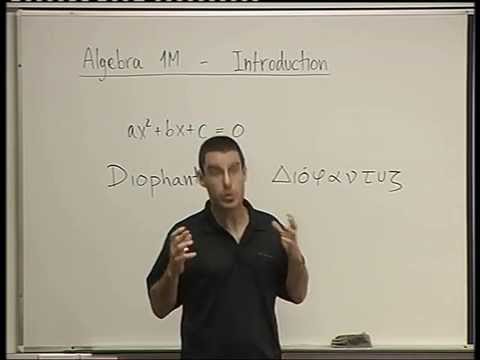
Algebra 1M - international
Course no. 104016
Dr. Aviv Censor
Technion - International school of engineering
real sable
Thanks !
 dreamy acorn
Is there an operation that returns zero when the integer input is 1, but returns 1 when the integer value is greater than 1?
dreamy acorn
i am using a very simple calculator, so i can only use basic mathematical symbols
 pale shell
Isnt this just y=mx+b
gray dust
Hardly?
gray dust

pale shell
..
 vast torrent
Affine algebra
dreamy acorn
i am trying to post a working formula into a wiki, but it hinges on being able to do what i stats (only base mathematical symbols
vast torrent
A formula for what
"Is there an operation that returns zero when the integer input is 1, but returns 1 when the integer value is greater than 1?"
This?
dreamy acorn
yeah
it only needed to fill 6 conditions though, someone came up with this:
f3(x) = -(1/12)(x - 1)(x - 2)(x - 4)(x - 5)(x - 6) satisfies:
f3(3) = 1
f3(1) = f3(2) = f3(4) = f3(5) = f3(6) = 0
vast torrent
I guess if you need to only use +×÷- then that's what you do
 vocal ginkgo
I am having a tough tim understanding this
what is the formula?
is it just this portion?
of everything?
I'm confused..
vast torrent
It's saying that
If chi is really small
chi² is really really small
So 1-chi² is very close to 1
And sqrt(1-chi²) is even closer to one
vast torrent
Which line did i lose you
vast torrent
Oh is your question about how sqrt(1-chi²) disappeared?
vast torrent
Yes
vast torrent
$\chi$
stoic pythonBOT
gfauxpas:
dusky epoch
$\xi$
vast torrent
Err
stoic pythonBOT
Ann:
dusky epoch
bruh
vast torrent
Xi sorry
dusky epoch
bruh
vast torrent

vocal ginkgo
vocal ginkgo
I understand what th leetters mean
vast torrent
I don't know why they repeat δ
vast torrent
Do you have this formula in the context of a larger problem
vocal ginkgo
Yes
QUESTION FIVE
A) A mass and spring system has a mass of 20 kg. The natural frequency of the system is 77 Hz without considering any damping effect. What is the spring’s stiffness?
(5 Marks)
b) A damper is added to the system to give the system a damping ratio of 0.1. Can you calculate the damping constant/coefficient?
(5 Marks)
c) Calculate the logarithmic decrement.
vast torrent
I don't think there's a reason delta is repeated, maybe a typo
vocal ginkgo
I have done A) and B)
correctly I believe
and now I have to calculate the log decrement
using that fromula
But I am confused, beecausee it has so many elements
four parts
vast torrent
Is the damping coefficient the same thing as the damping ratio?
gray dust
Damp ratio = actual damp const/critical damp const
vast torrent
Okay so
gray dust
That’s a fancy N
stoic pythonBOT
gfauxpas:
vast torrent
If you are correct that ξ=0.1
Well why don't you do it the real way and the approximate why
 vast torrent
It's telling you why the approximation works
The real formula is δ=2πξ/sqrt(1-ξ²)
The approximation is δ=2πξ
vocal ginkgo
ah!
that's what got me confused!
but can I use the real formula all the time?
instead?
vast torrent
Yes it you want to
vast torrent
But the answers will be very close if ξ is close to 0
Np
Sorry for calling xi chi
vocal ginkgo
no worries
vast torrent
,w sqrt(1-0.1^2)
stoic pythonBOT
 Requested by gfauxpas#9497
hoary agate
Requested by gfauxpas#9497
hoary agate
,w 1/sqrt(1-0.01)
stoic pythonBOT
 Requested by FlynnXD#2733
hoary agate
Requested by FlynnXD#2733
hoary agate
close enough
vast torrent
Or multiplying by that number, yes
 minor warren
does this proof look valid? 0 here represents the 0-vector. Prove -0 = 0. Proof: -0 = -1(0-0) = -0+0 = 0. QED
half ice
Have you proven previously that -x = (-1)(x)?
half ice
Yeah seems correct to me
minor warren
k, thanks !
scarlet ermine
well im finally done with this, thanks for your help y'all
i do not deserve this grade but i will take it gladly
 buoyant pike
 slow scroll
90-100 is probably an A, no +/- grades. Its simple and a lot of schools do it that way. The only problem is, at least at my school, is that an 89.4 and an 89.5 is the difference between a 3.0 and a 4.0 GPA.
Congrats, defunct 
gleaming topaz
How does grading in the U.S. even work? In my linear algebra class in Sweden we have one test to decide our grade for the whole 10 week course
cursive narwhal
Oof you study in sweden? Where?
dreamy acorn
so awhile ago i asked about an expression/equation where:
if 0 then 0
if 1+ then 1
and there weren't any great answers, but someone found a "close" answer
f(x) = 1/(1 + 100^(-100 * (x - 0.5)))
if 0 then 1x10^-100
if 1+ then roughly 1
it's truly beautiful
it's 1 divided by an exponential decay curve that has basically a falling edge at 0.5, and reaches near the asymptote after that
cursive narwhal
I think @vast torrent mentioned that a possible answer was $1-\delta _{ij}$
stoic pythonBOT
Abhijeet Vats:
cursive narwhal
Where that funny looking symbol is the kronecker delta
dreamy acorn
oh, perhaps i was confused then
gleaming topaz
@cursive narwhal At Örebro University
 uncut forge
@gleaming topaz you're a math major or just taking linalg?
gleaming topaz
Just taking linalg amongst other math classes for engineering
 weary talon
If I have:
f(1) = 1/0.8^0 + 1/0.8^1
f(2) = 1/0.8^0 + 1/0.8^1 + 1/0.8^2
How do I express f(x)?
dusky epoch
you've only said what f(1) and f(2) are, so without further information the value of f(x) could be just about anything for x other than 1 and 2.
weary talon
adding 1/0.8^x each time
dusky epoch
also, how is this linear algebra at all?
weary talon
I don't know what it is
dusky epoch
then post in #❓how-to-get-help, any of the 10 unoccupied channels
instead of risking posting something where it doesn't belong
weary talon
🙄
dusky epoch
also maybe try to be a little less vague in your descriptions.
hoary agate
where did you get the (x+1) from @weary talon
dusky epoch
this doesn't change the fact that this is not linear algebra at all
steady fiber
this is easily the most abused channel in the server
why do so many people not take the 5 seconds to understand the definition of linear algebra
or take the 5 seconds to understand that the course they are taking is not called "Linear Algebra"
weary talon
I'm not in a course and this is work-related, so I have absolutely no hinting on what branch of maths this would be in. I actually spent like a minute or two googling up equations/algebra, looked at the previous conversations here and it seemed to fit for me. Sorry for not being a math genius
scarlet ermine
@buoyant pike @slow scroll my 2 year school does the 90-100 = an A, 80-90=b, etc, with hard cutoffs at the -9.5
the 2 year school is extremely strict and curving only happens on individual exams with limited EC
so its actually extremely harsh for your gpa if you're a borderline student
UMD, the 4 year school i also attend, does +- and is much more lenient on curves
i've had friends earn a B with a 45%
so there a B= a 3.0, B+ = 3.3, A- = 3.7, and an A = 4.0
 empty valve
$ \sum{n = 0}{x} (5^n)/(4^n) $
 brittle juniper
$$\sum_{n=0}^{x}\frac{5^n}{4^n}$$
stoic pythonBOT
Tuong:
brittle juniper
now, what does this have to do with linear algebra?
vast torrent
I have the matrix equation Ax = y, where the matrices are defined as this
$\begin{bmatrix} 1 & 1 \ 1 & 2 \ 1 & 3 \ 1 & 4\end{bmatrix}\begin{bmatrix} x_1 \ x_2 \end{bmatrix} = \begin{bmatrix} y_1 \ y_2 \ y_3 \ y^4 \end{bmatrix}$
stoic pythonBOT
gfauxpas:
vast torrent
Find a pair of vectors u, v, in R^4 such that
for any $y \in \mathbb R^4$ satisfying $u^t y = 0$ and $v^t y = 0$
stoic pythonBOT
gfauxpas:
vast torrent
then there is a unique x in R^2 satisfying Ax = y as defined above
I honestly don't even know how to show effort in this
I just rewrote inner products in a bunch of ways hopeing something would become obvious
$y = \begin{bmatrix} x_1 + 1 x_2 \ x_1 + 2x_2 \ x_1 + 3 x_2 \ x_1 + 4 x_2 \end{bmatrix}$
stoic pythonBOT
gfauxpas:
vast torrent
I can write things like that but i dont know how to get closer to the solution ;_;
vast torrent
<@&286206848099549185>
hoary agate
@vast torrent
vast torrent
hi Flynn
hoary agate
you found u, v?
vast torrent
no I have no fucking clue how to do this ;_;
vast torrent
agreed
hoary agate
and v=-u 
vast torrent
but then that doesnt give a unique (x1,x2)
hoary agate
wdym
vast torrent
you just found a solution that works for all (x1,x2)
hoary agate
yes
hoary agate
ohh
vast torrent
thanks for trying
vast torrent
I need to com eback to this problem later, I'll try it later
hoary agate
aight
vast torrent
thanks Flynn, but my brain doesnt want to do it rightnow
hoary agate
yeah me neithor
vast torrent
appreciate the effort
magic slate
If a linear map between vector spaces is not bijective, does that imply that the mapping has no inverse?
or can you not say given only the bijectivity
vast torrent
in all areas of mathematics, a mapping is invertible iff it is bijective
khan academy has a proof of this
@magic slate
 mighty marten
Why is the cross product only defined on $\mathbb{R}^3$
stoic pythonBOT
0.5772156649:
cursive narwhal

Mathematics Stack Exchange
Wikipedia introduces the vector product for two vectors $\vec a$ and $\vec b$ as
$$
\vec a \times\vec b=(| \vec a| |\vec b|\sin\Theta)\vec n
$$
It then mentions that $\vec n$ is the vector nor...
mighty marten
Like if you think of the cross product as the vector orthogonal to a set of vectors with length equal to the area of the shape they make
cursive narwhal
Not that the question is bad but this is the sort of thing that can be googled.
mighty marten
I believe I have googled it in the past
I don't remember exactly what I got, but I think it wasn't a completely satisfying answer
quartz compass
you can think of it as a consequence of taking a determinant of 2 vectors and one "undetermined vector" in R^3 means you have a free row
so you can think of it as a kind of determinant operator, waiting for one vector to be dotted into it to fill the blank
in R^4 you could just as well make a "cross product" but now you need to feed it 3 vectors to get a vector output
so it's no longer a binary operation
for fun, work out what the "2D cross product" is
since from this perspective it takes only one vector input and gives 1 vector output
mighty marten
It would just be rotation, right?
Like equivalent to multiplication by the matrix
0 1
-1 0
quartz compass
yep
mighty marten
Wait what is a tensor?
quartz compass
and of course still has the nice property of being perpendicular
I never said anything about tensors hehehe
mighty marten
Right but
If the 2 dimensional cross product could be represented by a matrix (or 2-tensor) could the 3 dimensional cross product be represented by 3-tensor?
(That notation could be wrong but you get the idea)
stoic pythonBOT
Merosity:
mighty marten
Interesting
quartz compass
this would be a way to represent a cross product in tensor notation between U and V
the components
mighty marten
Wait isn't an n-tensor a mapping from 1-tensors (vectors) to (n-1)-tensors?
Because if so, that would make perfect sense
quartz compass
do you know what einstein summation notation is
mighty marten
No
stoic pythonBOT
Merosity:
stoic pythonBOT
Merosity:
quartz compass
it's skew symmetric in all its indices
and takes on only 1,0, and -1
in this form as I've written it
it's a skew symmetric symbol
stoic pythonBOT
0.5772156649:
quartz compass
sorry I should have written it as,
$W_i = \sum_{j=1}^3 \sum_{k=1}^3e_{ijk}U_jV_k$
stoic pythonBOT
Merosity:
quartz compass
let's start from the bottom, U, V are vectors and U_j and V_k are their vector components in some basis
at a point
mighty marten
Right
quartz compass
now e_{ijk} is a skew symmetric symbol which just means if we exchange indices, we alternate its sign
so $e_{123} =1 $and $e_{213}=-1$
stoic pythonBOT
Merosity:
quartz compass
furthermore $e_{112}=0$
stoic pythonBOT
Merosity:
quartz compass
should be clear how to derive this starting from just given e_{123}=1
the rest actually follows from that property
mighty marten
What is $e_{111}$
stoic pythonBOT
0.5772156649:
quartz compass
exchange the first two indices, you get e_{111}
and it should be the negative of itself
so that means it's 0
mighty marten
Wait is $W_i$ our tensor?
stoic pythonBOT
0.5772156649:
quartz compass
technically as I've written it, none of these are really tensors
mighty marten
Oh right
quartz compass
that's why I'm using e_{ijk} and threw away the epsilon_{ijk}
since really the relationship to make it a tensor involves relative tensors and normalizing by the square root of the determinant of the metric tensor
but you haven't quite gotten there yet
mighty marten
Wait does $e_{ijk} = e_{kji}$
stoic pythonBOT
0.5772156649:
quartz compass
since you just learned what einstein summation notation is
actually you didn't even leran that I think
since I didn't tell you lol
mighty marten
Wait negative that
quartz compass
well it's not important for now
mighty marten
There should be a negative there
quartz compass
yeah I think you're right
if you're familiar with group theory, it's the sign of the permutation
$e_{ijk} = - e_{jik} = e_{jki} = -e_{kji}$
stoic pythonBOT
Merosity:
quartz compass
just doing it one step at a time
mighty marten
Right
quartz compass
$\sum_{i=1}^3 \sum_{j=1}^3 \sum_{k=1}^3 e_{ijk}U_iV_jW_k$
stoic pythonBOT
Merosity: