Requested by davidL#1578
#linear-algebra
2 messages · Page 49 of 1
 stoic pythonBOT
 lone quail
if A and B are both similar and diagonalizable, so there exists matrixes P and Q so that:
(P^-1)AP=D and (Q^-1)BQ=D.
by transitivity, the textbook says, that the basis by which f is represented by B is formed by the columns of P(Q^-1), why is that?
For reference (in the image below) A is actually the representative matrix of f while B is the matrix at the bottom of the image
https://cdn.discordapp.com/attachments/540211747613704221/650392600208998430/image0.jpg

Can anyone help pls? sorry for repost
 timber minnow
@lone quail what confuses you
lone quail
why is B is formed by the columns of P(Q^-1)?
lone quail
@timber minnow
timber minnow
@lone quail can you be more specific
I understand the question but I don't understand where you're confused if that makes any sense haha
lone quail
i dont understand why B is formed by the columns of P(Q^-1)
where does that come from
@timber minnow
lone quail
so any ideas?
lone quail
im not sure you can move it that way
timber minnow
I didn't do any operations
I just substituted by definition of similarity
because we established that because B is similar to A, then B=P(-1)AP
lone quail
but you substituted A
lone quail
you replaced A with P^(-1)AP
if you try to invert the first equation
swap the sides
thats what you did
ok cool but its a different matrix P right?
so shouldt we call it S or something
because the matrix such that (P^-1)AP=D is different than the matrix P in (P^-1)AP=B
right?
@timber minnow
timber minnow
hm you might be right, I'm still here, was rereading the textbook statement
Ok
so we don't need a new matrix S
instead of thinking of it like A is similar to B
let's think of it like both A and B are similar to D
since both satisfy similarity: (P^-1)AP=D and (Q^-1)BQ=D
Q * (Q^-1)BQ = Q * (P^-1)AP
(BQ)^-1 = (Q * (P^-1)AP)^-1
(Q^-1)(B^-1) = (Q * (P^-1)AP)^-1
Q * (Q^-1)(B^-1) = Q * (Q * (P^-1)AP)^-1
(B^-1)^-1 = (Q * (Q * (P^-1)AP)^-1)^-1
B = Q * (P^-1)AP Q^-1
lone quail
@timber minnow what did you do from the first to the second step
timber minnow
that's why I multiplied by Q
lone quail
Ah ok i get it
timber minnow
(Q * (Q^-1))BQ = Q * (P^-1)AP
lone quail
So we got a different answer?
lone quail
Oh ok thanks
timber minnow

last step is just to show the term Q * (P^-1)A cancels to identity
then we will have B = P Q^-1
lone quail
We could rearrange it this way
I think
And then maybe view PQ^-1 as a change of base matrix?
timber minnow
yeah definitely, I just thought that was your question haha
if you're ok with it being change of basis then we are done
lone quail
I was just trying to understand the algebric steps to get here, thanks a lot
You’ve bee a great help
stoic pythonBOT
gfauxpas:
 feral mountain
take dagger of the whole thing
 wintry steppe
all its saying is that the algebraic multiplicity is equal to geometric multiplicity
 cloud glen
oh ok ty
 dusky epoch
E_λ(A) = ker(A - λI), most likely.
cloud glen
im comfused what it means by eigenspace dimension equal to multiplicity
i don't know what multipllicity of lambda means
you're saying that eigenspace = nullspace/kernel of eigenvalues?
dusky epoch
multiplicity of λ means multiplicity of λ as a root of the charpoly of A
cloud glen
ohh so like (x-2)^2 = 0, the eigenvalue 2 is multiplicity of lambda i think
 tame root
how do I find eigenvectors from an eigenvalue
for example, A = [.5 .4 ; -.104 1.1]
eigenvalues are 1.02 and .58
[A - 1.02I | 0] = [-.52 .4 0; -.104 .08 0]
tame root
but that gives [.52 .4 0 ; 0 0 0]
so wouldn't that make the eigenvector [.52 ; .4]
the book has [10 ; 13]
which is obviously not a multiple
cloud glen
eigenvector can be multiple
yeah
they multiply by 25
they take eigenvalue of 25
25[.52, .4] = [10, 13]
@tame root
cloud glen
u got result eigenvector of .52 and .4
but eigenvector result comes in form
t[.52, .4]
plug t = 25
and u get same answer as book?
cloud glen
they dont give u matrix A?
cloud glen
sorry im confused why they chose p = .104
 vast torrent
do you have a better suggestion Misha?
because if you don't, maybe you shouldn't criticize
0.104 is a good boy
he tries hard
stoic pythonBOT
Migillope:
cloud glen
nice job
stoic pythonBOT
Migillope:
tame root
thanks
vast torrent
@cloud glen i was just kidding
cloud glen
ohh okay did not understand, no problem
cloud glen
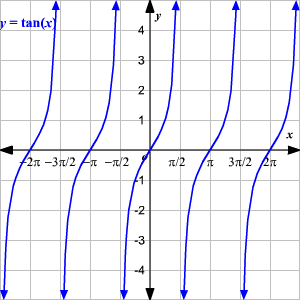
how do they know that theta is pi/4
(3,3) is coordinate but i dont understand how they how it results in pi/4
1 because 3/3?
oh wow thank you very much
wait sorry follow up question
what if coordinate (2,0)
how come answer would be pi/2
and not any period of pi/2
since tan undefined at pi/2, pi, 3pi/2, and 2pi
for example z = 2i
to find theta i need to find (0,2)
but 2/0 = undefined?
or am i mistaken
arctan(2/0) nonexisitant
using ur approach from earlier

oh
makes more sense, i though it was like unit circle (0,2) => (cos, sin)
then i need to find tan => sin/cos
 eternal jasper
hey could anyone help me start this?
don't really know where to begin
would be really appreciated
 empty copper
Translate (4, 3) to origin, rotate, and then translate back
eternal jasper
@empty copper because I'm solving for any real numbers what would the calculations look like?
empty copper
Ok, let's start off simple
If we have a vector (x, y), and we translate our coordinate system to a new system such that (4, 3) in the old system is the origin in the new system, then what are the new coordinates of (x, y)?
I'll give you a hint: it's (x - 4, y - 3)
eternal jasper
@empty copper I tried something and my numbers were similar to that, do u think this is right?
empty copper
You did it correctly, except for the very last vector you wrote down: the first entry should be 7 instead of 3 (as you wrote down correctly in the line before)
empty copper
🦈 🙏
eternal jasper
this one looks way harder
so for A is it safe to assume there's a translation of 4, 4?
as the origin is moved to 4,4
not too sure how to work backwords
eternal jasper
hey im really having trouble figuring this out @empty copper do you have any ideas on where to start?
 slow scroll
Since T is affine and T(0) = (4,4), T(x) = A(x) + (4,4) where A is some linear transformation. You're given some outputs of T, and you can use that to find what A does to a basis for R2
eternal jasper
so maybe like
would i take 8,4 and subtract the translation ?
getting 4, 0
then divide by 2 ?
idk
slow scroll
yea ur on the right track
T((2,2)) = A((2,2)) + (4,4) = (8,4) so
A((2,2)) = (4, 0) and since A is a linear transformation,
A((1,1)) = (2,0)
slow scroll
a program?
eternal jasper
didnt write it btw
empty copper
nice
slow scroll
Are you able to get that
A((1,1)) = (2,0)
A((1,3)) = (0, -4)?
where A is the linear part of T?
Once you do that, All you need to know is what A(1,0) and A(0,1) is to write a matrix for A
eternal jasper
yeah that makes sense but how u go from that to the final product is where im lost
oh
how would u find 1,0
slow scroll
well, the standard way is to use change of basis. However, in this case it is not hard to see that A((1,3)) - A((1,1)) = A((1,3) - (1,1)) = A((0, 2)) = (0, -4) - (2, 0) = (-2, -4). Therefore, A((0, 1)) = (-1, -2). Ill let you do the other one.
Also, the answer that the code gave you seems to be the transpose of the correct matrix. weird.
eternal jasper
okay thanks ill try the other one now
@slow scroll hm i ended up getting (2, 1.333)
for (1,0)
slow scroll
ok so how did you get that?
eternal jasper
i multiplied (2,2) = (4,0) by 3 to get (6,6) = (12,0) then subtracted 2 * (1,3), which got (6, 0) = (12, 0) - (0, -8), which gets (12, 8) and divided by 6 is (2, 1.333)
omg
i missed the (2, 6) subtracted for the x
it would be (4, 0) = (12, 8) which is (1, 0) = (3, 2)
thats also what the program got huh
anyway thank u for all the help that was extremely good
slow scroll
@eternal jasper note that this is NOT what the program got. What we got was $A = \begin{pmatrix} 3 & -1 \ 2 & -2 \end{pmatrix}$
stoic pythonBOT
kxrider:
slow scroll
By the definition of matrix multiplication, A(1,0) = first column of A and A(0,1) = second column of A. Thats how you construct the matrix
eternal jasper
so would the full answer be the thing i wrote down or the matrix u posted?
slow scroll
The full answer is whatever T(x,y) = A(x,y) + (4,4) is
 hexed crow
Just a general question. Can vectors be greater than three-dimensional? I normally see $\begin{bmatrix}1 \ 2 \ 3 \end{bmatrix}$. Can vectors $\begin{bmatrix}1 \ 2 \ 3 \4\.\.\.\n\end{bmatrix}$
stoic pythonBOT
tryingtolearn:
slow scroll
sure
hexed crow
thanks @slow scroll
 dreamy acorn
errr this might be the right place to ask....
is there a way i can represent a certain variable can not exceed a value of 115 inside the formula it is in? (i realize i could do something like Z<=115)
I want to show that Z in this equation can not exceed 115.
(Y + (X * 0.2) + W + (35 + Z)) * 1.05
is there some special super/sub script i can use?
dusky epoch
this isn't an equation.
wintry steppe
i have a vector and 2 bases, how am i supposed to find the change of basis matrix A -> B? 
wintry steppe
yes
 half ice
For something like
1,0,0
You can easily put this into a pretend matrix and find what a column should be
half ice
Sick. Your change of basis is
1 1
1 -1
Try putting in one of the basis vectors of R² to see why it works
wintry steppe
you mean multiplying by that matrix?
wintry steppe
it works but i dont quite get why lol
half ice
(1,0), when multiplied by a matrix, just gives the first column of that matrix
wintry steppe
sure
half ice
So, the first column should be (1,1) since that's in the other basis
 gleaming topaz
Sorry I suck at formatting, but you know that the basis of R2 = {(1,0),(0,1)}, right? So you want x1 * (1,0) + x2 *(0,1) = (1, 1), (1, -1) right
Where everything I've written are column vectors
wintry steppe
$ v =
\begin{bmatrix}
2 \
3
\end{bmatrix},
\boldsymbol{A} =
\begin{bmatrix}
1 & 0 \
0 & 1
\end{bmatrix} ,\boldsymbol{B} =
\begin{bmatrix}
1 & 1 \
1 & -1
\end{bmatrix} $
well technically 2 vectors in each matrix
gleaming topaz
So you get an augmented matrix of A | B = x
stoic pythonBOT
yami:
wintry steppe
yeah i got the coordinate vectors wrt A and B
gleaming topaz
Are you asked to find v's coordinates in A and B?
wintry steppe
yeah thats the first question, i have that already
v_A is trivial, v_B looks like this
,tex $ [v]_B =
\begin{bmatrix}
\tfrac52 \ \
\tfrac{-1}2
\end{bmatrix} $
stoic pythonBOT
yami:
wintry steppe
ugh
gleaming topaz
Wait sorry, what is the question even?
wintry steppe
i have to determine the change of basis matrix A -> B, i dont quite understand why it has to be the B matrix
i get that B's (1, 0) vector would look differently from A's (1, 0) vector
but isnt there a more.. mathematical way to determine what the A->B matrix is? lol
 gray dust
there's very little work to be done here since the columns of A are the standard basis vectors of R^2
half ice
Yes, you can solve the system of equations.
 wintry steppe
so my thing would look like
half ice
Is gon be pretty simple to solve this
gleaming topaz
Well you have Ax = B right, where A multiplied by something gives you your B matrix and that something x is the change of basis matrix from A->B
Which gives you A | B = x
half ice
No, the abcd is the change of basis matrix
wintry steppe
fml lol
half ice
Basically, we literally calculate a matrix that takes one basis to the other
wintry steppe
$ v = \begin{bmatrix}
1 \ 0 \ -1
\end{bmatrix},
\boldsymbol{A} = \left {
\begin{bmatrix}
1 & 0 & 0 \
0 & 1 & 0 \
0 & 0 & 1
\end{bmatrix} \left }, \boldsymbol{B} = \left {
\begin{bmatrix}
1 & 0 & 0 \
1 & 1 & 0 \
1 & 1 & 1
\end{bmatrix} \right } $
stoic pythonBOT
yami:
Compile Error! Click the  reaction for details. (You may edit your message)
wintry steppe
how would we do this
gleaming topaz
Are you asked to calculate v_b or what?
wintry steppe
same task
find v_A, v_B wrt bases A and B, find the change of basis matrix A->B, and with that change of basis matrix determine v_B from v_A
gleaming topaz
Do you need help with all of them or just the change of basis matrix one?
wintry steppe
seems reasonable to assume that v_A * ch.of.b matrix would result in v_B
since its just a transformation in the end no?
the way i found v_B was augmenting the basis B with the given vector and then bring it to RREF, the vector column is what my v_B is
gleaming topaz
Yeah that's right
B | v = x and x = v_b
Do you understand why you did that? If so, it doesn't work any different for the change of basis matrix
wintry steppe
uhhhh
no. lol
i think im lacking the deepest fundamentals of what it even means to bring something to RREF
gleaming topaz
Well, you have Bx = v, so you need to multiply B by some vector/matrix to get v right?
wintry steppe
sure
gleaming topaz
So x in this case would be v_b since B * v_b = v
wintry steppe
wait, isnt v a vector wrt basis A?
gleaming topaz
Well since A is the three standard basis vectors in R3 all vectors are the same wrt basis A
wintry steppe
yeah
gleaming topaz
Since 1 * (1,0,0) + 0*(0,1,0) + -1(0,0,1) = (1,0,-1)
So if you have Bx = v, how would you solve for b then
where x = (x1,x2,x3) or also v_b
wintry steppe
i want to say a system of equations but only because this is linear algebra and it seems like this is what its all about
gleaming topaz
So basically you have x1 * (1,1,1) + x2 * (0,1,1) + x3 * (0,0,1) = (1,0,-1) right
So you want to know is what you need to multiply the first, second and third vector in B by to arrive at (1,0,-1)
gleaming topaz
So this brings us back to Bx = v where x is (x1,x2,x3) as a column vector and when you put B|v = x and get B to RREF then it gives you x right
wintry steppe
what u just said may have been trivial to u but i think this actually gave me new insights lol, or at least i feel like i understand it somewhat better 
yes
gleaming topaz
And we agreed on that (x1,x2,x3) are how we need to scale our three vectors in B to get v right
so that becomes v_b
v's coordinates expressed wrt basis B
wintry steppe
yes
gleaming topaz
Do you understand this, if so change of basis matrixes isn't any more difficult
wintry steppe
i understood it now (i think)
gleaming topaz
Because we're asking us if we have A, what do we need to multiply it by to get B?
so Ax = B which gives you A | B = x and when as A is in RREF you get your change of basis matrix A -> B
wintry steppe
oh then whatever is on the | B side is my change of basis matrix A->B then?
so its like finding the inverse of a matrix except you augment with another matrix instead of the identity matrix?
gleaming topaz
Yes when you row reduce A into RREF the other side in your augmented matrix will be your A->B matrix
wintry steppe
and now it makes sense why when A = I the change of basis matrix A->B is just B
lol
gleaming topaz
Yeah, I hope that helped
wintry steppe
that was very good
and in order to find v_A from v_B i just need to get the inverse of B because its just an inverse transformation, yes?
gleaming topaz
Not sure how you meant but to find v_a from v_b using change of basis matrices you need to multipy v_B with the change of basis matrix B->A
Or you multiply v_b by B to get v in terms of the standard basis vectors which in this case solves v_A
wintry steppe
uhh yeah i guess?
my intention was to multiply v_B with B^(-1) since thats the change of basis matrix A->B
that would give me v_A, hopefully lol
gleaming topaz
Yeah in this case that works because A is the matrix consisting of the standard basis vectors in R3 so the change of basis matrix A->B just equals B
Otherwise you multiply v_B with (A->B)^(-1) to get v_A
wintry steppe
yuss
 meager tinsel
hey umm so
there is this article
https://en.wikipedia.org/wiki/Matrix_chain_multiplication
which explains how to make the most efficient matrix multiplication in terms of associative order
Matrix chain multiplication (or Matrix Chain Ordering Problem, MCOP) is an optimization problem that can be solved using dynamic programming. Given a sequence of matrices, the goal is to find the most efficient way to multiply these matrices. The problem is not actually to p...
there are 2 algorithms in there
that is
a naive one (with dynamic programming an stuff)
and a more advanced one that ties this to polygon triangulation
now
what I was thinking of is that surely
for tensor contraction this sort of order optimization makes sense as well
for matrixes the dynamic solutions is basically
there is a linear graph (range)
and we solve it for all subranges (subgraphs)
for tensors it won't be linear
wont even be a tree necessarily
will be just some graph
however, solving it for all subgraphs still works
What I wonder is
is there some analogy for tensors with efficient algo
maybe symplexification (is that a word) of some n-dimensional ...bodies (they would be very non convex)
I am very not sure but would be glad to hear someone's thoughts on this
empty copper
Once I followed a seminar, which offered two different research paths; one was to investigate algorithms for calculating high dimensional tensor products, and the other was about high dimensional quasi-monte carlo integration
Unfortunately for you, I followed the latter one
meager tinsel
yeah I mean catching up on the former not abandoning your thing)
tbh I implemented a naive solution as an upgrade to a library
and the the guy (author) asked me "what about tensordot"
and I was like well sure ehhh....
lemme dig this
and Now I found this and ofc nlogn is better then n^3
also, I like how it is smarter
feral mountain
@jagged saffron yeah look up spectral theorem
 jagged saffron
yea i was making sure
I don't really understand where to use schur decomposition here

gray dust
sigma $\sigma$
stoic pythonBOT
RokettoJanpu:
gray dust
lowercase sigma $\sigma$, capital $\Sigma$
stoic pythonBOT
RokettoJanpu:
gray dust
np
half ice
Note that ~ it's not trying to say that both elements are the same, but is trying to say both elements are related
cloud glen
ohh okay ill take that into account
half ice
I can see sticking away from = for the sake of clarity
 sonic osprey
Yeah I mean, it'd be weird to say that $\begin{pmatrix} 1 & 0 \ 0 & 1 \end{pmatrix} = \begin{pmatrix} 2 & 0 \ 0 & 2 \end{pmatrix}$
half ice
~ is something that acts LIKE = but doesn't have to be =
stoic pythonBOT
Zopherus:
half ice
Rofl
cloud glen
so its saying they're similar because of eigenvalues i guess
since the topic is eigenvalues
half ice
You can set up an equivalence relation where similar matricies are related
sonic osprey
It doesn't really say anything about why matrices are similar
Just what properties does similarity have
that every matrix is similar to itself
is the first property
half ice
Note that this gives you the power to treat any two similar matrices as "the same matrix" but still be able to say that they aren't really the same matrix
I'm totally being clear here
half ice
There we go. That's a great example. A is related to B, which is to say that A and B aren't necessarily the same, but are related by some rule
cloud glen
wicked
half ice
In this case, it's matrix similarity
sonic osprey
They're saying that IF A ~ B, THEN these properties
Not the other way around
You can have matrices with the same of all 5 of those things, but aren't similar
$\begin{pmatrix} 1 & 0 \ 0 & 1 \end{pmatrix}, \begin{pmatrix} 1 & 1 \ 0 & 1 \end{pmatrix}$
stoic pythonBOT
Zopherus:
cloud glen
so whats the base case to prove similarity if these properties don't define it
sonic osprey
have the same determinant, trace, rank, characteristic polynomial and eigenvalues
half ice
Did you really find an example where all 5 are the same that fast
sonic osprey
But they're not similar
Eigenvalues the same imply the rest so
you only need to fufill that single condition
Proving similarity is hard
Well, kind of
Your class will get to how we normally show two matrices are similar, i.e., diagonalization
cloud glen
hmm okay
sonic osprey
they're the same, since you can just take P = P^{-1} if necessary
half ice
Oh yeah good point
cloud glen
half ice
By the axioms of an equivalence relation,
If A~B and B~C, then A~C
Similarity makes "cliques" so to speak
We actually say that it "partitions" the set of all matrices
I'll leave this alone, I don't know how to explain it that great and you likely don't need it atm
cloud glen
yea haha appreciate the help
half ice
Np. Anything else you wanted? This is one of the best parts of lin alg
cloud glen
I think I'm okay for now. Reading about diagnonlization so if any questions pop up ill be sure to ask
 heavy glacier
Eh so why does an element of SL(2, Z) Preserve Z^2 (I worked out the matrix multiplication but still not really sure why)? And don't we need further restriction than just being in SL(2, Z) to be a rotation map of R^2?
half ice
Let's say a matrix has determinant 2. Then, it's inverse has determinant 1/2. But, this implies the inverse does not have integer entries
If the determinant is not 1, then the inverse is not made of integers


 half ice
Hmm. I'm making a logical leap here
 naive flicker
can someone help
wintry steppe
@naive flicker I don't think this is #linear-algebra
half ice
Did you? I still don't
heavy glacier
I was trying to find that A in SL(2, Z) maps lattice elements to themsleves (which I don't think is true)
it just transforms the whole lattice to itself
if T is the matrix multiplication
T takes M_2(Z) to itself
since what you get is (2x1 matrices of) linear combos of integers in the image which are just integers
and I cant say it preserves determinants (since the lattice elements dont have determinants defined) but were in SL group so its not sending elements way out in terms of metric either
 uneven bloom
Conversely, if det(A)=1 and A has integer entries, then A^(-1) also has integer entries (by adjugates, for example).
 north sierra
so when we're finding the characteristic equation and eigen values of a matrix A
we are finding the det(A-lamba*I)
so the determinant = the eigen values?
gray dust
A's charpoly=det(A-lambda*I). A's eigvals are values of lambda satisfying charpoly=0
gray dust
np
dusky epoch
this is not a matrix so it does not have eigenvalues
stoic pythonBOT
Миша:
dusky epoch
did you mean to say "how do i solve this equation"
cloud glen
Yes
dusky epoch
ok what have you tried
cloud glen
factorization, but that leads to no avail because of the constant +6
and i don't know quadaratic formula for degree of 3
cloud glen
cubic formula
dusky epoch
there is a cubic formula but it's long and unwieldy and definitely not something you're ever expected to use
but since all your coefficients here are integers...
the rational root theorem might be of use.
cloud glen
oh okay ill look into that, thank you
wintry steppe
nothin' wrong with a little bit of quartic formula
cloud glen
just learned rational roots test
seems like a lot of work, especically for an exam
i hope i get a simpler polynomial
half ice
It's amazing that you can say such a direct thing about a polynomial's roots without any work
x² - 2 has no rational roots via rational root theorem. Therefore √2 is not rational
cloud glen
sorry not following
half ice
What's the possible rational roots for x² - 2?
half ice
Rational root theorem says that the "possible rational roots" are of the form
±2, ±1
If the polynomial has any rational roots, they're in that list
dusky epoch
people don't understand if-then statements, kx
cloud glen
i think im missing something
whenever i try to find a polynomial for this problem
it is a challenging one with a large degree, making finding the roots a challenge
is there a special technique for this type of problem?
I tried the approach of simplifying it with a similar matrix
but it still doesn't help much
 winter moat
It tells you that $(\lambda +3)$ is a factor
stoic pythonBOT
oscillatingEquilibrium:
cloud glen
can i deduce the rest of the factors from that fact alone?
winter moat
Yes, if you can factorise a quadratic polynomial
 native lodge
by inspection of the matrix alone, no
but once you have the characteristic polynomial, then yes
winter moat
Good luck
cloud glen
tyvm
native lodge
when it says if possible though
makes you think if they are going to try and do something tricky
winter moat
I wonder if second eigenvalue is -3 as well
native lodge
could very well be the case
winter moat
If that's true, then third eigenvalue can be found from trace of the matrix
And can be verified
But it's better to do it the long way
cloud glen
i decided to try this one since its easier
but i got the polynormial x^3+x^2-x-1 = 0
now im stuck
how do i find the rest of the eigenvalues?
if i use the rational root theorem
i get {-1,1}
but then how can i be sure there isnt a multiplicity of one of these eigenvalues?
winter moat
You didn't get third?
cloud glen
from the polynomial $ x^{3}+x^{2}-x-1 = 0$
stoic pythonBOT
Миша:
cloud glen
i could only deduce -1 and 1
winter moat
It is $(x+1)^2(x-1)$
stoic pythonBOT
oscillatingEquilibrium:
winter moat
You know x-1 is a factor
So try to take it common out of groups of two terms
That's how you normally factorise it
Or it is easier to take (x+1) as a factor
$x^2(x+1)-(x+1)=(x+1)(x^2-1)$
stoic pythonBOT
oscillatingEquilibrium:
cloud glen
oh i thought u could only do that for quadratic
winter moat
You're welcome!
jagged saffron


Can anyone guide me on the right track here?
I tried using spectral theorem on B,C so they are diagonalizable with real eigenvalues, but the issue is that they aren't diagonalizable on the same basis unless B,C commute and there are no repeated eigenvalues
So I can't use it to find eigenvalues of A
I don't see how schur's decomposition theorem will help here unless I can split the decomposition into real and imaginary parts?
Also tried using gershgorin circle theorem but I don't think that works
 mint sentinel
anyone know why we use the formula v divided by the norm of v squared where v is an eigenvector to find a matrix P orthogonal to a matrix A?
vast torrent
We want P to have determinant +1 or -1
vast torrent
Otherwise it doesn't have Q-¹=Q^t
mint sentinel
i see
vast torrent
Only works for +-1 :)
vast torrent
It's a definition that we impose as part of wanting Q-¹=Q^t
mint sentinel
if you know what i mean lo
vast torrent
We want that as part of the definition
mint sentinel
yeah, that sounds better
vast torrent

mint sentinel
i see someone calculate the eigenvalues and vectors by det(A-alpha I) and others by det(alpha I-A), are both right to use?
dusky epoch
these differ by a factor of (-1)^n.
vast torrent
the advantage of the first is that the determinant is the char polynomial at alpha=0. Advantage of the second is the char polynomial has leading coefficient 1 on alpha^n
Choose your warrior
mint sentinel
: o
vast torrent
Same roots of the polynomial is the point
mint sentinel
because what happens when i calculate with each formula is is that the basis matrices have their vectors mirrored
mint sentinel
ait
vast torrent
As long as you match the right eigenvalue to the right eigenvector, i mean
mint sentinel
yeah
 quartz compass
there are times when you'd wanna order your eigenvectors in order from smallest eigenvalue to largest
quartz compass
you can worry about it when it comes up, it's not too serious
nothing for what you're doing I think, stuff to do with approximations
vast torrent
When doing orthogonal bases, i order them so the det is 1 rather than -1
Just my personal preference
mint sentinel
👍
vast torrent
When is a vector space isomorphic to its dual? Is that only for finite dimensional spaces?
Wait no it can't only be finite cases because L2 spaces are
jagged saffron
you can explicitly construct a isomorphism in the finite dimensional case
However I know this does not hold for all infinite dimensional spaces
I think dual space is not isomorphic ever in the infinite dimensional case
stoic pythonBOT
gfauxpas:
jagged saffron
I don't know any analysis
In mathematics, any vector space V has a corresponding dual vector space (or just dual space for short) consisting of all linear functionals on V, together with the vector space structure of pointwise addition and scalar multiplication by constants.
The dual space as defined ...
but its true
dual space of infinite dimensional V.S is never isomorphic to the vs
vast torrent
oh I was thinking of the contunuous dual space
 opal plaza
Hello again :)
Trying to conceptualize a problem: Describe the eigenspace of a transformation in R2 which reflects points over the Y axis.
I imagined that the transformation would be two vectors (-1, 0) (0,1) which means the eigenvectors would be (1,0) (0,1). And this means the space would be the individual span of these two eigenvectors? Which are kinda like the pivot the points rotate around as they're tansformed over the y axis.
feel like I'm on the cusp of understanding this
half ice
So an eigenspace can be best thought of as a set of vectors that "don't change direction" after a transformation
Let T be the act of flipping R² over the y-axis. This is a linear transformation
Obviously, anything on the x-axis isn't affected by T. So, this is an eigenspace. Plus, it has eigenvalue 1 since you don't have any scaling due to T
With me so far on this?
opal plaza
so the x axis is an eigenspace
half ice
Yus. We can describe it instead with a basis, one such basis is (1,0)
That's likely what you mean
opal plaza
Okay perfect
half ice
The other one is the y-axis. It has eigenvalue -1, since vectors get flipped
You can describe it instead with the basis (0,1)
opal plaza
and that's a vector going up the y-axis?
half ice
Any vector that lies entirely on the y-axis yeah
opal plaza
okay, perfect. And those two together describe the eigenspace because they don't change in direction based on the transformation.
half ice
There are two eigenspaces, each one is their own
opal plaza
I see
half ice
And those are the only two, yeah
I think you get it! You likely don't need to understand it in the depth I'm trying to push onto you lol
For many classes it's important that you can compute those basis vectors
opal plaza
So if it was in R3 the space would be a vector through the plane just with three coordinates, and the transformation would kind of rotate around that span?
no thank you for the help this is really interesting. I know how to compute them I'd just like to conceptualize it a bit better
half ice
Like, if we are flipping over the z-axis?
Then anything on the plane is in an eigenspace. This case is different, since the eigenspace is two dimensional and needs two basis vectors to describe it
As well, anything on the z-axis is another eigenspace. This one is one-dimensional
opal plaza
mm I suppose so. I'm trying to visualize some random matrix like (4, -2, -2) (0, 1, 0) (1, 0, 1). Like I solved the eigenbasis but I'm trying to picture what's going on beyond that
half ice
It's difficult to picture for completely random T lol
opal plaza
haha true
half ice
Here's an interesting example. Let's say you have R² and T is a 90 degree rotation. What's the eigenspace?
opal plaza
should be the same, no? (0,1) and (1,0)
half ice
I mean a 90 degree rotation about the origin, sorry. So (1,0) goes to (0,1)
gray dust
did you get the visual intuition of eigenvals and eigenvecs?
north sierra
yeah so it's just a line right?
and the eigen value scales the vector?
but like not really
i dont get it confidently
gray dust
there may exist a set of vectors in a vector space which only get scaled by some constant via a linear transform on that space
north sierra
ah i see
gray dust
this is all compactly said by $A\xi=\lambda\xi$ where $\lambda$ is an eigenval and $\xi$ is one of $A$'s eigenvecs associated with $\lambda$
stoic pythonBOT
RokettoJanpu:
north sierra
i see
gray dust
these exercises are to see if you can identify eigenvecs and eigenvals from how the matrix transforms these vector spaces
gray dust
for what
north sierra
for 31
gray dust
why
north sierra
so im thinking cause it goes through the origin lol
gray dust
an eigen value would be 0?
so im thinking cause it goes through the origin lol
how do these relate
gray dust
sketch R^2 and some line thru the origin
north sierra
gray dust
draw some vectors. transform them exactly as told by q31
gray dust
do you understand what transformation q31 entails
north sierra
not really
gray dust
which part
north sierra
the part where it says reflects points across some line through the origin lol
gray dust
remember reflecting stuff across lines in geometry class?
gray dust
plot the point (1,0) and reflect it across the vertical axis
gray dust
no
gray dust
note that the points are equidistant from the y axis. the line connecting them is perpendicular to the y axis
cloud glen
if an eigenvalue has multiplicity of two, does it mean that there will be two possible eigenvectors for that eigenvalue
north sierra
is my pic good?
gray dust
yes
north sierra
yes to who?
gray dust
your R^2 sketch
cloud glen
nm gettin ready for finals hah u
gray dust
what i said can be applied to reflecting anything about any line
north sierra
samee
half ice
Imagine folding a piece of paper along the line. Where does (1,0) end up?
north sierra
(-1,0)
what i dont get is that i thought eigen vector, values were supposed to only scale the vector, why is the question saying it reflects?
half ice
Maybe get a piece of paper and actually try it out
gray dust
the reflection is what the transform does to ALL vectors in R^2
 regal crater
or just play with mirrors
half ice
Basically, connect the point with a line that's normal to your line. Then, flip that line
north sierra
still dont get this uestion lol
so the yellow line i made is the line they're talking about that passes through the origin?
gray dust
yeah, though the answer to the q should apply to any line you draw through the origin
north sierra
true
half ice
With the picture you drew, (1,0) does not reflect to (-1,0)
gray dust
that was just an example for him to practice reflection. i told him to do it about the vertical axis
gray dust
aye
north sierra
aright
tbh
i still dont get the Q and how its related to eigen stuff
eigen value
when i reflect a point over the yellow line
what does that tell me?
i guess this would be the reflection ?
gray dust
yes
north sierra
so what does this tell me?
gray dust
draw any vector. note the line through the origin which contains that vector. then transform the vector. note the new line which contains the transformed vector
reflect some more vectors across the yellow line, and you should see a set of vectors which "stay" in their line
north sierra
like that?
so since the reflections are the same length they're not being scaled and thus the eigen value is 1?
half ice
Note that all vectors start at the origin
north sierra
oh
half ice
Now, you have the right idea. If a vector is perpendicular to the line, then the vector still lies along the same line it was on before. Its direction hasn't been changed, so it is an eigenvector
half ice
Perfect. That's bae
north sierra
LOL
half ice
What's the app?
north sierra
Notability on the I Pad
north sierra
LOL
north sierra
kaynex, the good at paint
half ice
That eigenvector has an eigenvalue -1, since its direction is getting flipped
half ice
I was thinking the vector before transformation, but it doesn't really matter
north sierra
oh okay
half ice
Any vector that has the same direction as the red is an eigen
Including if it were in the opposite direction
There's other eigenvectors. We have ignored the obvious case
north sierra
okay. But the opposite direction vectors would be - eigen values right
jagged saffron
does anyone know a proof for generalized schur's inequality, specifically the real part of the eigenvalue
any proof
I am desperate
jagged saffron
ok well i got it
cloud glen
my textbook shows for calculating eigenvectors to do $\lambda*I - A = 0$
but online it says to do $A - \lambda*I$
stoic pythonBOT
Миша:
cloud glen
which one is correct
stoic pythonBOT
Миша:
cloud glen
nvm results the same thing
dusky epoch
you want the dets of these matrices, not the matrices themselves, to be 0.
vast torrent
If you know the answer to one part, do you know how to get the other part?
wintry steppe
no
wintry steppe
a random vector in R3 can be expressed as a linear combination of v1 v2 v3
wintry steppe
so the random vector has unique elements?
wintry steppe
instead of v1 v2 v3?
vast torrent
Just an example of a non unique lin comb
wintry steppe
why isn't it unique
wintry steppe
ok
wintry steppe
using gauss method?
vast torrent
And solving 3 equations with 3 unknowns
wintry steppe
yeah
vast torrent
Okay
I claim
That showing every vector in R3 is a unique lin comb of v1 v2 v3
To show that that's true or false
You only need to consider how many solutions there are to
c1v1+c2v2+c3v3=0
c1,c2,c3 are scalars
I claim that if there's a unique solution to that equation , then and only then do those vectors span R³
Can you solve that?
wintry steppe
yeah i'll try
vast torrent
Good luck
Come back with more questions :)
I may not be around but someone should be
wintry steppe
ok, thank you
vast torrent
@wintry steppe if there is one and only one solution
Do you see what the solution is?
wintry steppe
0?
wintry steppe
can you send the link?
vast torrent
native lodge
An alternate look at the definition of linear independence, is that if your v’s are column vectors, then what you have is a representation of a matrix with v’s as its columns being multiplied by a column vector of c’s on the right.
So Ax=0
wintry steppe
thanks
native lodge
And to be linearly independent, the only set of c’s that makes Ax=0 true is the zero vector itself
vast torrent
If you don't understand sum notation I'll explain the proof
native lodge
If there are nonzero vectors in this nullspace, the vectors are not linearly independent
half ice
If you're just learning LA for the first time and want an easier read, you may be best going through an applied book first
Also, feel free to ask any questions about it here
 wind yacht
If it helps, I am using hoffman's linear algebra
half ice
It sounds like you are in an applied course and likely need an applied book
What book comes with the course?
wind yacht
although I have also been recommended Linear Algebra Done Right (Undergraduate Texts in mathematics) & Linear Algebra by Hefferon
lone quail
Why is it that if the cubic invariant is 0, then the polynomial of second order, which represents the conic, can be factored with two first order polynomials?
wintry steppe
How would I even approach this? Prove or disprove: Every square matrix is similar to an upper triangular matrix.
By similar I mean similar over reals
vast torrent
Can you guess whether it's true or false?
wintry steppe
Well the only thing that I can use to prove similarity is if there exists a P such that A=P^-1 BP. Just from that I want to say false because I don’t see how you would prove said statement with that.
vast torrent
I don't know the answer off hand but my suspicion is no because the existence of JNF requires the scalars to be complex
wintry steppe
JNF?
vast torrent
So my intuition says to construct a simple 2x2 matrix with no jordan normal form
wintry steppe
You mean a 2x2 whose rank doesn’t equal 2?
vast torrent
Did you learn about eigenvalues
wintry steppe
Yes, but not JNF
vast torrent
Thats when you do a change of basis of the (generalized) eigenvectors
Said another way
You do a change of basis so that you get a triangular matrix with eigenvalues on the diagonal
That exists as long as eigenvalues exist
So i would make a 2x2 matrix that's not triangular that has no eigenvalues
That's my hunch
wintry steppe
So I want to find a matrix with no real eigenvalues?
vast torrent
Im guessing
wintry steppe
Ok thanks
wintry steppe
Wait, so then how would I show that said matrix is not similar to any triangular matrix over reals?
vast torrent
Oh uh hmmm im thinking
wintry steppe
Do I write general form of an upper triangular matrix and show that there is no P to make the 2x2 similar to a general upper triangular?
vast torrent
I cant think of one
vast torrent
Because every matrix is similar to its rref
wintry steppe
Isn’t the only matrix similar to the identity matrix the identity matrix?
vast torrent
No but that's also not what i said
Every matrix is similar to.its rref so if every rref is triangular there's your answer
 scarlet ermine
i've been working on this problem and i can't really figure it out, my understanding for part a is i just multiply a^k*v(0) k number of times to get the series, but for part b it seems to need something about eigenvalues and eigenvectors and its over my head
vast torrent
Yes, that's the answer mikhail
wintry steppe
Ok thanks
vast torrent
What is SAGE
scarlet ermine
is that where i take a and subtract i*x from it?
vast torrent
Nope
It's when you do a change of basis into a diagonal matrix
Not always possible, but often is
But D^k is easy if D is diagonal because it's just the diagonal entries^k
vast torrent
If you dont know how to use eigenstuff, then look up how to have SAGE do it
Diagonalization of a matrix
If such a change of basis exists, it will.give you A=PDP-¹ with D diagonal
scarlet ermine
right i've figured that out
vast torrent
And (PDP-¹)^n does something nice
scarlet ermine
i never was able to figure out (or my professor) how to put a matrix to the k power
vast torrent
It's difficult in general without diagonalizing it
Or finding the closest thing you can to diagonal
Like it might need some 1s on the off-diagonal
And might need complex numbers even if A has real entries
scarlet ermine
i vaguely remember calculating p and d from a's eigenvalues and eigenvectors but i never fully understood it
vast torrent
Well the assignment looks like it wants the computer to do the work
scarlet ermine
sage is basically matlab but worse
and nobody knows how to use it including the professor
vast torrent
I don't use either
I use R but i have on my bucket list to switch to Python when i learn it
Wolfram alpha can diagonalize too
sonic osprey
That's like
Sage and Matlab do very,very different things
Sage can do a lot of things matlab can't do
vast torrent
At least for small matrices
I don't think wa would like it if you put in a 1000x1000
wintry steppe
@vast torrent hi again, for part A of this question i got the matrix:
[1 3 4 0]
[0 1 1 0]
[0 0 0 0]
row echelon form
could you help me with parts b and c?
scarlet ermine
@sonic osprey wow a sage stan
i always thought sage was only used by my professor and a small group of hipsters in 2012
based on how impossible it is to find online resources about it
vast torrent
@wintry steppe this goes back to what Amph said about the solution space to Ax=0
Do you remember?
wintry steppe
i remember but didnt understand
vast torrent
Lin ind means the only solution to c1a+c2b+c3c=0 is c1=c2=c3=0
So you want to solve a system of 3 eqns in 3 unknowns
How do you write such a system.as a mtx eqn?
wintry steppe
for part A?
sonic osprey
@scarlet ermine I feel like you're not looking in the right place, there's plenty of documentation
scarlet ermine
@sonic osprey well theres that huge textbook and some stuff like that
sonic osprey
Yeah I'm a bit biased, I've contributed a bit to sage
scarlet ermine
but once it gets to troubleshooting or youtube videos
 toxic pendant
I'm having trouble understanding the notation in this problem so some clarification would be appreciated
vast torrent
Defunct, lucky, the mtx is diagonalizable without even needing complex numbers
scarlet ermine
you're kinda boned bc nobody makes videos, theres 0 active forums, nobody at my uni uses it, none of my friends or tutors or other profs use it
toxic pendant
So S1 and S2 are intersected
sonic osprey
There are active forums
toxic pendant
but what does the weird 0 symbol mean
sonic osprey
Google Groups allows you to create and participate in online forums and email-based groups with a rich experience for community conversations.
vast torrent
And do you see what happens when you take SJS-¹ to the nth power?
sonic osprey
not super active, but active enough
toxic pendant
Is it supposed to represent an empty matrix?
vast torrent
@toxic pendant
sonic osprey
I'd estimate that around half of math professors have used sage before
vast torrent
$\varnothing = { , , , }$
stoic pythonBOT
gfauxpas:
regal crater
tbh thats pretty wasteful notation
toxic pendant
Okay so my guess was right? The condition is basically saying that there are no intersections?
vast torrent
With vector spaces
scarlet ermine
@vast torrent not yet but im gonna do the math and see what happens
wintry steppe
1c1 + 3c2 + 4c3 = 0
0 + 1c2 + 1c3 = 0
0 = 0
? @vast torrent
vast torrent
Sometimes "empty intersection " means only {0}
toxic pendant
In that case if one has (1,1) and the other has (2,2) would there be an intersection?
wintry steppe
based on the row echelon matrix
vast torrent
And actually that looks more like a phi
vast torrent
Aaaaaaa too many conversations
toxic pendant
ctrl c ctr v'ing the symbol into google brings up the page for phi if that helps
wintry steppe
sorry @vast torrent
vast torrent
@wintry steppe anyway, you can solve this by making a mtx and doing row reduction
@toxic pendant im guessing its just supposed to be empty set
toxic pendant
Sounds good
scarlet ermine
@vast torrent i don't see any pattern, maybe im dumb tho
when i multiply pdp^-1 i get A, as expected
but when i square that i just get a^2
which now i say it sounds like exactly what would happen
vast torrent

You can prove inductively that only the middle matrix needs to be calculated D^n
The change of basis mtces you can keep as they are
scarlet ermine
what do you mean?
vast torrent
Youre finding (SD^nS-¹)v, not (D^n)v
vast torrent
What was the original problem?