#linear-algebra
2 messages · Page 48 of 1
 undone garnet
 edgy ridge
Thanks! I'll take a look over it.
And your rank thing too.
You say the answer is two?
undone garnet
yeah
 gray dust
D is a diagonal matrix whose entries consist of A's eigenvals. P is an invertible matrix whose columns consist of each eigenval's corresponding eigenvec
edgy ridge
Erm, does order matter with D? Is it, in this example, ((-2, 0, 0), (0, 1, 0), (0, 0, 3))?
Sorry - I don't feel like invoking the TeX bot.
undone garnet
no
it just affect the way
you construct P matrix
I mean, each permutation of diagonal of D
each P matrix
edgy ridge
So... it doesn't matter?
gray dust
the order of the eigenvals must be consistent with the order of eigenvecs
edgy ridge
I'll be honest, I'll have to take a look at diagonalization first. But thanks for the help!
gray dust
for example if you had eigenvals $\lambda_1,\lambda_2$ with respective eigenvecs $\xi_1,\xi_2$\\if you construct $D=$ diag$(\lambda_1,\lambda_2)$, then P's first column must be $\xi_1$ then $\xi_2$ is next
edgy ridge
Er, just to clarify some terminology, for some matrix A and vector v, if Av=cv, then c is the eigenvalue, and v is the eigenvector, yes?
Some reason, the teacher just started using terms without really defining them... it's fun.
But yeah, I think I might get what you mean.
Fair enough.
gray dust
yeah c is the eigenval and v is the eigenvec @edgy ridge
really doesn't matter what names you give em
i usually call eigenvals lambda and eigenvecs xi
edgy ridge
Anyways, I threw some numbers into a calculator regarding trace... Let's say a diagonal matrix with 1, 5, and 9 (3x3, 1-9). Its trace was 15. I then tried throwing in its square, so 1, 25, and 81... its trace was 107. However, squaring the matrix should result in 261 as its trace...?
 stoic pythonBOT
RokettoJanpu:
edgy ridge
Recall that I was given only the eigenvalues, and was told to find the trace of A^2
The values were -2, 1, 3.
3x3 matrix.
gray dust
,calc 1+25+81
stoic pythonBOT
Result:
107
tr(A)=sum of A's elements along main diagonal
edgy ridge
Yeah.
I guess the problem in this case is I don't know the matrix - only its eigenvalues.
So I know the trace of A, but what is A^2?
Erm, the trace IS the sum of the eigenvalues, right?
gray dust
why 261
edgy ridge
I just used a calculator... hold on a sec.
Anyways, Nguyen mentioned that if x is a eigenvalue of A, then x^2 is for A^2...
And since the trace is the sum of the diagonal, and is also the sum of its eigenvalues...
Can I say that if A has eigenvalues -2, 1, 3, then trace(A^2)=4+1+9=14?
 uncut forge
Yeah, since it's diagonalizable(not sure if it's true in general)
Trace is sum of eigenvalues
And if A=$$PDP^{-1}$$ Then $$A^2 = PD^2P^{-1}$$
stoic pythonBOT
AoiKunie:
uncut forge
So the squares of the eigenvalues to A are eigenvalues for $$A^2$$
stoic pythonBOT
AoiKunie:
 dusky epoch
bad tex
 pallid swallow
A and B look almost similar
and M_2 is really whackable
only 2 cases essentially, invertible and rank 1
if A, B invertible we are done, because we have A=B
if A invertible we get AB=B^2...hmm
undone garnet
A^2 = tr(A)
hm...
A^2B = tr(A).AB
AB^2 = (A^2.B^2)/tr(A)
and we have
tr(A).AB = (A^2.B^2)/tr(A)
<=> tr(A)^2.AB = A^2.B^2
hm.../
 wintry steppe
Hello everyone. Would someone have any hint about the following:
https://math.stackexchange.com/questions/3445326/if-any-order-preserving-permutation-submatrix-of-a-otimes-b-belongs-to-a-b

Mathematics Stack Exchange
Edited after the comment below: let $A$ and $B$ be two permutation matrices of size $n$. If any order preserving combination of $n$ rows and $n$ columns of $A\otimes B$ that is a permutation matrix...
 analog wasp
<@&286206848099549185> how do we prove that an empty set is contained in a set that we will call X
 feral grove
yeah
analog wasp
i dont think i did
feral grove
you need to wait 15 minutes after asking a question to ping helpers
analog wasp
maybe that rule has been changed or something because i couldnt recall it and i just looked again i dont see it am i blind?
 half ice
@analog wasp
What's your question? How do we tell if the empty set is a subset of X? The empty set is a subset of every set.
analog wasp
apparently we need to demonstrate that
and i dont see a possible way to do so, maybe i miss understood what the teacher meant by that
if you understand any french then here you go, if not, the second question in Exercise 1 says : Demonstrate that Ø is included in X
 lone quail
why are the eigenvalues associated to the symmetry of a line r passing through the origin always 1 or -1?
specifically f(r)=r (eigenvalue 1) and f(r2)=-r2
where r2 is the line perpendicular to r
what i dont understand is where f(r)=r and the other part come from
 clever cedar
is it apporiate to say that a given linear transformation is not surjective because its rank does not equal m (the number of rows of the map)
dusky epoch
what's m
clever cedar
the number of rows
such that if T(x) = A(x) then m is the number of rows in the matrix A
 brittle juniper
there are no "rows" to talk about when you have just a linear map and not a matrix
the rank of T is the dimension of its image
the image of T has a structure of vector space, it's a subspace of the output vector space
if the output space happens to be finite dimensional, then you do have T surjective iff dim Im T = the dimension of the output space
 hardy blaze

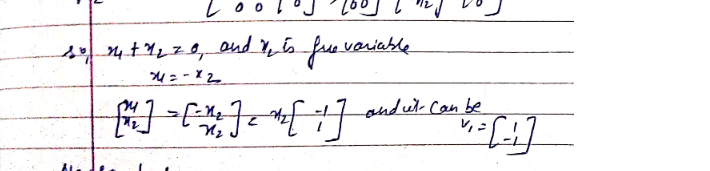 gray dust
looks like you only need to pick out an eigenvector corresponding to lambda_1 = 3
gray dust
@hardy blaze ^
gray dust
no prob man
 vast torrent
@sleek briar let's ask here. HP asked in the question chat and I dont know the answer
Questions gives two lines in space given by constant(x-x1)=constant(x-x2)=constant(x-x3) and similarly for the other line
question is to find the distance between the two lines
https://media.discordapp.net/attachments/490557019623915520/648235470211252245/IMG_20191125_002434742.jpg?width=298&height=398 his source gives this formula and I don't know its derivation

 grave plank
Well they are testing on whether you understand linear independence
in which case what you have to do is consider the linear dependence relation and create a system of equations to figure out w
 steady fiber
similar matrices have the same eigenvalues with the same algebraic multiplicity (and also have the same determinant)
so just find those
and compare
edgy ridge
Can anyone please help me with this question? Given a 3x3 matrix A with eigenvalues -2, 1, 3, find the rank(A+2I), where I is the identity matrix. A kind person was willing to help the other night, but I'm a bit lost still.
A has 3 distinct eigenvalues, so A is diagonalizable
A = PDP^(-1)
of course, I = PIP^(-1)
so
A+2I = PDP^(-1) + 2PIP^(-1) = P(D+2I)P^(-1)
rank(A+2I) = rank(D+2I)

D is diag(-2, 1, 3)
so
rank(D+2I) = rank(diag(0, 1, 3)) = 2
But where did rank(A+2I) = rank(D+2I) come from?
undone garnet
when you multiply a invertible matrix
it doesn't change rank
rank(P(D+2I)P^(-1)) = rank(D+2I)
edgy ridge
This applies when multiplying invertible matrices with that? Its inverse, or any other matrix?
undone garnet
just invertible matrix
I mean
rank(A.B) = rank(A)
if B is invertible
rank(A.B^(-1)) = rank(A) too
because B is invertible then B^(-1) is also invertible
so rank(PDP^(-1) = rank(DP^(-1)) = rank(D)
edgy ridge
Kinda confusing, but I'll take your word for it. 🙂
undone garnet
yeah
undone garnet
rank(A.I^(-1)) = rank(A)
right?
so when you're dealing with rank
just imagine an invertible matrix is an identity
edgy ridge
Alright. I guess, so since in the case PDP^-1, it is obvious that P is invertible by the existence of P^-1 in the equation, it will not affect the rank, therefore rank PDP^-1 == rank D?
edgy ridge
Yep! Thanks. Now, next part is
D is diag(-2, 1, 3)
so
rank(D+2I) = rank(diag(0, 1, 3)) = 2
Is there a typo there? Is it not supposed to be
rank(D+2I)=rank(diag(0, 3, 5))=2?
undone garnet
D is diag(-2, 1, 3)
I is diag(1, 1, 1) then 2I is diag(2, 2, 2)
then
D + 2I = diag(-2, 1, 3) + diag(2, 2, 2) = diag(0, 1, 3)
obviously rank(diag(0, 1, 3)) = 2
just write it out
edgy ridge
Well, if we add up the diagonals, then for top left, -2+2=0, for middle, 1+2=3, for bottom right, 3+2=5, no?
undone garnet
ah yes
edgy ridge
Then should it not be (0,3,5)? Am I missing something that makes it (0,1,3)?
edgy ridge
Ah alright. Thanks. It does not affect the rank, but it was making me puzzled.
wintry steppe
Hello, I've been asked to prove that if a subspace is T-Invariant, then the following is true:
I'm unsure where to go from T(S) = S to this
wintry steppe
forget it, id missed an important condition
wintry steppe
Can i ask very simple question related to Laplace transform?
I have the answer but I think it's wrong
dusky epoch
don't ask to ask
wintry steppe
Transform u(t) to ..
Is 1/s
But teacher wrote number*1/s
"Level unit signal" (using google translate).
Sorry if it's not clear.. teacher isn't clear either..
@dusky epoch can you help?
dusky epoch

wintry steppe
???😟
dusky epoch
i really don't want to deal with this rn
wintry steppe
Then why bother writing "don't ask to ask"?
dusky epoch
someone else might have come and helped you
wintry steppe
It's not a long answer.
But I understand your frustration
I doubt someone will help
I'm stuck on it and ask my classmates
vast torrent
@wintry steppe if you're not sure which is correct, why not just evaluate the integral L{u}?
Or L{u(t-c)}
For more generality
vast torrent
Well what's the definition of laplace transform, do you know?
vast torrent
Let's move to another chat, this isn't lin alg
 vast thicket
if 2 vectors row reduce to the identity matrix does that mean they span all of R^2?
u = <6,3>, v = <-30, -12>
gray dust
if you cram those vectors into a matrix and can row reduce it to I, then yes
vast thicket
thanks
 winter siren
If a set of vectors in R^4 are linearly independant. Are these vectors always a basis?
How do i determine if the vectors make a basis in R^4, otherwise?
Or in R^n in general.
gray dust
you need a set of n LI vectors from R^n to form a basis for R^n. Edit: thanks Ann
winter siren
Oh, it all makes sense now when looking at the question again. Thanks 😀
 vapid coyote
the definition would require linearly independent and spanning
it's a theorem that in finite dimensions it's sufficient to have n linearly independent or n spanning vectors
 grave halo
I'm tasked to the find the basis of the null space of the linear transformation (T_{A}:,\mathbb{R}^{3}\to\mathbb{R}^{3},, \mathbf{x}\mapsto A\mathbf{x}) where the matrix A is [\begin{bmatrix}
1 & 0 & 1\
0 & 2 & -1\
0 & 1 & -2
\end{bmatrix}]. Matrix A has full rank so the dimension of the null space is 0. Is the empty set a basis for a dimensionless null space? I'm not sure how to answer this. Thank you.
stoic pythonBOT
Noether:
grave halo
Or is the answer, it doesn't have a basis?
dusky epoch
empty basis
wintry steppe
Anyone know about linear congruency
Dunno if this is the right place to ask about it
Solve this congruence relation to find the smallest possible value of x: 5x ≡ 1 (mod 21)
Tried running it into a calculator but it just made no sense to me
 sonic osprey
What does it mean for something to be a vector space?
grave halo
Closed under addition and scalar multiplication, right?
sonic osprey
Are you sure?
grave halo
Uhh
A real vector space satisfies x,y\in L implies x+y\in L
And if x\in L then cx\in L if c\in R
sonic osprey
Are you reading this somewhere
grave halo
What do I have to check?
sonic osprey
It depends what the problem is asking for
Are you trying to check that they're vector spaces? Or subspaces of other vector spaces
grave halo
That they're vector spaces
sonic osprey
vast torrent
What does it mean to increase the determinant
half ice
@grave halo
For the first one, you know that R⁴ is a vector space. So, you can prove A is also a vector space by proving it is a subspace
vast torrent
What does it mean to increase the determinant
grave halo
@half ice Thank you. I did just that 🙂
@wary shoal I don't know if you mean increase it as in you want it to be 16721692 bigger, ie 906340587+16721692 or 16721692*906340587 but if that's what you want you can always use the the property of determinants: (\text{det}(cA)=c^{n}\text{det}(A)) somehow?
stoic pythonBOT
Noether:
grave halo
Well find the c^n that satisfies that! 🙂
n is the dimension of the matrix
Uhh
Those are a bit trickier rules
I'm not sure how to do it algebraically but you could brute force it numerically.
vast torrent
Have you tried randomizing it using a computer
grave halo
^ what I meant by numerically
grave halo
Did you try every single combination?
vast torrent
You sure there's a solution?
grave halo
What kind of algorithm did you use in order to not brute force it?
vast torrent
So leave your pc running for an hour and go cook dinner
grave halo
Can you somehow express the determinant algebraically with your required conditions?
vast torrent
Why are you using doubles for integers
grave halo
We wish haha
grave halo
Yeah thank God
sonic osprey
The permutation definition of the determinant might help here
At least, it may reduce down your search space
I mean, with a 9x9 matrix
It's going to be hard to determine what's invertible and what's not
Without actually calculating the determinant
vast torrent
Why are you using doubles for integers
grave halo
Ayy
vast torrent
I wonder if a greedy algorithm will work
Put all the 9s in one row and expand on that row
Worth a try
Well alternating i mean
9 1 9 1 9 1 9 1 9
In the first row
Try that
And the second row will be like
x 8 2 8 2 8 2 8 x
Something like that, still thinking it through
x x 7 3 7 3 7 x x
x x x 6 5 6 x x x
Worth a try
half ice
Do you disagree that i = e^(π/2)?
clever cedar
i have no idea what that means
:p
idk where it came from
or why it was introduced
wdym gary
half ice
Useful here is euler's formula:
e^(it) = cos(t) + isin(t)
Put in π/2, you get i = e^(iπ/2)
clever cedar
oh looks similar to de'moivres theorem
half ice
It's an extension of demov
clever cedar
oh
half ice
Is very useful
clever cedar
i did ctrl+f in my textbook for euler
didnt show anything 😠
but ill write it down
vast torrent
Wtf kind of book are you using
half ice
In fact your book presents re^(iθ) as polar form, your book must have introduced euler already
half ice
There's no understating how important this is, complex numbers exist because of it
e^(it) = cos(t) + isin(t)
So commit that one to memory lol
vast torrent
Post the book so we can roast it or prove your ctrl.f wrong, either way
clever cedar
ok one second
vast torrent
It's hard to believe this could be omitted
half ice
So yeah, let t = π/2, you've got e^(iπ/2) = i
vast torrent
Needs a password rip
clever cedar
oh
half ice
In fact, π/2 + 2πk for any k works as the exponent
You may see they have that in the proof
They have θ = π/2 + 2πl
clever cedar
oh ok
vast torrent
Page337 and Euler isn't mentioned
clever cedar
oh lolol
i thought he was just the guy who said 'i dont have enough paper so i cant write the proof'
half ice
Well, lin alg in its modern form is a 1900's thing
clever cedar
ah
half ice
No that was Fermat
clever cedar
oh ya
half ice
He also had some good stuff. Two very important theorems are named after him
clever cedar
oh damn
half ice
Well, maybe the last theorem isn't crazy important. Still interesting though
Fermat's little theorem is useful for modular arith
ANYWAY Still need help with it?
clever cedar
uh im watching a video
so i dont annoy u
if i still have q's ill ask
thank you !
half ice
Sure sure, good luck!
edgy ridge
What does it mean when a matrix is close to another? In this case, it's question B.
steady fiber
if you make a small approximation at one point, you get exactly the same matrix that you are supposed to be "close" to
you just approximate an extremely small number to be 0
edgy ridge
Erm, I don't understand? I ran it through a calculator, and this happened...
wintry steppe
Someond know how to do laplace transform with sin?
half ice
Oof that's nuts lol
edgy ridge
So, what’s supposed to happen? Will the resulting matrix equal the one depicted in b.?
steady fiber
you did no approximations like I said you should do
so you get that thing
which is also pretty close to what it needs to be
just looks disgusting
@wintry steppe don't think this is the channel you want for laplace transforms, probably #real-complex-analysis or #multivariable-calculus
 earnest onyx
vast torrent
earnest onyx
vast torrent
I thought that was the definition of orth. proj. What's the defn you have for ortho. proj?
earnest onyx
If it's a projection and it equals it's own tranpose
vast torrent
Ah okay
That's actually probably the definition
I just took the formula for granted
So
Call the matrix A(A'A)-¹A' =P
First prove P = P²
Then prove P = P'
Ah that's not enough, is it
earnest onyx
still need to prove it's the range of A don't I?
orthogonal projection ONTO the range of a
earnest onyx
On these questions, you have to remember to show that the orthogonal projection P is actually the projection onto the indicated subspace, that's some clarification he gave us
vast torrent
Yes yes that's what i meant by not enough
 ruby niche
Question 3.12
Whats the area of f(triangle PQR)
When triangle PQR has a area of 6
Isnt it just 6 times (2x2+3x8)?
dusky epoch
no
earnest onyx
aaaaaaa
ruby niche
ok solved it, just a misstake, instead of substitution i used addition
thx anyways @vast torrent
 opal plaza
could use some help getting started with this problem 🙂
vast torrent
@earnest onyx post your work, i wanna see
opal plaza
I thought isomorphic meant it had to be invertible
half ice
In linear algebra, you can quickly show two spaces are isomorphic if there's an invertible matrix that takes the basis of one to the basis of the other
Wait that doesn't work here does it?
Still, think in terms of bases
vast torrent
Trying tothink if there's a quick.way to do this rather than needing to.solve a system
My gut tells me it will be easier to find S-¹: V to R²
And then invert it
vast torrent
Anyway the idea is
To pick a basis of R2 {e1,e2}
and simutaneously solve
S[e1] = [1 1 1]^t
S[e2] = [2 0 -1]^t
Because to define a map on vector spaces you only need to consider how the map acts on a basis
If you choose {(0,1),(1,0)}
Shouldn't be too painful
vast torrent
Feel free to come back later :)
 uneven peak
Hey the way my prof teaches the course makes it hard for me to actually learn the material and I tend to learn better in a lecture setting. What YouTube channels or website do you recommend to use as review and help me understand the material?
 timber minnow
@uneven peak khan academy and 3blue1brown series are great resources
uneven peak
Thank you so much, gonna binge watch those over the next few weeks
vast torrent
Ted Shifrin has good videos if your course is heavy on Calculus @uneven peak
Depending on what the curriculum is
uneven peak
Ok will check it out too thanks
 north sierra
what is this symbol called?
im studying eigen vectors/values and they dont say what it's called
vast torrent
Greek letter lambda
vast torrent
👍
lone quail
@opal plaza i think theres a better way to do it
for a function to be linear and one to one it means that:
1)its ker(f)={0}
2)its space of arrival must be R2
what does it mean to be onto btw?
vast torrent
Surjective
lone quail
ok cool thanks
i think you can just stick in the values made from the bases of arrival?
Just like this no?
It is linear and one to one
And onto
vast torrent
Thats what you would get presumably solving the system of equations
You just did it by inspection , right?
lone quail
yeah
i mean you can sort of see it straight away
as if its rank is max so 2
it means kerf={0}
(by considering a matrix A made from the two bases of V)
which means that only the 0 vector goes into 0 (injective);
you also know that dim(kerf)+dim(imf)=2, so that makes dim(imf)=2, which means that its also surjective
(you can also check it by the rank of the map)
@vast torrent you got it?
lone quail
it is
vast torrent
It is, but rank nullity doesn't tell you that
lone quail
you can use it to tell if a function is surjective
vast torrent
I think you're making it too complicated
lone quail
if dim(imf) is equal to the dimension of the space of departure
vast torrent
If the functions maps a basis to a basis
lone quail
it has to be surjective
vast torrent
That's all you need
lone quail
if the rank of the matrix of arrival was 3 (which is not this case)
it would not be surjective
by definition
each vector has to depart and land in the same dimension
vast torrent
If you prove S maps any basis of R2 to a basis of V
You don't have to check anything else
lone quail
S?
vast torrent
lone quail
ah yeah
vast torrent
Youre not saying wrong things but youre overthinking it
lone quail
yeah but you dont have to do any calculations this way
vast torrent
We can use your function
And note that it maps the standard basis of R2 to the given basis of V
That's it
vast torrent
You did that for us
lone quail
yeah but that function was made using that reasoning
lone quail
yeah but which takes more time?
vast torrent
I don't know, which?
lone quail
i just think its an elegant approach to the problem
vast torrent
You don't need to check the kernel though
lone quail
you can see it straight away anyways
vast torrent
Do whatever you think is easier for you
lone quail
yeah
vast torrent
They picked first x2=2 and x3=0
Then x2=0 x3=1
it says "a" basis, they just picked ones to avoid fractions and because setting each variable to 0 except for one variable is an easy way to pick the vectors
sonic osprey
What have you tried?
vast torrent
What does it mean for x to be an eigenvector with lambda an eigenvalue?
You might need to go back to the definition, nothing wrong with that
north sierra
true
yeah i couldn't tell you that lol
so for x to be an eigen vector with lambda, the eigen vector * lambda equals Ax?
gray dust
aye, $Ax=\lambda x$
stoic pythonBOT
RokettoJanpu:
 distant chasm
I'm trying to convert a complex number to polar form
z = 3 + 3i
how do i find theta if the point is (3,3) on the unit circle?
how do i find the angle of (3,3) on unit circle?
vast torrent
the point (3,3) is not on the unit circle
half ice
@distant chasm
Draw a line to (3,3). What's the angle between it and the x-axis?
Note (3,3) is not in the unit circle. That is, the modulus is greater than 1
 sinful heron
To polar form you need to find “r”
Take the coeff of the real and imaginary parts, take the sum of the squares and square root that value (like Pythagorean)
sqrt(3^2+3^2)
=sqrt(18)
To find the angle, the equation works out graphically to be cosx=coeff real / r and sin=coeff imaginary / r
It’s the angle shared by those 2 values
For cosx=3/sqrt(18)
Bad question though no exact values
For angles
The formula for polar form is
re^i(x)
If I recall correctly
(3,3) has nothing to do with what’s on the unit circle
steady fiber
if you multiply the vector by the matrix, you get a zero vector
is that what you mean?
vast torrent
Is 0 a scalar multiple of (4,-3,1)?
steady fiber
what is the scaling factor
north sierra
i was gonna say that its not an eigen vector but i checked the answer and it said it was idk im confused
steady fiber
if there is one
is there a constant you can multiply (4, -3, 1) by
to get (0, 0, 0)
north sierra
0
steady fiber
then that's an eigenvalue
isn't it?
by definition 0 would be an eigenvalue
the vector is being scaled by a constant when multiplied by a matrix
north sierra
true
vast torrent
An eigenvector can't be 0, but 0 can be an eigenvalue
half ice
We define that the zero vector doesn't count as a basis eigen
Note that the zero vector is in every eigenvector space
sinful heron
I’m confused I thought eigenvector was defined as (lambda*I-A)x=0
half ice
Nuu. Eigenvectors and values are defined as v and λ that satisfy
Av = λv
half ice
That is, v is the vectors that don't change direction through your transformation
And λ is the amount they are scaled by
You can use that to show that
det(Α - λI) = 0
But that's a result and not a definition.
sinful heron
I see okay
half ice
It's useful to find them with
The only way 0 is an eigenvalue is if there's a non-trivial way to send a vector to 0.
Ergo, non-invertible matrices have 0 as an eigenvalue
sinful heron
Sorry for the blurry pic but this is mostly what you meant right
sinful heron
The notes makes sense now thanks
edgy ridge
Hey, so I ran a matrix through a calculator, and it says that the eigenvectors are (4, 2, 0) and (-3, 0, 2). But I got, from my own calculations, (2, 1, 0) and (-3/2, 0, 1), which are simply multiples of the the calculator's result. Am I correct, is the calculator, or is it equivalent?
 pliant thistle
does anyone know where to get started? I know that (3,3) must be 0 , apart from that I'm stuck.
 subtle wharf
Could someone explain to me why R_y(theta) or a rotation about the XZ plane is different from the other two?
In other words, why is theta negative here?
dusky epoch
it's... not?
subtle wharf
It is, theta is negative in that rotation matrix compared to the others
cos(-x) = cos(x) and sin(-x) = -sin(x), it's just simplified
 quartz compass
I don't really get your thing but maybe it's something to do with these matrices being formulated in a different handed coordinate system than the one you're using?
subtle wharf
I'm mainly asking because I want to develop matrices for rotations in 4D and I'm curious if the XW, YW, and ZW planes will have similar exceptions like that
quartz compass
it's not an "exception" it's a choice
flip the sign if you want
there's no god-given coordinate system or choice of where to rotate in any given plane
subtle wharf
Got it
 sturdy abyss
how can I prove the first part
 empty copper
Start writing it out
 winter moat
What would it mean by e is eigenvector of G? Can you write it in a mathematical equation?
empty copper
$G\mathbf{e}=\lambda\mathbf{e}$ for some $\lambda\in\bR$, assuming you're working with real numbers
stoic pythonBOT
Rijinaru:
sturdy abyss
yeah i got to that part I just can't seem to show it
since we are adding identity matrix
it seems confusing
dusky epoch
what is $(G + kI)\mathbf e$?
stoic pythonBOT
Ann:
winter siren
Checking if a matrix A is orthagonal by taking the matrix itself multiplied by its transpose A^T equals the identity matrix.
If I have (1 / 3) in front of it and get a diagonal matrix with 9s? Is it wrong to simplify it to the identity matrix?
dusky epoch
1/3 in front of what
winter siren
The matrix calulated by:
A * A^T
So
(1 / 3) (A * A^T)
lone quail
is A simmetric?
dusky epoch
...
winter siren
A is a diagonal matrix with 0s and 9 in the diagonal.
lone quail
so it is simmetric
dusky epoch
what the fuck are you on about.
you're giving the same name to what appears to be 3 different things
who cares if it's symmetric
who cares if A is symmetric
lone quail
was just trying to help but ok
dusky epoch
if AA^T = 1/3 * 9I = 3I, then NO, A is NOT orthogonal.
winter siren
Okay, thanks.
 gentle knoll
maybe you mean f^2(v)? because that would be f(f(v)) = f(lamda v) = lambda f(v) = lambda^2 v, assuming f is linear
@lone quail
distant chasm
could anyone give me any tips on how to start this problem
can't use quadratic formula since too many terms
should i convert it to polar form?
stoic pythonBOT
gfauxpas:
 stoic elm
Can someone tell me what I'm doing wrong lol
not sure if i'm even supposed to be doing that for these types of questions
distant chasm
u found the nullspace
you want to find which vectors
form a basis such that you can form other vectors for them
since you found from RREF that the first two vectors in the matrix are linearly independenat( pivot columns)
then the vectors that span the basis are
the first two vectors
i.e the standard basis of [1,0], and [0,1]
sorry since its R^4 it should be
[1,0,0,0], [0,1,0,0]
stoic elm
:/ that didn't work
wintry steppe
does this prove that tr on tensors is well defined?
or can anyone give me a hint
wintry steppe
<@&286206848099549185>
north sierra
so if you have a lower triangular matrix or upper triangular matrix, the eigen values are the diagonal entries of the matrix?
 sharp totem
@north sierra yes
dusky epoch
probably "advanced mathematics" since that's the one that isn't obviously not fitting
wintry steppe
thankd
 silver ore
quick question
Lets take <v1, v2> as an example
I know that for inner product spaces, there is conjugate symmetry
but for the dot product, if I have computed <v2, v1> first, I would get the same answer if I computed <v1,v2> first
why is that?
dusky epoch
$\left< (x_1, y_1, z_1), (x_2, y_2, z_2) \right> = x_1\overline{x_2} + y_1\overline{y_2} + z_1 \overline{z_2}$
stoic pythonBOT
Ann:
dusky epoch
this is the complex dot product.
steady fiber
those looks like high school subjects
so linear algebra probably falls under none of them
 north sandal
I'm confused by this question in my linear algebra book, any help is appreciated. Trying to understand it.
Describe all solutions of Ax = 0 in parametric vector form, where A is row equivalent to the given matrix. 11.
,tex $ A = \begin{bmatrix}
1 &-4 & -2 & 0 & 3 & -5 \
0 & 0 & 1 & 0 & 0 & -1 \
0 & 0 & 0 & 0 & 1 & -4 \
0 & 0 & 0 & 0 & 0 & 0 \
\end{bmatrix}
\sim \begin{bmatrix}
1 & -4 & 0 & 0 & 0 & -5 \
0 & 0 & 1 & 0 & 0 & -1 \
0 & 0 & 0 & 0 & 1 & -4 \
0 & 0 & 0 & 0 & 0 & 0 \
\end{bmatrix}$
I reduced to echelon form and can see that columns 1, 3, and 5 have pivots, thus leaving columns 2 and 4 as free columns. Writing it out in linear form gives:
,tex $
x_1 = 5 + 4x_2 \
x_3 = -1 \
x_5 = -4 \
0 = 0 \
$
I think the final parametric form would look something like:
,tex $
{ x_2 \begin{bmatrix} v_2 \end{bmatrix} + x_4 \begin{bmatrix} v_4 \end{bmatrix} : x_2, x_4 \in \mathbb{R} }
$
But I'm not sure what v_2 and v_4 would be... or if I'm correct with my approach. Thanks in advance.
stoic pythonBOT
czloc:
Compile Error! Click the  reaction for details. (You may edit your message)
half ice
@north sandal
That's correct. What are v2 and v4?
The final parametric form is
x1 = 5 + 4t
x2 = t
x3 = -1
x4 = s
x5 = -4
dusky epoch
$5^{12} - 5^{10} = 5^{10}(5^2 - 1)$
stoic pythonBOT
Ann:
 cobalt dagger
i know but like
im studying for this psychometry test
and i have to find a simplified form of this equation
gray dust
Equation??
stoic pythonBOT
RokettoJanpu:
gray dust
Cannot split a difference under a sqrt like that
wintry steppe
Good books to study linear algebra?
gray dust
you may want to get comfortable with prealg-algebra before tackling linalg
lone quail
if i know that det(M)=0 where M is any given square matrix
then does det(M-lamda*I)=0, whatever lambda (the eigenvalue) value is?
vast torrent
what do you think?
lone quail
probably
no actually of course it is
because im setting the equation to 0 lol
sorry im a bit tired, i prob did 10hr study today
vast torrent
@lone quail im not sure i understand the q actually
 gleaming topaz
If det(M) = 0 then there is no identity matrix or am I wrong?
lone quail
yeah but if det(M) is 0, it means whatever the eigenvalues are, then det(M-eigenvalue *I) will always be 0
vast torrent
There's a theorem, not sure what you're looking for
vast torrent
detA=0 iff 0 is an eigenvalue
lone quail
yeah
lone quail
yeah, what i was asking was that if the other eigenvalues subtracted to A would give determinat 0
which of course must be
vast torrent
Well you're solving for those lambda that make it true
vast torrent
As long as your scalars are algebraically closed, there's at least one
lone quail
yeah
lone quail
what do you mean by scalars are R?
vast torrent
If you insist on your scalars being real
lone quail
yeah ok i get what u mean
vast torrent
det(A-lambda I)=0 might not have a solution lambda
lone quail
yeah thanks
vast torrent
Np
 young pasture
<@&286206848099549185>
feral grove
det linearity
young pasture
What?
feral grove
like
when you have a determinant, and you multiply say 1 row by a scalar, it multiplies the determinant by that
there's a fairly simply proof for that
young pasture
Yeah i know that
How does that help me find the answer?
Cant see how that helps find n
feral grove
imagine multiplying every column by 7
row and column is interchangeable in this
how would that change your determinant
young pasture
That would multiply the dterminant by 7
Or rather 7^n where n is the number of columns
feral grove
yes
young pasture
Ok
feral grove
precisely
young pasture
How does that help me find n?
feral grove
n is the dimension of the matrix
young pasture
As an answer?
feral grove
7^n *-2
young pasture
Oh good idea dude let me try that
You are a legend it worked
I overthought it
I thought you had to find n but n is actually just a part of the answer
Thank you bullton
gray dust
@cursive junco express x,y,z in terms of two new variables t_1,t_2 as shown above then substitute into the vector (x,y,z)
 charred stirrup
gray dust
charred stirrup
gray dust
What’d you try
gray dust
Show work?
Neither point lies in the intersection
Review your notes on finding plane intersections (you need a direction vector and a single point)
gray dust
Definitely google this, attempt the q, come back if stuck
sonic osprey
@wintry steppe does it have to be linear algebra
wintry steppe
yeah
or AP calc bc
which is calc 1 and calc 2
im taking calc 3 next semester
i have a 99 in linear algebra rn
so id say im fairly good at it
@sonic osprey
lone quail
@wintry steppe
Why is it that A is orthogonally similar to B if and only if h=0?
(the two matrices in the middle of the page)
the definition of orthogonally similar tells me that there exists an orthogonal matrix P such that P^-1AP=B
the answer in the textbook however, tells me that for A to be orthogonally similar to B it must be symmetric, why is that?
wintry steppe
Well assume A is orthogonally similar to B
Then A = Q^T * B *Q
For some orthogonal matrix Q
Then we get A^T = Q^T * B^T * (Q^T)^T = Q^T * B *Q = A
so since B is symmetric, A is also symmetric
wintry steppe
No problem
young pasture

How would I solve this question?
I tried using cross product but did not work because you can't use cross product with matrices
stoic pythonBOT
⚡Amphy⚡:
 native lodge
the important thing is that v is a nonzero vector
young pasture
I am not sure I know where to go from there
native lodge
can you recall that matrix multiplication can be thought of as a combination of the columns?
native lodge
you see it now?
young pasture
yup
north sierra
Cool question
native lodge
we have a nonzero vector in the nullspace of E, so then we are working with a singular matrix
young pasture
Yup, I got it. Thanks dude. E's rank is at most 2
native lodge

 austere creek
If $\mathbf{v}_R$ and $\mathbf{v}_I$ and the real and imaginary parts of an eigenvector, what does the notation $P=(\mathbf{v}_R,\mathbf{v}_I)$ mean? Is $P$ just a coordinate?
stoic pythonBOT
Gamedolf:
Compile Error! Click the reaction for details. (You may edit your message)
austere creek
"An introduction to Eigenvalues" section in this book
it says predict what shape you will gert when you multiply some points in a previous step by P^-1
i guess P can't be a vector because no inverse
dusky epoch
no like can you give me a page
or sth
i want to see what context this notation is used in
austere creek
sec
austere creek
yea
austere creek
hmm
sturdy abyss
austere creek
oh is it the $\begin{pmatrix}a&-b\b&a\end{pmatrix}$ thing
sturdy abyss
how can I determine the values of k.
In the mark scheme, it says something about taking the vector product
please help
stoic pythonBOT
Gamedolf:
Compile Error! Click the reaction for details. (You may edit your message)
 tidal kettle
@sturdy abyss any value of k that makes anything in parentheses to the n-th power less than 1
because then as n goes to infinity the terms will goto 0
specifically work the 7k to find it because making sure the largest coefficient term is less than 1 for some k in general makes all the smaller terms less than 1 for that k aswell
@austere creek what book are you using
 strong kelp
help me
there was a method to solve linear equations by matrix method named after a guy i forgot the name
dusky epoch
Gaussian elimination? Gauss-Jordan elimination?
 eager kestrel
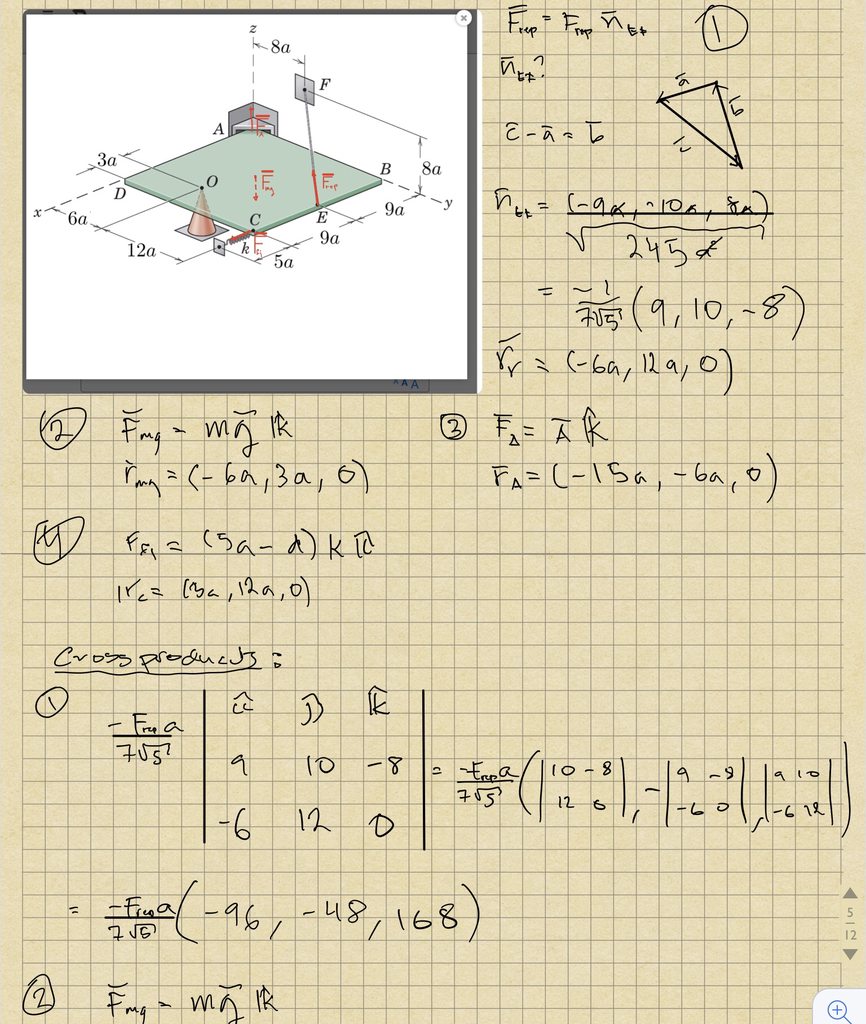
Hello, I am not sure my math is correct in this mechanics problem, I seem to got something wrong here, would appreciate all help I can get, tried to solve it for several days and this is my best attempt (most of the problem is just pure mathematics, linear algebra and system of equations, if you are not comfortable with the physics, just ignore it and focus on the math, thanks)
my try: https://imgur.com/gallery/UfF55tq
I tried to find the spring constant ”k”
The unstreched spring has a length of ”d”, and the table mass ”m”, express the spring constant ”k” in terms of, ”m,g, a” and ”d”
 clear otter
@eager kestrel the second term in your cross product is incorrect. It should be a positive 48
Where is F_mg acting? Is it acting at C or is it at the center?
Never mind. I see.
eager kestrel
@clear otter yes it should be 48 i saw that after posting
But the answer is still wrong
Also mg should be negative
But still wrong
I would guess its acting at c
Have you done mechanics?
Its just a basic course, would mean the world if you tried to solve it
gleaming topaz
You should have positive 96 as well but unsure if that affects the answer
clear otter
@eager kestrel you're taking the cross product because you're looking at moments about point O?
eager kestrel
Exactly
Thanks for pointing it out
@clear otter is not harder than that
And since i know its suppose to be equalibrium
Just set each component to zero
And solve system of eq for k
clear otter
Correct.
Sum all of your forces and set X Y Z to zero. Then sum all of your moments about some point and set them to zero.
clear otter
Personally, I'd recommend choosing a different point than O for finding moments because it'll let you ignore the contributions from a different force.
winter siren
I have a short question. If you have some vectors in the room R^3.
How can you determine the point / line / plane for these vectors?
What do I need to learn in Linear Algebra to accomplish this (It is a Matlab assignment)?
clear otter
You did not. You're taking your cross product with respect to O.
eager kestrel
But it does aleeaddy
clear otter
Oh I see, there's more than one page 🙃
clear otter
Ah right
@eager kestrel I'll try to quickly solve this and let you know what I get for k.
lone quail
if A and B are both similar and diagonalizable, so there exists matrixes P and Q so that:
(P^-1)AP=D and (Q^-1)BQ=D.
by transitivity, the textbook says, that the basis by which f is represented by B is formed by the columns of P(Q^-1), why is that?
For reference A is actually the representative matrix of f while B is the botton matrix
eager kestrel
okay great, means alot to me, when i changed it to 96 I got the answer:
(21mg)/(64*(5*a-d))
lone quail
Oh sorry thought you finished
clear otter
@eager kestrel is that the correct answer?
 clear otter
@eager kestrel this system of equations is a pain.
eager kestrel
Just solve for A like I did
Then put A in both of the eq equal to each other
From x and y
And then put inside sys of eq for z
You dont have to simplify, i can plugg in big answers!
@clear otter
clear otter
Lol,I know how to solve
It's just longer than I'd like. You just need k right?
@eager kestrel k = 21mg/(24*(5a - d))
eager kestrel

Somewhere you missed something aswell
thanks for trying, although you seem to missed something, unfortunately
@clear otter
clear otter
HMMMMMM
Is that green underline where it's saying the problem is?
oh shoot. I see where my problem is.
eager kestrel
no its just where I put the cursor when I type the answer in
ah great that you found it! really getting me excited
eager kestrel
https://gyazo.com/7de2c199bf06eab342c467aa8120eac9 feel bad for you now :/ welcome to my world!
 clear otter
@eager kestrel I'm not sure then. I've double checked my moment equations and they all look fine. That should be the correct answer.
When doing your cross product for Fmg, the second component should be negative. That should be a negative 3a.
Your 6a should also be positive in that cross product. Look at your origin.
grave halo
Let's say I want to project (\mathbf{x}) onto the subspace (V) where (V=\text{span}\left\lbrace\mathbf{b}{1},\mathbf{b}{2},\cdots\mathbf{b}{n}\right\rbrace) then I know that (\text{Proj}{V}\left(\mathbf{x}\right)=A\left(A^{\text{T}}A\right)^{-1}A^{\text{T}}\mathbf{x}). However I also know that if my basis vectors for (V) are orthogonal then I can also compute the projection with simple dot products. Can someone explain to me how the general matrix product simplifies when the basis vectors are orthogonal? Thanks!
stoic pythonBOT
Noether:
grave halo
I forgot to add that A has the basis vectors as its columns.
eager kestrel
@clear otter https://imgur.com/gallery/1qwe6UJ
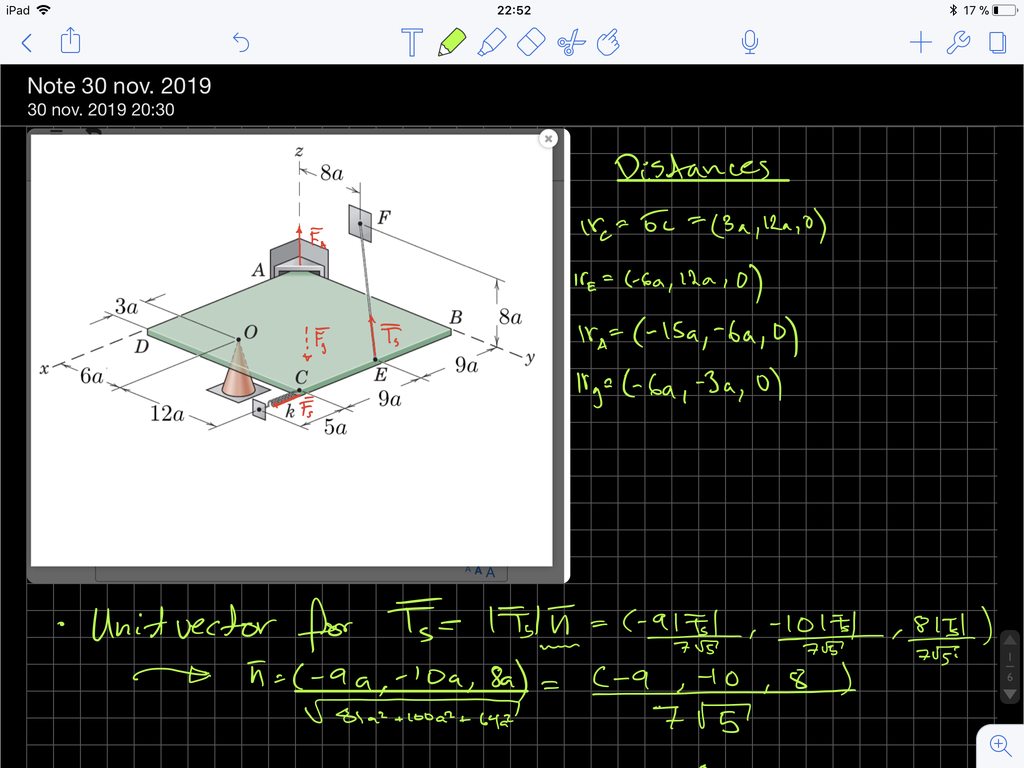


new solution, i think that a problem might be thr gravitations force in the ceneter and the force at A
since if you look at the second to last page
you see that the magnitude of vector |Ts| is equal to a vector, which is impossible
but if I dont equate the A vectors, I dont get the problem
how to deal with this? not sure..
opal plaza
If someone has a sec could you please help me check work. I found a vector of 6x_1 = 9x_2 so I think the basis would be [2,3]? Also trying to conceptualize what exactly this vector means in relation to the original matrix? ty ❤️
vast torrent
is 6(2) = 9(3)?
vast torrent
I make that mistake too sometimes
you meant [3,2]
how many eigenvalues and eigenvectors do you have?
opal plaza
just one, 4
opal plaza
I believe it's 1?
vast torrent
I dunno, I didn't solve Av = 4v, I'm assuming you did
I don't know if the solution space has dimension one or 2
opal plaza
one
gray dust
gonna quickly plug into symbolab eigen finder to confirm
vast torrent
lol I just did for wolfram alpha
then you only need one vector for the basis
if the vector satisfies Av=4v, you're done
gray dust
d'oh, too fast for me
stoic pythonBOT
Noether:
vast torrent
you dont need to delete, let other people see it
 clever basalt
Guys I need a math pro to be my guru 😭
lone quail
if A and B are both similar and diagonalizable, so there exists matrixes P and Q so that:
(P^-1)AP=D and (Q^-1)BQ=D.
by transitivity, the textbook says, that the basis by which f is represented by B is formed by the columns of P(Q^-1), why is that?
For reference A is actually the representative matrix of f while B is the botton matrix

 timber minnow
@finite sleet you can do this a better way
responding to your question earlier in #help-2
use this:
and decompose your matrix into A = (a-1)I + 1*t(1)
then you have the inverse to be:
timber minnow
$\frac{1}{a-1}
\left( I_3
-\frac{1}{(a-1)+\mathbf{1}^\mathsf{T}_3\mathbf{1}_3}
\mathbf{1}_3\mathbf{1}^\mathsf{T}_3 \right)$
stoic pythonBOT
davidL:
timber minnow
expanding:
,w (1/(a - 1)) ({{1, 0, 0}, {0, 1, 0}, {0, 0, 1}} - (1/((a - 1) + 3)) {{1, 1, 1}, {1, 1, 1}, {1, 1, 1}})
stoic pythonBOT
Requested by davidL#1578
timber minnow
solving:
,w Simplify[((1/(a - 1)) ({{1, 0, 0}, {0, 1, 0}, {0, 0, 1}} - (1/((a - 1) + 3)) {{1, 1, 1}, {1, 1, 1}, {1, 1, 1}})) . {1, 2, 3}]
stoic pythonBOT
Requested by davidL#1578