#linear-algebra
2 messages · Page 46 of 1
 quartz compass
seems to have terms of (a+b+c)^3 in them
going to need some kind of polynomial identity in mind
the truth is, someone started with some formula, and then they just messed around with it until they got this meaningless thing
and now it's your problem
I think if you work one piece at a time, make the a+b+c part and get that to work, it would eventually yield
 wintry steppe
I have no idea man, I tried tons of shit, and adding row2 and row3 to row1
and it gets real real weird
wintry steppe
🤔
 vast torrent
quartz compass
vast torrent
quartz compass
@sinful heron antisymmetry
 sinful heron
the vectors are oppositely symmetrical?
quartz compass
antisymmetry just means reversing the order makes it negative
sinful heron
oh
vast torrent
I'd've said anticommutativity
wintry steppe
so the LHS =
(d-c)(d-b)(d-a)(c-b)(c-a)(b-a) ?
vast torrent
Zoran maybe it would be easier to replace the lhs with that formula
Yes
Not sure if that helps
wintry steppe
🤔
let me take a crack at it with that try
I think I'll just go to bed, take it on fresh next morning
vast torrent
normal vector
sinful heron
to each respective plane?
vast torrent
ya
sinful heron
i see thx
if i take the cross product of these two vectors i should get the vector of the line that's parallel to the intersection line for the two planes
quartz compass
yep
 uneven bloom
@wintry steppe The RHS is homogeneous of degree 6 (like the LHS) , so you just need to conclude that it is 0 if any two of a,b,c,d are equal.
 north sierra

what do the sets actually mean?
so there's a vector such that a + b + c = 2 i dont really understand what that means
i know how to answer the question but like i dont get the notation
 dusky epoch
{object : condition} is the set of all objects for which the condition is true
i.e. for example
$\begin{bmatrix} 4 \ 7 \ -9 \end{bmatrix} \in W_7$, because $4+7+(-9) = 2$
 stoic pythonBOT
Ann:
dusky epoch
while $\begin{bmatrix} 1 \ -4 \ 2 \end{bmatrix} \notin W_7$, because $1+(-4)+2 \neq 2$
stoic pythonBOT
Ann:
dusky epoch
(W_7 here means the set given in exercise 7)
north sierra
okay makes sense, thank you!
 marble bone
Hey, if we are given a matrix M = diag(d1, d2, d3, ..., dn), does the "diag" notation imply that M is a diagonal matrix or does this notation just tell us about the diagonal entries?
context:
"A,D exist within the set Mnxn(R) and D is a diagonal matrix. Let D = diag(d1, d2, ..., dn) for some d1, d2, ..., dn that exist within the set R \ {0}, show that D is invertible and that D^-1 = diag(d1^-1, d2^-1, ..., dn^-1)"
is the D^-1 implied to be a diagonal matrix? It would seem so according to my intuition. But I'm not entirely convinced.
 cold ravine
Anybody willing to help me with an explanation? I think I'm good on what the actual answer is but putting into math terms is a little harder for me.
Tha basic gist I can muster is that you end up with the same set of vectors back because when you take the projection of one vector onto the other you'll get zero.
So when you subtract your projection from the second vector you just end up with that vector as your result.
Does that make sense?
 cold ravine
As a side note to my original request, this is what I have written down.
 twilit terrace
just want to clarify some things about notation
in the above picture, when it say T(v1), do they mean the 1st column of T (that's it) or that T acting on basis vector v1 (i.e T v1 = T(v1)) gives me the 1st column of T
twilit terrace
i tried doing it that with some numbers tbh(should i post it here?) but the results don't match with T acting on v1
hmmm
 half ice
Hey, nice excel work
twilit terrace
^^
twilit terrace
yup
i was using 2 different bases
i know that the Ts would be different in terms of physical meaning(same element, different bases), but was trying to show that in the 2nd case, T(v1) = 1st column, which i couldn't get it
half ice
T(v1) = (2,1,3)
In the second case. If your math is right.
I feel you might be trying to suggest that both cases should be the same. Why?
twilit terrace
erm...not sure if i can word it well,
I mean, given T(v1) = 1st column of T,
so, i just try to prove for myself?
and stumbled here
i was almost convincing myself that T(vi) is just a way of calling the ith column of T rather than T acting on any vector, but now, i am confused again
wintry steppe
if v1, v2, v3 are the standard basis, then T(vi) = the ith column of the matrix representing T
this is a bit more fundamental than you would think
 coral sage
Hey can anyone explain how principal component analysis works to a 2nd semester linear algebra student
I want to understand word2vec better
 minor galleon
@sinful heron get the vector line equation
u have P=r + kv where v is the direction vector
work out requirement for k such that distance is 3
then add n subtract
sinful heron
okay ill try the vector line equation but I also don't quite understand what it means by distance 3
does it have to do with the length of the vectors
vast torrent
@wintry steppe did you figure out the vandermonde thing
vast torrent
Can i hear how to do it
wintry steppe
It's a lot easier if you go at it from the right side to the left side
By manipulation you get a triangular matrix with all the factors that the Vandermond matrix has
vast torrent
Ah
wintry steppe
And the manipulation is: all rows - first row; factorize what you can (on the first step you're able to factorize (d-a)(d-b)(d-c))
And then expand along the first column
At least that's how I found it easier to work with
vast torrent
Ah so you did use the formula (c-b)...(b-a)
wintry steppe
Ye ye
We know the LHS = (d-a)...
So let's see if it's the same for the right side
Is basically what my mate told me when he figured it out
Still an awful fucking problem
😠
 carmine terrace
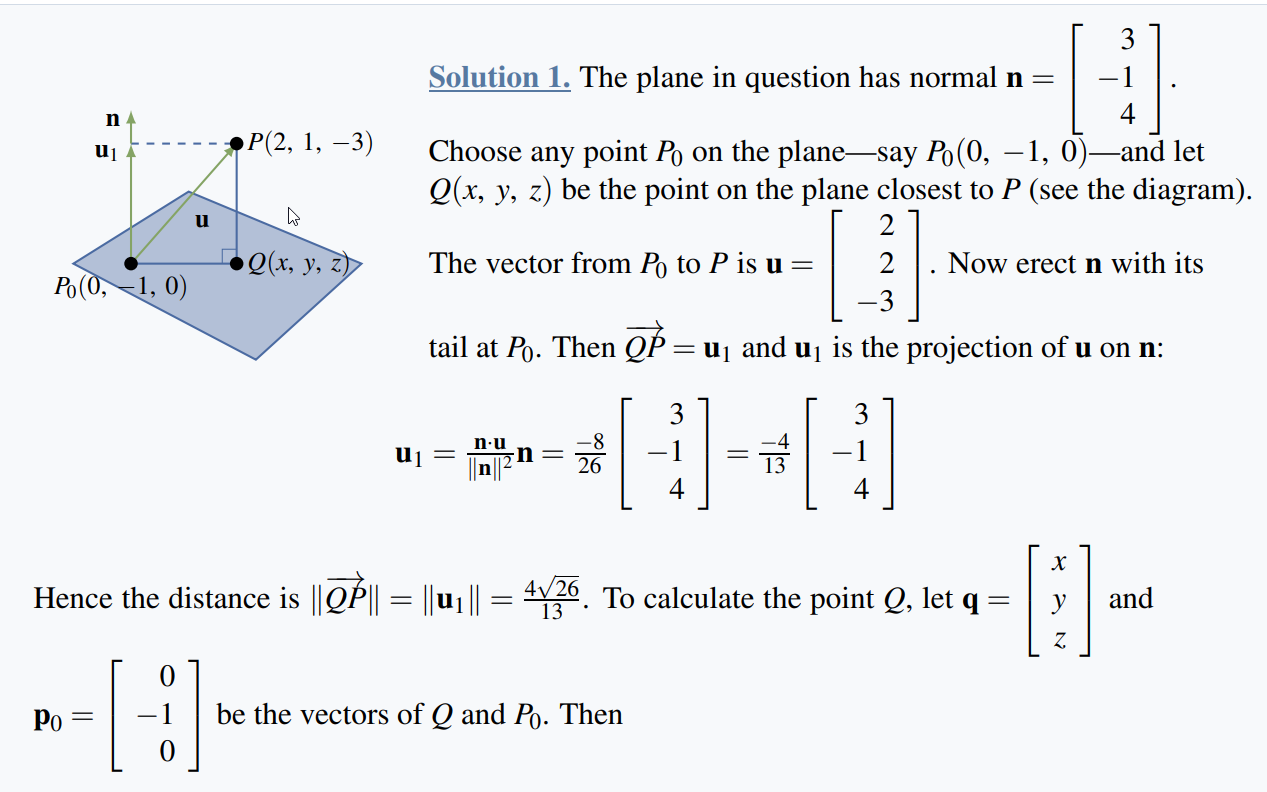
does any1 know how they get 4(sqrt26)/13?
I've been trying to figure out how to find the shortest distance for a long time and this is the part I think I'm getting stuck on
carmine terrace
thanks That was my first thought but I used the wrong vector somehow...
carmine terrace
Repost as I posted it wrong
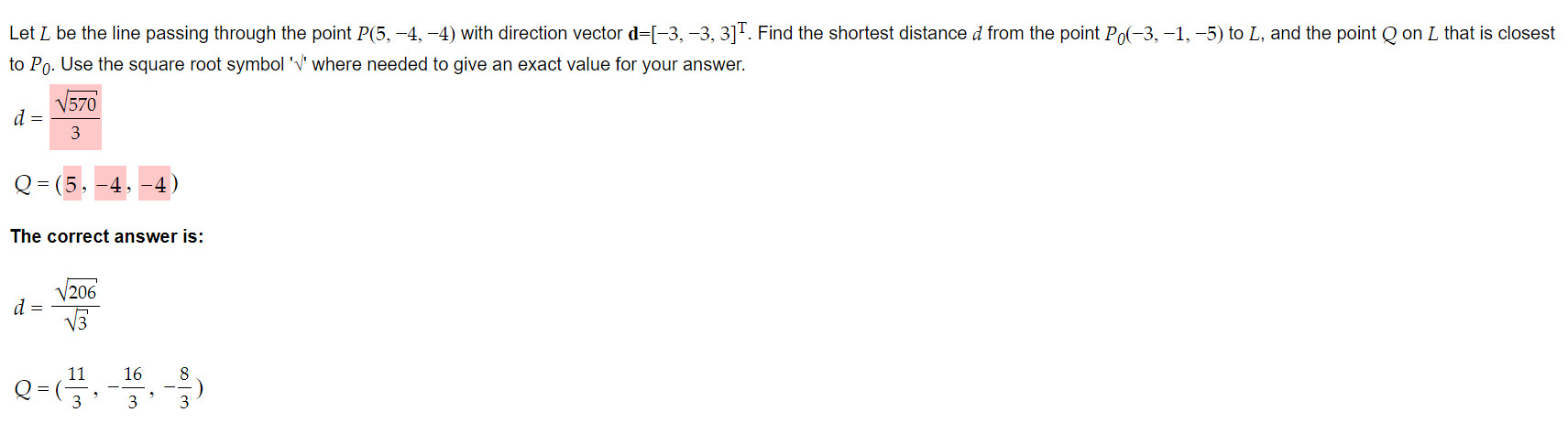
I'm trying to find shortest distance and point Q, IDK what I'm doing wrong
 opal plaza
kinda struggling with where to start with this question could use a push in the right direction ❤️
quartz compass
well first off, what are the dimensions of the matrix for T?
can only be two possibilities, 3x4 or 4x3 right, which is it? @opal plaza
opal plaza
umm it would have to be 4x3
so I'd have to figure out what T is?
1 1 0
0 0 0
2 0 1
0 1 1
Would it be the first two colums of T, since one row is all zeros?
 clever cedar
@carmine terrace still need help?
carmine terrace
@clever cedar I was able to figure it out. Thanks for offering the help
clever cedar
nice, np
that question was on my exma last friday
exam*
so make sure u know it :p
carmine terrace
I did it so many times I have it engrained in my memory.
 wild pagoda
Can someone explain the wording of question 8. I'm confused about the definition of e|x=7(f)
 slow scroll
@wild pagoda it evaluates a function at x=7
wild pagoda
don't all functions equal f(7) when evaluated at x=7
slow scroll
consider f(x)=2x a function from R to R
slow scroll
No, e is the linear functional that evaluates any function at x=7
So like e(x^2) = 49 for example
coral sage
hey, would someone mind reading my proof to make sure it's sound
i'm too tired to read it myself and have it make any sense
here it be, out of Axler's linear algebra done right
this is literally the longest and hardest proof ive ever written so im like nearly certain it's bunk
 dire delta
i think ive got this one down intuitively but im just checking
I want to make a convolutional neural network that scans over the elements of a matrix where the matrix is of form
\begin{bmatrix}
a_1_1 & a_2_1 & a_3_1\
a_1_2 & a_2_2 & a_3_2\
a_1_3 & a_2_3 & a_3_3
\end{bmatrix}
stoic pythonBOT
The Red Team Is Online:
Compile Error! Click the  reaction for details. (You may edit your message)
dire delta
where the rows and columns can be arranged arbitrarily
what is the complexity of doing the 2x2 convolution over every arrangement of row and column for an nxn square matrix?
Without any optimizations my naive answer is (n!)^2 which is... completly unfeasible but since I'm after the 2x2 convolutions specifically I'm trying to figure out how much complexity can be removed through symetries
its proably something basic I've forgotten / not realised I can apply here though thank you in advance for any help
wintry steppe
In triangle ABC let P and Q be points such that B->P = 1/3 B->C and A->Q = 1/3 A->C.
S is the intersection of lines AP and BQ.
Find A->S as a linear combination of A->B and B->C
Graphically it seems to look like
A->S = 2/3 A->B + 2/9 B->C
But I can't figure out how to get there 'normally'
 frosty kraken
If S is a finite subset of Rn
and Span S=V, then S is always basis for V
what would be the answer to that t/f question?
 empty copper
Well... I'd assume yes, obviously, unless I'm missing something
dusky epoch
you are
empty copper

ohh basis
Yeah some elements of S might be linearly dependent on each other
Which isn't allowed to happen in a basis
gotcha
dusky epoch
ew wording
empty copper
engineer wording
frosty kraken
ty thats what I was thinking but wasn't sure
wintry steppe
hi, im trying to find if a system of linear equations has an infinite number of solutions, the equations evaluate the same when i sub one value of a into them but differently when i sub the other value of a into them, also i only came up with one value of b
have i done it right?
sending pic
i misread the question sorry pff
the question asked for which pairs of a,b does it have infinite solutions..both pairs won't work
 sour spear
So you need to find the combinations of a and b resulting in infinite solutions, yes?
wintry steppe
yeah
i found out it's a=2, b=2 but i only got one value for b anyway, but for a i got 2 or -2
idk if i should have 2 values for b
sour spear
I think you would have 2 b values.
Rearrange the first equation in terms of x and plug that into the second equation.
If a is 2 or -2, you'll still have the y terms cancelling, yielding a = b
wintry steppe
so the pairs of solutions are a=2, b=2 and a=-2, b=-2 ?
sour spear
Yes
wintry steppe
im struggling to do that rearrangement, this is what i got so far
x = 1-ay (first eq. rearranged)
2(1-ay) - 4y = b
2-2ay-4y = b
sour spear
In the second line, keep it as a(1 - ay) before plugging 2 in for a.
Oh wait
1 + ay = x
In your first step
 cobalt tartan
If we have $[L]_B = P^{-1}[L]P$, where $P^{-1}$, $[L]$ and $P$ are matrices, can we do
$P^{-1}[L]P - \lambda I = P^{-1}[L]P - \lambda P^{-1}P = P^{-1}([L]P - \lambda P) = P^{-1}([L] - \lambda I)P$?
stoic pythonBOT
Liria ^(;,;)^:
cobalt tartan
Or do matrices not work like that
 thorn egret
im trying to relearn everything in linear algebra so i can actually understand anything else my professor defines
can someone help me with this definition
read this in english
quartz compass
what it's basically saying is they have some operation that takes two things from V and maps them to 1 thing from V
and specifically that map is (x,y) |-> x+y
that make sense or still not completely clear yet @thorn egret
thorn egret
i mean i get all of it from the beginning
im not completely new to this
but im trying to figure out if there's a clear formal meaning to all of this, like even the ","
 sonic osprey
There's no formal meaning to the comma no
The rest of it, yes there are formal meanings to it
thorn egret
i know that | means "such that"
sonic osprey
The : means that + is a function
Then it describes the domain and codomain of this function respectively
thorn egret
yeah i get that
the reason i want to relearn all of this is because
when i get into the real rigorous stuff
everything is defined as an ordered n-tuple
a "vector spaces over a space F" is defined as an ordered 3-tuple V = (V, +, *)
such that : (image above)
also im aware its not called a 3-tuple but my english is really bad
sonic osprey
3-tuple is what you would call it
Yeah depending on what linear algebra you're exactly trying to learn
You might not need all the formalism
thorn egret
"The relation ρ on a set A is every subset of cartesian products
A^n = A x A x ... x A"
i have no idea what this means
sonic osprey
I mean yeah
If you're actually trying to learn this stuff, don't really look for linear algebra stuff
Look for some intro to proofs stuff
thorn egret
basically all of my courses are divided into theory and practice, i get half the points from a practical exam and the other half from an oral theory exam on the whiteboard in front of my professor
wintry steppe
@sour spear thanks
thorn egret
i don't know if i have to learn all of this or not
vast torrent
linear algebra is sometimes the course students are introduced to basic proof concepts
but seeing as the vector spaces you first learn about are cartesian products of fields numbers, you should know what the cartesian product of sets means
and a relation is a subset of the cartesian product
that's a definition, not a theorem
thorn egret
thanks
sonic osprey
But yeah, looking for linear algebra resources on this isn't really what you want
Pick up an intro to proofs book
Like How to Prove It by Velleman
for information on this type of stuff
thorn egret
you're right
i just spent so much time trying to figure out the difference between a ring and a field
and i realized we will never mention rings again in linear algebra
lol
quartz compass
probably the main takeaway for rings in linear algebra to remember is you can add and multiply matrices, but sometimes you can multiply 2 nonzero matrices together to get the 0 matrix, and so you don't always have inverses to matrices meaning it's not a field
thorn egret
🤔
quartz compass
so what
vast torrent

probably the main takeaway for rings in linear algebra to remember is you can add and multiply matrices, but sometimes you can multiply 2 nonzero matrices together to get the 0 matrix, and so you don't always have inverses to matrices meaning it's not a field
just not sure waht you meant by that
quartz compass
just saying one example to help him see a difference between a ring and a field cause he doesn't seem to really remember
vast torrent
oh okay
quartz compass
if he's gonna forget it anyways, might as well say that one
thorn egret
last one, how do i read this and what does it mean
vast torrent
cant you have fields of finite characteristic? or am I thinking of rings
quartz compass
in a matrix? yeah
thorn egret
i mean specifically R^4[X]
i know what to do with it when i see it, i just dont know formally what it really is
vast torrent
maybe it means degree 4 or less polynomials in the variable X with real coefficients?
I'm guessing
actually no
I think what it means
is the set of 4-tuples, each of which is a polynomial in the variable X with real coefficients
so an example of an element of R4[X], if my guess is correct
would be (1+x^2, x^5, 1-3x+5x^11, 0)
thorn egret
the first thing it asks is to prove that V is a subspace of R^4[X]
so R^4[X] is a vector space, right
vast torrent
yes, an infinite dimensional one
thorn egret
wym infinite dimensional
vast torrent
know what a basis is
thorn egret
yeah
vast torrent
any basis of it has infinitely many things in it
thorn egret
oh ye
the 2nd thing it asks is to find dim(V)
we learn how to do all of these things in practice but i dont really pay attention in class when we explain theory
vast torrent
if it's the first class of linear algebra they will just want you to prove its infinite. or maybe whether or not it's countable or uncountable
if you haven't seen "countable" or "uncountably infinite" before then they just want you to show its not finite dimensional
but I'm not 100% sure that's what the notation means so Id prefer it if someone could confirm my guess
sonic osprey
notation of whta
vast torrent
$\mathbb R^4[X]$
stoic pythonBOT
gfauxpas:
vast torrent
I guessed it's 4-tuples of polynomials with real coefficients
sonic osprey
Oh this
This usually means polynomials up to and including degree four
At least in a linear algebra context
vast torrent
oh, for that I've seen $P_4(\mathbb R)$
stoic pythonBOT
gfauxpas:
vast torrent
But if R[X] means polynomials with real coefficients than R4[X] should mean what I said
oh well
quartz compass
yeah R^4[X] makes me uneasy like they're talking about polynomials of the form a+bx+cx^2+dx^3, I prefer the other notation
vast torrent
That's what galois says it means in lin alg
quartz compass
no he said something different
I put a degree 3 polynomial
cause there are 4 real numbers
quartz compass
lol
vast torrent
No joke
quartz compass
I know
I don't know what you think you're explaining to me, I was just expressing my discontent with that notation
I don't need a response really
thorn egret
i just always thought of R^4[X] as all vectors (u, v, w, t)
thorn egret
lol
quartz compass
if it's a degree 4 polynomial it would be like vectors of the form (a,b,c,d,e)
thorn egret
we literally don't even mention polynomials in this part of the course
quartz compass
ok I'm out of this channel for the next hour good luck lol
vast torrent
S[X] means polynomials of one variable
quartz compass
sort out what the notation should be from your book or teacher
vast torrent
That's what [X] in set notation means
You're right that there's an obvious isomorphism between polynomials with real coefficients and tuples of reals
vast torrent
Functions with domain V and codomain W
thorn egret
oh
 silver ore
is that all
thorn egret
really
vast torrent
Yes
silver ore
I feel stupid for worrying
vast torrent
L(V,W) means those functions for which + and . Are linear
Note that the order is counterintuitive
Domain V, codomain W
Is W^V
vast torrent
K
silver ore
they had the explanation of the L(V,W) thing above
but not the W^V thing
its 10:30pm now
gotta sleep
vast torrent
Bye
silver ore
Bye
 half sentinel
Could I ask a question?
I did part a but part b is kind of tripping me up
I first thought about doing a geometric series, but doing that proof of allowing that is hard
vast torrent
No you don't want to do that
multiply both sides by id-T should be easier
@half sentinel
Show that id = ... (id - T)
half sentinel
makes sense
then how would you do part c
would it be multiplying (s-t) to both sides of the idv?
vast torrent
Well if you derived what operator L satisfies L(S-T) = id
Then L = (S-T)‐¹
It's not always easier, but it's equivalent
vast torrent
That's what inverse means
I'm sure there's more than one way to do it
Terminating geometric series for inverses of nilpotent operators you can prove by induction if you want
Where 1/(1-T) is (id-T)‐¹
So that would be another way
Good practice if you're bad at induction 👍
vast torrent
Np
clever cedar
when it says T is induced by the matrix A
does it mean that the linear transformation for T occurs because of A?
vast torrent
Actually smores you can multiply both sides by id-T and still use induction
@half sentinel
It means T maps x to Ax
And S maps x to Bx
vast torrent
Np
clever cedar
what does it mean for $T: {R}^{n}\rightarrow{R}^{n}$ to be linear
stoic pythonBOT
mike0x81:
clever cedar
i understand that T is a linear transformation
but what does it mean for it to simply just be 'linear'
sonic osprey
the same thing
stoic pythonBOT
mike0x81:
clever cedar
in the context of linear transformations?
vast torrent
the regular arrow means domain:codomain
the arrow with a flat tail means element of domain: element in codomain mapped to
$f: \mathbb R \to \mathbb R \times \mathbb R, x \mapsto (2x, x+1)$
stoic pythonBOT
gfauxpas:
vast torrent
and linear can be different than linear transformation
consider the indefinite integral
it's linear, but it's not a transformation
clever cedar
currently in calc 1
vast torrent
well you know what the definition of a function is, right
clever cedar
yh
vast torrent
if something isn't a function, like for example it's not defined for all value sin the domain
it can still be linear, in that when it's defined, it's linear for those elements for which it's defined
or, if something isn't a function because it's many valued
it sends one thing to two things
it can still be linear, but it's not a transformation
do you want an example
vast torrent
let's say there's the price function, that tells you how much something sells for online
then it might be linear, because price(2 pizzas) = 2 price(pizza)
but the price function isn't really a function, because not everything has a price
vast torrent
a transformation is a functio
n
something can be linear and not be a function, so then it's not a linear transformation
clever cedar
oh i see
vast torrent
you'll see an example of something that's linear and not a function because it's many valued at the end of calc 1
called the indefinite integral
it sends functions to a family of functions
 paper egret
Just to clarify, if you're trying to do a change of bases from some arbitrary base B to the standard basis, all you gotta do is take your original vector from B and multiply it by that basis to get the coordinate in standard basis
i hope that makes sense lol
paper egret
also, can anyone here clarify what it means for a transofmration to be a basis B
$[T]_B$
stoic pythonBOT
MemesPlease:
half ice
@paper egret
I usually see [T]B refer to the matrix constructed by the basis vectors after they've been transformed
paper egret
hmmm ic ic...
i actually have an explicit definition, but for some reason can't make some sense out of it
$[T]B = P{B \to E} [T]E P{E \to B}$
stoic pythonBOT
MemesPlease:
paper egret
oh wait the arrows go reverse direction <-
half sentinel
@opaque sun , we have (A − λI)x = 0
so we want to find x, in the case of a 2x2 matrix, x = (x, y)^T
we can then find the values accordingly
you can do that as well
right?
x = (x,y)^T is just the same thing but now like a column like that picture
sour spear
Solve for x in terms of y and z from that equation
half sentinel
right
sour spear
And then make 2 eigenvectors from the coefficients of y and z
I.e y * (-1/2 1 0)
Imagine that's vertical. I don't know the code for the bot
If you think of the answer like x = -0.5y -z, y = y, and z = z
Then the eigenvectors are the coefficients of y and z
paper egret
free variable
sour spear
^
Solving a matrix/system of equations gives you x from the first equation, y from the second, and z from the third
But the y and z equations are all 0s
So y and z can be anything
Those 2 in the picture are right (it's your equation times 2 to get rid of the 1/2)
You want to split up the coefficients into y * (matrix of y coefficients) + z * (matrix of z coefficients)
When I get back to my computer I could type it out and it would probably make a bit more sense
(-1/2)
( 1 ) * y
( 0 )
(-1)
(0) * z
(1)
If I were on my computer it'd be prettier. I'll be back on it in 10 minutes or so.
@opaque sun
x = -1/2y - z
Which you got from the (1 1/2 1) matrix with the bottom 2 rows as all 0s
and the coefficient matrices would be your eigenvectors
half sentinel
Hey guys, could you help me out with this problem
sonic osprey
what are you stuck on
sonic osprey
Have you tried doing the proof
half sentinel
Well yes
sonic osprey
Okay, and what did you do
half sentinel
of which i got an inequality that the addition of (x,y) and (y,z) to be greater than sum of (x,z)
n1 is norm 1
and z is some other vector
and I feel like that's not what it's asking for
sonic osprey
Sure that's the triangle inequality
half sentinel
wait
sonic osprey
But that's the triangle inequality for metrics
half sentinel
right
half sentinel
sorry if it's a dumb question but would the first step be taking the norm of itself then?
clever cedar
for a surjection does the Transformation function have to be of the same R^n as the vector X it transforms onto
clever cedar
im not sure who ur talking to 😦
sonic osprey
not you
clever cedar
😿
sonic osprey
the answer to your question is no
clever cedar
oh cool ty
half sentinel
hi @sonic osprey okay, so I eventually got that (x,x) for || x || 1 becomes 0, and that's why it does not satisfy the parallelogram law, correct?
i meant | | x | | 1
clever cedar
is surjective and injective mutually exclusive?
clever cedar
idk what bijective is
just learning about surjective and injective now
didnt mean to offend :p
 terse mirage
sorry i didnt realize
clever cedar
no problem
terse mirage
bijections are defined to be maps which are both surjective and injective
slow scroll
bijective <=> invertible <=> columns of matrix form basis for target space <=> image of transformation is the target space
clever cedar
oo wow ty
slow scroll
ah yes, trivial kernel
clever cedar
the reason i ask is this
slow scroll
and nonzero determinant
clever cedar
it says if rank is n then its injective
but rank is m then surjective
so thats why
i asked
slow scroll
well if rank(T) = m then that means the column space / Im(T) has dimension m. Well, the smallest subspace of R^m which has dimension m is R^m itself. Therefore T is surjective Does that make sense?
clever cedar
Yeah I believe so, seems straight forward
slow scroll
In other words, since Im(T) = R^m, every element in the codomain gets mapped to, i.e. Tx = b has a solution for all b in R^m
uneven bloom
Wrong channel. This is not college math.
 lapis current
Sorry
uneven bloom
Go to #prealg-and-algebra
 feral mountain
clever cedar
feral mountain
clever cedar
appreciate it
 brittle orchid
Hi, I was wondering which of the following ebooks is a recommended resource to understand fields and vector spaces?
- Linear Algebra Done Wrong
- Elementary Linear Algebra
- Linear Algebra Third Editiion
- Linear Algebra with Applications
- Abstract Algebra
I'm looking for a text which is a little noob-friendly 😄
brittle orchid
yup, starting with that, in fact 😛
wintry steppe
hi, im trying to solve using the Gauss method, im not sure where i've gone wrong here
for each row operation, can we only do it so that it makes a 0 or a 1?
brittle orchid
what have you done in the second operation btw
wintry steppe
added rows 2 and 1
brittle orchid
my bad I didn't realise you wrote the operation above the matrix
wait
if you added rows 2 and 1 how did you get 0
for the first element of the second row
wintry steppe
ahh
i was too focused on keeping it 0, i forgot to add to it
but then the operation is wrong
brittle orchid
tbh my rre/gaussian elimination isn't particularly good as I'm pretty new to it myself xD
I was just having a read of this idk it might help you
wintry steppe
ok thanks
half ice
@brittle orchid
Linear algebra done wrong is a great book, but may be pretty technical if you've never done anything technical. If you're really new, take an easy run through an applied linear algebra book. 3b1b can be a great complement to this
Afterwards, come back and get the details right
minor galleon
Ok does anyone have any idea how to start finding curves that are invariant under a 2d matrix transformation?
half ice
Curves? 2d transformation? What space are you working with?
minor galleon
It’s just a student at a class I’m a supervisor over has posed a question I said I would get back to him
Basically Cartesian transformation matrix a 2x2 one
 timber minnow
wat?
minor galleon
How would I go about invariant curves in a way that doesn’t really involve eigenvectors stuff cuz they haven’t learnt it yet
We have invariant lines but what about invariant curves
timber minnow
you need to be more explicit...
half ice
"curves" is an odd term here. A space has vectors in it. If you do mean vectors, davidL just hit the nail on the head
These are the vectors where T(v) = v
timber minnow
if you want to "be more general" (?) you can say eigenfunction, with eigenvalue 1
minor galleon
No I literally mean say y=x^2 is an invariant curve of the matrix transformation (-1, 0),(0,1)
We ofc have infinitely many solutions but I was simply wondering whether there are any similar things for other 2x2 matrix transformations
half ice
I think you may mean the vectors (x, x²) for some x?
This transformation is R² → R², correct?
timber minnow
I think he wants like L2 or smth
minor galleon
Yeah
half ice
Because there are spaces of quadratics, but you'd need a 3×3 matrix
timber minnow
I don't think he means like polynomial basis
I think he means from function space to function space
where he applies some operator
and the function remains unchanged
but like, these are just statements (?), I don't understand what his question is
half ice
But then that's infinite dimensional. Even worse, you'd need to be explicit about a basis
timber minnow
"can I explain this without eigen-shits" not well
it seems like you don't really know what you're looking for (?)
I would not try to explain this to other people, especially at a very reductive level
I probably don't have enough background to cover this well either. I haven't taken functional yet
@half ice he doesn't mean vector space
but yes, I agree
he needs to specify many things before he can get any kind of meaningful response
@minor galleon care to clarify?

In mathematics, an eigenfunction of a linear operator D defined on some function space is any non-zero function f in that space that, when acted upon by D, is only multiplied by some scaling factor called an eigenvalue. As an equation, this condition can be written as
...
this is what you're looking for
half ice
I do think you mean R² → R², since you have a 2D matrix. all eigenvectors form a subspace, which in this case implies one of the following:
- They don't exist
- They are a line through the origin
- They are the entire plane (think of "do nothing")
timber minnow
I think they are just inconsistent enough that we can both be right XD
half ice
Nothing wrong with more info
timber minnow
I'm talking about the eigenfunctions of some linear operator (i.e. matrix) on some function space
but they specified 2D cartesian matrix, so ???
that implies what you said
wintry steppe
i have 3 vectors that create a subspace of R4, how do i calculate its dimension?
 gray dust
cram the vectors into a matrix, row reduce, count the pivots
wintry steppe
the matrix is irregular
dusky epoch
what do you mean by irregular
wintry steppe
i mean i can row reduce but at least one of the vectors is linearly dependent
gray dust
you mean the set of vectors is LD
gray dust
so the subspace dim < 3
gray dust
cram the vectors into a matrix, row reduce, count the pivots
north sierra
the dimension is just the number of vectors in the basis right
wintry steppe
may i ask why its not 3 but < 3?
north sierra
cause its dependent
wintry steppe
o
north sierra
so itll ❤
gray dust
dim of subpsace=minimum number of lin indep vectors from that subspace needed to form a basis for that subspace
wintry steppe
its not possible for 3 vectors in R4 to create a 3d subspace is it?
gray dust
why do you say that
wintry steppe
ok maybe this is specific to my example but when you row reduce the last row will always be 0 in a 4x3 matrix no?
gray dust
think outside row reducing
the dim of the subspace is 3 if the set of those vectors is LI. consider the span of a single vector, then an LI set of 2 vecs, then an LI set of 3 vecs
wintry steppe
 im having a hard time imaginging all this stuff
gray dust
3b1b's LA series has nice visuals
wintry steppe
right
brittle orchid
@half ice Thank you
Btw, could someone explain what's going on with the dot operator thing here
wintry steppe
@gray dust but even so, theres no way 3 vectors with each 4 elements can be linearly independent, no?

gray dust
As an easy example, pick any 3 of the R^4 standard basis vectors
vast torrent
@brittle orchid this is called a Cayley Table and it's a generalization of multiplication tables from elementary school . Which entry is bothering you
brittle orchid
the alpha and alpha+1
vast torrent
Have you seen finite groups before
brittle orchid
I think not
vast torrent
So in this context
This is like a set of 4 "numbers"
That you can multiply and add to get other "numbers"
vast torrent
So alpha and alpha +1 are two of those elements
This table is tellung you precisely what dot does
brittle orchid
what's the relationship between each row, column and entry
vast torrent
(a+1).(a)=1
It's telling you how dot is defined
Because there are only 4 elements
You only need 16 boxes to tell you what dot does
brittle orchid
Right
So it's not a standard operator so to speak?
The table describes the dot instead of the dot describing the table?
vast torrent
Unless you have another description of dot from somewhere else
brittle orchid
Btw what's the difference between F subscript n and F superscript
Sorry for spam but I'm just showing you what I've come across so far
brittle orchid
I mean the way it is described it acs as the modulo operator doesn't it?
vast torrent
Sure
brittle orchid
and if that's the case for integers n >= 2, then why isn't that the case for F4?
vast torrent
So basically what you're discovering is
Fp is isomorphic to Z/pZ
That symbol means Integers modulo p
P is prime
brittle orchid
isomorphic? xD
Please don't take anything for granted, assume I'm an absolute idiot 😄
brittle orchid
ah ok
vast torrent
Two fields are isomorphic if they're "basically the same"
brittle orchid
ah ok
So um, I was given a homework sheet with 4 vectors in F4, and I had to decide whether or not they're linearly independent when the field = rational.
I did that by reducing to RRE form and showing that all lambda values = 0
But I kinda don't get where any of this is going
I mean I get how to reduce to RRE but I have no idea why I'm doing so, nor what it really means for something to be linear independent, linear dependent or even linear
and I've especially got no clue of how to determine whether or not something is linearly dependent when F = F5
Since I'm conceptually really shaky
vast torrent
lambda values? is that the same as eigenvalues?
wintry steppe
the way i understood it is that if 2 vectors are linearly dependent then one is a scalar multiple of another
vast torrent
wait so the vector space is F_4 and the scalar field is Q?
wintry steppe
those are scalars
vast torrent
there are two equivalent ways to think about linear independence
at least 2
one is that the only solution to
$\lambda_1 v_1 + \cdots \lambda_m v_m = 0$
stoic pythonBOT
gfauxpas:
brittle orchid
yup, I proved that all the scalars are zero
vast torrent
a set {v1,v2,...,vm} is l.i. if and only if no vector is a linear combination of the other vectors
so for example, this set is not linearly indepdent. give me a sec while I write it
vast torrent
$\left{ { \begin{bmatrix} 1 & 2 & 0 \end{bmatrix}, \begin{bmatrix} -1 & -1 & 1 \end{bmatrix}, \begin{bmatrix} -1 & 0 & -2 \end{bmatrix} } \right}$
pretend they're columns
brittle orchid
yea
vast torrent
if you notice, the first one minus two of the second one is the third one
brittle orchid
yup
stoic pythonBOT
gfauxpas:
vast torrent
so the set isn't linearly independent
if I call those vectors x1, x2, x3
then the only scalars c1 x1 + c2x2 + c3x3 = 0 are c1=c2=c3=0
the two things I said are equivalent
brittle orchid
I don't understand what this has to do with the LI: if you notice, the first one minus two of the second one is the third one
 brittle orchid
really
wintry steppe
what hes trying to say is that the 3rd vector is a disguised 1st vector (?)
vast torrent
yeah the entry of v3 is 2, not minus 2
my bad
typo
third entry
the third vector can be written in terms of the first two vectors
brittle orchid
yea
wintry steppe
so its a linear combination of the other 2
brittle orchid
oh that's what it means to be a linear combination of something else?
wintry steppe
the linear combination is the set of all vectors you can reach by scaling a set of vectors i think
vast torrent
yes, you can write it in terms of the other ones with scalar coefficients, uniquely
wintry steppe
aka the span
brittle orchid
ngl I feel so dumb right now, like when you're introduced to the atomic model for the first time and you're studying this stuff but have no idea why or what it actually means
vast torrent
the span is the set of ALL linear combinations
brittle orchid
ie you have no tangible concept of it
wintry steppe
oh oops
vast torrent
linear combination means a (finite) sum with scalar coefficients
brittle orchid
So, what exactly does $F_5$ mean and what does $F^5$ mean
stoic pythonBOT
WhiteBerry:
half ice
I see above they're giving you Cayley tables to describe fields. I understand why you're confused, these normally are explained in a seperate course. To note, the things in a Cayley table are not vectors
brittle orchid
I feel like the subscript and superscript are used interchangably (they're obviously not) but I can't find anything explicit in the notes for all of the actual notation and terminology
vast torrent
yeah im kind of surprised theyre showing it to you in linear algebra
half ice
F5 is the field of 5 elements. That is, this is 5 "things" on which you can define addition, subtraction, multiplication, and division
brittle orchid
is that sub or super
vast torrent
$F^5$ often means $F \times F \times F \times F \times F$
stoic pythonBOT
gfauxpas:
half ice
This structure happens to be unique. There is exactly one field of 5 elements
brittle orchid
So when they say: Consider the following vectors in $F^4$
vast torrent
up to isomorphism, I briefly explained to him before Kaynex
stoic pythonBOT
WhiteBerry:
vast torrent
$F_4, F^4$, or ${F_4}^4$?
stoic pythonBOT
gfauxpas:
stoic pythonBOT
WhiteBerry:
vast torrent
do they say what F is
brittle orchid
May I just show you the question?
vast torrent
sure
brittle orchid
half ice
"When F = Q"
"When F = F5"
Replace F with those, when proceeding
F⁴ means the vectors from the field F that contain 4 entries
vast torrent
in other words, FxFxFxF
half ice
So part A is asking if the vectors are LI over Q⁴
brittle orchid
Oh I see
half ice
This is pretty technical for a lin alg course, congrats if you're keeping up
brittle orchid
I only started attending lectures last week smh
😂 😂
Literally haven't handed in a single piece of homework
So now I'm grinding to catch up lol
Anyway so in the case F = F5
what does that even mean like if you're to try and understand the meaning of it
half ice
For a very simple explanation, F5 is the integers mod 5
brittle orchid
Sorry for dumb questions and I sincerely greatly appreciate your patience ^
half ice
So for example 3 + 4 = 2
brittle orchid
yea
half ice
Or 2×3 = 1
brittle orchid
yea
vast torrent
and then use that linear independence of the vectors holds iff linear indepdence of the reduced row echelon form holds
iff means if and only if
brittle orchid
What does the matrix look like and why? 😅
vast torrent
matrix looks like the column vectors glued together side by side
brittle orchid
I mean for F5 what would the matrix look like
vast torrent
how many vectors are you given and what's F
brittle orchid
4 vectors
vast torrent
5 rational numbers in each one?
brittle orchid
in F^4
half ice
Same thing, the only thing that will change is how you reduce
vast torrent
as to why it works
think about the sort of things you do when you row reduce
if, say, the vectors were related by
v1 = 2v2 - v3
and you replace v3 with 2v3
then v1 = 2v2 -1/2(2v3)
brittle orchid
Right
vast torrent
doesnt change the fact that they're not independent
certainly switching the order of the variables doesnt matter either
brittle orchid
I didn't mean why does RRE work
I meant why are we trying to solve this system of eqns
vast torrent
because you want to know if the vectors are linearly independent, so you're trying to turn the matrix into something where the answer is obvious
brittle orchid
Ahh
vast torrent
if you get $\begin{bmatrix} 3 & 1 & 0 \ 1 & \frac{1}{3} & 0 \end{bmatrix}$
stoic pythonBOT
gfauxpas:
vast torrent
well then you can stop
because obviously the second vector is 1/3 the first plus the last
vast torrent
so you dont even need to finish row reducing if you see that one is the linear combination of the others if all you're asked to do is show independence or dependence
brittle orchid
I see
vast torrent
but if you completely row reduce it should be even more obvious whether theyre independent
brittle orchid
yeah
so when the scalars are = 0 the vectors are linearly independent?
else they can be expressed as a linear combination of..?
brittle orchid
yeah
vast torrent
then and only then v1, v2, ..., vn are linearly independent
vast torrent
it's worth thinking about why rather than just me telling you
np
about why those two ways to describe lin.ind. are equivalent
brittle orchid
I think I should read a bit of a book for a change
vast torrent
khan academy is good but he deals pretty much only with R^n rather than things like Q^n
but R^n and Q^n behave similarly
 wide warren
anyone good in derivative, graphs and things like that in an early uni level ? 🙂
 quasi vale

wide warren
So, I got f(x)= -2x^4+4x^3+10
With the question, Find the derivates Largest point
(English is not my first language as i am studying and trying to translate from swedish)
I used graphs, i derivated it and i got the largest point to be a point in (1,4)
BUT I am not sure how to get to this point and prove that the point is (1,4) on paper
without a graph
quasi vale
w/o a graph, you'd just differenciate the function, set the derivative = 0 if you're looking for maximum/minimum points
wide warren
W/o a graph its -8x^3 + 12x^2 = 0
Isnt it ?
because -8x^3+12x^2 is the second derivate
first derivate*
quasi vale
Yeah, then solve for x.
quasi vale
How'd you do that, can I see the working?
quasi vale
sec
wide warren
But more or less I had -2x^4 + 4x^3+10, I derivated this into -8x^3+12x^2
I put the -8x^3+12x^2 into the mathway and put it into graph mode, this gave me 5 points
X,Y
-1,20
0.0
1/2, 2
1,4
2,-16
quasi vale
Oh.
wide warren
the biggest point was 1,4
quasi vale
The question is to fine the derivatives' highest point, I get it.
wide warren
yes
quasi vale
That means to find the maximum/minimum points of the derivative function.
So what you have to do is take the derivative again, set it to 0, then solve for x.
wide warren
yeah, sorry my english isnt to good when it comes to translating school stuff
wide warren
So i get f''(x)=-24x^2+12x
wide warren
0,1**
 vapid coyote
why is this in linear algebra?
wintry steppe
so i have a transformation from R2 to R3
when it asks me to show the map as x |--> Ax, then it wants me to find the matrix i need to multiply the initial matrix with?
brittle orchid
Why are these two equations referred to as separate things?
Aren't both equations saying the exac same thing?
wintry steppe
the x are unknown scalars while a1, ... an are in the field K
at least thats how i would read it 
vast torrent
First one is with constant coefficients, second one with variable coefficients
wintry steppe
when it asks me to show the map as x |--> Ax, then it wants me to find the matrix i need to multiply the initial matrix with?
am i just being a dumbass about this
 ionic steppe
Could someone explain how they went from 3+6i+4i+8i^2 to that next step?
stoic pythonBOT
yami:
ionic steppe
Thank you 🙂
vast torrent
@ @wintry steppe context?
wintry steppe
linear transformation
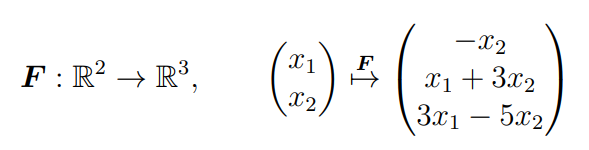
asking me whether F can be shown as x |--> Ax and if yes, to determine A
vast torrent
Oh, yeah, find the matrix M such that F(x)=Mx
Or A whatever
Or A whatever
Linear functions can be written in terms of matrices so if F is linear then it can be written as a 3x2 matrix
Linear functions can be written in terms of matrices so if F is linear then it can be written as a 3x2 matrix
wintry steppe
f is linear


 wintry steppe
the kind of transformation where they dont get multiplied with each other is generally linear no?
vapid coyote
what do you mean by that?
vast torrent
If each entry is a linear combination in the variables
vapid coyote
that one is trivially linear
it doesn't make a difference if you write that as matrix or directly
vast torrent
F(x,y) =(sinx,siny) is not linear
vapid coyote
??
vapid coyote
why is the text red
wintry steppe
yeah tahts what i meant @vast torrent
vast torrent
So the key is that to create a matrix for a linear transformation you only need to know how it acts on a basis
Do you see why?
wintry steppe
no
vapid coyote
It's not necessary to write linear functions in matrix form
vast torrent
That's the assignment mophra
vast torrent
Standard
But im explaining a concept
If a vector v in terms of a basis e1,e2,
..,em is
v=c1e1+...+cmen
Then T(v)= c1T(e1)+...+cmT(em)
See?
wintry steppe
yeah thats one of the requirements for the transformation to be linear
gray dust
this may look better bashed out in latex, fauxpas
wintry steppe
or at least looks like it
vast torrent
But do you see how T(v) is wholly determined by how it acts on e1,e2,..,em
wintry steppe
yeah
vast torrent
Im on mobile, it's annoying to use latex
vapid coyote
it really is
vast torrent
Anyway, can you write c1Te1+...+cmTem in terms of a matrix multiplied on a vector [c1,...,cm]?
gray dust
$v=c_1e_1+...+c_me_m\\$if transformation $T$ is linear, $T(v)=c_1T(e_1)+...+c_mT(e_m)$
stoic pythonBOT
RokettoJanpu:
$v=c_1e_1+...+c_me_m\\\\$if transformation $T$ is linear, $T(v)=c_1T(e_1)+...+c_mT(e_m)$
That's the matrix you want
$T(v)=c_1T(e_1)+...+c_mT(e_m)=M[c_1 $ \cdots & c_m]^\top$
gray dust
oh my, i'm sorry you had to do that on mobile
stoic pythonBOT
gfauxpas:
Compile Error! Click the reaction for details. (You may edit your message)
wintry steppe
oh transposed?
wintry steppe
hmm idk the matrix looks like an arbitrary m x n in my head
vast torrent
Someone on pc write that as a column vector to not be confusing
wintry steppe
np i get it
vast torrent
Tia
gray dust
$T(v)=c_1T(e_1)+...+c_mT(e_m)=M\begin{pmatrix}c_1\\vdots\c_m\end{pmatrix}$
stoic pythonBOT
RokettoJanpu:
$T(v)=c_1T(e_1)+...+c_mT(e_m)=M\begin{pmatrix}c_1\\\vdots\\c_m\end{pmatrix}$
Think of the row.column or column.row interpretation of mtx multiplication
And think of each T(ei) as columns
Bbl
wintry steppe
Think of the row.column or column.row interpretation of mtx multiplication
not sure what you mean by this, are you talking about how the rows and columns interact with each other when multiplied?
gray dust
The goal is to write the linear transform as just left-multiplication of the input by some matrix
wintry steppe
yeah so like some M x (x1, x2)
gray dust
Aye
wintry steppe
and in order to find M i have to find out how T(x) behaves on a basis
half ice
Seems like you get the strategy. What's the question?
vast torrent

Khan Academy
Showing how ANY linear transformation can be represented as a matrix vector product
half ice
vast torrent
have 18 minutes?
wintry steppe
sure
half ice
Okay, what's F(1,0)?
vast torrent
watch the video I linked to, he explains it
wintry steppe
-1
vast torrent
needs to be a 3-tuple
half ice
Remember, F takes in vectors from R² and returns vectors from R³
wintry steppe
so -1,0,0 then?
seems wrong
oh lmao
$ \begin{bmatrix}
0 & -1 \
1 & 3 \
3 & -5
\end{bmatrix}
\begin{bmatrix}
x_1 \
x_2
\end{bmatrix} $
stoic pythonBOT
yami:
wintry steppe
this is actually pretty cool
wintry steppe
so i understand how to compute the kernel but im not sure where it goes wrong 
take the matrix above, put it into RREF and then x1 = x2 = 0?
vast torrent
It's possible for the kernel to be {0}
In fact, there's a very important theorem
Know what an injective function is? Also called a one-to-one function
wintry steppe
yeah
vast torrent
If T is a linear function