#linear-algebra
2 messages · Page 44 of 1
 sonic osprey
 wintry steppe
Actually useless
 prisma kestrel
non-trivial is always mentioned when theres one which works "always"
sonic osprey
Right
prisma kestrel
reminds me of linear combinations
sonic osprey
0 is always in a subspace, so the intersection of two subspaces will always have 0
 paper egret
ah
sonic osprey
So non-trivial just means, not just 0
paper egret
omg i don't even know wtf i'm proving
holy shit
this is most likely wrong as hell, but that's what i got so far
wait nvm i have an idea
sonic osprey
V and W are linear transformations?
sonic osprey
Yeah that's pretty wrong
sonic osprey
It should help you to think of actual examples
Nah it's more strong
Think of the R^2 example
Figure out an example in R^3 and see how that works
paper egret
i got an idea, i just represent vectors u and w by some linear combination of vectors, and then when I add them together, show that some vector v is also a linear combination of the linear combination of v and w
thus showing that B U C is a basis for V
sonic osprey
Try it
prisma kestrel
in what topic does construction of natural numbers etc fit in the best?
got a question on that
sonic osprey
paper egret
ok so i have to prove this corollary now, but i have one question
prisma kestrel
ty
paper egret
If V is the direct sum of U and W, then dim(V) = dim(U) + dim(W)
what happens if there is some identical vector in B and C, where B is the basis of U, and C is the basis of W
oh wait
nvm
that would violate the direct sum
nvm
im retarded
`Let U and W be subspaces of V. Then U + W is the subspace of V defined by
U + W = {u + w | u is in U, and w is in W}`
this is basically direct sum
but a little different
i think
sonic osprey
How so?
paper egret
oh this is a different question
this says nothing about uniqueness
given that definition
Prove this
`Let U and W be subspaces of V. Then V is the DIRECT SUM U and W if and only if
(a) V = U + W
(b) U intersect W = {0}`
ok yea this is kinda obvious, but idk how to prove this without being vague af
 north sierra
 clever cedar
to find basis
after u do that
u know how to setup basis
which shows the subspace for R^3
north sierra
yeah
clever cedar
so the idea of basis jsut says
we can create the vector space R^3 (or R^n) with only a minimal amount of vectors
for example the basis of R^3 is {[1,0,0], [0,1,0], [0,0,1]}
because with ONLY those three vectors
we can create any other vector in the vector space R^3
north sierra
oh
north sierra
clever cedar
is to set up a basis for that given set
north sierra
so in my case, a would be the only vector needed to create the vector space R^3?
clever cedar
there can be infinite basis
so ur question says let W be the set [a,b,c] where a - 3b - c = 0
thats a little hard to comprehend
so lets redefine it
let W be the set of vectors [a,b,c] where a = 3b + c
now we know that we can create this subspace with this given condition
as long as a = 3b + c
north sierra
ohhh i see what i was confused on earlier now
but wait
im sstill lost on why solving for b and c dont matter
north sierra
aight
clever cedar
so we've set
let W be the set of vectors [a,b,c] where a = 3b + c
so in other words
we have to define W to be a subspace of R^3
where a = 3b + c
we can redefine this as
W = {[3b + c, b, c]}
now remember how a basis for R^3 is [1,0,0], [0,1,0] and [0,0,1]
?
was that clear to u
clever cedar
i can give u my book's example
north sierra
sure
clever cedar
clever cedar
np
north sierra
why is it true that Ax = v + w will also be consistent?
oh its cause colA is a vector space
north sierra
when it says "has a solution for each b in R^m" does it mean every vector in R^m or every entry in the vector b for that specific vector?
 slow scroll
@north sierra the former
north sierra
thanks
clever cedar
i have a question
if x = 0
why cant i divide both sides by x
0/x = 0
so 1 = 0
slow scroll
because x = 0 
 feral mountain
or d/dx both sides :)
 lone quail
whats the fastest way to find inverses of matrixes 4x4
im currently using the cofactor method
but i have to find 16 3x3 determinants which really can take a while in an exam
 rancid sonnet
does a vector space have to be closed under the two operations?
I don't see any closure condition in the axioms
prisma kestrel
i only read for addition: ass law, com law, neutral element 0 and inverse element and for scalar mult: left dist law, right dist law, ass law and neutral element 1
and yes, it was fun to me to write ass law
rancid sonnet
so do these imply closure, then?
prisma kestrel
as concerns what i have read so far no since only neutral and inverse have to be element of the vector space
 dusky epoch
if you don't have closure, nothing else even makes any sense in the first place.
dusky epoch
how can (x+y)+z = x+(y+z) make any sense if you don't know that x+y or y+z are still in your space
+: V×V -> V
*: K×V -> V
prisma kestrel
but do they have to picture in V?
dusky epoch
yes of course they do where else would they map
prisma kestrel
english words will bring me into nuthouse one day
but why are they limited to map into V? is it a restriction coming from fields?
rancid sonnet
Isn't that what closure means?
prisma kestrel
afaik closure means that A x A maps into A
dusky epoch
but why are they limited to map into V? is it a restriction coming from fields?
where else could they possibly map into
if you add two vectors and get something that ISN'T, then maybe you aren't dealing with anything resembling a vector space at all
prisma kestrel
but where is it restricted in the axioms and definitions? thats what i am asking for
rancid sonnet
how can (x+y)+z = x+(y+z) make any sense if you don't know that x+y or y+z are still in your space
prisma kestrel
and so how is the vector addition defined? i have no clue since i dont know much about LA
rancid sonnet
could be defined any way you like as long as it fits the axioms
 mint sentinel
if you have the characteristic equation (a+1)(a-2)(a-1), do you let the p1 be the matrix for when a = -1, the matrix p2 for when a= 2 etc. in that order?
dusky epoch
nnnnnno you're just way off-base
mint sentinel
how so
lone quail
@mint sentinel i call then E-1 and E2 if thats what you mean
to find E-1 i would do:
1)sub a=-1 into the original matrix
2)set the product of that matrix times the general vector equal to 0.
3)create equations
4)solve equations.
5)use those values to create the bases for E-1
6)Make E-1 by adding the bases as column vectors
mint sentinel
can you give me an example? all im wondering is that, when im supposed to find a matrix P that diagonalizes a matrix A and get bases p_1,p_2 and p_3 for example for the eigenspaces, what order do i put them in to get the matrix P? or rather, how do i chose which of the bases are either p_1, p_2 or p_3?
lone quail
so basically you have to find the bases of E1, E2 and E3
which are the eigenspaces
then you put those bases in one whole matrix
thats your matrix P
(or at least i think so, i was taught eigenspaces 2 days ago)
mint sentinel
yes, as a matrix of column vectors right?
lone quail
yes
mint sentinel
yes, but if i get a vector E1, why not call it E2 and make the original vector E2 as E1? how do you know the order?
lone quail
E1 is the eigenspace
the vector is the base of the eigenspace
order doesnt matter
i think at lwast
I just started on this topic so i may be wrong
mint sentinel
alright, thx tho
 vast torrent
@mint sentinel there's no "right" order for eigenvectors
if the choices of the matrix of the basis vectors give determinant +1 or -1, we generally prefer an order that gives +1
if the eigenvalues are all real, we often prefer them to be in ascending or descending order
but there's no "correct" order
@lone quail
mint sentinel
okay, thanks
 coarse rose
Do i need any pre knowledge besides high school math to learn linear algebra?
clever cedar
Nope
coarse rose
thats great
clever cedar
U have to be able to think abstractly tho
Things get challenging when ur introduced to vector spaces in third dimension
clever cedar
Love u too
prisma kestrel
xd
i mean im really interested in linear algebra and im not a math student so its great for me if i dont need pre knowledge
but i've got my lemme call it "semi-A level" so abstract thinking should be possible 😄
clever cedar
If ur interested in it and that means you wont give up at the first challenge then ull do fine
Try ur hardest and ask questions
Ull succeed
coarse rose
i dont have abstract thinking
cuz i havnt done math in 10 years
and i jumped into a engineer class
prisma kestrel
well i already constructed the natural and integer numbers
and i think thats quite hard if you havent done such an axiomatic construction before
AND YES IM HAPPY THAT IM ABLE TO CALCULATE THREE PLUS FOUR
and yes thats not linear algebra i think but kinda set theory if im not wrong?
on a german video about vector spaces, first comment: "vector spaces should burn in hell" 😄
north sierra
hello
clever cedar
Sup
prisma kestrel
which topic does stuff like equivalence transformations belong to? algebra i guess? but linear algebra as well?
wintry steppe
hi i need to multiply two matrices, B and A to get BA
B =
[    1    0    ]
[    0    1    ]
[    -1    -1    ]

A =
[    -3    2    -1    ]
[    0    1    1    ]
I managed to do AB, but BA is confusing because idk what to do when I reach the 3rd element of the first row of matrix A
Can someone help with this?
clever cedar
For BA
U have to make three copies of B
That are multiplied by each column of A
Respectively
wintry steppe
what do you want to see?
ok so first:
(1x-3)+(1x0) .... (0x2)+(0x1) ... then what do i multiply the last column of A by?
clever cedar
Its hard for me to type on my phone but if u give me 10 mins
I can write it out for u
So for example the first column of BA is
The entirety of B multiplied by the the column of A
wintry steppe
why is that so?
prisma kestrel
you can use my tex translations then and maybe copy it down
clever cedar
Ok ill write it on paper
north sierra
wintry steppe
dude that's the answer xd
clever cedar
Ill show u the steps
prisma kestrel
i think the solution wasnt asked but the steps to get there :^)
wintry steppe
wait now i'll just try to figure out the steps
wintry steppe
ty @prisma kestrel for the tex
prisma kestrel
if im not wrong, matrix multiplication, it means you multiply col from first by row from second matrix
wintry steppe
yeah
prisma kestrel
so in B*A, m-th col, n-th row it means m-th col from B * n-th row from A
wintry steppe
but col of first is 1 short of row of 2nd
clever cedar
wintry steppe
can you take a closer pic please?
clever cedar
Open original
wintry steppe
zooming is blurry
clever cedar
But yh sec
north sierra
its row from 1st row matrix by column of the corresponding second matrix
clever cedar
wintry steppe
yeah
clever cedar
I mean sure but showing ur work proves u understand it on exam
prisma kestrel
if you understood you can do it in your head but if you havent understood it yet the steps are important 😉
wintry steppe
i don't understand why you are multiplying the whole of matrix B by each column
wintry steppe
what's the difference between a vector and a matrix?
north sierra
true marino i dont really understand the steps lol
clever cedar
A vector is a list of numbers
dusky epoch
set != array
clever cedar
Yh sorry disregard what i previiusly said about matrix
lone quail
@@vast torrent ok thanks
I was watching threeblue1brown
Home page: https://www.3blue1brown.com/ How do you translate back and forth between coordinate systems that use different basis vectors? Full series: http://...
What is it doing at minute11?
How does it work?
north sierra
did you get it x14dev
wintry steppe
i still don't understand tbh why we multiplied the whole of B each time
no
did you get to your solution in the same way? @north sierra
wintry steppe
ok
prisma kestrel
@dusky epoch whats an array in math for you?
north sierra
ok not really the steps but do you see whats happening ? @wintry steppe
one sec
i made an error
clever cedar
Does ur textbook teach that?
north sierra
im not sure
ok that should be good
so i take the first row of the first matrix and multiply it by the first column of the second matrix
then first row of the first matrix by the second column of the second matrix
then first row of the first matrix by the third column of the third matrix
(first row,first column) corresponds to (1,1) so you put the sum in (1,1)
(first row, second column) corresponds to (1,2) so you put the sum in (1,2) etc..
prisma kestrel
oh then i confused it, i thought it was col * row but its row * col oO
clever cedar
Its the same thing just without showing the steps
 celest bridge
can someone please help me understand what the L_A matrix is?
wintry steppe
aha it makes sense now, so the entire row by each column
north sierra
yeah
clever cedar
????????? Its literally the same thing
How does his make more sense
??????:monkaS-1:
north sierra
i dont know
celest bridge
I don't understand why this isn't getting through my head, it seems like it should be real simple
north sierra
this way is more intuitive for me
wintry steppe
i have no idea how you got those smaller 1 column matrices
in the last step
@clever cedar
sorry not you
north sierra
kk
wintry steppe
thanks for the explanation too @north sierra
north sierra
np
wintry steppe
next time i will check the textbook too (i completely forgot to check it) uh
wintry steppe
that sign stands for an empty set, which contains no elements
but besides that idk
 gray glen
just a function from $\emp^2$ to $\emp$
 stoic pythonBOT
CaptainLightning:
gray glen
although $\emp^2=\emp$ so this is actually just the empty function
stoic pythonBOT
CaptainLightning:
gray glen
on the empty set
which if you consider its relation to be the function itself
is also the empty set
 half ice
Can you have null×null?
gray glen
yes
half ice
Is that just the empty set?
gray glen
yes
prisma kestrel
yeah but
a map from A -> B means i can input elements from A and i get elements from B
but the empty set has literally no single element
so what should i input
and in reverse what should be the output???
sonic osprey
Look at the set theoretic definition of a function
sonic osprey
that's not a definition
prisma kestrel
and i dont know where to find a definition
so that was my trial to find something in wiki 😄
half ice
It's the empty function. There's no mappings
sonic osprey

In mathematics, a function is a relation between sets that associates to every element of a first set exactly one element of the second set. Typical examples are functions from integers to integers or from the real numbers to real numbers.
Functions were originally the ideali...
half ice
One could think of a function A → B as the set of arrows starting at an element in A and ending at an element in B.
"No arrows at all" also counts as a function by this def
prisma kestrel
so this might be the definition
or rather that both criteria need to be fulfilled for a relation to be a function
half ice
That second picture is a relation between sets X and Y
sonic osprey
Functions are just a special type of relation
prisma kestrel
yeah sure
left total and right unique if these are the english words idk
already heard about it 30 min ago 😄
but okay
so i first thought the 2nd condition isnt fulfilled
because for any given element from X (lets imagine X -> Y) there is no element in Y to be part of the relation
but okay there are no elements in X so the condition is still satisfied
half ice
There exists the empty function on A → empty as well
prisma kestrel
and the top one is always fulfilled because the lhs of the implications always yields false (because there doesnt exist any tuple)
X -> Y is our empty -> empty
A -> empty?
wait
but the bottom one says
for every a there has to exist min 1 y
but there exists no y
because y is element of empty
half ice
Oh true, mb there is no empty function on that
prisma kestrel
THANKS GOD
half ice
There's an empty relation though
half ice
A relation between A and B is a subset of A×B. The empty set always counts
It's a set of arrows between A to B with no rules on the arrows
prisma kestrel
you mean that if R = subset of A x B and R = empty?
half ice
Ya ya
half ice
There could just be no arrows between A to B, that's an empty relation
prisma kestrel
with arrows you probably mean that if (x; y) is element of R, then x points an arrow to y
half ice
You know, I don't know why I'm explaining this, you likely know these definitions oop
prisma kestrel
oop?
half ice
That's not a math thing just an expression I have
prisma kestrel
thanks god
what was the half group again? only associative?
collecting the stuff i learned in onenote so i wanted to summarize it if i once forgot it 😄
interesting...
so we could build a group of integers but only a monoid of natural numbers
understood that right? 😄
half ice
There's a semigroup, which only needs associativity
prisma kestrel
im sry
half ice
Closure is always assumed in a binary operator
prisma kestrel
trying to translate the german words for it
half ice
Ah IC
prisma kestrel
in german its "half group"
half ice
I've never used one for anything lol
prisma kestrel
a semigroup you mean?
half ice
Ya ya
prisma kestrel
well but its interesting how it builds up
so first ass law, then neutral, then inverse
no wait
half ice
"ass law" lol
half ice
You're right, you need an identity before an inverse
prisma kestrel
identity?
prisma kestrel
well neutral element sounds better to me as well
vast torrent
well the identity map is $x \mapsto x$
stoic pythonBOT
gfauxpas:
vast torrent
because they're equal, identity implies things are equal
so I guess it's based on that
prisma kestrel
yeah i guessed the same
so i got a question
if we got a ring (M, +, *)
as concerns what i learned so far a ring has ass law, identity and inverse element for "+" and ass law + dist law of "*" whereas dist law is related to "+"
so a commutative ring restricts * to be commutative
and a unitary ring demands an identity element for *
but what about if we combine commutative and unitary?
does this have a name as well?
dusky epoch
commutative ring with unity
prisma kestrel
so it has no name, just two special properties
are operations in at least semigroups closed?
according to wiki they are, if wrong, just hit me up
is a general ring (R, +, *) commutative with respect to +?
because in my last video i've seen he didnt mention it but wiki tells otherwise
ok all comments say "+" needs to be commutative... 😄
wintry steppe
can this (B^T+A)C, be simplified to something other than CB^T + AC ? where B^T is B transposed
prisma kestrel
matrix?
prisma kestrel
maybe you should tell what C is
i cannot help you but those who can could be interested in
prisma kestrel
depends on the laws defined on matrices
distributivity in this case
if there is dist law or not
 dreamy depot
To show indeed show that $\mathcal{F_{a}}$ is a subspace of $\mathcal{F}$ is it enough say that, $$(f + g)(a) = f_(a) + g_(a) = 0 \in \mathcal{F_{a}}$$ $$a(f(a)) = 0 \in \mathcal{F_{a}} $$ ?
vast torrent
what's $f_0$?
stoic pythonBOT
gfauxpas:
dreamy depot
oh my bad typo it should be fixed now
wintry steppe
Yo if my line goes through (-3,-3) and x=0 how do I find the slope since I want to get a parallel line
gray glen
you need to check that all conditions are maintained under addition and multiplication by a real
wintry steppe
Wat?
stoic pythonBOT
Zophike1:
dreamy depot
Ahh ok @gray glen
wintry steppe
O srry I thought u were talking to me, my bad
wintry steppe
Yo if my line goes through (-3,-3) and x=0 how do I find the slope since I want to get a parallel line
dreamy depot
@gray glen let me relatex what I wrote
wintry steppe
gray glen
you also can't say either of these things in general
vast torrent
the question is, is this suficient to prove the space is a subspcae
if you know these properties hold for all functions in a subset
gray glen
you can't say f(a)+g(a)=0 for all a in [0,1]
or that a(f(a))=0 for all a in [0,1]
even for f and g in the subset
vast torrent
they're saying, IF it's true
gray glen
well it isn't much help to show that it's a subspace if you can't say either of those things for arbitrary elements of it

vast torrent
lightning, for example
dreamy depot
@gray glen the first part of the exercise was to show that it's a vector space so that's why i'm trying to show that it's a subspace
gray glen
I know
dreamy depot
Or wait is showing that it's a vector space implies that it's a subspace
a better way of going about it
gray glen
also what was the original space
vast torrent
go through the 3 step subspace test
nonempty, closed under scalar, closed under addition
the zero mapping is there
so it's not empty
dreamy depot
For the Subspace Test wouldn't I have to perform on the elements of my space
vast torrent
lightning, the original space is [0..1] integrable functions
dreamy depot
Like perform it on $f, g$ respectively ?
stoic pythonBOT
Zophike1:
vast torrent
oh wait, specifically, continuous on [0..1], f(0) = 0, f(1) = 1
dreamy depot
No the condition is f(0) = 0, and f(1) = 0 for the context of the question that's why I tried doing f(a) = 0 for all in a
vast torrent
you have to show:
the 0 function is in the space or that it's non empty
that if f, g are in the space then so is the pointwise sum f+g
dreamy depot
ahhh ok
vast torrent
and if f is in the space and c is a scalar, the pointwise scaled function cf is in the space
gray glen
which is why I said you couldn't assume that 
vast torrent
now, what is a
dreamy depot
a is some arbutiary constant right ?
dreamy depot
So the wise thing to do would be to consider $(f+g)(a) = f(a) + g(a) = (g + f)(a) $
stoic pythonBOT
Zophike1:
dreamy depot
@vast torrent yes
vast torrent
well you dont need to check f+g=g+f, we know that's how pointwise addition of function works
dreamy depot
Oh my bad we would need to check that f(a) + g(a) is closed
wintry steppe
Yo if my line goes through (-3,-3) and x=0 how do I find the slope since I want to get a parallel line
Sorry for texting this for the third time it's just no one responded
wintry steppe
O srry which one?
gray glen
dreamy depot
@gray glen how would you apply the Subspace Test i'm a bit stuck 😦
gray glen
well
dreamy depot
https://proofwiki.org/wiki/Subspace_of_Real_Continuous_Functions I'm looking at the general proof for some insight
gray glen
given two elements f,g of the subset
show that their sum f+g has all of the properties necessary to still be in the subset
go through each property in turn
then do similarly for cf for an arbitrary real c
dreamy depot
so should I use the sum for continous functions ?
gray glen
for showing their sum is continuous in particular, you'd want that the sum of two continuous functions is continuous
(this is true)
would you be expected to prove this as well or would you take it as obvious?
it's definitely a very fast proof even if you need to
dreamy depot
Can't we take it as obvious as this case or would I have to explain it ?
gray glen
if you feel like it's obvious then you can probably just say it is
but still point it out
dreamy depot
but know I have a clearer idea on proving the second part of the exercise I was a bit confused since a lot of proofs applying the subspace test usually are with involve employing matrices
dreamy depot
fair point I'll spend more time playing with functions that form a vector space
vast torrent
Im not even sure you can do a "matrix" with countably many rows and columns for countably infinite spaces, actually . Idk if it's possible
But certainly not uncountably infinite dimensions
wintry steppe
can someone help me simplify this in a form where I can solve for C?
dreamy depot
@vast torrent Since indeed $f,g$ are continuous functions it's easy to see that $\mathcal{F_{0}}$ is indeed a subspace of $\mathcal{F}$ since one has to establish that $f+g \in \mathcal{F_{0}}$, and $a(f) \in F_{0}$. To show this one can note that
$$\lim_{x \rightarrow c} (f + g) (x) = \lim_{x \rightarrow c} (f(x)) + \lim_{x \rightarrow c}(g(x)) = (f +g) \in \mathcal{F_{0}}$$
as well as that,
$$\lim_{x \rightarrow c}(c(f(x)) = c\lim_{x \rightarrow c}(f(x)) = a(f) \in \mathcal{F_{0}}.$$
stoic pythonBOT
Zophike1:
dreamy depot
^ I think this should be a good proof It's worded a little awakwardly but it should do the job
gray glen
on the left you have real numbers and on the right you have functions
it also ends with what you're trying to show stated (unjustified)
it seems like you're avoiding words in the later part and that might be the problem
you want to go like
(proof of property 1 for f+g)
 tame root
what do these brackets around the vector mean? I've been seeing this a lot recently. The B is a basis for vector space V and x is an element of V
dreamy depot
Ahh ok @gray glen
gray glen
"so we have property 2 for f+g"
until you get all the properties shown
and finally conclude f+g is in the subset
gray glen
well to start you haven't said anything about (f+g)(c)
dreamy depot
ahhh ok
gray glen
and that's just talking about them being continuous
you said nothing about (f+g)(0) or (f+g)(1)
dreamy depot
So I would have to perform the same steps for (f+g)(c) and (f+g)(0) ?
gray glen
you should say like "for c in [0,1]" blah blah "as f and g are both continuous" blah blah "so as c was an arbitrary element of [0,1] (f+g) is continuous"
stuff to that effect
dreamy depot
so was my idea in the corrected solution wrong then ?
gray glen
I think the general idea was there but the execution was quite off yeah
dreamy depot
oh I just didn't state it rigorously ?
gray glen
I mean the picture I posted is just wrong
dreamy depot
ahh all right 😦
gray glen
oh and also show it's nonempty but that's a small thing
prisma kestrel
why is the 0 excluded in field's definition for the multiplication group being abelian?
so why for a field (K, +, *) is only (K \ {0}, *) an abelian group
dreamy depot
@gray glen I'm clueness at this point on how to show it I get how it forms a vector space and how prove that it forms a vector space but I don't get how to use the subspace test to show it
 empty copper
0 doesn’t have a multiplicative inverse
prisma kestrel
wouldnt a commutative monoid work either?
dreamy depot
I think I know how to show it now give me a minute
empty copper
But that’s a monoid
prisma kestrel
well on the one hand we got (K, *) = comm monoid or (K \ {0}, *) = abelian group
 prisma kestrel
no wait
we want the inverse for every element except for 0
🤦♂️
but it bothers me that we totally exclude it
because then we exclude the case where 0 wouldnt fulfill the ass law for example
really theoretically here
 slender yarrow
prisma kestrel
slender yarrow
prisma kestrel
well actually
is the 0 excluded because identity element of addition?
or where does the "0" symbol come from
i mean we're talking about a general idea of a field
empty copper
I’m pretty sure one can show that within any field, any additive neutral element cannot have a multiplicative inverse
The 0 symbol is usually reserved to denote the additive neutral element
prisma kestrel
but still we talk about any additive neutral element
empty copper
Also pretty sure it’s unique :p
prisma kestrel
so not specifically OUR neutral element of addition which has no inverse
empty copper
By virtue of it being an additive group
prisma kestrel
what is an additive group? you mean with operation = addition? 😄
empty copper
Yes
prisma kestrel
aight
well
but still can we say something about general stuff? where we havent got numbers etc?
empty copper
A field, by definition is an additive group that’s also a multiplicative monoid
prisma kestrel
wasnt addition and multiplication abelian in fields?
sonic osprey
multiplicative group, once you remove the zero
empty copper
Addition is almost unanimously deemed to be an abelian operation
I meant commutative
But multiplication is not
prisma kestrel
well but still in our general definition we only have binary operations which yield no idea of our usual addition etc
empty copper
Yes you could call them differently
How about this: a field, by definition, is a commutative group that’s also a monoid under another supplied operation
prisma kestrel
how can a field be a group? a group only has 1 op
empty copper
Ok, although there’s an addendum: only the neutral element of the commutative operation doesn’t have an inverse under the second mentioned operation
A field, restricted to the relevant operation :p
prisma kestrel
well actually
dreamy depot
@gray glen I coudn't get it in the end I ended up looking up the solution : https://yutsumura.com/subspaces-of-the-vector-space-of-all-real-valued-function-on-the-interval/

Linear algebra problem. Let V be the vector space of all real valued functions on the interval [0,1]. We prove or disprove given subsets of V are subspaces.
prisma kestrel
if i think about it correctly
actually its all just definition
which can be thought of as good or bad
and i think its imprecise
but in the end only K\{0} needs to fulfill the abelian stuff
gray glen
uh those are slightly different sets
dreamy depot
@gray glen the set for part (a) would be right for my quesiton
dreamy depot
oh fair point but what was done in the solution for part (a) could work for the question i'm dealing with right ?
dreamy depot
@gray glen but I think I see how to solve my question know 🙂 sorry for being stupid 😢
dreamy depot
That is a fair point but I get angry at myself for not being able to come up with things on my own
vast torrent
That comes with time
dreamy depot
I know
half ice
Math is too big to reinvent
dreamy depot
@gray glen here's my final solution
$\text{Proof}$
To show that $\mathcal{F_{0}}$ is indeed a subspace of $\mathcal{F}$ we first must define that,
$$\mathcal{F_{0}} = \big{ f \in C[0,1] , \big| f(0)=0, f(1) = 0 \big}.$$
Then we consider the addition $(f+g)(x)$ it's indeed easy to see that,
$$(f + g)(0) = f(0) + g(0) = 0 \in \mathcal{F_{0}}$$
$$(f + g)(1) = f(1) + g(1) = 0 \in \mathcal{F_{0}}$$
Thus it follows that $(f+g)(x) \in \mathcal{F_{0}} $
Since $f \in \mathcal{F_{0}}$ we have that $f(0) = f(1)$ the scalar multiple $(cf)(x)$ satisfies
$$(cf)(0) = c \cdot f(0) = c \cdot f(1) = (cf)(0)$$
Thus $(cf)(x) \in \mathcal{F_{0}}$
stoic pythonBOT
Zophike1:
dreamy depot
oh my bad
gray glen
0 real number vs 0 function
(f+g) isn't necessarily the zero function
what you've done is show that (f+g)(0)=(f+g)(1)=0
which is good because that's one of the things necessary for f+g to be in the subset
but it isn't everything necessary for f+g to be in the subset
you still need that f+g is continuous
dreamy depot
I thought that for f+g to be in the subset it had to satisfy all the things within the subspace test
ahh ok to fix the proof should I just state that f,g are continous respectively
gray glen
and that this makes f+g continuous
make sure you don't get confused between the function f+g and the image of a certain point a under f+g
which is (f+g)(a)
dreamy depot
But wait I apologize for the dumb question but didn't I already define that f is indeed continuous earlier in the proof, by setting $\mathcal{F_{0}} = \big{ f \in C[0,1] , \big| f(0)=0, f(1) = 0 \big}.$ ?
stoic pythonBOT
Zophike1:
gray glen
f is continuous and g is continuous
but you have to say something about f+g being continuous
dreamy depot
ooooh ok now I understand the issue
dreamy depot
So I have to also employ the property that it is continuous as well
gray glen
you have to say that it's continuous and why it's continuous yeah
dreamy depot
To show that $\mathcal{F_{0}}$ is indeed a subspace of $\mathcal{F}$ we first must define that,
$$\mathcal{F_{0}} = \big{ f \in C[0,1] , \big| f(0)=0, f(1) = 0 \big}.$$
Then we consider the addition $(f+g)(x)$ which produces a continuous function since,
$$D_{x}(f + g)(0) = D_{x}(f(0)) + D_{x}(g(0)) = D_{x}((f+g)(0))$$
$$D_{x}((f + g)(1)) = D_{x}(f(1) + g(1)) = D_{x}((f+g)(1))$$
Thus it follows that $(f+g) \in C^{(1)}(0, 1)$ and $C^{(1)}(0, 1)$ is closed under addition.
Since $f \in \mathcal{F_{0}}$ we have that $f(0) = f(1)$ the scalar multiple $(cf)(x)$ satisfies
$$D_{x}(cf)(0) = c \cdot D_{x}f(0) = c \cdot D_{x}f(1) = D_{x}((cf)(0))$$
Thus, $(af) \in C^{1}(0,1)$ and so $C^{1}(0,1)$ is closed under scalar multiplication.
stoic pythonBOT
Zophike1:
dreamy depot
Yeah is that a misstep on my part ?
dreamy depot
$\frac{d}{dx}$
stoic pythonBOT
Zophike1:
vast torrent
How are you diff'ing if we don't know tje functions are differentiable
dreamy depot
But aren't continuous functions differentiable
vast torrent
No, differentiable functions are continuous
dreamy depot
ahh okay my bad
vast torrent
Consider |sin x|
dreamy depot
fair point now i'm confused how do I show that $f+g$ is continous
stoic pythonBOT
Zophike1:
vast torrent
Continuous but not diffavle where sin x changes sign
Well there's more than one definition of continuous, which do you know?
vast torrent
that would work
write f(x+h)+g(x+h) = (f+g)(x+h) for |h| small and non zero
for epsilon != 0
maybe h would be better than epsilon because usually we use epsilon>0
changing it
there
note, however, that your work would be useful when analyzing the vector space of differentiable functions
something is still bothering me about this though
you say f(a) + g(a) = 0 in your space?
for every a?
dreamy depot
$$\mathcal{F_{0}} = \big{ f \in C[0,1] , \big| f(0)=0, f(1) = 0 \big}.$$
stoic pythonBOT
Zophike1:
dreamy depot
Sorry posted the wrong thing eariler
vast torrent
yes but does that mean f(1/2)+g(1/2)=0 for all f, g in C[0,1]?
dreamy depot
yes
vast torrent
well that's a bizarre set
dreamy depot
Unless I'm misunderstanding the set
vast torrent
post the origina,l problem again
dreamy depot
vast torrent
that doesnt say that f(a) +g(a) = 0
dreamy depot
oh shoot your right I must have misread the problem then
vast torrent
yeah, the problem is just to show this is a vector space
${ f \in C^0([0..1]): f(0) = f(1) = 0}$
stoic pythonBOT
gfauxpas:
dreamy depot
ahhh okay I see where I got confused now 😦
vast torrent
so you need to prove two things
that it's closed under vector operations for continuity
and that the f(0)=f(1)=0 thing stays true for the vector operations
dreamy depot
I get how to show how it's closed but I don't get how to show that f(0) = f(1) = 0
dreamy depot
oh ok
vast torrent
or just check (cf+g) in one step
dreamy depot
So to check $(f+g)$ I would just take that $$\lim_{h \rightarrow 0} (f(x+h) + g(x+h)) = f(0) + g(0) = f(1) + g(1) = 0 $$
stoic pythonBOT
Zophike1:
dreamy depot
to conclude that indeed $(f+g)(x) \in \mathcal{F_{0}}$
stoic pythonBOT
Zophike1:
vast torrent
You need to check closure under continuity seperately from checking closure under the boundary conditions
They're two different creatures
dreamy depot
ahhh ok I thought you wanted me to do it all at once
vast torrent
No, you can't
Or shouldn't
but instead of checking f+g and cf seperately you can check cf+g
Crossed it out bc people usually don't use that shortcut, at least not when you're taking your first la class
dreamy depot
That's fair i'm just trying to piece together the proof at this point I get some of the idea's but I can't put togther the bigger picture
vast torrent
Do you know what it means for a set to be closed under some operation?
dreamy depot
yeah when you add members of the set it produces members of the same set
vast torrent
"add" or perform whatever operation being considered
In linear algebra, the two operations you need to check for closure
Are addition, and multiplication by a scalar
dreamy depot
So I should do $(f + g)(x) = f(0) + g(0) = f(1) + g(1) = 0 $
stoic pythonBOT
Zophike1:
vast torrent
Your set has two defining properties
Continuity and the bdry conditions
You need to check that both those things are closed under addition and scalar multiplication
dreamy depot
ahhh ok by boundary conditions you mean f(0) = f(1) = 0 ?
dreamy depot
At this point can I just see the proof ? I've been stuck on this for hours now
vast torrent
You're close
Do 4 things
Prove f+g is continuous
Prove cf is continuous
Prove (f+g)(0)=(f+g)(1)=0
Prove (cf)(0)=(cf)(1)=0
To prove a function is continuous, use this definition
$\lim_{h\to0}f(x+h)=f(x)$
stoic pythonBOT
gfauxpas:
vast torrent
Go forth young man
dreamy depot
To prove the first point I noted that $(f+g)(0) = f(0) + g(0) = f(1) + g(1) = (f+g)(1)$
stoic pythonBOT
Zophike1:
dreamy depot
^ Is this fine ?
vast torrent
Add =0
dreamy depot
all right thanks
Woah I got it thanks man @vast torrent 🙂 I see the proof and I get how and why it works
Also what was the shortcut you mentioned I shouldn't use ?
clever cedar
does anyone know if the cauchy swartz inequality holds for the cross product
north sierra
for 9, why is is that i can just make the equations = 0 and then that makes it a vector space?
clever cedar
are u familiar with subspace test
north sierra
ya
clever cedar
pretty much he's summarizing that the subspace given satisfies the subspace test
since u can make those vectors into a zero vector with being a suspace of R^n
as well as its closed under addition and under scalar multiplication
north sierra
but he doesnt show the addition and scalar multi part
clever cedar
slader is also student provided solutions so my guess is he didnt go into depth
but i could be wrong
half ice
Oh I see. He noticed that it is a null space of some matrix, which is a vector space
dreamy depot
Dumb question does a Cone form a vector space ?
half ice
Not a bad idea
north sierra
can you explain kaynex?
half ice
The null space of any matrix is a vector space.
north sierra
how did he know it was Nul space
half ice
Rearranged it so it was
Can you see the similarity between the matrix and the equations in the solution?
north sierra
ya
they’re the coefficients of the equations
but how does he know without row reducing
that theres a set of solutions to Ax=0
half ice
Remember that the null space is the set of vectors that, when put through the matrix, gives 0
north sierra
ya
half ice
We also have that a - 2b - 4c = 0, 2a - c - 3d = 0
What happens if we put [a,b,c,d] through that matrix?
north sierra
it should equal 0?
half ice
Ya ya. You'll get the zero vector. So [a,b,c,d] is in the nullspace of that matrix
dreamy depot
I'm struggling with the last part of this question i'm having trouble seeing that a cone is not vector space. I'm I missing something here because if it's closed under addition and mutiplication shoudn't the cone be a subspace or R^{3}. I'm I missing something here !!?
half ice
Here's a cheat, it's not a vector space if there's a constant in the equations. 7 and 8 are not.
vast torrent
@dreamy depot instead of testing f+g and cf in two steps you can test cf+g
dreamy depot
@vast torrent for the problem i'm facing or the shortcut I was asking about for the last problem
vast torrent
For testing closure under vector operations
Like if i have a map T and i want to see if its linear
I check T[x+y]=Tx+Ty
And T[cx]=cTx
dreamy depot
ahhh ok I see
vast torrent
But the shortcut is to check T[cx+y]=cTx+Ty
half ice
"multiplication by positive numbers"
There's other scalars that break this
What happens if your scalar is -1?
dreamy depot
ahhh I see so I would just have to throw some negative numbers at it
@half ice when you do multiply -\alpha (a) you would get atributary scales outside our side
so therefore $C$ cannot indeed be a vector space since the axiom closed under scalar multiplication is not satisfied
stoic pythonBOT
Zophike1:
dreamy depot
@half ice ^ is this a good rigorous answer
dreamy depot
Sweet thanks man 🙂
 carmine terrace
can anyone help me understand how they calculated cos for this
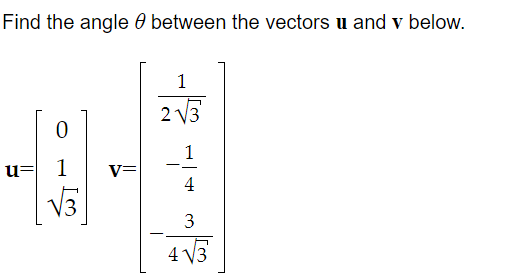
Dot product u*v makes it = to -1
and they use this formula

to get -sqrt3/2
u*v = -1
is the absolute value u*v = 1?
 gray dust
the bottom is magnitude u * magnitude v
clever cedar
its a dot product property
u * v = ||u||||v||cosx @carmine terrace
u * v = |u||v|cosx
the bars should be double but discord sees that as a spoiler tag
its length of the vector
and * is dot product in this case
$\cdot$
stoic pythonBOT
mike0x81:
carmine terrace
Thank you Mike, that's a good explanation.
clever cedar
anytime
paper egret
Let V be a finite-dimensional vector space. Let U and W be subspaces of V with dim(U) + dim(W) = dim(V).
The following are equivalent
V is the direct sum of U and W
V = U + W
U intersect W is the 0 vector
any hints
just want some sort of direction
dunno how to start this off
clever cedar
np
consider what dimension means in terms of its representation as a subspace
for example
if i say the set V has a dimension of 4
what vector space is it in
paper egret
no i know that, i just need some hints on how i should start this proof
whether its easier to start proving statement 1, or statement 3
kind of thing
carmine terrace
Hey guys I'm having problems with this problem



How do i find L2?
For L1 I got
x = -3+-3t
y = 3+-3t
z = -1 + -t
but I'm not sure how to proceed for L2
I think this is L2
x= -18+-6s
y= 3+4s
z= 0 + 2s
then I just make em = to each other since they instersect
north sierra
kk thanks kaynex i get it
clever cedar
@carmine terrace you're suppose to use substution
so like for instance
you take one of the X's
and the other one isolate for T
then plug in the second one into the first one
then you should get a value for X
where if plugged into both equations satisfies
same thing for Y and Z,
 cloud cairn
if i have 2 points in a plane. i know their points. (green points)
i have a 3rd point (blue) ALSO in the plane, i am trying to solve for.
i know the distance between each of the points. (3 lengths of a triangle given)
i have the equation for the plane (in picture top left)
how to go about solving the 3rd point?
i understand it will probably have 2 solutions. (cuz we could flip the triangle across the line formed by 2 green pts)
the blue point we want must satisfy the equation for plane
clever cedar
interesting problem
let me think
wait
u know the distance between green points and blue point right?
clever cedar
why cant u just
solve for the vector equation
where a green point would be position vector
and direction vector would be distance
cloud cairn
i guess i havent covered direction vectors. or to say idk how to find vector that connects the blue dot to green
clever cedar
i see
would u mind giving me full problem?
or is that all of it
with the givens
cloud cairn
actyually i think i know what ur onto
the full problem is actualy something that preceded this. and i was trying to solve it usng this method
full problem something else 1 sec
clever cedar
ok
clever cedar
this is a simpler problem
i wish u presented to me this first
i could explain u it
cloud cairn
find the point on the plane closest to the point given
cloud cairn
ok
clever cedar
first what we want to do is find an arbitrary point on the plane
in order to do that
cloud cairn
right i know this part
clever cedar
we find [x,y,z] that satisfies the equation of the plane
ok
next
we want to find the vector from that point
to the point outside the plane
cloud cairn
right, red line on my picture
clever cedar
now
cloud cairn
er not red line
clever cedar
we want to project that vector onto the normal vector
cloud cairn
right
clever cedar
with that, we now know the distance from the point outside the plane
to a point on the plane
(shortest distance)
cloud cairn
yes
clever cedar
lastly
take the point outside the plane
and subtract it by the projected vector
and we get the point on the plane
cloud cairn
lol...
cloud cairn
"take the point outside the plane
and subtract it by the projected vector
and we get the point on the plane" this is too easy lol
i wish this popped immediately into my head.
im still working my head around vector addition, subtraction, how it all works. and i havent thought deep about it
clever cedar
lol
cloud cairn
even tho i know its one of the easier subjects of linear algebra
clever cedar
its crazy how abstract ideas can be solved with simple subtraction
i understand
hope that helped
clever cedar
lolol dw
cloud cairn
btw i was uisng the pythagorean theorm, everything you dud there
cloud cairn
but then i went off into some bizaare tangent
clever cedar
happens
cloud cairn
ok question
you said to solve the length of the projection vector
and then you say subtract the projection vector from the point
when do we use the length?
 uneven bloom
((AB^T)^(-1))^T=((B^(-1))^TA^(-1))^T=(A^(-1))^T*B^(-1), so the answer is ((A^(-1))^T)^T=A^(-1).
I’m using the properties:
- (AB)^(-1)=B^(-1)A^(-1). This works since inverses are well-defined and since ABB^(-1)A^(-1)=B^(-1)A^(-1)AB=I.
- (AB)^T=B^TA^T
Element ij in (AB)^T is element ji in AB, which is sum a_(jk)b_(ki). But then element ij in B^TA^T is sum b_(ki)a_(jk), so these are equal.
wintry steppe
@uneven bloom ((B^(-1))^TA^(-1)) is it ^TA^-1 or ((B^(-1))^T x A^-1?
uneven bloom
T is applied to B^(-1) and separate from A^(-1)
wintry steppe
so C = A^-1 ?
wintry steppe
ok
dang it this is so complicated
applying all these property rules
gonna take a bit till i can do that myself
could you just help me with this last one too please? @uneven bloom
dusky epoch
$D = \begin{bmatrix} 3 & 1 \ 5 & 2 \end{bmatrix}^{-1}$
stoic pythonBOT
Ann:
wintry steppe
thanks @dusky epoch but how do i arrive to a diagonal matrix from that?
dusky epoch
what do you mean "arrive at a diagonal matrix"
wintry steppe
doesn't D have to be a matrix with 0s on each side of the diagonal?