#linear-algebra
2 messages · Page 43 of 1
 clever cedar
what is the LEAST amount of vectors u need in order to create the R^3 space
 native lodge
I like how three people are trying to find the best way to ask the same question now lol
 silent dune
3?
native lodge
yes, three
clever cedar
lmfao my bad
native lodge
no, it's not bad lol
silent dune
the more the merrier
native lodge
I just find it funny we are all trying to accomplish the same thing
so we need at most 3
any more than three and we know that one of them isn't needed at all
to put it into linear algebra language you have heard before: one of the vectors is a linear combination of the others
 gray dust
you need at least 3 linearly independent people to have a basis for helping solve linalg questions
native lodge
do you recall the definition of linear independence?
silent dune
hm
native lodge
how about you search for that definition first then
native lodge
right, they are linearly independent if the only coeffs that give you the zero vector is 0
so how about we write out the linearly independent condition for your given vector set
can you do that really quickly on paper for me?
$c_1\begin{bmatrix}1\2\0\end{bmatrix}+c_2\begin{bmatrix}2\5\1\end{bmatrix}+c_3\begin{bmatrix}2\5\1\end{bmatrix}+c_4\begin{bmatrix}1\3\2\end{bmatrix}=\vec{0}$
 stoic pythonBOT
⚡Amphy⚡:
silent dune
ok got it
native lodge
now you can see plainly that there is a non zero combo that will get you zero
but this is a good case, let's formula how you would do this in a general case then
so recall matrix multiplication and it's many different forms
one method of multiplying matrices looks at taking combinations of columns
if I have AB, then I use the coefficients of B to take combos of the rows of A
so if I rewrite the above statement in terms of matric multiplication, I get this
$\begin{bmatrix}1&2&2&1\2&5&5&3\0&1&1&2\end{bmatrix} \begin{bmatrix}c_1\c_2\c_3\c_4\end{bmatrix}=\vec{0}$
stoic pythonBOT
⚡Amphy⚡:
native lodge
now I would preform row reduction on the matrix we see on the left and see if the matrix is invertible or not
(not invertible is what you will find)
I mean you have seen this all before right?
silent dune
this is getting confusing lol
native lodge
solving for null space is what we are doing
silent dune
not this way
native lodge
I haven't seen many books present the null space in this way either lol, which is why I liked it when I thought of it
start with linear independence and we end up at null space lol
it's just a way of showing where Ax=0 comes from
but you have heard of null space before?
taught about free variables and all?
native lodge
the vectors that satisfy Ax=0 are in a vector space we call the null space
how about you just take this document and see if it helps at all
 north sierra
need some help with 18
this is the solution but i was wondering why he doesn't take the zero vector into consideration?
north sierra
shouldn't question 18 be made of 4 vectors
native lodge
the second row is just a * 0 + b * 0 + c * 0
 half ice
Do you understand the algebra they used to get that set S?
half ice
What's the difference?
native lodge
I mean you can add d * zero vector and nothing will happen
half ice
The zero vector is in there, let a = b = c = 0
Remember a span is always a vector space
native lodge
it's already going to be in it
north sierra
true
native lodge
by setting all coeffs to 0
north sierra
oh yeah true
half ice
This is like saying "x isn't the solution, x + 0 is"
clever cedar
is the image of a matrix the same as its column space?
it seems as it would, since kernel is the same as null space
different words for same things 😠
silent dune
@native lodge it didn't really help lol I'm sorta confused more now lmao
Can you explain why they're using t=1, like I get the c1 setup but like
half ice
I have no clue either. The above is how I would
(2,5,1) = (2,5,1)
(2,5,1) - (2,5,1) = 0
half ice
I think they got there the same way I did, but with a lot more arbitrary steps
silent dune
is it dependent cause there is a free variable
kay
in the sense if there was no free variable there would only be one solution so it would be independent
half ice
It's dependent because there's a way to make one of the vectors using a linear combination of the others
silent dune
For then it would be independent then?
clever cedar
dude
just row reduce
then ull know
if all of the columns are pivot columns than yes
if not then no
silent dune
so what I said above is right then ye
north sierra
what did you say above
silent dune
in the sense if there was no free variable there would only be one solution so it would be independent
north sierra
ya
clever cedar
think of it this way. If there is a free variable than at least one of the columns is DEPENDANT upon that free variable
half ice
Well, you want to find all a,b,c such that
$a\begin{bmatrix}1\3\-1\-2\end{bmatrix}+b\begin{bmatrix}2\5\0\-1\end{bmatrix}+c\begin{bmatrix}1\-1\1\-1\end{bmatrix}=\vec{0}$
Oh
clever cedar

north sierra
😦
silent dune
thats what I asked mike lol, also what is that LOL
stoic pythonBOT
Kaynex:
Compile Error! Click the  reaction for details. (You may edit your message)
half ice
Wat
Well, imagine those are your vectors from your problem
Finding all a,b,c is the same as solving the matrix equation Ax = 0, where x is (a,b,c) and A is:
[1 2 1]
[3 5 -1]
[-1 0 1]
[-2 -1 -1]
 uneven bloom
There’s a little trick here. You can show they’re linearly independent just by showing the determinant of the block formed by the first three rows is nonzero because dim column space=dim row space.
Even even more simply, if the three 3 by 1 truncations of the columns formed by ignoring the bottom row are linearly independent, the original vectors are.
And the det is nonzero
@silent dune
silent dune
Can you show an example I'm kinda lost on the wording
half ice
So our vectors make a non-square matrix, we can't use the determinant here
uneven bloom
I’m truncating the vectors
half ice
But, you can row reduce it to solve the system
uneven bloom
Take [1,3,-1], [2,5,0], [1,-1,1]
If these are linearly independent, the original vectors are too
silent dune
ah I see
north sierra
what is the difference between vector space and subspace
half ice
None, really. A subspace is a vector space inside your vector space
half ice
A plane is a subspace of R³
The plane and R³ are both vector spaces, but one happens to be contained in the other
uneven bloom
I forgot to say that the converse also (almost) holds
If all n by n truncations of an m by n matrix, m>=n, have det 0, then dim col<n.
 visual acorn
I have a homework question and was wondering how I would tackle this using Linear Dependence and Independence.
Determine all values of k for which the following set of vectors spans ℝ4. You can select 'always', 'never', 'k = ', or 'k ≠', then specify a value or comma-separated list of values.
Where i'm given 4, 4x1 vectors with one of these vectors having a variable k.
visual acorn
north sierra
which the following set of vectors spans ℝ4. what are the vectors?
kk
form a matrix
then row reduce
anyone know how i can do this?
clever cedar
wtf
north sierra
what lol
clever cedar
question is fucked
north sierra
yeahh lolol
clever cedar
this chapter took me the most time to understand
clever cedar
yeah same
stoic pythonBOT
rjcaste:
clever cedar
they arent inverses of each other
one is an inverse of the other
BA = I is the same as A^-1A, which is not the same as A^-1*A^-1
ok yeah
north sierra
yeah
clever cedar
whats ur question
stoic pythonBOT
rjcaste:
stoic pythonBOT
rjcaste:
clever cedar
:)
how do i prove subspace for this
using subspace test
textbook didnt teach me shit
i can break that up into 3 vectors?
o shit didnt know that
iight ty
north sierra
oo ur on the same chapter as me
clever cedar
lol where u from
north sierra
Ontario canada
clever cedar
r u at york
north sierra
nope
north sierra
👀 i can pm u if you really wanna know
clever cedar
ya r u
north sierra
yep
clever cedar
ye
native lodge
upon inspection there is no way that can span R^4 lol
it can be subspace though, yes
thought it said span R^4 or not lol
clever cedar
is it because there are only 3 vector columns?
native lodge
as in span all of it
north sierra
yeah
native lodge
R^4 needs a 4x4 matrix that has linearly independent columns in order to span all of R^4
you only have a 4x3
clever cedar
oh right on
native lodge
it can be a subspace of R^4 though
clever cedar
didnt even cross my mind till u mentioned it
native lodge
divide by a matrix is not a thing
the proper terminology is multiply by the inverse
important to know that
north sierra
r u first year @clever cedar
north sierra
aight peace bro
clever cedar
i dont even know where to begin
would there be a point on each line that is parellel to one another?
 slow scroll
are you familiar with orthogonal projection?
clever cedar
No sir we skipped that section
not enough time until midterm he said
i know projection
i understand how to project onto an orthogonal vector
but i only understand that context within a plane
if theres a point on a plane that is orthogonal to a vector
slow scroll
@clever cedar hm i found this: https://math.stackexchange.com/questions/2213165/find-shortest-distance-between-lines-in-3d

Mathematics Stack Exchange
Find shortest distance between lines given by
$x-2/3=y-6/4=z+9/-4$ and $x+1/2=y+2/-6=z-3/1$
Is there any shortcut method for this problems?
clever cedar
oh wow, thanks man
slow scroll
no problem
 elfin wasp
is there a way to find a linear independent vector from others without using gram schmit
i have the first 3 LI and i need a 4th
in R^4
elfin wasp
i have vectors (1,0,1,0), (0,1,0,1), (1,0,2,0)
need a 4th linear indepenedent
i know i can educated guess
but is there like a process i can use
clever cedar
yeah 0,0,0,1
uh
i think
if u set up the first three columns as those
and then the last column as the 0,0,0,1 vector column
then row reduce it to RREF
ull get the first column to become
0,0,0,1
which is known as extending a basis
elfin wasp
yeah
that would just be to show that 0,0,0,1 is a LI vector tho
not to actaully find it
i guess i can reduce the first 3 into the first 3 basis vectors of R^4
and then see which one is missing
half ice
Can always let it be the general vector (a,b,c,d) and row reduce including that one. You'll get rules a,b,c and d have to follow
There's definitely many choices you can make to find them
elfin wasp
if S is a subset of V and they have the same dimension how do i prove S = V
i guess i gotta show they have the same span but idk how to
like rigourosly
elfin wasp
yeah sorry
 dusky epoch
is V findim
elfin wasp
oh yeah they specified tha too
hm mmaybe if i say if B is a spanning set of V then it has dim(V) linear independent vectors, and C is a spanning set of S it has to have dim(S) linear independent vectors, so dim(V) = dim(S) means span(B) = span(C)
dusky epoch
no that sounds kinda dodgy
elfin wasp
ok
heres what i did instead
let B be a linear independent basis of V so V = span(B)
|B| = dim(V)
because B has dimV linear independent vectors
and sicne dim(V) = dim(S) then |B| = dim(S)
and that implies S = span(B) since it was specified that all vectors in B are LI
V = span(B) = S so V = S
slow scroll
hmm how do you know that every vector in the basis of V is a member of S? S is a subspace of V, so this doesn't exactly follow immediately.
uneven bloom
@elfin wasp no, this doesn’t work at all
elfin wasp
ok
lol
the cardinality of a set of linear independent vectors is equal to the dimension of a vector space
doesnt that mean its a spanning set>?
uneven bloom
You’re trying to show a basis of subspace S of dim V spans V
elfin wasp
ok how do i do that
uneven bloom
This isn’t that easy from scratch. One approach is to go by contradiction and complete the basis (assume S doesn’t span and add some new vectors to the basis so it does span) and then show that all bases of V have the same cardinality
uneven bloom
Feel free to ask if you need help with the details
 stiff comet
Hey, anyone have any experience with linear hashing?
i dont know the right section to ask this at
 sage mantle
hey , in a) to prove that there is a 0 we basically just look at f(1)=0 so there is no need for computations but for the b) what should i do? assume that f(3)=0 and f(1)=0 so f(3)=f(1)?
 sonic osprey
I don't think you understand part (a) correctly
sage mantle
that might be the case^^
my teacher told me that i need to show that f(x)=0
and since in this case f(1)=0 , it's kinda proven based on my understanding
i know that there is also the addition and multiplication part to prove but i'm not doing that rn
sage mantle
that there is a zero vector? and that if i add a vector called x with the zero vector it will give me the vector x
sonic osprey
okay so how do you add vectors in this vector space
sage mantle
that's my problem right now , i know most of the rules and i'm fine with proving that something is a subspace as long as it's not a function but with functions i have no clue how to proceed
i just said that thing earlier because my teacher tried to explain it to me but it looks like i misunderstood her
sonic osprey
You should go figure out how addition of functions is defined
and scalar multiplication of vectors
sage mantle
you mean like f(x)+g(x) and a * f(x) ?
half ice
@sage mantle
In this space, the vectors are functions, and the scalars are constants. f(x) + g(x) is adding two vectors, af(x) is a scalar multiplication
You'd have to go through your subspace test, which has three rules in it
sage mantle
so for the first rule , we need to prove that f(x)=0 right?
and since f(1)=0 , then it's proven?
half ice
f is a vector that belongs to V.
f is a vector that also belongs the subspace W, if f(1) = 0
For the first rule, we want to prove that f(x) = 0 is one of the vectors in W.
@proven magnet.
Yes, but there are ways to relate det(A) to a row reduced version.
sage mantle
I see thanks
 proven magnet
@half ice convert it to a "similar matrix" A=QSQ^(-1) where S is a basis in the same space
is there a fast way?
fuck it, cofactor expansion it is then
half ice
I personally like to do this for 3×3 matrices
You can add row 2 onto row 3 to reduce a cofactor expansion by one step
proven magnet
I can't wait to finish this spectral theory part
elfin wasp
how do i get RREF based on column relations
A is a 4x5 matrix
col 1 2 and 3 are LI
col1 + col2 + col4 = 0
2col2 - col3 + col5 = 0
native lodge
The simplest set of columns that are LI are columns of the identity matrix, and if we must create an RREF matrix based on the given info, those are the columns we must use anyways
From there, you can see what the other two columns must be based on the given linear combo relationships
elfin wasp
ohh ye i was kinda confused cuz i wasnt sure if i could assume the collums could be reduced to 1, 0 0 0 0 etc
but u always can do that its only the rows u cant assume that
silent dune
can someone explain why that n and r work
is n = 9 cause its transpose of C, and must be like that to multiply by b?
gray dust
first what's the size of C^T?
silent dune
9xr
gray dust
yes, so n must be 9 so that C^T can right-multiply with B or AB
have you figured out r?
silent dune
ye it doesn't matter, I was just confused if you could change the order when multiplying it would matter then
gray dust
matrices are associative under multiplication
silent dune
thanks
gray dust
no prob 
clever cedar
I have one online assignment question on skew lines but it was never covered in class or the chapters we've in the book. Which section of the book could it possibility be in?
 swift frost
Are you guys taking the same class or something?
 wintry steppe
What book are you using specifically
 rose grotto
thx
ohh im asking for the rank
@half ice
the 2nd part
the rank is usually the rows with the pivot
but how do I found out how many pivots this has
RREF?
half ice
You can't find the number of pivots without A. However, you do know A's nullspace
rose grotto
how do I know a's nullspace
if I have its nullspace
ill have its rank too
3-nullspace
cuz 5x3
half ice
You're right, if you have one you'll have the other. They add to 3
I should be saying "nullity" not "nullspace"
rose grotto
but how do I know its nullity
nullity is the free var columns
ohhhh
theres 2 free var colums in this right
the S one and the T one
so the first one
is a pivot
right
rose grotto
@half ice
half ice
The nullity is 2, yeah. So, rank is 1!
 pallid rampart
How do I show AB-BA=I has no solution
Oh wait
The previous question makes it trivial
 ok
ok
uneven bloom
Additivity of trace plus Tr(AB)=Tr(BA) finishes
pallid rampart
yeah
pallid rampart
How do I prove that if two homogeneous systems of linear equations in 2 variables have the same solution set, then they are equivalent in the sense that each equation from each system is a linear combination of the equations from the other system
<@&286206848099549185>
 hollow cedar
So given a solution set say X, belong to R^2, then any two homogenous systems a_i*x + b_i*y = 0 which have the solution set X can be transformed into each other through row operations
now the solution set itself can be either 0, or a 1-d subspace, or the whole of R^2
now you need to check each of the three cases individually
pallid rampart
Ok

 vast torrent
you have proved that it's bounded, I think. that's equivalent to proving it's continuous for linear operators
t.f.a.e for linear operator: bounded, continuous, continous at zero
 atomic flint
ok
would it be as simply as just stating that L:C([-3,3]) -> is bounded and hence continuous
vast torrent
you should say "since L is linear, L being bounded implies L is continuous", and then prove it's bounded
and then do what you did
 silver ore
Heya
A question
if I have a eigenvalue that is a complex number and a corresponding eigenvector
why is the conjugate of the eigenvalue an eigenvalue
and why is the eigenvector associated with it also the conjugate of the eigenvector?
and why are conjugates so important anyways
dusky epoch
is your matrix real
if so, then its charpoly is also real, and with those, complex roots come in conjugate pairs
silver ore
It asked me to convince myself
so I tried
and I don't know how to approach it
And I think its real?
oh
dusky epoch
yes A is a real matrix it says that up there
atomic flint
hey I am having a little problem with figuring out where to go next with this

that is what i have so far
 winter siren
Quick question:
Do:
(P index 0)
v = vector
--->
P0P = tv
mean
(x1, y1, y1) = t(x2, y2, y2)
proven magnet
a diagonalizable operator A : V → V has exactly n = dim V eigenvalues (counting multiplicities).
counting algebraic multiplicities? so (ƛ - 6)^2, eigen value "6" appears twice in the diagonal matrix D?
<@&286206848099549185>
gray dust
your wording is scattershot
clever cedar
i mean the last question
those were other q's
the last one 3.1.16
asked
i mean 3.1.14
Let A be an r×r matrix and suppose there are r−1 rows (columns) such that all rows
(columns) are linear combinations of these r−1 rows (columns). Show det (A) = 0.
gray dust
for a square matrix A, det(A)=0 <-> the set of A's columns is linearly dependent
clever cedar
i mean only one has to be linearly dependant not all of them
gray dust
SETS of vectors are referred to as LI or LD. not individual vectors
clever cedar
right, semantics arent my concern at this moment
although i will study them more as per ur note
im just wondering if my proof of linear dependence here is acceptanble
in the context of determinants
gray dust
there are a couple people here who will be harsher on you for improper wording
clever cedar
im being unclear
gray dust
i won't double check the work but if you show det(A)=0 then the set of A's columns are LD. or if you know the cols are already LD then you can expect det(A)=0
clever cedar
the wording pertains to other questions not related
i shoulv'de taken a better picture
the question im concerned with is where i created the matrix beside 3.1.14
but regardless thank you
gray dust
where? you just added two cols to make the third col
clever cedar
yeah
that was my demonstrative matrix
to show that if a column in a matrix is LD on other columns
than det = 0
gray dust
the set of the columns is LD
clever cedar

- The n column vectors of A are linearly independent
regardless ur avoiding my question and being pedantic on some wording, so thanks anyway lol
dusky epoch
it's not pedantry. precise wording is important in math and especially so in linear algebra where imprecision can be fatal
slow scroll
@clever cedar to answer your original question, your "proof" doesn't really capture why its the case that singular matrices have zero determinant, and as soon as you write down a matrix, you are losing generality. You have to use the linearity of the determinant and its invariance under row/column replacement.
First, you should know that the determinant of a matrix with a zero column/row is necessarily zero (this follows from the linearity of the determinant). Then you should prove that any singular matrix (non invertible square matrix) can be transformed to a matrix with a zero column w/o changing the determinant.
clever cedar
the question wasnt in regards to singular matricies. It was in regards to linearly dependant matricies
I appreciate ur input nevertheless
sonic osprey
Those are the same thing
clever cedar
4 = sqrt(16) and 4 = 2^2
but they are different expression
the question DIRECTLY asked about showing how a linearly dependant matrix has det of 0
not how a non-invertible matrix has det of 0
sonic osprey
Those are not the same thing
Singular and linearly dependent are actually the same thing
A matrix is singular if and only if its linearly dependent
clever cedar
"Singular Matrix. A square matrix that does not have a matrix inverse"
sonic osprey
Just replace everything in what he said with linearly dependent if you want
clever cedar
ive never come across the term singular in my book
sonic osprey
I don't think you understand what logically equivalent means
clever cedar
so im phrasing the internet
sonic osprey
That's true
 prisma kestrel
Me: Wants to learn full linear algebra.
Also me: Finds a PDF with 400+ pages...
 terse mirage
400 pages barley scrapes the surface probably
 lone quail
How to do this?
Basically the issue is:
I know how to do it using this way (correct me if its wrong):
clever cedar
whats the question
lone quail
First page
Find the representative matrix Mcc(f)
Thing is i heard i can also do it using this method but its not coming out the same:
So i was trying something like this, I’m getting a similar matrix but not quite, anyone know where i went wrong (question above)?
sonic osprey
What do you think?
north sierra
not sure
sonic osprey
Well think about what they're saying
You know what the union of two sets is
you know what subspaces are
clever cedar
"Let H and K be subspaces.." ""show that the union of two subspaces is not a subspace"
what
sonic osprey
Read that again, you're missing a couple words there
north sierra
the union of two sets is just whats in one set right
oh no
its both the sets right
clever cedar
yh
north sierra
first or latter?
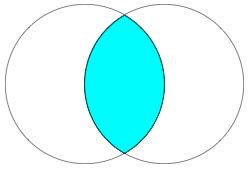 clever cedar
o
 rigid comet
yes
sonic osprey
Why are you trying to help if you're not completely sure about these things
rigid comet
union would be all
clever cedar
"help" and "discussion" are two different things
north sierra
union is both set A and B
rigid comet
in the circles
north sierra
true so anyways
i understand sub space and union
but dont know how to approach this problem
sonic osprey
Well what is the question asking you to do


 north sierra
yeah
sonic osprey
Well read it, what is it asking you to do
north sierra
lol
sonic osprey
In contrast to the first part
In the first part, you showed that the intersection of two subspaces is always a subspace
north sierra
yeah
sonic osprey
So what is this second part asking for
north sierra
i guess the zero vector would also be present in both sets
but closure under addition and closure under scalar multiplication wont
prisma kestrel
#advanced-number-theoryYesterday at 22:19
What did you expect
Linear algebra is a huge subject, there's a lot to learn
agentnolaYesterday at 22:37
400 pages barley scrapes the surface probably
@terse mirage @sonic osprey cmon let me be frustrated over wanting to learn this and having not much already in knowledge xd
sonic osprey
How do you know that closure under addition and closure under scalar multiplication won't?
@prisma kestrel yeah it's definitely tough
Just get started though, you'll get through it
then you'll look back wondering how you ever did that
north sierra
because if i take something from set a and add it to with something from set b it wont always be true that its under addition cause we dont have the intersection of the two
they're just arbitrary
sonic osprey
it could be there though? How do you know it can't?
sonic osprey
Maybe the thing from set a added to the thing in set b is in set b
north sierra
but like it wont ALWAYS work
north sierra
cause we're taking the union
not the intersection
is my thinking right?
am i in the right irection
direction
sonic osprey
Why does that matter?
You should read the second part of the question again
Word for word
sonic osprey
It really tells you what to do
prisma kestrel
im a bit curious though what IS linear algebra because i thought algebra captures stuffs like calculating with letters and numbers 😄
wintry steppe
if you're given the dimensions of a matrix and what Col A is equal to
how do you find Col A^-1
by Col I mean column space
rigid comet
is that a serious question
wintry steppe
yessir I am not smart
rigid comet
no i meant marino
wintry steppe
o
rigid comet
sry
wintry steppe
np
prisma kestrel
somehow yeah, but im distracting the discussion, so i wouldnt like to expand this topic in this channel
except the ongoing stuff would be over but i dont think so
sonic osprey
Yeah algebra kinda is like that
north sierra
@sonic osprey so i can give two vectors one from one set and one from another set and show that adding them does not give me back the same vector as each other i thinking?
sonic osprey
try it
@prisma kestrel Linear algebra is just like that, except you don't really work with numbers anymore
you work with vectors
which are kinda like multidimensional numbers
Then you study the analogue of lines
prisma kestrel
vectors are only element of the cartesian product of sets which contain numbers arent they?
sonic osprey
Vectors can honestly be anything, they just have to satisfy a couple rules
In most cases, with people just learning though, you'd be right
prisma kestrel
so the same axiomatic stuff as in natural numbers?
sonic osprey
They'd always be real numbers or sometimes complex numbers
Related, but quite a bit more complicated
A bit less set theoretical
prisma kestrel
im at the moment busy with the construction of N (through peano) and slowly moving to the integers atm 😄
well axioms dont have to be based upon sets ^^
In most cases, with people just learning though, you'd be right
im learning this stuff for fun or lemme say due to interest
sonic osprey
Vectors are just a lot easier to visualize and stuff in 3 dimensions and with real numbers
prisma kestrel
so i dont really care what people do to learn it to get through the exam 🤣
north sierra
sonic osprey
when your vectors themselves are functions, it becomes pretty hard to visualize
north sierra
?
sonic osprey
What are your sets
And visualization is pretty important in linear algebra
So you build up the geometric intuition first
Then you can move onto more abstract things
prisma kestrel
thats what i loved about the visualization of pythagoras in R³
you can just see HOW and WHY it is like that
sonic osprey
Well, explain what you wrote
north sierra
so
prisma kestrel
general matrix addition with same rows and columns i guess xd
north sierra
wait actually
let u = (a,0) and v =(b,c)
u in one sub space
and v in the other
vector addition results in the second entry not being 0
thus there is not a closure under addition?
sonic osprey
You haven't said what the subspaces are
north sierra
subspaces of r^2?
sonic osprey
whatever these vectors are in
sonic osprey
Are U and V subspaces or vectors
north sierra
how do i define what the subspaces are
sonic osprey
You know what subspaces are
north sierra
yea
sonic osprey
Then you know how to define a subspace
north sierra
subspace of a vector space which is also a vector space
i guess u and v are sub spaces?
im not reallt sure
tbh
north sierra
idk
sonic osprey
Then go think more
north sierra
they are vectors to me
when i first drew them
i thought of them as vectors
okay
i mean isn't a vector space a set of vectors
where as this is just one vector
sonic osprey
Depends exactly what you meant by writing [a 0] I guess
prisma kestrel
looks like a 2d vector (?)
ok i stop it because i influence even more confusion than what is already there 🤣
wintry steppe
does linear dependence imply a zero row?
north sierra
not always
but the reverse implication holds true
a zero row does imply linear dependence
wintry steppe
could you give me an example of a matrix that is dependent but doesn't have a zero row?
north sierra
oh ok
clever cedar
'''if det(A) != 0 for an n x n matrix than if AX = 0 show that X = 0.
AX = 0
AIX = 0
AAA^-1X = 0
stuck from here
idk what next
north sierra
clever cedar
o
shit
thanks man
it didnt cross my mind i can multiply RHS
since it was 0
wait
10 = 0
5 * 10 = 0 * 5
50 = 0
thats not allowed
north sierra
these are vectors and matrices not real numbers
prisma kestrel
which sketchboard software do u use elite?
north sierra
notability on the i pad
prisma kestrel
......
clever cedar
oh ok
prisma kestrel
i hate there is no useful stuff on windows/android 🤣
north sierra
lol im sure there is
clever cedar
nonsense, plenty of sketch apps on andriod
north sierra
it's windows come on
microsoft has their own notebook software
microsoft onebook or something @prisma kestrel
my professors use it a lot
north sierra
lol
prisma kestrel
what do you think how i feel as i fill this notebook with mathematical proofs
and what sucks the most is that its microsoft
I WANT INDEPENDENT SOFTWARE 😦
and if they one day should close one note i dont think i can keep my notebook
so i'll create pdf backups now and then
wintry steppe
hey guys I was doing an induction proof I was able to get to the part now I just need to do algerbra and I am stuck i need to make:
((k + 1)! -1) + ((k + 1) * (k +1)!) = ((k +1) + 1)! - 1
prisma kestrel
can you show the to-prove formula?
north sierra
ye probably
prisma kestrel
n=1 worked so nvm
north sierra
yeah thats the base case
now the hard part:
induction hypothesis but i am not smart enough to figure it out
i haven't done induction in like a year lol
prisma kestrel
well im doing it on paper rn
north sierra
nice!
prisma kestrel
ok i got it
stoic pythonBOT
prisma kestrel
i chose "i" as iterator variable, hope that doesnt matter too much
 jaunty hemlock
can some some help with an identify trig question
prisma kestrel
@north sierra @wintry steppe looked over it? 😄
jaunty hemlock
i need to prove left side equal right side
prisma kestrel
do you know if they are equal in fact? 😄
given by exercise description or something
jaunty hemlock
yeah they equal my teacher told me
prisma kestrel
ok i got it fujoshi
 teal plume
Say you have x (i1,j1,k1) X y (i2,j2,k2) with x and y being some number. After doing the cross product, would the magnitude just be x * y? If so, do you keep the numbers found for direction in the cross product with that specific direction? Ergo the final result being ( x1 i, y1 j, z1 k)
prisma kestrel
@jaunty hemlock you need the trigonometric pythagoras
teal plume
With z1, y1, x1 being the numbers you calculated in the cross product
jaunty hemlock
yeah
prisma kestrel
@wintry steppe btw im sorry for just solving the exercise, that was dumb, so where have you been stuck on?
@jaunty hemlock and where are you stuck?
teal plume
Or actually, the magnitude would be |b|*|a|*sin(theta(ab))
jaunty hemlock
sorry what do you mean
prisma kestrel
well you asked for help to prove the equality
so how far have you got and where have you stopped?
i mean i could just send the solution but i think nobody would support me with that and actually its not useful either 😄 and i already did it with an induction above so i wanna keep away from this kind of "help"
jaunty hemlock
could i see what you got and tell you where i got stuck
prisma kestrel
just show me what you have problems with
what have you already tried etc
do you have a mobile phone with which you could send a picture via discord?
jaunty hemlock
okay let me upload it
prisma kestrel
i'll prepare tex
stoic pythonBOT
Marino:
jaunty hemlock
here where i got
prisma kestrel
lemme give you the hint you dont need to transform the trigo functions into other functions because the solution is much simpler
this transformation isnt too clear to me
jaunty hemlock
alright i come back to that i currently stated a new equation
prisma kestrel
because $\frac{\frac{tan - sin}{tan}}{sin}$ should be $\frac{tan-sin}{tan \cdot sin}$ if im not wrong
stoic pythonBOT
Marino:
 paper egret
send help please
Let U and W be subspaces of V. Then V is the direct sum of U and W, if every element v in V can be expressed as
v = u + w for some u in U, and w in W in a unique way
wtf
is this
supposed
to mean
paper egret
everything lol
ok yes i know what subspaces are
how do you usually represent a subspace though
because what I usually picture
is a 3D space
and a subspace would be a plane
paper egret
only thing I know is that there are three things that define a subspace.
- Closed under vector addition
- Closed under scalar multiplication
- Zero vector exists
what is one possible subspace of R^3? Would {x1, x2, 0} where x1 and x2 can be anything be defined as a subspace of R^3?
sonic osprey
Sure, but at its core, a subspace is just a set of vectors
That satisfy the properties you listed
paper egret
infinite set of vectors?
my problem is how would one represent that set of vectors that make the subspace
sonic osprey
Usually infinite, not always
paper egret
😮
sonic osprey
Why do you need to represent sets
paper egret
R^0
sonic osprey
I mean it's not pointless
paper egret
right?
sonic osprey
Yes
paper egret
hmm
sonic osprey
It's just that it doesn't really matter here
paper egret
ok
so going back to my question
uhhh
hold on
I have to prove both directions oh no
if V is a direct sum of U and V, then B U C is a basis of V
wait lememe type it up
Let B be a basis of U and C be a basis of W. Then V is a direct sum of U and W if and only if B union C is a basis of V
it actually looks really obvious, but lemme try formalizing it
sonic osprey
Well do you understand what direct sum means yet
paper egret
yes
kind of
take some vector in U, take some vector in W
add them together
wait actulaly not rly
LOL
I thought I understood it
prisma kestrel
sum sounds like the sum of every possible vector which could occur but im not into this topic so dont take me too serious here
sonic osprey
@paper egret Understand that first
paper egret
do you think it possible to see a numerical example
i think the part that's messing with me the most is "in a unique way"
sonic osprey
R^2 is the direct sum of the x-axis and the y-axis
paper egret
So let me guess
there's something about Spanning
wait actually
does that mean that
this has smoething to do with a basis
basis means each vector can be expressed uniquely
sonic osprey
wow it's almost like the problem you need to solve answers that question
paper egret
so lemme guess. if V is the direct sum of U and W, it means U and W are basically bases of V
wait
that sounds so wrong
wait
LOL
sonic osprey
Just read the question you're trying to solve if you want to know the answer lmao
wintry steppe
does anyone know about the jacobian determinant and it's numerous uses!
wintry steppe
Use the jacobian determinant!
prisma kestrel
Let U and W be subspaces of V. Then V is the direct sum of U and W, if every element v in V can be expressed as
v = u + w for some u in U, and w in W in a unique way
wtf
is this
supposed
to mean
this one?
wintry steppe
Theres a tool you guys can use...
sonic osprey
Stop, please
wintry steppe
Lol
prisma kestrel
who are you talking to galois?
sonic osprey
It's really not that funny
sonic osprey
Well it's irrelevant to his problem so
wintry steppe
ITS NOT
sonic osprey
It is
paper egret
lol ban hammer plz
paper egret
jacobian determinant has nothing to do with this shit lmao
sonic osprey
Please just stop trolling
wintry steppe
im not trolling
Can someone please help me understand something about determinants, I have a quiz tomorrow and I have absolutely no bloody clue on what to do
sonic osprey
@wintry steppe This channel's in use, move to a different one please
wintry steppe
Omg
his question is resonable
and he has a quiz tomm
ffs
No one is answering in the other ones
have some sympathy
USE SHOELACE
prisma kestrel
"sympathy" if (lemme say i trust #galois) he says that that topic doesnt help in this topic? lol
sonic osprey
Just ignore him
wintry steppe
I met jacob jacobi
prisma kestrel
said the guy in white
sonic osprey
It's not worth the time
prisma kestrel
:^)
wintry steppe
I MET JACOB JACOBI
wintry steppe
ok ill ignore
sonic osprey
What does your problem say
sonic osprey
Definitely not
prisma kestrel
ok i blocked him, i recommend doing so either
sonic osprey
Can you find a counterexample
paper egret
coutner example?
I can't really think of one off the top of my head
for direct sum
sonic osprey
To the idea that U and W must have the same dimension
Can you come up with an example of a direct sum in R^3
paper egret
if they have the same dimension, wouldn't that be perfect?
uhhh lemme think
xy and yz plane maybe?
sonic osprey
Are you sure that works?
paper egret
oh wait there's an intersection
wintry steppe
😳
sonic osprey
Right, intersections are bad
paper egret
there's a subspace from the intersection
sonic osprey
Right, so you can write v + 0 and 0 + v
sonic osprey
Are you sure?
paper egret
i mean it could be
it could be both
both could have the same dimension, and both don't have to
in the case of R^2
x-axis and y-axis
wait actually that's bad, there's an intersection {0}
wait shit i'm getting confused
wintry steppe
whats the issue ?
sonic osprey
Well why isn't the intersection of {0} bad
wintry steppe
i will answer it
sonic osprey
Why are the other intersections bad
wintry steppe
I am fast
paper egret
the first intersection we had in R^3 had like an infinite set of vectors
wintry steppe
Not like
paper egret
the R^2 case is also bad too though right
paper egret
wait
wintry steppe
😭
sonic osprey
As a sum of something from the x-axis and from the y-axis
wintry steppe
😡
sonic osprey
So what's the difference
 pale orchid
🅱&
 jagged pendant
ah jun got em
wintry steppe
Can someone please help me I’m desperate right now
sonic osprey
Why does 0 not have a uniqueness problem?
wintry steppe
No one is answering questions
sonic osprey
But other vectors do?
jagged pendant
no cuz this channel is busy
paper egret
0 doesn't have the uniqueness problem because there's only one way to represent em
wintry steppe
Well I know but can literally no one pop in on questions
paper egret
other vectors do, for example in R^3, have multiple ways to represent em
that aren't unique
sonic osprey
The R^3 part doesn't really matter
if you have a non-trivial intersection
An intersection that's something that's not just 0
Then you can always write it as 0 + v and v + 0
okay anyways go back to thinking about the problem
paper egret
i dont get what you meant by non[trivial intersection