#linear-algebra
2 messages · Page 42 of 1
 jagged saffron

If you assume axiom of choice, these function is exists - you can construct this function to use Hamel basis of R over Q. - But if you does not assume axiom of choice, you can't show that nonlinear additive function - If you assume axiom of determinacy, every real function is measurable. And every measurable additive real function is linear.
 uncut forge
The function f(t)=E(X(t)) where X(t) is a random process with stationary independent increments
But we can probably assume it is at least bounded
uncut forge
Thanks for finding the link it was an interesting theorem
 uncut forge
Yeah I think I did too for continous functions
And density arguments
Ah actually
Since X(t) is defined for all t it has to be bounded on every interval
 celest bridge
Yea we actually covered that formula about the det wrt permutations, I just kinda glossed over that day and completely forgot about it.
I'm looking over my notes now and finally see it lol
Thanks again.
 clever cedar
I cant wrap my head around this definition
What does it mean S can be extended tk a basis of U
To**
If we have a basis of U
Does it mean we can make S into that basis?
 worn crow
usually it has infinitely many
worn crow
yes
clever cedar
Sick thank you
uncut forge
There's always infinitely many bases unless it has dimension 0
You can just scale one of the basis vectors and get a new basis
uncut forge
Nope because if for example u and v are linearly indep, then u and 2v is too
clever cedar
Oh shit ya
uncut forge
Try to think of it geometrically
If the dimension is 2 then all vectors not on a straight line are linearly independent
clever cedar
Oh and we can generate vectors not on a straight line by a sum of any two other vectors? (If that makes sense)
Nvm
Maybe not
uncut forge
Nope not in general
clever cedar
Alright. Well thank you very much
uncut forge
Np, btw a good youtube series about linear algebra is "Essence of linear algebra" by 3B1B
clever cedar
Ill definitely check that out
clever cedar
Im confused about the definition of image, if a kernel is the vector matrix that when multiplied by the matrix A equals 0, what is image
i cant understand notation
what is this saying
isnt that infinite?
thank you
another q
what is difference between kernel and nullspace
 blissful vault
for this proof, is this enough?
if vector v = sum(k=1, n) a_k v_K but also = sum(k=1, n) b_k v_K
then sum(k=1, n) a_k v_K = sum(k=1, n) b_k v_K
and sum(k=1, n) a_k v_K - sum(k=1, n) b_k v_K = 0
therefore there is a unique solution only
clever cedar
unique basis u mean?
celest bridge
same thing
Just different word. Kernel sounds cooler, but null space makes much more obvious/intuitive sense.
 gray dust
@clever cedar kernel's a more 'general' term for any function between two sets. kernel of a linear transform T on a vector space, ker(T), can also be referred to as null(T)
clever cedar
Thank you
 stoic elm
how 2 do this
gray dust
parallel lines have direction vectors that point the same direction
 wintry steppe
 urban bough
is the frobenius norm of a matrix the same as the 2 norm of a matrix?
and why or why not?
the two of them seem identical
 rancid sonnet

reposting because it went unnoticed probably the last time
The first two axes correspond to x and y
I'm guessing the last three has to stretch from minus to plus infinity?
And I could define the color to be the remainder when divided by 256?
 slow scroll
@rancid sonnet can't help much since im going to bed, but note that nothing is being done to the position of the pixels in order to invert the colors. Lets say you have a color/position (x, y, a,b,c). Then according to the problem, the inverted color is (x, y, 255 - a, 255, - b, 255 - c). Think about what the linear transformation has to do to each coordinate to come up with a matrix representation.
rancid sonnet
yes I already noticed that
The problem is, just subtracting 255 isn't a linear transformation since it shifts the origin, that's why I thought I had to represent them with that remainder thing
slow scroll
Oh yea duh... hmm I know of way to do it by adding an extra dimension but that is probably unnecessary. Yea idk but I gtg
 versed topaz
Dumb question: what does it mean for a quadratic form to be nonsingular? My prof said it meant that the associated matrix was nonsingular, where the matrix M associated to the form Q is the one satisfying Q(v) = v^T M v. But this doesn't seem well defined? If Q(x, y, z) = Ax^2 + By^ 2 + Cz^2 + Dxy + Eyz + Fzx, then we could pick M = [[A D F] [0 B E] [0 0 C]], which is nonsingular iff A≠0, B≠0, C≠0. But it seems like this would say xy + yz + zx is a singular. That sounds ridiculous, since this is just a hyperbola (there's no cusps or anything)
wintry steppe
when you're trying to find eigan values
and you're converting to an upper triangular matrix
how do you factor in the negative?
if you switch around the rows?
or do you just multiply by -1?
 lament atlas
Hey guys can you help me pls. The question is about vectors. V.W1×W2 = 1 what is the result of W2×(W1-V).W1 ?
V, W1 and W2 are vectors
The answer is - 1?
wintry steppe
hey i need a sanity check
 half ice
@rancid sonnet
You could let the vectors be mod 255, then T(x) = -x which is linear. Problem is, you can't represent 255 seperately from 0 this way
rancid sonnet
Just let it be mod 256? @half ice
rancid sonnet
how
half ice
I noticed that, if T(x) is the inversion of x:
T(x) + x = 255
Which makes mod 255 a natural choice
rancid sonnet
oh right
the transformation
hmm
so I'm still stuck
what if
I did it mod256 anyways, and defined the colors to be the remainder minus 1 ? @half ice
and defined 255 to be when the remainder is zero
 north cloak
Anyone wanna help in B?
 quasi vale
someone did reply
clever cedar
i dont understand the language of the example
does it mean describe the set that spans those two vectors?
for where u & v span(R)
where R is a set
clever cedar
sorry in my mind if a vector is an element of a span set than that vector can be derived as a linear combination of that set
is that wrong?
 dusky epoch
that's less wrong than before
clever cedar
I guess ill need to re-study the formal definition
clever cedar
Oh i think see now, span is any linear combination of those two vectors. And from those two vectors I presume we generate the R^2 vector space
That makes more sense I believe
dusky epoch
...no not really
clever cedar
lol not really or no
dusky epoch
you're trying to say something but it inevitably ends up mangled bc of your unfamiliarity with mathematical language in general
clever cedar
I have no shame in my lack of mathematical parlance. If I fundamentally understand its nototion in my head than I'm happy regardless
dusky epoch
no offense but you cannot claim fundamental understanding if you can't word it coherently
clever cedar
non taken and thats fine. Hopfully as I read and study more my understanding will grow
"The span of a set of vectors is the set of all linear combinations of the vectors." @source https://homepages.rpi.edu/~mitchj/handouts/linalg/
so if we ask if v${\in}$span(U) than we're asking if v is a linear combination of the set
 stoic pythonBOT
Mike0x81:
stoic pythonBOT
Ann:
dusky epoch
but yes
clever cedar
Incredible, thank you
rancid sonnet
what's a linear combination of a set?
all possible linear combinations of all the elements of the set?
clever cedar
Can u write down exactly what question / example is confusing u
rancid sonnet
No, my question was related to your statement

where you said "linear combination of set" @clever cedar
clever cedar
ohh
yes sir
i mean that the set contains some vectors (at least) that can be linearly combined to create the vector
rancid sonnet
oh
I thought you meant something else
First time I heard someone talking about linear combinations of sets
Is that a term used often? Sounds ambiguous
 charred stirrup
for this question I solved it by finding the RREF and then finding row and col by inspection
and i did the null by writing pivots in term of free variables
but for this question the answer is kind of backwards
when I find the RREF, i need to transpose the original matrix, why is that?
so the answer to row(A) is a 5x2 instead of a 2x5
clever cedar
can someone tell me if this is a good answer for part 1
these vectors are not linearly independenant because there are 5 vectors and only 4 vectors are needed to the span the vector space R^4. So at least 1 vector is dependant
 burnt heath
@charred stirrup u go to uofa ?
charred stirrup
ur boy is socal and why @ if no help
clever cedar
r u saying row(A) is incorrect?
clever cedar
i dont understand this question
assuming w and w_1 are in R^4 do i have to see if u is in the subspace of R^4 given those constraints?
is it asking me if u is a subset of R^4 given that w * u = 0 and w_1 * u = 0?
gray dust
asking if M is a subspace of R^4
clever cedar
what does the stuff after the colon do to the question
like what do i have to take into consideration
i shouldve asked with an easier example
gray dust
conditions that all elements in M have to satisfy
gray dust
M contains all vectors in R^4 that satisfy the given conditions
clever cedar
and my job is to check if those vectors which satisfy the given conditions are also in the subspace of R^4?
sorry my professor didnt really explain these problems
gray dust
you really need to review how to read sets
clever cedar
i was never taught sets in the first place
gray dust
${x \in \bZ :x \geq 10}$
stoic pythonBOT
RokettoJanpu:
clever cedar
x is an element of Z such that x >= 10
gray dust
no
clever cedar
i mean id be happy to pay u for tutoring if that would help
i am just eager to understand
gray dust
it's the set of ALL x's that are elements of the set of integers, such that x is greater than or equal to 10
clever cedar
that is the only one ive seen really
stoic pythonBOT
RokettoJanpu:
wintry steppe
anyone knows how to use matlab or octave??
clever cedar
wintry steppe
okay
half ice
@clever cedar
u is a vector in R⁴ that, when dotted with w or w1, gives 0
clever cedar
When we say u we're generalizing for ANY vector in the R^4 space?
half ice
Well, any u that satisfies
u•w = 0, u•w1 = 0
clever cedar
Oh ok
clever cedar
Ohhhh thats more clear
half ice
Any is best in this case
half ice
If I said
A = {1, 2, 3}
That means "A is a set that contains 1, 2, and 3"
clever cedar
Ahh okay, theres just so much notation ive never seen in that problem that I couldnt break it down
half ice
In your above problem, M is a set that contains all of those vectors that follow those rules.
clever cedar
ohhhhhh thats 100000x more clearer
than i jsut use subspace test to see if that set is a subspace
half ice
Yus.
clever cedar
but am i assuming that im checking for if its a subspace of R^4?
since it doesnt clarify which space
half ice
It says u ∈ R⁴
half ice
I guess you're right that it's not saying which space it should be a subspace of, but R⁴ is a fair assumption
clever cedar
o what happened last time lol
half ice
Jk nothing that crazy
clever cedar
oh lmao
wintry steppe
How do I do this? Please explain as I want to prepare for a upcoming test
Sorry I'm only in the 7th grade
I'm new btw
half ice
A function passes the vertical line test
wintry steppe
So it would be c right? Because the x coordinate never repeats
half ice
There's only one y for any x, yes
wintry steppe
But what does it mean it asked the function of x
half ice
This isn't the right channel for you @wintry steppe, try #prealg-and-algebra
wintry steppe
O srry
clever cedar
but doesnt M have to be a set for all of R^4
half ice
M does not have to contain all of R⁴, no
Just the vectors that follow the rules given there
clever cedar
ffs why am i retard
half ice
This is notation you've never been taught, I get it
clever cedar
thank you
half ice
@clever cedar
"Passes the subspace test" isn't great reasoning. I have no idea how you'd check for the rules here. Instead, you noticed that S is the span of those three vectors, and a span is always a vector space
The logic is good on the basis and dimension
clever cedar
Yeah im still working on wrapping my head around subspace test. Its hard for me to think of a case when a subspace test may fail considering the infinite possibilities
Thank you for your response on the basis and dimension. That was a concern
half ice
@clever cedar
M is the set of all vectors orthogonal to w
If I may use that notation.
1st subspace test:
Is the zero vector in M?
Remember, "to be in M" means "orthogonal to w" here. So, we're asking "is the zero vector orthogonal to w?"
 pallid swallow
we just need M nonempty, addition and scalar multiplication closed in M
clever cedar
oh so not only does a zero vector have to exist but it has to be orthogonal to w
whatever ill just fail this part ive spent too many hours and its still over my head
half ice
"Existing" is "being in M"
and "being in M" is "orthogonal to w"
clever cedar
How am I suppose to know if the zero vector, being in m, is orthogonal to w, when w can be $\in$ of R^4
half ice
If you want to move on we can oop
stoic pythonBOT
Mike0x81:
Compile Error! Click the  reaction for details. (You may edit your message)
clever cedar
like the zero vector could be orthogonal to w = [1 0 0]
but what if w = [ 0 1 0]
there are literally infinite
posibbilities
half ice
No matter what w is, what happens if you dot it with [0,0,0,0]?
half ice
Exactly. The zero vector is orthogonal to anything. So, the zero vector is in M
clever cedar
ur mind is fucked that you're able to realize that without problem
half ice
Just lots of time with it
Plus some important theorems come from this idea
Fine, I'll give you spoilers
clever cedar
lol
half ice
The set of all vectors orthogonal to a list of vectors S is called the orthogonal subspace from S
It's a common way to generate subspaces
clever cedar
oh thats crazy
half ice
Want to move onto the second test?
clever cedar
please
half ice
You need a special property of the dot product. It distributes over addition
(a + b) • x = a•x + b•x
So let's say u•w = 0 and v•w = 0. That means both u and v are in M.
Is u + v in M?
clever cedar
as long as both u and v satisfy the constraint and are in R^4 then yes I believe so
half ice
That is, is (u + v)•w = 0?
clever cedar
I gotta brush up on my knowledge of dot product and other theorem axioms
half ice
Yeah that one's important. Luckily there's a very similar one for the next test
k(u•v) = (ku)•v
Makes the third test similar to the second
clever cedar
oh wow so in order to do these tests I literally have to mathemtically prove them
for the given constraint
clever cedar
😛 only with help for 80% of it
half ice
Actually, you're getting a lot better
clever cedar
That means a lot
half ice
The proofs are eh but you're actually stating what you need to prove, and that's the hard part
clever cedar
interesting, glad im not completely clueless
charred stirrup
what's the standard matrix for reflecting about line in y = -x ?
 quartz compass
you can work out the columns of a matrix by looking at where your basis vectors go
 young pasture
charred stirrup
young pasture
charred stirrup
@young pasture I wouldn't say that cant be the case, but the question by inspection heavily implies that all three of the rules hold for the question, otherwise I think it would ask you to prove it is not a subspace
half ice
@young pasture
I was just doing this exact question above with Mike
 prime needle
- Let f(x) = x and g(x) = x3 be vectors in C[0, 1]. (a) Find 〈f, g〉. (b) Find |g|. (c) Find d(f, g). (d) Orthonormalize the set B = {f, g}.
can someone help me with that?
dusky epoch
by x3 do you mean x^3
prime needle
I have the answers but I have no idea how to get it
dusky epoch
are you defining your inner product as $\left< f, g \right> = \int_0^1 f(x)g(x) \dd{x}$
stoic pythonBOT
Ann:
dusky epoch
or something
prime needle
oh i think so
prime needle
i saw that somewhere in my textbook but I thought it was just for a specific example instead of for all f and g
yeah i think that's it
thanks a lot
 prisma kestrel
yo
prisma kestrel
your net wont matter too much i guess since i dont know if its your exercise to teach me lmao
dusky epoch
matrix multiplication is defined such that composition of linear transformations corresponds to multiplication of their matrices
prisma kestrel
can you explain the composition of linear transformations or linear transformations at all?
dusky epoch
...are you saying you don't know what those are
what the fuck
i was going to recommend the essence of linear algebra series by 3b1b, as it does a good job explaining certain bits of linear algebraic intuition
prisma kestrel
im not at a university for math so nope
so if you know this fact its probably not "what the fuck" anymore 😄
dusky epoch

prisma kestrel
🤣
dusky epoch
@slender yarrow i saw you typing, do you mind taking this over
what with you being discount me and all
 slender yarrow
err i don't feel like i could explain that super great since i haven't really done lin alg for quite a while
but i could try
dusky epoch
rip
 gray glen
translation: "I ain't tryna talk to these mfs smh"
dusky epoch
appuyez sur F pour payer des respects
 sonic osprey
im here
prisma kestrel
well i've just looked up linear mapping but probably just the conditions under which a map is a linear map isnt everything which is worth noting about those
its pretty interesting how different the german and the english wiki articles are in contrast lmao
dusky epoch
,,,
gray glen
,,,
prisma kestrel
well i already guessed this kind of reaction occurs if somebody who hasnt got the opportunity to study at a university wants to learn something trys to achieve that 😉
sonic osprey
You're really projecting your own attitude onto their reaction
prisma kestrel
nah
sonic osprey
That's not what they were trying to say at all
prisma kestrel
...
this is just a reaction
like
are you serious
are you dumb
why
just why
prisma kestrel
then i'll be sorry
but as you might guess, its a bit hard for me to learn everything on my own
prisma kestrel
not begging for compassion, just summarizing it
gray glen
what did you say first
prisma kestrel
well i had two initial questions
- why are matrix multiplications defined the way they are
- why do we need multiply a vector with a matrix when rotating the vector
sonic osprey
Well first thing about matrix multiplying a vector
sonic osprey
If you think about all the vectors, matrix multiplication onto vectors is a function from vectors to vectors
prisma kestrel
so you wanna say that for A x B the function is mapping from $X^{m x n} x Y^n$ to $Y^n$ ?
stoic pythonBOT
Marino:
prisma kestrel
have i wrote that even correctly? lol
sonic osprey
Nah, I'm talking about matrix times vector multiplication right now
So take a matrix and multiply it on the right by a vector
sonic osprey
The mapping is just Y^n to Y^n
prisma kestrel
and tried to say that matrix m x n multiplied with vector of dimension n results in vector of dimension n
well the mapping takes two arguments doesnt it? matrix and vector
sonic osprey
The function is just from Y^n to Y^n because you take vectors from Y^n and the matrix multiplication sends them to vectors of Y^n
No you just fix some matrix
prisma kestrel
oh so we imagine a static matrix?
sonic osprey
Every matrix gives rise to a function from Y^n to Y^n
prisma kestrel
well you mean that for every matrix we could define a function which maps the vector to its product (with the corresponding matrix)
sonic osprey
yes
prisma kestrel
yeah makes sense
sonic osprey
So every matrix is just a function
But now we have some idea of multiplying matrices
prisma kestrel
stop
sonic osprey
But if we take two matrices A,B and a vector v
prisma kestrel
So every matrix is just a function
well you mean that we map an index to its corresponding coefficient?
sonic osprey
uh what
This is what we've been talking about
"Every matrix gives rise to a function from Y^n to Y^n"
sonic osprey
The matrix is a function that takes elements of Y^n and outputs other elements of Y^n
prisma kestrel
wait xDDD
we talk cross i think
can you give me an example to show me what is getting mapped to what?
because if we talking about matrix as a function i had thought we map an index to the coefficient, so I -> X where I is the index set and X the set which the coefficients lie in
sonic osprey
$\begin{pmatrix}
1 & 2 \
3 & 4
\end{pmatrix} \begin{pmatrix} 1 \1\end{pmatrix} = \begin{pmatrix}3 \ 7 \end{pmatrix}$
stoic pythonBOT
Zopherus:
prisma kestrel
so for the static matrix (1,2,3,4) each vector gets mapped to another vector which is the result of the multiplication matrix * vector?
sonic osprey
yes
prisma kestrel
ok
stoic pythonBOT
Zopherus:
sonic osprey
In other words, if we multiply the matrices AB and then apply the function to the vector v
It would be the same as if we applied the matrix/function B to the vector v, then applied A to the new vector
prisma kestrel
well but do we know how the function has to look like? the Y² -> Y² one
i just used ² for readability reasons
sonic osprey
Yeah
prisma kestrel
then we should clarify that function design first
how does this function look and why?
the "map static matrix * vector to new vector" one
sonic osprey
How it looks is easy, the why is a bit more tricky
But starting with the why is more important
prisma kestrel
yeah sure
sonic osprey
The idea is that as you read, there are linear maps from Y^n to Y^n
These are vaguely like lines through the origin
prisma kestrel
that would be x ↦ a*x ?
sonic osprey
Yeah
Its basically this idea, but in higher dimensions
And skipping over some of the details here, it turns out that all linear maps from Y^n to Y^n can be represented as a square matrix
sonic osprey
Yeah, there are just a lot of details here that I don't really have the time to fill in
If you really want to learn this stuff, you should read a book
prisma kestrel
okay
but the square matrix you talked about
so do you wanna say this matrix is finite?
sonic osprey
The dimensions of the matrix are exactly n by n
prisma kestrel
but static matrix * every possible vector can be summarized in n*n values? o.O
sonic osprey
Because it's a linear function yes
prisma kestrel
and i guess this matrix is the matrix multiplication right? 🤣
sonic osprey
uh what
prisma kestrel
oh wait no
wrong
but how is it going on? which relation does the n*n matrix have to the matrix?
stoic pythonBOT
Nguyễn Thành Trung:
 undone garnet
any idea for this problem?
$\begin{vmatrix}1+x_1&1+x_1^2&\cdots&1+x_1^n\1+x_2&1+x_2^2&\cdots&1+x_2^n\\cdots\1+x_n&1+x_n^2&\cdots&1+x_n^n\end{vmatrix}$
stoic pythonBOT
Nguyễn Thành Trung:
 lost comet
A particle is fired downwards at speed v from height z equals H. It then moves freely under gravity. At what time does it reach z equals 0?
hi guys i dont know how to start this question
could anyone help
 surreal shuttle
@lost comet wrong channel
lost comet
which channel
surreal shuttle
you should be in either #prealg-and-algebra or #precalculus
 north sierra
im having trouble finding the determinant of b
using co factor method
im doing something wrong
the first matrix is the original matrix
im supposed to be getting -2
but i get like -8 or something
or maybe this is right?
idk could someone check
clever cedar
o which mistake
north sierra
the one you were telling me about last time
clever cedar
oh lol
north sierra
clever cedar
happens lol
north sierra
c.
clever cedar
oh haha
north sierra
lol yeah
clever cedar
theres a alot of rules to remember
so its understandable
do u still need help with the above q?
clever cedar
oh nice
 keen thorn
Can someone please explain to me what reduced cost means in layman terms in linear programming?
Everything I read online makes no sense to
north sierra
u talking to me?
sonic osprey
yes
north sierra
im not sure what r is
north sierra
lol
true
what do you mean exampleS?
i checked the explanation online
but i still dont get it
not sure where they get the identity matrix from
sonic osprey
yes
clever cedar
u havent asked a question
 topaz plover
Hey anyone know what I should do to find a basis for col A
I know how to get col A
and I know how to get a basis of something
I know how to get something in col A*
half ice
@wintry steppe
A change of basis matrix (Not an identity matrix!) maps β to η.
Any linear transformation in the first basis, when composed with the change of basis, gives the same linear transformation in the second basis
I'd like to repeat, absolutely not an identity matrix
@topaz plover
Row reduce. Any column without a pivot represents a vector that's causing linear dependence. Cut them off, you have a basis
 mossy saffron
what's the difference between the dot product and matrix multiplication?
slow scroll
A dot product is a binary operation on vectors to the target field, while matrix multiplication is the composition of linear transformations. The difference is pretty much... everything 
half ice
Vector dot vector = real number
Matrix multiplied by matrix = matrix
quartz compass
matrix multiplication is the dot products of all the row vectors of the left matrix with all the column vectors of the right matrix
mossy saffron
I see
topaz plover
@half ice isnt that how you get a basis
but how do you get basis of col(a)
like what you said thats how you get a basis of a mtrix
is it the same for getting basis of col(a)
what about getting basis for nul(a)
half ice
@topaz plover
What you're calling "the basis of a matrix" is actually "the basis of col(a)"
For null(A), multiply by a general (a,b,c,d) vector, find out how to get the zero vector as an output. This is also done by row reducing
north sierra
why is that for a system to have uique solution, the determinant of coefficient matrix must not be zero?
unique*
slow scroll
because invertible matrices have non-zero determinant @north sierra
north sierra
true
and if the determinant is zero, it's linearly dependent right?
the columns of the matrix
slow scroll
yep. And if the columns of a matrix are linearly dependent, then the kernel is nontrivial, which means non-unique solutions
slow scroll
yea.
half ice
And the kfc guy
slow scroll
npnp
half ice
Property to know:
det(A^-1) = det(A)^-1
topaz plover
could someone help me with this plz
half ice
That's why a matrix with determinant zero has no inverse. If it did, it would have a determinant that divides by 0
@topaz plover
You've got to reduce!
Try to get the pivots in the same place
north sierra
could someone check my answer for this
just for x1
the back of the book says 7/(3p-3)
but i think they're wrong
i double checked my mark though
i let p = s
cause s looks like 5 and it gets confusing
half ice
You want to find a vector u in H, and a scalar c, such that the vector cu is not in H
half ice
Is (6,14) in H?
half ice
H is the set of all vectors of the form (3s, 2 + 5s)
north sierra
oh
dusky epoch
does there exist a number s such that (6, 14) = (3s, 2+5s)?
if yes, then (6, 14) ∈ H. if not, then (6, 14) ∉ H.
north sierra
how to i figure out if it's an element of H?
dusky epoch
does there exist a number s such that (6, 14) = (3s, 2+5s)?
if yes, then (6, 14) ∈ H. if not, then (6, 14) ∉ H.
i just wrote it
north sierra
lol
dusky epoch
i know your brain's stuck in overthinking mode
north sierra
yeah
dusky epoch
but please read stuff people are saying
north sierra
it is lol
dusky epoch
snap out of it
north sierra
LOL
dusky epoch
does there exist a number s such that (6, 14) = (3s, 2+5s)?
if yes, then (6, 14) ∈ H. if not, then (6, 14) ∉ H.
half ice
You want
(3s, 2 + 5s) = (6, 14)
By looking at the first entry,
3s = 6
s = 2
But that gives me (6, 12), not (6, 14). So my attempt to shove (6, 14) into H has failed me.
half ice
Oh yeah, that's the easiest way to break it. But your random choice did too
north sierra
true
dusky epoch
i'd suggest working backward from the rref to get the right constants in your rows
 unborn rover
Hello, i'm trying to create a spherecast against a triangle and stumbled upon a problem for which i need vector math help. I am trying to detect collision between a spherecast and a line segment, however, not just any point, but the closest to the spherecast's origin. I've transformed the logic of the problem to be: find the points on 2 defined rays: AB and CD which form a third ray EF that has a defined length. The point E on ray AB should be chosen to be closest possible to ray's AB origin point A. https://i.imgur.com/hgUNnTm.png
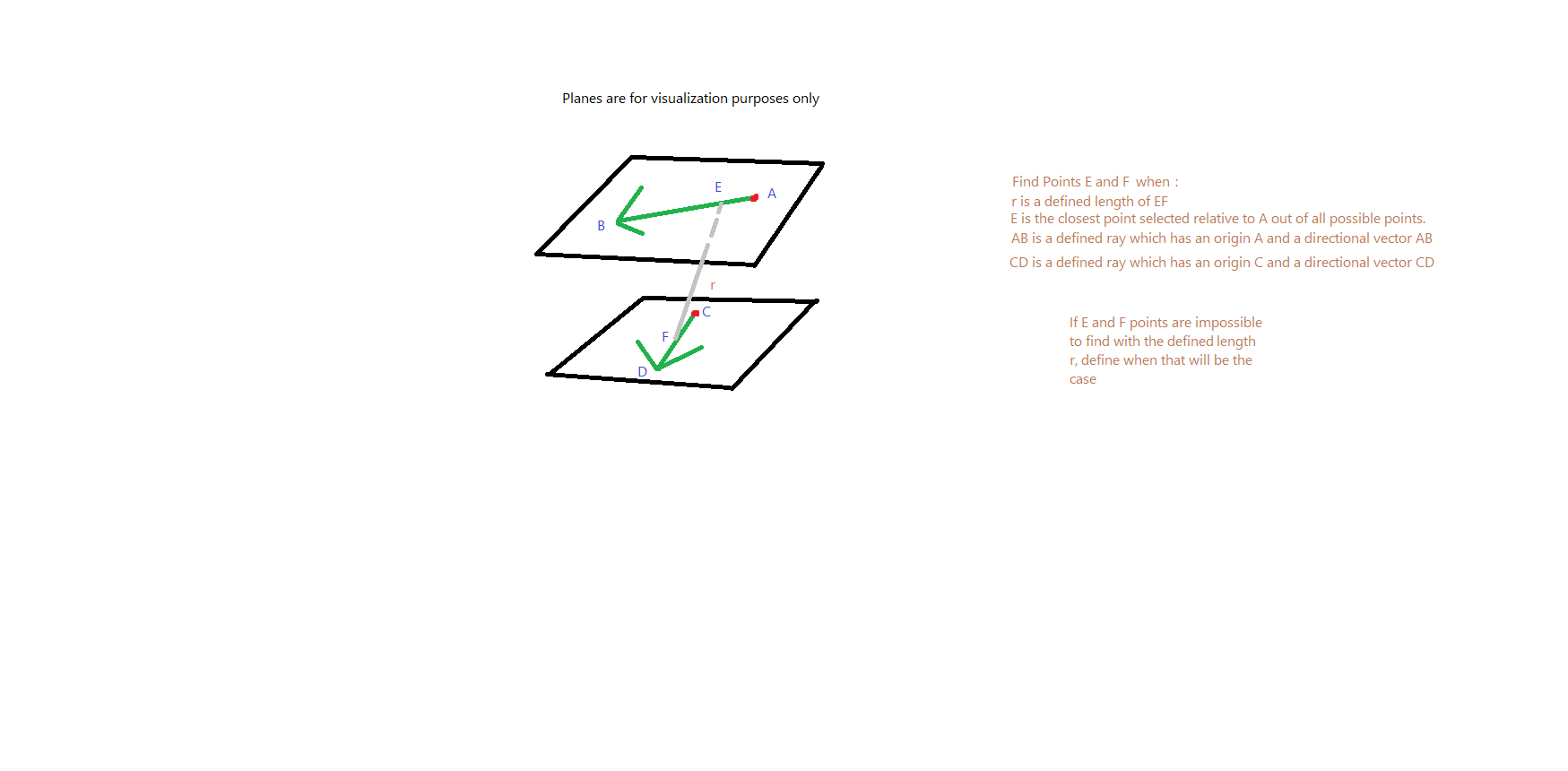 pallid swallow
ah but the planes are important
use planes that are parallel to both vectors
@unborn rover
if r is really big, it's possible, right?
then it has something to do with distance between planes
 steady fiber
column dependence does not change from row operations
if column A is 2*column B - 3*column C in the original matrix
that will still be true after doing row operations
topaz plover
@steady fiber what do u mean
 winter siren
Can you see if two vectors is linearly dependant or linearly independant based on the diagonal having leading entries when reducing
to row echelon form?
2 Vectors:
(6, -3),
(-4, 2)
in R^2
According to this website it seems like that, but I want to be sure:
http://www.math.odu.edu/~bogacki/cgi-bin/lat.cgi?cmd=li;vdat=2;vdat=R2;m1_1=6;m2_1=-3;m1_2=-4;m2_2=2;curn=2;curn=2;submit21=Submit&hideops=0
half ice
Oh that's very smart
3 3 1
b 2 and f
0 d 1
Must be linearly independent @topaz plover
@winter siren
You can always take any set of vectors, and cut some out to create a linearly independent set. Put them into a matrix and row reduce, any column without a pivot represents any vectors you should cut out.
north sierra
so this is not closed under scalar multiplication cause of the second row
but what about the first row and third row?
topaz plover
@half ice ya ik but like
idk what to do
I have a a matrix with variables
and
a reduced matrix
half ice
Basically,
3 3 1
b 2 f
0 d 1
Has a non zero determinant
steady fiber
you also know that [3 b 0]^T and [a -8 0]^T
are linearly dependent
so they have to be multiples of each other
and so a = -24/b
that was the easiest dependence to see
but there's a ton of easy dependences in the vectors you can see
just use them to find the relationships between the variables
winter siren
"You can always take any set of vectors, and cut some out to create a linearly independent set. Put them into a matrix and row reduce, any column without a pivot represents any vectors you should cut out."
I'm sorry @half ice, but I don't quite get it.
pivot = A non-zero entry in the diagonal?
"... any column without a pivot represents any vectors you should cut out."?
half ice
@winter siren
I suppose the thing I'm getting at is to row reduce
You won't get the identity matrix
6 -4
-3 2
Does not reduce to identity, so the set is linearly dependent. Another easy way to see that is
-2/3 (6,-3) = (-4,2)
You can make one vector using the other, so the set is linearly dependent
winter siren
Ohh, okay.
Thanks @half ice
topaz plover
do I like
half ice
You know that if you multiply that vector by A, then you get b
No matter what s and t are
half ice
@topaz plover
A is a linear transformation. So:
T[(1,0,-3) + s(5,1,0) + t(-2,0,1)]
= T(1,0,3) + sT(5,1,0) + tT(-2,0,1)
= b + sT(5,1,0) + tT(-2,0,1)
But that should be b. So, the other two parts must be 0
The same thing without the (1,0,-3) bit is the nullspace
 vernal salmon
If v is a vector of arbitrary dimension (finite) with complex number coordinates,
does < v, v > = 1, imply <v complex conjugate, v> = 1(dot product)
so far, I've got
<v,v> = complex conjugate of <v,v>   as c. conjugate of 1 is 1
so complex conjugate of <v,v>  = 1
i.e. conj( v1^2 + ... + vn^2 ) = 1   [if v is n-dimensional]
=> conj(v1)^2 + ... + conj(vn)^2 = 1
I'm trying to get
conj(v1)*v1 + ... + conj(vn)*vn = 1 which would give the result <v complex conjugate, v> = 1
dusky epoch
<v,v> = 1 means v is a unit vector
but also, for $v \in \bC^n$ you do not have $|v| = \sqrt{\sum_k v_k^2}$ in general
stoic pythonBOT
Ann:
dusky epoch
actually, $\frac{1}{\sqrt{2}} (1, i)$ seems \textit{orthogonal} to its own conjugate, if anything.
stoic pythonBOT
Ann:
vernal salmon
hmm but if I let v = 1/sqrt(2) [1, i], isn't <v,v> = 0 and not 1
I'm trying to start with <v,v> = 1 and arrive at <conj(v), v> = 1
though, I'm not sure if it's true / can't find a counter example
stoic pythonBOT
Ann:
dusky epoch
think about it, it makes no sense for <v,v> to be 0 without v itself being 0
vernal salmon
oh crap... yeah, it wouldn't be an inner product otherwise
I had the wrong definition in mind x_x thanks
(i.e. I thought you do the same as if it were for real coordinates, just multiply and sum corresponding entries)
dusky epoch
yeah no you gotta conj
vernal salmon
mhmm, I see that now, thanks !
 gleaming topaz
Sorry I'll wait
dusky epoch
$U^* = \begin{pmatrix} u_1^* \ \vdots \ u_n^* \end{pmatrix}$
stoic pythonBOT
Ann:
 hardy blaze
if you're asked to find eigenvalues for a matrix to the 5th power
could you just get the diagonal numbers and put them all to the 5th power?

sorry if tahts a dumb q..
clever cedar
is column space the same thing as the image?
 paper egret
i know this is obvious as hell
but specifically
how do you take determinants of matrices in a matrix
nani
paper egret
yes
i know that
like i know how to take determinants of a matrix, but how do you take the determiannt of matrices in a matrix
formally
sonic osprey
So if $A = \begin{pmatrix} 1 & 2 \ 3 & 4 \end{pmatrix}$
stoic pythonBOT
Zopherus:
paper egret
det(A) = -2
but how do you take the determinant of a matrix, in which its entries are NOT numbers, but matrices
sonic osprey
then $\begin{pmatrix} A & 0 \ 0 & I \end{pmatrix} = \begin{pmatrix} 1 & 2 & 0 & 0 \ 3 & 4 & 0 & 0 \ 0 & 0 & 1 & 0 \ 0 & 0 & 0 & 1 \end{pmatrix}$
stoic pythonBOT
Zopherus:
paper egret
yes i know
but is there any easy way to do it?
as in, you don't know how large A and I is
sonic osprey
So
celest bridge
like for some arbitrary A and I?
paper egret
yes
celest bridge
what is the context of this question?
paper egret
without writing all the entries of A and I itself
lmao just that
any easy way to do it?
sonic osprey
Think about what you know about determinants
Or ways to calculate determinants
And try to use those
The elements of this matrix are not matrices, it's just a shorthand for writing matrices of numbers
paper egret
oohh..
when you say it like that
hold on gimme a sec
thanks, i got an idea
i thought there was like a shortcut/easy way to do it
any hints on this one?
<@&286206848099549185>
Ive broken down the matrix, but can't seem an easy way to do this at all. I was able to do the previous 2 by breaking down the matrix and seeing that row reducing made it simpler
celest bridge
I know that the determinate of an upper triangular matrix is just the multiples of the diagonal
maybe that can help?
paper egret
i thought about it
 buoyant pike
How much linear algebra is reasonable to learn within a month?
Trying to study for putnam
 feral grove
depends on how deep an understanding you want
for putnam for the most part information about invertibility and determinants are most important, but learning them without prior structure might not be ideal
celest bridge
what is putnam?
paper egret
hardcore math competition
feral grove
also goon
paper egret
waddup
feral grove
it is useful to try to decompose your matrix into the product of two matrices
then note that det(AB)=det(A)det(B)
paper egret
decompose matrix into product of two matrices?
feral grove
correct
paper egret
mmmm any examples
feral grove
besides this one
paper egret
yep
feral grove
like
i'm slow at latex so i'm hesitant to really construct an example but
like see the previous problem you did
feral grove
you proved the determinant of that matrix with and A and an I on the diagonal is det(A)
sonic osprey
how did you do part (a)
feral grove
yeah there's a reason a and b come before c
feral grove
you can write your determinants in C as the product of determinants in a and b
of matrices rather
than determinants
paper egret
and what I did was, determinant of that is equal to the same thing, but instead of an I matrix that is nn in size, i let it be equal to (n-1)(n-1) in size
in short, shrinking it
til it just becomes
det(a)
the second part
I did row reduction
until the diagonal entry B and C disappeared
part C is where i'm stuck at, can't row reduce, can't triangulate for any finite sized matrix
because I'm supposed to show this holds true for any finite sized matrix
I can't just use a 2x2 example
and prove it
feral grove
but
sonic osprey
why can't you row reduce?
paper egret
I can row reduce, but it has to be any finite sized matrix, i have to make my argument convincing, think of this as a proof
sonic osprey
uh okay? You row reduced for part (b)
sonic osprey
Why wouldn't the same thing work in part (c) then
paper egret
too many variables to work with, and I have to show its true for any finite size
sonic osprey
part (b) also had a lot of variables
sonic osprey
I also don't see why more variables would be a problem
paper egret
by allowing me to row reduce nicely
for part b, the one with the C matrix
I just argued that the identity matrix, the leading entry in that row will just cancel out with each entry in C
since it was identity, and the one next to Identity is 0
it has no effect on the matrix D
thus allowing me to make C "vanish"
for part c
any row reduction has some sort of impact on other matrices
in short the identity let me row/column reduce very VERY nicely
think of it as a proof
sonic osprey
It'll work
feral grove
but so much work
paper egret
that was what I was avoiding lol ^
sonic osprey
It'll turn out that the values of C won't matter in the end
The proof is actually the exact same
paper egret
I tried row reducing to make all the entries in A disappear, but that modifies matrix A
feral grove
but like use what you've already proven
feral grove
c directly follows from reducing to a and b
don't row reduce more than you have to lmao
paper egret
ok ima just give up and say this lmao
feral grove
goon pls
paper egret
[A 0 C D] = A*[I 0 C D]
done
i can factor a matrix out of a row
determinant of that
done
dunno how valid that sounds
but w/e
feral grove
[I 0 C D] *[A 0 0 I] = [A 0 C D] peppega
feral grove
🙂
feral grove
shouldn't
paper egret
uh do the mat
feral grove
i did
paper egret
i did too
feral grove
how'd you get AC?
feral grove
you shouldn't multiply by a row with A in it for that term
feral grove
no wait mb flip them
feral grove
that's probably actually not too bad
paper egret
free
 native lodge
it tells you that 0 is equal to 0

north sierra
Aight thx
paper egret
if in the final row
native lodge
help me with reimann sum longhand calculation, memes
north sierra
Yup
gray dust
thought it's spelled reeman
native lodge
if you get 0 = anything other than 0 then you have no solutions
paper egret
fuckin amphy


 paper egret
the second part idfk lmao
north sierra
what
paper egret
i wanna say 3, but that sounds too obvious
native lodge
it's saying is w in the column space of the v's
does matrix formed from the v's and then set equal to w have a unique solution?
north sierra
nah
native lodge
so then w is not in the span of the v's
native lodge
that is saying how many unique basis vectors do you have?
native lodge
since we have a free variable we know that there is some non zero combo of c_1(v_1)+c_2(v_2)+c_3(v_3)=0
north sierra
cause one vecter is a multiple of another
native lodge
yes
north sierra
true
native lodge
so there are only actually two vectors for this span
the third is just some combo of the other two
native lodge
so can you see geometrically what is happening?
native lodge
how about a quick vc to let you see it a different way then
native lodge

north sierra
@native lodge why should a matrix formed by the v's have to have a unique solution for w to be in {v1,v2,v3}?
native lodge
because then that means there is one and only one combo of the columns of v to give w. When that happens that means w is in the column space of the v's
so now suppose that w is the zero vector
north sierra
ok
native lodge
we now have two ways to arrive at the zero vector, that wasn't just setting all constants to zero
we are back to being linearly dependent
north sierra
wait i think i mixing things up
so when it says is w in {v1, v2, v3} does that mean span?
native lodge
yes
that is asking: is w in the span of the v's
another way: is w in the column space of the v's?
 silent dune
How am I supposed to do b
native lodge
how much work do we need to provide?
we can answer this question by inspection actually
oh wait, we need to do the math to show it
but first let's just answer: independent or no? Can you tell right away?
silent dune
not sure kinda forgot how
native lodge
our vector space we are in is given by the number of components in the vectors
so we have three components, so we are in R^3
the most vectors we ever need for a basis of R^3 is how many?
massive red flag detected

silent dune
Uh
native lodge
but still how many vectors are needed to form a basis for R^3?
clever cedar
whats the dimension of R^3 is what he's asking
silent dune
3x1 ?
gray dust
visualize R^3 as 3d space