#linear-algebra
2 messages · Page 34 of 1
 wintry steppe
wintry steppe
wintry steppe
okay
 pallid swallow
A=[xi^3 xi.^2 xi ones(size(xi, 1),size(xi, 2))]
 leaden ermine
Well, I know that if a set of vectors Vn are linearly dependent, then there is no way they can span N dimensions. So if they are linearly dependent, they cant span all of R^2, if they are linearly independent, they span R^2 because there are two vectors. But obviously that thinking isnt sufficient to get the question right
pallid swallow
somthing like this @wintry steppe
@leaden ermine hmm it's almost there
we just need to phrase it properly
2 cases: Linearly dependent or linearly independent.
leaden ermine
Do I have to keep regurgitating propositions and definitions?
pallid swallow
Case 1: Linearly dependent, so we are done.
leaden ermine
Yes
wintry steppe
thats all i change?
pallid swallow
I'm not sure exactly
but the idea is there
because you have your matrix A that says your linear system you want to solve
It's a vandemonde matrix
@wintry steppe
wintry steppe
uh alright
leaden ermine
But the answer key is a whole page, talking about canonical basis, two vectors 0,1 and 1,0. happy to show you it
pallid swallow
it can be longer or shorter
proofs don't need to be of a certain length
as long as you proven the statement you are done
leaden ermine
But what suffices as proving it? Like the above we did, we just said 2 lines. We didnt say the definition of span, or the definition of linear independence etc etc
pallid swallow
It really depends, proofs really depend on the module
you are taking
A proof is used to communicate
leaden ermine
so this is an intro-ish class. on the homeworks ill do the proofs and ill lose points on stuff and really not know why
pallid swallow
Usually in an exam, all the textbook definitions, lemmas, theorems can be used in the proofs
leaden ermine
so lets try one more example
pallid swallow
Sure
leaden ermine
So for that one, we know that k is less than n (Or assumed?) so even if they are all linearly independent they cant span the whole space. if X is not in the span of vectors v1....vk and its an element of R^n then we know its an additional dimension and no combination of v1 to vk can create x
leaden ermine
true
pallid swallow
but we can prove k <= n from the first line
we just use the definition of linearly independent
leaden ermine
well if x is an element of R^N and linearly independent from v1 to vk it has to be such that kis less than n
pallid swallow
Proof by contradiction is easily done here.
Suppose linearly dependent then you can solve a1v1+a2v2+...+akvk+bx=0, of course b is nonzero, but that means x is in the span of v1 to vk, so we are done.
leaden ermine
So what made you go to proof by contradiction?
But the paragraph I wrote above wouldnt be sufficient, right?
pallid swallow
because the condition "no solution for this equation" cannot be used easily
so, that's why I went proof by contradiction
@leaden ermine
"then we know its an additional dimension and no combination of v1 to vk can create x", this has the idea, but doesn't have the rigour
leaden ermine
I see, so what am I missing to utilize mine. And what kind of proof was mine? Construction?
I think I just need to develop an eye on seeing hte problem and identifying what kind of proof best suits the problem
So for there you want to contradiction
For the first one, we used construction?
wintry steppe
dang still cant figure it out
pallid swallow
first one was by cases
@leaden ermine
because there's the linearly independent and dependent case
wintry steppe
MatLab: anyone knows how i can convert this quadratic into a cubic?
xi=[1:3]'
yi=[3 5 -1]'
A=[xi.^2 xi ones(3,1)]
b=yi
x=A\b
f = @(t) x(1)*t.^2+x(2)*t+x(3);
t = 0.5:.01:3.5;
y = f(t);
leaden ermine
Hm ok lets try another one if you dont mind? ill see if i can identify the best kind of proof
leaden ermine
Ok so, for here we can possibly go with contradiction. Showing that if there is a null set as their intersection, and both U and V are linearly independent sets that span different subspaces whose dimensional sums are greater than n, its simply not possible? Idk exactly
Or
Contrapositive maybe? If dim(U) + dim(V) > n then there must be exist anon-zero vector in their intersection. Then we can try and say if there is not a non-zero vector in their intersection, then dim(U) and dim(V) cannot exceed n? But maybe thats no easier i dont know
I guess the best proof technique is the one that will require the least amount of explanation, so it is simple and to the point
pallid swallow
your contradiction seems okay
If intersection is {0}, then , U, V are linearly independent
contrapositive is equivalent to proof by contradiction
leaden ermine
Ah, ok didnt know that! Well I know the idea behind why the question is true, but what would it now require to display that in a proof? the answer key shows a whole page proof again
and they do go via contradiction
Here was what i submitted
and it was marked incorrect
well, yeah basically just saying its not possible if U and V are independent. Only way if it was possible is if they are somehow also out side of the subspace
pallid swallow
maybe we need to rigourise it a bit more too
leaden ermine
But the answer key goes through contradiction too. they define a basis for U and V, and assume there exists a vector set of all of the vectors in U and V that are an element of R^n and not all equal to zero such that ther is a combination of them that sum to zero
maybe ill just show the proof instead of typing it
thats the answer
 charred stirrup
im trying out different ways of reducing to the RREF of the matrix, does anyone have a method in mind that they find particularly fast?
the one im using right now is this
pallid swallow
@leaden ermine The first 2/3 of the page is rigourously showing linear independence
@charred stirrup hmm, I think they tend to take O(n^3) usually
charred stirrup
@pallid swallow O(n^3) ?
pallid swallow
yeah, in terms of speed, it takes about O(n^3) additions/multiplications/subtractions
charred stirrup
oo that is very clever
pallid swallow
well
there are many possible A
like the 72 degree rotation matrix
or the one that swaps 5 basis vectors in a cycle
 halcyon garnet
Maybe something with the minimal polynomial $g_A$. Because $A^5=I$, we have $g_A\mid t^5-1$. This would solve the problem if we knew A was 3x3 or smaller
 stoic pythonBOT
leoli1:
pallid swallow
ah, that means the eigenvalues have to be a 5th root of 1
wintry steppe
why is this true
what am I missing here
you're taking the diagonal values of the matrix AB
but how do you get that double sum
 brittle juniper
the inner sum is just the ii coeff of AB
wintry steppe
im not understanding
brittle juniper
for all $i$ and $j$, $(AB){ij}$ is $\sum{k=1}^nA_{ik}B_{kj}$
stoic pythonBOT
Tuong:
wintry steppe
ohhh
okay I see
but why is this equal to the sum of all the diagonal values of AB?
brittle juniper
because in particular, $\sum_{k=1}^nA_{ik}B_{ki}=(AB)_{ii}$
stoic pythonBOT
Tuong:
wintry steppe
i think i have a conceptual understanding msising
why is
$$\left(AB\right){ij}=\sum {k=1}^nA{ik}B{kj}$$
this true
stoic pythonBOT
apples:
 hardy blaze

why does it have to be A^k-1
i understand the AB=BA=I so A has to be multiplied by another matrix (A^k-1) to = I which proves A is invertible
but y does it have to be A^k-1 
 worn crow
because inverses are unique
Assume AB=AC=I
Then BAB=BAC, so IB=IC, so B=C
or easier
BAC=(BA)C=C=B(AC)=B, so B=C
hardy blaze
ok
ty
tht helps a lot :0
so for this 1 would u set A = A^k?
is how u get A^k-1 for it
i feel like im overthikning this
i feel like the -1 is throwing me off so hard 
 hearty meteor
i think she means leading variables basically
 wispy kayak
pivots
hardy blaze
for my question ... since A^k is the same thing as AA^k-1
is that why thats the answer
LMAOOOOOOOOOOOOOOOoooooooooooo
i cant believe im so dumb omg
wintry steppe
im having trouble with the second part of the question
would any A and B with non square dimensions do?
since only square matrices have inverses?
 sonic osprey
not any A and B
wintry steppe
what in particular?
so I know they have to have a different number of rows and columns
sonic osprey
Would multiplying any A and B that you can multiply always give you a square matrix?
 steady fiber
AB must have rank less than or equal to the minimum of rank A and rank B
since AB has rank n, A and B have rank n as well
so they're invertible
that's it
wintry steppe
what does it mean to take the rank of a matrix?
I know what it means to take the rank of a linear map
but a matrix?
sonic osprey
linear maps can be represented by matrices if you choose a base
It turns out the rank is invariant under this choice of basis
steady fiber
rank A = dim(col A) = dim(row A)
wintry steppe
interesting
steady fiber
dim = dimension
row = row space
col = column space
if the rank of an nxn matrix is n, that implies every row/column is linearly independent
and so it must be invertible
and ya, as zoph said, a linear map can be represented by a matrix
so you can think about it that way as well
 quartz compass
an obvious example is take a matrix that maps the xy plane to 3D space, then multiply that with a map that goes from 3D space back to the xy plane
in general any map that goes from a subspace to a larger space and back down again
at least, these are sane for me to want to think about
steady fiber
or just any linear map from any vector space to any other vector space
but it is good to think about some common ones, like projection from a higher space to a lower space
or rotation within a space
or stretching
 stuck nexus
Could someone ELI5 matrix multiplication?
sonic osprey
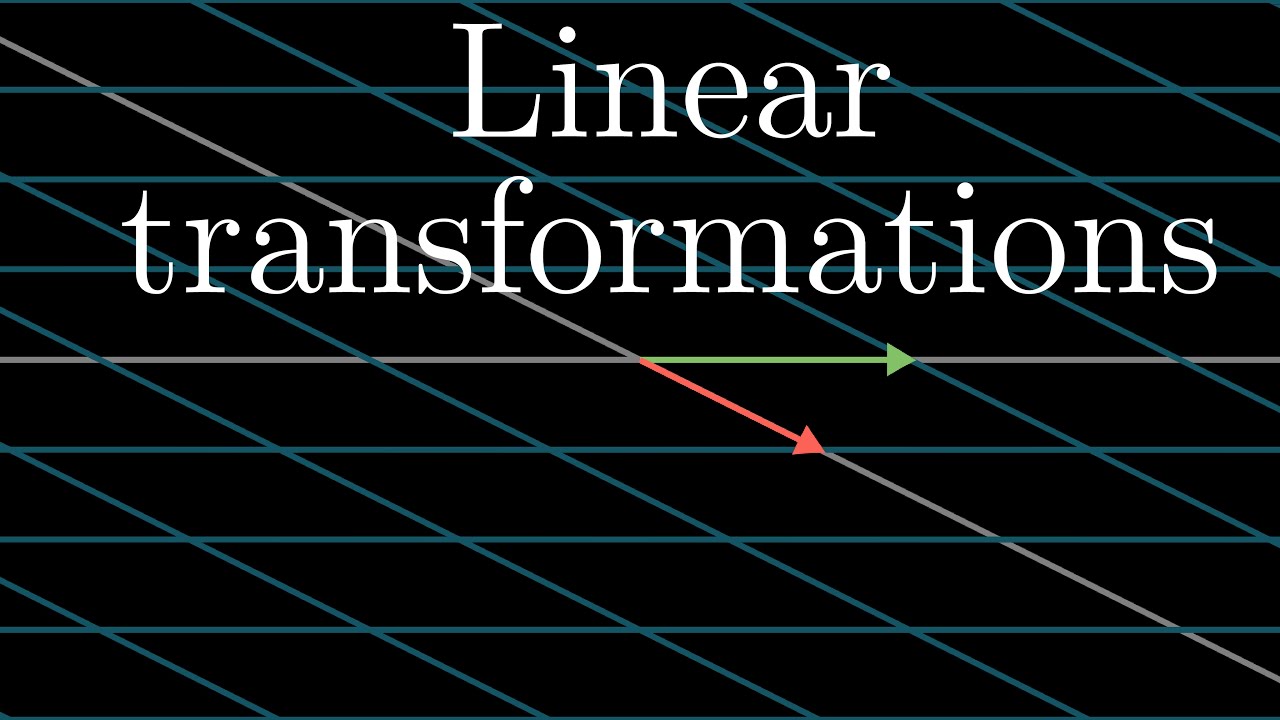
Home page: https://www.3blue1brown.com/ Matrices can be thought of as transforming space, and understanding how this work is crucial for understanding many o...
quartz compass
composition of linear maps is magic
 limpid vine
3blue1brown 😍
stoic pythonBOT
vypr:
sonic osprey
Really just watch the video
stuck nexus
absolute wizardry
steady fiber
finding the eigenvalues of this is almost trivial
in fact you can just look at the matrix and know the eigenvalues
leaden ermine
Agreed, so what other ways could I go about seeing if something is diagonalizable
Oh
Hmmm
Well I suppose the pi squared does not change anything.
well if we square this matrix, not much changes except for the pi^2 value right
wait
nothing changes
you just get the same exact thing due to the bottom left 0 and the 1's
steady fiber
why would you square the matrix
quartz compass
for 2x2 matrices you can usually guess the eigenvalues by noticing the trace is both of them added together and the determinant is both of them multiplied
leaden ermine
well we can estimate a matrix to it's n'th power using eigenvalues, so if this matrix never changes when you multiply it by itself wouldnt this tell us that the eigenvalue is zero?
quartz compass
well in this case there's a simple closed form
you don't have to really diagonalize if that's all you want to do
you could do a few multiplications, guess the form, prove it by induction
leaden ermine
Thats true, but is there a better way to go about it here? Rather than showing since A^2 = A and A^n power = A that the eigenvalues are zero? (If they are zero, I dont know)
Im new to eigenvalues and vectors
quartz compass
I don't have any preference, they're all pretty easy
you started by wanting to avoid what I think is the best method, so I gave a little trick for getting eigenvalues
 digital garnet

 uneven bloom
Prove that there is no zero element
(Usually you’re looking to see how the axioms are broken)
 brazen heart
ye i know the axioms i just dont know how i check them with the information im given from the question
i dont really get the addition bit honestly
 dusky epoch
what do you not get about them?
are you taking an intro linear algebra class and getting problems that look like "here is a set, here are two operations we're calling addition and scaling, now see if this makes a vector space or not"?
brazen heart
i am taking an intro linear algebra class
first i had to define the axioms i guess
then they gave me some example 'vector spaces' and i had to prove that they werent actual vector spaces using the axioms
its just i cant seem to connect the way the axioms are presented and the way the vector spaces are presented
 lone quail
is 0 included in the set of positive integers?
i see a lot of confusion on google and cant seem to find a reliable answer
sonic osprey
What does positive mean?
dusky epoch
there are two conventions
one includes 0 as a natural number while the other does not
lone quail
@sonic osprey some people consider positive integers as the set of non negative integers which includes 0, others dont apparently
@wheat shoal @dusky epoch i mean the set of positive integers (Z+), not natural numbers
dusky epoch
"positive integer" is unambiguous
lone quail
kk ty
dusky epoch
then why the "two"
 undone garnet
:p typo
dusky epoch
and why the insistence on not using laplace
dusky epoch
no like
does the problem specifically say "you are not allowed to use laplace expansion"
pallid swallow
hmm
pallid swallow
Honestly, I'll try adding all the rows (to the first row) for the left hand side
 lethal quartz
Does anyone know how to do this one:
Consider the n x n matrix A given by $a_{pq}=p+q$. Calculate det(A)
stoic pythonBOT
yesyesufkurs:
dusky epoch
for n>2 you can do row operations on your matrix to get a zero row so the det is 0
for n=1, 2 you can compute it explicitly
lethal quartz
Oh alright, I just computed the determinant of n=1,2,3, and I didn't really see a pattern, so I was a bit confused
Thanks for the help!
 strange vault
How the hell do I visualize
S={(x, y, z): x + y = 2z}
Or any three dimensional object other than a circle ig
 native lodge
Plane of some sort
strange vault
It's just so vague to me
native lodge
If you rearrange to x+y-2z=0, you can substitute 0 as one of the variable values then graph the resulting line in the appropriate plane
Like taking z=0, I’m left to graph x+y=0 in the xy plane
Then let x = 0, graph in yz plane
Finally let y=0 and you graph in the xz plane
You get a graph that shows the plane in the first octant
Or something like that
Point is, you’ll see part of the plane, but not the full thing using his method
 frank gate
Someone please help! I need to find the ortogonal projection of t on H given these: https://gyazo.com/3a5ffe2f22761277d61e402a10b880ff https://gyazo.com/c35de496af189daad5776d8279b645a6


I get it to (t+t^2)/2 but it is wrong :/
Calculate Proj(_H)*t
This is my plot for that solution. The blue line is mine and the red is the correct projection, please help https://gyazo.com/fdd2522a6739507bf30a391c71035010
 frank gate
Nvm got it
 cobalt tartan
Hrm
For this question over here I think that what it's asking for is that they want me to find an inner product on R^2 such that if we have
<(a, 0), (b, b)> = 0
Right?
cobalt tartan
I'm not really sure how to find an inner product that does that
Do you have any hints that you can give me lol
I've been trying to go and do it as a matrix
but not reall ygetting anywhere?
 thorn robin
you have 3 pieces of information
the matrix is symmetric, which as you wrote gives d2 = d3
(1, 1) is orthogonal to (1, 0). this should give you the equation d1 = -d2
cobalt tartan
Wait
thorn robin
the third piece of information is that the matrix is positive definite
cobalt tartan
Why does that give me the equation d1 = -d2?
thorn robin
just write down the inner product of (1 1) and (1 0)
thorn robin
yes and on the other side of the equation you have d1 + d2
or d1 + d3 I didn't pay close enough attention, but either way lol
cobalt tartan
hrmmm
thorn robin
let me write it explicitly
0 = (1 1)(d1 d3; d2 d4)(1 0) = (1 1)(d1 d2) = d1 + d2
lazy notation but you understand what is a row and what is a column vector
cobalt tartan
Wait why is it just d1 d2
thorn robin
just multiply the matrix and the column vector
thorn robin
no I made sure to put the d's in the exact location as on your paper xD
but d2 = d3 so it doesn't matter of course
cobalt tartan
No I meant that I wrote down the (1, 1) and the (1, 0) in the opposite order lol
thorn robin
oh ok
cobalt tartan
wait but this doesn't tell us anything about d4 doesi t
thorn robin
nope
cobalt tartan
Oh so d4 doesnt' matter?
cobalt tartan
Yea
thorn robin
but you still need it to be positive definite
cobalt tartan
How do you make it positive definite?
thorn robin
for example trace > 0 and det > 0
cobalt tartan
Oh
Then if I just let c and d be positive integers
Say 1 and 2
Wait does that work let me check
Trace would work
Determinant would uh yea I think that that's >0
We'd have (2) - (1) = 1?
thorn robin
as long as c, d > 0 and d > c then yes it works
thorn robin
so yeah your original c = 1, d = 2 is the cleanest looking choice
cobalt tartan
Ah yea we have'nt covered symmetry either
Ok
Yea like
I was very stuck on this question
Lol
thorn robin
well an inner product is supposed to be symmetric and positive definite sooo 🤷
cobalt tartan
The part about how <x, y> = (x^T)(Ay)
Well yes but I dont' know how that applies to matrices lol
Thank you for the help!
thorn robin
sure 😋
thorn robin
gram-schmidt
cobalt tartan
Just gram-schmidt on your standard basis?
thorn robin
on any basis yes
sonic osprey
Standard basis doesn't really have a super well-defined meaning
But yeah that's probably what I'd call the standard basis
cobalt tartan
o ok
 desert cloud
anyone know what "find the matrix of S ∘ T by direct substitution" means
cobalt tartan
Hrm
@sonic osprey given this inner product, would 1 become... 2... when it's normalized...?
Like
cobalt tartan
Oh wait sorry
I sent the wrong image the first time
It's supposed to be
I just need a sanity check because it seems very silly to me that 1 "normalized" becomes 2??
sonic osprey
It's true
It's not that weird
You could define a norm on R^n that's just half of the usual norm
Then (1,0) normalized would become (2,0)
cobalt tartan
I
Ok
No it is just uh
I've never seen something like this before
And I just needed a sanity check
Because it's ????
cobalt tartan
Ya
Its just weird for the first time lol
Now that I have seen it I guess it will make more sense in the future
 raven nebula
If two matrices commute, what can be implied?
To be more specific, if two transformations commute
 gray dust
you can still call it a linear combo of v, but in this case it sounds better to just call it a scalar multiple of v
dusky epoch
this is the same as proving CB = BC, which doesn't seem like it's necessarily true
dusky epoch
is nothing else given?
undone garnet
Nothing
dusky epoch
where did you even get this problem from
dusky epoch
😒
 hoary agate
xD
dusky epoch
take any two matrices A and B that don't commute such that A is nonsingular, then CB will not be equal to BC
undone garnet
Thank you
undone garnet
hm...
 feral mountain
you gotta come up with a M_2019 counterexample tho right?
undone garnet
no
I have proof 😄
so we need to prove that
CB = BC
we have
A = CB => AB = CB^2
C=I+AB <=> C-AB=I <=> C-CB^2=I <=> C(I-B^2)=I
<=> (I-B)C(I+B)=I <=> (C-BC)(I+B)=I
C(I-B^2)=I <=> C(I-B)(I+B)=I <=> (C-CB)(I+B)=I
=> (I+B)^(-1) = C-BC = C-CB
BC = CB
feral mountain
doesn't C(I-B^2)=I <=> (I-B)C(I+B)=I need I-B to be invertible?
doesn't (I+B)^(-1) need I+B to be invertible?
feral mountain
ah I see thx
 cloud meadow
How do I calculate scalar triple product with Wolfram Alpha? I have a solution that I'd like to checl there.
worn crow
by calculating the determinant
pop the entries in a matrix
out pops the scalar product
just make sure to order your columns correctly
the way you order in the product
because otherwise you can get a sign error
 novel wasp
Does the zero matrix commute with any matrix?
worn crow
think about it
novel wasp
I'm trying to prove whether this subset is a subspace "The set of all n × n matrices A that commute with a
given matrix B; that is, AB = BA"
And I'm first trying to see if it's non empty
And my thought process is that if we have the the 0 n x n matrix, wouldn't it commute with any matrix B?
Thus proving that it's non-empty?
worn crow
yes
novel wasp
One solution I've seen used the identity matrix I
And I thought why use the identity matrix I, when you can use the zero matrix
worn crow
there are almost always many ways to prove something
cloud meadow
Oh so scalar triple product = determinant, thanks :)
worn crow
I and 0 are both extremely simple matrices
novel wasp
Gotcha
Can you also use the identity matrices for other subspace proofs to determine whether it's empty or non-empty as well then?
Or it depends?
worn crow
depends
you can always use the zero matrix though
if it's actually a subspace
because not all subspaces of matrices have I in them
leaden ermine
Hi, for this matrix, I am trying to show it's diagonalizable. Ive found the eigen values to be plus and minus 1 and realize its a reflection matrix. Furthermore I found the eigenvectors to be v1=t[1,0] (So I just used [1,0]) and v2=[0,0]. This one should be diagonal because v1 and v2 are a basis of R^n, but it doesnt seem they are, since it doesnt span R^2
dusky epoch
good luck trying to prove a false statement
also -1 isn't an eigenvalue for this
also [0,0] isn't an eigenvector of any matrix
it's the zero vector
any linear transformation will send zero to zero
leaden ermine
Oh yeah, youre right I failed in factoring out in the initial eigenvalues
Mathematical error
It should be just 1 as the eigenvalue
dusky epoch
yes
leaden ermine
Which corresponds to an eigenvector of t[1,0]
dusky epoch
there is indeed only one LI eigenvector
leaden ermine
And we would need 2 eigenvectors to make this diagonalizable, which we dont
dusky epoch
the dimension of the eigenspace is 1, while the multiplicity of 1 as a root of det(M-λI) is 2
yes
leaden ermine
woudl we need 2 different eigenvalues also?
leaden ermine
So at most, a 2x2 matrix can give us 2 eigenvalues (If they are distinct then the matrix is diagonalizable), which would give us 2 linearly independent eigenvectors.
dusky epoch
an n×n matrix with n DISTINCT eigenvalues is always diagonalizable yes
leaden ermine
Awesome, thanks 🙂
Would this still qualify as a reflection matrix?
I dont think multiplying by -1 would change the properties of a reflection matrix
the eigen values 1 and -1 would just become -1 and 1, which means its still doing the same thing
leaden ermine
meaning M=M^T, so if we do MM we get (Idn - 2Ps) (Idn - 2Ps), which expands to Idn^2 -4Ps(Idn) + 4Ps^2. Idn^2 = Idn, 4Ps^2 = 4Ps. 4Ps(Idn)=4Ps. So this simplifies to Idn - 4Ps + 4Ps = Idn. Would this be correct?
leaden ermine
I see, so my method of showing doesnt work?
I thought M(M^T) = I shows orthogonality, which to your point is the same as M^{-1}=M^T.
But youre right i did use M=M^T, which I think is a property of a reflection matrix
hardy blaze
the IMT
made everything we learned in the 1st weeks understandable for me now 🥴
idk y but love that theorem!
leaden ermine
@quartz compass Could you please provide a recommendation on how youd approach this problem? I think im almost there, but If i know Ps is orthogonal, and I calculate out M^T(M) = (2P-Idn)^2 then I should get that to sum to 1. but right now im stuck on Idn - 2Ps^T - 2Ps + 4Ps^TPs. Just trying to figure out what property allows that to sum to just Idn
Is it because we know Ps^T=P, but it doesnt state that its necessarily symmetric
leaden ermine
Nvm figured it out, orthogonal projection matrices have the properties of P^2 = P = P^T
 remote fable
While reading the proof of this theorem I come across this curious looking identity
I understand the proof but can't figure out why the author can think of that identity
it seems gratuitous to me
 sleek helm
A better write up of that proof would provide the computations
Iirc they make sense kinda if you see them in full
pallid swallow
looks like difference of two squares
let's guess a term to add and subtract
<T(u+w), u+w>+<T(u+w), u-w>-<T(u+w), u-w>-<T(u-w), u-w>=<T(u+w), u+w+u-w>-<T(u+w)-T(u-w), u-w>=<T(u+w), 2u>-<T(2w), u-w>
still trying to check calculations here
remote fable
I don't even bother to do the computation I don't doubt it is true. But a thought process behind that would be useful. I hate proofs like this. I feel like I have learnt nothing about why the theorem is true after reading the proof, which it is supposed to explain.
I remember an identity from real analysis that looks like this
$\frac{u+v}{2}+\frac{u-v}{2}=u \
\frac{u+v}{2}-\frac{u-v}{2}=v \
$
stoic pythonBOT
AConfusedStudent:
remote fable
maybe that's where the inspiration comes from
pallid swallow
i'm thinking of perhaps writing this as matrices and matrix product, and using SVD to get inspiration
 north sierra
so if i have a matrix that is true for all of those points (a,b,c,d) then that means it spans all of R^m for any b vector that is the same amount of entries as a vector in A?
remote fable
It means if your matrix satisfies one of the condition, then it satisfies all the conditions, and vice versa.
north sierra
yeah but for c. it says the colums of A span R^m
doesn't that mean that the matrix Ax=b would have to be consistent for any b vector?
north sierra
yeah
remote fable
Yes, that's what the theorem says: If it has a solution for any b, then columns of the A spans R^m
north sierra
how do we find out if it has a solution for any b though
that seems like a lot of possibilities to check lol
remote fable
You get it wrong
You are not asked to find the solution
your assumption is "it has a solution"
then you prove that this thing and that thing applies to this matrix
etc
remote fable
Yes, but since they are all equivalent
You only need one of those 4 conditions
and the other 3 conditions are all true
north sierra
oh true
remote fable
and vice versa, if one of them is false for your matrix, then they are all false
remote fable
👌 you got it
north sierra
what do you think is the easiest one to check?
so it doesn't really matter which one i check right
check for Truthness i mean
I feel like checking "if every row has a pivot" is the easiest
remote fable
If it has a solution for every b, then the matrix has to be invertible
So if you don't have a pivot in any row, then there is a row that all entries are zeroes
if that is the case, then the matrix has to be non invertible, which is a contradiction
on the other direction, if it has a pivot position in every row
I assume this is after gaussian elimination
north sierra
what does invertible mean
remote fable
then of course you can find a solution by backward substitution
north sierra
but yeah i see what you're saying
remote fable
It means the linear map represented by your matrix is bijective
does it make sense to you?
remote fable
If it is not bijective, then there could be situation where 2 different vectors are mapped to the same vector. That is the reason why Ax=b doesn't always have a solution when A is not invertible
north sierra
that is a bit too advanced for me 🙂
lol
i will probably understand that by the end of the week
thanks for the help btw!! i understand theorem 4 now
remote fable
you are welcome
north sierra
@remote fable hey, so if 3 vectors span R^3, I don't have to reduce it to RREF and check the pivots right? I can just stop at REF
 half ice
If 3 vectors span R³, they are linearly independent. No need to check REF
half ice
Oh yeah. Technically you're done if you can get upper triangular with non-zero elements on the diagonal
half ice
Np. Good luck!
half ice
First entry here is 2x1 + 3x2 + 4x3
Product Ax is referring to A as the matrix, x as the vector in the middle.
Sum of products, 2x1 is a product, and you're taking a sum of these
This seems to be teaching you matrix-vector multiplication? Seems trivial for your level
north sierra
oh i see
yeah haha
im dumb tho
what about the second entry?
and third, fourth..
leaden ermine
Hey, can anyone please tell me if Matrix M, M=Idn - 2Ps can be considered a reflection matrix, where Ps is a matrix of the orthogonal projection onto S? Where S is a subspace of R^n
uneven bloom
You can think of Mv like this: you start with a vector v, you subtract Psv to collapse the span of the vector space (in 2D, think of mapping the whole plane onto a line), and then subtracting Psv again gives the additive inverse of v wrt this new projection space.
I’d recommend thinking about this in 2D
north sierra
if we have a mxn matrix, and m>n, then we say that it spans R^n right?
half ice
Take for example
0 0 0
0 0 0
0 0 0
0 0 0
4×3 matrix. The columns are three vectors in R⁴. They only span the zero space
Well, a zero space, I suppose.
north sierra
lol
but
could we use this theorem if we ever have m>n
and instead of saying R^m, can we say R^n
half ice
All these are either true together, or false together
There are ready examples of m×n matrices where these are all false
north sierra
so for example
1 0 0 3
0 1 0 4
0 0 1 2
could we say it spans R^3 based on that rule?
half ice
Yes
half ice
Oh, you're asking if you can switch the roles of m and n
north sierra
yeah
half ice
The way I think of it, the number of columns with a pivot is the number of dimensions the column vectors span
The above matrix doesn't span R⁴
north sierra
yeah
so this theorem wouldn't work for when m>n?
wait what am i saying
i mean m<n
half ice
I guess it couldn't, since you couldn't have a pivot in every row
north sierra
i was confusing my >< signs lol but
1 0 0 3
0 1 0 4
0 0 1 2
what about this?
every row has a pivot
half ice
That's a 3×4 matrix
north sierra
o i get it now
half ice
If A is diagonalizable, then its eigenvectors form a basis. The Gram–Schmidt process can turn that into an orthonormal basis
leaden ermine
So if A is diagonalizable, then A=SDS where S are the eigenvectors v1...vn. Those eigenvectors form a basis (But those eigenvectors arent currently orthogonal). We can turn those into an orthonormal basis via the gram-schmidt process.
 carmine terrace
Hey guys, I'm completely messing this up
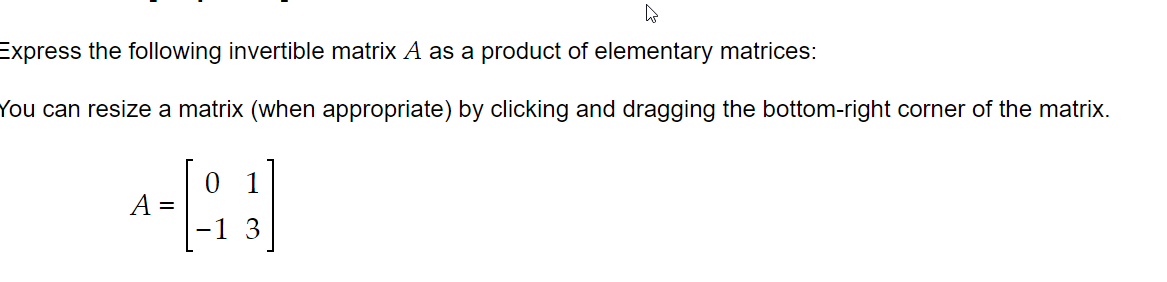
Don't I just do right side is = to 1 0
0 1
then my first E^1 is = to 0 1
1 0
 normal gust
which identity would I use to continue this proof?
 slow scroll
Hint: I wouldn't try to prove it like that. In general, if you want to show that A^-1 is the inverse of A, then you want to show that AA^-1 = A^-1 A = I
@normal gust
normal gust
mhm, I'm just completely lost on the problem, I don't see a way to manipulate it aside from that
slow scroll
yea i bet lol... im kinda trying to say that you shouldn't manipulate it. You just have to verify that it works. do you understand what i mean by that?
normal gust
As in actually set up dummy matrices and then verifying it?
slow scroll
nonono. okay, you want to show AA^-1 = A^-1 A = I
What is 'A' in this case?
normal gust
a nonsingular nxn matrix
slow scroll
as in, what does it represent for this proof lol
we are trying to prove something is the inverse of something else. What is the something in this particular proof?
wintry steppe
undone garnet
A is M_2020
a_ij = (i+j)^2019
calculate det(A)
any idea?
hm...
I'm trying to do something with (a^n-b^n)/(a-b) = a^(n-1) + a^(n-2)b + ... + b^n
undone garnet
any idea 😢
undone garnet
nah nah nah
undone garnet
but the result is 0
pallid swallow
Maybe M_3, ^2
4, 9, 16
9, 16, 25
16, 25, 36
Let's subtract the first row from the next two
4, 9, 16
5, 7, 9
12, 16, 20
then maybe the second row 2 times from the third
4, 9, 16
5, 7, 9
2, 2, 2
determinant looks nonzero
pallid swallow
I'm pretty sure it only worked because it's ^2017 for a M_2019 matrix
pallid swallow
then the pairwise differences would pull up a zero row
^2018 M=2020 it might work
 paper egret
oh when it means subspace
it means any vector space that's smaller or equal to vector space of V, i.e i meant it in the number of dimensiosn or number of elements
sonic osprey
It just means any vector space that's a subset of V
And has the same operations as V
sonic osprey
V is a subspace of V
sonic osprey
Do you know what a subset of a set is
paper egret
yes
sleek helm
A sub space of a vector space V is a subset of V that is a vector space
Subset being $\subseteq$ here
sonic osprey
And that subset has to have the same operations as V
stoic pythonBOT
MaxJ:
paper egret
oh
sleek helm
unless you only care about vector spaces up to isomorphism yes zoph is correct
paper egret
so in short, a space that has less than or the same number of elements of each vector, as V
sleek helm
Elememts of a vector doesn’t quite make sense to me
And no thats not entirely true
Take R^2 vs R (as R-vector-spaces)
They have the same “number of elements” (cardinality) but R^2 is not a subspace of R
paper egret
cuz i'm assuming that R^n is a subspace of R^m as long as n <= m
sleek helm
This is true
paper egret
that's what i meant
sonic osprey
There are many ways to see R as a subspace of R^2 though
Like you can take the x-axis or the y-axis
sleek helm
Necessarily $dim W \leq dim V$ for $W\subset V$ a subspace
stoic pythonBOT
MaxJ:
sleek helm
al least for finite dimensional but if you consider dim K to be a cardinal then this always holds
sleek helm
(It’s very easy and a good exercise to prove this)
paper egret
question, what is the zero vector, for definition of subspace
for a subspace to exist, zero vector must exist
what does that mean mathematically?
sonic osprey
That there's an identity vector
That if you add it to any other vector, you'll get back the other vector
Just like how if you add 0 + a = a
half ice
For example
[2] [0] [2]
[3] + [0] = [3]
[4] [0] [4]
That middle vector is a zero vector, because if you add it to anything, it doesn't change that thing.
paper egret
for number 16
how do i show that there is a zero vector
cuz a vector space is defined by 3 things
zero vector, addition, and scalar multiplication
i guess i show that any combination of a and b can't give u a zero vector right?
half ice
If there exists a zero vector, then -a + 1 = 0 implies a = 1
Then a - 6b = 0 implies that b = 1/6
But then the third line is not zero.
There is no zero vector in the "space"
paper egret
thus W is not a vector space
steady fiber
only if you assume regular addition and scalar multiplication
paper egret
aight
just to confirm, for 18, there is no set of vectors that spans W
because the 2nd entry is always 0
and any combination of a, b, or c, keeps the 2nd entry 0, thus no set of vectors span the space W
steady fiber
why can't W be spanned because of a 0 term there
paper egret
because not all vectors with 4 elements are possible
the vector {0, 1, 0, 0} ain't possible at all
steady fiber
with that logic none of these can be spanned
steady fiber
15, 16, 17, and 18 all have vectors in R^4 that cant be formed
with the restrictions given
steady fiber
for example, let me define vector space V = {(x, 0} | x in real}, then (1,0) spans this vector space
no?
paper egret
doesn't look like it spans .-.
steady fiber
it does
steady fiber
I can make any vector in V with a linear combination of (1,0)
paper egret
but u cant make (0,1)
paper egret
oh...
steady fiber
I defined V to be a vector space where the second entry is always 0
paper egret
oooHH
that's what it means to span a vector space...
so in this case, W can be spanne
because all W vectors are defined to be in the form of like
{something, 0, something, something}
steady fiber
possibly
sleek helm
That’s a bit oversimplified
paper egret
ah shit
steady fiber
it could also be possible it's not spanned
paper egret
ah
steady fiber
but it's not confirmed that it can't be spanned
sleek helm
You need to be careful, the write way to think about it is linear combinations
steady fiber
yes
sleek helm
Which really aren’t that hard once you get used to them
paper egret
ok
sleek helm
Right* fuck me Im tired
steady fiber
In fact I think all of these vector spaces can be spanned
depending on how you define addition and scalar multiplication for W
the question doesn't specify that you have to use the "normal" definition for them
sleek helm
I am fairly certain they want you to use the induced operations of R^n
Like sure you could be cheeky but this looks graded
steady fiber
it's not stated anywhere
it's a crucial part of the definition of a vector space
and so I'd assume I'm free to define W as I wish
following the axioms of course
and even then if I cannot find a vector space W that can work
I would say it's not possible
wintry steppe
Quick question
How would you find lim x-> negatif infinity of sqrt(x^2+5)-x
So we usually multi ppl ly by the adjugate
And divide as well
And that would leave u with 5/sqrt(x^2+5)+x)
steady fiber
that does not look like linear algebra
wintry steppe
It is
My course name is literally linear algebra calculus 1
Anyways my prof told me literally i could divide all factors by x and like the sqrt(x^2/x^2 +5/x^2)
steady fiber
ok, they can call it literally anything they want to
that's not linear algebra lmao
steady fiber
probably would suggest #precalculus
that would deal with limits like this
I believe
wintry steppe
:( im on phone ima try to rewrite that
north sierra
we can say a set of vectors is linearly dependent if it has a free variable right?
slow scroll
no, a set of vectors are linearly dependent if there exists a non trivial linear combination of them that gives the zero vector
north sierra
but doesn't non trivial mean that it contains a free variable
steady fiber
non trivial means that all of the coefficients are not 0
if your set of vectors is ${x_1, x_2, ..., x_n}$, and you have $c_1x_1 + c_2x_2 + ... + c_nx_n = 0$, then the only solution is if $c_1, c_2, ... c_n$ are all $0$
stoic pythonBOT
PorosInMyAshe:
steady fiber
if any of the coefficients is non-zero it is a non trivial solution
that is what non trivial means
half ice
You mean the columns are linearly dependent if the matrix has a non-pivot column. That's true
north sierra
yeah ^ that
half ice
But definitely know the definition of dependence/independence in case you can't use a matrix
half ice
If you do use the matrix approach, the columns with pivots represents the set that IS independent
steady fiber
knowing the definition of dependence outside of matrices is quite useful
I think it should be taught independent of matrices and then the matrix way of thinking about it should be introduced and shown as equivalent
north sierra
yeah
so the definition of linear indepedent is c1v1+c2v2+CnVn = 0 where C are scalars and not all of the scalars are zeros
?
sorry dependence
steady fiber
yes
half ice
We say this has a non-trivial solution if there's a solution other than making everything 0
steady fiber
that is the definition of linear dependence
half ice
Because c1 = c2 = cn = 0 always causes a solution
steady fiber
there's many equivalent definitions for it as well
north sierra
i see
steady fiber
a very useful special case is that if you have more than n vectors in a set, and the vectors belong to a vector space of dimension n, then they will definitely be linearly dependent
as an example
north sierra
for a set of vectors to be linearly dependent not all of the vectors need to be dependent of one another right
like so for example if i have a set of 4 vectors {w,x,y,z}
and w,x are dependent
steady fiber
only one of the coefficients has to be non-zero
north sierra
does that make the whole set depedent
steady fiber
therefore if any one of the vectors is dependent on the rest
the whole set is linearly dependent
north sierra
what about my example
steady fiber
quoting myself here,
north sierra
lol
ok
i get it
ty
what would be the best way to tell if a set of vectors are linearly independent?
going to REF?
like what if checking if they are multiples of each other is too hard
steady fiber
ref is always an option
north sierra
true
steady fiber
just replacing the x1, x2, ..., xn with the actual vectors and solving the equations for values of c
is also an option
for example, is (x^3, x^2+x, x+1, x^3+x^2) linearly independent?
if we use a,b,c,d for the coefficients, we get
(a+d)x^3 + (b+d)x^2 + (b+c)x + c = 0
we know c must be 0.
we know b+c must be 0, so b=-c = 0
we know b+d must be 0, so d=-b = 0
we know a+d must be 0, so a=-d = 0
so a,b,c,d all must be 0 and so they're linearly independent
this would be rearranging the coefficients to be coefficients of a known linearly independent set and using the knowledge that those "new" coefficients must be 0, and solving those equations to find them
it's sometimes hard
sometimes it's easier than a matrix
in this case the known linearly independent set was (x^3, x^2, x, 1)
north sierra
okay
 wild pagoda
 thorn robin
I think you're overcomplicating things by a factor of about 100
it follows in one line from the ordinary distributive law for scalars
just write down the definition of matrix multiplication
paper egret
so to show thaT W us a subspace of V, again, i have to show that
- W has a 0 vector
- addition holds
- scalar multiplication holds
how tf am i supposed to show the first one
i cant just state that there's a 0 vector
v_0 + w = v_0?
slow scroll
what w gives you the 0 vector in X?
paper egret
negative of v_0?
slow scroll
yea. Since v_0 is vector space, it contains -v_0
wait what are you trying to prove? That X is a subspace or W is a subspace?
paper egret
i have no freakin clue lmao
idk why he has X and W
oh
ignore the second W
the = W part
slow scroll
i think he wants you to show X=W
paper egret
show X is a subspace of V
ignore the second W
this is the whole problem
so i assume the first one has a small typoe
slow scroll
well, it is true that X = W in (1). It looks like to me that is what he wants you to show 
paper egret
show that X = W?
slow scroll
yea
slow scroll
well the only difference in (2) is that v_0 is not in W. That makes a big difference
paper egret
so show X = W? not that X or W is a subspace of V?
wdf
this question doesn't make sense at all
slow scroll
I think it must be given/assumed somewhere that W is a subspace of some ambient vector space V.
I don't see any any information about W
slow scroll
I wouldn't do that. I strongly recommend that you prove X=W under the assumption that W is a subspace of V.
Thats the only interpretation of this problem that really makes sense imo xd
paper egret
well its obvious as hell though right
v_0 is in w
v_0 is in W
w is in W
anything adds is in W
anything multiplies is in W
and X is just a combination of vectors of W
can i just state this
v_0 in W, w in W, thus v_0 + w in W
slow scroll
ok So now show the other inclusion: that W is subspace of X. If X is subspace of W and W is a subspace of X then you can conclude that X = W.
paper egret
kk
yep i'm so fucked for lin alg
i thought multi was tough
taking the proof version of lin alg is fucking me over hard
slow scroll
also idk if you caught this, but keep in mind that you should show that every w in W can be written as v_0 + w for some w in W. This is kinda sorta more involved than "anything adds/multiplies is in W"
paper egret
i have a general question
how do you show addition and scalar multiplication
is a thing
cuz that stuff
is like super obvious isn't it?
slow scroll
the rules are inherited from the ambient space V
 terse mirage
@slow scroll if you show 0 vec is an element any abritrary element in V can be in it
right?
paper egret
null space is, punch in any vector in Ax, and you always get 0, that x is a null space
slow scroll
no? {0, 1} is a subset of R, has 0, but does not contain every element of R
paper egret
wtf is a column space
slow scroll
its the span of of the columns of a matrix. Aka the "image" or "range" of a linear transformation
basically, every possibly "output" of a matrix/transformation. For example, Ax=b is inconsistent when b is not in the column space of A
paper egret
oh so you call matrix A the colum nspace
wait
no
uh
so i know in null space
you call x the null space
wait
OH
i get it
null space and column space are all sets of vectors
i'm dumb
thanks
slow scroll
np.
@terse mirage I think i see what you meant by your question earlier. Showing that an arbitrary element of w of W is in X is similar to showing that the zero vector is in X.
paper egret
😮
slow scroll
I won't spill the beans tho goon u got dis.
terse mirage
so if you show 0 is an element
paper egret
i'll come back to ti
slow scroll
well, you don't even need to show 0 is an element. Showing that X=W has nothing to do with proving that X is a subspace. I kinda messed up explaining that earlier.
paper egret
can we do like a simpler proof
show that something is a subspace
i want to make sure i understand vector spaces and subspaces
because i think i have some gaps in my knowledge
slow scroll
I'm not sure if this is really any simpler than the problem you were given, but if you haven't done this exercise already, its a classic you could try:
\ \
Let $X, Y$ be subspaces of a vector space $V$. Show that $X \cap Y$ is a subspace.
stoic pythonBOT
kxrider:
paper egret
that means the 0 vector exists in X, and the 0 vector exists in Y, so that means in X intersect Y, the 0 vector must also exist
0 exists in X, and 0 exists in Y becuase they're subspaces
condition 1 proved
slow scroll
yep
paper egret
now condition 2, vector addition must hold true in this new vector space X intersect Y