#linear-algebra
2 messages · Page 33 of 1
 quartz compass
 cobalt tartan
You could just find values of a, b, c such that p(a) + p(b) = p(c) or something
quartz compass
they're individually squared so it won't affect it, we can't negate the results of others
quartz compass
p(a), p(b), and p(c) at most 2 are 0, one is nonzero
cobalt tartan
Yea
And beacuse at most 2 are 0, and one is non-zero, we find that <p, p> = 0 if and only if that last non-zero value of c is actually the 0 vector in p^2
Right?
quartz compass
well the only way we can get p(a)=p(b)=p(c) for a!=b!=c is if p(x)=0
cobalt tartan
Yea
quartz compass
so yeah that looks good
 sleek briar
Good sums resources for linear algebra?
Can anyone send a couple at a high school level
 wintry steppe
linear algebra done right
 dusky epoch
no
 feral mountain
u
 late rampart
If A direct sum B = E
And A direct sum C = E
Does it mean B=C?
late rampart
Sorry. E is a finite dimensional vector space.
A,B,C subspaces
I mean equality of the vector spaces
late rampart
I mean I think it's correct but the problem is that it's making me question another thing related to projections. So I'm all confused right now
dusky epoch
why do you think it's correct
late rampart
Lmao I don't know why I thought it was correct
Yeh you just consider any other basis element and it becomes direct sum
 sonic osprey
Yeah
sleek briar
I am a little confused
What is this channel meant for
Since queries are supposed to be asked on the questions channel

 toxic pendant
so you have multiple channels to spam when it's 2 in the morning
 sullen cradle
how do i check if two lines in parametric form intersect each other in three dimensions?
 half ice
Check if there's a value of t that gives the same x,y,z values on both lines
@sullen cradle
sullen cradle
Thanks
toxic pendant
Assuming you did your math right, having less leading numbers than number of equations means there will be infinitely many solutions
 unborn bear
In general, any system of n (linear) equations with m variables (m>n) will have infinitely many solutions.
toxic pendant
It makes sense if you think about it, if you have 3 equations with 3 variables and none of them are linearly dependant, then you can solve the system of equations to get an unique value for each variable
dusky epoch
ok
 steady sun
how come the book can calculate the basis with odd numbers like that?
A1m is just A1 but adding a row [1 0 0 0 0] at the bottom
similar for A2m
I tried to calculate basis but the result is only basis with 0, 1 elements
not weird numbers like that
any idea?
 pallid swallow
hmm
context, what's the 4-to-1 Dickson converter?
@steady sun
Maybe they used a CAS
(Computer algebra system)
Could be that they found an orthogonal basis?
Not sure
steady sun
4-to-1 Dickson converter is just a circuit
not really related to this
The matrix A1m and A2m are created above from A1 and A2 by adding a row [1 0 0 0 0] at the bottom
pallid swallow
I do suspect CAS though
but idk unless I see the circuit and what sort of weird numbers it uses
steady sun
well you're right
they used orthogonal basis
do you know about circuit?
if you are I will send you
 thin bloom
Quick question, is the integral operator linear? I'm trying to see if the dimension theorem applies to an indefinite integral transform.
I've heard that it's not a linear operator on reddit but I'm unsure if that's true
half ice
What's the definition of a linear operator?
thin bloom
half ice
Yeah, that
thin bloom
I'm just worried about the constant it makes at the end
half ice
Splits over sums and scalars
thin bloom
So what would the null space be?
Setting the integral to zero yeilds that the constant should be 0 so is it the zero vector only?
half ice
Oh fuq, my bad. Good counter example, the integral is not a linear operator
half ice
Well, the indefinite integral isn't
thin bloom
yee
half ice
Definite integrals are
First answer here puts it really well https://math.stackexchange.com/questions/1069664/is-indefinite-integration-non-linear

Mathematics Stack Exchange
Let us consider this small problem:
$$
\int0;dx = 0\cdot\int1;dx = 0\cdot(x+c) = 0
\tag1
$$
$$
\frac{dc}{dx} = 0 \qquad\iff\qquad
\int 0;dx = c, \qquad\forall c\in\mathbb{R}
\tag2
$$
These are ...
 frigid willow
I tried to ask this question in #help-8, but no one replied. can you help me with it?
I need to find quadratic form tr(A^2) in canonical form
maybe im doing something wrong, but i've got the formula for tr(A^2)
$\sum_{i,j=1}^{n}{a_{ij}a_{ji}}$
but if it is quadratic form, then we should take sum with i <= j
 stoic pythonBOT
ppnk:
frigid willow
then the matrix of a quadratic form will be just ones in each entry
it seems to me that I am misinterpreting something
 jagged saffron
For this do we just have to show that the second term in the equation is in $U^\perp$ ?
stoic pythonBOT
Victoria:
 blissful vault
is this the correct solution? I'm doing a similar problem but can't get the right answer...
i mean especially this formula |n*PQ|/| |n| |
nvm, forgot how to do cross product properly :3
wintry steppe
A matrix m x n with real coefficients can be considered a linear mapping from R^n to R^m right
err
this is called a matrix transformation on A
or something
 dreamy depot
I have a bit of a dumb question, in the Linear Algebra text i'm working through one has to show that $\text{show that if the columns of B are linearly dependent, then so are the columns of } AB$
stoic pythonBOT
Zophike1:
wintry steppe
What does linear dependence mean @dreamy depot
dreamy depot
@wintry steppe A set of vectors is linearly depdent if and only if $x_{1}v_{p} + \cdot \cdot \cdot \cdot x_{p}v_{p} = 0$ where $x_{1}, ..... , x_{n}$ are aributary weights. I see that the defintion could be used to prove this I was going to ask if it would be perssimble to compute the determinant to conclude $AB$ is linear dependent since $det(AB) = 0$ but it seems that result would only work if $AB$ are square matrices
stoic pythonBOT
Zophike1:
wintry steppe
You're correct
dreamy depot
Yeah 😦 I wish the $det(A) = 0$ didn't just apply to square matrices alone 😢
stoic pythonBOT
Zophike1:
Compile Error! Click the  reaction for details. (You may edit your message)
wintry steppe
I think the simplest way is just noting that bx = 0 for a nonzero x.
dreamy depot
Ahhh ok I was just overthinking it
blissful vault
need helpl!
my reasoning:
since u + v + w = 0, the 3 must be on same plane
thus their cross product will be the same normal vector because they all reside on the same plane
but how do i prove that ?
wintry steppe
Are they linearly dependent? @blissful vault
 dusky tartan
i wish i had a more challenging linear algebra class because it was really easy but i also didn't learn much. at least i have a textbook
dreamy depot

Google Books
dusky tartan
maybe i'll check that out but linear algebra doesn't seem that interesting on its own
like i get the point of matrices (transformations, linear equations, linear programming, diff eqs) but as a subject on its own it feels kinda dry. those do seem like good problems tho
wintry steppe
@dusky tartan are you an engineer
if you're an engineer, read: Linear Algebra done Wrong.
Otherwise: Linear Algebra done Right.
dreamy depot
Oh that looks good @wintry steppe :>)
dusky tartan
yeah i'd heard of that before i guess i'd look at it
i didn't realize there was a "linear algebra done wrong" book
wintry steppe
ahah yeah
its the exact opposite of Axler's
w/ determinants from start to end
meant for engineers
 versed topaz
@blissful vault I don't think that's sufficient, since it's false if you scale w by 2, even though they'll still be on the same plane
Try proving u × v = v × w by writing w in terms of u and v
Your geometric intuition is right, there's just more to say about the magnitude of the normal, I think
 undone garnet
how to prove $\det(A-A^T) \ge 0$?
stoic pythonBOT
Nguyễn Thành Trung:
undone garnet
hm... I got det(A-A^T) = 0 when n is odd
but for n is even
:/ how could det(A-A^T) >= 0 :?
quartz compass
not sure, but I'd try to use the diagonal being 0 and upper triangular part being the negative of the bottom triangular part, maybe try some kind of induction on the dimension
I think this is called the pfaffian if you feel like googling around for ideas
pallid swallow
A has to be a square matrix here
so here we are dealing with an antisymmetric matrix
undone garnet
yup
pallid swallow
Hmm
det(A-A^T)=det(A^T-A), because the determinant of the transpose is the same..., so that's how you did for n x n matrices when n odd
Let's say n even, then we can split it into 4 equal square matrices.
A B
B^T C
where A, C are antisymmetric...
undone garnet
$(A-A^T)^T = (A^T-A) = -(A-A^T) => det(A-A^T) = 0$
stoic pythonBOT
Nguyễn Thành Trung:
pallid swallow
that works when n is odd
quartz compass
I think I might have a way
consider the determinant as being the sum of all the different ways of picking one element from each row and column with sign
now the only terms in our sum that can be nonzero are ones where they have different indices
since diagonal terms are 0
so if you look at, say a product of entries, you'll see a generic term in it like a_{ij}
each product of entries corresponds to one with all the entries reversed a_{ji}
so if they're opposite signs, they cancel to 0
if they're the same sign they add together
pallid swallow
hmm let's see
quartz compass
no that's not restrictive enough, although each product of elements has an even number in it, that's not enough to force them to be all squares
or wait, is it, because the term with all the reversed indices will end up also sign cancelling with the sign of the permutation, yeah that will work
needs to be cleaned up to be more presentable but I think that should work
stoic pythonBOT
Victoria:
jagged saffron
Because if we have a transformation $T : R^n \xrightarrow{} R^m$ then |Mat(T)| = $n x m$
stoic pythonBOT
Victoria:
jagged saffron
I know i just have to use rank nullity for this but im not sure what to use for the where dim(im(t)) = r and i need to find dim(ker(t))
I understand that but what are the dimensions of each vs?
pallid swallow
the "vectors" are matrices
jagged saffron
I thought it was $n^2$ but the way we define transformations as matrices is making me confused
stoic pythonBOT
Victoria:
jagged saffron
ok so rank nullity says, for a transformation from v to w, that $dim(W) = dim(Im(T)) + dim(ker(T))$
stoic pythonBOT
Victoria:
jagged saffron
what is dim w in this case? n^2?
pallid swallow
yeah the domain and codomain are of dimensions n^2
steady sun
hi
if I have a matrix A of size m x n
and I vector x of size n x 1
and the equation Ax = 0
is there a theory to know the number of basis for the nullspace A?
also the size of basis?
dusky epoch
"number of basis"?
steady sun
like how many of basis vectors in a set
dusky epoch
then what do you mean by "size of basis"
steady sun
like this one
I mean the set has 3 vectors in a basis
and each vector in this basis has a size of 6x1
how can I determine that for a general case?
dusky epoch
the nullspace of an m×n matrix A is by definition a subspace of R^n... so whatever vectors are in there will obviously be n×1
steady sun
Yeah, that makes sense
how about the other question?
Like in the image, there is 3 vectors in a basis
how to determine this number in general?
half ice
If these are real vectors, you can put them into a matrix then row reduce the matrix. Any column without a pivot represents a vector you should remove from the set. After removing, you have a set of independent vectors
@steady sun
You may have to get creative if they're not real vectors
steady sun
what's a pivot?
half ice
It's a column that only has a 1 after reduction
It looks like they reduced the vectors in your picture
steady sun
What does it mean to reduce a matrix?
half ice
You've definitely done row reduction before, maybe you didn't call it that?
Row Reduced Echelon Form ring any bells?
steady sun
nope, I don't know English terms for math
 dense stone
maybe I can help about the language, what language do you speak ?
steady sun
vietnamese
but I'm watching a video now
I think I can search from the term
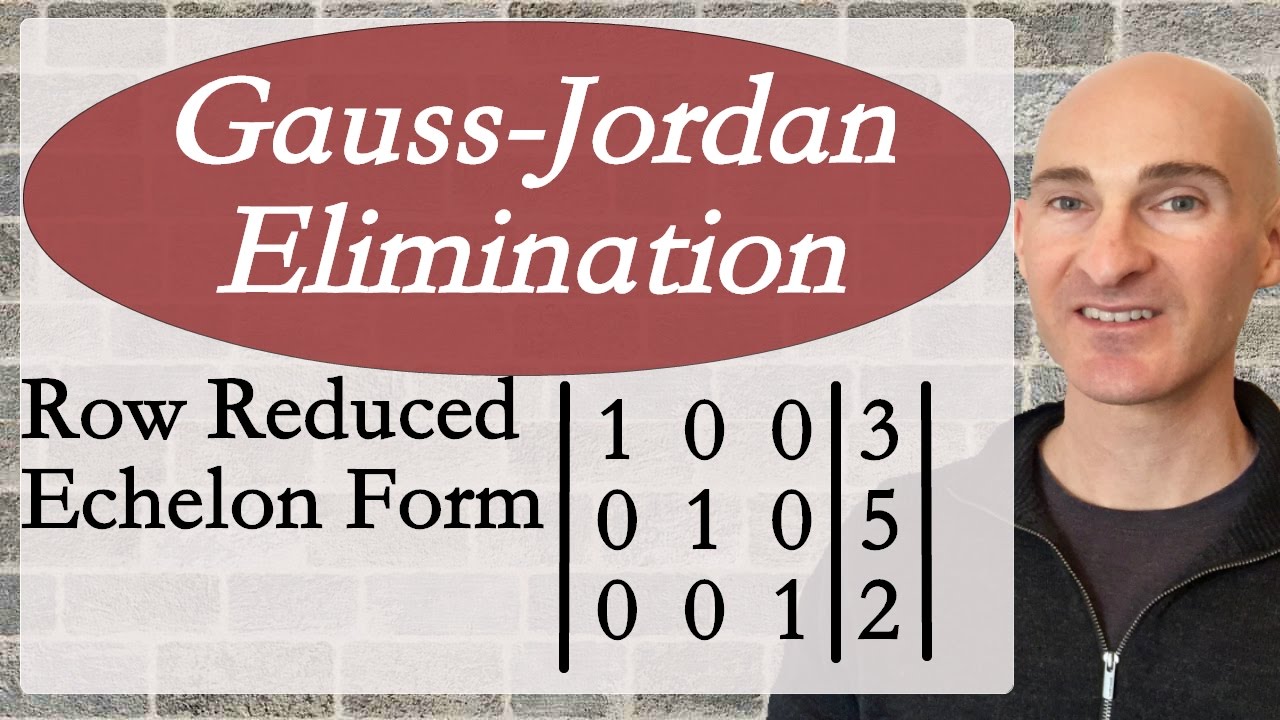
Learn how to use Gauss-Jordan Elimination row reduced echelon form to solve systems of equations in this free math video tutorial by Mario's Math Tutoring. 0...
dense stone
sorry I don't know vietnamese
 remote fable
@steady sun I'm Vietnamese. I think you can use the rank nullity formula
It's basically : matrix rank + dimension of null space ( what you are asking for) = number of columns in the matrix
To find matrix rank you can use the Gaussian elimination as others said
steady sun
Thank you! I have just read that too.
Oops, I learned Gaussian elimination at school
but never heard Row Reduced Echelon Form
remote fable
Row reduced echelon form means " dạng bậc thang ở hàng"
If you look at an example of row reduced echolon form u will immediately understand
pm me if you have any question ; )
steady sun
Thanks!!! I googled that terms and found a good video.
https://www.youtube.com/watch?v=biW3S9EdE4w
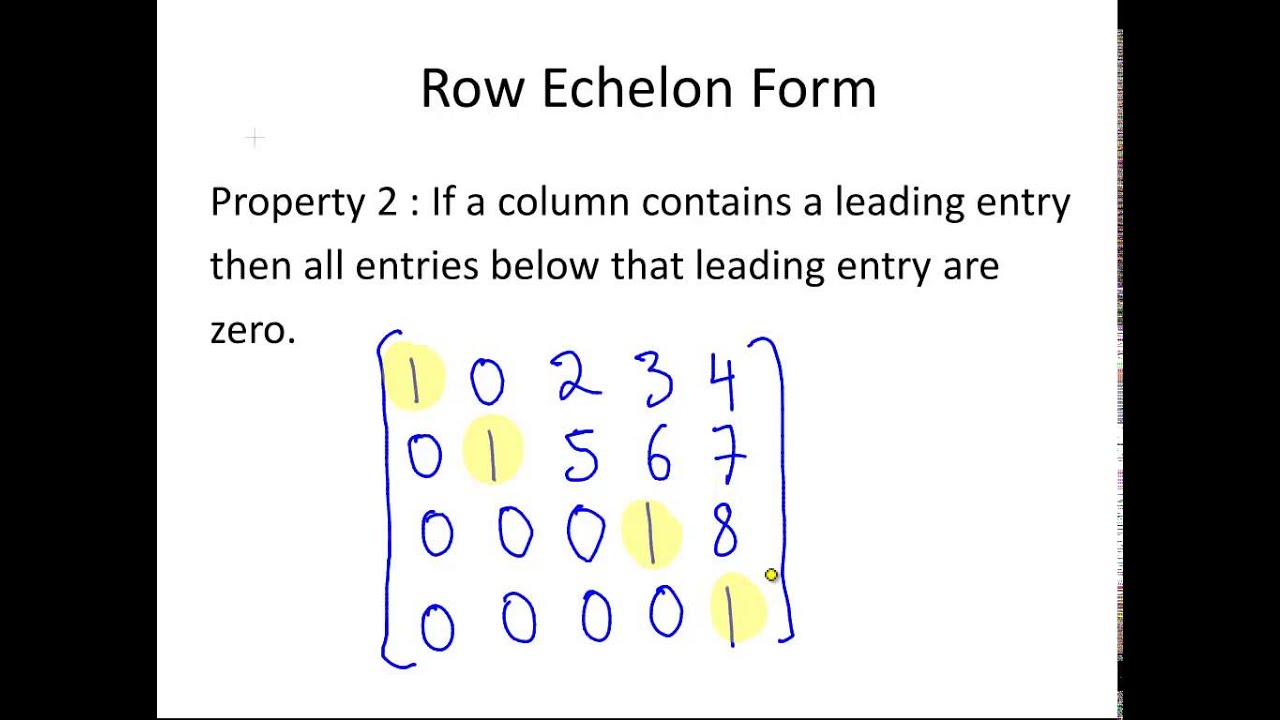
MathsResource.Github.io | Linear Algebra | Matrices
remote fable
Yes, then you count the number of pivots ( number of ones in this case ), that's the matrix rank
sleek briar
I have a query
If we do row transformations then it is said that it is now forbidden to do Column transformations on that same matrix subsequently
Why is this so
quartz compass
with elementary matrices?
row and column transformations corresponds to multiplying by matrices on the left or right
if you're thinking about gaussian elimination, try to think about the corresponding system of equations
you'd be trying to cancel different variables out, doesn't make sense to do that
3x+2y=7
5x+4y=9
I can subtract a multiple of the first equation from the second
but I can't take the vertical columns of coefficients on the x and correspondingly subtract those from the corresponding coefficients on the y, that would be a kind of column operation
 clear otter
Does anyone have any good resources for understanding tensor products and the universal property? I'm feeling completely lost
dreamy depot
Dumb question but woudn't one be able to prove this via the Row Colulum rule ?
 clear otter
@wintry steppe Yup. First apply the inverse to your product of matrices. This gives 1/5D^(-1)AC = B
I think it's straight forward from there?
wintry steppe
OH
okay i get it
yeah i forgot to put the inverse on the 5
thank you

same thing with this, how does it equal to g?
clear otter
@wintry steppe What have you tried?
dreamy depot
@clear otter was my proof idea right ?
wintry steppe
@clear otter so far i have made the A^6 to A^5 but what confuses is me what to do with the 3I
clear otter
How did you make A^6 to A^5?
wintry steppe
cuz the inversenwould reduce it
by -1
and oh i think i got it
cuz A would be the matrix so (A^6) ^-1 then add by an identity matrix of 6 and multiply by 1/3
i think
clear otter
You're multiplying everything by A^-1
wintry steppe
put the equation into the form $A[\text{something}] = I$
stoic pythonBOT
Sadly Lachrymose:
wintry steppe
or $[\text{something}]A = I$
stoic pythonBOT
Sadly Lachrymose:
half ice
A^6 - 6A + 3I = 0
Multiply both sides by A', doesn't matter if on left or right
A^5 - 6I + 3A' = 0
A' = 2I - 1/3 A^5
wintry steppe
oh okay
 stoic elm
hi! is this where i can ask questions for MAT223?
clear otter
What is MAT223?
stoic elm
linear algebra
LOL
idk i was thinking there were like different versions/courses or another channel to ask questions
clear otter
This is the linear algebra channel
stoic elm
so to determine if it's invertible, i need to find the determinant first right?
and i did this
when i'm doing row operations to find a determinant, can i switch rows around
also not sure if i'm even doing it right or not
 gray dust
are you allowed to compute determinants using cofactor expansion?
half ice
You can also row reduce it, and see if you get identity
stoic elm
idk i was doing it during the tutorial and my TA was giving me shit cuz it was taking so long
half ice
The determinant of a 4×4? I mean that's not a short process
stoic elm
but moving rows around is ok right?
gray dust
yes, that's what i mean by cofactor expansion
you can also use row ops to get the determinant, but remember what effect row ops have on the resulting matrix
stoic elm
oki
half ice
Yes, swapping two rows does not change the det
Adding/Subtracting rows doesn't change it either
gray dust
multiplying a row through by a constant scales up the determinant by the same constant
stoic elm
oh riight ok
and also, i really don't understand how to find the inverse of a 4x4 matrix
i kind of get it for a 2x2 but not for this
half ice
Same as any other. If you are going to find the determinant, you mineswell find the adjacent
half ice
Sorry, adjugate matrix
stoic pythonBOT
RokettoJanpu:
stoic elm
i think i get it, thank you!
stoic elm
I'm not sure how to prove b and c
I believe theyre both true, but idk how to explain it without giving an example
actually it depends for b) cuz there might be 0s in there that makes the determinant = 0
half ice
@stoic elm
c is ez. Multiply both sides by A^-2 to get the form you want
There's an easy counter example for b
stoic elm
both sides as in it'll become A = A^(-2)?
wait nevermind i was being dumb and looked at the wrong one
half ice
c make sense?
stoic elm
nvm i thought i got it but i still don't :/
half ice
A³ = A
A³A⁻² = AA⁻²
A = A⁻¹
 feral grove
worry not
meanwhile i have a question lmao
so while looking through this problem i can't really see how the dimensions of a matrix for this transformation would work, given it needs to be 3x2, but a 3x2 matrix multiplied by a 2x2 matrix gives a 3x2 matrix which is not the 3x1 vector wanted as an output
i suspect i'm fundamentally misunderstanding something about this type of problem
half ice
@stoic elm
And like I said, there's a very easy counter example for b. Don't over think it
You can also solve the equation by factoring to get a counter example
stoic elm
not really sure how to do it by factoring, but is one of the easy counter examples you were thinking about this?:
half ice
That works! I was thinking even easier
stoic elm
all 0s?
half ice
Yup lol
half ice
Np, let me know if you got anything else
stoic elm
and sorry @feral grove i;m like spamming your question away T_T
ty! i think i'm good with everything else
feral grove
np i shouldn't have asked
i thought you were done
which is mb
i forget about the other question
half ice
@feral grove
I feel like T would have to multiply on the other side. A 3×2 times a 2×2
feral grove
i mean we've dealt with them as vector spaces before, but i've never had a transformation from or to it
my guess was just a 3x4 that's (T(E_11) T(E_12) T(E_21) T(E_22)) but that's 3x4 so i don't really know what the meaning of it would be
half ice
The problem is that the output is 3×1 and that's neither of the input's 2×2, and you necessarily have to keep one of them
Is it okay to write it as a 4×1 instead?
feral grove
oh wait
i think i can decompose some A=({a,b}{c,d}} into coordinates as 4x1 and then multiply it by the 3x4 matrix
i'm guessing at least
yeah
ok
that's gotta be it
half ice
Depends what your teacher wants
Makes me think that, in the form it is written, this isn't really a linear operation
Idun
feral grove
i mean i think the idea is we can treat M_2x2 as R^4 since any A in M_2x2 can be written in terms of basis matrices multiplied by the entries of A as scalars, and then those scalars become a vector in R^4
i hope
jagged saffron
Say we have some matrix, call it A, which is the matrix representation of the transformation $T : R^n \xrightarrow{} R^n$ with rank R.
stoic pythonBOT
Victoria:
jagged saffron
Then, we apply this matrix, A to a new transformation, call it $F : Mat_{n x n} \xrightarrow{} Mat_{n x n}$, defined by $F(B) = AB$
stoic pythonBOT
Victoria:
jagged saffron
Since the kernel of T is R, is the kernel of F N^2 - N*R?
Since the image of T has a basis, some $v_1..v_r$, which we can then extend to NR number of basis, because we now have n more columns
stoic pythonBOT
Victoria:
jagged saffron
and then by rank nullity we have our answer?
toxic pendant
So if I can find the inverse by basically doing row operations while on the other side I have an identity matrix, then doing it again should give me the original matrix right?
Or to put it another way does (A^-1)^-1 work?
 steady fiber
yes
toxic pendant
Nice
How would I prove that
Also, what is the mindset in I should have in order to solve proofs
How should I approach a question where I need to prove something
 foggy lodge
 leaden fiber
I'm doing question i)! Can I find the determinant of a 4x4 matrix using row reduction?
or do I do the ijk thing that people do with vectors
can I do that? crossing out one row and one column gives me a 3x3 and I don't know how to do that thing for a 3x3
 wispy kayak
im pretty sure you do the crossing out thing
let me find my old notes
ok
for the first question
acutally
i think a video might help, explanation of this would be long

Use expansion of cofactors to calculate the determinant of a 4X4 matrix.
after you watch the video though, try your homework problem out
we can work through your problem if the video doesnt help
gray dust
@leaden fiber cofactor expansion and row operations are both fine ways of computing the determinant
wispy kayak
this video explains well
leaden fiber
ahh okay I'll go watch!!
gray dust
galileo linked you a video on how to do it with cofactor expansion
wispy kayak
OH
gray dust
are you required to use a particular method of computing the det?
wispy kayak
you can do row operations
isnt it you multiply diagonal of rref @gray dust
is that what you mean by row operations
gray dust
you do your best to reduce the matrix down to the identity. and keep in mind the effect that row ops have on the determinant of the resulting matrix
wispy kayak
oh yeah
leaden fiber
nope, not required to do any method
gray dust
both methods take some time to do
eh, depends whether you're faster at row ops or taking determinants of minor matrices
wispy kayak
i think cofactor expansion would help him when learning eigenvalues
ping if you would like me to walk you through it
wispy kayak
cool! its a lot of steps so take your time 😄
gray dust
if it's your first time computing det with cofactor expansion, you may want to try it out with a smaller sized matrix first
leaden fiber
Like this right?
gray dust
,rotate
stoic pythonBOT
leaden fiber
sorry haha
leaden fiber
yeet tysm!!
gray dust
👍🏽
wispy kayak
!!
gray dust
are you iterating over the 4th column?
leaden fiber
third row
gray dust
oh my, lots of computing you don't have to do. nice
most of the time you will not be as lucky 
gray dust
an invertible matrix is a matrix whose inverse exists
leaden fiber
there can be matrixes which don't have inverses??
gray dust
mhmm
wispy kayak
^^
leaden fiber
galileo I thought you were gonna sleep!!
wispy kayak
ahhh
leaden fiber
0 doesn't have an inverse? (oH RIGHT)
leaden fiber
any matrix which doesn't have an all-zero row should be invertible, right?
gray dust
do your notes say anything about determining whether a matrix is invertible?
gray dust
inverse exists iff the determinant is nonzero
gray dust
transpose
wispy kayak
zz
leaden fiber
I saw that!!
It is bed o clock go to bed!!!
I don't have a test until december :P
wispy kayak
zz.
leaden fiber
tyy!! and good night go to bed
how do I find if something is coplanar? Do I just cross product to find the normal vector of the plane that has two vectors, and then sub the points of the third point in?
waaah I should have listened in class
pallid swallow
hmm
undone garnet
Just use simple calculation because this was one of question in midterms exam
pallid swallow
a and b real numbers?
undone garnet
Yeah
undone garnet
x is variable
pallid swallow
x is matrix?
pallid swallow
hmm
pallid swallow
where c>0?
hmm
maybe we consider how eigenvectors of X^2 are like
if X is diagonalisable with real eigenvalues, I think we are done.
but the problem is that X might not be
but note that this is a continuous function (in terms of c), so basically, we must show that X^2 has no negative eigenvalues
If X^2 has a negative eigenvalue, -c, then X^2v=-cv for some vector v.
@undone garnet any ideas?
undone garnet
wooop
my proof is
p(x) = x^2 + ax + b = (x+a/2)^2 + b-a^2/4 >= 0
so b-a^2/4 >= 0
let m = b-a^2/4
so
and
P(A) = (A+a/2I)^2 + mI
pallid swallow
we need to show that X^2 cannot have a negative eigenvalue
undone garnet
well
no need to do that
let X = (A+a/2I)
so
we need to prove
det(X^2 + mI) >= 0
pallid swallow
okay you jumped into complex numbers
pallid swallow
???
pallid swallow
determinant is a polynomial, so we are done?
undone garnet
det(B.conj(B)) = |det(B)|^2 >= 0
undone garnet
det(A+B).det(A-B) neq 0
M = [A, B; B, A]
prove that det(M) neq 0
A, B is M_2
any idea?
hm..I'm thinking about
M = C.D
in this det(C) = det(A+B), det(D) = det(A-B)
undone garnet
can anyone check my prof for me please?
prob: A, B is M2. A = AB - BA, prove that A^2 = 0
my proof:
from Cayley-Hamilton we have
A^2 = trace(A).A - det(A).I
trace(A) = trace(AB-BA) = trace(AB) - trace(BA) = 0
so
A^2 = -det(A).I
we need to prove det(A) = 0
indeed
A = AB - BA
<=> A^2 = A(AB-BA) = A^2B - ABA
or
<=> A^2 = (AB-BA)A = ABA - BA^2
by add two equations we have
2A^2 = A^2B - BA^2
2(-det(A).I) = A^2B - BA^2
<=> -2det(A).I = A^2B - BA^2
get trace both side
trace(A^2B - BA^2) = trace(A^2B) - trace(BA^2) = 0
trace(-2det(A).I) = -2det(A).2 = -4det(A)
=> -4det(A) = 0 <=> det(A) = 0
so A^2 = 0
clear otter
I'm not sure I understand the difference between the cartesian product and the direct sum when dealing with modules.
It seems the direct sum of modules has a linear structure where addition is componentwise, and scalar multiplication is on every component.
Does the cartesian product of two modules have no such structure?
Is it literally just a set?
sonic osprey
I'm confused exactly what this means
What's the set on which the direct sum of two modules
As in, how do you get the set for the diret sum of two modules
clear otter
"For two R-modules M and N , M ⊕ N and M × N are the same sets, but M ⊕ N is an
R-module and M × N doesn’t have a module structure."
sonic osprey
Is this quoted from something you're reading
clear otter
Yeah. It's a paper on tensor products by Keith Conrad.
sonic osprey
link me to it?
sonic osprey
I'm honestly just as confused as you are
clear otter
phew
I think they want you to describe what happens to a vector when you apply that transformation.
ie, how is it rotated and scaled.
 spice sparrow
https://gyazo.com/dba34305c984fe31d3738d2f0336cf3f
can someone please explain the step from top right to bottom of the picture?
(I'm not sure if this belongs here)
 quartz compass
work it backwards, start from the bottom and distribute that and try to make the thing on the top right
equation signs are reversible, so once you understand how to go backwards use that to teach yourself how to go forwards
half ice
@clear otter
One is finitely many modules, the other allows for infinitely many
They are named as such because they do have different properties
stoic elm
I'm not sure if I'm just dumb, but I can't solve this
gray dust
Show work?
half ice
Once you get upper triangular, the determinant is just the product of every term on the diagonal
stoic elm
Is the -2(-1) part wrong
Also 9 wasn't right but I couldn't figure out where I went wrong
gray dust
You have -2 on the outside and -1 in front of the first 2x2 det
Multiply those constants, the outside should be 2 but you wrote -2
stoic elm
Ooh
Oh I finally found out what I did wrong, it was that and some other copying issues I did 😭
Guess I'll just use this instead of row ops if I can, idk why I couldn't get it with row ops
half ice
@stoic elm
The first thing you did was divide a row by 2. That will half the determinant. You have to remember to double to get the original determinant
stoic elm
Oh what I need to do that?
Oh true I guess I did tamper with the result
Also sorry, one more problem
How would I find the matrix using the third column?
gray dust
You mean how to iterate over column 3 when computing detA?
gray dust
The hint is asking you to do basically what you did for the last q. Cofactors expansion
stoic elm
I used the first row to do that, is there a way to use the third column the same way
Wait NVM there's the second row that could do basically the same thing
gray dust
Notice for each minor matrix you alternated between multiplying it by 1 and -1?
stoic elm
Oh yeah
gray dust
For any element sitting in the i’th row and the j’th column, you multiply the det of its minor matrix by (-1)^(i+j)
 native ore
I dont know how to go about 2.5
I just know that the dot product of the vector and normal vectore should be 0
but im dealing with 1 vector orthogonal to both equations and im not sure how to set it up
wait do I just take the cross product of the two vectors in R4
pallid swallow
there's no cross product for vectors in R4, I think
Just take the standard basis and find a orthogonal basis of the span of x1, x2, and then subtract the vectors parallel to these basis vectors
@native ore
native ore
oh
wait so cross product only works for vectors up to r3?
Cant I solve this using row reduction
native ore
Do product?
I know dot product works but how do I setup a dot product system
for both vectors
pallid swallow
how do the components of an orthogonal vector look like?
@native ore
row reduction?
native ore
what does it look like?
its just a vector thats perpendicular to the given vectors
All orthogonal vectors in would be a plane thats orthogonal to the plane created by those 2 vectors
pallid swallow
you need v dot x1 = v dot x2 = 0 @native ore
toxic pendant
I had a question on the midterm that blindsided me and I'd like to know how to solve it
The matrix is 5X3
The question was basically to find a solution to b
pallid swallow
ah
you have a1, a2, a3 column vectors
express the matrix multiplication in terms of those column vectors
@toxic pendant
pallid swallow
because maybe you haven't seen matrix multiplication expressed in terms of column vectors
 toxic pendant
But this concept is simple, I just couldn't connect it in my head for the 15 minutes I sat there
I slep about 8 hours as well
native ore
I cant afford to sleep
I dont know enough
im going through the whole textbook
I've already got my large double double from tim hortons
toxic pendant
Your midterm is the entire textbook?
native ore
im actually gonna get tilted
steady fiber
starbucks pretty shit too
steady fiber
mccafe is probably the best "regular" coffee
toxic pendant
So same as me
native ore
??? where do you go
toxic pendant
Anyways there are studies showing that having proper sleep outweighs cramming for a few extra hours
steady fiber
there's a specialty coffee place next to where I live that has some high quality coffee, also my friend worked at a high end coffee company factory
and he hooked me up with a lot of good coffee beans
and so I just make my own from that
toxic pendant
Especially since there are extreme diminishing returns when doing it all in one session
native ore
well as much as I'd like to agree with those studies, I've been focusing so much on my other math course
I'm missing a lot of fundamental concepts
plus my exam is in the late afternoon tomorrow
toxic pendant
I mean how many hours until it happens
steady fiber
I never prioritize studying over sleep
native ore
so I can get some sleep after
native ore
the exam is in 20 hours from now
toxic pendant
Sleep 8 study 10
native ore
sure but I have the drive to study now
so I study now sleep 8 later
im so groggy when I wake up in the morning
I get nothing done
toxic pendant
Sleep at your regular time to not disrupt circadian rhythm
toxic pendant
I'd go over and write down the key concepts
native ore
I will sleep
toxic pendant
And then sleep on them
Then do questions when I wake up
Then again this is coming from the person who just epik failed on an easy question
native ore
we'll see I guess
my goal is literally
70%
some dude on discord who is writing the same exam just asked me what R2, and R3 is
so at least I know im not the most behind
cobalt tartan
Hrm
Given some liner mapping T:R^n->R^n and a basis B that spans R^n such that B = {v_1...v_n}, is it true that ([T]_B)(v) = T(v)?
I think that it's true
Like i'm using this as part of my proof
For this question
remote fable
What do you mean by ([T]_B)(v)?
Wikipedia has some nice for that fact
*proof
Since T preserves the inner product, it preserves vector length. For an orthonomal base, we have that vector length = v transpose * v
So we have: v transpose * v = (Tv)^transpose * (Tv)
Open the bracket and from there you have T transpose * T = Identity, or T is orthogonal
pallid swallow
it seems like v1...vn are doing nothing
select the standard basis, then you get information about the columns of T
then pick something else
$(Tv)^TTw=v^Tw$
stoic pythonBOT
Element118:
pallid swallow
so $v^TT^TTw=v^Tw$
stoic pythonBOT
Element118:
pallid swallow
Since this is true for all v and w
by choosing standard basis for w, we can show $v^TT^TT=v^T$
stoic pythonBOT
Element118:
remote fable
If a linear subspace is invariant under every operator, does that mean the subspace must be trivial? (the zero space and the whole space)
half ice
No, some linear operators are not bijective. The zero map will take the whole space to 0 @remote fable
cobalt tartan
Hrm
Wait
THat's not quite what I want
If I rewrite v and w in terms of a basis B, is the dot product preserved?
@remote fable what wikipedia page?
Like my thought process for this question is that if we have some linear mapping T:R^n->R^n, then the matrix for this linear mapping with respect to B = {v_1... v_n} would be
[T]_B = [ [T(v_1)]_B ... [T(v_n)]_B ]
So then we have T(v), with respect to base B becomes ([T]_B)(v_B)
As v, w in V and B spans V, then we can rewrite v and w as linear combinations of v_1...v_n
So that v_b = a_1v_1 + ... + a_nv_n, and w_b = w_1v_1 + ... + w_nv_n
Is this ok so far?
Err like
LIke I'm assuming that becaues T(v)T(w) = <v, w> are all in R^n I can just change the basis to B because B spans R^n
cobalt tartan
Err
Ok nvm that question
Different question
Given this question
I've been able to show that L(v_1)...L(v_n) is a basis for W
But I'm not sure how t oshow orthonormality
@pallid swallow do you have any idea?
Like showing that it's orthonormal means showing that for all i != j, we have L(v_i) dot L(v_j) = 0 and L(v_i) dot L(v_i) = 1
wintry steppe
does this question want me to find the a transpose?
cobalt tartan
THey want you to go and take the transpose of A^T yea
wintry steppe
but i dont understand
a transpose would be 4x2
you cant add a 2x4 and 4x2 matrix right
cobalt tartan
They want you to subtract the 2x4 from the other 2x4
And then to transpose your answer
 cobalt tartan
Yea
Like your question is of the form 2B + A^T = C
Like I dont' want to bother typing out the matrices
So then you can find A^T = blah blah
THen you go and take the transpose of your answer
wintry steppe
so 2b - c = -a^t
wintry steppe
this one wants me to find a matrix such that
-3B + A = C^T
so find a matrix a that equals the transpose of c when added with b
?
wintry steppe
oh
when you switch a matrix over the equals does every digit (element?) get sign flipped
wintry steppe
like the same way if you had a integer 2x + 3y = 0 if you move the 2x over it becomes 3y = -2x
for a matrix do i inverse every digit
dusky epoch
there's no such thing as "moving something over" or "switching something over"
all i did was add 3B to both sides, plain and simple.
wintry steppe
👍🏽
dusky epoch
but if you did want to multiply a matrix by -1, yes, each entry would just flip.
 urban bough
I have a question about matrices of transformation
If I want to represent a matrix of a transformation from R3 to R2 A
As mapping from a nonstandard basis in R3 B
Going to a nonstandard basis in R2 C
How would I do that?
dusky epoch
wdym
as in
you have a transformation from R^3 to R^2, and you want to write its matrix with respect to your two bases, B and C?
urban bough
Yes, the transformation matrix is in terms of The standard bases in R3 and R2
dusky epoch
uh huh
dusky epoch
well the simplest way would be to just go by the definition tbh
urban bough
Definition?
urban bough
Where’s that?
dusky epoch
are you... saying you don't know how to represent a linear transformation with a matrix
urban bough
No no I do
dusky epoch
like... the columns of your matrix are the coordinate vectors (wrt C) of the images of the vectors in B under your transformation
so like take the first vector in B, apply the transformation to it, write the result as a linear combination of vectors in C, arrange the coefficients in a column, and that's the first col of your matrix
and likewise for the other two
half ice
@charred stirrup
Yes
 charred stirrup
@half ice thank you, I was wondering if they intended me to figure something out through substitution instead
half ice
It's very rare that, when given a system, you shouldn't immediately reduce it
In this case, you solve a with the reduction
charred stirrup
and use my answer from a to do another reduction in b ye
half ice
You can, and that would work. You can also put your solutions from a into the equation
Or is that what you were saying? Oop
charred stirrup
why would I evaluate the plane with the answer from a? just trying to conceptually understand what's going on
half ice
a will give you a line. This represents all places the two planes intersect
charred stirrup
Yup
half ice
If you add another plane, you can just find the intersection between that line, and the plane
Rather than (but you still can) finding the intersection between all three planes
charred stirrup
by evaluating the plane at that line, I effectively get the point where they intersect?
half ice
Yup!
Note they may not intersect at all. The question implies they do though
charred stirrup
I really like your note on the fact that it's intersection between all 3 planes
because the line itself is the intersection of the first two planes
thank you
half ice
Np. That all you needed? Feel free to ask if there's anything else
charred stirrup
is it more preferred to reduce to row echlon form or rref?
half ice
Yes, reduce as much as you can. The answer is very clear if you do
It's also common to reduce to upper triangular, then the solution is still very quick, but save that for later in the course
charred stirrup
@half ice if you are available, is the direction vector of a line its unit vector?
same question #1
charred stirrup
how would you represent the line in general form after you solved the x1, x2, x3 values?
native ore
no this is patrick
charred stirrup
@native ore 😦
half ice
@charred stirrup
For part b? It's not a line at that point
cobalt tartan
hrm
"Let V be an inner product space with inner product <,>. Prove that <v, 0> = 0 for any v in V"
Isn't this part of the definition of an inner product?
That <v, v> = 0 if and only if v = 0
dusky epoch
yes that's part of the defn but no your statement isn't the same as that
cobalt tartan
Oh
charred stirrup
@half ice for part A), I have the x1, x2, and x3 solved, but I cant seem to express the line in parametric vector form
charred stirrup
Top row: 1 0 1 | 2
bottom: 0 1 1.5 | -2
my solved x1, x2, x3 respectively is 10/3, 0, and -4/3
@half ice
half ice
That's a solution, but it doesn't represent all solutions
If you take your matrix back to an equation form:
x1 + x3 = 2
x2 + 1.5x3 = -2
You can rearrange like so:
x1 = -x3 + 2
x2 = -1.5x3 - 2
This allows you to put in whatever you want for x3, and get a solution (x1, x2, x3)
We say that x3 is a free variable. We can refer to it with a different name to represent this. I'll call it t. Our equations are then:
x1 = 2 - t
x2 = -2 - 1.5t
x3 = t
That's the parametric equation of the line
charred stirrup
we have an infinite amount of solutions?
gray dust
at least 1 free var means infinitely man solns
charred stirrup
that is an amazing explanation thank you @half ice
How can I identify the free variable in the future? So that I know to rewrite in terms of the free variable
charred stirrup
So in my case, the first 1's in each row were my pivot
but my 3rd column had no pivot
so the entirety of x3 is considered a free variable
?
half ice
Yus
If you're deeper into linear algebra there's a bit more to make sense of here. Since there's one free variable, the solutions form a one dimensional space (kinda, the constants break this but it's still worth thinking about this way) if you had two, this would be a two dimensional space, ect
We have a line of solutions, because there's one free variable.
 quaint heart
The word you're looking for is coset lol
 young pasture
I have a question about basic linear algebra
- I am having trouble converting a direction vector [1, -4, 7] into a normal vector ( I know the dot product just has to be 0 since they are orthogonal) but my prof said that not any vector that gives 0 when multiplied is orthogonal which confused me.
2)Give an example of a 3×4 coefficient matrix A such that [A|b⃗ ] has a solution for every 3×1 vector b⃗ . Justify your answer.
Literally no clue how to do this
No idea where to even begin
@half ice Could you possibly assist? @quaint heart
quartz compass
in 3D space there is an entire normal plane to a vector
young pasture
Here is the full question
I was thinking get the direction vector, convert to normal vector and then find the general equation of the line
then solve the system
<@&286206848099549185>
sonic osprey
Read the rules in #❓how-to-get-help please
half ice
@young pasture
That line can also be written as
x = -2 + t
y = 5 - 4t
z = 1 + 7t
Plug those into your plane, do you get a value for t?
young pasture
Wait is "t" supposed to be in the point of intersection? I am a little confused sorry
I do understand what you are trying to say tho
I don't understand what you mean by "plugging the values into the plane.
half ice
Put x, y, z in. You'll have an equation that only has t
young pasture
@half ice what does t =
half ice
t is a free variable. It can be anything. Any choice of t will give you a new point on the line
half ice
That line can also be written as
x = -2 + t
y = 5 - 4t
z = 1 + 7t
Plug those into your plane, do you get a value for t?
half ice
If you do have a value for t, then use those equations above to get an (x,y,z). That's the intersection

 young pasture
@arctic fox join the club bro
young pasture
how would you justify that answer? How did you derive that answer?
half ice
Let's say you have the block matrix
1 0 0 0 | a
0 1 0 0 | b
0 0 1 0 | c
What's the solution to the system?
 arctic fox
[a,b,c]
half ice
No!
It's (a,b,c,t)
Where t is whatever you want it to be.
There's infinitely many solutions, but that's always true for any vector b in the block
arctic fox
ahh makes sense, thank you!
half ice
Np, feel free to ask if you have anything else
young pasture
@half ice your a legend. Thanks bro
charred stirrup
I found x1 = -5, x2 = 6, x3= -1, but how do I create the vector equation x = p+td ?
i feel like I am missing out a big part of understanding by not being aware of the significance of solving the system
okay nvm I got it the significance of the solved values produces a point that exists in the system
then I just grab the direction vector and sum it
wintry steppe
anyone kno how to use matlab?
if so, how do i get a proportional value out of a list
so like lets say there is average temp and i extract all the days temp was less than 22 how would i find the proportion after extracting
wintry steppe
i just tried getting the sum of the total each.. so the sum of the list and the sum of the extraction \
and dividing it
it didnt work..
alright and whats v?
pallid swallow
the list
wintry steppe
oh okay
pallid swallow
if it is stored in a vector
pallid swallow
finally found you again
yeah, the problem is we need to find the correct functions
sum((int)(v<22))/size(v)
might be this
wintry steppe
it says: error: 'int' undefined near line 1 column 6
@pallid swallow leave that for now
can u help me with this can u tellme what i have to modify in order for it to work for a cubic
xi=[-1:2]'
yi=[4 0 8 1 5]'
A=[xi.^2 xi ones(3,1)]
b=yi
x=A\b
f = @(t) x(1)*t.^2+x(2)*t+x(3);
t = 0.5:.01:3.5;
y = f(t);
pallid swallow
hmm
wintry steppe
can equation like this
ax3 + bx2 + cx + d
and find a b c d by given points which i alrdy inserted
wintry steppe
yea
 leaden ermine
Hey all, any tips on how i can better understand how to go about solving linear algebra proofs? Or a resource/book with a lot of proof examples
wintry steppe
this
pallid swallow
@leaden ermine depends, any examples
wintry steppe
its a quadratic one but i wanna change it into cubic
acc wait no
xi=[1:3]'
yi=[3 5 -1]'
A=[xi.^2 xi ones(3,1)]
b=yi
x=A\b
f = @(t) x(1)*t.^2+x(2)*t+x(3);
t = 0.5:.01:3.5;
y = f(t);
thats the quadratic one ^ and i wanna turn into cubic
and still an error @pallid swallow Ȁerror: operator /: nonconformant arguments (op1 is 1x1, op
2 is 1x2)
leaden ermine
Hmm, I guess basic proofs for LA, so nothing super complex but proving maybe here are some
pallid swallow
@wintry steppe sum(double(v<22))/size(v, 1)?
@leaden ermine which do you want to look into
wintry steppe
nvm i figured it out
i had to do this
count= sum(x < 50) and then ratio = count / numel(x)
leaden ermine
well I am looking more for help on the mentality on how to approach these kinds of questions. I cant seem to really understand proofs no matter what i read. I know the linear algebra (Decently) but i get stumped on "Show this" or "Prove this"
wintry steppe
@pallid swallow do u know how to turn the equation into a cubic?
pallid swallow
which equation?
@leaden ermine Hmm, okay, firstly, maybe you can try some examples
wintry steppe
this
pallid swallow
if you can try some examples, you get a feel for the mechanics for the question
wintry steppe
xi=[-1:2]'
yi=[4 0 8 1 5]'
A=[xi.^3 xi ones(2,-1)]
b=yi
x=A\b
f = @(t) x(-1)*t.^3+x(0)*t.^2+x(1)*t + x(2);
t = 0.5:.01:3.5;
y = f(t);
plot(t,y,xi,yi,'o','MarkerSize',5,'MarkerFaceColor','black')
use that method
and modify it to solve for
y = ax^3 + bx^2 + cx + d
pallid swallow
you want to solve equations by plotting?
wintry steppe
yea
leaden ermine
Well so for example, let me take a really easy one.
ill wait till youre done with unknown
pallid swallow
@wintry steppe might want to bound where your root is
leaden ermine
dont wanna interrupt
pallid swallow
@leaden ermine if you want you can move to a #❓how-to-get-help channel
wintry steppe
well i have been only given these points: (-1, 4), (0, 8), (1, 1), and (2, 5).
and i need to find a b c d
leaden ermine
its ok, ill wait, im in no rush
wintry steppe
yeah and
pallid swallow
@leaden ermine Okay, so, what do you think of your question?
wintry steppe
i gotta plot those points into this and turn this quadratic one into cubic
xi=[1:3]'
yi=[3 5 -1]'
A=[xi.^2 xi ones(3,1)]
b=yi
x=A\b
f = @(t) x(1)*t.^2+x(2)*t+x(3);
t = 0.5:.01:3.5;
y = f(t);
but idk how to
how do i turn it so uses qubic
pallid swallow
oh you are solving a linear system to find the coefficients