#linear-algebra
2 messages · Page 31 of 1
 half ice
Lol nah your last one was perfect
 north sierra
ok
half ice
Likewise, Span(u, v) is the plane that goes through u and v.
Unless u and v are dependent
half ice
If one is dependent on the other, then the other is dependent on the first
half ice
Yup! If one is dependent on the other two, any one of them are dependent on the other two
north sierra
I see
so in Span(u,v)
if u is dependent or if v is dependent
it wouldn't span all of R^2 right
half ice
It wouldn't span a 2 dimensional space, no
Since the dimension is the number of independent vectors in the span
 clever cedar
my textbook states that the inverse of a matrix A is 'unique'
what do they mean by unique?
such as, it is unique to that matrix or it is unique in the sense that no other matrix will have the same inverse matrix
 dusky epoch
unique in the sense that there's only one
i.e. a matrix can't have two different inverses
north sierra
if you can make a matrix into REF, is it automatically considered consistent
or do you have to go all the way to RREF
clever cedar
if it has a solution in REF then yeah its consistent
u just have to do gaussian elimination to find the solutions
which is plugging in one equation into another
until u isolate x,y,z etc.
all RREF does it make the work of finding the values of the variables easier
but u can do either way to find the solution
clever cedar
anytime
 rose grotto
I still need help with these
I understand what a symmetric matrix is
but I understand the problem
dusky epoch
@hot nymph this channel is occupied, please move to a free questions channel.
@rose grotto yes, a symmetric matrix is a matrix equal to its own transpose.
what is giving you trouble with these 5 problems you posted, exactly?
rose grotto
kk
dusky epoch
$A = \begin{bmatrix}
1 & s \\
-2 & t
\end{bmatrix}$
 stoic pythonBOT
Ann:
dusky epoch
can you write out A^T
rose grotto
$A^t = \begin{bmatrix}
1 & -2 \
s & t
\end{bmatrix}$
stoic pythonBOT
crinko3:
rose grotto
for them to have the same things in the same spots
in this case
wouldn't it not be equal
since for example the s is in diff spot
dusky epoch
well what you're asked to do is find the values of s and t that make A^T = A
of course A^T isn't going to be equal to A for all s and t
rose grotto
how would I do that
dusky epoch
there are 4 entries in A and 4 entries in A^T
write out A = A^T as 4 equations equating their corresponding entries
rose grotto
1 = 1
s = -2
-2 = s
t = t
dusky epoch
ok great
three of these equations are redundant
or rather, two are tautological and the third is equivalent to the fourth
rose grotto
why can it be anything
dusky epoch
give me one value of $t$ which makes the matrix $\begin{bmatrix} 1 & -2 \ -2 & t \end{bmatrix}$ fail to be symmetric.
stoic pythonBOT
Ann:
 carmine terrace
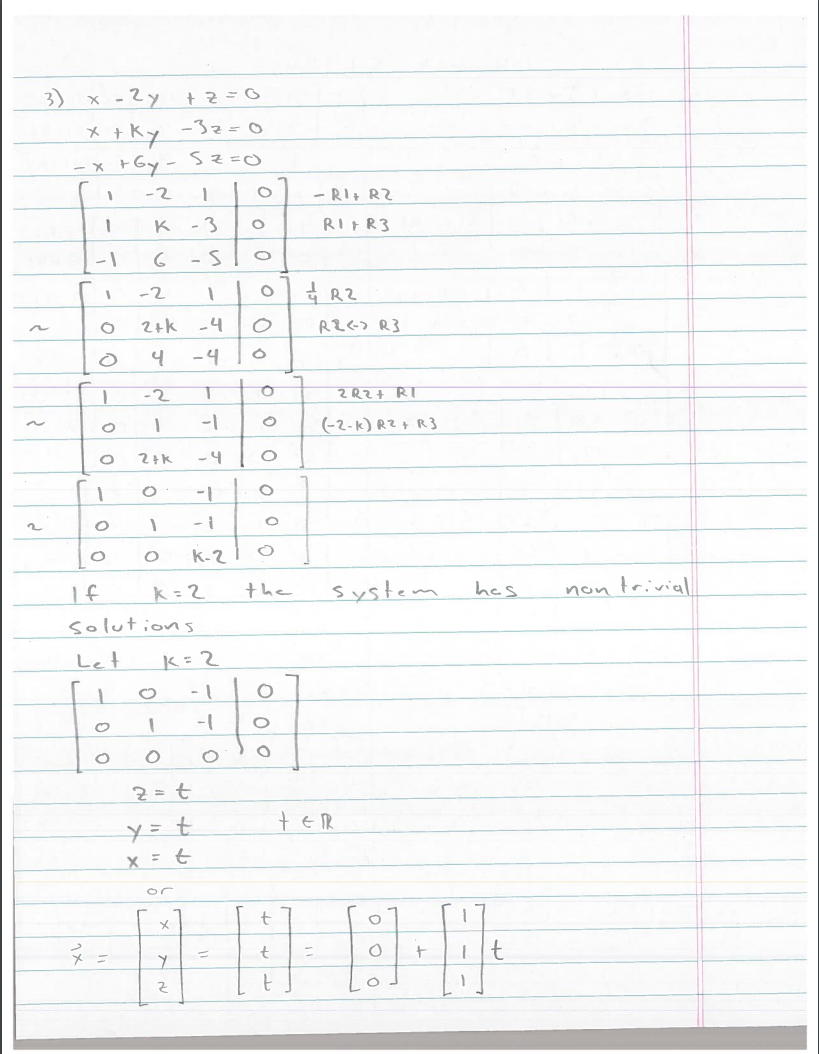
can someone1 help me understand this answer
https://i.imgur.com/lnsJsp5.png
I don't get why the answer is what it is
 rose grotto
oh ya true
 wintry steppe
@carmine terrace this system is homogeneous, that mean the system coeficients is zero, example:
aX + bY = 0
cX + dY = 0
all equals to zero.
after escalonating process, you got a reduced matrix, at this point you can get the solutions of the system, but by definition the trivial solution is x = y = z = 0
carmine terrace
yea, it's after the reduced matrix that I get confused
IDk how they got [0 0 0] and [110]
wintry steppe
to get [ 0 0 0 ] they applied k = 2
on reduced matrix, the last line you have [ 0, 0, k-2 ], where k is a constant to be determinated
wintry steppe
backing this matrix to coeficient system you got
1X + 0Y -1Z = 0
0X + 1Y -1Z = 0
0X + 0Y + (k-2)*Z = 0
if k-2 is diferent from zero, you got that Z should be zero
it is mean, z admits a unique value, that sould be zero(part of trivial solution)
if k-2=0 implies k=2, and you have 0*Z=0 or 0=0
for all values of Z this is true, Z in R
wintry steppe
you are welcome xD
 gray dust
x and b are vectors
 pallid rampart
mfw A is not given
 subtle apex
Hi guys, im new
can anyone shed some light on any of these problem? ur effort is much appreciated
dusky epoch
oh my god how rude can you even be
thank god everyone pings are disabled
you come to a server with thousands of people and ping everyone? seriously?
gray dust
it's not
subtle apex
well im sorry that im new to this channel/server, hence you must forgive me, since this is my first time here
i am just desperate to get some help
now without further ado, are you willing to lend me some of ur intelligence?
or any other bright minds out there
dusky epoch
which one(s) of these are you having trouble with
subtle apex
hmmm, i would say im not quite confident in all of them, but specifically number 2
dusky epoch
ok number 2
subtle apex
yes
dusky epoch
let $A \in F^{m \times n}$, prove that $\mathrm{Nul}(A)$ is a subspace of $F^n$
stoic pythonBOT
Ann:
dusky epoch
just transcribing the problem here so i don't have to scroll that far up
well
ok
first off
write out the definition of Nul(A)
if we wanna prove anything about it we gotta know what it is
dusky epoch
ok first off
no
the definition of Nul(A) should not mention Nul(A) itself
and no that doesn't even make any sense
subtle apex
I thought the nullspace is a vector that gives you zero
dusky epoch
no
the nullspace isn't a vector
it's a set of vectors
specifically Nul(A) = {x ∈ F^n | Ax = 0}
subtle apex
oh yup
dusky epoch
it's the set of all vectors in F^n which when left-multiplied by A give zero
so now
do you know the definition of a subspace
subtle apex
not yet
dusky epoch
what
dusky epoch
how the hell are you getting assigned problems that say "prove this is a subspace of this"
while not having been given the definition of a subspace
subtle apex
he uses a textbook that does not have everything, then he use another one
dusky epoch
that's fucking nonsense
dusky epoch
a what school
subtle apex
and there's this one definition that i cant find in both books and only one webpage from mit that has it
cu boulder
party school
subtle apex
yup
dusky epoch
i suggest Linear Algebra Done Right by Axler
subtle apex
is it free?
subtle apex
interesting
dusky epoch
mmm idk i don't have it handy so who knows
subtle apex
completely opposite of ur title
dusky epoch
wait so you weren't even told what a field is? 
i'm having the massivest thonker right now
subtle apex
such that F^n={[a1,...,an]| (a1,...,an)∈F)}
i read it
it's how a set is considered a "field" if it is: additive and commutative
 dusky epoch
F^n consists of lists of length n whose entries are all in F
a field, loosely speaking, is a set where you can add, subtract, multiply and divide (except by 0)
dusky epoch
the three most commonly encountered fields are Q, R and C
the fields of rational, real and complex numbers
subtle apex
he made us download this book and "read about field"
which i did
and this is what it says
so it's a set that is has the definition above, that is a field
i kinda gave up now...

dusky epoch
uhhhhh yeah i think you might be best off going on khanacademy and learning linalg from there
subtle apex
lol
XD
told u that i goes to a pretentious school
and i observed that a lot of the big name schools
their lectures are atleast 2 hours long
mines are like 50 min, then nope, goodbye

anyway can u just help me finish number 2
ill go look up the rest on my own on khan academy....
subtle apex
thanks
dusky epoch
given a vector space V, a nonempty subset U of V is called a subspace of V if it satisfies these criteria:
- for any u, v ∈ U, u+v ∈ U
- for any u ∈ U and c ∈ F, cu ∈ U
subtle apex
ok
dusky epoch
i.e. closure under addition and closure under scaling respectively
and with that in mind the check becomes kinda straightforward
bc if Au = 0 and Av = 0 then A(u+v) = Au + Av = 0 + 0 = 0
and if Au = 0 then A(cu) = c*Au = c*0 = 0
 dusky epoch
well you also need to check for nonemptiness but i hope it's obvious that the zero vector is in the nullspace of any matrix
 thorn robin
@subtle apex Halmos is a good book
I think it's basically what Axler's book is based off of
subtle apex
true, i can see that 0 vector is in null
 jagged saffron
For a orthonormal basis of the trace zero matrices, how do you construct the basis for the diagonal?
with the standard inner product
dusky epoch
standard inner product i.e. $\tr(X^TY)$?
stoic pythonBOT
Ann:
jagged saffron
uh as in $\sum_{ij} a_{ij}\overline{b_{ij}} = \langle A,B \rangle$
stoic pythonBOT
Victoria:
 fringe vessel
I was wondiering today if the trace is still as interesting if you consider matrices over non-commutative rings
It feels like lots of results involving the trace may just stem from it being a homomorphism into a nice field. I'm thinking about results about subspaces given by statements about the commutator in particular.
 tacit lynx
Hi, can anyone give me any hints on how to go about answering these two questions?
This is what I’ve tried so far for 4. but I feel like it’s probably wrong😅
 bitter minnow
Does
100
010
001
000
Span R3?
north sierra
no
bitter minnow
Why not?
It’s linearly independent, I don’t think I fully understand why the spanning property is though
 sonic osprey
That question doesn't really make sense
That's just a list of numbers
You ask if vectors span R^3
bitter minnow
I was trying to type out a 4x3 matrix
Each column being a vector, do those vectors span R3
sonic osprey
What are the sizes of those vectors
bitter minnow
4x1
sonic osprey
So are they elements of R^3?
sonic osprey
That's true yes
bitter minnow
So by definition it cannot span R3 because it has 4 elements?
sonic osprey
Those vectors aren't elements of R^3
bitter minnow
Would 100, 010, 001, and 000 span R3?
sonic osprey
Would they?
sonic osprey
Why does 000 being encompassed in that matter?
sonic osprey
Not sure what you mean by inconsistent
north sierra
never mind
sonic osprey
It's not inconsistent as a system of linear equations
Well at least
It's not really a system of linear equations because we don't know what the constants are in some sense
 earnest onyx
aaaa I'm just starting out and I don't even know where to begin my fucking b r a i n like where do x1 and x2 come in man
earnest onyx
nvm
 unkempt robin
Given some vectors a and b, can the following simplification be made? $\langle \frac{b}{\langle b, b \rangle}, a \rangle = \frac{\langle a, b \rangle}{\langle b, b \rangle}$
stoic pythonBOT
skippi:
gray dust
@unkempt robin looks fine, inner prod of b with itself is the square of b's norm, ||b||^2... inner prod properties allow you to factor out 1/||b||^2
unkempt robin
Oh, I was thinking about this simplification wrong... hm. So I guess this works out:
$\langle \frac{b}{\lVert b \rVert ^ 2}, a \rangle = \frac{1}{\lVert b \rVert ^ 2} \langle a, b \rangle = \frac{\langle a, b \rangle}{\langle b, b \rangle}$
stoic pythonBOT
skippi:
unkempt robin
Cool. There exists a scalar such that $a - \gamma b \perp b$
stoic pythonBOT
skippi:
 steady fiber
is that supposed to be multiplication?
north sierra
row-vector rule
unkempt robin
Should be matrix-vector multiplication by juxtaposition.
gray dust
you didn't answer the question:
is that supposed to be multiplication?
steady fiber
ok, there we go
gray dust
determine if you can even DO the multiplication
north sierra
i dont think i can
gray dust
and why not?
north sierra
cause number of columns and number of x is not =
steady fiber
ok, so there's nothing to compute
north sierra
ok this was a bad example to ask my quesiton
rose grotto
steady fiber
how would i compute this without using the row-vector rule
the answer is you can't compute this in any way
north sierra
okay can we use this example to answer my original quesiton
question
is there another way to solve this
other than using the row-vector rule
steady fiber
what is the row vector rule
north sierra
cause my professor says for this question that you don
dont' ave to use the row vector rule
i know i can but what other options do i have
since he said i dont have to use it
row vector rule is the multiplication thing
@steady fiber
steady fiber
there's many ways of multiplying matrices
steady fiber
I don't really know many outside the normal way to multiply matrices by hand
the other ways are for computers to do matrix multiplication quickly
gray dust
hmm
steady fiber
just say the last column for now
rose grotto
what u mean
steady fiber
$$c-\frac{3\left(b-3a\right)}{-6}$$
stoic pythonBOT
PorosInMyAshe:
steady fiber
just to make sure, this is what you have in your bottom entry in the last column
rose grotto
ya
steady fiber
ok, so you can rearrange that a bit into $\frac{-3a+2c+b}{2}$
stoic pythonBOT
PorosInMyAshe:
steady fiber
which is easier to work with
rose grotto
ok
steady fiber
and since the last row is [0 0 1 | (-3a+2c+b)/2]
we know that $z=\frac{-3a+2c+b}{2}$
stoic pythonBOT
PorosInMyAshe:
steady fiber
we also know $3x+2z=6$
stoic pythonBOT
PorosInMyAshe:
steady fiber
and we can substitute $z=\frac{-3a+2c+b}{2}$ to get $3x + (-3a+2c+b) = 6$
stoic pythonBOT
PorosInMyAshe:
steady fiber
or $x = \frac{6+3a-2c-b}{3}$
stoic pythonBOT
PorosInMyAshe:
steady fiber
and you can rearrange the first equation in the same way
substituting x and z to get y
or you can just go all the way to RREF
to do the same
and in this case, you find that no matter whaty ou pick for a,b,c you get a unique solution
so there's no restrictions on a,b,c for the system to be consistent
as far as I can see
steady fiber
that looks suspiciously like the expression for z
rose grotto
ohh
ty
arg
@steady fiber for this
do I turn it into ref
or I keep it like this
then see which k values make it a unique solution
wait nvm
I think ik what to do
@steady fiber whats the det
in d
idks
what does it mean
steady fiber
determinant
rose grotto
what does that mean
 lone cove
determinant
rose grotto
what does it do
if a colomun has all 0's
is it no solution
or only rows
I mean
yeah
 reef grotto
oof
I haven't done LA just yet but in HS we took determinants and inverses of 2x2 matrices. I have taken other determinants for calc 3.
In HS we used determinants for linear transformations and as an area scaling factor.
Like if we have a circle and we transform it to an ellipse we multiply the area of the circle by the determinant of the transformation matrix. By the way, I really have no idea what I am talking about, I haven't done LA properly at all.
But you can google to to take determinants which is pretty much all I know how to do.
sorry this isn't much help
rose grotto
@steady fiber for this
I made it REF
what do . Ido
its weird now
cuz its = 3
and not = a
reef grotto
Is REF where there are zeroes in the bottom left corner?
if so you should e able to multiply out the bottom row to find z, then plugging in z into the middle/top row you should be able to multiply out the middle row and get y, and then pluggin in y to solve for x.
I can't exactly remember but I watched a lecture cuz I was bored.
rose grotto
diff question
so I did K
and I have a 1 on the top left
and a 1 in 2nd row at x4
I might have done it wrong
the answer
is really weird
(s/2 − 2t, s, t, 2)
thats the answer
idks
@steady fiber
why is the answer like that
theres no s or t in the question even
is it the wrong answer possibily
rose grotto
<@&286206848099549185>
 rigid cypress
rose grotto
rigid cypress
rose grotto
nope
why do k = 3
give it infinetly many solutions
@rigid cypress
It doesnt make a full row of 0
<@&286206848099549185>
@half ice hi
hi
@steady fiber can u help for 1 sec plz if ur not busy
I can't figure out why k=3 makes that infinetly many solutions
do I have to do something to the rquation
before I start pluggin in
 tranquil trail
@rose grotto what you have trouble with bud?
rose grotto
@tranquil trail why does it say
that k=3
gives infinetly many solutions
in the answers
I don't understand that
infinitely many is 1 row of 0's
but where does k=3 make a full row of 0
north sierra
infinitely many solutions does not mean there is 1 row of zeros
it means there is at least 1 free variable
another way to say it is that not every column has a pivot
north sierra
anyways, could someone explain why they are talking about u and v (only 2 vectors) but they say its in R^3
why don't you make the systems of equations into a matrix and make the matrix into RREF? @rose grotto
it's very hard to see what the answer is without putting it in at least REF or RREF
gray dust
the example you're talking about probably gave u and v as members of the space R^3
north sierra
looks like k can't be equal to 5
@rose grotto
wait what does that mean @gray dust
gray dust
u & v are 3d vectors
gray dust
you know what the 0 vector is?
gray dust
each component of the vector is 0
rose grotto
@gray dust could u help with mine
gray dust
each entry in the 0 vector is 0
gray dust
you're probably reading some demonstration of a linalg concept
as with some proofs, they start off assuming some things. "let u and v be non 0 vectors in R^3"
north sierra
okay cause my prof said "if vector u and vector v != zero-vector and vector v is not a scalar multiple of vector u then span({u,v} is a plane through the origin
is that correct? this is what i wrote down
in my note book
gray dust
yes
north sierra
so i guess alone with u and v not being a multiple of each other, they also can't be equal to zero-vector
what if it is though?
gray dust
take a wild guess as to what span{u,v} would be
north sierra
my only guess would be that span(u,v) would be a line through the origin
wait
if u is a zero vector
then the span (u,v) would just be v right
gray dust
you asked me if both u and v are 0 vectors, right?
gray dust
👍🏽
north sierra
cool
wait can we do the other scenario too lol
so if u is a non zero and v is
then span(u,v) would just be span(u) right
gray dust
👍🏽
gray dust

rose grotto
@north sierra dms plz
wintry steppe
Does anyone know how to do this
rose grotto
@north sierra aa dms
this is questio
this isanswer
when I try to rref the systems I get a negative and positive
I need 2 positives so that its a realistic answer
but im not sure how
tranquil trail
lads how do i prove A^2 = A, then I-2A = (I-2A)^-1
 cloud cedar
do you know what it means for something to be the inverse of something else
dusky epoch
@tranquil trail consider proving instead that (I-2A)^2 = I
rose grotto
can anyone help with my question plz
 pallid swallow
hmm
the problem is that you need an integer solution
@rose grotto
So, it's a diophantine equation
don't attack it with linear algebra
attack it with modular arithmetic
 coral comet
Can I ask about linear functions here?
half ice
Nope, linear algebra is the study of vector spaces and linear transformations between them. Check #prealg-and-algebra
 undone garnet
$A, B$ are sym matrix\
prove that $C= AB$ is a sym matrix
stoic pythonBOT
Nguyễn Thành Trung:
undone garnet
$C=AB \Rightarrow C^T = (AB)^T = B^TA^T = BA$
stoic pythonBOT
Nguyễn Thành Trung:
undone garnet
hm...I don't see that $C^T = C$
stoic pythonBOT
Nguyễn Thành Trung:
undone garnet
sorry, I've solved my prob
 quaint heart
north sierra
quaint heart
north sierra
@half ice sup u there
so i have this and I made everything dependent
of eachother
all the vectors dependent of each other
so that would mean it spans all of R^1?
gray dust
they span a line in R^3
tbh just look at the vectors before you multiplied them by the scalars. they're the same vector (1,2,3). what'd you expect?
gray dust
any thoughts?
north sierra
not sure
my professor just told me to span R^m we need at least m number of vectors and m<n
this isn’t related to the picture but i just wanted to say that lol
cause idk what he meant by n
the rows?
gray dust

gray dust
why don't you form a matrix out of the vectors v1/v2/v3, rref it, and count off the pivots? that could help you determine span{v1,v2,v3}
north sierra
,w row reduce {(2,4,7,a),(4,8,13,b),(6,12,19,c)}
stoic pythonBOT
Requested by The-Elite#2835
gray dust
texit just gave your answer 
north sierra
it spans all of R^3?
gray dust
nah
north sierra
what
then?
but the matrix is consistent
oh it’s assuming c = 2b - a
so it doesn’t span R^3
but then what does it span
c-2b+a=0?
gray dust
i asked you to try rref as a guide to test LI
but one could, from inspection, see that v1 and v2 are multiples of each other while v3 isn't a linear combo of either. the span is a plane in R^3
north sierra
sorry my phone died @gray dust
im not sure how to test for linear independence with RREF
wait is there a difference between the span is a plane in R^n and all of R^n
 brittle juniper
a plane in Rⁿ is a subspace of Rⁿ with dimension 2, and all of Rⁿ is all of Rⁿ 
north sierra
If number of entries in the vectors in A are all the same and > than the number of vectors in A and the system is consistent (Ax=b), then the last row will be a 0 row.
hello is this True?
half ice
The system can't be consistent
north sierra
what how
half ice
Wait, I always forget the definition of consistent. There's no unique solution, that's for sure
Consistent means there's at least one solution?
north sierra
yeah i guess
half ice
The rref would have to have at least one zero row, yeah
north sierra
okay nice
if it wasn't consistent then there would be a pivot in the augmentated column
half ice
There will always be a 0x + 0y + 0z ... = something line
If that something is not zero, this is clearly impossible
north sierra
yeah but if it was consistent itd be 0x + 0y + 0z = 0
if not then 0x + 0y + 0z = non-zero
yeah
i just repeated what u said
lol
half ice
And I just repeated what you said!
north sierra
LOL!
thats v good
we are both right
i am confident now
that my Q = True
the second pic the RREF
so since the last row is 0 row, does this no longer make it span R^3?
does it go to R^2?
well would the above RREF Matrix be the same as:
 cobalt tartan
Hrm
If I have a linear mapping M:V-> W that is surjective, and if C ={v_1, ... v_n} spans V, then does {M(v_1), ... M(v_n)} span W?
sonic osprey
Try proving it
cobalt tartan
I mean that's what I'm trying to do lol
But like I can't think of an example of a surjective but not one-to-one linear mapping so far
cobalt tartan
Mmm if we have L:R^n -> R, with L defined as being L([x_1 ... x_n]) = x_1
That is surjective yea? Every vector in R can be described by a vector in R^n?
sonic osprey
Yep
cobalt tartan
Hrm
But it's not necessarily true is it? Like if we have dimW > dimV and n < dimW then it wouldn't span W right?
sonic osprey
What's n?
cobalt tartan
Um the vectors are {v_1 ... v_n} right?
sonic osprey
As in your basis for V?
cobalt tartan
Um I dont' think that you can span a space if you have fewer vectors than the dimension of the space?
Or am I misunderstanding something
Because my understanding of spaces/span/basis are very shaky
cobalt tartan
The dimension of W is larger than the number of vectors in C
Then we can at most make n basis vectors from M(v_i), which is not enough to span W?
 clear otter
Isn't dim(W) <= dim(V) since M is surjective?
cobalt tartan
I'm not sure
gray dust
that's a gnarly username
clear otter
@cobalt tartan You said you can't think of a surjective, but not one-to-one mapping?
cobalt tartan
Yea that's what I had
clear otter
Is that surjective?
cobalt tartan
I think so? Every element of R can be created by an element of R^3?
clear otter
Are you convinced of that?
So next question, is it one-to-one?
Can you find two elements of R^3 that map to the same element in R?
clear otter
So it's not one-to-one
cobalt tartan
Ok that does make sense that if M is surjecwtive that dim(W) <= dim(V)
clear otter
So now back to your original question
Or rather, play with R^3 -> R for a bit. If you have a set of vectors hat span, say the standard basis.
Under M, do they span R?
half ice
@north sierra
Sorry, didn't answer. The column vectors span a 2D subspace. This subspace is not R2 though
It's the space of all vectors [a, b, 0].
clear otter
Poor English 🙂
choose the standard basis in R^3.
Under the transformation M, do they span R?
Standard basis = (1,0,0), (0,1,0), (0,0,1)
cobalt tartan
Uh yes they do span R
clear otter
So now generalize it to R^n
 random ermine
Hey im new here but I have a problem can you guys help me its quite simple I think
cobalt tartan
Yea, if you have M: R^n -> R^m, such that n < m, then under the transformation M they span R^m
random ermine
Can you help me pls?
clear otter
@cobalt tartan and that was your original question, right?
Er, you have that backwards.
cobalt tartan
Uh my original question was V->W, arbitrary vector spaces?
clear otter
In the above ,if n < m, then M won't be surjective.
clear otter
Right, so with arbitrary vector spaces, this same logic is going to apply.
cobalt tartan
Err it can only be surjective if n >= m
clear otter
Correct
wintry steppe
Hi I'm having an issue with this matrix
clear otter
The R^n example above is sufficient anyway since every n-dimensional vector space is isomorphic to R^n
lone cove
thats an awfully roundabout way to prove it
cobalt tartan
If we have arbitary vector spaces V and W, and C = {v_1... v_n} that spans V, and a linear mapp M:V->W be surjective, then we must have that {M(v_1)... M(v_n)} spans W
Ok I am convinced that this is true now
clear otter
That's not really the way to prove it. I just think that's an easier way to understand it and convince yourself it's true.
clear otter
if C spans V, then that means you can get any vector in V from linear combinations of C.
If M is surjective, that means that M(v) \in W for some v \in V
Errr, for all w \in W, there exists v \in V such that M(v) = w
 frosty vapor
haha
cobalt tartan
Yea that name is giving me uh thiccy anxiety lol
Hrm
Did you mean "For some v in V" or did you mean "For all v in V"
Wait that proof looks kinda wonky
"If C spans V, then all vectors in V can be represented as linear combinations of the vectors in C, and if M is surjective, then for all w in W, there exists v in V such that M(v) = w"
lone cove
yeah
then turn M(v) into M( combination of basis )
then break it up
cobalt tartan
What do you mean?
lone cove
there exists v in V
then all vectors in V can be represented as linear combinations of the vectors in C
cobalt tartan
"If C ={x_1... x_n} spans V, then any vector in V is a linear combination of the vectors in C, and if M is surjective, then we must have that for all w in W, there exists a v in V such that M(v) = w. Then any M(v) can be represented as M(c_1x_1 + c_2x_2 .... + c_nx_n), by linearity"?
Or something?
lone cove
you havent used linearity yet
cobalt tartan
AHhh
Fuck
Idk how to do the part where you break it up lol
Like I thought that you meant something like how, beacuse it's linear, M(x_1) + M(x_2) = M(x_1 + x_2) or such
lone cove
that is what i mean
north sierra
@half ice so it's still considered R^3?
cobalt tartan
Then c1M(x_1) + ... c_nM(x_n) are also linearly indepnedent
lone cove
no
and we dont even care if the M(xn) are independent
we just want M(xn) to span the output
cobalt tartan
How do I make it span the output...?
Like that's what I'm not understanding
Like I can see that it can span it but I don't see how to write it
carmine terrace
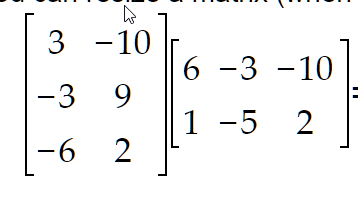


how do I do Matrix multiplication with this
(3)(6) + -10(1)... I'm confused as to how to follow up with the rest
cobalt tartan
Any v in V can be written as
v = c_1x_1 + ... + c_nx_n
Becaues M is surjective we require that any w in W be able to be written as w = M(v)
i.e, that
$$w = M(v) = M(c_1x_1 + \cdots + c_nx_n) = c_1M(x_1) + \cdots + c_nM(x_n)$$
stoic pythonBOT
Liria ^(;,;)^:
lone cove
so any w can be written as a linear combination of M(xi)
cobalt tartan
And because w here is arbitrary
We must have that all w in W are covered by this
RigHT?
lone cove
not how i would word it, but basically
cobalt tartan
"As w is arbitrary, we must have that span(M(C)) = W"
lone cove
sure
cobalt tartan
Hrm
If I have that U, V, and W are finite dimensional vector spaces, with L:U->V and M:V->W as one-to-one linear mappings, with U and W isomorphic, then V is not necessarily isomorphic to U right?
Because I'm thinking that I could have like say L:R->R^2, L(x) = (x, 0) and then M:R^2->P_0, M(x, 0) = x right?
cobalt tartan
Yea
lone cove
M isnt one to one
steady fiber
if it's one-to-one, then I'm pretty sure it has to be an isomorphic mapping (in terms of vector spaces)
since for vector spaces, we can say it's an isomorphism if it's an invertible mapping, and since it's 1-to-1, it ought to be invertible
cobalt tartan
L(x, y) -> x is injective but not surjective
Apparently people use "one-to-one" and "Bijective" interchangebly
I should clarify that I mean injective
lone cove
thats not injective
cobalt tartan
Wait is it not
cobalt tartan
Okie ya
My textbook uses one-to-one as injective
HRm
Welp guess I gotta prove that this is true
steady fiber
that clarifies something
I was wondering why they even mentioned anything about M or W
cobalt tartan
Ok let me rewrite that then
U, V, and W are finite dimensional vector spaces, with L:U->V and M:V->W as injective linear mappings, with U and W isomorphic, is V isomorphic to U
Can't think of any counterexamples
So I guess I have to prove ti
thorn robin
it's easy to see it's true
U isomorphic to W means they have the same dimension
now the composition is an injective linear map between spaces of the same dimension, hence an isomorphism
thorn robin
I just wrote a proof
cobalt tartan
Wait
I don't understand the second part of what you said
"Now the composition is an injective linear map between spaces of the same dimension"
steady fiber
think about what it means for M(L) to be an isomorphism
and what it must imply for V
thorn robin
the entire thing can be phrased like this: if a \leq b \leq c and a = c then a = b = c
which is completely obvious
it's enough to see that it's true for numbers since having the same dimension is enough to obtain isomorphism
thorn robin
but it's also true that you get explicit isomorphisms out of M and L
cobalt tartan
It's because I thought that we could go like ... from a higher dimension to a lower one and maintain injectivity?
thorn robin
since like I mentioned, injective linear maps between spaces of the same dimension are isomorphism (rank-nullity theorem)
no that's not true
it would amount to embedding a large space in a small one
steady fiber
what do you mean by "is there any voltage"
there's 2 voltage sources
there's probably voltage drop across all of the resistors
wintry steppe
Hey I'm doing Matrices
can someone explain to me what I'm doing wrong?
Cause I don't know what I'm doing wrong for that to be wrong
lone cove
thats right
wintry steppe
that x is telling me otherwise
lone cove
online assignments are usually shit
wintry steppe
okay mind telling me if this is right
cause this is also telling me this is wrong
lone cove
thats right
 serene axle
does anyone have any tips on matrices additon and subtraction?
i keep making errors
it'll be great if anyone can suggest a way to keep track of the numbers more accurately
steady fiber
add element by element
it's just simple addition of corresponding elements
there isn't much more to it
practice more I guess?
serene axle
@wintry steppe i got the same thing. you're in the good.
oof
😰
welp guess i'll get points off then
apparently people are so smart they sense the numbers
and never get points off
wintry steppe
Can you explain to me how to find the inverse of a matrix?
serene axle
without some sort of organizing
the inverse of a matrix yeah sure
you use guass jordan technique to find the inverse
do you know the proof?
wintry steppe
serene axle
so do you know the proof of the guass jordan thing?
cause every textbook has it
it goes through the details and gives you a tool to find the inverses
steady fiber
most lin alg courses outside math majors don't really care too much about the proof for it
i'm pretty sure
serene axle
well it made sense to me after i saw the proof for it
and i can comfortably use the technique
wintry steppe
mine just wants an answer and I'm good; I've kinda done math most of my life via understanding the concept but never the actual name for it
serene axle
basically what you want to do it set that matrice given to the left hand side
and the right hand side
it's this
1 0 0
0 1 0
0 0 1
you want to manipulate the matrices such that this junk
goes to the left hand side
it's an overglorified version of sudoku
it gets really complicated after 3x3 matrices
3x3 is prob the most reasonable one professors expect you to solve on an exam
2x2 is easy
wintry steppe
I was kinda really sick for a week and had to miss class and they kinda breezed through it and I'm now lost
serene axle
do you understand what im saying?
do you understand how to annotate your matrices?
maybe that'll help
you need to do multiplication
wintry steppe
Truthfully? I'm getting like 50%
I understand guass jordan getting to
1 0 0
0 1 0
0 0 1
but then you lost me after that
serene axle
ah
maybe it'll make sense after an example
uh im just gonna do a basic ass matrice
that even an idiot can do k
wintry steppe
appreciate it
serene axle
rip
steady fiber
then you do gauss jordan elimination on the matrix to the left of the line
do the same row operations on the right as well
whatever you have left on the right when you complete the gauss jordan elimination on the left
is the inverse
wintry steppe
so
3r(2) + r(3)
steady fiber
yes
wintry steppe
then mirror that on the right side?
steady fiber
yes
wintry steppe
getting
1 0 0
0 1 0
0 3 1
steady fiber
so you would get
since you have RREF on the left side
whatever you have on the right
is the inverse
so yes, what you wrote is the inverse
$$[
\left[
\begin{array}{ccc|ccc}
1 & 0 & 0 & 1 & 0 & 0 \
0 & 1 & 0 & 0 & 1 & 0 \
0 & 0 & 1 & 0 & 3 & 1 \
\end{array}
\right]
]$$
stoic pythonBOT
PorosInMyAshe:
$$\[
\left[
\begin{array}{ccc|ccc}
1 & 0 & 0 & 1 & 0 & 0 \\
0 & 1 & 0 & 0 & 1 & 0 \\
0 & 0 & 1 & 0 & 3 & 1 \\
\end{array}
\right]
\]$$
```Compile error! Output:
! LaTeX Error: Bad math environment delimiter.
See the LaTeX manual or LaTeX Companion for explanation.
Type H <return> for immediate help.
...
l.11 $$[
Your command was ignored.
Type I <command> <return> to replace it with another command,
or <return> to continue without it.
Sorry I'm like... idk how to word it other than like an animal but if something feels easy then I get super suspicious and feel like I'm doing it wrong and second guess myself
serene axle
i feel
the matrices i've dealt with from the textbook involved nasty fractions
im practicing how to deal with arithmetic errors cause i don't get calculators on the exam
if i had calculators
then easy pzy
the professor im taking is hard believer in no calculators
if i get fractions gg
wintry steppe
I am given a calculator but my professor went over how to use it while I was sick and isn't gonna go over them
for me
so I'm like "fuck"
serene axle
given calculator
serene axle
what model is it
serene axle
bring a scientific calcualtor if there are no graphing problems
you don't really need a Ti for matrices for instance
unless professor wants you to interpret the matrices then lmao
idk if there are software powerful enough on TI to do that
wintry steppe
You mind if I keep asking questions? I learn better when the language is dumbed down cause I think the textbook just words things with more terms than I can actually remember all at once
serene axle
skim through it
think of the textbook as one big pile of shit like stack over flow exchange answers
because that's what it really is
but it's way better than strangers on the internet giving you advices
wintry steppe
I've done that for the past two hours and barely grasp but being able to bounce off other people is how I learn best; sort of trial and error with someone able to tell me "You're wrong and here's why" and I can ask questions and try things while being told by ppl smarter than me if my grasp on a concept is right or wrong
serene axle
so what you do is you look at the theorems closely
ignore all the text
text is garbage
100%
only use it as supplemental if needed
pictures = good
words = bad
i say this because your textbook has information
your professor may not deem important
so learning extra things is not beneficial at all
wintry steppe
I just wanna pass the class dude
wintry steppe
my major doesn't even use math that much besides basic arithmetic
serene axle
and just look at the example problems and theorems
closely
theorms helps with conceptual understanding
example problems helps you have a basic foundation to tackle any general problems
oof
serene axle
this is how i read it
skim through the top part
for minors and cofactors of a square matrix
read it carefully
refer to the bottom cause it gives an example
focus on that carefully
try to understand it and internalize it for a couple of mins by playing around with it on a piece of paper
cause sometimes textbook skips steps like this one does.
you just gotta work with shitty explanations
wintry steppe
I just wanna know where that formula got the numbers
cause this is also homework which I'm gonna be pulling an all nighter for cause I got an exam tomorrow
Thanks to you guys I now know how to get inverse
Now I need to understand determinants rather than looking at something I can barely understand how to read
wintry steppe
how do I "play" around with that?
serene axle
i don't believe in reading the text
and then somehow understanding the material
get a piece of paper
and start putting stuff down on it
you can start with that example provided for instance
if people somehow understood everything just by reading and not trying to interpret the meaning then i assume proofs must be done the same way.