#linear-algebra
2 messages · Page 29 of 1
 zealous kettle
which one
fuck no this is wrong https://cdn.discordapp.com/attachments/540211747613704221/622868945421991936/179701226995318785.png

 tranquil junco
ye
 stoic pythonBOT
hegel:
 tranquil junco
yes
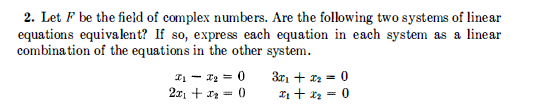
 digital garnet
 digital garnet
hey do u guys have any idea with this?
tranquil junco
FUCK
tranquil junco
ll
stoic pythonBOT
Spes:
tranquil junco
you need to multiply (2x_1 + x_2) by 1/3 too
zealous kettle
$\frac{1}{3} (x_1 - x_2) + \frac{1}{3} (2x_1 + x_2) = x_1$
stoic pythonBOT
Spes:
tranquil junco
okay yes.
zealous kettle
NOW we add
 clever cedar
whats the difference between an n x 1 vector and m x 1 vector
 sonic osprey
They're different sizes?
clever cedar
are u asking me?
sonic osprey
I'm answering your question
clever cedar
with a question mark
sonic osprey
But confusedly
clever cedar
wut
sonic osprey
Because your question really makes no sense
sonic osprey
It's not that I don't understand it
I've taught college courses in lin alg, it's that your question really makes no sense
clever cedar
"Because your question really makes no sense"
u couldve asked for clarification
i dont see the difficulty in that
sonic osprey
Then clarify
clever cedar
as my book defines it, n x 1 vector is a column vector
and when my book goes through an example which results in what they call an m x 1 vector it to me, also looks like a column vector
so i dont understand the difference
sonic osprey
Yeah I really didn't need more clarification, my answer was correct
They're different sizes
I'm not sure why you think there's a difference here
clever cedar
you have a weird attitude to solving questions
u might need to reconsidering 'helping people'
telling me they're different sizes helps
i dont need u to be condesending
sonic osprey
I've won teaching awards thank you
I'm not sure where you see any condcendingness?
<@&268886789983436800>
clever cedar
"ive won teaching awards"
 stone drum
Please do not use homophobic slurs.
sonic osprey
Don't ban him yet let me talk to him
stone drum
And verbal abuse of the Helpers is unlikely to get you help.
sonic osprey
I answered your question, I'm confused why you thought I was being condenscending
How?
clever cedar
if u cant see how ur responses are condensencing, then noone can
its a stylistic approach to how u respond
with question marks
stone drum
What I see is a miscommunication
sonic osprey
teaching is too hard over text
I told you they were different sizes
The question marks were more that I was confused at what you were confused at
clever cedar
u told me they're different sizes, which is helpful but then u question my intelligence by saying "how cant u see that hur durr"
clearly im unaware if im asking
sonic osprey
I don't see where I did that?
Did you take the question marks to mean that?
Because I meant them more as my confusion about what you were confused about
And not sure if I was answering what you were confused about
stone drum
Let's move past the accusations and return to the question.
What is it that you're not following with the n x 1 vs. m x 1 vectors?
clever cedar
i see now, thanks to zopherus that m x 1 is simply a different column vector
of different size
stone drum
Yes.
In this example, specifically, the result vector is m x 1 because the matrix A is m x n
clever cedar
i dont understand the notation n x 1 and m x 1 to represent column vectors though
stone drum
In the matrix, m x n is m rows and n columns.
But after multiplication with the n x 1 vector, the result is an m x 1 vector.
clever cedar
okay thank you
 quartz compass
@clever cedar when you write a m x 1 matrix it looks like 1 single column with m "shelves"
I see how that seems backwards
clever cedar
thank you @quartz compass
quartz compass
you're welcome
 jagged saffron
say we have a linear transformation T from a vector space V to W , which is surjective
If V is finite dimensional, then does that imply that the T(v_i's) form a basis of W if v_i are a basis for V
sonic osprey
Not necessarily
jagged saffron
But if the transformation is surjective, that implies that W is the same dimension by rank nullity theorem right?
And since a linear transformation is defined by the action on the basis, the only way it would be surjective would be for the basis to map to another set of basis
oh wait

nvm
W can be of smaller dimension then V
sonic osprey
Yeah
jagged saffron
but it would map to a spanning set of W basically
sonic osprey
Yep it will
 feral grove
sonic osprey
feral grove
sonic osprey
Just think about what that last sentence is really saying
feral grove
i'm unsure how that last sentence at the bottom follows
oh are you still helping
mb
sonic osprey
It's describing how to write v_i in terms of the basis
feral grove
yes
sonic osprey
Which is a pretty trivial equation to write down, but you write it in that form so you can apply the transformation T
jagged saffron
Assume we're talking about the same surjective linear transformation T: V->W where V is finite dimensional,
Then im trying to show that a inverse exists, such that S composed with T is the identity map
but what if we have two basis elements in V that map to the same element in W?
I was gonna define S(W_1) = v | T(v) = W_1
 wintry steppe
I have a few questions if anyone is not busy
quartz compass
never ask to ask, just ask
 quaint heart

 gray dust
https://sol.gfxile.net/dontask.html @wintry steppe
 tepid pulsar
can someone help me solve 0.25(t + 64) = 6.4 + t
stoic pythonBOT
apples:
wintry steppe
can I assume
$$\left(u+v\right)x_1+\left(a\cdot u\right)x_2=0\Leftrightarrow x_1=x_2=0,:a\in \mathbb{R}$$
stoic pythonBOT
apples:
tepid pulsar
can someone help me out pls :S
stoic pythonBOT
apples:
wintry steppe
yes
wintry steppe
@anyone who can help me with my problem
wintry steppe
I already did
 earnest zinc
oh
wintry steppe
begins with "if I know that..."
it's about assuming linear independence of two vectors
earnest zinc
id assume a = 2
i assume u = v
so u + v = 2u
hence they linearly dependent?
wait
wintry steppe
nope u and v are any vectors
earnest zinc
if x1 and x2 are = 0
wintry steppe
I know they are linearly independent
earnest zinc
o
wintry steppe
but if I add them and I multiply u by a scaler, are they still linearly independent
$$\left(u+v\right)x_1+\left(a\cdot u\right)x_2=0\Leftrightarrow x_1=x_2=0,:a\in \mathbb{R}$$
stoic pythonBOT
apples:
wintry steppe
like is this true?
wintry steppe
thanks bro lol
 dense dock
it should be true
i think
if a is nonzero
since two linearly independent vectors u,v
then (u + v) and u
or (u + v) and v are also linearly independent
wintry steppe
interesting
I mean like is there a way to prove it though? I was just going to assume that since I was focusing on proving something else
dense dock
well yea u could definitely prove that
im sure u dont have to tho
but for intuitive purposes it gives us some insight
wintry steppe
I see
thank you for your helo
help*
$$\span \left(u,:v\right)=\span \left(u+v,:a\cdot u\right)$$
stoic pythonBOT
apples:
Compile Error! Click the  reaction for details. (You may edit your message)
wintry steppe
is this also true
wait
$$\text{span}\left(u,:v\right)=\text{span}\left(u+v,:a\cdot u\right)$$
stoic pythonBOT
apples:
dense dock
yep
same idea
here its easier, try to make u and v from linear combinations of (u+v) and (au)
 grave linden
Wanted to get thoughts on this. What do you suppose the "natural n^2 x n^2" matrix flattening of an order-4 tensor would be? I haven't found any references to a "natural" flattening
i think it is just the flattening onto a matrix of size n^2 by n^2 but i havent seen a reference to a flattening being natural before
as of now im just assuming its just a plain old flattening
for context i am working on this relation at the moment
mostly because i could be a fool but i don't think a matrix of size n x n can be multiplied with a matrix of size n^2 x n^2
nvm i just cant read
 fringe cave
nice
fringe cave
nice
grave linden
this is part of a section of a paper to give an efficiently computable upper bound on the injective tensor norm
its a bizarre topic but quite interesting
 lone cove
so, the matrix they give in the second part has eigenvalues 4, 4, and 8
which means xT A x never equals 1 by the first part
am i getting pranked or am i missing something
lone cove
oh, i assumed that xT x was 1
 noble swallow
Mm, so is it 1/8 <= x^T x <= 1/4 in the end?
 undone garnet
$\begin{vmatrix}
1+x_1y_1&1+x_1y_2&1+x_1y_3\
1+x_2y_1&1+x_2y_2&1+x_2y_3\
1+x_3y_1&1+x_3y_2&1+x_3y_3
\end{vmatrix}$
stoic pythonBOT
Nguyễn Thành Trung:
Nguyễn Thành Trung:
Nguyễn Thành Trung:
Nguyễn Thành Trung:
Nguyễn Thành Trung:
undone garnet
does any check this prob for me please
i don't know but I find it = 0
but it's not = 0 😐
still don't know why
woops
I check the case n = 2 and it's not zero
but for n >= 3, it = 0
 dusky epoch
this is J + xy^T, where J is the 3 by 3 matrix of all ones, x = [x1;x2;x3] and y = [y1;y2;y3]
rank(J) = 1
rank(xy^T) <= 1
rank(J + xy^T) <= rank(J) + rank(xy^T) <= 2 < 3
undone garnet
any idea for this problem?
dusky epoch
angle sum formulae i guess
||letting a = [α_1; α_2; ...; α_n], your matrix is sin(a)*cos(a)' + cos(a)*sin(a)', in matlab notation||
||so its rank is at most 2||
||so for n above 2 this is guaranteed zero||
undone garnet
let me try
dusky epoch
rank(A+B) ≤ rank(A)+rank(B)
$\mathrm{rank}(uv^T)$ is 1 iff $u$ and $v$ are both nonzero, otherwise 0
stoic pythonBOT
Ann:
undone garnet
does anyone know how to prove
$\text{rank}(AB) \le \min{\text{rank}(A), \text{rank}(B)}$
stoic pythonBOT
Nguyễn Thành Trung:
undone garnet
this my proof
let x in ker(B) => Bx = 0 => ABx = 0 => ker(B) is subset ker(AB) then rank(AB) <= rank(B)
rank(AB) = rank(AB)^T = rank(B^TA^T) <= rank(A^T) = rank(A)
so rank(AB) <= min{rank(A), rank(B)}
I've read some solution in some math forums
but this one made me confused
how "if A is singular, then clearly, nomatter what B is, rank(B) <= rank(A)"
I don't understand
 visual kraken
Hi guys, could you tell me about some good resources, books or whatever to learn linear algebra in my own?
 slow scroll
I used a book called “linear algebra done wrong” @visual kraken
 fringe vessel
Apart from trasnposition and inversion, are there some other interesting maps such that
f(x*y) = f(y) * f(x)
?
Do they have a name?
slow scroll
Multiplication endomorphisms?
fringe vessel
order flips
slow scroll
Oh.
@fringe vessel I think I found it: anti involution https://en.m.wikipedia.org/wiki/Involution_(mathematics)

In mathematics, an involution, or an involutory function, is a function f that is its own inverse,
f(f(x)) = xfor all x in the domain of f.The term anti-involution refers to involutions based on antihomomorphisms (see § Quaternion algebra, groups, semigroups below)
f(xy) =...
Anti homomorphism would be the more general term for f(xy)=f(y)f(x)
slow scroll
xd it’s a good question
visual kraken
Thanks @slow scroll
quartz compass
@fringe vessel Looks like you're asking about multiplicative and completely multiplicative functions
you can define a completely multiplicative function with a completely additive function, A(x*y) = A(x)+A(y), by f(x) = C^{A(x)} as this gives you f(x * y) = f(x) * f(y) if that interests you
fringe vessel
erm, A=log being an example?
quartz compass
yep
fringe vessel
I'm not sure if that's what I'm after
I'm looking for functions with f(x*y) = f(y) * f(x) but x and y aren't generally commutative here
transposition and inverstion of matrices being an example
I couldn't find another example yet
quartz compass
complex conjugation usually goes well with transposition
that's where stuff like hermitian and unitary matrices pop up
there's also conjugation like f(x) = a^{-1} x a
fringe vessel
not really tho 🤔
f(x*y) = a^{-1} x y a = a^{-1} x a a^{-1}y a = f(x) f(y)
not
f(x*y) = f(y) f(x)
wintry steppe
Yo how do i figure this out?
 sage shoal
Hint :- h(h^-1(x)) = h^-1(h(x)) = x
sonic osprey
Well you've shown it exists I'm sure
What happens if two polynomials of degree n-1 agree at n points?
jagged saffron
Someone told me their difference would have n roots
but how would a polynomial of degree n-1 have n roots
Thats actually what im kinda confused about rn
noble swallow
The difference has degree <=n-1
So if it has n roots, it's the 0 polynomial
jagged saffron
But why does the difference have n roots
noble swallow
d(x)=p(x)-q(x)
And p(x_i)=q(x_i)=y_i for all i=1,...,n
undone garnet
how to prove rank(A) = 1 then A has only one eigenvalue != 0 and it's value = trace(A)??
dusky epoch
assuming A is square?
dusky epoch
dim ker(A) = n-1
where n is the size of A
so its charpoly has 0 as a root of multiplicity n-1
slow scroll
well if rank(A) = 1 then we have that A = xy^T for some nx1 matrices x and y. Thus the columns of A are all scalar multiples of x. Then it follows from the definition of matrix multiplication that A maps any vector to some scalar multiple of x. Therefore, x would be an eigenvector whose eigenvalue is exactly the sum of the diagonal entries of A. This is exactly trace(A).
Suppose that there is some other eigenvalue of A such that trace(A) = (the previously found eigenvalue). We know that trace(A) is the sum of the eigenvalues of A. If lambda is the eigenvalue we found previously, and lambda2 is another eigenvalue, then we must have that trace(A) = lambda = lambda + lambda2. This implies lambda2 = 0.
undone garnet
lambda2 = 0
so lambda 2 can be -1 + 1
I mean
sum of the rest of eigenvalues = 0 but it's not equivalent to all of them = 0
slow scroll
oh yea rip :/
I mean, you could just say for all v!=0, Av = ax. Therefore 0 and x are the only possible eigenvectors of A. We found the eigenvalue for x, and the eigenvalue for 0 is 0 🤷
noble swallow
@undone garnet mm that's not always true. Two cases are possible, the characteristic polynomial of A is
(x^(n-1))(x-λ) or it could also be x^n (omitting eventual leading signs)
In either case -tr(A) is the coefficient of the order n-1 term
undone garnet
well
because I'm trying to prove
det(A+E) = trace(A) + 1
and I've read some solutions
it guides me to prove eigenvalue of (A+I) = trace(A) + 1
and the others is 1
=> det(A+E) = (trace(A) + 1).1.1.1.1 = trace(A) + 1
dusky epoch
the spectrum of A is known in its entirety
0 with multiplicity n-1, some other value λ with multiplicity 1
you're really overthinking it
noble swallow
Uhm wait no, 0 could have also multiplicity n
A+I has eigenvalues 1 and trace(A)+1 if we agree to mean with it that when trace(A)=0 the only eigenvalue is 1
dusky epoch
yeah if λ=0
noble swallow
Yes, indeed to prove that det(A+E)=trace(A)+1 we can argue that A is similar to an upper triangular matrix with only 0 on the diagonal except for one entry being trace(A)
So A+E is similar to an upper triangular matrix with only 1 on the diagonal except for the one trace(A)+1 entry
@undone garnet
 pine hearth
Was reading through my linalg textbook and found that the zero vector is not a basis of the space it spans. Why is this true?
lone cove
if it was true then the space that it spans would have dimension 1 even though it isnt a line
pine hearth
geometrically that makes sense, but the dimension itself is defined by the number of basis vectors
sonic osprey
@pine hearth the dimension is 0 for that space
pine hearth
According to the textbook I'm using the definition for the dimension is the number of basis vectors fo a space so I was wondering why it had 0 basis vectors
jagged saffron
never done exact sequences before, does it just by definition tell us Ker(T_1) = 0?
 dawn apex
Yea
 cosmic coral
can somebody explain the difference of these two funcetions of variance to me? i realize they are the same but for some reason i get different results
 green garden
@cosmic coral well they have different denominators, so they compute different things
when the mean is known, the first one is an unbiased estimate of the variance. when the mean is not known, the second one is the unbiased estimate
m here is the sample mean
 mellow meteor
https://en.wikipedia.org/wiki/Basic_Linear_Algebra_Subprograms#Level_3 does that mean that it's either transposing A and B or none at all?
Basic Linear Algebra Subprograms (BLAS) is a specification that prescribes a set of low-level routines for performing common linear algebra operations such as vector addition, scalar multiplication, dot products, linear combinations, and matrix multiplication. They are the de...
 rose parrot
Do I understand this terminology correctly? Any spanning list of a vector space V needs to be linearly independent? I know that we can have a linearly dependent list of vectors have the same span as if we removed 'excess' vectors. But my book says that the length of any linearly independent list in V needs to be less than or equal than the length of any spanning list. That's where I assume from, that the term spanning list relates to any linearly independent spanning list. Is that correct?
Everything is clear to me, including the stated theorem, but that leads me confused about the term spanning list
Appreciate any answers
sonic osprey
No, the answer is that a spanning list/set does not need to be independent
 open ingot
can anybody help me in geometry
open ingot
when did you tell me this
rose parrot
Ohhh I get it now. The key word in the theorem is that any independent list needs to be shorter or equal in length to every spanning list
Ok that clears it up
sonic osprey
Correct
open ingot
@sonic osprey lie
tepid pulsar
could someone help me graph the equation y=-1/2x+9/2
sonic osprey
This isn't really the right channel for this. #prealg-and-algebra would be more appropriate
 leaden ermine
Hey all, can someone please help show me why taking the trace of an n x n matrix would be considered a linear transformation?
 winter harbor
What would be the geometric intuition of determinants in higher dimensions?
I don't think there would be something equivalent to a volume or area in higher dimensions maybe.
Or there is?
Like a generalization of the notion of ''amount of space'' we get when talking about area or volume.
slow scroll
sure there is
winter harbor
Is there like a name for it?
Just like polytopes are a general term for polygons and etc...
slow scroll
hypervolumes I think?
gray dust
it's called "don't complain if you can't visualize spaces higher than R^3, just shut up and do the algebra"
slow scroll
Just consider the integral of some function over a 3d region. That can easily be interpreted as 4d volume
winter harbor
It feels way more intuitive, for sure.
Damn
Living in a 3D space sucks.
Yeah, that seems reasonable.
slow scroll
im having trouble understanding what the last line is saying. L_k b_k are both linear functionals, right? 
er um would L_k be elements of the field that make up the coordinates of L?
 slim yoke
Not sure if this is the right channel, so please just redirect me if possible.
(I am also an amateur, so please pardon any incorrect and/or inaccurate terminology.)
Is there a theorem or whatever that states that for every exponential multiple (dunno the proper term) of 4 (4, 16, 64, 256, 1024, and so on), there exists a positive integer (x) such that f(x) = 3x + 1 for that number, where (x) is the sum of all preceding exponential multiples?
For example, for 4^4 = 256, there would be a value (x) such that f(x) = 3x + 1, and (x) would be the sum of (4^0)+(4^1)+(4^2)+(4^3) = 85.
Is there a theorem for that?
 thorn robin
so you're asking if 4^n is always of the form 3m + 1
the answer is yes
because 4^n mod 3 = (4 mod 3)^n = 1^n = 1
slim yoke
Does that apply to all integers used as base or just 4?
slow scroll
4 = 1 (mod 3)
4^2 = 1 (mod 3)
suppose 4^n = 1 (mod 3)
4*4^n = 4^(n+1) = 1 (mod 3)
slim yoke
I mean, not exactly always 3x + 1. But for other base integers, will there be something like that too?
thorn robin
if you don't like the mod thing, it is easy enough to rephrase this in plain terms
like @slow scroll suggested we can use induction
you know 4^1 = 3*1 + 1
and if 4^n = 3a + 1 then 4^{n+1} = 4 * (3a+1) = 12a + 4 = 3(4a+ 1) + 1
noble swallow
@slow scroll yes L_k are scalars
leaden ermine
Hi all, if A is an n x m matrix, how could I show that the Image of A and the kernel of A are subspaces of R^n and R^m respectively?
slow scroll
f(x) = nx + 1
n+1 = 1 (mod n)
(n+1)^2 = 1 (mod n)
yea so you could proceed by induction for the general case as well. Basically the fact Im using about modular arithmetic is that for
k = n (mod a)
bk = bn (mod a)
so if we know n+1 = 1 mod n
then (n+1)(n+1) = 1*1 = 1 mod n
slow scroll
@leaden ermine show that they are subsets of the spaces, and then show that they contain the 0 vector, are closed under addition and scalar multiplication. Use the fact that a matrix is a linear transformation.
leaden ermine
Hi ok, I understand. Do I prove them separately or together? So for one, would I simply say the Image is a subspace of R^n because of those 3 criteria?
slow scroll
yea, but you have to show that each of those criteria hold
and prove them separately for the image and kernel
leaden ermine
So for instance, for the zero vector and showing the image is within R^n. Since A0n=0n, the zero vector is an element of R^n and in the image space. For closed under addition we want to show that x+y is an element of the image space, so we just need to show A(x+y)=0 through A(x+y)=Ax+Ay = 0 + 0 = 0
I guess im not sure how to show it without using an example matrix, so Im just using definitions
slow scroll
Ax + Ay is not necessarily 0. I'm not sure where you were going with that.
For any x, y in the image of A, we have that x = Au and y = Aw for some u, w in the domain of A. Try from here
leaden ermine
So going off that, we have to show the image contains the zero vector, meaning if we set all variables in the image matrix to zero, our output should be zero right?
at least for the first criteria
slow scroll
Oh so what you had for that was basically valid. It might not hurt to consider A(x-x).
leaden ermine
Does this link do a good job of proving these properties? It seems very simple so not sure if its actually proving or just stating...

We prove that for a given matrix, the kernel is a subspace. To prove it, we check the three criteria for a subset of a vector space to be a subspace.
seems like it used the zero vector to prove all 3 criteria?
slow scroll
Well that’s because the kernel has a lot to do with the zero vector lol!
The proof for the image is very similar as well
slow scroll
Hm not really. It really is almost the same
let x, y be in the image of A. Why should x+y also be in the image of A?
For any x in the image, there exists some u such that A(u)=x. I’ll leave it at that
leaden ermine
Got it, fair enough thank you for your help! One last question, why would taking the trace of an n x n matrix would be considered a linear transformation?
slow scroll
Yeah it would.
As an exercise, you could try to find the matrix $\operatorname{tr} : M_n(\bbR) \to \bbR$ that takes every matrix in $M_n(\bbR)$ to its trace in $\bbR$.
stoic pythonBOT
kxrider:
slow scroll
actually i don't think that is that simple
lone cove
wouldnt you need 2 matrices to get to a 1x1 matrix
one on left and right
still not that hard tho
[condense columns matrix] [projection onto I_n] [input] [condense rows]
thorn robin
if you plan on writing the trace as a matrix it's going to be a 1 by n^2 matrix
and n of the n^2 entries will be 1, the rest 0
with respect to the obvious basis of M_{n x n}
but for @leaden ermine original question, it is much more straightforward to just verify directly that the trace is linear i.e. tr(aX + bY) = a tr X + b tr Y
slow scroll
Oh well yea, finding a matrix representation for trace is obviously super impractical, but u could do it xd
undone garnet
prove that if A has sum of each row (or column) = 1, A has 1 as an eigenvalue
dusky epoch
there is a nonzero vector which is pretty obviously in the kernel of A-E
dusky epoch
consider how you might obtain the sum of all the entries of a row vector by multiplying it by a cleverly chosen column vector
undone garnet
well
x = (1, 1, ..., 1)
right?
sorry for misreading
I thought you said no vector
(A-E)x=0 <=> Ax = x => A has 1 as an eigenvalue
yeah
niceeee
thank you 😄
 native ore


 leaden ermine
Thx Kxrider and Seoin, was able to verify Trace as a linear transformation
undone garnet
$A, B, C \in M_2$ prove that $(AB-BA)^{2004}C=C(AB-BA)^{2004}$
stoic pythonBOT
Nguyễn Thành Trung:
undone garnet
any idea?
dusky epoch
is there a ^ missing on the left
quaint heart
Can you think of a counterexample?
quaint heart
You can definitely brute force this
Maybe there is something clever with diagonalization or something
Wait actually
It has to be a diagonal matrix
In order for this to be true
undone garnet
oh I see
quaint heart
(AB-BA)^{2004} that is
stoic pythonBOT
Nguyễn Thành Trung:
undone garnet
$(AB-BA)^2 = (a^2+bc)I$
stoic pythonBOT
Nguyễn Thành Trung:
quaint heart
So that's it then
2004 is even
So you're done
It's a well known result that the matrices that commute with every other matrices are the ones of the form aI
For some a
(I meant to say that, not diagonal)
 split grove
is this an acceptable proof?
can I call that induction
first line is given as a theorem
 pallid swallow
If this is a class on proof writing, then you need to be a bit more rigourous with your induction
@split grove
If you are just trying to show your result, then, this should do.
 mint surge
What matrix could I multiply a 2x10 matrix by, to get the same matrix, but every other column is 1/3 its size?
pallid swallow
Do you multiply on the left or right?
@mint surge
as such, what would be the dimensions of such a matrix?
mint surge
I'm new to linear algebra, not quite sure if it was possible or nt
I might not understand the question I was given
pallid swallow
It is possible.
@mint surge So, do you multiply the new matrix on the left or right, and what are the dimensions of such a matrix?
Think elementary matrices
mint surge
My initial guess would be to put it on the left, because if I were doing a scalar thats where i'd put it
pallid swallow
So, what would the size be?
And can that make every other column 1/3 its size?
@mint surge
mint surge
That's the part I've lost myself on. Column size would have to be nx2 to multiply with a 2x10
mint surge
2x10
pallid swallow
so, that means the matrix you multiply needs to have size?
mint surge
hmmmmmmmmmmmmmmmmmmmmmmmmmmmmmmmmmmmmmmmmmmmmmmmmmmmmmmmmmmmmmmmmmmmmmmmmmmmmmmmmm
10x10?
n x k by k x m = n x m
pallid swallow
but it might not be possible multiplying on the left
did you manage to do it for multiplying on the left?
Try expressing your product in terms of row/column vectors
mint surge
I did some experiments with 2x2's but I couldnt get it to correctly go to every other row.
(Im using matlab)
If I were to do a 10x10, how would I represent "every other column"
mint surge
So would I just make the diagonal
1 1/3 1 1/3 1 1/3?
going all the way down
Got it, thanks!
pallid swallow
yeah, that's the idea
slow scroll
j^j should be t^j, right?
 gray glen
yes
slow scroll
okay that would make more sense.
i don't think im quite clear on why this is dual. The trivial example make sense where the every basis vector e'_k in the dual of Rn maps every basis vector e_j in Rn to 1 if j=k, and 0 otherwise.
I'm not sure if I am seeing the connection
 hollow phoenix
Question.. let T(V) denote the tensor algebra or a vector space V and I the ideal generated by elements of the form x tensor x.. then the exterior algebra Wedge(V) is defined as T(V)/I. There is a natural surjection pi: T(V) -> Wedge(V).
There is also a isomorphism between T(V’) and multilinear maps out of V, and an isomorphism between Wedge(V’) and alternating multilinear maps out of V. Here V’ denotes the dual of V.
We can define the Wedge product on the level of the exterior algebra as follows..
a Wedge b = pi(a0 tensor b0), where a0 and b0 are any two representatives of a and b in T(V’).
Now say we want to define the Wedge product on the level of multilinear maps as is usually done In textbooks. Say a corresponds to the alternating multilinear map A and b to the alternating multilinear map B by the isomorphism mentioned earlier.
We can define the Wedge product of these two maps as Alt(A tensor B) or (some term with factorials) Alt(A tensor B)
Which of these corresponds to a Wedge b as defined earlier? And which of these is the one used in differential geometry when taking Wedge products of forms? If they differ, why the difference?
quaint heart
So your question is if we use the one with factorials or not?
@hollow phoenix
That choice depends on your definition of the alt map
hollow phoenix
Err my question is which one corresponds to the Wedge product as defined earlier
Oh .
Wait.
So the two maps are actually the same then?
quaint heart
So some people define the alt map with dividing by n!
hollow phoenix
Ah..
hollow phoenix
But both of these ways lead to the same map which corresponds to
Dividing
I checked stackexcuange
quaint heart
Ok yeah
hollow phoenix
Anyway they’re both the same map that corresponds to the former Wedge product?
quaint heart
Yeah, so if you include that in your definition of the alt map
hollow phoenix
Ah wonderful
quaint heart
You need to cancel the factorials from Alt(A \tensor B)
hollow phoenix
Confusion resolved I guess
quaint heart
And stuff like that
hollow phoenix
Any reason why people define it this way (on the level of maps) and not in the exterior algebra which feels much more natural
quaint heart
Well it's the same
quaint heart
They define the exterior Algebra using this map
quaint heart
👌
@hollow phoenix Wikipedia defines it without the n!
While lee defines it with the n!
hollow phoenix
Okay so .. let i1 denote the isomorphism between T(V) ~ multilinear maps and i2 the isomorphism between Wedge(V) ~ alternating multilinear maps. And let Alt denote the alternating operator. Then given a in T(V) is it true that
pi a = i2^-1 Alt i1 a? For which definition of Alt is this true?
I guess it’s the one with the n! ?
@quaint heart
quaint heart
Hmm, I need to think about that for a bit
Wait sorry, what is i2?
@hollow phoenix
Do you mean between Wedge(V) and alternating multilinear maps or something?
quaint heart
Ok, got confused for a sec
quaint heart
So the funny thing is, I'm thinking of Wedge(V) as the subspace of alternating tensors of T(V)
hollow phoenix
Hmm
hollow phoenix
I mean they’re the same in some sense..
But like the defintion I’m using is like
Wedge V and T(V) are different spaces
quaint heart
They are both quotient maps
hollow phoenix
hmmm....
hollow phoenix
Hold up
Can we agree that pi is
At least
Canonical?
Theres like no ambiguity
quaint heart
Hmm
hollow phoenix
Send an element of T(V) to its equivalence class in Wedge(V)
And i1 and i2 are canonical as well..
So there seems only one choice of Alt that makes that identity work ..
hollow phoenix
I mean I’m seeing Alt as a operator sending multilinear maps to multilinear maps
And pi is the natiral surjection
quaint heart
Yeah
hollow phoenix
So a priori they’re different things ..
quaint heart
I guess write everything out
quaint heart
Yeah
quaint heart
Yes
hollow phoenix
Thanks 4 help
quaint heart
👌
hollow phoenix
@quaint heart ehh wtf
Wikipedia uses the k! In the alternation shit but still uses the factors in front of the Wedge product
So a wedge b as defined here is actually different than a wedge b as I defined it ..
quaint heart
If you use k! you need the factors
Otherwise you don't
Cause you want to cancel out the 1/(k+m)! From alt
And replace it with (1/k!)(1/m!)
If you don't use k! You don't need factors
@hollow phoenix
You do this for homomorphism reasons
hollow phoenix
Oh rite
Ugh that means that the map I mentioned and the map given here are not the same..
I guess I’ll live with it
 toxic pendant
I have a question assigned in my homework and I'd like to verify if my answer is correct
Is this statement true or false, if a system has more equations than variables, it's rref must have a row of 0's
I think the answer is true but my answer divides the solution into 3 cases, one solution, infinite and none
With one solution, you only need one equation for each variable, as such any more equations would be redundant and be reduced down to 0's
With infinitely many, you'd need to intersect two planes which only required two equations out of the 3 variables, any more would be redundant and reduced down to 0's
With none, there would be redundant parallel planes which would be reduced to 0's
slow scroll
are you talking about the rref of the augmented matrix?
toxic pendant
Yes
slow scroll
Consider the case where the first n-1 equations are linearly independent and the nth equation is a linear combination of the others, but inconsistent. Then every row will have a pivot in the augmented matrix. In the last row, you will have zeros everywhere except in the last column. @toxic pendant
i.e. the pivot for the last row is in the last column of the augmented matrix
toxic pendant
That is very simple and upsetting that I didn't think of it
You're saying that for example, with 4 equations the last one could be (0,0,0|5)?
slow scroll
well in rref it would be a 1, but yea
toxic pendant
Thank you for the assistance
slow scroll
np
toxic pendant
Another thing, why do we use rref instead of systems?
 north sierra
if you make a matrix into REF, there could be multiple answers right?
slow scroll
its not always useful to think of transformations as systems, you can deduce a lot of things about a transformation by examining its rref
@north sierra Sure
er wait, answers to what? You mean solutions to Ax=b?
slow scroll
oh yea ref is not unique, but rref is
slow scroll
yea
north sierra
when a matrix is not augmented
it doens't matter if all the row positions are 0 except for the last one right
so like
[0 0 0 4]
slow scroll
matter for what?
north sierra
cause if its a augmented matrix having all 0s in a row except for the last one means its inconsistent
slow scroll
ok, but a non augmented matrix is not an equation
slow scroll
yea if its just a regular ol matrix and the last column doesn't correspond to anything in particular then its fine
dense dock
oh just dot product everything
dawn apex
u•v=||u|| ||v|| cos θ where θ is angle between u and v
So jus need to show
u•w=||u|| ||w|| cos θ/2 and similarly for v
that seems like the simplest way?
 cloud cedar
you can put a slash in front of the || to stop it from making spoilers: \||v\|| gives ||v||
 thin bloom
If I had a set of vectors {[1,0],[0,1], [1,0]} would this be Linerly dependent? I heard that sets cant have the two elements that are the same so would the set collapse to {[1,0],[0,1]}?
cloud cedar
do you know the definition of linear dependence
thin bloom
If the solution to the homogeneous linear combo has a at least one nonzero solution
The constants of course of the linear combo
cloud cedar
so if i take the linear combination n[1, 0] + 0[0, 1] - n[1, 0], i can get zero even tho the coefficients are not all zero
thin bloom
Yes but in my next question I asked if the set is equivalent to {[1,0],[0,1} which is linearly independent
cloud cedar
depends on what you mean by equivalent; the sets span the same space
thin bloom
I mean like in set theory the sets {1,2,3} is equivalent to {1,2,3,3}
So for a set of vectors can we say the same?
lone cove
you dont usually deal with sets of vectors, theyre typically lists
thin bloom
So they're not sets?
north sierra
if my matrix is inconsistent
plugging in the values into the original equation wont be True right?
slow scroll
what values?
north sierra
the last value of each row in an aguemented matrix
augmented
is there a name for that btw?
 bitter minnow
Question that's killing me: is it possible nullspace of a 4x3 vector to contain only the zero vector?
slow scroll
"the solution"
If the matrix is inconsistent, then there is no solution of course. I'm not quite sure what the other coordinates of the solution would represent if the system is inconsistent.
James, if you mean 4x3 matrix, then no
slow scroll
np. I or someone may ping you if they can think of a better answer lol
north sierra
okie dokie
bitter minnow
4x3 matrix, yes what I meant... im tired and struggling 😦
Why is that the case?
I am so confused...
slow scroll
consider the column space of that matrix. You can't have more than 3 vectors in a basis for R^3, so one of the vectors must be "redundant." Therefore the representation of any solution to Ax = b is not unique
bitter minnow
so it must contain at least 2 vectors, and by definition the nullspace contains the zero vector
slow scroll
specifically, the solutions to Ax = 0 wouldn't be unique. If it was, then it would exactly line up with the definition of linear independence.
Does that make sense?
bitter minnow
More or less...
I honestly haven't understood what tf was going on for a while so I think that'll have to do for now
slow scroll
if v1, v2, v3, v4 are the columns of A and if the kernel is nontrivial, then that means there is an x = (a,b,c,d) not equal to the zero vector such that
av1 + bv2 + cv3 + dv4 = 0
north sierra
sorry for interrupting, but if i have a a*b coefficient matrix where a are the row and b are columns, how do I know if it's consistent or inconsistent
without knowing the matrix values
slow scroll
I'm not sure I understand what you mean by the a*b thing xd
slow scroll
axb matrix?
north sierra
where 4 is the row
bitter minnow
so you have a axb matrix
north sierra
and 6 is column
bitter minnow
oh wow lag
north sierra
yeah i said where a is the row
and b is the column
i said are but i meant is lol
but yeah
slow scroll
Anyway, it could be inconsistent whenever a>b.
slow scroll
so if you have a matrix A, and an equation Ax = b. There are some values of b that yield solutions (the column space of A)
north sierra
what if a<b?
slow scroll
then the solutions are not unique
slow scroll
that means its rref form has free variable(s)
and to be clear, the conditions a<b and a>b guarantee non-uniqueness and inconsistency respectively, but any transformation can be both (or neither for square matrices)
gray dust
a>b guarantees inconsistency
most of the time, sure. but it could have solutions if a row is a linear combo of the others @slow scroll
north sierra
ok well i have this similar question in my textbook
how would i even solve this if i it's not guaranteed
to be inconsistent
or the opposite
slow scroll
to say its consistent just means that you choose b such that Ax = b has solution(s)
slow scroll
the "b" is the vector form of the RHS of the system. so take a random system;
.... = 1
..... = 3
... = -1
b = (1, 3, -1)
The variables of the system are just x = (x1, x2, x3)
and the coefficients of each variable correspond to a coordinate of the matrix A.
gray dust
@north sierra i feel like you would REALLY benefit from watching a linalg video series that emphasizes viewing matrices as transformations on spaces
slow scroll
yea +1 to that.
gray dust
that's a nice start
and then get some practice with khanacademy's linalg pset, the usual stuff
bitter minnow
mk... stuck again... if matrix A has a column space that is 2x2 and a nullspace that is 2x2 then does A need to be 4x4?
bitter minnow
yes
sorry, interpreted it wrong
the column space and nullspace are both 2 dimensional
slow scroll
yep
bitter minnow
digging through my notes for it but can't find it 😐
rank(a) + nullity(a) someting somethin
slow scroll
yea rank nullity. basically
rank(a) + nullity(A) = columns of A
bitter minnow
so A must have 4 columns, does it need to have 4 rows?
slow scroll
hmm it should have a minimum of 2 rows just because rank(A) = rank(A^T)
there is no similar equality relating the dimension of the null space and the dimension of the left null space tho
north sierra
okay i get what you explained now @slow scroll
i still haven't learnt vectors
so these videos are not working out for me
im still in he process of learning vectors tho
(started today)
slow scroll
keep on learning that stuff, but let me ask you this: how many variables does a 4x7 matrix have?
north sierra
7
slow scroll
right, and the pivots correspond to the "basic variables." So if there are 4 pivots, then how many free variables does there have to be?
north sierra
3
so no row will be a zero row (example: 0 0 0 = b where b is a non zero)
so it's consistent
plus having 3 free variables means it has infinite number of solutions
so thats also another reason?
slow scroll
nope that is not necessarily true. Because there are free variables tho, how many solutions does a consistent system have with this matrix?
north sierra
infinite?
slow scroll
yep.
north sierra
so what's not necessarily true?
slow scroll
its not necessarily inconsistent. It is entirely dependent on the choice of RHS for the system of equations. And as a disclaimer, for a 4x7 matrix it could very well be the case that it is never inconsistent i.e. there are always solutions to Ax = b for any choice of b
slow scroll
oh ok lol. well yea you have the right idea about the free variables and everything
north sierra
oh ok lol
linear algebra is hard to imagine
but its fun
so like when you find the general solution (RREF), you have found lines where they all intersect one another at the same point?
slow scroll
well they are not necessarily lines. they can be higher order spaces. This is a decent visualization tho. lets say you have
x+y+z=1
x+y+z=2
These planes never intersect (they are parallel to each other) and naturally there is no solution (x,y,z) to this system (i.e. its matrix representation is inconsistent).
when you start to think of matrices more as transformations, you'll think of them more frequently as collections of column vectors. so a 2x3 matrix for example would have 3 vectors from R2 (2d vectors) A = [v1 v2 v3].
bitter minnow
I have some 3x3 matrix A, I calculated the basis for the column space and nullspace of A and A^t. If I wanted to check if the vectors of the basis of the column space of A and the vectors of the basis of the nullspace of A^t give a basis of R^3 I just need to see if the 3 basis vectors are linearly independent, right?
Im struggling to understand the problem...
slow scroll
If nullity(A^T) + rank(A) = 3, then yea, all that remains is to check is if they are linearly independent
bitter minnow
perfect, I really should just have some more confidence :p
Thanks for the huge help tonight kxrider, your efforts are greatly appreciated
 leaden fiber
is span the plane containing the three points? how do I check if vectors lie in a span :o
(ping me ty <3)
gray dust
@leaden fiber turn the three vectors in the parentheses into a matrix A. let one of the vectors you're testing be b. see if Ax = b has solutions
 uneven bloom
Well can you find the rank of the corresponding matrix or note that two are linearly dependent
Matrix is not invertible so you need a little bit of work
leaden fiber
what is the rank of a matrix :o
dusky epoch
the span of a set of vectors is the smallest subspace that contains them all
leaden fiber
so, a plane in this case?
gray dust
yeah their span looks like a plane in R^3
dusky epoch
are these LD
gray dust
ya
gray dust
linearly dependent
dusky epoch
ok yeah they are
gray dust
the maximum number of linearly independent column/row (depending on matrix size) vectors of a matrix
leaden fiber
I don't understand >.> wdym by maximum number tho, isn't it just three if all three vectors are linearly independent?
gray dust
in your example the three vectors in the parentheses are linearly dependent. do the math and you see that one vector can be expressed as a linear combo of the others. the rank is 2
if they WERE linearly independent, then rank = 3. we call that "full rank"
gray dust
no problem 
leaden fiber
did you spot the linear dependent thing by eye though, and is there a way of finding out without doing the math?
still gonna do the math ofc, just wondering if there's an intuitive way of making guesses
gray dust
call the vectors v1 v2 v3. it doesn't take long to see that v1 + 2*v2 = v3
gray dust
yw 🙂
leaden fiber
does the linear dependency in the span affect the steps I need to take in checking whether the two vectors lie in the span?
gray dust
if the set of vectors were LI, you'd have a nice basis for R^3
leaden fiber
(does R^3 mean a 3D space)
gray dust
you can think of it like that
and having a basis for R^3 means EVERY vector in R^3 can be expressed as a linear combo of v1/v2/v3
so you wouldn't have to bother checking to see if the other two vectors lie in the span of v1/v2/v3
leaden fiber
ah right :o
oh no I lost my notes for class, forgot how to check if A(x)=B
do I just do:
-1x+1x+1x=1
1y+2y+5y=1
0z+3z+6z=-1? but there'd always be a value for x,y, and z
(in class we used x1, x2 and x3 instead of x,y, and z so me using xyz is probably inaccurate but less confusing typing it out here)
gray dust
turn v1/v2/v3 into a 3x3 matrix and call it A
call one of the vectors you're testing b
when you solve Ax=b, make an augmented matrix from A and b, then get it into reduced form to solve for x
leaden fiber
This is augmented matrix, right?
gray dust
yes
if the matrix has at least one solution, then b lies in the span of the set of v1/v2/v3
stoic pythonBOT
gray dust
this is inconsistent
uneven bloom
Uh @leaden fiber in general, you can take the determinant of the 3 by 3 matrix
It completely classifies invertibility/linear independency
Invertibility essentially means that the vectors span R^n, meaning that any element of R^n can be expressed as a linear combination of the vectors.
leaden fiber
everything could all be zero?
gray dust
no
leaden fiber
oh right
:o
me bad me bad
yeah so that means the vector doesn't lie in span right?
gray dust
you get a row of 0s except with a nonzero constant at the end
this implies 0x_1 + 0x_2 + 0x_3 = 1 which isn't true. no solution for x
thus b lies outside the span
gray dust
np
leaden fiber
what if there are infinite solutions?
for the second one both of the lines give 0 3 6 -1 so one goes 0 0 0 0
so infinite solutions
that counts as having solutions right?
gray dust
if the matrix has at least one solution, then b lies in the span of the set of v1/v2/v3 @leaden fiber
dusky epoch
use the definition of linear dependence
dusky epoch
don't ping me personally. >:|
 upper yew
what the fuck im just trying to get some help u tell me to move out of that channel and then now u tell me not to ping u
i don’t understand
just trying to get help man
dusky epoch
ok let me spell this out for you
- the reason there are 10 questions channels is so that many people can get help at once without having to shout over one another in 1 channel, and i expected you to move to one of those.
- i am not the only one who provides help. you should've waited 15 minutes and then, if nobody came, pinged @ Helpers.
upper yew
my bad
dusky epoch
and also this is the wrong channel
upper yew
then why don’t u just help me and i’ll just get out of ur hair
 floral prairie
guys
when doing system of equations with gauss elimination sometimes multiply and add method can be done in head and you straight up write the equivilent system of quations but sometimes the method is to hard to do in head and requires to write it down and calculcate. is those "side calculations" supposed to be on a side paper which can be thrown away before handing in only the solutions?
basically if i cant do it in head do i have to present my calculation in the answer?
because watching others they are either gods at head calulations or they have a side paper which they do the in between calculations on then dont include in their answers
gray dust
@floral prairie i seriously doubt your teacher will take away points for including side calculations necessary for row operations on your paper, but perhaps ask them anyway if that's ok
gray dust
if it were ME i'd rather find space on the original paper to do calculations instead of getting another sheet of paper, but like i said, ask your teacher if that's ok
undone garnet
$A^{2017} = 0, AB=BA$ prove that $r(AB)\le r(B)-1$
stoic pythonBOT
Nguyễn Thành Trung:
undone garnet
uhhuh
pallid swallow
but no solution here yet
undone garnet
$r(AB) + r(BA^{2016}) \le r(B) + r(ABA^{2016})$
stoic pythonBOT
Nguyễn Thành Trung:
undone garnet
$\Leftrightarrow r(AB) \le r(B) - r(BA^{2016})$
stoic pythonBOT
Nguyễn Thành Trung:
stoic pythonBOT
Nguyễn Thành Trung:
undone garnet
hm...
undone garnet
well
north sierra
so for an augmented matrix
[1 3 | 2 ]
[0 3 | 0 ]
does this have one solution?
since there are two pivots
pallid swallow
Well, you can think about it
Try actually solving the system
the second variable = 0, and back substituting, the first variable is 2
north sierra
what does back substituting mean
oh does back substiuting just mean doing operations
okay i see what you mean
thx
north sierra
@pallid swallow wait im confused again
i can solve that matrix in two ways
one way that can make it inconsistent
and another way that can make it not inconsistent
so does that mean it has more than one solution
gray dust
How did you show it’s inconsistent?
north sierra
wait acutally
i dont think i can now
i thought i did
so how do i know
if it has one solution
or more than one
well it has two pivots
so i think it has 1
but i need someone to confirm lol
i have doubts
gray dust
Usually you can tell by how many free variables there are
north sierra
oh i remember how i showed it was inconsistent
gray dust
At least one free var means infinitely many solutions
north sierra
so i did r2 - r1
which gave
1 3 | 2
0 0 | -2
oh nvm
i forgot the -1 in the bottom left
but i have 0 free variables
so would that mean one solution?
gray dust
What’s your rref or ref?
north sierra
1 0 | 2
0 1 | 0
gray dust
Yeah one solution