#linear-algebra
2 messages · Page 28 of 1
 quasi plume
 earnest zinc
@quasi plume are you trying to self study it? I can give you the pdf to a very good book
quasi plume
ok
earnest zinc
@north sierra
quasi plume
send me it
 north sierra
he will give you a $135 book for free
north sierra
its in RREF
north sierra
im trying to do what i did earlier
if you scroll up more
i had a chat with Kaynex
i want to get the equation
for the free variable
north sierra
i think it is right cause i got the same answer as my TA
 half ice
Same idea, turn it into the equations, solve each pivot in terms of the non-pivots
You have three free parameters, the solutions form a 3 dimensional subspace
north sierra
im having trouble kaynex
half ice
Basically, the only thing you need to do is
x1 = -1 - 3x2 - x3 - x4
You can choose x2, x3, x4, and find x1
half ice
You're rearranging
x1 + 3x2 + x3 + x4 = -1
north sierra
so what should i rearrnage?
half ice
The -1 has no reason to change sign
earnest zinc
think of that veritcal line in the matrix as the equal sign
half ice
You're rearranging
x1 + 3x2 + x3 + x4 = -1
earnest zinc
^
half ice
Into x1 = -1 - 3x2 - x3 - x4
Just algebra, adding the numbers onto both sides until you get the form you want
north sierra
oh ok
makes sense now
lol
so that's all i do?
You can choose x2, x3, x4, and find x1
i can choose any value ?
for x2, x3, x4?
earnest zinc
yes
but if they ask you to find the general solution for the matrix
then you state that they are free variables
north sierra
so the general solution would be written like this?
i meant to put x2 not x^2 lol
north sierra
in that text book it uses my way
north sierra
but i also saw my TA use your way
north sierra
so it's both good i guess
earnest zinc
: D
north sierra
i went from like 2 hours for 1 matrix
earnest zinc
YUH
earnest zinc
applications are hard, especially in the textbook
earnest zinc
dm is always open 😄
earnest zinc
lets GO
north sierra
haah thanks bro
 cobalt beacon
@half ice Are you available to help me put a linear programming problem into tableau form please? i'm very confused
for part (c) i reformulated the constraints with the slack, surplus and artificial variables
but im not sure how to solve this using big-M
half ice
I can't say I know any linear programming, sry
 undone garnet
how can we prove that index of a nilpotent matrix <= n for A is nxn matrix?
I've read some solutions in mathematics stack but don't understand a lot
north sierra
if you wanna change row 2 for example
can you do row2 = number * row2 - another number * row3
or can you only do row2 = row2 - number * row3
 slow scroll
you could do either.
north sierra
@undone garnet is that Geoffrey Hinton in your picture?
undone garnet
@north sierra it is
slow scroll
np
slow scroll
right any non zero scalar
north sierra
what does scalar mean
slow scroll
like a "regular" number, not a vector or anything.
north sierra
oh ok
slow scroll
the idea that comes to mind is that you have $\ker{A} \subset \ker{A^2} \subset \cdots \subset \ker{A^n}$ but I am not sure how to argue that each should be a proper subspace of each other.
 stoic pythonBOT
kxrider:
 thorn robin
oh, that's a good hint I think
because we also know that if ker A^k = ker A^{k+1} then ker A^k = ker A^{k+1} = ker A^{k+2} = ...
@undone garnet proved this earlier (maybe a week or so ago?)
slow scroll
ohh
thorn robin
but since A is nilpotent.... (should be easy to finish from here)
undone garnet
yeah
slow scroll
@undone garnet just curious, where do your questions come from?
undone garnet
my facebook
but
we get what from there?
prove index of A (nilpotent) <= deg(A)
undone garnet
yes I know
thorn robin
the kernel eventually becomes the whole thing
and it must do this before ker A^m = ker A^{m+1}, because if this happens it stops growing forever
in the worse case scenario, the dimension of the kernel increases by 1 each time you take a higher power
so even if ker A is 1 dimensional then the kernel increases to the whole space by A^n
north sierra
is this about my question?
slow scroll
nah, nguyens
north sierra
oh
thorn robin
and it can not be that dim ker A = 0 since then A is an isomorphism and can't be nilpotent
slow scroll
Ok so in order for A^k = 0 k<=n for an nxn matrix, the dimension of the kernel of A must decrease by at least one with every composition of A with itself.
Suppose we have a nilpotent nxn matrix where the dimension of the kernel decreases by 1 after every composition with itself, except for exactly m times when we have that ker(A^j) = ker(A^{j+1}). Lets say A^k = 0. Then we can conclude that k = n+m.
But its never the case that ker(A^m) = ker(A^{m+1}) for a matrix with nontrivial kernel.
Its never the case that ker(A^j) = ker(A^{j+1}) and ker(A^j) not equal to ker(A^{j+2})
corrected the last part
undone garnet
hm...
because A is nilpotent matrix => det(A) = 0 => rank(A) != n => ker(A) >= 1
suppose index of A is k > n
=> A^n != 0 => ker(A^n) < n or we can say that ker(A^n) <= n - 1
1 <= ker(A) <= ker(A^2) <= ... <= ker(A^n) <= n - 1
this statements implies that exist m < n that ker(A^m) = ker(A^{m+1})
for any vector v
(A^k)v = 0 (because k is index)
m+1+k-(m+1) = k so
(A^k)v=0 <=> A^(m+1).A^(k-(m+1))v = 0
this one implies A^(k-(m+1))v is in ker(A^(m+1))
=> A^(k-(m+1))v is in ker(A^m) too because ker(A^m) = ker(A^(m+1))
=> (A^m).A^(k-(m+1))v = 0 <=> (A^(k-1))v=0
do this k-n times
we get A^n = 0
thorn robin
you don't need to do it more than once
you already arrived at (A^(k-1))v=0
this contradicts the fact that you said in the beginning k is the smallest k so that A^k = 0
thorn robin
essentially you reproved the fact you proved a week or two ago that if ker A^k = ker A^{k+1} then ker A^k = ker A^{k+1} = ker A^{k+2} = ...
but yes it's correct 👍
undone garnet
I prove that
for a sequence
A^k, A^(k+1), A^(k+1),..., A^(k+n)
if ran k(A^k) = rank(A^(k+1))
then
ker(A^k) = ker(A^(k+1)) = ... = ker(A^(k+n))
just to solve my prob that rank(A)=rank(A^2) then find rank(A^3)
after remind my proof I find that this one can solve my latest prob to
ker(A^m) = ker(A^(m+1)) for m < n
ker(A^m) = ker(A^(m+1)) = ... = ker(A^k) = n
so A^m = 0
🤣
undone garnet
$\begin{cases}x_1+x_2=1\x_2+x_3=2\\cdots\x_{n-1}+x_n=n-1\x_n+x_1=n\end{cases}$
stoic pythonBOT
Nguyễn Thành Trung:
undone garnet
any idea help me to solve this system linear equation?
thorn robin
looks inconsistent if n is even
thorn robin
should be easy to solve if n is odd
just write
x2 = 1 - x1
x3 = 2 - (1 - x1)
x4 = 3 - (2 - (1 - x1))
...
xn = (n-1) - (........)
x1 = n - (...........(1-x1))
use the last line to solve for 2x1 = n - (n-1) + (n-2) - ... + 3 - 2 + 1
also n - (n-1) + (n-2) - ... + 3 - 2 + 1 = (n+1)/2 since every two terms combine to give 1
so x1 = (n+1)/4
thorn robin
I didn't substitute x1 back in to get formulas for the other variables
but that can't be right
the sign of n should depend on i
undone garnet
oh sorry
thorn robin
for example x2 = 1 - (n+1)/4 = (3-n)/4
undone garnet
mistake
stoic pythonBOT
Nguyễn Thành Trung:
undone garnet
typo 🤣
undone garnet
$A_n, 2012A^3=2011A+I$ Prove that $\exists lim_{k\rightarrow \infty}A^k=D$ and $D^2=D$
this is the hard one
D'alembert
stoic pythonBOT
Nguyễn Thành Trung:
stoic pythonBOT
Ann:
 dusky epoch
and how does it relate to $A$
stoic pythonBOT
Ann:
undone garnet
A_n means A is nxn matrix
 pallid swallow
you mean $A\in \mathbb{R}_{n\times n}$
stoic pythonBOT
Ann:
pallid swallow
Well, $A^k$ seems to be converging towards $I$.
stoic pythonBOT
Element118:
undone garnet
this is the hard one
my friend solved it
but his solution doesn't make sense to me
dusky epoch
can you show his sol & the part that doesn't make sense
dusky epoch
oh it's in viet?
undone garnet
yeah
it is
he uses this one
The fundamental theorem of algebra states that every non-constant single-variable polynomial with complex coefficients has at least one complex root. This includes polynomials with real coefficients, since every real number can be considered a complex number with its imaginar...
to prove that
A is a diagonalizable matrix
equation: 2012x^3-2011x-1=0 has three solutions
x_1=1
x2=-4.97.10^(-4)
x3=-0.9995
x1, x2, x3 <= 1
=> A has eigenvalues <= 1
dusky epoch
but that assumes n=3
dusky epoch
you can't assume A diagonalizable
undone garnet
and I don't know why he needs to mention D'alembert here
pallid swallow
hmm 2012A^3-2011A=I so (2012A^2-I)A=I so A is invertible.
undone garnet
this is his solution
pallid swallow
but this assumes diagonalisable?
pallid swallow
wait
undone garnet
he proves A is diagonalizable
pallid swallow
we have 3 distinct eigenvalues
undone garnet
not assume
pallid swallow
but doesn't that require n=3?
stoic pythonBOT
Nguyễn Thành Trung:
pallid swallow
diagonalizability, that is
undone garnet
$\begin{cases}x_2+x_3+x_4+...+x_n=1\x_1+x_3+x_4+..+x_n=2\x_1+x_2+x_4+...+x_n=3\\cdots\x_1+x_2+x_3+...+x_{n-1}=n\end{cases}$
stoic pythonBOT
Nguyễn Thành Trung:
pallid swallow
that's just $x_i=\frac{n(n+1)}{2(n-1)}-i$
undone garnet
how 😮
stoic pythonBOT
Element118:
stoic pythonBOT
Nguyễn Thành Trung:
dusky epoch
were you only asked for the last variable
undone garnet
solve this system equation
this one is tedious for me
my method will have solution
but it's tedious
by
row1 = row1 - row2
row2 = row2 - row3
...
row(n-1) = row(n-1) - rown
after that
row1 = row1 + row2 + ... + row(n-1)
and then
row2 = row2 + row1
row3 = row3 + row1
...
row(n-1) = row(n-1) + row1
and the next is
row2 = (row2)/n
row3 = (row3)/n
...
row(n-1) = (row(n-1))/n
pallid swallow
looks like just try out taking the difference of two rows
undone garnet
I'm trying to make A to become an E matrix
E = I
for this, we can easily solve this one
but it's too tedious for me
I'm looking for another way to do it
 amber bay
im trying to prove that two vectors that are perpendicular to the same two vectors are parallel
and i get that its obvious through intuition
but im stuck in getting through with rigour
 sonic osprey
use the dot product
amber bay
yeah i have the four relations
where the dot product is zero
but i cant get any further without running into circular logic
sonic osprey
Well think about what you're trying to end up showing
And see if you can manipulate your relations to get htere
pallid swallow
is this 3d?
dusky epoch
@amber bay this isn't necessarily true
consider R^5 with the standard inner product
e_1 and e_2 are both perpendicular to e_5 but are not parallel
amber bay
oh yeah i shouldve mentioned its in R^3
and yeah ill give it another go later, ill just say i did try manipulating my relations to my maximum extent already fams
 wintry steppe
if it's in R^3, this isn't true?
(1, 0, 0) is orthogonal to (0, 1, 0) and so is (0, 0, 1), but they aren't parallel
 raven nebula
I have a set of 5 vectors with 4 entries in each, so the set is linear dependent. After putting the 5 into a matrix A and then getting the resultant RREF matrix, I have one free variable. How do I find a nontrivial linear combination of the vectors that satisfies Ax= zero vector?
 green garden
raven nebula
green garden
raven nebula
 silent dune
If I'm just subtracting two vectors (a - b), a = (-4,2) b = (1,-4) what would it look like graphically, would I draw 4 to the left, 2 up, then switch the signs on the b vector going from the tip of a, 1 to the left and 4 up ending at (-5,6) and then connect the tip of that to the origin (0,0)
 prime knoll
Is a column vector the same as a nx1 matrix?
 gray dust
@prime knoll yes
prime knoll
Alright thanks
north sierra
you know how variable - equations = free variables
what if the (variable - equations) < 0
does that infer anything
gray dust
wth is variable - equations?
north sierra
for the system of linear equations
number of variables - number of equations = number of free variables
so what if (number of variables - number of equations) < 0
gray dust
we call that an overdetermined system when you have more equations than unknowns. an overdetermined system might be inconsistent or have solutions depending on whether you actually solve it
 noble swallow
It is (number of variables) - (number of linearly independent equations) = (number of free variables)
That difference is never negative
north sierra
what does number of linearly independent equations mean
so like i have this
wouldn't it be 3 - 4 = -1
noble swallow
No, because at least one equation/line can be obtained through linear combinations of others
So the number of linearly independent equations (that can't be obtained in such way) is less then 4
north sierra
can you give an example of which equation can be obtained through another
for my Question
gray dust
R2+R4 = R1
noble swallow
Mm I don't know we should have to calculate that number
Have you already seen the term rank of the system/matrix ?
noble swallow
There is an algorithm to calculate the number of linearly independent equations
north sierra
oh
noble swallow
But you'll probably see it later on, I suppose
north sierra
i see
noble swallow
,w row reduce {(2,2,0),(1,-2,-3),(3,0,-3),(1,4,3)}
stoic pythonBOT
Requested by Mat#9616
noble swallow
Then one sees the rank is 2
north sierra
what
noble swallow
However we were considering your system as if the RHS were 0
noble swallow
The matrix of coefficients I wrote represents the system
There are some operations that can transform the matrix preserving its rank (if we apply them, the matrix is changed step by step into a different matrix with the same rank)
Those can be properly applied to simplify the matrix in the so called "row reduced form"
north sierra
oh yea
noble swallow
Were the rank is more evidently readable
north sierra
so this doesn't have anything to do with finding the independent equations?
noble swallow
We found the number of them
noble swallow
The rank of a matrix is basically the number of linearly independent equations of the system associated to it
It's 2
north sierra
oh
noble swallow
Because the simplified matrix with equal rank we found has more clearly rank 2
With system associated I mean the one with all the RHS equal to 0
north sierra
oh
noble swallow
Basically the concept of linearly independent equations coincides with the idea of making the system as essential as possible
north sierra
so thats the algorithm you were talking about earlier?
to find the independent equations
noble swallow
If there are equations that can be obtained by combinations of others, they are superfluous and we could ignore them
north sierra
or is there another one
noble swallow
Yes it's called gaussian elimination
north sierra
i see
noble swallow
But you'll see these things in a more precise way I hope!
noble swallow
Awesome, you're welcome
 rose snow
Hello~ I am trying to find the values of a parabola but since my "completing the square" skill is bad so can you guys help me to check if my equation is right or wrong ? thanks
north sierra
post your Question
rose snow
 blissful vault
I have a question too
Find the point of intersection of the two lines or show that no such point exists:
x = 1 - 3t, y = 7 - 2t, z = 3 + t
x = 1 + s, y = 2 - s, z = 1 - s
what i did was separate them
(1, 7, 3) + t (-3, -2, 1)
(1, 2, 1) + s (1, -1, 1)
now am i suposed to ignore the points and solve using the lines? in my understanding the points do not matter right
if the slopes intersect, the lines should intersect too
north sierra
,w row reduce {(2,2,0,-2),(1,-2,-3,2),(3,0,-3,0),(1,4,3,-4)}
blissful vault
<@&286206848099549185> pls
wintry steppe
I don't recall the proper method for this but I may have noticed something im gonna work on on my own paper to see if I can approach another way 
blissful vault
👀
enlighten me
the main point is that, is my theory correct? do i need the points (1, 7, 3) and (1, 2, 1)
or can i just calculate if the slopes intersect
wintry steppe
So
x=1-3t
x=1+s
What I thought was to set equal, assuming t and s must be equal at a shared point
(x-1)/(-3) = t
x-1=s
assuming s=t
solve and x=1
at x=1, s and t are equal
but is this true for the rest?
We gotta do that through y and z but lemme check
blissful vault
👀
wintry steppe
so not that when x=1
note *
t=0 , s=0
we must plug t and s = 0 through both equations and show those values are equal
y=7-0
y=2-0
z=3+0
z=1-0
that
now can we conlude that they don't intersect ever off of this?
wintry steppe
<-3,-2,1> = n_t
n_s = <1,-1,-1>
wintry steppe
So i'm pretty sure that the idea is that for s and t to be at <0,n1,n2>
meaning the point
we showed the only solution for x was t=0
I conclude therefore it is not possible for another point of x to be equal at another t
as a line is indeed linear, and won't recur
Can someone properly verify this doesn't intersect? <@&286206848099549185>
and help fren @blissful vault
blissful vault
wintry steppe
blissful vault
i was thinking that the only way that two slopes that intersect dont anymore after a translation is if they cross over completely
wintry steppe
fact
wintry steppe
The idea you mentioned was
 quaint heart
@blissful vault you are right
wintry steppe
they only cross once if their slopes aren't equal, if they cross at all
they're either parallel and equal
or incidentally they cross at some point P
you right
blissful vault
ok so i just have to prove that the slopes n_t and n_s cross, then even if they are moved to another starting point they shoudl still cross, just at a different P
ayt
thx
wait i got lost
how do i solve where the points meet
wintry steppe
assume s=t
at x, y, or z
if they share a point
show that the x value of s and t
are equal
i.e. s=t
 zealous kettle
hey guys, I wanna self study linear algebra.. which book should I use: hoffman kunze or roman?
north sierra
@earnest zinc can hook you up, @zealous kettle
zealous kettle
?
north sierra
with a v good book
zealous kettle
ah.. ok
zealous kettle
Sure!
north sierra
to find out if a system of linear equations is consistent you HAVE to put it in RREF or is there another way?
north sierra
oh ok
so how do i know
if its consistent now
it's in REF mode
hope thats clear
north sierra
oh
earnest zinc
inconsistent*
earnest zinc
if there isnt a 0 0 0!b then its consistent
because the 0 0 0!b shows that there i no solution
north sierra
yeah
gray dust
because for a nonzero constant b, having a row 0 0 0 | b implies 0x+0y+0z=0=b which is nonsense
north sierra
yeah
true
so the question is asking
DEtermine if the system is consistent
would i just explain
gray dust
if the system is consistent then it has at least one solution
earnest zinc
oh basically just get it in echelon form, then say that since there isnt a row 0 0 0!b, the system is consistent
north sierra
oh
but the thing is
it's already in echelon form
like the question gave the matrix in REF form
earnest zinc
then just look to see if there is a row of 0s except for the last entry which is nonzero
north sierra
it's 1a on page 9 btw
lol
oh
then i can just explain since there is no row of 0s = to a non zero, the system is consistent?
earnest zinc
tes
yes
but you should prob go more on depth
just for funzies; say if it has one solution or multiple
they will ask if it has one or infinite solutions later
north sierra
o
earnest zinc
if there is at least one free variable then it has inf sol
earnest zinc
😄
earnest zinc
yessir
north sierra
except for the last column (= column)
okay sweet
is there a name for the last column?
in an augmented matrix i mean
north sierra
ok
blissful vault
-3t -s = 0
s -2t = -5
s + t = -2
to transform this into a matrix is it
-1 -3 | 0
1 -2 | -5
1 1 | -2
?
because trying to solve for it gives t = 1 nd t = -3 at the same time
so is this impossible matix?
<@&286206848099549185>
 tranquil junco
you mixed up the first row
i think
wait no im not helping you you did not obey rools
blissful vault
rool
tranquil junco
 blissful vault
...
 blissful vault
it's the same problem from 2h ago
blissful vault
tranquil junco
kay nvm
wintry steppe

tranquil junco
uh yah as i said you flipped the first row
your coefficients are -3 and -1, not -1 and -3
tranquil junco
ye
blissful vault
then i sent the unknowns to same side
tranquil junco

 stone drum
The coefficients looked right to me.
stone drum
They were just written in a different order.
tranquil junco
i didn't see that the first row was t then s but the rest was s then t
tranquil junco
lol
stone drum
It would be nice to see your calculations after obtaining the matrix.
zealous kettle
fancy background
stone drum
I think you need to elaborate that last step.
blissful vault
stone drum
I mean, I can straight up tell you that there is one, consistent solution to this set of equations.
,rotate
stoic pythonBOT
stone drum
Hang on, let me work through your calculations.
north sierra
,w row reduce {(1,5,2,-6),(0,4,-7,2),(0,0,5,0)}
blissful vault
maybe my method is wrong?
i was trying to find values of s and t when the two lines intersect
stone drum
Yes, I see.
So here's where I'm confused.
The two equations:
3x+y = 0
x+y=-2
Intersect at (1,-3)
Oh.
Hm.
Maybe it's the other pair that's wrong. That's working. It gives y =-3
blissful vault
?
blissful vault
stone drum
No.
blissful vault
?
stone drum
Ok. Let me be extra careful here.
s = x, t = y
So we get -x -3y = 0
x-2y = -5
x+y = -2
blissful vault
yes
stone drum
Your calculations are correct. There is no single point that satisfies all three equations.
blissful vault
okoko lemme recalculate
stone drum
Pro tip: Don't write your variables in different orders. It makes things confusing. 😛
blissful vault
sigh wait i realised i was doing the wrong assignment
 blissful vault
ok i'm back on problem 22 of my actual assignment 😢
is there a formula for shortest distance?
,rotate
stoic pythonBOT
pallid swallow
dot product?
blissful vault
what does dot prod do?
pallid swallow
projection
blissful vault
wat
pallid swallow
yeah
dot product of 2 vectors is the projection of the first on the second multiplied by the length of the second
pallid swallow
@north sierra So what have you tried?
north sierra
made it in rref
pallid swallow
and?
north sierra
found a free variable
pallid swallow
where?
north sierra
x2
pallid swallow
what's your rref?
north sierra
1 -1/2
0 0
north sierra
there's a h and k
pallid swallow
yeah, so your result is in terms of h and k
north sierra
1 1/2 | h
0 0 | k
?
idk how i would do it
with h and k
i dont know what h and k are
pallid swallow
well, they are numbers
you can add, subtract, multiply, divide (as long as they are not 0) them
north sierra
i dont get it
pallid swallow
you don't know the exact values, but you know they are real numbers
north sierra
yeah so?
pallid swallow
so, you can manipulate them like real numbers
just that you don't know the actual value
north sierra
k = -3, h = 1
pallid swallow
anything else? @north sierra
You might want to write it in terms of an expression in k and h
pallid swallow
well, what other values work?
pallid swallow
so, how do h and k relate?
north sierra
k = 3h?
pallid swallow
nope
north sierra
x2 is a free variable right?
how come when i try to substitute the values back into the original equation, i don'gt get the same answer? @pallid swallow
north sierra
so
2(k/2) - (k/3)+h = h for the first equation
the first equation is giving me problems
where k = -3 and h = 1
oh it worked now
my algebra was messed up thats why
thanks nvm
lol
north sierra
how can see the graphs of these equations btw?
like is there a way to graph this
on desmos
or something
pallid swallow
you let x1 be x and x2 be y
pallid swallow
well, why do you want to graph it?
earnest zinc
^
north sierra
i’m just curious as to how it would look on a graph
congrats on the helper role @earnest zinc
u helped me a lot
pallid swallow
diagonal is 1 to n?
undone garnet
it is
undone garnet
hm...
after that
let row2 = row2/2
then row2 = row2 + row1
row2 = row2 - row3
row2 = row2 - (row4)/2
let me try this
$4-2n$
stoic pythonBOT
Nguyễn Thành Trung:
 feral mountain
yes, now for what n?
feral mountain
what values can n take such that the determinant = 4 - 2n?
undone garnet
$n \ge 3$
stoic pythonBOT
Nguyễn Thành Trung:
pallid swallow
$\begin{vmatrix}
-1&0&0&0&\cdots&0&0\
2&2&2&2&\cdots&2&2\
0&0&1&0&\cdots&0&0\
0&0&0&2&\cdots&0&0\
\vdots&\vdots&\vdots&\vdots&\ddots&\vdots&\vdots\
0&0&0&0&\cdots&n-3&0\
0&0&0&0&\cdots&0&n-2\
\end{vmatrix}$
stoic pythonBOT
Element118:
pallid swallow
and now time to cofactor expansion
pallid swallow
actually, we can just eliminate easily
undone garnet
$2(n-2)!$
stoic pythonBOT
Nguyễn Thành Trung:
pallid swallow
$-2(n-2)!$, you mean
stoic pythonBOT
Element118:
stoic pythonBOT
Nguyễn Thành Trung:
pallid swallow
Isn't that just $I+ab^T$
stoic pythonBOT
Element118:
pallid swallow
hmm...
basically you want to multiply each value in a 3x1 matrix by multiplying that vector with a matrix?
undone garnet
repost my problem
pallid swallow
Hmm
Looks like we can eliminate quite a lot
Okay, firstly we can probably remove all rows with 0, and their corresponding column
If a3=0, we can remove the 3rd row and the 3rd column
So, let's assume a1, b1 are not 0
hmm, a1 not 0 is sufficient
$\begin{vmatrix}
1+a_1b_1&a_1b_2&a_1b_3&a_1b_4&\cdots&a_1b_{n-1}&a_1b_n\
-\frac{a_2}{a_1}&1&0&0&\cdots&0&0\
-\frac{a_3}{a_1}&0&1&0&\cdots&0&0\
-\frac{a_4}{a_1}&0&0&1&\cdots&0&0\
\vdots&\vdots&\vdots&\vdots&\ddots&\vdots&\vdots\
-\frac{a_{n-1}}{a_1}&0&0&0&\cdots&1&0\
-\frac{a_n}{a_1}&0&0&0&\cdots&0&1\
\end{vmatrix}$
now we use each row to eliminate the terms in the first row as such
stoic pythonBOT
Element118:
pallid swallow
yeah this seems correct
pallid swallow
$\begin{vmatrix}
1+a_1b_1+a_2b_2+...+a_nb_n&0&0&0&\cdots&0&0\
-\frac{a_2}{a_1}&1&0&0&\cdots&0&0\
-\frac{a_3}{a_1}&0&1&0&\cdots&0&0\
-\frac{a_4}{a_1}&0&0&1&\cdots&0&0\
\vdots&\vdots&\vdots&\vdots&\ddots&\vdots&\vdots\
-\frac{a_{n-1}}{a_1}&0&0&0&\cdots&1&0\
-\frac{a_n}{a_1}&0&0&0&\cdots&0&1\
\end{vmatrix}$
undone garnet
how you eliminate
stoic pythonBOT
Element118:
pallid swallow
Hence the determinant is $1+a_1b_1+a_2b_2+...+a_nb_n$
stoic pythonBOT
Element118:
undone garnet
how did you come up to this one?
pallid swallow
Oh, just subtracted the first row $\frac{a_i}{a_1}$ times from the $i$th row
stoic pythonBOT
Element118:
pallid swallow
That's assuming if $a_1$ is not 0
stoic pythonBOT
Element118:
pallid swallow
if all are 0, then trivial
otherwise, we probably can do some row/column swaps and transposing to make a1 nonzero
@rich wren #prealg-and-algebra
 quartz compass
I have an alternate solution by considering the eigenvalues, since the determinant is the product of eigenvalues
pallid swallow
oh yeah
quartz compass
first take (I+ab^T) and check that as long as b^Ta !=0 then it has eigenvalue (1+b^Ta)
then there's an n-1 dimensional subspace of vectors perpendicular to b
so (I+ab^T)c =c all have eigenvalue 1
quartz compass
it's a symmetric matrix but yeah I don't know I forget what it implies past having orthogonal eigenvectors for separate eigenvalues
pallid swallow
AA^T would be an orthonormal matrix times a diagonal matrix times another orthonormal matrix
quartz compass
I think the n-1 subspace of eigenvectors can still be orthonormalied with gram schmidt
pallid swallow
If it's symmetric then yes all eigenspaces are orthogonal
quartz compass
my thinking is, we have an n-dimensional space so we can represent any vector by a linear combination of a with the n-1 vectors orthogonal to b
of course if a is also orthogonal to b, then the determinant is really just 1 because the original matrix is just the identity matrix
pallid swallow
hmm interesting observation
 paper egret
dont wanna ping any helpers, but if anyone does have an idea, ping me back 😄
undone garnet
I think that
a1, a2, a3 is linearly independent
sow
so describe a matrix with rank = 3
paper egret
how did you come to that conclusion?
paper egret
any thm? or just logic
undone garnet
well
paper egret
i just wanna make sure i can formalize it, that's all
undone garnet
a1, a2, a3 is not linearly dependent
a3 = x.a1 + y.a2
with x and y can't both = 0
so that means a3 is in span{a1, a2}
paper egret
where are you getting that equation from?
ive never seen that
is it from a definition?
paper egret
yes
undone garnet
well, my bad English can't describe what I think
paper egret
nah it's all good fam
paper egret
ye
undone garnet
so there must be at least one vector in {a1, a2, a3} is a linear combination of the rest vectors
but a1, a2 is linearly independent
so it must be a3
 hardy blaze
are u thinking of a free variable @undone garnet for a3
undone garnet
then a3 is a linear combination of a1 and a2
so
a3 = x.a1 + y.a2
x and y can't both = 0
paper egret
oh wait so if im understanding this correctly
if a3 is a vector built from a1 and a2/// a1, a2, and a3 are linearly DEPENDENT
undone garnet
because x = y = 0 then a1 a2 a3 is linearly independent (not what we assumed)
a3 = x.a1 + y.a2
so a3 in span{a1, a2}
hardy blaze
yes @paper egret
theres a thm
if one vector in a set is a linear combo of previous vectors in the set, the set is linearly dependent 
jus leanred that thursday
BUT my prof said we can only use that thm to prove dependence, not independence
paper egret
it's all good man
undone garnet
though this one this really familiar with me
paper egret
what does it mean for a linear system to be consistent
i think the definition is too complicated for me to understand
dusky epoch
we say that a linear system is CONSISTENT if it admits a solution.
paper egret
in the context of a matrix, what does that mean?
i think i'm getting matrices and linear systems mixed up
paper egret
uh huh
dusky epoch
well
usually when explaining said representation i adorn augmented matrices with a little decoration
a vertical line separating the last column from the rest
so like
paper egret
oh wait matrix is just a matrix, augmented matrix is the one with the line separating the equality
damn i keep getting confused on that, stupid
paper egret
i just learned the difference between matrix and augmented matrix, and before that i was struggling to understand when is when LOL
ok back to consistent
how would a linear system look consistent vs not consistent in the context of a matrix
dusky epoch
the system $\begin{cases} a_{11}x_1 + a_{12}x_2 + a_{13}x_3 = b_1 \ a_{21}x_1 + a_{22}x_2 + a_{23}x_3 = b_2 \ a_{31}x_1 + a_{32}x_2 + a_{33}x_3 = b_3 \end{cases}$ is represented by the following augmented matrix: $\left[\begin{array}{ccc|c} a_{11} & a_{12} & a_{13} & b_1 \ a_{21} & a_{22} & a_{23} & b_2 \ a_{31} & a_{32} & a_{33} & b_3 \end{array}\right]$
stoic pythonBOT
Ann:
dusky epoch
that make sense? @paper egret
paper egret
yes
paper egret
mhm
dusky epoch
and the row [0, 0, 0, ..., 0 | b] corresponds to the equation 0 = b
which, if b isn't 0, is a contradiction
so if you ever get that
paper egret
oh so a linear system is consistent if it doesn't have any of that
paper egret
omg
bro i thought it was something like
[0, 0, 0, ..., b | x]
stupid augmented matrix shit
 astral adder
Does anybody know any good resource for learning about sigma notation sums? I'm in my first year of maths at uni and need to write some proofs about the trace of a matrix.
astral adder
Yeah capital sigma sums
paper egret
what kinda math is this
astral adder
I mean this $\sum$
stoic pythonBOT
Arnau ∉ ℝ:
paper egret
oh uhh gimme a sec
lemme pull up a resource for you
here's like what a Sigma does

Khan Academy
Sigma, Σ, is the standard notation for writing long sums. Learn how it is used in this video.
astral adder
Okay, thank you!
zealous kettle
https://i.imgur.com/v5q6vIq.png how do i solve this?
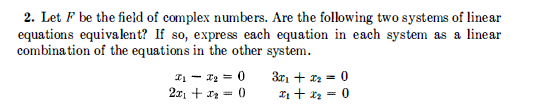


elimination proves that they are equal quite easily, but I'm having a hard time getting linear combinations of the system on the left to equal any of the two equals in the system on the right
stone drum
I would probably take the left set and generate combinations that give just x1 and just x2 separately
And then combine them to get the equations on the right and simplify
zealous kettle
hmm... so something like -1(x_1 -x_2) + 1(2x_1 + x_2) for x1
and 0(x_1 + x_2) + 1(2x_1 + x_2) for x2
then I ... add them?
tranquil junco
i think for x_2 it would be more like 1(2x_1 + x_2) - 2(x_2 - x_2) = x_2
stoic pythonBOT
Spes:
tranquil junco
why would you need 3x_2?
zealous kettle
you dont
tranquil junco
there's 3x_1 + x^2 and x_1 + x_2
zealous kettle
but I mean the way your equation adds up
tranquil junco
oh fuc typo
sorry
ok im gonna latex this to avoid the typo
ok wow fuc
i cannot think of how to isolate x_2

zealous kettle
oh
like that?
well
https://i.imgur.com/v5q6vIq.png reposting
negative 2 of row 1
idk if that means anything
zealous kettle
so then...
stoic pythonBOT
Spes:
tranquil junco
are you sure it should be -2/3?
zealous kettle
$\text{which equals} \frac{-1}{3}(x_1 - x_2) + \frac{5}{3}(2x_1 + x_2) = x_1 + x_2$
stoic pythonBOT
Spes:
zealous kettle
thats not right either daflekjavap