#linear-algebra
2 messages · Page 20 of 1

 dusky epoch
what was the original matrix
 frank gate

All i get is sign errors on like two elements, and in some other exercises, i get it right using the same method.
dusky epoch
this can probably be chalked up to arithmetic fuckups
frank gate
Hmm oki, are you able to spot any errors? I have double checked and cant find anything
this is from the same standard matrix i posted above
I legit cannot find anything wrong. Just completed another exercise using the same method and got it right..
frank gate
it was just arithmetic errors. I was calculating it wrong. Used a more secure way to write everything out now anyways, ty for help
frank gate
Ye that is what i got and is thr correct answer. My problem was that i do it to quickly, and when i write matrix of minors, i some times miss the negative sign completely. I basically write each one one step of the time now so i dont fuck it up ^^
But ye. That answer you posted is correct
 shy spade
xD
 native lodge
Your can always do the quick check: does A(A^{-1})=I ?
 cedar solar
“Quick” 😛
 digital hazel
If unless you had a calc and your elements are all numbers, then calculator is faster
 stone drum
Even by hand, it's pretty fast
Faster than finding the solution in the first place, certainly
digital hazel
Yeap
digital hazel
Really? I use that a lot tho
native lodge
Never seen someone write down 9 separate 2x2’s lol
 winter reef
I always jsut put identity matrix of the same size and just reduce until I get the identity on the left. Thr right one is the inverse
and it works for any dimension
native lodge
I always do that too
digital hazel
That was longer right?
native lodge
[A I] ———> [I A^{-1}]
winter reef
depends, but that method above works onkly for 3x3 and needs remembring lol
native lodge
Longer, yes, but works for any dimension? Yes
 slender yarrow
digital hazel
slender yarrow
digital hazel
Yeah
 indigo cradle
hi guys
digital hazel
Yes?
indigo cradle
im trying to find out why the answer says the nullspace is a plane
when the answer itself says that the nullspace matrix will have n-1 columns
i can only see the nullspace being a plane if n=3
native lodge
Some higher dimensional plane then
indigo cradle
doesnt plane mean 2d
native lodge
That’s the one we are most familiar with
I guess it’s harder for you to accept the higher dimensional stuff though
Like in 5D, the line is 1D though it has 5 components. What’s left is a 4D hyperplane. It won’t fill all of R^5 since it’s only got four dimensions to it, but it covers this “plane” of sorts
winter reef
No, plane is 2d
'kinda'
plane is span of 2 lin independent vectors
@indigo cradle not sure why the answer is like that, I also think its only if n=3
indigo cradle
welp k thanks for the assurance
native lodge
Oh, that formula for the 3x3 inverse comes from Cramer's Rule
whoa lol, I would recommend against that for higher order matrices
 patent orbit
M has three distinct eigenvalues. I need a hint to show that the corresponding eigenvectors are linearly independent.
digital hazel

Mathematics Stack Exchange
How can I prove that if I have $n$ eigenvectors from different eigenvalues, they are all linearly independent?
indigo cradle
hi guys
can i have help making sense of this
R being the row reduced echelon form
 slow scroll
Let E be the composition of row operations that gets A into rref, and F be the composition of row operations that gets B into rref. E and F are necessarily invertible. Then we have
EA = FB = R
A = (E^-1 F)B. E^-1 F is also invertible.
slow scroll
np
indigo cradle
how do i approach this
the answer says this
but "A = (pivot columns)(nonzero rows of R)" didnt come up in the notes or the lecture video
slow scroll
im not sure what thats about, but I don't think you need that fact to come up with the answer. For A, the first two columns are linearly dependent, so you can split the matrix between the 2nd and 3rd columns. similarly for B.
 quaint heart
Yeah that's the easy way of doing it
quaint heart
Yes, but that's might be because of the way you phrased it
quaint heart
Oh lol I'm being stupid
Yeah they could be different
Let me find a good example
There's a very trivial way
Let the intersection be {0}
And let Q_1=P_1, Q_2=P_2
Yeah that does it
@golden cloak
Once you see this example, you can make lots of other examples
 golden cloak
can you give me one please, because i can't see non-trivial ones
quaint heart
Just add a basis element to basis of both P_1 and P_2
golden cloak
oh
lol this is why i love this server, alone by myself i would think about it way to long and there would always be something you can't grasp atm
ty
quaint heart
🐴
 clear drift
So this is the rref
Writing the solutions in terms of the free variable x3 I get x3 (4 3 1)
(sorry for bad notation)
however this is what the answer key says, how did they get to R^4 when the matrix is only in R^3
 half ice
@clear drift
The matrix takes vectors in R4 and maps them to R3. Since you're looking for vectors that map to zero, the answer will naturally be in R4
clear drift
so are you just supposed to solve Ax=0 and add an extra zero row to go from R3 -> R4?
ohh
I'm stupid yeah it should be in R4 because it must have 4 columns to be able to multiply A by it.
half ice
You are supposed to solve it, easiest way is to assume a vector [a, b, c, d]
clear drift
Gotcha thanks.
 fervent palm
hello, i have a matrix of size 2 X 3, and it is the linear transformation mapping from R3 to R2, and i have bases with the dimensions of 3 X 1
the result i get when i multiply the 2 X 3 with 3 X 1 matrix is a 2 X 1
and i know i have to take the coordinate vectors , but i end up getting something like this:
 wintry steppe
What's the problem you're trying to solve?
fervent palm
[5
13] = a [ 1, 1, 0]^Transpose + b[0 1 1] ^T + c[1 0 1] ^ transpose
is it possible to calculate the change of basis matrix?
cause the coordinate vector equations i get are
a + c = ?
a + b = ?
b + c = ?
how can i solve that when my result is [5 13]^ transpose
wintry steppe
What do you mean change of basis matrix? What are the two bases between which you are trying to change?
fervent palm
so I have a matrix A which is a linear transformation mapping R^3 to R^2
wintry steppe
Okay
fervent palm
and was given bases { [1 1 0]^T, [0 1 1]^T, [1 0 1]^T}
i have to find the matrix representation of A with respect to those bases for R^3
that was the question
wintry steppe
Okay
fervent palm
my approach was to take the matrix A and multiply it with each of the bases
and compute the coordinates with that
wintry steppe
So can you write the change of basis matrix from R3->R3 changing from the standard basis to that basis?
fervent palm
so for instance I get [5 13] ^ T = a[1 1 0]^T + b[0 1 1]^T + c[1 0 1]^T
wintry steppe
A is right now written with respect to the standard basis
fervent palm
yes
i know the other way i could do it is by using C^-1 * A * C where C is the matrix representation of my bases
but then i have the dimensions don't match! C ^-1= 3 X 3, A = 2 X 3 and C = 3 X 3
wintry steppe
Let's call the matrix you want to get B
B is supposed to take a vector written in terms of the new basis, convert it to a vector in the standard basis, and then transform it using A
fervent palm
thats what i was trying to do, but the dimensions are not lining up :(
wintry steppe
So you have Bv = A C v
where C is the change of basis matrix from the new basis to the standard
We only know the change of basis matrix from the standard to the new
fervent palm
in this case what is v?
fervent palm
what if i wasn't given that arbitrary vector but was instead just told to transform the matrix A in T(x) = A(x)
wintry steppe
I never said you were given a vector
That would make it the very opposite of arbitrary
What I was trying to explain is that B = AC, but if you don't understand the definition of equivalence of linear transformations, then that's a problem
And you didn't mention the other basis
In that case, B = DAC for suitably chosen C and D
C changes a vector in the new 3-dimensional basis to the standard basis
D changes a vector in the standard basis to the new 2-dimensional basis
fervent palm
Oh I see, i think i didn't understand equivalence of linear transformations well enough! Will be looking into that again! Thank you @wintry steppe
wintry steppe
guys, i've been trying to understand these math concepts for a few hours but i still can't understand them :(
slow scroll
@wintry steppe do u know what they do?
wintry steppe
ah, right, sorry for that. the first one gets the two vectors' X axis and multiply them and then sum it with the product of the two vectors' Y axis
the second one is the same but it subtracts instead
and the last one is the same as the first one but instead it takes the square root of the answer
slow scroll
well yea, but do you know what they mean geometrically?
wintry steppe
oh wait nvm
uhh, the first one i think it's dot product
or so what i was told
idk about the rest
cross product maybe?
slow scroll
okay well the important thing about dot product is that if you have two vectors $a$ and $b$, then $a\cdot b = \lVert a \rVert \lVert b \rVert \cos{\theta}$ where $\theta$ is the angle between the two vectors. If the vectors are perpendicular for example, then the dot product is zero. $\newline \newline$
The cross product between two vectors $a$ and $b$ returns a vector $a \times b$ which is perpendicular to both $a$ and $b$. In that code though, those are 2D vectors. What that code is doing is pretending that the third component is zero and taking the magnitude of the vector that would be pointing in the non-existent third dimension. Basically, cross product follows this identity: $\lVert a\times b \rVert= $\lVert a \rVert \lVert b \rVert \sin{\theta}$. So if the vectors lie on top of each other, then the cross product is zero for example. $\newline \newline$
The last one is literally pythagorean theorem. @wintry steppe
wintry steppe
uhh, the bot didn't work
slow scroll
 wintry steppe
what are these two lines between each other
slow scroll
that means the length (aka magnitude aka norm) of the vector inside the bars
wintry steppe
do the vectors have to be intersecting each other
slow scroll
the concept of vectors intersecting doesn't really exist. As far as you are concerned, they are just arrows with length and direction. Typically, when you think of these operations, you place the vectors tail to tail
slow scroll
again, the concept of origin doesn't really exist.
slow scroll
for the geometric purpose of these operations, its convenient to write them like that
wintry steppe
ah
isn't |a| the modular operation?
so it can't be a negative value
but what is a and b? the length of the vector?
wintry steppe
oh xd
slow scroll
^ in case you haven't seen that, that is how we usually represent the sum of two vectors
slow scroll
the dot product
golden cloak
If I can just add something, a vector is every set of points that are "of the same length" and "of the same angle" with respect to coordinate system.
here, this two top vectors are the same vector, as 2 = 2 anywhere in the equation
wintry steppe
huh
golden cloak
-a is negative vector
wherever on the plane you find set of points with that length and angle
it represents the same vector
so a vector is a set of all such "lines"
wintry steppe
i see
golden cloak
so, why not choose one which starts from origin?
wintry steppe
but what is the X and Y of a vector?
slow scroll
if you represent a vector using the coordinates on x and y axes, then for a vector a, a.x just refers to the x coordinate and a.y refers to the y coordinate. Its assumed that these vectors point from the origin to the point (a.x, a.y)
golden cloak
like with fractions, you almost never write 6/12 to represent 1/2
but fraction 1/2 is really a set of all pairs (a, b) such that a/b = 1/2
wintry steppe
hold on
if a vector is a line, then where is the X and Y? at the end of it? at the origin?
golden cloak
wait ill draw it
slow scroll
conventionally, it points from the origin to the (x,y) coordinate. So the arrow lies on the (x,y) coordinate
golden cloak
wintry steppe
ah, i see
but
why would i want to do this?
(vec1.x times vec2.x) + (vec1.y times vec2.y)
which is the dot product
slow scroll
its kinda complicated why that works lol. You would "want" it because it equals ||a||||b|| cos(theta) and knowing the angle between vectors is useful.
wintry steppe
it's multiplying cos(theta)?
slow scroll
well, and also to calculate something called a "projection"
yeah
golden cloak
but here's a hint: your vector a is a sum of two vectors, one which lies on the x axis and one which lies on y axis
so we can kinda decompose any vector into two vectors (here 2 because this is 2D)
the vectors are (x_a, 0) and (0, y_a)
is that ok?
wintry steppe
... i'm screwed
i need 3D vectors to solve my problem
but i don't even understand these basic concepts
wintry steppe
hold on
golden cloak
I mean, simply put
 golden cloak
you really need to understand how the object moves in a vector space
wintry steppe
how do they move in a vector space?
golden cloak
consider 2D case
say that ball is centered at the tip of the vector a
how would you move the ball left/right, parallel to x axis?
what you need to change?
wintry steppe
uhh
golden cloak
what would happen?
 slow scroll
Hint: coordinates
wintry steppe
uhh
golden cloak
golden cloak
you kinda skew it
golden cloak
consider a unit circle at the origin
your two vectors will cross it somewhere, right?
wintry steppe
yeah
golden cloak
so from the crossing points, you draw normals on x axis
and consider the change of angle
golden cloak
line which makes 90 degree angle with another line
wintry steppe
uhh
wintry steppe
how would that look like?
golden cloak
see the dot product formula
wintry steppe
that red line would be B?
golden cloak
cos of each angle is a factor of stretching
wintry steppe
so let's say the circle's center is at X and Y 1
the angle would be Pi / 4, right
so, the cos of that will be the length of the red line?
golden cloak
well would it be, in unit circle?
wintry steppe
yeah
golden cloak
no, red line would be sin
length of it, i mean
you see that y coordinate stays the same
for 2 positions
so you need to change x coordinate of the first vector, to get the coordinate of the second
golden cloak
not really, but cos will appear there
golden cloak
golden cloak
that's for two vectors, not the coordinates of one vector
nvm i misunderstood you
but you really need to understand this nicely
to be able to grasp what you need to do
"Algebraically, the dot product is the sum of the products of the corresponding entries of the two sequences of numbers. Geometrically, it is the product of the Euclidean magnitudes of the two vectors and the cosine of the angle between them. These definitions are equivalent when using Cartesian coordinates. In modern geometry, Euclidean spaces are often defined by using vector spaces. In this case, the dot product is used for defining lengths (the length of a vector is the square root of the dot product of the vector by itself) and angles (the cosine of the angle of two vectors is the quotient of their dot product by the product of their lengths). "
wintry steppe
why multiply though
like
if you multiply a vector by another, assuming they have different length, won't that be a rectangle
wintry steppe
a * b is what then
golden cloak
which represent their coordinates
wintry steppe
from the "origin"?
golden cloak
its the expression which tells you you should multiply coordinates of the two vectors in some way which tracks the notion of angle between them
and their lengths
yeah, always from the origin
golden cloak
you have two vectors, a and a_0
wintry steppe
a_0?
golden cloak
yes the one you get after moving the ball
now, "the cosine of the angle of two vectors is the quotient of their dot product by the product of their lengths"
I mean, noone can really help you understand it unless you go through it yourself
wintry steppe
how do i go through it myself
wintry steppe
uh, but like
let's say i wanna do the dot thing
but i don't know the angle
how am i supposed to get the angle?
golden cloak
you have coordinates of each vector
wintry steppe
arctan?
golden cloak
look at the picture I've sent you
wintry steppe
oh, arccos
x times y / |x| times |y|?
but, if the coordinates are 0 or higher, it's gonna always be arccos(1)
wintry steppe
wait wait wait
wintry steppe
cos of the angle is equal to the length of the vector divided by x1?
golden cloak
1/cos of the angle
wintry steppe
oh
golden cloak
so ||a||cos alpha = x_1
wintry steppe
i see
golden cloak
its basically all trig
wintry steppe
and cos alpha = x1 / ||a||
golden cloak
because it is 😄
wintry steppe
aaaa this is much better now XD
so like
the dot product is for getting the angle between the two vectors?
golden cloak
hm how to put it
wintry steppe
hold on
let me put this again
so the doc product of vec1 at (4, 2) and vec2 at (2,3) would be
(4 * 2) + (2 * 3)
which is 14
is that correct?
golden cloak
maybe... I can't really understand the code well
wintry steppe
it just says this: (vec1 X times vec2 X) + (vec 1 Y times vec2 Y)
wintry steppe
and the length would be the square root of it?
 frosty vapor
yeah the alternate way to do dot product is to
golden cloak
oh yeah...
frosty vapor
do the x components multiplied plus the y components multiplied
wintry steppe
so the doc product of vec1 at (4, 2) and vec2 at (2,3) would be 14, and the length would be the square root of that?
but where would the line with that length be?
frosty vapor
nono not square root 14
wintry steppe
how not
frosty vapor
14 is the dot product
wintry steppe
yeah
frosty vapor
if u want the lengths multiplied u need to compute the length of each vector and multiply
wintry steppe
square root of the dot product would be the length
frosty vapor
no?
wintry steppe
it said that in the code for some reason
frosty vapor
nah
look closely
they are only for vector a
its the x compnent squared plus the y component squared
then sqrt that
ack i gtg
wintry steppe
oh
from what i've seen here, the code gets the distance between the two vectors with the origin of the circle
and to get the distance, he does this:
sqrt((vec1 X * circOrigin X) + (vec1 Y * circOrigin Y))
and does that for another vec too
uhh, then it creates 4 more vectors
oh hold on hold on
the length this is wrong hold on
i read it wrong
it gets the vec1 - circleOrigin
and uses that new vector to get the legnth of it which is written as sqrt(newVecX² + newVecY²)
this is starting to get confusing
it then calculates 2 intersections like this
hold on
took a while to type it out
i don't feel like i understand this anymore
i mean, doesn't that look complex?
 proven magnet
so the xy-plane and xz-plane subspaces are NOT orthogonal? seems kinda counterintuitive
but [1 1 0] [1 0 1]^T = 1*1 +0 + 0 != 0 so not orthogonal
they're just random vectors in xy and zx plane respectively
 vague belfry
Yeah, my bad
 sonic osprey
they aren't orthogonal correct
dusky epoch
subspaces that intersect are never orthogonal
sonic osprey
Except at the origin
dusky epoch
what
oh
yeah
ofc
subspaces whose intersection has positive dimension are never orthogonal
wintry steppe
Random vectors 
golden cloak
if i have a space like this: {( (α, β), (γ,δ), (ε,φ) ) | α,β,γ,δ,ε,φ in R}, how do I call it? (R^2)^3?
is it isomorphic to R^(2×3)? whats its basis? is it
( (1, 0), (0,0), (0,0) ), ( (0,0), (1,0), (0,0) ), ..., ( (0,0), (0,0), (0,1) )?
sonic osprey
Well it's isomorphic to (R^2) x (R^2) x (R^2)
Which is indeed (R^2)^3
And you technically can't just use like "exponent rules"
golden cloak
yeah I got that too
sonic osprey
but it turns out that you can here
And it is isomorphic to R^6
I'm not quite sure what basis you were trying to write
but seems like a fine
Also, I should probably ask how you actually add points
golden cloak
ill write it out on paper
yes it is isomorphic to R^6 and R(2×3) but not equal to any of them I would say.
but is this the "standard basis" for this space? or the notion of "standard basis" can't be applied here?
sonic osprey
Standard basis has no rigorous definition
So you can call it a standard basis if you want
golden cloak
because it can be rewriten such that 1 matches the index of a vector in basis
in my book i have a space V, dim(V)=n and space W of arbitrary dimension, a =(a_1, ..., a_n) basis for V and a map defined like this: val_a: Hom(V, W) --> W^n, val_a(f) = (f(a_1), ..., f(a_n))
and we show that it's bijection
i'm trying to give myself concreete examples
structure matters
 noble swallow
Two vector spaces (over the same field) of the same finite dimension are in general isomorphic, so maybe that is more interesting when dim(W)=inf
quaint heart
@noble swallow the same is true for infinite dimensional spaces
Vector spaces are just fancy cardinals
noble swallow
@quaint heart Oh nice.
So there are different types of infinite dimensions?
Like Q[x] and R as vector spaces over Q are differently infinite dimensional?
quaint heart
@noble swallow they are the same dimension I believe. This is because they are the same cardinality and cardinality determines dimension once you are above the cardinality of your field
proven magnet
determinants: so if you multiply one row by ∆ and another row µ you can factor them out of the matrix?
that is ∆µ [matrix]
noble swallow
So if Q[x] is countable and R is uncountable, they have different cardinality and hence a different infinite dimension? That's why I was wondering
quaint heart
Q[x] is not countable lol
Oh wait I'm stupid
I was thinking Q[[x]]
Yeah you're right
(the set of formal power series in Q)
Q[x] is countable dimensional
noble swallow
What notation should I adopt to express this? Until now I have always written dim(V)=inf indiscriminately
quaint heart
Do you know what a cardinal number is?
noble swallow
Mm vaguely
quaint heart
The ones you will likely use is countable and the cardinality of the reals. For countable you would use $\aleph_0$ or $\omega$
 stoic pythonBOT
Liquid:
Compile Error! Click the  reaction for details. (You may edit your message)
quaint heart
For the cardinality of the reals you would use c for continuum
I like omega as the cardinality of the naturals personally
quaint heart
Both are common
noble swallow
Alright, thank you a lot
 dawn apex
(omega kinda syntactically sucks cuz it refers to both the ordinals and cardinals)
noble swallow
is convinced by the argument
Also a rare occasion to use the phoenician alphabet lol
dawn apex
Uhh a set S has cardinality κ if there exists a bijection from S to κ
dawn apex
$|\omega_n|=\aleph_n$
stoic pythonBOT
Ariana:
quaint heart
So we define a cardinal to be the smallest ordinal...
dawn apex
for ordinals it is the order type of a well ordered set, a isomorphism from a well ordered set to a ordinal
uh not rlly
Basically ordinals and cardinals are like 2 different ways of describing how big sets are, one is for describing a ordered set another is for describing (almost) arbitrary sets
quaint heart

In mathematics, cardinal numbers, or cardinals for short, are a generalization of the natural numbers used to measure the cardinality (size) of sets. The cardinality of a finite set is a natural number: the number of elements in the set. The transfinite cardinal numbers descr...
Read the formal definition
Lol
dawn apex
uhh its kinda assuming AC
dawn apex
usually its like $|\omega_n|=\aleph_n$ and $\aleph_n^+=\aleph_{n+1}$
stoic pythonBOT
Ariana:
quaint heart
?
dawn apex
Then just find the bijection from some ordinal to the cardinals to get cardinality of a ordinal
quaint heart
The point is, by this definition $\aleph_0$ and $\omega$ are actually equal as sets
stoic pythonBOT
Liquid:
Compile Error! Click the reaction for details. (You may edit your message)
quaint heart
So it is not wrong in any way to use either interchangeably
dawn apex
I don’t rlly use omega for cardinality cuz it gets confusing sometimes like
$2^\omega=\omega$ for ordinals
$2^{\aleph_0}\geq\aleph_1$ for cardinals
stoic pythonBOT
Ariana:
dawn apex
so you get funny stuff like $|\omega^\omega|=|N|$ and $\omega^\omega=R$
stoic pythonBOT
Ariana:
quaint heart
I guess in that respect you're right, the only thing I use ordinals for is transfinite induction so I don't care too much about that sort of thing
But if you do more serious set theory it might become a problem
For most people it doesn't matter lmao
dawn apex
well true mdr
frank gate

How do i work myself in to find the formula for distance between the two lines?
for some reason, the formula for the distance is: https://gyazo.com/ec43be517f6af633552a254630c60a39

but why is it the times the unit vector of the normal vector? shouldn't it be just the normal vector?
 vagrant iron
Yo can anyone help me with Q2?
sonic osprey
This isn't linear algebra, go to #precalculus
native lodge
not really I would say
 untold quiver
is it a good idea to take linear and calculus 2 at the same time ?
native lodge
linear algebra and calc 2? seems strange
usually you finish all of calc (whatever that is to you) before moving onto linear
native lodge
if it's not linear algebra, then don't post here lol
native lodge
prealgebra is the better fit
native lodge
 nimble pawn
I'm working on preparing for a makeup final exam (I caught serious pneumonia late in the term), and I've only got fragmentary notes from another student (no instructor notes) and a practice exam to work from. I have a few problems that I haven't been able to connect to sections of the notes that I'm a bit lost on if anyone's up to help explain parts
For (1) I'm thinking of approaching it in two parts- first I need to show that the set of solutions is a subset of R^n, then I can show it's a subspace. Stuck on figuring out how to show subset since I missed this material entirely
noble swallow
Write explicitly the definition of R^n, so you can check if elements of that set are in R^n
nimble pawn
I think the thing I'm struggling with is understanding the set of solutions itself as an object
stoic pythonBOT
Mat:
nimble pawn
Just joined this server- that bot is amazing
noble swallow
True lol even if I am no expert at all with it
nimble pawn
Ok, yeah I understand the definition of the set of solutions is general but I'm having a difficult time coming up with a rationale for claiming that this set is a subset of R^n. (Intuitively I think it is, but I haven't thought up a concrete proof)
I feel like I'm missing something obvious
noble swallow
The set is a subset of R^n as long as all x1,...,xn are in R
I already assumed this above
The question should have specified this
Indeed number 1 is actually 5 free points
nimble pawn
Well, I still have to prove it's a subspace
noble swallow
Yeah that part is more interesting
slow scroll
in general, the set of solutions to Ax = 0 is a subspace (called the null space).
nimble pawn
Ah, you're saying that if we view the equation as a function on vectors in R^n then the solutions form the kernel
which is a subspace
slow scroll
yea. its just an equivalent (easier imo) way of looking at things
nimble pawn
How would one go about finding a basis for the kernel?
native lodge
solving Ax=0
slow scroll
the algorithm you use to find the kernel gives you a basis for the kernel. (Where you put the matrix in rref and solve for the pivots in terms of the free variables)
nimble pawn
Wouldn't solving for Ax=0 give the whole space rather than just a basis?
slow scroll
the span of the basis vectors would be the actual space
when you find the kernel, you get something like av1 + bv2 + cv3, which means all linear combinations of the basis vectors: v1, v2, v3
nimble pawn
I don't think I quite follow
slow scroll
hnngh this problem is not a good example to demonstrate on, as a simple example, $$\Ker \begin{pmatrix} 2&1\0&0\end{pmatrix} \ = \Ker \begin{pmatrix} 1&1/2\0&0\end{pmatrix} $$ $$ = \begin{pmatrix} -1/2 x_2 \ x_2 \end{pmatrix} = x_2 \begin{pmatrix} -1/2 \ 1 \end{pmatrix} = \operatorname{span}\begin{pmatrix} -1/2 \ 1 \end{pmatrix}$$
stoic pythonBOT
kxrider:
slow scroll
in the case of this problem, the matrix is (2 2^2 2^3 ..... 2^n) and rref would be (1 2 2^2 .... 2^{n-1})
noble swallow
I would work on polynomials to find the basis for this exercise
nimble pawn
Hmm, I think I'll sit on that one for now
Here's another that I've been unable to make sense of:
There was a class where a certain form of column echelon form was mentioned, but the notes are really vague
For part (1)
I don't think the intention was to grind out 5x5 determinants, so I'm guessing there's some property I'm missing
slow scroll
its kinda obvious just by looking at it, but if you have to prove it, you could write the first four columns in a matrix, and compute its null space. If the null space is {0}, then the columns are linearly independent. Does that make sense?
nimble pawn
Yeah, I agree it's intuitively obvious- but this instructor is a bit of a stickler for rigor
Yeah, that method makes sense
native lodge
or just find rref(A)
pivot columns are independent columns
you can invoke the rank
or still not enough justification?
nimble pawn
This linear algebra course never mentioned pivot columns nor reduced row echelon form
slow scroll
yeah thought of that, but proofily speaking thats just like pointing to the saem thing
nimble pawn
Here's a pic of the note I mentioned:
last bullet point
Haven't been able to decipher it and missed the class since I was in the hospital
noble swallow
Column echelon form is an equivalent way of solving it
As rank per rows and rank per columns coincide
native lodge
column echelon is just rref(A^T) 
slow scroll
not sure why you'd want to do that though 
native lodge
thought rref(A) and then showing the rank is 4 was enough to prove it for that professor
noble swallow
He said he only knows columns approach
slow scroll
o thats weird
nimble pawn
Yeah, the class was taught exclusively with a column approach (plus a proof of the equivalence)
...which didn't match the book...
..which we only vaguely followed...
it was a bit of a mess to be honest
even aside from me getting sick
noble swallow
Strange, I think you should use the approach you prefer
It wouldn't make sense that your professor penalizes you because you adopt different pet-lines
nimble pawn
Yeah, I'm sure I could do it either way- it's just that the class was much more confusing than it needed to be because of the inconsistency between the class and the book
native lodge
oh darn 
nimble pawn
Yeah this exam is going to be ~rough~
native lodge
I taught matrix diagonalization to someone only about a week ago
I can give you the link to the posts so you can read it if you want, but it's best if you were the one I was teaching 
makes for the better experience
nimble pawn
That'd be useful, I appreciate it
Thanks to everyone who stopped by to help out by the way!
native lodge
noble swallow
I was present 
noble swallow
lol that makes me curious
native lodge

 round wharf
Not sure if this goes in here but just wanted to ask
If two vectors are parallel (facing the same direction) and equal in magnitude, but at separate positions(maybe one vector is two units away from the other), are they equivalent?
Oh wait I googled it and they are
frank gate
Can someone tell me, how the fuck P1P2(->) is equal to that most right side?

the unit vector n is 1/(sqrt(98)) in this example
P1P2(->) should be P2 - P1 ??
native lodge
What were P1 and P2
frank gate
sec


points where a line goes through
Line 1 goes through P1 and Line 2 goes through P2
native lodge
It is P2 - P1
frank gate
ye right?
this is the whole question

So you are to find the distance between L1 and L2. And they are saying that, that distance is equal to this formula: https://gyazo.com/8010c6799ab8f63d62f6c90be6ae8f50
I dont get why, isn't distance from point to plane: (Ax + By + Cz + D) / | n |
frank gate
ah oki. But i still doesnt get that P1P2 (->) thing. Do you know how this is correct? This is the whole equation to answer

i can get the unit vector n but not the rest
native lodge
The computations or the set up? I’m not sure about the set up myself lol. Hard to think in 3D at this time of night.
frank gate
It is not even the same values i posted above, it is something wrong with that solution. It is not correct
11,0,8 turns into -11,0, 7?
joke teacher :/
wintry steppe
It's not a joke teacher
You're just not paying attention to the actual concepts here
You cannot just do a standard pattern comparison and expect yourself to get the right answer
The distance from a point to a plane is the projection of the vector between that point and any point on the plane onto the normal of the plane
You should know how to compute the vector between two points. Second-guessing the correctness of the solution that quickly is not productive.
nimble pawn
Ok, back for another day of wading through linear algebra
Exam tomorrow 
Can anyone think of a non-computational way of solving (1) and (2)? I'm pretty certain the problem was intended to be conceptual rather than calculational
sonic osprey
I mean in (3), it says "without doing any further computations"
so seems unlikely that (1) and (2) are non-computational
nimble pawn
That's fair
Based on the fragmentary notes I have, I think the first has to do with a property of column echelon form though
Or at least I have a hunch that there is a simple answer along those lines
(backstory to this being that I am making up a final exam for an abstract linear algebra class because I missed the last quarter of the class due to being hospitalized with pneumonia)
So basically I'm trying to backfill those classes from some notes I got from a classmate (instructor didn't have notes to provide)
nimble pawn
Here's another one that I'm unable to really start on. (Normally I wouldn't present questions so vaguely, but I don't have any examples in the notes of problems like this)
wintry steppe
is anyone here familiar with 3d vectors and coding?
digital hazel
I'm not sure but it might be just finding the null space since Ax = 0
native lodge
for Bran's question, you just have to solve Ax=0 and look at the pivot columns
then those corresponding columns in A make up C(A)
nimble pawn
I think I'd need to see an example to understand what you mean
native lodge
playing a game, will talk more later
nimble pawn
@native lodge no prob
digital hazel
Is it range space or null space?
native lodge
linear subspace
so rank 1
leads me to conclude that we are looking for the nullspace
let me check if this matrix has rank 3 then
indeed it is rank three
@nimble pawn want to use vc? as this will take a bit to explain
nimble pawn
sure, give me a sec
native lodge
$\begin{bmatrix} 1&-1&5&-1 \ 1&1&-2&3 \3&-1&8&1 \1&3&-9&7 \end{bmatrix} \begin{bmatrix} x_1\x_2 \x_3\x_4 \end{bmatrix}=\begin{bmatrix}0\0\0\0 \end{bmatrix}$
stoic pythonBOT
⚡Amphy⚡:
nimble pawn
ok so that's the equation system written as a matrix
native lodge
you don't want to join vc?
you only have to listen and can ask questions here
Ax=0
native lodge
$\begin{bmatrix} 1&2&0&0 \ 0&0&1&0 \0&0&0&1 \0&0&0&0 \end{bmatrix} \begin{bmatrix} x_1\1\x_3\x_4 \end{bmatrix}=\begin{bmatrix}0\0\0\0 \end{bmatrix}$
stoic pythonBOT
⚡Amphy⚡:
native lodge
$x=\begin{bmatrix} -2\1\0\0 \end{bmatrix}$
stoic pythonBOT
⚡Amphy⚡:
native lodge
If you are unsure if this in indeed in the null space, just multiply Ax and see if you get the null vector to confirm
slow scroll
maybe
 tropic moss
i got this
S= {(1,-2-0-1) (-1,0,0,-1) (1,1,0,0)
and T= {(x,y,z) ∈ R^4 / x-2y + z - w= 0}
find Dim(S+T)
I have no idea what to do 😦
noble swallow
S is probably the span of those three vectors?
native lodge
S is a space
tropic moss
S and T are subspaces
native lodge
well a set of vectors that span a space
and a subspace at that since the space is R^4, yet we only have three basis vectors
noble swallow
I mean are you sure that in your question you don't have //
$S=span{v_1,v_2,v_3} $or$ S=<v_1,v_2,v_2>$?
slow scroll
ok i think its pretty clear he means span...
stoic pythonBOT
Mat:
noble swallow
Are you confindent on what span means and hence S is constituted of?
slow scroll
Y. for S, if you put the columns in a matrix, and compute the ref, the linearly independent columns make up the basis for the span of the columns.
tropic moss
@noble swallow its written with {
noble swallow
No span mentioned? That's weird
Do you know the formula for the dimension of the sum of two subspaces?
tropic moss
dim(S+T) = dim S + dim T - dim (S∩T)
noble swallow
Awesome, have you any difficulties at finding dimension of S and T ?
tropic moss
not really
my problem is the S∩T
let me try to translate whats my real problem
when i find the basis of S
noble swallow
Ok tell me
tropic moss
I have to find the Cartesian equations
noble swallow
That is a possibility
tropic moss
what can i do if my base is: (1,0,0,0) (0,1,0,0) and (0,0,1,0)
or
(1,-2,1,0) (0,-2,0,0) (0,0,2,0)
S dimention is 3
native lodge
you can't span all of R^4, but you can span a 3 dimensional subspace
it's near impossible to imagine how that looks though
so then dim(S)=3
noble swallow
Take the basis of S, put it in a matrix with a vector (x,y,z,w) and impose that the rank is 3
To find the cartesian equation of S
tropic moss
do u guys know a good page for do that? also i need to learn how to find the equation without computers
noble swallow
This is the common way to go from span to cartesian equation
It's a bit long to explain the process here, search on google "from span to cartesian equation"
noble swallow
Howevere this is not the only way to deal with the exercise
tropic moss
i dont know hwo to make a cartesian equiation from a canonical basis
really? if u know another way please tell me haha
im tired of searching
tropic moss
k
noble swallow
Have you done?
noble swallow
2? What did you do after the linear combination?
noble swallow
Just write λv1+μv2+ηv3
Where v1,v2,v3 is the basis of S you have
That's a generic vector is S
tropic moss
(x,y,z,w) = λ(1,0,0,0) + μ(0,1,0,0) + η (0,0,1,0)
x = λ
y= μ
z = η
w = 0
(x,y,z,w) = λ (1,-2,1,0) + μ (0,-2,0,0) + η (0,0,2,0)
x= λ
y= -2λ -2μ
z= λ + 2η
w= 0
so i can get something like
μ = (y + 2x)/ -2
and η = (z-x)/2
noble swallow
That is probably correct, but why are you using that basis? Did you find it previously?
noble swallow
What is the basis of S? The second one?
tropic moss
both are
the second one was the first time i tried to solve the problem
i found that, the first time i tried, lol
noble swallow
The almost canonical basis is a basis of S?
tropic moss
yes
its okay if i have 2 equations?
from the second one?
or should always be only 1?
noble swallow
Mm that's a curious coincidence but I have nothing to write with to find it out myself, however in general one puts the vectors of the span in a matrix and reduces it with Gauss elimination, maybe you have used this approach
Let's choose the first basis at this point
"(x,y,z,w) = λ(1,0,0,0) + μ(0,1,0,0) + η (0,0,1,0)
x = λ
y= μ
z = η
w = 0 "
We continue from here
Now sub this form of x,y,z,w into the equation of T
We enter the intersection now
tropic moss
what i do with those values?
noble swallow
x-2y+z-w=0
This is the equation vectors of T must satisfy
Impose it for what you found, which is a generic vector in S
Sub λ,μ,η in it
wintry steppe
You can also think of it in terms of orthogonal complements
Let A be a subspace and A^C be its orthogonal complement
A vector is in A iff it is orthogonal to all vectors in A^C
A vector is orthogonal to all vectors in a subspace iff it is orthogonal to all vectors in a basis for that subspace
So let v1, v2, v3, ... be a basis for A^C. Your equations are then just that v1 dot x = 0, v2 dot x = 0, ...
tropic moss
😄
wintry steppe
Finding a basis for A^C is as simple as making a matrix of row vectors that span A and finding its null space
tropic moss
ty guys
 red pike
does
1 1 0
0 1 1
0 0 1
count as an upper triangle?
even though its got a 0 in the top right?
 worn crow

 wheat osprey
Dimesion of a subspace w={(x,y,z,t): x+y+z+t=0, y+z+t=0} Of R^4 is?
sonic osprey
What are you confused about?
vague belfry
How did you approach it
wintry steppe
Certainly by not planting Bitcoin crops
Each linearly independent equation constrains the subspace by one dimension, so if you count them with your toes, you get the answer
 restive hound
Do u learn about eigenvalues and eigenvectors in 1st year uni?
 subtle walrus
in europe, yes
native lodge
I got to linear my second year in US while some had it first year, just depends on the math classes you have to take
subtle walrus
also i was assuming math major
wintry steppe
linear is first year for me
 rigid cypress
LA tends to be first year for most math majors
 sleek helm
^ it’s also essential for a first course in analysis
winter reef
sure
rigid cypress
my uni has a course where it's lin alg + intro to analysis
so i'm assuming it's kinda fundamental
sleek helm
If you don’t understand LA you can probably fake your way through analaysis 1
But analysis 2 will be brutal
To be honest pretty much every field of math relies heavily on LA or LA-derivatives
winter reef
yup
I mean, if you dont kinda understand LA then you probably wont understand analysis 
 dreamy depot
I need to learn some proof based Linear Algebra 😔
dusky epoch
you mean linear algebra
if it's not proof-based, it's matrix-bashing, not linear algebra
sleek helm
I disagree Ann, LA is fundamental in things like ML
But you can get by without understanding abstract vector spaces or proofs
I’d say it’s gate-keepy to argue that approximations and numerical techniques for solving LA problems isn’t “real LA”
dusky epoch
numerical linear algebra is one thing
a semester full of nothing but 6x6 gaussian elimination problems is another
quaint heart
There are other meaningful computation based things you can do
That are done in that sort of first course
rigid cypress
right, but i dont really hope most of the people interpret "non-proof based LA" as numerical LA rather than just matrix bashing
wintry steppe
heehee guass was pretty much the only thing in my first la course lol
matrix bashing
wintry steppe
Mine is def proof based 😅
That said, does anybody recommend any supplementary study resources? I’m taking it over the summer as well as Calc 2 plus working full time at a startup. Calc 2 is going fine but I’m definitely behind in LA.
slow scroll
khan academy has LA videos
slow scroll
i haven't watched too many of them. I think there are some proofs, but mainly I think Sal just does a good job of getting the point across.
Some other resources you could try is MIT opencourseware's series on LA by Gilbert Strang, or reference books like Linear Algebra Done Right or Linear Algebra Done Wrong.
and the discord server ofc 😎
wintry steppe
This is going to be a long, math filled weekend 😝
rigid cypress
i think khan academy helped me a little bit when i was going over some specific things, but it wouldn't give you that much help if it's proof based
wintry steppe
strang’s course is wonderful
but it is much more matrix bashy
especially at the start
strang is bluepilled and for engineers
my worst experiences with books is strangs linear algebra and any physics book ive read
I don’t mind his book 🤔 but it isn’t very proof based
And slightly disorganized
His prose is interesting too
Does inject a lot of his passion for the subject
exactly
no proofs= gay
And he does try to make it as easy as possible
its a good book for an engineering class or physics class but its not rigorous
Maybe if you’re just coming out of high school or in high school then it’s a great introduction
Before they force you to develop Matt maturity
*maff
sure
wintry steppe
Looked over the Strang book a bit, and saw that there is another LA class on open courseware that is specifically described as more theoretical than the Strang course. Seems to be what I need, no video lectures though. Definitely going to go over the KA material and maybe read some of Strang’s book, but Linear Algebra Done Right seems to be what I need. I’ll also look up the Hoffman/Kunze book.
clear drift
So if there are more columns than rows in a matrix (basically more vectors than the dimension of the space they’re in) the columns are linearly dependent
How exactly does that work? Like if there are three vectors in a 2D space but the vectors themselves are 2D why are they guaranteed to be parallel?
slow scroll
The particular three vectors in 2d space might not be parallel (but they are certainly not all orthogonal), but at least one of the vectors is guaranteed to lie in the span of the other two.
and yes to your first question
wintry steppe
Non-zero determinant
Also gotta be square
Cofactor matrices and a whole lot of computation
I mean Gaussian elimination has a predictable effect on the determinant that can make computation easier
But the raw computation requires you to do the cofactor computation.
slow scroll
ok but nobody does that beyond 3x3. gaussian elimination (keeping track of scaling rows) is fine
wintry steppe
Google "how to compute determinant of general nxn matrix"go from here
Computers do that beyond 3x3
What are you proving?
Actually there might be a cleverer way using the notion of volume.
One way or another, its finnickity
slow scroll
on the one you did before, how do you know that there aren't any other vectors in the intersection?
 bright token
if you want to do a determinant computation, it's a lot better to use row reduction/gaussian elimination to a triangular matrix
and then multiply the diagonal entries
cofactor expansion is far less efficient
wintry steppe
You're doing this in a vector space right?
And I'd trust Starfall on this, I give zero-shits about making computation more expedient
It looks like your prof tried to introduce you to the notion of an internal direct sum - where you can decompose a vector space into a subspace and its orthocomplement.
slow scroll
well yea but a proof should at least state that. weird
wintry steppe
Basically you want to prove that the subspaces you chose would be orthogonal and so would only contain the origin in common
slow scroll
wat? Orthogonal?
stoic pythonBOT
Obama Llama:
Compile Error! Click the reaction for details. (You may edit your message)
wintry steppe
Basically this is only true if each u+v is unique
And you can only really do that if you construct Uo+V using the combined span of U and V
You have a sum of subsets which is the general thing on the right hand side of the equality - if each u+v is unique, we say that it defines a direct sum.
Hope this helps
iff u+v is unique for each u and v
Ye
Although the index set is redundant
Cuz
You just choose each u in U and each v in V
Why do you need to index it
Nah it doesnt
You can have non-unique sums even with indices
Basically the point is
This uniqueness doesn't happen if the intersection of U and V contains more than just 0
So now you just gotta prove this in both directions
I mean if this is elementwise addition between vectors then... yeah?
Got some weird notation going on here - you transpose one of the matrices then you just add them elementwise
,tex b_{ij} = \sum_{i=1}^n\sum_{j=1}^n a_{ij}+a_{ji}
stoic pythonBOT
Obama Llama:
Compile Error! Click the reaction for details. (You may edit your message)
wintry steppe
I mean your way just ends up adding all the rows and transposed columns into a single vector though
Which is definitely not what A+A^T is
wintry steppe
you do realize that you have two free variables here, right?
So anything that doesn't have two unbound variables is weong
 proper yarrow
 pallid rampart
Well you can just send it here
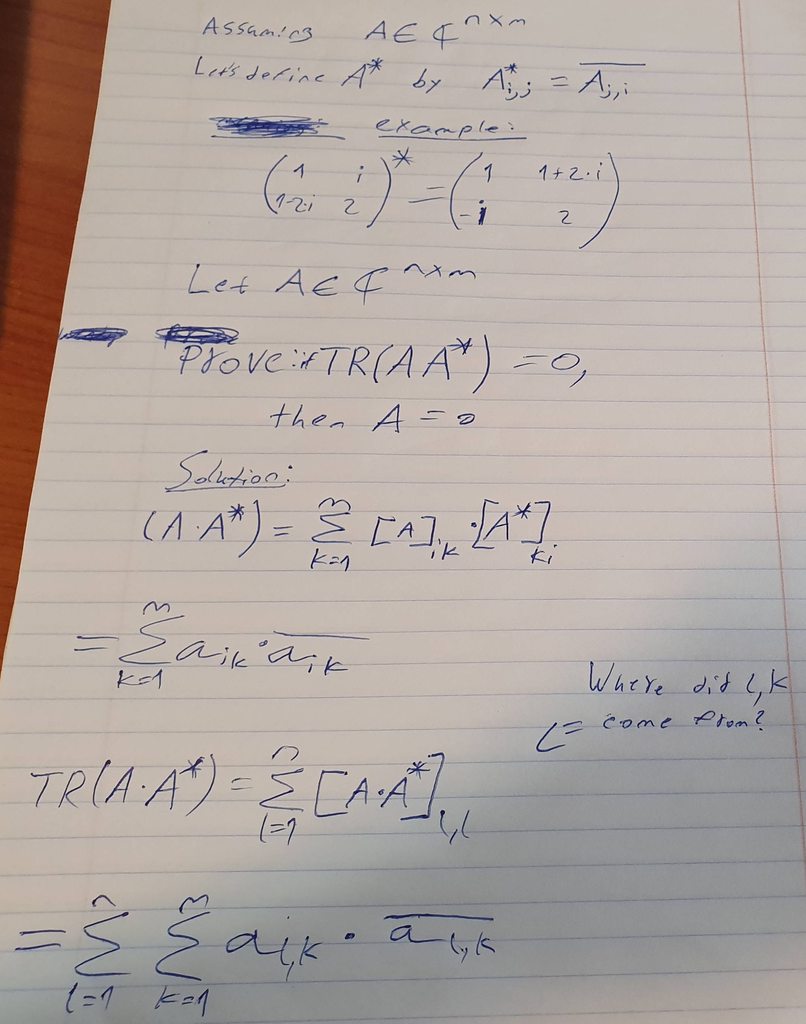
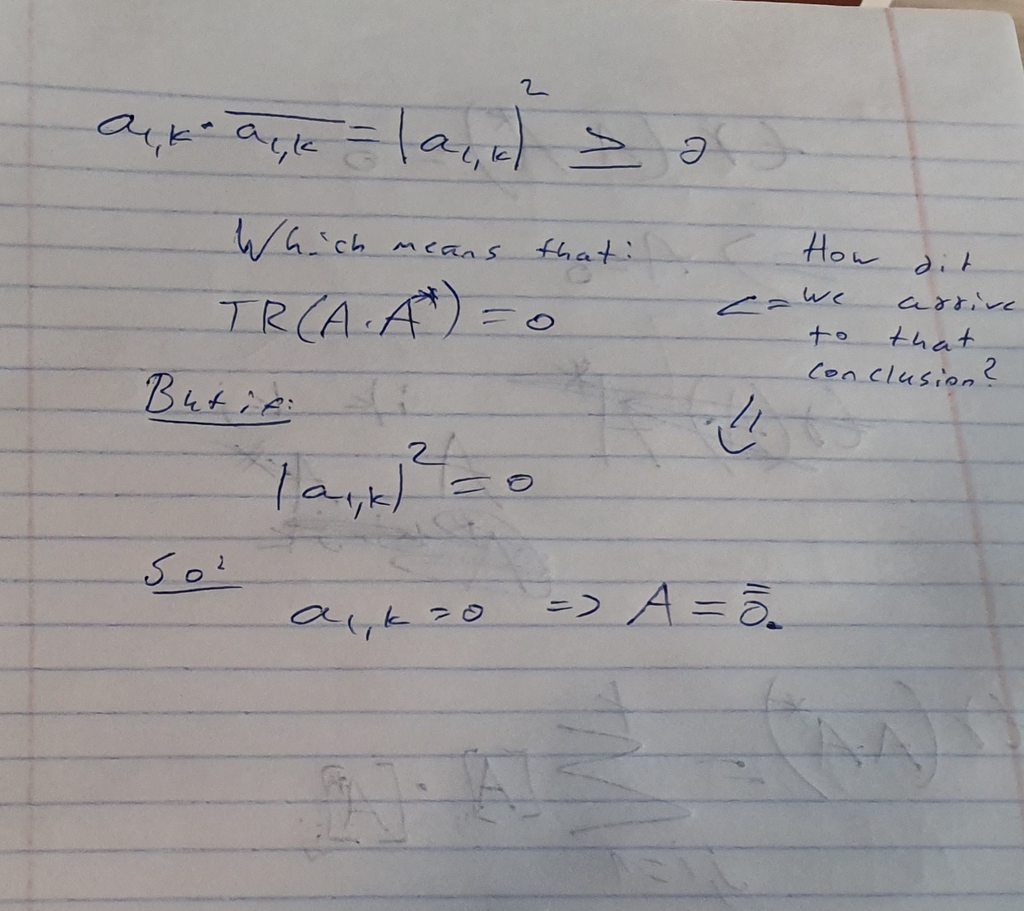
 cedar solar
The entire thing makes no sense
The first part is, that is the definition of trace. The sum of diagonals
The second page, that is not the argument
We are saying that AA* must have nonnegative entries
So if the trace is 0, then the only way for a bunch of nonnegative numbers to sum to 0, is if they are all 0
And there is only one way for that to happen
clear drift
I'm confused, how do you find just a basis for the subspace? Without knowing if it is the column space or null space?
dusky epoch
why would you need to know the nature of the space in the first place?
you want a basis for the span of these four vectors
cedar solar
We need to take a step back and check your understanding of basis, span, and subspace
What is the definition of bases vectors?
clear drift
Linearly independent set of vectors in a sub space that spans the subspace
@cedar solar
cedar solar
So i get the sense, the source of confusion is
Subspaces are defined by what vectors span them
So if i say, the subspace is the span of (0,1) and (1,0)
That is a 2d plane that extends in all directions
You are given four vectors, and the subspace is the span of those four vectors
Asking about the null space or column space is gibberish
You should review what those terms mean
dusky epoch
does it satisfy the definition of echelon form?
dusky epoch
well then
indigo cradle
ok thanks
frosty vapor
lol
clear drift
So I'm still kind of confused about pivot positions... “Pivot position in every row" means that there are as many basic variables as number of pivot positions, correct?
half ice
@clear drift
No, for example, consider a matrix with two rows and three columns
1 0 3
0 1 5
Has a pivot in every row
 versed flare
You should post the solution too, for most would tell you to do effort first i guess
wintry steppe
this is variation of parameters
 tranquil hamlet
this is my solution
here an example from the book since my writing and org skills are trash
wintry steppe
I think you might have your first eigenvector wrong
the eigenvectors of that matrix are [1, 0] and [1,1]
wintry steppe
the eigenvectors are [1,0] and [1,1]
 hasty rune
The Linear Algebra book by Hoffman and Kunze just popped up at the store - should I grab it soon?
 idle pewter
I just started the kahn academy linear algebra course last night. So far it's pretty good. Anyone finish it, if it's worth it or if there are better teachings elsewhere?
native lodge
Why the heck would they use Cramer’s rule though for the above problem
MIT lectures on linear algebra are very good as well
idle pewter
Cool, I'll look that up. Thanks
slow scroll
@hasty rune if it’s cheap I guess. I’m pretty sure it’s free online tho
hasty rune
@slow scroll it's being sold at PKRS 1,000 - should be around $6
slow scroll
Yeah that’s a good deal. I
Haven’t used Hoffman and kunze very much though so idk if it’s any good.
frosty vapor
lol cramers rule by hand
slow scroll
lol cramers rule at all
frosty vapor
kek
 brittle juniper
it's already diagonal, why would you try to diagonalize it 
 undone garnet
I mean