#linear-algebra
2 messages · Page 17 of 1
 sonic osprey
Do you understand what is happening in the last sentence?
 edgy lynx
 broken hawk
are those sentences supposed to have any connection with one another
 dusky epoch
@indigo cradle do you understand how row operations are equivalent to left-multiplication by elementary matrices?
 indigo cradle
yes
dusky epoch
ok
 cedar solar
So the matrix P is
0 1 0
1 0 0
0 0 I
But now instead of doing left multiplication
You do right multiplication
See how now it swaps columns?
indigo cradle
I see how it swaps columns
but i dont understand why it works
or is it a coincidence
columns and rows seem very different
for me the thought process was
to get the inverse I reverse the transformations
so from B = PA, where P is the permutation matrix that swaps the rows
to B^-1 = A^-1 * P^-1
then i went to the answer
and it jus says i was supposed to swap the columns
then i looked at my P^-1 and realised that it had that purpose
but didn't arrive at my answer with the understanding that " because i swap rows from A to B that im suppose to swap columns from A^-1 to B^-1 "
so i feel like im missing something out
and i just want to be sure
cedar solar
So the intuition is, inverse of a matrix is like inverse of a function
When you left transform with A, you are mapping from the row to column
When you invert A, the inverse maps from the column of original A to the row of original A
indigo cradle
interesting
it would be nice to see the geometric interpretation of that
would you recommend any video?
sonic osprey
The other thing to think about is when you multiply a permutation matrix on the left, it swaps the rows
But when you multiply by a permutation matrix on the right, it swaps the columns @indigo cradle
So if B = PA, then B is just A, but with rows swapped
But taking the inverses gives you B^(-1) = A^(-1)P
So B inverse is A inverse with the columns swapped
indigo cradle
i get it now thanks
so if i could clarify
the statement provides an interpretation of the permutation matrix
but is not the method to answering the question
because in another similar question
i would get the answer by adding col 1 of A^-1 to col 2 to get B^-1 via the same line of reasoning
but the answer is in fact:
so it seems that the statement serves only to provide an interpretation of the permutation matrix
but is not how i was suppose to derive it
sonic osprey
This matrix here is not a permutation matrix
So I'm not quite sure what you're asking
indigo cradle
can you get the permutation matrix from doing column operations
sonic osprey
This matrix in this problem is not a permutation matrix
sonic osprey
But yes, swapping two columns is a valid column operation
indigo cradle
but how do i get from "add row 1 of A to row 2 to get B"
to " substract col 2 of A^-1 from col 1 to get B^-1 "
cos i derived the matrix just be reversing the first statement i.e minus row 1 from row 2
but it seems that the answer took a different approach
by doing column operations
sonic osprey
The same thing happens
Multiplying by it on the left does row operations, multiplying by it on the right does the analogous column operations
indigo cradle
i understand that
but it seems the thought process of the question setter is different from mine?
sonic osprey
Are you asking about why it's subtract rather than add?
cedar solar
Oh whoops i think i flipped it. When you left transform with A you map columns to rows
Like a 2x3 matrix takes a vector of length 3 and spits out a vector of length 2
As for your followup question
You get B = PA
So inverse of B is inverse of A times inverse of P
If you were given B and asked to find A, you would do inv(P) B = A
Nvm i feel like not making any sense
 rancid iron
Hello, I was wondering if anyone could explain the error I am doing with this problem.
First I made the matrix a triangular matrix using row reduction and reduced it to this
 vague belfry
I'm not sure you can find eigenvalues by reducing a matrix
 rigid cypress
that wouldnt be how you find eigen values
rancid iron
and then I thought since the eigenvalues is when the det(A-λI) = 0 the eigenvalues should be -1 and 4
rigid cypress
when you reduced it to an upper triangular matrix
that matrix ceased to be A
you want to find the determinant of A-(lambda)I for the original A
rancid iron
I thought row operations don't affect the determinant of the matrix?
"Suppose that B is produced by adding a multiple of one row of A to another. Then det(A) = det(B)." is what my textbook says
Sorry I'm confused now :/
dusky epoch
I thought row operations don't affect the determinant of the matrix?
row addition doesn't
row switches flip it, row scalings multiply it by the scaling factor
rancid iron
The only thing I did was R4 - 2R3 so it wouldnt affect the determinant in this case, no?
 slow scroll
so you replaced R4 with R4 - 2R3?
slow scroll
that would not change the determinant. Lets say you replaced R4 with
2R4 - R3 to make ur calculations easier or something. Then the determinant would be scaled by a factor of 2
thats also a pretty common thing to do with elimination, so its worth noting
rancid iron
Ok but since I am calculating the eigenvalues and that is when det(A-λI) = 0, then my row addition wouldnt change the eigenvalues. Right?
Oh I see, it could potentially change the eigenvalues
Which I think it did in this case
slow scroll
computing the det(A-λI) works like computing the determinant of any other matrix
row addition won't change the characteristic polynomial, but scaling rows will.
rigid cypress
wait
hold up
an elementary row operation Should affect the eigenvalues iirc 
the characteristic polynomials of both A before row reduction and after row reduction are different
vague belfry
It will if we apply the operations to the matrix A
slow scroll
Elementary row operations that do not scale rows/column in any way have determinant 1. If E1E2E3... is the series of row operations you perform to put A-λI in row echelon form, then
det(E1E2E3....En(A-λI)) = det(E1)det(E2)....det(En)det(A-λI) = det(A-λI)
since det(Ei) = 1 for all i 1<=i<=n.
rigid cypress
just. check manually. the eigen values before the row operations are 1 and 2, while after row operations it's 1 and -4
am i losing my mind completely?
slow scroll

rigid cypress

dusky epoch
slow scroll
umm # some other channel than this
 lethal kayak
So what channel?
 wintry steppe
already pointed u there
slow scroll
anyway, @rigid cypress i didn't know what problem u were referring to at first, but it looks like @rancid iron put A in ref instead of A-λI for one thing....
lethal kayak
Thanks
rigid cypress
@slow scroll don't mind me lol, i was just losing my mind for a bit
my brain just completely shut down leaving me mathematically impotent
slow scroll
me 24/7 kek
wintry steppe
Hey guys, I've been trying to wrap my head around this for like a good while
In the explanation, why would the set of (c1v1 + c2v2 + ... + cnvn) be multiplied again by v1?
 fringe cave
they did a dot product of both sides, you know like any algebraic thing
wintry steppe
oh, okay xD
 shrewd slate
How do you determine if a point in 3-dimensional space falls within a particular plane?
 wintry sparrow
can you sub it into the equation?
shrewd slate
Uhhh
Ok, let me show you the linear combination
I’m trying to sort of figure out what the domain of this linear combination would be
fringe cave

so, you wanna find the span
first, make sure they're linearly independent
Which if i'm not retarded, they are
shrewd slate
Could you say the third is dependent? Would that be appropriate?
slow scroll
what do you even mean by find the "domain?"
shrewd slate
Yea, about that
fringe cave
He wants to find the subspace generated by those two
shrewd slate
Basically the values that the right side can take on and be within the plane generated by the left side’s linear combination
Like uhh what values are on the plane that the lin combination of the first two make up
*combinations
slow scroll
if you ignore the the last vector, then R^2 is the domain
fringe cave
I.e. find the subspace generated by your two vectors
slow scroll
the subspace generated by those two vectors is the span of those two vectors
shrewd slate
Yea, a plane
slow scroll
what is the =(1, 0, 0) part about then?
shrewd slate
Well, that’s not on the plane
So that’s what got me thinking about which values could be on the plane
fringe cave
The = 1 0 0 thing is just a scratch thing
wintry sparrow
if you wanted to find out if a vector is in the null space of a matrix, do you just have to multiply them and see if the result is the zero vector?
slow scroll
yeah
shrewd slate
Is that another question
wintry sparrow
yes
shrewd slate
Ok I just wasn’t sure if that was like a reply to mine
I’m uhh just starting this linear algebra deal
wintry sparrow
me too, just trying to figure stuff out for my exam
slow scroll
mr. peanut, im not too sure what u want. If you wanted to generate a vector that lies on the plane in question, then you can just plug in whatever scalars into c1, and c2 and generate a vector like that
shrewd slate
Hmm
Let me put it in an analogy
If I had a line on a two dimensional plane, all points on that line would be defined by an equation
fringe cave
He wants an equation to describe the plane
fringe cave
Like ${(x,y,z) \in \bR^3 : ax+by+cz = 0}$ or something of that sort
 stoic pythonBOT
Darkrifts:
shrewd slate
In a way where you can plug in the values from the right side vector and see if the statement is true
slow scroll
oh wait i think i know what you want.
shrewd slate
Great!
slow scroll
do you just mean writing these vectors in an augmented matrix, [v1 v2 | b], putting it into reduced echelon form, and figuring out whether a solution x exists for Ax = b?
shrewd slate
I don’t know what that is
wintry sparrow
basically figuring out what coefficients for the three vectors on the left make the vector on the left
the second 'left' should say right
shrewd slate
Sort of like that except an equation that quickly tells you if there are such coefficients
slow scroll
yea so you can use matrices to talk about these things equivalently. Notice that $c_1 (1, 1, 1)^T + c_2 (2, 3, 4)^T = \begin{pmatrix} 1 & 2 \ 1 & 3 \ 1 & 4 \end{pmatrix} \begin{pmatrix}c_1 \ c_2 \end{pmatrix} = \begin{pmatrix} 1 \ 0 \ 0 \end{pmatrix}$
shrewd slate
Just like how 1 = 0 is false, the equation would be false if the values of the vector on the right are “incorrect”
stoic pythonBOT
kxrider:
shrewd slate
I think I’ve figured out a plan to eventually come up with an answer to this, so I’m going to give that a try. I’m going to start off on a 2-dimensional plane and compare it to this problem. Thanks a lot for your time, guys
shrewd slate
I think I got the answer I wanted
Suppose that $c_1 (1, 1, 1)^T + c_2 (2, 3, 4)^T = \begin{pmatrix} x \ y \ z \end{pmatrix}$
stoic pythonBOT
Mr. Peanut:
shrewd slate
Then, as long as $-x = c_2 - y = 2c_2 - z$ is true, there exists a c1 and c2 that satisfy the above
stoic pythonBOT
Mr. Peanut:
shrewd slate
Idk how to use texit, sorry
Here’s the work
I turned it back into a system of equations because normal algebra is nice and yea

@ me if you have any comments
 native lodge
three equations and two unknowns, we could be headed for trouble here
stoic pythonBOT
 Requested by Lionel#5497
 tacit sigil
How would you find the basis of im(T) for
finding the basis for ker(T) was straight forwards
 brittle juniper
try finding $P$ and $Q$ such that\
$T(P)=\begin{pmatrix} 1&0\ 0&0\end{pmatrix}\
T(Q)=\begin{pmatrix} 0&0\ 0&1\end{pmatrix}$
stoic pythonBOT
Tuong:
brittle juniper
those two matrices could make a good basis...
dusky epoch
tacit sigil
basis for im(T) is just basis of T???
brittle juniper
no
"basis of T" doesn't really make sense to begin with
But $\begin{pmatrix} 1&0\ 0&0\end{pmatrix}$ and $\begin{pmatrix} 0&0\ 0&1\end{pmatrix}$ seem like they could make a good basis of $\im(T)$
stoic pythonBOT
Tuong:
brittle juniper
Assuming $P_2(\bbR)$ is a set of polynomial functions...
stoic pythonBOT
Tuong:
tacit sigil
hmm gotcha thanks
wintry steppe
can anyone explain what to me whit linear function
Solve equations for linear functions
?
 subtle walrus
what
 faint lintel
@wintry steppe what do you mean by linear function?
 plain fjord
If λ belongs to C, and I have r size Jordan (block?) matrix, J_r (λ), which has only one eigenvalue λ, how do I determine what the eigenspace E(λ) is? I know that alg(λ) = r and geom(λ) = 1.
Can't imagine what E(λ) looks like in this case.
Another somewhat difficult thing is projections, I know what it means graphically, but for example: Let w = (1, 0, i, √2) ∈ ℂ^4. Determine an ortogonal projection matrix to the subspace <w>. Uh, come again?
So yes, I kinda get it what it means, closest point to W from any point in C^4, but...
plain fjord
I need to use the basis of C^4, standard one, or what...
 wet finch
for the first one, you just do it. write down what the matrix looks like and find the eigenvectors for the eigenvalue lambda
there's not much else to say really :/
would you know how to find the eigenvalues/eigenvectors if I gave you a 3x3 matrix?
plain fjord
Yes, that's not a problem.
Problem in the first exercise is, that the size is r, so, i guess the eigenspace is different for each size, 1x1 is of course only [λ], and thus eigenspace , uh, not much choices there. 2x2 is [[λ,1],[0,λ]] if we use wolfram alpha notation for a matrix.
wet finch
just do it for the first couple of cases
find the eigenspace for the 2x2 case
and the 3x3 case
and you will very quickly see the pattern
then you can prove it for the general nxn case
plain fjord
What about the second exercise, the <w> thing i wrote about?
tacit sigil
Yea I need to figure out if T is diagonalisable
plain fjord
Not yet
wet finch
umko i'm not sure what that means here because usually you only talk about something being diagonalizable if the domain and codomain have the same dimension
i'm assuming P_2(R) is polys of degree <= 2
catnose, that first one that you're stuck on is easier, you should work at it a little more
tacit sigil
So domain and codomain have different dimentions -> is not diagonalisable???
tacit sigil
ok gotcha thanks
wet finch
catnose, have you looked at teh wikipedia article for orthogonal projections
it gives an example for how to do it for projecting onto a line
dusky epoch
"not diagonalizable" != "the concept of diagonalizability does not apply"
tacit sigil
What do you mean @dusky epoch
dusky epoch
i mean exactly what i said
"not diagonalizable" is not the same as "the concept of diagonalizability does not apply"
"false" is not the same as "N/A"
plain fjord
Heh, is it just (1,0,0, ..., 0) for the E(λ) i asked about? 😃
tacit sigil
So are you implying that a linear transformation can be diagonalisable even if the domain and codomain are different?
dusky epoch
no!
i am in fact saying the opposite, that diagonalizability as a concept DOES NOT APPLY to transformations whose domain and codomain aren't the same!
plain fjord
@wet finch I mean, that's what I think the answer is to the first question.
tacit sigil
ohh ok. I was confused
wet finch
yes
plain fjord
Yeah, I believe if you need something that resembles diagonalization for m x n matrices, where m is not n, you need the canonical form, A = MCN where M and N is invertible?
and C is canonical form of A, not a square matrix
tacit sigil
slow scroll
what does \mathcal(L) mean?
tacit sigil
S^2 and T^2 are similar if and only if
$S^2 = Q{-1}T^2Q and T^2=Q^{-1}S^2Q$
stoic pythonBOT
UMKO:
Compile Error! Click the  reaction for details. (You may edit your message)
tacit sigil
S^2 = Q^-1 T^2 Q and T^2 = Q^-1 S^2 Q no?
dusky epoch
that's very bad tex
tacit sigil
Sorry I'm bad at tex
 quaint heart
lol
dusky epoch
also, no, these two cannot be simultaneously true for the same Q
quaint heart
you'er given that there exists Q invertible so that $T=Q^{-1}SQ$
dusky epoch
you're*
stoic pythonBOT
Liquid:
Compile Error! Click the reaction for details. (You may edit your message)
tacit sigil
But would it apply to T^2 as well?
dusky epoch
would WHAT apply to T^2
quaint heart
So $T^2=Q^{-1}SQQ^{-1}SQ$
stoic pythonBOT
Liquid:
Compile Error! Click the reaction for details. (You may edit your message)
quaint heart
so yeah, the same Q works
plain fjord
They are similar if they have the same eigenvalues... so think about the matrix which has eigenvalues on the diagonal, and what happens if you square that...
dusky epoch
no
no
no
two transformations may very well be similar but neither may be diagonalizable, rendering your eigenvalue talk moot
quaint heart
lmao
quaint heart
similar means they are in the same congugacy class
plain fjord
Hmm, you could always jordanize them... heh if that's even a term.
quaint heart
sniped
plain fjord
Meaning make a Jordan form out of them. But I just learned about Jordans like this week at school
I mean the A = SJS^-1
plain fjord
The Jordan matrix, meaning eigenvalues in the diagonal and 1's above them, then zero everywhere else
quaint heart
where does this jordan matrix take values from?
plain fjord
Yeah, actually I'm not familiar with the correct English terms yet, since I study in Finnish, gotta look those up
quaint heart
maybe your proof is fine if you work in the algebraic closure of your field
but I'm not so sure
cause the main problem is S may not take values in your field
but then it's actually hard to square a jordan matrix
so this proof doesn't seem so easy even for the case of F algebraically closed
which ann said earlier lol\
plain fjord
But about the earlier question of mine, "Let w = (1, 0, i, √2) ∈ ℂ^4. Determine an orthogonal projection matrix to the subspace <w>". I'm kinda at loss how to do that. Let's name the projection as P. It is 4x4 matrix, right? Does it mean that if I multiply some vector with it, Px, it becomes exactly w? Or something like xw, meaning (x1, 0, ix3, x4sqrt(2)) where x1-x4 are coordinates of x.
dusky epoch
you want Px to be the projection of x onto w
i.e. Px must be parallel to w, and x - Px must be orthogonal to w
plain fjord
Hmm, oh.
And I know that P^2 = P and P^* = P for the projection and orthogonality to hold
Orthogonal to x - Px, means inner product of Px with w is zero? And parallel... hmm?
dusky epoch
no, the inner product of x-Px with w is 0
Px must be a scalar multiple of w no matter what x is
plain fjord
Oh yes of course, I mistyped the second Px, meant to type x - Px there of course.
dusky epoch
$P = (w^w)^{-1}ww^$
stoic pythonBOT
Ann:
plain fjord
What, really?
dusky epoch
yeah check it
plain fjord
I will, thanks 😃
Hmm, I don't think (w^*)w is invertible, since it has a zero row
I mean, what is below the ^-1 in that image
Uh wait...
dusky epoch
$w^*w = |w|^2$
stoic pythonBOT
Ann:
plain fjord
I might have made a mistake myself
Yeah calculated the wrong way, I think I got the right matrix now that I tried that formula... bit simpler than what I thought of...
 sturdy scaffold
NO GO AWAY I WAS HERE FIRST
native lodge
shoot, we about to see the physics take on the inner product
rigid cypress

native lodge
oh lol
sturdy scaffold
y u warned
rigid cypress
i'm not
sturdy scaffold
w/e wrong channelf or this
test
How the fuck do maf ppl say this?
$\text{i have a question on communication }$
$\newline$
$\emph{The abridged problem: }\newline$
The space of all polynomials is a subspace of the space of all nice functions that map from the reals the to the reals: $\mathbb{P(R)} \subseteq \mathbb{F(R)}$. Prove that this subspace has a non-finite dimension. $\newline$
$\emph{My abridged proof: }\newline$
By induction, you can always find a subspace of $\mathbb{P}$
$ {(x^i)}{i=0}^{n-1}\subset^* {(x^i)}{i=0}^{1}\subset^* {(x^i)}{i=0}^{n-1}\subset^* {(x^i)}{i=0}^{n+1} \dots..\newline$
$ \underbrace{{(x^i)}{i=0}^{1}\subset^* {(x^i)}{i=0}^{dim{\mathbb{F(R)}}}}_{\text{This is supposed to be a chain of subspaces*}}:$
plain fjord
Wonder where you got that formula, @dusky epoch , it's not kinda obvious how P can be calculated like that 😃
dusky epoch
i have no idea what you are trying to communicate there
dusky epoch
are you trying to say {1} ⊂ {1, x} ⊂ {1, x, x^2} ⊂ ... is a sequence of subspaces of ever higher dimension
sturdy scaffold
yis
stoic pythonBOT
上海:
dusky epoch
thus making it impossible for the space that contains it all to be findim
sturdy scaffold
yep
sturdy scaffold
I was hoping you guys had some funny indexed thing for the subspace symbol like
$\text{these guys} \sum_{i=1} \quad \Pi_{i} \quad {x}^{max}_{i=0} $
stoic pythonBOT
上海:
dusky epoch
eh?
sturdy scaffold
I was expecting some thing like this to say im taking lots of subspaces $\subset_{i=1}^{max}$
stoic pythonBOT
上海:
sturdy scaffold
well fucking sorry
 spiral kelp
Okay my professor doesn't explain very well in my opinion, so I need help understanding linear algebra concepts like basis, linear combination, span, and linear independence
native lodge
all pretty big ideas to cover, and a shame he could not convey what they are
spiral kelp
Okay, to be fair, it's the application
And it might just be the fact that I'm getting used to seeing vectors portrayed as matrices
sturdy scaffold
You can say they both live in two different spaces, but if they follow the same rules then they are equivalent
dusky epoch
i mean yeah $\bbR^{2 \times 2}$ and $\bbR^4$ are isomorphic but then so are any other two spaces whose dimensions happen to match
stoic pythonBOT
Ann:
rigid cypress
@spiral kelp all of those are Vital to linear algebra, is there perhaps a TA or someone you could ask for greater detail? while i'm sure we could give a solid explanation, it may be best to talk to someone in person who can resolve not only your current problems with understanding but future ones as well
rigid cypress
if basis, linear combination, span, and linear independence are explained poorly, the rest of the course may be explained poorly as well, which would be unfortunate
dusky epoch
it's a great playlist
dusky epoch
SUBSCRIBE TO 3B1B
rigid cypress

spiral kelp
And honestly I think everyone else is as stuck as I am but they aren't saying anything.
Happens in every class
rigid cypress
consider a study group with some of them?
sturdy scaffold
you can try plotting these things and maybe you'll get a better sense with what happening
rigid cypress
if you can fill in each others gaps of knowledge then that is the most beneficial
plots and diagrams are great for visualizing lin alg too
sturdy scaffold
im also really bored so if you wanna ask now i could chat with you
spiral kelp
I'll definitely check out that channel y'all referenced me to though
I'm watching a Khan Academy video rn
sturdy scaffold
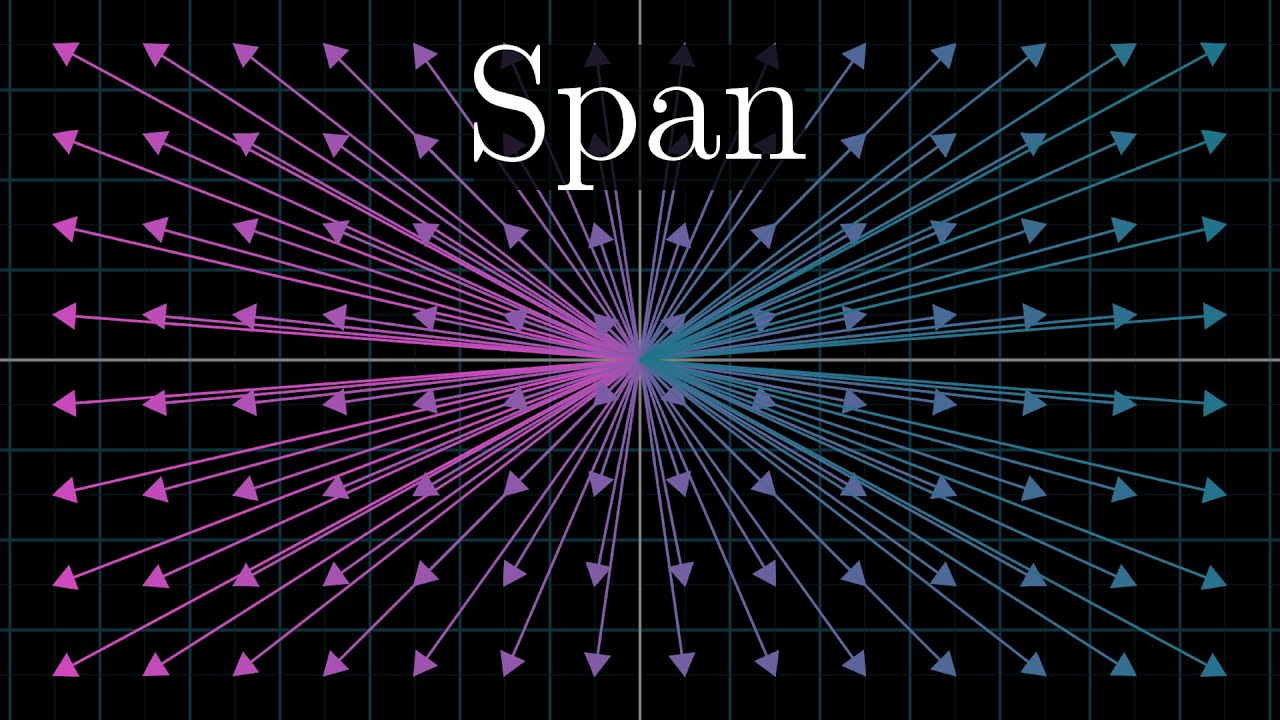
Home page: https://www.3blue1brown.com/ The fundamental vector concepts of span, linear combinations, linear dependence, and bases all center on one surprisi...
bless this clip
slow scroll
on multivariable calculus tho...
sturdy scaffold
why doesnt he make them as pretty as his videos
sturdy scaffold
what year are you in
spiral kelp
I'm a freshman in college this Fall
sturdy scaffold
o
spiral kelp
I just graduated high school
sturdy scaffold
welcom
I think all the math ppl aren't looking
inhale
if basis, linear combination, span, and linear independence are explained poorly, the rest of the course may be explained poorly as well, which would be unfortunate
rigid cypress
spiral kelp
unit vectors are basis vectors right?
rigid cypress
wait
sturdy scaffold
yap
sturdy scaffold
shh kids love ddr
rigid cypress

spiral kelp
Because you can write all vectors in terms of the unit vectors
sturdy scaffold
Yap
slow scroll
basis vectors don't have to be unit vectors. Basis vectors "generate" a space and are linearly independent in that space
sturdy scaffold
They don't always have to be like 90 deg to each other in this cartoon
But that what make this one special
spiral kelp
What do you mean generate a space? They're like the corner or something?
sturdy scaffold
it means you can stick them together to make everything else
slow scroll
(1, 2) and (1, 4) are a basis for R2 for example. These aren't unit vectors nor orthogonal vectors. generate, span, and complete mean the same thing. you've probably heard span
stoic pythonBOT
上海:
sturdy scaffold
stick them all in a set
spiral kelp
Are the ^ supposed to identify vectors?
sturdy scaffold
okie
dusky epoch
there are many ways to notationally distinguish vectors from scalars
sturdy scaffold
$ a\hat{i} +b \hat{j} + c\hat{k}$
stoic pythonBOT
上海:
sturdy scaffold
here u go
dusky epoch
$\hat{\imath}, \hat{\jmath}$
stoic pythonBOT
Ann:
dusky epoch
:p
sturdy scaffold
be laz
shut off c (plug in zero) and set a to like 1 and b =2
what ever you want
$ 1\hat{i} +2 \hat{j} + 0\hat{k}$
stoic pythonBOT
上海:
dusky epoch
grumble grumble
rigid cypress
sturdy scaffold
do it repeatedly for possible a, b, and c
sturdy scaffold
no no we're just going to talk about V all at once
$ 1\hat{i} +2 \hat{j} + 2\hat{k}$
$ 2\hat{i} +0\hat{j} + 69\hat{k}$
$ 1\hat{i} +2 \hat{j} + 2\hat{k}$
$ 420\hat{i} +0\hat{j} + 69\hat{k}$
$ 1\hat{i} +2 \hat{j} + 2\hat{k}$
$ 2\hat{i} +0\hat{j} + 69\hat{k}$
$ 1\hat{i} +2 \hat{j} + 2\hat{k}$
$ 420\hat{i} +0\hat{j} + 69\hat{k}$
stoic pythonBOT
上海:
sturdy scaffold
etc etc etc
itd be annoying to scribble all of them down
$span(\hat{i} , \hat{j},\hat{k})$
stoic pythonBOT
上海:
sturdy scaffold
so write that instead
stoic pythonBOT
上海:
sturdy scaffold
this one isn't special
i made it from these one that are v special $ \hat{i} , \hat{j} , \hat{k}$
stoic pythonBOT
上海:
sturdy scaffold
If this means ALL of V= $span(\hat{i} , \hat{j},\hat{k})$
stoic pythonBOT
上海:
sturdy scaffold
What if you threw some not so special one in there
spiral kelp
A basis is a set of vectors, not just a single vector right?
sturdy scaffold
Yap
Well if your space is smol it could be just one single vector
it depends on how much you need
a basis has the least amount you need period
spiral kelp
So a basis for 3D is 3 vectors?
spiral kelp
R2 is 2 vectors
rigid cypress
3 linearly independent vectors
sturdy scaffold
yap
We gunna throw in a not special vector
$span(\hat{i} , \hat{j},\hat{k}, ( 1\hat{i} +2 \hat{j} + 0\hat{k}))$
stoic pythonBOT
上海:
sturdy scaffold
what is this
spiral kelp
I'm not sure, R4?
sturdy scaffold
well span just means I wrote out all the possible ways you can add up $span( \text{whatever shit you stuck in ehre})$
stoic pythonBOT
上海:
spiral kelp
But what's the fourth term?
sturdy scaffold
doesnt mean whatever shit you stuck in ehre is a basis
its some random thing
but you can make it out of the other things
spiral kelp
Yeah, span(i,j,k)= ai+bj+ck
rigid cypress
span(i,j,k)= ai+bj+ck
uh
sturdy scaffold
shh
i know
it doesnt matter what number you multiply it by you cant make i from j
or k from j etc etc
$(\hat{i} , \hat{j},\hat{k}, ( 1\hat{i} +2 \hat{j} + 0\hat{k})$
stoic pythonBOT
上海:
sturdy scaffold
that why this one is a problem
 low hornet

sturdy scaffold
this not a basis
spiral kelp
What I said was wrong?
sturdy scaffold
ya
sturdy scaffold
a span mean you wrote out all of the possible ways you can add these things together
{usually you put in braces to say you have a set -- all of them}
{name tag | requirements}
i prefer writing it this way
give the elements in this set a name tag and then fill out the requirements something needs to meet to be in the set
we're using this to describe all of V
V is R^3
what is the criteria to be in R^3
dusky epoch
...
rigid cypress
was gonna say something, i will instead let cawabi handle this
sturdy scaffold
u can just come in
rigid cypress
i am tired and impatient rn so i doubt i would be able to explain well
spiral kelp
Criteria for R3 is just have 3 dimensions right?
sturdy scaffold
sure but dont talk about dimensions yet
there are other ways to say you're in r3
spiral kelp
3 components?
sturdy scaffold
we have them
they special ya
can you make i out of j
no
can you make j out of k
no
rigid cypress
Criteria for R3 is just have 3 dimensions right?
okay so, a better way of thinking of it is that it can be represented within 3 dimensions. for example, a 2 dimensional vector can be represented in 3 dimensions, and is still in R^3
or do you disagree with this cawabi
spiral kelp
Yeah, I should've put it that way
rigid cypress
thank
sturdy scaffold
$ a \hat{i} + b \hat{j} + c\hat{j} $
stoic pythonBOT
上海:
sturdy scaffold
whoops spoilers
this represents anything in R^3 ya
we populated our space by throwing in numbers into a b and c
if you set one of these things to zero
$ a \hat{i} + b \hat{j} + 0\hat{j} $
stoic pythonBOT
上海:
stoic pythonBOT
上海:
sturdy scaffold
If these vectors are special we should check whether or not it matches this cartoon of an x y and z axis
It's kinda silly
$ a \hat{i} =- b \hat{j} - c\hat{k} $
stoic pythonBOT
上海:
sturdy scaffold
just move two of the basis vectors over to the other side
but now this is saying you can make i out of j and k
that sounds like bullshit
spiral kelp
It does sound weird
sturdy scaffold
there should be no solutions to this thing
unless you set a, b and c to 0
try to find some
oh
hmm
slow scroll
The nice thing about this representation of a linearly independent basis, (that is,$a, b, c = 0$ in $ a \hat{\imath} + b \hat{\jmath} + c\hat{k}=0 $) is that you can use the null space to determine whether a set of vectors are linearly independent.
rigid cypress
maybe slow down some, what is your understanding of linear independence and linear combinations?
sturdy scaffold
$ \hat{i} =\frac{- b}{a} \hat{j} +\frac{- c}{a} \hat{k} $
stoic pythonBOT
上海:
sturdy scaffold
there
stoic pythonBOT
kxrider:
spiral kelp
Mine?
rigid cypress
yes
spiral kelp
Almost afraid to say it this time because apparently my definition of span is incorrect
Linear independence is when a, b and c are all 0
When all the coefficients of a set of vectors are zero
rigid cypress
true
sturdy scaffold
give up on life!! that was uncorrect answer1111111
rigid cypress
don't be afraid around me and cawabi
i won't hunt you down until you're in your second lin alg course
once you're there, be VERY afraid
spiral kelp
Second lin alg?
sturdy scaffold
super hard lin alg
spiral kelp
There's more??
rigid cypress
yep!
sturdy scaffold
yap
sturdy scaffold
i think this other guy wanna help too
im just going to finish w/e i was gunna say
so i dont talk over him
you know how in middle school if you want to find solutions you usually plot some shit and see if it intersects
saying that a=b=c=0 is like trying to find the one place where a the x y and z axis intersect
slow scroll
the whole point of linear independence is that the representation of a vector with a basis is unique.
the whole av + bv2 + cv3 = 0 iff a=b=c=0 is an algebra trick to show thaat you can't set one of the vectors equal to a linear combination of the others in some non trivial way
spiral kelp
Is this assuming the x, y, and z axes intersect at some other point that's not (0,0,0)?
sturdy scaffold
no no im just motivating why 000 is the solution
spiral kelp
Oh
sturdy scaffold
0 is also special
you'll understand y later
let go of this idea of an axis for a second
You have a vector
It exists and its happy
I can give it a name $\vec{V}$
stoic pythonBOT
上海:
rigid cypress
veccy the vector
sturdy scaffold
$\vec{V} = (\text{no fucking clue what goes in here})$
stoic pythonBOT
上海:
spiral kelp
woah what happened
sturdy scaffold
I drew some more arrows
now you can relate the cartoon to this thing
$\vec{V} = a \hat{x} + b\hat{y}$
stoic pythonBOT
上海:
rigid cypress
basis is defined as: the smallest set of linearly independent vectors that span a set, hence why it's BASE for basis
sturdy scaffold
i change my mood i think this axis is shit
rigid cypress
lel
spiral kelp
x and y hat are unit vector components
sturdy scaffold
yes
Remember that one is special
its also ez to draw
look I picked another one
spiral kelp
@rigid cypress Why isn't the basis always the unit vectors?
Is it because there are more possible bases?
sturdy scaffold
now it looks more like this$\vec{V} = a \hat{v} + 0\hat{u}$
rigid cypress
there are applications for having a basis for a particular system
stoic pythonBOT
上海:
rigid cypress
you can change between bases, but let's not get into that rn
sturdy scaffold
i know that not what Im gunna drive
rigid cypress
sturdy scaffold
just wake up and pick a basis
there's only one way you can make V using those basis vectors
spiral kelp
V = the span of the basis vectors?
sturdy scaffold
mbadd
If you crack open whatever your prof teach or any lin alg book they'll mention a lot of things that seem like they come right out of thin air
I was where you were a few weeks ago
what is span
what is basis
etc
You have to learn the language
spiral kelp
The class I'm taking is so fast paced and I often find myself wanting to just leave or something because it becomes nonsense, especially when he pulls out the proofs
rigid cypress
cawabi has gud memes
spiral kelp
I guess I do now
sturdy scaffold
Look we have a shitty dock
Birds sit on these things right
all kinds of different birds
seagulls
pigeons
w/e
But for some magical reason, all of the poles have a bird on it so long as its 11am ish depending on where you live
Theres a way you can write this down using these spooky symbols math ppl use
All poles have a bird ya.does it have to be the same bird across all poles`?```🇾 🇳 ans now and get your priz
u get ur prize
its a meme
$\forall \text{poles} \exists \text{rat with wings}$
stoic pythonBOT
上海:
spiral kelp
wtf
sturdy scaffold
now we use the scary symbols
This is a promise
$\forall $ Every pole...
$\exists $ has a birb
stoic pythonBOT
上海:
spiral kelp
For any pole exists a bird?
sturdy scaffold
no
every
We're super sure of it, we we're going to use the funny upsidedown A
every single last pole
now you're going to guarantee there is a bird
that means it well
exists
thats the E
its the bare minimum you can say about the bird
they could all be the same bird or they could all be a different bird we dunno so we won't make that promise
the point is we are saying there def is a bird there
spiral kelp
okay
sturdy scaffold
ok order matters
what do you think if I switch the E and the A thing around
$\exists \text{rat with wings} \forall \text{poles} $
stoic pythonBOT
上海:
spiral kelp
there exists a pole for every bird
wait what
I thought you were just switching the symbols
sturdy scaffold
naw fam we switching the order of the promises
spiral kelp
lmao
sturdy scaffold
i said something exists
it doesnt give a shit about anything else
it just
is
rigid cypress
pole: exists
sturdy scaffold
now i'm promising that every pole has one
rigid cypress
bird: 
spiral kelp
1
stoic pythonBOT
上海:
sturdy scaffold
one UNIQUE birb, FOR ALL poles
dusky epoch
what even is this anymore
spiral kelp
^
dusky epoch
cawob are you drunk
spiral kelp
Well I have to go now
sturdy scaffold
o fuk
spiral kelp
It's late and my class is unfortunately a morning class
sturdy scaffold
inhale
spiral kelp
But I have the whole weekend to take all of this in, fortunately
So I'll be sure to watch the videos you all have.. prescribed me
sturdy scaffold
There are a few rules you need to meet to be in a vector space
These are the 8 axioms for being a vector space
rigid cypress
cawabi ur memeing forthe break weren't u
rigid cypress
also @spiral kelp please go talk to your prof
rigid cypress
ask them to explain in detail outside of lecture
rigid cypress
if you don't understand lecture you need to go above and beyond
make every effort you can to learn and understand
sturdy scaffold
if u dont get it cum bak and ask these ppl (try first)
spiral kelp
Alright, I will @rigid cypress
rigid cypress
a prof is v knowledgeable
i'm certain you will get something out of the experience
sturdy scaffold
sneepy well
 untold flax
is an isometry map/transformation that is not an operator, f:U->V, where U and V are finite, always linear?
seems it is, nvm
dusky epoch
use the definition of linear independence.
no
you don't need contradiction for this
this can be proved w/o contradiction
tacit sigil
hmm I'm not really sure yet
I think whether {v1,...,vn} is lin indep depends on what kind of linear tranformation T is
dusky epoch
no, this result is actually true no matter what T is
hell you don't even need V or W to be findim
here, i'll start you off:
Let $c_1, ..., c_n \in K$ such that $\sum_{k=1}^n c_k \mathbf{v}_k = \mathbf{0}$. We wish to show that $c_k = 0$ for all $1 \leq k \leq n$.
stoic pythonBOT
Ann:
dusky epoch
(if your course considers only real vector spaces, you may replace $K$ with $\bbR$)
stoic pythonBOT
Ann:
stoic pythonBOT
UMKO:
dusky epoch
you don't care whether it does
but also
you can't just bold and unbold the symbols like that
$\mathbf{V}$ isn't a thing. $V$ is.
stoic pythonBOT
Ann:
tacit sigil
ok. I thought I needed to bold V because its a vectorspace
I should've bolded the vectors
dusky epoch
I thought I needed to bold V because its a vectorspace
no
and in fact vector spaces are almost never denoted with bold letters
you should always stick to whatever notation the problem gives you
dusky epoch
have you actually attempted a proof
there is a very basic proof which does not require any heavy machinery, but which it's easy to overthink
tacit sigil
I was thinking I could use the fact that $span({T(v_1),...,T(v_n)}) = im(T)$
stoic pythonBOT
UMKO:
dusky epoch
no
no no no no
you don't need spans
or images
or any of that
you just need the definition of linear independence
 swift plaza
Like Ann said, let $c_1, ..., c_n \in K$ such that $\sum_{k=1}^n c_k \mathbf{v}_k = \mathbf{0}$. Now what happens when you apply T to both sides of this equation?
stoic pythonBOT
killer_memestar:
dusky epoch
well, i was hoping for @tacit sigil to come up with the idea of applying T to both sides of that on their own
but ok
tacit sigil
RHS $T(\mathbf{0}) = \mathbf{0}$
stoic pythonBOT
UMKO:
tacit sigil
If I apply T to lhs, would it be inside the sum?
 cunning hedge
you're also using linearity when" bringing it inside" the sum
tacit sigil
ah ok thats the word for it.
dusky epoch
you now get $\sum_{k=1}^n c_k T(\mathbf{v}_k) = \mathbf{0}$.
stoic pythonBOT
Ann:
tacit sigil
yeah thats what I got
dusky epoch
so now
there's one more premise that you've yet to use, which is that {T(v_1), ..., T(v_n)} is linearly independent
tacit sigil
Thus c_k = 0
dusky epoch
no, not "c_k = 0", but "c_k = 0 for all 1 ≤ k ≤ n".
 slim wasp
A projection matrix P that projects any vector v onto the range of matrix A,
would P always have the same range as A?
hmm I guess they never have the same range as P would have to transform a vector v such that it results in the part of v that is orthogonal on A
which it cannot if it has the same range
although I don't know how general that is or if there are cases where A and P may have the same range
I am just getting confused by these two images
cedar solar
So P brings any vector onto the closest point on the range of A
What does that imply about the range of P?
slim wasp
@cedar solar it would seem like the same range then, P is just a modified A which will result in an orthogonal projection on A, while A won't necessarily result in an orthogonal projection on A?
So A will still transform a vector onto its range, but just not orthogonally
slim wasp
right yeah that must be it, it's a constructed projector from an aribitrary basis
P is constructed solely from the basis of A, although it's a bit hard to visualize $A (A^* A)^{-1} A^*$ doing that
stoic pythonBOT
ksj:
slim wasp
oh lol yeah I forgot the bot takes more than what I want
cedar solar
I think you’re misunderstanding what orthogonal projection is
Let’s say you have y=x
And have a point (1,0)
This is not on the line y=x
An orthogonal projection onto it turns the (1,0) into something on y=x that is closest to it, in this case (sqrt(2), sqrt(2))
(Mental math so i might be wrong)
But if you have (1,1) then the orthogonal projection of it onto y=x is still (1,1)
Because (1,1) is the point closest to (1,1) on the line y=x
slim wasp
well yes I am aware of that
I was just wondering what the range of P must be considering the range of A, but they must be the same as P is literally used to project vectors onto the range of A
and not just any projection, it's the orthogonal projection
cedar solar
Right
So projection by definition needs to be orthogonal, so saying A projects a vector onto its range isnt quite right
A projection matrix needs to be symmetric and idempotent, which A might not necessarily be
For instance take the line y=2x and the matrix A = 2I
Where I is a 2x2 identity matrix
Then yes it takes any input to the range of A, but it does not project onto its range
Because if you have (1,2) intuitively its projection onto a line containing itsef should be (1,2)
But A will make it (2,4) so A is not a projectionr
slim wasp
right I think I agree, my mistake was to say A projected anything then
thanks @cedar solar
wintry steppe
Basic question: just getting back into mathematics after many years of hiatus. How can we think of a projection, in linear algebra? I'm looking for something more intuitive/geometric than "linear transformation where P^2 = P".
But a little better than "a vector's shadow".
I don't know if I'm being obstinate here.
cunning hedge
It gives the closest thing in the subspace to the original
wintry steppe
In the subspace of whatever we are projecting on?
cunning hedge
ye
wintry steppe
I feel like it's almost like we are extracting the component that lines up with the new vector or plane or whatever, but that's be a gross generalization?
Anyway, I'm going to be asking a lot of questions here over the next several years. They will likely be very dumb at first. Over time, I'll graduate to being merely dumb. 😃
sonic osprey
What does the $\mathcal{L}$ notation mean?
stoic pythonBOT
Zopherus:
tacit sigil
linear transformation
dusky epoch
consider that T(v) = w + 5v is the same as (T-5I)(v) = w
consider also what can be said about T-5I given that T is an operator on R^4 and given that you know four eigenvalues of T.
@tacit sigil
tacit sigil
ok I'll see what I can do
 urban spruce
Hey guys! It's my first post there:)
I have a problem that I can't solve hence I've decided to ask.
I need to solve:
Probably using De Moivre's Theorem...?
the part that gets me stuck is that sin φ = Im(Z)/|Z| = (sqrt(6) - sqrt(2))/2
how do I solve for φ?
Thanks for any help in advance
dusky epoch
consider rewriting this as $\frac{(\sqrt{3} + i)^{30}}{(1-i)^{30}}$ instead, and doing the num and denom separately
stoic pythonBOT
Ann:
dusky epoch
you might find that easier
 feral mountain
I would write it as $\left(\frac{2e^{i\theta_1}}{\sqrt2e^{i\theta_2}}\right)^{30}$
stoic pythonBOT
EpicGuy4227:
urban spruce
they only introduced rectangular and polar forms to us
feral mountain
o
 gray glen
well use polar then
urban spruce
thank you guys
tacit sigil
https://cdn.discordapp.com/attachments/540211747613704221/587122522391183371/unknown.png
for this, you get (T-5I)(v)=w. I'm supposed to get something out of T-5I because I know the eivenvalues but I'm not sure

 dusky epoch
well
are there any other eigenvalues that T could have, besides the ones stated in the problem? if yes, which ones? if no, why? @tacit sigil
urban spruce
@dusky epoch if I use de moivre's for num and denom separately, how do I write it in final form when both num and denom are in polar? is it fine to leave it as |Z|*fraction?
dusky epoch
e^ix/e^iy = e^i(x-y) 😛
urban spruce
oh alrighty. Thank you!
tacit sigil
???????? How do I know what eigenvalues T has? @dusky epoch
dusky epoch
i'm not asking you which eigenvalues it has
i'm asking you whether there can be any besides the ones the problem gives you, and IF SO which ones
the fact that T is a linear operator on R^4 may be relevant
tacit sigil
w can be the linear combination of the eigenvectors??
feral mountain
don't mind me, Ann's solution should be the best
tacit sigil
???
dusky epoch
the solution i'm trying desperately to hint at
without actually disclosing it
think about this: how many eigenvalues can an operator in $\mathcal{L}(\bbR^n)$ have?
stoic pythonBOT
Ann:
tacit sigil
n number of eigenvalues?
dusky epoch
...the last three words didn't belong there
but yes
an operator on R^n can have at most n eigenvalues.
so going back to your problem
can your operator, an operator on R^4, have any eigenvalues besides the four you're given?
tacit sigil
no
dusky epoch
correct.
so then
your operator has four eigenvalues, and 5 isn't one of them.
what does that let you say about T - 5I?
tacit sigil
T-5I is nonzero
dusky epoch
well, duh, if T - 5I were the zero operator then T would be 5I. but 5I wouldn't have 1, 2, 3 and 4 as eigenvalues.
but that isn't enough
tacit sigil
hmm
dusky epoch
consider, though, that you might not have properly communicated what you wanted to say
tacit sigil
(T-5I)(v) is nonzero?
tacit sigil
😦
rancid iron
Can someone explain to me what the range of a matrix is?
Ive seen like 4 different explanations
feral mountain
do you mean rank
rancid iron
well the rank is the dim(range) right?
Is there a difference between the range of a linear transformation and of a matrix?
tacit sigil
isn't the range just the image of the linear transformation?
rancid iron
wym the image
tacit sigil
Image is what the tranformation maps to the codomain
feral mountain
for $T-5I$ I noted that $\det(P^{-1}TP-5I)\neq0\implies\det(T-5I)\neq0$, where $P^{-1}TP$ is the diagonalisation of $T$ but there's probably a better way about it
stoic pythonBOT
EpicGuy4227:
dusky epoch
no need for diagonalization.
5 isn't an eigenvalue of $T$, therefore $\ker(T - 5I) = { \mathbf{0} }$, therefore $T - 5I$ is invertible.
stoic pythonBOT
Ann:
 prisma ocean
I have a question
feral mountain
niicce, been a while since I've done linear algebra
prisma ocean
Well I’m working on trigonometry right now
native lodge
trig fits in the trig channel lol
tacit sigil
I was really confused when @feral mountain mentioned diagonalisation but @dusky epoch s comment makes sense
prisma ocean
Ok thanks
 undone garnet
can anyone explain for me line 3 to line 4
I don't understand why $rank(A^p) \le rank(A)$
stoic pythonBOT
henry:
brittle juniper
you have $\im(A^p)\subset\im(A)$
stoic pythonBOT
Tuong:
brittle juniper
so $\dim\im(A^p) \leq\dim\im(A)$
stoic pythonBOT
Tuong:
stoic pythonBOT
henry:
undone garnet
where did it come from?
dusky epoch
every vector in Im(A^p) is also in Im(A)
brittle juniper
take a vector $Y$ from $\im(A^p)$\
there exists a vector $X$ such that $Y=A^pX$\
then $Y=A(A^{p-1}X)$ so $Y$ is also in $\im(A)$
stoic pythonBOT
Tuong:
dusky epoch
^
undone garnet
so, that implies $\im(A^k) \subset \im(A) \forall k \in N$
stoic pythonBOT
henry:
dusky epoch
yes exactly
brittle juniper
(with $k\geq 1$)
stoic pythonBOT
Tuong:
dusky epoch
well, as long as 0 not in N under your convention