#linear-algebra
2 messages · Page 15 of 1
 frank gate
x-y is at distance 3 from origin
x + y + z is at distance 0 from origin
Does the two planes intersect because the plane that is: x-y = 3 has a z = 0 which match the second plane?
 misty cairn
The two planes intersect because you can find a solution that fits both equations
It's true that at z = 0, they intersect but you can find a more general solution by solving the simultaneous equation using both the plane equations, so you end up with the equation of a line
 neat pond
hey
is the standard matrix here just ```
[1 0 0 0]
[0 1 1 0]
[0 0 0 3]
please help
PLEASE
 astral junco
@neat pond sry i can't help. you might want to post that in #help-1 as well so more people can see your question.
 rare barn
how do you find a pagerank vector from the steady state vector?
 sand oak
rare barn
sand oak
rare barn
So from my alt transition matrix, i set up a system of equations and solved setting each row = to a,b,c,d resppectively and got a=1/3, b= 2/9 , c= 1/3, and d= 1/9
sand oak
Need some help
rare barn
idk where to go from there though, ik thats the steady state vector but idk
wait, is a pagerank vector the same as the steady state vector? im confused
 rigid cypress
 honest marlin
In a video on the cross product by 3blue1brown, at this time: https://youtu.be/BaM7OCEm3G0?t=487, he solves for p1,p2,p3 but how does he know that they are specifically in that order? If I have x + y = 5 + 2, I do not know whether x or y is equal to 5 or 2.
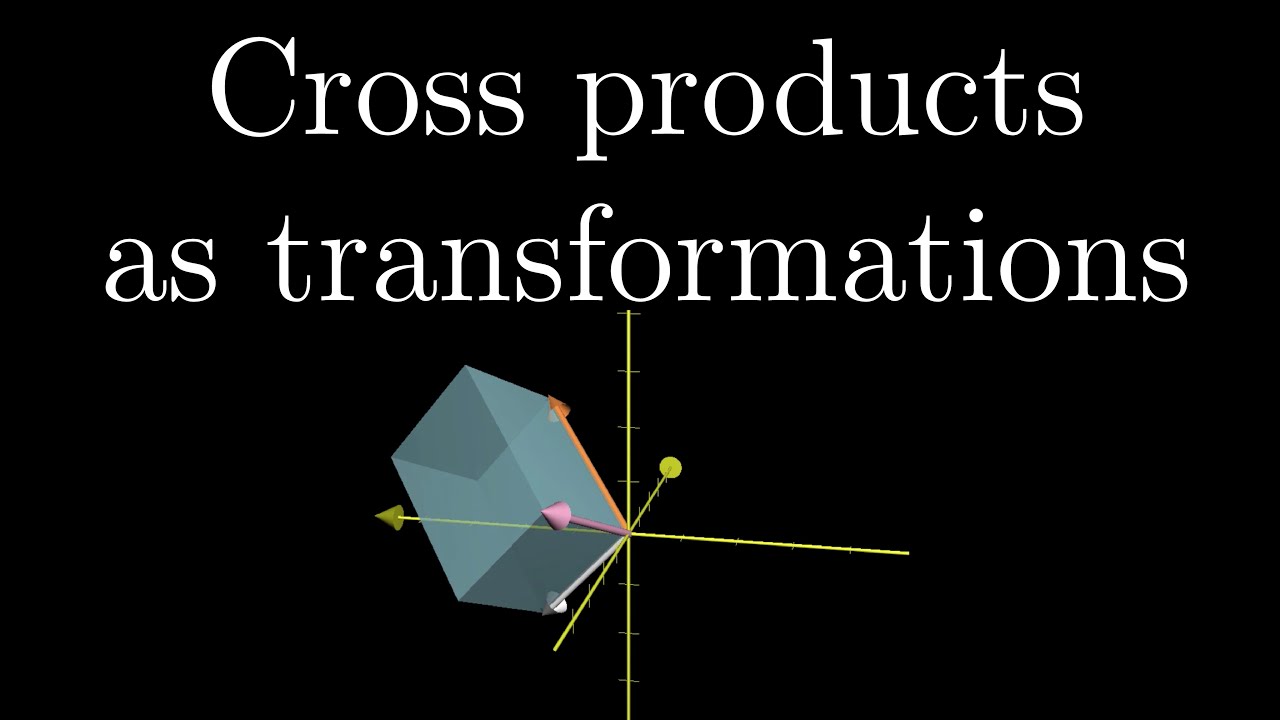
Home page: https://www.3blue1brown.com/ For anyone who wants to understand the cross product more deeply, this video shows how it relates to a certain linear...
 dusky epoch
he can do this because $$p_1x + p_2y + p_3z = (v_2w_3-v_3w_2)x + (v_3w_1-v_1w_3)y + (v_1w_2-v_2w_1)z$$ is an equality meant to hold for \textbf{all} $x, y$ and $z$
 stoic pythonBOT
Ann:
 burnt oar
I have a quick question about the distance function $\mathrm{dist}(A,SO(n))$ for matrices $A\in\mathbb R^n\otimes\mathbb R^n$
stoic pythonBOT
Simplex:
burnt oar
Is it true that the taylor expansion near the identity is given by
$$\mathrm{dist}(\mathrm{Id}+A,SO(n))=\left| \frac{A+A^T}{2}\right| + O(|A|^2)$$
stoic pythonBOT
Simplex:
burnt oar
or should i rather ask this in #❓how-to-get-help ?
dusky epoch
nah here is ok too i guess
 winter reef
If f is an isometry f(a) =b and f(c) =d then is f(a x c) =b x d? (vector product)
And lets Say norm of a and c is 1
If that makes a difference
 worn crow
@winter reef i think it's f(axc) = +- b x d
since an isometry doesn't have to preserve right-handedness
winter reef
yeah, thats what I thought
worn crow
but yeah, it preserves angles and lengths, so it's definitely +- bxd
winter reef
@wintry steppe
 wintry steppe
Okay, so I only see the channel when I am tagged
yep
I have muted this too
don't worry you're not the only one
 granite light
Kinda lost, what im assuming I have to do is rewrite this into a bigger matrix and then make it into RREF and count how many pivot positions i have?
more lost on how exactly to make it into a bigger matrix, ive only done 2x2 but im assuming the first matrix is rewritten as
1,0,1,0,1,0
 half ice
@granite light
Can you show this set is/isn't linearly independent?
There's a rather simple argument showing this isn't independent
Oh yeah, you could split these in half, then use rref
granite light
yea i got linear dependent
half ice
You can kill one of these before starting with a matrix
Make the matrix a bit smaller
So get rid of m5 = (0 0 0 1 1 1)
granite light
so gt rid of m5 and then compute it with m1,m2,m3,m4?
cuz this is how i originally approached problem, forming this:
and just RREF'd and saw wasnt LID
and found # of pivot positions
professor didnt cover this at all and the book is showing examples of dimension null space instead of regular 
half ice
If you've already got the number of pivots, you already have it
Dimension = number of pivots
granite light
yea but
im not sure if i did the
matrix right
like did it riht
yakno
i cant check my answer anywhere
like idk if my process is right
half ice
Can do this
(1 1 1 0 0 0)
(1 0 0 1 0 0)
(0 1 0 0 1 0)
(0 0 1 0 0 1)
(0 0 0 1 1 1)
granite light
ohh !
ok
i think i get it
i think my problem is more of making these small matrixes into one big one
half ice
Make sense? They aren't the same elements, but still convey the same info
half ice
Good luck, lmk if you need anything else
granite light
okieee
half ice
Oh, and remember you can kill one of the elements with a lin dep argument
granite light
correct
cuz span(v1, vk) = span (v1, vk-1) if vk is a linear combination of v1 to vk-1 correct
 sage mauve
ye
 paper egret
taking linear alg next semester, anything i should be expecting or be ready for?
 tranquil junco
@paper egret death
 broken hawk
@paper egret there’s two possibilities:
it’ll open your eyes to the true beauty of math… or it’ll just be really boring. depends on what the focus of the class is and whether you’ve got a good prof
paper egret
yea im reading up a bit on my professor atm
so far i see a full page of him flaming AP calculus in 2001
paper egret
or scoring rubric for 2001
wrote a shit ton of books 👀
wtf is the american mathematical society, is that huge?
tranquil junco
satan
 limber sierra
the AMS is... just that
its an organization that acts as a public ambassador for mathematics
organizes meetings and events
has its own journal
writes articles on important happenings
etc
AMS fellowship is prestigious but just being an AMS member is fairly standard
getting published in the JAMS is a huge deal though
tranquil junco
they're different from the MAA right
limber sierra
yes
tranquil junco
these fucking acronyms god damn
limber sierra
but similar
 tranquil junco
is not new york
my teachers are trying to 1 up each other for harder exam while not violating school policy
mine is winning
paper egret
wtf is the point, do they get a raise or something?
the people who dont like math suffer and end up hating it
tranquil junco
there's no one who doesn't like math in the honors classes at my school
you have to take a test filled with math to get in
and do well on math before to get in too
and you have to apply for it
paper egret
some people do honors, because it's "honors", regardless of the subject
at this level in high school
trying to be impressive in your classes is the mindset people have in preparation for college
honors this, honors that
tranquil junco
yah but its a stem school with a heavy focus on math
ik
i do it too lol
i've honestly never met someone who dislikes math in my geometry classes
paper egret
i feel horrible for kids that feel the need to take honors everything just to have a chance at better education
tranquil junco
maybe ppl who dislike the class cuz its hard but not math in general
yah that's sucky
tbh i just take all honors cuz non honors is boring
i'd rather hard and annoying than boring
paper egret
your time could be well spent on other things imo
tranquil junco
they aren't hard tbh
eh the only subject i don't really care about is english anyway
and there's no honors for that till ap eng lang in 11th
paper egret
ye i c where ur coming from
tranquil junco
idk its just like
if a class is hard at least i can bitch about it in earnest lmfao
when classes are too easy i actually sometimes end up doing worse cuz i can't bring myself to engage
paper egret
looking back i kinda regret taking some APs
complete waste of time
i could be doing other stuff
ima move this to #chill
tranquil junco
yus chill migration
 silver ore
got a question
if I have a function, lets call it a that can be represented by a matrix A
If A^N=0
how can you proof how 0 is the only eigenvalue?
broken hawk
the harder part would be showing that there is a 0 eigenvector, imo
silver ore
I felt like I gave an incorrect answer
So im just here to confirm
when I think back, the logic is embarrasing
broken hawk
if a matrix is the 0 matrix, then multiplying it with any vector will give 0. but if v is an eigenvector of A of value λ, then it’ll be an eigenvector of value λ^n of A^n
silver ore
so I would rather not put it down
broken hawk
and in particular, not in the kernel
this is proven by an easy inductive argument
the existence of a vector not in the kernel then contradicts A^n = 0
note that this does not yet prove that A has any eigenvalues at all, however
but that’s also straightforward enough: if A is nilpotent, then A cannot have full rank. if A has not full rank, then its kernel is nontrivial. the kernel is the eigenspace of eigenvalue 0. so 0 is an eigenvalue
silver ore
ah
I see
I can't believe I didn't see this
@broken hawk thanks so much
I think the whole topic of eigenvalues just clicked for me suddenly
thanks so much
its a bit too late since my exam is done
but thanks anyways
winter reef
Let V be a linear euclidean space of dimension n. For what k, composition of k orthogonal symmetries to subspaces W_1,W_2,..... W_k of dimension n-1 changes orientation of V? Is it for k uneven?
 dense holly
how do you find the change of coordinates matrix
 slow scroll
[v1 v2 v3] is the matrix that takes vectors in the basis of {v1, v2, v3} and sends them to vectors in the standard basis for example @dense holly
 clear spoke
Hey, what do I need to do to get the angle of a linear function?
for example
$y = \sqrt{3}x$
stoic pythonBOT
Autistic Hoodie:
clear spoke
The angle of that is $\pi/3$
stoic pythonBOT
Autistic Hoodie:
dense holly
im reviewing for a final tm an i dont understand this problem and it seems really easy..
how do you solve these
 native lodge
For part a, what do you know about x? You can see that it's composed of two parts
in fact, one of the parts comes from solving Ax=0
do you know which part of x that would be?
for part b, now you only have a single vector, x, that solves Ax=b
what does that mean about A? once you figure that out, what does that imply about Ax=0?
 idle echo
Would it be accurate to think of matrices as multi dimensional numbers?
slow scroll
Ehh i don't know about that, but it would be accurate to think of numbers as one dimensional vectors, and linear transformations from R to R as 1x1 matrices
dusky epoch
"multi dimensional numbers" what's that even supposed to mean 
 fringe cave
@idle echo There was one thing I read that treated matrices as multidimensional lists, but honestly you're probably better off not doing multidimensional numbers as your analogy
Instead of matrices as multidim. numbers, you could instead think of them as linear transformations or (if you're a cs major) multi-(usually 2-)dimensional arrays
slow scroll
How might i try to prove that a an orthonormal basis of N vectors can be constructed from the eigenvectors of a NxN Hermitian operator? 
dusky epoch
maybe try proving eigenvectors corresponding to different eigenvalues are orthogonal
slow scroll
i am more hung up on the existence of N orthonormal eigenvectors, not so much proving they are orthogonal if they do exist
dusky epoch
hmmm
wintry steppe
@slow scroll This is just the spectral theorem. See https://en.wikipedia.org/wiki/Spectral_theorem#Hermitian_maps_and_Hermitian_matrices
In mathematics, particularly linear algebra and functional analysis, a spectral theorem is a result about when a linear operator or matrix can be diagonalized (that is, represented as a diagonal matrix in some basis). This is extremely useful because computations involving a ...
wintry steppe
someone can help me to find a good demonstration of the Perron Frobenius theorem ?
slow scroll
@wintry steppe I know what spectral theory is. I mean, I don't think I'm very good at it so I may have missed something. What is it about a Hermitian operator in particular that ensures its always diagonalizable?
wintry steppe
The proof is given on the page; essentially, it comes from the fundamental theorem of algebra and the fact that, for Hermitian operators, if V is an invariant subspace under A, then V^perp is also.
 inner isle
tranquil junco
inner isle
tranquil junco
fam this isn't linear algebra what
 frosty vapor
lol
wintry steppe
How do you prove the determinant of a matrix without using a calculator? Do you just solve it by hand?
wintry steppe
5x5?
native lodge
That’s pretty hard to do in your head unless you have zeros all over the place, you would have to work it out by hand
wintry steppe
Got it, thanks
native lodge
Row reducing is an option available to you to make it a bit easier, no matter what you choose to do, it will take a bit of time
broken hawk
I now wonder… are QR-Decomposition or SVD ever easier to compute by hand than LU-Decomp
winter reef
Ahh shit, here we go eigen
 rotund cargo
@clear spoke are the functions guaranteed to pass through the origin? if so, you can take arctan(y(1)) - can also replace 1 with any positive number
oops
for some reason my chat just updated after i sent that message
sorry!
 elfin schooner
if <u,u> > 0, why do we have the modulus in Cauchy-Schwarz inequality?
Am I missing something?
nvm i figured it out
winter reef
what did you figure out?
im not sure why, since the modulus is before the square so why would that matter?
ohh, for complex?
stoic pythonBOT
 Requested by dog#3227
rare barn
Requested by dog#3227
rare barn
is thjis true or not? and why... If a vector space V is spanned by {v1, . . . , vn}, then V is isomorphic to R^n
 swift plaza
If V is a real vector space, then yes. In general, if V is an n-dimensional vector space over a field k then V is isomorphic to k^n, but the isomorphism is generally not canonical, i.e. it depends on the basis you choose for V and is therefore usually not particularly interesting.
The intuition is that you can just take the linear map that sends v1 to e1, v2 to e2, ..., vn to en where the e's are the standard basis, and then by linearity this defines a map from the entirety of V to R^n
rare barn
so then isn't it isomorphic all the time here?
swift plaza
actually, I just saw that you're original message said "spanned by {v1, . . . , vn}", in that case it isn't true, you also need that {v1, . . . , vn} is linealy independent, so it's a basis
fringe cave
Span =/= form a basis
rare barn
so it needs to be linearly independent as well to be isomorphic
fringe cave
i mean, obviously the linear independence is key, otherwise you'd be saying V (is spanned by {1, 1, 1}) isomorphic to R^3
rare barn
👌
fringe cave
o o f
 quaint heart
That's what a basis is
Also what you said for finite dimensional vector spaces is true for infinite dimensional vector spaces as well
rare barn
srry ive got one more... The set of polynomials p ∈ P2 such that either p(0) = 0 or p(1) = 0 is a subspace of P2.
broken hawk
what happens if you take two polynomials which are 0 in different locations?
rare barn
would they not be a subspace
half ice
For example, p(x) = x and q(x) = x - 1 are both in that set, but (p + q)(x) = 2x - 1 is not
rare barn
yeah, so they aren't a subspace of P2
 placid oracle
How can I show that this transformation T:V->P_1 defined: T(f)=f(1)+f'(0)t is linear
where V is thew vector space of differentiable fxns f: R->R
placid oracle
what do u mean
 brittle juniper
tbh just use the definition
fringe cave
^
Anyhow, f` is the derivative, which you know is linear (as is multiplication by t if that t is what I think it is)
and f(1) is linear because (h+g)(1) = h(1)+g(1)
placid oracle
dont i have to use: T(u+v) = T(u) + T(v) and Tc(u) = T(cu) for the whole thing though
dusky epoch
that's the definition
and that is what @brittle juniper just suggested
but also... did you mean T(cu) = c T(u)
fringe cave
yes clearly
placid oracle
yes my b ann
ok but for when i use the definition, im confused as to what f im allowed to use, can it be any f that is differentiable?
slow scroll
f is a letter. g is also a letter. if you want those letters to mean differentiable functions then that's fine
rare barn
srry just reposting this if T : R3 → R4 has two pivots, then the kernel of T is a
line in R3. is this always true, sometimes true, or just false?
slow scroll
if T has two pivots in REF, then yea, then the nullity of the matrix is just 1.
rare barn
okay, but is there an exception to this that wouldn't always make the Kernel of T a line in R3?
slow scroll
hmm can't think of anything. This is a basic application of rank-nullity. We have a 4x3 matrix with two pivots in REF. That implies rank = 2, and rank + nullity = 3, therefore nullity = 1, a line in R3
 abstract bolt
How do i get the equation for this?
 spice storm
Why am I keep getting -7 when I try to do this?
It should be 0 in the position where 2 is
slow scroll
huh? is it row2 - 2*row1 youre asking about?
spice storm
I have to use the gauss-Jordon elimination
Yes
2x2
I have on my calculator -3-2*2
And keep getting -7
slow scroll
(2x - 3y) - (2x - 4y) = 0x + y
spice storm
I’m confused
I’ve been in the same problem since 9:30 and is really annoying me
PM
slow scroll
@spice storm its like elimination method of solving systems of equations. Now ur just doing it with matrices instead
spice storm
But why am I keep getting -7
When I literally just typed R2-2R1
R2 is -3 and R1 is 2
And yet I keep getting -7
slow scroll
(2x - 3y) - (2x - 4y) = 0x + y
2x - 3y -2x + 4y
combine like terms.
spice storm
Y=1
slow scroll
well, 0x + 1y, not -7y
spice storm
I’m still getting -7 😭😭😭😭 this is beyond annoying. Where did you even get 2x-4y
slow scroll
thats 2 times row 1
 sonic osprey
R1 is -2 not 2
sonic osprey
Those are the same
slow scroll
those are the same thing? I can't figure out what ur confused on exactly. Are you trying to use a calculator or something
spice storm
Yes I’m using a calculator
slow scroll
ok don't do that. aint necessary and you might be typing something in wrong
spice storm
I need a calculator because i have a disability
But here’s what I have on my@calculator
slow scroll
-3 -2(-2) is what you want
(-3) is the entry on the second row. (-2) is the entry on the first row, and you are subtracting 2 times that
spice storm
I got 1
slow scroll
alright cool thats right
spice storm
But why is R2+(-2)R1 wrong on my calculator but R2-R1(-2) is right?
slow scroll
R2 - R1(-2) is the same as
R2 + 2R1 because of the double negative
spice storm
Thank you!
slow scroll
npnp
spice storm
For the constant what should I do? Because I keep getting 19 and it should be 5. I’m doing -3-2(2)*-11
slow scroll
are you talking about the third column?
spice storm
Yes
slow scroll
(-11) -2(-8)
-11 comes from third column of R2. -8 comes from the third column of R1
 sour garden
Prove (x-a)^k, k=0, 1, ..., n is a basis for polynomials of max degree n
sour garden
I wasn't trying induction
broken hawk
also, all you have to show is that they’re linearly independent (easy) and that there’s a way to represent a known basis with them
sour garden
I was expanding (x-a)^k with binomial theorem and trying to find the determinant of the transformation matrix
broken hawk
just try to represent x^n with the (x-a)^k
like, prove for all n (inductively) that x^n can be represented as a linear combination of the (x-a)^k for k≤n
and then also show that they’re linearly independent in some way
(that one’s easy)
I don’t see how or why you’d want to involve determinants here
dusky epoch
$x^n = ((x-a) + a)^n = \sum_{k=0}^n \binom{n}{k}a^{n-k} (x-a)^k$
stoic pythonBOT
Ann:
sour garden
Ooh nice
 rapid robin
stoic pythonBOT
rapid robin
stoic pythonBOT
kwak:
dusky epoch
weird. your reasoning looks fine to me
sonic osprey
What does R_3[x] mean? Up to degree 3?
brittle juniper
Usually yeah
sonic osprey
I'm not sure your scalars on u are correct, each of the x_i should be reals
But you might mean that already
sonic osprey
Oh, even none of the f(P_i) are 0, their linear combination can still be zero
placid oracle
Can someon ehelp me with this problem? In the year 2000, the population of two cities are both twenty million, but at the end of every year, 5% of citizens from city 1 move to city 2, and 15% of citizens from city 2 move to city 1. If m_x is the population of city 1 after x years after 2000, what is the limit of x as it approaches infinity of m_x. (lim_x->infinity of m_x)
In the year 2000, the population of two cities are both twenty million, but at the end of every year, 5% of citizens from city 1 move to city 2, and 15% of citizens from city 2 move to city 1. If m_x is the population of city 1 after x years after 2000, what is the limit of x as it approaches infinity of m_x. (lim_x->infinity of m_x)
So Ik that to find it after one year, you multiply the migration matrix by the population matrix
and to find it after another year, you multiply the migration matrix by the matrix you found in the previous step
and so on
but here, it doesn't seem to be converging anywhere and im also not supposed to use a calculator, so im pretty sure theres another way to do this without multiplying the matrices over and over
 wet finch
first question for you: what are the dimensions of your migration matrix and population matrix?
(and can you write out your migration matrix and the starting populatino matrix?)
wet finch
( so far so good!)
placid oracle
is this right?
wintry steppe
Can someone help me how to solve this problem?
Determine algebraically the zeroes of f(x) = 3x^3 + 21x^2 + 36x
I am used to doing it with 4 terms
but I don't know how to do it if 0 was the 4th term
I try and group it but I can't find 2 of the same expressions
placid oracle
i did the thing where we keep multiplying them but it doesnt seem to converge anywhere (i also stopped at four because it became hard to do by hand)
@wintry steppe try prealg-algebra
wintry steppe
ok
wet finch
@placid oracle that is correct
placid oracle
Okay, so what do i do next...
wet finch
the trick is to not multiply them out the way you did
instead of calculating Av, A(Av), A(A(Av)), etc
use the associativity of matrix multiplication
and look at Av, A^2 v, A^3 v, A^4 v, ...
i.e. calculate just the powers of A
and see what that converges to, and THEN multiply by v
(it's still going to be hard to do that, so there is another trick...)
placid oracle
yeah isnt that also tough to do by hand
wet finch
yes but it's the key insight
that you should look at powers of A first
so the strategy now is to diagonalize A
write A = P D P^(-1) for some diagonal matrix D
and now the great part
$A^2 = A A = P D P^{-1} P D P^{-1} = P D^2 P^{-1}$
stoic pythonBOT
Buncho Bananas:
wet finch
and in general, $A^n = P D^n P^{-1}$
stoic pythonBOT
Buncho Bananas:
placid oracle
omg i completely forgot abt this
wet finch
how does that help? because calculating powers of a diagonal matrix is SUPER EASY
placid oracle
yep totally, im gonna try it on my own gimme 2mins
wet finch
so then to find the lim as n -> infinity of A^n, you just need to do it for D^n and then conjugate by P
placid oracle
so what do i plug into the power though?
placid oracle
Ok so ive diagonalized it:
so basically 1^infinity is 1 and 4/5)^infity is 0
so then i resolve the matrix
placid oracle
yes so it convereges to 30mil and 10mil
placid oracle
so the answer is 30mil, cool!
@wet finch i got 1 more question for u if u got time
wet finch
ok
placid oracle
Let transformation T: V-> P_1 be defined by T(f) = f(1) + f'(0)t and V be the vector space of differentiable function f: R->R.
I first had to show that it was linear, so I said that we know f' is linear and so is the mulptlication by t. And that we know that f(1) is linear because (h+g)(1)=h(1)+g(1) in any possible function in this example
is that enouigh to show that its linear?
and second, I have to prove that it is an onto function, but i am lost as to how to do so
wet finch
one minute
you need to show that T(f+g) = T(f) + T(g) and T(af) = aT(f)
it sounds like the things you said will certainly help you show those two facts
but at the end of the day that's what you need to show
placid oracle
yes but im not sure how
wet finch
as for the surjectivity, you need to show that "for any real numbers a and b, there is a f such that T(f) = at + b"
i.e. f(1) = a and f'(0) = b
placid oracle
again, im not sure how
placid oracle
u
u(1)+v(1)
but is that all the justificaiton i need?
and (u+v)'(0)t = u'(0)t+v'(0)t
wet finch
what do you mean "all the justification"
you are correct that that is u(1) + v(1)
now write out T(u) + T(v)
so literally: write down T(u) and write down T(v) and add them
placid oracle
u(1) + v(1) + u'(0)t+v'(0)t
wet finch
is that the same as what you got when you wrote T(u+v)
placid oracle
so yes, they are equal
wet finch
please notice that it wasn't actually hard to do this!
you are just psyching yourself out
placid oracle
i had already done this
wet finch
to show that T(u+v) = T(u) + T(v), you just do it. write out both sides and see that they are the same
wet finch
why wouldn't it be?
that's literally the definition of linear (along with T(av) = aT(v), which you still need to show)
placid oracle
im not sure, ur right i was psyching myself out because i thought it was too simple
wet finch
math doesn't have to be hard
just because it's simple doesnt' mean you're wrong
sometimes it is just simple
placid oracle
so T(cu)=cT(u)
(cu)(1)+(cu)'(0)t = ((cu)(1))+(c(u)'(0)t
which works
but now what abt to show that its onto
wet finch
onto just means that for any a + bt, there is some f with T(f) = a + bt
i.e. there is some f with f(1) = a and f'(0) = b
placid oracle
okay, but again i dont see how i can show that
pretty sure im missing smth dumb again
wet finch
once again, just do it
write down a linear function with f(1) = a and f'(0) = b
for example, f(x) = bx + (a-b)
placid oracle
ok but arent there linear fnxs where this doesnt work?
wet finch
maybe my use of the word "linear" in my last sentence was misleading
i meant "linear" in the sense of "degree-1 polynomial" not in the sense of "linear transformation"
was that your question?
placid oracle
yes but also, im confused as to why we're allowed to pick any linear function, there are clearly ones that dont work for the condition as well?
wet finch
what do you mean? the problem is asking you to show "for every a + bt in P_1, there is some differentiable function f such that T(f) = a+bt"
but T(f) = f(1) + f'(0)t
so if I give you something that looks like a + bt
you need to find some f with f(1) = a and f'(0) = b
so that T(f) = f(1) + f'(0)t = a + bt"
so now YOU get to find f(x)!
and you can do whatever you want to find it
placid oracle
oh so i just need to show that there exists a function that satisfied that condition and that works?
i was confusing it with all fxns need to satisfyu the condition which is obv not true and it wasnt making sense
wet finch
i mean it's obviously not true that every function f satisfies T(f) = 0
but to show surjectivity you just need to find AT LEAST ONE function f with T(f) = 0
and AT LEAST ONE with T(f) = 1 + 3t
and AT LEAST ONE with T(f) = pi + 42t
that's what surjectivity means
placid oracle
ok the at least one idea makes a lot more sense, i rlly need to brush up on this
wet finch
yeah if you have trouble with surjective and injective and stuff like that, you need to review it before you do more linear algebra
that kind of stuff is the foundation of linear algebra (and beyond) and you need a strong foundation before you move on!
placid oracle
for sure, thanks for all the help tnite!
wet finch
yep, gl
sonic osprey
@wintry steppe see my comments above
sonic osprey
@wintry steppe
What do you mean by distribute f?
If you use the linearity of f, you get -14f(P_1) + f(P_2) + f(P_3) which is 14 - 3 - 11 = 0
@wintry steppe
 plain fjord
If I have an upper triangle matrix, and need to find a basis for it, doesn't identity matrix suffice? I can construct any triangle matrix with that.
I mean, if that is so, it's quite easy exercise...
sonic osprey
This makes no sense. You don't find basis for matrices, you find basis for linear spaces
plain fjord
Whoops, you are right. Let me rephrase
I had an exercise where I had to prove that upper triangle matrices form a vector space. I did that, 8 things to check. Then I need to find a basis for that vector space, and construct a matrix which represents that basis
But I was thinking, isn't identity matrix one of such matrix?
plain fjord
I know that with identity matrix, I can form matrices that are not upper triangle matrices, so it contains "extra" stuff, but I was thinking, does it matter?
broken hawk
also btw, if you’ve already shown that the space of all nxn-matrices is a vector space then you did too much work
sonic osprey
The identity matrix is in that linear space yes
broken hawk
you could’ve just shown that the triangular ones are a subspace
which is only three things to check
(nonempty, closed under addition, closed under scalar multiplication)
plain fjord
I mean, if the diagonal has even a single zero, that would mean the matrix is not invertible and can't form a basis
Yeah actually I thought about that, and did it at first, but then I read about more properties that vector space has, and checked them all. was tedious though
sonic osprey
I think you're confusing yourself here
The basis you want to construct is for the vector space of upper triangular matrices
Not for R^n or something
broken hawk
there’s a theorem that:
- a subspace of a vector space is a vector space over the same field
- a subset of a vector space is a subspace if it
a) is nonempty / contains 0
b) is closed under addition
c) is closed under scalar multiplication
it then inherits all other axioms from the larger space
this means in most cases you don’t have to prove it satisfies all 8-9 axioms
but only those three things
that theorem gives you everything for free
plain fjord
Okay. Good to know.
Zopherus, hmm, yes that's true, it is for whole R^n, so identity matrix is a "larger" basis than what was asked, but I'm not sure is that a bad thing.
broken hawk
R^n isn’t even in consideration here
the space is TriUpp(n) or however you wanna denote it
which is isomorphic to $\mathbb{R}^{\frac{n^2 + n}{2}} = \mathbb{R}^{\frac{n(n+1)}{2}}$
stoic pythonBOT
Sascha Baer:
broken hawk
(by simply ignoring all the zero entries of the matrix and considering it a weirdly arranged vector)
plain fjord
Hmm, oh yeah, if identity matrix would represent the basis, then it wouldn't be closed under addition, i mean, i could get out of the Upp(n) space with standard basis
So probably not a good idea after all
sonic osprey
Yeah you could use the identity matrix as one of your basis matrices, but probably not the nicest way to do it
broken hawk
I’m not quite sure what they ask to do with that matrix representing the basis tbh
are you sure you’re not supposed to find matrices which form a basis
 hot ivy
Please help me answer this question!! It’s multiple choice! Thanks!
If a function is not one-to-one on an interval I, it cannot have an inverse function on I.
a) True. If a function is not one-to-one then at least one of the range values of the function has more than one image when the inverse is defined.
b) False. The function can have an inverse as it is not one-to-one on the interval I.
c) True. If a function is not one-to-one then at least one of the domain values of the function has more than one image when the inverse is defined.
plain fjord
Actually, now that you mention that, I'm supposed to find a basis for the Upp(x) space, not necessarily a matrix representing it...
broken hawk
good. that’s much easier cause I actually know what that means :P
consider the matrices as weirdly arranged vectors
plain fjord
And count the dimension to it, but that must be n i suppose
broken hawk
it’s definitely not n
plain fjord
I know that the matrices are vectors in disguise... heh.
broken hawk
(I actually spoiled it earlier on)
plain fjord
I mean, the columns of a matrix are the basis vectors
plain fjord
hmm, you mean like (1,0) is the first thing in a matrix, i mean 1 in the diagonal
and then expand to n coordinates, that example above would be case if n is 2
broken hawk
I have no idea what you just said
plain fjord
hehe okay, doesnt matter
Back to the original question, the basis. So it doesn't necessarily have to be the standard basis, since that is too large, right?
broken hawk
I think you’re still triyng to find a basis for the wrong space
this is what a vector in your space looks like (for $n=3$):
$$\begin{pmatrix}
a & b & c \
0 & d & e \
0 & 0 & f
\end{pmatrix}
$$
stoic pythonBOT
Sascha Baer:
plain fjord
Yes, true
broken hawk
this is a vector any nothing else
the columns of this thing are meaningless
in this exercise
plain fjord
V = {(a,0,0),(b,d,0),(c,e,f)} in other form, right?
plain fjord
Look what i wrote, the first thing becomes a column in that matrix you wrote
broken hawk
are you just using really really bad notation?
pls don’t interrupt
also this is not linear algebra
hot ivy
sorry wrong discord
plain fjord
It's possible I have my terms mixed up
slow scroll
catnose, i think you are getting confused between finding a basis for the column space of a matrix and finding a basis for the vector space of triangular matrices
broken hawk
what you wrote there is “the vector space V is a set with three elements: the vectors (a,0,0), (b,d,0) and (c,e,f)”
this is false
plain fjord
Actually, what i tried to write was another way of saying the same thing you wrote, and you wrote it in matrix form.
broken hawk
then you’re using ridiculously confusing notation
plain fjord
kxrider, hmm, it's possible
broken hawk
I hesitate to call any notation bad but I think you got pretty close to it
{ } has a very established meaning
plain fjord
Hey come on, I'm just learning the stuff, that's why I am asking 😃
So I'm happy if you point out that my notation is messed up
 placid zephyr
Anyone wanna get in vc and talk about some linear ?
plain fjord
Hmm, perhaps { should be <
slow scroll
if you said "V = span{(a,0,0),(b,d,0),(c,e,f)}"
that would be the column space of that upper triangular matrix, not the space of triangular matrices
a, b, c, d, e, f can be any element of the field, so they each need their own degree of freedom
frank gate
Hello everyone! If i want to find a normal in a plane given to vectors v1 and v2
that would be that the normal n = v1 x v2
but! does it mather the order i cross them in? if i do v2 x v1 instead i get different values, but is that equivalent?
v1 x v2 <=> v2 x v1 ?
plain fjord
But... hmm
slow scroll
thats why the space of nxn upper triangular matrices would have n(n+1)/2 vectors in its basis
broken hawk
my god can you people stop interrupting
plain fjord
Wait, so for n = 3, that would lead to (3^2+3)/2 = 6
But, isn't that impossible, a basis can have at most n vectors...?
broken hawk
you're still confused as to what the vector space is
slow scroll
a nxn matrix has n^2 entries lul
plain fjord
Yes, but...
slow scroll
for a 3x3
1 degree of freedom in first column
2 degrees of freedom in second
3 in third....
= 6 total
placid zephyr
Degrees of freedom sound like the dimension of the linear vector space
Or are they not related
broken hawk
it's literally what this is about
slow scroll
these are triangular matrices
broken hawk
@plain fjord you're stuck thinking that "vectors are columns and matrices are a didferent thing"
plain fjord
Actually in this case, we are limited to nxn spaces
broken hawk
here, the vectors are matrices
sonic osprey
the elements of your vector space are matrices
plain fjord
Oh yeah... now I think I'm starting to get it...
Hmm...
It's starting to get a little clearer, but I gotta think this a little 😃
so, in two dimensional space, if i had a matrix [a,b; 0,c] that would be a*[1,0;0,0] + b*[0,1;0,0] + c*[0,0; 0,1] - (in this ; means change to next row)
$$\begin{pmatrix}
a & b
0 & c
\end{pmatrix}
$$
stoic pythonBOT
Catnose:
plain fjord
Ah damn, misspelled it
0 and c are meant to be in the next row
Anyway, you get the idea what I wrote? I don't know the syntax to that bot yet
swift plaza
[1,0;0,0] , [0,1;0,0] and [0,0; 0,1] would indeed be a basis for the space of 2 by 2 upper triangular matrices
but be careful, you said in two dimensional space, the matrices are 2x2 but this space is 3 dimensional
plain fjord
Actually, in the exercise, it's n-dimensional, but we are getting there
plain fjord
Uh, sorry, i meant, that the matrices are square matrices, and nxn
placid zephyr
Wouldn’t n x n be square ?
plain fjord
Thanks for clarifying that :). Yeah you are right, I gotta be more careful with what I type
Yes we are dealing with square matrices
placid zephyr
Ok
plain fjord
So I just gotta generalize what I have now.
Thanks for your help, even though I haven't yet completed it, but I learned a lot
 oblique crag
Need help with 27. Completely clueless on how to even do part a
oblique crag
<@&286206848099549185>
 dreamy quest
Ahhhhh this
Linear transformations with respect to 2 bases
It took me more than 5 hours to understand this
The most important thing I learnt in those 5 hours was that a linear transformation has something absolute about it, and that, given a basis, its representation in that basis (or with respect to two bases) is simply one of infinitely many ways to represent that linear transformation.
stoic pythonBOT
Tony Wang:
dreamy quest
^
Though for the first question you don't need this.
But the idea of a base or basis remains the same: you can represent every number or vector in your domain of interest uniquely using that basis. For numbers, base (n) dictates that the (k)-th digit to the left, (a_k), must be between 0 and (n-1), and that it represents a value of (a_k k^{n-1}). But note that \emph{every single number has exactly 1 unique representation in a base} -- in particular, two numbers are the same iff each digit is the same. Similarly, given a basis, every vector in your vector space has exactly one unique representation. For the first part of 27.\ it's just a matter of finding that unique representation.
stoic pythonBOT
Tony Wang:
dreamy quest
Here, I think you will find that the correct "digits" of the vector are (89 , -15, -6)
Because 89(1) + (-15)(5-x) + (-6)(2+3x-x^2) = 6x^2 - 3x + 8
A nice parallel that might help you understand the idea of basis more is if you consider working in base (x) from 0 up to (x^n), where (x) is an unknown positive integer variable. Then the coefficient of each (x^k) is really just (a_k) as I talked about earlier. So for example, here, (6x^2 - 3x + 8) would be represented as ((6, -3, 8)). In fact, you may notice that working in this base is equivalent to working with the basis (B = {x^{n-1}, x^{n-2}, \dots, x, 1}). (This is a basis for polynomials of degree less than (n).)
stoic pythonBOT
Tony Wang:
dreamy quest
@oblique crag
 modest jasper
Does anyone know how to do a question like this?
slow scroll
just want to point out that you can also just create a change of basis matrix that maps every vector in the standard basis to a linear combination of vectors in B. @oblique crag
@modest jasper have you computed the eigenvalues of A?
modest jasper
Yeah @slow scroll 😃
slow scroll
and the eigenvectors i presume?
modest jasper
Yes.
slow scroll
ok so you need the matrices that do the right stuff (im tired lol). Have you done this before? Typically I see A = PDP^-1, but you can invert matrices to get D = P^-1AP
slow scroll
nice np c:
oblique crag
@dreamy quest it says <95,-18,-6> but im@still confused on exactly how u came up with those numbers
dreamy quest
Do you understand why it is those numbers though @oblique crag
slow scroll
@modest jasper ur answer is a little off according to wolfram alpha lol
oblique crag
I see why they make sense but my question is more of how did u get them without guessing random numbers @dreamy quest
slow scroll
pahy, would you know how to construct the change of basis matrix from the standard basis to B?
oblique crag
Honestly ive come to realize my class uses some rly weird terms compared to friends taking classes at other school
So i have no idea
modest jasper
@slow scroll Oh, sorry, I should have posted this.
oblique crag
Imma say no
slow scroll
thats right according to WA @modest jasper 🤷
slow scroll
okay pahy, there is a linear transformation that takes any vector in B to the standard basis. First, do you know how the standard basis of polynomials works?
(1, 0, 0) = 1
(0, 1, 0) = x
(0, 0, 1) = x^2
oblique crag
Yep i understand that
dreamy quest
Oh right so for that one it's quite easy because the only way you can get an x^2 is if you use the third vector
so you need a -6 there
dreamy quest
Yeah and you work downwards, so the next term you look at is the x term
oblique crag
Then u get -18x from that
dreamy quest
yeah XD
oblique crag
And have to make it -3x with 2nd term
dreamy quest
Though for other bases which arne't so easy you set up a system of linear equations and solve
dreamy quest
essentially you have a(1) + b(5-x) + c(2 + 3x - x^2) = 6x^2 - 3x + 8 and you solve for a b and c by comparing coefficients of 1, x, and x^2
oblique crag
Still interested in learnin bout converting to standard basis though if ur keen kxrider
dreamy quest
and in this case it's very straightforward
slow scroll
$B = {1, 5-x, 2+3x -x^2}$, $$\begin{pmatrix} 1&5&2 \ 0&-1&3 \ 0&0&-1 \end{pmatrix}$$ is the matrix that takes vectors in $B$ as an input and outputs vectors in the standard basis. The inverse of this matrix takes in vectors from the standard basis and outputs vectors in $B$, the transformation you are looking for.
stoic pythonBOT
kxrider:
slow scroll
right, but not the matrix in that picture, but the inverse of that matrix
oblique crag
Inverse?
slow scroll
the one in the picture says that if put in (0, 1, 0) for example, I get out (5, -1, 0). The vector I plugged in was from the basis of B, and the transformation converted it to the standard basis. The inverse of this matrix allows me to input vectors from the standard basis, and get that vector in the basis of B
oblique crag
Right, how do u get the inverse though
slow scroll
have you inverted matrices before?
oblique crag
Oh right yes i have
Need to look at my notes to recall though
Wait i think i remember
Can add the columns with leading 1s
Then do rref
slow scroll
yea so rref the matrix augmented with the identity matrix
oblique crag
Yep thanks
slow scroll
np
 woeful laurel
Anyone know some tricks you can pull on matrixes
Like this one, multiplying with that column matrix gives you the sum of the rows
I know it's not really trickery but still
broken hawk
not really sure what you’re looking for tbh
rigid cypress
what do you mean by when you say trick?
plain fjord
Probably some handy things to know, to simplify calculations?
But they are just curiosities and fun to know things, usually
quaint heart
I guess you should know the relation between matrix multiplication and the dot product
plain fjord
Of course. But I guess what he was trying to say, are there other nice simplifications like that, or other interesting things to know.
 earnest vessel
But a trick should be something that simplifies calculations
What they posted IS the calculation
So I'm not sure what they are referring to
plain fjord
Well, perhaps something, that is interesting to know?
plain fjord
Well, not maybe related to his thing, but i got an exercise, to prove that a row operation on a matrix, is the same as multiplying on an elementary matrix from the left side.
Which is kinda easy if you try it with finite matrix, like 3x3 matrix, and multiply it with a matrix that has two rows exchanged, it exchanges the rows on the original matrix too
But the proof should be about any matrix, not just 3x3
earnest vessel
Yes, that is at least theoretically useful
plain fjord
Yeah, my exercise has nothing to do with what he said, but I just mentioned it, since the topic came up.
oblique crag
Anyone help with part c
oblique crag
<@&286206848099549185>
sonic osprey
What are you confused about?
oblique crag
part c. i dont understand how i am supposed to compute it. completely lost on even the first step @sonic osprey
like i think im supposed to multiply [t1]bb' by the 2x1 matrix of <-7,5> but thats not giving me the right answer
sonic osprey
It would be (-7, 5) if the bases being used were the standard bases
But they're not the standard bases
oblique crag
Right... so how do i approach this
Hmm could it be -7(1)+5(1-x)
So -5x-2
<-2,-5> multiply by [t1]bb’?
<11,-22,-35>
-11(1)-22(1+x)-35(3x-x^2)
Okay got it, tysm zopherus
oblique crag
Alright so why is part g process different from part c. Or is it the same and im doing my math wrong
 inland anvil
In general, if you have a matrix that's mostly empty and repetive
actually, not just one, but a series
for each size or so, it's like a patern
what are good ways to find the determinant in terms of some sort of recursive formula
asking because I have such a series and I have a conjecture for a formula the determinants follow
but I want to be able to prove it
 copper fossil
You mean like a sparse matrix?
inland anvil
I don't know the definition of that
lemme see
oh, it's pretty informal actually
yeah
exactly what I'm thinking
inland anvil
that's the one I know
inland anvil
eh, maybe I should just focus on using that more
I'll read http://mathworld.wolfram.com/Determinant.html as well
silly me, not researching my problems well before asking online
woeful laurel
@broken hawk yeah it's kinda hard to explain
something kinda like the example that I gave
it's not a trick per-say but it's something nifty
yeah that still makes zero sense
 hasty rune
I've gotten a bit rusty with my definitions - given a Matrix, is the Dimension the number of independent rows and the Rank the number of independent columns?
swift plaza
Rank is the dimension of the column space, which is indeed equal to the number of independent columns. 'Dimension' on it's own really has no meaning, but the dimension of the row space is equal to the number of independent rows, which in turn is equal to the rank.
placid oracle
is this always true? why? In an inner product space, if <x, y>= 0, then either x = 0 or y = 0.
dusky epoch
placid oracle
?
placid oracle
no?
winter reef
no
placid oracle
what
winter reef
its not always true
dusky epoch
@placid oracle well, is it not always true?
how do you prove that a statement that begins with "for all ..." is false?
placid oracle
u just find one examplee where it isnt
dusky epoch
well
if you claim that it is NOT the case that
In an inner product space, if <x, y>= 0, then either x = 0 or y = 0,
then find me a counterexample!
broken hawk
and do it fast cause I have a question
winter reef

 placid oracle
well doesnt it work if they are both = 1
dusky epoch
who are "they"
placid oracle
x and y
dusky epoch
what does the < , > symbol denote?
placid oracle
wdu mean
dusky epoch
i mean exactly what i said
there's this symbol which you've used in your statement
composed of two angle brackets and a comma
what does it denote
placid oracle
for inner product doesnt it mean they are functions
dusky epoch
answer my question
what does < , > denote?
wouldn't be a good idea to use the symbol if you don't know what it means, would it?
placid oracle
i just said it, what inside is a function
dusky epoch
no, you did not answer my question
< , > denotes THE INNER PRODUCT.
and what does the inner product take as its inputs?
placid oracle
functions
broken hawk
well, functions are vectors
of some spaces
(it may be that there's information we were not told)
placid oracle
"The inner product of tweo functions f(x), g(x) on the interval [a,b] ios a number denoted <f,g> given by <f,g> = integral from a to b of f(x)g(x) dx"
dusky epoch
ok but that's just looking at a particular kind of vector space
with that particular product
and in that vector space, the vectors are functions
broken hawk
and you didn't indicate the question was about that particular space
dusky epoch
but you are working in the more general context of an inner product space, whose elements may or may not underlyingly be functions
broken hawk
so we were assuming full generality
dusky epoch
should i give the most straightforward counterexample to "If <x,y> = 0 then x = 0 or y = 0" or nah
brittle juniper
||>two functions f(x), g(x)
🤢 ||
placid oracle
no then ur right
placid oracle
yes
dusky epoch
so you need to produce a vector space, and two vectors therein, such that neither of the vectors is the zero vector, but their inner product is equal to zero.
what vector spaces do you know of?
give me the simplest vector space you can think of
placid oracle
R^n
placid oracle
but doesnt the vector not matter if you can just choose an interval where the inner product will equal zerop
dusky epoch
what interval
look
all i'm asking you to do now
is find two vectors in R^n
neither of them the zero vector
such that their inner product is zero
can you do this
broken hawk
(the standard inner product, unless you wanna make things complicated)
broken hawk
(don't pick 1)
placid oracle
(1,1) (-1,1)
broken hawk
aye, sec
Let $x \in \mathbb{C}$ and $A \in \mathbb{C}^{n \times n}$. Define $K = \langle x, Ax, A^2 x, \dots \rangle \subseteq \mathbb{C}^n$.
Is $\exp(A)x \in K$? If no in general, under which condition is it?
stoic pythonBOT
Sascha Baer:
dusky epoch
did you mean $x \in \bbC^n$
stoic pythonBOT
Ann:
broken hawk
yes, sry
dusky epoch
ok
exp(A) can be expressed as a linear combination of A^k for 0 ≤ k ≤ n-1
because by cayley-hamilton, chi_A(A) = 0
so that gives you an expression for A^n in terms of those
and once you have A^n you can express all the powers above it as well
and nothing should diverge
broken hawk
still an infinite sum tho, so I suppose I’d have to somehow reason it’s a cauchy sequence, right?
which, tbf, it probably is
the same reasoning should also apply to exp(iAt)x, right? (where i is i and t is a positive real number)
still in the same K, but the exponential plays well with scalars
placid oracle
can someone explain to me what im doign wrong here: im supposed to show the least squares solution to the system of equations written below by both solving the normal equations and through the Ax=projColA b method
but im getting two different answers for both methods
<@&286206848099549185>
placid oracle
anyone?
slow scroll
yea idk personally 🤷
placid oracle
i have no clue what im doing wrong and ive been trying to redo this problem for th epast hour
still getting the same stuff
 paper vector
could someone tell me what the difference is between linear and abstract algebra
like what some of the main focuses are in each kind of algebra, all i know is that abstract algebra has groups and vectors and rings but not much about linear algebra
hasty rune
Linear is about vector spaces that obey a particular set of properties
IIRC, vectors must be scaleable and addable
slow scroll
@paper vector Linear algebra is just focused on vector spaces and linear mappings between them while abstract algebra is the study of groups, rings and fields
limber sierra
well, abstract algebra is much broader than that
but thats the focus at a general level, yes
paper egret
how come abstract algebra isn't early university?
limber sierra
its worth noting that linear algebra is a subset of abstract algebra, but they're usually treated pretty differently
@paper egret because its research-based pure math, all of which fits better under "Advanced Mathematics"
and in some systems (particularly american), math majors might not even encounter it till, like, the 3rd year of ug
limber sierra
the distinction is mostly meant as a divide between research-adjacent fields and more "computational" or "general" fields
so like, everything up to intro to proofs fits under "early university"
then anything actually rigorous and proof-based is "advanced"
but of course, this isnt a 100% hard-and-fast rule
and its largely contextual
still, its usually clear enough (except for that poor kid asking about exponential functions in #groups-rings-fields)
placid oracle
how do i show that in an inner product space if ||u+v||^2 = ||u||^2+||v||^2, ui and v are orthogonal?
winter reef
it jsut follows kinda from definiton, (a+b)^2 = (a)^2 + (b)^2 + 2<a,b>
if u and v are orthogonal then it means <u,v> = 0
half ice
@placid oracle
What's u²? <u, u>?
clear spoke
How would I go about solving the system of equations
$c_1 \cdot \sin(\pi - c_2) = 1 \ c_1 \cdot \cos(\pi - c_2) = 0$
stoic pythonBOT
Autistic Hoodie:
clear spoke
Hmm, maybe I should actually use my brain instead of mathematical procedure
c_1 could be 1 and c_2 could be pi/2
Yup 😃
But the answer is -cos(x)
placid oracle
how do i do this?
hasty rune
Isn't inner product also on usual math LA courses at the end when generalizing LA concepts?
native lodge
it is lol, but I hear that word used more often with physics
hasty rune
True
hasty rune
They're akin to Dot Products, right?
hasty rune
Oh lol
placid oracle
<@&286206848099549185>
wintry steppe
Sorry, can anyone give me a hint on q9?
I posted above <@&286206848099549185> sorry n.n
 solar rock
15 minute rule
wintry steppe
I posted my first one a few hours ago
same question but someone else posted
after
 gray glen
remember how you would normally compute the dot product
also that $\mathbf a \cdot \mathbf b =|\mathbf a||\mathbf b|\cos\theta$ where $\theta$ is the angle between them
stoic pythonBOT
CaptainLightning:
 wide rain
ok?
wintry steppe
Ree ty for the tips will try
wide rain
so you want to show that cos 90 = 0 ????
 gilded junco
Yo guys question about left inverse and right inverse. Something in my textbook is throwing my mind in loops
Left inverse is intuitive 'Is there a function,g, that you can apply to function f to return back x?"
Right inverse is like "Is there are function,g, where you can apply before hand to f, and you'd get x?"
So g circle f = idx (left inverse)
and f circle g = idx (right inverse)
BUT MY TEXT BOOK SAYS "f circle g = idy"
but f by itself = idy. So I just don't get it
Thanks i'll leave now, hopefully some kind person knows what i'm missing :*(
Oh, I was using idx in the sense of "What's the first thing you put into the function"; and in fact, if g: Y -> X, then the first thing you put into the function is idY. Ok I get it now, thanks
sonic osprey
Yw
 warm stirrup
Glad I could help
gilded junco
Can I ravage someone about inverses
native lodge
matrix inverse?
gilded junco
functions inverse
native lodge
linear algebra isn't most suited for that topic lol, doesn't really fit
gilded junco
excuse me, i'm shook
maybe it's cause this class is so early on, that they felt to include it even though it isn't part of linear algebra
slow scroll
well if the functions are linear transformations it probably fits 🤔
native lodge
you need to show problem then
gilded junco
the problem is my understanding
Forgive my laziness, but I would love if I explain things how I understand it, and you correct me
So let f: X->Y. The left inverse will take where you mapped to with f, and give you where you started
The right inverse..... ?
gilded junco
It's pretty much synonymous dude
Matrices in some way come from functions; excuse my butchering of the concept
native lodge
function inverse I typically think of f^(-1)(x)
maybe because I do more calc than LA
slow scroll
A right inverse to f:X -> Y is a function g such that f is a left inverse to g @gilded junco
gilded junco
Yeah, I got to that realization
This surely shows where my iq limit is, or atleast that's what i've been telling myself
sonic osprey
What are you asking?
gilded junco
to uNdErStand
I see the right inverse as nothing more than a left inverse from a different view point
(as kxrider pointed out)
I'm on a mission to understand the other viewpoint - why would you use a right inverse
slow scroll
"I see the right inverse as nothing more than a left inverse"
careful, the right inverse is not a left inverse, but if
gf = id, then g is a left inverse to f, and f is a right inverse to g. thats all i was saying
sonic osprey
Something that might help is noting that a function has a left inverse if and only if it is injective. And a function has a right inverse if and only if it is surjective
gilded junco
Zopherus ^ I know that factoid too, if you think it'd help in explaining the difference, please elaborate
So @slow scroll , let's start with
"Left inverse helps you get back the domain when a function has been applied to it"
"Right inverse..... "
sonic osprey
If you're looking for differences between the two, there aren't really any differences between right and left inverses. The ideas are dual to each other
gilded junco
When would you use one over the other? In particular the RIGHT inverse?
The lecture slides I posted above seem to have just that, I just can't comprehend
I gotta have dinner now. Sorry. afk for 15
slow scroll
they don't always exist. A function has a left and right inverse iff its bijective
sonic osprey
When he says you can make the argument of why do
That makes 0 sense
idy is a function from Y to Y, but f is a function from X to Y, so having f(x) be idy makes no sense
gilded junco
oh
soz
thanks for pointing that out!
Would you say:
You can make the argument of why do f ( g(x) ) to get an element in the codomain when you could've just done f ( x ) to get the same element, in half the steps
slow scroll
if g(x) = y, then f(g(x)) = f(y)
not f(g(x)) = f(x)
gilded junco
ok that point is a whole mind bobble, that i'm trying to get my head around; I think this is where I became messed up in the first place.
Reading your thing now kxrider
 jaunty fern
<@&286206848099549185>
Need help with 13.b
I made y the subject
for the first equation
dusky epoch
and what did you get
dusky epoch
-b/2 = 4
jaunty fern
?