#linear-algebra
2 messages · Page 14 of 1
 fringe cave
then ax+by = whatever
and so on
so it's easy to look at without requiring knowing that k
 modest jasper
I don't know how to do that though lmaoo 😂
fringe cave
lmao
I'd recommend doing the adding and subtracting with the top two to get rid of z
try that
modest jasper
Hmmm, okay.
fringe cave
so you just have x and y, which is much more managable
 warm sluice
So a cross product simplifies to ABsinθ
And a dot product simplifies to ABcosθ?
 native lodge
those are different representations of it, ABsinθ only gives magnitude, but the cross product actually gives a vector that is normal to the two input vectors
ABcosθ is a scalar, just like the dot product
warm sluice
The three-hand rule only applies to the Cross Product however right?
native lodge
if we had three hands, that would be interesting, but let's call that but its conventional name...the right hand rule
native lodge
you can find the direction of the vector produced by the cross product using the right hand rule...at least up to a certain point. If your vectors are at arbitrary orientations, it can get difficult
warm sluice
So I'm assuming you can't do that with dot products?
native lodge
dot products are scalars, no directions to worry about there
warm sluice
Ok goodie
 astral junco
what does a non-negative matrix mean?
can't seem to find what it means on google
i mean the negative of a matrix just has all elements signs switched right
so i can't figure it out what this means
 dusky epoch
context?
astral junco
says "non-negative diagonal matrix" on this slide
astral junco
i'll check
astral junco
gotcha yeah that might be it. i'll see if i can find an example
 wintry steppe
it would have to mean that all entries of Sigma are nonnegative (Sigma has nonzero entries only on its diagonal; some entries on the diagonal may be 0)
 unborn wedge
Heyy can someone help me with smth
 brittle juniper

unborn wedge
I have a true or false exercice and im trying to verify
In R^4 there exists two vectorial spaces that intersect at 0
Its true right?
Cuz r4 is a vectorial space and it includes 0
?
brittle juniper
you may send the thing in its original language
 broken hawk
for any vector space V that isn't only zero, all of V, and {0} are two subspaces intersecting in 0
@unborn wedge
unborn wedge
Il existe deux plan vectorielles F et G dans R4 tel que F inter G = 0
It is easy im in first year haha
brittle juniper
En dimension finie, on a toujours existence de supplémentaires
unborn wedge
@brittle juniper also "certaines applications linéaires R^2 ---> R^3 ne sont pas injectives est vrai aissi no?
unborn wedge
Thought so
brittle juniper
haha
broken hawk
hey I've had enough years of french to read french math :P
brittle juniper
nice
unborn wedge
I second guess myself a lot dont laugh at me xD
broken hawk
don't think that laighter was directed at you
 solemn lantern
I damn near need an instructor for my current assignment... Probably be about 30 minutes to an hour tops if someone is willing to help me. Going through some pretty mentally unstabling things in my life right now, but I also have homework and my major to focus on still. Any help is greatly appreciated, and if I had money to pay for your services I would, but that's college life for you.
I'm actively following off a PDF for my assignment, and I'm using google sheets as my digital paper as it is an online class. Both will be linked accordingly.
 split parrot
if I take sum of elements of a row/column multiplied by cofactor of some other row/column why is the result 0
a11C21 + a12C22 + a13C23 = 0
can anyone explain to me why?
 half ice
@solemn lantern
Feel free to post any questions or pictures here
solemn lantern
Here is the PDF for the assignment I'm working on;
https://tinyurl.com/MAT85-A3
Here is what I've done so far...
https://docs.google.com/spreadsheets/d/1Gj3H4Aw7z1KrTMUS_foBUtmuY14SqADFQ31iQanfG1A/edit?usp=sharing
Create a new spreadsheet and edit with others at the same time -- from your computer, phone or tablet. Get stuff done with or without an internet connection. Use Sheets to edit Excel files. Free from Google.
I just need to know if what I've done so far is correct, and then I'll continue on it for a bit until I have another question.
half ice
Can't seem to access the spreadsheet. Are you unsure about any of the questions?
solemn lantern
Try this one maybe
https://docs.google.com/spreadsheets/d/1Gj3H4Aw7z1KrTMUS_foBUtmuY14SqADFQ31iQanfG1A/edit?usp=sharing
Create a new spreadsheet and edit with others at the same time -- from your computer, phone or tablet. Get stuff done with or without an internet connection. Use Sheets to edit Excel files. Free from Google.
half ice
Nvm got in
solemn lantern
And I'm unsure of my formulas and general understanding if a formula is linear or not.
I feel like I'm correct, but I just like to know for certain.
Once I'm sure I have the first few parts correct, then I'll move on to the slope and y intercept part of the assignment, etc.
half ice
@solemn lantern
Acme obeys 31500(1.05)ⁿ¯¹
Oceanic obeys 33000 + 1500(n - 1)
Oceanic is linear, acme is not
solemn lantern
Test?
Odd
My comment was immediately deleted lol
So I do have that correct alteast. It kinda made sense anyways just due to the fact that it's going up by a percentage, which is going to become steeper and steeper of a climb in salary as the salary increases. Whereas for Oceanic, it's a constant rate of 1500 per year.
I'd assume making something of similarity to the shape of a J over time.
ƒ(x)=m(1.05)^n-1 and ƒ(x)=m(1)+1500(n-1) then?
m representing the base or new base amount
Wait, why would it be n-1? If n is a representation of years, Wouldn't it simply be, for instance, ƒ(x)=31,500.00(1.05)^1 (for 1 year), which would equal etc?
half ice
,calc 31500(1.05)^1
 stoic pythonBOT
Result:
33075
@solemn lantern
As you can see, that gives you year 2
solemn lantern
Not based on the amounts I have. That correlates with the first year for Acme Corp for me. The second year I calculated 33,075*1.05 = 34,728.75
Because year 0 is when he starts, then using ^1 calculates for year 1, etc
half ice
Oh I see, my mistake
modest jasper
Does anyone know how I can answer this question?
half ice
Yeah, then what you have should work
solemn lantern
No worries haha
half ice
@modest jasper
What methods can you use? Can you compute a matrix determinant?
modest jasper
We can use any method we want.
In terms of what I know how to do, I don't know how to compute the determinant, but I can compute the row echelon form @half ice
half ice
Okay, then do the row echelon form. You should be able to reach the identity on the left, but keep track of if you ever divide by (k - a)
If you are forced to divide by zero, you can't get rref
modest jasper
What's rref?
half ice
Row reduced echelon form
modest jasper
Oh, okay.
But how can I do that if k is on the diagonal?
I can't change k to 1, can I?
half ice
You can! You'll have to divide by k
It won't be just k though. Start at the left, work towards the right
 vague belfry
I have a linear transformation that is a reflection on plane x+2y+3z = 0
And I should determine the matrix of the transformation with respect to base v1=[1, 1, -1], v2 = [-1, 2, -1], v3 = [1, 2, 3]
The matrix of this transformation is
[1 0 0]
[0 1 0]
[0 0 -1]
correct?
Since v1 and v2 lay on the plane so they will not move, and v3 is perpendicular to the plane so the coordinates will become negative
now I have a problem determining the matrix with respect to the standard base
how do I do it xD
 slow scroll
the matrix you wrote is for a reflection over the xy plane, not the plane x+2y+3z = 0
oh wait i see what you mean
vague belfry
with base v1 v2 v3
I guess, v1 and v2 stay the same since they are already on the plane
yeah
modest jasper
Does anyone know how I can do this question?
 red night
youre looking for a vector X, such as AX=0
modest jasper
How do I find that
red night
you could just solve the system
take the vector X=(a,b,c,d) vertically
and find a b c and d such as AX=0
Or you could just try to check what answer is correct
by just multiplying the vectors by A and see if it gives you 0
 low hornet
lil eigenvalues
 tranquil ermine
for any projection
a projection is actually defined by that property
that P^2 = P
so the elements in the image are fixed by P
and yeah you may find the direction of projection by the kernel of P
but in general this is more than 1 dimensional;
projection from R^3 onto a line for example has a 2 dimensional kernel
so it isn't as nice
 wanton glade
Does a matrix A have the same eigenvalues as A transpose?
slow scroll
yea because the determinant of A - \lambda I is equal to the determinant of its transpose.
that works because the identity is symmetric
wanton glade
Awesome, thank you
slow scroll
np
low hornet
@wanton glade yes
 haughty rune
I'm not sure how to go about answering this...
could someone point me in the right direction
 olive breach
I am taking this course https://www.udemy.com/share/100dKwAkQZcVxaQw==/

Udemy
Learn concepts in linear algebra and matrix analysis, and implement them in MATLAB and Python.
low hornet
@olive breach that B = (X^TX)^-1X^Ty on the cover there is a called the least squares solution
of a matrix
olive breach
I program multiaxis cnc machines and I want to understand this http://linuxcnc.org/docs/devel/html/motion/5-axis-kinematics.html
 kind arrow
can someone explain this property of the dot product? $(k\vec{a}) \cdot \vec{b} = k(\vec{a} \cdot \vec{b})$
stoic pythonBOT
Randomdude:
kind arrow
if you do @ me with the explanation
 onyx tundra
it should be pretty obvious from either of the standard definitions of the dot product @kind arrow
if you have a dot b = |a||b| cos(theta), then (ka) dot b = |ka| |b| cos(theta) = |k| |a| |b| cos(theta)
kind arrow
oh
onyx tundra
if k is positive, then cos(theta) doesn't change because a and ka are parallel
kind arrow
wow I am such an idiot thank you
yeah I just looked at it but I didn't make sense
but that explains it
onyx tundra
if k is negative then theta becomes 180°-theta and cos(180°-theta) = -cos(theta), so since if k is negative |k| = -k, the negatives cancel out and you get k|a||b|cos(theta) in either case
kind arrow
ah ok thanks
onyx tundra
np
 grave plank
what are people's opinions on Jim Hefferson's Linear Algebra (the free one) and Howard Anton and Chris Rorres, Elementary Linear Algebra 11th edition (2014)
 frank gate
Find the vector x that is transposed on the equation seen on picture: https://gyazo.com/34afdc133fc4f6a8863b03127f6d9f4c

How do i do?
Is it just ( X_1 = -1, X_2 = 2) ?
low hornet
ye
 frosty granite
wanton glade
frosty granite
wanton glade
If two matrices have the same eigenvalues, will they have the same eigenvectors?
wanton glade
I thought so, thank you
 summer dagger
What does the notation W^⟂ mean?
brittle juniper
it's the orthogonal of W
summer dagger
so what does that mean exactly confused by what the textbook is saying
x is in W^⟂ is saying x is an orthogonal vector to W or in W?
brittle juniper
If you've got a vector space $E$ provided with a dot product $\brk{\cdot,\cdot}$, \
then $W^\bot=\brc{x\in E~|~\forall y\in W,~\brk{x, y}=0}$
stoic pythonBOT
Tuong:
summer dagger
ty still kind of lost
 winter reef
bascically set of vectors that are orthogonal to any vector of W
brittle juniper
every
winter reef
ye
summer dagger
but going back to the question i had earlier is x in W or x is in W^⟂ which is the set of all vector ⟂ to W?
x is in W^⟂ is saying x is an orthogonal vector to W or in W?
brittle juniper
if $x\in W^\bot$, then $\forall y\in W,~x$ and $y$ are orthogonal
stoic pythonBOT
Tuong:
summer dagger
alright ty I'm sure I'll be back soon
brittle juniper
👌
 hazy mica
hello everyone
how do I prove that if A and B are similar matricies, then they have the same eigen value?
this isn't my homework or exam, I promise
brittle juniper
if A and B are similar, then exists an inversible matrix P such that A=P¯¹BP
take an eigenvalue λ of A
there exists a non null vector X such that AX=λX
so P¯¹BPX=λX
so BPX=λPX
P is inversible and X≠0 so PX≠0
so PX is an eigenvector for B with eigenvalue λ
In the same way you can show that if μ is an eigenvalue of B, then it's also an eigenvalue of A
brittle juniper
You're welcome
wanton glade
If a matrix has the eigenvalue 0 is it diagonalizable?
 wet finch
wanton glade
wet finch
wanton glade
Ok good lol
winter reef
Umm what about 1 0 first row, second 00?
 jagged pendant
that's diagonal(izable)
but the question was is it necessarily diagonalizable, and the answer is no, not necessarily
buncho gave a counterexample
frank gate

Does it matter what two points i take to get the normal vector? For example (p_1 - p_2) x (p_1 - p_3)
I got the normal vector to (2,-3,2) but the answer contains the normal vector (-2, 3, -2)
dusky epoch
yes
frank gate
Oki awesome! ty
broken hawk
what that means is if you have a normal vector, then e.g. twice that (or in your case -1 times that) will also be one
because the normal vector is just some vector that lies in the normal line to the plane
as in, the line that is perpendicular to the plane
and doubling a vector on a line (nb: “line” in linalg means it goes through the origin!) just makes it twice as long, but still on the same line
 flint sequoia
Hey, I have a couple quick questions, not in linalg rn but just learning about it on my own time.
Conceptually, why are affine spaces closed under subtraction?
I’ve heard it said that some basis B of V is always a linearly independent subset of a spanning set S over V. This seems wrong to me. My naive thought process is that there a) may be no linearly independent set of vectors defined by linear combinations of elements of S and thus obtainable by reduction of S, and b) that a basis defined by linear combinations of elements of S is not necessarily a direct subset of S. Meaning A+B, with A and B being members of S, might be an element of the basis, but my understanding is that it’s not part of a subset of {A,B}
broken hawk
before I say something really stupid, is an affine space just a different word for a vector space or is it something entirely different?
winter reef
Different
broken hawk
yea I just looked it up
 remote fable
I'm learning about LU decomposition. For normal cases, all is good. What I don't understand is the degenerate cases like this : $ \begin{bmatrix}
1& 2 &3 \
0& 0 &1 \
0& 1 & 0
\end{bmatrix} $
stoic pythonBOT
topbottom:
broken hawk
LU is a lie, it’s actually LPU where P is a permutation matrix
you have to exchange two rows here, which is what the P does
remote fable
Yeah but what is the exact algorithm? Suppose that we go from A and transform it to this matrix (let's call it U), and record the row operations in L, so we have A=LU (with U not in upper triangular form yet). now we need to swap 2 rows, right? Then we have PA= PLU. Now we need to somehow move that P to the right so we have L'(PU). But what happens to L'? How do we get from L to L'?
The textbook states this theorem: for any matrix A, we can decompose the matrix PA to LU, with P is the permutation matrix. But that requires we know the proper permutation a priori, which we do not. If we try and fail (like above), we have to start over again?
summer dagger
don't want to interrupt is it ok if i ask a quick question that is a one word answer?
if a matrix is Orthonormal is it invertible?
winter reef
lol
summer dagger
ty
remote fable
A matrix is orthonormal iff $ QQ^{T}=I $ so it is invertible and the transpose is its inverse.
stoic pythonBOT
topbottom:
dusky epoch
that's called orthogonal
broken hawk
yes, but it shouldn’t be
it’s inconsistent naming
imo, orthogonal matrices should be ones where $Q^TQ = \Lambda$, with $\Lambda$ diagonal and invertible
stoic pythonBOT
Sascha Baer:
broken hawk
btw, imo, $Q^TQ$ is better notation than $QQ^T$. You may think it’s a technicality. however, in the QR-decomposition, if you decompose a nonsquare matrix, $Q$ may only have orthogonal columns, not rows
stoic pythonBOT
Sascha Baer:
broken hawk
specifically, this happens
and if you use Q̃, then the rows are not orthogonal
depending on which algorithm you use, you may either get the first or the second decomposition
(gram-schmidt gives you the second, householder the first, for example. they’re equivalent)
astral junco
I'm a bit confused on this. how is v_1*i a member of R?
What does "R" mean in this context?
broken hawk
then don’t speak
 devout moth
jeez don't have to be rude about it
broken hawk
basically, all you do is take $\mathbb{R}^2$ and identify the second coordinate with the imaginary part
stoic pythonBOT
Sascha Baer:
broken hawk
so like… $$\begin{pmatrix} x \ y \end{pmatrix} \equiv x + iy$$
stoic pythonBOT
Sascha Baer:
broken hawk
the $x,y$ parts are real numbers
stoic pythonBOT
Sascha Baer:
broken hawk
what are the <,>?
that usually means inner product, but that wouldn’t make sense here
astral junco
oh sry i just meant the x,y vector you wrote
sry about that i wazs trying to represent a vector. not sure if i did it right
broken hawk
the vector (x,y) is an element of R²
x+iy is an element of ℂ
you show that essentially, the two are the same thing
by showing that if you add two vectors in R² and then go to C, or if you first go to C and then add them, you get the same result
astral junco
interesting. i'll have to think about this.
broken hawk
it’s called an isomorphism
note that usually when we talk about ℂ, we mean ℝ² with the additional structure of multiplication
astral junco
i guess i'm just having trouble with what a vector space is. so C is the vector space that (x,y) lives in?
broken hawk
no. you have two spaces here
in the space ℝ², we have vectors of the form (x,y)
in the space ℂ, we have vectors of the form x+iy
what you show in this exercise is that the two are essentially the same if you consider them vector spaces over the field ℝ (this means that the operation “scalar multiplication” takes real numbers as its scalars)
a vector space is three things:
•a set of elements
•a rule to add elements
•a field of “scalars” together with a rule for scalar multiplication of a scalar with a vector
a field being… a number system essentially
one in which you can add, subtract, multiply and divide
like the real numbers, or the rational numbers, but not the integers (because you can’t divide)
now, let me just describe how all these things look in ℝ²
astral junco
gotcha that clarifies it in my mind a lot
broken hawk
the elements take the form $\begin{pmatrix} x \ y \end{pmatrix}$, where x and y are real numbers
stoic pythonBOT
Sascha Baer:
broken hawk
the addition rule looks like this: $\begin{pmatrix} a \ b \end{pmatrix} + \begin{pmatrix} c \ d \end{pmatrix} := \begin{pmatrix} a+c \ b+d \end{pmatrix}$
stoic pythonBOT
Sascha Baer:
broken hawk
the scalars are real numbers, and if $\lambda$ is some scalar, then the scalar multiplication rule looks like this:
$\lambda \begin{pmatrix} a \ b \end{pmatrix} := \begin{pmatrix} \lambda a \ \lambda b \end{pmatrix}$
stoic pythonBOT
Sascha Baer:
broken hawk
I hope all of this looks familiar enough
astral junco
yep
broken hawk
now, how does this all look in ℂ?
Well, now the vectors have the form x + iy, where x and y are real numbers.
addition looks like this: (a + ib) + (c + id) = (a+c) + i(b+d)
and we can again choose the scalars to be real numbers, and then λ(a+ib) = (λa) + i(λb)
now if you compare this to the above, you can see that it’s essentially the same thing, except that instead of writing it in a column, we write it as a sum, with an “i” in front of the second element
so ℂ can be seen as a two-dimensional real vector space
the confusion arises (possibly) because ℂ is also itself a field, and you can therefore see it also as a one-dimensional complex vector space. and those are not the same thing anymore
astral junco
hmm yeah now that i see what it means it's pretty pretty straightforward
broken hawk
(also I said a bit of a half-truth above: the vector space isn’t just any thing that has those three things, they also have to satify some axioms)
astral junco
think i got tripped by the wording vector space "over" R. couldn't figure out what "over" meant. now that you've explained it i think i get it.
broken hawk
(which basically tell you that addition and multiplication work exactly how they should)
astral junco
yeah i see what you're saying. it's a bit abstract, but it makes sense.
broken hawk
also, imo the whole “vector space over a field” thing really only makes sense once you’ve seen some other interesting examples of fields
so uh… have you met $\mathbb{F}_2$ yet
stoic pythonBOT
Sascha Baer:
astral junco
no what 's F_2
broken hawk
it’s the field with two elements. so, you have two numbers, 0 and 1 only
and the following rules:
0 + 0 = 0
0 + 1 = 1 + 0 = 1
1 + 1 = 0
for addition
0 · 0 = 0 · 1 = 1 · 0 = 0
1 · 1 = 1
for multiplication
if you stare at this hard enough, you may recognize the rules of odd and even numbers: odd + odd = even (1+1=0) and so on
astral junco
hmmm
broken hawk
I wrote the numbers in bold to remind you that they’re not the real numbers 0 and 1
astral junco
what are they?
broken hawk
they’re just the things above
astral junco
some representation of T and F
astral junco
oh
broken hawk
ongoing discussion already, go somewhere else please, thanks
now, since this is a field, you can have vector spaces over 𝔽₂
astral junco
yeah there's a chill section guy. i'm trying to learn here
broken hawk
so for example, $\mathbb{F}_2^2$ would be vectors of the form $\begin{pmatrix} x \ y \end{pmatrix}$, where x and y are elements of $\mathbb{F}_2$
stoic pythonBOT
Sascha Baer:
broken hawk
basically the same thing as ℝ², but with elements from a different field
there are only four elements in 𝔽₂², namely:
stoic pythonBOT
Sascha Baer:
broken hawk
and you can think about what adding those would look like
astral junco
hmmm so is this like a seperate kind of number system? 1 and 0 are not real numbers?
broken hawk
exactly
a field is just any number system where you can add, multiply, subtract and, notably, also divide through anything except for 0; and the operations satisfy what you might call the rules of arithmetic
things like commutativity and distribution laws
astral junco
i've got a question about vector spaces which are kind of like these fields.
the set of rational numbers is not a vector space over R because if x,y and k are members of R then not every combination x+y*k is a rational number?
like in the previous example with complex numbers every x+yi represented a complex number but here not all of them represent a real number?
does that make any sense?
astral junco
broken hawk
as a vector
and the real number π as a scalar
then π*1 would have to be a vector, ie rational
but it clearly is not
…actually use √2, just in case the person who corrects it gets all annoying and asks you to prove that pi is irrational
:P
astral junco
haha yeah i'm not sure how i would even do that
broken hawk
uh I think it’s doable but not easy
astral junco
thankfully no one will be correcting it. believe it or not, i just finished a linear algebra college class, but i think i have to start over from the beginning because clearly i did not absorb all the information lol
broken hawk
tbf, if it wasn’t a theoretical class this stuff was probably rushed
astral junco
yeah the class description said it would focus on applications of lin alg. idk it took me forever to learn calculus also so it might just be i'm not really a "math person". i'm kinda a slow learner. i do like math a lot though.
red night
in the culture part of my course i have this proposition: let A be a ring
M in Mn(A) is invertible <=> det(M) is invertible in A
is that true?
because det is a morphism of Mn(A),× to A,× such as det(Id)=1 right? So if M is invertible then the det is too
red night
i know that's true in a field
the question was: Is it also in a ring?
if it is it's a beautiful result
fringe cave
B u t, it would certainly make sense given how matrices work, I'd have to actually look at it
broken hawk
I vaguely recall this to be true. iirc you can prove it with cramer's rule
fringe cave
^ yeah, it should be true, but i can't be bothered to actually prove it
broken hawk
3b1b has a video on it
it's a kinda ugly but occasionally useful rule for determining inverses
fringe cave
It's rather ugly i must say
broken hawk
yea. never use it in a calculation, only in proofs
fringe cave
if you use it in calculation, kindly uncalculate please
red night
in my course its said that if f is a function of A into B such as f(ab)=f(a)f(b) and f(1)=1 then f(A*) is included in B*
so it should be true i think
so i just need to show that if det(M) is in A* then M is invertible in Mn(A)
 dire hound
hey
if I try to reduce a matrix to RREF and an entire row ends up being zeros
do I just take that row out and make the entire matrix one row shorter?
dire hound
please
astral junco
i'm not sure what you mean by taking the row out?
what are you trying to do exactly
@dire hound
did i prove that the set is not a vector space correctly?
dire hound
actually let me rephrase my question
what happens when one row of a matrix is a scalar multiple of another?
astral junco
well it means that you have free variables in your solution set for one
i'm pretty sure
are you trying to solve a system of equations?
dire hound
yes
astral junco
ok so do you know what a pivot column is?
summer dagger
feel like it's late for me to be asking this but does anyone know a good way or video to visualize row , col and nul of a matrix
astral junco
if type "3blue1brown null space" into youtube he has a great visual explanation of it
summer dagger
ik it's just a shame he doesn't have one on orthogonality cause then I'm lost
I'm trying to find something showing rowa perp = Nul a
astral junco
yeah beyond 3b1b videos i'm not sure. i'm retaking lin alg from the beginning because i'm lost as well
summer dagger
have a final tomorrow and every hour I study i feel like ik less lol
dire hound
why can there be multiple bases for a vector space?
dire hound
thx
half ice
But all basis will have the same number of elements
Ergo vector spaces have a dimension
There's infinitely many
astral junco
my books says the answer is that it's not a vector space but for a different reason.
just trying to see mine is correct as well.
 slender yarrow
works as well
astral junco
ok thank you 👍🏼
 slim pebble
hey guys if a matrix is 5x5... would this be NO for diagonizable?
68.64208 + 0.00000i -3.64208 + 0.00000i -0.00000 + 0.00000i -0.00000 - 0.00000i -0.00000 + 0.00000i
these are the eigen values
summer dagger
dont think it would be cause doesnt have 5 distinct values but I'm not the person to answer lol
slim pebble
that what i was thinking too tbh lol
 sonic osprey
You can't tell, it could be or it could not be diagonalizable
The identity matrix doesn't have two distinct eigenvalues, but is diagonalizable
 sonic osprey
Review the definitions of algebraic multiplicity and geometric multiplicity
stoic pythonBOT
woopy:
slow scroll
yea
modest jasper
Does anyone know how I could solve this?
 rigid cypress
what it's asking for is two non-trivial solutions to the matrix
@modest jasper
so for the matrix A, find x1 and x2 for which Ax1 = 0 and Ax2 = 0
modest jasper
What does it mean for the matrix to be equal to something?
broken hawk
that’s not what it’s asking
for a matrix to equal something just means they’re the exact same matrix. but it’s asking you to find a product of matrices here which will result in 0
you have an equation of matrices and have to solve for x, where x is a matrix :P
and it’s specifically asking for a nonzero matrix, so your answer is wrong because of that
 dusky epoch
no, this is correct
dusky epoch
that matches what you have
frank gate
oh oki 👌
frank gate
I think i figure it out! Gonna try
frank gate
yep got it
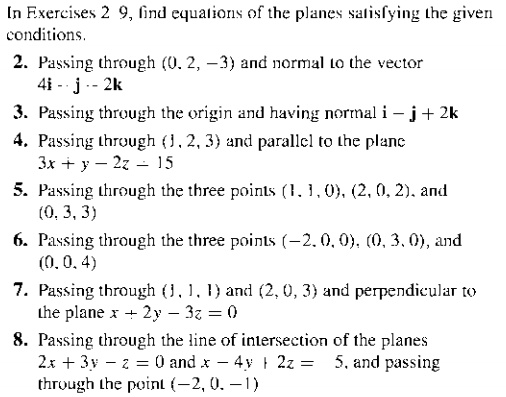
I am in need to find the equation of a plane passing through the line of intersection between two planes and a point
What is the strategy to finding the normal vector for this type of example?
im on exercise 8
wintry steppe
So remember that the coefficients of a plane are the direction vector (if I remember correctly?)
lemme get my notebook
yeah its in general form
so whats the normal vector of the plane of 8?
@frank gate
frank gate
is it the (plane 1 vector - plane 2 vector) ?
cross product i meant
(2, 3, -1) x (1,-4,2)
wintry steppe
Well you could find any point in that plane
suppose x and y = 0
solve for z and you get point a
frank gate
How do i solve for z in that case? I am awful at this
wintry steppe

x=y=0
then -z=0
z=0
for that piont
and the other plane x-4y+2z=5
x=y=0
2z=5
frank gate
oki 😮
wintry steppe
2z=5
 wintry steppe
let me check something
frank gate
oh wait
wintry steppe
,w cross (2,3,-1) and (1,-4,2)
stoic pythonBOT
 Requested by Babowwz#1394
wintry steppe
Requested by Babowwz#1394
wintry steppe
well well well 
point is 0,0,0 right
and 0,0,5/2
point in reference was -2,0,-1
ab = (-2,0,-1)
ac= (-2,0,-7/5)
,w cross (-2,0,-1) and (-2,0,-(7/5))
stoic pythonBOT
Requested by Babowwz#1394
frank gate
I think you are suppose to combine the planes and introduce a variable F for example and then that equation should correspond to the point of refrence you had
check this e.x: https://gyazo.com/b2df64af6d92a077ba859fb68feead82

same question, different values
frank gate
just think of it as variable F instead
wintry steppe
ay fren @half ice or @wooden plover you bois know bout this?
wintry steppe
<@&286206848099549185>
frank gate
you combine the two planes, insert x, y, z of the point on all the positions and solve for introduced variable F
wintry steppe
Yea, theres a couple m8s who know this just wait for someone to roll aroudn and check on it, ping me when u got a method
half ice
Wat? Are we all good now?
frank gate
i think so : )
frank gate

im on exercise 9. Can someone explain what to do?
this is the solution sheet but i dont get it

where the heck does x = -1 + 2t come from for example?
half ice
Lel essex. I had his class in PDE, interesting guy
frank gate
? 😮
half ice
I don't understand the solution either. That's an equation for a line, no?
frank gate
Ye read the top of this https://gyazo.com/f617fb3eb242165cdc0fb82fee47c9c1
and im on 9
modest jasper
@broken hawk Do you know how I might be able to solve the question then?
broken hawk
why are you pinging me
modest jasper
You responded to me...
broken hawk
sorry, I didn’t recognize you
wintry steppe
broken hawk
yes, I do know how to solve it, but the person with the green name already told you what to do
and I don’t believe spelling solutions out explicitly is helpful
you should review your material on how to solve an equation like Ax = 0 (where A is a matrix and x, 0 are vectors)
and then, as was said there, your target matrix will just have (any) two solutions for that equation in it
modest jasper
I thought you said that's not what it's asking.
broken hawk
there’s infinitely many of them
then you misunderstood what I said
read it carefully
modest jasper
Okay.
broken hawk
it’s telling you that the solution itself may not be 0. not the righthand-side, but the thing you’re solving for
modest jasper
Alright, thanks.
 dusky mesa
im trying to find a generalization for multiplication to the power of n for a 2x2 matrix, this is doable right?
i dont want to waste hours
im using eigenbases
 cloud cedar
if you have an orthonormal basis of eigenvectors then taking A^n just means (a_{ii})^n
since it’s diagonalized
broken hawk
if you’re in the eigenbasis then it’s just taking the power of the diagonal entries
astral junco
I don't understand how S = {1} is a vector space. I thought vector spaces must have a zero vector?
slow scroll
it looks like addition is defined differently on this set. 1 acts as the zero vector
astral junco
ah good point
slow scroll
let $v \in S$. Vector addition on this set says that $v+1 = v$, so $1$ is the additive identity. Similar thing for scalar multiplication
stoic pythonBOT
kxrider:
astral junco
interesting. so it becomes a trivial space under these operations i guess
stoic pythonBOT
Cosack:
 feral crow
Or do I just treat them as variables
cloud cedar
looks like they're intended to be constants; one for the x direction and one for the z directoin
weird that they capitalized them though
@feral crow
feral crow
How do I find a vector that diagonalizes H?
I know A = PDP^(-1)
Is that asking for D?
Or P?
cloud cedar
you know what D is already once you find the eigenvectors/values of H
writing H in the basis of eigenvectors diagonalizes it; the diagonal entries are the eigenvalues
it's asking for P
feral crow
So P is just the eigenvectors?
In matrix form
and D has the cooresponding eigenvalues in the diagonal terms
cloud cedar
do you know braket notation? it makes it a bit more clear imo
feral crow
$P = [v_1 v_2]$
slow scroll
$\bra$
stoic pythonBOT
kxrider:
Compile Error! Click the  reaction for details. (You may edit your message)
Cosack:
cloud cedar
$\mel{i}{H}{j} = \sum_{n,m} \braket{i}{v_n}\mel{v_n}{H}{v_m}\braket{v_m}{j}$ where $i$ and $j$ range over the original $x/y/z$ basis and the $v$s are the eigenvectors. since they form a complete set, the sum over the projection operators $\sum_n \outerproduct{v_n}{v_n} = 1$ and you can insert the sum over eigenvectors wherever you like
stoic pythonBOT
cloud cedar
but basically yes, you write the eigenvectors as a matrix in the original xyz basis to get your rotation matrix
if this doesnt make sense to you, you can just ignore it (im a physics person so seeing the dirac notation is more illuminating for me, but it might not be the case for you)
feral crow
So when I use this calculator
D mages sense because it's just diagonal eigenvectors
But wtf is going on in the denominator
Do they normalize or something
cloud cedar
you can multiply v1 and v2 by x without changing their eigenvector status
it will probably make the math a little prettier
feral crow
Well the first column of P is clearly v_1
cloud cedar
since x is a constant, $\hat{H}v_1 = \lambda_1 v_1$, you know $\hat{H}(x v_1) = x\hat{H}v_1 = x\lambda_1 v_1 = \lambda_1(x v_1)$
stoic pythonBOT
feral crow
I just dont know why they have the denom
cloud cedar
ohh i see
feral crow
Maybe just how the calculator works
feral crow
Since they all have the same term I can just ignore it i suppose
That denominator is definitely out of the scope of my class
cloud cedar
you can write it in wolfram and see if it simplifies
cloud cedar
no prob!
slow scroll
yes
think about the column by coordinate definition of matrix multiplication with vectors.
slow scroll
if you have a matrix with columns, $v_1, v_2, v_3, $ then $$[v_1 \quad v_2 \quad v_3] \begin{bmatrix} a \ b \ c \end{bmatrix} = av_1 + bv_2 + cv_3$$. This is completely equivalent to the other definition where you multiply the entries of each row with each corresponding column and add them together. @modest jasper
stoic pythonBOT
kxrider:
modest jasper
@slow scroll Oh, yes, I figured that out.
I just want to know how I can determine what that matrix actually is.
Wait, I figured it out.
The answer was actually pretty simple.
Thanks again!!!
slow scroll
nice. no problem
cloud cedar
it's not actually as bad as it looks if you remember the multivariable chain rule; you have $x$ as a function of $r$, $\theta$, and $\phi$, so you can expand like $$\dd{x} = \pdv{x}{r}\dd{r} + \pdv{x}{\theta}\dd{\theta} + \pdv{x}{\phi} \dd{\phi}$$
stoic pythonBOT
cloud cedar
and similarly for dy and dz
feral crow
Is the determinant of a rotation matrix always 1?
Since that means it preserves the dimensions
er volume
i guess
feral crow
And thanks stellar!
dusky epoch
in fact rotation matrices satisfy a stronger condition
they're orthogonal
meaning $A^TA = AA^T = I$
stoic pythonBOT
Ann:
feral crow
Thanks!
stoic pythonBOT
Cosack:
feral crow
I get a SUPER messy set of equations when I square dx, dy, dz
modest jasper
Does anyone know how I can solve a question like this?
feral crow
My best guess is C and D aren't linear because they move as a function of x in two different dimensions
So maybe that makes them not linear
But I don't know for sure
sonic osprey
What does it mean for a transformation to be linear?
There are two rules it needs to follow
modest jasper
Being honest I'm not exactly sure.
I did a lot of reading but it's still a bit hazy to me.
I know about x+y/3x.
 hoary nimbus
Definition of linear to most people :
T(av + bw) = aTv + bTw
For a and b in K
For v and w are vectors
dusky epoch
that is the definition of linearity yes
modest jasper
I'm still not sure how that helps, I'm sorry....
hoary nimbus
Well added a disclaimer in case there are other notions
dusky epoch
you can separate it out into T(v+w) = Tv + Tw and T(cv) = cTv
modest jasper
I'm still not really sure how it helps, sorry.....
hoary nimbus
@modest jasper try substituting the vectors (x y z) with (x y z) + (x' y' z')
hoary nimbus
Just dummy you use to test
modest jasper
I'm still not sure how that helps, sorry...
I don't get why that makes a difference, I mean.
hoary nimbus
First try acting T on original vectors + dummy vectors then see if it equals T acting on original vector plus T acting on dummy vector separately
First property of linearity is just see if T(v + w) is it equal to Tv + Tw?
modest jasper
You mean T as in x+y/3x?
hoary nimbus
Where v = (x y z) and w= (x' y' z')
modest jasper
What does that have to do with the other side of the equations?
How does it factor in?
hoary nimbus
T is like some operation you do to vector v = (x y z) to produce things on the right
So T is not really numbers or anything (though it can be represented with matrix)
modest jasper
So it's not x+y/3x?
hoary nimbus
@modest jasper where do you get that x+y/3x from?
modest jasper
Khan Academy tbh.....
broken hawk
"it can be represented with a matrix" only if it's linear!
hoary nimbus
@broken hawk yeah  almost forgot that
@modest jasper forget trying to factor T or making sense what number T is. T is just operation you do
To vector (x y z) and (x y)
modest jasper
So for something like the first question, would T be something like:
0 0
0 4
?
hoary nimbus
Seems correct
modest jasper
Okay, I'll be back in a second...
broken hawk
“forget trying to make sense what number T is.”
“so T would be (numbers)”
“seems good”
I hope you see the irony in this exchange
hoary nimbus
@broken hawk no comment
@modest jasper but you can NOT represent NON linear transformation with matrix. So the easiest check is, for example the first one is
try acting T ((x y)+(x' y')) = T(x+x' y+y') = (0 4(y+y'))
The outside parenthesis is the parenthesis for vector
broken hawk
this would be less confusing with latex
wintry steppe
what makes linear algebra difficult im thinking of trying to self study it
modest jasper
Self-study?
broken hawk
it’s not really difficult at all, tbh, but it tends to be somewhat of a spike in rigor
hoary nimbus
@broken hawk yeah typing latex in phone is hard
broken hawk
if you’ve never done any proof-based math that’ll be the challenge, mostly
wintry steppe
oh i c
modest jasper
@hoary nimbus I'm really sorry but what you said confused me a lot...
wintry steppe
how to get better at proof based math
broken hawk
do proof based math
wintry steppe
true
hoary nimbus
Haha sorry maybe @broken hawk can explain better
broken hawk
the issue with proofs however is that it’s easy to fool yourself into thinking you got sth right
wintry steppe
yeah
broken hawk
if you don’t like spam it
sure
anyway, lemme see if I can explain this
lemme show you two examples in one dimension to illustrate how to check this
Example 1: $T(x) = 3x$
stoic pythonBOT
Sascha Baer:
broken hawk
now you need to check if $T(x + y) = T(x) + T(y)$ and $T(\lambda x) = \lambda T(x)$
stoic pythonBOT
Sascha Baer:
broken hawk
where x,y are vectors (which in 1D are just numbers) and lambda is a number
so let’s start at the beginning
broken hawk
are they the same?
modest jasper
Yes?
stoic pythonBOT
Sascha Baer:
modest jasper
What about it?
broken hawk
does it hold?
modest jasper
Yes.
modest jasper
I don't know. Didn't you just tell me that was the rule above?
broken hawk
no?
you need to read more carefully
I said we have to check two properties
the first we’ve checked
T(x+y) = T(x) + T(y)
but we’ve not yet checked if T(λx) = λT(x)
for a function to be linear, both of these must be true
and one does not necessarily imply the other
modest jasper
Uh...
dusky epoch
||if your base field is Z_p for p prime, it does||
broken hawk
all you have to do is plug in the definition of T(x)
that’s all you have to do
just apply the function to whatever it is applied to
modest jasper
Is it that because T(x)=3x+3y, if you take out three and have 3T(x)=x+y, that will be equal to T(x)=3x+3y?
modest jasper
I'm sorry, I'm really confused...
broken hawk
please work more carefully
modest jasper
I don't know how to determine this lambda stuff.
broken hawk
you just need to take it slow. I gave you a definition and all you have to do is apply it
what is T(x)?
modest jasper
3x?
broken hawk
what is λT(x)? (lambda is just a number)
broken hawk
now, what is T(λx)?
modest jasper
The same thing?
dusky epoch
i feel like linalg isn't the best place to start out for a student who isn't familiar with proofs
broken hawk
worked for me
hoary nimbus
@dusky epoch what's your recommendation?
stoic pythonBOT
Sascha Baer:
dusky epoch
i would recommend giving How To Prove It by Velleman a read.
broken hawk
Saten, can you try to calculate T(x+y) and T(x) + T(y)?
modest jasper
T(x+y) I guess would be x^2+2xy+y^2, and T(x)+T(y) would be x^2+y^2?
broken hawk
yes, that’s correct
and it’s pretty easy to see that those two are not always the same
modest jasper
Yes.
modest jasper
But how would you do it if T(x) was a vector instead of a scalar?
broken hawk
you do the same procedure, but instead of x and y you use two vectors
and the function will be applied to each component of the vector inside
dusky epoch
well no
broken hawk
it’s hard to word
modest jasper
I'm a bit confused. Could you give an example? I pretty much only understand examples tbh.
broken hawk
ann, can you take over? I have to start working on my own stuff
dusky epoch
sure, gimme a min
i'm gonna get some paper
so here's an example of a transformation whose inputs are vectors, in this case from R^2
@modest jasper do you want to try it for yourself? check whether this transformation is linear, and if it is, write a proof of its linearity
modest jasper
What I need to know is what to do if the output is a vector.
dusky epoch
there really is nothing special about that
you know how to add and scale vectors, do you not?
modest jasper
Yes.
modest jasper
I was wondering because all the examples I got before had T(x) equal to a single value.
dusky epoch
this is not multi-valued either
there is only one output; it just happens to be a vector
well
a vector from a space that isn't R
hoary nimbus
@dusky epoch I think she might get it with R^2 - > R^2
modest jasper
That example seems to be okay, but I don't know how to check if it is linear...
broken hawk
just work through the steps, one by one
- calculate T(v+w) and T(v)+T(w), where v and w are now vectors. If they’re not always the same, then it’s not linear
- Calculate T(λv) and λ*T(v), where λ is a scalar. If they’re not always the same, then it’s not linear
if they’re always teh same, then it’s linear
that’s all you have to do
now just do it
step by step
dusky epoch
don't overthink it
modest jasper
Can T be a vector instead of a single scalar value?
hoary nimbus
T is abbreviations of transformation
modest jasper
How do I know what the value of the function T is then?
dusky epoch
you will be given it.
modest jasper
In my question I wasn't given T though...
hoary nimbus
@modest jasper you were given the value of T
modest jasper
Is that vector value the function you were talking about?
dusky epoch
ok wait
what is your original question?
modest jasper
What do I do if T is a vector instead of a single scalar value?
hoary nimbus
dusky epoch
you mean if T is vector-valued? i.e. its outputs are vectors?
modest jasper
In @broken hawk 's examples he only gave one value as the value of T.
That's not what's in the question.
So I'm still confused about how to answer my questions...
dusky epoch
sorry but i really don't understand your confusion
checking a transformation for linearity is EXACTLY THE SAME whether its outputs are numbers or vectors
hoary nimbus
maybe should start with definition of function as certain subset of Cartesian product of X \times Y just to remove prejudice what are function 
broken hawk
yes, I gave examples with one value to show the procedure
because the procedure is the exact same
you just… have to actually do it
you’re way overthinking it
just start writing
$T\left(\begin{pmatrix}x_1 \ x_2 \end{pmatrix} + \begin{pmatrix}y_1 \ y_2 \end{pmatrix}\right) = \dots$
stoic pythonBOT
Sascha Baer:
broken hawk
simplify the expression inside first, then apply the function based on the instructions given
modest jasper
I'm sorry, but I'm just not sure how to do this with both an x and a y and a vector @broken hawk .
I just don't really know how to determine what T is and how to plug in the values into the function.
broken hawk
calculate T for 500 values until you understand exactly how to do that, then replace the values with variables
what T is is given to you
modest jasper
Where?
broken hawk
e.g. in Ann’s example
and in literally every other exercise
it always says exactly what T does
you just have to apply it
modest jasper
It just says what you get what you have T(x y).
But I don't know what to do when I have two variables.
broken hawk
I said “simplify the expression inside first”
modest jasper
I don't know how to do that...
modest jasper
Yes.
broken hawk
then do it
modest jasper
Okay.
hoary nimbus

dusky epoch

modest jasper
I just think it's kind of unreasonable for you to expect me to figure out on my own how to complete these questions when your only example was something that was far simpler than what I have to do now.
broken hawk
I mean I also shouldn’t be helping anyway, I have a measure theory chapter to get through
hoary nimbus
@modest jasper how about reviewing the material? Or just ask your teacher/professor?
hoary nimbus
You know you guys in America got things called office hour right?
modest jasper
I'm Canadian but okay.
hoary nimbus
 do it with your friends
modest jasper
I don't have any friends.
hoary nimbus
Make one or two soon
modest jasper
r/wowthanksimcured
 empty copper
 modest jasper
Thanks.
sonic osprey
What have you tried?
sonic osprey
What does it mean for these to be linearly independent?
 thick tiger
their superposition, when = 0, only is valid for when all constants are 0
sonic osprey
Right and you have to remember this is a superposition of functions. So the thing on the right, the = 0 is really the 0 function.
thick tiger
yes
sonic osprey
So it's true for all t
sonic osprey
That the superposition of the functions = 0 for all t
thick tiger
if they are linearly independent, yes
i have to prove they are
setting them equal to 0 doesnt do anything since its all e
and trying to do ln(e) doesnt work since ln(0) is undefined
though rn im trying to see what happens if i divide all by e^t
sonic osprey
You want to show that all your constants are 0. Plugging in t = 0 will give you a system of equations so that you can solve for these constants
thick tiger
plugging in t = 0 will just net me the matrices given
the [1 1 0] etc
im not sure if "verify" means it can be dependent or independent
because so far everything ive done has shown dependence
sonic osprey
Remember what superposition actually is. You're taking a linear combination of these three vectors. So you have three constants
These constants are what you need to show are 0
thick tiger
got it
thank you
is this correct?
looked it up more
if i get a 0=0 situation, it's infinitely many solutions
and if thats the case, it's not linearly independent
so
honestly i've tried multiple things
more than once i've gotten linearly dependent
dusky epoch
tbh isn't it kinda obvious these are LI
thick tiger
yes
but the wording of the question implies they should be independent
but
i dont know
i feel like the fact that theres that e^t bullshit going on, its affecting it in some way that makes it independent
dusky epoch
yes it does
the only way to make u e^2t + v e^4t ≡ 0, where u and v are vectors, is to make u = v = 0
thick tiger
dunno where you got 4t from
but
i cant just say that, can i?
i dont want to lose points by just explaining
 wintry dirge
How do I get from the first to the second step? Where does (2, 3, 4) come from?
wintry dirge
I'm not quite sure, it says to solve the equation system (first step)
And the second step is to be the solution
So I guess A is a matrix?
@dusky epoch
dusky epoch
i mean yes A is a matrix
i was asking you for its value
can you post the whole problem
rigid cypress
wait, you wouldnt need A to find the vector (x y z)^T
what it's saying is for some unknown matrix A, Ax = (1 0 1)
wintry dirge
The problem is just: Solve the following equation system
rigid cypress
and for the inverse A^-1*(1 0 1), you would get x
dusky epoch
@wintry dirge does the problem not say "A = ( ... ... ... )" elsewhere
rigid cypress
wait, is the question asking you to find x y z from the the values given?
is there any more information in the question
wintry dirge
The problem before on the sheet is to Invert A and to prove it
wintry steppe
I was shown this method for finding the determinant of a 3x3 matrix (denoted by "A" in this first screenshot). It is expressed as the sum of 3 ,2x2 determinants which have each been multiplied by a scalar. http://prntscr.com/npg0y0 . I am then shown this general way of calculating the determinant of a N x N matrix. http://prntscr.com/npgcdy If I have a 4x4 matrix, i am to calculate the value of 4, 3x3 "minor" determinants. To calculate the value of each of these 3x3 determinants in order to calculate the value of the 4x4 determinant, am I to follow the same method in the first screenshot but repeat the method 4 times?


The minor determinant for a cofactor within A is generated by eliminating every element in the same row and column as that cofactor
winter reef
If I have a 4x4 matrix, i am to calculate the value of 4, 3x3 "minor" determinants. To calculate the value of each of these 3x3 determinants in order to calculate the value of the 4x4 determinant, am I to follow the same method in the first screenshot but repeat the method 4 times?" Yes you can do that.
There's also rule of Sarrus on how to find determinant of a 3x3 matrix
wintry steppe
Ok good
winter reef
but what you sent is called Laplace expansion