#discrete-math
1 messages · Page 220 of 1
 vital dewBOT
ᴇɴᴏsʜɪᴍᴀ ᴛʜᴇ 𝟻𝟺ᵗʰ

 idle hazel

 dense glade
Does anyone get the idea here because I'm little lost

 coral parcel
Are you lost on (a) or (b)?
dense glade
coral parcel
Are you lost on (a) or (b)?
on a
coral parcel
Start by expanding the definitions of "commutative" and "f".
dense glade
coral parcel
Start by expanding the definitions of "commutative" and "f".
I'm not getting the function
though
isn't the every ordered pair made of 8 digits?
like for example (0,0,0,0,0,0,0,0) x (0,0,0,0,0,0,0,0) --> Z but what would be (a1,a2)?
coral parcel
(0,0,0,0,0,0,0,0) is one of the 256 elements of A.
Each of a1 and a2 is one of those.
So one possible (a1,a2) would be ((1,0,1,0,1,0,1,0), (1,1,1,1,0,0,0,0))
Writing (0,0,0,0,0,0,0,0) × (0,0,0,0,0,0,0,0) does not make sense, though. The × needs to operate on two sets, and (0,0,0,0,0,0,0,0) does not (for our purposes here) denote a set.
dense glade
ah I meant
an element from the set
o
so now
if these are (a1,a2) ((1,0,1,0,1,0,1,0), (1,1,1,1,0,0,0,0))
ah I see so
the function value would be in this instance
4
coral parcel
Yes.
dense glade
ok this is obviously commutative
coral parcel
Yes.
dense glade
its also transitive
coral parcel
What would that mean here?
dense glade
I'm goanna write it symbolically first
then say what it means
OK so I think whats its saying for example
if the difference in positions between (a1,a2) is 4 and (a2,a3)=4 then the difference between position between (a1,a3)=4
coral parcel
Hmm. That's not even true. For example a1 and a3 could be the same string, so the distance between a1 and a3 is 0.
Moreover, even though I can see some sense in your interpretation, "transitive" is not generally used about functions.
dense glade
yeah it just about the relation
I miss interpreted it
how can u prove
that its associative though
coral parcel
It isn't.
dense glade
the def says: for all a,b,c if f(f(a,c),b)= f(a,f(c,b))
coral parcel
Right.
So "associative" is not applicable to this function either, because the output from f is not the right kind of thing to give as one of the inputs to f.
dense glade
yeah
coral parcel
In other words, (b) is a bit of a trick question.
dense glade
coral parcel
Right.
I have a question and it's probably dumb one but I'm a little bit confused. for mod 3 [0] is the residue class where 3 divides the elements of [0] evenly, but how is this equivalent to [3], shouldn't this be we remainder 3?
coral parcel
3 cannot be a remainder: 3 divided by 3 is 1 with remainder 0.
With a common definition of residue classes we have $$\begin{array}{l} [0] = { 3n + 0 \mid n \in \mathbb Z } \{} [3] = { 3n + 3 \mid n \in \mathbb Z }\end{array}$$ and these are just two ways of writing the same set.
vital dewBOT
Troposphere
 dense glade
yeah the set will be the same
but you need different values of n
to get the same values
I guess this doesnt matter
coral parcel
Right: The set doesn't remember which values of n goes with each of its elements.
 simple vale
I have the following exercise:
Having this permutation f so defined (see the image below) determines f^2 and the inverse permutation of f.
I know how to do the inverse but not the squared permutation

 muted gate
can you see that f(1) = 5, f(2) = 3, and so on?
 sour arrow
1 → 5 → 6
So in the squared permutation, 1 → 6
muted gate
maybe that will help you with determining the composite
muted gate
muted gate
can you see that f(1) = 5, f(2) = 3, and so on?
because you'll notice that f(f(1)) = f(5) = 6
like kaynex showed
simple vale
So, in the end, the squared permutation should be this?

where 1 -> 6, 2 -> 1, 3 -> 5, 4 -> 4, 5 -> 7, 6 -> 2, 7 -> 3. Right?
 rich tiger
I'm struggling with:
- Images
- Fields
- Proof by contrapositive
- Proof by contradiction
- Induction
- Cardinality
- Bijective/injective/surjective stuff
- GCD's and the Euclidean Algorithm
- Reflexive, Symmetric and Transitive stuff.
can someone help me go over these 😭
I watched like 5 videos on induction i still dont get it
dense glade
rich tiger
I'm struggling with:
1. Images
2. Fields
3. Proof by contrapositive
4. Proof by ...
That's the entire course

 pale epoch
thats a lot of stuff
i suggest going through it one by one and trying to formulate concrete questions
i know that is hard, but the process will also make you interact with the material more thoroughly
and if you have concrete questions, people here can help
rich tiger
dense glade
That's the entire course
sadly thats only half of it 😭
rich tiger
pale epoch
i suggest going through it one by one and trying to formulate concrete questions
true
we can start with fields
okay hmm let me find a question

okay something like this
ik theres like 5 field axioms but
i dont understand some of them
like commutativity and distributivity etc
 weary tiger
hi
can someone help me get started on this problem

I was saying that if x is in c, then x is in d U a. but then if y is in b, then y is in Dc, which is not in D. then, the intersection of c and b is everything except for D
but what if the elements in B are not in A?
 ember obsidian
@weary tiger that question has no bearing on the logic required
also the logic isnt in the required format (element proof)
weary tiger
ember obsidian
<@456226577798135808> that question has no bearing on the logic required
does this mean that every possible element exists in a, b, c, d?
is this the right format? I'm not rly sure what element proof means tbh
to you or if anyone else is interested in looking it over:
 ember obsidian
this is what element proof is
weary tiger
2nd proof is better than the first
ember obsidian
lets say u wanna show X is a subset of Y
u take any element in X then show it must be an element of Y
weary tiger
weary tiger
does this mean that every possible element exists in a, b, c, d?
is this a fair assumption?
ember obsidian
im not sure what that means
ur saying every object is in at least one of those sets?
if so then thats not necessarily true
weary tiger
yes that's what I mean.
ember obsidian
but it too has no bearing on the required logic
weary tiger
isn't that intersection though?
ember obsidian
take any element in C cap B then show it must be an element of A
weary tiger
like I would have to know that B intersects C, which means B is A
ember obsidian
namely, smth like "let x be any element of C cap B"
weary tiger
oh do I start with what I am supposed to prove?
i thought it started with the supposition
ember obsidian
no, we're following the format for showing a set is a subset of another
this is what element proof is
lets say u wanna show X is a subset of Y
u take any element in X then show it must be an element of Y
ember obsidian
to recap
u wanna show C cap B is a subset of A
follow the element proof format
take any element in C cap B then show it must be an element of A
weary tiger
how can I know x in B is in A if I only know that an element in B is also in D complement?
ember obsidian
we eventually wanna show x is in A
now what does this say about x?
we let x be any element of C cap B
weary tiger
x is in c, b
ember obsidian
pls use correct casing
ember obsidian
capital vs lowercase
weary tiger
x is in C, B ?
ember obsidian
yeah
weary tiger
okay, apologies
ember obsidian
ie x is in C and x is in B
from the other info we have, what can we conclude from x being in C?
weary tiger
it is in D union (?) A
weary tiger
x could be in D or A
weary tiger
okay
weary tiger
x is not in D
ember obsidian
x is in D^c, from which that follows
weary tiger
yes
ember obsidian
now consider the new facts we got so far
x is in D or x is in A
x is not in D
what can we now say about x?
ember obsidian
we now conclude C cap B is a subset of A
weary tiger
thank u so much
what do you suggest i do in the future
like this feels so much easier now
but it was a brick wall before
ember obsidian
no prob. u can prob find many more set proof problems online
i have a few typed somewhere

prove if $A\sse B$ then $A\cup B=B$ and $A\cap B=A$
vital dewBOT
RokabeJintaro
 weary tiger
would you be okay to walk me through a couple
ember obsidian
i can help for the last one i sent then i need to go
weary tiger
okay
ember obsidian
namely A cap B=A
muted gate
Let $G = (V, E)$ be a graph with $n$ vertices and let $t(G)$ denote the number of triangles in $G$. Prove that: \
$$t(G) \geq \frac{\abs{E}}{3n} \left(4\abs{E} - n^{2}\right)$$ \
vital dewBOT
texaspb
 muted gate
can somebody help me start this proof? I don't even know what definitions or results I could be using
i'd appreciate any sort of guidelines 
weary tiger
so i would say that if x is in a, then x is also in b by the supposition
or like where would i want to start with this
since im not showing a subset this time
ember obsidian
X=Y if X is a subset of Y and Y is a subset of X
so equalities (usually) demand two subset proofs
weary tiger
okay
I found a video online, I think I'm gonna follow along with it
ty again for the help with the previous problem
ember obsidian
yw, gl on my posted problems
weary tiger
ty
 severe swan
Am I doing this correctly?
You roll a fair die once. Let A be the event that the roll comes up as 2, 3, or 4, and let B be the event that the roll comes up as an odd integer.
What is P(A | B) ?
A) roll is 2, 3, or 4
1/6 + 1/6 + 1/6 = 3/6 = 1/2
B) roll is odd
1, 3, 5
3/6 = 1/2
P(A | B) = P(A ∩ B) / P(B)
(3/6) / (3/6 ) = 1
3 is the only number that is the same for A and B
P(A ∩ B): 1/6 / P(B): 3/6
1/6 / 3/6 = 1/3 Answer?
 vernal cypress
Hi, can anyone help?

 fair jungle
Yes, but its nested within a for loop that repeats |V| times.
Shouldnt it be O(|V|x|E|)?
Sorry for the late reply.
 alpine grove
vernal cypress
Hi, can anyone help?
alpine grove
vernal cypress
Hi, can anyone help?
is this permutation/combination question?
muted gate
vernal cypress
Hi, can anyone help?
this looks like a PHP problem
coral parcel
fair jungle
Yes, but its nested within a for loop that repeats |V| times.
Shouldnt it be O(...
O(|V|×|E|) would be a valid bound, but O(|V|+|E|) is a tighter bound and also valid. The body of the inner loop repeats at most twice for each edge (namely once when each of its endpoints is moved to L), so the total number of iterations is at most 2|E|, no matter how those 2|E| are distributed across vertices.
This assumes you have a representation of the graph where you can efficiently find all the edges incident to a given vertex. But if you don't have that already (say, if you're given the graph in the form of a single randomly ordered list of edges), it's usually easy to start by constructing it.
fair jungle
yes, i do have an efficient representation. But why is O(|V|+|E|) tighter?
I understand the total number of iterations is 2|E| but why is it added.
What i mean is, how can i identify, in the future, for different algorithms, when to use a +, and not a x
I was just taught that if its nested, its multiplied. :/ How to spot when the bound of O(ab) is not as tight as O(a+b)
vernal cypress
muted gate
this looks like a PHP problem
can u help?
coral parcel
What you're really after is an upper bound for how many times each operation inside the inner loop is executed. It always works to multiply upper bounds for the number of iterations for the outer and inner loop what you have found separately, which why it's a good fallback. But a more careful analysis can sometimes give a better bound.
For example, if we consider complete graphs on n vertices, we have that |V|×|E| is about ½n³, whereas |V|+|E| is only about ½n², and therefore grows smaller.
fair jungle
😮 ok ok i understand now
coral parcel
In general if you can choose between a sum and a product, the sum will always grow smaller: As long as a > 2 and b >2 we'll always have ab > a+b (and the behavior for small a and b is irrelevant for asymptotic analysis).
fair jungle
Its just deriving the sum that poses an issue for me
I mean, how did the 1/2 n^3 come? I assume its through graphing? is there any way to know when the sum is tighter and a better upper bound?
fair jungle
coral parcel
In general if you _can_ choose between a sum and a product, the sum will always ...
This assumes you can choose between a sum and a product, but if u dont know that the sum is a tighter bound, how can you choose between something you dont know?
coral parcel
If you don't know, then you don't know it, of course.
But it's hardly deep mathematics that the product of two not-small numbers is larger than their sum.
fair jungle
Yes, but for example, in the algorithm i sent, how can you "derive" the O(n+m) without wikipedia telling you?
coral parcel
It sounds like you expect it to be a mechanical process.
It isn't.
It's based on understanding how the algorithm works.
fair jungle
alright, so the code having two nested for loops irrelevant then , only the computation it does is relevent?
coral parcel
It's not "irrelevant", but it doesn't mean you're duty-bound to use a particular canned procedure either.
The two nested loops are an essential part of how the algorithm does what it does; you can't hope to understand it without also understanding those loops.
fair jungle
Im confused. If its not a mechanical process, how can one ~~prove ~~ calculate that its O(n+m)? I understand how the algorithm works, but i dont make the link between summing.
coral parcel
Finding a proof of anything is almost never a mechanical process.
"Calculate" sounds like a mechanical process. I'm telling you that you're not supposed to follow a mechanical process.
It's not a matter of learning a pre-cooked recipe for analyzing an algorithm where you start by writing the algorithm down and then follow prescribed steps brainlessly until you reach something with a double line under it.
You need to understand how the algorithm works.
fair jungle
It maintains a map of vertices and their degrees, repeatedly "removes" or rather considers the minimum vertex present on the subgraph as removed, updates the degrees of the neighbors on the map, and does this until the subgraph produced is null.
coral parcel
Um, yes, good.
fair jungle
How can i make the jump to "analyzing the algorithm" now?
coral parcel
Didn't you tell me that you understand that the total number of times through the inner loop is at most 2|E|?
fair jungle
yes, because you must update the neighbors for each vertex. And so you will be looking at the (V_i ,V_j) and then eventually (V_j ,V_i), but its an unodered pair so we are looking at the same edge twice
if i understand correctly 😕
coral parcel
Yes.
But then what is your question? The only thing you seem to be asking for is which cookbook recipe would have told you to look for precisely that property. And the answer to that is THERE IS NO COOKBOOK RECIPE.
fair jungle
I just want to understand why its O(n+m)
coral parcel
Didn't you tell me that you understand that the total number of times through the inner loop is at most 2|E|?
coral parcel
O(|V|) + O(2|E|) = O(|V|) + O(|E|) = O(|V|+|E|).
fair jungle
coral parcel
O(|V|) + O(2|E|) = O(|V|) + O(|E|) = O(|V|+|E|).
and its O(|V|) + O(2|E|) because?
coral parcel
O(|V|) is the number of times the program executes some step outside the inner loop. O(2|E|) is the number of times the program executes some step inside the inner loop.
The number of times the program executes any step is the sum of these.
fair jungle
and why exactly isnt it the product?
coral parcel
sdf.lkwehrtogfjwethwrg
If you're putting some marbles into a bag and N of the marbles are red and M of the marbles are blue, then what is your best estimate of the total number of mables in the bag? N×M or N+M?
fair jungle
coral parcel
If you're putting some marbles into a bag and N of the marbles are red and M of ...
suppose i was in kindergarten. I just want to know why we add N and M to get the total number of marbles
thats my question
Like why add
 coral parcel
For the exact same reason that in kindergarden you ADD the number of red marbles to the number of blue mables to get the total number of marbles, instead of multiplying those numbers.
fair jungle
But the marbles its commutative, it seems to me that its distributed within the code
coral parcel
The number of steps ever executed by the algorithm is the number of steps it executes outside the inner loop added to the number of steps it executes inside the inner loop.
Addition is commutative no matter what is is you count. Marbles, apples, dollars, computational steps, that doesn't matter.
fair jungle
coral parcel
Addition is commutative no matter what is is you count. Marbles, apples, dollars...
Yes, but if a loop is nested within something else, isnt that distributive? I mean, the for loop to look in the neighbors is going to be launched |V| times sounds like distribution to me. I just want to know why im wrong
coral parcel
If you want to count how many cars are crossing the bridge per day? Count the number of cars that cross it from east to west, then count the number of cars that cross it from west to east. Add those number.
OR: Count the number of red cars that cross the bridge, and then count the number of cars that are not red, and then add THOSE numbers.
Or count how many cars have a male driver and count how many cars have a female driver, and add those numbers.
If you want to count how many instructions the program executes? Count how many instructions it executes in the inner loop, and count how many instructions it executes outside the inner loop, and then ADD THOSE NUMBERS.
fair jungle
fair jungle
but for example two, the inner loop executes m instructions, and outside it executes n instructions, and the answer is O(nm)
coral parcel
No.
If you have a set of ANYTHING AT ALL -- marbles! cars! instructions! apples! -- and you split it into two groups that you can count separately, then the total number of things you have is ALWAYS the sum of your two counts. Never the product.
 spring zephyr
fair jungle
but for example two, the inner loop executes m instructions, and outside it exec...
spring zephyr
fair jungle
but for example two, the inner loop executes m instructions, and outside it exec...
You count the steps inside the for loop and multiply that with n
coral parcel
Unless the two counts are either both 0 or both 2.
fair jungle
okk i get it, the 2|E| is the total of all executions of the inner loop within the program
?
coral parcel
Yes.
 coral parcel
Phew.
 high ermine
Hi, can anyone help me with this $\sum_{k=1}^{n-1} \frac{1}{k(n-k)}=O(\frac{log(n)}{n})$?
vital dewBOT
LearTsura
 high ermine
nvm, $\frac{n}{k(n-k)}=\frac{1}{k}+\frac{1}{n-k}$
vital dewBOT
LearTsura
 dense glade
how many ways can we pull 3 aces and2 jacks? my answer is :
(13C1)(4C3) for the aces and (13C1)(4C2) for the jacks so (13C1)(4C3) * (13C1)(4C2) but the answer is just (4C2)*(4C3)
What did i do wrong?
 balmy jay
dense glade
how many ways can we pull 3 aces and2 jacks? my answer is :
(13C1)(4C3) for th...
balmy jay
dense glade
how many ways can we pull 3 aces and2 jacks? my answer is :
(13C1)(4C3) for th...
I guess the answer is just doing: there are 4 aces and 4 jacks in a standard deck of 52 cards so from 4 aces, we choose 3 and from 4 jacks, we choose 2. So (4 choose 3) * (4 choose 2) in total
I don't quite understand how you're getting (13 choose 1) * (4 choose 3) for the aces
 onyx fable
Does anyone know the recursive fomula for 3,12,27,48,75...?
 obtuse lance
looks like 3n^2
idle hazel
obtuse lance
looks like 3n^2
How do you figure it out so fast
idle hazel
Yeah but 48??
obtuse lance
they were all multiples of 3 so I divided out 3 and was left with squares
 white hawk
oh weird
idle hazel
obtuse lance
they were all multiples of 3 so I divided out 3 and was left with squares
I figured that out but 48 confused me
white hawk
48 is n = 4
idle hazel
I see now
white hawk
(or -4 perhaps)
idle hazel

obtuse lance
in my head I didn't know if 3*16=48 immediately but I knew 16=2*8 so I put the 2 with the 3 to make 6*8 which I knew was (7-1)*(7+1) = 7^2 -1 = 49-1 = 48
ok that last part is a meme, I memorized 6*8 as a kid lol
 obtuse lance
also when I first went through it I just skipped the 4th term and knew 75 was 3 quarters so that's all the evidence I needed
obtuse lance
weary tiger
wrong channel try #prealg-and-algebra
white hawk
obtuse lance
ok that last part is a meme, I memorized 6*8 as a kid lol
haha flashbacks to dad forcing me to learn all the mult. tables
obtuse lance
take finite differences of it until it goes away
each time you take f(n) and go to f(n+1)-f(n) the degree of the polynomial decreases
 clever kraken


 light heath


 remote cosmos
weary tiger
when I do it I end up with 0
remote cosmos
weary tiger
when I do it I end up with 0
what do you mean you end up with 0?
remote cosmos
weary tiger
first start with your base case
(which should hold true)
then state the hypothesis,
and show it holds for the n+1 case
at some point you have to plug in your hypothesis help you prove it
 dim sage
Hello.
Is there anyone completely familiar with Discrete Math?
Need a tutor for 3-5 hours who can help me brush over concepts and clear my understanding regarding certain topics.
^^ PAID
Please ping me if you're able to ^^
 queen tapir
Hello. I have a question about Rabin crypto. https://crypto.stackexchange.com/questions/13022/why-is-this-authentication-procedure-using-rabin-crypto-not-useful For this top answer, I dont understand why it works with probability 1/2? x^2=d mod N should have 4 solutions for N=pq. So shouldn't the probability be 1/4?

Cryptography Stack Exchange
A friend asked me the following, pointing out that the method is not very useful (my problem is I do not see why it is not good):
Consider a person A which chooses $n$ as the public key for the R...
 jolly jay
Does anyone know an approximation to the number of surjections? Or a lower bound?
A lower bound that is not f(x)=6.9
coral parcel
Which surjections?
 manic coral

 umbral tendon
Hi, I've been working on a proof for surjectivity. I would like someone to tell me if the proof is correct.
For the function to be surjective every element of the function's co-domain is the image of at least one element of its domain.
So we can prove by counterexample by saying 2x^3 + 3 = 100 and after solving the equation we end up with 3.647 which lies outside of the range of the domain of x [0,1] so there exists a an element in the co-domain that doesn't have an element in it's domain therefore the function is not surjective.

 robust mango
jolly jay
coral parcel
Which surjections?
robust mango
jolly jay
coral parcel
Which surjections?
An approximation to the number of surjections from X to Y.
The first two terms of the sum given by the exclusion-inclusion principle might be it, no clue
muted gate
guys in this example if he wanted he could've done the bipartition $(V_{1}, V_{2})$ with $V_{1} = {v_{1}, v_{2}, v_{3} }$ and $V_{2} = {v_{4}, v_{5}, v_{6} }$ instead of the one he did, right?

 vital dewBOT
texaspb
 obtuse lance
muted gate
guys in this example if he wanted he could've done the bipartition $(V_{1}, V_{2...
obtuse lance
muted gate
guys in this example if he wanted he could've done the bipartition $(V_{1}, V_{2...
not if they're numbered the same way
muted gate
I just noticed
obtuse lance
v1 and v2 are connected with an edge, so they can't be in the same set
obtuse lance
cool
obtuse lance
👍
coral parcel
jolly jay
The first two terms of the sum given by the exclusion-inclusion principle might ...
It does sound like a typical inclusion-exclusion problem, yes.
More specifically, inclusion-exclusion can be used to count the maps that are not surjections.
If |X|>>|Y|, taking the first few terms would probably give fairly good bounds.
Alternatively, there are some explicit approximations at https://en.wikipedia.org/wiki/Stirling_numbers_of_the_second_kind
... from which you can compute the number of surjections as $|Y|!\genfrac{}{0pt}{}{|X|}{|Y|}$.
vital dewBOT
Troposphere

 north bay
What do I do in Simplex Method when one of my restrictions is x >= 3 for example
I only know how to apply the method when the variable is greather or lower than 0
oh wait
nvm
got it
simple vale
I've got a group (first image), that is symmetric on 7 objects, and a permutation f (second image). I have to determine what's the cyclic subgroup <f> of the group generated by f. I know what's a cyclic subgroup (third image) and that to find it i just have to execute the binary operation on the elements to see if it is indeed a cyclic subgroup, but the exercise poses the question like there is only one cyclic subgroup. Can someone explain to me how it works?

 pale epoch
there is no third image
but each element of a group generates a cyclic subgroup by repeatedly multiplying that element with itself
in finite groups you are guaranteed to arrive at the identity at some point and then you are done
simple vale
pale epoch
there is no third image
Right, i forgot to send it
 pale epoch
so there is only one subgroup generated by f
it contains the elements id, f, f*f, f*f*f, ...
simple vale
So in this case the identity should be "1" and it is intended to be my "stop" signal when searching for subgroups, i mean that when i repeat the binary operation and i reach the identity it means that no matter how many times i do the operation, i'll always get the same results. Right?
vernal cypress
Hi, can anyone help?
 pale epoch
simple vale
So in this case the identity should be "1" and it is intended to be my "stop" si...
pale epoch
simple vale
So in this case the identity should be "1" and it is intended to be my "stop" si...
yes, hence the name cyclic
if f^n = 1, then f^(n+k) = f^n*f^k = 1*f^k =f^k
so you can reduce the exponent modulo n and the elements just repeat
you can also just do this and see it for yourself
once you reach 1 with positive exponents, you are done
 placid mason
vernal cypress
Hi, can anyone help?
placid mason
vernal cypress
Hi, can anyone help?
This is a nice problem, represent the people as a complete graph on six vertices, red edges for "people who know each other" and blue edges for "people who don't know each other". Your task is to prove that there is a monochromatic (one coloured) triangle in this graph
A good start is just to try things out. Pick your favourite vertex. It has five edges going out, and analyse each case: when three of those edges are blue, two are red. Or when four are blue, one red, etc.
 pale epoch
try building such a tree with less vertices
 elder berry
How does one show the following sum?
vital dewBOT
peaceGiant
 elder berry
So the above is just binomial expansion... Nevertheless, is the above the answer to the following question?
vital dewBOT
peaceGiant

 whole field
@elder berry what does the arrow mean
whole field
hmm
elder berry
Here is my write-up of the solution, I am looking for someone to verify it (confirmed)
 elder berry
vital dew
**peaceGiant**
elder berry
vital dew
**peaceGiant**
(by the term confused relation, I am indeed referring to the above relation with the said property)
 bitter meadow
Werid question. Im a comp/physics major with a little bit of coding experience (like two classes) and have finshed calc 1,2,3 and ODE. I need to take discrete math but it conflicts in my schedule so the head of the department wants to throw me into the grad level course. Is it mostly math not coding and would I die? Bc I dont want to get slaughtered in the course
 tidal tulip
bitter meadow
tidal tulip
bitter meadow

 sick dirge
Hey, so I have a different proof than my textbook, so was hoping if someone can help me check if it is right. The question is to show that if $az^2 + bz + c = 0$ and $a, b, c$ are odd, then $z$ is irrational. Here's my proof: By the quadratic formula, we have that $z$ is irrational if and only if $b^2 - 4ac$ is not a perfect square. Suppose for the sake of contradiction that it is a perfect square. Then, since it is odd, then by a previous theorem, it must have the form $8N + 1$. However, substituting $a = 2k + 1, b = 2m + 1, c = 2n + 1$, we have $b^2 - 4ac = 4k^2 + 4k + 1 - 4(4mn + 2m + 2n + 1) = 4[k(k + 1) - (4mn + 2m + 2n)] - 3$. The term in brackets is even, so this number has the form $8N + 5$. Hence, contradiction. Is this right?
vital dewBOT
PhenomPlasma

 unreal stump
Yea That's correct @sick dirge
Well you changed variables(should be 4m^2+4m+1-...) but the general idea is correct
sick dirge
Ah I mixed up my letters. My bad. Thanks!
 raven kiln
 vital dewBOT
texaspb
 muted gate
yes
Let $\textbf{A} \in {0, 1}^{n \times n}. \text{ Suppose that at least } 2n \text{ entries in \textbf{A} are 1}$. Prove that \textbf{A} has two entries such that one of them is strictly above and to the right of the other.
vital dewBOT
texaspb

 stray reef
also just to clarify
you meant that there are two ones of which one is strictly above and to the right of the other, yes?
@muted gate
muted gate
yes
muted gate
what is sw-ne?
muted gate
stray reef
pigeonhole
okay, gotcha. the trick is to just find what are the pigeons and the pigeonholes right
I always mess this up
stray reef
muted gate
what is sw-ne?
southwest-northeast
stray reef
muted gate
okay, gotcha. the trick is to just find what are the _pigeons_ and the pigeonhol...
didn't i already basically lay out the holes for you tho
and it should be p obvious that the pigeons are 1s

 nimble sequoia
 frosty musk
why is 27 and not 29
frosty musk
why is 27 and not 29
for c?
nimble sequoia
2 of the digits are 4 so they only have 1 option each
since you need exactly 2 4s the other digit is any number except 4 so there are 9 possibilities
frosty musk
that means that it's 10 * 10 * 10 - 10
nimble sequoia
then you can either have 44x, 4x4 or x44 so there are 1 * 1 * 9 * 3 = 27 possibilities
frosty musk
nimble sequoia
2 of the digits are 4 so they only have 1 option each
since you need exactly 2 4...
yes exactly
it can be 0
ty
.close
nimble sequoia
np
frosty musk
how?

this one I understand:

10 * 9 * 8 * 7, but since the table can be rotated in 4 ways, it overcounts by a factor of 4
so the answer to 1. is 60, 6! = 480, 60 = 480/8, so according to this 6! overcounts by a factor of 8?
but i don't see how i could have come to this
idk how to solve this either

 fickle turret
How come i can use absorbtion law in this given
a v b v c v (!a ^ c ^ b) given
a v b v !c absorbtion
frosty musk
occupied
 spring surge
frosty musk
idk how to solve this either
spring surge
frosty musk
idk how to solve this either
bride next to the groom is from b g 0 0 0 0 to 0 0 0 0 b g
5 places, we can switch them so X2 and we arrange all what's left 4! times. Final a) answer is 5 x 2 x 4!


 cold topaz
i'm not sure how to answer c : \ .. please ping me if c is answered
muted gate
cold topaz
i'm not sure how to answer c : \ .. please ping me if c is answered
you didn't post anything
cold topaz
muted gate
you didn't post anything
i did : | .. using the bot
cold topaz

 cyan prawn
Revising for an exam coming up, think I'm getting the hang of things but could use some help 🙂

For showing this is a semi group, would I show that multiplication on A is a binary operation by something like (e^xπi) * (e^yπi) = e^(x+y)πi
and x+y is an element of R, therefore it's binary?
Also if so can I then just say it's a semi group as I've proved that and since multiplication is associative on C? (and is there a better way to word this)?
One more, if I want to show its a monoid, would e^0πi be the correct identity element? That would work out as 1, correct?
severe swan
How can I solve this?
Cats Fluffy and Tigger have decided to have one kitten in 2022, a 2nd kitten in 2023, and a 3rd kitten in 2023.
Let A be the event that they have at least one female kitten and one male kitten.
Let B be the event that they have at most one male kitten.
If p(A)=x/8 , what is the value of x ?
If p(B)=x/8 , what is the value of x ?
If p(A∩B) =x/8 , what is the value of x ?
cyan prawn
Semigroup is the operation is an associative binary operation yeah
pale epoch
ok yeah, it inherits associativity from multiplication in C (or addition in R)
thats the best argument as well
also notice that e^0πi = 1
so this agrees with the monoid structure of (C, *)
cyan prawn
Also if someone could explain what's going on here a little better to me, confused by a few things. Firstly is it known that e^10πi/5 = 1 because there's a pattern in the set?
 pale epoch
thats eulers theorem
cyan prawn
And then next where is the line "e^2kπi = 1 for every k in Z coming from?
pale epoch
$e^{i x} = \cos(x)+i\sin(x)$
vital dewBOT
Lochverstärker
 pale epoch
you basically turn x radians on the unit circle in the complex plane
so if you turn 2pi (or any multiple of that) you land at 1
cyan prawn
Hmmm okay I'll look into that
spring surge
Describe all possible intervals in Z.
I suppose it asks for a set { a : a is interval of Z }
how can i make it more formal?
cold topaz
frosty musk
idk how to solve this either
no one solved the question c here? 
 austere cedar
cold topaz
no one solved the question c here? <:sadcat:547124024585486359>
austere cedar
cold topaz
no one solved the question c here? <:sadcat:547124024585486359>
there are as many arrangements with the bride being on the left of the groom as there are arrangements with the bride being on the right of the groom
cold topaz
austere cedar
there are as many arrangements with the bride being on the left of the groom as ...
so it's simply half of the answer to a?
wait no
it's half of the total ways 6 people can be arranged
austere cedar
spring surge
how can i make it more formal?
You can write something like $\lbrace [a,b]|a,b \in \mathbb{Z} \rbrace$, but i guess thats all
vital dewBOT
Alexander42
 austere cedar
cold topaz
it's half of the total ways 6 people can be arranged
austere cedar
cold topaz
it's half of the total ways 6 people can be arranged
yes
vital dewBOT
waris
 austere cedar
yes
cold topaz
austere cedar
yes
awesome! thanks : }
fickle turret
How come i can use absorbtion law in this given
a v b v c v (!a ^ c ^ b) given
a v b v !c absorbtion
onyx fable

 floral field
How can I argue that for a graph with 9 vertices, I can't have a bipartite graph, where the degree of the vertices are:
{3,3,3,3,3,5,6,6,6}? Because I've tried to get it done, but it's just impossible
elder berry
floral field
How can I argue that for a graph with 9 vertices, I can't have a bipartite graph...
Maybe there is a better solution, but I think this argument works:
If we have two disjoint sets A and B, we can put one of the vertices with degree 6 in the set A.
Because of that, at least how many elements must be in B?
(and at most, how many elements can be in A)
elder berry
right
 sleek loom
can I use the duality principle like this?
If $B^{c} \cap A \neq U$ then by the duality principle $B \cup A^{c} = \varnothing$
vital dewBOT
Orian

 languid citrus
can someone verify if my answer for this question is correct?
 stray reef
there are some typos
also you keep saying A ∈ Z, B ∈ Z, C ∈ Z when you should be taking them as elements of P(Z) and not elements of Z
also "BSA is symmetric" doesnt make sense. relations can be symmetric, their particular values at particular points are just that - truth values
languid citrus
wait let me edit it
languid citrus
stray reef
there are some typos
is this correct now?
 stray reef
yes
frosty musk
if the case of letters doesn't matter then why is the answer =>, and not 52^3 + ...?

 frosty musk
cold topaz
it's half of the total ways 6 people can be arranged
frosty musk
cold topaz
it's half of the total ways 6 people can be arranged
why?
why is it 18 and not 21?
4* 3 * 2 * 1 - 3 (where a is followed immediately by b)

 bleak void
frosty musk
why is it 18 and not 21?
4* 3 * 2 * 1 - 3 (where a is followed immediately by b...
bleak void
frosty musk
why is it 18 and not 21?
4* 3 * 2 * 1 - 3 (where a is followed immediately by b...
Where to you get -3 from? If a is followed by b, then you have more than 3 situations where that can happen.
frosty musk
[a][b][][] [][a][b][] [][][a][b]
frosty musk
bleak void
Where to you get -3 from? If a is followed by b, then you have more than 3 situa...
^
oh
bleak void
OK, so there are three "patterns", but e.g. for [a][b][][] you have two possibilities.
abcd, abdc
frosty musk
frosty musk
if the case of letters doesn't matter then why is the answer =>, and not 52^3 + ...
what about this one?
though here i wasn't careful, not sure about this one
bleak void
If you ignore case, there are only 26 letters to choose from.
frosty musk
it says, though, that the case does not matter
not that you should ignore it
so you still have 52 possibilities
oh wait
nvm
they'll be equal
so i'm double counting
bleak void
Well, you can do it with 52 possibilities, but then you have to divide out by the number of strings that are the "same" according to the casing.
You're going to get the same thing in the end.
stray reef
frosty musk
if the case of letters doesn't matter then why is the answer =>, and not 52^3 + ...
it is precisely because letter case for not matter that you have only 26 options for every letter and not 52 as you would if you considered a distinct from A
cold topaz
frosty musk
why?
well just imagine in your head all the possible ways the bride, groom, and the four other people can be arranged. half the time the bride will be on the right side of the groom and the other half of the time she'll be on the left. so we want the total number of ways to arrange 6 people in 6 spots and find its half. does that make sense?
frosty musk
thanks
 zenith oyster
Is turing machines discrete math?
unreal stump
Yea sure
zenith oyster
I have a problem to solve, and I'm struggling a bit on how to think about these Turing machines.
I'm supposed to determine if a problem is decidable. The problem is:
A Turing Machine is run on empty input and at some step if the position i of the memory tape is equal to a value x (part of the alphabet of M) then it returns true and if not false.
My question is what exactly the program is able to do? What if at position i+1 it enters a state where it tells the tape to go back one space and put a x in the cell instead. Then it surely would be able to enter accept state right? What if the program just puts x in every cell and when it hits position i it finishes. Can it do that?
Would this also mean it can theoretically keep going forever if the cell never is set to x? If the tape is infinite that is? Then I could use undecidable of Halting problem on empty input to prove that it's undecidable right?
It's very confusing to me
How does a turing machine know whether it's on position i of the tape anyway?
Because if I was to write this in Python then logically there would be some program that would never end.
unreal stump
zenith oyster
I have a problem to solve, and I'm struggling a bit on how to think about these ...
Well,yea it can go back and put an x in that cell . I guess the assumption is the initial configuration is all blank except for position i which may not be blank
You can do a counter kind of thing in TM, so you can keep track of what position you are in
zenith oyster
Ok, so empty input means the memory tape is empty right?
unreal stump
That's what I would assume,but then isn't the problem obviously false?
zenith oyster
Maybe
unreal stump
Ok,nvm I get it
Your transition function might cause some changes
For example, convert blank to your x and move right while being in the same state
This would mean for any position i ,it will become x
Because your head sees a blank and makes it a x,and then move forward again seeing a blank
zenith oyster
Ok but if it stays in same state can it truly check for position matching as well?
zenith oyster
But I can decide what my Turing Machine does?
unreal stump
Well yea
zenith oyster
this is the problem in its original formulation
 unreal stump
This is decidable I think
If Your Turing machine doesn't ever reach i, the answer is No
If it does,It can make it into x or not
zenith oyster
unreal stump
If Your Turing machine doesn't ever reach i, the answer is No
Couldn't it reach i, go further than i and come back to i though?
zenith oyster
sure but for every pass couldn't it edit what x contains, in perpetuity without making it x?
unreal stump
The question is if i will be changed to x at some point of timd
unreal stump
zenith oyster
sure but for every pass couldn't it edit what x contains, in perpetuity without ...
You can predict that with transition functions
Well in that case it will be no
zenith oyster
but I feel it depends a lot on what instructions the machine runs on, should I think of it as I don't know what instructions are on it maybe?
unreal stump
Think of it as a program
No matter how big a program is,it will be finite
And you can do a dry run to check if a particular situation will ever occur or not
Think of the transition functions as a giant switch case
zenith oyster
sure
floral field
Why does any simple graph have at most nC2 edges?
stray reef
what's n? the number of vertices?
floral field
Yeah, n vertices
stray reef
if so then that's because nC2 is how many edges K_n has
unreal stump
Now finiteness of states mean your turing machine is either stuck between 2 integer points
Or it goes on in one direction forever
stray reef
K_n is the complete graph on n vertices. it is the graph containing every possible edge that exists
zenith oyster
unreal stump
Now finiteness of states mean your turing machine is either stuck between 2 inte...
yes I can see that
unreal stump
floral field
Why does any simple graph have at most nC2 edges?
Well nC2 is the number of ways you can choose to make an edge with n verticrs
zenith oyster
so you're convinced its decidable?
unreal stump
Yea
If it oscillates between two points,The behaviour also oscillates
If it goes in one direction,That case could be yes or no but that is completely determined by the transition function
zenith oyster
ok I will think about this
unreal stump
This is just intuition, formalize this
zenith oyster
couldn't the position i be set to x without it the machine noticing
like it write x to i but it doesn't check if i is x if you know what I mean
unreal stump
Actually nvm,could happen ig
zenith oyster
so should my solution be that it applies for every possible program
unreal stump
Yea
zenith oyster
wack
thanks for your help I think I need to digest all
one last thing, it says in the problem,
"will ever be
assigned a certain value at some time during the execution of the program"
there will be some time step where position i of the memory tape contains the value x
does this mean it cannot go backwards? if i represents time?
unreal stump
i doesn't represent time
zenith oyster
oh its just some time as in at some point?
unreal stump
Think of an array a[100]
for x in a:
x=1
for x in a:
x=0
Here each element of a is 1 at some point of time
zenith oyster
ye
unreal stump
That's what they mean
zenith oyster
ok
unreal stump
Think of the space as an infinite array
And you are starting from 0
This problem corresponds to bring able to do a dry run and predict how variables will be,I believe
Because in a dry run ,you are acting like a "Turing Machine"
zenith oyster
ok
weary tiger
we have 3n+1 balls, and n are identical and 2n+1 are different, in how many ways can we choose n balls from them
I kinda need help, so if it is identical and it's all of thme
we have one way
and vice verse with all different
but between them
is it the sum from k=0 to n for 2n+1choosen-k?
 minor zephyr
Let $A,B$ be languages with $A \leq_m B$. If $A$ is context-free, then is $B$ context-free?
vital dewBOT
kxrider

 subtle juniper
trying to solve congruence equation, which part am i doing it wrong?
 coral parcel
minor zephyr
Let $A,B$ be languages with $A \leq_m B$. If $A$ is context-free, then is $B$ co...
coral parcel
minor zephyr
Let $A,B$ be languages with $A \leq_m B$. If $A$ is context-free, then is $B$ co...
What does \leq_m mean in that context?
minor zephyr
A is mapping reducible to B
coral parcel
Google finds me at least one definition of "mapping reduction" which looks like it means just many-one reducability with an arbitary computable map.
In that case, you could let A be a language that consists of just one string, and B be any language that is known not to be context-free...
For example A = { 1 } and B = { 1^n 0^n 1^n | n in N }.
 median mica
Hey everyone, I wanted to hear your input on this one: (ping for response)
 minor zephyr
coral parcel
In that case, you could let A be a language that consists of just one string, an...
minor zephyr
coral parcel
In that case, you could let A be a language that consists of just one string, an...
ahh okay, thanks. the computable function concept wasn't really clicking to me at first, but this makes a lot of sense
 delicate river
U={1,2,3,4,5,6,7,8,9,10,11,12,13,14,15,16,17,18,19,20} A={5,8,10,12,13,16,17,19,20} B={x∈U:x is a multiple of 2} C={x∈U:x>5}
 minor zephyr
Let $A,B$ be languages with $A \leq_m B$. If $A$ is context-free, then is $B$ co...
minor zephyr
minor zephyr
Let $A,B$ be languages with $A \leq_m B$. If $A$ is context-free, then is $B$ co...
hmm the converse to this seems much less obvious though
wait no. If B is context free but say B \neq Sigma*, then given some non-context-free language A, there is a computable function mapping all strings in A to a single element of $B$, and mapping all strings not in A to a string not in B. At least that should be the idea
coral parcel
Yeah, as long as A is at least decidable.
simple vale
As you can see i've tried to solve this exercise and i think that i got it right, but i was wondering if it's possible to simplify the result even further because 47^22 is still a huge number.
 stray reef
@balmy dome do you want somebody to do this for you?
 balmy dome
stray reef
<@707417705459875951> do you want somebody to do this for you?
balmy dome
stray reef
<@707417705459875951> do you want somebody to do this for you?
yes
if u could explain it, that would be great
stray reef
we don't do other ppl's homework here
balmy dome
I just needed help understanding the topic, thanks anyway
 north pulsar
The degree of a vertex A in an undirected graph is the number of vertices that do not share an edge with vertex A.
true or false
 wide vine
For directied graphs, how do self loops work regarding indegree and outdegree of a vertex
north pulsar
well a self loop is an edge that connects itself to a vertex
outdegree of a vertex is how many edges are pointing from it, whereas indegree is pointing to it
wide vine
yeah so idk if you count it as both or none?

say you have this
A has a in degree of 1 because (b,a) and an out degree of 1 because (a,b)
but I am just not sure if you count (b,b) as both in and out
nvm I guess it counts as both
north pulsar
its false
wide vine
`in-degree(u) = |{ v | (v, u) ∈ E }|
out-degree(u) = |{ v | (u, v) ∈ E }|`
coral parcel
simple vale
As you can see i've tried to solve this exercise and i think that i got it right...
First, the line where you write about $21347^{182\bmod \phi(100)}\equiv 1\pmod{100}$ is misunderstood or misphrased. That simply connects two false statements with a $\implies$, because $21347^{22}$ is in fact not congruent to $1$ modulo $100$.
vital dewBOT
Troposphere
 wide vine
north pulsar
its false
wide vine
north pulsar
its false
wdym its "false"
coral parcel
simple vale
As you can see i've tried to solve this exercise and i think that i got it right...
Second, you can get a better reduction by using the https://en.wikipedia.org/wiki/Carmichael_function instead of the totient function. The Carmicheal function of 100 is 20 rather than 40 -- namely, a^2 == 1 (mod 4), and a^20 == 1 (mod 25), so by the Chinese remainder theorem, a^20 == 1 (mod 100). So you can reduce all the way down to 47^2.
wide vine
oh Idk  we never got to undirected graphs
simple vale
coral parcel
Second, you can get a better reduction by using the https://en.wikipedia.org/wik...
Thanks for the tip but my teacher didn't explain this way of doing this kind of exercise so i prefer to stick to what she taught to me (the Euler's theorem)
coral parcel
You did ask for ways to simplify it further. ¯_(ツ)_/¯
Another way you can simplify is to write 47^whatever as (50-3)^whatever; then if you expand by the binomial theorem all terms except the first two disappear modulo 100. (And the second term disappears too if the exponent is even).
zenith oyster
zenith oyster
this is the problem in its original formulation
Anyone have any thoughts on this, JohnDS has helped me to think this is decidable. It would be decidable as the input is blank, if it doesn't reach i the answer is no and if it does it can either put x in position i or not.
However one thought I cannot shake from my head (as I don't fully understand the capabilities of a turing machine) is if it can tell if it's on a certain position, which I'm logically guessing it can how else would it know where i is?
coral parcel
One standard question to ask yourself each time you wonder whether such-and-such is decidable is: If I had a way to decide this, could I find a way to abuse it into solving halting problems for me?
(The other is of course: Can I come up with a way to actually decide this?)
There are problems that are neither decidable nor can be used to solve halting problems, but they arise surprisingly rarely in practice.
zenith oyster
Ok i will of abuse
coral parcel
zenith oyster
Anyone have any thoughts on this, JohnDS has helped me to think this is decidabl...
This reasoning doesn't really sound convincing. What if the Turing machine reaches the designated square and doesn't immediately write an x to it? It's not immediately clear how you'd tell whether it eventually returns to that square to write x.
zenith oyster
Sure but same logic can be made from it just moving 2 squares in an infinite loop no?
coral parcel
Hmm, not sure how that becomes an argument that you can decide the problem.
zenith oyster
coral parcel
This reasoning doesn't really sound convincing. What if the Turing machine reach...
This was my first thought but somehow i can’t rly prove that such a thing is possible in a finite set of conditions
coral parcel
You can't prove that what is possible?
zenith oyster
A turing machine would be deterministic on empty memory tape right?
coral parcel
Turing, not "turning". But yes, Turing machines are deterministic.
zenith oyster
coral parcel
This reasoning doesn't really sound convincing. What if the Turing machine reach...
Ok, but what if it does an infinite loop looking for the x at i, does that count as decidable or undecidable? Like it's this part I don't rly get
coral parcel
"Decidable" means there is a way to decide the problem that will always complete with the correct answer. (Or in other words "(loops forever)" counts as a wrong answer no matter what the right answer was).
That's the difference between "decidable" and "recognizable". For "recognizable" you're allowed to loop indefinitely when the correct answer is "no".
zenith oyster
So in the case it is decidable, I need to think of a case where using it solves halting problem then it must be undecidable
Like should I assume it is decidable and if I don't find scenario of abusing halting then it is truly decidable
coral parcel
If you find neither a plan to solve halting problems nor a way to decide it, then you cannot conclude anything from that.
(I can tell you that one of these is in fact possible for the particular problem you're looking at, though).
severe swan
Question 8)
You roll a fair die once. Let A be the event that the number comes up a 5 or 6. Let B be the event that the number that comes up is greater than 2. What is p(A|B) ?
I don't understand why the answer is 3/6.
A) event that the number is 5 or 6
2/6 probability that 2 out of the 6 numbers are a 5 and a 6
B) event that the number is greater than 2
4/6 (3,4,5,6)
Because 5 and 6 appear for A where the number is 5 and 6 and also for B where the number is greater than 2 is it counted twice since it appears in event A and event B?
Trying to solve for p(A n B) I did 2/6 x 4/6 and got 2/9.
p(A|B)
p(A n B) = ? 2/9
p(A n B) / p(B) = (?) (2/9) (A n B) / (B) 4/6 = 2/9 and not 3/6 When I tried converting 2/9 to x/6 I got 4/3 as the answer.
How do you get to 3/6 as the answer?
zenith oyster
coral parcel
(I can tell you that one of these is in fact possible for the particular problem...
nice tease (maybe obviously idk), I'll think about it more
may I ask did you just know about this problem or did you think your way to the solution?
zenith oyster
Still my question about positioning remains, like how does the turing machine know which cell is at position i?
severe swan
Tickets numbered 1-100 are put into a hat. Four tickets are drawn randomly. Once a ticket is drawn then it is put back into the hat. The first ticket drawn wins $900, second wins $500, third wins $200, fourth wins $100.
What is the probability ticket #35 wins a prize?
Answer: 1 - (99/100)^4
Where does the 1 come from?
I get that one ticket is taken out and that is why it is 99 and there are 100 tickets total.
 balmy jay
severe swan
Tickets numbered 1-100 are put into a hat. Four tickets are drawn randomly. Once...
balmy jay
severe swan
Tickets numbered 1-100 are put into a hat. Four tickets are drawn randomly. Once...
Since there are 100 tickets total, there are 99 tickets that are not ticket #35. The probability all 4 tickets drawn are not ticket #35 is (99/100)^4. We subtract that from 1 to get the probability that ticket #35 is at least one of the four tickets drawn.
coral parcel
zenith oyster
Still my question about positioning remains, like how does the turing machine kn...
We number squares relative to the square the machine starts on. If the machine wants to know its absolute position later on, it needs to have kept track of how far it has moved since then, by a combination or low-level information encoded in its state, and writing appropriate navigation marks on the tape if if moves farther away than its finite state space can remember.
coral parcel
zenith oyster
may I ask did you just know about this problem or did you think your way to the ...
I don't recall seeing that exact problem before, but I know that questions about how programs behave in general requires knowing which parts of the program they can even reach, which means we effectively need to know if an early part terminates.
So if I'm asked does this program print out "hello world"?:
10 do something complicated (which doesn't contain any commands to print anything)
20 PRINT "hello world"
30 END
then effectively I'm being asked whether the "something complicated" terminates or not.
weary tiger
 clear ridge
can anyone help with this proof by induction
clear ridge
can anyone help with this proof by induction
what have you tried so far

 south mesa
How do you do 8b with proof contradiction also
I don't understand how you'd show it must be infinite
severe swan
How do I calculate this? Specifically if D is correct and how can I calculate E?
Two fair dice are rolled.
Let A be the event that at least one of the dice lands on 5 or 6.
Let B be the event that the sum of the values is 7.
A) If p(A) = v/36 what is v?
20/36
B) If p(B) = w/36 what is w?
6/36
C) If p(A n B) = x/36 what is x?
4/36
D) If p(A|B) = y/36 what is y?
p(A|B) = p(A n B) / p(B)
4/36 / 6/36 = 2/3
2/3 converted to 24/36
E) If p(B|A) = z/100 what is z?
p(B|A) = p(B n A) / p(B)
How can I calculate p(B|A) if I have p(A|B)?
Is p(A n B) the same as p(B n A)?

 proven silo
severe swan
How do I calculate this? Specifically if D is correct and how can I calculate E?...
proven silo
severe swan
How do I calculate this? Specifically if D is correct and how can I calculate E?...
Look up Bayes theorem (or just derive the relation yourself)
delicate river
how are sets and functions useful?
like whats the purpose
coral parcel
They are a common framework that we can use to speak about the things that are actually interesting. Without something like them we'd need to reinvent the same concepts a lot of times.
delicate river
coral parcel
They are a common framework that we can use to speak about the things that are a...
is that the main reason they are useful?
coral parcel
Yes, it's a common vocabulary for essentially all of mathematics,
delicate river
coral parcel
Yes, it's a common vocabulary for essentially all of mathematics,
thank you
 forest saddle
So in this proof we assume that d is the minimum element in S, and using this assumption we find that d is a common divisor of a and b

We then show that any common divisor of a and b must divide d
But does this proof prove that the gcd of a and b is the minimum element in S
coral parcel
It proves that d is a common divisor, and that every other common divisor is smaller. What else do you want for being a greatest common divisor?
forest saddle
Isn't that all that needs to be proven to show that d is a gcd
coral parcel
I'd say so. It sounded like you were disagreeing.
forest saddle
But what I'm asking is does this also prove whether d is the smallest element in S, or that d is the smallest combination ax + by
coral parcel
It defines d to be the smallest element, which is (by definition of S) the smallest positive integer combination ax+by.
forest saddle
So it doesn't prove that it is the smallest element? My intuition says that because we use this definition in the proof that it must be the case that d is the smallest positive integer combination ax+by
coral parcel
It doesn't prove that d is the smallest element in S. It defines d to mean the smallest element.
With that definition there's nothing to prove.
forest saddle
So we initially define d to mean the smallest element, and then prove that it is the gcd
And this means the gcd(a,b) is equal to the smallest positive integer combination of ax+by?
coral parcel
Yes.
forest saddle
Great thanks
dense glade
What is an induced relatrion?
coral parcel
Needs context.
severe swan
Am I calculating this correctly?
You flip a fair coin 3 times. Let A be the event that all 3 flips come out Heads. Let B be the event that at least one flip is Heads.
What is p(A|B)?
A: H H H so 1/2 chance of Heads x 1/2 chance Heads x 1/2 chance Heads = 1/8
B: ---- ---- ---- 3 chances for heads since it says at least one flip is Heads
1/2 x 1/2 x 1/2 = 1/8 so B is 1/8
So to calculate p(A|B) = p(A n B) / p(B)
(1/8 x 1/8) / (1/8) = p(A|B) = 1/8
(1/8 x 1/8 would be p(A n B) ) I am not sure if I calculated p(A n B) correctly. If I was calculating p(B|A) then it would be the same correct? p(A n B) / p(A) = (1/8 x 1/8) / (1/8) = 1/8
dense glade
Let A be an 8 element subset of {2,3,4...,34}. Prove that there two disjoint non empty subset of A which have the same sum.
I know this screams pigeon hole principle but I can't really figure it out, any hint is appreciated
bleak void
dense glade
Let A be an 8 element subset of {2,3,4...,34}. Prove that there two disjoint non...
How about starting with A = {} and building it up little by little?
dense glade
I did
so we want 2 subsets of A, 255 possibility for each
and they have to be disjoint but the sum s the same
I'm just not sure how to construct 2 subsets with the same sum but different elements
bleak void
Actually let's start with A = {2, 3} and keep adding elements carefully to prevent two disjoint subsets with the same sum.
A = {2, 3} is fine. Let's increase it to A = {2, 3, 4}. That's also fine. How about A = {2,3,4,5}. Here we are screwed because {2,3} and {5} have the same sum.
How about A = {2,3,4,6}. That also doesn't work. A = {2,3,4,7} has the same problem.
dense glade
yes
bleak void
A = {2,3,4,9} seems OK.
bleak void
severe swan
Am I calculating this correctly?
You flip a fair coin 3 times. Let A be the eve...
How are you getting 3 for B? For example, all these have at least 1 head: HTT, HHT, HHH, HTH.
severe swan
You are totally correct, I messed up. Thanks for pointing that out.
vital dewBOT
Rezende
 wide vine
is there specific notation to denote directed vs undirected graphs?
Regarding when you write out the edge as a set
nvm
appears you would use (a,b) vs {a,b} to denote
 cunning locust
Could somebody help me with this problem?

In 1.3 my answer is A_n = 1.12 \cdot A_n-1 but i'm not sure
sour arrow
Ye
wide vine
the notes only tell me what c6 and k6 are considered cycle and complete graph respectively. Is there a name for the Q3 and K3,4

Is it really just called "n-dimensional hypercube" graph?
and they didn't seem to give a name for the K3,4 other then denote the notation
like what do I looked up other then K_3,_4 if I want to learn more about that graph
just Kn,m graph?
sour arrow
Most graphs won't be named. Q3, at least from a graph theory perspective, has nothing to really differentiate it.
Maybe you're looking for "bipartite"?
wide vine
looks like it
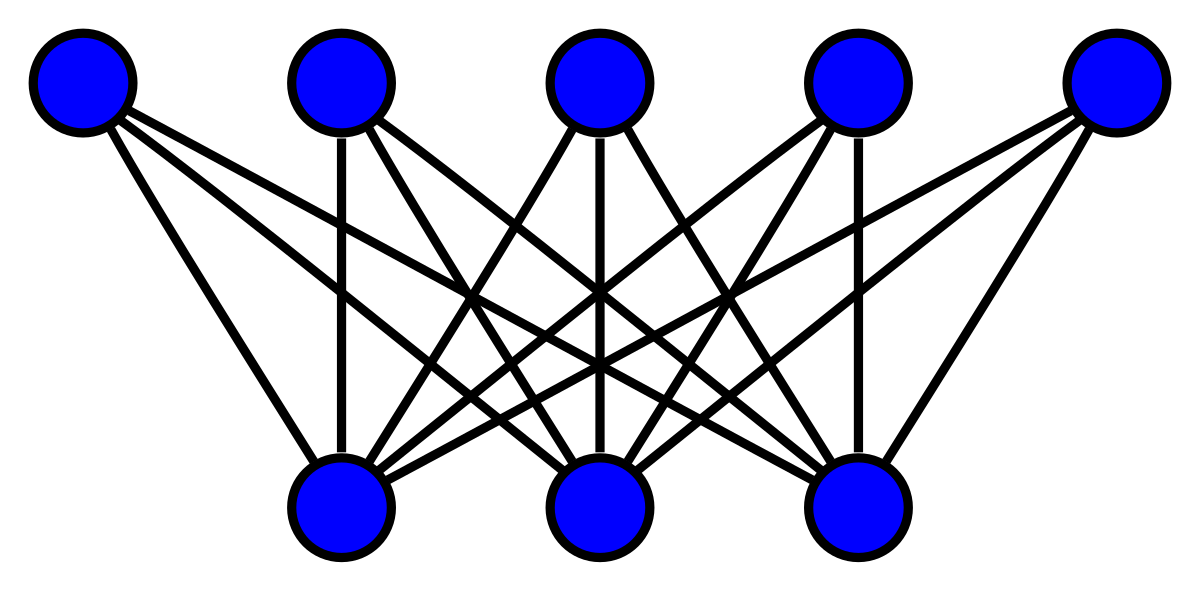
In the mathematical field of graph theory, a complete bipartite graph or biclique is a special kind of bipartite graph where every vertex of the first set is connected to every vertex of the second set.Graph theory itself is typically dated as beginning with Leonhard Euler's 1736 work on the Seven Bridges of Königsberg. However, drawings of comp...
frosty musk
How?
 coral parcel
Take all the subsets, subtract the ones with two or fewer elements.
frosty musk
I don't know how to
Like
the ones with two or fewer elements would be C(100, 1) & C(100,2)
Would all the subsets be C(100, 100)? I don't think so
Like, that would be 1
sour arrow
C(100,100) would be all of the subsets that have size 100
 coral parcel
How to choose a subset: First choose whether the first element is in your subset or not (2 ways to do this). Then choose whether the second element is in your subset or not (2 ways to do this). Then chose ... and so on, until you choose whether the 100th element is in your subset or not (2 ways to do this). How many ways are there in total to make all these choices?
coral parcel
frosty musk
the ones with two or fewer elements would be C(100, 1) & C(100,2)
Here you're forgetting the subset with zero elements, by the way.
frosty musk
coral parcel
How to choose a subset: First choose whether the first element is in your subset...
2^100?
coral parcel
Yep.
frosty musk
Thanks
wide vine
with finding the isomorphism of 2 graphs it seems it requires lots of comparsions
and I am struggling a bit with finding the mapping between the vertexes even if the graphs I say are isomorphic
is there an easy way to do this or is it always time consuming and requires a bit of checking

for example this
coral parcel
There's no polynomial-time algorithm known for finding an isomorphism in the general case, so you'll need some ad-hoc cleverness.
wide vine
bummer :/
I guess easy to count vertex and edges and then start checking each vertex for its degree. Regarding checking if they are isomorphic.
the first 2 steps will I guess will help a lot :v
and at least with finding the function I guess I can start but looking at a vertex that has a unique degree within the graph
dense glade
@coral parcel are these isomorphic because I think so but the answer they are not
 cunning locust
I tried to solve for \sqrt(a_n), but I don't know how to completely remove the square roots
 stray reef
@dense glade why do you think they are isomorphic? have you constructed an isomorphism between them?
dense glade
stray reef
<@597676920293031988> why do you think they are isomorphic? have you constructed...
I thought they were because I was under the impression
that I could connect the 2 edges and mak them cross
but I relaized that in isomorphism I'm not allowed
stray reef
so you did not in fact have a mapping from the vertices of one to the vertices of the other
stray reef
yes, when constructing an isomorphism you cannot just sever an edge from one of its vertices.
dense glade
are you good with probability questions
by chance?
I have a question
but it's kind of weird
 dense glade
let me screenshot it
stray reef
very likely that i'll complain about it being phrased in a weird way or maybe even being underspecified
ok and what are you having trouble with
dense glade
it's an application of Bayes' theorem
stray reef
this isn't "kind of weird" this reads like a run of the mill bayes theorem question to me
yes
stray reef
what's b?
dense glade
P(Observe someone at party | Introvert) =
stray reef
in any case P(goes to party | introvert) is not what you're asked to find here
you're asked to find P(introvert | goes to party)
the probability of the person you're looking at being an introvert, given that they're at the party.
dense glade
ok
so that would
0.25(0.40)/0.40
or am I off?
I'm just unsure about p(b|a) here
stray reef
yes
dense glade
then the probability should be the p(introvert) *pr(party | introvert) / prob(goes to the party)
stray reef
what's &?
okay yes
you didn't need to use literally 3 different abbreviations for the word "probability"
stray reef
"the second second term"?
dense glade
*pr(party | introvert)
dense glade
I will go to bed
stray reef
unless you pride yourself on your own burnout which you should not do
dense glade

dense glade
yep
dense glade
stray reef
P(partygoer | introvert) = 0.4 **as literally stated in the problem**
wairt sorry
hmm I see
well this simplifies to 0.40
because I used 0.25 as the prior probability
stray reef
what was your value for P(partygoer)?
what was that?
i saw you post a message that you then immediately deleted before i could read it
dense glade
yeah
this is the one I'm missing actually
the probability of being party goer
would that be
0.40+0.75
stray reef
because you've deliberately burned yourself out with 16 hours of continuous, no-breaks study.
i am sure your parents are so draconian that if they had their way you'd be studying for 25 hours every day.
anyway,
P(partygoer) = P(partygoer|intv)P(intv) + P(partygoer|extv)P(extv)
dense glade
ok let me crack the numbers
dense glade
stray reef
because you've deliberately burned yourself out with 16 hours of continuous, no-...
does 15% make senses to you?
i think I did it
it's time to finally rest
stray reef
no that doesn't make sense either
15% is way too low
it should be between 40% and 75% 
,calc (40 + 3*75)/4
vital dewBOT
Result:
66.25
66.25%
dense glade
yeah
dense glade
stray reef
,calc (40 + 3*75)/4
would you please
explain where did
the 3*75 come from
stray reef
$\frac14 \cdot 0.40 + \frac34 \cdot 0.75$ is what i did
vital dewBOT
Ann
 cunning locust
I tried to solve for \sqrt(a_n), but I don't know how to completely remove the s...
cunning locust
cunning locust
I tried to solve for \sqrt(a_n), but I don't know how to completely remove the s...
Any suggestions?
stray reef
well it literally says to make a substitution
have you done as you were told by the problem?
vital dewBOT
Sisyphus
 dense glade
stray reef
$\frac14 \cdot 0.40 + \frac34 \cdot 0.75$ is what i did
dense glade
stray reef
$\frac14 \cdot 0.40 + \frac34 \cdot 0.75$ is what i did
are you 100% sure about this? because I swear I'm plugging into the calc and giving me 15%
stray reef
@cunning locust first off, \sqrt**{a_n}**
cunning locust
stray reef
<@861854315153326111> first off, \sqrt**{**a_n**}**
yeah, sorry
stray reef
second, after the substitution you will in fact have $b_n = b_{n-1} + b_{n-2}$
vital dewBOT
Ann
 stray reef
you're supposed to do it for the whole sequence and not just one term
stray reef
dense glade
are you 100% sure about this? because I swear I'm plugging into the calc and giv...
take a picture of your calculator with the exact thing you're putting into it
dense glade
 stray reef
then why are you claiming that putting 0.40 * 0.25 + 0.75 * 0.75 into your calculator is giving you 0.15?
cunning locust
vital dew
**Ann**
what about the '2' in '2\sqrt{a_n-2}'
stray reef
what 2?
$\sqrt{a_{n-2}}$ doesn't have a 2 coefficient attached to it as far as i can tell from your problem
vital dewBOT
Ann
 dense glade
stray reef
then why are you claiming that putting 0.40 * 0.25 + 0.75 * 0.75 into your calcu...
dense glade
stray reef
then why are you claiming that putting 0.40 * 0.25 + 0.75 * 0.75 into your calcu...
I just followed what you told me and plugged in probabilties
P(partygoer) = P(partygoer|intv)P(intv) + P(partygoer|extv)P(extv)
cunning locust
Oh, sorry, wrong ss
 stray reef
cunning locust
I tried to solve for \sqrt(a_n), but I don't know how to completely remove the s...
stray reef
cunning locust
I tried to solve for \sqrt(a_n), but I don't know how to completely remove the s...
that 2 coefficient is missing here
but if it was meant to be there then sure
it will still be there after the substitution
cunning locust
Okay, thnx
stray reef
$b_n = b_{n-1} + 2b_{n-2}$
vital dewBOT
Ann
 stray reef
dense glade
I just followed what you told me and plugged in probabilties
stray reef
dense glade
I just followed what you told me and plugged in probabilties
what i am taking issue with is that you made it sound like you were calculating JUST THE DENOMINATOR and not the whole thing, and that calculating JUST THE DENOMINATOR gave you 15%

 stray reef
,calc 0.25*0.40/0.6625
vital dewBOT
Result:
0.15094339622642
ok thanks a lot
when I graduate tomorrow
I will tell them without ann
it wouldn't have been possible
cunning locust
stray reef
it will still be there after the substitution
Should I use the same initial conditions after the substitution?
stray reef
no, you should recalculate them in terms of b_n
cunning locust
Okay
zenith oyster
@coral parcel What do you think of this related to the turing machine problem we discussed?
 coral parcel
Um, if your tapes are finite, then it's definitely not standard Turing machines you're working with, and about everything I said should be ignored ...
coral parcel
It looks like a good argument that essentially every question about finite-space machines is decidable.
zenith oyster
Well if the tape is infinite instead, that means I have infinite configurations so in finite time I can hardly conclude if x is on position i
Like I don't see another way this can be reasoned about
coral parcel
It is indeed not decidable.
zenith oyster
How do I prove it though+
coral parcel
Here's a hint for how to use it to decide halting problems. Say you want to decide whether M halts when started on the empty tape. Then modify M such that it moves two spaces each time it would originally have moved one, skipping over the odd-numbered squarea. When/if the original M would have reached a halting state, instead start a loop to write 1 into all the odd squares...
spring surge
Are there general properties of functions
which answers if (f ◦ g) ◦ f = f ◦ (g ◦ f )
without using substitution?
coral parcel
spring surge
Are there general properties of functions
which answers if (f ◦ g) ◦ f = f ◦ (g...
Function composition is always associative.
spring surge
There is no case when its not?
coral parcel
No, because f(g(h(x))) is always the same as f(g(h(x))).
spring surge
got it. thanks.
stray reef
coral parcel
No, because f(g(h(x))) is always the same as f(g(h(x))).
but tropo what if you reject reflexivity of equality
coral parcel
Then your immortal soul is forfeit anyway.
zenith oyster
coral parcel
Here's a hint for how to use it to decide halting problems. Say you want to deci...
So I've been looking at my material and I'm allowed to use reductions from undecidable problems. I know halting on empty input is undecidable (or even just traditional halting problem but I'm guessing it's easier the more similar it is to my problem). So if I understand correctly, if I can reduce that problem to my problem then I'm good. Correct?
coral parcel
Yes.
zenith oyster
thanks
zenith oyster
coral parcel
Here's a hint for how to use it to decide halting problems. Say you want to deci...
I've been thinking about it a bit, is the idea that as the memory tape is infinite, the odd/even number of cells are infinite as well therefore writing 1 in every odd cell is an infinite operation?
coral parcel
The idea was just that you could ask your MemoryWatch decider whether cell 1 ever gets set to 1. Writing 1 to all the odd cells was just so the modified machine won't have to keep track of how to find cell 1 when it's ready to write something there.
zenith oyster
So do you mean that when M would have halted in accept state, I make M' write x to position i kind of? Thus, if M originally would go into a loop, M' would not write x to position i? Something like this?
coral parcel
Yes.
Remember that when reducing TO MemoryWatch, you get to choose what x and i will be.
zenith oyster
smart
muted gate
guys I'm trying to prove something regarding connectivity and just wanted to check if the following makes sense if I want to define a component of a graph $G = (V, E)$ recursively. \
Let $C_{n} \subseteq G$ denote a component of $G$, if $G$ has $n$ vertices. Then: \
$G = \bigcup_{k = 1}^{n} C_{k} = C_{1} \cup C_{2} \cup C_{3} \cup \dots \cup C_{n}$, then we define any component $C_{n}$ recursively such that: \
$C_{1} = G$ \
$C_{2} = G \setminus C_{1}$ \
$C_{3} = G \setminus C_{1} \cup C_{2}$ \
$\vdots$ \
$C_{n} = G \setminus C_{n-2} \cup C_{n - 1}$\
vital dewBOT
texaspb
 muted gate
does this make sense or is it not possible for me to make such assumptions?
stray reef
...no, none of this makes any sense
muted gate
ok
care to explain?
my guess is that it's not possible to define any component like this right
stray reef
well i mean like
you are defining the first component to be the entire graph
and the second to be... empty?
muted gate
hmmm
stray reef
and the third will also end up empty once you put in the missing pair of parentheses
the only thing that makes any sense here is the statement that G equals the union of its own connected components
muted gate
my thought process was that for a graph with n=1 vertices, C_{1} is obviously the entire graph, and then I tried to extend this by increasing the amount of vertices. but now that I'm rethinking of that, it doesn't make much sense
because when I increase the amount of vertices
it starts to get so tricky
😦
coral parcel
It sounds like you're using "component" in an unusual way. Why do you find it is obvious that one of the components is the entire graph? That sounds downright false to me.
muted gate
a component has to be a subgraph of the original graph?
can it not be the entire graph?
like
coral parcel
The entire graph is only a component if the graph is connected.
stray reef
if your graph is connected then it consists of one single connected component equal to the entire graph
^
muted gate
aaaaaah ok
stray reef
in fact tropo and i just said two halves of an iff statement
coral parcel
Heh.
muted gate
a graph has a single connected component iff it is connected?
coral parcel
Correct.
stray reef
yes
muted gate
okay guys, thanks!
I'll review these concepts they're still pretty obscure in my mind
is there any way to do what I was trying to do?
if you guys even get what I was trying to do...
stray reef
we don't
muted gate
alright I don't blame you two
wide vine
can someone explain to be what they are asking exactly "Prove that for any k, the property of having C_k as a subgraph is preserved under isomorphism."
C_k refers to a graph cycle?
and k would be just some integer value >=3?
bleak void
wide vine
can someone explain to be what they are asking exactly "Prove that for any k, th...
I suppose it's about: https://mathworld.wolfram.com/CycleGraph.html
wide vine
Sure but I am just confused what it is even asking
say k = 3
then you have C_3
I mean you could call C_3 a subgraph of itself but I don't get why they are asking about a "sub graph"
stray reef
you're asked to verify that if G contains a cycle of length k and G' is isomorphic to G then G' also contains a cycle of length k
which should be kind of obvious
stray reef
(G and G' are graphs)
wide vine
Okay I see.