#discrete-math
1 messages · Page 188 of 1
 waxen nest
 snow sleet
let me try this another way
 snow sleet
do you see any lines repeated!?!?!?!?
snow sleet
waxen nest
I'm not talking about this line
the third to last line and the second to last line are the same thing! That's incredibly redundant to state the same thing over again
do you see what I'm talking about @waxen nest ?
snow sleet
@waxen nest wanna see an even quicker way to simplify the expression you were asked to simplify? This way can be done all in one's head
Here was the question you asked:
 waxen nest
yeah sure
snow sleet
Aight
 vital dewBOT
logician
 snow sleet
since R is assumed to be true (because ~P and R was assumed to be true), and R is also the conclusion, this whole statement is a tautology because clearly R->R is always true
make sense?
@waxen nest
waxen nest
??
doenst make sense
~P and R wasnt assumed to be true, T was represented as simple statement not true?
 snow sleet
waxen nest
~P and R wasnt assumed to be true, T was represented as simple statement not tru...
snow sleet
waxen nest
~P and R wasnt assumed to be true, T was represented as simple statement not tru...
If V, then U means if V is true, then U is true.
If (~P ^ R) is true, then R is true.
waxen nest
why is (~P ^ R) is true in the first place lol
snow sleet
snow sleet
If V, then U means if V is true, then U is true.
read this^ @waxen nest
So IF (~P ^ R) is true, then (~P ^ R) was assumed to be true
snow sleet
snow sleet
since R is assumed to be true (because ~P and R was assumed to be true), and R i...
and then we see this^
waxen nest
ohh
snow sleet
make sense? @waxen nest
snow sleet
vital dew
**logician**
So then you see that this^ statement is always true (I'll represent it with a T).
Then you just have to simplify $\neg T\land P$
vital dewBOT
logician
 snow sleet
which is quite easy since that's just $F\land P$
vital dewBOT
logician
 snow sleet
which is just $F$
vital dewBOT
logician
 snow sleet
@waxen nest
waxen nest
right got it thanks
 sour arrow
Not too sure, english isn't a great basis for logic and I think there's a failure here
 last timber
"For all x in world (if x is not me then x is ugly)"
sour arrow
Teacher probably means "Everybody else is ugly" which doesn't rule out that they may also be ugly
Including the "except me" is sus though
snow sleet
this only makes sense if he had said "everyone in the world except me is ugly."
yea this is because p imples q doesn't mean ~p implies ~ q
nice lolll
snow sleet
lmaoo
so if the sun rises, she became his girlfriend
this can also equivalently be interpreted as "you become my girlfriend or the sun won't rise"
this is correct
∀x(L(x)∧¬O(x)→R(x)) says that all lions that are not old roar, while ∀x(L(x)∧O(x)→¬R(x)) says that all old lions don't roar. So those two TOGETHER explain except in that context
sometimes "except" and "but" are used interchangeably...and sometimes "but" is synonymous with a logical "and"
You're welcome
have a good night!

 faint narwhal
what have u tried?
sour arrow
P(U)
waxen nest
im not sure how to start tho

not familiar with powersets and idk what am i supposed to do
sour arrow
P(U) is the set of all subsets of U
That is:
If A ∈ P(U)
Then A ⊆ U
And vice versa
I wouldn't overthink this though, all the top line is saying is that A,B,C are sets made up from the universe, U
 sour arrow
Yes to all
Use the same notation that is on your paper haha
For the assignment anyway
waxen nest
sour arrow
For the assignment anyway
what assignment?
waxen nest
sour arrow
Use the same notation that is on your paper haha
i mean i tried to copy the symbols from pdf ... but
it didnt work
തሻ൯ܤ∩ܣሺ ∪ ሻܣ∪ܤ൫ሺ ∩ തܤ
when i paste it becomes this ^
 sour arrow
Gotta know your distributive laws
Pro-gamer tip, can write it like this:
B'((B + A) + (AB'))
To help with distributivity
sour arrow
It isn't one lol. I just relabeled U and ∩
sour arrow
Darn. Sorry we couldn't get through it.
 rustic quest
Is it just me or is number 3 is not logically equivalent. Idk if I’m missing out on anything

 split drum

This is kind of a silly question...but this can be written in roster or interval notation, right? I have it this way and a friend has an interval [0, 4]. I think they're equivalent.
 pale epoch
rustic quest
Is it just me or is number 3 is not logically equivalent. Idk if I’m missing out...
pale epoch
rustic quest
Is it just me or is number 3 is not logically equivalent. Idk if I’m missing out...
you should see that ~q suffices to make the LHS true, right?
now consider the case that r is true. if q is true, then q and r is true and thus the LHS. if q is not true, then ~q is true and we have already seen that this suffices
alternatively just make a truth table to convince yourself
pale epoch
split drum
This is kind of a silly question...but this can be written in roster or interval...
do your intervals only contain integers?
split drum
Ooh, [0, 1] means implies real numbers.
 stray reef
no, the union of {x, x+3} as x runs over [0,1] would be [0,1] \cup [3,4]
 split drum
stray reef
no, the union of {x, x+3} as x runs over [0,1] would be [0,1] \cup [3,4]
split drum
stray reef
no, the union of {x, x+3} as x runs over [0,1] would be [0,1] \cup [3,4]
Wait, could you explain this?
stray reef
for each point x in [0,1] your union contains x itself as well as the point 3 units right of x
last timber
{x,x+3} is then {1/2, 3+1/2}
vital dewBOT
Commander Vimes
 last timber
@split drum
split drum
Oooh, now I see.
snow sleet
rustic quest
Is it just me or is number 3 is not logically equivalent. Idk if I’m missing out...
number 3 is indeed logically equivalent. I'd recommend writing out the appropriate truth table to see this
 simple nova
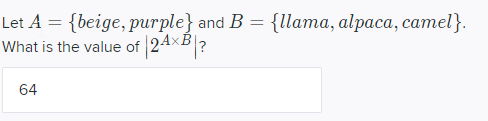
Is my thinking here right? I got the cartesian product size which is 6
then 2^6 = 64
snow sleet
yes, looks good @simple nova

 young jolt
<@&286206848099549185>
 fierce osprey
young jolt
fierce osprey
young jolt
A logical formula is considered to be in DNF if it is a disjunction of one or more conjunctions of one or more literals.
you can start by ruling out the last two because conjunctions are tying together the literals
and then that odd case of an or not disqualifies option two, I believe
you can have nots within your groups of literals
 last timber
@gusty gale what have you tried and where are you stuck
 gusty gale
I didnt do yet , idk how to do
last timber
how is bijective function defined?
waxen nest
oh it is one-to-one function

 meager prairie
waxen nest
meager prairie
waxen nest
did you end up figurin it out?
snow sleet
waxen nest
oh it is one-to-one function
one-to-one functions aren't always bijective
snow sleet
gusty gale
if the function isn't one-to-one or if it isn't onto, then it's not bijective.
snow sleet
gusty gale
here's a massive hint...plug in x=1 and record what f(x) is in that case. Then plug in x=-1 and record what f(x) is in that case. Now compare the f(x)'s
snow sleet
@gusty gale do you still need help with this?
 limpid topaz
I have a questions, can I write "The natural number n is prime" as (∀k ∈ N)(∃n ∈ N)(k ≤ n) ([(n/k) ∈ N] => (n=1 v n=k))
waxen nest
meager prairie
did you end up figurin it out?
i think i need to plot the graph out to see?
meager prairie
looks like logician sorta answered
id use more of a definition or uhh
map based approach than graphing
to answer the question
graphing software might make assumptions about domain and such
waxen nest
oh okay thanks
 storm osprey
hi guys i need help on my exercise
Let Q(x) be the statement “x < 2.” What is the truth value of the quantification ∀xQ(x), where the domain consists of all real numbers?
how do i answer thoese question?
snow sleet
it's false
because you can find a real number that isn't less than 2
consider x=3
@storm osprey
snow sleet
storm osprey
Let Q(x) be the statement “x < 2.” What is the truth value of the quantification...
The statement you brought is saying: Every real number is less than 2.
that statement is of course, false
make sense @storm osprey ?
storm osprey
if x >2 it still would be false right ?
snow sleet
storm osprey
if x >2 it still would be false right ?
yes, because x=1 is a counterexample for that case
storm osprey
haa, i see
storm osprey
What is the truth value of ∀xP(x), where P(x) is the statement “x2 < 10” and the domain consists of the positive integers not exceeding 3?
is my answer is correct?
domain 1,2,3
1^2 < 10 true
2^2 < 10 true
3^3 < 10 false
 red nest
If x2 means x^2, then you should be doing 3^2=9, not 3^3=27
storm osprey
if x2 does not means x^2 how the correct answer should be? i because i assuming that x2 is x^2.
red nest
I have no clue what x2 would mean if it is not x^2
storm osprey
Let P(x) denote the statement “x > 3.” What is the truth value of the quantification ∃xP(x), where the domain consists of all real numbers?
storm osprey
storm osprey
Let P(x) denote the statement “x > 3.” What is the truth value of the quantifica...
that statement consider false ?
red nest
The statement is true, because there is a real number greater than 3.
storm osprey
if ∃xP(x) change to ∀xP(x) then it would be a false statement?
red nest
Yes
storm osprey
thank you so much i start to understand a little bit
snow sleet
storm osprey
What is the truth value of ∀xP(x), where P(x) is the statement “x2 < 10” and the...
if x2 means x^2 or 2x, then the truth value is true.
 lavish hornet
hi guys, anyone can help me solve this problem :
- a semi-competition basketball tournament with 39 teams participating. In this case, one team plays each other once. If each team wins at least twice, show that there are at least 2 teams that have the same number of wins
stray reef
how familiar are you with the pigeonhole principle?
lavish hornet
hmmm, i know that pigeon is 39 team right ?
lavish hornet
stray reef
how familiar are you with the pigeonhole principle?
we just learned this, and still a little confused
stray reef
you can group the teams by how many wins they scored
i.e. the teams who scored 2 wins, the teams who scored 3 wins, etc.
there are 38 such groups as there are 38 possible scores (2 to 39; we are told no team scored only 0 or 1)
lavish hornet
So, the pigeon's nest is 38 wins?
last timber
yes
@lavish hornet basically restating Ann's words:
For 39 teams there are only 38 possible numbers describing the amount of their wins
lavish hornet
ooh okay, thanks guys


 pale epoch
it looks fine
 plush dock
Heyo, quick question (might be more of a basic algebra problem that I'm struggling with for some reason, rather than discrete, but the context is discrete, I hope it's fine).
In the context of generating functions (combinatorics), I'm going over a solution for a problem and after coming up with the generating function rule, they do this (note: it is missing one ')'): see below.
And while I do understand the right part of the equation, I don't get how they turned it into (1+x^6)...

Thanks a bunch
 vale cairn
I have a feeling there's a slight typo as you said with the bracket
i.e. i think it should be f(x) = ((1+x+x^2+x^3) + x^6(1+x+x^2+x^3))^4 where you can just factorise out the (1 + ... + x^3)^4 to give the 2nd line
vale cairn
np
 mint bane
it's impossible to use induction over all integers right
stray reef
you can use what might be called bidirectional induction
show P(0), and show P(n) implies both P(n+1) and P(n-1)
mint bane
thanks ann :) i had a feeling that could be a thing but didnt actually try it, gotta take more of an initiative lol
 pale epoch
maybe one is a subgroup of the other?
 weary tiger
Hey guys so I solved this (no idea what's it called in english) :

And now I'm trying to solve this one with the same way ( A(x) = Σa(n)*x^n ) but I don't know what to do about the 9^(n-1)

Any ideas ?
faint narwhal
it should just be sum 9^(n-1) x^n when you convert into generating functions
weary tiger
faint narwhal
it should just be sum 9^(n-1) x^n when you convert into generating functions
Yeah but where do I go from there? From what I understand I need to get rid of the variables . Is it something I'm missing?
faint narwhal
I'm not really sure what you mean by get rid of the variables
You solve for the a_n
faint narwhal
No? You might get something in terms of n
weary tiger
Ohhhh guess I misunderstood then , so I just ignore the Σ(9^(n-1)*x^n) all together ?
faint narwhal
No? Why would you
 tidal tulip
i want to see if i am understanding things correctly is it correct to say: 1) empty is a subset of the empty set is true, 2) empty set is an element of the empty set is false, 3) empty set is a subset of the set containing the empty set is true
pale epoch
yes
tidal tulip
thanks!
 shut jacinth

can someone help me figure out why these two graphs aren't isomorphic?
i would imagine because all the vertices are deg = 3 you could map all of them to the other
 reef kelp
Hi everybody! I'm taking a discrete math 1 class and one of our problems is to turn definitions into quantified sentences. The definition I am trying to quantify is "The natural number n is prime." and I wanted to know if my quantified sentence makes sense to you all. I did (∀x)(n/x ∈ ℕ ∧ n > 1 ∧ n/x = k, (k ∈ {1, n}))
 static comet
 faint narwhal
shut jacinth
i would imagine because all the vertices are deg = 3 you could map all of them t...
faint narwhal
shut jacinth
i would imagine because all the vertices are deg = 3 you could map all of them t...
It's not necessarily true that the same degrees on the vertices means they're isomorphic
shut jacinth
true
faint narwhal
The easiest example is a hexagon and two separate triangles
Both on six vertices, all the vertices have degree 1, but these aren't isomorphic
To show that these are non isomorphic, think about cycles
If two graphs are isomorphic and one has a cycle of length n, then the other also must have a cycle of length n
faint narwhal
Mm I'm not so sure that the maximum cycle length will help here, but that is something that can help in general
faint narwhal
I'm not super sure that would be helpful either
Thinking back to your previous idea, instead of looking at maximum length cycles, what about minimum length cycles
shut jacinth
faint narwhal
Thinking back to your previous idea, instead of looking at maximum length cycles...
trying to wrap my head intuitively why looking at maximum doesn't work and minimum works
faint narwhal
I mean, what works is going to depend on what graphs you have. Sometimes maximums will differ and minimums won't
shut jacinth
shut jacinth
in this case i looked and it does for the minimum (didnt check maximum yet)
left: a-b-j
right: 1-2-3-10
so since there does not exist a cycle in the right graph of length 4 can we say they are therefore not iso?
faint narwhal
You have to be a bit more careful than that. You can't just show that there's a cycle of length 4 in the right graph, you need to say why there's no cycle of length 3
But yes, isomorphic graphs must have the same minimum cycle lengths (also called girth)
shut jacinth
faint narwhal
You have to be a bit more careful than that. You can't just show that there's a ...
i see
although im a bit unsure how to show a cycle of length 3 cant be formed in that graph
faint narwhal
I don't think there's really any nice way other than brute force
shut jacinth
oh i thought you meant to prove it :u
faint narwhal
Look at each edge, for example the 1-2 edge, and confirm that 1 and 2 don't share any neighbors. Thus, the 1-2 edge can't be in a 3-cycle
I mean, this is a proof that there's no 3-cycle
faint narwhal
No problem, the maximum cycle thing doesn't work cause its easy to check that you can cycles of length 10 in both
shut jacinth
ah gotcha
 sand cipher
does that means that?
 weary tiger
sand cipher
does that means that?
weary tiger
sand cipher
does that means that?
no
reef kelp
No, you don't just distribute the negation unary operator, you negate the logical sentence of "If P, then Q" Here's a truth table


 weary tiger
sand cipher
so i don't get the hint, should i use that truth table or this
weary tiger
sand cipher
so i don't get the hint, should i use that truth table or this
well the hint is showing the amount of statements you have
weary tiger
sand cipher
so i don't get the hint, should i use that truth table or this
and thus the truth and false combinations you'll be using for the arguments
reef kelp
Yeah you take each proposition and assign it a letter. Ex. "Gustavo lives in Italy." is a proposition and it could be denoted with the letter p
weary tiger
^^
weary tiger
np
reef kelp
Oh yeah I think your problem has a typo too. The second statement should probably be If Gustavo drives a Maserati
sand cipher
i'll tell him that xD thx
 stark delta
Not sure if this is discrete Math..
 weary tiger
This seems like more #calculus or #multivariable-calculus
snow sleet
@sour arrow Here's another instance of that sort of generating function being applied to a similar problem.
waxen nest
waxen nest
hey i think i still need some help with this qn
i plotted the graph on desmos but im still trying to figure out whats the domain and range
 pale epoch
for the domain you have to figure out for which $x$ the term $\frac{5}{\sqrt{2x+3}}$ is defined
vital dewBOT
Lochverstärker
 pale epoch
for the range you can look at the graph and notice that its always above the x-axis (what does this mean?) and consider whats the behavior "all the way to the right" and "all the way to the left"
waxen nest
pale epoch
for the domain you have to figure out for which $x$ the term $\frac{5}{\sqrt{2x+...
how do i figure that out

im not sure if this is correct
waxen nest
pale epoch
well, you divide two numbers right?
divide two numbers? which two numbers
pale epoch
5 and sqrt(2x+3) in this case
waxen nest
idk
waxen nest
pale epoch
for the range you can look at the graph and notice that its always above the x-a...
isnt range look at y?
domain is x axis right
pale epoch
yes, but if the graph is above the x axis that has implications on the possible y values
pale epoch
waxen nest
idk
well, is division of all numbers possible?
waxen nest
pale epoch
well, is division of all numbers possible?
?? what do you mean
pale epoch
can you always compute a/b for all a and b?
waxen nest
how to get the range and domain ? is the graph even useful to get both range and domain?
or do i need to calculate manually
waxen nest
pale epoch
can you always compute a/b for all a and b?
whats a/b ? how did you get a/b?
pale epoch
the graph is useful in the sense that it gives you an idea if you know what it means
(and that desmos only shows you the graph for the biggest possible domain)
its just some arbitrary numbers
waxen nest
okay so what do i do now
pale epoch
tbh it seems like you should go back to the beginning of the chapter and study
 rough crater
Aₙ is the group of all the strings that are created from the three numbers {-1,0,1} such that from the first number to any point the amount of 1s is greater or equal to the amount of -1s.
Find the generating function that gives us the number of strings that meet these requirements
im not the best with generating functions but i assume this has something to do with the catalan numbers
stray reef
group? did you mean set?
rough crater
yes sorry
stray reef
so... A_n is the set of all strings composed from -1, 0 and 1 for which every prefix has a nonnegative total
did i get that right?
rough crater
yep
rough crater
i tried to find one but kept getting stuck
then i realised the whole 1 , -1 is pretty similar to the catalan numbers except that there could be more 1s than -1s
i dont know if that helps at all
faint narwhal
seems pretty similar to Catalan's triangle or Lobb numbers
 tawny trout
Hi, I have a small question and I can't find any resources for this specific case.
Question: if (P and Q), then P
I believe this proposition to be true because if P and Q is true, then so is P. Am I right or wrong?
tawny trout
yeah, i agree. I wasnt sure if the reasoning was correct. Thank you so much!
vale cairn
np
 daring beacon
can someone explain to me how p and r turned to TRUE here
 waxen nest
apply demorgan's
daring beacon
I don't understand wym cuz I don't see demorgans turning anything to TRUE here
 weary tiger
No it's called distribution
They applied that law to it
Also, $P\lor{\neg{P}}$ is a tautology which is TRUE
vital dewBOT
jswatj
 daring beacon
Thanks @weary tiger
daring beacon
can someone tell me the name of this specific rule
 daring beacon
where would you go next from here to prove this is a tautology: (p and r) or ((not p and not q) or (r or q)) ?
daring beacon
using substitution
daring beacon
It's fine thank you for trying
 subtle charm
Is it possible to simplify the proposition further? ~(a V b V c) V (~c ^ (a V b)) V c
vital dewBOT


 stray reef
lmao guess it's a tautology
 grand yoke
I am having confusion while understanding diff. btw universal statements and existential statements
stray reef
"all geese have three feet" vs. "there is a three-footed goose somewhere out there"
grand yoke
stray reef
"all geese have three feet" vs. "there is a three-footed goose somewhere out the...
the first is universal, though it is false statement but the property of having three feet is not there in any goose in a universal set of all geese. am i correct?
stray reef
...you are overthinking it but yes the first one is universal
subtle charm
stray reef
pretty sure it is
How do I go about simplifying it? After I apply de morgan and distributive law, I am stuck with (~a ^ ~b ^ ~c ) V ( ~c ^ a ) V (~c ^ b ) V c
stray reef
i'd draw a k-map or something
or a truth table
or do you want to do it symbolically
grand yoke
@stray reef i am kind of getting it
stray reef
you can factor out ~c from all but the last term to get (~c & [(~a&~b) v a v b]) v c @subtle charm
subtle charm
stray reef
you can factor out ~c from all but the last term to get (~c & [(~a&~b) v a v b])...
Ok thanks, I will try it out.
grand yoke
universal statements can be converted in conditional statements by rewriting them?
mr. @stray reef ?
stray reef
would you call a woman "mr."?
grand yoke
stray reef
would you call a woman "mr."?
oh i didnt check it sorry miss
stray reef
anyway yes
grand yoke
So if i say that 'all houses are red'. (and lets say in some parallel universe this statement is true) 'if theres a house, then it is red' would mean the same are the first universal statement?
stray reef
oh, no. not like that.
"all houses are red" as a conditional would become "if it's a house, it's red"
or "if x is a house then x is red" or whatever
grand yoke
stray reef
"all houses are red" as a conditional would become "if it's a house, it's red"
hmm
snow sleet
grand yoke
the first is universal, though it is false statement but the property of having ...
"the property of having three feet is not there in any goose in a universal set of all geese" is a confusing statement that can be interpreted in more ways (and perhaps other ways than you meant)...try instead thinking about "there is a three-footed goose" by simply thinking "a three-footed goose exists".
snow sleet
grand yoke
hmm
this is because ANY house you're given, you are guaranteed that THAT given house is red because "all houses (including the one you're given) are red".
 livid drum
grand yoke
So if i say that 'all houses are red'. (and lets say in some parallel universe t...
livid drum
grand yoke
So if i say that 'all houses are red'. (and lets say in some parallel universe t...
In spirit they would be the same.
However, in the formalism specifying the languages, their syntax might be different.
These two sentences suggest two separate first order languages.
The first quantifies over all houses and has unary predicate R (red).
The second quantifies over all buildings and has two unary predicates: H and R (house and red).
The first sentence symbolically is: "for all x, R(x)";
the second is: "for all x, H(x) implies R(x)".
The "equivalence" between these two sentences is not the usual logical equivalence within the formal system.
These two sentences are stretched over two languages; the "equivalence" is a meta-mathematical one.
Surely, if the first sentence is the only axiom of the first language, and the second the second, any proof of "for all x, A(x)" in the first language can be translated to a proof of "for all x, H(x) implies A(x)" in the second, and vice versa.
grand yoke
livid drum
In spirit they would be the same.
However, in the formalism specifying the lang...
oh yes 'if theres a house' says abt the existence of house
but there is no need to say that
i am getting it hmm
subtle charm
Given P is a class of boys and girls,
Boy(x): x is a boy
Girl(x): x is a girl
Soccer(x): x plays soccer
Can I write the statement; Only boys player soccer
$\forall$x$\in$P (Boys(x) $\Rightarrow$ Soccer(x))
Is this correct? or Do I have to include the girls -> ~Soccer(x))
waxen nest
whats P
vital dewBOT
Pepega0918
 subtle charm
i mean P is the set of class with boys and girls
subtle charm
I think the predicate Boy(x) define if x is a boy or girl?
if Boy(x) is true then x is a boy?
 grave sluice
the statement that only boys play soccer would be the other way around
vital dewBOT
Mic
 grave sluice
that would mean that every boy plays soccer
 cerulean wind
every boy plays soccer is not equivalent to the only soccer players are boys
subtle charm
Ah okay. I get it.
cerulean wind
every boy on the planet could play soccer, but, for sake of example, your mom could still play soccer with you, and it wouldn't break the statement that every boy plays soccer
weary tiger
how to prove this with induction?
 faint narwhal
If all the vertices had different degrees, what must the degrees of the vertices be? @weary tiger
faint narwhal
Right
So there are a couple ways to do this, but by induction, you can think about what happens if you remove the vertex with degree n - 1
weary tiger
what if there isn't any vertex with degree n-1
stray reef
then there's something else you can apply
weary tiger
oh okay you assumed every vertices have different degree
waxen nest
whats pmi
weary tiger
pmi -> principle of mathematical induction
waxen nest
oh okay
weary tiger
stray reef
then there's something else you can apply
like?
stray reef
pigeonhole principle
subtle charm
I know that (-1)^2k = 1 where 2k is an even number. Just wondering is there any theorem I can quote to support it?
 stray reef
can you show the exact thing demanded of you
subtle charm
actually, i think this will be more appropriate since -1 raised to any even power is essentially -1 x -1 2k times where 2k is any even number
 subtle charm
stray reef
can you show the exact thing demanded of you
subtle charm
stray reef
can you show the exact thing demanded of you
Thanks for the help, but I want to try it on my own first.
Appreciate it.
stray reef
are you like
working directly with field axioms rn or something
that would explain why you would be demanded to obsess over the exact reasoning for each step
subtle charm
yes haha

 waxen nest
<@&286206848099549185>

ive tried doing it but im not sure if its correct
can someone help to check?
 iron marsh
Oh, pretty sure this is just B'

 iron marsh
Hope this helps @waxen nest
waxen nest
iron marsh
Hope this helps <@159347050327048192>
what rule in set theory is this?
vital dewBOT
dackid
 iron marsh
waxen nest
A U B = A??
iron marsh
waxen nest
A U B = A??
This one, not the second one
waxen nest
hmm why does A U B' = B' then
iron marsh
Wait, I blundered. The first part is right, but the claim you just made (which I also made) was flawed
waxen nest
iron marsh
As long as B is a subset of A
how do you know B is a subset of A?
iron marsh
So A U B' is where it stops
 iron marsh
vital dew
**dackid**
iron marsh
vital dew
**dackid**
No, I made an error here.
waxen nest
waxen nest
i tried to plug in this into some online calculator to solve and its correct. it gives AUB'
but if i plug in the original qn, the final ans calculator give is A' U B'
https://www.symbolab.com/solver/set-theory-calculator/\left(\left(A\cap B^{c} \right)\cup A^{c}\right)%5Ccup%5Cleft(%5Cleft(B%5E%7Bc%7D%5Ccap%20A%5Cright)%5Ccup%5Cleft(B%5E%7Bc%7D%5Ccap%20%20B%5Cright)%5Cright)
Free Set Theory calculator - calculate set theory logical expressions step by step
now im wondering is theres a mistake in my previous working?? or the calculator is wrong
pale epoch
you lost the complement on A when you applied the distributive law first
right here

@waxen nest
everything else is fine
daring beacon
where would you go next from here to prove this is a tautology: (p and not r) or ((not p and not q) or (r or q)) ?
daring beacon
I don't get what you mean
pale epoch
there is a finite number of cases to check if this is a tautology
i.e. construct a truth table
if you're smart about it, you can skip most of that by thinking about what cases (r or q) already covers
daring beacon
I'm suppose to use substitution only tho
ohterwise I would have already used a table
 outer hinge
We’re doing things with strings and the Cartesian product and I’m so confused
weary tiger
well, what are you confused about
outer hinge
I don’t even know what they are and how they relate to Cartesian products or relations
weary tiger
Then, you should probably take a look at Cartesian products and relations on their own, there are lots of books on it
split drum

Logically, d (the one with a red dot), is true right?
If the premise is false, but the conclusion is true, then the if-then is true?
pale epoch
yes
snow sleet
split drum
vacuously so, so yes it's true
split drum
Nice, thanks guys.
 iron marsh
Gonna be taking this in fall. Any resources you guys recommend to be prepared.
snow sleet
iron marsh
Gonna be taking this in fall. Any resources you guys recommend to be prepared.
We used this text (http://www.ams.org/books/text/041/text041-endmatter.pdf) in our course. I really liked the text, some people didn't since the back of the book rarely gave answers but rather hints which weren't always helpful. There's the link for the free pdf of PART of our textbook... you can get the full text from the AMS bookstore. It's a good text to have if you're into collecting math texts.
Here's the link for book on the ams website https://bookstore.ams.org/text-41/
iron marsh
snow sleet
We used this text (http://www.ams.org/books/text/041/text041-endmatter.pdf) in o...
Thanks
snow sleet
 snow sleet
This channel is open for questions
 oak notch
Quick question, can someone explain what a pair of arbitrary vertices is? How is it different to an edge when writing it?
Also, what does u,v ∈ V(G) mean in:
Let G be a grapth and let u,v ∈ V(G). u and v are connected if there is a u-v path in G
faint narwhal
@oak notch it's just any two vertices in your graph
Saying that uv is an edge means that u and v are connected by an edge, but here u and v don't have to be connected by an edge
oak notch
What's the difference in writing uv and u,v?
One is an edge and the other is an arbitrary pair of vertices?
faint narwhal
I mean, these things don't really mean anything by themselves
It's only when you say uv is an edge, or u,v are vertices in G, that these things mean something
oak notch
Okay then. What if I write: "Let u,v ∈ E(G)." What does that mean? Is the syntax correct?
faint narwhal
Mmm
I think people would know what you meant if you wrote this
But people just tend to write uv or maybe (u,v)
It kind of boils down to how you've defined E(G) to begin with
oak notch
I see. How would you write it? "uv", "(u,v)", or "u,v"? Do the formats mean the same thing?
Like "Let (u,v) ∈ E(G)." --- "Let uv ∈ E(G)." --- "Let u,v ∈ E(G)."
All these 3 mean that it is an element in the edge set of G?
faint narwhal
I guess your question comes down to how we define a graph and how we define V(G) and E(G)
oak notch
Yeah
faint narwhal

So Wikipedia defines it in this way
For them, edges are just sets of two vertices, and so they would write {u,v} in E(G)
For others, especially if you care about directed graphs, want edges to be ordered pairs, since sets don't care about ordering so you can't say an edge points a certain way
In that case, if your edges are ordered pairs, you would write (u,v) in E(G)
However, people get lazy and just start writing uv in E(G) when it's understood that they really mean {u,v} or (u,v)
oak notch
This clears it up
faint narwhal
No one writes u,v in E(G), not that I've seen
oak notch
Does u,v in V(G) usually mean that it's a pair of arbitrary vertices in V(G)?
Or does that depend on the context
faint narwhal
Yes
Also technically, writing u,v in V(G) means that u and v can be equal unless stated otherwise
oak notch
I see. Thanks
I'm going on to a different topic here, but what about this one?
"Hey guys, this is about the characterization theorem in Graph theory. Can anyone please explain to my why {x,y} should not be equal to {u,v}? I've been watching the lecture my teacher provided but I still can't understand it. He also mentioned about intersection being empty or 1, but can't be 2. Can someone also explain the intersection part, please?"

Case 1: {x,y} =/= {u,v}
  > u =/= x and u =/= y
I asked that question yesterday, but no one was able to answer it
waxen nest
pale epoch
you lost the complement on A when you applied the distributive law first
okay thanks for pointing that out

can someone check is this correct?
faint narwhal
oak notch
```
Case 1: {x,y} =/= {u,v}
> u =/= x and u =/= y
```
So does your professor never address the case where u = x and v = y?
oak notch
Well, he just described that u cannot be x and y (or v cannot be x and y)
faint narwhal
Yeah I'm confused as to why your professor said that
oak notch
Then after that, we considered G - u.
"Since x,y ∈ V(G - u), then x and y are connected"
oak notch
Oh
After that, he considered that case
What I'm asking is, can you explain case 1?
I think if I get case 1, I can get case 2
faint narwhal
What don't you understand about case 1?
faint narwhal
what
It can
The point is that you're splitting it into two cases
And these two cases cover all the possibilities
Maybe as an example, if you wanted to prove something for all integers. You could split it into two cases. Case 1, the integer is odd, case 2, the integer is even
If you prove both of these cases, then you've proven it for all integers
oak notch
Hmmm. I guess what I'm trying to say is that I don't understand how to prove case 1 in the characterization theorem
faint narwhal
Oh
Yeah, so like they say x,y in V(G - u)
since V(G - u) is connected, there's some path between x and y
but this gives you a path between x and y in G as well
oak notch
So in case 1, u should not be equal to x and y and v should not be equal to x and y because we will be deleting u/v?
faint narwhal
yeah, this argument doesn't work unless x,y is in V(G - u) or V(G - v)
oak notch
Ooh
Ah, it makes sense now. Thanks for answering everything Zoph
Oh wait, one last, can you also explain the second case?
faint narwhal
What's the second case
oak notch
Case 2: {x,y} = {u,v} (x = u, y = v)

Then P1 and P2 were concatenated because it had a common vertex which was w.
oak notch
Why are we supposed to concatenate G -u and G- v though?
faint narwhal
Huh? We're concatenating two different paths to give us a path from u to v
oak notch
WHy didn't we do the same for case 1?
faint narwhal
Because there was no need to
oak notch
Ah cause u and v aren't x and y
Is case 2 something like transitivity in equivalence relations?
faint narwhal
I mean, being connected is an equivalence relation on the set of vertices yes
So yeah, you can think of it that wag
oak notch
I see
Okay then. That made things a bit clearer
Thanks for answering everything Zoph
 last timber
yes i mean where is question from
waxen nest
my school past year paper
im practicing for my exam TOMORROW!
My answer is:
a) private key is (35, 65)
b) encrypted ciphertext for 15 is 20.
c) decrypted original message for ciphertext 5 is 60.
i would appreciate if anyone could help to verify these answers 🙏
my workings are abit too long so i shall not post it here to flood the chat
 sharp ledge
Let f : (−2, 3) → R defined by f(x) = x^2
Determine the image of f. Is f injective?
Is f surjective? Is f bijective?
sharp ledge
sharp ledge
Let f : (−2, 3) → R defined by f(x) = x^2
Determine the image of f. Is f injecti...
Will the image be a range ? since the x is from -2 to 3
weary tiger
How different is discrete maths from normal maths
?
I just started learning it
And give me any tips or strategy for it
Pls :)
Thank u
sour arrow
Why isn't discrete normal? What did it do to become a misfit?
weary tiger
Ok discrete maths vs calculas etc etc
pale epoch
it might serve as an introduction to proof-based mathematics
my tip is to do the homework
waxen nest
pale epoch
it might serve as an introduction to proof-based mathematics
hi can help me?
weary tiger
What is logical equivalence?
(I've watched a few vids and read few sites i can't understand)
weary tiger
pale epoch
my tip is to do the homework
...
weary tiger
sour arrow
Why isn't discrete normal? What did it do to become a misfit?
😂😂😂😂😂😂😂😂
weary tiger
weary tiger
😂😂😂😂😂😂😂😂
What does it mean p biconditional operator q is a tautology
 desert edge
Could I get some help with understanding solving logical propositions exercises
we are using some notations im not familiar with and my professor basically skimmed through it

I understand up to this point

And I know this is the solution.
I also see the rules applied but I dont quite get how
snow sleet
sharp ledge
Will the image be a range ? since the x is from -2 to 3
Then image is the range, yes
snow sleet
sharp ledge
Let f : (−2, 3) → R defined by f(x) = x^2
Determine the image of f. Is f injecti...
Plug in x=-1.5, then plug in x=1.5. What do you notice about f(x) for each of these values of x? This is for the part that determines whether or not f is injective. For surjectivity, find a real number that f does hit...in other words find a real number that never equals x^2 for any x in (-2,3).
snow sleet
weary tiger
What does it mean p biconditional operator q is a tautology
It means that p happens exactly when q happens.
 weary tiger
snow sleet
It means that p happens exactly when q happens.
weary tiger
snow sleet
It means that p happens exactly when q happens.
?
sour arrow
@weary tiger
Two statements are logically equivalent when their truth table matches.
weary tiger
Yea thanks
sour arrow
Wait, that proof is really messed up. That from the book?
Oh they're proving the absorption law and failing lol
snow sleet
weary tiger
And why put 1 there
[p v (p ^ q)] is equivalent to [(p^1) v (p ^ q)], which is equivalent to [p ^ (1 v q)]. (1 stands for 'true' there btw)
[p ^ (1 v q)] is then equivalent to [p ^ 1], which is equivalent to p.
(1 v q) is equivalent to 1 btw since (1 v q) will always be true.
@weary tiger see above^
snow sleet
sour arrow
Oh they're proving the absorption law and failing lol
they're not failing lmaoo. Their proof is solid
it's just a little hard to see the jump from [p v (p ^ q)] to [p ^ (1 v q)] without noticing [p v (p ^ q)] is equivalent to [(p^1) v (p ^ q)]
weary tiger
Hmmmmmmmm thanks
snow sleet
You're welcome!
vital dewBOT
A Kid Named Galois
\begin{align}
\neg{(\exists{x}\forall{y}[p(y)&\implies{\forall{zq(z)}])}}
\\ \forall{x}\exists{y}\neg{[p(y)&\implies{\forall{zq(z)}]}}
\\ \forall{x}\exists{y}\neg{[\neg{p(y)}&\lor{\forall{zq(z)}]}}
\\ \forall{x}\exists{y}[p(y)&\land{\exists{z\neg{q(z)}}]}
\end{align}
```Compilation error:```! Missing } inserted.
<inserted text>
                }
l.60 \end{align}

I've put in what seems to be necessary to fix
the current column of the current alignment.
Try to go on, since this might almost work.```
 tender hearth
I'm uncertain about negating nested quantifiers. Are my last two steps incorrect? I'm trying to negate it. pls help me
\begin{align}
\neg{(\exists{x}\forall{y}[p(y)&\implies{\forall{zq(z)}])}}
\ \forall{x}\exists{y}\neg{[p(y)&\implies{\forall{zq(z)}]}}
\ \forall{x}\exists{y}\neg{[\neg{p(y)}&\lor{\forall{zq(z)}]}}
\ \forall{x}\exists{y}[p(y)&\land{\exists{z\neg{q(z)}}]}
\end{align}
vital dewBOT
A Kid Named Galois
Compile Error! Click the  reaction for more information.
(You may edit your message to recompile.)
 tender hearth
<@&286206848099549185> pls help me ^
pale epoch
looks good
tender hearth
pale epoch
looks good
Thank you!!
daring beacon
can someone explain to me why only T implies F == F and not also F implies T:
for instance, if I use the example: if police does not see me speeding (F) and I get a speeding ticket(T) should be false right ?
unless the policeman made a mistake ?
snow sleet
daring beacon
can someone explain to me why only T implies F == F and not also F implies T:
fo...
(True -> False) is by definition False since (True -> False) is equivalent to [~True v False], which is equivalent to (False v False).
(False -> True) is true (vacuously)
use the fact that (p -> q) is equivalent to (~p v q) to see this
 kind hollow
is this class really hard? Im taking it with Calculus 1 at the same time
waxen nest
 snow sleet
kind hollow
is this class really hard? Im taking it with Calculus 1 at the same time
snow sleet
kind hollow
is this class really hard? Im taking it with Calculus 1 at the same time
it's hard for some, but quite natural for others. I thought the course was pretty easy.
 vivid locust
waxen nest
vivid locust
waxen nest
Use p->q ≈ ~p^q and expand each
waxen nest
okay
waxen nest
vivid locust
Use p->q ≈ ~p^q and expand each
isnt it or instead of and
snow sleet
vivid locust
Use p->q ≈ ~p^q and expand each
(p->q) is equivalent to (~p v q)
snow sleet
waxen nest
isnt it or instead of and
yes
kind hollow
snow sleet
it's hard for some, but quite natural for others. I thought the course was prett...
I have no choice, just needed someone’s two cents. Thanks
snow sleet
You're welcome lmao
vivid locust
snow sleet
(p->q) is equivalent to (~p v q)
Oops my bad
snow sleet
all good it's a simple error any of us could've made
faint narwhal
Prove that k = 3 first


 faint narwhal
Yep
 lament copper
hello im kinda having trouble understand what is being asked here I did the truth table though


i really dont understand what im being asked
like prove why the last colomb answers are true or false or?

yea
like this ?
or using laws?
sorry for the spam

this would be idempotent laws
would that be it?

So pretty much step by step and come to the solution of it being biconditional?

this is all the hw
i dont know either
 devout root
Is there an identity like $\binom{n}{2} + n = \binom{n+1}{2}$ or maybe someone can offer an idea at a proof.
vital dewBOT
jm
 faint narwhal
Just write out both sides and do some algebra @devout root
devout root
I know.. but I'm lazy :).. thanks ❤️
 dire wren
Just finished a proof for the start of my Combinatorics class (Pigeonhole Principle). It's a bit late, would appreciate a second pair of eyes to check for any errors. Thanks. Attaching below

 faint narwhal
Yeah seems good
I think I'd justify a little more why
The thing with zeroes at the end being divisible by 1969 implies that the thing without zeroes at the end is also divisible by 1969

 snow sleet
devout root
snow sleet
devout root
this can be done in a slightly simpler fashion since $\frac{n(n-1)+2n}{2}=\frac{n(n-1+2)}{2}=\frac{n(n+1)}{2}$
vital dewBOT
logician

 weary tiger
@snow sleet do u happen to know asymptotic functions at all? like big O or omega?
snow sleet
weary tiger
<@!856623557685674005> do u happen to know asymptotic functions at all? like big...
uhhh I meannn I know aymptotic functions from calc...I'm not sure what you mean by "big O or omega"
faint narwhal
weary tiger
<@!856623557685674005> do u happen to know asymptotic functions at all? like big...
What do you need help with?
@weary tiger
vital dewBOT
Pepega0918
 weary tiger
faint narwhal
What do you need help with?
weary tiger
faint narwhal
What do you need help with?
its this question
faint narwhal
Yeah, there's not much more to this than just writing out the definitions
weary tiger
yeah it seems to be that way, but my proof doesn't really make note of some variable that they want me to
pepega can go
subtle charm
Hi @weary tiger if you are okay, can I post my question?
weary tiger
ill ask about it later
subtle charm
okay
Let P be a set of athletes in the Olympics
Soccer(x): x is a soccer player
Swimmer(x): x is a swimmer
talk(x,y): x talked to y
How do I go about writing the statement that every soccer player talk to a swimmer during the Olympic?
My solution is this:
$\exists$x$\in$P(Swimmer(x) $\land$ [$\forall$y$\in$p(Soccer(x) $\Rightarrow$ talks(x,y)])
vital dewBOT
Pepega0918
 subtle charm
Is my understanding right?
faint narwhal
No this isn't correct. In words, what you've written down is that there exists a swimmer that every soccer talked to
Do you see why?
subtle charm
Initially, I wrote it in a different manner. Let me typed it out.
cerulean wind
faint narwhal
No this isn't correct. In words, what you've written down is that there exists a...
thought they wrote "there exists a swimmer in P and if that swimmer is also a soccer player, then they have talked to every person in P"
faint narwhal
Ah you're right
cerulean wind
@subtle charm you should start your solution by writing for all x in P, if swimmer(x), then ...
(roughly, i dont know what you are and aren't allow to quantify over)
subtle charm
$\forall$x$\in$P(Soccer(x) $\Rightarrow$ [$\exists$y$\in$P(Swimmer(y) $\land$ talks(x,y))]
vital dewBOT
Pepega0918
 subtle charm
not sure if this is right?
but i think this is wrong
since if the hypothesis is false then the statement is vacuously true?
cerulean wind
yea that looks right now. for every person x in P, if x plays soccer, then there is a person y in P that is a swimmer who talked to x
subtle charm
This is my original solution but I kept thinking that if Soccer(x) is false then won't the statement be true by default?
cerulean wind
subtle charm
since if the hypothesis is false then the statement is vacuously true?
if there is no witness x to soccer(x), then the statement is vacuously true.
like, if for some reason, soccer got cancelled and there were no soccer players, then it would be vacuously true... sort of
subtle charm
so if x is not a soccer player then does it mean that x also talks to a swimmer?
$\forall$x$\in$P([$\exists$y$\in$P(Swimmer(y) $\land$ talks(x,y)] $\Rightarrow$ Soccer(x) )
vital dewBOT
Pepega0918
 subtle charm
does this even makes sense?
cerulean wind
no. lets say x1 is Usain Bolt and x2 is Simone Biles, and Usain Bolt talks to Katie Ledecky but Simone hates swimmers and doesnt talk to any of them.
soccer(x1) and soccer(x2) are both not satisfied, but x1 talked to a swimmer and x2 didnt talk to any swimmers.
it could go either way (unless you know more information)
cerulean wind
vital dew
**Pepega0918**
this says if a person talked to a swimmer, then they play soccer
subtle charm
Yeah, I think I get the idea.
 minor pumice
yo is this proof by induction?

if so then what is the induction hypothesis?
assume true for some prime k > 3 in positive integers
stuck after that
 civic horizon
A direct proof is the way to go
minor pumice
civic horizon
A direct proof is the way to go
I only know how to do induction and counter example
can u give the first step or something
do I just do let p = 5 and q = 2p + 1
civic horizon
Go case by case
minor pumice
p is prime and q = 11 is prime
civic horizon
What if p = 0 mod 3
Yeah so the statement is true
That is not a counterexample
Thats just an example
minor pumice
?
minor pumice
civic horizon
That is not a counterexample
are you trying to get me to do proof by counterexample?
civic horizon
No
minor pumice
wdym
civic horizon
I want you to consider cases
So we show that it is impossible for p to be 0 or 1 mod 3
Which means it has to be 2 mod 3
minor pumice
oh I get it
subtle charm
Hi, can I check if the -> used in propositional logic translate to subset in set theory?
if so, is the statement below true/logically equivalent?
A $\cup$ B $\rightarrow$ A $\equiv$ A $\cup$ B $\subseteq$ A
vital dewBOT
Pepega0918
 subtle charm
I'll check back again in the morning so thanks in advance to whoever answers this!
 slate tree
is x^3 *(log(x)) the same as log(x^4)?
I know 2x^2 + x^3 logx is O(x^4) but I'm trying to understand it better
slate tree
hmm okay
is it because with an exponent outside the log it makes the log grow quicker than it would so the n goes up? I think I remember something about that.
weary tiger
no clue what you mean tbh
slate tree
idk originally I thought that problem would be O(x^3)
weary tiger
its O(x^3 logx)
slate tree
the book says x^4
slate tree
oh bc the problem is asking for the least integer n for (x^n)
 lofty night
So I’m new to discrete math and I was wondering if someone could help me with truth tables
And converses

 tawny walrus
lofty night
So I’m new to discrete math and I was wondering if someone could help me with tr...
tawny walrus
lofty night
So I’m new to discrete math and I was wondering if someone could help me with tr...
Watcha need help with specifically? Basically the rundown is, for every given letter in a truth (typically, p, q, r, etc), you assign it a truth value. So basically if you have p and q, you will have your truth table for those two letters be TT, TF, FT, FF. Then solve for the and column, so it would be true when p and q = TT respectively, and false for all other combinations. and so forth. I know it's a bit of a clunky answer, but if you have any specific questions I can help
lofty night
So I used that and i thank you for your help but I need to find the converse of the statement “if the Eagles win the Super Bowl that I am the president”
How would you do that?
tawny walrus
So lets convert your current form to p --> q. So now a converse if basically flipping the p and the q, so your new sentence would be "If I am the president, then the eagles win the super bowl", hence your new form would be q --> p
lofty night
So the converse is the opposite?
That makes sense
Thank you
So I now know how to make a truth table but how do you prove something using a truth table? The question is p → q ≡ q∨ ∼ p
Would it be done the same way?
tawny walrus
Yes. So create a truth table for p → q, then either in a separate truth table or the same one do q ∨ ~p. Then in the case of a truth table, if the T an F values are equal (going up and down, which I believe are columns, my English isn't too great even though I'm a native speaker) then they are logically equivalent
Heres a truth table I've solved out before, you can see where I drew the two arrows at the bottom and put the logically equivalent sign, that is an example of if a statement is logically equivalent
 lofty night
So just make two truth tables and see if they match?
tawny walrus
Yea, or do it in the same one like I did. Saves you from having to do the p q and r columns again
But also, the whole truth table doesn't have to match, just simply the columns with p --> q, and q or ~p
 tawny walrus
Yes, so then the two statements are logically equivalent
Btw, how do you type if --> symbol, and the and and or symbols? I always have to look them up then copy and paste them😆
 north harness
"If a quadrilateral is a square, then it is equilateral. A rectangle is not equilateral"
Ik this sounds dumb
but i put
"Therefore a rectangle is not a square"
Which is techically true ig
tawny walrus
Lemme think this out
So
p --> q
p being a quadrilateral is a square
q being, p is equilateral
Where does the rectangle come in here

 near tide
Hey there,
I'm wondering if anyone can help me with this.
Rough translation of the text:
The propositional functions F and G are given so that
.....
Find the largest domain M that includes real number pairs (x,y) and fulfils the following
.....
 tawny walrus
 lethal frost
as an interval notation
lethal frost
as an interval notation
Yep, looks right to me.
rustic quest
Having trouble with a formal proof for this one, can someone help me?
 cerulean wind
hint: ||(p v s) --> r <==> (p --> r) ^ (s --> r) and ~r --> ~s <==> s --> r||
rustic quest
The exact part im stuck at is when (p --> r) ^ (s --> r)
ooh
i see now
what
do you call that when (p v s) --> r <==> (p --> r) ^ (s --> r)
im trying to do it with rules of inference
proofs by cases?
thanks
desert edge
how exactly do I know when to use the law of excluded middle?
pale epoch
what do you mean? you use it every time you do a proof by contradiction
desert edge
sorry i just recently got introduced to logic
with discrete math and its troubling me more than I expected it to
i pretty much understand every rule here till classical rules:

we are proving logical propositions with some weird tree notation
pale epoch
🤔
desert edge

example
Its proved from bottom to top
i didnt understand anything from my teachers explanation
pale epoch
i'm afraid i cannot parse this weird notation
desert edge
i dont blame you
im having a very hard time finding help cause theres barely anything on it
its not even in my book
 hazy sand
so I know you can multiply a matrix by a scalar, but is there a similarly understood operation for sets?
pale epoch
in general, no
hazy sand
if someone were to want to, would it be more appropriate to say that it's not permitted, or is it just not specifically named as an operation on sets?
pale epoch
if the elements of your set can be multiplied by scalars, then its easy to extend that notion to sets
but in general, there is nothing you can do that makes sense
hazy sand
okay
pale epoch
(the word scalar already implies you are talking about vector spaces, so in that case there is a "natural" way)
hazy sand
yeah i'm not particularly sure what to refer to a single number as
pale epoch
well, how would you multiply the set {green, blue, banana} by 3?
pale epoch
well, then there is a notion of multiplication
and you would define $x\cdot A$ as the set ${x\cdot a \mid a \in A}$
vital dewBOT
Lochverstärker
 hazy sand
ah okay
pale epoch
for some set of numbers A
in most cases anyway, thats what people would assume unless you mention something different
hazy sand
for some set whose elements are real numbers, if that set were multiplied by zero, the result would just be the single-element set {0}, right?
pale epoch
ye
vale cairn
what you're currently talking about has very little to do with set size (number of elements)
pale epoch
or just the operation "add an element that was previously not in the set" increases a sets size (as long as it was finite)
hazy sand
i suppose i meant traditional mathematics problems, such as addition and multiplication
i suppose i should just ask outright the problem I'm addressing:
I noticed some classmates having a discussion involving division by zero, and (with a bit of my own refinements, I must admit; some concepts they expressed were wrong enough to disregard the discussion outright,) they seem to have come to the conclusion that ℝ * 0 = {0} ⇒ {0}/0 = ℝ
what'd be an efficient way to disprove this, assuming they're only just now taking Calculus II
pale epoch
division by 0 in a field (like R) is undefined
this situation does not improve when you try to divide whole sets of real numbers
hazy sand
yeah the problem is they've come to the conclusion that UNDEF = ℝ by combining {n : n ∈ ℝ}/0 = UNDEF with {0}/0 = ℝ
hazy sand
well they used 0/0 more specifically, I had changed it to make multiplying a set by a number result in a set
pale epoch
0/0 also has no mathematical meaning
hazy sand
that'd be what i'm trying to convince them of
pale epoch
well
thats a bit more technical
generally we define division by multiplication of inverses
the (multiplicative) inverse $a^{-1}$ of a number $a$ is defined as the (unique) number such that $a \cdot a^{-1} = 1$

 pale epoch
if now $0$ has a multiplicative inverse $0^{-1}$, then $0 \cdot 0^{-1} = 1$, but then also $a = a\cdot 1 = a \cdot (0 \cdot 0^{-1}) = (a \cdot 0^{-1}) \cdot 0$ by associativity and commutativity and finally $(a \cdot 0^{-1}) \cdot 0 = 0$ and thus $a = 0$
vital dewBOT
Lochverstärker
 pale epoch
which is kinda bad
actually there are probably easier contradictions if you allow division by 0
hazy sand
yeah like the 0=1 'proof'
pale epoch

this
yeah, so
if you allow division by 0 you will have to give up many other rules of arithmetic


 finite sapphire
Is that discrete math?
 gloomy beacon
my bad
pale epoch
this is discrete, its essentially a counting problem
what have you tried? whats the coefficient formula?
 gloomy beacon
ah right so the problem for me is the x on the outside of the brackets
pale epoch
well the "x" in the image is your 5x^{-2} and the "y" in the image is your -7x^3
gloomy beacon
Ohh so would I just exclude the x that isn't part of the brackets?
pale epoch
oh
sorry i misread
so if you expand the (a-b)^11 thing
you get a sum
and multiply this whole thing by x
now what does that do to the exponent of x of the summands?
gloomy beacon
+1?
pale epoch
ye
pale epoch
yes, by 1
pale epoch
you can ignore the x in front of the brackets and find the coefficient of x^13 instead
since multiplying by x will turn the x^13 into x^14
 velvet gate
Hey can someone help me with this question

I want to know if im doing it right
or wrong
so far


 zealous crane
Is there any chance anyone with some decent discrete knowledge would be able to hop in a vc for a little bit and help me out with something, I'm somewhat struggling
 agile magnet
just send your question here
zealous crane
It's these two problems that I'm struggling with

For #3 I'm just confused on even how to start because I'm still unsure of how to get r when it's not in either of the given bits of information
And for #4 I think it's false, but I'm still just a touch confused as to how to get there, here is my work so far though

 hidden totem
pale epoch
hidden totem
pale epoch
so obviously this is a simplified version of the faulty proof with a=b, it's using the same concept of factoring difference of squares
however, if we're gonna simplify it to the point where we're just using regular numbers, then this is very roundabout way to prove that dividing by zero breaks arithmetic
0 = 0
0(1) = 0(2)
divide zero:
1 = 2
 floral lily
r = a student read 25 books or less this year
when it says "read 30 books this year" how can i show that its more than 25, to me the ¬r would imply the student didnt read 25 books or more than 25 books, how can i properly display this?


 dry oar
hey, would this be a false quantifer?
 snow sleet
dry oar
hey, would this be a false quantifer?
snow sleet
dry oar
hey, would this be a false quantifer?
uh
I'm very confused about the notation being used there
looks like someone tried to use set builder notation
while trying to incorporate predicate logic
dry oar
snow sleet
uh
i'm confused as well 😓
 rich siren
is this transitive because technically if a can be both x/y while also being z, then
x(a),y(b) - y(b),z(a) - x(a),z(a)
x(b),y(a) - y(a),z(a) - x(b),z(a)
Is there an easy way to disprove/prove transitive properties?

or do you just have to basically map everything and try to find one that doesn't fit
(x,y), (y,z), (x,z)
faint narwhal
u basically have to try everything
Remember that a relation being transitive means that every x,y,z makes it work, not that there exists x,y,z that makes it work
rich siren
So every time both a x,y and y,z relation exist, a x,z must exist
I understand it I guess, just figured there'd be a less annoying way to check
faint narwhal
heres a dumb way
u can represent a relation as a matrix of 0's and 1's
if u square this matrix and look at the non-zero entries of this squared matrix
all u need to check is that the non-zero entries of this squared matrix only appear in spots where the original matrix was also non-zero
rich siren
that's too big brain for my small brain
waxen nest
if A = {1} R = {1,1} . is it reflexive, symmetric or transitive?
rich siren
so here I could just say
x(a),y(a) and y(a),z(b) but not x(a),(b)

@waxen nest I believe it's all 3
reflexive because all elements relate to each other
symmetric because all elements x(1),y(1) and y(1),x(1)
and transitive because there's only one ordered pair so it can't even break the rule
but im a set nub too
waxen nest
ahh right i think it should be all 3 too
dry oar
can anyone help me with this question?
 waxen nest
ohhh @dry oar our profile pic looks similar
snow sleet
dry oar
can anyone help me with this question?
if p is true, then r is true, and so s is true, and so u is true. If q is true, then t is true, and so u is true. In either case, u is true.
for p v q to be true, at least one of p,q must be true btw
 tall lodge
dry oar
hey, would this be a false quantifer?
tall lodge
dry oar
hey, would this be a false quantifer?
Wtf
snow sleet
so if p is true, you need modus ponens, and hypothetical syllogism
if q is true, you need modus ponens, and hypothetical syllogism as well
there's a law that says (s v t) -> u is equivalent to [(s-> u) ^ (t-> u)]...I'm forgetting what that law is called but you'll need that law also
all that really matters with equivalences is that you know them...not necessarily that you can name them. But for your case, it sounds like you're at the stage where you must name them....a few years later on, I doubt you'll need to know the names of the laws.
 polar hound
Hi. Let A be a set. What is A union A and what is A intersection A? Is it just A?
 tough root
I think it is A
stray reef
yes it is just A @polar hound
polar hound
Alright thanks
tough root
What is a cardinality for set of all quaternions?
Is same as cardinality od all complex numbers and real number?
faint narwhal
Yes