#discrete-math
1 messages · Page 177 of 1
 errant bear
 young wasp
solve T(n) to get it in terms of n?
i thought that's an easier way to find the relation
*value of Tn in terms of n
@weary tiger i am not sure but something like:
ncr * (n-rc1 (r+1)! + n-rc2(r+2)!...)
errant bear
young wasp
i thought that's an easier way to find the relation
how is it easier lmao, the question is literally asking you to find T(n) in terms of n..
young wasp
how would you do it?
 weary tiger
young wasp
ncr * (n-rc1 *(r+1)! + n-rc2*(r+2)!...)
weary tiger
young wasp
ncr * (n-rc1 *(r+1)! + n-rc2*(r+2)!...)
What?
young wasp
ncr ways to choose the set A
minimum no of elements in m would be r+1
no of subsets having r+1 = m elements
would be
n-rc1(you have to chose that extra element that makes up the m subset)
that's my understanding in you example for A= {1,2}
for m = 3 there are 18 permutations 6 each for 123,124,125
and for m = 4 there are 24 each for 1234 1245 and 1235
so for this example : it would be 5c2*(3c13! + 3c24!)
young wasp
the 5c2? because there are multiple ways of choosing 2 elements from the whole set and for each such selection there would be same number of permutations and this would give you the total number of such permutations
which is what you want to find
weary tiger
Alright
 deep tapir
Thank you!
 idle cave
can someoen explain russells paradox to me
 vital dewBOT
Manan.

 gritty crescent
Also "sets containing themselves" is something not possible(try to think about any set which contains itself)
@idle cave
 worthy shard

closed formula for this recurrence?
i never saw this kind of question starting at A0
just A1
 pale epoch
you solve this the same way
worthy shard
damn
An = 5 * 2^n + (n/2) * (-2)^n
got that

"determine the largest integer a < ... "
this one i cant even read properly
can someone explain it?
 hallow relic
worthy shard
can someone explain it?
hallow relic
worthy shard
can someone explain it?
: → such that
| → divides
Most likely.
gritty crescent
Yes, seems like
weary tiger
Let S = {1,2,3,4,5}. A permutation f of S is said to fix i in S if f(i) = i. How many permutations of S fix exactly one element of S?
I tried counting it, but the issue is that there is casework. If we fix f(1) = 1, then f(2) has 3 choices, but then f(3)'s number of choices depends on what f(2) is.
 stray reef
have you heard about derangements
weary tiger
If f(2) = 3, then f(3) has 3 choices. If f(2) = 4, then f(3) = 2 choices.
No, haven't covered that
weary tiger
I can use principle of inclusion-exclusion, combinations, permutations
stray reef
but the idea was that you could count the permutations of n-1 points which do not fix any points at all
weary tiger
That's what I am trying to do, but there's casework
stray reef
okay so like
the number of permutations of 1:n which do not fix any element can be counted using inclusion-exclusion
weary tiger
How?
stray reef
by applying inclusion-exclusion to the family of sets A_i := {f: S -> S | f(i) = i} and then taking the complement
weary tiger
$#\bigcup_{i=1}^5 A_i$?
vital dewBOT
n/c
 weary tiger
But this is going to be huge
It would be like
|A1| + ... + |A5| - |A1 n A2| - |A1 n A2| - ... - |A4 n A5| + |A1 n A2 n A3| + ...
stray reef
yeah it is gonna be huge
im trying to figure out how to write it down without a sea of notation
weary tiger
I can show you what the book does but it's confusing as well
They also don't explain how the got what they got
stray reef
sure
maybe they have a more elegant method for your problem in particular
which btw boils down to n * (number of derangements of n-1 points)
weary tiger
They just say that "we see that the number of permutations is..." Which isn't very helpful.

 civic horizon
5 is pretty small so maybe you could try deriving the recurrence for derangements
weary tiger
I did it on paper and I think I get it now
It looks something like this
$\left|\bigcup{i=1}^4 A_i \right| = |A_1| + \dots + |A_4| - |A_1 \cap A_2| - \dots - |A_4 \cap A_5| + |A_1 \cap A_2 \cap A_3| \dots + |A_3 \cap A_4 \cap A_5| - |A_1 \cap A_2 \cap A_3 \cap A_4|$
vital dewBOT
n/c
 weary tiger
Then A_1 means f(1) = 1, so that has 1 choice and the others have 3! choices total
So |A_1| = 1 * 3!
Then A_1 cap A_2 means f(1) and f(2) have 1 choice each, so there are 2 * 1 choices total for the others
But actually
If A_1, A_2, and A_3 are fixed, then doesn't that automatically fix A_4 as well?
So there is some overlap between the case where 3 of them are fixed, and when all 4 are fixed...
weary tiger
S U T contains S
So when you take the intersection of something that contains S, with S, you will get only S
idle cave
how do u know that S UT contains S
weary tiger
What's the definition of the union?
idle cave
either one or both
weary tiger
What?
idle cave
elements that are either in S or T or both
weary tiger
Does anyone know how this degenerate conic would look?

If you complete the square you'll probably get a better idea
I did
it equals 0
rather than some constant k
Then it's a point somewhere not a conic
yeah
so how do I graph this
I got 9(x-2)^2 + 25(y-1)^2 = 0
desmos shows nothing
It should show a point
At (2,1)
ok
I'll put that on my graph
@stray reef Any clues about my concern?
stray reef
i dont have the energy to write things out in full rn
 hardy remnant
is there a trick to write out truth tables with more than 3 values? i am getting lost after writing out the values in the table
stray reef
are you familiar with binary
stray reef
yeah so you can write false as 0 and true as 1
then writing out all the rows in the truth table becomes a matter of counting up from 0 in binary
hardy remnant
yeah its just after a couple rows i forget if i already have that written before or not haha
stray reef
again, just count in binary
0000
0001
0010
0011
0100
0101
0110
0111
1000
1001
1010
1011
1100
1101
1110
1111
 obtuse lance
write the columns first instead of rows, since one column is TFTF... the second is now TTFFTTFF... third column is TTTTFFFF...
each time you're just alternating but repeating 1, 2, 4, 8, ... depending on which column you're in
hardy remnant
ahh ok, gotcha. alrighty thanks
 coral raven
from what
you need more information than that
every cyclic group can be said to have 'some integers' in it, in a sense
what's it a subgroup of
yeah i don't understand what you want me to count the elements of
ok so the subgroup generated by (34) will have two elements, (34) and just the identity
since (34) just swaps 3 and 4, so doing it twice swaps them back
the identity is the group element that does nothing
it sends 1234 to 1234
if you do (34) twice, that's the same as doing nothing
i'm still not quite sure what you want to count the elements of
for the subgroup generated by (234)?
well doing (234) twice, (234)(234), will send 2 to 3 and then to 4; 3 will go to 4 to 2; 4 will go to 2 to 3
so (234)(234) is (243)
then doing (234) another time, (234)(243), that's going to be the identity
and then you can stop, because the identity and (234) together is just (234) again
am i going too fast?
no
if you do (12) or (13) or (24) twice it's the same as doing nothing
if you do (123) or (134) or (234) three times it's the same as doing nothing
so (234) means you send 2 to 3, 3 to 4, 4 to 2
(234) again will send 3 to 4, 4 to 2, 2 to 3
so (234)(234) will send 2 to 4, 4 to 3, 3 to 2
ie. (234)(234) = (243)
no
because if you do it again then you get the identity
that's the third one
every group has an identity element, it's part of the definition
in fact an identity element by itself is called the trivial group
just ()? that's just the identity
that's the trivial group
1 element
give me an example of what you want to find, lol
what, a subgroup with two elements?
no groups with 0 elements btw, every group has an identity element
well the only group with 1 element is the one with only the identity
(12) will generate a subgroup with two elements
(123) will generate one with three
(1234) will generate one with four
experience
look
(12) shuffles two elements around in a loop
each time you do (12), they'll move round one
so it only takes two times to get to the identity, and you can stop at the identity because after that you get back to where you started
not a coincidence
for (123), it'll take three applications, because every number needs 3 steps to get back to where it started
what
no, the identity isn't (12)
i don't understand
yes
the identity is the one that does nothing
() does nothing
()(1234) is just (1234)
(1234)() is just (1234), still
no, () is an element
the identity element is an element
the two elements in the subgroup generated by (12) are (12) and (12)(12), which is another way of saying (12) and ()
not replace
yes
 odd epoch
Any youtube channels that i can learn discrete math ?
 young star
https://media.discordapp.net/attachments/612696384252018720/847320753916477440/IMG-20210527-WA0000.jpg
does anybody know how to solve this?

 lament zenith
Is there any way to simplify this solution or a better approach to responding to this?

All I could write down for when looking at this algorithmn
Would be that the lower bound: Will take any input, it will run some constants within the loop represented as c. And for this nested loop, the outer loop will iterate i to n times - until i matches to n. Furthermore the inner loop will also iterate as j to n (being the length of the sequence) and execute constants (mentioned prior as c) such adding the value being inspected from j's inspection of the sequence and its index location, then inspection of thisSum and assigning the maximum sum. This inner loop will iterate until its current index ends at n. Then the outer loop will iterate again and reassign some value being thisSum and once again reiterate this process. This algorithm will at least operate by inspecting some sequence using an outer loop that runs n times and a inner loop that iterates with regards to the out loop making it n^2. Therefore the sum of both the inner loop and outer loop taking at least some input and no less is Omega(n^2).
^ This may be very vague and not well done, since I'm not to sure how to really capture or explain it the best way I want it to be
That being more simple and at times specific when required. So let me know what you think, I'm interested on how I could approach wording these explanations better
 static ivy
if $f_1(n)=O(g_1(n))$ and $f_2(n)=O(g_2(n))$ then $f_1(n)^{f_2(n)}=O(g_1^{g_2(n)})$
have to prove or disprove this, failing miserably, anyone have any hints?
vital dewBOT
MALLOC
 stray reef
this strikes me as probably not true
n is O(n) and 10 is O(1) but n^10 is not O(n^1)
@static ivy
 unreal yew
Can someone help me understand the intuitive proof for this?

There are some explanations about picking from two sets somehow, but I don't really get it at all. The notes I am looking at aren't very good in this part, I think.
civic horizon
Imagine you have n hats, of which you choose k
now the left hand side tells you the number of ways to pick your hats
imagine now that you pick one of the hats as your favorite. If you pick your favorite hat in your selection of k hats, then you are basically picking k-1 hats out of n-1 hats. If you dont pick your favorite hat, you will have to pick k hats from the remaining n-1 hats
because you either pick or dont pick your favorite, the sum of these will tell you the number of ways of picking k hats from a total of n hats
civic horizon
np
weary tiger

I'm trying to do the very last part
How do I even relate a truncated dodecahedron to a planar graph?
Also I think it has f=32, e=90, n=60 (or f=12+k, e=30+3k, n=20+2k where k is the # of vertices truncated)
but I don't see how this makes equality hold?
weary tiger
<@&286206848099549185>
weary tiger
is anyone good at and willing to explain modular arithmetic, multiplicative inverse mod n, etc in vc?
actually Ill ask in number theory
 tribal gulch
weary tiger
is anyone good at and willing to explain modular arithmetic, multiplicative inve...
tribal gulch
weary tiger
is anyone good at and willing to explain modular arithmetic, multiplicative inve...
Hi do you have a concret doubt or is to explain modular arithmetic in general?
tribal gulch
okay, you can think modularity as a relation between numbers that have the same reste in their eulidean division by a fixed number
weary tiger
reste?
tribal gulch
for exemple $30=4*7+2$
vital dewBOT
carrot137b
 tribal gulch
weary tiger
reste?
tribal gulch
weary tiger
reste?
sorry, probably I've done a bad translate
let me search it
remandier*
34 also has remander 2 when we divide it by 4
so we say $30\equiv 34\ (mood\ 4)$
weary tiger
right
vital dewBOT
carrot137b
 tribal gulch
in general let $a\equiv b\ (mood\ p)$ you have p diferent clases of equivalence
vital dewBOT
carrot137b
 tribal gulch
then you can define the quotient of sets (using that this is relation is an equivalent relation)
I don't know if you were asking for this general explanation or if you have concret doubts
tribal gulch
depends the notation, this is the tipical for groups
errant bear
mod n is Z_n
weary tiger
ok
tribal gulch
yes, thats one notation. I don't know why didn't work the bot, the other one is Z/nZ
weary tiger
Z_n = {0,1,...,n-1}
tribal gulch
more used in group theory
tribal gulch
weary tiger
Z_n = {0,1,...,n-1}
yes!
weary tiger
oki
tribal gulch
but you have to be carefull with notation, in this case 1=n+1
normaly I use bars to differentiate concepts $\bar{1}=\bar{n+1}$
errant bear
technically Z_n = {[0], [1], ..., [n-1]} but 99% of the time you drop the brackets/overline, which say that they are equivalence classes, because its clear from context what is meant
tribal gulch
as Z_n or Z/nZ
if you don't use the brackets maybe Z/nZ would be more correct, but better use the notation @errant bear has provided
weary tiger
Z_n = {{x in Z | x ~ 0}, {x in Z | x ~ 1}, ..., {x in Z | x ~ n - 1}}, where x ~ y is x == y mod n
is this right?
tribal gulch
perfect
tribal gulch
what is S?
tribal gulch
weary tiger
sorry maybe Z/~
yes, this is more natural for me
weary tiger
ok makes perfect sense
now for example

this somehow relates to the euclid algorithm
tribal gulch
you can use modular arithmethics in (mod 33) you have the equality 1=3\cdot 33-7\cdot14, in Z_33 the equality is 1=3\cdot 0-7\cdot 14=-7\cdot 14
then the inverse is -7 that is equivalent to 26
weary tiger
ok thank you guys @tribal gulch @errant bear
tribal gulch
weary tiger
you're welcome. If you want to go deeper into this topic, you can explore the Bézout's identity and theorem. Two examples of this identity appear in this image
 main marlin
trying to demonstrate that the automorphism groups of a graph with distinct eigenvalues are abelian i have an adjacency matrix A and I know that there exist permutation matrices $P_1,P_2,\cdots$ s.t. $P_1^{-1} AP_1=A$, $P_2^{-1} AP_2=A$, etc, which also demonstrates $P_1A=AP_2$ and $AP_2P_1=P_2P_1A$. I assume from here I've gotta use the properties of the adjacency matrix to show that $P_2$ commutes with $P_1$, but my linear algebra is a bit rusty so i'm having trouble doing so. my professor said to consider the fact that eigenspaces are 1-dimensional but I can't tell how helpful that is here
vital dewBOT
panoramatopia

 sudden flax
what would be the negation of ∃x, x∈A∩B?
from my logic i thought it was Ax, x∉AUB
but I dont really understand negation because sometimes all the operations flip and sometimes only some
 white igloo
You just flip the existential quantor ∃ in that case. That way you're saying such an x does not exist.
 light radish
could anyone help me with some predicate logic?
 ember obsidian
when negating, swap $\exists$ by $\forall$ and $\in$ by $\notin$
vital dewBOT
RoκερραJαnpu
 white igloo
@RoκερραJαnpu is negating ∃ alone, formally correct?
ember obsidian
no, each “piece” must be negated
in a relatively simple statement as this you can quickly see it makes sense that the negation of ‘exists x, x in A’ is ‘forall x, x notin A’
sudden flax
@ember obsidian so would my my answer be correct? Ax, x∉AUB
ember obsidian
sudden flax
<@!150414892225134592> so would my my answer be correct? Ax, x∉AUB
no we swap what's said above and no more. that means we don't change the set A∩B
also the forall symbol isn't 'A'
sudden flax
oh ok
so i longer question like this ∀x∈R, ∃n∈Z, (xn⩾2)∨(n≠2) would be ∃x∉R, ∀n∉Z, (xn⩾2)∨(n≠2)
for negation @ember obsidian
x^n
ember obsidian
if a quantifier uses set membership, eg '∀x∈R', then we don't replace 'in' by 'notin' in the quantifier
ember obsidian
think it in 3 pieces. forall x. exists n. x^n>=2 or n!=2
negate each piece then put em back together
exists x (in R). forall n (in Z)
ember obsidian
sudden flax
becoming (x^n⩾2) and (n=2)?
this isn't right
sudden flax
ember obsidian
this isn't right
∃x∈R, ∀n∈Z, (x^n<2)∧(n=2), i would get this
ember obsidian
yes
sudden flax
so this is correct?
ember obsidian
yes
sudden flax
ok. thanks for help man!
ember obsidian
no prob
 tame isle
 weary tiger

Trying to do the second bit
So I can WLOG so that no a_ij=1 (else can get rid of that row and column and use induction)
And I made a bipartite graph with |X|=|Y|=n with edge xy in the graph if a_xy>0 but I'm not sure how to apply Hall's from there
 olive hamlet
what did you try @weary tiger
or rather i should ask, what do you think. Do you see how if there is a perfect matching in your graph it implies the statement of the problem
weary tiger
Yeh so if there is a perfect matching the problem is solved
but what I'm struggling with is showing for all subsets A in X that |N(A)|>=|A|
olive hamlet
hmm ill give you a hint
induct on |A|
try out the |A|=1,2 etc cases to get an inutition first or w/e
weary tiger
k will do thanks
 slate breach
hi folks!
Given two sets X and Y, not disjoint $\mathbf{X} \cap \mathbf{Y} \neq \varnothing$, I can define a new set $\mathbf{Z} = \mathbf{Y} \setminus \mathbf{X}$.
If I define the set Z in this way, then $1)~\left| \mathbf{Z} \right| < \left| \mathbf{Y} \right|$ and $2)~ \mathbf{X} \cap \mathbf{Z} = \varnothing$.
vital dewBOT
Videlicet
 slate breach
If I draw out the venn diagrams, I can see it and believe it.
How does one go about proving this?
weary tiger
 slate breach
lol
weary tiger
are X and Y finite?
slate breach
yes.
weary tiger
Important assumption.
slate breach
(i didnt know that, but yes, they are finite)
weary tiger
Ok so 1 is obvious right
slate breach
it's only obvious cuz i can see the venn diagram.
that doesn't count as a proof though.
weary tiger
ok so let |X|=n, |Y|=m and |X and Y| = k
ok wait different approach
actually is fine
|Z|=m-k
so |Z| = m-k< m= |Y|
you there homie?
slate breach
weary tiger
so |Z| = m-k< m= |Y|
got it!
weary tiger
2 is even more obvious
slate breach
yeah, yes. this makes sense
slate breach
weary tiger
ok so let |X|=n, |Y|=m and |X and Y| = k
but it make sense only if i assume the value of k
slate breach
$k \stackrel{?}{=} \left| X \cap Y \right|$
vital dewBOT
Videlicet
 slate breach
that's what k is?
weary tiger
weary tiger
therefore such k exists
k>0
weary tiger
yes
slate breach
weary tiger
2 is even more obvious
okay, i'm ready for this one
slate breach
these are all electron and photons flowing through wires and fibers though.
weary tiger
not worth the e-ink
Ok maybe I was wrong
It's not more obvious than the first one
hmm maybe it is
idk
hard to judge
civic horizon
Just note that Z consists of those elements of Y which are not in X
slate breach
so for some context, this is the base case for a more general inductive proof, for a lemma i need to prove a result in #linear-algebra
slate breach
inductive step
 slate breach
and this is the problem in axler i need this lemma to do some heavy lifting in: https://cdn.discordapp.com/attachments/540211747613704221/847393956211195934/image0.png

but anyways, im just trying to piece this all together, and this is one of the final pieces to the puzzle.
weary tiger
I mean I think you should see it is true in a different way maybe
look at basis of U_i
bases of Ui can coincide
therefore basis of u1 + ... +um is smaller then sum of bases
slate breach
lolol. no. don't worry about the axler problem.
dont mind the LA problem.
i just need to know that X intersect Z is disjoint, lol.
slate breach
civic horizon
Just note that Z consists of those elements of Y which are not in X
do i just push through definitions?
civic horizon
slate breach
do i just push through definitions?
I mean do you need to
Doesnt what i said suffice
weary tiger
yeah it does, but this is just unfolding definitions
civic horizon
Pretty much
There isnt much to these questions so thats what it comes down to i suppose
slate breach
okay, so this is what i've come up with:
$Z = { z \mid z \in Y \wedge z \notin X }$
$a \in Z \cap X \iff a \in Z \wedge a \in X \iff a \in Y \wedge a \notin X \wedge a \in X $.
a in X and a not in X is a contradiction.
vital dewBOT
Videlicet
 slate breach
a \in X and a \notin X ..... only the empty set has this property.
weary tiger
Z intersects X is the empty set
this says a is an element of the empty set
but the empty set has no elements
lament zenith

Hey guys, from the previous analysis made in (a). I've conclcuded that the lower bound that is appropiate to the running time of the algorithm would Omega(1). Since for any input, if the 1st and 2nd sequence values are a product of the target product. It will return the algorithm output straight away
And for the analysis made in (a). Any input n given, will execute that if condition statement in the inner loop if there exists no sequence that results into the product of the target value. So we can use this understanding to bind the lower bound to Omega(1). Since that the boundary of which the algorithm can run at least. But would that be a appropiate to claim this statement. Or would you say this bound is very loose and not tight?
<@&286206848099549185>
lament zenith
I just went back to this question, and figured it is talking about the bounding this algorithm to the "Worst-case time complexity". From that understanding we can say that the asymptotic lower bound that bounds this worst-case time complexity algorithmn would be Omega(n^2). Since the minim requirement this algorithmn needs to run at least would to iterate through the sequence using the index i for the outer loop and the j for the inner loop [Therefore a nested loop]. To find some common value that equals to a target product we're interested in
 dire void
civic horizon
Just note that Z consists of those elements of Y which are not in X
dire void
civic horizon
Just note that Z consists of those elements of Y which are not in X

That’s what I came up with. Using inclusion/exclusion.
Just define the size of X as m* + k and Y as n*+k.
Where n*+k =n = |X|and m*+k = m = |Y|
sure
you can also note that $Z = Y \cap X^c$, and so if $z \in Z$, then $z \in X^c$, and so $z \notin X$
vital dewBOT
Pappa

 agile citrus
Hoping someone can help with propositional logic 😓
I have to convert a formula to a CNF (conjuctive normal form) using a CNF algorithm. I get through the first few steps but I'm stuck on the part of the algorithm for distributivity or just not really sure how to arrive at the final step
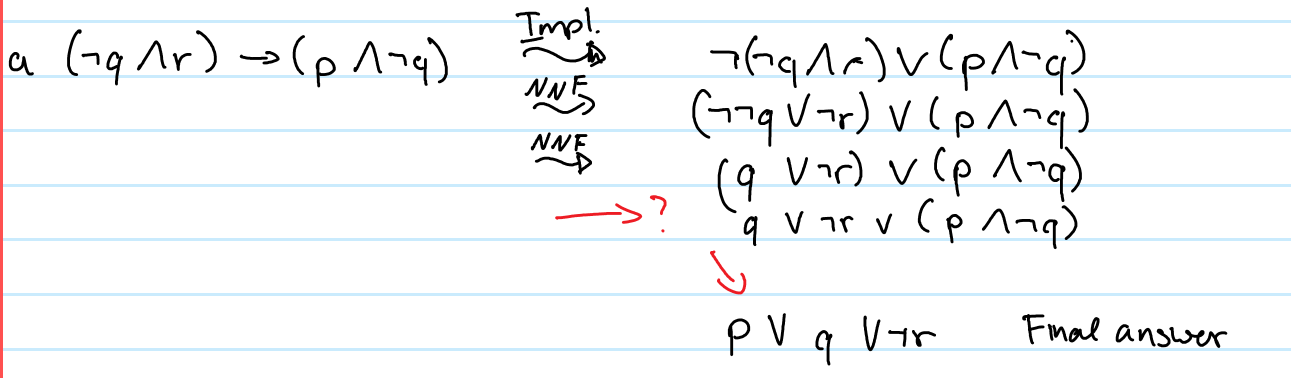
so i have to find the CNF form of (not q and r) implies (p and not q)
through a cnf algorithm but i get stuck from changing it into the last form, I'm unsure where the not q in the last clause goes
 kindred umbra
 light ginkgo
yes ofc
 woeful crag
ty
 coral bramble
uh, i need some help with this problem.
Find the number of non-negative interger solutions to this equation: a + 2b + 10c + 20d = 50
 finite cape
agile citrus
https://i.imgur.com/LMEkyFK.png
finite cape
agile citrus
https://i.imgur.com/LMEkyFK.png
i think this material can help you: http://logic.stanford.edu/intrologic/chapters/chapter_05.html. you should try to use the first distribution rule and then the resolution principle.
agile citrus

i ended up solving it like this
i just had to get to that spot where i could apply distributivity on the A
(p^~q)
agile citrus
finite cape
i think this material can help you: http://logic.stanford.edu/intrologic/chapter...
thank you for the link by the way! it's a good read. This topic is kind of rough because it feels like every place teaches it differently so all the resources online are so different and are hard to google 😓
finite cape
agile citrus
nice!
finite cape
agile citrus
thank you for the link by the way! it's a good read. This topic is kind of rough...
no prob. exactly, i found very hard to discuss it with another people who also learned this topic by themselves due to this difference on the materials online.
agile citrus
this link was great exactly for that reason because it's using the exact same way of notation as my university!
agile citrus
and my university doesn't mention anything about law of absorption 😓
 jagged junco
anyone?
 stray reef
count the edges incident to V1 and the edges incident to V2
those counts must be the same as every edge in G connects a vertex in V1 to a vertex in V2
jagged junco
yes, is it with induction? or I can say it according to some
jagged junco
I know there's theorem A bipartite graph contains no odd cycles
if it has to do with that
jagged junco
stray reef
you know the definition of a d-regular graph, right?
yes, so every degree of each vertex is d
stray reef
yeah.
so there are $\absv{V_1} \cdot d$ edges incident to $V_1$, and there are $\absv{V_2} \cdot d$ edges incident to $V_2$
vital dewBOT
Ann
 jagged junco
I agree
stray reef
every edge is incident to both parts and there are no edges incident to only one or neither part
therefore $|V_1| \cdot d = |V_2| \cdot d$
vital dewBOT
Ann
 jagged junco
stray reef
every edge is incident to both parts and there are no edges incident to only one...
jagged junco
stray reef
every edge is incident to both parts and there are no edges incident to only one...
oh your words made me see it
I understand it now!
thank you 🙂
light ginkgo
jagged junco
anyone?
try contradiction
stray reef
you're a little late
jagged junco
stray reef
you're a little late
haha
light ginkgo
stray reef
you're a little late
👍
jagged junco
light ginkgo
try contradiction
thank you that works too
light ginkgo
cmon are you even trying?
if you have a connected graph on n vertices it must have at least n-1 edges
jagged junco
light ginkgo
if you have a connected graph on n vertices it must have at least n-1 edges
Yea I agree, but it said n is the number of connected graph components
if it is n=1 I understand it the way you said
light ginkgo
it has k components each are connected. Let n_i be the number of vertices in the i-th component for 1<= i< =k. Now for 1<=i<=k the ith component must have at least n_i-1 edges. What happens when you sum from i=1 to k of (n_i -1)?
jagged junco
Oh wow . So we get
sum ( from i=1 to k )(n_i) - k
And then it is |V|-k
but I couldn't think about it if you didn't say it 😭
light ginkgo
you have to spend time thinking about the problems
and solving them yourself
it takes time
jagged junco
yea you're right I guess.. I feel they speed up with the lessons here, like always every other lesson is completely different subject, makes it hard to keep up
thing is I'm glad someone like you helps me to brighten up those weak points because I don't have any teacher to ask only zoom
thank you!
I'll keep trying
light ginkgo
it is tough but you can do it
 pulsar thunder
hello! i need help w/ (c). using the formula, the pattern is it's increasing 1 unit from the previous number starting from 1 (so it's 1,2,3,...) but i don't quite know how to explain if it's valid for all natural numbers n  ...and letter (f) too :((

 limpid fossil
any advice on how to prove the property $\phi(mn) = \phi(m) \phi(n)$ for relatively prime integers m and n?
vital dewBOT
add

 kindred portal
any help appreciated for this one 
 errant bear
er, not really a counterexample my bad, but hmm
kindred portal
it's in the context of a enumeration assignment
the powerset has 31 + null set of possibilities
errant bear
like, 2 subsets of the power set
 tame arrow
how do I find how many terms are in this sequence?

I came up with the equation An = 5(2/5)^n
but I can't figure out how to solve to get the index of the last value
kindred portal
errant bear
like, 2 subsets of the power set
for example in the example they gave
here's the result of all subsets % 31 including empty set

wait proving it's not onto is trivial
because the domain is defined as natural numbers
but %31 only gives 0 - 30
errant bear
uh
kindred portal
2^n - 1
errant bear
by sublist you mean element of the power set
errant bear
and so what is your argument?
kindred portal
so the last line here is all the sum(sublist) % 31
and the ones before it are all the sublists listed
there are repeat values
how are we to prove that there will be repeat results
cause although i can say there are 31 subsets, i can't say their %31 results are going to be consecutive
errant bear
it might be better to have your output list, not in ascending order
so you can see what sublist corresponds to what sum mod 31
 errant bear
what
kindred portal
the pigeon hole principle
the powerset consists of 32 sets right
inclusive of the empty
we have 31 possible values
!!
the pigeon principle states that if you're shoving k objects in m holes where k > m
one such hole must have a number of elements of at least the ceiling of k / m
errant bear
this would work if you allow the empty set to be in the domain which i mean i guess it would
kindred portal
in my course they treat 0 to be an element of natural numbers
¯_(ツ)_/¯
or rather somebody asked a question about whether or not the empty set is a part of it, and the lecturer said yes
so

errant bear
im saying like, this works if you let f({})=0 which is kinda sketchy to me, but i guess its okay
oh i see
then yeah thats fine
kindred portal
i guess it's just my course's convention ahaha
otherwise i see no other way to prove it easily
errant bear
i was trying to php like the 5 elements themselves, but yea its not obv to me
otherwise the answer they want is surely that because they chose mod 31 for that reason

 oblique cove
is 2 element belongs to this set {{2},{{2}}} ?!
stray reef
no
oblique cove
no more sorry
{{∅}} ⊂ {{∅}, {∅}} true or false
gritty crescent
What do you think?
oblique cove
i think it's false @gritty crescent
gritty crescent
Why?
oblique cove
but it would be true if ⊆ not ⊂
because all elements in set A in set B if we say right side is A and left is B
Distinct B
gritty crescent
Interestingly, the set on the right has the same element written twice
So yes, if that's the definition you're using
Then it's false
oblique cove
i asked to make sure i'm understand correctly because who suppose to mark my answers say it's true and don't know the difference between ⊆ and ⊂ from rosen book 😦
gritty crescent
This is a matter of notation really
vital dewBOT
Manan.
 gritty crescent
So check with the notation your book/class uses and go with it
vital dewBOT
Manan.

 last timber
@dark schooner there is an axiom for infinity
it can be stated as
"exists I such that {} is in I and if x is in I then x U {x} is in I"
 hot jacinth
i have a question that may seem totally obvious but i think im missing something right
lets say I have 2 consecutive numbers multiplied, n(n+1). I know you can show its always even because one is even and one is odd so 2k(2k+1) = 4k^2 + 4k which is 2(2k^2 + 2k)
but, to show that n(n+1) is even you cant directly show that it can be written as 2k directly you have to go through the fact all numbers are either even or odd
why is this only possible for divisibility by 2
or rather, lets say im trying to show divisibility by 7
if i cant show directly that its divisible by 7 by writing it as 7k, what am i to do?
theres no "even - odd" version for divisibility by 7
obtuse lance
there is, it's just there are more
we call these residue classes, they're described by their remainder when you divide by 7
for instance just like n(n+1) is even you can say n(n+1)(n+2)(n+3)(n+4)(n+5)(n+6) is also divisible by 7
also probably depending on your question, there's fermat's little theorem
if n is not divisible by 7 then n^6 - 1 is divisible by 7
more generally, if n is not divisible by the prime p, then n^(p-1) - 1 is divisible by p
this is part of #elementary-number-theory and modular arithmetic @hot jacinth
hot jacinth
Oh interesting
So if you have some expression f(x) you are trying to show is divisible by some number n, then it is not guaranteed that it can be written in the form n*g(x)?
Im in this room cuz this was in my discrete math book 😅
obtuse lance
you can sure
I guess maybe it depends what you mean by that form
I'd say n(n+1) = 2*(n(n+1)/2) is of that form
since we can safely say n(n+1)/2 is an integer
in fact we can say it's a binomial coefficient n choose 2
and even better, the binomial coefficients form a basis for all rational polynomials that are integer valued at all integers you plug in
so idk, that's pretty good I guess, you can even represent other things like exponentials this way too
hot jacinth
Ah wow ok that makes perfect sense. Thank you very much!
hot jacinth
obtuse lance
and even better, the binomial coefficients form a basis for all rational polynom...
So ive thought about this a lot. How would I take any polynomial and write it as the basis of binomials? @obtuse lance
 dark schooner
last timber
it can be stated as
"exists I such that {} is in I and if x is in I then x U {x...
dark schooner
last timber
it can be stated as
"exists I such that {} is in I and if x is in I then x U {x...
I don’t understand.
Basically I just wanna know if u could create an infinite set via successive addition (n+1) or whether the elements of an infinite set are actualised simultaneously?
 pine spire
anyone know how to negate the statement "If today is Thursday, then we meet for class"?
 red nest
Today is thursday and we don’t meet for class
red nest
(P or Q)and(not(P and Q))
 red nest
What have you tried
light ginkgo
pine spire
i need help with this problem too
Cmon TRY
red nest
pine spire
damn you gotta mention me when replying
Nice
 feral osprey
What does the uppercase pi means?
 obtuse lance
means product
the p|n means what we take the product over
we only look at the primes p that divide n
and multiply 1-1/p together
for instance phi(12) = 12 * (1-1/2) * (1-1/3) since the only primes that divide 12 are 2 and 3
feral osprey
Thanks
obtuse lance
you're welcome
 unreal stump
Try showing (n k)<=(n k+1) for k<n/2-1
Consider (n k+1)/(n k) and do some manipulations to show it's >=1
 tranquil flint
Hey guys for the pigeon hole principle, the statement is if there are n>m pigeons being fit into m holes than at least 1 hole as more than 1 pigeon
right
but everytime i think about it, im like why cant we fit all the pigeons into 1 hole
i mean unless the statement requires each hole be filled
i dont get the intuitive nature of the theorem
Like if there are more people in london than max hairs on the human head
tranquil flint
then 2 ppl have same amount of hair
Oh
LMFAO jesus christ ok i am so dumb
...
coral raven
don't sweat it
tranquil flint
havent slept in 24 😭
unreal stump
Why is (n/2+1)/k > n/2+1?
You could just do if n/2>=k
Then ((n/2)+1)/k=(n/2)/k +1/k>1
 smoky kiln
How would I write this sum out as a double sum in ( i ) and ( j )? ( \sum\limits_{ \substack{ i , j \geq 0 \ i + j \leq n } } a_{ij} )
vital dewBOT
g_ijoe
 pale epoch
$\sum_{i=0}^n\sum_{j=0}^{n-i}a_{ij}$ should work?
vital dewBOT
Lochverstärker
 smoky kiln
ok it makes sense, thanks
weary tiger
how can I show a tree with even number of edges has a vertex of even degree?
if I assume all deg(v) are odd then I can conclude there are even number of vertices but idk what next
probably that forces a cycle but idk
obtuse lance
doesn't every tree have a vertex of odd degree, not just ones with an even number of edges?
weary tiger
sorry homie I meant even
obtuse lance
two formulas come to mind
for a tree |V| = |E| + 1
and generally speaking,
$\sum_{v \in V} \deg(v) = 2 |E|$
vital dewBOT
Merosity
 obtuse lance
so |E| being even means |V| is odd
now assume deg(v) is odd for all v
so you're summing an odd number of odd numbers and getting an even number
that's the contradiction
weary tiger
obtuse lance
so |E| being even means |V| is odd
wait why
obtuse lance
obtuse lance
for a tree |V| = |E| + 1
this one
weary tiger
oh from the first one
obtuse lance
yup
weary tiger
how come I didnt know about this formula hmm
pale epoch
how did you define tree?
pale epoch
yes
weary tiger
- you can go from any vertex to any other
pale epoch
you can use that formula to define tree (in the finite case)
and depending on what you used, its more or less easy to prove
(so maybe its part of the exercise)
weary tiger
maybe ye ill try to prove it
hot jacinth
In class today this proof for the inverse of f o g being f' o g' assuming f and g are bijections was shown today
This particular one i sourced from stackexchange but it was basically the same
 weary tiger
obtuse lance
for a tree |V| = |E| + 1
weary tiger
obtuse lance
for a tree |V| = |E| + 1
ok ez induction
hot jacinth
But i think im a bit slow today because I have no idea how this shows that the (f o g)' is f' o g'... lol
could someone walk me through it? thank you in advance 🙂
pale epoch
i don't think there is more one can say about this other than the first line
obtuse lance
looks like you're not even reading it because the inverse has f and g inverse reversed
hot jacinth
doesnt this imply the order doesnt matter?
obtuse lance
no
think of g as putting on socks and f as putting on shoes
f o g means you put on socks then shoes since it starts right to left
then you take off your shoes then take off your socks in reverse order, not take off your socks before your shoes
hot jacinth
Ok, with you so far
So in that first line when they move the brackets
thats not changing the order, just the grouping
?
obtuse lance
the brackets aren't super meaningful because function composition is associative
hot jacinth
Wait wait
ok at the risk of embarassing myself
doesnt associative mean that the order doesnt matter?
weary tiger
associative means it doesnt matter where you put the parentheses, so like x(yz)=(xy)z
hot jacinth
Oh im thinking of commutative then
weary tiger
yes
hot jacinth
OK then back to the inverse of the composite is the composite of the inverses proof
Maybe Im just confused because i dont see someting like (f o g)' = ... = ... = I and then f' o g' = ... = .. = I
instead there is g o f o f' o g'
unless
OOOOHHH nevermind
i see
sorry 😅
weary tiger

it says "write down the variance" which kinda implies its trivial
but it's not trivial right unless im missing something?
light ginkgo
Yea finding the variance isnt trivial
I dont really think theyre trying to say its trivial thogh
pale epoch
what's n and m?
light ginkgo
pale epoch
what's n and m?
What
pale epoch
someone redacted a question
weary tiger
light ginkgo
I dont really think theyre trying to say its trivial thogh
ah thanks
obtuse lance
weary tiger
how come I didnt know about this formula hmm
just came to mind, a more general perspective on the formula for trees earlier is to use euler's formula |F|-|E|+|V|=2 since a tree can be thought of as having just 1 face, so |F|=1 recovers the formula
light ginkgo
number 5

 lilac delta
can somebody explain why this is considered Anti-symmetric?
 stray reef
antisymmetry isnt a matter of consideration, its a matter of being
why don't you tell us what's making you cast doubt on this relation's antisymmetry?
feral osprey
Can an Order of an object withing a group exist only when the objects be desribed by another object to the power?
feral osprey
oh, thanks @light ginkgo
We studied order using the order of an object via his power to become the identity object
Just wanted to understand it accurately
light ginkgo
Im not really sure what your asking can you restate it?
feral osprey
can an object of a group have it's order described not via it's power to the function the group is assigned?
(G,*,e) g belongs to G
can o(g)=n be described not by g^n=e?
coral raven
how can something not be described by a definition of the thing
light ginkgo
Im sure there are other ways to describe it but it isnt really useful to do so.
lilac delta
stray reef
why don't you tell us what's making you cast doubt on this relation's antisymmet...
is it antisymmetric because it doesn't include {1,3}?
lilac delta
yeah, thanks.
 pure harbor
If i have a nth order linear recurrence eq, im thinking it always have n linindep solutions? But how would you prove this
nvm i think i got it
FTA and then do some rearranging
unreal stump
You can convert a homogenous linear reccurence into a ODE
So,Your problem gets reduced to solving an ODE
pure harbor
thanks, ill look up that
unreal stump
See exponential generating functions
weary tiger
Hi, I am a little confused on this question. I tried drawing a graph representation of the relations but, I'm a little lost on the information given and how they relate.
Could any one help walk me through it?

 tardy remnant
 forest lodge
Is {1, 2, 3} a subset of {2}
I know
{2} is a subset of {1,2,3}
pale epoch
{1, 2, 3} is not a subset of {2}, since for example 1 is an element of the former but not of the latter
forest lodge
Ty!
 hasty glade

 feral osprey
yes
It's a theorem that for each prime that is the product of n you calculate n(1-1/p) for each prime?
obtuse lance
sort of
that's more like describing how to compute phi(n)
which is called euler's totient function
but euler's theorem is if gcd(a,n)=1 then $a^{\varphi(n)}=1 \mod n$
vital dewBOT
Merosity
 obtuse lance
it's a kind of generalization of fermat's little theorem
vital dewBOT
Nightchanger
 obtuse lance
sure, it's more like if gcd(a,n) is not 1 then you end up with a divisor of n
like take n=4 and a=2
1=3 mod phi(4) but 2^1 != 2^3 mod 4
feral osprey
feral osprey
How do I prove?
so how does it relate to my op?
obtuse lance
vital dew
**Merosity**
knowing this is the key to answering it
you can think of 1 as being a^0, so you can think of stuff living in the exponents as mod phi(n) arithmetic
feral osprey
I see thanks
obtuse lance
you're welcome
weary tiger
Hi, in the context of binary relations; when we examine them to see if they are symmetric, reflexive, or transitive, these are traits that we look for after the relation is established correct? Not something that we are trying to create when relating two sets?
For example if I am given some relation, I would have to logically determine if they have any of those traits?
lament zenith
I believe so, if you have a relationship between two sets and have drawn this out. You look at if they're symmetric, reflective or transitive. If not they're the opposite or neither. For example a graph can be either me symmetric, anti-symmetric or neither.
lament zenith
weary tiger
For example if I am given some relation, I would have to logically determine if ...
Yes
weary tiger
Right, I was just pondering that and couldn't fully grasp it until now.
lament zenith
Do you have the example of the relation
Because I'm not to sure if I've mixed something up with binary relations
ok dw
weary tiger
I am referring to binary relations
lament zenith
Yeah, just wanted to double check if I'm not talking about some other topic about it
weary tiger
but nah, no example just thinking about it broadly is all, now I am understanding previous questions/my final coming up
nahh I think we are thinking of the exact same thing lol
thanks for taking the time to chat about it
 loud sonnet
Let $n,k$ be positive integers with $k<n$, then consider the process where a person flips a coin and stops if they get exactly $k$ consecutive heads, or if they get to flip it $n$ times (what happens first). Then, how many ways can this happen?
lament zenith
Glad i could help!*
vital dewBOT
MisterSystem
 loud sonnet
I was trying to solve this using generating functions somehow
and studying the case where k=2
But nothing so far
*whatever happens first,
 dense garnet
hi, does anyone know about binary tree here? ive got a few questions to ask
stray reef
ask your questions
dense garnet
so im tryna figure out why im not getting this array
the question asks you to pre order the binary first
i so pre ordered it
from this
(9,5,8,13,20,1,12,22,15)
to this
(9,5,1,8,13,12,20,15,22)
then the question asks you to read the binary in reverse post order
so im expected to get this
(9,12,15,22,5,13,1,20,8)
however, idk what step im missing here
i keep getting different answers regardless of using all the methods available
i dont how it goes from 22 to 5 and back to 13
 stray reef
eh?
wait
the problem gives you a binary tree and asks you to do things with it, yes?
dense garnet
no its sorta like a challenge question
it asks you draw a binary tree using pre order
stray reef
okay can you show the question in full, exactly as it is stated
i want to see the exact wording of the question
i have a strong feeling there's some details you're not mentioning that may be important
dense garnet
aite hang on a sec

its about decrypting a message
im quite new to the topic but im assuming each alphabet can be represented in the order of numbering?
like A equals to 1
B equals to 2
stray reef
each letter
and uh
i don't see why you would need to replace them with numbers, really...
dense garnet
haha i guess thats just my way of understanding
stray reef
let me try
dense garnet
but im quite stuck on inverting them
been researching and still found no clues so now im finally questioning that i may have done sth wrong
stray reef
i mean ok first off
there is no requirement anywhere that the nodes of a binary tree should always be numbers
they can hold any kind of data you like
dense garnet
oh i see
stray reef
anyway, i'm going to try and reconstruct the tree rn
stray reef
yeah this is what the tree ends up as
 dense garnet
oh thats entirely different...
stray reef
the first nodes i placed are the i (root), h (leftmost) and o (rightmost)
then i worked from there
there are now two ways to get the reverse post-order reading:
either read it in post-order and then write what you get backwards,
or read it in pre-order except taking right before left
dense garnet
aite lemme pre order it first
is it i, e, h, m, t, a, l, v, o
for the pre order part
stray reef
that is an l, not a c
but other than that, yes, of course the preorder is iehtamlvo. the problem gives you that!
and i made use of it
stray reef
this is incorrect
in a post-order the root should come at the very end
you got the e subtree right though.
stray reef
as i said,
you got the
esubtree right
stray reef
you got the first five characters right in your postorder
dense garnet
ohhhh
stray reef
the postorder is htamevoli
dense garnet
omg ;-;
why am i so dumb
oh wow now that makes sense why ive been getting wrong answers
i constructed a wrong tree in the first place
stray reef
yes, your tree was wrong
dense garnet
lemme try with the other one
but omg again you're a life saver
thank you so much for helping ;-;
 weary tiger
@north stone please stop dming me to do your exams
 north stone
ok troll
weary tiger
your name is durag phil thats cultural appropriation man
north stone
<@&268886789983436800> can somebody do something about this blabbering troll?!?!?
errant bear

north stone
😋
gritty crescent
weary tiger
<@!216012128623001602> please stop dming me to do your exams
Can you share message details through ModMail?
north stone
crime report subject #5000B-4
ember obsidian
did you seriously accept money to do someone else's exam?
weary tiger
thats not what i said
i said i have never been paid to do an exam before
it still stands true
gritty crescent
Can you cut if off regardless?
weary tiger
i am going to report them to their dean
gritty crescent

 gusty ermine
hello im just wondering can someone explain why AxB is only these 4 elements?
 ember obsidian
ask asked above, please send details of your exchange with phil to @graceful condor
weary tiger
what details needed
there is private information that i dont feel comfortable sharing
gusty ermine
why only (0,2) (1,9) (3,2) and (0,9). what happened to (1,2) (9,2) (1,6) and the others?
gritty crescent
A screenshot of concerned messages with their username would suffice
weary tiger
gusty ermine
why only (0,2) (1,9) (3,2) and (0,9). what happened to (1,2) (9,2) (1,6) and the...
nvm i think theyre just giving you a general example
gusty ermine
weary tiger
nvm i think theyre just giving you a general example
then wheres (0,6)?
gritty crescent
If you're not going to substantiate your claims, I don't think there's anything we can do.
gritty crescent
Do that if you deem necessary, but refusing to let us know about the details yet continuing to complain about it is making us suspicious of you as well.
I strongly recommend sending a screenshot of concerned messages to ModMail. You can block out parts of the text you find private/confidential other than usernames.
gusty ermine
^i do agree
weary tiger
i told you if you send me your test i will report you
gritty crescent
gusty ermine
why only (0,2) (1,9) (3,2) and (0,9). what happened to (1,2) (9,2) (1,6) and the...
A function is a special subset of A×B, where each element of the first set(domain, here A) is mapped to a unique element in the second set(codomain, here B). Since (0,2) is already in f, you can't have (0,anything else) as well.
north stone
@ing me in every server
weary tiger
we only have 1 mutual server and its mathematics??
you dm'd me first asking abt your stupid calc 3 test
gritty crescent
Alright, since neither of you is willing to cooperate, I find no choice other than muting you both.
gusty ermine
gritty crescent
A function is a special subset of A×B, where each element of the first set(domai...
so is there a particular reason 0,2 is first? Like when creating the subset do u need to go from left to right?
so say like its A = {1,2,3} and B = {4,5}
would u map something like
F = { (1,4), (2,5)}?
cause what i dont understand is 0 appears twice in the f = (0,2) and (0,9)
and then 2 appears twice as the 2nd value as (0,2) and (3,2)
gritty crescent
No, that was just an example. You could have (0,6) too, the important thing is:
- Everything in A must be mapped to something
- The element being mapped to should be unique
gritty crescent
gusty ermine
and then 2 appears twice as the 2nd value as (0,2) and (3,2)
This is acceptable for a function
In fact, all the elements can map to the same thing in the codomain
For your sets A and B, {(1,4),(2,4)} is not a function since it doesn't include any pair with 3. {(1,4),(2,4),(2,5),(3,5)} is not a function since 2 is being mapped to two elements.
gusty ermine
gritty crescent
For your sets A and B, {(1,4),(2,4)} is not a function since it doesn't include ...
oh so in order to get a function u need the same amount of elements in the first set and the second?
gritty crescent
That would be incorrect, since some elements could get mapped twice at the cost of another element not getting mapped at all
As I said
Every element in the domain should be mapped to something
And that "something" should be unique
Let me draw a picture to clarify this visually
gusty ermine
ok so, everything in x needs to map to a y, and the y needs to be unique?
gritty crescent
Yep!
Do notice that two different x can map to the same y
But the same x can't map to two different y
And every x must be mapped to some y
gusty ermine
oh ok
so like does that mean the f in the question isnt what A->B is equal to
like A->B isnt a operation/function (multiple divide etc)
gritty crescent
It is an operation in a sense, but a "unary" operation(an operation that works on a single input value), as opposed to "binary" operations like addition, multiplication, etc.
gusty ermine
its just given as the question to be those 4 different sets?
hm but like
couldnt i make my f something like (0,9) (1,2) (9,6) (3,2)
like theres a bunch of combinations that i could map all x to y and make sense the same x isnt mapped to 2 different y
gritty crescent
Sure
gusty ermine
hm i see
gritty crescent
All of them are functions from A to B
gusty ermine
man i was so confused i thought it was like matrix multiplication or something
and then couldnt find any pattern in f's elements
gritty crescent
Here's a pictorial way to think about it: everything in A has an arrow going out of it, but no more than one either. Two different values in A can have arrows pointing to the same thing in B.
 gusty ermine
gritty crescent
Here's a pictorial way to think about it: everything in A has an arrow going out...
gusty ermine
gritty crescent
Here's a pictorial way to think about it: everything in A has an arrow going out...
right yea that clears stuff up
but u could have 2 mapped to 6
gritty crescent
Sure
gusty ermine
it would still be a function
gritty crescent
Yeppp
gusty ermine
and everything could be mapped to 5
and still funciton
but u cant have A = 1 and A = 2 mapped to 1 B value
gritty crescent
(A function where every x maps to a different y is called an injective/one-one function)
gritty crescent
gusty ermine
but u cant have A = 1 and A = 2 mapped to 1 B value
That's...what my image clarifies? XD f(1)=f(2)=5 there
gritty crescent
gusty ermine
thank you very much manan
No worries; goodluck!


 lofty cloudBOT
From
Rule 4
If your question has not been answered for a minimum of 15 minutes, you may use the Helpers tag once. Please do not try to bump your question using this ping unnecessarily. Do not abuse this ping. Do not individually ping users with the Helpers tag without their express permission.
light ginkgo
 candid musk
Can someone help me with this ? 😫
candid musk
Can someone help me with this ? 😫
what is S geometrically
candid musk
Its a set
light ginkgo
geometrically
candid musk
Not really mentioned 
light ginkgo
yes you have to think about it lol
candid musk
Yeah I guess lol
light ginkgo
why dont you draw the interval and fix some values for a and b and see what the set S looks like and compute sup S and inf S for that specific case of S. Then try to see if you can generalize it
candid musk
I don't have much idea cuz we are taught this new
and I wasn't able to get this kind of Problems
light ginkgo
ok for a=0 and b = 1 what is S?
light ginkgo
ok now what is sup of (0,1) and inf of (0,1)
candid musk
Like how, Can u show some working regarding?
light ginkgo
you know b is an upper bound so show that if c < b then c is not an upper bound
a is a lower bound show if a<c then c is not a lowerbound
candid musk
Hmm