#discrete-math
1 messages · Page 170 of 1
 coral raven
 sleek swallow
Are you seriously going to call people names now?
coral raven
not ==
 tawdry edge
dude....
the variable m
what ever it is
is the modulus
you get it from the modulus
coral raven
no it's not, but ok
coral raven
so your problem is with the idea that you can multiply m by c?
tawdry edge
you derive those formulas directly from the statement a == b (mod m)
coral raven
no
sleek swallow
This person is trolling
tawdry edge
You people are helpess
tawdry edge
I'm not... you legit lack such a fundamental conception of language or math that you cannot explain yourselves.... at best all I see is regurgitation
 mint bane
bruh
 errant bear
what is a hommie
tawdry edge
Let $a = b (mod(m))$. And, $c = d (mod(m))$. Then, $ac = bd (mod(m))$.
 vital dewBOT
MaggyD
 coral raven
maggy please stop
tawdry edge
How do prove this?
errant bear
you multiply by c
coral raven
i feel like the first two are right but the third is wrong?
sleek swallow
Doesn't actually want to learn shit. He says we're wrong without really saying why we're wrong lmao
mint bane
p l e a s e
tawdry edge
I don't know how to convey to you that I'm not trolling.... however, I will admit that I was sincerely flummoxed
errant bear
im trolling too
mint bane
i thought so as well but why
coral raven
ok so you have that the non-t letters can be anything, 25^7
and that the t can only be one thing, 1^1
tawdry edge
I'm done debating, because my position was a matter of semantics on the previous question... I understand how you derived the proof, I just don't like it personally how that conclusion is made from the premise. That is my person issue to resolve.
coral raven
oh ok
but anyway
so you have the different things that it could be
all the letters
but how many positions can the t be in?
mint bane
yeah any position
coral raven
so how do you account for it being in any position
mint bane
^8
coral raven
no
coral raven
ok so imagine you had an 8-letter word with a t to begin with
and then 7 non-t letters
there would be 25^7 words, right?
mint bane
yeah
coral raven
or well strings
ok but the t could also be the second letter, not the first
and that would be another 25^7 letters
all of which are different
mint bane
but it's not 26^7 either is it
coral raven
to those where the t is first
no, it's not
so you have 25^7 strings
for each position of t
how many positions can t take
coral raven
yes
coral raven
have a go
mint bane
i think d is 7!
coral raven
not quite, how did you get there
 weak shuttle
@weary tiger when you write a permutation in loops it's like a Concatenation of functions that feed from right to left
mint bane
P(26,7)
coral raven
that sounds more like it
wait
no
ah you gotta be careful
it's not 26 specifically
because what do you know about those 7 letters
 weary tiger
weak shuttle
<@456226577798135808> when you write a permutation in loops it's like a Concaten...
weary tiger
weak shuttle
<@456226577798135808> when you write a permutation in loops it's like a Concaten...
I get that part. How do I read it though? '4 is the new number 1' or '1 is the new 4' or are both wrong?
mint bane
would the last one be 5 * 26C4
mint bane
t can be anywhere in the set
coral raven
ok
mint bane
need to pick the remaining 4 from any 26 letters
coral raven
4??
weak shuttle
@weary tiger the image of 1 is 4, the image of 4 is 8
weary tiger
weak shuttle
<@456226577798135808> the image of 1 is 4, the image of 4 is 8
Okay, ngl im not getting it. I'm gonna do some examples and come back
I appreciate it 🙂
mint bane
order doesnt matter
coral raven
doesn't it?
coral raven
i mean since it's repeats
mint bane
8 *26^7...?
coral raven
yeah that looks good
and now i think 4
back to 4, whoops, i slipped up
d
there should not be P
mint bane
why not
mint bane
so it is a permutation
mint bane
but then why cant e be a C
mint bane
yeah but cant choose also work with repeats
coral raven
not really
weak shuttle
@weary tiger every loop in lin 3 is a permutation and function by itself. Now delta is the concatenation of these functions. so delta(4) is (27)4 which is like Identity(4) which is 4. then (14)4 is 1. then (18)1 is 8 but 8 doesn't appear in the next loops so they apply to 8 like the Identity so delta(4) is 8
mint bane
wynaut
coral raven
without repeats, how many ways to choose 2 sweet flavours from 2 sweet flavours?
2C2 = 2!/2!0! = 1
with repeats, how many ways to choose 2 sweet flavours from 2 sweet flavours?
2^2 = 4
coral raven
np
tawdry edge
1543x == 1 [mod 1847]
how?
it says tip: use the euclidean algo
but I am, I don't see how I can solve for x...
 naive gulch
tawdry edge
1543x == 1 [mod 1847]
naive gulch
tawdry edge
1543x == 1 [mod 1847]
Are you familiar with Euclidian Algorithm and backwards substitution? Like where are you getting stuck with Euclids alg.
Also for the pigeonhole principle

I know we're using [N/ k] but I'm not too familiar with where
We have seven integers and we need to prove two pairs of them both = 11
But our goal isn't to show that [N/ k] = 11 right?
tawdry edge
Backwards substitution?
weary tiger
weak shuttle
<@456226577798135808> every loop in lin 3 is a permutation and function by itsel...
Ive been pulling my hair out. Im sure this isn't meant to be this confusing..
I'll come back here after some sleep
 burnt frost
hi can anyone give me an example of two functions f and g that have these properties:
- f is not surjective
- g is not injective
- g o f is bijective
and explain why
 steel jacinth
not sure brodie
coral raven
burnt frost
hi can anyone give me an example of two functions f and g that have these proper...
when i read g o f is bijective i immediately just want to be lazy and make g o f = x
does that help? @burnt frost
weary tiger
I suggest f: {1} → {1,2} and g: {1,2} → {1} defined in whichever way you wish
whichever of the two ways you can define them, lol
Can someone help me with this problem?

 unreal stump
Should be O(x^2),O(x!) and O(x log(x))
weary tiger
Why would it be those?
unreal stump
O(xlogx) is clear,right?
weary tiger
yea
unreal stump
now logx< x for x>=10(there's a lower x but this works)
so x log x < x^2 for x>=10
now that function < c x log x for some c
Which means function < c x^2
for all x>= x_0 for some x_0
weary tiger
ohh okay thank you
unreal stump
Similarly for O(x!)
 uncut matrix
https://i.imgur.com/I8p21Bf.png
why would {a, i} ∈ C be considered false here?

are elements a and i not both in C?
unreal stump
{a,i} is very different from a and i
unreal stump
{a,i} refers to a set containing a and i
uncut matrix
so it would want C = { (a, i)} for it to be true?
unreal stump
Think of it as a different object
For instance if C={{a,i},e,u} we say C contains {a,i}
Because you can pick out an element and match it with {a,i} to conclude they are same
unreal stump
Yes
uncut matrix
meanwhile if you had something like A ⊆ B, you would interpret whether each element within A exists in B
unreal stump
Yes
uncut matrix
This was really the fundamental understanding that I lacked
thanks so much for clarifying it
gonna redo all these problems and give it another go
 lapis idol
How can we find the total number of solutions to a + 18b + 24c + 48d + 120e + 240f = 240. I know how to solve these type of questions if the coefficients are 1. Any help is appreciated, thanks!
lapis idol
nonnegative integers
 stray reef
uh huh
you can do this through generating functions
or through some clever simplifications that may reduce the number of variables or make the coefficients smaller
lapis idol
I tried to use generating functions at first but I'm not sure what n would represent
I let F(x) = (1 + ...x^240)(1+...x^13)(1+...x^10)(1+...x^5)(1+...x^2)(1+x)/(1-x)^6
stray reef

you want the coefficient of $x^{240}$ in $$\frac{1}{(1-x)(1-x^{18})(1-x^{24})(1-x^{48})(1-x^{120})(1-x^{240})}$$ i think
vital dewBOT
Ann
 lapis idol
I'm a little lost. Can you please explain why it would be that?
Does it have to do with multiples of each coefficient?
stray reef
yes
uncut matrix
Sorry, does anybody know what B ∈ P(A) would be false for:
https://i.imgur.com/I8p21Bf.png
P(A) = {∅, {∅}, {∅, {∅}}, {∅, {∅, {∅}}}} if I'm not mistaken
wouldn't B = {∅, {∅}} be the third element in P(A)
sleek swallow
Nope
that third element should be the set containing the set containing \varnothing and {\varnothing}
To keep things simple, let $\varnothing = 0$ and let ${\varnothing,{\varnothing}} = 1$. Then, $A = {0,1}$. So:
$$\mathcal{P}(A) = {\varnothing,{0},{1},{0,1}}$$
vital dewBOT
Abhijeet
 sleek swallow
Nope. 1 is an element of A. {1} is a subset of A
Sure and the power set of A is the set of subsets of A. 1 is an element of A, so {1} is a subset of A
sleek swallow
@uncut matrix
As Buncho Drunk just said, B is just 1, in my notation. So, you can see that B cannot be an element of P(A)
sleek swallow
You're welcome
uncut matrix
I should get into the habit of setting a larger set into a simple letter notation so I'm less likely to make errors & can just substitute the values into it after
good tip!
sleek swallow
Indeed, it's especially useful when you have complicated looking things and you're not sure if you're missing braces here or there
lapis idol
stray reef
yes
Thanks a lot! I got it now 🙂
uncut matrix
man I keep getting confused
this entire problem set is just a mess for m
https://i.imgur.com/I8p21Bf.png For this:
(∅, ∅) ∈ A x B = True
and ... {(∅, ∅)} ⊂ B X A = True
So, the reasoning for the first one is that:
A x B computes to {(∅, ∅), ...} so there certainly exists a (∅, ∅) in A x B
It is different from the other case for which B = ∅, {∅}, and P(A) = {∅, {∅}, {∅, {∅}, {∅, {∅}}}, where the third element of P(A) = {∅, {∅}} ... so essentially if we let B = 1, then the third element of P(A) = {1} and 1 is not equal to {1}
For the second one, since it's a proper subset, we test(?) individual elements of ∅ within a bracket, and since ∅ and ∅ can be found in at least one element in B X A = {(∅, ∅), ... },
it is true?
sleek swallow
Try just using substitutions. Let $\varnothing = 0$, ${\varnothing} = 1$ and ${\varnothing, {\varnothing}} = 2$. Then:
$$A = {0,2}$$
$$B = {0,1}$$
$$A \times B = {(0,0),(0,1),(2,0),(2,1)}$$
$$B \times A = {(0,0),(0,2),(1,0),(2,0)}$$
Now, you want to know if $(0,0) \in A \times B$. That's certainly true. Moreover, it is certainly true that $(0,0) \in B \times A$ so ${(0,0)} \subseteq B \times A$.
vital dewBOT
Abhijeet
 sleek swallow
@uncut matrix
uncut matrix
thanks again
I'm trying to wrap my head across this but I'm always getting mixed up somehow
sleek swallow
Perhaps a break is in order
uncut matrix
for instance, there's another question which says (∅, ∅) ⊆ A x B is false
sleek swallow
Well, there is a difference between (0,0) and {(0,0)}
These are not the same objects
uncut matrix
wait, scratch that, I think I understand this one - it's false because even if you take ∅, there are no elements of ∅ in A x B, only objects of some bracket combination ()
but yeah I'm more or less just confused by when the brackets appear and when they don't
sleek swallow
You'll figure it out soon enough 
uncut matrix

for reference here were all the questions lol
https://i.imgur.com/mqxH9rm.png
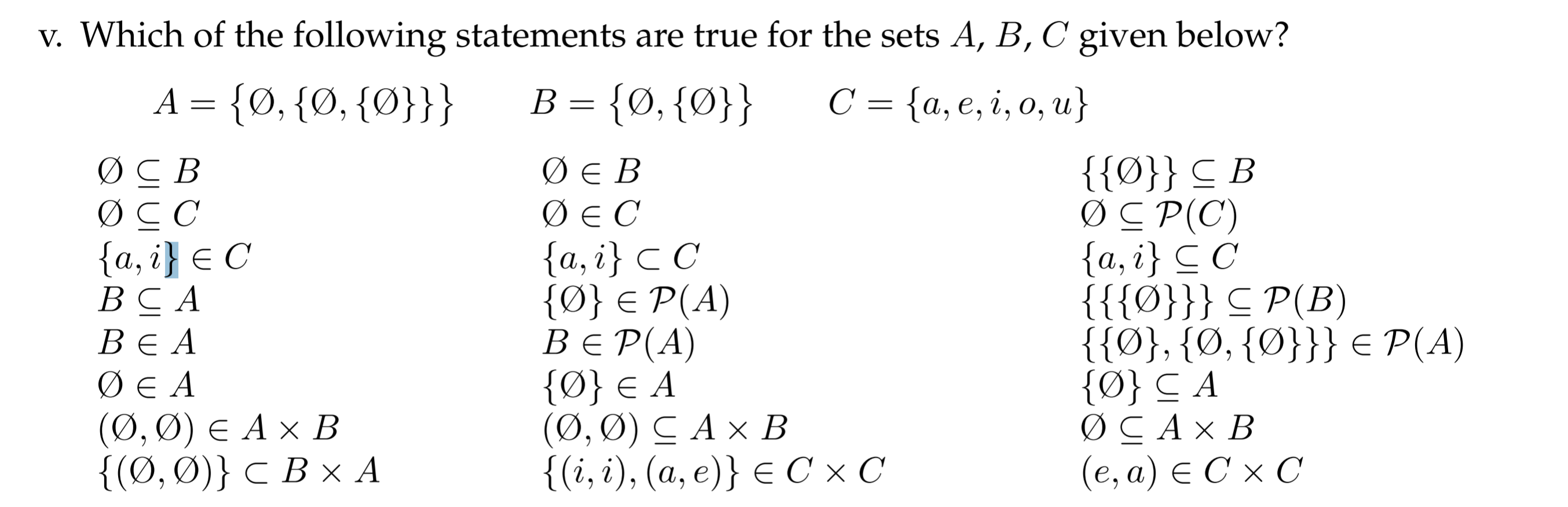
man ...
for {∅} is an element of A
For ∅ = 0, {∅, {∅}} = 1, A = {0, 1}
Then {∅} = {0} and since A only contains 0, and 1, it is false?
thanks for helping me again and again by the way
despite how hopeless I am at this lol
not gonna sleep until I give all the remaining ones a shot
will try to substitute as much as possible
sleek swallow
You should rest
There is no sense in banging your head against the wall when you're bummed out by the work you're doing
You can try again when you have rested
uncut matrix
alright, I guess I'll go to sleep
this is really just too confusing
thank you for taking your time to help me today
sleek swallow
You're welcome
 exotic shadow
Can anybodey help with these?
 weary tiger
exotic shadow
Can anybodey help with these?
weary tiger
exotic shadow
Can anybodey help with these?
For 1) What does it mean for a graph to have no cut edges?
Also if it asks to prove this for every integer k, the first thing to try is induction I guess
For 2) observe that an odd cycle cannot be bipartite
So if a a bipartite graph has a subgraph which is not bipartite this contradicts pretty obviously the fact that the graph is bipartite
exotic shadow
weary tiger
For 1) What does it mean for a graph to have no cut edges?
Like this. As far as I understand
 stray reef
say G is a 2k-regular graph, so every vertex has degree 2k
imagine you have an edge which, when cut out, makes the graph fall apart into two components
(connected components to be more precise)
within each component, one vertex has degree 2k-1 (the one incident to the cut edge) and the rest have degree 2k
so we have a graph with a single odd-degree vertex
which is impossible
 dense sapphire
Did anyone struggle with recurrence relations and generating functions and then get it? What was key? Rosen is not helpful, and MIT's 6.042 is losing me as well. are there any videos or anything you watched that helped
weary tiger
can implications, i.e. -> or <-> be used in an algebraic style proof regarding sets?
 weary tiger
So for instance the statement (C ⊆ (B − A)) → (A ∩ C = ∅)
in an algebraic style proof can I say
C subset (B-A)) -> (B-A) intersect C = C
not for the proof but like is it valid
is it "algebraic"
then to culminate different implications to show that they then imply the result
 proud birch
would there be a difference among these 2 sentences?

 lament quiver
you can draw this as a picture
*try to
that's terrible advice but it will show you something
proud birch
ohh okay, I just thought they were the same sentence just different ordering lol
lament quiver
yeah they're not
weary tiger
proud birch
would there be a difference among these 2 sentences?
E = there exists
upside down A looking thing means for every
the C with the line in the middle means "x IN N", and N is the set of all natural numbers
weary tiger
proud birch
would there be a difference among these 2 sentences?
so it means
- For every x in N, there exists a y in N such that x < y.
- There exists a y in N, that for every x in N, such that x<y.
If you need more help it would probably be good to look up the difference between existential and universal statements
proud birch
weary tiger
so it means
1. For every x in N, there exists a y in N such that x < y.
2. There...
thank you king
weary tiger
@proud birch but yeah the universal quantifier (upside down A) and existential quantifer (backwards E) mean very different things and can result in substantially different claims as well as the difficulty of proving said claims. I.e., every British person is stupid, or there exists a british person who is stupid, the latter can be easily proven, the former cannot
weary tiger
proud birch
thank you king
Likewise when disproving a statement, you have to basically use the other quantifier, i.e. to disprove the statement
Every British person is dumb
You simply have to show there exists a single British person who is not dumb
However for the statement
There exists a British person who is dumb
To disprove this
You have to either
- Exhaust every British person showing they are not dumb
or 2. Show that it is not possible for a single British person to be dumb by traits of a generic particular where the particular is a British citizen
proud birch
i see, that makes the notation very much more clearer
weary tiger
proud birch
i see, that makes the notation very much more clearer
I forgot to add that the latter part of my message was about DISPROVING a statement
 balmy hornet
How many bitstrings of length less than n are there? in my notes i have "there are 2^𝑛 bitstrings of length n." so would but be 2^n-1?
 proven garnet
balmy hornet
How many bitstrings of length less than n are there? in my notes i have "there a...
proven garnet
balmy hornet
How many bitstrings of length less than n are there? in my notes i have "there a...
If a(n) denotes the number of bit strings of length n. You want a(1) + a(2) + ... a(n-1)
which is $$2 +2^2 + \ldots 2^{n-1} $$ and that's a standard sum of a geometric series
vital dewBOT
andreO
 sleek swallow
You forgot about the empty string
proven garnet
depends on convention if we wanna include it or not
balmy hornet
wait im confused. i dont know what you mean by the inclusion of empty string. so them 2^n-1 is correct in the seme that it is the typcial formula?
proven garnet
The sum comes out to $2^{n}-2$
vital dewBOT
andreO
 proven garnet
If we wanna consider the empty string (which i don't think we should in this case), you just gotta add 1 to it to get $2^n - 1$
vital dewBOT
andreO
 uncut matrix
https://i.imgur.com/kH5F80J.png
Can anybody explain these three please?
(∅, ∅) ∈ A x B
{(∅, ∅)} ⊂ B x A
(∅, ∅) ⊆ A x B
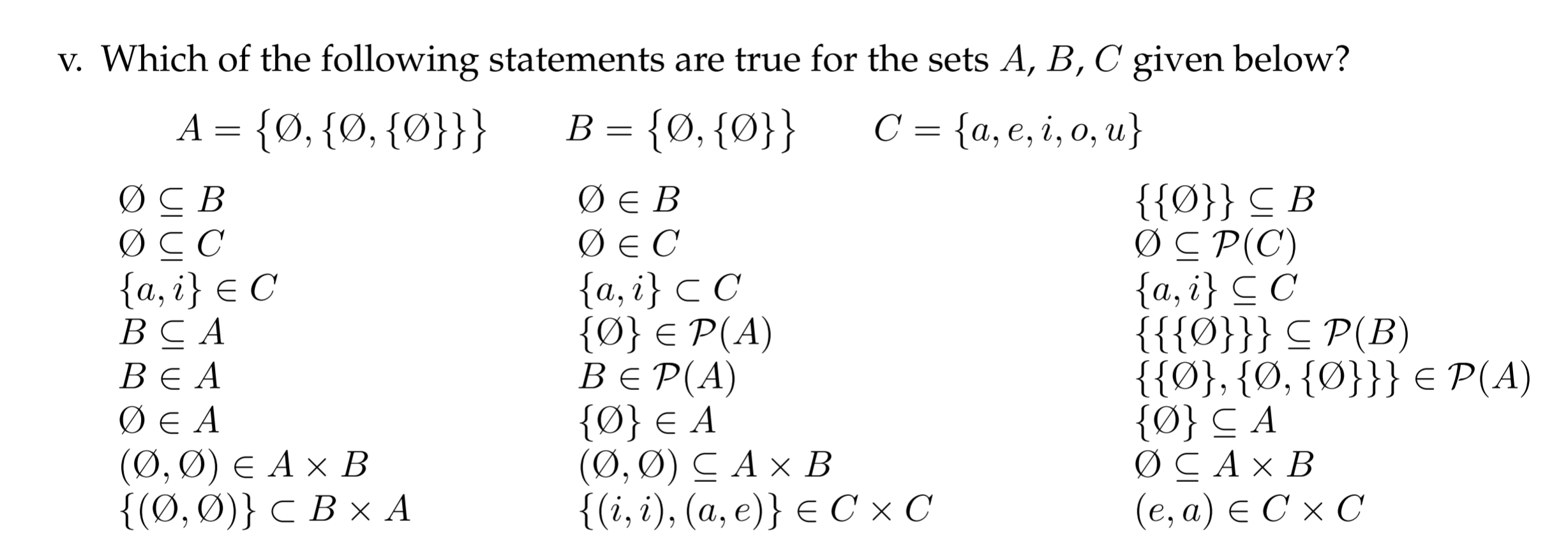
I'm just terribly confused and have been for a few days now
uncut matrix
basically, yes
I'm starting cs soon and discrete'll come in second semester
don't want it to kick my ass so I'm doing questions for it in advance
haven't honestly struggled in it that much (even with basic proofs) until this one collection of questions idk
errant bear
i mean i wouldnt worry about this problem. literally ur never gonna need to deal with stuff as convoluted as this
uncut matrix
I mean it's going to be really shitty if it comes up on a final and I'm not able to solve it
errant bear
i mean, are you able to deal with AxB, where lets say A={1,2,3}, and B={4,5,5}?
you dont need to worry about nested empty sets
uncut matrix
yeah ofc
errant bear
yea i mean, i doubt your prof is gonna be a dick and give you problems like these
uncut matrix
it's when they nest proofs that it becomes some clusterfuck
errant bear
i wouldnt worry ab these imo
uncut matrix
I mean this is in the problem set though
errant bear
i mean, if you want, the first one you asked is true
errant bear
wdym problem set. is this from the class? which you're taking next year/sem?
errant bear
how do you have the exact questions
uncut matrix
I found the class site by googling online
it's from like 2019 iirc and all the problem sets were on it
uncut matrix
yeah, some guy earlier taught me about when you examine whether something belongs in a set, you look at it as a whole
so since (∅, ∅) exists as the first element in A x B, (∅, ∅) ∈ A x B is true
the other ones really confuse me though
with subsets/strict subsets you are apparently suppose to look at whether each element in the set exists or not
uncut matrix
true
uncut matrix
next one looks at B x A which is {(∅, ∅), (∅, {∅, {∅}}), ({∅}, ∅) and ({∅}, {∅, {∅}})}
so seeing if {(∅, ∅)} is a strict subset of that
for subsets/strict subsets im suppose to see if all the elements in the set exist in another (and then that one other condition for strict subsets)
wait
errant bear

uncut matrix
yeah so the issue is with {(∅, ∅)}
I don't know how to break it down to elements and compare it to elements of B x A
would it just be ∅?
or would it be treated as (∅, ∅) because of the { }
my intuition is telling me the latter but
intuition
errant bear
what is/are the element(s) of {(∅, ∅)}
uncut matrix
oh, it's just (∅, ∅)
errant bear
yes that is the only element
uncut matrix
it's not ∅ because there's no non-nested ∅ in the set
so since B x A contains one element that's (∅, ∅) and not all elements of B x A exist in {(∅, ∅)} it's true that {(∅, ∅)} ⊂ B x A?
errant bear
yes
uncut matrix
idk, it's just written in the problem set
errant bear
wait
uncut matrix
I'm assuming its {∅, ∅} essentially
uncut matrix
which is just {∅} yeah
idk maybe the prof decided to write it as (∅, ∅) to fuck with people
uncut matrix
errant bear
stop messing me up u nerd 
coral raven
look it's not as if it were on purpose
errant bear
lol okay ignore the past 10 messages carry on beyond
uncut matrix
so could I consider (∅, ∅) as just {∅}?
uncut matrix
so just treat it as one element I'd find from the cartesian product?
I guess that makes sense since (∅, ∅) belongs in A x B but
next one is (∅, ∅) ⊆ A x B
A x B = {(∅, ∅), (∅, {∅}), ({∅, {∅}}, ∅), ({∅, {∅}}, {∅})}
since I'm trying to test whether (∅, ∅) is a subset of A x B, I need to examine whether each element existing in (∅, ∅) also exists in A x B
if I were to consider (∅, ∅) as a set(???), then I would look for whether ∅ exists in A x B
A x B only has nested elements, so ∅ does not exist
therefore false?
errant bear
hmm
coral raven
none of that is true
coral raven
uncut matrix
since I'm trying to test whether (∅, ∅) is a subset of A x B, I need to examine ...
starting here, all of the below is false
errant bear
phi is a set, you you cant take the interval im p sure
coral raven
it's a cartesian product element
like (1, 1) in R^2
to test whether (∅, ∅) is a subset of A x B, you test whether ∅ is in A and whether ∅ is in B
if both are true, it's in AxB
uncut matrix
so since A = {∅, {∅, {∅}}) and B = {∅, {∅}} it's true?
since ∅ does exist in A and B
coral raven
yes
uncut matrix
answers say otherwise though 
https://i.imgur.com/WLTIiuN.png
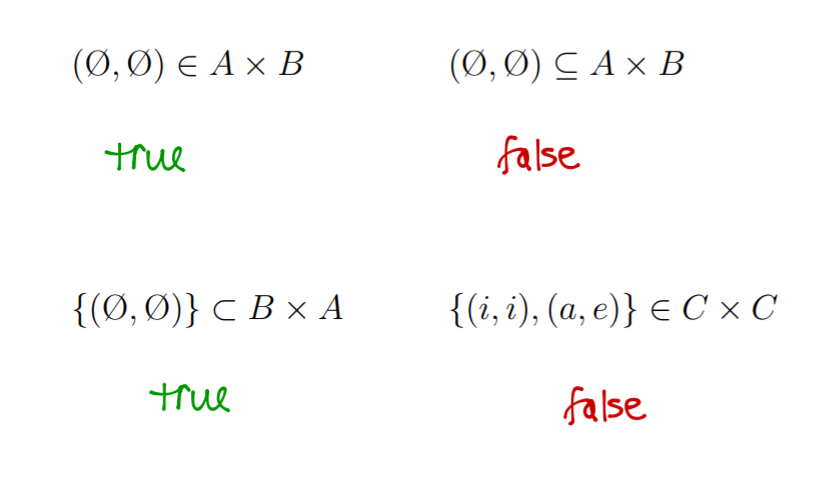 uncut matrix
gotta love it when they just write this crap without any explanation
errant bear
what. but its not a set
coral raven
they are different things
errant bear
kaish ur trolling
errant bear
(∅, ∅) ⊆ A x B is the statement we r on
errant bear
...yes
errant bear
i am everyone
uncut matrix
so it just doesn't exist because you can't access its elements because its not a set?
o
coral raven
it's not a set, so it's not a subset, so that top right thing is false
uncut matrix
okay
uhmm I might have a few more questions but these 3 were def the big ones
but yeah, thanks a bunch for clarifying everything
coral raven
ok cool
uncut matrix
one sec
next one I was wondering about concerns:
{{∅}, {∅, {∅}}} ∈ P(A)
with A = {∅, {∅, {∅}} so
im getting confused so I'm gonna use substitution to calculate the power set
let 0 = ∅ and 1 = {∅, {∅}}
errant bear
okay
uncut matrix
then P(A) = {0, {0}, {1}, {0, 1}}
P(A) = {∅, {∅}, {{∅, {∅}}}, {∅, {∅, {∅}}}}
errant bear
ok
uncut matrix
P(A) has the following elements:
∅, {∅}, {{∅, {∅}}}, {∅, {∅, {∅}}}
but does not contain {{∅}, {∅, {∅}}}, so it's false?
errant bear
ye
uncut matrix
damn, think I'm finally starting to get it
🙏
alright last one ... seems pretty simple but
∅ ⊆ A x B
for A x B = {(∅, ∅), (∅, {∅}), ({∅, {∅}}, ∅), ({∅, {∅}}, {∅})} as calculated earlier
∅ isn't a set, so it cannot be a subset
therefore false
wait im stupid
∅ is technically {} is it not?
then it could be a subset potentially
I still think it's false because A x B only contains nested elements and is not empty
coral raven
yes
 carmine grove
Someone just randomly sent this and went away.. what the hell does this mean and which channel do I even put this thing to ask this question

I'm just curious
uncut matrix
man, thanks so much again for everything you two
 violet kayak
@carmine grove maybe it's me lacking mathematical knowledge, but I honestly think it was a shitpost instead of something serious
nothing seems to be coherent in it
 still wagon
i agree
 jolly saffron
What book would you recommend for getting started in graph theory(from mathematical perspective)?
And what to read next?
carmine grove
violet kayak
<@325869773063716879> maybe it's me lacking mathematical knowledge, but I honest...
Oh LOL okay
 urban saddle
I have this ecuation $a + b + c +d = 12$ and I want to see how many no negative integers are solutions
vital dewBOT
Jackieto
 weary tiger
urban saddle
I have this ecuation $a + b + c +d = 12$ and I want to see how many no negative ...
weary tiger
urban saddle
I have this ecuation $a + b + c +d = 12$ and I want to see how many no negative ...
HINT: Use a binomial coefficient related to an unordered selection with repetition
Assuming that a,b,c and d are all non-negative integers
 spare matrix
I don't know where to ask this, but: Is it typical to denote the rational numbers by $\mathbb{R}_0$?
vital dewBOT
veryhappyperson
 spare matrix
I always thought you would call them $\mathbb{Q}$, but this might be some local thing.
vital dewBOT
veryhappyperson
 weary tiger
No its not typical
In fact I dont think anyone uses it
Maybe they justify it somehow but seems weird
proven garnet
urban saddle
I have this ecuation $a + b + c +d = 12$ and I want to see how many no negative ...
You want non-negative integer solutions to $$a + b + c + d = 12$$

This is the same as permuting

12  $*$'s  and 3 $|$'s  ( $|$ are separators indicating which variable they belong to)

Example possible configuration: $**|***|*|******$
corresponds to $a =2, b=3, c=1, d=6$


In general, if you wanna find the non-negative integers solutions to
$$a_1 + \ldots + a_r = n $$
it's the same as permuting $n$ $*$'s and $(r-1)$ $|$'s. That's the number of permutations of $n$ things of one kind and $r-1$ things of a second kind and is given by $${n + r -1 \choose r-1}$$

In your case, we have $n =12$ and $r = 4$
$$----------------$$

The number of non-negative integer solutions of
$$a_1 + \ldots + a_r = n$$ is also the same as the coefficient of $t^n$ in $$(1 + t +t^2 + \ldots) (1 + t +t^2 + \ldots)(1 + t +t^2 + \ldots)\ldots (1 + t +t^2 + \ldots) \text{ ($r$ times) }$$
$$= (1-t)^{-r} $$
andreO
 weary tiger

If S and T are both finite and non-disjoint, i don't think 1) is well defined. Shouldn't it be disjoint union instead?
weary tiger
weary tiger
If S and T are both finite and non-disjoint, i don't think 1) is well defined. S...
This is correct
See Inclusion-Exclusion Principle
naive gulch

Could someone give some pointers here? We have N and k, is our goal [N, k] = 11?
Err, are the N objects the integers, and the k boxes the "possible" pairs out of seven integers?
weary tiger
Not sure what that notation is but it seems simple to me to prove this by grouping pairs of integers that sum to 11 together
There will be 5 pairs, so if you choose 7 numbers total, you’ll have to have chosen both numbers in some two pairs
naive gulch
Gotcha let me try that
 weary tiger
When taking mathematical notes by the book, do you include examples?
stray reef
if you find it helpful, go for it
weary tiger
But is it practical thing to do?
 weary tiger
Onto means that the codomain = image of the function
 lilac delta
how did they get -1 from +1
weary tiger
For any y in the codomain Z, there exists an x in the domain such that
y = x+1
equivalently
x = y - 1
What is not clear about it?
 near prawn
ur missing info
weary tiger
We're trying to help you. But are you sure you know what's the definition of an onto map?
lilac delta
yep
sleek swallow
What is the domain/codomain of your function?
@lilac delta This is going to affect whether it is onto or not.
lilac delta
the set of all integers
sleek swallow
For both, yes? Okay, so you have:
$$f: \bZ \to \bZ$$
$$n \mapsto f(n) = n^3$$
Now, let $y \in \bZ$. If you agree that $y^{\frac{1}{3}}$ is defined for any integer $y$, then you must ask yourself if $y^{\frac{1}{3}}$ is an integer for every $y$ or not.
vital dewBOT
Abhijeet

 sleek swallow
?
sleek swallow
You're jumping around
weary tiger
lilac delta
is it one - to - one?
A graph is one to one (injective) if every horizontal line in R^2 cuts the graph at most one
 eternal roost
Could anyone help me with this one, thinking its A but not sure e

 neon frost

This is bipartite right? I'm not really sure how the K and M points affect it
if at all
weary tiger
neon frost
This is bipartite right? I'm not really sure how the K and M points affect it
They don't affect the bipartition of the graph since the definition is related to edges
This graph isn't bipartite
neon frost
Are NO and PJL not the two groups I can make to show it's bipartite though?
 vernal linden
Hey!
I have this question: "There is a function f: N -> N, prove that the function is surjective if and only if every two infinite and different sets A, B subsets of N exists f-1[A] /= f-1[B]. ( Sorry for not using tex )
I managed to prove the first part of the proof and that is to suppose f is surjective and prove that f-1[A] /= f-1[B], but I can't prove the other way around, I'm having trouble with that, can anyone point me to the right direction?
 untold raptor
is it possable to get from [ p(y) → s(x) ] ∧ [ s(𝑥) → p(y) ] to [ p(y) → s(x) ]

 clever sage
well I mean by definition a-b should also be in the ring R if a,b are elements of the ring
 edgy vine

A is an affine room. u vector and ub a point. What is the subtraction meant to be here?
Like I know affine rooms have defined addition: point+vector = point, so I would understand the subtraction to also be a point. And a norm of a point is just irritating me.
Or can I view ub as a point which is very close to the point the arrow would show, if it was set from the (0,0,0)+u
 plucky thunder
a tautology means that it is always true right?
 fallen vigil
yah
 quasi quest
 unreal stump
How do the games work
quasi quest
Is this question incomplete?
quasi quest
unreal stump
How do the games work
Thats all the info provided
unreal stump
Yea,feels incomplete
 flat harness
I'm assuming you have a knowledge given any pair of them, who beat the other
and it need not be transitive
that's my guess, @quasi quest
then a cycle of length m would be a chain m-long such that person i bears person i+1, yet person m beats person 1
these are all of my guesses
so for all of them to form a cycle, means the existence of a cycle of length n
otherwise I think you can do some partitioning using cycles, but play around with it
quasi quest
Thanks!
flat harness
go ahead and ping me individually if you need more assistance
or helpers. either way I will get it
one thing to consider could be given some person, look at the set of participants reachable by a downward chain from that person
 mystic moss
I think you can do a proof by contradiction
I.e. if there is no such partition, then there must be a cycle
weary tiger
clever sage
well I mean by definition a-b should also be in the ring R if a,b are elements o...
S is not a ring in general
still wagon
it's okay because that's exactly asking S to be an additive subgroup of R ?
i'm saying that the condition you added
is exactly asking S to be an additive subgroup

weary tiger
this is from a book recommended by this server lol
still wagon
which one ? @weary tiger
weary tiger
still wagon
which one ? <@456226577798135808> <:thonk:597510924533891075>
Advanced Linear Algebra (Steve Roman)
still wagon
in which chapter ?
 tawdry edge

I don't understand the first question, are they asking the total combination of participants or the orientations of juniors and seniors allowed possible in a committee?
 median mica
tawdry edge
I don't understand the first question, are they asking the total combination of ...
median mica
tawdry edge
I don't understand the first question, are they asking the total combination of ...
I believe total, so either only juniors or seniors, or both
tawdry edge
is this a n choose k problem or would it just be a permutation of n=10?
median mica
median mica
how come H is a forest here?
any thoughts on this @wary scarab ?
 wary scarab
median mica
any thoughts on this <@!613427039827001576> ?
wary scarab
median mica
any thoughts on this <@!613427039827001576> ?
A forest is an undirected graph in which any two vertices are connected by at most one path. H satisfies this property right?
median mica
yes it does
wary scarab
Hence it's a forest
median mica
it is a tree to be specific, but since all forest are trees, then it is a forest
as you said
cool
thank you
wary scarab
tawdry edge
how did you come up with the that equation <@!613427039827001576>
How would you solve it given it's a combination problem
tawdry edge
Well, why couldn't it be 100 choose10?
wary scarab
Oh yeah it is indeed that
I thought you were meant to use vandermonde's identity because of which i wrote it like that
naive gulch
Are questions ongoing or can I pop in?
tawdry edge
I don't believe we were ever taught that...
I just find the question to be equivocal
like the permutation of a committee with seniors and juniors? Or like out of the pool, how many combinations of the committee irrespective of class?
Seriously... fuck these problems
wary scarab
When the question says choose you don't need to think of permutations.
tawdry edge

There is no way this is true...
unless I'm misunderstanding the LHS expression
because for base case 1 you do not get 7 = 7
tawdry edge
woah... hold up
why are you insinuating that you don't need to apply the full LHS summation?
coral raven
it's ..., it's informal
tawdry edge
why do the 7 + 5 + 3 just disappear
coral raven
it's just understood that that's what meant
tawdry edge
...
coral raven
like technically you could go all sigma
but i don't think ppl like sigma, easier to see when it's term 1, term 2, term 3, dot dot dot
even if it's not gonna have a term 2 or 3 or so on if it's only n = 1
tawdry edge
ellipsis also means "something happens between , or a continuation of the pattern before"
so I don't understand how you can derive a universal interpretation of this problem
it is equivocal
coral raven
sure, but i don't think it's easily misunderstood, perhaps i'm wrong
tawdry edge
Well, to me it is misunderstood
coral raven
i think most people here would understand it fine but again it's subjective
tawdry edge
because when you define a recursive expression... sometimes you use ellipsis to denote that you start at some number then summation happens then you end up at nk or whatever
so it is stupid
coral raven
it's a little stupid, but it's understandable so idrc
it's a little stupid, but it's understandable so idrc
tawdry edge
I guess... maybe I'm pedantic but this shit makes me unwilling to solve the problem
Like why even do this
coral raven
bruh
it makes it easier for you to see the pattern
would you actually prefer the sigma
i know i wouldn't
wary scarab
For the base case n=1 so the lhs is 9-2=7 so it's just the first term
 tawdry edge
You don't need sigma G
naive gulch
I understand that if set E has 3 elements and set F has 1, then p(E) = 3/4, and p(F) = 1/4, from the examples I've seen
coral raven
tawdry edge
You don't need sigma G
so what would you do
tawdry edge
Actually, if this is a summation of the expression (9-2n) through n - 1
then it is even more stupid
that they didn't use SIgma
coral raven
?
tawdry edge
FUck this problme
tawdry edge
exactly!
coral raven
it's just notation
tawdry edge
It is the most stupid thing ever
coral raven
it's not
tawdry edge
how am I supposed to derive that
tawdry edge
derive, yes...
coral raven
i just completely do not understand why you have a problem with this
i do not get it
tawdry edge
given a signal / sign, you must interpret and derive meaning
this expression on the LHS IS EQUIVOCAL
coral raven
oh my gods
wary scarab
naive gulch
Regarding probability, shouldn't p(E) + p(F) for separate events = 1?
Iif E=complement of F or vice versa
naive gulch
Ah hm
coral raven
tawdry edge
this expression on the LHS IS EQUIVOCAL
i just don't see the point in getting worked up over an expression being not a hundred percent rigorous if the meaning is clear
means to an end
tawdry edge
Homie... it is obviously an intentional equivocation on behalf of my professor is induce confusion that is unneeded.
It is one of those, "tricks" used in pedagogy that serve absolutely no pragmatic utility besides creating confusion for the sake of complexity.
If you don't have an issue with that, you allow pedagogy to be a dissipated waste of time
wary scarab
naive gulch
Do you understand how to do this?
naive gulch
Yikes, lowkey sounds like you're starting to pull out words out of thesaurus
naive gulch
wary scarab
Do you understand how to do this?
Sorta, trying to work out the logic rn
wary scarab
Ok
tawdry edge
@naive gulch Ehhh, sorry my diction isn't the same as yours
coral raven
tawdry edge
Homie... it is obviously an intentional equivocation on behalf of my professor i...
i have to say that i think you are objectively wrong if you think that anyone did this to cause confusion on purpose. i believe that it would be perfectly clear to most people and that you simply hadn't run into this before
i don't think talking about this further will be helpful especially given that ppl are trying to do maths here
naive gulch
For the latter portion, since 0.8 * 0.6 = 0.48 where p(e)p(f) = p(e intersection f), that satisfies the p(E intersection F) >= 0.4 right?
tawdry edge
Yeah, I changed it to summation and now I can solve the problem... what a wondrous thing
wary scarab
naive gulch
For the latter portion, since 0.8 * 0.6 = 0.48 where p(e)p(f) = p(e intersection...
The formula you wrote is valid only if e and f are independent
They could be dependent
naive gulch
Ah true shoot I forgot that only applied for independent events
wary scarab
P(E intersection F)=1-P((E intersection F)^c)
Try to use de Morgan's law now
c is the complement
tawdry edge
Does anyone know the rule for sigma summation ?
Like when you have
n + 1 for your "top part"
so you can separate out the +1 and just get n sigma plus something?
naive gulch
wary scarab
P(E intersection F)=1-P((E intersection F)^c)
Try to use de Morgan's law now
Ah ok thanks let me try that!
wary scarab
tawdry edge
so you can separate out the +1 and just get n sigma plus something?
n sigma plus the (n+1)th term
naive gulch
tawdry edge
<@!194987049848143873> Ehhh, sorry my diction isn't the same as yours
I mean, isn't it kind of ironic you're annoyed at the unneeded complexity of the problem when you could've used like five words to say the above message 
tawdry edge
Well, if you wish the speak for me, could you tell me what those 5 words are and how they would be equivalent to what I said in my message? @naive gulch
Unlike Math, rhetoric is relative and more abstract, sorry
dense sapphire
How is this done
 neon frost
Hello! I have a problem. We were given that the number of cycles of length 4 in an n-dimentional hypercube is n(n-1)2^(n-3) where n is greater than or equal to 2 and we must prove this by induction.
I've tried writing out the adjacency matrices for Q2 and Q3 as their entries can be used to determine the number of paths of length 4, but I'm not sure how to relate paths to cycles so I gave up on that.
Then I found out that the number of edges in a n-dimentional hypercube is equal to the sum of the entries in the nth row of Pascal's triangle which is crazy but I haven't been able to do anything other than find where the n(n-1)2^(n-3) formula comes from.
The only answer I've found online (here: https://math.stackexchange.com/questions/431472/number-of-cycles-of-length-4-in-the-n-cube) requires splitting up the hypercube into smaller cubes? No idea what this means or how to do it. If someone could either help me find another way or explain what it means to break a hypercube into other cubes I would be very grateful.

Mathematics Stack Exchange
How would I do this problem? I know that I have to consider pair of strings that differ in exactly 2 positions, but I am stuck beyond this.
proven garnet
neon frost
Hello! I have a problem. We were given that the number of cycles of length 4 in ...
Consider the $3$ -cube. We can represent it with vertices $(x_1, x_2, x_3)$ where $x_i \in {0,1 }$. A way to split this cube into two $2$ - cubes would be to consider the cube with vertices where $x_3=0$ and the one with $x_3=1$.
You can do this for any $n$-cube by considering sub-cubes where the last co-ordinate is $0$ and the one with last co-ordinate $1$.
vital dewBOT
andreO


 wraith parcel
Saw the question up there earlier and wanted to check with yall if my proof by induction is correct.
 proven garnet
wraith parcel
Saw the question up there earlier and wanted to check with yall if my proof by i...
proven garnet
wraith parcel
Saw the question up there earlier and wanted to check with yall if my proof by i...
You're not really making use of the induction hypothesis
For $n = a+1$, you could do
$$\sum_{k=1}^{a+1}(9-2k) = \sum_{k=1}^{a}(9-2k) + (9-2a-2)$$
$$= -a^2 + 8a + (9 - 2a -2)  \text{ (using the induction hypothesis) }$$
$$= -a^2 -2a-1  + 8(a+1)  $$
$$= -(a+1)^2 + 8(a+1) $$
andreO
 proven garnet
yup
proven garnet
np
 remote cape
I was wondering how FFT is used in the Schoenhage strassen algorithm, does anyone have an idea on how that works?
remote cape

 jolly ridge
But isn't radix a sorting method and not a searching?
You have two lists A and B.
A is an unsorted list, whereas, B is sorted.
Given ′𝑋′ a number input by the user, you need to determine whether or not 𝑋 is present in A and B.
In how many ways can I do this?
How is radix searchdifferent from binary search?
@stray reef
stray reef
i don't have the energy to explain it right now, you can look it up
jolly ridge
stray reef
i don't have the energy to explain it right now, you can look it up
Just one question, isn't radix a sorting method and not a searching one
jolly ridge
Other than Binary search, which else method can you use for searching a sorted list?
weary tiger
there are infinitely many ways to search do it. most of them are extremely inneficient tho.
 slow jewel
Any ideas guys
 mystic moss
Check each element 100 times to make sure the array isn’t trolling you 😌
mystic moss
slow jewel
Any ideas guys
Also you can start with the subgraph of just the neighborhood of the largest degree vertex and see what happens as you add vertices to complete the tree
 slow jewel
I used the idea that if its a tree it must have n-1 edges. Starting with the degree(n-1) we get n-1 leafs and decreasing the degree each time for v_1 say, decreases the number of edges connected to v_1. Since the number of edges it fixed (n-1) and the fact the T cannot form a cycle. Then this produces another leaf. Hence L<=D
@mystic moss
mystic moss
slow jewel
I used the idea that if its a tree it must have n-1 edges. Starting with the deg...
Wdym “produces another leaf”? It’s possible that it just replaces another leaf
Otherwise the number of leaves would stay n-1 no matter the tree
 mint shore
ok so i'm having a bit of a brain fart right now
A shop sells 5 types of sodas. If one was to buy 8 cans of soda, how many possible purchases would there be?
it's probably with C(n,k)
but man, brain stuck
wary scarab
Every can has 5 soda types to choose from
 quick folio
umm
wary scarab
5^8
quick folio
ummmm no?
wary scarab
what is it then?
quick folio
8^5
mint shore
seems a little high
quick folio
do u have the answer?
mint shore
nope
mint shore
i have these formulae though
 quick folio
yep
so look
8 cans of soda
first can can be any 5
second can can be any 5
....
mint shore
so C(5, 1) makes sense
quick folio
no
wary scarab
quick folio
last can can be any 5
You should multiply 5 8 times duh
quick folio
5C1 means that you are not allowed repetitions
mint shore
true
mint shore
but wait
mint shore
if it's 8^5 for 8 cans, for 1 can it would be 1^5 which would be 1
quick folio
pls forgive me
mint shore
yea 5^8 makes more sense
mint shore
nice
quick folio
can u help me with this qtn now
 wary scarab
yeah what's containment relation
mint shore
what's the relation between the 2 sets?
mint shore
oh ok
quick folio
or equivalence too
mint shore
ok so
think about i)
what does that set have in it?
not talking about ranges
what do you apply U on
you have f(a) U f(b) right
on the one side you combine f(a) with f(b), on the other you combine a with b
so you have to think about what those Us will return to you
think functions
quick folio
they will return sets?
mint shore
yes
but what do those sets have in them
let me help a bit
f(a) holds the output of f for every value in a
whereas a alone is the set that goes as input in f
quick folio
f(a) or f(b) will return a collection of sets
f(a or b ) will return same collection of sets
let x in a and y in b, f(a) = a1 and f(b) = b1
f(a or b) = {a1,b1}
f(a) or f(b) = {a1,b1}
so its equivalent
is that right approach
mint shore
ok so suppose
f's domain is {1,2} and range is {3,4}
if i wrote that correctly
so let A = {1} and B = {2}
this isn't a solution, just for testing to get a feel for what we're being asked to prove
ok so with some mock values it is correct
f(a or b) = {a1,b1}
@quick folio i think this part of your solution is what you need to explain a bit
f(a) or f(b) = {a1,b1}
this works
because of your hypothesis
now if you can get the other equation using some smart moves, you're set
quick folio
uhh
a is an arbitrary element in A
which maps to a1
same with b
like how u said dom is {1,2}
say a = 1 and b = 2
mint shore

come to think of it my little thought is a little wrong
because it has to do with what info you're given regarding f
quick folio
like what
if A and B are disjoint sets
f(a) or f(b) will give out lets say image S
a and b are like elements of A and B
f(a or b)
will spit out S as well?
because the subset a or b is mapped to S by f as well?
mint shore
disjoint = no common element?
 weary tiger
I was here to ask about my question lol.
weary tiger
What is your problem about.
quick folio
set theory

i cant imagine it
or prove it idk why reee
@weary tiger
whats ur qtn
ill tru urs
weary tiger
Well f(A and B) is in f(A) and f(B)
quick folio
yeah how is that the case
 shadow pond
Hey guys, could you help me with this problem: https://gyazo.com/b7a1b0ef2d0a53c65c824f134828b13b

I was thinking of using induction, but I didn't really get to the answer
quick folio
can u send the whole qtn
shadow pond
oh that is the whole question
the others are just other parts
i was thinknig maybe inclusion exclusion
but that only applies for union not intersection
quick folio
it is the inclusion exclusion
shadow pond
how so?
I don't see the application
|A ∪ B| = |A| + |B| – |A ∩ B|
isn't this inclusion exclusion ^
 weary tiger
@quick folio Okay right one is in left one.
weary tiger
$x \in f(A \cap B) \implies f^{-1}(x) \in A \cap B \implies f^{-1}(x) \in A $ and $ f^{-1}(x) \in B \implies x \in f(A) $and $x \in f(B)$
vital dewBOT
Godel
 quick folio
yessir
quick folio
Kinda
quick folio
u need to do the inclusion and exclusion on a bigger set
sec
thats why i said
send the whole qtn
.>
 quick folio
-2n??
shouldnt it be 3k-N
?
cause when m = 3 ur universal set cardinality is N
so >= 3k-N
so its mk-N
shadow pond
ooh yeah
shadow pond
i see
mint shore
does anyone know any type of solver for mod equations?

this type
i just want to find some way to verify whether my solution is right or not
shadow pond
quick folio
for induction u need to use A and B
for part b, with three sets I end up getting n >= 3k + |x1 ∩x2∩x3| - |x2∩x3| - |x1∩x2| - |x1∩x3|
but now i'm stuck on making this expression mk-n
because how do i deal w/ the other three interseciotns


 vital dewBOT
Lochverstärker

 valid wave
thank you
wait wouldnt most of these be true
oh wait
im confused
so were taking the power set of a the intersection of b
then comparing it to the power set of the intersection of a and b
arent these the same things in all cases
 pale epoch
that's the question lmao
valid wave
So all of this is true
I’m saying isn’t this a dumb question then
It’s just rewording it
Unless I’m missing something
valid wave
could you elaborate
pale epoch
also not all of them are true