#discrete-math
1 messages · Page 153 of 1
 agile lava
 stray reef
a relaxed k-coloring is a k-coloring where you don't require that all edges connect vertices of different colors
rather, the number of good edges (i.e. edges connecting different colors) is now an objective function to be maximized
agile lava
so, what I think is, since there's 4 colors, the probability for a good edge (both ends have different colors) are 1-4C1/4C1*4C1=3/4
I could see the number 3/4 showing here but how to link to the final answer
stray reef
assign every edge a score of 1 if it's good and 0 if it's bad
the expected score of each edge is 3/4
therefore the expected number of good edges is 3/4 |E|
and max good edges is obviously ≤ |E|
agile lava
I see, thanks a lot
 potent oracle
agile lava
potent oracle
agile lava
arithmetric sequence, B
potent oracle
Wa...I actually got that right
potent oracle
 light path
if this is a quiz you probably shouldn't be asking for help
potent oracle
Shouldn't be but it's the only hope I have left :c
light path
life doesn't end when you fail a test
potent oracle
For me it does. It's the only course I don't understand and I need it to get the scholarship
 unreal stump

light path
there are a limited number of scholarships
if you didnt study enough you shouldnt take it from someone who did
potent oracle
there are a limited number of scholarships
@light path
I don't blame you for being oblivious as it is I. I'm not taking from someone who did. If you knew the disposition of the college it would be much different in perception
I never cheat so this is a new low...I shouldn't and you're right
 coral raven
woah, wicked deja vu just now
light path
I'm glad you made that decision
 near prawn
damn, character development
 pale epoch
redemption arc
unreal stump
What about the 2nd betrayal arc?
 errant bear
top 5 anime comebacks
potent oracle
🤣 it was something
 rugged pebble
can someone help me with transitive closure
for this relation {(a,a), (a,c), (b,a), (c,a), (a,1), (1,2)}
i got this {(b,c), (c,1), (b,1), (a,2), (b,2), (c,2)} but idk if its right
 silk coyote
Are there some good techniques to get the closed form for a recursive function?
Like tips I should know?
unreal stump
Generating functions exist
silk coyote
Thanks for the info
rugged pebble
@unreal stump do you think you can help me?
 weary tiger
hi. would a kind sole please write out the way to solve this kind of problem:
like these ones
what is an efficient and easy to understand way of solving this?
i can solve regular modular arithmetic and systems of equations in modular arithmetic, just not sure about his kind of questions
please ping me if answering. thank you
 bronze cosmos
lol sid i would use a calculator for problems like those
euler’s theorem doesn’t help at all
the best method i know of is to write e in binary and calculate a^(2^k) mod n for each natural number k such that 2^k < e, and then writing e in binary
for example, in question (a),
calculate
4995^1 (mod 9208),
4995^2 (mod 9208),
4995^4 (mod 9208),
4995^8 (mod 9208),
4995^16 (mod 9208), and
4995^32 (mod 9208).
notice that at each step, you can easily calculate using the previous step
for example, after calculating
4995^2 (mod 9208) = 3497,
you then know that
4995^4 (mod 9208) =
(4995^2)^2 (mod 9208)=
3497^2 (mod 9208), which you can then calculate
so at every step, you square the result from the previous step and then reduce mod 9208
finally, 33 = 32 + 1 (this is the “binary expansion” of 32)
therefore
4995^33 (mod 9208)=
(4995^32 * 4955^1) mod 9208
and then multiple those results together from what you got and reduce one last time mod 9208 and that’s it
i’m also now realizing that the number was 4955, not 4995 but whatever you get the idea
does that make sense @weary tiger ?
 vast narwhal
I was told that this process is actually computationally fast as well
 vale ibex
weary tiger
vale ibex
weary tiger
yes that makes sense thank you
 brave lava
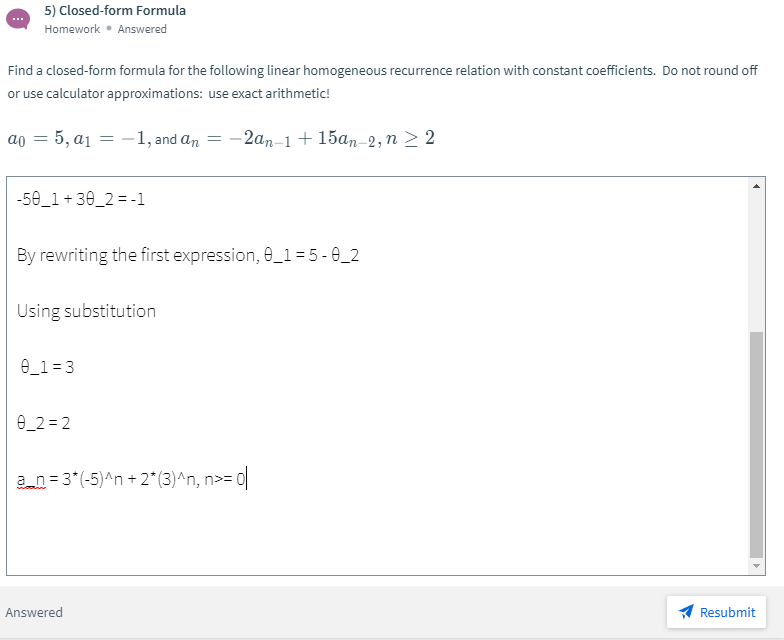
can anyone check my a_n general solution?
I got r1 = 3 and r2 = 2 for my values
then plugged into my a_n general equation
 icy parcel
hey guys
can someone help me understand what should we do in step 3)
like generally
not only in this example
i saw the correction but im not understanding a thing
 minor dagger
i think its asking for the equivalence classes
stray reef
yeah it's the set of all equivalence classes
icy parcel
what is that
stray reef
wait did you do a and b
icy parcel
if someone can join vc it would be easier, but what I understood in these type of problems, if we want to check if the relation is equivalent we need to check if it's reflexive, symmetric and transitive
the b) is kinda easy
but 3 I have no clue at all
stray reef
but you did b
icy parcel
ok yes I remember
icy parcel
yes
stray reef
in part c you need to find all the possible ECs under this relation
which it should be obvious that since $\overline{1} = (0,+\infty)$ and $\overline{-1} = (-\infty, 0)$ there are no other ECs since everything is already in one of those two
 vital dewBOT
Ann:
icy parcel
the eq is every x that's in relation with the number we want to find inside the set right?
stray reef
wording...
ok yeah whatever
there is no way to phrase it that is not a mouthful
yes
icy parcel
sorry I was french educated
but in university it's american system so Im not familiar with the wording in math
so what are the steps to solve the 3? like I know the result now right?
stray reef
yes, the only "step" is to acknowledge that you've found all the equivalence classes already
icy parcel
so in 3) generally they ask to find all the EC of R ?
but isn't the $\overline{1} = (0,+\infty)$ and $\overline{-1} = (-\infty, 0)$ only for 1 and -1? or since it has every element in here, so the answer of all of the ec would be inside this interval ?
vital dewBOT
Fillory:
stray reef
every positive number has (0, +∞) as its EC
every negative number has (-∞, 0) as its EC
there is nothing else in R*
icy parcel
I'm looking at the answer now but not familiar with the way it's written, can I send it here?
icy parcel
if you can help me understand it pls
icy parcel
yh...
stray reef
what do you think it is
 twilit sierra
im lost between 3 or 4
are we supposed to count 1 twice as its inside a set itself
near prawn
what about it
twilit sierra
in that case P(A) is 8?
stray reef
P(A) is a set not a number
twilit sierra
we have a formula P(A)=2^A
stray reef
P(A) is a set not a number
twilit sierra
twilit sierra
the | | mean cardinality?
near prawn
yes
twilit sierra
when we have to prove or disprove an equation like that one
and we find that the ven diagram is diferent
is there a certain method to find which set would be an empty set and which would have an element
like here we said A={1} B={1} C=empty set
 twilit bronze
minor dagger
twilit bronze
minor dagger
i think you might be schizophrenic
 shy drum
New Document(2)
sorry to be asking such a simple question but I want to be sure
the bottom line has {x , {z}}
what is {x,{z}} in this context?
shy drum
is {z} considered to be a set of it's own?
stray reef
it's not "considered to be" a set, it is a set
shy drum
Ok, thanks ^^
So both statements are true
stray reef
no
shy drum
oh?
stray reef
second one is false
 last timber
because subset is {{z}}
though {z} is indeed set, in the context of {x,{z}} we have {z} as element
if it helps you can denote {z} by y and you have {x,y} and {y} as its subset
shy drum
so...
stray reef
z may not even be a set
shy drum
it would be true if it was {x,z} but not {x,{z}} correct?
stray reef
no.
last timber
still would be wrong, because z is element
stray reef
z may not even be a set
last timber
subset of A is a set including elements of A
shy drum
in what case that statement would be true?
last timber
which statement?
shy drum
How would it need to be rewritten to be correct?
vital dewBOT
Commander Vimes:
shy drum
oooh
so if it was {z} sideways U {x,z} then it would be correct?
Honestly I feel like I'm wasting your time, could someone recommend a resource regarding this exact question?
I would read up a bit more before asking this
last timber
so if it was {z} sideways U {x,z} then it would be correct?

i mean any book on set theory even basics treats this q
shy drum
I think I'm starting to understand
In this case A is false and B is true
correct?
no
last timber
does {u, {y}, t} contain element y?
last timber
nah
 viral patioBOT
From
Rule 3
Stick to one channel and don't post the same question in multiple channels. Please don't ask for help in other channels if no one is responding in the one you have posted your question in.
shy drum
ok as long as I'm not bothering anyone
I will have a lot of silly questions
Both are false
 sand turret
hello
I was experimenting with graph coloring, thinking about different sequences to traverse the graph in in order to produce an optimal coloring
I thought of decreasing degree sequence
but then I thought BFS would be better
but I found an SO answer where it's stated BFS would not produce an optimal sequence
so why is decreasing degree sequence better than BFS?
last timber
wym by optimal coloring
sand turret
minimum no. of colours required
satisfying the usual no two neighbouring nodes have same color condition
last timber
well, then first of all, see that bfs does not put any conditions on root
stray reef
so you want an algorithm to find the chromatic number of your graph?
sand turret
well, then first of all, see that bfs does not put any conditions on root
@last timber I have taken one of the highest degree nodes as the source of BFS
so you want an algorithm to find the chromatic number of your graph?
@stray reef I want an optimal coloring
i.e. with min no. of colors
so I need the chromatic number as well as the coloring itself
last timber
well, i guess the reason why decreasing degree is preferable
is that contrary to bfs, on each step dec degree would take a key places of your graph
sand turret
can I use BFS from highest degree node and dec degree in each layer?
last timber
i mean i do not have paint on my distro now but imagine a graph where you have for example vertex a on one end of the graph would have deg 10 then there is a bunch of vertices of deg 1-2 and then on other end there would be vertex of deg 9
how would bfs proceed here?
sand turret
normally but each layer will be sorted acc to degree
so dec degree seq is the best I can do?
last timber
idk if this is the best but it seems preferable here
sand turret
Okay, I vaguely understand the reasoning behind that
I mean it's easy to see that algo working in a graph and feel that it's better
can you formally prove one algo is more optimal than the other on average?
last timber
well, for example you can prove that one is linear and second is say O(n^2) and then the former is preferable
or you can show that for one preconditions are weaker and one algo is in general more capable
sand turret
yeah that's understandable but any seq I use will give O(V+E) complexity ig
last timber
well if you have O(V+E) then you can analyze memory complexity etc
sand turret
but I want to compare the optimality of the algo not the performance
i.e. whether one gives less no. of colors on average
sand turret
nope
last timber
because one graph cannot have two optimal colorings in the sense of no. of colors
sand turret
Neither will give optimal coloring in every possible case
it has to be closer to optimal or optimal coloring in more cases
last timber
well, then it will require probabilistic analysis ig
sand turret
hmmn yeah ig
 rustic dew
Can someone help me with a problem? I know I have to use rules of inference with quantifiers to prove an argument, but I'm lost as where to start.
 mystic moss
@glacial elm wdym
 marsh hatch
I'm taking a graph theory course and I'm working through one of the problem books. One question says
What is the largest number of cuts that can be made in a volleyball net (5×10) so that it does not fall apart?
For context, this comes right under the topic "Eulerian and Hamiltonian Graphs". I've looked through all the theorems and definitions but I can't figure out what criteria to use to determine 'when it will fall apart'.
I take it that a cut = edge deletion. And 'fall apart' = no longer connected. So the question is asking how many edges can be deleted in the 5 x 10 net such that the resulting graph is still connected. Is this right?
It seems I simply need to use |E| - |V| + 1
marsh hatch
Thanks, that's what I did.
 chilly hull
Could someone help me with question 3, part h? I think the answer is [2^(n-1)]= {2^(n-1)....2^(n)-1] but I’m not sure..
chilly hull
<@&286206848099549185>
rugged pebble
can someone help me with transitive closure
for this relation {(a,a), (a,c), (b,a), (c,a), (a,1), (1,2)}
i got this {(b,c), (c,1), (b,1), (a,2), (b,2), (c,2)} but idk if its right
 opaque fern
Is this channel occupied?
 tame hound
hi, anyone here?
weary tiger
I need help understanding something in modular arithmetic
first, is this correct?
please ping me if answering. this involves a bit of a discussion
errant bear
yes its correct
 knotty mauve
I'm still new to discrete math, can someone help me with this questions?
knotty mauve
<@&286206848099549185>
 analog sonnet
What have you tried
analog sonnet
Do you know what the statement $A\cap B\subset A$ means?
vital dewBOT
Rijinaru:
knotty mauve
Yes
analog sonnet
Can you explain it in your own words?
knotty mauve
analog sonnet
,rccw
vital dewBOT
knotty mauve
Is this how it is done?
analog sonnet
Yeah, that seems like a good proof
I thought you just said you haven't done anything
But you seem to be doing quite well for yourself already
Keep it up!
analog sonnet
Please do show your work in the future though, even if it's scratch work
 slim idol
Maybe add : Choose a random x
analog sonnet
It saves time for all of us
analog sonnet
imo the "if x in A intersect B" already implies that you're looking at a generic element x
But yes, add it if you want to be very rigorous
knotty mauve
Thank you
 distant bobcat
Is the power set of natural numbers under the operation union a set? Im guessing no, since although it is closed I dont think that it has an identity element.
near prawn
try it again
distant bobcat
What would I need to prove for a set to be a monoid? Im only familiar with groups, fields and rings so far in my course.
 sour arrow
A monoid is a group without inverses @distant bobcat
So, prove it is a group, then erase the inverse part.
 distant bobcat
What would you prove for a subgroup of a monoid then? The identity and that its not empty?
last timber
subgroup of monoid?
sour arrow
Only cool kids erase the inverse part
I guess you could call it a submonoid, haha
Closed + has identity
unreal stump
A monoid could have a subgroup
distant bobcat
Thanks)
A monoid could commute as well right? Does it have a special name like the abelian group?
unreal stump
abelian monoid?
distant bobcat
who knows except google)
 tidal plinth
Commutative monoid
 untold cliff
can you find a graph from the third power of its adjacency matrix?
 olive sun
Translation: Using mathematical induction, prove that:
Can anyone help me with this?
 coarse sparrow
First Incorrect , 2nd and 3rd correct and 4th incorrect
coarse sparrow
they are asking true / false
stray reef
what is Phi?
coral raven
why does it matter
coarse sparrow
Empty group
stray reef
empty set*
weary tiger
its pretty obvious right
(B\C) isn't in (A\B) so you aren't subtracting any element from (A\B)
(because B\C is a subset of B)
vast narwhal
I'm guessing internal means more than one edge...
vast narwhal
I would say yes... With a tree, any vertex could be a root
 karmic nymph
read of the ruler
vast narwhal
So you wouldn't want to toss out a vertex that would otherwise be internal, but becomes excluded by certain artificial choices. That would be a lot to keep track of if you should change your mind which vertex is the root
karmic nymph
So you wouldn't want to toss out a vertex that would otherwise be internal, but becomes excluded by certain artificial choices. That would be a lot to keep track of if you should change your mind which vertex is the root
@vast narwhal ah i see
karmic nymph
9/16 it looks like
vast narwhal
The 8/16 mark is halfway between 75 and 76 on the first one, that's a good thing to keep in mind
I love playing the "bruh what" game when I go to the hardware store. I can pretty much point to any measuring device...
 vague fog
this? this is 8/16? how tho? are the big lines 5 each?
mystic moss
okay, but what if the root has only one neighbor--then is it still an "internal" vertex
karmic nymph
i thought internal vertex meant, a vertex with more than 1 edge
mystic moss
according to some random pdf from illinois:
so since the root has children, it would be considered an internal node. it's mostly an arbitrary distinction, depends on what you want to do with it
So you wouldn't want to toss out a vertex that would otherwise be internal, but becomes excluded by certain artificial choices. That would be a lot to keep track of if you should change your mind which vertex is the root
@vast narwhal about this--i think if you defined "internal" to be something irrespective of the root, you might as well just define it on an unrooted tree (this is the notion of a leaf, right). so a rooted-tree-specific quality should probably depend on the actual choice of root
mystic moss
according to the pdf from illinois, yes.
karmic nymph
nice, giving the name "internal" is kinda misleading
vast narwhal
If you "bent" the top-right edge to where it's facing northeast, it's more apparent as to why...
mystic moss
i think you can just think of it as like a waterfall or something, or a river delta.
(interestingly enough, if we "bent" the top-right edge and rooted the tree at the topmost vertex, it would also become "internal".)
vast narwhal
It would be a different situation if the edges were pointed, but with unlabeled edges it's sorta arbitrary
mystic moss
by rooting the tree we kind of direct the edges, though
hm. every "connected" dag is a rooted tree, right?
no, i lie.
vast narwhal
no loops allowed
mystic moss
yup
what about this--every dag that stays a dag irrespective of the direction of its edges is a rooted tree? 🤔
vast narwhal
I think it's just a wordy way of talking about valence, this internal vs end
mystic moss
valence?
vast narwhal
how many edges are touching said vertex
mystic moss
okay, gotchu. also, "end"?
vast narwhal
not internal, only one edge touching
mystic moss
okay, so leaves.
vast narwhal
woops my bad, yes
"end" is something different - I think it's more like a "leaf at infinity" sort of notion
mystic moss
at infinity? so like, on an infinitely large tree?
vast narwhal
You could have a tree in the poincare disc model of hyperbolic space, and think of it as reaching out towards the boundary circle at infinity
mystic moss
poincare disc model of hyperbolic space?
vast narwhal
Here's some cool imagery of it:
https://youtu.be/xHvAqDuWG2M

Visualizing the sphere and then the hyperbolic plane under various azimuthal projections (five of each).
spherical projections:
-
orthographic projection of the sphere (at 17s),
-
gnomonic projection of the sphere (at 1m16s),
-
stereographic projection of the sphere (at...
If you think of a euclidean sphere as being positively curved, with fattened triangles. This is negatively curved, with thinner triangles
mystic moss
hm. can we embed this in 3d space like we can the sphere?
vast narwhal
The answer is no by Hilbert's Theorem, it was a big question at the time
I think it can be embedded in R^4 though
 neat holly
😳
vast narwhal
Super discrete, lol
neat holly
I can see that lmao
I can't wait to try to understand a quarter of what was just discussed
Also, if I may ask, how would I go about doing this?
I've defined a nested interval as $I_1 \supset I_2 \supset ... \supset I_n \supset ...$
wait let me figure out the latex formatting
o
vital dewBOT
Rai Bread:
neat holly
uh
vital dewBOT
Rai Bread:
vast narwhal
You want to show that $\cap_i I_i$ contains at least one point
vital dewBOT
Apopheniac:
neat holly
My professor's hint says something like constructing a Cauchy sequence ${x_n}$ that approaches some number x, and then show x is in every interval $I_n$ and if it's in every interval, then the intersection is non-empty.
vital dewBOT
Rai Bread:
vast narwhal
That sounds about right. You would want ${x_n}$ to satisfy $a_n\leq x_n \leq b_n$ for each n, this is what it means to have $x_n\in I_n$
vital dewBOT
Apopheniac:
neat holly
Can we say there's a non-empty set ${a_n : }$ bounded above such that ${x_n}$ is the supremum?
whoops
vital dewBOT
Rai Bread:
vast narwhal
Yes all of the $a_n$ are bounded by what then? In order to say it's bounded, it can help to state a bound so that the assertion is clear
vital dewBOT
Apopheniac:
 grim swan
each individual a_n is bounded by x_n, but the set of a_n is not necessarily bounded by any x_n
vast narwhal
And then you would also want to argue that the supremum that you obtain satisfies what you want: show that it is contained in the intersection of these intervals
neat holly
I think it's all starting to come together!
grim swan
do you already know every cauchy sequence has a limit?
neat holly
Yes
grim swan
cause if you know that, you can just say that in this case. if not you can use the supremum idea to prove there's a limit
neat holly
It'd deal with the idea of how every convergent subsequence is Cauchy, right?
grim swan
i don't think so? any convergent sequence is automatically cauchy
in any case i think we're getting away from what the idea here was
you choose $x_n \in [a_n,b_n]$, then show the sequence of $x_n$ is cauchy, then let $x_n \to x$
vital dewBOT
doubledual:
grim swan
that's where we were at right?
neat holly
I was thinking of saying ${a_n} \lneq {x_n}$ for all $n \in N$ but also that ${x_n} \lneq {b_n}$ for all n
And yes.
whoops
vital dewBOT
Rai Bread:
grim swan
i think you just want \leq
but ok that is true by how you defined the x_n, what do you do from there?
neat holly
I'm not too good at LaTeX. My bad.
Would we start proving for different cases, say, ${a_k}$?
grim swan
i'm not sure what you mean by that
vital dewBOT
Rai Bread:
neat holly
$k \in N$
vital dewBOT
Rai Bread:
grim swan
so you want to show $x \in \bigcap_{n=1}^\infty I_n$ right
vital dewBOT
doubledual:
neat holly
asterisk is just correction. I mean to say that if we have such a set $[a_k]$, we can prove for cases when $n \leq k$ and $k < n$
vital dewBOT
Rai Bread:
neat holly
Yesyesyes
grim swan
so you need to show $x \in I_n$ for every $n$
vital dewBOT
doubledual:
grim swan
so I don't see how the cases come in at all
neat holly
Maybe I'm just overthinking the Cauchy Convergence Criterion
I think I see what you mean
grim swan
oh are you on the step of proving that the sequence of x_n are cauchy?
or the step where you prove x is in the intersection
neat holly
I started by defining a nested interval and then assumed $I_n \supset I_n+1$, so $x_n \geq x_n+1$
Apologies if I butcher the latex
vital dewBOT
Rai Bread:
neat holly
The +1 is meant to also be subscripted but I have no idea how to do that
vast narwhal
$x_n \geq x_{n+1}$
vital dewBOT
Apopheniac:
vast narwhal
there's supposed to be an underscore inbetween the x and the brackets, discord chopped it off
neat holly
I see the text italicized but I guess TeXit took the raw input anyway
vast narwhal
yeah it hates me
neat holly
At least I know how to subscript things now
vast narwhal
snap cool
neat holly
I know that if you put a backslash before a formatting character, it'll prevent Discord from formatting it, too
vast narwhal
Like ${$?
vital dewBOT
Apopheniac:
vast narwhal
ah gotcha
neat holly
Oh yeah I didn't think of that
vast narwhal
gonna have to start coming up with street lingo to keep from getting messed with by discord bot grammar nazi
grim swan
oh btw going back to the problem, no need to assume the sequence is decreasing
you can do that wlog if that gives you an easier solution though
neat holly
Perhaps I'm just new to Cauchy Convergence Criterion and assumed there'd be a lot to it. I was so ready to introduce an $x_m$ too
vital dewBOT
Rai Bread:
neat holly
I love cans
grim swan
the cauchy sequence of x_n doesn't have to decrease
vast narwhal
because the intervals are nested, the endpoints form a monotonic sequence on either side
grim swan
yeah the endpoints are monotonic, but the x_n don't need to be
vast narwhal
Correct, I was thinking of the $a_n,b_n$
neat holly
So we go by assuming that if a sequence is Cauchy, then it is also bounded and the opposite may also be true, no?
vital dewBOT
Apopheniac:
vast narwhal
Well, everything is Cauchy here, right? The $a_n$ and $b_n$ are convergent and therefore Cauchy
vital dewBOT
Apopheniac:
neat holly
Oh. yeah! I'm dumb lmao
last timber
are u guys trying to prove nested segments lemma?
grim swan
yeah we're trying to help rai with it
neat holly
Hihihihihi
last timber
use axiom of completeness (and hence least upper bound property equivalent to it)
no need in cauchy
grim swan
what is the axiom of completeness to you
because to me it's "every cauchy sequence has a limit"
last timber
well they are equivalent
grim swan
or maybe "sets bounded above have sups"
vast narwhal
Heine-Borel, yes there are many equivalent thingies
last timber
but i mean have you met the one that if A and B are nonempy and for all a in A and b in B a \leq b then there is c separating them
this one is much more easier to use for the proof ig
vast narwhal
We can pick one, and it doesn't require rewording everything
neat holly
But would it also count as using the Cauchy Convergence Criterion for proving the NIP?
Though they are equivalent
last timber
anyway, the point is that you can prove that for all n a_n <= b_n which is obvious
and a_n <= a_(n+1)
and also a_m <= b_n for all n,m
vast narwhal
$a_n$ is increasing here, not decreasing
last timber
ye sorry
vital dewBOT
Apopheniac:
vast narwhal
wtf aoc is not needed here
last timber
and if segments are of arbitrary length you can show that this point is unique
wtf aoc is not needed here
@vast narwhal how would you prove nested segments lemma w/o AoC?
neat holly
I'm trying to think of a way to apply like n > m or something
vast narwhal
oh lol I thought you meant axiom of choice my bad
i forgot you said completeness earlier instead
last timber
well i think we still use choice but implicitly here tho
I'm trying to think of a way to apply like n > m or something
@neat holly well
no actuall need
you can show

this
by contradiction e.g
suppose there is such pair m, n so that a_n > b_m
neat holly
What about $b_m - a_m$?
neat holly
Hmmm.
vast narwhal
All of the endpoints on the right are to the right of all of the endpoints on the left
neat holly
My braaaaain
vast narwhal
This is by definition of nested
vital dewBOT
Commander Vimes:
grim swan
oh i see what you're getting at here, that is definitely one way of doing it
you can do it with midpoints too if you want, and that's what rai's professor hinted to do
last timber
no need in midpoints tho
vast narwhal
You could even do it with a constant sequence
last timber
 grim swan
that isn't what AoC means
vast narwhal
If a set is bounded above by b, its supremum is at most b...
neat holly
Would this be related?
grim swan
but yeah you can just say sup a_n = inf b_n, and that point is in every interval
and that uses the contradiction argument from above
last timber
my argument uses the defn of AoC as if A,B are sets such that forall a, b in A,B respectively a <= b holds then exists point c so that a <= c <= b for all a,b
vast narwhal
the point would be in every interval without contradiction
last timber
https://media.discordapp.net/attachments/496785905474994186/778117166952087562/image0.jpg?width=332&height=443 well yes ray this is visualisation
 neat holly
I see where the contradiction lies
grim swan
@last timber i don't think that statement is equivalent to axiom of choice, i'm pretty sure i can prove it without axiom of choice
last timber
by AoC here i meant completeness
grim swan
AoC and completeness are super different lol
last timber
sorry if i led you to confusion
vast narwhal
So complete and cauchy, these are both notions of completeness.
last timber
well one can show that they are equivalent
e.g it maybe easier to show that cauchy is equiv to least upper bound property on R and then it follows
grim swan
oh let me just show you guys the midpoint argument since it's actually easy
vast narwhal
ok good
neat holly
Maybe another thing that gets me is the amount of rigor for proofs that I'm still trying to get a hang of
grim swan
so we want to show $x \in I_n$ for every $n$
vital dewBOT
doubledual:
last timber
btw you can use heavy machinery and use monotone sequence 
well not really heavy but overuse
grim swan
the sequence $(x_k)_{k \geq n}$ is a sequence in $I_n$ that converges to $x$, using here that the intervals descend
vital dewBOT
doubledual:
grim swan
so since $I_n$ is closed, $x \in I_n$
vital dewBOT
doubledual:
neat holly
I thought about it, but perhaps I take "Use Cauchy Convergence Criterion" too seriously
vast narwhal
What is x_n defined as?
grim swan
just take the midpoint of I_n
to avoid axiom of choice lol
you do need to check that's cauchy, and that is because the intervals descend and the length of the intervals go to 0
vast narwhal
ah ok. yes - closed means contains limit points, very quick and clean
vast narwhal
if they're not closed, then you don't get NIP
neat holly
All convergent sequences are bounded
vast narwhal
take (0,1/n)
last timber
oh ye sorry
grim swan
@neat holly i feel like this conversation was really long and disjointed, so i want to give you an outline of the proof. i'll explain the proof which involves cauchy sequences since that was your professor's hint
neat holly
I was also going to scroll up and connect the dots either way, but I did learn a lot more than I expected and I thank all three of you for taking your time with me
grim swan
we choose $x_n \in I_n$, you can choose the midpoint if you want something explicit
vital dewBOT
doubledual:
grim swan
you need to show $(x_n)_{n\geq 1}$ is a cauchy sequence
vital dewBOT
doubledual:
grim swan
when you do that, by completeness, you know there is some $x$ such that $x_n \to x$
vital dewBOT
doubledual:
grim swan
now you want to show $x \in \bigcap_{n \geq 1} I_n$
vital dewBOT
doubledual:
grim swan
this means you need to show $x \in I_n$ for every $n$
vital dewBOT
doubledual:
grim swan
now here's the easy trick to do this:
the sequence $(x_k)_{k \geq n}$ is sequence contained in the set $I_n$, using here that the intervals descend
that sequence obviously converges to $x$
vital dewBOT
doubledual:
grim swan
and since $I_n$ is a closed set, we conclude $x \in I_n$
and thus $x$ is in the intersection as needed
vital dewBOT
doubledual:
neat holly
ohmy
vital dewBOT
doubledual:
neat holly
My mind has been blown
grim swan
the big step I left out here was showing that the sequence (x_n) is a cauchy sequence, i'll leave that part to you 🙂
vital dewBOT
doubledual:
grim swan
great 😄
neat holly
I'll keep trying to connect previous dots from the clash of you three great minds
vast narwhal
You could argue by Cauchy-ness of another sequence, sometimes that can allow you to avoid having to write as much
neat holly
Every convergent sequence is bounded. If I can prove convergence, it'd also be Cauchy?
Also, there's a lemma that states that a Cauchy sequence of real numbers is bounded
grim swan
it's easier to prove it's cauchy, then use completeness to show it converges
the basic idea is: the end terms of the sequence are contained inside intervals shrinking to length zero
or use apop's suggestion if you can figure that out
neat holly
I'll play around with the ideas for a bit then construct a good proof
Again, I appreciate all of you for taking your time to help me. It all pushes me to continue pursuing mathematics!
last timber
you are welcome
neat holly
:)

 neat holly
I want to be useful someday
last timber

neat holly

 lofty mango
how am i supposed to Prove that if a and b are positive integers such that a|b and b|a, then a = b?
i think | is supposed to be divide
they're positive integers
i don't know what else to say TBH
that's it
i'm supposed to use either direct, contrapositive, contradiction, proof by cases, or mathematical induction
alright
 gritty crescent
Need help.
I don't understand how assuming the contrary helps here, since the distribution of points is at random. I thought about successively considering triangles of the largest area, and then somehow showing that the distance between the vertices of these triangles will become smaller and that would somehow give a triangle of area<68 but that is too contrived to work it seems.
I'm just stuck now. This is supposed to be solved using pigeonhole principle.
I also considered covering the bigger triangle with smaller triangles, but overlaps might kick in(?)
gritty crescent
Discrete, I suppose, it is irrelevant either ways, no?
The choice of points is random
pale epoch
what are continuous points 🤔
last timber
i mean
triangle
what are continuous points 🤔
@pale epoch points in string theory

pale epoch
but i too wonder what "span a triangle of at most 68 means"
so i take 3 points that not all lie on a line, they span a triangle and ?
gritty crescent
The area shouldn't exceed 68
pale epoch
ah
gritty crescent
The claim says that of the 169 points inside the triangle of side length 100, there must exist a triangle of area less than 68 units
gritty crescent
Yes, it is supposed to be pigeonhole.
pale epoch
yeah
you need the added condition though that no 3 points lie on a straight line
otherwise just have all points lie on a line
then there are no 3 points that even span a triangle
anyways...
my first hint is this bad drawing:
gritty crescent
Hmmmm
then there are no 3 points that even span a triangle
They span triangles of 0 area, no?
gritty crescent
And is the idea behind that drawing partitioning a triangle using those points?
pale epoch
just partition the triangle
gritty crescent
Hmmmm
pale epoch
whats area of a smaller triangle?
gritty crescent
Wouldn't some of the triangles be formed using the vertices of the bigger triangle?
Or is that a non-issue
?
pale epoch
what do you mean
right now im not even thinking about the random points inside the triangle
gritty crescent
Uh
Look at any of the smaller triangles above except the central one
It is formed using a vertex of the bigger triangle
And I think I shouldn't be including them
pale epoch
including them in what?
gritty crescent
I was confused nvm
I get your point
I actually considered that before but subsided due to this confusion of mine
But partitioning seems to work
And possibly the only way pigeonhole works
stray reef
what does "a triangle of at most 68" mean
does it mean a triangle containing at most 68 of our points inside?
p sure you can argue there will always exist a triangle containing ZERO of our points in its interior
gritty crescent
does it mean a triangle containing at most 68 of our points inside?
@stray reef A triangle of area at most 68 square units
stray reef
oh
pale epoch
what's the definition of internal vertex?
karmic nymph
a node that has more than 1 children
pale epoch
what's the definition of child then
karmic nymph
a node that branches of another
pale epoch
that's not really precise
karmic nymph
b c d are children of a for example
um
is my definition for internal vertex incorrect?
pale epoch
correct?
well
t is only a parent node of u
so t has only 1 child, which is u
so if your definition of internal is at least 2 children, t is not internal
all this is assuming that the tree is rooted at a
pale epoch
wikipedia says "An internal vertex is a vertex that is not a leaf"
karmic nymph
the answer for b, they include the node t
pale epoch
and t is not a leaf
 obtuse lance
it has more than one child node
q and u are both children of t
you're imagining a directed graph that isn't really there because of how it's drawn, you've fooled yourself
@karmic nymph
karmic nymph
i mean it doesnt say rooted at a but i assumed it too
pale epoch
then v is a child of w if w is the parent of v
karmic nymph
The question says "Consider the following rooted tree"
pale epoch
and the parent is the unique node that is on a node-root path right after the starting point
so t is the unique parent of u, hence u is a child of t
q is not a child of t, since q is the parent of t
karmic nymph
ye
ye, thats if its rooted at a
if its rooted at t, then children are q and u
i think thats what he meant
pale epoch
oh yeah
weary tiger
"how many letters must be printed so the expected number of occurrences of the string “BANKRUPT” is exactly 1?" Where each character is chosen uniformly at random from the 26 capital letters
how do i approach this
 terse kayak
,iam adv
vital dewBOT
Your roles have been updated!
vital dewBOT
Lunasong:
 quaint star
Are A, B and C subsets of some universal set? Otherwise what does B complement mean?
And the first statement of the last line is wrong
$(A \cap \overline{B}) \cup ((A \cap \overline{B}) \cap C) = A \cap \overline{B}$
vital dewBOT
Lunasong:
coarse sparrow
yeah so i should just erase the last line and go straight for what you wrote?
without explaining the reason i can do that?
quaint star
I mean, you didn't write any explanations so far
I'm just telling you it's incorrect
I have no idea what you are expected to write
You also didn't answer my question
Are A, B and C subsets of some universal set? Otherwise what does B complement mean?
@quaint star
You can't talk about complements unless it is in relation to some specific set.
coarse sparrow
ok here's another version of my classmate
does that look like a right way of showing it?
quaint star
No this is horrible
What is the intersection of two statements?
And horrible misuse of the equals sign
quaint star
I like the vague idea behind that better though
Take an element of the left hand side, and show it belongs to the right hand side
And the reverse
coarse sparrow
yeah they asked to show only 1 way
sorry i forgot to mention
my bad
is that right if so?
coarse sparrow
they asked us to show that the left hand side is the same as the right hand side
normally we have to do both ways
quaint star
coarse sparrow
but our teacher required only left side
quaint star
If the left hand side is the same as the right hand side, then the right hand side is the same as the left hand side
Do you mean you have to show LHS is a subset of RHS?
coarse sparrow
it only says to show that they both mean the same thing
so not a sub set
but actually the same set
quaint star
Yes, then what you said makes no sense
a = b is the same as b = a
Anyway
X = Y iff X is a subset of Y and Y is a subset of X
So show take the LHS is a subset of the RHS
And then show that the RHS is a subset of the LHS
coarse sparrow
ok Lunasong , i got another one more technical , forget about the previous one i sent
hold on
?
please don't tell me its also wrong
quaint star
It's wrong
coarse sparrow
so i need to add another set of brackets
like
{{1}}
for example
on the first row
quaint star
Yes
quaint star
And it's all a mess because you don't have commas where you should, so it's hard to read
coarse sparrow
but pc has to be right
quaint star
Yes P(C) is correct
coarse sparrow
so {1} is not the same as {{1}}
coarse sparrow
this should help me with understanding this better
tell me if i got it right
i need to answer True / false
so i said False , True , True , False
quaint star
Correct
coarse sparrow
nice
one more silly question
so you said to add the brackets
this is the 2nd row
i need to had brackets to the {1} , {2} {1,2} ?
all the way to the end im guessing
quaint star
I cannot make out what is written there
You will need one big pair of { } to enclose your whole set. Then for each element, you need another { }, and inside of that should be elements of P(C)
olive sun
Can anyone help me, I got 30 mins left
Translation: Prove formally that f(x) = 3x - 2 is injective or not.
 grizzled laurel
Just insert two different variables in the function
and compare the to functions
f(x)=f(y) gives 3x-2 = 3y-2
3x=3y
x=y
so the function is injective
 candid hollow
how can i prove that the set {(x,y) s.t x^2+y^2=<1} cant be written as the cartesian product of two sets A and B, where A and B are subsets of the real numbers?
grim swan
uh i don’t think it can be
candid hollow
yes it cant, and i need to prove that
grim swan
oh can’t sorry
misread
ok so
do you have a visual sense of what the cartesian product of two sets looks like?
candid hollow
a rectangle?
grim swan
yeah pretty much
coral raven
stupid question: ||can't it be polarised||
grim swan
@coral raven not in this context
candid hollow
i didnt do polar coordinates yet though
grim swan
we’re just trying to write the unit circle as a cartesian product in the (x,y)-plane
without some fancy coordinates
candid hollow
yeah thats what i was struggling with lol
grim swan
to make the rectangle idea more precise
you know if a \in A, then (a,b) \in A \times B for every b \in B
so like, a point in A generates a line over points in B
and vice versa
candid hollow
yeah i can see that
grim swan
so for example, if the circle were a cartesian product, (1,0) is a point in the circle, so 1 is in A
 tropic lion
oh
grim swan
and then for every b in B, (1,b) is in the product, and thus the circle
so what’s the problem with that
coral raven
yes
grim swan
try and expand on that
how do you know the rectangle has corners
where are the corners
candid hollow
wait
to first prove that we have a rectangle
dont we need to prove that the sets A and B are intervals?
grim swan
you would yeah
but you don’t need to do that
try drawing a picture btw
This is the picture of what I was describing
candid hollow
yeah i had a picture on desmos already
grim swan
so I think what you would want to do next is pretty clear from the picture...
if we assume for contradiction the circle is equal to AxB for some sets A and B, we know 1 is in A
since (1,0) is in the circle
can we use that to find a point in AxB that definitely isn’t in the circle?
so you know that AxB = {(a,b) | a in A, b in B}
so there are two things to keep in mind
if (a,b) in AxB, that must mean a in A and B in B
and second, if you have a point a in A, then (a,b) in A x B for every b in B
and similarly, if b in B, then (a,b) in A x B for every a in A
candid hollow
am i supposed to find a b for which (1,b) is not in the unit disk?
candid hollow
oh lol if i take the point (1,1) it's not in the disk but it's in the rectangle
because the point (1,0) is in the disk, therefore 1 is in A
and the point (0,1) is in the disk, therefore 1 is in B
so (1,1) is in AxB
i was trying to generalize the notion of a corner but i struggled with that, and at the end the answer was really simple...
anyway thanks for the help
errant bear
cool
 fluid tendon


 opaque fern
<@&286206848099549185>
opaque fern
Yea
 crimson jetty
you can find the bezout coefficients if you use that method
opaque fern
Yea exactly what your saying
crimson jetty
i'm assuming you were taught the algorithm in a class or something?
are you having trouble with it
crimson jetty
how did you do euclid's algo
opaque fern
Haven’t attempted it yet
But i don’t struggle with it
I can solve it for u rn
If u want
But do it too and see if I’m correct
crimson jetty
oh can u send
opaque fern
weary tiger
Formal proofs btw
crimson jetty
Check your remainder for the first one
crimson jetty
The question you posted says find the GCD of 3470 and 280, not 3740 as you wrote.
opaque fern
@crimson jetty you around ?
errant bear
yeah 
crimson jetty
this is good
so you can work backwards from here using Bezout's identity, that there exist integer coefficients a and b such that 3470a + 280b = 10.
opaque fern
@crimson jetty can you send that part
It’s way to difficult
I won’t get it just hopeless
crimson jetty
Use Bezout's identity for each line. I'll do the first one for you as an example:
10 is the remainder here as well as the GCD of 50 and 60, so:
10 = 60 - 50 * 1
Then, we use Bezout's on 50. From the next line up, we have 50 = 110 - 60 * 1 so plugging into our first equation we get:
10 = 60 - (110 - 60 * 1) * 1
opaque fern
Would you mind writing it
It’s working backwards right
Can you do that part I’ll just attempt it for this question
There’s another one I need help with also
I flat out don’t know what to do can’t lie
crimson jetty
yeah, use bezouts for each line
Then combine like terms by factoring out the 60 that you need for the next line up. so you get 10 = 60 - (110 - 60 * 1) * 1 = 60 - 110 + 60 = 60 * 2 - 110 * 1
Keep using bezouts like this for the rest of the lines until you get the Bezouts coefficients you need.
opaque fern
Which are
Can you write what you’ve said on paper
Or some online draw app
@crimson jetty
crimson jetty
had to find my phone so made myself a snack. Here's the first few lines, there's only a bit more to do so I'll leave it to you
opaque fern
It’s correct?
Can you continue with how’s yours would’ve finished
It looked clean and simple
crimson jetty
Well you need to write the GCD as a linear combination of 3470 and 280 right? So your problem requests that you find co-efficients a and b such that 10 = 3470a + 280b
So you got 10 = 3470(-5) + 280(62)
opaque fern
So that’s the answer
crimson jetty
uhh my handwriting's bad but if you insist
crimson jetty
yup
opaque fern
Way much more simpler to follow
crimson jetty
but hey, you got through it once :))
crimson jetty
least common multiple?
crimson jetty
well the most obvious way is to factorize both values and then find it that way
but you already have the GCD, and LCM = |3470 * 280| / gcd (3470, 280)
crimson jetty
mhm