#discrete-math
1 messages · Page 146 of 1
 weary tiger
 verbal silo
Hello! how can i show that there exists a natural number n such that 11|(2^n-1)
weary tiger
I understand what you're saying completely but I'm hope to be thorough for homework and not making any sort of leaps in logic
Why can you "just" rename variables to something else? Because they are variables whose name was arbitrary in the first place. I could have called q Y instead. I could have drawn a little symbol of a fish or a Chinese character instead. It will behave the same
ok, got it.
Awesome!
thanks for being patient with me haha. this is all very new.
Oh my pleasure good luck with it all :)
@verbal silo What have you tried so far?
verbal silo
i got 2^n congruent 1 (mod 11)
weary tiger
Nice
An often useful trick when you are working with congruences is to repeatedly multiply both sides by the same thing
Because you can just reduce it mod 11 or whatever you are working in
So you can clench your cheeks and hope that your prof made it easy to find some power of 2 congruent to 1 just by multiplying 2 by itself over and over and over again mod 11
It's not a rock solid method but it often works out pretty nicely
Have you seen that before? I can demonstrate if not
verbal silo
no! I actually havent 😭
it would be great and i would be really thankful, if you have the time!
weary tiger
Sure thing

2 mod 11 is 2
2*2 mod 11 is 4
2*2*2 = 2^3 mod 11 is 8... etc
but note that after this step the magic happens
2^4≡16≡5 mod 11
and so 2^5≡5*2= 10 mod 11, etc
try to keep going on your own
you might just find something ≡1 mod 11 (what you wanted)
 errant bear
(what if i'm not good at looking for things)
verbal silo
okay!
weary tiger
when you are done I found a more reasonable proof than just proof by example if you're interested
for a time-constrained exam or something I would recommend this sledgehammer smashing method though lol
errant bear
oh wow didnt know you were fermat 😳
weary tiger
We need to determine whether or not this equivalence hold. Does anyone know how to go about this question?
I have searched for these kinda questions but couldnt find them anywhere.
Can anyone pls help me with it?
weary tiger
<@&286206848099549185>
 pallid lintel
https://gyazo.com/3d644fe37c3755083ff21e4130027a03 if i find r(5,5) would i get a phd in math? r(6,6) would be fields medal worthy perhaps?

I'm trying to prove r(3,3) in an extremely difficult way compared to the paragraph length proof that is normally given hehe.
 vapid oyster
1.P → Q )
2) ~R۷S
3) P ۷ R
Therefore Q → S
is this the correct solution for this
4. Q New premise
therefore S
5. ~P Modus tollens 1,4
6. R Disjunctive 3,5
7. S Disjunctive 2,6
 unreal stump
https://gyazo.com/3d644fe37c3755083ff21e4130027a03 if i find r(5,5) would i get a phd in math? r(6,6) would be fields medal worthy perhaps?
@pallid lintel Probably no
 stray reef
this is the proper logical or symbol. if you don't have it available then you can type the latin letter v or the letters or
anyway, what's your argument again
vapid oyster
I'm trying to solve it via conditional proof
stray reef
$\frac{P \to Q, , \neg R \lor S, , P \lor R}{Q \to S}$ this?
 vital dewBOT
Ann:
vapid oyster
yes
stray reef
ok so in your first step you add Q as a premise and change the conclusion to S, yes?
vapid oyster
yeah
stray reef
step 5 is invalid
vapid oyster
after that i used modus tollens to get ~P
stray reef
modus tollens would be $\frac{P \to Q, , \neg Q}{\neg P}$
vital dewBOT
Ann:
stray reef
but you have Q, not !Q
vapid oyster
oh wait no the conclusion was ~Q implies S sorry
stray reef
the plot thickens
stray reef
ok this seems to hold up now
vapid oyster
After getting ~P i used disjunctive to get R
i'm not sure if i did the 7th step correctly
 gritty crescent
Umm that the sequence terminates at n=6, I guess
It starts at n=1(as indicated in the subscript) and terminates at n=6(as indicated in the superscript)
stray reef
the n=1 and 6 together mean that n ranges from 1 to 6
so the 6 indicates the index of the last term in the sequence
vapid oyster
@stray reef is what i did correct?
stray reef
yes
vapid oyster
thank you
yes
@stray reef
weary tiger
thank you @gritty crescent @stray reef
 karmic nymph
$(A \oplus B) \oplus B = A$
vital dewBOT
Yes:
karmic nymph
could someone help me prove this without a table?
Could someone explain to me index shift? I don't really get it
@weary tiger looks like regular series algebra
karmic nymph
(A-B) U (B-A) XOR B
hmm i guess i can illustrate it on venn diagrams and see that its A
karmic nymph
are you a CS major?
weary tiger
yes
karmic nymph
same
karmic nymph
yep
weary tiger
I've just started last month
karmic nymph
just started this week
weary tiger
Ooooh
karmic nymph
I like discrete math lol
weary tiger
how are you finding discrete math so far?
karmic nymph
Good
weary tiger
It was ok at first, wasn't too hard to catch up
karmic nymph
I have a background in mathematics already so i enjoy this
weary tiger
but as the unit went on it became increasingly difficult to a point where I can't really understand the lecture slides anymore
karmic nymph
Are you learning from a book?
weary tiger
No, from lecture slides
karmic nymph
oh
weary tiger
I have a mathematical background as well
karmic nymph
My teacher is really bad so im just learning from the Rosen book lol
weary tiger
noice
karmic nymph
Im on chapter 2
karmic nymph
HL
karmic nymph
I did A level further math which is UK equivalent of HL IB
so yeah not too bad
What chapter are you on?
weary tiger
A levels and IB are the only 2 pre-graduate curriculmn that I respect
they're both very rigorous
AP is a fucking cakewalk
SAT is for kindergardens
weary tiger
Yeah but at least A levels is somewhat more difficult than AP and SAT
karmic nymph
yep
weary tiger
and u hear americans complaining all the time about it
karmic nymph
lol yes
karmic nymph
lmao
weary tiger
I haven't used the rosen book yet, since I'm basing off my learning from lecture slides
Is the rosen book actually good?
karmic nymph
Youre European right
karmic nymph
King's College
weary tiger
damn that's pretty good
weary tiger
It's fairly prestigious but not as prestigious as king's college I think
weary tiger
yep
karmic nymph
i started on 28th sep
karmic nymph
yep have fun lol
karmic nymph
$\bigcap_{i=1}^{\infty} A_i$
vital dewBOT
Yes:
stray reef
$\rien \neq {0}$
vital dewBOT
Ann:
karmic nymph
wait why is it {0}
stray reef
a point is in $\bigcap_{i=1}^{\infty} A_i$ precisely when it is in every $A_i$ at once
vital dewBOT
Ann:
stray reef
and don't you agree that 0 ∈ {0, i} no matter what i is
stray reef
wym comparing,,,
karmic nymph
comparing is a bad word, i mean errr
I was looking at the subsets as a whole but nvm i understand now
vapid oyster
can someone help me solve this using indirect proof
- A → ( B and C )
- B → ( D and E )
Therefore A or D
stray reef
show that the premises $$A \to B \land C, , B \to D \land E, , \neg A \land \neg D$$ lead to a contradiction
vital dewBOT
Ann:
stray reef
which... hold up, do they?
stray reef
...your question reads as if you saw the word function and asked "What does func mean?"
the notation $f: (-2,3) \to \bR$ means ``$f$ is a function from $(-2,3)$ to $\bR$'' (i.e. this notation establishes the function's name, domain and codomain in that order)
vital dewBOT
Ann:
vapid oyster
@stray reef uhmm how about the steps? also the conclusion was ~A or D my bad
vapid oyster
well i'm a little lost on what to do when it comes to indirect proof
all i know is the new conclusion will be ~(~A or D)
stray reef
de morgan, and-elim, or-intr, MT
verbal silo
Can some one help me out with how to apporach this problem
stray reef
pick a low integer of your choosing, say 10
try to prove that this inequality holds for n ≥ 10
verbal silo
but wouldnt i have to plug in everynumber greater than 10
after
since im trying to prove for all?
vapid oyster
de morgan, and-elim, or-intr, MT
@stray reef -elim -intr?
vapid oyster
elimination
@stray reef is this disjunctive syllogism?
stray reef
??
idk what that's supposed to mean, but i'm referring to the derivation of P from P&Q
verbal silo
no 😭
vapid oyster
idk what that's supposed to mean, but i'm referring to the derivation of P from P&Q
@stray reef is it like this
P and Q
therefore P?
stray reef
sure
vapid oyster
how about introduction?
stray reef
P therefore P or Q
 vapid oyster
P therefore P or Q
@stray reef Ohh okay thankss
 brave lava
<@&286206848099549185>
 daring beacon
can someone explain to me how the qu turned positive when it went to 6(ii) to 2(i),3(i)
I'm using this as a reference
q* not qu
weary tiger
I think it might have just been a typo, but that doesn't really matter, right? at that point you already have "p or not p", so "or" that with anything else and you still have a tautology yeah?
daring beacon
yeah thanks
 static maple
write the statement: if an integer is positive then it equals its absolute value.
I put
for every x in natural numbers, x = abs(x)
while the "correct" answer is
for every x in integers, x > 0 => x = abs(x)
but are these not the same?
static maple
what are natural numbers then?
 sick swallow
Bruh
static maple
sick swallow
Oh wait it says x is an integer
static maple
yep
sick swallow
But yea that is obviously equivalent
static maple
well in that case rip 6% of my grade
weary tiger
Could I get some help with this problem
sick swallow
It is probobly some syntax error
static maple
its human graded
 honest barn
0 should be a natural number
static maple
idk what they are
sick swallow
0 should be a natural number
@honest barn
weary tiger
It's NOR @static maple
sick swallow
Yea it did literally define it in the question
weary tiger
Pierce's arrow
static maple
change the nors in the final statement to not ors, distribute with demorgans, combine with associative?
cant think that far ahead
sorry to steal your question but i do have one more problem
for every x and y in D, x^y is in D
i said this was true for D = natural numbers
and i believe it works for 0 as well so i dont see where i went wrong here
static maple
natural numbers are closed under multication tho?
sick swallow
Yea of course
static maple
so why is that statement false for the domain of natural numbers?
i can submit a regrade request but i need to make sure im right
sick swallow
Did it say it is distinct from x and y
sick swallow
What does the bottom image mean, countable?
static maple
ℕ is what we learned for natural number
sick swallow
Yea it is
sick swallow
But yea, natural number satisfy this condition
sick swallow
Lol it seems the people who marked this test don’t know about natural numbers
static maple
regardless of if natural numbers include 0 thats still true
x^0 = 1 which is in N, and 0^x = 0 which is in n
oh
im willing to bet their argument is 0^0 is indeterminate
and therefore does not have to be in N
sick swallow
Yea 0^0 is undefined
static maple
guess i should have written N /= 0
sick swallow
That is like saying R/i
static maple
i lost 10% of my grade because these people use the other definition of natural numbers
thanks guys
honest barn
Yea 0^0 is undefined
@sick swallow eh
In quite a few situations you define it to be 1, or 0, depending on what you need
But that’s usually for things where you do sums and don’t want to special case some weird edge case
(I’m partial to saying it’s 1 tho)
static maple
the question is if i can prove 0^0 is in natural numbers
weary tiger
static maple
you can get rid of the other down arrow if you want too
sick swallow
well u cant because it is undefined generally
weary tiger
In the same step?
static maple
im fairly sure when you distribute you end up with part of it being your other identity given reg
no another step reg
sick swallow
but it does have accepted values in some instances as chmonkey mentioned
honest barn
Yeah to show any property of 0^0 you need to define it
sick swallow
honest barn
You can define it as different things
sick swallow
this is a graph of x^x
static maple
great ill define it as 1 and call it a day /s
honest barn
If you have it defined as like the limit of 0^x as x -> 0 (actually this is one sided)
Then clearly it’s 0
static maple
can i just pick some arbitrary definition that works for my goals tho
honest barn
Uhhh no?
sick swallow
actually it is not clear
honest barn
Is this for a class?
static maple
... but i dont have one
sick swallow
in fact, anaylsis is one of the discplines which keeps 0^0 as undefined
honest barn
If you don’t have one then ask them
Because else
this is like asking you to show if Apple is a natural number
Or like
static maple
i mean this argument is because i slightly messed up a problem, but if i can show 0^0 is in natural numbers then my answer is also correct
 glass condor
if you have $x^y$, $0^0$ depends on whether you first do $x \rightarrow 0$ or $y \rightarrow 0$ (both at the same time is the same as the latter)
sick swallow
bruh as mentioned u dont need to worry aobut 0^0
honest barn
Or more carefully see how you got 0^0
Because I’m guessing you just naively plugged some shit in to get 0^0 which won’t work
sick swallow
because 0 is not in natural numbers
vital dewBOT
ConfusedReptile:
static maple
yes the reason i got 0^0 is my prof uses "natural numbers include 0" definition while i didnt when doing the homework
sick swallow
umm that isnt even true what u said confusedreptile
honest barn
What’s ur problem actually?
static maple
but i have to show x^y is closed under natural numbers
where natural numbers apparently include 0 as well
honest barn
Uhhhh
Ask for a definition of 0^0 then
Or say like... “there’s some issues with this lmfao” and explain that
And say “but some define it as 1 so if we go by that convention...”
static maple
to be clear theres no other instances where thats false right, 0^0 is the only place its potentially not closed?
sick swallow
you dont need to justify whether natual numbers include 0 or not
 west hedge
there's no issue with defining 0^0 = 1 for natural numbers
sick swallow
it is a definition that they dont
honest barn
He isn’t justifying it
sick swallow
he kind of is
honest barn
The definition of natural they’re given includes 0
static maple
they already said natural numbers include 0, I cant change that
glass condor
@sick swallow
umm that isnt even true what u said confusedreptile
$$
\lim_{y \rightarrow 0} \lim_{x \rightarrow 0} x^y = \lim_{y \rightarrow 0} 0^y = \lim_{y \rightarrow 0} 0 = 0
$$
vital dewBOT
ConfusedReptile:
honest barn
They need to show x^y is a natural for x,y naturals
static maple
yes
sick swallow
why dont u tell them that their definition is wrong
honest barn
That limit doesn’t exist reptile, the first one
static maple
somehow i feel like telling the prof their definition is wrong isnt the greatest idea
honest barn
When y is just some amorphous number you can’t go from the left to 0
sick swallow
why
honest barn
Since you can’t define x^y for arbitrary y when x is negative (as a real number)
sick swallow
if it is wrong, then it is helpful informing him of his misinformation he is spreading
sick swallow
no it doesnt
glass condor
When y is just some amorphous number you can’t go from the left to 0
@honest barn yeah, that's true, I meant from the right (for both).
errant bear
0 is my favorite natural
honest barn
We’ll settle this in discussion math
stray reef
@honest barn @sick swallow 
static maple
ill go to office hours and ask about my problems, then maybe submit a regrade if i can convince the TA
errant bear
i also like -0 though
weary tiger
wouldn't associative not work because theres an and?
Discrete math is so hard...
I'm gonna fail this unit...
 lean cave
Yall, I need help. I drew the 5 x 5 grid and I noticed that there are some restrictions where you can't have a 1 x 1 block placed with the 1 x 2 block, but I really can't explain it with words. here is the problem: You want to tile a 5 by 5 grid out of a single 1 × 1 tile and twelve 1 × 2 tiles. Are there conditions on the location of the 1 × 1 tile, i.e. can it occupy any space of the 5 × 5 grid or are there positions it cannot occupy?
 tardy pelican
https://en.wikipedia.org/wiki/Bertrand's_ballot_theorem#Variant:_ties_allowed
Can someone explain how the reflection principle works here ? Any resources would be helpful.
sick swallow
Discrete math is so hard...
it is trivial
sick swallow
not being a computer scientist doesnt imply being an engineer in this question
it is being a computer scientist imples not being an engineer, which is different to that
daring beacon
can someone tell me where the -1 came from here when you are trying to prove x-3/x+3 is one-to-one?
daring beacon
but what would you cross multiply to get x_1 between (x_2+3)(x_1-3)
like I don't see a value that that would equal x_1 for
I only see the same values as the right side
unless its a typo which the prof said there might typos in this
 naive saffron
The 6th one is also correct
weary tiger
thanks!
weary tiger

 bitter moss
weary tiger
bitter moss
weary tiger
I'm unsure of what an infinite series is much less convergence
don't need to
Oh.
It's bring q as a premise
think of everything written as just logical statements
and implying p
yeah that sort of thing
converse error
POG
 dapper girder
hey this is probably the wrong place to ask this, but does anyone know if
ℕ X {0, 1, 2} is countable or not? I've been trying to figure it out for a while
weary tiger
try making an injection to N, that would suffice yeah?
dapper girder
oh yea lol thanks
honest barn
I think that’s supposed to be complement
Okay so bruh
I’m gonna ask you to do some stuff okay?
@unique herald
I’m gonna ask you to draw some stuff
And then you’ll see why this is true and I think you can prove it
 unique herald
Wait I think i figured it out
But now I'm stuck on a new question lol
What does it mean by translate in two ways?
honest barn
They just mean write it in symbolic logic
unique herald
For 8a). I got: x = students in our class, y = students who can't swim. ∃y∀xP(x, y)
honest barn
This isn’t right
unique herald
why?
honest barn
Sorry, what is P here?
unique herald
predicate
honest barn
Actually okay, I’m not the one to help with this TBH, but it seems wrong to me.
I’m pretty sure you want to say there exists a student in the class such that they can’t swim
But honestly maybe this works
Idfk, this isn’t stuff I’m good at, if no one comes by in 15 min ping helpers
honest barn
Ann is currently online so if no one else does I know she’ll be able to help you, but I wouldn’t ping her specifically
Since that’s kinda rude and defeats the purpose of the 15 min thing
unique herald
oh wait
i think im wrong
but this would be right
let x = students in our class
let y = students in our class who cant swim
1). ∃xP(x)
2). ∀yP(y)
honest barn
I mean...
If you say y = students in our class who can’t swim
Wouldn’t it suffice to literally just go “there exists y”
honest barn
I forget what a predicate is
unique herald
Like what even is the predicate statement
honest barn
But isn’t that like a thingy that takes in a variable and spits out a truth value?
Like you say P(x) is “x can swim”
Then if you let x be students in the class then you just have “there exists x such that not(P(x))”
But the thing is I don’t actually know any of this shit
I just do math and picked up basic symbolic logic from that so I don’t know any of this crap
honest barn
Okay so like here it is
When the universe of discourse is students
It should be P(x) is x cannot swim
Then it should be like
there exists x P(x)
Since then if you translate this this legit says “there exists x, which is a student in your class, such that x cannot swim”
But when the universe of discourse is all people
You have to say P(x) is x cannot swim
Q(x) is x is a member of your class
Then the sentence is
“There exists x (P(x) ^ Q(x))
Cuz when you translate this now it says there exists x, a person, such that x cannot swim AND x is in your class
When you enlarge the universe you draw x from, from ppl in ur class to ppl in the world you have to add in Q(x) so that you know x is actually in your class
unique herald
ahhh smart
Idk why but discrete math is much more enjoyable than other math courses imo
thanks for the help btw!
weary tiger
Sorry for asking again but can anyone please help me with this question?
We need to determine whether or not this equivalence hold. Does anyone know how to go about this question?
I have searched for these kinda questions but couldnt find them anywhere.
weary tiger
How come only B is correct?
if I were to convert 100 to base 10, wouldn't I get 4 as well?
OH WAIT IT'S A "NOT EQUAL" SIGN
smh
nasty trick
 scarlet current
is ∃x∃y(a(x) —> b(y)) logically equivalent to ∃xa(x) —> ∃yb(y)?
please someone help
 wintry obsidian
hello
anyone available to help with simple question that i don't get?
@here anyone ^
weary tiger
who wrote this question
errant bear
the author
 wild flame

For this notation.
Why is the J relevent?
Oh. To denote that it starts with '1', right?
honest barn
Because you’re stating what variable you’re using to index them by
wild flame
I apologize, as I'm not quite sure what that means.
By 'index them by', do you mean that the the J sets the interval that they're indexed by? For example, if J = 2, then they would be indexed by 2's?
@honest barn
Or does that just choose the starting variable for he index?
honest barn
you wrote p_j
If you wrote like
$\wedge_{i = 1}^n p_j$ this has an entirely different meaning
vital dewBOT
Chmonkey:
honest barn
Also I'm confused why you write a capital J when there's no capital J being mentioned in the picture you had linked
wild flame
Hrm? I was referring to the only variable j in the image.
Also I'm not understanding the relevance of your response.
honest barn
but J and j are different things
capitalization matters a ton
you might have a J and a j floating around in the same context which are different
wild flame
Aye, I get that.
honest barn
I'm saying that you write j since you're indexing over p_j
I don't know how to do that like
big or symbol but
let's do the wedge symbol thingy for right now
$\wedge_{j = 1}^n p_j = p_1\wedge p_2\wedge\dots\wedge p_n$
vital dewBOT
Chmonkey:
honest barn
But $\wedge_{i = 1}^n p_j = p_j\wedge p_j\wedge\cdots\wedge p_j$ where you have $n$ copies of $p_j$
vital dewBOT
Chmonkey:
honest barn
Note that by saying $\wedge_{i = 1}^n$ you're going "okay take the thing that's in there when $i = 1$, then do $\wedge$ with what is in there when $i = 2$, then do $\wedge$ with what is in there when $i = 3$..."
vital dewBOT
Chmonkey:
honest barn
but since you have $p_j$ inside of there when $i = 1$ you still have $p_j$, when $i = 2$ you have $p_j$...
vital dewBOT
Chmonkey:
honest barn
versus when you do this with $j = 1$ to $n$, when $j = 1$ you have $p_j = p_1$, when $j = 2$ you have $p_j = p_2$...
vital dewBOT
Chmonkey:
wild flame
Ah I get what you're saying.
vital dewBOT
Chmonkey:
honest barn
and then it's understood since $j$ is the only variable in there that you're indexing over the $j$
vital dewBOT
Chmonkey:
honest barn
but if you have say $\wedge_1^n p_{j,i}$ then you don't know which one to index over
vital dewBOT
Chmonkey:
honest barn
since $\wedge_{i = 1}^n p_{j,i}$ and $\wedge_{j = 1}^n p_{j,i}$ are different
vital dewBOT
Chmonkey:
wild flame
Basically. For the 'i' variable (or in the original 'j'), the variable is set to a certian value. Then it loops until reaching some n value.
In the original, j is both the initial value an its tied to P.
honest barn
yeah pretty much
wild flame
So as j increases, so too does j.
vital dewBOT
Chmonkey:
honest barn
cuz what's in there is a constant with respect to $i$
vital dewBOT
Chmonkey:
honest barn
but now if you do $\sum_{i = 1}^n a_i$ it changes
vital dewBOT
Chmonkey:
honest barn
but with respect to $i$, $a_j$ is gonna be a constant so $\sum_{i = 1}^n a_j = na_j$
vital dewBOT
Chmonkey:
 gritty crescent
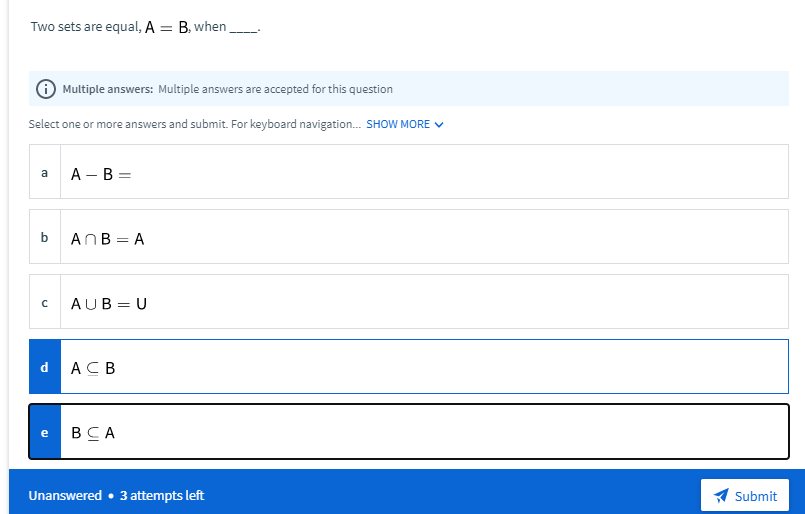
Looks good.
gritty crescent
b) is incorrect; A could be a proper subset of B and the statement would still hold
gritty crescent
Counterexample: A={1,2,3}, B={1,2,3,4}. Then A intersection B={1,2,3}=A, but A is not equal to B.
brave lava
but A isn't a proper subset. Both the sets are equal as given in the question
gritty crescent
They've asked when is A=B?, not actually if A=B, then...
The sole criterion is infact A subset B and B subset A
 brave lava
<@&286206848099549185>
 minor dagger
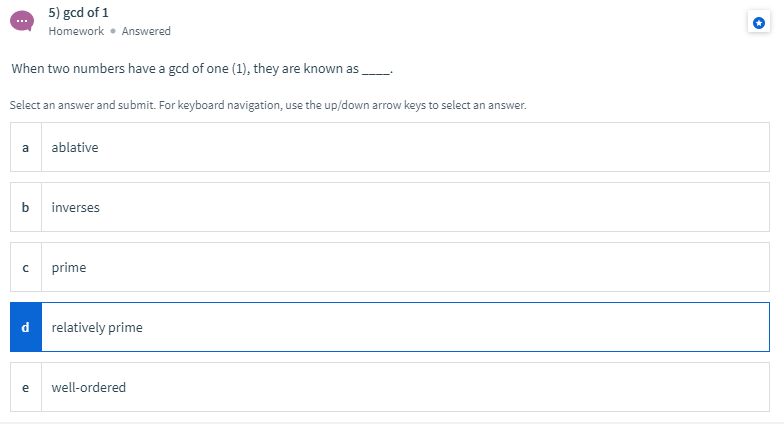
are you allowed to select more than one answer>
should be relatively prime
because they dont actually have to be prime they just need not share any common divisors
other than 1 of course
weary tiger
anyone knows how to get the range of this function?
minor dagger
you might be able to say well-ordered because the non-empty set of divisors for each contain the same smallest values
not sure tho
gritty crescent
@weary tiger You can figure out range for both the definitions individually and then get their unions?
 minor dagger
looks good to me
 sonic path
does this properly represent an example of a relation on a set that is neither symmetric nor antisymmetric
weary tiger
try to remember what the definitions of those words are, and then figure out what each means in terms of the matrix representing the relation
but if you just want an answer to check your reasoning by, yes it does
brave lava
 sick swallow
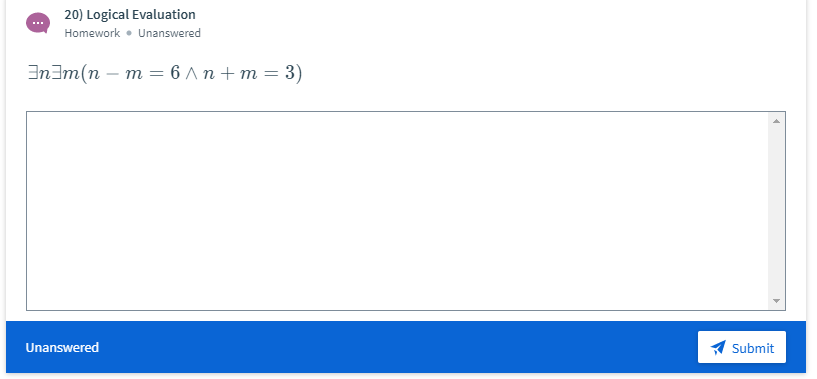
it is just an easy simultaneous equation
 pale epoch
do you know what that means in english?
brave lava
no
pale epoch
then look up the definitions of the symbols
brave lava
can you help?
minor dagger
bruh if you are trying to do discrete math you NEED to know the notation
sick swallow
it was trivial
brave lava

stuck
we have to assume a is not congruent to b mod m
does anyone know what steps are after
weary tiger
how do you define a to be congruent to b mod m
brave lava
using multiples lol? idk
weary tiger
well how do you want to solve an exercise about congruence if you don't know the definition
brave lava
thats why im asking
weary tiger
before asking someone you should read your book if you have one or if you're learning without book search on internet
i could tell you a definition but i think it's better if you find it yourself
 pure mountain
a hypercube in dim 3
Define Diameter as the longest shortest path between two nodes
in our case does that imply Diamater is 3 ? because of we pick (0,0,0), to get to (1,1,1) # of edges = 3?
because we cant do better
weary tiger
you need to prove that you cant do better
pure mountain
we can think of it as a graph
Let me draw something
and label nodes to give a succicent understanding
we get a torus
glass condor
for an n-dim cube, each step in the path corrects one coordinate
so to go from (0,...,0) to (1,...,1) you need n steps.
glass condor
in the general case, the length of the shortest path between $(x_1,x_2,\dots,x_n)$ and $(y_1,y_2,\dots,y_n)$ is $\sum_{i=1}^n |x_i-y_i|$, yeah
vital dewBOT
ConfusedReptile:
glass condor
so at most n, when all the coordinates are different (opposing vertices of the hypercube).
pure mountain
oh
ur the best
and when i think of it
it make sense
thanks
its so nice
when you transform a problem
into a form where u can easily reason
about it easily
thank sir~
glass condor
huh, by the way this means that all path lengths between two vertices in a hypercube have the same oddity
uhh, evenness. However you call divisibility by 2
EDIT: a-ha, parity, thanks Madeleine
because in order to deviate from the shortest path, you need to choose to change a coordinate that doesn't need changing and then change it back, so 2 additional edges traversed
 mystic moss
interesting. is this not true for things that are not hypercubes? (also, parity)
glass condor
is this not true for things that are not hypercubes?
here it's due to the fact that all edges have a simple form in the coordinate representation. One can see that for a full graph, paths of all lengths are possible. Besides that, no idea 🙂
honest barn
thanks, this is a really good image, I'm gonna steal it
weary tiger
What’s ā I haven’t seen that notation
wild flame
Is it more or does the book does a poor job at answering #11?
I was able to solve the issue by using some logical equivalence laws.
And I checked via Chegg and they had a similar answer. So I want to ask a few questions.
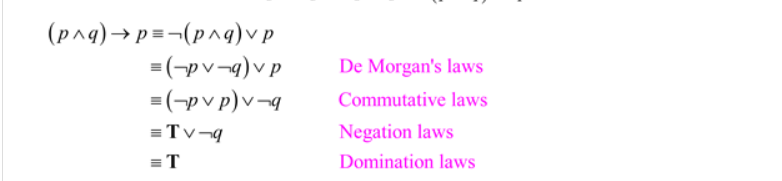
Couldn't the portion changed with the Commutative law also be just as easily changed with the Associative law?
stray reef
actually TECHNICALLY you need to apply the associative law then the commutative law then the associative law again if you're being extra formal
wild flame
Ah. Why is that? is not extra formal
stray reef
cause you need to regroup the parentheses to the right, then switch around the p and the !q, then regroup the parentheses back
scarlet current
for proofs by contradiction
can i just negate the theorem
and show that it is false
hence the original theorem is true?
 sour arrow
- Assume the negation of the theorem
- Prove ANYTHING both true and false at the same time, which is not allowed
- Therefore assumption was wrong and the theorem is proven
 stark creek
ehm, hi i have a question in kinda stuck on
A particle moves in a horizontal line. The distance it covers each second is twice the distance it covered in the previous second. If a_n represents the position of the particle at the second n. Find a recurrence relation for a_n.
i mean, i know the answer just by kinda looking at it
id say its ||2^n - 1||
but my professors solution is very very very different and i dont understand it
sour arrow
That's a formula for the position at any n, and not a recurrence relation for it
stark creek
oh
well how do i find a recurrence relation, i dont really understand them tbh
i could say that An-An-1 = 2(An-1 - An-2)
but
is that enough?
dont i have to solve that somehow?
sour arrow
Lol yeah that's a recurrence
One could solve that, but the question doesn't want you to
stark creek
i see
well
how would i solve it?
the first step is seeing if that discrete function is homogeneous or not?
sour arrow
Okay good you know a little bit of this
scarlet current
Prove that If n is an integer, then n is odd if and only if n^2 is odd. For this question is the conditional statement important? or do I only look at the biconditional?
stark creek
that might not be the right word in english sorry
sour arrow
This one is homogeneous, so the solution will be terms of the form
a(n) = Cλ^n
Sub that in, you'll be able to solve a quadratic to get λ
stark creek
so, i know its homogeneous because there are only terms with An or An-1 and things like that right?
sour arrow
Exactly
stark creek
because there are no independent terms
okay okay
i think i see it now
thanks a lot kaynex, the wise!
i will probably be back
sour arrow
Np! Feel free to ask if you need anything else!
stark creek
also, i get the C and the λ by subbing in different terms that i know the values of, right?
scarlet current
i took into account the conditional statement and now I negated the theorem "n is an integer and ((n is odd and n^2 is even) or (n is even and n^2 is odd))"
stark creek
if n^2 is odd, then n is odd
i would try to prove that if n^2 is odd, then n is even
scarlet current
can i simply just go like if n^2 is even then n must be even (definition of even numbers) but it says n is odd when n^2 is even so contradiction?
sour arrow
@scarlet current
The question is a common example of the contrapositive
sour arrow
Do you have to do this one with contradiction?
scarlet current
no
sour arrow
Oh fuq sorry you need the iff
scarlet current
the textbook solved it by just showing
if n is odd then n^2 is odd and if n^2 is odd then n is odd
sour arrow
So there's two proofs in one statement here:
n is odd → n² is odd
n² is odd → n is odd
scarlet current
ah ok thanks for the help!
sour arrow
Did you need any other help with it?
stark creek
Find a recurrence relation to obtain the number of ways n poker chips (which can be blue, green, red or white) can be stacked without 2 consecutive blue chips.
im back.
so
sour arrow
Lol welcome back
sour arrow
This one is tricky
sour arrow
How many ways can you stack one chip?
stark creek
4
sour arrow
The trick is to think top-down if that helps
stark creek
yeah thats what im doing
but it gets kinda fuzzy when theres multiple blues in different places
sour arrow
Think of the number of ways to write the order of the chips above position n, in terms of the number of ways to write the two positions above it
stark creek
okay
so two cases for this
one if the top most chip is blue
and one if the 2nd chip is blue
if the top chip is blue, there are 3 possibities for the 2nd chip
sour arrow
I had some serious trouble wording that haha
stark creek
hahah i think i know what you mean, i kinda remember from class
but my professors are just so vague about it
heres where im at right now
n-2 | RGW | B
n-2 | RGWB | RGW
those are two cases i guess
if the last chip is blue, the 2nd can be red green or white
and whatever comes before that is just the solution of n-2
and then if the last chip is NOT blue, then the 2nd chip can be any color
and all before that is the solution of n-2
so now i guess i have to add these, as they are totally parallel to each other
the first situation gives me 3An-2
and the other one 12An-2
but that doesnt look right
sour arrow
Let s(n) be the number of possibilities above position n for any stack, where the top chip is position 1, ect. Let's say s(any non-positive number) = 0
Let's say at position n, there's a blue chip. Then, there's 3 + s(n - 2) ways to stack from here up.
Let's say there's a non-blue chip at position n. Then, there's 3 + s(n - 1) to stack from here up.
Like you said, these are disjoint so we can just sum them.
s(n) = s(n - 1) + s(n - 2) + 6
@stark creek
Oof but that can't be right, that would imply s(1) = 6. Hmm.
mystic moss
say s(0)=1 and s(1)=4. then could it be that s(n)=3(s(n-1) + s(n-2))?
where s(n) is the number of ways to pile a stack of height n (sorry for abusing your notation kaynex 😅)
@stark creek
 bronze rain
I think it is easier to look at recurrence equations for sequences ending with a blue or a non-blue chip. Then combining then. However the manipulations required for getting a recurrence for the total may not be the most straightforward and more importantly may not give much insight into the problem.
mystic moss
yeah, if you end with a blue chip you have one way to choose the blue chip, 3 ways to choose the previous chip, and s(n-2) ways to choose the rest. if you don't end with a blue chip, you have 3 ways to choose that chip and s(n-1) ways to choose the rest
which manipulations are you referring to here?
stark creek
oh
bronze rain
Ah right. I meant having separate b(n) and b'(n), and s(n) being their sum. But yes what you wrote is easy to see.
stark creek
ladies and gentlemen
i got it
n-2 | RGW | B
n-2 | RGWB | RGW
doing this
i realized that the one in the second row is just n-1
so the relation is An=3An-1 + 3An-2
i think thats what @mystic moss had said
scarlet current
how would you solve this? prove that 3^n < n! if n is an integer greater than 6. Would it be by induction?
bronze rain
Induction is the easiest I guess
stark creek
yeah
its induction
over the the set of integers greater than 6
so instead of analyzing p(1) you would use p(7) as your starting point
@scarlet current
scarlet current
is there any other way to solve it?


 weary tiger
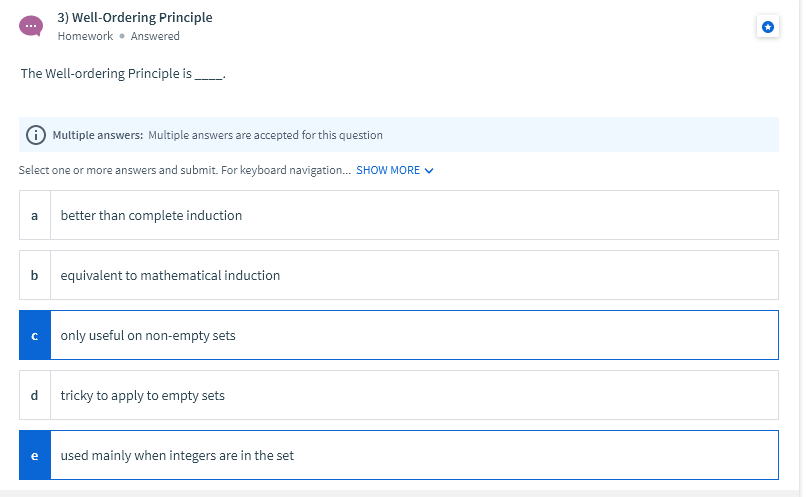
b is true
brave lava
thanks
weary tiger
you should probably either try to prove it or look at a proof of that tho
not good to mindlessly memorize things imo
gritty crescent
A school has a certain number of students, and every student must participate in one of its 3 clubs. If each club has exactly 35 members and the only thing that is known is that 10 students are members of all the 3 clubs, find the minimum and the maximum possible number of students in the school.
I came up with minimum=60 and maximum=85 with a lot of contrived reasoning. Can anyone guide me through a legible solution?
pale epoch
how that minimum 🤔
bronze rain
Could you let us know your line of thought? Might be helpful to emphasize the points where you seem to be having trouble.
gritty crescent
Say there are 3 clubs, and 2 of them have a total overlap of 25 students. The 3rd club has 25 members who are not members of either of the remaining 2 clubs and has 10 more members who are members of both the other clubs. That gives me a total of 25+35=60 students.
pale epoch
but what if every student is member of every club
gritty crescent
The intersection of students in all three clubs is restricted to 10 
pale epoch
is it?
gritty crescent
Yes
Uh let's ground some notation here. Suppose the clubs are denoted by A,B and C. Then $$n(A)=n(B)=n(C)=35$$and $$n(A\cap B\cap C)=10$$These are the only two pieces of information I have, and I need to find $$\max(n(A\cup B\cup C))\text{ and }\min(n(A\cup B\cup C))$$
vital dewBOT
TedNowKaczynski:
gritty crescent
My contrived reasoning to get these values is to minimise/maximise the overlap somehow
bronze rain
Why do you believe that the case you considered actually gives the minimum? Or can you try to do better?
gritty crescent
This is precisely why I call my reasoning contrived
bronze rain
Your reasoning is intuitively on the right track but try not to limit the possibilities
gritty crescent
I'm aware that $$n(A\cup B\cup C)=n(A)+n(B)+n(C)-n(A\cap B)-n(B\cap C)-n(C\cap A)+n(A\cap B\cap C)$$
pale epoch
a student can fill at most 2 slots
vital dewBOT
TedNowKaczynski:
stray reef
$|A \cup B \cup C| = |A| + |B| + |C| + |A \cap B \cap C| - |A \cap B| - |B \cap C| - |C \cap A|$
vital dewBOT
Ann:
gritty crescent
Lel I did an overflow but I'm aware of it.
a student can fill at most 2 slots
@pale epoch
gritty crescent
That makes sense
pale epoch
and my quick sketch confirms that it's possible
stray reef
$|A \cup B \cup C| = 115 - |A \cap B| - |B \cap C| - |C \cap A| = 115 - 30 - \sum_{cyc} |A \cap B \setminus C|$
vital dewBOT
Ann:
pale epoch
and the "a student can fill at most 2 slots" should show its the min
gritty crescent
Cyclic index 
stray reef
im lazy ok
gritty crescent
and the "a student can fill at most 2 slots" should show its the min
@pale epoch I see, I'll try to sketch this rigorously.
stray reef
the sum is the number of ppl in exactly two clubs
bronze rain
Yeah the maximum was fine
gritty crescent
😌
Might get partial credit afterall
But I still need to figure out the minimum bit on my own.
Are "non-crossing" and "no isolated element" standard terminology in relations/combinatorics?
One of the questions I encountered today was about finding the number of non-crossing and "no-isolated element" relations from the set {1,2,...,k} to {1,2,...,n}
The two terms were defined, so I can clarify what they mean
pale epoch
never heard either
bronze rain
I'm guessing non-crossing is some kind of order condition on the images of the elements
gritty crescent
Okay, they did give formal definitions for both that I've now forgotten, but I can supplement the idea with a picture. If you place the elements of the sets {1,2,..,k} and {1,2,...,n} in parallel rows, when matching elements of first to second(to create a relation), none of the lines should intersect. This was roughly the idea of non-crossing relations.
pale epoch
combinatorics is so whack
gritty crescent
So say if you've got (1,1) and (2,1) in your relation, then you can't get (1,2)
bronze rain
Yeah that's what I guessed. Ah interesting it's relations not functions. That makes it not as easy as I had originally thought.
gritty crescent
This was the non-crossing condition. The no-isolated element condition simply met that every element should have at least one image, and every element of the set {1,2,...,n} should have at least one pre-image.
Yeah, relations are whack.
I tried doing the case for n=k, and realised on my way back from the test that I did that one wrong as well 
Apparently I said the identity map worked, but there were more possibilities which I couldn't even count
bronze rain
So when you say intersect, is this allowed: (j, i) and (j+1, i) in that relation?
glass condor
If you place the elements of the sets {1,2,..,k} and {1,2,...,n} in parallel rows, when matching elements of first to second(to create a relation), none of the lines should intersect. This was roughly the idea of non-crossing relations.
oh god, I think I've got combinatorics flashbacks from this one
that's some classical task, but I most certainly don't remember how it's solved
gritty crescent
So when you say intersect, is this allowed: (j, i) and (j+1, i) in that relation?
@bronze rain As long as (j,i+p) for some p does not happen, sure.
Uh can you guys suggest some resources to get a hang of combinatorics and proofs based on them?
It's whack and I don't get it right most of the times, tripping over one thing or the other.
pale epoch
there is no overarching theory for combinatorics
gritty crescent
:(
bronze rain
A really really good book but I'm not sure if it's at your level is Jukna's Extremal Combinatorics
gritty crescent
Would a book on Discrete Math suffice?
pale epoch
every problem is solved by magic
bronze rain
But yeah combinatorics is more about problems and a wide variety of techniques
gritty crescent
The name sounds intimidating @bronze rain , I'm fairly certain it would be beyond me.
pale epoch
or by divine provenance
gritty crescent
I have neither
bronze rain
The first chapter or so is definitely accessible I think.
Jukna was the name of the author by the way in case that was confusing
mystic moss
about the problem--given a number of mappings between the two sets, could you do a stars-and-bars kind of argument on both sides?
gritty crescent
I hope you can forgive me for not knowing what stars-and-bars argument is supposed to be.
bronze rain
Yes that's what I was thinking could be done Madeleine
mystic moss
ah it's an aops thing I guess
gritty crescent
Might have to look up AoPS texts on combinatorics, perhaps they could give me some grounding.
mystic moss
and then maybe it could be a summation over all possible numbers of mappings?
@gritty crescent yeah I liked their combo books
gritty crescent
Thanks, I'll look into it. Maybe I need some more grounding in combinatorics before handling such problems.
While matching I came up with a pseudo-boolean value argument but it failed too
bronze rain
For the other no isolated one, do you have any ideas?
gritty crescent
With the picture at hand, I could choose to either map an element to its identity, or its successor/predecessor(in two separate cases) or both simultaneously. I could not discard the possibility of neither happening, though.
Nope honestly, I think the first condition that has to be placed is, in fact, the no-isolated elements one.
Not only this, I was actually asked to find a recurrence relation f(k,n) which described it
And then find the value of f(3,n)
bronze rain
That actually makes more sense than asking for a closed form expression.
mystic moss
there was another no isolated one? 🤔
mystic moss
I'm apparently confused about the question ;-;
gritty crescent
Although a bit vaguely
mystic moss
hm okay
gritty crescent
I'll rephrase the question
mystic moss
thanks :))
gritty crescent
I'll try to be as coherent as I can
I have to find the number of relations from the set S={1,2,...,k} to T={1,2,...,n} such that:
i)Every element of S is related to at least one element of T, and every element of T has at least one pre-image in the relation(this is the condition of no-isolated element)
ii) If you place the elements of S and T parallel to each other in rows, and join the elements related to each other by a line, then the lines should not intersect at any point(this is the condition of no-crossing; there was a formal definition but I forgot it :3)
The solution is sought as a recurrence relation f(k,n).
scarlet current
why is set A and set B equal if and only if ∀x(x ∈ A ↔ x ∈ B)? why not ∀x(x ∈ A /\ x ∈ B)
(/\ meant as conjunction sign)
glass condor
because that'd mean both A and B are equal to the universal set 😛
scarlet current
ah right
mystic moss
well okay if you add another element to S, is it the case that you can only hope to add it to the last element in T?
and vice versa
gritty crescent
Yes, makes sense.
But it could be the case that it can be joined to its predecessor as well
mystic moss
whose predecessor?
gritty crescent
Ummm suppose that n>k. Then, k->n as well as possibly k->(n-1).
stray reef
what's ->
gritty crescent
I guess that works regardless of the relation between n and k though 
mystic moss
n needed to be connected to k-1 though
gritty crescent
Maps to
mystic moss
like {1, 2, ..., k-1}
gritty crescent
I so wish to be able to draw on the screen atm :3 lemme grab a quick visual from GeoGebra to clarify what I meant
So here, k->n as well as k->(n-1)
mystic moss
right, but if we consider recursion, we're adding vertex k to the existing relation between {1, 2, ..., k-1} and {1, 2, ..., n}
gritty crescent
Correct.
mystic moss
so n must have been connected to something before k
gritty crescent
I hadn't even thought about this problem in terms of recursion 
I struggled to even get a basic idea of what sort of relations I'm looking for, then got stuck up in a jumble of combinatorial arguments
mystic moss
;-; this was for a test?
bronze rain
I think an idea is to pick the earliest neighbour of k and then see whether you want to allow that to be connected to others or not.
bronze rain
Wild for an entrance test
gritty crescent
They take in olympiad kids, not very surprising
mystic moss
earliest neighbor of k?
weary tiger
huh
bronze rain
If (k, i) holds then (k, j) for all j > i. Unless I messed up somewhere
weary tiger
meanwhile American unis:
my life be like dat
gritty crescent
If all else fails I might head to American unis, ngl
mystic moss
right, yeah. you'd get that by starting at a scenario where k=k and n=i and then adding vertices to T until n=n, right?
bronze rain
Yes
gritty crescent
Question: Does this have anything to do with graph theory?
mystic moss
oh so when you mean choose the earliest neighbor, it's like a kind of fan almost
i don't believe so
gritty crescent
Oh, alright.
weary tiger
relations can be interpreted in terms of adjacency matrices so kinda
scarlet current
sorry to interrupt but why is A a subset of {a,b} when {a,b} is in set A?
bronze rain
But graphs are pretty nice that way. They model a lot of things.
mystic moss
yeah, that's true. i don't think any graph theory results are specifically used here though
bronze rain
I agree
stray reef
@scarlet current where does it say that A ⊆ {a,b}?
scarlet current
sorry to interrupt but why is A a subset of {a,b} when {a,b} is in set A?
@scarlet current oh nvm A is not a subset of {a,b}
got confused by the B
gritty crescent
Much thanks for the help everyone. I think I'm still lacking a lot of background knowledge here, so I'll try to study some combinatorics from AoPS first and then come back to this problem.
scarlet current
also what is the difference between {a} and a?
gritty crescent
{a} is the set containing the element a
scarlet current
ah i see
mystic moss
sure thing. when you do come back to it, do tell
gritty crescent
Thanks :) Your help is much appreciated.
weary tiger
competition math kids are something else
always blows my mind how early in life people can really delve into that world
gritty crescent
This particular test was neat, the problems were very descriptive and gave definitions, even hints and suggestions for almost all problems.
For instance, for this particular problem drawing a diagram was suggested.
mystic moss
i hope you do get into that college then, it seems nice
gritty crescent
Yeah, might have to try next year again, I plan to build some math background by that time but now I'm a bit split into thoughts.
I initially planned to study elementary analysis/abstract algebra in this gap duration but now I think I might have to focus on combinatorics/geometry which are relevant to the test.
weary tiger
check this out
if you move the parallel lines around into perpendicular ones, and curve the edges in the right way
wait nvm
mystic moss
it's nice that you can try again after you've studied more. also, gap duration?
weary tiger
oh wait yep it's fine:
every corner is a 1 in the adjacency matrix
elsewhere 0
and you always get something that looks like that with no crossings
gritty crescent
Hmmm, niceee, ConfusedReptile gave me a solution about antisymmetric relations based on a matrix argument too.
mystic moss
oh so like a path from the top left to bottom right?
gritty crescent
it's nice that you can try again after you've studied more. also, gap duration?
@mystic moss Ah, I got out of HS this year and covid happened, so the entire admission process got delayed by months. I might be on a gap year till the admission process next year now.
Ngl, I'm a bit glad it happened, I wouldn't have fallen for maths else if!
mystic moss
yeah, relatable. the two months after quarantine started was when i learned web dev :)) wouldn't have had the time otherwise
weary tiger
POG
gritty crescent
I wish I used the initial time in a better way though, if the realisation would've struck me earlier I might've gotten through but well, no point regretting now.
Web dev is cool
And tough Ig?
mystic moss
i wouldn't want to still be in quarantine when college starts though, that would be sad
yeah i'd originally wanted to because of web exploit in ctfs
weary tiger
but based on my drawing is there like something that's close to permutations but if you choose "none" as an option it cuts off the remaining options forever? Cause it's basically a k-repeating version of that
mystic moss
it's hard to attack something if you don't know how it works ;-;
"none" as an option?
weary tiger
Yeah so look at the options for the first column vertex's adjacencies to the row vertices
you have n choices, then none or n-1, or none or n-2, etc, and say where you pick none is m
and then for the second column vertex it's the same thing but for n-m I think
this interpretation probably makes things more complicated than other solutions though so maybe not worth pursuing
mystic moss
how do you get those choices for the first column vertex?
weary tiger
Ahh wait, it's close
It needs at least one adjacency, but the furthest one it can take is the n-k-th row vertex
err
wait no
mystic moss
hm?
weary tiger
I was thinking of this wrong
the first row vertex has to connect to the first column vertex
mystic moss
yeah, and it has to be connected to every consecutive vertex after that until it decides to leave the rest to the remaining vertices
this seems very related to stars and bars
weary tiger
havent taken combinatorics but looks interesting
mystic moss
yeah. also there are some edges in that diagram that can be potentially deleted, right?
weary tiger
yeah
mystic moss
oh interesting. we can think about this as the column vertices "claiming" subsets of the row vertices
weary tiger
and I think it's recursive from there
mystic moss
in this case, 1 gets 1, 2 gets 2, 3 gets 34, and 4 gets 5
i think we don't particularly need recursion in this case, perhaps?
weary tiger
so f(n,k) = (first row vertex's choices that leave n-s row vertices including the last one it connected to) + f(n-s,k-1)
mystic moss
yeah, that works
weary tiger
POG
mystic moss
we also have that k-1 can choose to connect to the n-sth vertex if it wants