#discrete-math
1 messages · Page 143 of 1
 pale epoch
maybe
 brave lava
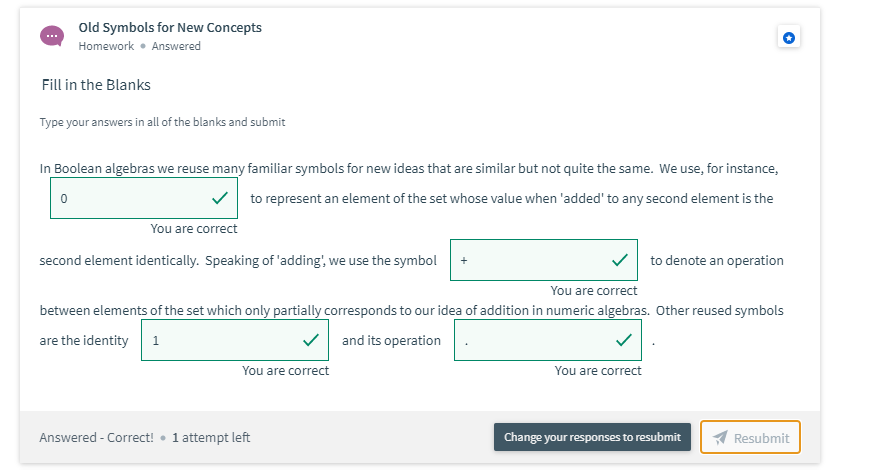
it was the . lmao
he kept repeating it in his lecture
so I put that for multiplication
thanks though
that made a lot of sense
👍
 near root
True or false:
B={1,2,3..., m}
C={m+1, m+2, m+3..., m+n}
A = B U C
Number of functions f:A->A that fulfill |f^-1[{1}]| = m and |f^-1[{2}]| = n is C(m+n, m).
I think that's true since after picking m amount of numbers you're left with an n amount of numbers to pick from that you pick n amount that comes to n over n aka 1 so it's C(n+m, m) * 1
near root
Binomial? Lemme google that
pale epoch
B is just a set
its just a weird way of saying that A is the set of the first n+m natural numbers
near root
I think C is just a group of natural numbers
Since B is natural numbers up to n
So...
pale epoch
wait what do you mean by group?
near root
I meant set
pale epoch
ok
near root
Forgive my poor math English
pale epoch
A, B and C are sets
near root
Yes
near root
Is my explanation right?
pale epoch
it's not wrong
it's a bit short
you could/should add what are you choosing
why are those the only choices to make
near root
Because you already picked an m amount of numbers therefore you're left with an (n+m)-m numbers to pick from and you need to pick n amount of numbers
Is that not sufficient?
pale epoch
but what are you picking
when you pick m out of n+m numbers
what are those m numbers
near root
They're the numbers that are all sent to {1}
pale epoch
exactly
you first choose the m numbers that are sent to 1
and then choose the numbers sent to 2
and get that result
i would add that to the explanation, then its better
near root
x1+x2...+x7 = 10
The number of solutions that none of the numbers is a multiplication of 2 or 3 is the coefficient of x^10 in the opening(don't know the right term for it in English) of (1+x+x^5+x^7)^7
I have no clue how to use the generating function
near root
I know 1 is there because it's x in the power of 0, but isn't 0 considered to br a multiplication of 2 and 3 ?
 stray reef
x1+x2...+x7 = 10
The number of solutionsthatin which none of the numbers is amultiplicationmultiple of 2 or 3 is the coefficient of x^10 in theopening(don't know the right term for it in English)expansion of (1+x+x^5+x^7)^7
hmm... you're right, this expansion does allow the x_i to be zero
and 0 is a multiple of 2 and also of 3
are you sure you wrote down the problem correctly tho
@near root
near root
It's true or false but yeaa
stray reef
why didn't you say it was a t/f question
stray reef
multiple
near root
?
near root
Is it false though?
stray reef
yes, it is false
but you're using the word multiplication where you should be using multiple
near root
One more question if you don't mind, the x1+...+x7 = still stands. Number of solutions where exactly 3 unknown numbers are equivalent to 2 is C(7,3).
I pretty much just did D(4, 4), is it right ?
stray reef
equal*
also holy fuck how hard is it to acknowledge something when i point it out for the second time
also what's D?
near root
C(n-1+k, k)
stray reef
exactly three unknowns are 2... the other four are forced to be 1 since i assume they must be positive
near root
They could be zero
stray reef
oh they could? hold up
stray reef
(2,2,2,0,0,1,3) would be a valid solution but it doesn't get included in the C(7,3) count
near root
Why isn't it included there?
stray reef
because C(7,3) counts the permutations of (2,2,2,1,1,1,1)
looks like you want the coefficient of x^10y^3 in (1+x+x^2y+x^3+x^4)^7
 mint bane
can someone help me with this proof please
i have predicate and base case set up ofc
this is what i got so far
 vital dewBOT
˞˞˞˞˞˞˞˞˞˞˞˞˞˞˞˞˞˞:
pale epoch
exactly what confuses you?
 nova pewter
I don't know if you're allowed to have a compliment of the union sign
pale epoch
$\overline{\cup}$?
vital dewBOT
Lochverstärker:
nova pewter
yes, is that allowed?
pale epoch
what is it supposed to mean
nova pewter
I don't know either
pale epoch
is there an example where this actually appears?
vital dewBOT
Lochverstärker:
pale epoch
which is perfectly fine
or maybe $\overline{(\overline{A} \cup \overline{B})}$ makes it clearer
vital dewBOT
Lochverstärker:
nova pewter
Ok, that makes sense. I think it's just that sets confuse me
thanks for the help
$ \langle 3,1 \rangle \in (A, \geq) $
vital dewBOT
Larz:
nova pewter
is this correct notation?
Because after my understanding, (A, greater or equal) is a set?
nova pewter
Oh, I struggle with translating math to english, but I can try
pale epoch
i mean right now this makes 0 sense to me
so it's better you tell me what you want to say, to see where this goes wrong
nova pewter
So I'm basically saying that (3,1) which is a 2-tuple, is part of the ordered set of (A, greater or equal)
Let's say, A = {-3, -2, -1, 0, 1, 2, 3}, then (A, greater or equal) is the ordered set. Does it make sense? ^
pale epoch
ok
what you want to say makes sense, it does not correspond to the notation above
the easiest way to write that down is just $3 \geq 1$
vital dewBOT
Lochverstärker:
nova pewter
Well, yes that's true haha
pale epoch
depending on how you formalize what exactly an order (or a function for that matter) is, you can say other things
but that's really obfuscating things
nova pewter
Thanks though, I am totally overcomplicating things
pale epoch
in general, don't use \langle, \rangle for tuples, it's just (,)
and (A, >=) is technically a set
nova pewter
Really? I've seen they've been used elsewhere.
nova pewter
Okay, thanks.
pale epoch
depending how you formalize mathematics, everything is a set
but in this example, you could probably not tell me how an element of $(A, \geq)$ even looks like
vital dewBOT
Lochverstärker:
pale epoch
so better not talk about them
nova pewter
I suppose (A,>=) just gives you the relation between elements
pale epoch
it just tells you that we have a set A and some kind of relation called >= on A
just a convenient way to group information
in most contexts you would not even mention >= and just talk about A
nova pewter
Riiight right.. That makes a lot of sense actually.
But it suddenly makes sense WITH context.
 swift agate
Prove that the following wff is a valid argument: (∀x)[S(x)→(∃y)(P(x,y)∧T(y))]∧(∃x)(C(x)∧S(x))→(∃x)(∃y)((C(x)∧T(y)∧P(x,y))
Could someone help me with this problem?
 lyric pumice
@swift agate It looks like a parenthesis is missing at the end.
swift agate
it is a difficult problem for me ... i had one other one i was having trouble with that might be easier.... either prove that the wff is a valid argument or give an interpretation in which it is false: (∃x)[R(x)∨S(x)]→(∃x)R(x)∨(∃x)S(x)
so for the second problem I have 1. (∃x)[R(x)∨S(x)] Hyp 2. (∃x)R(x) Hyp by deduction 3. R(a)∨S(a) from 1 by ei 4. R(a) from 2 by ei
nova pewter
$ \emptyset \cap \overline{B} = U \cup B $ ?
vital dewBOT
Larz:
nova pewter
This just looks wrong, what am I doing
nova pewter
haha
pale epoch
$\varnothing \cap A = \varnothing$ for every set A
vital dewBOT
Lochverstärker:
nova pewter
Oh, right that makes sense
pale epoch
so that is true iff U is the empty set i guess
lyric pumice
@swift agate The second statement is clearly valid.
@swift agate The first statement is clearly valid.
Let a be such that C(a) and S(a). Then using the universal instantiation, S(a) implies P(a,b) and T(b) for some b. So, a and b are such that C(a) and T(b) and P(a,b).
swift agate
@lyric pumice thank you I am still having trouble with it but thanks for responding..I sent email to professor so hopefully I will understand soon
 bronze wagon
How would I solve this problem?
 last timber
bronze wagon
last timber
bronze wagon
yeah Im kinda confused on how to make the truth table
 lapis idol
 wintry schooner
hey, could anyone show me some guidance on how to solve this problem, new to discrete maths so mind if its very basic to you 😛
 unreal stump
Don't ask whether someone will help. Just ask
wintry schooner
For each of the following binary relations, determine whether it is
reflexive, symmetric, antisymmetric or transitive. For each point, state your reasoning in
proper sentences.
I have a feeling it may be antisymmetric but im not sure if Im on the right track
or how I could explain my reasoning
stray reef
it's vacuously asymmetric because it's impossible for two parties to both have more seats than the other
wintry schooner
oh okay thanks
i see now
so it would not be either one of these? reflexive, symmetric, antisymmetric or transitive
because my question asks to whether it is either of them
stray reef
it is transitive
seats(N) > seats(L) and seats(L) > seats(M) implies seats(N) > seats(M)
wintry schooner
so its transitive because you cannot have two parties where both have more seats than the other?
ahhhh yes
ahh okay thanks bro
stray reef
please don't bro me
wintry schooner
understand a bit better now cheers
stray reef
but yw
 gritty crescent
Let $A$ be the set ${1,2,...,20}$. Fix two disjoint subsets $S_1$ and $S_2$ of $A$, each with exactly three elements. How many 3-element subsets of $A$ are there, which have exactly one element common with $S_1$ and at least one element common with $S_2$?
vital dewBOT
TedNotKaczynski:
gritty crescent
I would like to know what is meant by 'fixing two subsets'-I'm guessing it means I first choose 3 elements from those 20, then 3 more from the remaining 17, and then proceed?
gritty crescent
Oww, I see.
gritty crescent
Hmm, I wouldn't see that spoiler yet.
gritty crescent
So I choose any one of the three elements of S1, then choose 1/2/3 elements from S2
?
gritty crescent
Oh, right, I need a 3 element subset.
So I'm supposed to choose 1 out of S1(3 choices), then select either 1 out of S2(again, 3 choices) and 2 out of the remaining 14 elements, or 2 out of S2 and the remaining element from the 14 elements?
 prisma osprey
I'm trying to come up with S and T such that f:S->T, g: T->S are both injections or surjections but f != g^{-1}, where S and T are finite sets
I've tried a few dfiferent sets for S and T such as like even and odd numbers between 0 and 10, or like pairs of numbers
But I ca'nt come up with any f and g that are'nt just inverses of each other?
err is this a discrete math question even?
 quaint star
@prisma osprey Let S = T = {1,2,3,4}. Let f map 1 to 2, 2 to 3, 3 to 4, and 4 to 1. And g map 1 to 3, 2 to 4, 3 to 1, and 4 to 2.


 weary tiger
Various keywords are used to specify this statement: descendants of ALGOL use "for", while descendants of Fortran use "do".
its heating up here
 sleek island
Does anyone have any idea how to solve this?
sleek island
<@&286206848099549185>
pale epoch
in the last step you are transforming $(p \lor r)$ to $(\neg p \implies r)$
vital dewBOT
Lochverstärker:
pale epoch
so there
 spring mica
why do i put parenthesis around it
as opposed to leaving it without parenthesis
@pale epoch
pale epoch
because implication is not associative
$$(0\implies 0)\implies 0 \equiv 1 \implies 0 \equiv 0$$ but $$0\implies (0\implies 0) \equiv 0 \implies 1 \equiv 1$$
vital dewBOT
Lochverstärker:
pale epoch
so without parenthesis its not clear how the statement is to be interpreted
weary tiger
I think that the first set of quantifiers is false, and the second is true. But I keep overthinking it, can anyone confirm?
pale epoch
the first statement is false, the second is true
it suffices to give a single counterexample to disprove the first
weary tiger
@pale epoch Phew thanks, for some reason two quantifiers of the same type keep messing with me
pale epoch
and it suffices to give a single example to prove the second
weary tiger
Would the reasoning behind the first one being false be that one could choose a y value that could be lower than x?
And the reasoning behind the second one being that there is a definite set of values x and y that make the statement true?
That's my logic^
pale epoch
you are correct on the second
on the first you probably think the right thing, but the argument is sloppy
for example -10 < 1, but 1^2 = 1 <= 10000 = (-10)^4
weary tiger
Oh shoot lol
pale epoch
i say "but" even though the statement is true
i.e. this is not a counterexample
but as i said, it suffices if you find any counterexample
weary tiger
@pale epoch Thanks, i'll try to practice more proof by contradiction. Once again appreciate the help
weary tiger
doing this problem
I think that this is basically the cartesian product of (1,0), (-1,0), (0,1), (0,-1) and [0,1]
I also have to sketch the cartesian coordinates, so does that mean this is a 3 dimensional graph of a cyclinder?
I was trying to find easy plots to point so I ended up doing the cartesian product between the radius and the points
sorry about that
if it was x^2 + y^2 < 1 the line would be dashed instead of solid right?
when drawing the cyclinder?
a shaded circle
ah that makes sense
because [0,1] is 0..1
makes it a lot easier to visualize that way thank you
that's pretty interesting
a donut?
also and elipse
 daring beacon
Does set A^c means every set considered
 shut sundial
i thought it meant the complement of A, so everything thats not A?
How do I read L = { x : ∃yℇ{a,b}*(x=ya)} and also what does it mean?
Also is there a good refresher pdf or something I could use to review all the symbols used in Discrete Math?
daring beacon
Wikipedia has a page on it for basic ones
Thanks it is the compliment but I was wondering if it means that every other set that isn’t A. So if there is set A,B,C than than A^c means set B, and,C
shut sundial
yes I think you are correct
 honest barn
Who needs a superset, just take its complement in the entire universe of objects
shut sundial
oh yeah gotta consider the universe
weary tiger
i think theyre just pointing out that the square is gonna be positive
spring mica
yeah it is
but is that equivalent notation @weary tiger
this is what it says in my textbook
weary tiger
yes that notation is equivalent
i dont think it was intended to be super formal though lol
looks more like just pointing out a hint to the reader to me, but i dont know the context
weary tiger
consider the hint and the power rule of exponents
it might also be more obvious if you consider a simple base like 2 instead of e
 woeful galleon
struggling to understand lol
spring mica
The textbook did S(m,y)
but i just did S(x) where x is the mail message
how do i know when to get more specific @weary tiger
weary tiger
is that the full answer?
spring mica
no
hold on
this is the full answer
This is what i did
where S(x) x = any mail message and s(x) is when its larger than 1 megabyte
@weary tiger
weary tiger
i wouldve done the same i think, since our number of megabytes wont vary
maybe its more formal to attach a variable to every number mentioned
spring mica
thank you so much!
spring mica
@weary tiger do you know what the A means here
in question 46
I can't see how its a predicate
since it dosen't take anything as input
weary tiger
u dont need to know what it is, just know that it holds some variables, just like P(x)
it just doesnt take input
spring mica
wdym by holds some variables
how can something hold variables but not take in input
A = x + y + z
weary tiger
A can be a list of numbers from 1 to 10, or the name of every person in group A, for example
spring mica
oh gotcha
@weary tiger why is the middle quantifier an exists
while the outer two are for all
i'm so confused
also why does the limit definition account for error
weary tiger
error?
gritty crescent
I guess you mean that for a given choice of delta, there will be some tolerance range in terms of epsilon(I've seen that being used as error margin in Thomas' Calculus in an engineering context)
 bold schooner
Hey guys, Ive been struggling trying to get this question, could someone please help me out with this?
pale epoch
what's the problem?
bold schooner
I'm not really understanding the use of quantifiers here, and tbh im not sure how to approach this question at all
pale epoch
just read as "there exists a y in Z, such that ..."
(a) is just plugging in values
(and some algebra)
bold schooner
(a) makes sense, I set the equation to 19 and 11 and i solved for y and I saw whether they were integers to see if they were true or false. but b and c arent making any sense to me
pale epoch
what is the definition of "open sentence" and "mathematical statement"
bold schooner
Open Sentence: A sentence that contains a
variable, where the truth of the sentence is determined by the value of the variable chosen
from the domain of the variable
Mathematical Statement: A statement is a sentence that has a definite state of being either true or false
Taken straight from the textbook^
pale epoch
then just plug in P(x, n) into the respective statements and see if the truth value still depends on a variable
i.e. if there is a variable not bound by a quantifier
bold schooner
well the one thing i did notice was that in b there were more variables than quantifiers
and n was not bound by a quantifier, whereas in (c) all the variables were bound on a quantifier
pale epoch
exactly
this makes (b) an open sentence according to your definition (its truth depends on the value of n chosen)
and it makes (c) a mathematical statement
namely "for all positive integers n, there are integers x and y, such that x^2 - xy + y^2 = n"
bold schooner
ur last statement is for c im assuming?
pale epoch
yes
bold schooner
thank you so much @pale epoch ! is my method for (a) correct as well?
bold schooner
alright thanks alot man!
weary tiger
$S:=:\left{1,2,3,4\right}$
vital dewBOT
The-Elite:
weary tiger
$S\backslash 4$
vital dewBOT
The-Elite:
weary tiger
are you allowed to do this for set complement?
like use a single value (i.e. 4 in this case)
or are you only allowed to use two sets for complement
pale epoch
only sets
weary tiger
oh
pale epoch
try $S\backslash {4}$
weary tiger
so i let E = {4}, I can do S\E?
vital dewBOT
Lochverstärker:
pale epoch
why not?
pale epoch
yes, it is correct
weary tiger
ok 🙂
weary tiger
A little confused on this homework question, I tried putting 4=7 as a statement as one in the last instance and said i was incorrect
I thought statements just have to have true/false values?
pale epoch
i would agree
pale epoch
with
I thought statements just have to have true/false values
weary tiger
Yeah exactly
weary tiger
Me too, but perhaps its just looking for statements that are true?
Which in the case would be what I put?
pale epoch
the statements you checked are true
do you have notes that define the term "statement"?
weary tiger
I do actually
Here:
"An expression that has a definite state of being either true or false"
pale epoch
then 4=7 is a statement
weary tiger
Exactly
The module isn't being too helpful with saying which ones are incorrect tbh
just saying im flat out wrong instead of which specific ones
I guess ill go with this?
pale epoch
the rectangle one is a statement, if A, B, C, D are fixed 🤷
weary tiger
they're technically true
that was my thought as well
but perhaps they're looking for a sentence which provides a true or false answer immediately
pale epoch
but i can't read your teachers mind
pale epoch
it could also be that your teacher thinks the term "some" is not well defined
but in mathematics it usually means "at least 1"
unreal stump
"There exists a x in Z,such that y=x^2 for all y in Z"
bold schooner
i dont get it 
unreal stump
The statement is saying if we choose one particular value of x
Then for whatever y we choose,y will be x^2
bold schooner
so if i choose lets say 1 for x
to be tru then all integer values of y have to be equal to x^2
 sick swallow
bruh it is basically saying 1=2
unreal stump
The Statement says such a value of x exists
 gusty crag
all of these are statements except for the one with theta
that's probably why you were marked wrong before, you were missing some of the statements
@weary tiger
 marble haven
if something is an element of a set, doesnt that imply that it is also a proper subset of that set?
pale epoch
$1 \in {1, 2, 3}$, but $1 \not\subset {1, 2, 3}$
vital dewBOT
Lochverstärker:
marble haven
oh that makes sense
pale epoch
however ${1} \subset {1, 2, 3}$
vital dewBOT
Lochverstärker:
pale epoch
also notice that 1 is an element of {1}, but {1} is not a proper subset of {1}
@marble haven
marble haven
oh
I was working with the possible existence of
if G is a subset of P(G), does G exist
(powerset of G)
gusty crag
if you allow something like "the set of all sets", then the power set of that set should be the set itself, so if such a set were to exist it would be both an element of and a subset of its power set
but that's putting no restrictions on what a set is allowed to be
I believe ZFC's axioms stop such a set from existing because it leads to contradictions (thank you russell)
weary tiger
Anyone familliar with falsifiability of disjunction normal form?
weary tiger
what does this C mean?
pale epoch
probably complement?
weary tiger
it is complement
vital dewBOT
Schuams:
 signal basin
Means "all the elements in X but not D".
weary tiger
how would i prove this?
pale epoch
using the definition of subset
sick swallow
this is assuming C is a subset of B right?
 naive saffron
I feel like they are the same set
sick swallow
i think so
naive saffron
If you choose some universal set X, say X=A U B U C, and use the fact that B-C = B intersect C^c
and distribute intersection over union
weary tiger
what if hypothetically, $B - C$ but B and C do not share any of the same elements?
vital dewBOT
maddog:
weary tiger
what would $B - C$ be equal to?
vital dewBOT
maddog:
weary tiger
oh
naive saffron
Sorry it should be B
weary tiger
no worries
i can see why this is true through boolean algebra
but i don't think you can carry over boolean algebra laws with set theory
and i can't speak in the language of proof
naive saffron
Well some properties of boolean algebra are similar to those in set theory
Like $A\cap(B\cup C)=(A\cap B)\cup(A\cap C)$
vital dewBOT
Whoever:
naive saffron
and $A\cap A=A\cup A=A$
vital dewBOT
Whoever:
naive saffron
Also $A\cup\varnothing=A$ and $A\cap\varnothing=\varnothing$
vital dewBOT
Whoever:
weary tiger
$G\backslash \left(T:∪:I:∪:P\right)$
vital dewBOT
The-Elite:
weary tiger
i'm trying to word this in english. Is it right to say we are removing elements from set T, I and P from set G?
vital dewBOT
Whoever:
weary tiger
ok
but would I use OR or AND
we are removing elements from set T, I or P from set G?
we are removing elements from set T, I and P from set G?
signal basin
@weary tiger If you are the CS type, then just reduce it to logical statements. That might be easier.
weary tiger
CS as in computer science?
signal basin
yes
signal basin
thought so
 patent fable
Would anyone be able to help me to understand transitive closure?
If I have the set {1,2,3,4,5} and R={(1,3), (2,4), (3,1), (4,2), (5,4)}, what would be the best technique I can use to solve this?
I understand I can look at the vertices (1,3) and (3,1) to create the point (1,1) or (2,4) and (4,2) to make (2,2) by combining the a of the first vertex and b of the second vertex (after identifying b of the first vertex = a of the second).
Guess the two questions I have are: How can I better understand transitive closure?
What is the best way to resolve this problem?
naive saffron
Transitive closure is just the smallest transitive relation containing your original set
and what you did is the best way
Just continue doing so until you can't add any more elements
naive saffron
Well see if (1,1), (2,2) and (4,5) with what's originally in the set can create more vertices
weary tiger
$x_1:+x_2+x_3:=80$
vital dewBOT
The-Elite:
weary tiger
it could be easier if you write it up and look for potential patterns if thats what you did, i find it easier than just doing all the calculations in the head
like write a directed graph
$0\le x_1\le 40$
vital dewBOT
The-Elite:
patent fable
ah, duh. (4,5) and (5,4) = (4,4) as well
weary tiger
$0\le x_2\le 32$
vital dewBOT
The-Elite:
weary tiger
$0\le x_3\le 64$
vital dewBOT
The-Elite:
patent fable
so, everytime I add a new vertex, check to see if there are any other vertices I can add?
naive saffron
Yeah
You need to keep doing so until you can't add anymore
i.e. until you have a transitive relation
patent fable
Perfect. So i'm assuming there's no perfect algorithm to find all possibilites. just trial and error
naive saffron
Well, you can't say for certain that there is no perfect algorithm
But I don't see any obvious way to speed up the process when the initial set is large
weary tiger
$x_1 + x_2 + x_3 = 80$
$0\le x_1\le 40$
$0\le x_2\le 32$
$0\le x_3\le 64$
if i wanted to find B∩C, I do
$x_1 + x_2 - 32 + x_2 - 64 = 80 - 32 - 64 = -16$
which is -14 choose 3
so does that mean that B∩C is just the empty set?
can't get this ever
there
naive saffron
@patent fable it turns out you can use Floyd-Warshall algorithm to compute the transitive closure by representing your initial relation as a directed graph: http://www.mathcs.emory.edu/~cheung/Courses/323/Syllabus/Graph/Warshall.html, but I think that's much more work than doing it by hand in this case
vital dewBOT
The-Elite:
weary tiger
I personally find it easier if you represent it with a directed graph, that was what i was taught in my course
it's easier to see patterns that way
for simple problems
naive saffron
Hmmm maybe yeah
patent fable
@naive saffron appreciate the algorithm. I'll look into that. I tried the digraph, I just think I'm terrible at drawing paths, so I tried to do the brute force method. I ended up with:
(1,1) (2,2) (4,5) (4,4) (2,5)
Ah, is (4,5) not to be added?
patent fable
How do you get (2,5)? The only way I found it was through (4,5)
weary tiger
so we have 5,4 and 4,2
which implies 2,5
according to transitive property or w/e its called
R had (5,4) and (4,2) if i recall correctly
but if u write it as a directed graph it would be very easy to see that
patent fable
Ohhhh I see it now
weary tiger
it's a good way to spot the minimum set to make it fulfill whatever property you want
the directed graph approach
patent fable
I see it much clearer now. The brute force method is a bit confusing since you have to keep adding vertices. Does the diagram in anyway show how you can get (2,5) without needing to find (5,4) and (4,2) together?
weary tiger
the blue color in the picture i sent shows that thing i talked about i.e 5,4 and 4,2 -> 2,5
okay
so the pattern u need to know
in order to fulfill transititve property
is uh
ill write it
whenever you have 2 vertices like this
i mean 3
then by transitive property it implies that
so thats the pattern u want to look out for
in the directed graph
patent fable
So the property states that even if all the paths go in 1 direction, the last vertex can reach the first?
weary tiger
ye
patent fable
Wow that's nice
I had no idea, that makes it a lot simpler. I didn't see that property in our notes at all
weary tiger
ye its nice for simple problems
patent fable
I was under the assumption that there was no way back. Thank you
weary tiger
idk about if there are more than 3 vertices though
but if there are 3 like the pic
then it works definitely
more than 3 idk
was a time ago i did this
i dont remember fully hehe
patent fable
I see, thank you
weary tiger
but just learn the directed graph approach and it will be easier
for other properties as well
to spot symmetry, anti-symmetry, reflexivity etc
the directed graph helps in that
the one i showed is for transititve, for reflexivity its easy just self loops
patent fable
Okay, I will have to find further instruction on digraphs so I better understand then
I saw reflexive in our text, all vertices must have self-loops to be reflexive
weary tiger
ye
patent fable
Awesome
weary tiger
and then
for symmetry
(y,p) => (p,y) i think thats the definition for symmetry
well probably more like y R p => p R y
uh my memory
😄
patent fable
Perfect, and I know there's no way to tell for antisymmetry for the most part based on the graph
weary tiger
the arrows just implies a relation between the 2 elements
u can with directed graphs
but i dont remember fully
i mean definitely for simple problems
patent fable
Ah, okay I'll look that up then
 naive mural
I think you did the transitivity thing wrong
naive mural
An equivalence relation looks like a disjoint union of complete graphs
weary tiger
so thats for transitivity
as i said my was a time ago i did this
sorry hehe
but @patent fable u can easily google this
patent fable
even then, (2,5) still should exist I think
weary tiger
it's 5,2 then i think
naive mural
Identity means it’s related to itself so it’s not really a graph
weary tiger
i just did it opposite
naive mural
Or a simple graph
weary tiger
patent fable
Can I ask how you would construct this digraph? @naive mural
Also, @weary tiger, I think because the set is {1,2,3,4,5} and R={(1,3), (2,4), (3,1), (4,2), (5,4)}
(5,4) (4,2) = (5,2)
naive mural
Is it meant to be a transitive relation?
patent fable
So the full transitive closure is R = (1,1), (1,3), (2,2), (2,4), (3,1), (4,2), (5,2), (5,4)
naive mural
Yeah then just draw all the lines in
patent fable
The question in the book is asking for transitive closure of the set {1,2,3,4,5} on the relation R={(1,3), (2,4), (3,1), (4,2), (5,4)}
naive mural
And (3,3)
Yeah, so you draw 5 on each side
Label them 1 to 5
And connect them all up that should be connected
patent fable
Ahhh, I didn't see (3,3) because (3,1) (1,3) = (3,3).
Alright, so the graph I can utilize when I see 3 vertices connected in 1 path that vertex 1 must always have a connection with vertex 3
1 directed path*
patent fable
think I got it. I can't send a picture unfortunately, but I can see now how the paths help determine the links. I got (1,1) (2,2)(3,3)(5,2) for the values not currently in the relation that are needed for transitive closure. I'm not seeing any other paths
weary tiger
Use the Principle of Inclusion and Exclusion to determine the number of solutions of
$x_1 + x_2 + x_3 = 80$
$0\le x_1\le 40$
$0\le x_2\le 32$
$0\le x_3\le 64$
vital dewBOT
The-Elite:
weary tiger
So i'm having trouble with doing (B U C)
where B is the solutions to x2 >= 33 and C is the solutions to x3 >= 65
 hearty stag
how would you rewrite the power set
would it be x: x subset A * P(B)
which become x: x subset A * x: x subset B ?
the cardinality of this would just be the number of subsets
and the amount of subsets is denoted by 2^ cardinality of a set or |A|
would the answer be 2^m * 2^n ?
 errant bear
hearty stag
errant bear
hearty stag
is it just m*n
naive saffron
You need parenthesis
weary tiger
Use the Principle of Inclusion and Exclusion to determine the number of solutions of
$x_1 + x_2 + x_3 = 80$
$0\le x_1\le 40$
$0\le x_2\le 32$
$0\le x_3\le 64$
vital dewBOT
The-Elite:
weary tiger
So i'm having trouble with doing (B ∩ C)
where B is the solutions to x2 >= 33 and C is the solutions to x3 >= 65
cause if x2 >= 33 and x3 >= 65, itll be greater than 80
which will give a negative solution
lyric pumice
You should think of distributions under different restrictions.
weary tiger
@lyric pumice
I'm taking a Set S which contains all possible solutions any any restrictions
then i'm taking
set A which is the set of all solution to x1 >= 41
set B which is the set of all solutions to x2 >= 33
set C which is the set of all solutions to x3 >= 65
then S\(A u B u C)
was wondering if i was doing this right
vital dewBOT
mathew_soto78:
hearty stag
oh how would I do that
gusty crag
before I answer that, do you go to hunter
hearty stag
yeah lmao
gusty crag
aye
a friend of mine literally just asked me for help on that
Are you taking it with cherkas?
hearty stag
ohh does he take math 156
gusty crag
this is awesome
lyric pumice
@weary tiger You need to count.
gusty crag
and yeah my friend is also taking 156
hearty stag
i got the other professor
weary tiger
? @lyric pumice
hearty stag
x. huang something
gusty crag
ah, when I took 156 I had it with cherkas
gusty crag
that name doesn't sound familiar
gusty crag
I'm a double major, cs and math
lyric pumice
You should consider consider cases of xs individually.
hearty stag
and then we had a break and she sent us a video
weary tiger
hmmmmm
hearty stag
ah fuck isubmitted that shit with the wrong answer
lyric pumice
Then you must consider combinations of the xs.
gusty crag
what I mean by that is that if a set has k elements, then the size (cardinality) of the power set is 2^k
so the cardinality of that set is $2^{|A\times P(B)|}$
vital dewBOT
mathew_soto78:
Compile Error! Click the  reaction for details. (You may edit your message)
gusty crag
if set C has s elements and set D has t elements, then the cardinality of $C\times D$, the cartesian product of C and D, is s times t
vital dewBOT
mathew_soto78:
gusty crag
so the cardinality of $A\times P(B)$ is $m2^n$
vital dewBOT
mathew_soto78:
gusty crag
putting it all together gives you what I said earlier, $2^{m2^n}$
vital dewBOT
mathew_soto78:
weary tiger
how come what i'm doing is not right ? @lyric pumice
hearty stag
wait a min
wasnt it |P(A*P(B)|
where |A| = m and |B| = n
|P(A) | is the amt of subsets
so that would be 2^m
 tame hound
Hello
gusty crag
hello
 carmine vine
hello
tame hound
hey can anyone help me out.
I have been working all day and i am so tire that i can't finish my work. I need help with a couple of questions asap
weary tiger
What is K3,3?
What are stuff with K in it in graph theory?
And how is K3,3 complete if it doesnt have all vertices touching each other?
stray reef
K_3,3 sounds like the notation for the complete bipartite graph on 3 and 3 nodes
(ie the two parts are 3 nodes each)
ie the graph in the utility problem
weary tiger
I am trying to prove that it is nonplanar.
Someone told me that i should use that “each region is bounded by at least four edges in K3,3”
but IDK why that is true.
@stray reef Like how is each region bounded by >= 4 edges In K3,3?
stray reef
what face
stray reef
oh so you're starting with the assumption that K3,3 is planar
tame hound
12. Prove that there exist two integers a and b such that a + b > ab
20. Let m and n be integers. Prove that if m + n ≥ 10, then m ≥ 5 or n ≥ 5.
26. Let x ∈ R. Prove that if x
3 = x, then x
2 < 2
36. Prove the following De Morgan’s law for sets:
For every two sets A and B, A ∪ B(bar on top of them) = A ∩ B.(Bar on top of them)``` if anyone could help with this i would greatly appriciate itYes contradiction.
stray reef
K3,3 is bipartite by construction so all cycles in it have even length
weary tiger
All cycles have even length implies each region is bounded by >= 4 edges?
stray reef
≥4
weary tiger
Oh my bad.
stray reef
you can't have a region bounded by two edges since thatd require the two edges to connect the same pair of vertices
which is impossible
stray reef
no like
two edges between the same two vertices
since in your defn of a graph an edge is identified exclusively by the nodes it connects
weary tiger
K3,3 is bipartite by construction so all cycles in it have even length
@stray reef What do you mean by cycles have even length?
stray reef
i mean exactly what i said
every cycle in K3,3 (or in fact, in any bipartite graph) has an even number of edges
stray reef
every region in a planar graph has at least 3 edges
but you can't have exactly 3 since 3 is odd
weary tiger
OH TYSM.
every region in a planar graph has at least 3 edges
This was the piece i was missing.
marble haven
guys im stck, how do I prove that (n+1)=(m+1) implies n=m
given that n and m are natural numbers
constructed from sets
stray reef
isnt that one of the peano axioms? or are you specifically trying to prove it for your construction
gritty crescent
Isn't this one of Peano's Axioms?
stray reef
if so then what is your construction
marble haven
i have to prove it only knowing the first three peano axioms
gritty crescent
"The first three" could vary from book to book; maybe you could tell which ones they are?
marble haven
oh my god i just got it
i was just being silly and didnt read the axioms thoroughly enough, thanks for the reminder lol
basically I'm going to say that (n+1) -> n U {n} -> S(n)
and then show that both sides are the successor, therefore n and m have to be quivalent for their successors to be equivalent
gritty crescent
Yes, in fact the statement itself is an axiom, I'm not sure why you've been asked to "prove" it.
marble haven
:/ weird class
weary tiger
@lyric pumice Sorry but these hints are not making sense to me
Use the Principle of Inclusion and Exclusion to determine the number of solutions of
$x_1 + x_2 + x_3 = 80$
$0\le x_1\le 40$
$0\le x_2\le 32$
$0\le x_3\le 64$
vital dewBOT
The-Elite:
weary tiger
I have X and Y, Z has to be X and/or Y. Is there any established symbol for this?
gritty crescent
Are you looking for this? $$(Z=X)\lor(Z=Y)$$
vital dewBOT
TedNotKaczynski:
stray reef
was that all of the options?
on a first read it feels like you've got it all down correctly
mint bane
in this question is 0 the base case or would 2 be the base case and 0 and 1 special cases instead
stray reef
you'd need 0 and 1 as base cases
weary tiger
@stray reef yeah
 left kindle
I think it's .a
gritty crescent
@weary tiger Where are you stuck in this problem?
weary tiger
i dont understand how to get the answer
mint bane
i think what they mean is what line of reasoning have you tried that didnt yield the answer
weary tiger
H1 is a also a sub statement of H2 that's where i get confused
mint bane
make a truth table and treat each side as separate
assign "ram is mathematics major" to some arbitrary letter Q, so H1 is just Q and H2 is Q or K, where K is "ram is a computer science major"
weary tiger
H2 contains two cases either or
mint bane
yes and you can treat the result of that "or" as one value on your truth table
weary tiger
okay , then if i take truth table for h1 and h2 it will the same answer for "and"
i feel dumb
mint bane
shit takes time dont worry
im still very much learning as well
i meant something like this
weary tiger
oh okay
then ,how can i arrive to the statement?
they didnt mention either it is conditional or biconditonal
mint bane
from here you need to sort of combine this with the truth table of an implication
weary tiger
i dont understand
weary tiger
i am fine with truth tables , i dont understand how to arrive to the statement
weary tiger
i am not getting anything , i feel so dumb
mint bane
getting stuck is the most important part of learning, be patient with yourself
weary tiger
okay
pale epoch
definitely not that
 pliant horizon
Since 0 is not in either?
pale epoch
yes
pliant horizon
So what would we call it then?
pale epoch
call what?
pliant horizon
The domain and codomain
pale epoch
well, what values can you not plug in?
pliant horizon
I mean i get that its the real numbers without zero but what would we call that
vital dewBOT
Lochverstärker:
pliant horizon
So $\bR\setminus{0}\to \bR\setminus{0}$?
vital dewBOT
nix:
pale epoch
sure
R\{0} is the largest possible domain
(ignoring complex numbers)
you can ofc always restrict the domain
the codomain can also be bigger than the range
pliant horizon
So then we could do R \ 0 -> R
pale epoch
ye
pliant horizon
and how could we restrict the domain in symbols?
pale epoch
dont forget the curly braces
pliant horizon
Ah
pale epoch
just define it as a function from whatever you restricted it to
like, defining it as a function ${1, 2} \to \left{{1, \frac{1}{2}\right}$ is totally fine
vital dewBOT
Lochverstärker:
Compile Error! Click the reaction for details. (You may edit your message)
pliant horizon
alright cool thank you
also just to make sure im understanding partitions and equivalence relations, could we partition N with the even and odd positive integers, and would that be an equivalence relation?
pale epoch
you can partition N into even and odd numbers, yes
as every number in N is either even or odd
every partition induces an equivalence relation and vice versa
pliant horizon
Alright thanks again
 fallow raft
would x $\notin$ (x $\in$ A $\land$ x $\notin$ B) be equivalent to (x $\notin$ A $\land$ x $\notin$ B) or (x $\notin$ A $\lor$ x $\in$ B)?
My question is if you have the not in before the parentheses does it act like a negation or would it just extend to the others somehow?
vital dewBOT
Swagger:
pale epoch
the first statement makes no sense
the thing in parenthesis is a truth value, what does x in that mean
fallow raft
X would be an arbitrary but particular value in a set
Im trying to simplify C - (A - B) so I can prove something
But i cant figure out how to simplyify the C - (A - B)
vital dewBOT
Lochverstärker:
pale epoch
supposed to mean
fallow raft
The way I simplified it was C - (A - B) turns into x $\in$ C $\land$ x $\notin$ (x $\in$ A $\land$ x $\notin$ B)
vital dewBOT
Swagger:
vital dewBOT
Lochverstärker:
pale epoch
the thing in parenthesis evaluates to a truth value
it's a statement
it's either true or false
what does $x \notin \mathrm{TRUE}$ mean
vital dewBOT
Lochverstärker:
fallow raft
I was trying to simplyify the set differences that are in the equation
pale epoch
ok, i understand what you tried to do
but do you see, that what you wrote down does not make sense?
fallow raft
I see what you mean, I just had no idea how to prove this thing so I was tying to get it into simplest form I could
Yeah I understand
pale epoch
it would be something like $x \in C \land \neg(x \in A \land x \notin B)$
vital dewBOT
Lochverstärker:
fallow raft
Yeah that's what I was trying to express in the second option I listed
fallow raft
So based off that if I have (C - A) - B could that be expressed as $(x \in C \land x \notin A) \land x \notin B$
vital dewBOT
Swagger:
pale epoch
yes
fallow raft
@pale epoch Thanks man, I really appreciate the help!
Are logical opperations communitive? As in if I have $x \land (y \lor z)$ and I distribute that, would it be distributed the same as $(y \lor z) \land x$
vital dewBOT
Swagger:
pale epoch
depends on the operation
OR and AND are commutative (check truth tables)
implication is not
fallow raft
Yeah luckily I'm only working with OR and AND right now, so this one should be communitive. Thanks!
weary tiger
what does it mean when it says find the best possible lower bound
specifically lower bound
marble haven
of what
 pallid lintel
late to the convo, but to prove K,3,3 is not planar, try drawing the graph in a different way than normal. BY the Jordan curve theorem you can make a cycle that partitions the plane, with 6 edges. then you have 3 remaining edges, one has to go inside the cycle. the other has to go outside the cycle. The remaining edge will cross an edge if its inside our outside the cycle.
marble haven
is it not possible to create transcendental numbers out of dedekind cuts because they cannot be expressed algebraicly?
ik this isnt a question for discrete but idk how to get into the category theory channel
pale epoch
its not category theory either
dedekind cuts give you transcendental numbers
what do you even mean by "expressed algebraically"?
marble haven
like you cant just use algebra to show that they exit
exist
you have to create a infinite sequence
pale epoch
you cant do that with irrational numbers either
like, sqrt(2) is defined as the root of some polynomial
and pi is also defined as the root of some function
marble haven
hmm ok i'm just gonna keep reading from another document and see what comes out of it
but that makes sense i think
pale epoch
dedekind cuts give you all the transcendentals
completeness gives you intermediate value theorem and then you can define pi as the smallest positive root of sin(x) or something
so its a real number
then you need to put in more work to show its transcendental (i.e. not the root of a polynomial with rational coefficients)
marble haven
but is it possible to construct like pi only from a dedekind cut
yes, because it is a real number, right?
pale epoch
"only"?
there is a dedekind cut for the number pi, yes
but its harder to write down than the one for, lets say sqrt(2)
well, writing it down is just $({x\in\bQ\mid x < \pi}, {x\in\bQ\mid x > \pi})$, but that's unsatisfactory i guess
vital dewBOT
Lochverstärker:
marble haven
doesnt that just show that it exists, not that we can construct it?
pale epoch
what do you mean by construct?
marble haven
idk there is just a conceptual question that says "Can you construct the real number, pi, as a Dedekind cut"
pale epoch
i mean you can define the sine function or wtv
and then build a dedekind cut using that
by like making one partition all the non positive numbers and those x, such that x < 4 and sin(x) is positive
pliant horizon
Would someone mind giving me a hint for how to proceed with this proof?
`Prove $\mathcal{P}(X\cap Y)=\mathcal{P}(X)\cap\mathcal{P}(Y)$'
vital dewBOT
nix:
naive saffron
Show both are subsets of each other
pliant horizon
Alright so its not too bad to show that $\mathcal{P}(X\cap Y)\subseteq \mathcal{P}(X)$ and $\mathcal{P}(X\cap Y)\subseteq \mathcal{P}(Y)$
vital dewBOT
nix:
naive saffron
that is a subset of both P(X) and P(Y) then it is a subset of the intersection
gusty crag
does $\mathcal{P}$ denote the power set?
vital dewBOT
mathew_soto78:
pliant horizon
Yes
 delicate ridge
i am trying to enumerate all numbers of the form 2^n * 3^m in order of size
is there a "smart" way of doing this?
pliant horizon
So then I'd want to show that $\mathcal{P}(X)\cap\mathcal{P}(Y)\subseteq \mathcal{P}(X\cap Y)$
vital dewBOT
nix:
naive saffron
Well
Let an element be in P(X) intersect P(Y)
what can you say about the elements inside this element
pliant horizon
they must be in both X and Y
naive saffron
Yes
So that means that this element is a subset of X and a subset of Y
So a subset of X intersect Y
so it is an element of the power set of X intersect Y
 novel lance
hey can someone look at these and let me know if im correct?
fallow raft
I'm not sure if this is more discrete math or more for the proofs and logic channel but can someone help me out really quick? Say you have 10 unique marbles and 5 unique bowls, how many ways can you arrange the marbles in the bowels? My thought was to take the # of total ways - # of invalid ways and that will return the number of valid ways, but I have no ieda how to actually calculate either of those two. Anyone have any ideas? I don't want a solution but somewhere to get started with figuring these values out.
 analog sonnet
 fallow raft
@analog sonnet Hey, would you mind explaining a bit either here or in PMs? I read through it but I thought that it said that the stars needed to be indistinguishable and the bins distinguishable. Would this still apply for my question even though the marbles AND bowls are distingishable? I'm confused by the theorem itself, but would it even apply here?
fallow raft
Yeah, darn. Anyone else have any ideas? Ive been hard stuck here for a few hours tbh.
 crimson apex
can someone help me with this proof pls
i know that we have to prove they are subsets of each other
but idk how to do that
weary tiger
i suck at counting, but is it maybe as easy as 5^10? For each marble, and there are 10 marbles, you can choose any box and there are 5 boxes, and every choice is distinguishable at any time? @fallow raft
So u get like 5*5*5*...*5 = 5^10
fallow raft
@weary tiger I'm not sure if this is correct since you have to assume that the number of marbles per bowl can fluctuate with at least a minimum of 1 per bowl. I know for a fact from other convos I get the correct answer if I can do # of combos - # of combos where its broken (ie 1 or more bowls is missing any marbles), I just have no idea how to calculate those.
weary tiger
what do you mean by "the number of marbles per bowl can fluctuate with at least a minimum of 1 per bowl"?
gusty crag
I think Rubik's cube is right (5^10) as long as there's no minimum number of marbles in the bowl
@fallow raft were there any additional constraints on the problem other than 10 unique marbles in 5 unique bowls?
lyric pumice
@weary tiger What kind of non-negative integer solutions are possible for x_1+x_2+x_3=80?
Deconstruct the numbers of a solution so that they are made up of 1s.
And then look at how another solution is obtained by transferring 1s from one variable to another.
fallow raft
@weary tiger Each bowl HAS to have at least 1 marble in it, but it can have more than that
weary tiger
this is a stab in the dark since I suck, but i would think the strategy would then to be to give each bowl 1 marble, that way you will always satisfy the condition and then count for the remaining marbles.
So
- how many ways are there to give 1 marble to each bowl from a set of 10 distinguishable marbles?
I think it's10*9*8*7*6 - Then for each such case multiply by the ways to give the remaining marbles to 5 bowls which with earlier approach
5^(10-5) = 5^5
The final count is then:
10*9*8*7*6 * 5^5
perhaps mathew or someone else can correct me because I'm not 100% sure either hehe
fallow raft
Tom has 10 distinguishable marbles ad 5 (distinguishable) bowls. Tom wants to put at least one marble in each
of bowl. How many ways can Tom place marbles in his bowls? Remember! All marbles must be in a bowl. see if you can use inclusion-exclusion in your solution... @gusty crag There is a minimum and not too many constraints
fallow raft
I got confirmation the total # of possible assignments would be 5^10. Then using Inclusion-Exculsion I can find the total # of incorrect permutations (4^10 for all 5 bowls), and subtract this from the total # of permutations which returns the number of correct permutations, but I don't know how to do tis since I dont know where the intersets between the incorrect ones would be.
Like I have no idea what value the intersections would hold.
lyric pumice
@crimson apex Show that an arbitrary element of one side of the equation is an element of the other side of the equation.
fallow raft
@gusty crag @weary tiger if either if you have any ideas^
fallow raft
@lyric pumice are you able to explain it any further in PMs?
lyric pumice
Yes.
gusty crag
@weary tiger that expression definitely overcounts. If a placing of marbles into bowls ends up with marbles 1 and 2 in bowl 1, in the first phase of counting you could have assigned marble 1 to bowl 1 and in the second phase assigned marble 2 to bowl 1, or you could have assigned marble 2 to bowl 1 in the first phase and marble 1 to bowl 1 in the second phase
ignoring what happens with the other marbles, this counts any 'distribution' of marbles into bowls where one bowl has two marbles at least twice
I have no idea if millenial's answer is right but it definitely could be