#discrete-math
1 messages · Page 142 of 1
 stray reef
why are you using the same letter on both sides of the sign
are you sure you didn't mean x < y ????????
 rain ridge
thank you so much for the help, for more context "Give an example of a finite set S, a partial order R on S and an element x of S which is
a minimal element of S with respect to the order R but is not a least element." is the question im trying to solve.
In my attempt to answer question I considered the relation x/y and defined a set S to be {3, 4, 12, 24, 48, 72}
i think this produces a hasse diagram that allows 4 and 3 to be on the same lowest level but numerically 3 is still less than 4
Tbh I barely understand this stuff and have spent weeks teaching myself Discrete Maths
Does what I'm saying make sense?
But again, least really has no meaning when you speak about < because it’s least with respect to a different order
@honest barn maybe I dont understand the topic well enough, and I appreciate the help
 honest barn
This means the set can't have a least element
a minimal element means that nothing "lies below it"
i.e. x is minimal if whenever y < x, this means y = x
Least means that it is "below every element"
so x is a least element if for all y, x < y
This has to do with incomparability
take the set {3,4,12,24,48,72} under divisbility
we see that 3 is a minimal element since nothing else in there divides 3, except 3 itself
it isn't a least (or minimum) element because 3 does not divide 4
@rain ridge
what I was pointing out earlier is that if a set has a least element, then any minimal element has to be that least element. Let x be a least element, and y a minimal element. Since x is least, we know that x < y, but since y is minimal this means x = y
rain ridge
So then have I answered the question as best as it can be answered since the question doesn't allow the relation to have a least element. Thank you for explaining the definitions aswell
honest barn
I mean you produced an example
so yeah
Also for division we use the symbol |
so x | y means x divides y
rather than x/y
rain ridge
what I was pointing out earlier is that if a set has a least element, then any minimal element has to be that least element. Let x be a least element, and y a minimal element. Since x is least, we know that x < y, but since y is minimal this means x = y
@honest barn Id probably have to include some explanation like this if i was to submit a formal answer right
honest barn
no
this is aside the point
Your original question was about a minimal element which isn't the least element
I was pointing out that's impossible since if you had a least element any minimal element is the least element
but that isn't what the problem asked for
it wanted a minimal element which isn't a least element
the first one assumes a least element exists, the latter doesn't
For the latter, you produced an example, and argued why this is an example
i.e. like, 4 is minimal, but isn't least since it doesn't divide 3
that's all you have to do
Although the explanation that 3 < 4 numerically isn't quite right I suppose
I mean this automatically implies that 4 doesn't divide 3 but
¯_(ツ)_/¯
rain ridge
Thank you so much for your time and help, really appreciate it
 pliant horizon
Would this be a propositional function, and not a proposition?
"R^m is isomorphic to the complex numbers"
and would it be a proposition if it was
"R^2 is isomorphic to the complex numbers"
<@&286206848099549185>
stray reef
what's confusing you about the complement?
 weary tiger
like does it mean anything outside of the intersection ?
or outside of the union
of a and b
stray reef
$\overline{A \cap B}$ means the complement of $A \cap B$, i.e. everything not in $A \cap B$
 vital dewBOT
Ann:
stray reef
it is not $\overline{A} \cap \overline{B}$
vital dewBOT
Ann:
stray reef
$A \cap B = { 1, 4 }$, so $\overline{A \cap B} = \overline{{1,4}} = {2, 3, 5, 6, 7, 8, 9, 10}$
vital dewBOT
Ann:
weary tiger
oh so my answer is correct?
stray reef
yes
stray reef
empty set
weary tiger
ah ok thx so much!
pliant horizon
Would this be a propositional function, and not a proposition?
"R^m is isomorphic to the vector space C over the reals."
And would it be a proposition if it was
"R^2 is isomorphic to the vector space C over the reals."
weary tiger
Does any1 know if the books answer to question 40 is wrong cuz I think it is?
i know that an empty set is a subset of any set but not sure bout the reverse
 gritty crescent

By its very definition, the empty set has no elements.
Thus, no set(other than the empty set) can be its subset, because the empty set doesn't have anything to begin with.
And it's been correctly demonstrated by saying that there's at least one element in A which is not in B
This is a sufficient condition to prove that A is not a subset of B
honest barn
Actually
the empty set is a subset of the empty set
This is the only subset of the empty set
gritty crescent
Ah yes, let me fix my statement.
 errant bear
i think you misinterpreted your books nswer
weary tiger
yea
In a group of students, each student is taking a mathematics course or a computer science course or both. One-fifth of those taking a mathematics course are also taking a computer
science course, and one-eighth of those taking a computer
science course are also taking a mathematics course. Are more
than one-third of the students taking a mathematics course?
ima try to work it out
but im lost
gritty crescent
The universal set here is the group of students. Let the number of elements in that set be x(choosing a number such as 100 wouldn't do harm either, but will compromise generality). Proceed with the given information then.
weary tiger
ok kool il get back to u
gritty crescent
Sure.
rain ridge
Suppose that M is a monoid with operation ∗ and identity element e. Suppose also that
a ∗ a = b ∗ b for all a and b in M. Prove that a ∗ b = b ∗ a for all a and b in M.
anybody have a clue on how to start this proof
honest barn
are you absolutely certain
that it says a^2 = b^2 for all a,b?
This says that a^2 = e for everything
weary tiger
@gritty crescent I’m prolly wrong as hell. Is any of this remotely right
gritty crescent
I'm a bit too sleepy to follow at this point. I guess someone else could explain it better at the moment 😅
honest barn
Anyway, I guess under that you know
weary tiger
lol all good np
honest barn
(ab)^2 = abab = e
but then multiply by a on the left and b on the right
you get a^2bab^2 = ab
but then ebae = ab
ba = ab
 vital wyvern
hey everyone what does it mean when something is closed under countable intersections?
and unions?
honest barn
You don't suppose
You know it
since for any element a, a^2 = e^2 = e
hey everyone what does it mean when something is closed under countable intersections?
@vital wyvern This is for a set of sets, suppose that S is a set containing sets. What it means to be closed under countable intersections means that if you have a countable collection of stuff in S, so like A1 in S, A2 in S, A3 in S,... that the intersection of all A_i is still in S
Likewise for unions
If it says closed under finite unions for example, it means for finitely many sets in S, that S still contains the union
and likewise
vital wyvern
oh thank you very much
honest barn
This is a more general thing
vital wyvern
so like what you mean is there will be at least one union in S
honest barn
If S is a set with an operation
then for S to be closed under the operation means that for stuff in S, that the output of the operation is still in S
What I mean is
vital wyvern
ohh
honest barn
If S contains the sets like {0} and {1}
then it has to contains {0,1}
the union of {0} and {1}
An example of a set not closed under some operation is like
Vectors in R^2 under the dot product
if you do the dot product of two vectors, you get a number, not a vector
But if you add two vectors you still get a vector
vital wyvern
oh i see
honest barn
so R^2 is closed under addition
(This is maybe a bit disingenuous, normally an operation has to map back into the set but let's ignore that)
vital wyvern
thanks!!
vital wyvern
gotcha
vital wyvern
such as 1,2,3,4, etc?
honest barn
Uhh
Let S_n = {n}
So it's a singleton containing the number n
so the first few look like
{0}, {1}, {2},...
this is countable because you have one N's worth of sets
vital wyvern
oh so if S is countable you would have {{1}, {2}, {3},...}?
honest barn
Yeah
but I mean if S is closed under countable unions
then if it had {1},{2},{3},...
then it has to have the unions
union*
so it has to contain {1,2,3,...}
versus if you said it's closed under finite unions
it might not have {1,2,3,...}
It'll contain {1,2,3,...,n} for all n
since this can be written as {1} U {2} U... U {n}
so you're doing a union over finitely many sets
vital wyvern
okay
because {1} {2} would still be in S
and thats why its closed under countable
honest barn
I don't know what {1} {2} is
vital wyvern
unions
vital wyvern
oh
vital wyvern
i am quite confused
honest barn
Just because {1} in S and {2} in S
and {1,2} in S
doesn't mean S is closed under countable unions
If S is closed under countable unions and {1} and {2} in S, then {1,2} in S
Okay I'm going to write this out formally
vital wyvern
sorry 😓
honest barn
A collection of sets $S$ is closed under countable unions if the following is true.
vital dewBOT
Chmonkey:
honest barn
Given a countable collection of sets $A_n \in S$, the union $\bigcup_{n = 0}^\infty A_n \in S$
vital dewBOT
Chmonkey:
honest barn
not just two
this would imply it for two but
Yes
if you have two sets, their union is a set
you require that that union is also an element of S
vital wyvern
oh okay
honest barn
Maybe I can illustrate a counterexample
vital wyvern
that makes sense
honest barn
Let S = {{0},{1}}
vital wyvern
oh that would be helpful too
honest barn
S is not closed under unions
since {0} U {1} = {0,1} is not in S
It is closed under intersections though
Wait no
it isn't
take {0}\cap {1} = empty set
but the empty set is not in S
honest barn
No worries
I feel as though you don't quite still understand what I meant by countable
but that's something you should look into more
This has to do with different sizes of infinity
vital wyvern
yeah...when it comes to this kind of math it doesnt quite process the right way
honest barn
You can generalize the union operation to unions of infinitely many sets
vital wyvern
more of a computational person
honest barn
It's just everything that's in at least one set
vital wyvern
these things are hard for me to grasp
honest barn
Countable collection means you can number the sets
So like your collection looks like {A_i} for i in N
N being the set of natural numbers
honest barn
So there's a 0th set, a 1st
no
countable is infinite
it's the smallest infinity
Okay so
For you
If I say like we have a collection of A_i
do you get what that subscript means?
It's a way to like keep track of them, a specific example is A_0, A_1,...
those are all in our collection
For a countable collection just take it to mean that the subscripts are natural numbers
An example of a non-countable collection would be if we let the subscripts be any number
So if we have A_0.32, A_pi, A_1, A_32.6343, etc.
that's not countable
honest barn
What does sequential mean?
vital wyvern
like A_1, A_2, A_3, vs A_2, A_1, A_3
honest barn
Oh, no it doesn't matter
Since the collection is actually like
the set of all of those
vital wyvern
oh right
honest barn
formally it's like {A_1,A_2,A_3}
vital wyvern
makes sense
honest barn
so I guess one thing I should mentino is
finite is also countable haha
really it means any collection of size at most as large as the natural numbers
so for your purposes
it's either a finite collection or
if it's infintie we can number them using N
vital wyvern
so its not countable if its rational?
honest barn
Well...
this is messed up
actually the rationals are countable
there's a bijection between N and Q
But don't worry!
Since this means if you use rational numbers to number out your sets
you could actually renumber them using only natural numbers and still number every set
If you want to learn more about this kind of stuff look into learning some set theory
I think Halmos's set theory is good and is really short + cheap af
vital wyvern
So if we have A_0.32, A_pi, A_1, A_32.6343, etc.
so then whats the difference between saying that rational is countable vs this is not countable
honest barn
Umm
So what I really wanted to get at is that
If you like set A_x = {x}
where x is any real number
then the collection of all A_x has size |R|
which is not countable
All I mean is that if you want to show something is closed under countable intersections
vital wyvern
why is that not countable
honest barn
There's no bijection from N to R
vital wyvern
whats a bijection
honest barn
uhh
one-to-one and onto function
I don't really want to get into this stuff
it's more than I can just explain in a short time
vital wyvern
okay thanks for the explanation tho
 carmine vine
how would I go about approaching this? I know about
i tried drawing a Venn diagram and got 34 but i am unsure about it and need some help 😅
weary tiger
so I think what you could do is
find |A∪C| with principle of i/e
then find |A∪B∪C| in the same way (with the formula you posted, to be specific)
number of elements in B which aren't in A∪C is |A∪B∪C| - |A∪C|
then subtract that from |A∪C|?
weary tiger
not sure if this is the most efficient way but sounds like it will work
@carmine vine
 copper ore
anyone know how a permutation can be regarded as a one to one function
weary tiger
a permutation is by definition a particular type of bijective function
weary tiger
in some (most?) parts of math, this is the "correct" way to think about a permutation
copper ore
Let S be a set with n elements and let A be the set of all ordered sequences consisting of exactly k pairwise distinct element
what does set A look like ? An example would be nice
 naive saffron
Say n=5, k=2, and S={a,b,c,d,e}, then A={ab,ba,ac,ca,ad,da,ae,ea,bc,cb,bd,db,be,eb,cd,dc,ce,ec,de,ed}
naive saffron
But you're welcome
copper ore
even 2 is long 👀
copper ore
i don't get how this is related to the product rule
I noticed that the formula is also the same as counting the number of one to one functions
but just don't understand how this is related to any of that
 woeful galleon
knowing that EEPROM can hold 1k bytes
how do i do this.. ? i am pretty confused
carmine vine
for the question regardingn parallelograms,
how did they come up wit this solution?
I did 6C1² + 5C1² + 4C1² + 3C1² + 2C1² + 1C1²
which is just 6² + 5² + 4² + 3² + 2² + 1² = 91
 devout vault
Hey guys I apologize if this isn’t the right place but this problem does come from a discrete mathematics book. Can someone help me understand why this argument can’t be proved valid. A convertible is a fun car to drive. Issacs car is not a convertible. Issacs car is not fun to drive
stray reef
just because convertibles are fun to drive doesn't mean they're the only type of car that's fun to drive
devout vault
Thanks for the response. That makes sense, is there a way to use the rules of inference to state that or does the answer boil down to we aren’t given enough info about other cars that may be fun to drive therefore no other inferences can be applied?
stray reef
well if you want to be formal about it then ig you can say that $\frac{A \to B, \neg A}{\neg B}$ is a non-rule
vital dewBOT
Ann:
devout vault
Ok awesome thanks so much
Sorry quick follow question to make sure I understand a different problem. There is no rule that because p -> q then q-> p right?
stray reef
yes there is no such rule you're right
devout vault
Alright thanks for the help!
 mystic bobcat
(being in Paris) -> (being in France) != (being in France) -> (being in Paris) @devout vault
gritty crescent
Is there any particular notation used to denote the contrapositive?
stray reef
no
gritty crescent
I want to prove that the contrapositive of the contrapositive is logically equivalent to the original statement, but I don't know how to frame this as a proposition in terms of symbols
By its definition, the contrapositive of $P\implies Q$ is $\lnot Q\implies\lnot P$. Applying a contrapositive again simply brings me back, by definition, to the original proposition. What's there to prove?
vital dewBOT
Manan:
stray reef
you're right, there is nothing to prove
the contrapositive of the contrapositive is not just logically equivalent to the original, it IS the original
gritty crescent
Guess the book just wants me to explicitly say that $\lnot(\lnot P)\iff P$
vital dewBOT
Manan:
gritty crescent
Thanks for helping out :)
the contrapositive of the contrapositive is not just logically equivalent to the original, it IS the original
@stray reef Apart from symbolic representation, there is no fundamental difference between being logically equivalent and being the original proposition, right?
vital dewBOT
Zophike1:
 south marten
Is my proof of De Morgan's law correct ?
stray reef
primes are just ' and not ^' in latex btw
south marten
Oh thanks yeah I'll have to learn latex for formally but is the proof correct @stray reef
 vast mulch
how do i solve these?
vast mulch
why start from 2^10?
stray reef
it's the power of two most famously approximated by a power of ten, so much so that 2^10 (or 1024) bytes is called a kilobyte
weary tiger
Can someone check if i did this right?
In a group of students, each student is taking a mathematics course or a computer science course or both. One-fifth of those taking a mathematics course are also taking a computer
science course, and one-eighth of those taking a computer
science course are also taking a mathematics course. Are more
than one-third of the students taking a mathematics course?
 swift agate
I need help with this type of problem: Give interpretations to prove that each of the following wffs is not valid. (∃x)A(x)∧(∃x)B(x)→(∃x)[A(x)∧B(x)]
swift agate
There exists an x such that a(x) is true and there exists an x such that b(x) is true does not mean that that there exists an x such that A(x) and B(x) is true
honest barn
Right, but I think they want an example of such an a(x)
something like
there exists dogs with 4 legs and there exists dogs with 3 legs
but there exists no dog with 4 legs and with 3 legs
swift agate
ok thank you for help these type of problems are tricky for me
best way for me to practice is just to see lots of examples i guess
 marble haven
can anyone help me break up
x is not a member of (A U B)
into it's parts??
i cant figure it out
i'm completely stumped
for example, x e (A U B) = (x e A) or (x e B)
yeah idk
maybe i'm over thinking it. Originally I was just thinking that x not in A and x not in B
ohhhhhh
that makes so muhch more sense
wait so can I say:
(x not in AuB) = ~(x in AuB)
=~((x in A) or (x in B))
= (x not in A) and (x not in B)
marble haven
is there some law that states x not in A = x in A'
 quaint star
Do you mean $x \not\in A \implies x \in A'$ where A' is the complement of A?
vital dewBOT
Lunasong:
quaint star
Then that is the definition of A'
gritty crescent
What exactly does the set B={x| x is in A and x is not in f(x)} mean?
(This comes up in Wikipedia's proof of Cantor' Theorem)
I can see why the theorem is true( I can create an injection from A to P(A), but it won't be a surjection)
But the notation is confusing me. Can someone help out?
honest barn
Recall that
Okay so f is a supposed bijection between a set A and P(A) right?
this means x an element of A, is inside f(x), which is a subset of A since f(x) is in P(A)
@gritty crescent
(Or I guess a supposed bijection, but it matters not)
gritty crescent
this means x an element of A, is inside f(x), which is a subset of A since f(x) is in P(A)
I see. How is this fact used to produce a contradiction?
honest barn
consider what happens to an element x such that f(x) = B
B is in P(A)
if x is in B then x is in f(x) so x cannot be in B
but if x is not in B then x is not in f(x) so it's in B
gritty crescent
Ah, that makes sense. Thanks!
honest barn

weary tiger
@weary tiger I think u got the right answer but not in the right way, although i'm not 100% sure I did it correct either
total students is not M + C + B, it's M + C - B, because M and C each has B counted in their set, so if you add them you add B twice, therefore you have to subtract with b once for the extra b that is added
the general formula for adding together multiple sets that have elements in common is called inclusion-exclusion formula, u can check it out here:
https://en.wikipedia.org/wiki/Inclusion–exclusion_principle
stray reef
yeah the answer is b not c
consider that positions 58 and 60 must contain 1's if you want your string to be 00-free
copper ore
if the length is 77 than the answer should match with fibonacci number 79 though right? Cause i never get it to match
@stray reef
stray reef
no, it's smaller
you're not looking for ALL 00-free strings
you're looking ONLY for those which have a zero at the fifty-ninth position
stray reef
also wait i think i was off by 1
57 symbols, followed by 101, followed by 17 symbols
yeah that means c is the answer
copper ore
ok i don't really get how to solve this problem
i was reading it completely wrong earlier
you're looking ONLY for those which have a zero at the fifty-ninth position
@stray reef like what does that exactly mean?
stray reef
it means exactly what is said lol
copper ore
lol
but like wouldn't it just be 1? I don't get it
stray reef
okay so like
here's a bitstring of length 77, broken up into bytes for your convenience but it's still a single bitstring:
11010010 01110111 10110110 10111000 00000011 01101011 00101011 11111100 00001011 01111
can you tell me whether or not the bit at the fifty-ninth position in this bitstring is 0?
stray reef
yes
do you still not understand what i meant when i said
you're looking ONLY for those [00-free bitstrings] which have a zero at the fifty-ninth position
even though i meant exactly what i said?
copper ore
yeah i get what you mean now
copper ore
57 symbols, followed by
101, followed by 17 symbols
@stray reef btw what is technique that you’re using to solve this?
what does symbols mean in this context
stray reef
bits
and im not using any techniques
im just using common sense
isn't it obvious that if a 00-free bitstring has a 0 at the fifty-ninth position, then the fifty-eighth and sixtieth positions must necessarily have 1's so as to, yknow, avoid a 00?
copper ore
yeah i see that now lol
vital dewBOT
Schuams:
 pale epoch
A union empty set 
 signal basin
A union empty set
@pale epoch ... 😄
signal basin
never mind. i did it.
vital dewBOT
Manan:
gritty crescent
For the special case where both bijections are inverses of each other, the resulting bijection is simply the identity bijection. This is easy to prove.
However, I have difficulty framing a formal proof for the general case. I'd like to get a raw sketch/idea to work out the complete proof.
gritty crescent
Okay, I'll try that. Thanks!
stray reef
or you could just give a formula for the inverse lol
gritty crescent
Is that sufficient to prove the statement?
stray reef
have you already proved bijective iff invertible
gritty crescent
Yeah, I can prove bijective iff invertible
Aight, this makes sense
But, this doesn't mean composing two arbitrary bijections is also a bijection, right?
gritty crescent
I mean, if f:A to B and g:B to A are bijections(A, B are non-empty and equinumerous, but not necessarily identical), then I need to show that fog:B to B and gof:A to A are bijections as well
 unreal stump
The inverse of first is simply g^{-1}o f^{-1}
gritty crescent
But this argument relies on the assumption that fog is bijective to begin with(invertible iff bijective). Since I haven't shown fog is bijective, I can't invoke its inverse.
Or should I explicitly construct its inverse, show that it works, and then assert it is indeed bijective?
gritty crescent
Okay, but this seems daunting to be phrased as a formal proof.
unreal stump
Sure
gritty crescent
I'll give it a try, and send my "proof" here once I'm done. I'd like one of you to check my work.
gritty crescent
Lmao that seems too dismissive, I'd like a proof which at least shows why fog has an inverse when it hasn't been proven to be bijective. I'm thinking about mapping elements explicitly, then showing how an inverse of fog can be constructed, then assert it is bijective.
gritty crescent
Okay, I'll send my proof once I'm done anyway. I don't usually trust my proofs easily.
unreal stump
ok
stray reef
is xmin supposed to be that marker with the "X 0.037, Y 2.839" window next to it?
vast mulch
yea
stray reef
then no you have not marked it correctly
 sleek island
Could anyone explain why it's twice here?
 analog sonnet
Each cycle that contains v in particular contains two incident edges to v; in other words, the moment you register a cycle containing an incident edge to v, you will register the very same cycle containing another incident edge to v
That's why you count each cycle through v twice
sleek island
Thanks!
analog sonnet
💊
weary tiger
can't u just try n=0 and n=1 for instance and see if they match with the given definition
copper ore
but that doesn't show that it's true for all integers n>= 0
weary tiger
ah u have to motivate, i thought they just wanted you to choose one of the answers and that was it
ye i guess u can try induction for each one of them and see
it's just that i did it the lazy way by just finding if they were not equal, which if u try for n=0 and n=1 if you will see that some of them can't be equal to the original formula
 sour arrow
Indeed, I would try a few to see if they're not equal, and attempt induction if I think they may be
weary tiger
ye since it's just a multiple choice question, it's always easier to first try find contradictions
sour arrow
Aight, so let's do one of these.
I'll use P(n) to mean "the proposition is true for the number n".
For part a)
P(n) only if f(n) = 6(4^n) - 2^n
Base case, check P(0)
copper ore
f(0) = 5
sour arrow
Oops, misread the question
See the edit
For the recursive definition
f(0) = 6
For the function they want us to check
f(0) = 5
So it fails the base case
copper ore
ok
weary tiger
ye in this case all of them will fail the base case
oh except for b)
and c) lol nvm
sour arrow
So let's go onto b)
The proposition is that the recursive definition is the same as
f(n) = 7(4^n) - 2^n
Again, trying f(0) in both definitions shows that they both evaluate to f(0) = 6, so P(0) is true
copper ore
ok
sour arrow
And that's the base case done.
Now, for the inductive step we assume that P(n) is true, and use that to show P(n+1)
What does P(n) say?
copper ore
the proposition is true for n
sour arrow
Actually let me rephrase I'm not being clear haha
copper ore
npnp
sour arrow
P(n) is assumed true, which means
f(n) = 7(4^n) - 2^n
For our specific choice of n. f(n) being the recursive definition of course
P(n+1) means that:
f(n+1) = 7(4^(n+1)) + 2^(n+1)
Which we would like to show
.
f(n+1) = 4f(n) + 2^(n)
By our recursive definition
copper ore
ok
I actually got stuck on the part after this lol
i couldn't make it show that they were equal
sour arrow
Indeed, I don't think we can
weary tiger
its kinda lika
and then u have to show that the f(n) = (7*4^n)
which is like another induction inception
i wonder if u can just apply strong induction and show for 2 base cases that they are not equal? the formula and the original formula
copper ore
.
f(n+1) = 4f(n) + 2^(n)
By our recursive definition
@sour arrow wouldn't it be f(n+1) = 4f(n) + 2^(n+1)?
copper ore
no problemo
weary tiger
Not sure but maybe if u then again apply induction on f(n) = 7*4^n, and try for the base case when n=1 because f(n) is only defined for n>=1, then you will see that f(1) = 7 *4^1 => 4 * f(0) + 2^1 = 26 and not 7 * 4=28
copper ore
are you talking about option b)
weary tiger
From what Kaynex said earlier:
`f(n+1) = 7(4^(n+1)) + 2^(n+1)
and
f(n+1) = 4f(n) + 2^(n+1)
By our recursive definition
We can write f(n+1) = 7(4^(n+1)) + 2^(n+1) = 4 * (7 * 4^n) + 2 * 2^n
And we can also write our recursive defintion as f(n+1) = 4f(n) + 2^(n+1) = 4 * f(n) + 2 * 2^n
So we want to show:
4 * (7 * 4^n) + 2 * 2^n (this is the option b) = 4 * f(n) + 2 * 2^n (this is our recursive definition) => (7*4^n) = f(n)
`
ye option b
and then as i said earlier
if u then again apply induction on f(n) = 7*4^n, and try for the base case when n=1 because f(n) is only defined for n>=1, then you will see that f(1) = 7 *4^1 => 4 * f(0) + 2^1 = 26 and not 7 * 4=28
it's weird though since we are applying induction twice here, I've never done that so idk if it's correct. Would be cool to here what kaynex has to say about that
copper ore
We can write f(n+1) = 7(4^(n+1)) + 2^(n+1) = 4 * (7 * 4^n) + 2 * 2^n
should be
$4\left(7\cdot :4^n-2^n\right)+2^{\left(n+1\right)}:=:7\cdot :4^{\left(n+1\right)}-2^{\left(n+1\right)}$
vital dewBOT
The-Elite:
weary tiger
ye i might have misread option b lol
copper ore
np
but anyways..
the answer is b) (i checked the answer key)
the problem i have is showing that LHS = RHS
but... yes i never did induction twice either
weary tiger
okay i think i got it now @copper ore :
(option b):
f(n+1) = 7*4^n+1 - 2^n+1
= 4 * (7 *4^n) - 2^n+1

(recursive definition):
f(n+1) = 4 * f(n) + 2^n+1

And we assumed n to be true meaning that:
f(n) = 4 * f(n-1) + 2^n (recursive defition)
= 7 * 4^n - 2^n (option b)

Using our assumption we can get something like this by just moving -2^n from the RHS to LHS:
f(n) + 2^n =
4 * f(n-1) + 2^n + 2^n = 4 * f(n-1) + 2^n+1 =
7 * 4^n

So we substitute 4 * f(n-1) + 2^n+1 = 7 * 4^n into the equation of option b for when n+1:
4 * (7 * 4^n) - 2^n+1 =
4 * (4*f(n-1) + 2^n+1) - 2^n+1 =
4 * 4 * f(n-1) + 4 * 2^n+1 - 2^n+1 =
4 * 4 * f(n-1) + 3 * 2^n+1 =
4 * 4 * f(n-1) + 3 * 2 * 2^n =
4 * 4 * f(n-1) + 6 * 2^n =
4 * 4 * f(n-1) + (4+2) * 2^n =
4 * 4 * f(n-1) + 4 * 2^n + 2*2^n =
4 * (4 * f(n-1) + 2^n) + 2^n+1 =
4 * f(n) + 2^n+1 (this is the recursive definition for when n+1) =
f(n+1)

So we have shown that starting from option b when n+1 we arrived at the recursive definition for when n+1.
First we tested for the base case which showed to be true, then we assumed n was true and using that assumption we showed that it was also true for n+1, thus completing the induction.
 sick nebula
hihi, can anyone explain the intuition behind the binomial theorem? what exactly does the number of k element subsets in an n element set have to do w the coefficients of each term in an expanded binomial?
unreal stump
$(1+x)^n$ can be written as $(1+x)(1+x)....(1+x)$ n times.
Coefficient of $x^k$ is number of ways you can choose k elements from the total of n elements
vital dewBOT
DrunkenDrake:
copper ore
@sick nebula it’s the number of ways each term is made using FOIL
you see there are 2 ways for x and y using FOIL
1 way for x and x
1 way for y and y
that’s where the coefficient comes from
 brave lava
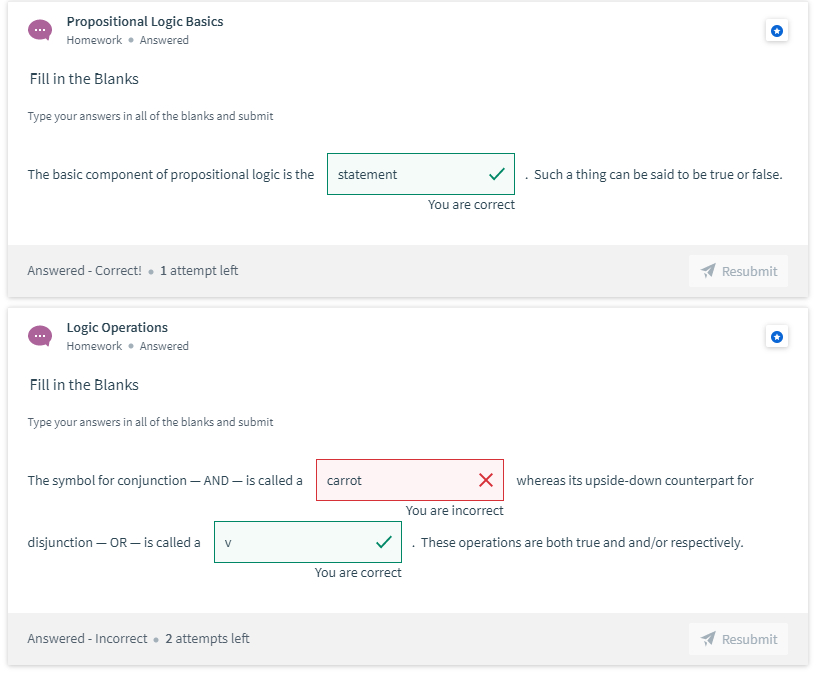
im confused for the one i got wrong?
what is this symbol called ^
nvm
its called a wedge
i got it
sick nebula
@copper ore thank you!
 marble pivot
I thought a field had to include a multiplicative inverse for every element
Why didn’t they include 0 in the second table
pale epoch
what's the multiplicative inverse of 0 in the real numbers?
marble pivot
There isn’t one
marble pivot
Ah
So then a field only has multiplicative inverses for every element except the additive identity?
pale epoch
yes
marble pivot
lit
gritty crescent
the additive identity can't have a multiplicative inverse
@pale epoch Does this hold true for any arbitrary field/whatever it's called?
weary tiger
Yes it does hold for arbitary fields, does not hold in arbitrary ring (there is a zero ring in which 1=0)
gritty crescent
Interesting
gritty crescent
Do you want to prove why $$(A\lor B)\land(A\lor B')\iff A?$$(Also, $B'$ is the negation of $B$, I assume?)
vital dewBOT
TedNotKaczynski:
 leaden moon
Yeah
gritty crescent
If it's any help, $$(A\lor B)\land(A\lor B')\iff A\lor(B\land B')$$by the distribution law
vital dewBOT
TedNotKaczynski:
gritty crescent
Can you continue from here?
gritty crescent
Np :)
leaden moon
so much lol
 sick swallow
woah it is same
weary tiger
w o a h
 true comet
Is there a way to solve "Show that (p → q) ∧ (p → r) and p → (q ∧ r) are logically equivalent" using logical equivalences? I could pretty easily do it using a truth table but while the other exercises specify "using a truth table" this one does not.
pale epoch
consider that $(p\implies q) \iff (\neg p \lor q)$
vital dewBOT
Lochverstärker:
pale epoch
@true comet
true comet
Okay, I can work with this, thanks!
pale epoch
although truth table is fine
 strong wolf
I spy notability
 last timber
,rotate
vital dewBOT
vital wyvern
Thanks 😅
vital wyvern
I think so yeah
last timber
i am dumb lol
last timber
ah no ok
A_k indeed is subset A_{k+1}
so union would be largest set of this obviously
last timber
so you would have (0, 3) as union
vital wyvern
yes
last timber
that is
vital wyvern
the limit?
last timber
limit is (0,3)
last timber
and igtg sorry
last timber
yw
marble haven
do questions about partitions fall under discrete mathematics?
weary tiger
not especially? depend though.
 delicate ridge
it basically means contradiction
weary tiger
okay tyvm
stray reef
it means False
 nocturne carbon
Calculation:
    7 · 8
  =⟨ Fact `8 = 7 + 1` ⟩
    7 · (7 + 1)
  =⟨ Fact `7 = 10 - 3` ⟩
    (10 - 3) · (7 + 1)
  =⟨ “Distributivity of · over +” ⟩
    (10 - 3) · 7 + (10 - 3) · 1
  =⟨ “Distributivity of · over -” ⟩
    ((10 · 7 - 3 · 7) + 10) - 3
  =⟨ “Identity of ·” — twice ⟩
    10 · 7 - (3 · 7) +   10   -   3
  =⟨ Fact `3 · 7 = 21` ⟩
    (10 · 7) -   21  +   10   -   3
  =⟨ Fact `10 · 7 = 70` ⟩
    (70)     -   21  +   (10   -   3)
  =⟨ Fact `10 - 3 = 7` ⟩
    (70     -   21)  +        7
  =⟨ Fact `70 + 21 = 49` ⟩
    49     +        7
  =⟨ Fact `70 - 28 = 42` ⟩
    56
Can someone please explain what ive done wrong, im new to discrete math
 serene basalt
7 · 8 = 7 * 2 * 2 * 2 = 14 * 2 * 2 = 28 * 2 = 56
nocturne carbon
yea ik there is a alternative way to do itt, bt my professor gave us this and told us to fix the error
 short hamlet
idek how to start this
i think base case: n = 1. start at the only even number
<@&286206848099549185>
 olive sun
I know it's in Spanish but I'll translate it. What I have to do is prove that the first proposition is logically equivalent to the second one by using succession of statements. Now, I know how to turn everything into the other side with the exception of the "If, then" into the "And" from the second proposition. I'm genuinely lost, is there like a law that allows to do that, cause I'm losing my mind over this.
 tawny oracle
Hello! Just wondering if anyone can help me understand why the last question is true. I would like to know if the apostrophe next to the“ O’ “ is what makes it true.
weary tiger
probably means just the complement to O denoted as O'. And u can see that O has odd numbers. So the opposite of that would be even numbers
and the larger set which is implicitly defined in this case is U
so O is a subset of U, containing the odd numbers. U contains both odd and even numbers. When you take the complement of O, then you get all the other elements that are not in O within the larger set U. You can think of it as removing all the elements of O within U, so what is remaining will be the even numbers. @tawny oracle
weary tiger
if you try to visualise it it would look like this, where U is the larger set containing both of them
errant bear
is U the universal set here?
weary tiger
ye i guess so if you mean by the larger set that they are contained within
it seems that they implicitly defined it as U = {1,2,...,10} as the universal set for this assignment
 formal tulip
weary tiger
formal tulip
weary tiger
Probably “element of” in this context
 haughty garden
You might want to use strong induction
More specifically, assume that f(n) and f(n - 1) both hold true. Then use those two statements to show f(n + 1) = blah
 humble hornet
Hmm
haughty garden
Should be a few lines of working
humble hornet
Idk about strong induction yet
haughty garden
Oh that’s sort of what the hint is gauging at
I just flipped the indexing around a bit
You just assume the statement holds for two cases instead of the regular one
Strong induction assumes that every case preceding n is true which is where your assumption of two cases come in
humble hornet
Oh i see
 hollow saddle
I've been so stuck on question 12. I was able to do 11, but I don't think I'm understanding the question itself. Am I finding what I did previously just without the not negation?
pale epoch
you want to express $\neg P$ only using NAND and parentheses
vital dewBOT
Lochverstärker:
hollow saddle
so P nand P would not make sense? This is all so new to me haha
pale epoch
why do you think it would not make sense?
hollow saddle
ahhh, so if I use (not) PnandQ for the first one on 11, then if I were to rewrite it without the negation not, It would be (PnandQ)nand(PnandQ)?
no...
wait yes
lol
pale epoch
ye
this has applications in circuit building
because you can build wtv you want if you have only NAND and no NOT gates
hollow saddle
Ohhh, okie! Thank you so much (:
weary tiger
So uh
I described a specific issue I had in #precalculus and I dont think I need to write it all out again
 gusty crag
@weary tiger it was something about pi in binary?
weary tiger
Yeye
Sequential calculation that can be expressed using relatively simple mathematical functioms
pliant horizon
Quick question: What is the codomain of the exponential function? I thought exp was R->R with the range being R^+ but my discrete teacher said differently.
She also said a function must be onto to have an inverse, but then that seems to contradict the existence of the log function
naive saffron
Well like you said already, you defined exp as a map from R to R, so the codomain is R by definition
The image of the function, however, is R^+
and also yes a function must be onto to have an inverse
But remember the definition of an inverse function
$g:B\to A$ is the inverse of $f:A\to B$ if $g(f(a))=a$ for all $a\in A$ and $f(g(b))=b$ for all $b\in B$
vital dewBOT
Whoever:
naive saffron
and $\log$ does not satisfy this definition because $e^{\log x}$ is not equal to $x$ for all $x$, in particular this does not hold for any negative $x$ since it doesn't even make sense
vital dewBOT
Whoever:
naive saffron
However it is nevertheless a left inverse of $e^x$, since it is the case that $\log(e^x)=x$ for all $x\in\bR$
vital dewBOT
Whoever:
naive saffron
@pliant horizon
honest barn
wdym?
the example just says you're looking at things being equal mod 7
and for any number x, x = x mod 7
 merry token
hey in a proof what does hexibiting mean
the context is
"Disprove the following conjectures by hexibiting a counterexample:"
I just negated the statements and proved that the negation is true
weary tiger
maybe a typo for exhibiting?
merry token
ohhhhh
that would make sense
in that case negating it and proving that the negation is true should be sufficient right?
weary tiger
yeah, just prove that the conjecture doesnt hold
merry token
merry token
yeah threw me for a loop lmao
pliant horizon
I think this is a relatively stupid question but I was wondering if someone could explain why exactly this proof works.
It's to prove that for a real number x, if x^3 is irrational then x is irrational. It's pretty easy to prove by contrapositive (if x is rational then x^3 is rational) but I don't see exactly how that proves the original proposition. I also get that the contrapositive is equivalent but how this particular contrapositive is equivalent is not clicking for me. Maybe I messed up the contrapositive though
also i meant to respond to you earlier @naive saffron but I got distracted. What you said makes sense, and I had already thought that the log was a pseudo inverse of some kind since not all the conditions were met. I'm glad that my intuition was mostly correct. thank you!
naive saffron
You're welcome
And you can think of your contrapositive proof in this way
Suppose for contradiction x^3 is irrational and x is rational, then x^3 is rational since x is rational, which is a contradiction
So x can't possibly be rational
@pliant horizon
pliant horizon
oh np i didnt even notice
naive saffron
You can always think of contrapositive proofs this way
 glossy pollen
Hello #discrete-math,
I am seeking some help understanding the function:
The question at hand is to rewrite this functions so that it has less error when being estimated by a computer
The book gives this explanation:
I have to replicate this process for class and do not understand how it can be justified that the new function is better than the old function beyond just testing cases
stray reef
the reason you're getting loss of precision is because you're subtracting two large numbers that are close by
@glossy pollen
glossy pollen
so subtraction is specifically the issue?
what if the expression was as follows:
where y is equal to sqrt(x) but could be negative or positive.
could we reliably reduce the error not knowing if y is being added or subtracted?
stray reef
where y is equal to sqrt(x) but could be negative or positive.
what
glossy pollen
i know i know
stray reef
make up your mind, is y a separate input or do you have like a two-valued function
what do you even mean by "not knowing if y is being added or subtracted"
glossy pollen
if y is negative then -(-y) = +y
stray reef
...
glossy pollen
i might not really have the language to ask what im thinking
stray reef
are you saying you have a function of the form $f(x) = x(\sqrt{x+1} \pm \sqrt{x})$ but it's given to us as a blackbox or what
vital dewBOT
Ann:
stray reef
so like all we know is that either there's a plus there or a minus but we don't know which
or do we know even less
glossy pollen
yea i suppose so
stray reef
then evaluate f(1) or something and check if it gives you sqrt(2)-1 or sqrt(2)+1
and act accordingly
stray reef
you are
glossy pollen
thanks for the answer
vital dewBOT
Lochverstärker:
pale epoch
and when p is false, not p is true, so you get that
it even has a fancy name
'principle of explosion'
weary tiger
where all discrete math is used in computer science?(excluding graphs)
 pulsar timber
trees
weary tiger
anything else?
pale epoch
what do you consider discrete math?
finite state machines are discrete in nature
and a very big part of computer science
so are pushdown automata
arithmetic in finite fields is used in cryptography
e.g. diffie hellmann is based on the theory of quadratic residues (number theory)
other crytographic protocols are based on finding discrete logs in finite fields
which is also number theory, but as the name suggests it deals with discrete structures
weary tiger
thanks for the answer
glossy pollen
It depends more on what you consider to be computer science imo
If you think computer science is making a website with prebuilt libraries that hold your hand the whole way then discrete math has not much to do with that.
If your doing basically anything else, then the finiteness of the bits matter, and using those finite bits to produce more and more elegant information is the business of computer science.
 neat holly
Quick question: Can someone guide me through what this looks like and why?
unreal stump
A consists of all pairs (x,x),such that x is a rational number lying betweem 0 and 1(both included)
B consists of all pairs (x,1-x) such that x is a irrational number in the same interval
neat holly
To my understanding, they form an X (that is, y = x, y = 1 - x) and both A and B never intersect. Would I be correct in that assessment?
neat holly
Oh, I see! The format of these problems sometimes still gets me.
B could have something like (pi, 1 - sqrt(2)/2), I assume.
weary tiger
can anyone give me a hint ?
pale epoch
consider that division by 0 is undefined
weary tiger
hmm okay thank you
so the last statement, (let a and be equal 1) cannot be true because otherwise we'd be dividing by 0 in the previous step (divide by a - b)?
errant bear
yes
weary tiger
thank you 🙂
 weary tiger
because it is undefined behaviour?
errant bear
what do you mean
weary tiger
not quite sure, other than that i was told that its undefined
errant bear
sadge
gusty crag
@weary tiger are a and b supposed to be rational numbers, real numbers, or something else
pale epoch
its fine, it doesnt matter what numbers a and b are
if you want to know, why division by 0 is undefined, its because there is no number x, such that 0*x = 1
as 0*x = 0 for all x and 1 is different from 0
gusty crag
it does if a and b come from a structure which has zero divisors
pale epoch
no
pale epoch
division by 0 is undefined in any ring
even if there are zero divisors
unless maybe you consider the zero ring, but that is madness
gusty crag
I thrive on madness
 midnight plover
My teacher got the opp sign
but my distributive is diff than his so what did i do wrong
haughty garden
Both ways won’t work because they mean different things.
Distributive law is: $a \land (b \lor c) \equiv (a \land b) \lor (a \land c)$
vital dewBOT
opengangs:
haughty garden
It’s basically saying “a and EITHER b or c must true” which is the same as saying EITHER (a and b) OR (a and c) must be true
 spring mica
Why does line 1 have ^
and line 4 and 5 have ->
i thought line 1 would also use ->
<@&286206848099549185>
 viral patioBOT
From
Rule 4
If your question has not been answered for a minimum of 15 minutes, you may use the Helpers tag once. Please do not try to bump your question using this ping unnecessarily. Do not abuse this ping. Do not individually ping users with the Helpers tag without their express permission.
 woeful jewel
@spring mica you should learn your defintions again.
gritty crescent
@spring mica The premise is the statement: There exists a student x who is in the class AND has not read the book.
spring mica
Then why does line 4 have a -> @gritty crescent
shouldn't that also have an AND
which ones @woeful jewel
have any good resources for me
 brave lava
<@&286206848099549185>
 near root
True or false:
A = {1,2,3,4} B={1,2,3,4,5,6} number of functions f:B->A that fulfill |f[A]| = |A| is 4^3 * 3!
Could someone please explain to me this?
stray reef
what is f[A] here
near root
Pretty sure it's the img?
pale epoch
why just pretty sure?
pale epoch
they just want to know what f[A] is
stray reef
^
near root
Isn't |f[A]| just A^2?
pale epoch

near root
Since that's all the possible functions so...
pale epoch
what
near root
What do you mean what
near root
|A^2| is 256
stray reef
pale epoch
lets start at the beginning
gritty crescent
As far as I can tell, |f[A]|=|A| means all such functions f:B->A such that f is surjective/injective?
pale epoch
what is f[A]?
near root
Img of A
near root
Number of elements inside of A
pale epoch
which is?
near root
4
pale epoch
so you want that the image of f has cardinality 4
as f is a function B -> A, that means that f must hit every element in A
or in other words f is surjective
so the task is to count surjective functions B -> A
did you cover stirling numbers?
pale epoch
then my hint is to use that
i.e. figure out how stirling numbers relate to surjections
stray reef
A = {1,2,3,4} B={1,2,3,4,5,6} number of functions f:B->A that fulfill |f[A]| = |A|
A is a subset of B so technically you just need f restricted to A to be a bijection
taken literally
pale epoch
f(5)=1, f(6)=2, f(1)=3, f(2)=4, f(3)=f(4)=4 satisfies the condition, but f restricted to A is not a bijection?
pale epoch
image of f is all of A
near root
Uhh
What
F can't be bijection though since |B| > |A| or am I too pepega to understand
pale epoch
hence
f restricted to A
near root
So can I just calculated the total amount of functions and substract the bijections and multiply them by the remaining numbers that remain in B in the power of the times they appear?
pale epoch
what
the total amount of functions between what
subtract the bijections between what
near root
so the task is to count surjective functions B -> A
@pale epoch
For the record is Stirling's numbers the n, c, p or d?
pale epoch
i told u to disregard what i said, i misread the question
A is a subset of B so technically you just need f restricted to A to be a bijection
this is the real hint
near root
How do I restrict it tho?
near root
Right so I made the domain smaller to be equivalent to A, now I get a bijection function, the possibilities for that is 4! am I still missing something?
near root
So b has remaining 2 numbers each that can go to the remaining numbers
Therefore it's 4 in the power of 2 I think times the 4!?
pale epoch
ye
near root
Eyyy
pale epoch
that's your given solution as well
near root
You take paypal?
pale epoch
what?
near root
For helping me
pale epoch
money? nah, im good
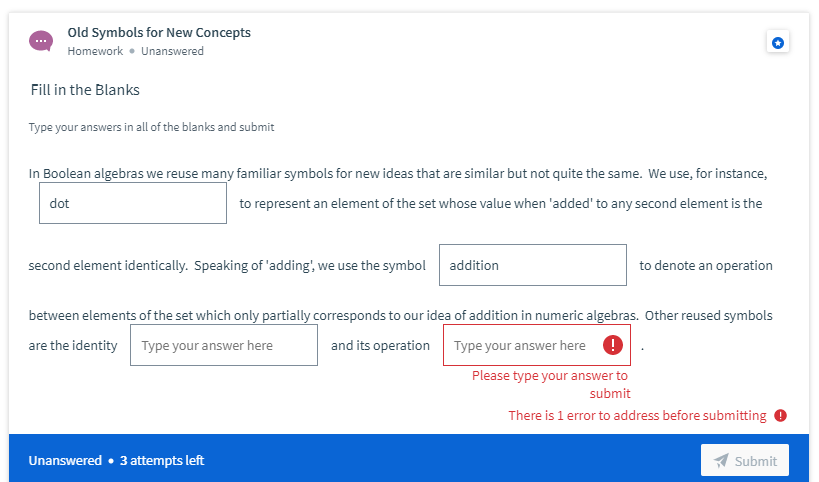 pale epoch
this should just be reading your script
pale epoch
what symbols from arithmetic are used in boolean algebra?
brave lava
nope
brave lava
the symbol
of multiplication
he kept repeating it in his lecture so it was a guess lol
pale epoch
it's not an element of the set though
brave lava
nope
unreal stump
Subtraction?
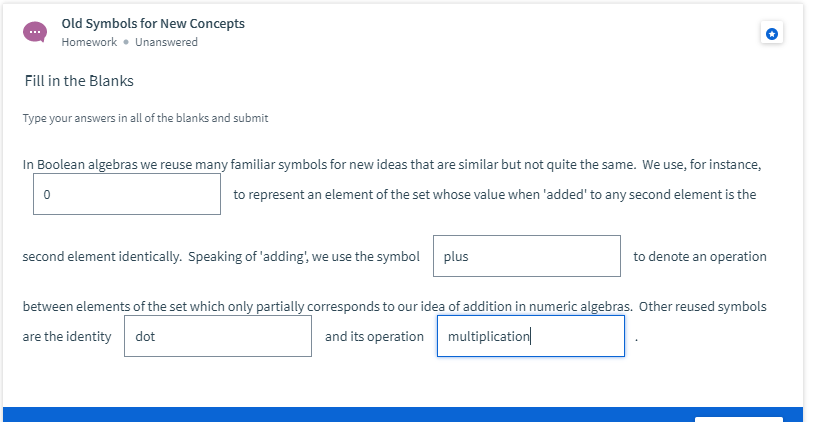

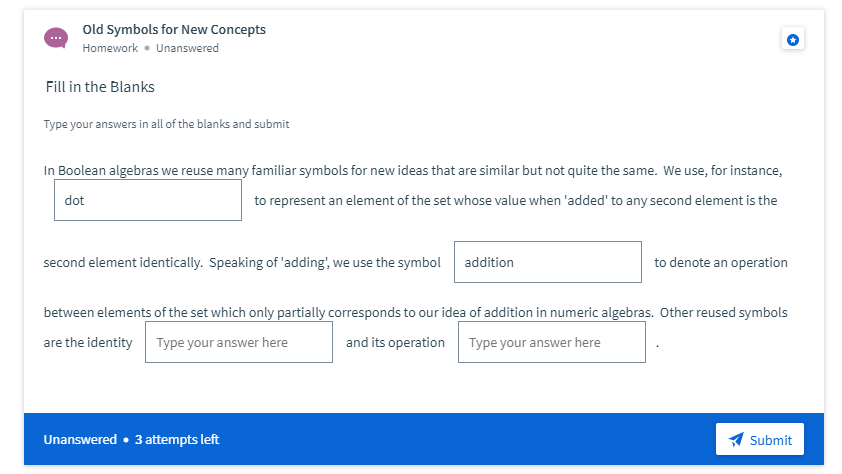

 pale epoch
the identity of multiplication is not dot
brave lava
1 . a = a
pale epoch
ye
pale epoch
no
it's 1
thats the multplicative identity
in boolean algebra, we use 1 to represent "true", 0 for "false"
multiplication is "and" and addition is "or"
brave lava
yeah
pale epoch
then you get stuff like A or FALSE = A as A+0=A
and well, we reuse 4 symbols
multiplication dot, addition +, 0 and 1
the first 2 blanks are about the "additive symbols", the last 2 blanks about the "multiplicative symbols"
brave lava
i have this right now
pale epoch
should be fine 🤷