#discrete-math
1 messages · Page 141 of 1
 frank zinc
 last timber
 brave lava
how hard is discrete math out of 10
 sick swallow
maybe 9 although idk
 unreal stump
Depends
 lyric pumice
10 out of 10. It has Millennium Prize Problems among many other long-standing open problems.
Collatz Conjecture
Chromatic Number of the Plane
lyric pumice
Yes.
frank zinc
ty
lyric pumice
Certainly.
 leaden moon
How should I get rid of (P V ~Q)?
 weary tiger
weary tiger
weary tiger
np
weary tiger
not really a law but when you have a T or F you can simply get rid of it
weary tiger
ah ok
 vital dewBOT
Ann:
 void valve
De morgans?
 stray reef
yes
void valve
Aha! thanks I had missed that each of the subsets on the RHS was complement
stray reef
this is just de morgan's for countable unions & intersections
void valve
thanks yeah I read it as A_i only on the RHS
thank you 🙂
Wait sorry what do you mean coountable? Like they are countably infinite? Could it be that we have an uncountable number of unions?
stray reef
you're unioning and intersecting countably many sets
you could have $\bigcup_{i \in \mathcal{I}} A_i$ for $\mathcal{I}$ a set of any cardinality
vital dewBOT
Ann:
void valve
Aha so like for example you could have i element or real numbers? What would it mean for the index of the set to be 0.1 for example?
stray reef
?
well you'd have an indexed family of sets, one for each real number
for example you could have a family of intervals of the form (0, r) indexed by positive reals
void valve
Yeah I dont know I guess I've only encountered integer indices then. So in your example as r could be any real value it wouldnt suffice to only have integer indices, right?
void valve
Yeah so you could have (0,r_1)....(0,r_n) and therefore you would also need real number of indices?
stray reef
you're overthinking it
void valve
As always hahah 😦
Alright but could you give some simple real-life example where it would be needed?
 buoyant marsh
Anyone knows about codeword??
 mint bane
can someone help me translate from english to predicate logic pls, im doing some practice problems and i wanna get em right. the statement is "there are no people who are TA's in this class and didn't get A's", functions that can be used are S(x), meaning that “x has been a student of this class,” A(x), meaning that “x has gotten an ‘A’ in this class,” T(x), meaning that “x is a TA of this clas,” and E(x, y), meaning that “x and y are the same person.”
bottom one is my guess
 quartz wigeon
Hi, I've been doing this exercise but the -->q keeps confusing me and don't know if I have it correct.
What I'm doing wrong?
weary tiger
what is "⇒q" doing inside the table as a column?
 hollow bloom
Two graph being bipartite doesn't mean they are necessarily isomorphic right?
weary tiger
Certainly not
 naive saffron
For any n there is a bipartite graph with n vertices: namely the graph with n vertices and no edge
Certainly a bipartite graph with 2 vertices is not isomorphic to a bipartite graph with 3 vertices
 manic tiger
@quartz wigeon
Are you asking what the --> q means in the truth table, the possible outcomes?
weary tiger
"⇒q" should not be in the truth table in the first place!
manic tiger
Yeah, should replace that with the negation of q since it's being used down the road
@mint bane if the picture you sent is the translation of there are no people who are ta's in class and didn't get a's then that would be good
some places say it's good practice to not leave negation before quantifiers so you could simplify but that still is right
 cerulean ore
Is T(n) = 1+2+3+4+....+n equals to Θ(n^2)?
cerulean ore
I am trying to prove that it is Theta(n^2).
So, let c1 * n^2 <= n(n+1)/2 <= c2 * n^2,
If c2 = 1,
n(n+1)/2 <= n^2 for n>=1 .
Now, I have to find a c1 * n^2 such that c1 * n^2 <= n(n+1)/2 .
unreal stump
1/2
stray reef
^
cerulean ore
It doesn't have to be an integer value?
unreal stump
No
stray reef
it does not
cerulean ore
Thank god I asked you guys, thank you! So, for c1 = 1/2, and c2 = 1. The following inequality holds:
c1 * n^2 <= n(n+1)/2 <= c2 * n^2, therefore f(n) is Theta(n^2) .
stray reef
yes
cerulean ore
Thanks!
 celest geyser
I have a probability unit in my course, not sure if this is the place to ask, but I posted a question at #help-1 and I was hoping someone can take a look
celest geyser
I'm good now thanks
 copper ore
weary tiger
copper ore
weary tiger
I think it's b despite not seeming like it would b
try showing the first expression is equal to 3n C 3
weary tiger
how do you know they are equal if you can't do what you just asked?
copper ore
i would never guess the top part is equal to 3n C 3
i just did it
i calculated it
i think you misunderstood me
i said how can you derive the top part lol
top part =
this
i would never guess the top part is equal to 3n C 3
copper ore
yeah like by reading statement b, I would go straight to doing 3n C 3 not the top part
weary tiger
to start, a more suggestive form is probably $$3\cdot {n \choose 3} + 6n \cdot {n \choose 2} + n^2 \cdot {n \choose 1}$$
vital dewBOT
Botnuke:
weary tiger
try showing the first expression is equal to 3n C 3
also disregard this it sounds like a bad idea now that I think about it
weary tiger
uh no?
copper ore
oh yeah
nvm
also disregard this it sounds like a bad idea now that I think about it
@weary tiger why?
weary tiger
probably algebra hell, when there is a more elegant argument
copper ore
true ok
weary tiger
hmm not sure where the 3 and 6 are popping out from yet
maybe there is some kind of case splitting going on
I feel like I am just reverse engineering some really inefficient but correct way that someone came up with to count a simple value
weary tiger
something dumb like subsets that have an element from each different set, subsets that have elements from only 2 different sets, and subsets that have all their elements from one set
and then adding them up
wait that might actually be it
copper ore
im basically doing recursion
im turning all of them into this lol
it's taking too long
then when k= 1 i remove the combination symbol
weary tiger
I dunno if that's gonna work for an algebraic solution but you can try
weary tiger
something dumb like subsets that have an element from each different set, subsets that have elements from only 2 different sets, and subsets that have all their elements from one set
I think this is it though
for a counting method solution
weary tiger
yea I regret even suggesting to show it with algebra
 last sigil
yeah
weary tiger
the last quoted message is pretty much it, but it's very terse
copper ore
isee ok
weary tiger
$3\cdot {n \choose 3}$ counts the number of subsets that have elements from only 1 set, $6n \cdot {n \choose 2}$ counts the number of subsets that have elements from exactly 2 different sets, and $n^2 \cdot {n \choose 1}$ counts the number of subsets that have elements from 3 different sets
vital dewBOT
Botnuke:
weary tiger
any subset described in (b) is in one of these categories, so it counts them all
weary tiger
someone else should verify this as I could be wrong, but it seems good to me
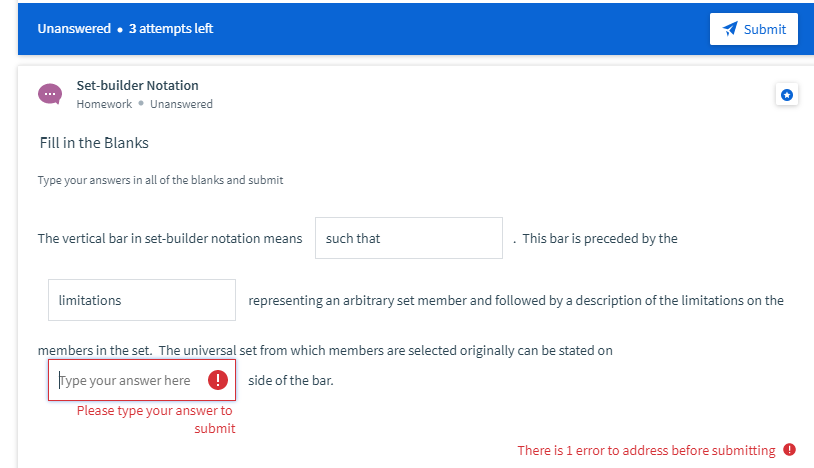 stray reef
your second blank should be variable and the third blank should be left
brave lava
thanks
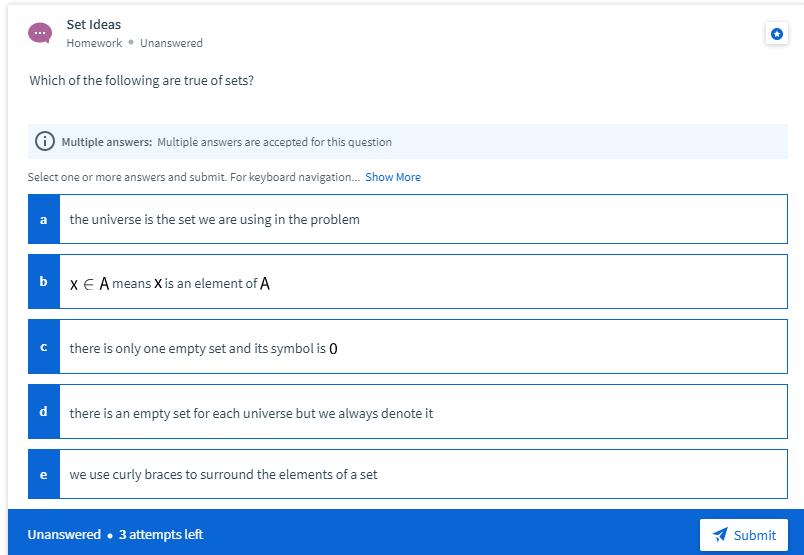
for this question
for C
Im confused
I know there is only one empty set
and that its represented by a 0 with a slash through it
vital dewBOT
Ann:
brave lava
yeah that one
for part d
i know all universes have the same empty set
but im not sure what my teacher meant by
"we always denote it"
stray reef
i don't know
it looks like there was meant to be a symbol following it
but it got lost
brave lava
okay thats fine thanks ill just email him tomorrow
unreal stump
What does one empty set for each universe mean?
unreal stump
Yes
brave lava
like there is an empty { } set for each universe
and an empty set is a unique set, and only one exists
and its unique because it exists for all universes
according to what my lecturer said lol
unreal stump
I don't know why we have to deal with "what a universe is" in a math question
D is really weird
brave lava
its my first time taking a discrete math course and my book hasnt even arrived so im not even sure either lol
unreal stump
Or what denoting it means
weary tiger
In the 1st part of inequality, would a proof which goes like this suffice: If K(G) is not empty, consider a set of vertices K with |K| = K(G). Such a set exists by definition of K(G). Then this will have some vertices, which will in turn have some edges. and the number of edges incident on the vertices have to be greater than the vertices because of minimality of K. Thus proved
The book has more elaborate proof for the same using different reasoning, so I wondering if there was a simpler one
stray reef
what even are kappa, lambda and delta?
weary tiger
ah, sorry 😓
kappa is the connectivity
lambda is the edge connectivity
delta is the minimum degree of a vertex
stray reef
so kappa(G) is the smallest number of vertices that need to be removed to disconnect G, and lambda(G) is the same but with edges?
weary tiger
yup
stray reef
and what are you calling K(G)
weary tiger
ah, that's kappa
weary tiger
yes, sorry for my bad english !
stray reef
ok i'm not exactly sure what your argument here is
are you just picking out kappa(G) vertices from your graph arbitrarily
weary tiger
yup, that's the definition
stray reef
so you aren't concerned with whether or not your set disconnects G?
weary tiger
we are concerned with that. kappa(G) is the max number of vertices you can remove without concern, and G will still be connected
same with lambda, but for edges
weary tiger
ah okay, I think my reasoning is wrong. I assume there will be more edges than vertices because of minimality, but that's not always true
 south marten
Can anyone check if i've started the proof of demorgan's laws correctly: http://mathb.in/44767
 pale epoch
let $x \in A' \cap B'$ this means that $x \in X$, and that $x \notin A', B'$ 🤔
vital dewBOT
Lochverstärker:
pale epoch
also you started with $x \in A' \cap B'$ and concluced $x \in A' \cap B'$
vital dewBOT
Lochverstärker:
south marten
Oh shoot good point the argument could be circular
@pale epoch is it cicurclar I thought to prove two sets were equal you have to show that one set is entriely contained within the other
pale epoch
yes, but you dont do that
south marten
Where is the error particularly
vital dewBOT
Lochverstärker:
south marten
ahhh okay
pale epoch
you have to start with $x \in (A \cup B)'$ and conclude $x \in A' \cap B'$
vital dewBOT
Lochverstärker:
pale epoch
and then do it the other way around as well
south marten
Why can't I start with $x \in A' \cap B'$
vital dewBOT
Zophike1:
pale epoch
you can, but you have to conclude $x \in (A \cup B)'$
vital dewBOT
Lochverstärker:
pale epoch
which you did not
south marten
ahhh makes sense
pale epoch
(in fact, you have to do both directions)
you have only shown $ A' \cap B' \subseteq A' \cap B'$
south marten
Yes I know
vital dewBOT
Lochverstärker:
south marten
Oh 😦
@pale epoch also I was asking if i started the proof the correctly i'm well aware I have to show the reverse inclusion I fixed the issues you mentioned: http://mathb.in/44770
pale epoch
you did not
i mean, now everything you write down is correct except
and hence we have shown that $(A \cup B)' \subset A' \cap B'$
vital dewBOT
Lochverstärker:
south marten
I'm not understanding how is that not correct because woun't the conclusion follow after showing the reverse inclusion
pale epoch
i don't know how to make this more clear
you write
let $x \in A' \cap B'$ this means that $x \in X$, and that $x \notin A, x \notin B$ via definitions.We know that an elements belongs to $A'$ if and only if it is in $X$ and not in $A$ the same observation is applicable to $B'$ This proves that $x \in A', x \in B'$ Finally this means that $x \in A' \cap B'$
vital dewBOT
Lochverstärker:
pale epoch
or to cut it down a bit
let $x \in A' \cap B'$ [some true statements] Finally this means that $x \in A' \cap B'$
vital dewBOT
Lochverstärker:
pale epoch
this shows $x \in A' \cap B' \implies x \in A' \cap B'$ or in other words $A' \cap B' \subseteq A' \cap B'$
vital dewBOT
Lochverstärker:
pale epoch
which is true, but doesn't contribute to the proof you are doing
south marten
Okay now I see the mistake i'm sorry : (
pale epoch
no need to apologize
south marten
How would get the conclusion from what I have so far
pale epoch
what does it mean for $x$ to be in $(A \cup B)'$?
vital dewBOT
Lochverstärker:
south marten
For $x \in (A \cup B)$, $x \notin A$ $x \notin B$ which implies that $x \in A' \cap B'$ also not that $x \in A'$ and $x \in B'$ as well
stray reef
are you allergic to the word "and"
south marten
nahh I just typing this out on my phone
vital dewBOT
Zophike1:
 desert wind
Hey does anyone have an interesting paper somewhere in the combinatorics/discrete math realm that a beginning graduate student might have to parse through without having to look up >7 definitions? I need just one paper to look at and review but everything I've looked at looks like it'll take 2 hours of reading other papers just to parse.
It's for a Research Analysis, just read and summarize, I don't need to do a lot with it but everything I'm looking at seems waaaay over my head.
desert wind
Thanks. Does it still have an impact factor that, y'know, registers? Because part of this is supposed to be a lesson on what papers not to use, what papers to use, etc.
Sorry, being colloquial. XD I meant that as in being prestigious. Yeah, that's pretty low, but right now I might just go with it. Thank you.
Yeah, that gives me something to talk about.
Thank you
sick swallow
ok...
 strong wolf
lol
 white jetty
pale epoch
white jetty
pale epoch
what have you tried @white jetty ?
pale epoch
what seems finite?
 barren apex
Alright, quick question with general algorithims
Is the question incorrect with the multiple choices it has?
The unchecked choice shouldn't be there as far as I know
pale epoch
seems like it
barren apex
¯_(ツ)_/¯
desert wind
@white jetty one route might be to consider the binary counting system, and seeing if you can work something with that.
imo it is literally easier to prove your bonus question. XD
pale epoch
why
the bonus question has you consider strings thats start with arbitrary many 0's
so you can't just use your suggestion
desert wind
Step One: Solve the bonus question
Step Two: Consult answer to Step One. XD
Nah, I getcha
pale epoch
that being said the bonus question is not much harder
but the original question is easier and should be solved first
desert wind
Anyway, did you get it or do you still need help?
the bonus question has you consider strings thats start with arbitrary many 0's
@pale epoch
Answer to part one has arbitrarily many trailing zeroes. Turns out this doesn't really matter
pale epoch
it does though
using your suggestion, you would map 1001 and 01001 and 001001 and ... to the same element
desert wind
I'm just saying consider the same general mechanism of add-carry.
Sorry, that was a weird hint.
But yeah, the two parts are really the same, because the set of all that start with one is a proper subset with the same cardinality. To construct the first group, you just need to construct the second, then tack a one on the front.
I unno, I feel like it's a distractor.
Like, imagine the answer to the second question. It contains stuff like the empty string, and every binary string with 0s and 1s included.
Tack a one to the front
Now you have all the answers to part one.
pale epoch
this doesn't change the fact that it is easier to come up with the actual isomorphism for the first set...
desert wind
Anyway, I'd start with something like this:
Let l be the length of the string.
Consider first the set of single-length strings, {0,1}
Clearly this is a finite set with cardinality 2, and is countable. Namely, we can biject it with {0,1}
Then just work your way from there.
Basically get your 1 length out of the way, then your 2 length, then so on inductively.
If you can partition the number line such that every number ends up in a set of size 2^n, where n is the length of a given subset of all binary strings, then you've basically proved you can do it without having to even specify how.
Ask special permissions for the empty string, and you got part B. Then appeal to "Tack a one on the front" then you got part A.
desert wind
@pale epoch thank you for the problem, just decided to write up a solution for my own edification and it was really fun, actually. 😄
Oh wait, you weren't the one who posed it. XD
Thanks anyway, it was fun talking to you!
 fervent briar
I've got a question about logical equivalence
Question:
Isn't it pretty much just like that?
That's for the second statement
hollow bloom
Can anyone find a K 3,3 or K 3,3 modification from this graph?
I have tried stretching vertex a and b but I can't seem to find one
fervent briar
I got the answer as 131.916 but it's wrong
I've recounted 3x for this problem
Can anyone help spot the mistake?
 leaden pebble
@fervent briar it seems you arent taking the correct vectors
you are getting an external angle
fervent briar
Why?
leaden pebble
its the supplementary of b
leaden pebble
if you want B, yes
you are getting the angle the line that extends AB does with BC
leaden pebble
extend AB
 errant bear
think of shifting the vector AB so the origin matches up with BC
leaden pebble
and see the angle it forms with BC
errant bear
this "new" angle is the one you already found
also this is more multivar calc/LA than discrete math btw
fervent briar
also this is more multivar calc/LA than discrete math btw
@errant bear Yes, I got it into the wrong channel since I was doing discrete earlier. Sorry
leaden pebble
considering the channels, it may be either LA or geometry in pre
fervent briar
It's multi var
leaden pebble
 I see
I see
fervent briar
thanks btw
leaden pebble
no problem
always check if the vectors leave the same point
so youre getting the right angle
mint bane
whats the difference between proof by contradiction and proving by contrapositive
like im looking at a question that says "prove the statement 'if r is irrational, then r^(1/5) is irrational' by its contrapositive"
my math intuition tells me this isn't the same as if it said prove by contradiction but idk
pale epoch
it isn't
proof by contraposition uses the fact that $A \implies B$ is equivalent to $\neg B \implies \neg A$
vital dewBOT
Lochverstärker:
pale epoch
proof by contradiction, you assume not A and arrive at a contradiction to prove A
mint bane
alright i understand that
pale epoch
like, in both cases you start by assuming r^(1/5) is rational
but in the first case you deduce that r is rational
in the second case you would use that r is irrational to deduce some contradiction
mint bane
so for what i said above, i need to assume that r^1/5 is rational and then deduce from that that r is also rational
and by contraposition that tells us the r being irrational implies that r^1/5 is also irrational
wait did i just describe contradiction by accident? i meant to describe contrapositive lol
pale epoch
nah you are good
mint bane
ok but then what would the contradiction side of it look like
i wanna make sure i get both rn
pale epoch
it's assume r^(1/5) is rational and that r is irrational
and then deduce some contradiction
(in this case probably that r is both rational and irrational)
so yeah, contradiction doesn't really gain you anything in this case
you will have to do the "normal" proof anyway
mint bane
so what changes is the statement that gets proven then? the contrapositive proves that not B implies not A but contradiction shows that not B implies both A and not A?
pale epoch
in general proof by contradiction you would assume not B and A and arrive at any contradiction
but like, in this case a proof by contradiction is not really possible
or at least i dont see how
mint bane
yeah im trying to think in more general terms
pale epoch
by that i mean, you could take any "proof by contradiction" and reformulate it to not use contradiction
mint bane
do yk an example that might better illustrate it, i just pulled this from a free mit thing lol
pale epoch
the thing is, in this case you are already asked to proof a statement of the form "A implies B"
so contraposition is obvious
can't think of an implication that is proved with contradiction
mint bane
ohhhhh
pale epoch
but like, the standard proof of infinitude of primes is proven via contradiction
you want to prove "there are infinitely many primes", so you assume there are just finitely many
and then arrive at some contradiction
so your assumption must have been wrong
mint bane
ok i think im getting it
im gonna do some reading abt it, can i bother you in like 10 min if anything comes up pls?
pale epoch
you can try
mint bane
also unrelated but what's that books role you have?
pale epoch
it's from the testing phase of #book-recommendations
mint bane
ah
 pliant horizon
doing #29 and it feels weird. https://puu.sh/Goc7Y/893585089a.png

I think its this but I'm not sure, and the book doesn't have answers for all problems
$\neg P(1)\lor\neg P(2)\lor\neg P(3)\lor\neg P(4)$
vital dewBOT
nix:
pliant horizon
these are the answers for some of them https://puu.sh/Gocbi/bad8678a9f.png
 stray reef
yes, your answer for 29 is correct
pliant horizon
okay cool thank you
 keen glade
I hope Permutations and Combinations doubts are welcome here - I was suggested to move my queries to this channel yesterday.
I'm trying to solve this question. Part A specifically. Here's my approach:
6 distinct toys and 3 distinct boxes such that neither of them is empty. First I focus on filling each box with at least one toy. This can be done in 6C1x5C1x4C1 ways. Three toys remain and they can each go in any one of the three boxes in 3x3x3 ways.
Total number of ways: 6x5x4x3x3x3 ways. The answer given is 540. Could someone please help me realize my mistake here?
 honest barn
why is the end 3x3x3?
keen glade
Because I have 3 toys remaining and since each box is filled with one toy, I have no criteria for putting in these 3 toys - they can go in any one of the three boxes independently
honest barn
okay so
you've somehow overcounted by 6
I think this has to do with the initial bit the 6 x 5 x 4
So I think this is what happend
keen glade
Okay, please go on
honest barn
So what's the logic that it's 6 x 5 x 4?
I imagine for the thing filling the first box
you have 6 options
keen glade
Yes
honest barn
likewise for the second, likewise for the third
keen glade
Yes exactly
honest barn
Oof, okay so my original thought isn't right but
I think there's some issue in that like
the way you put in the latter 3 can sort of like, mess up that
Sorry I need to think a bit harder
so I can actually verbalize what I think is going on haha
keen glade
I notice that I have changed the way of looking at it - I'm not sure if this helps but I was trying to first see WHAT toys can each box carry. Once I reached 3 toys left, I'm going for WHICH toy can go in which box
honest barn
Yeah that's
sort of what I'm getting at
I think like for the first 3 you don't have to fill all the boxes
since in the last 3 you can fill one you missed
but somehow maybe you can quantify this as overcounting by 6
which somehow I think manifests as a 3!
since this is combinatorics lol
keen glade
Hahah but that's reverse engineering the solution xD
honest barn
I mean
I suppose
haha
So I have an alternative idea
Of how to calculate it just period
keen glade
Okay I'm listening
honest barn
But I think it's probably important to figure out what's going wrong
keen glade
Yes I really want to know what's wrong too
honest barn
But we can calculate this as total ways to put 6 items in the 3 boxes
- number of ways in which one box is empty
And I think number of ways in which one box is empty is easy to calculate
keen glade
Indeed
honest barn
I'm pretty sure it's 3 * number of ways in which one distinguished box is empty
keen glade
number of ways in which AT LEAST one box is empty, you mean
keen glade
Yes
honest barn
although I think my method of counting actually includes that
so if the first box is empty
that means all 6 toys are in the other 2
which is just stars and bars on n = 6 and k = 2
and that includes say, first is empty
and second is empty
since that includes counting all 6 toys in the last box
ugh, but then you actually overcount!
lmao
the idea here is, all 6 toys in teh third box
appears both in "ways in which first box is empty" as well as "ways in which second box is empty"
but the overlap is really easy to count
keen glade
Yes I see how your approach will indeed get me to the solution honestly - but the fact that I still haven't found the error in my approach is a bit triggering 😅
keen glade
Hang on, let me just write down SOME possibilities - maybe I'll figure out where the issue is
honest barn
You're essentially singling out single elements as like "the one which must go into the 1st, 2nd, 3rd box"
respectively
keen glade
Hang on, I think there's another error because I haven't really permuted the toys either?
honest barn
I think you don't have to
because they're distinct
I had that idea earlier too
This is actually how I thought you overcounted by 3! at first
keen glade
But being distinct is all the more reason to do so right?
keen glade
If they were all identical I'd not need to permute them
honest barn
divide by number of permutations haha
since often when things are not distinct you count it as if they were
then divide by overcounting
I think it's not too important to worry about that since there's something else wrong
keen glade
yk what, let me draw possibilities. I always get stuck in these kinds of questions, dude. It's so annoying
Get back to you within ten?
honest barn
sure
keen glade
Okay
keen glade
Woah what's the issue?
honest barn
so first I'll give the solution
keen glade
Okay
honest barn
so first just pretend that the things aren't distinct
then you know the first part where you fill each box?
keen glade
Yes
honest barn
this is where 6 x 5 x 4 came from
this actually means nothing
since you can just fill each box with one such element such that they go in that box
if that makes sense?
keen glade
Yes yes
honest barn
then for the next part
we pretend they're distinct again
then you get 3 x 3 x 3
just as you said
keen glade
Okay?
honest barn
now let's go and examine
the initial step of putting those 3 into the 3 boxes
this isn't 6 x 5 x 4
it's 6 choose 3
keen glade
Yes
honest barn
and if you do 6 C 3 * 3^3 you get 540
remember that 6 x 5 x 4 = 6!/3!
while 6 C 3 = 6!/3!3!
So basically I think when you did those 3, you
honest barn
But
keen glade
Uhh so see
keen glade
No they'll be different cases right?
keen glade
I was thinking along those same lines rn about 6C3. But you WILL have to multiply it with 3! for permutations...
honest barn
but then somehow the 3 x 3 x 3
like accounts for this
somewhere buried in there is accounting for the permuations I think
blech
keen glade
Yes, wait hang on I think you're right
T1 - T2 - T3
T4 - T5 - T6
is the same as
T1 - T5 - T3
T4 - T2 - T6
keen glade
Yes I'm sorry
honest barn
yeah
keen glade
It does mean that
keen glade
And you're absolutely right. The 3x3x3 accounts for the internal permutations
honest barn
if you interpret the first line as like the ones which had to go into the thing
keen glade
Yes exactly
honest barn
it's really really nebulous how though
I think has to do with the shift of "have to" versus "can"
Like if you go by the can for the last 3
to get 3 x 3 x 3
then there's no reason the first 3 have to fill out the boxes
keen glade
No no, see you have various ways to select 3 right? So even if you don't have T1-T2-T3 being the same as T2-T1-T3, this will be taken care of when you add in the last toys because that could be taken care of by T4-T5-T3
keen glade
I was filling out the first 3 boxes just to ensure none of them remains empty - but then like you said, I can always take all possibilities and then exclude some
Wait let me think
honest barn
So I think in the first step you consider
T1-T2-T3 as separate from T4-T5-T6
but both can later become equal
by doing the other one
blech
oh wait but I think I see it!
so the only way two initial things can become equal
okay so umm
keen glade
How about 6P3x3x3x3/3!?
The way I see this, you choose three toys and you permute them in all the ways you can to fill in the boxes. Then you fill in the remaining three toys as we decided.
But this includes the cases I mentioned - two other toys being a part of the permutation in the 3x3x3 step accounting for the extra cases, so you divide by the number of ways in which the three initial boxes are permutable - 3! ways
It is essentially 6C3 though so...
I reverse engineered I'm sorry 😅
honest barn
Sorry so actually
I don't think
So even if you don't have T1-T2-T3 being the same as T2-T1-T3, this will be taken care of when you add in the last toys because that could be taken care of by T4-T5-T3
This isn't right since
you can't fix those two
like if you chose T1-T2-T3 at the first step versus
T2-T1-T3
no matter what you do
T1 will always be in the first box in the first one, but in the second box in the second case
The only way two of the initial ones can become equal is if you're looking at two disjoint cases
like T1-T2-T3, and T4-T5-T6
and there's exactly 3! like, disjoint ones for any specific initial choice
if that makes sense
keen glade
No - what I mean it T1-T2-T3 is one case. Now we have an issue where T2-T1-T3 is another case - assuming T4 - T5- T6 respectively as the next additions
But T2-T1-T3 can be taken care of when we're selecting T4-T5-T3 for example, and in the last step when we're left with T1, T2 and T6 I fill them accordingly
keen glade
What I mean is, what possibilities we exclude when choosing 6C3 in place of 6P3, we account for all of those in the 3x3x3 step
honest barn
oh right
keen glade
It's just what you said, it's the internal permutations in the last step that account for those
honest barn
because we're busy fuck off
keen glade
@weary tiger I'm sorry, please give us 15 minutes?
honest barn
No one has to help you
and we're in the middle of discussing something and had been before you came in here
keen glade
Chill chill, I think we're almost there?
honest barn
I can answer ur question in like 10 seconds tho
if 3 pencils = 96
divide by 3
1 pencil = 32
multiply by 5
keen glade
@weary tiger
honest barn
I think?
keen glade
Yes
keen glade
Okay anyway
keen glade
Good catch man, that 3x3x3 was a wonderful observation
honest barn
T1-T2-T3 and T1-T3-T2 as separate
keen glade
Yes
What I mean is, what possibilities we exclude when choosing 6C3 in place of 6P3, we account for all of those in the 3x3x3 step
This
keen glade
I think it satisfies me - what about you?
honest barn
I guess I'd ideally want to
keen glade
Do you think we're missing out on sth?
honest barn
come up with like an... in-words explanation
like the original false one was easy to describe
first we have to fill each box, for the first we have 6 options, then 5, then 4
from there each one has 3 boxes to go into, completely free so we get 3x3x3
keen glade
Yes
keen glade
Yes I feel you - it's not as aesthetic, or easily descriptive I guess?
keen glade
Hahaha
honest barn
I would be satisfied if like
I took a generic "solution"
like some choices of boxes for each toy
and then can show how given this algorithm so to speak
how we can produce it
but I can't like... pick a generic one
without WLOGing it or something
keen glade
Yeah you want a mathematical explanation instead of this verbose one I guess?...
honest barn
Idk haha
Gah
Well, if you're satsified with it haha
I would probably go by means of counting the number of ways to fail to fill one box with a toy
keen glade
No no, you should be too. We can argue on this further
Yes I can see how your way of solving it is super intuitive
keen glade
48 - 6h
8 - 1h
32 - 4h
@weary tiger
honest barn
I'm not incredibly concerned with understanding every method of counting
keen glade
Hmm
honest barn
as long as I can find one that works
haha
I guess this just comes from me not wanting to do combinatorics so I'm satisfied with just being able to solve a problem somehow
Wait a second
keen glade
I guess, my way to go usually is to use any stupid method but if it is wrong I just want to know WHY that's stupid method is wrong
honest barn
Hold up
keen glade
Okay?
honest barn
I swear to god I came up with a way to count the number of surjective functions
from a set of size n to a set of size k
This is exactly the same
keen glade
I have no idea what surjective functions are 😅
honest barn
umm
keen glade
One-one onto?
keen glade
Okay yes I remember those
honest barn
So like
a choice of which boxes the toys go into
gives you a function
the condition that each box is filled just says they have to be onto
keen glade
Yes I see, it's exactly an onto problem!
keen glade
Man, lovely extension
honest barn
Maybe I did that?
I know for sure I did injective functions
or one-to-one
but I don't actually remember if I did onto functions
keen glade
So what's your background? Are you into research or..?
honest barn
I am fine with counting the number of ways it can fail
but I looked it up]
and wow
so
keen glade
Yeah that's better indeed
honest barn
number of surjective functions is complictaed af
https://math.stackexchange.com/questions/264799/calculating-the-total-number-of-surjective-functions

Mathematics Stack Exchange
It is quite easy to calculate the total number of functions from a set $X$ with $m$ elements to a set $Y$ with $n$ elements ($n^{m}$), and also the total number of injective functions ($n^{\underli...
keen glade
Oh God I'm gonna pass out seeing that man - not my cup of tea
honest barn
So I definitely didn't do that
keen glade
Last I studied math at this level it was 4 years ago hahah
honest barn
Junior in Uni
keen glade
I just graduated this year
Bachelors, I mean
Anyway, let's keep this open for everyone else then. Thank you for your time @honest barn - once again, brilliant catch there :P I'd have never guessed it!
No no, my discussion is over. Feel free to ask @weary tiger :) thanks for being super patient
Ciao
I'm a little busy brushing up my PnC man, just post it here I'm sure there are lots of people who can help!
You could PM me, but I'd answer after I'm done
weary tiger
To me
weary tiger
how could we write it without !
honest barn
but also using your words is prefereable
There is one and only one real solution to the equation x² = 0?"
Is the best way
if you mean in a symbolic form
honest barn
Most of the time we try to avoid logical symbols
if you read math they'll almost always use words
but if you do want to learn the symbolic one, I don't know
Sorry oof
Try like
weary tiger
I can't read symbolic lmao.
honest barn
It's more suited
for ther
That says
for all x in R, x is in C
the ∀ means for all
∈ means that an element is in the latter set
OK
I mean
The number 1
is the number 1 + 0i
There's a natural copy of R inside of C
No
for any real number x
x is x + 0i
R sits inside of C
C is the plane
the xy-plane with this funny multiplication
R is the x-axis
and turns out the funny multiplication of C when restricted to the x-axis
operates the same way as it does in R
weary tiger
so would you say "for each x" or "for all x"?
honest barn
for all x
yeah
yup
Yup
or like
the difference of two perfect squares
if you wanna say it that way
yeah
weary tiger
perfect square comes from where?
weary tiger
thank you i didnt know.
keen glade
You might wanna lower the trolling on a serious discord server my dude
weary tiger
@weary tiger I think you could do something like this:
$\exists x\in\bR$ such that $x^2=0$, and $\forall x,y\in \bR, x^2=y^2=0 \implies x=y$
vital dewBOT
Botnuke:
weary tiger
feels filthy typing this
maybe you could replace the and with ⋀ and such that with : or something if you want to be extra filthy and purely symbolic
 vital wyvern
hello everyone
can someone help me do letter c
not sure how to do with the multi variables
 rain stone
@vital wyvern if you're struggling on a question like this, I would suggest starting by just writing out some elements
write out a list of examples of elements in A, and elements in B
vital wyvern
ok but im confused would A = {(1, 3/2), etc, etc, }?
is that how this is formatted?
and would I have to list every possibility between 1 and 2 but not inclusive of 1 and 2
because isnt that an infinite amount of possibilities?
rain stone
yep, there are an infinite amount @vital wyvern
but
you can describe them with the interval notation
examples just help you get a feel
and yes, you're exactly right; A is ordered pairs of real numbers, where the first component is between 0 and 2, and the y-component is between 1 and 2
 wild flame
The booklet does not appear to mention what to do in a set-notion when referring to multiple variables.
What does 'ab' mean?
https://i.imgur.com/gd1sYRm.png

I'm not used to set-notation builders having two variables
weary tiger
'ab' means a times b I think
in more plain english it says: all products you could make with 1 element from A and 1 element from B
you can find these exhaustively by going through
1⋅2, 1⋅3, 1⋅4, and
2⋅2, 2⋅3, 2⋅4
wild flame
Ah. So I would have to first find the element(s) that is in both Set A AND Set B
Then multiple them, correct?
rain stone
@wild flame no. You just need a to be in A, and b to be in B. You don't necessarily need a to be in B, or b to be in A
wild flame
Ah.
so the Set AB = {2, 3, 4, 4, 6, 8}
Since there are repeating elements. It becomes:
AB = {2, 3, 4, 6, 8}
Right? @rain stone
vital wyvern
@rain stone Ohh wait so I think I sort of get it thanks for talking it out with me! ^^
weary tiger
I think we did a problem like that in class but not really sure
Yes, but it has to come from "Mathisfun"
Yes
Yeah, I think I got it. I'll try it out thanks
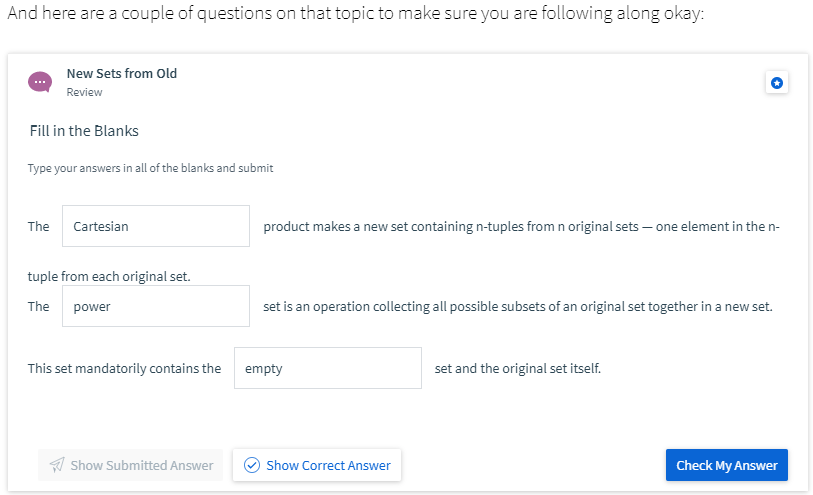 stray reef
it is correct
brave lava
thanks Ann
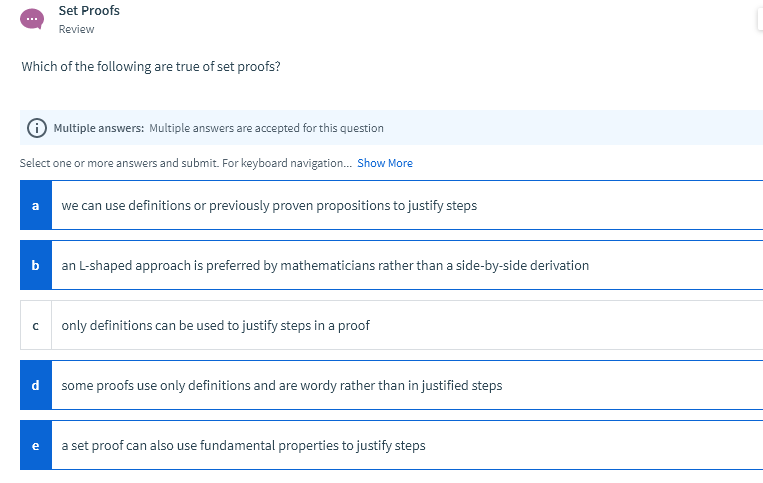 unreal stump
Isn't that personal?
brave lava
what
unreal stump
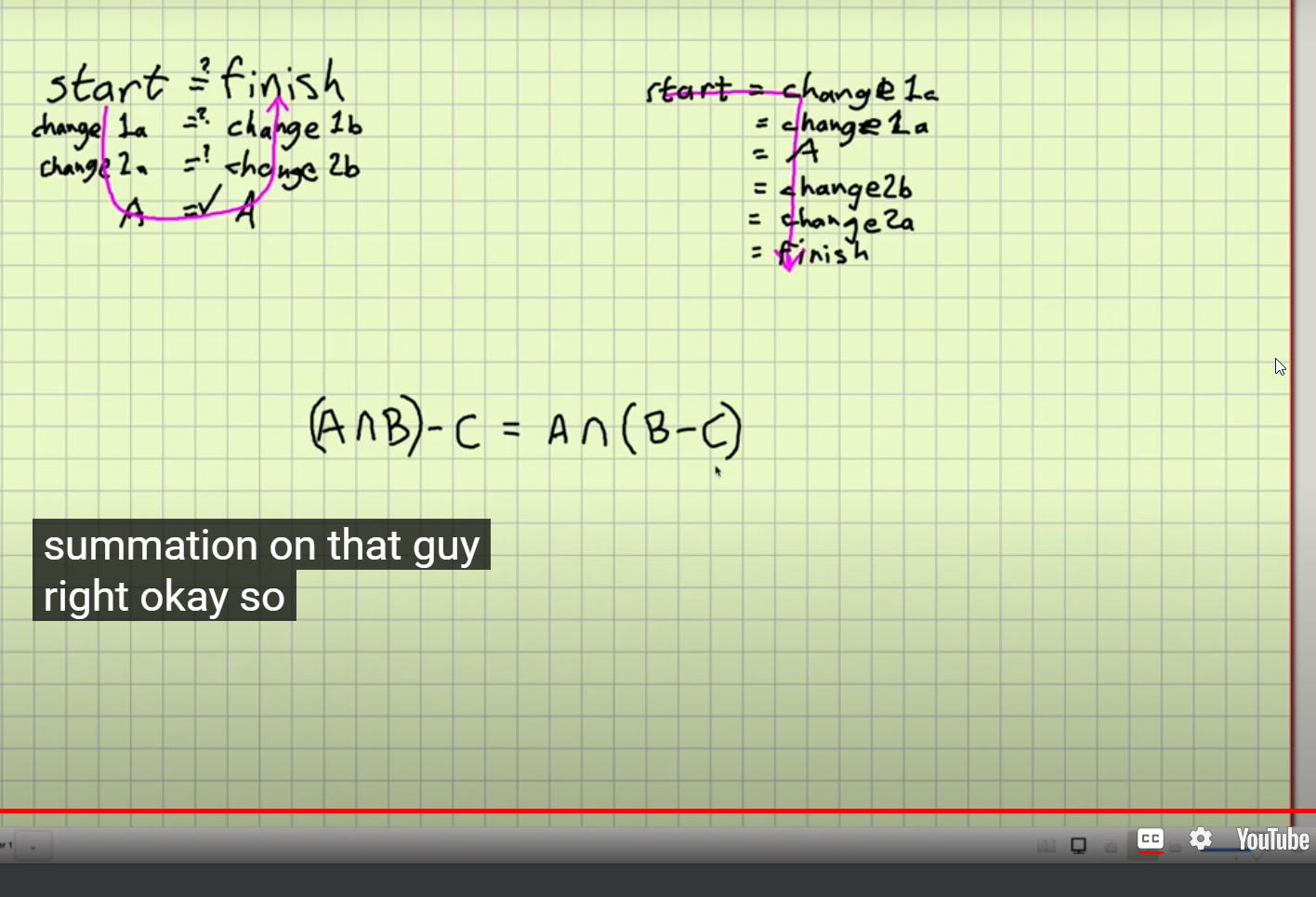
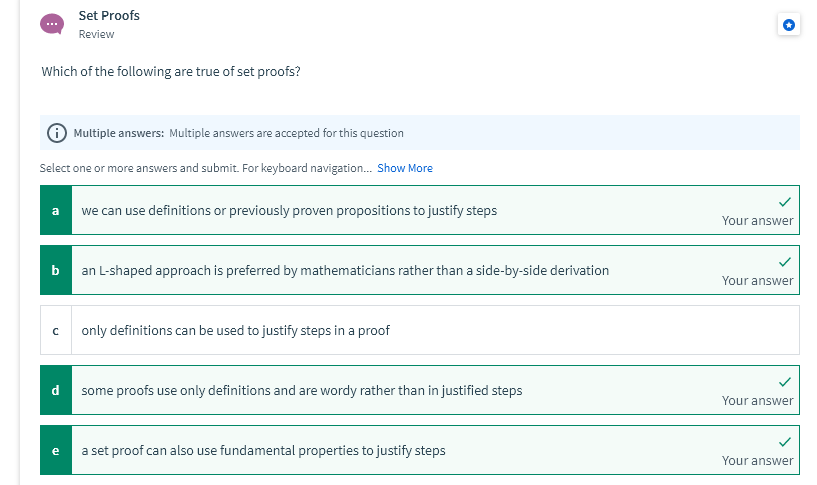
Preference of an "L shaped approach" vs a side-side derivation
brave lava
he talked about it in the lecture and he said L shaped approaches are better
unreal stump
Plus,You can make any proof wordy
stray reef
what the fuck is an "L-shaped approach"?
 unreal stump
What?
brave lava
the left side is the traditional approach i used from precalc and other classes
the right side is the "L" approach
unreal stump
Pretty sure it's completely personal
 brave lava
what
unreal stump
There are semantic problems like "what counts as a definition"(If I define a particular function,Is that a definition,by your sense?) ,"how are fundamental properties different from definitions"?"What is a L shaped approach"?
Don't think anyone can help you with those
brave lava
which once do you think are not right
brave lava
damn
unreal stump
B is personal
brave lava
why is A not true
i thought if we prove something
then we can use that proof in future proofs
unreal stump
Sorry AE are true
brave lava
lmao
i got it right anyway
4/4
LOL
that was aids
i think im just going to read my book and watch the trevor guy on youtube for discrete math
unreal stump
Try zach star. He might be an engineer, but he does good math videos
brave lava
my teacher is the type where you dont learn anything after 30 mins lol
he rambles a lot too and never sticks to a point
do you have his playlist
for zach star
and discrete math
for this one
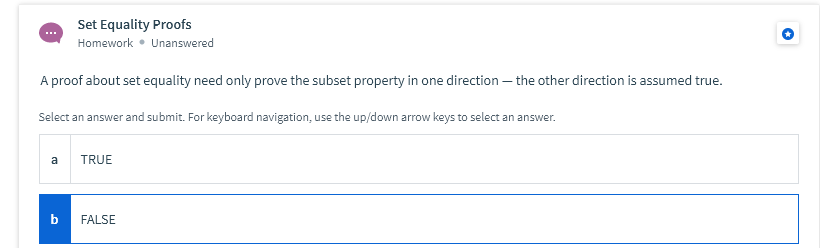
i think its false b/c you cant assume one side is true
you gotta show both sides are equal
thats the whole point of a proof
i got it right
 burnt herald
can someone explain why the answer is B?
does this qn belong here or proofs-andlogic?
honest barn
Proofs and logic I think
burnt herald
Proofs and logic I think
@honest barn Thanks
weary tiger
Does this look right
weary tiger
And what about this
 open narwhal
I'm having some issues determing if a function is 1-1 and onto. Would anyone be willing to help me out in a questions channel or voice channel?
 pallid lintel
whats the function
 gritty crescent
Wouldn't this proof work if I just chose k!+1, k!+2, ..., k!+k instead?
 gritty crescent
Ummm right
Should've thought harder; thanks for pointing out!
Is k!+1 a prime for any k>3?
unreal stump
11
gritty crescent
Ah, I see. Thanks!
Is there a way of determining this?
Or you just knew 11 works?
unreal stump
It is an unsolved problem
gritty crescent
Oh, I see.
stray reef

 misty merlin
Don’t give me an answer but any guidance is appreciated
I don’t know where to start. I understand what adders are. How do I approach this question?
misty merlin
If I adjust the question so change 3x to 2x and 0 =< x < 8 to 0 =< x < 4
Can u build a circuit for that?
Idk how my circuit to answer the actual question should be
How do u build a circuit for 2x?
Do you just draw x1 and x2 lines across and to output f(2x)
At the beginning I thought of doing x + x + x idk if I was on the right track
stray reef
2x is just x bitshifted left by one
south marten
Can some check if my proof of $(i)$ in the pigeonhole principle is correct: http://mathb.in/44843
vital dewBOT
Zophike1:
weary tiger
Huh?
south marten
@weary tiger that is the negation of Injective yes ? I'm prettty sure since I looked up the defintion online
weary tiger
First, what is the word surjective doing there?
south marten
oh my bad sorry typo
unreal stump
Typo
south marten
I'm sorry :c http://mathb.in/44852
weary tiger
Am I losing it or have you written a definition for injective, rather than not injective?
weary tiger
It should be something like “there exists unique a and a’ with f(a)=f(a’)
south marten
@weary tiger I sent an image of the correct defintion
weary tiger
Yes that one looks better
south marten
Yeah that's what I applied to say $f$ is not injective i'll have to change the link
vital dewBOT
Zophike1:
south marten
@weary tiger aside from that is the proof correct ?
weary tiger
I couldn’t follow it so probably not
But maybe I am just not understanding what you’re trying to do
misty merlin
@stray reef Thanks btw
south marten
What i did was a set up the set $X$ with different number of elements than $Y$ then used the definition of not one-to-one to show that $f$ is not one-to-one
vital dewBOT
Zophike1:
weary tiger
I get that, but you never mentioned pigeonhole principle or anything like that
So I’m not sure what the reasoning was
For concluding that f is not one to one
south marten
To conclude that $f$ is not one to one it comes down to seeing that
vital dewBOT
Zophike1:
south marten
$f(x_{1}) = f(x_{n+1)}) \implies x_{1} \ne x_{n+1} , \forall n \geq 1$
vital dewBOT
Zophike1:
weary tiger
Actually I think I may have realized what you did now
And it’s not right if that is the case
Lemme reread
Ok so...
This is a faulty assumption
south marten
Oh how to do I fix it 😦
weary tiger
f(x1) must equal f(k) for SOME k in X, it does not need to equal f(k) for ever single other k in X
Err wait
Btw
f(x1) needs to be general
It’s not like every element needs to break the injective property
Just 1
Well, 2 really
south marten
oh that's fair
weary tiger
As they would come in a pair
south marten
My assumption was faulty since I said that f(x1) = f(k) for all x but that's not the case
weary tiger
All k, but yes exactly
unreal stump
What are you trying to show, exactly?
south marten
$f(x_{1}) = f(x_{n+1)}) \implies x_{1} \ne x_{n+1} , \forall n \geq 1f(x_{1}) = f(x_{n+1)}) \implies x_{1} \ne x_{n+1} , \forall n \geq 1 $
vital dewBOT
Zophike1:
south marten
^ This was what I was trying to get at
weary tiger
Use pigeonhole principle to show that f from X to Y with |X|>|Y| cant be one to one, drake
unreal stump
You could simply write "there doesn't exist n"
Such that the condition is satisfied
south marten
Oh makes a sense damn I can't belive my proof was destroyed 😦
weary tiger
Happens to everyone
south marten
@unreal stump I could write there dosen't exist an $n$ such that $f(x_{1}) = f(x_{n+1)}) \implies x_{1} \ne x_{n+1} , \forall n \geq 1 $
vital dewBOT
Zophike1:
south marten
@weary tiger i'm trying to prove PHP you can't use what you want to prove
unreal stump
$\nexists$
south marten
ahhh okay okay
unreal stump
Are you trying to restate injectivity condition?
weary tiger
Are one line proofs with pigeonhole principle accepted? Or do you have to go through function constructions first?
south marten
weary tiger
I gtg for a bit, but if you think about, this question is pigeonhole principle stated pretty much exactly, but in the language of functions
south marten
@unreal stump I think I got the proof for $(i)$
vital dewBOT
Zophike1:
unreal stump
Not exactly,how do you know f(x1)=f(x(n+1))?
weary tiger
And you were asked to use php
unreal stump
It could be f(x2)=f(x(n+1)
south marten
Oof true
unreal stump
For some i,f(xi)=f(x(n+1)
unreal stump
Or better,Let f be injective,then f should have a range of (n+1) elements,but range has only n elements
So can't be . Therefore f is non injective
(because f(x1),f(x2)... Should all be distinct)
south marten
That makes a lot more sense I see where my error was I made the faulty assumption that f(xn)=f(x(n+1)) for all given $n$ which is not the case
vital dewBOT
Zophike1:
south marten
@unreal stump is the proof okay now
I think i may have put the wrong definition for injective again
south marten
yeah hense why you said for some $i$ that f(xn) = (x(n+1))
vital dewBOT
Zophike1:
unreal stump
It should be $f(x_i)=f(x_j) \exists i,j$
vital dewBOT
DrunkenDrake:
unreal stump
Like not necessarily n+1,and i
south marten
but would that be fine ?
unreal stump
$f:{1,2,3,4} \mapsto {1,2,3}$
$f(1)=1,f(2)=2,f(3)=2,f(4)=4$
south marten
so i'm pressuming yes to say for some given $i$ $f(x_n) = x_n+1$ because you did say that eariler I belive @unreal stump
vital dewBOT
Zophike1:
south marten
yeah I figured thanks for helping me you have any advice with counting arguments i'm pretty weak at them 😦
unreal stump
Contradictions probably
south marten
it seems easier to say something is "not" in the context of a counting argument then it is to try to prove it directly
also how close was my orginal proof to a correct solution ?
unreal stump
I don't know. I can only say whether a proof is right or wrong
south marten
it's fair
 rain ridge
concerning the field of discrete mathamatics, could anyone provide an example of an partial order relation that has a minimal element in regards to the order relation that is different to the least element of the set the relation acts on.
honest barn
What
To have a least element implies you already have some sort of order
The only way you could make this work is if you’re considering some “natural” order in regards to
least element of the set the relation acts on
And then a different order, but this is really pointless since you’re considering two orders
Take like N ordered by divisibility and then 1 is a least element with respect to this, and then if I just arbitrarily consider the partial order < which states
x < y if and only if x = y then every element is minimal, so take 2, 2 is minimal with respect to < but not the “least” element
But again, least really has no meaning when you speak about < because it’s least with respect to a different order


