#discrete-math
1 messages · Page 135 of 1
 last timber
 languid flint
just one more step, from that G(x), I have to get S(k)
like
I need to find the sequence whose generating function is G(x)
and folks, that is how we solve a recurrence relation using generating functions 
 cerulean ore
If n>2 then,
gcd((k)*(k+1)/2, n*(n+1)/2) - k*(k+1)/2)>1 where k<=n.
I am trying to prove it.
(n*(n+1) - k*(k+1))/2)
can be written as (n-k)(n+k+1)/2
How do I prove that they have gcd>1?
 vital dewBOT
Ann:
 stray reef
is this your thing
cerulean ore
Yes!
stray reef
i am pretty sure gcd(a, b-a) = gcd(a,b)
cerulean ore
$\gcd\left({\frac12 k(k+1), \frac12n(n+1)\right) > 1$
stray reef
\paren is a custom command i put in my latex preamble. you will need to use \left( \right)
anyway w/e
cerulean ore
Oh, actually I have never used latex before, but it feels very neat to use.
stray reef
so you have 2 ≤ k < n i guess
cerulean ore
lmao, I am sorry.
vital dewBOT
Kaori4Kousei:
Compile Error! Click the  reaction for details. (You may edit your message)
stray reef
we can assume 1 < k < n since k=n makes it trivial and k=1 makes it falsae
uh
yeah no if you are trying to prove this for ALL possible pairs (k,n) then i'll have to disappoint you as there is a simple counterexample
cerulean ore
You mean it is not possible for every 1<k<n, like there are specific values of k when it works?
stray reef
can i see your problem exactly as it was stated to you?
cerulean ore
Like for n = 7: (4, 24) has gcd 4, but it is not possible to make 4 from some first natural numbers, right?
cerulean ore

Codeforces
stray reef
your restatement has precious little to do with this problem
cerulean ore
People came up with different solutions, I came up with a solution when gcd(sum of first k natural numbers, sum of first n numbers - sum of first k numbers)>1 then, I have my answer. It worked and got accepted.
So, I am trying to understand why this is true.
stray reef
huh?
ok so what you're saying is you want to prove (∀n ≥ 2)(∃k ≤ n)[gcd(k(k+1)/2, n(n+1)/2 - k(k+1)/2) > 1]?
cerulean ore
Yep!
stray reef
well i suppose if k is an odd prime then k divides k(k+1)/2
so if n has an odd prime factor you can just use that as your k
cerulean ore
Yes.
One solution was gcd(n, n*(n-1)/2) > 1. I proved it by considering n as odd first then, even.
But couldn't prove my statement.
cerulean ore
Yes, but mine is hard to prove.
 pallid lintel
do you people agree with my proof?
its kinda like 7 bridges of konisberg heh
odd number of bridges over a river
pallid lintel
ah i wrote this proof for people in my class so they would all know what the terminology is, if any anything is unclear lemme know
we actually proved it after the assignment using chromatic flow polynomials and the proof was 2 lines long
 near prawn
what have you tried
 jovial grove
I get what to do conceptually
Add the cases where priya is in and the cases where Ana is in
Then subtract the cases in which both are in
I just don’t know how to like set it up
Like I feel like I’m not accounting for some things
Or I’m overcompensating
near prawn
no thats the right approach
jovial grove
I mean like when computing
Like I’m not sure I’m doing it right
I just need clarification on what it looks like
 vapid light
What I did was that I split the set of girls into two sets, one that has Roberta and Priya and other set has the rest of the girls. Then I just chose 1 from the first set, 2 from the rest of the girls, and 3 from the set of boys
Not sure if I'm entirely correct
So don't take my word for it ig
jovial grove
Can someone show the solution in latex
vapid light
I got ${2 \choose 1}{15 \choose 2}{14 \choose 3}$
vital dewBOT
Gupple:
jovial grove
Does that account for the fact that both priya and Roberta not being in the same committee
vapid light
Yeah
jovial grove
Okay
vapid light
It's because you can only pick 1 from roberta and priya, which is 2 choose 1
And then you remove the two girls from the set of girls
So 17 - 2 choose 2
vapid light
Yep
 compact shell
How many of the arrangements have exactly two consecutive consonants (non-vowels)?
UNUSUAL
Could someone help me on this question?
The answer mentions 5P2 * 3P2 * 4!/3!
 honest barn
So you’re looking at permitting the letters right?
Oh shit, ughhhh this is gonna be annoying
Let’s figure out how to get this to work lol
So let’s justify each bit of the answer @compact shell
compact shell
Okay
honest barn
So we need like
A block of two consonants
And then the last one to be separate from it
As in, not adjacent
honest barn
Yes
compact shell
Ok
compact shell
ok
honest barn
Let me think for a second, I thought I had a proof for that bit, but it fell through
compact shell
oh okay
honest barn
So I can say for certain
The division by 3!
Has to do with the fact you have 3 U’s
So in your final answer you would overcount
Because we treat the U’s as being separate, but any permutation of the U’s counts as the same word
compact shell
correct
honest barn
Gaaaa, this is really annoying. I don’t think I can salvage my ice
Idea
I have an idea that’s very close to working, but fitting in 5C2 is so hard
honest barn
I’m still thinking about it tho
So basically I feel like you want to slot in the 2-letter consonant cluster
The issue is there’s 6 places it can go
And 2 of them leave the remaining consonant with 4 places to go
And the other 4 give it 3 places
So I almost have it, I just overcounted by a factor of 2
So I need to figure out where the symmetry is lol
compact shell
🙂
honest barn
Weird, my final answer ends up being 4 larger than their answer
;w;
Okay, I’ll outline my methodology, maybe it will help you figure out how to actually get this to work
Begin by placing the 2 consonant block in one of the 6 positions, it’s 6 since there’s 6 places the first letter can be
The two ones on the edge give 4 remaining places for the final consonant
While the other 4 give only 3
So in total there are 20 ways to put in our 2-consonant block, and the other one
From there there are 3C2 ways to pick which two to put in the block
And then there are two ways to actually put them in, because you can flip the two
E.g. SN vs NS
From there there are 4! ways to arrange the remaining vowels
But you overcount by 3! Because of the U’s
So in total I get 203C22*4!/3!
So 480
Their answer is 120
That’s all I got ¯_(ツ)_/¯
compact shell
Yea
 rancid ibex
Not sure if this is right place to ask, but
Can somebody explain to me, a noob, what is the difference between Stirling number of the second degree and Bell's number with some basic example? It seems like Bell number is just a sum of Stirling numbers but i can't understand it very well.
compact shell
Are there any specific conditions when we could add a "premise" in rules of inference?
I have done some questions which randomly seem to add their own premise
 lyric pumice
@rancid ibex Basically, Stirling numbers of the second kind count the number of ways to put some number of distinct objects into some number of groups and the Bell numbers count the number of ways to put some number of distinct objects into any number of groups.
rancid ibex
Thanks.
compact shell
Find the number of all arrangements of 3 ones and 5 zeros such that no two ones are adjacent to each other.
Isnt it gonna be 6C3 * 5?
 smoky harbor
Hi all, good morning. I am doing a Discrete Math subject next year, I have not done any type of Maths recently but I am looking to study hard to prepare myself for Discrete Math, do you guys have any recommendations of what I should study to prepare myself? Thanks
 rain stone
@smoky harbor check if there are any pre-requisites for the class you're taking. If there's a pre-requisite class, do a review of the material and some problems. If there are no pre-requisites, I would suggest reviewing basic logic and proofs. There are recommendations for good books in #books-old and #book-recommendations
in terms of raw knowledge, you don't need much for discrete math; logical skills and proofs are much more important, at least from what I've normally seen
some linear algebra might be needed depending on the class, but not very much, and the syllabus/pre-requisites should tell you that
smoky harbor
Thanks @rain stone There are no pre-reqs, I'll look into proofs, algebra and logic, cheers
 errant bear
honestly i wouldnt be worried at all
like, your class should walk you through all of the steps/tools/techniques you need
 hardy remnant
so i have the answer to this question but i cant seem to solve it on my own
these are my steps so far:
i turned (p->r) into -p OR r
and q -> r into -q OR r
stray reef
and them together
hardy remnant
(-p OR q) AND (r OR r)
hardy remnant
so (r OR r) is true so that just become a single r
with the idempotent rule
now i have (-p OR q) AND r
stray reef
can you check your work again
hardy remnant
ok
(p -> r) AND (q -> r)
(-p OR r) AND (-q OR r)
(-p OR -q) AND (r OR r)
(-p OR -q) AND r
thats my work so far
stray reef
uh. what's that step from line 2 to line 3
hardy remnant
i switched the r and -q
hardy remnant
im just making educated guesses by looking at the formula sheet
i thought i saw people switch variables around
ok since theres a single r, maybe i should use a distributive rule
wait then that would become step 2 again
idk what im doing, im reading the chapter and its not helping
 sleek swallow
Nice question:
$$[(p \implies r) \land (q \implies r)] \iff [(\lnot{p} \lor r) \land (\lnot{q} \lor r)]$$
$$\iff [(\lnot{p} \land \lnot{q}) \lor r]$$
$$\iff [\lnot{(p \lor q)} \lor r]$$
$$\iff [(p \lor q) \implies r]$$
vital dewBOT
Abhijeet Vats:
sleek swallow
It's just an application of distributivity followed by the fact that the following two propositions are logically equivalent:
$$(p \implies q) \iff (\lnot{p} \lor q)$$
vital dewBOT
Abhijeet Vats:
sleek swallow
@hardy remnant Understand?
sleek swallow
There's no reason to use idempotence or anything like that here. Try doing these things in a basic way before moving forward to anything more obscure.
Also, another way to prove the equivalence would be to assume that there existed an assignment of truth values for each atomic proposition such that the equivalence was false. Then, show that there must be a contradiction.
But that, of course, is a more wordy way to do it and is entirely unnecessary given that there are perfectly good laws you can use, as I have shown above.
hardy remnant
alright, thank you
sleek swallow
you're welcome
hardy remnant
@stray reef so i can switch the r around
abhijeet, that makes sense now
i forgot to take the - out of (-p OR -q)
sleek swallow
You cannot technically switch the r around. What I did wasn't to switch the r around. You may pull it out because distributivity does hold.
hardy remnant
ahh
 twilit matrix
Anyone have a good online resource for Discrete Maths?
Something like Khan Academy but with Uni maths lol
honest barn
libgen?
twilit matrix
Thanks but I was thinking more like a series of videos or lectures explaining single concepts. Like a 10 minute video on just Sets.
 robust mango
ik, this was all i had so i thought id share
vapid light
cs 70 is pretty dope
psets are ass cancer though
wow theyre teaching markov chains in the summer
wack
 weary tiger
https://www.youtube.com/playlist?list=PL3o9D4Dl2FJ9q0_gtFXPh_H4POI5dK0yG I haven’t watched these but I’ve enjoyed all the mit lecture series I’ve watched so I might be willing to recommend them

YouTube
errant bear

YouTube
Discrete Mathematics. Covers Set Theory, Logic, Counting, Permutations and combinations, functions, relations, number theory, proofs, and formal grammar. MAC...
pallid lintel
are there any ppl here that know a lot of ramsey theory that i can add to friends?
 serene basalt
 weary tiger
lemme send you the pdf
 thorny willow
How does one prove that a graph is not n-colorable?
proving a graph is n-colorable is straight forward -- just colour it
but idk how to show when it isn't possible
 tulip ravine
It can be quite messy. One common technique is to identify subgraphs of known chromatic number, but not all graphs are amenable to taht
 heavy crescent
Guys, I don't understand Example 22. Why can't you remove one of the white squares so it becomes - 21 blue, 21 black, 21 white - instead of removing one of the blue squares (resulting in 20 blue, 21 black, 22 white)?
 fluid verge
screenshot pls
weary tiger
There are actually 21 blue squares
heavy crescent
"...we may assume that we have rotated the coloring so that the missing square is colored blue"
one of the blue squares gets removed
my question is: why can't you rotate the board so one of the white ones get removed?
fluid verge
the goal is to reach a contradiction, removing a white square won't do that @heavy crescent
 forest zenith
does anyone know a good way to upper bound the sum
$\sum_{k=1}^n \sqrt{k(k+1)}$
vital dewBOT
jn:
forest zenith
so far I just have
$\frac{n^2 + 3n}{2}$
vital dewBOT
jn:
forest zenith
but there has to be something tighter than that
honest barn
I feel like that’s a pretty tight one
The sum is slightly above the sum of k from 1 to n
And that is just (n(n+1))/2 = (n^2 + n)/2
@forest zenith
forest zenith
yeah maybe i should just be happy with that then
honest barn
Maybe you can squeeze out a tiiiiiiny bit better of a bound
But it’ll definitely still be on the order of n^2
So I don’t see a time it would make a difference
forest zenith
yeah i'm just gonna take a big O eventually anyway so it's probably fine lol
honest barn
👍
forest zenith
thanks!
heavy crescent
@fluid verge Oh, I see what you mean - you can interpret the board as 20:blue, 21: black, 22:white so it contradicts the premise.
fluid verge
yes
heavy crescent
👍
 naive saffron
There's also 5, 7 and 9
weary tiger
because i'm starting at 1 -> 4
then i look at 4 in the x row which corresponds to 8
then i go to 8 in the x row and that corresponds to 1 so i don't write 1 again and i close the parenthes
is that the right approach?
naive saffron
Yes
weary tiger
and then i went to the next biggest number at 2 and that corresponds to 6 but then 6 corresponds to 2 but then i can't have repeats
yeah there are other problems bc i have questions on them too
naive saffron
Yes that's basically how you do it
But also you're missing 5 7 and 9
Look at 5 7 and 9
weary tiger
what about them?
naive saffron
They are not fixed by the permutation
So there is also a (5 7 9) in the cycle notation of a
naive saffron
Ok so if a number doesn't appear in the cycle notation at all, that means the permutation does nothing to it
weary tiger
i stopped bc then there were repeats...
naive saffron
?
naive saffron
So far, but it's not complete yet
weary tiger
ok so now i move on to 3
naive saffron
yes
weary tiger
and 3 -> 3 but i don't write that down
naive saffron
yes
weary tiger
so i go to 4 correct?
naive saffron
yes
weary tiger
4->8->1
naive saffron
but 4 already appeared in a cycle
weary tiger
and then 1 goes to 4
naive saffron
so you don't need to worry about it
weary tiger
oh shat
naive saffron
now go to 5
naive saffron
Does 7 get mapped to 7?
weary tiger
ok so then 9->5
naive saffron
Yes
weary tiger
so would it be (579)
naive saffron
Yes
weary tiger
so is a = (481)(26)(579)?
naive saffron
And then you move on to 6, 7, 8,9 but all those numbers have appeared already
So you're done
Yes
naive saffron
Permutation is a bijective function
In particular, it's injective: no two input will have the same output
And when expressing it in cycle notation, this is just the way to do it
Do you know what these cycles mean?
weary tiger
so these cycles are just a way to represent permutations right?
idk if i answered the question
naive saffron
Each cycle is in itself a permutation
weary tiger
i see
naive saffron
We can then write the permutation as a product of cycles
And the product here is the product of two permutations: function composition
weary tiger
so when it's a product of two permutations, it's function composition?
or not always
naive saffron
Writing a permutation like this allow us to easily know what the permutation does
It is always
naive saffron
Well unless otherwise specified in your text
weary tiger
i see i see
ok can i ask about the pure cycle method and the function method in 5
lemme resend
naive saffron
"as described in the notes"
Sadly as much as I hope I do, I do not have access to your notes
weary tiger
ok so the reason why im scared is because i haven't seen example when there is another permutation multiplied together by another in a
oh
wait where do you see "described in notes"
AH
hold on
ok you should have it now
naive saffron
Ok if you really understand what permutations are and what cycles are then the "pure cycle" approach should make sense
Ok we can go through it i guess
weary tiger
lol im kinda clueless
actually remove the kinda
i basically wanna make sure i have it right becauase it's two permutations multiplied for a so that's kind of confusing
lemme try to work it out real quick and then send my work
because going from right to left will get weird
naive saffron
You can think of a permutation as a way to reorder things
For example the permutation a in problem 4
That permutation takes the 1st object and place it at position 4, take the 2nd object and place it at position 6, take the 3rd object and place it at position 3, etc
last timber
@weary tiger циклический и "функциональный" методы - два способа визуализации одной и той же пермутации
weary tiger
@last timber абсолютно спасибо большое)))
honest barn
The equivalence classes of Z_7 were formed by modding out by the equivalence relation a ~ b iff a = b mod 7
the equivalence class as a set simply holds all things that are equivalent to any thing inside of it
so the equivalence class of 3 is all things equivalent to 3
weary tiger
I must be a whole unit behind, thats why Im struggling so much. For something to be equivalent
what does that mean exactly?
I was given this definition, and I can use it
but, no completely sure what this would mean in the deeper sense
honest barn
I mean, that's the definiton
if you know what a reflexive, symmetric, and transitive relation is separately
weary tiger
yeah
honest barn
then an equivalence relation is just one that is all 3 of those at the same time
This lets you form equivalence classes
weary tiger
Ohhh
ok, so uhh
This is so much, idk how you guys can do this
Ugh, this is dumb question then, but why wouldn't there be infinite equiv classes of Z_7?
honest barn
because each thing is either equivalent to 0,1,2,3,4,5, or 6
but each equivalence class has infinitely many elements
the equivalence class of 0 has 0, 7, -7, 14, -14, 21,...
weary tiger
ok, that makes sense
would it be fair to say, that in a = b mod n, our a = the value for our equivalence class, and b belongs to a value in that said set?
honest barn
they're both "representatives" of the same equivalence class since they belong to the same equivalence class
 obtuse minnow
Equivalence classes are just sets of elements of an overarching set that contain all elements of the overarching set and don't have elements in common. (in math speak we take a set and put ALL of its elements into disjoint subsets and each of these subsets are an equivalence class). An everyday example is the letter grade system: All possible grades must conform to exactly one equivalence class of A, B, C, D, F. No grade belongs to more than one and all grades must belong to at least one. In a lot of cases, each subset will have the same number of elements, but it's not required. Hope that helps.
 elder summit
I don't fully understand the first part of the question - a transposition is a cycle of length two, so how can it consist of n - 1 cycles?
Could someone give an example please
 gleaming zephyr
a cycle is something that looks like (a_1a_2... a_n)
thats an n cycle
a transposition is a two cycle
t_1 here would prob mean there are n-1 transpositons
(12)(23)(34)..... n-1
@elder summit
elder summit
Oh, I thought they meant t_1 would be an individual transposition ie (12) which is why I was wondering how (12) could consist of n - 1 cycles
hardy remnant
for a question a, the ! means its a unique quantifier
so doesnt E!x already mean Ex
idk how to do the reverse E
there exists an x that is unique, but that also applies to the second ExP(x)
sleek swallow
$\exists! x \in S: P(x)$
means that there exists precisely one $x$ in the set $S$ such that $P(x)$ holds.
vital dewBOT
Abhijeet Vats:
sleek swallow
So, if you assert the existence of precisely one, you've also asserted existence in general
On the other hand, saying that:
$$\exists x \in S: P(x)$$
does not mean, necessarily, that there is precisely one such x.
vital dewBOT
Abhijeet Vats:
 elfin lagoon
this may or may not be the right channel but, what does the resulting set look like?
the star us for kleene closure
is the stuff in paren saying a OR b ?
 obtuse lance
yeah, probably
I think the notation is not 100% standardized, for instance I think even using () instead of [] can have a different meaning, I'd have to really look in the book you're using to know how it's defined
hardy remnant
for f, how does a person figure out what the third variable stands for when it is not given, such as z
i just put that z is a server but that is a guess
sleek swallow
W(x,z) just means that student x has visited website z
hardy remnant
oh
ok so there can be multiple of the same website or people
ahh, because the second argument in W(x, y) is for websites
sleek swallow
So, for f), it is:
There exists a student x and there exists a student y such that for all possible websites z, both students are not the same and student x has visited website z iff student y has visited website z.
sleek swallow
you're welcome
hardy remnant
does it make a difference if i use if or iff
sleek swallow
yes it does
the double arrow refers to a biconditional
if you just use an if, then you're only looking at an implication in one direction
pallid lintel
im practicing counting problems atm...i got 14C5* 14C5 *13C4 *11C2 *12C3 *10C1 for this, anyone get the same? i treated it as taking non replaced balls out of a bag. (and taking taking A out of bag for first choice, ect, putting it back in for 2nd choice, ect
near prawn
works?
pallid lintel
examiner mispelt words heh
near prawn
this seems like a permutation problem rather than combinations
weary tiger
any discrete people available?
errant bear
dont worry i wont tell anyone 🤫🤐
 soft bobcat
This upcoming semester, I'll be taking discrete math (This is the description: An introduction to the discrete structures that serve as a foundation for mathematics and computer science: set theory and mathematical logic; binary relations; counting and algorithm analysis; induction and strings.). Will I use Calculus in this class?
stray reef
up until algorithm analysis, almost none if any
sleek swallow
induction problems might involve calculus
stray reef
in algorithm analysis, you will need a little bit
weary tiger
Calculus falls under continuous math aka non discrete math
pallid lintel
you will have to use partial fractions in recurrence relations as well but the lecturer will explain what that is. (its usually learnt first in a calc class though)
there are a couple derivatives used for generating functions, nothing difficult
this was taught in my 2nd discrete math class though, not my first one
pallid lintel
can anyone explain what this definition means? the context is a proof of ramsey theorem on p-uniform hypergraphs. I don't understand what 'same beginning' means
 analog sonnet
I'm guessing that two p-sets (of natural numbers?) have the same color iff their minimal element is the same
 sinful meteor
I'm gonna ask here because i've struggled to find a proper youtube video explaining this. How can you tell if a relation is a function using the domain and target? I keep finding stuff on using domain and range, but not target, and i'm trying to finish up a programming assignment on this
The definition I understand, every element of A is mapped to exactly one element of B. But my specific problem doesn't have a formula to follow, only a couple of sets so i'm a bit tripped up on where I need to get started
More specifically,
B = [4, 5] #target
f = [ [1, 4], [2, 5], [3, 4] ] #relation``` faint narwhal
[1,4] exactly means that 1 is mapped to 4
sinful meteor
But [3,4] means that 3 is also mapped to 4
Therefore it cant be a function
Correct?
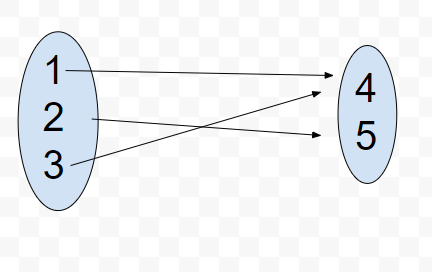 obtuse lance
f(x)=x^2 is a function that maps 2 and -2 both to 4
sinful meteor
Ahh. So the above is a function. As long as every element of A is mapped to one and only one element of B ?
Even if some A share the same B
obtuse lance
have you learned what injective and surjective mean
sinful meteor
onto/one-to-one ?
I understand this concept when an actual formula is involved, but not just when i'm handed a few sets
I keep getting tripped up without having an actual formula to follow
obtuse lance
whenever you have a relation that you suspect is a function, try to determine if it's injective or surjective
 floral silo
Hi, I understand the Bellman-Karp algorithm and how it works but I'm reaaaally struggling to represent it in pseudocode using a cost matrix. Could someone help me out?
weary tiger
@sinful meteor if an x in the domain is mapping to more than one element y in the range then its not a function everything else is a function
 drifting atlas
So I think I got this down, I just want to be sure.
b. The range is (-inf, inf). It is one to one as both the input and output are all real numbers, the inverse is $(x-4)/5$ and the range is once again all real numbers so (-inf, inf).
vital dewBOT
Soulgiver831:
drifting atlas
I didn't do the division thing right but yeah
drifting atlas
<@&286206848099549185>
weary tiger
inverse looks right
im not sure about your explanation for why it's 1-1 though
@drifting atlas can you elaborate on why the function in part b is 1-1?
(i hope there's no problem with me using the @)
drifting atlas
Okay. So should I just do f(x)=f(y) with x and y in R?
weary tiger
yep. assume that f(x) = f(y) and show that x = y
that's what it means for f to be 1-1
drifting atlas
Okay cool.
weary tiger
that should be your argument for why f is 1-1
drifting atlas
I think I got it for d as well but I'm not sur ehow to prove x/(1-x)=y/(1-y) implies x=y/
weary tiger
what have you tried?
this one's just a matter of simplifying the equation until x = y pops out
drifting atlas
Well I tried to multiply both sides by (1-x) but that would mean that mean x=y*(1-x)/(1-y)
weary tiger
you can make that a bit simpler
for problems like these it's usually a good idea to try and get rid of all fractions
drifting atlas
Oh wait dang I forgot about cross multiplying.
weary tiger
can you finish it from there?
drifting atlas
I got it
weary tiger
nice
drifting atlas
Thanks ^^
weary tiger
no problem
drifting atlas
@weary tiger Sorry to @, I just think I made a mistake and I wanna be sure. For d is the domain of the inverse (y=x-xy) also between 0 and 1?
drifting atlas
Sorry I'm confused ><
weary tiger
which part?
drifting atlas
Like, what is the image of the original function?
weary tiger
have you found it already?
you should probably do that before you find the inverse
just so you know where the inverse is defined
drifting atlas
I don't think so. I got the range, I proved it's one to one, and I got the inverse function
weary tiger
range and image are the same thing
weary tiger
im not sure about that
weary tiger
in this case, yes
the image of f is not going to be the same as the domain
staring at a desmos plot tells me that the image should be {x in R : x > 0}
and thats the set which will be the domain of the inverse
now, of course, you have to actually prove that the image of f is the set i just described
drifting atlas
But how would we get, say, 100? The highest x can be is .9999_ right?
weary tiger
the image is the set of values that the function takes
try solving f(x) = 100, say
oh oops i might have misinterpreted
can you elaborate?
drifting atlas
The domain is what you can plug into the function. Like if you have a function f(x)=x+5 and your domain is (1,2,3) your range would be (6,7,8).
weary tiger
correct
drifting atlas
At least that's how our professor described it.
So the range here is 0<x<1
or sorry domain
weary tiger
mmhm
drifting atlas
So I figured you just plug in 0 and 1 for x which gives you 1 for x=0 and N/A for x=1
weary tiger
the problem here is that the domain contains a LOT of numbers, so you won't be able to find the range by just checking certain numbers in the domain
you have to verify, set-theoretically, that im(f) = {x in R : x > 0}
drifting atlas
How?
weary tiger
the same way you show any two sets are equal
for one direction, show that if y is in the image of f, then y > 0; specifically, if 0 < x < 1, then f(x) > 0
and for the other, show that if y > 0, then y = f(x) for some x in the domain of f
there's probably a cleaner way to do this but i think it would help if you worked right from the definitions here
drifting atlas
And that gives me that the range is x in R: x>0 right?
weary tiger
yup
drifting atlas
Okay and the domain of the inverse is the same as the range of the original function right?
So it's the same thing
weary tiger
it is correct that the domain of the inverse will be the range of the original function, so long as the inverse actually exists (which is the case if the function is 1-1; you've already shown that)
drifting atlas
Sweet!
weary tiger
i made a correction to the thing above btw
drifting atlas
Okay. Thank you again ^^
 faint jackal
@cerulean idol am having issues with my algebra problems maybe help ?
 cerulean idol

faint jackal
english not really good can french lessons maybe ?
cerulean idol

cerulean ore
$\lfloor\frac{n}{a}\rfloor+\lfloor\frac{n}{b}\rfloor-\lfloor\frac{n}{lcm(a,b)}\rfloor$
vital dewBOT
Kaori4Kousei:
cerulean ore
How to generalize this for m numbers?
faint narwhal
generalize what? You just have an expression
cerulean ore
I mean if we want to find the count of the numbers between 1 to n that are not divisible by a and b then we do n - n/a - n/b + n/lcm(a,b)
faint narwhal
this is just inclusion-exclusion
cerulean ore
Yes, for past 3 hours I am trying to implement PIE.
But cannot come up with a solution for m numbers. (Getting confused all the time)
Eg. Suppose n = 100 and numbers are m = {2,3,5,7}. How to find the count of numbers that are not divisible by any of the numbers from the set m?
faint narwhal
you subtact 100 - 100/2 - 100/3 - 100/5 - 100/7
But this overcounts the numbers that are divisible by 23, 2 * 5, 2 * 7, 35, 3*7 and 5*7
cerulean ore
But when we add the overcounted numbers back to this : 100 - 100/2 - 100/3 - 100/5 - 100/7 are not we overcounting some numbers again?
cerulean ore
Which are the multiple of pairwise LCM of these: 2*3, 2 * 5, 2 * 7, 3*5, 3*7 and 5*7?
faint narwhal
yes
cerulean ore
Will we count some numbers again?
faint narwhal
yes
faint narwhal
yes
cerulean ore
Thank you! 😄
weary tiger
Suppose 5 different integers are randomly chosen from between 20 and 69, inclusive. What is the probability that they each have a different tens digit?
is the answer $\frac{10^5}{50 \cdot 49 \cdot 48 \cdot 47 \cdot 46}$
vital dewBOT
polynomial:
weary tiger
@stray reef ?
weary tiger
why tho
stray reef
vimes please don't interrupt
vimes please don't interrupt this isn't even the issue here
anyway, you do not care about the order in which you draw your numbers
weary tiger
yes but look at them one at a time
say we wanted 1 number to fit this
10 ways to pick a tens number
50 ways to pick a number at all
do you agree
stray reef
50 * 49 * 48 * 47 * 46 would count the possible draws if you DID care about which integer came first, which came second etc
 glass karma
what grade you in
stray reef
i.e. under that count, you would count [51, 23, 21, 20, 66] as a different outcome than [21, 66, 20, 23, 51]
and if you choose to do it that way, which you certainly can, then the number of favorable outcomes will no longer be 10^5
it'll be 5! * 10^5
weary tiger
i don't see how i am not accounting for the same thing with the 10^5 tho
stray reef
since to count the favorable outcomes you still want one number from each ten-range
but now it matters what ten-range comes in what position in your now ORDERED draw sequence
e.g. you could have the number in the twenties come first in your draw
or second
or third, or fourth, or fifth
weary tiger
ok but look at it one step at a time
choosing any first of the 10 numbers
we have
10 choices for any tens digit
right
do you agree
stray reef
yes, and we also have 5 choices for what the tens digit will be
weary tiger
oh ok
stray reef
ie whether the first number will be in the twenties, thirties, forties, fifties or sixties
stray reef
there's another way to look at it
weary tiger
yes?
stray reef
you could say that the first number can be whatever you want
ie 50 options
but then after you pick it the number of options goes down not by 1 but by 10, since you're crossing off the entire ten-range the number was in
so the next number has 40 options
the next has 30, then 20 and then finally 10
weary tiger
ohhh
yeah
i like that way more
thanks
that makes a lot of sense 🙂
that also explains my overcounting
weary tiger
Ten people are sitting around a round table. Three of them are chosen at random to give a presentation. What is the probability that the three chosen people were sitting in consecutive seats?
@stray reef can you help me again please
i am thinking of (10 * 2 * 2)/(10 * 9 * 8)
weary tiger
Wouldn't it be 10!/((10-3)! * 3!)
= 10!/(7!*3!)
10 * 9 * 8/(3!)
this can't be it because that makes the probability way higher than 1.
Oh my bad i misread the question
I was thinking about ways to choose sorry
Wait wouldn't it be the # of ways to pick 3 consecutive people / # of ways to choose 3 people
yes
Total num of ways to pick 3 ppl is 10 choose 3 = 120
But now to find how to pick 3 consecutively
Since for the first person, there r 10 selections that can be made
We have 10 * ..
this is wrong for sure since your order is messed up
But i mean i have the general idea
well i had the general idea as well above..
Its been a while since ive done discrete sorry
Guess i dont remember it as much as i thought i did
Sorry about that
 strong urchin
anyone good with fourrier series and fourier- + z-transformations? pls pm me :)
stray reef
the number of ways to pick 3 consecutive people from a round table is obviously just 10
@weary tiger @weary tiger
 stray reef
every picking of three consecutive people is uniquely determined by who's in the clockwise-most position
sinful meteor
If I were to try and say "There are no dinosaurs living at the zoo" in terms of a logical expression,
S(x) : x is a dinosaur
M(x) x lives at the zoo
Wouldn't it just be
∃x(¬S(x) \/ M(x))
? Or is it ∀x ? I'm confused on the difference. I know the wording difference but have no clue when to use each
I guess i'm confused because "There are no" kinda implies EVERY, but the wording is "There are" so I get tripped up.
weary tiger
you can think of a "there are no..." statement is as the negation of a "there exists" statement, which seems to be what you had in mind
you should therefore end up with something with a "for all" in front
your final answer should be the logical equivalent of "every animal living at the zoo is not a dinosaur" (which you don't need logic to figure out)
sinful meteor
∀x(¬S(x) \/ M(x)) seems to be what im after then
weary tiger
iirc "(not P) or Q" is "P implies Q", so what you've written is "for all x, if x is a dinosaur, then x lives at the zoo"
or "every dinosaur lives at the zoo", which would be pretty cool but is unfortunately not the case
sinful meteor
so then technically it would be the opposite of that? ¬S(x) /\ ¬M(x) for all x, x is not a dinosaur and x is not living at the zoo
meaning that any animal that is not a dinosaur could be living at the zoo
weary tiger
in my mind the final answer should be (up to logical equivalence) the statement
"for all x, M(x) implies (not S(x))"
which is, written out, "for all x, (not M(x)) or (not S(x))"
(typing on my phone so i can't use fancy logical symbols)
where did the "and" come from?
i suggest you start from the statement "there is a dinosaur living at the zoo" and try negating it. you should get the answer you want
rain stone
it's asking you if that is correct or not
weary tiger
lmao
sleek swallow
@solemn dome
 solemn dome
i saw the response. I said true, but I'm not sure why because i havent looked into how contrapositives work yet
sleek swallow
They're telling you that the implication is equivalent to its contrapositive
If a statement is equivalent to another statement, the equivalence is obviously true
solemn dome
okay
do i need to do a truth table to find out if something is a contradiction or a tautology?
im trying to figure out if this is a tautology or a contradiction
sleek swallow
Is the prime supposed to represent negation?
solemn dome
yeah
sleek swallow
Well, look at the truth value of $A \lor \lnot{A}$.
vital dewBOT
Abhijeet Vats:
sleek swallow
Is it true or false?
sleek swallow
Well, $A$ is a proposition so it is either true or it is false. But, $\lnot{A}$ would be false whenever $A$ is true and true whenever $A$ is false. So, what is the truth value of $A \lor \lnot{A}$?
vital dewBOT
Abhijeet Vats:
solemn dome
T
sleek swallow
Good. So, now, your implication $(A \lor \lnot{A}) \implies \lnot{(A \lor \lnot{A})}$ is something of the form $T \implies F$. Is that true or false?
vital dewBOT
Abhijeet Vats:
sleek swallow
@solemn dome
solemn dome
false
sleek swallow
Indeed and this happens regardless of what the truth value of A is, yes?
solemn dome
yes
sleek swallow
So, is this is an absurdity, tautology or a contingency?
solemn dome
so its a contradiction
sleek swallow
Yeap
solemn dome
okay thank you
sleek swallow
You're welcome
solemn dome
i did all of those problems wrong originally
sleek swallow
Well, that's very natural if you're not working with truth tables
solemn dome
i turned the A and B into sentences and tried to think of them in that way
because my previous homework did something like that
solemn dome
okay
sleek swallow
They're annoying to make but you gotta do that bread and butter stuff before you get to the cool stuff
 hasty glade
How can I found that A = {0,1,2,3} and (A. *) is a group?
The only property that I do not know how to prove is associativity
 sour arrow
Do you mean (A, +)? Haha
sour arrow
Unfortunately associativity isn't easy to prove with the Cayley table
hasty glade
D:
sour arrow
You've got to check all combinations. (Or, make an argument for why associativity should hold)
hasty glade
The full exercise is to prove that (A, +, *) with operations defined by a Cayley table is a ring
So I wanted to prove first associativity
But it is probably a tedius exercise
sour arrow
Oh, so you do mean (A, *)
You can probably assume the group axioms, as the point of the exercise is to get you learning the ring axioms
sour arrow
That's a really neat multiplication haha
sour arrow
Good argument imo
hasty glade
How Can I prove distributive
sour arrow
Gotta check all combinations. Happily, most of them are 0
hasty glade
I hate that... hahaha
 granite hamlet
not sure if this holds up rigorously but one thing u can notice about (A, •) is that odd * odd = 2
and like hopefully use that to make your owrk shorter
sour arrow
Oh yeah, maybe there's a way to reason it out
granite hamlet
this way you only need to check like 6 combinations of parities for a(b + c)
 brittle berry
Why do we assume x is even here when working through this? That's my only question
 last sigil
@brittle berry Look at (iii)
also, I don't understand (i), since 3x + 2 =5, and x is odd?
brittle berry
So that automatically forces you to assume x is even sinve x squared is even?
brittle berry
Ah yeah thats a good reminder xd
last sigil
Actually, I think I get (i) & (ii), but the way they phrased this question is very weird
brittle berry
So i just need to prove all 3 assuming x is 2k?
last sigil
What you need to do
is show
(i) implies (ii)
(ii) implies (iii)
and (iii) implies (i)
brittle berry
Mmmm ok thank you. Sounds fun
last sigil
If 3x + 2 is even, then x + 5 is odd (prove this to show (i) implies (ii))
honest barn
I think it's easier to just show all of these are equivalent to x is even tbh
Like that's a far more underlying thing going on here, if you know any of these then you know x is even
and all the statements follow from that
hasty glade
All order 4 groups are conmutative ?
Men.. All order 4 groups are conmutative..
And there are only 2 possible isomorfisms
Groups are pretty crazy
hasty glade
Guys
I m having a loot of trouble in finding elements of a ring
Or that giving a prove to show that in a ring (A, +, *) * is distributive with +
Any suggestions ?
granite hamlet
what’s the ring?
weary tiger
Idk an onion ring?
 delicate ridge
weary tiger
delicate ridge
weary tiger
I agree. R sucks
 velvet junco
I love being able to work through these on my own
Feels like solving a puzzle once you get it all done
fluid verge
me: mom, can i have an elegant proof
mom: no, we already have elegant proofs at home
elegant proofs at home: induction
 loud copper
its always induction 
 safe tinsel

hasty glade
Guys how can I prove that two groups are distributive with each other ?
Do I have to test all cases ??
sleek swallow
What do you mean two groups being distributive with each other?
If $(G,\circ)$ is a group and $\square$ is another binary operation defined on $G$, then is $\square$ distributive over $\circ$? Is that what you're asking?
vital dewBOT
Abhijeet Vats:
sleek swallow
If that's what you're asking, then you need to test whether that holds with any three elements $a,b,c \in G$. In other words, you need to show that:
$$a \square (b \circ c) = (a \square b) \circ (a \square c)$$
for any $a,b,c \in G$.
vital dewBOT
Abhijeet Vats:
sleek swallow
@hasty glade
hasty glade
@sleek swallow do you know what a ring is ? I ask because I dont know If what I m talking about is known as that.
because I have the problem with rings
sleek swallow
Yea, just send a clear picture
I mean, you can just search up what a ring is and check if what you're talking about matches up with the definition of a ring
hasty glade
Okay. Lets say yoy have a ring made of (A, +, *)
loud copper
ring is just spicy group 
hasty glade
You know that (A, +) Is already a conmutative group
How do you prove that * is distributive with + ?
stray reef
now
loud copper
tricked
sleek swallow
show us the exact question
stray reef
EXACTLY
sleek swallow
send a picture
hasty glade
The thing is that it is full spanish lol
stray reef
just send it...
hasty glade
That is why I do not send pics
sleek swallow
My dude, just send it
loud copper
You have to say if It is or not
stray reef
we'll ask to translate what needs to be translated.
loud copper
and u just got pranked into answering the q 
stray reef
so far you're just leaving us in the dark.
hasty glade
Find the values remaining for (A,+,*) being a ring
stray reef
A = {s, t, x, y} as i understand it?
hasty glade
Yes
hasty glade
And also you already know that (A, +) is a conmutative group
So you just have to work on the second table
well you can see from the addition table that s is your 0
@stray reef Yes
stray reef
you have that tt = t, xt = t, xy = y and yx = s
notice that from the distributive law and the addition table you get that xx = x(t+y) = xt + xy = t + y = x
and from the associative law you get that yy = y(xy) = (yx)y = sy = s
continue in a similar fashion to find the values of yt, tx and ty
hasty glade
It will take a lot of time lol
hasty glade
You completed the whole table ??
stray reef
it's only like five unknown entries
and yes i did complete the whole table
by means of, for lack of a better word, doing some arithmetic in this ring
errant bear
i feel like this is like the 5th day jack has asked this question
weary tiger
Np stay blessed
 halcyon ledge
yay
hasty glade
I got a 9/10
halcyon ledge

jovial grove
Question
If I’m choosing a group of 5 from 6 boys and 9 girls
How many combinations if the group must have 3 boys and 2 girls
errant bear
what have you tried
jovial grove
6c3*9c2?
naive saffron
Seems about right
jovial grove
Alright
errant bear
but nCk, i feel like it should be written the other way around
like the smaller number first
jovial grove
$$6 \choose 3$$
vital dewBOT
Bivariate:
jovial grove
Like this?
errant bear
no its fine
naive saffron
I think nCk is fine
naive saffron
Are you saying it should be kCn
jovial grove
Oh I c
errant bear
like i feel intuitively you should start out with your like, rule, or requirement
jovial grove
k chosen out of n
errant bear
and so like we are picking k out of n
jovial grove
I mean that sorta makes sense
weary tiger
if you read C as "choose" then what's unintuitive about it?
errant bear
not, given n, pick k
weary tiger
"choose k"
jovial grove
I guess everyone’s just used to the normal notation
errant bear
im not arguing about that botn, im saying the whole idea of n choose k im not a fan of
it makes more sense to me to pick k out of any n
by fixing n, it like doesnt flow like in every day setting
weary tiger
Fn,Ck
errant bear
idk how to describe it
hm yeah, i get that, but like, picking k out of n seems to flow better in language
idk how to describe it
like the structure of the statement is better imo the other way
but anyways, yeah you needing 3 boys is independent of needing 2 girls, so you just multiply their possibile outcomes
which is why its correct
cerulean ore
I am trying to find out why my algorithm works for this problem:
https://codeforces.com/contest/437/problem/B
The problem states that we have numbers from 1 to limit and we have to find the set of distinct numbers such that the sum of their lowbit(x) is equal to the given sum.
Low bit of x is : Lowbit(x) = 2^(position of least significant set bit (0 indexing))
set i-> 1
for i to limit:
  create pair {lowbit(i), i}
  append to the set T
Sort the set T in the order of non-increasing of first element of each pair.
for pair in T:
  if(sum-pair->first >= 0)
    sum-=pair->first
if sum is 0
  answer exists
else
  answer doesn't exists

Codeforces
Basically if we have 2^0, 2^0, 2^0, 2^0, 2^1, 2^1, 2^2, 2^3,
and from these numbers if we want to make a number x then, it is always best to choose the biggest number such that x-(number)>=0.
last timber
yep i think u should always pick the highest possible power
In the first line print an integer n (1 ≤ n ≤ 105), denoting the size of S. Then print the elements of set S in any order. If there are multiple answers, print any of them.
oh wait it is size
like {1, 2, 6} will have size 3
cerulean ore
Yes
last timber
well, idea is that given sum is some sum of powers of two
let us say for example that the sum is
10101010100
taking highest possible power which will be 10000000000 i get new number
i.e 101010100
and 10000000 wil be put into set of answers
101010100 repeating this procedure
i will consecutively get
10000000
and etc
is it clear?
cerulean ore
How does it works for when the limit is 8 and the sum is 15?
last timber
so 15 in binary notation is
1111
cerulean ore
1 1 1 1
2^3 + 2^2 + 2^1 + 2^0
(8,4, 2, 1)
last timber
by taking highest power
i will get
1000
which is 8
then 100 which is 4
then 10
and 1
but also u should remember
that if limit was 7
then u will be forced to take 111 as first number
i mean taking not only the highest possible power
but highest number
cerulean ore
Yeah, that is what I was going to ask. Suppose if sum is 20 and the limit is 8.
16 8 4 2 1
1  0 1 0 0```
We cannot have 16, as the limit is 8.20 = 8+7+5
yes, take highest number possible
in general it is greedy + recursion as i see
cerulean ore
Wait lowbit(8) + lowbit(7) + lowbit(5) = 10
Summation of lowbit of every number in the set should be equal to the given sum.
obtuse minnow
discrete mass is that like dark matter?
weary tiger
Would f(x)=-abs(x) be not one to one nor onto for domain:R->R+
It would not be one to one given counter x= 1, x=-1
And would not be onto because not all range in R+ is reached,
stray reef
f(x) = -|x| does not even define a function from R to R+ at all
weary tiger
Uh oh
stray reef
do you have the exact statement of the problem handy
errant bear
it does for positive enough negative values smh
weary tiger
The problem is to give an example of a function that would not be one to one or onto given the domain
R->R+
stray reef
ok, your thing does not work
there is a relatively simple to write down function which does
f(x) = x^2 + 1
weary tiger
I get how to make a function not one to one but not sure about onto
Im confused on onto
stray reef
you need to make it so that at least one value in the codomain is never returned by the function


 urban olive
Hey guys I need help with this problem
''In how many ways can a commission be selected to design the syllabus for a discrete mathematics course at a computer school if the commission need be composed of three members from the computer department and four members from the mathematics department, knowing that the department of computer science has nine members and the one of mathematics eleven.''
Need help trying to figure out the total ways possible, the topic is permutations and combinations
Nvm I think I got it
Combination of (11, 4) + (9, 3)
 spare terrace
I feel like those combinations should be multiplied
near prawn
yes you multiply them and not add
pallid lintel
yes its multiplied by the multiplication principle https://en.wikipedia.org/wiki/Rule_of_product

In combinatorics, the rule of product or multiplication principle is a basic counting principle (a.k.a. the fundamental principle of counting). Stated simply, it is the idea that if there are a ways of doing something and b ways of doing another thing, then there are a · b wa...
for any set of 4 of the mathematicians you can select 3 distinct comp sci people
 winged sun
Hey guys, just started studying discrete maths and having some issues with propositional logic
Let's say we have P: The window is open and Q: The lights are on. Let's say both of these are true. Then P -> Q is also True. But how can we say that P implies Q when really these are two rather unrelated things
Like P could be true and Q could be false
In other words. How can we say "If the window is open, then the lights are on." - doesn't make any sense to me
 foggy hatch
To non-Wey readers, I just responded to that in #proofs-and-logic
 sudden wedge
Hey guys I was wondering if someone could point me in the right direction on this question, I'm not certain I understand what is being asked
\item List all functions $f$ from ${1,2,3}$ to ${1,2,3}$ that satisfy $(f\circ f)(x)=x$ for all $x\in{1,2,3}$. You may do this by either explicitly writing down all the pairs of each function OR by using arrow diagrams. Hint: There are 4 such functions!\
vital dewBOT
Trapezoider:
sudden wedge
I'm guessing I am supposed to find the functions that map from the first set to the second? But they are the same set so.... Apologies for my confusion and lack of understanding
naive saffron
What's wrong with them being the same set?
sudden wedge
Nothing I suppose
I am just thick headed and am not sure how to approach this question
Maybe the first function could be one that adds zero to each element?
Another multiplies by 1?
Am I even thinking along the correct lines here?
naive saffron
If you think about it, they are the same function
But yes, the function you described satisfy the equation (f o f)(x)=x
sudden wedge
So basically its just asking me to find 4 functions that take in an element of a set and output the same element?
If thats the case I vastly overconfused myself for no reason 😆
naive saffron
No no no
naive saffron
It's asking you to find a function f such that f(f(x))=x for all x
sudden wedge
Ahh and there are 4 such functions...
naive saffron
Yes
sudden wedge
Okay, I understand now. Ill have to do some googling to figure out what those 4 functions are. My pea sized brain is struggling to generate an answer. Thank you for your help @naive saffron 🙂
naive saffron
Um
I suggest you don't
You probably won't be able to find the answer online to a specific question like this
naive saffron
What I suggest you to do is writing out all the functions from {1,2,3} to {1,2,3} and see which ones satisfy f(f(x))=x for all x
There are only 9 functions to test
You should think of a function as a machine that takes in something and outputs something
 maiden fractal
Hey guys, I have a question, was wondering if anyone could help?
The problem is as follows: We have buckets numbered from 1 to N each with a tag.
A tag can consist of characters from an arbitrary alphabet, or * and %.
We can send tags to select buckets, a tag works similar (but differently) to a regex, where % matches any 1 character in the alphabet and * will match 0 or more of any character.
However, the caveat (making it different from a regex) is that * disregards any characters after it. Meaning that if we have buckets will tags "1234" and "1235", the tag "12*" will match both of them, but so will "*" followed by any combination of characters e.g. "*%skdkljlkadfj" will match both as well, since as soon as the there is a "*" in the tag, it will match ALL tags assuming the start of the tag has already been matched.
Essentially, as soon as there is a "*" the all tags will be matched from that point on.
The goal is to maximize B, the amount of buckets from 1..B that we can match. For an L, length of the tagging string. E.g. if L = 3 and B = 3 then the scheme allows match buckets 1, buckets 1 and 2, buckets 1, 2 and 3 with unique selection tags, given that our tags for the buckets are 3 characters in length.
Assuming we have an alphabet of just 0 and 1, I've created the following scheme which allows us to match L buckets. This means that B = L for the following scheme.