#discrete-math
1 messages · Page 128 of 1
 nimble plover
yea, i dont understand this
 spark oyster
But that doesn't mean we know anything more about x
nimble plover
yep, i got -3(22x) = -87(mod 67)
spark oyster
Yeah
Now on one side you have -66x; but -66 = 1 mod 67, so that's the same as x mod 67
And the right hand side is -87 mod 67 = 47 mod 67
So as a final result you get x = 47 mod 67
nimble plover
that's the full answer? Or just a simplification of the original question?
spark oyster
In the end that's the answer, yeah
you should check that every x that is equal to 47 mod 67 fulfils the original equation
and then you're done
nimble plover
Now on one side you have -66x; but -66 = 1 mod 67, so that's the same as x mod 67
@spark oyster im a bit confused here, how does -66 = 1 mod 67 help here?
spark oyster
-66 = 1, so -66x = 1x
nimble plover
And the right hand side is -87 mod 67 = 47 mod 67
@spark oyster we still have 1 there, wouldn't the equation here be +-1 ?
OOOH i see
because of mod you can just -66 + 67 and it's still equal
right?
so on the side with x i can do +67x any amount, and on the other side i can do +67 any amount
and it's equal?
okay i think i see it, so on the next question i had 101x=172(mod300) so i multiplied both sides by 101 (one of my numbers) and then did (101)(101x) % 300 = (172)(101) % 300 (mod 300) to get x = 272 (mod 300) which is the right answer
thanks @spark oyster
 patent moat
X~Y means , Food Y is included less than food X in the everyday day menu
letters represent foods
A<B
C <D
E <F
F<G
E<H
I<G
G <K
D< L
L<G
L<B
M<C
A<L
Is this a partial provision relationship? Strict partial provision; Total layout;
im totally lost on this one , anyone has any idea?
 whole hawk
how to compute echelon form over ring of integers mod non prime??
 weary tiger
ok so this is a bit of a bruh moment
but i don't seem to be able to prove this
Let S be any set. Prove that the law of composition defined by ab = a is associative.
idk i just tried to prove a(bc)=(ab)c but a(bc)=a and (ab)c=ab
 opal crescent
 pale wing
If a graph A has a subgraph homeomorphic to graph B and graph B has a subgraph homeomorphic to graph A
Does that necessarily imply graph A= graph B?
 fervent cove
knowing the inicial condition, how do i prove the following?
using induction atm, but not being able to prove P(n+1)
 pale epoch
why not?
 prisma arch
needs me a little help with this following problem for b and c. My top row for c matches the top row for the inverse of b but i cant get it to match up the bottom row.
pale epoch
what are your results
prisma arch
pale epoch
you did c) wrong
pale epoch
also to show that two matrices are inverse of each other you could also multiply them together and show the result is the identity matrix
 pliant pendant
~~Children in kindergarten arrange towers using colored blocks. They have two types of blocks: blocks of length 1 in three colors (white, red, black) and blocks of length 2 in four colors (yellow, green, blue, brown). Determine, by arranging a recursive relationship, number of towers of height n.~~
Hello, I have a question about this relatively easy problem. Is it possible to arrange recursion with regards to colors? Without colors its easy Fibonacci sequence but I don't know how to count colors in this.
If something is unclear in my explanation let me know, English isn't my first language.
I solved it by myself. I needed to multiply a_n-1 (block of length 1) and a_n-2(block of length 2) by number of colors (3 and 4 respectively)
 whole shard
What do you guys suggest I should review ( pre-uni) to get better with discrete math
I think im abt to fail again
 vale sedge
Anyone familiar with Shift Registers for Shift Matrix and Generating Matrix?
 static basalt
 lilac pivot
for even numbers it's obviously true
for odd numbers, $\ceil{\frac{n}{2}} = \frac{n+1}{2}}$, $\floor{\frac{n}{2}} = \frac{n-1}{2}}$
 vital dewBOT
PorosInMyAshe:
Compile Error! Click the  reaction for details. (You may edit your message)
lilac pivot
$\frac{n!}{\left(\frac{n+1}{2}\right)!\left(n-\frac{n+1}{2}\right)!} = \frac{n!}{\left(\frac{2n-n+1}{2}\right)!\left(\frac{2n-n-1}{2}\right)!} = \frac{n!}{\left(n-\frac{n-1}{2}\right)!\left(\frac{n-1}{2}\right)!}$
vital dewBOT
PorosInMyAshe:
weary tiger
how do i begin to find the probability that five rolled values from a 10-sided die form a weakly increasing sequence?
 lyric pumice
@weary tiger Observe how many ways a particular distribution of values can appear.
 north jewel
How many ways are there to arrange the letters AABBCDEF (length 8)?
I've thought of two ways
- 8C2 * 8C2 * 4! (choose location for A's, choose location for B's, then choose locations for CDEF)
- 8! / (2! * 2!) (number of permutations, then divide by the overlap?)
But they're different; which one did I mess up on?
lyric pumice
@north jewel The first result overcounts by giving too many possible locations for Bs.
north jewel
oh duh
should be 8C2 * 6C2 * 4!
I guess I'm just blind... they match up now
thanks haha 😅
 dapper rose
This was a claim in my graph theory class
but I came up with a counterexample?
k(G) is number of connected components of G
graph means simple graph
lyric pumice
@dapper rose How many connected components of G are there?
lyric pumice
S is not a vertex cut.
lyric pumice
@dapper rose The removal of S decreases the number of connected components present.
dapper rose
yes, which is a counter example to the claim that removal of an arbitrary S increases the number of components?
lyric pumice
It is not a counterexample.
It is not the case that k(G-S)>k(G). So, the requirement for {x} to be a vertex cut is not met by the definition.
dapper rose
you aren't making any sense, the definition of a (y,z)-vertex cut is given in definition 5. {x} satisfies:
- {x} is a subset of V(G) - {y, z}
- y and z are in difference components of G - {x}
I'm not saying {x} is a (x,y)-vertex cut
I'm saying {x} is a (y,z) vertex cut
Millenial what you have been saying makes no sense to me. My question still stands for any other ppl reading this
lyric pumice
The definition is confusing because it is incomplete.
x and y should be assumed to be connected.
Of course, strictly, it may be plausible that {x} is a (y,z)-vertex cut and yet {x} is not a vertex cut of G, but I am doubtful of this.
dapper rose
here's the definition our professor gave for a vertex cut, which I've been using in this conversation
 pallid lintel
this seems like a strange proof of the handshaking lemma to me. it essentially relies on counting the rows and collums on the incidence matrix? (modified so loops are 2 instead of 1). hows that any different from counting vertices/edges on a graph by hand?
lyric pumice
@dapper rose What kind of professor do you have?
There is no finite graph in which every vertex is a vertex cut.
dapper rose
a cut vertex and vertex cuts are different things
you are looking at https://math.stackexchange.com/questions/2461202 where they are talking about cut vertices? @lyric pumice

Mathematics Stack Exchange
We know that graph is connected when there is a path between every pair of vertices. A graph that is not connected is disconnected. A graph G is said to be disconnected if there exist two nodes in ...
this is my class's definition of cut vertex
lyric pumice
Mathematics Stack Exchange
I am new to graph theory and I am asked to prove this proposition in a homework assignment:
Prove that a cut-vertex in a simple undirected graph is not a cut-vertex of its complement graph.
A cut-
lyric pumice
pallid lintel
we didn't use vertex cut definition in our class because we can use a slightly more complicated definition that allows us to say more things. (called a seperation). a seperation is when AUB=V in G(V,E) and no edge from A-B and B-A is connected. A intersect B is the boundary, its size is the order of the seperation
weary tiger
how would one show this concisely
 sour arrow
I don't see anything to show
weary tiger
oops
i think i got it anyways
its to show general associativity
i used induction
 stray reef
it's not that they "could" both have a cardinality of 3
they DO both have a cardinality of 3
yes
 wary lichen
Hi i need help with fine state acceptor
 lime jolt
Is this correct for finding the gcd?
29 = 3(8) + 5
8 = 1(5) + 3
5 = 1(3) + 2
3 = 1(2) + 1
2 = 1(1) + 1 <-- gcd
weary tiger
nah
the last line should be 2 = 2(1)
@lime jolt
for instance
if you had 14,4
14=3(4)+2
4=2(2) <- gcd
lime jolt
oh damn, thank you @weary tiger
lime jolt
Can someone help me with Eulers Theorem with 7^55320486
 faint narwhal

lime jolt
How do i calculate the last two digits of that huge number using eulers theorem
faint narwhal
can you think of a way to transfer "last two digits" into something involving mod?
lime jolt
is it like this
7^55320486 = 7^5532048 + 6 = 7^10(5532048) * 7^6
= (7^10)^5532048 * 117649 = 1^5532048 * 117649
?
honestly im not too sure
faint narwhal
uh
lime jolt
following some method my teacher did
lime jolt
I have no clue lol
In all the examples, he gave us a mod
but in this problem he did not provide it to us
so I am not sure how to get it
faint narwhal
Well again, like I said
can you think of a way to transfer "last two digits" into something involving mod?
 sterile sandal
static basalt
sterile sandal
static basalt
and there you go for odd numbers
@lilac pivot THanks just saw this now
 queen patio
I can't really think of a better place to ask but
can any language be defined as the limit of a sequence of regular languages?
hm, actually the answer is yes because any language can be defined as a limit of finite languages and all finite languages are regular
nevermind
 last sigil
Consider the numbers mod 4 @hidden geyser
You can try to generalize the result afterwards
 hidden geyser
Are you telling me to use the numbers -3, -2, -1, 0, 1, 2, 3 to formulate the proof or that there's some insight to those numbers?
last sigil
Consider only positive residues mod 4
0, 1, 2, 3 - Notice we have 4 residues and 5 numbers in our subset. What does the pigeonhole principle tell you now?
we ignore -3 mod 4, since this is equal to 1 mod 4; same reasoning for other negative residues
hidden geyser
The difference doesn't hold in the case of a 4 element set is what I'm getting?
Sorry if I'm not getting something obvious I'm a programmer not a mathematician 😄
hidden geyser
It's a past exam paper from 2017 for our maths module.
last sigil
Also, can you restate the pigeonhole principle? Just wanna make sure you understand it
hidden geyser
If we have an excess of items from containers at least one container must have more than 1 item is my understanding of it.
last sigil
Yeah, kinda awkward how you stated it though
So basically we have "boxes" and "objects"
If we have more objects than boxes, then at least one of the boxes will have more than 1 object
Now when using pigeonhole, the tricky part is finding out what our boxes & objects are
0, 1, 2, 3 - Notice we have 4 residues and 5 numbers in our subset. What does the pigeonhole principle tell you now?
Going back to this, what do you think the boxes & objects might be?
@hidden geyser
hidden geyser
no clue 
last sigil
Alright, what do you know about a-b mod 4
hidden geyser
will be 0, 1, 2 or 3
last sigil
No?
hidden geyser
oh will be a - (0, 1, 2, 3)?
 sleek swallow
hidden geyser
sleek swallow
hidden geyser
define residue
last sigil
Note we have 4 boxes
residues mod 4 are (0, 1, 2, 3)
Every integer mod 4 must be 0, 1, 2, or 3 mod 4
hidden geyser
I'm asking what residue means in this context not what they are
last sigil
residues are the possible remainders after dividing by 4
hidden geyser
Why are they the "boxes" in this situation?
They don't seem like they could contain anything
last sigil
Our "items" will be the elements of your set
You have 5 items now right?
And 4 boxes
So one of the boxes will have 2 elements of the set that are the same residue mod 4
hidden geyser
so are the boxes those numbers and the objects are how many times each appear when we mod the numbers in the set by 4?
hidden geyser
then what would be correct ?
last sigil
So we got our 5 element subset {a, b, c, d, e}
And 4 boxes, which are 0 mod 4, 1 mod 4, 2 mod 4, and 3 mod 4
Since every integer is 0, 1, 2, or 3 mod 4
And we have 5 elements
Pigeonhole tells us that one of these boxes contain 2 elements of the set
You following?
hidden geyser
ye that's what I said
hidden geyser
Could I ask why do you ignore negative numbers? And how this would work in the case where we have 5 numbers that are say something like 8, 12, 16, 20, 24?
those would just go into 0 5 times
last sigil
Sure that still works
Take 12 - 8
That is a multiple of 4
Infact, notice any combination of the difference of those is a multiple of 4
hidden geyser
oh yeah sorry got a bit tunnel visioned there
last sigil
Reason we can ignore negative numbers mod 4, is that -3 mod 4 is equivalent to 1 mod 4
hidden geyser
that's not how I know mod to work 
last sigil
How do you think mod works 
hidden geyser
-3 % 4 = -3
last sigil
a mod b= a + b mod b
Also
-3 mod 4 = -3 is saying -3 is 3 less than a multiple of 4 (0 - 3)
But
-3 is also one more than a multiple of 4 (-4 + 1)
hidden geyser
that's how modulus works in any programing language
hidden geyser
I take it for -5 % 4 => -1 % 4 => 3 % 4 = 3?
last sigil
yeah
-5 is 3 more than a multiple of 4 (-8 is the multiple; -8 + 3 = -5)
Is that clear now?
last sigil
Sure
Alright, back to the main point at hand
Note that pigeonhole tells you one of the boxes contain at least 2 objects
(this covers the case where all 5 are 0 mod 4)
hidden geyser
a and b are those 2 objects is what I'm leaning towards
or
any pair that are in the same box
hidden geyser
(4a' + n) - (4b' + n)
n = common residue
a' = (a - n) / 4
b' = (b - n) / 4```and then simplify?
hidden geyser
Thank you so much for being so patient 😄
last sigil
It established that at least 2 of the elements share the same residue mod 4
Lets call them a and b
We then had to simply show a -b mod 4 = 0, which implies a -b is a multiple of 4
@hidden geyser Using a similar argument, one can show that in any n+1 -element subset of the integers, There exists a and b, such that a-b is a multiple of n
I encourage you to try it for yourself as practice
last sigil
There are a lot of cool pigeonhole problems out there; recognizing the boxes and objects are usually the toughest part
Anyways, np; good for you for hanging in there!
hidden geyser
Until I'm stuck again 
 solemn cairn
 pale epoch
look up what Big-$\Theta$ runtime means
vital dewBOT
Lochverstärker:
 mighty garden
<@&286206848099549185> need help in my math homework, it's sets and functions. anyone can help me?
 lime turret
@solemn cairn Take the dominant term to find Big O when you have a complex term thrown together, usually works.
Looks like you might want to do some distribution first though, hint hint
post it here? or DM I can try @mighty garden
 quartz gull
 eternal patrol
weary tiger
eternal patrol
weary tiger
use Bayes' theorem or just work it out directly
weary tiger
@quartz gull
spark oyster
that ain't a good name fam

 toxic zodiac
Would rationals and irrationals be a proper subset of all real numbers?
A proper subset means that one set MUST have some elements of the other, and is not allowed to be equal. So, if that's the case, then all real numbers CAN be represented by rationals and irrationals. Therefore, rationals and irrationals would NOT be a proper subset, as they would be a (regular) subset.
Would this assessment be correct?
Written in equation form,
thereby making this equation incorrect
pale epoch
irrational numbers are by definition real numbers that are not rational
so the union of all rational and all irrational numbers is by definition all real numbers
notice that some some authors use $\subset$ instead of $\subseteq$
vital dewBOT
Lochverstärker:
toxic zodiac
ah yeah--so this is one of those things where the definition of subset and subseteq matter based on asker 🤦
but I understand it! thank you!
 foggy scarab
can someone break this down for me? I understand recursion but I'm having a hard time understanding what all the notations mean
 obtuse minnow
Tell me what ya know about induction.
foggy scarab
i have to prove n+1 and n-1 to be true for the induction to be valid
obtuse minnow
So tell me what you know about the induction step?
(either in general or specific to this problem or both)
foggy scarab
usually i take the equations given in the problem and manipulate it to where it is equivalent to the question being asked
but im mainly having trouble understanding what all the math symbols mean
obtuse minnow
ah okay. (a, b) is a two-coordinate object.
The first line states (1, 5) and (3, 7) are both two-coordinate objects in S.
foggy scarab
so theyre just coordinates? not like a range such as 1-5 and 3-7?
obtuse minnow
Then next line states there's other guaranteed objects.
I am pretty sure they are coordinates in this case
foggy scarab
so the recursive step is saying if there is one coord, follow the equation. if there are two coords, plug them together and make them into one coord?
obtuse minnow
it is better than that, for ANY object you have, then we'll also include the modified object.
for ANY 2 objects, we will include the formula for a new object and that object will be in S.
It's a bit like this: I have two numbers (not coordinates just two separate numbers) 5 and 10 in T.
I tell you whenever you have a number in T I will promise you that half of that number is in T.
Can you show me there are (some property) of elements in T. I could go for:
- there are infintely many elements between 0 and 1.
- infinitely many terminating decimals.
- no repeating decimals. 🙂
I'm trying to provide extra examples
But yes, the second line with (c, d) says exactly that.
If two coordinates are in S combining them in this given way results in an object in S
foggy scarab
ok so i assume i will need to use both recursive steps in my proof?
obtuse minnow
Yes but one at a time.
Like you want to prove every possible new thing as defined by the top must also be in the set.
then you have to prove every possible thing as defined by the bottom will also be in the set.
foggy scarab
so what im thinking right now is to start proving two coord, then one. since the example im trying to prove only gave me one coord, ill have to convert it to two coord? does that sound right?
obtuse minnow
So for the second part it says IF these two things are in S then so is (blah). Can you set up the condition (if part)?
Basically you say if (a, b) is in S and (c, d) is in S, then a + 4 = b and c + 4 = d.
Then show that (2a + d, 2b + c) follows the pattern for S.
foggy scarab
ok i believe i proved that above, and reduced (2a+d, 2b+c) to y = x+4. does that mean i proved it for two coord and do i do the same for one coord using (3a + 1, 3b − 7)?
foggy scarab
so i was able to get both (2a+d, 2b+c) and (3a+1,3b-7) to equal y= x+4. does that mean i have successfully proven the recursive definition?
 proven girder
Could someone correct me if I'm wrong with this? (Please):
I don't think this is possible, since there's only 5 people there can only be 2 pairs. Like the pigeonhole principle, one of the handshakes will have to repeat which isn't allowed. Therefore, it isn't possible.
proven girder
There are more values than there are variables, so one of the values (handshake) would have to repeat.
I'm assuming that in order for this to work there would have to be 2*3 people in order for there to be 3 unique handshakes.
Thank you for confirming it by the way, I've fallen for some tricky questions would rather not try to lose a few points
pale epoch
ok, you have the right idea i think
but i dont see how to turn this into a pigeonhole argument
like, the number of handshakes is the pigeons and the boxes are what exactly?
(there is an easier argument if you covered the handshaking lemma)
proven girder
I was thinking that because there's a repeating value that it could be tied to that principle, I'll just keep it out of the argument since I myself don't even know that. But for some reason it did help me understand it a bit easier.
weary tiger
@proven girder do you understand a solution now?
Because if you want a relatively simple solution
proven girder
I do understand it, but I'd like to hear the simple solution!
weary tiger
I'm not sure how simple it'll be but
WLOG let A shake B,C,Ds hands
Then E must shake B,C,Ds hands also because if not A has shaken more than 3 hands
So we have 3,2,2,2,3 being the number of hands shaken of A,B,C,D,E respectively
 little matrix
can u gimme the answer someone plz
weary tiger
Then WLOG B shakes Cs hand so you end up with 3,3,3,2,3 and clearly it can't be done
@little matrix angles on a line add up to 180 and angles in a triangle add up to 180
you can do it from there
pallid lintel
Is this a good definition?: A walk in a graph is an alternating sequence of vertices and edges v1e1v2e2···en−1vn such that each ei is incident with both vi and vi+1
i feel like it should be specified that vi can equal vi+1 for loops
 obtuse lance
your definition has some redundancy I guess, unless you're specifically allowing for multiple edges between vertices
pallid lintel
the course lecturer has us doing non simple graphs yes (meaning loops and parrell edges)
 mellow girder
My Assignment
I missed my classes, what topic do i need to search up and learn to be able to complete this assignment?
 ancient otter
Hi, can someone help me to get this?
Z_n is the same as Z/nZ the ring of residue classes mod n
Z*_n is the elements in Z_n where gcd(x,n)=1
what is nZ
weary tiger
Does anyone know how to do mathematical induction like this example
been stuck on this for weeks
i cant seem to grasp it
at least how to start would be greatly appreciated
stray reef
start by writing out your inductive hypothesis and your goal
 robust fog
can anyone help me with this integral?
been on some olympiad from 2008 and i've no idea how to wrap my head around it
weary tiger
start by writing out your inductive hypothesis and your goal
@stray reef what is that, never taken it
stray reef
you've never done mathematical induction before?
 near prawn
@robust fog divide top n bottom by x^2
then use u=1/x-x as a sub
also wrong channel
robust fog
sry for that, but i still cant really work it out
 main heart
Hi sorry, but what is the difference between an additive group and multiplicative group?
and can't an additive group be a multiplicative group as well, since the adding a value to itself is just multiplying?
I am keeping the discrete log problem and Elliptic curves in mind, when I ask this
stray reef
additive vs multiplicative out of context just means that the group's operation is called addition or multiplication respectively
obtuse lance
often times people will use + to specifically mean a commutative group, but it's not a set in stone convention
main heart
Aren't both group commutative? Or are things like matrix multiplication also considered a multiplicative group
pale epoch
the set of all invertible matrices with matrix multiplication is a non-commutative group, yes
pale epoch
also i wouldn't really use the term "additive group"
and "multiplicative group" refers more to the multiplicative group of a field specifically
ultimately the symbol you use to denote the group operation is arbitrary
main heart
I see... just have to be aware on how I use them, i guess
 lapis geyser
Hello, I'm trying to figure something out here. I need to justify if a function is 1-1 and/or onto. I understand 1-1 but not so much onto. In this problem I have where f: Z x Z -> Z defined by f(x,y) = x + y . I know it is not 1-1 because f(1,0) = f(0,1) but (1,0) does not equal (0,1). For onto, I am currently going with it is onto but because f(0,y) = y. I'm not sure I get how to explain/justify how something is onto or not.
pale epoch
it's onto if every element in the codomain has a preimage
like in this case: for every z in Z, you have to find a (x,y) in Z x Z, such that f(x,y) = z
which you did
lapis geyser
So technically the explanation that it is onto because f(0,y)=y is correct?
lapis geyser
Okay thank you. Now what happens if I explained it f(x,0) = x would that be incorrect?
pale epoch
no
you just have to find any preimage
in this case every element in Z has at least 2 preimages
but finding one is enough to show the function is onto
lyric pumice
@mellow girder Look at combinatorics and sets.
lapis geyser
When doing inverses of a floor or ceiling function can you end up with something like [sqrt(-10), sqrt(-5)) or is this something considered imaginary and is not included in the final answer of an inverse
To explain more f^-1(s) = [sqrt(-10), sqrt(-5)) U [0, sqrt(5)) . Could the final result be f^-1(s) = [0,sqrt(5))?
near prawn
@robust fog did u figure it out
 wintry rock
Does this look like a correct DFA to you? Reg expression is ab(ab) + c
I kinda used my wits lol
Whoops
That's the reg expression
 novel quartz
Sorry if this is against the rules but is there anyone I can pay as a tutor to guide my thinking for an assignment I have due in 10 hours
last sigil
Yes; Payment is against the rules
novel quartz
understandable
main heart
quick question... but what does it mean when a statement says (z/5z)^2 as a finite field
does it mean that exclude all integers which are multiples for 5 and square the remaining?
Sorry if this is the wrong channel
stray reef
no that's not what that means
stray reef
Z/5Z is the field of integers modulo 5
main heart
ok... so / implies modulo?
stray reef
it's the notation for quotient groups and rings
main heart
oh alright
 olive hamlet
i think they meant $A\in P(B) \iff A\subset B$
vital dewBOT
JohnDoeSmith:
 fallow bronze
I have a question on graphs: Let G be a graph with at least 4 vertices. Suppose that each vertex in G has degree of at least 2. Prove that there is a simple path in G of length 4. For some reason I have no idea how to prove this. Any help?
obtuse lance
since all vertices have degree 2, every vertex you enter connects to another vertex, so try constructing a simple graph with only paths of length 3 or less
pale epoch
is & set union
then ye
no idea where the 40 comes from
but ye
this is called the inclusion-exclusion principle
fallow bronze
Does anyone know how many connected components this graph would have?
stray reef
one
fallow bronze
Why is that?
stray reef
this is a connected graph
for any two vertices in the graph there is a path from one to the other
obtuse lance
start from one vertex and start coloring edges the same color if they're connected until you run out, that's one simple way to do it
fallow bronze
Oh I see. Thank you. I will try out this coloring method too
 atomic steeple
What I have so far is "the equivalence class for each integer includes every real number with a floor value equal to that integer"
but is there a fancy notation way to write this
obtuse lance
write it in terms of an interval
stray reef
the equivalence classes of this relation are intervals of the form $[n, n+1)$ where $n \in \bZ$
vital dewBOT
Ann:
fallow bronze
I have a problem similar to this on my homework but I would rather know how to do this so can anyone run me through the process of how to solve this? For example: Theres a total of 20 distinct cards. I have 14 distinct cards and my friend has 11 distinct cards. How many do we have in common, at least?
vital dewBOT
work:
stray reef
anyway, if $x_i$ denote the indegrees and $y_i$ the outdegrees, then $\sum_{i=1}^n x_i = \sum_{i=1}^n y_i$
Ann:
stray reef
yes
exactly
you're kinda overthinking it
$ \sum_{i=1}^n (x_i^2 - y_i^2) = (n-1) \sum_{i=1}^n (x_i - y_i) $
Ann:
vital dewBOT
Ann:
vital dewBOT
Ann:
stray reef
this is because each edge contributes 1 to the indegree count via its head and 1 to the outdegree count via its tail
this is true in any directed graph
yeah so that proves $\sum_{i=1}^n x_i = \sum_{i=1}^n y_i$ and hence by a simple algebraic manipulation $\sum_{i=1}^n (x_i-y_i)=0$
vital dewBOT
Ann:
 white monolith
does anyone here know how to do relations and induction proofs
im a little confused
near prawn
just ask
 minor crest
Hey could someone else help me pls
pallid lintel
whats this question mean by 'G is an odd cycle'? Does that mean all the vertices in G are connected in G to form an odd cycle?
 ripe cave
Yeah, to be presice it says that G is isomorphic to C_n for some odd n
In other words, the vertices of G in some order form an odd cycle and there is no edges in G other than edges of that cycle
pallid lintel
right, thats what i thought, thanks
seems like i can prove it by showing that any 2 odd cycles joined togethor make an even cycle if i try to colour them. odd+odd length paths=even length.
pallid lintel
maybe represent it as a balls into urns problem. set circuit with 6 vertice as 1ball {a}, 7 vertices as 2ball, {a,b}, ect.
you done permutations and combinations before?
i think your on the right track.
circuits are paths that end on same vertex right? you can't use other vertex more than once so i would have thought a length 3 circuit is 10*9 * 8
length 6 would be 10x9x8x7x6x5
ah ok.
ripe cave
Are you sure? The common definition of circuits specifies that the edges can't repeat
pallid lintel
all my 3 graph theory courses ive done havnt even mentioned circuits. definitions seem to change from teacher to teacher
ripe cave
Lol yeah, you should check the presice definition that was given to you
Also sometimes the circuit 1-2-3-1 is identified with 2-3-1-2 and 3-1-2-3
pallid lintel
mindfucking me haha, my definition of path must be different than yours
yeah dont listen to me. i've been using different definitions to you
 woeful galleon
A recurrence relation is an equation that expresses each element of a sequence as a function of the preceding ones i know what it is but this is straight from wiki (i do coding so hard to explain)
 sterile scarab
the sad thing is im in HS and im doing shit covered in Calc III
not for school, but because I decided to torture myself
well
woeful galleon
that is ^
sterile scarab
im implementing a research paper that discusses topics part of calc 3
such as vector gradients, tangent planes, normals, etc
mainly applied into computer science specifically
and mean squared error
I guess thats more stat then anything tho
lol
theres the main equation
I understand how to find a vector gradient
but how do I find the tangent plane?
dont I need normals for a tangent plane?
and how would I find the pseudo inverse of that function
the paper suggests if there is no solution to just use the pseudo inverse?
oh
the pseudo-inverse of the matrix
im really dumb
sorry guys
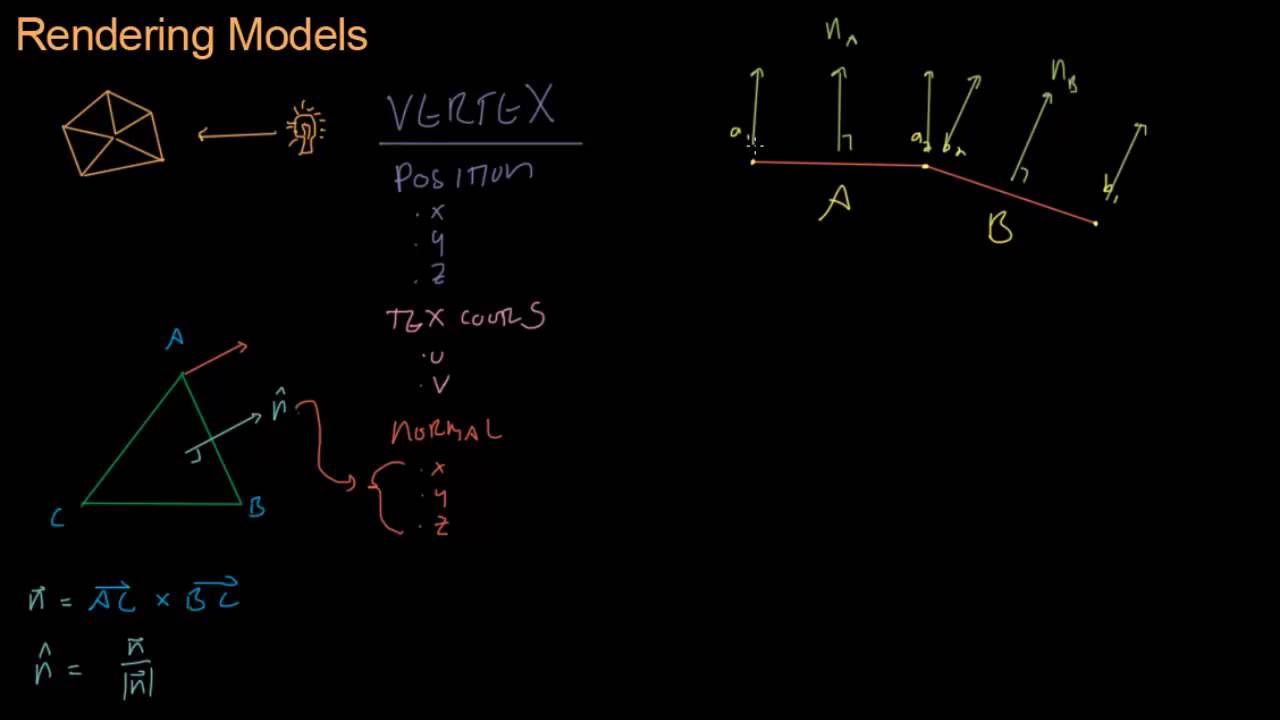
Wherein we apply normal vectors to our triangle mesh so that it can be rendered with light and shading.
Find the source code here: https://github.com/BSVino/MathForGameDevelopers/tree/trimesh-normals
New video every Thursday. Question? Leave a comment below, or ask me on Twi...
yay I found something that might help me
pallid lintel
if you take a circuit (1,2,3,1) is the same as (1,3,2,1) backwards? in any case maybe your lecturer got the question wrong for not being specific enough with definitions! They are definitely different on weighted and directed graphs but not sure about simple graphs. will have to ask your teacher i think
 fading abyss
Hi , this isn't really a help post but im taking Discrete next semester and I was wondering if anyone had any suggestions on books/lectures/videos/practice exams(esp with solutions)
pallid lintel
mit ocw is usually good. books are pretty indepth...a lot more problems in them than the course usually covers.
 blissful ibex

 bronze sky
i have no idea what this question wants me to do in my head
could anyone help me with this?
 tulip vale
to clarify does $\overline{A}$ mean the complement of $A$ in $U?$
vital dewBOT
EGA 1:
bronze sky
yes
i cant stop thinking that A has to be Ø, or something
cause in my head it doesnt make sense
tulip vale
okay what it says is that $A \neq U,$ and $B \neq = \emptyset.$
stray reef
no?
tulip vale
A centernot = U
stray reef
since when did B have to be empty just because $\overline{A} \cup B = U$?
vital dewBOT
Ann:
tulip vale
A and B centernot those things lol
stray reef
what's "centernot"
bronze sky
ye
stray reef
did you mean the not-equal symbol
tulip vale
not equals
vital dewBOT
Ann:
stray reef
anyway $B$ need not be nonempty
bronze sky
what
stray reef
indeed if A and B are both empty then the equality $\overline{A} \cup B = U$ is true!
vital dewBOT
Ann:
stray reef
what you can say is that $A \subseteq B$, which imo is a much stronger statement
vital dewBOT
Ann:
bronze sky
ok but how did you get to that conclusion
stray reef
$\overline{A} \cup B = U$, intersect both sides with $A$ to get $(A \cap \overline{A}) \cup (A \cap B) = U \cap A = A$
vital dewBOT
Ann:
stray reef
$A \cap \overline{A} = \varnothing$ so the left-hand side is just $A \cap B$
hence $A \cap B = A$, which is equivalent to $A \subseteq B$
tulip vale
oh shit I missed for all x
I though it was there exists x
so I just wanted the thing to be nonempty
bronze sky
so A = Ø?
stray reef
it means exactly what's written
the intersection of A with its own complement is empty
bronze sky
yes
stray reef
which should be obvious if you know what a complement is and what an intersection is
tulip vale
All you need is A is contained in B
bronze sky
yeah thats whats cinfusing me, why do you use it
tulip vale
because Everything not in B will then be in the complement of A
stray reef
ega 1 you're kinda overcomplicating it and at the same time repeating what i said already
i took the condition $\overline{A} \cup B = U$, which is given, and from it derived that $A \cap B = A$
vital dewBOT
Ann:
bronze sky
fuck
how did you derive that
am i stupid
got it
thank you @stray reef
I was stuck on this one, how do you see that connection so fast?
 balmy nacelle
hey you guys, I'm stuck on a homework question right now
don't they all have the ability to be false?
balmy nacelle
my professor makes bad homework assignments lmao
which a are you guys talking about, the first one?
stray reef
lowercase a
some letter will be used more than twice
there's 10 questions
if each letter is used twice or less, that only covers 8 questions at most, which is less than 10
bronze sky
thats the only one thats true
tulip vale
the second b is also true; with only ten questions, there can't be at least 3 answers with all 4 choices
tulip vale
that's fine, then b won't be used more than 3 times
it doesn't say every letter will be used at most 3 times
tulip vale
it just says "some letter" will be used at most 3 times
bronze sky
mb
bronze sky
lol ye
tulip vale
So the only ones that have to happen are the first a, and the second b, @balmy nacelle
bronze sky
wait i seriously cant wrap my head around 3 2nd b
doesnt it say that any letter will be used 3 times max?
tulip vale
no is says some letter will be used at most 3 times
which means: there exists a letter which is used at most three times
it doesn't say: each letter will be used at most 3 times
spark oyster
the second b is not necessarily true, because it's a multiple choice test
bronze sky
i overlooked that
tulip vale
Lol I assumed that only one answer is correct for each question
spark oyster
it's sneaky
tulip vale
the first a is still true; because you have to write down at least 10 letters
and you're choosing from only four of them
so you have to repeat
bronze sky
i think they mean the correct letter
like when you are done with the test you look at wich letter was used, assuming you 100% the test
tulip vale
Oh so you're saying you think that the combination AB as the correct answer does not count as "using an A"
bronze sky
its using a in that case
i mean the test can go:
A : Correct
fuck
wait
q1
A : Correct
B : false
C: False
D : false
q2
A : Correct
B : false
C: False
D : false
and repeating
tulip vale
Sure
bronze sky
that means B C D was never used
tulip vale
that's fine; you used a more than twice
balmy nacelle
are you guys good at proofs?
tulip vale
it says "some letter" not "each letter" lol
bronze sky
uogtvrae
tulip vale
Depends on what "good" means lol
balmy nacelle
bronze sky
jesus i swear to god i have dyslexia
balmy nacelle
I literally hate proofs lol
tulip vale
I'm not top 50 putnam good
balmy nacelle
so for the base case
tulip vale
The base case just plug in n = 0
0 < 1 checks out
Also check $n = 1,$ $2^1 = 2(1) = 2,$ so it checks out. Suppose that $2n \leq 2^n,$ $n \geq 1$ we w.t.s. $2(n+1) \leq 2^{n+1}$ But then, since $2(n+1) = 2n + 2,$ and $2^{n+1} = 2(2^n) = 2^n + 2^n,$ we apply inductive hypothesis to say $2n \leq 2^n,$ so we've reduced the inequality to showing that $2 \leq 2^n,$ but $n \geq 1,$ so $2^n \geq 2^1 = 2.$
vital dewBOT
EGA 1:
balmy nacelle
Can someone check that I have the right idea
so you got
Where exactly can you tell where the internal nodes end?
it's not just B and C right?
pale epoch
what's an internal node
weary tiger
anyone know how to prove that
assume its not and there are 2 numbers that give the same remainder mod M
weary tiger
i don't understand what you mean
faint narwhal
Look at the definition of injective
weary tiger
 gleaming zephyr
= here means logicall equivalent
try using P <--> Q = P --> Q and Q-->
and using P--->Q = not P or Q
and demorgen
@white monolith the algebra should work out ig
 left thistle
Can I get help with a few homework questions? I’m kinda stuck on them
oki
@neon thorn you said post the questions?
Yeah I tried the problems but I don't know how to finish them
Like for 5 and 6 I can try setting up the problem, but I'm stuck on what to do next
left thistle
🤔
When you say it like that, it's easier to break down that I managed to solve it. Thxs for the help man I really appreciate it
 patent rover
we have k choices for a, then 100-k choices for b and then 100-k choices for c
which is k(100-k)^2 choices
but the solution says this:
could anyone help me understand this more intuitively
stray reef
what's X
mellow girder
For 1 i got C(6/1)87*C(5/4)*8^4
Sorry, it's
C(6/1) * 8 * 7 * C(5/4) * 8^4
for 2) i got
C(6/1) * 4 * 3 * C(5/4) * 8^4
Is this right?
weary tiger
@lucid fog I'm sure there is a more elegant solution to this (probably with some theorem like whatever the answer to q3 was) but you could try brute force contradiction for each of $X_k \equiv \pmod{0 ,1,3,4}$
vital dewBOT
Botnuke:
weary tiger
and q4 implies q5 very quickly
the cases for 1 and 3 mod 5 are easy, and I think I have a contradiction for 0
I will try 4 mod 5 as well
 lucid fog
I'm not sure what you mean by brute force each of Xk because they dont give you values for what k is
I was planing to prove num 5 first because every 3^power has a pattern
weary tiger
oops I mistyped
$X_k \equiv 0,1,3,4 \pmod{5}$
rule out these possibilities
and it must be congruent to 2 mod 5
wtf
lucid fog
ye
vital dewBOT
Botnuke:
weary tiger
proving either of q4 or q5 will give the other
but q5 says more than q4
I don't think it could possibly be easier
weary tiger
I think I've solved it btw but not 100% confident in my proof
I (maybe successfully) used well ordering on the 0 and 4 mod 5 cases to show there is no least X_k which is congruent 0 or 4 mod 5
which also implies q5
oh wait I'm dumb
there is more to it for 1 and 3 cases
ok I used well order for those as well
stray reef
this does not count the passwords of the kind you are asked for
10 * 36^5 counts the passwords which begin with a digit
weary tiger
i need help ive tried 5 times and still getting wrong
 tardy jacinth
not the right channel
spark oyster
i do wonder why discrete math attracts so many questions which absolutely have nothing to do with discrete math
do people just come here if they want their homework solved discreetly
pale epoch
i do wonder why discrete math attracts so many questions which absolutely have nothing to do with discrete math
@spark oyster it's because classes like "intro proofs" or even just "intro mathematics" are labeled "discrete mathematics"
spark oyster
huh, weird
pale epoch
it's often just math for computer scientists or sth
stray reef
@steady tendon too vague.
what are we coloring? vertices, edges, perhaps both? how many colors are available? what conditions must the coloring satisfy, if any?
 steady tendon
vertex colouring, such that no two adjacents can be of the same colour
stray reef
how many colors are available?
 halcyon ledge
Well just one, the vertex in the middle has 6 neighbours, so you need a different color for each of them
lyric pumice
@pale epoch Maybe it's also because they see the word "math" in the channel name.
And all the other channel names look more specific.
 lilac gazelle

 sacred furnace
Could I possibly get some help on this problem?
sacred furnace
How to preform the function for (1,1)
Like (1,1)G(1,1) = 1-1=1-1?
Would the 5 elements be 1,1,1,1,0?
gleaming zephyr
we say (a,b) R (c,d) iff a-b = c-d
so u want the equivalence class of (1,1)
[(1,1)] = {(a,b) | (1,1) R (a,b)} = {(a,b) | a-b=0}
sacred furnace
Is that a modulo?
gleaming zephyr
no
sacred furnace
I'm still lost on this problem. I can't find anything online or in my book
sacred furnace
Do I want a-b=c-d to be 0=0 or 1=1 for the elements of [(1,1)] ?
weary tiger
imma guess the latter (1=1)
sacred furnace
Ya that's what I'm thinking
 quasi finch
any1 wanna help me out real quick? try not to give me an answer but give me some methods. I missed the first half of this lecture and my professor doesnt have online notes..... so i missed this "easy " part of lecture 🙂 please and ty 🙂
<@&286206848099549185>
 hexed granite
which problem?
quasi finch
problem 1 i think i got problem 2
hexed granite
so for 1a, you have 26 letters and 2 cases so 26*2 = 52 and 10 numbers so 52 + 10 = 62
and you have lengths 9 - 11
so for the first 9 characters, you can choose any of the 62 characters
and for the 10-11 you have the option not to choose any so that is 63 options
but for the 11th characters you only have that choice if you chose a character on character 10
quasi finch
uhhhhhh....
what if one wants to not have case and or numbers and just all letters?
or is that not how it works
or is that possibility ^ included in these options
hexed granite
its included
quasi finch
no idea man.....
 idle violet
any ppl reading discrete math
lyric pumice
Yes.
patent moat
How many possible combinations in 10 character password?
using only small letters
it's 26^10 right?
halcyon ledge
yes assuming you're allowed to use any letter as many times as you want
patent moat
ok then it becomes a bit tricky and im stuck
it asks lower case only + no repitition + in alphanumerical order
e.g bdgjkmpqr
halcyon ledge
well no repetition should be simple
patent moat
yes
halcyon ledge
alphanumeric makes hard
halcyon ledge
exactlly
patent moat
but the alpha order it's like i need to form a formula
halcyon ledge
hmm okay
I would go about it the same way as with the no repetition only now include the additional restriction
so say c is the first letter, then for the next position you only have 24 instead of 25 and so on
patent moat
so if we say we picked the 15 letter of alphabet the second one needs to be in the range [16,26]
halcyon ledge
hmm I don't think there is a closed formula
patent moat
so i should go about it with a reference starting point ?
halcyon ledge
because if you start with q you only have one possible password
qrstuvwxyz
so the amount of possibilities always depends on what letters you place
patent moat
so u suggest starting from a reference point ?
and that possibiliti always changes tbh
if u start with A then u have 25^10 possibilities but then if u pick Y u have 1^10
 last timber
look
for the first letter you have only 16 choices
since if you take for exampe w as first letter no password is possible
last timber
no, why you always have to preseve 10-k letters that are bigger lexicographically then the k-th letter
patent moat
i think the solution is 16 * 15* ..... * 7
last timber
and let us always thing that k-th letter we take is always the biggest lexicographically
halcyon ledge
No 16 * 15 * ... * 7 would include illegal strings
because if you place d as the second letter you have less options
patent moat
so if u pick K as the first letter that takes from [16,26]
ehh im burned.
i think im missing something can't be that hard.
halcyon ledge
whats the course?
patent moat
discret math
halcyon ledge
as in what tools did you get to solve the problem?
last timber
or look abcdefgh
patent moat
yea e.g bdgjkmpqr
last timber
that means it is just combinations of 10 elements without repetition out of 26
since {a,b} and {b,a} is in set notation equal
last timber
yep
well you can check it in the way you have password "abcdefgh" and you have 17 options
then "abcdefgi" and you have 16
and so on
 runic cedar
is the coefficient of x^12 in (1-x)^-7 0?
because I'm getting 7C12 which is a no no 🤔
patent moat
yes u can have aaaaaaaaa
or bbbbbbbbb
so each time u have 2 options a or b
2^10 * 2^10 .... 2^10 , 10 times
no ?
last timber
A and Z?
patent moat
ye
last timber
then yep, 2^10
patent moat
what if
patent moat
2^10 * 10
patent moat
so each
u have 2 options
2^1
for 10 letters
so
2^1 * 2^1 * 2^1 .... * 2^1
oh yea should be correct
what if , use only the letters A and Z but same quantity for each.
so it could be
AA BB AA BB AB
or
aaaaa bbbbb
last timber
yep
as my professor tells it is not important which is the letter
it could be even spongebob
patent moat
this is another one
what if , use only the letters A and Z but same quantity for each.
for 10 char pass
patent moat
not really
last timber
obviously 2 ways
last timber
oh i see.
patent moat
AB AB AB AB AB
patent moat
why
last timber
well, since a and b are equal in quantity then it could be only 5 of each
patent moat
true
last timber
and then you just arrange all of A and B into two "boxes"
patent moat
wum
last timber
like here
patent moat
10! / 5! * 5! , 10 goes for 10 char long , 5 goes for each A and 5 for each B
hmm ok
2 tricky onesl eft.
but i have no idea what to do
use only small letters + digits , no repitition + take turns one letter one digit or the other way
e.g 1a2b3j8g5l or k3j5s0l1m9
So we have
26 for the first one + 10 for the digits
i stuck on those because how u gonna solve it , it always depends if the first is 36 then if we pick number second is 26 if we pick letter second is 10
last timber
actually your logic is right
since multiplication is commutative
you have 36 ways for the first pair
or smthng like that
sec
10*26 for the first
patent moat
For the first one yes but second one really depends on first.
last timber
9*25 for the second pair
last timber
yes, but look
we take them by pairs
a1a1a1 for example differs from 1a1a1a only by order
so we can do like that
last timber
we count all ways when the first is digit and then multiply by 2
letters are 26 , digits are 10
and?
2610=1026
26x10=10x26
patent moat
26x10 is the possible outcomes if we pick a digit or ch
char right?
ok yea true makes sense.
last timber
look. let us suppose we use order char - digit
patent moat
so 2610 for first
2510 for second
24*10 for third?
last timber
yes
and so on until five pairs are done
then you multiply it by two since order digit-char also allowed
last timber
why 10?
patent moat
that's what i was thinking now
last timber
26x10x25x9x....x20x5x2
patent moat
ok and do u know how to do small letter + no repitition + lexigraphical order?
e.g bdgjkmpqr
thanks for ur help btwi truly appreciate it
last timber
ok and do u know how to do small letter + no repitition + lexigraphical order?
amm
we did it just before no?
patent moat
no we never figured it out
last timber
that means it is just combinations of 10 elements without repetition out of 26
@last timber