#discrete-math
1 messages · Page 126 of 1
 pale epoch
pale epoch
pale epoch
or at least not needed at all
 silk grove
Oh okie
 dense creek
oh yeah @pale epoch I do have that
pale epoch
well, you can do it that way, try it maybe
dense creek
I do not know how to continue it
 vital dewBOT
Lochverstärker:
silk grove
I’ll brb
pale epoch
so by induction hypothesis $f(\frac{k+1}{2}) = (\frac{k+1}{2})^2$
vital dewBOT
Lochverstärker:
dense creek
I am assuming you are using strong induction?
pale epoch
yeah
silk grove
I really wanna help but I’m not at my computer
dense creek
It's ok @silk grove
pale epoch
i'm assuming strong induction
dense creek
why is f(k+1/2) = (k+1/2)^2?
pale epoch
by induction hypothesis
pale epoch
as (k+1)/2 < k
dense creek
let me try
pale epoch
no
it's {(3,{1,2}), (3,{4,5}), (1,{1,2}), (1,{4,5})}
yw
i have no idea and i don't care really
dense creek
I have one more question
Using regular induction, I understand that adding one more element in the set will multiply the size of the set to the previous set because there is one more location that the elements can move to, but I am having trouble showing it mathematically
dense creek
<@&286206848099549185>
 hardy viper
@dense creek you can just try to explain all the new permutations in the n+1 case
like explicitly say some of the permutations are {n+1, [permutations of n]}
same with any other position of n+1
dense creek
Is that proof by induction though?
hardy viper
for the full proof you need the base case too
dense creek
I've only been exposed to mathematical induction
Haven't really tackled a question using words so I don't know if it counts
dense creek
I understand but, is there anyway to show that adding a new element will multiply the existing permutations by the size of the new set?
hardy viper
yea with what I started with
start with the permutations of n objects, then add {n+1} before, after, or in between it, for n+1 total places you could put it
giving n!+n!+... (n+1 times) for (n+1)!
hardy viper
uhh like for n=3
dense creek
I approached this using regular induction, so my only base case was n = 1
hardy viper
when going to 4, you have the permutations with 4 first {4,1,2,3} {4,1,3,2} etc
then the ones with 4 in the 2nd position {1,4,2,3} {1,4,3,2} etc
dense creek
So what you are saying is that the number stays still while all of the other numbers permute as usual just like in the set before?
new element added stays still*
hardy viper
yea, each case is a position for the new number (4)
dense creek
But why would that multiply the previous amount of permutations by the size of the new set?
hardy viper
because there's n+1 cases, each one contributing n! (previous amount of permutations)
 twilit matrix
@dense creek are you in Ganapathi's class?
dense creek
yes
twilit matrix
nice lol
twilit matrix
yea
 lilac edge
Define relation R on Z where xRy <=> x^2 + y^2 is an odd number OR y < 0
and proof whether it is reflexive, symmetric, antisymmetric, transitive
so my thought process is:
defining two relations, first - 2 does not divide x^2 +y^2
and the second one is x^2 + y^2 : y < 0
then examine both relations separately for each of reflexive, symmetric, antisymmetric, transitive
although I can drop the second condition when examining the reflexivity, since xRx does not include y value at all
is this a correct approach?
 stray reef
no
stray reef
it's rare that you can derive a property of $R_1 \cup R_2$ solely from the fact that $R_1$ and $R_2$ have this property individually
vital dewBOT
Ann:
 ivory badge
Also
Why split it up at all
stray reef
like
lilac edge
ok, so the relation should be then:
2 does not devide x^2 + y^2 : y < 0
and when examining xRx, only second x is < 0, right?
stray reef
....
what
the relation is "x^2 + y^2 is odd, OR y < 0"
and what do you mean by "only second x"
what second x
the two instances of the letter x refer to one and the same variable
lilac edge
when i am examing the reflexivity of the relation
lilac edge
what i am not getting is the OR part
lets say we set x=1 as you said
and it is false for xRx
now I do have to set x = <0, so if for example, x = -1 would satisfy xRx, which it does not, but I want to understand this correctly, the relation would be reflexive
vital dewBOT
Ann:
stray reef
so if there exists even one $x$ for which $xRx$ is false, then the relation is \textbf{NOT} reflexive.
vital dewBOT
Ann:
lilac edge
sure, but since the domain has OR, does it mean that I have to examine for both conditions separately? so what i am saying is, 2 does not divide x^2+y^2 OR y<0, does it mean that there is two relations, first one 2 does not divide x^2+y^2 and the second one just x^2+y^2 where y<0, then xRx would be true in the second relation, since it does not care about if its odd or not
stray reef
"the domain has OR"
the domain is Z
it doesn't "have" OR or AND or any other logical connectives
the DEFINITION of your relation involves an OR.
do you understand that the statement "2x^2 is odd OR x < 0" is false if x = 1?
lilac edge
i dont, what does OR mean exactly then?
lilac edge
yes
lilac edge
i do know what or means
lilac edge
i thought it represented logic here
lilac edge
ok i get it now, thank you
stray reef
so you understand why your relation is not reflexive now?
lilac edge
yes, since there is at least one value for x, which gives even in my relation, it can not be reflexive
 unreal berry
Translation inbound*
Functions. Let the Amounts A ****** respective C b given. Create the function g.
(a) give an injective function f *** that makes h = becomes bijectiv
(b) same as above but A -> C does not become bijectiv
Please give me an explanation of how this works.
 weary tiger
don't really know how to send you a picture but
@unreal berry draw blobs in a row of the 3 sets A,B,C
Like this but with A,B,C
Then from that you can see that you must map {1,2,3} to {a,b,d} or {b,c,d}
unreal berry
think I solved it
unreal berry
a) f = ((1,a),(2,b),(3,d))
weary tiger
yeh that works
weary tiger
yeh
unreal berry
lol that was easy
unreal berry
*Translation inbound
Relations: Define the relation R on Z through
zRy <=> x^2 + y^2 is an odd number or y < 0
Give a complete summary or all capabilites of this relation; whether it is reflexiv, symmetrical, anti-symmetrical och transitiv. That means, if this relation does not have any of these properties, prove that it doesn't and vice versa.
Gonna write what I think they are trying to say and you can tell me if I am right or not
Reflexiv: Either x^2 + x^2 is odd or x < 0
is this correct thinking from me or not?
Transitive: x^2 + y^2 is odd or y < 0 Then y^2 + x^2 is odd or x<0
Anti-symmetrical: same as above and x = y
stray reef
"anti-transitive" 
unreal berry
I might be suffering from serious brain injury and tinnitus
cus retarded people
Transitive: Either x^2 + y^2 is odd or y < 0 and Either y^2 + z^2 is odd or z < 0 then Either x^2 + z^2 is odd or z < 0
stray reef
you've listed out the statements whose truth you need to check. though you did not do so fully.
stray reef
you forgot all your quantifiers
reflexive: (∀x)(2x^2 is odd or x < 0)
symmetric: (∀x)(∀y)[(x^2+y^2 is odd OR y < 0) => (y^2+x^2 is odd OR x < 0)]
transitive: (∀x)(∀y)(∀z)[(x^2+y^2 is odd OR y < 0) AND (y^2+z^2 is odd OR z < 0) => (x^2+z^2 is odd OR z < 0)]
 safe tinsel
Sorry I haven’t read the conversation so I may be saying the same thing as Ann
But
Reflexive: xRx for all x
Symmetric: xRy implies yRx
Transitive: xRy yRz implies xRz
I think
stray reef
you are once again saying the exact same thing as me except that you only even mention a quantifier in reflexivity
safe tinsel
Lol
safe tinsel
?
unreal berry
so does that mean only one of the the condition needs to be right?
I mean
the reflexive one is interesting since y isn't even included
safe tinsel
If R satisfies all of those 3 conditions, it’s an equivalence relation
Again, I’m pretty sure
safe tinsel
I’m confused
unreal berry
I mean
safe tinsel
If u are saying that = is an equivalence relation u are correct
unreal berry
Reflexiv: (xany)Either x^2 + x^2 is odd or x < 0 so just use -x
same with all the others.
safe tinsel
Ok what was the question sorry
I was just saying the definition of an equivalence relation in general
unreal berry
Ann am I correct to say all R S AS T are correct?
safe tinsel
What is R A AS T
safe tinsel
Wth is anti symmetrical
unreal berry
same as symmetrical but x = y
safe tinsel
So xRx implies xRx?
That’s just a long winded version of transitivity
What was the actual question; why are we even talking about this
unreal berry
reflexive: (∀x)(x^2 + x^2 is odd or x < 0)
symmetric: (∀x)(∀y)[(x^2+y^2 is odd OR y < 0) => (y^2+x^2 is odd OR x < 0)]
transitive: (∀x)(∀y)(∀z)[(x^2+y^2 is odd OR y < 0) AND (y^2+z^2 is odd OR z < 0) => (x^2+z^2 is odd OR z < 0)]
@stray reef couldn't I just set all variables to -1 so that the right condition gets fulfilled?
stray reef
there's a difference between existential and universal quantifiers
you can't "set" a variable to anything when it's bound to a for all
safe tinsel
Exactly
unreal berry
???
safe tinsel
Unless u do a classic proof by example lmao
safe tinsel
FORALL means not just a specific case
It means all cases
So also when x,y,z aren’t -1 and also when they are
unreal berry
:I
safe tinsel
😐
safe tinsel
Who?
stray reef
grallak
unreal berry
but if the right condition gets fulfilled then everything is ok right?
stray reef
no
stray reef
if you want to prove that R is reflexive.
then you need to make sure xRx is true for all x.
what part of "F O R A L L" do you not understand??????????????????????????
unreal berry
so any x could also be positive
stray reef
major bruh moment right here
unreal berry
x + x != odd
safe tinsel
That’s what ur tryna prove?
unreal berry
looking at the reflexiv
stray reef
??
unreal berry
well x^2 + x^2 can never be odd if it's reflexiv
unreal berry
but it can be x < 0
safe tinsel
I meant confused
stray reef
you don't yet know if the statement (∀x)(2x^2 is odd OR x < 0) is true.
which
it should be obvious that it's not
safe tinsel
Bruh
stray reef
because if x=1
then neither of the two things connected by the OR
are true
they're both false
safe tinsel
2 times an integer is gonna be even May I point out
stray reef
so the entire thing is false
unreal berry
what if x is -1?
stray reef
so what if x is -1
safe tinsel
Still wrong
unreal berry
Are you sure about that?
stray reef
here's what you're saying rn
there's a room full of people
and you're insisting that all the people in there are white
safe tinsel
Lmaoooo
safe tinsel
I see where this is going
stray reef
"but look here jack is white"
safe tinsel
Hahaha
stray reef
while pointing at another person
unreal berry
all of these capabilities should be impossible then
well
actually symmetri is possible
anti-symmetri is also possible
no
actually not lol
Reflexiv is false, symmetry true, anti symmetri false cus if they are the same then they can't be odd
transitive should be possible
stray reef
symmetry is not true. 1R-1 is true but -1R1 is false
safe tinsel
What are u talking about
unreal berry
odd + odd = even
unreal berry
yeah you are right ann
stray reef
there is a counterexample to transitivity too
unreal berry
Reflexiv,symmetri,anti-symmetry,transitive are all false.
safe tinsel
And I still don’t know the question
weary tiger
Hi
How could I have figured out that this function is O(9^n) ?
Does any number raised to n that is greater than 2 and 3 work ?
If so, that means that in great O in an exponent, the coefficient of n is ignored, correct ?
pale epoch
$2^{3n+1} + 3^{2n+2} = 2\cdot2^{3n} + 3^2\cdot3^{2n} = 3\cdot2^{3^n} + 9\cdot3^{2^n} = 3\cdot8^n + 9\cdot9^n$
vital dewBOT
Lochverstärker:
 obtuse lance
$ 3\cdot(2^3)^n + 9\cdot(3^2)^n$
vital dewBOT
Merosity:
obtuse lance
this is what you meant in your 3rd part, not the exponentiated exponents
 weary tiger
so since the last part is 3 * 8^n + 9 * 9^n
we can drop the 3 * and the 9 *
and then pick the fastest growing of 8^n and 9^n
and that's the answer
pale epoch
essentially
weary tiger
why essentially ?
pale epoch
it's not a rigorous argument
weary tiger
Ah, right
Well I'm glad you showed me that technique, I was just eyeballing previously
so thx
pale epoch
that last equal signs is iffy, but yeah
unreal berry
is the amounts of words you can write with KOMBINATORIK = 12!/(2! X 2! X 2!) ?
just quick check
safe tinsel
Lol
 sacred furnace
f:Z x Z -> Z , f(a,b)= |a-b|
How do I determine whether this one-to-one, onto, both, or neither?
 heavy tinsel
@sacred furnace try to fix b to 0
like f(a,0) = |a-0| = |a|
|a| >= 0, so it cant be negative
which means it cant cover the codomain, Z, which means its not onto
i think..
as for one-to-one,
fix b = 0, then f(1,0) = |1 - 0| = |1| = 1 f(-1,0)
so its neither
im also a student and we covered the same topic a month ago so correct me if you think i made a mistake
sacred furnace
This is helpful, I just am having such a hard time with this course, I probably should have dropped it ages ago, this subject is so dry and dense I can hardly wrap my mind around it
So hard to find good help to, I feel I need a tutor but don't know where to find one
heavy tinsel
i know how you feel exactly, i took this course only because it is required to get into the comp sci program at my school
heavy tinsel
well, for me i try to understand the proofs in my textbook, then proceed to do as many questions as i can related to the topic
so far im doing ok in the course, i dont see any other way around it
 dapper mason
For my base case: n=1, 15|15
My induction hypothesis: there exists k in the set of positive integers such that k is odd and 15|4^n+5^n+6^n
In my induction step: n=k+2. k is odd so there exists an integer a such that 2a+1 = k so from my induction hypothesis I have 4^(2a+3)+5^(2a+3)+6^(2a+3)
I think I'm in the right path but I'm not sure what algebra to do next
<@&286206848099549185>
 near prawn
theres no need to re write k like that
4^(k+2)+5^(k+2)+6^(k+2)=16x4^k+25x5^k+36x6^k=16[4^k+5^k+6^k]+9x5^k+20x6^k
@dapper mason
 distant bay
ayo, anyone here self studying Discrete Maths and if so what books / courses you following
near prawn
using rosen rn
near prawn
there arent any really
just make sure youre familiar with the all formalities i guess
like sets, functions, relations etc
pale epoch
no
what is your definition of graph
so yeah, count what's the total amount of edges possible
and then for each edge, you have 2 choices: either include it in the graph or not
this gives you 2^(something) total graphs
depending on how many possible edges there are
there is more than 4 possible edges in this case though
and depending on what distinct means in this case, you also have to check for isomorphisms 🤔
obtuse lance
what do you mean "allowed"
either you're counting graphs as if they're labeled or you aren't
like imagine the graph with vertices A and B connected and C and D connected
this is distinct from A and C connected and B and D connected
however, they're isomorphic as graphs if you are counting instead by ignoring the labeling
so they are the same graph from that perspective
obtuse lance
the image of the text clears it up
for the graphs to be distinct, they can be isomorphic
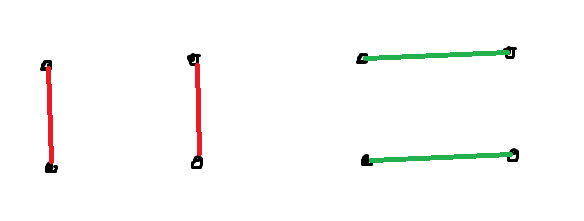
the red graph is distinct from the green graph
but they're isomorphic
so when you have 4 vertices
how many edges can you have at most?
good
so now to count the number of possible graphs you think
either it has an edge here, or it doesn't
yeah
in general while we're here
I was gonna ask what's the number of graphs when you have n vertices
try to see if you can make it planar or not first
and tell me your guess
show a picture to prove it
well to be planar just means something very simple
you can draw it without the edges crossing
I can just look lol
yeah
proving it's not planar is trickier
no not true
now you've cut it apart
I'm assuming you meant specifically https://gyazo.com/8462ffa91d898f7c97ee2f0ee4149f2a

Gyazo
that you sent earlier
see in the middle it crosses
you can rearrange vertices in space but you can't chop them
that graph has 3 edges at every vertex
your red graph doesn't
so they're obviously different graphs
yeah nice
here was my solution I was gonna send
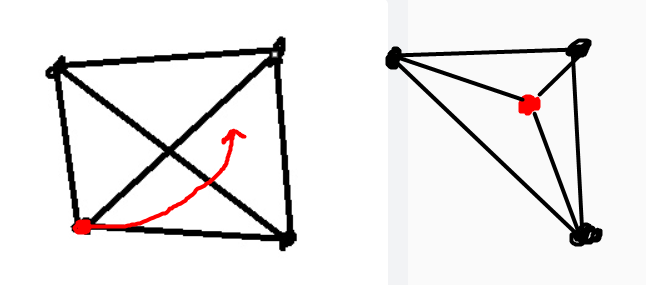
no it's not the only way
there's a theorem I forget the name
kurtowski something
pale epoch
kuratowski
obtuse lance
I don't know if that is sufficient to use that formula
yeah you'd already know it has faces by that point
I guess that tells you how many faces you have to look for
but that's not quite enough
pale epoch
kuratowskis theorem is fine for mathematical needs
but in reality there are better algorithms to check if a graph is planar
obtuse lance
it's like 2 kinds of "sub"graphs
not sure what the terminology is
well been a while since I thought about this and I never learned the proof, just know there are the two graphs to search for
I think K_3,3 and some fancy star one that's popular
pale epoch
K_5 and K_3,3 are in some sense the "smallest" non-planar graphs, yeah
obtuse lance
back to the original question before, you should probably know how to find
what's the number of graphs when you have n vertices
well I'll let you both play I'm heading out
I have to go do boring stuff 😢 have fun
pale epoch
🤷
K_n is the graph with n vertices and the maximum amount of edges
$K_{n,m}$ is something called a bipartite graph with maximum amount of edges, which you will probably encounter in the future
vital dewBOT
Lochverstärker:
 north jewel
is it natural to want to prove everything by contradiction?
i.e. to me proving something like $A \neq B$ for
$$
A = { 1, 2 }, B = {x | x^3 - 2x^2 - x + 2 = 0}
$$
seems most natural by using contradiction
since it follows logically from the definitely of set equality
vital dewBOT
Frank:
north jewel
like how would I even nicely prove this directly without contradiction?
pale epoch
how do you even prove this with contradiction
north jewel
assume A = B, then for all y in B, y in A
y = -1 is in B, which is not in A
contradiction squiggle
pale epoch
why did you assume A = B
pale epoch
exactly
just don't assume it
you found an element that is in B and not in A
proof done
this is not a contradiction proof
north jewel
something about that doesnt feel right
i think im just being really stupid rn lemme think lol
hmm ok i guess
i would just have to establish that if A != B then there exists some y in A s.t. y not in B
none of my profs examples used this which is probably why
pale epoch
i mean that is just what A != B means
pale epoch
yes, but you can just negate that
north jewel
so would the negation of
$$
\forall x \in X \Rightarrow x \in Y
$$
be
$$
\exists x \in X \text{ where } x \not\in Y
$$
vital dewBOT
Frank:
pale epoch
eh
the negation of $\forall x: x\in X \implies x \in Y$ is $\exists x: x\in X \land x \notin Y$
vital dewBOT
Lochverstärker:
pale epoch
and
pale epoch
notice that this is not the negation of X = Y tho
the original statement is $X \subseteq Y$
vital dewBOT
Lochverstärker:
pale epoch
so the negation is just the negation of that
north jewel
yea negation of X = Y would be neg(X subset Y) or neg(Y subset X)
pale epoch
yeah
constructing negations of logical statements you can just look up
it basically turns for alls into exists
ands to ors
and sth like that
weary tiger
There are 5 courses A B C D E and 3 of them must be scheduled at 2pm, 4pm, 6pm how many schedules are possible
is this 5 choose 3?
or 5 * 4 * 3 or something i dont get what its asking
north jewel
it would be a permutation since order matters
ABC (2pm, 4pm ,6pm) is different from BAC
5 choose 3 is the # of ways you can choose 3 elements disregarding order
weary tiger
ok so P(5, 3)?
that ends up being 5 * 4 * 3 which is what i thought it was initially
weary tiger
A company has 10 software projects and 3 software engineers and wants to assign one project to each engineer, how many assignments are possible?
is this P(10, 3)?
 echo karma
can anyone help me with these proofs
my professor didn't teach this and i am struggling with it
Prove the following statements:
- Any three consecutive integers will include a number divisible by 3.
- If a and b are rational numbers, with b ≠ 0, and r is an irrational number, then a + br is irrational.
- 8^n-3^n is divisible by 5 for any integer n>= 0
i get the first one but am not sure about the other two
 white jetty
Hey guys
I got confused by a question
So suppose A={1, 2, 3} and B={a, b, c, d}
Is there a function from A to B that is onto?
pale epoch
what do you think?
pale epoch
that is not a function though
pale epoch
it's only a function if for every input value you have a unique output value
in this case for 3 you don't have that
white jetty
Ohh
In order for it to be a function....okay that make sense
thanks man @pale epoch
pale epoch
you're welcome
 boreal beacon
why does this graph have a subdivison of k3.3
weary tiger
@boreal beacon if you remove 8 and 4 and combine 781 into one edge and 345 into one edge then it's k3,3
Also not that it really matters but i'm p sure you'd say that this graph is a subdision of K3,3 not it has a subdivision of K3,3
boreal beacon
oh ok thankyou
north jewel
With mathematical induction, you need to show that if the statement is true for n = k, it is also true for n = k + 1. Are you also allowed to assume the statements where (basis) < n < k are true?
 gleaming zephyr
it works too
north jewel
ok
 echo abyss
Suppose $A = {a,b, c,d}$ and $R ={(a,a),(b,b),(c, c),(d,d)}$. Is R reflexive? Symmetric? Transitive? If a property does not hold, say why
vital dewBOT
DSO:
echo abyss
For the symmetric property since xRy is false then xRy => yRx is true
Is that all that is needed to show that property is present?
north jewel
yea thats the definition of symmetric right
echo abyss
Yeah I'm just having difficulty putting that in a more "mathy" way
If that makes sense
north jewel
hmm.. well idk if im much help since im also just learning this but I would do something like
We need to show that for all x, y s.t. xRy => yRx. then just go case by case, there's only 4 possibilities for x,y anyway
idk someone else should confirm/give a better way
echo abyss
Okay thanks
weary tiger
It's clearly all 3
echo abyss
Yeah I can see that I'm just having difficulty saying as to why that is
weary tiger
So $\forall x \in A$ we have that $(x,x)\in R$
vital dewBOT
same:
weary tiger
which means that it's reflexive
echo abyss
Okay
weary tiger
$(x,y)\in R \implies (y,x) \in R$ clearly too
vital dewBOT
same:
echo abyss
Oh okay
I didn't realize I could simply just say that
$(x,y)\in R \implies (y,x) \in R$
weary tiger
i mean theres not really much you can say
vital dewBOT
DSO:
echo abyss
Yeah
weary tiger
that's the definition of symmetric
but ofc you need a forall a
at the start
but i mean it's just the identity relation and all of the properties are kinda trivial
echo abyss
It just seemed to simple to just basically restate that def
weary tiger
the question only asks to explain why they don't work
but they do
so i dont even really think it wants you to say much
echo abyss
Yeah our prof said to also say why they do
weary tiger
but you can go through and manually check all properties too
echo abyss
Okay that makes sense
weary tiger
like you can check that R is reflective by looking at all elements
you can check that its symmetric by looking at all the elements too
then you can explain that it's transitive too by looking at it
 gentle frost
Assuming you can use uppercase letters and digits 0-9.
"How many different 7-character license plates avoid having 2 digits in a row?"
A classmate of mine told me i can find a recurrence relation, but im having some trouble
gentle frost
you can use uppercase letters and digits 0-9
weary tiger
and its just a 7 digit string of any of them?
because then you have 36 choices of characters
and each one has to be different to the one before
gentle frost
yea
weary tiger
so there's
36*35*35*... possibilities
=36*35^6
the recurrence relation would literally be u_{n+1} = 35*u_n but is kinda pointless
gentle frost
hmmm, i remember getting the same answer, but was told i was wrong, im trying to remember why
you can't have 2 of the same numbers, but you can have 2 of the same letters.
AAAAAAA is valid
A1A1A1A is also valid
like if the first character is A, then for the next spot i should be able to use any of the 36 different possibilities
but im limited to 35 by that answer
weary tiger
Ah okay I just assumed nothing could be repeated
well if you let u_n be the sequences with n characters that end in a number and v_n be the sequences with n characters that end in a letter
then u_1=10 and v_1=26
and we have u_{n+1}=9u_n+10v_n
and v_{n+1}=26u_n+26v_n
and the number you want is v_7+u_7
you can solve the recurrence relations simultaneously to get an answer
gentle frost
ok, how did you get those 2 eq. not sure i follow
for a license plate 2-characters long:
if the first character is a number, then you have 35 possibilities for the second character
if the second character is a letter, then you have 36 possibilities for the second character
weary tiger
so
we are looking at the n+1th character
for u_{n+1} we are considering when that character is a number
in the case of the nth character being a number there are 9 possibilities
in the case of the nth character being a letter there are 10 possibilities
for v_{n+1} we are considering when the n+1th character is a letter
and in both cases there are 26 choices
gentle frost
yes
gentle frost
for v_{n+1} we are considering when its a ltter
ok. im trying to process this actually. lol. im slow at understanding things
weary tiger
im gonna go to sleep but idk what best way is to solve simultaneous recurrence relations like that but one way is you could just make it into a matrix equation that should be simple enough
gentle frost
ok thank you!
weary tiger
Can someone provide me a proof of Chapman kolmogorov equation proof. The proof has been left as an exercise in the book but i can't figure it out
 lyric pumice
@gentle frost @weary tiger Here is a formula for a generalized version of the problem, where a string of n characters is made by choosing from a set of a numbers and from a set of b letters.
gentle frost
oh yeah, thank you. I figured out a simpler recurrence relation actually
vital dewBOT
tekunalogy:
gentle frost
oh thank you!
lyric pumice
stray reef
let D(G) be the highest degree of the vertices in G
then by definition for every vertex v you have deg(v) <= D(G)
sum this up over all vertices of G and you have the inequality you asked about
sum this up over all vertices of G
the left hand side becomes the sum of all the degrees
the right hand side becomes the sum of |V| copies of D(G)
stray reef
no, it's the sum of |V| copies of the highest degree
 analog sonnet
weary tiger
analog sonnet
weary tiger
7^2 = 49 which is 24 mod 25 which is -1 mod 25
obtuse lance
I mentally would just go straight from 49 = 50-1
distant bay
I'm guessing most of the people in this room are here studying this for computer science right ?
ahhh
yeah, the moment I got out of uni, Computer Science got a ton more interesting
just because I could literally take it anywhere at my own pace
like even now, I'm just studying maths to buff up my development skills
yeah yeah, I work as a web developer
no not really for your average gig
but for high end jobs, it gets brought up a lot more
plus I wanna do games development
oh yeah you'll definitely need maths for those
I know that you need Linear Algebra for AI work
huh never heard of it anywhere before
what's the application if you don't mind me asking ?
ah ok
honestly I'm just making my way though the basics on Khan Academy at the moment as there were major hole in my maths understanding
so haven't touch discrete maths :/
hoping to get to it, this whole thing is going on
oft, that's rough
weary tiger
Let $H(V,E')$ be a subgraph of $G(V,E)$ that is minimally connected. Assume $\delta(H)\geq2$ then $e(H)\geq|H| \implies f \geq 2$ by Euler's formula. So there is a cycle which is a contradiction as $H$ minimally connected so $\delta(H)=1$. $\exists v$ s.t $d(v)=1$. Then $H-v$ is still connected hence $G-v$ is connected
vital dewBOT
same:
weary tiger
Does that make sense
or should i also explain why H-v is connected and that implies that G-v is connected?
 languid heart
Is there anyone experienced with RSA algo?
 past plaza
@languid heart I am not and I'm looking for good review videos on that if you have anything please lmk
boreal beacon
does anyone know the formula for this question? I cant find it
obtuse lance
yeah it's the multinomial coefficient
like the literal term is
$\frac{9!}{3!5!1!} x^3 (2y)^5 z^1$
vital dewBOT
Merosity:
obtuse lance
so they pull the coefficient off that, if you want to literally derive this you can do it by thinking combinatorially like you would for the binomial coefficients
depending on what you think is hard determines how I explain it any further than that but at least you have a keyword to google on your own time
weary tiger
just to check
13=xmod7
x would be equal to 20 right?
since 13 and 20, are in the same equalivence class
meaning they both have have the same remainder of 6
weary tiger
seems fine
north jewel
ok ty
near prawn
yes
lyric pumice
@boreal beacon That is not an equation.
boreal beacon
i dont know what the correct terminology is xd
lyric pumice
It is an expression that is a multinomial coefficient.
 faint narwhal
Yeah, this is the hockey stick identity
 ancient basin
Would like to know if my work for this question (b,c,d,e) is correct. I'm still iffy about the theory, so I feel I may have done some conceptual mistake.
lyric pumice
@ancient basin Connect 1 and 9.
ancient basin
Alright, thanks!
ancient basin
I think my upper/lower greatest lower/least upper bounds may be wrong. Still trying to grasp what the right answer is
stray reef
have you learned about modular inverses yet
you're glossing over way too much detail here
...
gcd(7,25) = 1 means that the inverse of 7 mod 25 EXISTS
there are many ways
if you know how to solve diophantine equations you may find it helpful to look at the equation that way
trial and error
reduce -77 mod 25 obviously
or i mean
you could just write -77 itself but that's too big
so mb go with -2 instead
is -2 not an integer all of a sudden
we could
i just don't like large numbers
stray reef
no
neither of these two is a subset of the other
yes, {1,2} is a proper subset of {1,2,3}
but {1,2} and {1,2,3} do not have the same cardinality
stray reef
sure that works
 lunar remnant
Hey guys what would be the next two numbers after 2,88,80,16,11,3,30,95 and why
lunar remnant
oop yeah, I browsed through that page as-well haha
lilac edge
SANNOLIKHETSLARAN
a) probability of drawing two of the same letters, (also two S or two N)
b) if two letters are the same, what is the probability of them being two S
c) if two letters are the same, what is the probability of them being two N
a) ((2 over 1) * (3 over 1)) / (17 over 2)
b) 2/17 * 1/16
c) 3/17 * 2/16
is this correct?
 mossy sable
I have a recursive relation, f(x) = f(x-1)*x + f(x-2)*x^2 (I wrote it to be more friendly for discord, but f(x) is actually a sub n)
How do I find f(1000)?
I'm thinking I need to get an explicit formula, but I have no idea how to go about that, and google hasn't been much help
weary tiger
Search for homogenous difference equations, might help, there were ways to find an explicit formula.
mossy sable
Alright
weary tiger
@mossy sable you'll need ICs surely?
mossy sable
What is an IC?
weary tiger
initial condition
mossy sable
Oh right
a(0) and a(1) are both 1
I thought I wrote them there, but I guess I didn't
Frankly I've written this question in so many places it's hard to keep track
It looks a LOT like the recursive formula for the fibonacci sequence
pale epoch
did you cover the master theorem?
weary tiger
yes i believe so
pale epoch
then use that
 vocal forum
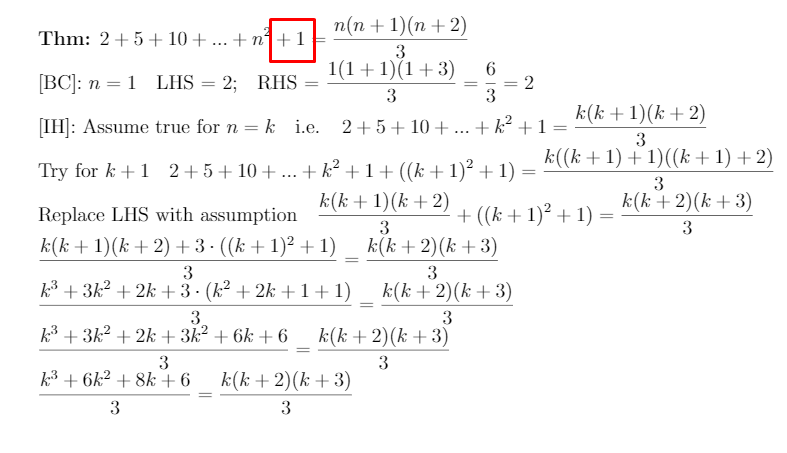
hey all, im trying to do a proof via induction, this is what i have so far: http://prntscr.com/s03drh

however im stuck, I cant seem to complete the LHS to equal the RHS
my question is whether i need to add (k+1)^2+1 on the RHS side as well. Or if I just simply missed a step
vocal forum
ya i just found one
pale epoch
the other causes your error
pale epoch
there is a stray +1 on the LHS in line 4
k^2 + 1 +...
i don't think that should be there?
 vocal forum
is that not from: http://prntscr.com/s03md0
 vocal forum
all good
pale epoch
anyways, with (k+1) what you did checks out
vocal forum
(k^3+6k^2+11k+6)/3
pale epoch
altho you should add $\iff$ or something in front of every line
vital dewBOT
Lochverstärker:
pale epoch
or just start with the LHS and dedue the RHS
vocal forum
ok ya
pale epoch
otherwise the very first line is what you want to show
 boreal beacon
is the dual of every planar graph isomorphic to its original planar graph
pale epoch
try n=2
vocal forum
in my base case?
pale epoch
yeah
 vital dewBOT
Lochverstärker:
vocal forum
ahhhhh
 bleak cypress
lyric pumice
bleak cypress
lyric pumice
@bleak cypress #❓how-to-get-help
 rough copper
It's not fair to go: please help with these reviews
What have you done
Show us some will to do it
And we will help if we can
 limpid berry
 sour arrow
Show that they are both solutions, show that they are linearly independent. Wronskian may be one way to do so.
@limpid berry
ax + bxln(x) = 0
Only has a solution when x = e^(-a/b). Since we can't fix x, there's no a and b that always satisifes this
 patent oriole
(S1) ∀x(Q(x) ↔️ R(x))
(S2) ∃x(Q(x) ∧ ¬R(x))
(S3) ∀xQ(x) ↔️ ∀xR(x)
Are the following true or false?
Every interpretation that makes (S3) true also makes (S1) true.
Can anyone help?
distant bay
heya all, just wondering what's your opinion on Trevtutor's course on discrete math ?

Today we introduce set theory, elements, and how to build sets.
This video is an updated version of the original video released over two years ago. Hopefully the higher pen quality and refined explanations are beneficial for your learning. If you'd like to see more videos red...

Welcome to Discrete Math 2! The course topics are introduced right at the beginning. In this video, we review permutations, combinations, permutations with repetition, and combinations with repetition. If any of these topics are unclear, please refer to the Discrete Math 1 vid...
 night crescent
Hey guys, lets say I have a set {1,c,8,8,c}
Does it matter if I said that {8,8,c} or {c,8,8} is a subset of that set?
Futhermore, does the order matter?
pale epoch
{1,c,8,8,c} = {1,8,c} and {8,8,c} = {8, c} = {c, 8, 8}
 sleek swallow
@night crescent There's no notion of ordering or repetitions in a set. So, like Loch said above, {8,8,c} = {8,c}
 quartz gull
Can someone help me with this?
quartz gull
@weary tiger
weary tiger
yee
quartz gull
thanks
stray reef
yes
weary tiger
Ok thx
I'm not getting the right sequence at the end once I've solved
I'm getting that the solution is f(n) = 3(-1)^n + -1(-4)^n
I have the following roots: r1 = -1 with multiplicity 2
and r2 = -4 with multiplicity 1
f(n) is giving {2, 1, -13, 61, ...}
a(n) is giving {2, 1, 0, -17, 98, ...}
stray reef
your general solution is $a_n = (c_1 + c_2n)(-1)^n + c_3 (-4)^n$
vital dewBOT
Ann:
stray reef
yes for exactly that reason
stray reef
what's giving you trouble here
stray reef
write out the definitions of everything
stray reef
,rccw
vital dewBOT
stray reef
no
weary tiger
I also tried just writing ka=bc and stuff
stray reef
the definition of divisibility has nothing per se to do with prime factorization
yes that is what i am trying to suggest
$a | bc \iff (\exists k)(bc = ka) \ \gcd(a,b) | c \iff (\exists m)(c = m \gcd(a,b))$
vital dewBOT
Ann:
stray reef
note that by bézout's lemma we have $(\exists x)(\exists y)(\gcd(a,b) = xa + yb)$
vital dewBOT
Ann:
weary tiger
ohhh
bezout
fuck i didnt think of that
thanks
im so dissapointed
@stray reef
is it possible to do it by prime factorization definition of integers
weary tiger
like notation
stray reef
okay, let $a = \prod_p p^{\alpha_p}$, $b = \prod_p p^{\beta_p}$ and $c = \prod_p p^{\gamma_p}$ where all three products are to be taken over the primes
vital dewBOT
Ann:
stray reef
and α_p, β_p, γ_p ≥ 0 obviously
weary tiger
yep
stray reef
$\frac{bc}{a} = \prod_p p^{\beta_p + \gamma_p - \alpha_p}$
vital dewBOT
Ann:
stray reef
$\frac{c}{\gcd(a,b)} = \prod_p p^{\gamma_p - \min(\alpha_p, \beta_p)}$
vital dewBOT
Ann:
stray reef
we want to show that $\frac{c^2}{a} = \prod_p p^{2\gamma_p - \alpha_p}$ is an integer
vital dewBOT
Ann:
weary tiger
where 2Yp-Ap>= 0 right
stray reef
gamma_p
weary tiger
for all p
stray reef
but yes
weary tiger
ok
thanks for the help, ill try again w/ both methods
wait actually i didn't make a mistake writing it out
vital dewBOT
LHC2012:
weary tiger
and we have $\gamma_{p}- min(\alpha_{p}, \beta_{p}) \geq 0$
vital dewBOT
LHC2012:
weary tiger
but then i couldnt show the 3rd
stray reef
$\alpha_p \geq \min(\alpha_p, \beta_p)$
quartz gull
yo @stray reef is your left hand okay?
vital dewBOT
Ann:
weary tiger
yeap i recognize that, but i couldnt use it
quartz gull
I heard you got hurt while playing basketball
 quartz gull
nope someone told me about u lol
quartz gull
are you fine though?
stray reef
i am okay and so is my left hand
quartz gull
oh great then do my homework 😆
stray reef
....what
weary tiger
hes doing a test or smthg lol
stray reef
<@&268886789983436800>
weary tiger
thanks Ann
lmfao sneaking 100
@weary tiger don't post DMs please
mb
np dw
so given say $b+c-a \geq 0$ and $c-min(a,b) \geq 0$, and knowing $a,b \geq min(a,b)$, I still can't show $2c-a\geq 0$
vital dewBOT
LHC2012:
stray reef
is it
weary tiger
as a counter-example: take a=b=-4
and c=-3
is it
If I'm not mistaken
ah yes, restrict it for positive values
stray reef
a, b and c are nonnegative integers here
quartz gull
^^^true
weary tiger
oh sorry didn't know that
 sudden knot
 wet belfry
what does AVI stand for in discrete mathematics ?
wet belfry
because I keep searching for it but nothing to find, it seems it's like that our professor invented it 😅
pale epoch
ask him then
 lilac gazelle
can someone tell me the difference between (m+n) mod p and m+n (mod p) if there is one
faint narwhal
there's not
lilac gazelle
oki ty
quartz gull
Hey can anyone help me with discrete?
near prawn

quartz gull
@radiant bough Is your hand okay? I heard u got hurt while playing baskeball
 radiant bough
uhhhhhh what
quartz gull
is your hand okay?
quartz gull
yes i think but is your hand okay?
radiant bough
you might be sure but I am not
lilac gazelle
🤔
radiant bough
I didn't even walk into that one
lilac gazelle
in that case may I ask a question
quartz gull
Sure go ahead
 lilac gazelle

quartz gull
I am so bored coz this Corona
when will this end :/
I am so unmotivated as cs major
lilac gazelle
do you play basketball
lilac gazelle
the cringe is too much, I gotta take a break from life
what has quarantine done to me
quartz gull
i feel same
I am like trying to play pranks now instead of focusing on my school work lol
quartz gull
damn i am motivated now
lilac gazelle
see now I understand why m + n is congruent to m mod p + n mod p (mod p)
since m ≅ n mod p --> n ≅ m mod p
that means (m + n) mod p ≅ m mod p + n mod p -----> m + n ≅ m mod p + n mod p (mod p)
THEOREM UNDERSTOOD
 slate marten
i got a word problem that i could use some help with, is it okay if i post it in here
slate marten
C(12,5) ?
 raw birch
You have 5 ways of selecting the compulsory penny. When you take it, you have 4 pennies and 7 nickles and you have yo select the other 4. So the result is 5 times that number
C(12,5) ?
@slate marten Pennies and Nickels are different so be careful
Well, I think that wouldn't matter here
sour arrow
This problem is combinations with repetition. There's 2 objects to choose from, and you choose 5 of them. That's (2 + 5 - 1)C5 ways
raw birch
So it does
 sterile flint
slate marten
sterile flint
slate marten
hmm