#discrete-math
1 messages · Page 119 of 1
 weary tiger
the information I have i that x have to be bigger than 3 ?
 tough locust
I dunno, does it say that?
 tough locust
Yes, explicitly
weary tiger
but if not then left side is false, therefore the other statement can never be true
tough locust
It literally and exactly says x is greater than 3
weary tiger
so we need to find which x fullfills the left side condition / statement
tough locust
Gonna try my clue one last time
You have information about x
How do you get information about x²?
weary tiger
by squaring x
tough locust
$x > 3; x^2 > ?$
 vital dewBOT
gfauxpas:
tough locust

weary tiger
I am actually trying
tough locust
Something like that
I said that if 0<y<x
And 0<a<b
Then 0< ay < bx
Use this rule to prove that if x>3, x²>9
Or use any other argument
Why you're allowed to turn x>3 into x²>9
My way is a suggestion, there are other ways
You could also prove x²-9>0 and use a formula for difference of squares
weary tiger
did you remove the y?
tough locust
From the beginning of our conversation until now
I have been talking about x and x²
Do you think that x>3 implies x²>9?
weary tiger
yes
tough locust
Can you prove it?
weary tiger
with induction maybe ?
tough locust
Sure
weary tiger
let me see
tough locust
I gave an easier way tho
I said that if 0<y<x
And 0<a<b
Then 0< ay < bx
So if 0 < 3 < x
 tough locust
Oh
Yeah sure
So if 0 < 3 < x
And also
0 < 3 < x
Then by the rule i told you
You can multiply the inequalities together
weary tiger
is this because they have a common relation
tough locust
It's because
tough locust
If 0<y<x
weary tiger
I feel st
weary tiger
since you are multiplying, not sure about the y though, I just noticed the multiplication. Its easier with pen and paper
tough locust
Just pattern matching
 stray reef
3.3
weary tiger
as a student i feel like
if u just plugged in some numbers like
0 < 2 < 3
and 0 < 3 < 4
it would go down easier
not u im saying the guy with the question
yes, that helps for me as well
I tried first pluggin in some numbers like 1
which did not fullfill the x > 3
then I understood that the domain had to be bigger than 3, but wasnt sure if this was because of the x > 3, since the domain was just all integers
but since this is for some x
and I found 3 to be true,
then it should be true, since its not for all x, only for some x
so if the left side was true, with values bigger then 3, then that was good, but for the and clause, the right side also had to be true
so I just tried plugging in for values bigger than 3, but got thrown off by the y
tough locust
The trick is
weary tiger
since I didn't know which values I could plug in. Maybe I phrased my question wrong
tough locust
That since you have a statement about x² next to a statement about x
You want to get 2 statements about x² to compare the two predicates
weary tiger
why 2 statements
is it because if you can find one wrong
then the whole thing is wrong, isn't that for the all symbol and not some x
tough locust
x>3 is one statement, the other is x²+y²=5
weary tiger
and it wworked, but then the right side was false, since != 5, therefore the whole thing is false
for all values of y appareantly
and I am not talking about 4, since y could be whatever, this is what I was confused about
I thought x and y had to be equal if you choosed something from the domain
but I guess they are kind off from different domains
tough locust
It doesn't say x=y
weary tiger
I Understand that, but the notation threw me off, I had only seen for some x, not some x and y
thats where the confusion came from
weary tiger
so if there where like 3 statements, like x > 3, x^2+ y = 5 and x+y+z^3
then z would been from another domain as well
tough locust
It does not say x²+y=5
tough locust
No
tough locust
You can't just introduce new predicates like that
weary tiger
I get that, I just wanted to understand, what would happen with more variables
tough locust
You have no justification to say x²+y=5
tough locust
You didnt finish the problem and you're asking for a harder one
tough locust
x²+y>5 isn't helpful
weary tiger
But I am not sure if I would get it on the exam
tough locust
No, you really didn't
weary tiger
alright
tough locust
x²>9 so what
weary tiger
where is the y
tough locust
?
weary tiger
i scrolled up for that question and
tough locust
We didn't prove anything about y
weary tiger
cant he say x^2 <= 5
tough locust
No, because x²>9
weary tiger
i mean in the x^2+y^2=5
the equality was wrong, that was my bad
if x^2 > 9 and x^2 <= 5 then its not valid for integers
this is the original question
weary tiger
y^2 can either be 0 or a positive number greater than 0
can you show us this on paper @tough locust
tough locust
No

 thick sky
having a little trouble understanding the "left side" part of this, where does that come from?
thick sky
wouldn't that just produce what's in the "right side" statement?
 sleek swallow
As in:
$m \leq x \leq m+1$
$m + n \leq x+ n < (m+1)+n = (m+n)+1$
So then use the definition after that
thick sky
how does the floor get added to the n part though?
i get that this has to be true on a broader level, but not the mathematical proof of it
vital dewBOT
Abhijeet Vats:
sleek swallow
Look at the definition closely. You have x+n, which is greater than m+n and less than (m+n)+1. Let x+n = y. Then:
m+n =< y < (m+n)+1 and that just means that [y] = m+ n = [x+n]
thick sky
is proving it this way rigorous enough to get full credit on a typical exam?
thank you for the explanation!
sleek swallow
I’m pretty sure it works. If your instructor wants you to include additional explanation, you’d probably have to do that.
 soft thorn
Doesn't it?
I got 18 for both sides
LHS = 3 + 3 * 5 = 18
RHS = 3(25 - 1)/4 = 3 * 24/4 = 3 * 6 = 18
@neon thorn
sleek swallow
Why?
 dry knoll
@sleek swallow maybe im wrong, but can u explain about that index shifting?
 elder oak
anyone knows any step by step tools that solves propositional equations , mega stuck on this
(p∨q) ∧ (r ∨ p) ∧ ( ¬q ∨ ¬r ∨ p)
goal is to simplify it.
 neat fog
Can't you do this with boolean algebra?
 pale epoch
what do you consider "simple"?
elder oak
i mean u can
pale epoch
this is already in CNF, so arguably pretty simple
elder oak
it becomes one huge pile of equations the way im doing it
so i miss something
hmm im gonna try again found some new absorption laws.
sleek swallow
If you wanna simplify, there is a p common to all of them so you can pull that out using distributivity
@elder oak
 languid ledge
 faint cargo
hey i've got a quick question, so for proof by induction in the inductive step, i most commonly see people assuming that the statement is true for some n, and then prove that it is true for n+1, but is it also valid to assume that it's true for n-1 and then prove that its true for n? my teacher started using both and it's kinda confused me since the result seems to be the same
stray reef
yes
faint cargo
ok ty
weary tiger
Hello i do not understand this definition
If an induced subgraph has the vertex set S, isn't it just a spanning subgraph
And an edge induced subgraph is when a given an edge in the set of edges E = {e1, e2, ...} in a graph G, and e1 = uv , the edge induced subgraph H only requires that it has at least one edge in its edge set (e1 for example) E' = {e1, e'1,e'1...} and one vertex in u V' common with G?
 shut fjord
Can someone help me understand part D of this problem
Can someone help me understand part D of this problem
 meager silo
stray reef
meager silo
stray reef
what have you tried
vital dewBOT
End:
stray reef
you can select m-k elements from A instead
or put another way, you can choose k elements of A that WON'T go in your subset
 wheat crypt
Hello. Could someone explain to me why the following example is an equivalence relation? I'm not sure I understand how to put it into practice.
I'm not sure the thinking is correct, but the tuples are symmetric because m is related to n in m/n and p is related to q in p/q?
pale epoch
$(m,n) \equiv (p,q) \iff m \cdot q = p \cdot n \iff p \cdot n = m \cdot q \iff (p,q) \equiv (m,n)$
vital dewBOT
Lochverstärker:
pale epoch
it follows from symmetry of "="
wheat crypt
👍 Ah okay. So it's then reflexive because m . q = m . q ?
wheat crypt
Ah okay, that makes sense.
weary tiger
Anyone know how he found i to be equal to 8?
for x^10
is it because of this step
 faint narwhal
because taking i = 10 and i = 8 will multiply with the 1 and the 2x^2 outside
to give you x^10
weary tiger
oh okey, so you arent looking at the (2x)^i at all
faint narwhal
uh you are
weary tiger
because thats kind off referring to the [1+2x^2]
I think I understand what you mean now
Do you also happen to know why we are actually multiplying with -1 ^1
would we also do it if we had, 1 - 2x^2 ?
or do we do it since we have + between them
weary tiger
ty
I got another question here
I am thinking about (-1)^i
does this come because of the 1 + 2x, and specifically the 1
so if it was (8 + 2x)^-6
then the -1 would be -8 instead?
and same procedure with (-8)^i
or have I misunderstood the -1, hope you understood my question. I am not wondering about the i anymore, so this is not related to the last question 🙂
I don't see whats happening from that step to the step with << x^10>>
Why is it 2^-6 * 2
And what happened to the x, we don't care about the x in the calculation?
 rich condor
weary tiger
rich condor
weary tiger
Hi
could someone drop into an voice channel and explain something for me?
find coefficient of x10 in (1 + 2x2)(2 + 4x)−6.
can someone help me with this
Can wolpfram or symbolab do this one?
I think that becomes for all X
since you are negating the for some x
for all or for some
V this one turned upside down
what do they mean by discourse?
do i negate the p too?
only a name for the course?
i dont even know, the book does a shit job at explaining
No, I think you don't need to negate the p
I believe that ~[Ex whatever] becomes to All X whatever
shoot me if I am wrong
but I believe its like this and the other way
so ~ All X whatever becomes Ex whatever
but not E that way ofcourse
so its not the case that all student is taking a math course
I believe that is the case
since you are negating some x (some students )
and when you negate some x, then I believe it should become for all
oh ok bet, thx
wait a sec
nvm, I am empty battery. Was going to send you a picture
we might be wrong
i looked up an answer online
I agree with this one, but then I misunderstood the question
But yes, that makes sense.
Do you happen to know biniomial expansion?
ahh no i don
dont*^
 agile lake
something going on in 35
33 and 35 are the same so not sure how you have different answers
agile lake
35 is wrong
weary tiger
thanks for claryfying
i cant spell today dff
u know how i can get better at premises and conlcusions
i've watched tons of video and its not clicking
agile lake
Do you understand what all the quantifiers mean?
weary tiger
like i had to guess because he obviously got rich because he studied hard
yea we only covered the backwards E a nd the upside down A for now
agile lake
I assume this is a logic course so there's some pedantry around how you do the derivation but obviously iff means gthat r -> p, therefore p.
weary tiger
yea she's basing the course around logic and critical thinking
agile lake
Its been a few years so I dont remember all the names of the rules. but the usual idea is, you're given r is true, and you're given q iff r, which implies r iff q, then you conclude q.
weary tiger
q iiff r? u mean p if r
 bleak cypress
 patent juniper
When you're given a string and told to do multiple things to it that affect the same places, do you do them in sequential order? For instance
"Swap the first and third characters in the string
Move the third character to the fourth position"
Do I move what was originally the third character or what is currently the third character?
 south olive
what is the point of diagonal method?
 naive saffron
I’m sorry, but what’s the diagonal method? @south olive
south olive
https://en.wikipedia.org/wiki/Cantor's_diagonal_argument @naive saffron , my teacher just try to teached but I didnt understand want she was doing.
 faint narwhal
The point of the diagonal argument is to show that the real numbers are uncountable
 strong atlas
why do you need (2,2) to be transitive? are all transitive relations reflexive??
faint narwhal
Well you see that we need to add in (2,1)
strong atlas
yes
faint narwhal
now you have (2,1) and (1,2)
 heady geyser

Can someone help me with part (b)
i dont have any idea how i would "guess" a formula
pale epoch
what did you get for (a)?
heady geyser
its at the bottom of the photo i sent
pale epoch
im retarded
my tip would be calculate a few more and try to see a pattern
that's the intention of the exercise at least
heady geyser
alright
vital dewBOT
l spacebaR l:
heady geyser
yeah i wouldnt have noticed it's the triangular numbers
pale epoch
first time seeing induction proofs?
heady geyser
no
its just the guess that was messing me up
hindsight is 20/20 though so it makes perfect sense now
lol
pale epoch
the better way would've been to think about the recurrence instead of the actual numbers tbh
my tip was garbage
or just $a_n = a_{n-1} + (n-1) = a_{n-2} + (n-2) + (n-1) = \dots = a_1 + \dots + (n-1)$
vital dewBOT
Lochverstärker:
pale epoch
$= \sum_{i=1}^{n-1}i$
vital dewBOT
Lochverstärker:
heady geyser
just work it down till i get the base case in the expression?
is that the best way to approach this stuff
pale epoch
in general no
heady geyser
ive seen the eigenvalue method, but this isnt homogenous so that wouldnt work
pale epoch
i think that's a lot of work computationally
in general you can do recurrence relations with generating functions
heady geyser
generating functions?
pale epoch
yeah, i guess if you haven't covered them, then nevermind
heady geyser
hmm im on wikipedia and they seem interesting
pale epoch
but you can encode series in a (formal) power series
heady geyser
would that come up in a number theory course?
heady geyser
im just taking an intro discrete class atm
 gleaming zephyr
induction
 oak wigeon
i'm not too sure how to use induction in order to prove this
 sour arrow
@oak wigeon
Induction always goes the same way.
Prove the base case, where you prove that P(2) is true. (By that, I mean you prove that 2! < 2²)
Then prove the inductive step, where you prove that IF P(n) is true, THEN P(n+1) is true
P(n) being "the statement is true for the number n"
 drowsy trout
what exactly is the inductive step here though?
my first thought is to expand the factorial and separate the exponent
but where do you go from n!<(n+1)^n
is it even safe to assume you can divide by (n+1) given that n>2
oh wait
youve already assumed n!<n^n
so then n! is obviously <(n+1)^n
is that valid?
sour arrow
@drowsy trout
So you have assumed that n! < n^n
And you want to prove that (n+1)! < (n+1)^(n+1)
Divide both sides by n+1:
n! < (n + 1)^n
It's clearly the case that n^n < (n+1)^n, but n! < n^n, proving the inductive step
drowsy trout
so what i said?
 little pike
sleek swallow
little pike
sleek swallow
$(n+1)^{n+1} = (n+1)^n \cdot (n+1) > n^n \cdot (n+1) > n! \cdot (n+1) = (n+1)!$
vital dewBOT
Abhijeet Vats:
sleek swallow
@drowsy trout
soft thorn
Yes
 balmy nacelle
hey dudes is anyone here rn?
anyone wanna help me on this?
and like, pls don't just post the answer I kinda want to get there myself
if you can think of a way to guide me towards thinking about it right
sleek swallow
That's the wrong thing to do
Specific examples may work but that doesn't mean the statement is true in all cases.
So, you need to be more general if you want to prove the truth of the statement
balmy nacelle
so does that work in all cases?
sleek swallow
Well, let's try and see if it does. We have to prove it if it does. We have to prove it if it doesn't. So, let's assume that it does and try to see if we hit a snag in the proof, yea?
What does it mean for two sets to be equal?
balmy nacelle
they have the same elements
sleek swallow
In other words, the elements of one set belong to the other and vice versa. So, they are subsets of each other.
Hence, we must prove that $A \cup (B -A)$ is a subset of $A \cup B$ and vice versa. We'll begin with the first statement, okay?
vital dewBOT
Abhijeet Vats:
balmy nacelle
Sounds good
sleek swallow
Let $x \in A \cup (B-A)$. Then, $x \in A \lor x \in B-A$
vital dewBOT
Abhijeet Vats:
sleek swallow
Understand?
balmy nacelle
x is an element of A, and x is an element of B-A?
sleek swallow
In this case, x is just an object that is an element of A U (B-A)
Nope, or
It doesn't have to be in both sets
balmy nacelle
oops
sleek swallow
Are you clear so far?
balmy nacelle
yes
sleek swallow
Okay, suppose that $x \in A$. Then, $x \in A \cup B$. So, $A \cup (B-A) \subset A \cup B$. If $x \in B-A$, then $x \in B \land x \notin A$. So, $x \in A \cup B$ and the subset relation between both sets still holds.
vital dewBOT
Abhijeet Vats:
sleek swallow
This proves that $A \cup (B-A) \subset A \cup B$.
vital dewBOT
Abhijeet Vats:
sleek swallow
Do you follow so far?
balmy nacelle
one sec trying to wrap my brain around the first part, you can start typing the next one out though
sleek swallow
Well, I wanted you to do the next part, actually.
The next part would be to show that $A \cup B \subset A \cup (B-A)$.
vital dewBOT
Abhijeet Vats:
sleek swallow
If that holds, then you've shown equality between the two sets.
But yes, take your time in absorbing what i've said above.
balmy nacelle
when you do this are you just thinking through this logically and getting it or are you following certain steps?
sleek swallow
A more terse proof would've been the following:
$x \in A \cup (B-A) \implies x \in A \lor x \in B-A \implies x \in A \lor (x \in B \land x \notin A) \implies [(x \in A \lor x \in B) \land (x \in A \lor x \notin A)] \implies [x \in A \lor x \in B] \implies x \in A \cup B$
vital dewBOT
Abhijeet Vats:
sleek swallow
Well, I'm using the idea of mutual containment. That's a standard proof technique for showing that two sets are equal to each other.
^Don't read the terse proof above. Just fully understand the more detailed proof i've written above for you.
A large portion, if not all, of set theory is based off of logic. So, in principle, you could use logic as a way of deducing set theoretic statements. At least, that's the way I learnt to do it.
balmy nacelle
So the third statement you make, that starts with "So, A union (B-A).." How did you make the conclusion that that is a proper subset of A union B?
sleek swallow
Let A & B be two sets. Then:
$A \subset B \iff [\forall x: x \in A \implies x \in B]$
vital dewBOT
Abhijeet Vats:
Compile Error! Click the  reaction for details. (You may edit your message)
sleek swallow
So, really, what i'm showing is that if i take any element in A, then that element also has to be in B in order for A to be a subset of B
In a similar way, I've taken an arbitrary element, x, from A U (B-A) and i'm showing that that element also belongs to A U B
balmy nacelle
so, is it because x is an element of A in the A union (B-A) that you can make the conclusion that that also belongs in A union B?
sleek swallow
Well, that's the general idea.
balmy nacelle
ok cool, i understand
as for the next step you wanted me to do
didn't you already prove that?
sleek swallow
Nope. We haven't proved that $A \cup B \subset A \cup (B-A)$
vital dewBOT
Abhijeet Vats:
balmy nacelle
but we proved it the other way around tho right?
Abhijeet Vats:
ok that didnt work

that being the other way around
balmy nacelle
ok so, i'm not sure how to work the bot that you're using so bare with me as I try to type this out lol
sleek swallow
Sure
balmy nacelle
so x is an element of A or (x is an element of B and not an element of A), but because it's a union we know that x is an element of A union (B - A), and since we know that x is an element of A union B, then A union B has elements in A union (B-A)
does that look okay?
sleek swallow
Nope. You need to begin with the statement that x is in the union of A and B.
So, let $x \in A \cup B$. Then, $x \in A \lor x \in B$. If $x \in A$, then $x \in A \cup (B-A)$. If $x \in B$, then $x \in B-A$ (since $x \notin A$). Hence, $x \in A \cup (B-A)$.
vital dewBOT
Abhijeet Vats:
sleek swallow
That proves that $A \cup B \subset A \cup (B-A)$
vital dewBOT
Abhijeet Vats:
balmy nacelle
Well, was I almost right? It looks like the only difference is that I didn't start with x being an element of A union B
sleek swallow
Nope. Your proof was not very good because it wasn't very clearly formulated.
It was nearly incomprehensible. It also started with the wrong statement. You had to begin with x in A or x in B.
But don't give up. This stuff takes time to learn. Keep going, you're doing better than most.
pale epoch
no
stray reef
uh
pale epoch
i'll let ann take this now
stray reef
ok you typo'd
should be A(k) and k^3 < 3**^**k
anyway
anyway
there are a number of ways you could lay this out
uh.
what
what??
this is what i did last time someone asked me to do this exact problem
er
there's a typo in there hold on
this is proving the inductive step
also typo fixed
no
you don't HAVE TO do anything
and i didn't do any expansion either
i multiplied and divided by k^3 lol
is it
i thought this was relatively straightforward
 loud basalt
stray reef
loud basalt
stray reef
i think so? it looks correct to me at a glance.
the step itself has nothing to do w induction
if you want i can attempt to explain to you the informal reasoning behind doing what i did
i am working with (k+1)^3 which i don't know much about
if you squint, it looks sort of like k^3, which i do know something about
so this step basically... the introduction of k^3
pale epoch
i mean you start with (k+1)^3 and want to arrive at 3^(k+1) by only using < and = signs
you only have information about k^3
stray reef
so the goal is to introduce the variable on the other side of the equation
no...
the goal, if any, is to relate A(k+1) to A(k)
 sonic herald
So I'm having a bit of trouble on a problem, it goes as follows: Prove that between every rational and every irrational number that there exists another irrational number. I'm not familiar with my proof techniques so this one's been a struggle. Any help would be appreciated. Thanks.
sleek swallow
You could try to explicitly construct such a number. Let a be a rational number and b be an irrational number. Then, consider (a+b)/2.
@sonic herald
 analog sonnet
,rccw
vital dewBOT
 soft bobcat
so
I'm finishing calc ii and one of my options for next year is discrete math
How is it compared to like lin. alg and calc iii and that stuff?
It seems fun definitely but i need other opinions lol
pale epoch
did you have proof-based classes yet?
soft bobcat
Not yet
pale epoch
sometimes discrete is an intro to proof
soft bobcat
I'm in HS still
pale epoch
and well, discrete differs a lot from place to place
sleek swallow
Maybe check the syllabus for the course?
pale epoch
could be combinatorics, could be intro to proofs, could be graph theory
soft bobcat
I'll take a look at the syllabus (if I can find it. I don't go to the college, but I would be going for this one class)
soft bobcat
"Introduction to Discrete Structures"
pale epoch
that's more like a computer science class
sleek swallow
Oof
pale epoch
yeah, its usually intro to proofs for CS students
soft bobcat
Hmm
pale epoch
yeah, this is intro to proofs
soft bobcat
Ohh
sleek swallow
Linear algebra uses quite a bit of the material in that course above
Well, most of math does
soft bobcat
My school says if you finish AP Calc BC, you can choose between Lin. Alg, Calc III (If you get a 5 on the ap exam), and discrete math so I wasn't sure of the like "hierarchy". Poor word choice, Ik, sorry lol
pale epoch
if you are in highschool, then this would be a first taste of "what math really is"
soft bobcat
I can find the syllabus and put it in the proper room
pale epoch
unless maybe you want to be an engineer
sleek swallow
Yea sure just put it here
I mean, to be fair, computational linear algebra is pretty important
As much as i hate to admit it
pale epoch
we taught computers how to do everything we need, so we dont have to
soft bobcat
Can I put it here or should i put it in the lin alg room
sleek swallow
Put it here
soft bobcat
sleek swallow
Okay yea looks quite computational
soft bobcat
Ik we can only use Scientific Calculators so
sleek swallow
A theoretical class would start off with a detailed study of vector spaces
pale epoch
this is a lot of stuff
sleek swallow
If you want to go ahead with it, you can. Personally, though, I found it really hard to understand LA when starting with matrices.
soft bobcat
Yeah, Never done matrices
I have no clue how to do anything with them. But I'm leaning towards discrete math
I do really want to learn proofs. I think after the AP Exam, my calc teacher is gonna start teaching us how to do proofs
sleek swallow
Hey, don't let me deter you. Perhaps you might understand it better by starting with matrices. But it didn't work for me.
pale epoch
i mean, this covers at least real vector spaces later
sleek swallow
Go for discrete structures then. Though, in a way, I'm rather skeptical about the quality of the content that will be presented.
sleek swallow
It covers both real and complex vector spaces
pale epoch
even QR-decomp and least squares
soft bobcat
Hmm. Another option is to take Discrete math first semester and Lin. Alg second semester. I can take calc iii freshman year in college if that's a better option
sleek swallow
What does calc iii consist of?
soft bobcat
I can look into that
sleek swallow
If it's multivariable, then you should take linear algebra to reduce the number of things you have to memorize
pale epoch
honestly if you do anything with math you will need woth lin.alg and calc 3
and discrete as well
although that is the easiest to pick up without any class in it
at least the syllabus you posted
sleek swallow
But idk, if i were you, i'd just take discrete
soft bobcat
sleek swallow
Like, take discrete in the first semester, then go into each topic in depth on my own in the second semester
soft bobcat
That sounds like a good idea
sleek swallow
Like, for example, I'd learn the content from my teacher for, say, Set Theory. Then, I'd get a set of notes on Set Theory online or maybe a small book (Naive Set Theory by Halmos maybe?) and just work through that in the second semester
soft bobcat
Okay. It's a semester long class I'm pretty sure
I'm still getting used to that lol
But would it be a good idea to do Discrete math 1st semester, Lin. Alg second semester and calc III freshman year of college?
sleek swallow
I personally wouldn't.
Discrete Math 1st semester, I'd pick up a linear algebra book that starts with vector spaces for the 2nd semester & work through that, then calc iii in my freshman year of college
^But that's my personal take
pale epoch
is your goal even to study math?
pale epoch
if you like it, good
soft bobcat
My math teacher does proofs for us in class.
sleek swallow
Discrete math 1st semester, then in-depth exploration into your discrete math topics in semester 2
pale epoch
avoid classes that are not proof-based
soft bobcat
Okay.
sleek swallow
Cos the thing is, you have to remember that your classmates will be taking the class as well
And the teacher would, ideally, want them to pass the class. So, the content may not be presented in the most honest way
pale epoch
implying teachers care
soft bobcat
I think my teacher does lol
pale epoch
honestly the main goal of the teacher - at least at university - should be keeping integrity
soft bobcat
He proves everything he can
pale epoch
ofc he wants students to pass
soft bobcat
He also teaches things past calc at times
pale epoch
but if the students don't put in the work, it's not his problem
sleek swallow
Alright
soft bobcat
He's gone over some more advanced diff eq stuff, taught a bit of number theory, just basic things of later classes because he thought it'd be fun
sleek swallow
So if he's honest about the way he's presenting the content, then you're gonna have fun in discrete
But like i said, use the 2nd semester to delve more deeply into each topic you've discussed in class
soft bobcat
Okay, thank you. That helps a lot.
 broken berry
Maybe someone here will know the answer. Because someone said that here is the best place for my question.
I rephrase my question:
How many all possible combinations are there if we choose 2 blank squares from 30 squares, where each blank square can have an image from the set of 12 images, and it can be in 4 diferent positions (the image is rotated for 90 degrees each time)? (We can overlay each square with one image) My solution is C(30,2)124. So C(30,2) combinations times 12 different images times 4 positions of image. Is this correct?
 exotic sun
Quick question, whats the term for stars and bars but without caring about the ordering?
 tacit willow
Hey
Harry Alisa, Ann, Don
Karl Alisa, Monti, George
Alisa Harry, Karl, Ann
Monti Karl, Monica, Don
Monica Monti, Don, George
Ann Harry, Alisa, George
Don Harry, Monti, Monica
George Karl, Monica, Ann
Draw the graph representing these eight guests and their friends. Find a seating arrangement where each person sits between two friends (i.e., no-one sits next to one of their adversaries). ```Could anyone help me with this one?
 lyric pumice
tacit willow
lyric pumice
tacit willow
anyone?
stray reef
@tacit willow are they sitting in a row or in a circle
tacit willow
i figured it out, thanks 🙂
broken berry
Thank you @lyric pumice
 minor zephyr
I am stuck on part b
.... I am especially confused with what the hint is trying to get me to do? I tried counting the operations within those constraints

Although I don't see how this is any better than just computing total number of operations to begin with since they would both be cubic....?
weary tiger
How would i write:
-15, 18, -21, 24, -27,...
as a closed-form expression?
I know how to write it as a summation but idk about closed form expression
soft thorn
It's a sequence though?
soft thorn
Still a sequence though
weary tiger
wat does dat mean
the directions says to write a closed form expression first index is 0
soft thorn
How would you write it as a summation for a start
weary tiger
n = 0 to infinity (15+3n)(-1)^(n+1)
soft thorn
So the nth term is given by?
weary tiger
huh
 little nacelle
hey guys
can somoen explain
how this is 1
in min plus algbra
(0 * a + 1 * 1) + b = ?
how is that 1
soft thorn
a_n = (15 + 3n)(-1)^(n + 1) no?
little nacelle
😦
little nacelle
can someone help
soft thorn
Yes
soft thorn
Yes
weary tiger
how do i rotate
?rotate
-rotate
anyways for summations, its only complicated like that when i have to adjust bounds?
soft thorn
, rccw
vital dewBOT
soft thorn
Perhaps
weary tiger
pls
sleek swallow
What is the proposition you’re attempting to prove? @weary tiger
sleek swallow
Alright nice
weary tiger
But i have another problem:
Write this in closed for expression:
-15, 18, -21, 24, -27, ...
is that simply:
a_n = (15+3n)(-1)^(n+1)
sleek swallow
If it is, prove it. If it isn’t, prove it.
weary tiger
so just plug a value in and if i get the expected answer its correct?
sleek swallow
I would say that you should attempt to find a recurrence relation for your sequence and attempt to show that your closed form satisfies it.
But tbh, if it does just work for the given terms and the pattern continues in the way it does, i guess you could just write a few lines for why your closed form works
weary tiger
Give a recursive definition:
The set S of ordered pairs (m,n) where m and n are positive integers and m is divisible by 3 and n is divisible by 7
Im assuming the base case is: (3,7) in S
am i wrong
soft thorn
You can start at 0 can't you?
sleek swallow
Positive integers though
sleek swallow
Well, m is divisible by 3 and n is divisible by 7
So what do those statements mean?
weary tiger
m = 3k and n = 7k?
sleek swallow
What's k?
weary tiger
just a placeholder variable, cuz doesnt m is divisible by 3 mean that there exists an integer k, where m = 3k
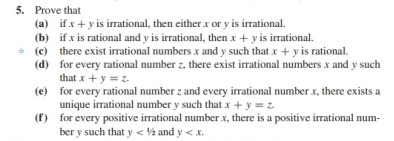 stray reef
i can't read this
"for every positive irrational number x, there is a positive irrational number y such that y < 1/2 and y < x"
is this it
@weary atlas
 weary atlas
Yes sorry @stray reef
stray reef
try proving the result with the additional assumption that x < 1
weary tiger
can someone explain why the set of divisors of the integer a and the set of divisors of the integer −a are the same set.
weary tiger
thank you so much!
 blissful zenith
can someone explain what this means in words? ∩n∈N[a_n,b_n] = ∅
weary tiger

Ops? Trying to re-brand to SiriusVisuals and incorporate a S and V into my logo. Disregard colors. Purely looking at the design.
For the left one I tried matching the left angle of the S to the right angle of the V. But, the logo does look thick and short in length.

 Twitter

 past dew
Sorry I misread it it aucatally only have one base case then its proving it
 mortal light
would this be the right channel to ask about context-free grammars?
sleek swallow
That really sounds like a logic thing. Go got #foundations & talk to the qualified individuals there.
sleek swallow
Uh didn't we go through this before?
weary tiger
no problem lol
sleek swallow
Uh okay:
$S = {(m,n) \in \bZ^+ \cross \bZ^+ | (m =3k) \land (n = 7r) \land (r,k \in \bN) }$
vital dewBOT
Abhijeet Vats:
weary tiger
yea
i need help with the recursive step
my prof gives us examples like this, then gives us hard questions 😦
sleek swallow
Yeap sure, so if $m \in S \implies m+3 \in S$ and $n \in S \implies n+7 \in S$
vital dewBOT
Abhijeet Vats:
sleek swallow
Yeap. Obviously, you have to specify that the base case (3,7) belongs to S as well
weary tiger
would the recursive step apply for like (6, 21)
sleek swallow
What do you think?
weary tiger
im not too sure cuz 21 is 7 + 7 + 7, but 6 is 3 + 3
idk if it applies to those cases
sleek swallow
Does (6,21) belong to S?
weary tiger
yea
sleek swallow
Okay is 6 divisible by 3?
weary tiger
yes
sleek swallow
So all we're saying is that (9,21) also belongs to S
Actually, my phrasing above is kind of wrong
weary tiger
(6, 21)
sleek swallow
??
weary tiger
u said (9, 21) belongs to S but im asking if (6, 21) belongs to S 😂
sleek swallow
Anyways, you need to fix the phrasing above. My phrasing is not correct but the idea just extends itself


 sleek swallow
Sure but the set that it belongs to needs to be changed and the recursion just needs to be modified
sleek swallow
Basically:
$(m,n) \in S \iff (3 | m \implies 3 | (m+3)) \land (7|n \implies 7|(n+7))$
vital dewBOT
Abhijeet Vats:
sleek swallow
Where 3|m just means that m is divisible by 3
Saying that $x \in S$ and $y \in S$ is wrong because they're the components of each ordered pair and they don't belong to S. That's the mistake that I made above and I've corrected that.
vital dewBOT
Abhijeet Vats:
weary tiger
ahh so (x,y) in S
sleek swallow
Yes
Then use the most recent recursion that i gave to you
And obviously, include the base case
Cos the base case is the thing you'll use to construct other elements
sleek swallow
Urm okay that's a bit weird
weary tiger
i dunno, our prof wants it in these mongoloid terms
lmao
i gotta use english not logic
sleek swallow
Because if we begin with (3,7), then you're saying that (6,14) is in S while (6,7) is not in S.
Oh
You can just replace $\land$ with and lol
vital dewBOT
Abhijeet Vats:
sleek swallow
Like, in my recursion above, as long as the first component of the ordered pair is divisible by 3 and the second component is divisible by 7, it's in S
Idk i'd honestly just go with the very initial statement I made about S:
$S = {(m,n) \in \bZ^+ \cross \bZ^+ | (m =3k) \land (n = 7r) \land (r,k \in \bN) }$
vital dewBOT
Abhijeet Vats:
sleek swallow
You're welcome.
Your professor certainly has a weird way of doing this sort of thing.
sleek swallow
Ya that works because you're not working with ordered pairs
With ordered pairs, you need two definitions.
sleek swallow
Hmm base case is just a
sleek swallow
Then the recursion is just going to involve the length of the string
So if the length is divisible by two, you take the length and add 1 to it and that produces a string that does appear to be an element of S.
weary tiger
so:
x in S and |x| + 1 is divisible by 2
sleek swallow
Yea that works. Then, you just need to include your base case in there and you should be done
sleek swallow
If x in S, then |x|+1 is divisible by 2
weary tiger
oh lmfao
sleek swallow
Then you also need to say something additional about the first letter in the string
weary tiger
yeah was just about to say that
sleek swallow
So it's more like, If (x_1 = a) and (|x|+1 is divisible by 2), then x in S
weary tiger
kk
faint narwhal
what is 12 * 17 mod (29)?
reduce that down, what do you get
uh, how'd you get 209, 17 * 12 is 204
what is 204 (mod 29)
riht
so what does 17x * 12 ≅ 3 * 12(mod 29) become
yes
but how'd we know that the inverse of 17 was 12
 sly pewter
It's p much established that a = b (mod m) then ac = bc (mod m)
faint narwhal
The idea is that (mod 29) doesn't care about multiplies of 29
so when you write 1 = 17(12) + 29(-7)
And take this equation (mod 29)
the right hand side becomes 17(12) + 29(-7) = 17(12) (mod 29)
minor zephyr
I just realized that this said "is this a more efficient way" and not "is this the most efficient way"
With that said, how could you prove that x^{2^k} can't be computed from x in fewer than k multiplications?
sly pewter
I think there could be a way
Actually induction proved me wrong duh
I thought there would be a legit way to do it in shorter step, but this integer world says no
weary tiger
How do I prove that my closed form expression is equal to a_n
minor zephyr
it looks like you started the induction. Basically, since $$a_k = \frac{k(k+1)(2k+1)}{2} $$ for some $k\geq 1$, you want to show that $$a_{k+1} = a_k + 3(k+1)^2 = \frac{k(k+1)(2k+1)}{2} + 3(k+1)^2 $$ $$ = \frac{(k+1)((k+1)+1)(2(k+1)+1)}{2} $$
vital dewBOT
kxrider:
minor zephyr
yeah, you have all of the steps written out. The proof is just a bunch of algebraic manipulations
minor zephyr
Well, like "prove P(k+1)" is not a proof of P(k+1). The proof involves showing the equality I wrote above.
weary tiger
o ok
minor zephyr
which involves adding the formula for a_k with 3(k+1)^2 and simplifying and stuff.
weary tiger
my brain isnt functioning right after doing this assignment for 5 hours
minor zephyr
relatable
weary tiger
@minor zephyr can u help me with one more thing
For the sequence -15, 18, -21, 24, -27
Can u confirm if the closed form expression is:
a_n = (15+3n)(-1)^n+1
i just wanna make sure
minor zephyr
assuming the sequence starts from 0 (i.e. a_0 = -15) looks fine to me.
minor zephyr
yea
weary tiger
Thanks man 😄
minor zephyr
npnp
weary tiger
my head be pounding
 hybrid plume
hey what is the difference between partitioning and the urn modell ?
exactly the stirling numbers and the formulas with binomial coefficient
wheat crypt
Hello. I am currently studying finite state automata, and I came across these questions:
sleek swallow
What’s A o B supposed to mean?
wheat crypt
Concatenation of A and B
sleek swallow
So concatenation of two elements, one from A and the other from B?
wheat crypt
Yeah.
Couldn't it be true for all of them except for (e) assuming that one of the sets were concatenating with is only an empty string?
Actually scratch that.
I read it wrong.
sleek swallow
Hmm d) also looks problematic
pale epoch
so does c)
sleek swallow
Ye
wheat crypt
yeah. I thought of splitting the string after a 001 substring and count for odd '1's.
sleek swallow
That’s not entirely the best way to do it
This is basically asking you to find two strings that, when concatenated together, produce the string in each part. So if you can find them, you’re gucci
So for example, for a), you can form it by taking a string 10011 from A and a string 1 from B. Concatenating them gives you the string in a)
wheat crypt
Hmm, ah makes sense. So it's safe to say that d and e aren't members.
sleek swallow
Like loch said, c) also seems to have issues
wheat crypt
Hmm, yeah. If i were to separate them, i could get different results. 0010000 and 1 or 1001 and 0000. I feel like i'm missing something and somewhat wrong in thinking that.
pale epoch
concatenation is not commutative
wheat crypt
Ah got it. so the cut would be at 1001 for A.
sleek swallow
No
Then 11 would belong to B, from what you’re saying
Last time i checked, 2 isn’t odd
wheat crypt
for c)
pale epoch
i mean, you can also cut at any later time
sleek swallow
You’re welcome.
weary tiger
can someone please help me with this
im not sure how to solve a)
or b) for that matter
patent juniper
How many bit strings of length 8 contain exactly 3 1s?
 balmy sandal
What have you tried?
patent juniper
Nothing, I'm not sure how to solve this. Wouldn't it be like, 2^5?
balmy sandal
Well, first, how do you normally add a number to a fraction?
If I asked you to add 2 to 3/7, how would you do it?
balmy sandal
Good so far. What does that give you now?
weary tiger
balmy sandal
And now you add together the stuff on the numerator. Do you remember how to multiply out brackets?
Because I should hope you do.
balmy sandal
What does that get you? Show all your steps.
balmy sandal
Good. Now you just have to factorise the top.
weary tiger
it doesnt seem very factorable
balmy sandal
Indeed, that's the slight problem, isn't it.
Here; how about this: How would you calculate 5(x+5) + 3(x+5)?
weary tiger
15(x+5)
balmy sandal
Why?
weary tiger
cuz they share the same variable
balmy sandal
And how did you get to your answer? Go step by step.
balmy sandal
And how did you get to your answer? Go step by step.
weary tiger
i just substituted x for (x+5)
since theyre the same variable
then added 5x + 3x
that sounds hard
why not just factor like terms or factors
its not factorable
sure it is
each term in that expression has x+5 as a common factor
no i mena
the one im doing rn for homework
thats an example
5(x+5) + 3(x+5) = (x+5)(3+5)

 balmy sandal
@weary tiger I'd appreciate if you didn't butt in while I'm trying to teach a student.
weary tiger
this one
id appreciate not using discrete math channel to teach algebra
It has to do with induction
😂
so go to proofs

sleek swallow
@flat echo there is a combinatorial way to interpret that sum that leads into a very nice answer
 flat echo
How? I'm studying the binomial theorem, but I can't with this exercise
flat echo
I haven't started with university yet haha