#discrete-math
1 messages · Page 114 of 1
 dim magnet
 sleek swallow
Well, I can state it for you.
Let A be any given set. Let p(x) be an open sentence. Then, the axiom of specification tells us that the following set exists:
$B = {x \in A: p(x) }$
That just says that the B is the set of all elements x that belong to A such that a given sentence p(x) holds for some fixed element x.
 vital dewBOT
Abhijeet Vats:
sleek swallow
Basically, what it says is that subsets of a given set A do exist and you can form them by constructing sentences that become propositions for any specific element.
dim magnet
What does a sentence mean in this context? Set builder notation?
sleek swallow
Uh okay, I should explain this a bit better.
Suppose I told you something like x>3. Okay?
Just suppose that I threw that at you without any context about what x really is
dim magnet
ok
sleek swallow
Now, the problem is that x>3 can be true or false depending on the value of x
So if x = 5, then 5>3 means that x>3 is true. If x = 2, then 2>3 is clearly false, so x>3 would be false.
So, that's what I mean by a sentence
The moment I give you context about what the variables are, you should be able to determine if that sentence is true for that variable or false
dim magnet
right
so I have a set A = {2,4,6,8}, and I have a sentence x<6, then a set B = {x | x is an element of A and x<6} = {2,4}
sleek swallow
There are more rigorous definitions for what a sentence is, though. But I certainly haven't learned them yet. I've seen some books on logic and set theory define those things in a more rigorous fashion.
But in any case, that's the basic idea of what a sentence is.
Yes, exactly
However, the way I'd write set B is:
B = {x is an element of A | x<6}
So, the specification portion comes before the open sentence.
However, some authors do write it like how you did. I, generally, don't prefer that.
dim magnet
Ah
I do it like that because the current course I'm taking in year 11 high school teaches it that way
Thanks a lot!
oh sorry
I forgot to ask XD
sleek swallow
Yea what you're learning now is naive set theory so they're less inclined to use formal notation
So, it's okay to just grab objects and elements out of thin air. However, you can't really do that cos that leads to contradictions.
dim magnet
"The answer is that if you look at the axiom of specification and have a set A, then you can define the empty set by means of a contradiction."
How would you define the empty set by means of a contradiction exactly?
sleek swallow
Let B be the empty set. Then, B = {x belongs to A | x does not belong to A}
sleek swallow
Indeed
In fact, you should have that as an axiom of set theory. If x is an object and A is a set, then (x belongs to A) is a proposition for some fixed x.
That means that it is either true or false but not both.
dim magnet
Right
sleek swallow
I know this is a bit difficult to understand cos you haven't been acquainted with some basic logic
The point is that all these terms have very strict definitions. So, the only way to grasp the subject is to get a good grip of those definitions.
dim magnet
the little logic I know is from some from proofs and some from this book xd
Converse, contrapositive, negation
sleek swallow
Oh okay, so do you know what a contradiction is formally?
$p \land \lnot{p}$ is the contradiction that's used to construct the empty set
vital dewBOT
Abhijeet Vats:
dim magnet
Proof by contradiciton
Is like you negate the original statement you're trying to prove and then look for some sort of a fallacy?
sleek swallow
Because what you have is a set that consists of all the elements that belong to another set but also do not belong to that set. Now, an element cannot belong to a set and not belong to it at the same time. So, there are no elements that satisfy that open sentence. Hence, the set is empty.
Well, suppose you have a statement p and you want to prove q from statement p. What you do is to assume that q is false. Then, use p & not(q) to derive a contradiction. Since contradictions don't exist in math, q must have been true.
^That's the basic idea, but there's a formal way of expressing it as a rule of inference
dim magnet
I see
Wait
how does "Since contradictions don't exist in math, q must have been true." tie in to defining the empty set using a contradiction?
oh
Let me see if I get it
sleek swallow
mmh go on
dim magnet
you're proving a set can exist with no elements
wait
hmm
wait I think I can do this
sleek swallow
Yes. We're trying to show that a set with no elements does exist. To do it, we need to construct an open sentence that is guaranteed to be false for any object.
dim magnet
oh I see
we assume the statement we're trying to prove is false: a set can't exist with no elements
Let A be a given set
sleek swallow
Nope.
We don't have to do a proof by contradiction here
The axioms already give us a way of directly constructing the empty set
dim magnet
right
sleek swallow
A proof by contradiction would be an example of an indirect proof
Let S be a set. Set Theory guarantees that S exists. Now, let x be some object from S. Then, we define the following subset:
$\varnothing = {x \in S | (x \in S) \text{and} \lnot{(x \in S)} }$
vital dewBOT
Abhijeet Vats:
sleek swallow
So, keep in mind that we're asserting that x is an object that somehow belongs to a set S but also doesn't belong to the set S. That is NOT true for any object x. So, this subset cannot contain any elements. However, it does still exist because it follows all the rules that we've laid out beforehand. Hence, it does exist as a set and since it has no elements, we define it as an empty set.
dim magnet
The penny has dropped
Far too late xd
Thank you for persevering with me XD I'm not the smartest tool in the tool shed unfortunately
sleek swallow
To be fair, the language that's required for this stuff is not known to you yet
So I don't blame you if you don't understand what I've written above
however, keep working at it and you'll get it eventually.
dim magnet
We can use the axiom of specification to define the empty set by a contradiction.
sleek swallow
yea correct
dim magnet
The axiom of specification states that given any set A, and some sentence, there always exists a set B such that x is an element of A and satisfies the sentence
Sorry
That was phrased wrong
x doesn't have to satisfy the sentence
sleek swallow
Indeed. It's just that you can define subsets of A using the open sentence, where the open sentence is something that becomes a proposition the moment you use a specific x.
dim magnet
and because that subset always exists, regardless as to whether the conditions contradict
we can have the empty set
sleek swallow
yeap
in that situation, the condition (which is informal speak for the open sentence) is not true for any element x in the set A. Hence, it is always false and therefore, the set contains no elements.
dim magnet
epic
dim magnet
so now I can actually consider what this means xd
so if we start with the union collection
sorry
arbitrary union definition
for an empty collection
This is how I'm interpreting it
the union = {x | x is an element of nothing an nothing is an element of the empty set}
or do I have it all wrong
dim magnet
I feel like I'm not quite understanding what it means to be an element of the empty set
sleek swallow
Well, it means that it's false
sleek swallow
See, the statement $x \in \varnothing$
vital dewBOT
Abhijeet Vats:
sleek swallow
is actually false for all objects
There is a definitive meaning that it has. It just means that if you find me an object x and ask me to check if that object belongs to the empty set, I will ALWAYS tell you that that's false. It can never belong to the empty set.
dim magnet
what would A be in this case then?
the subset of the empty set
That's what I'm not understanding
sleek swallow
Now, if you're talking about the empty union, then let's look at it a bit more simply with just a family of two sets.
If x belongs to the union of the family F = {A,B}, where A & B are sets, then we are saying that x must belong to either A or B or both. That means that there is a set in F such that the statement (x belongs to that set) is true.
Now, let A be the empty family and U A be the empty union. So, we are asserting that this set contains all the elements such that there exists a set in A where (x belongs to that set) is somehow true. However, that cannot be the case because there is no such set in A. A is empty, after all. Hence, the open sentence is false for all objects x. Thus, the empty union is empty.
 stray reef
why not write ∅ for the empty family lmfao
 dapper rose
option shift o for mac
stray reef

sleek swallow
😦
haizzz, i'm just really dumb tbh. I should probably use latex more
also, $\phi$ will always be the empty set for me ❤️
vital dewBOT
Abhijeet Vats:
vital dewBOT
Ann:
sleek swallow
NO 😄
stray reef
38(
sleek swallow
no u
dapper rose
@dim magnet *element of the empty set
is more accurate
dapper rose
disscrete-math
 gilded cove
Hello guys. First time submitting anythinh to this forum. I have a Hard time to get started with this homework. Can anybody nudge me to th right direktion. PS sorry bad engrish
 reef thistle
| is divides, as in a | b iff a is a factor of b, don't use it as a division operator @gilded cove
Did you transcribe the question accurately?
 spice lance
can someone help me understand the language of this question. Rewrite each of these statements so that negations appear only within predicates (that is, so that no negation is outside a quantifier or an expression involving logical connectives). a) ¬∀x∀yP(x, y)
gilded cove
transcribe = make out or write out. Yes. And i do understand that it is a two part question @reef thistle
reef thistle
do you understand fermat's little theorem?
gilded cove
But there seems to be that i have forgoten some kind of therom
there it is
no first time i have heard of fermat's "little" theorem
but i will look in to it
only heard of Fermat's theorem, thanks for the information
reef thistle
I think it's likely to be the same one
unless you mean this: https://en.wikipedia.org/wiki/Fermat's_theorem_(stationary_points)
gilded cove
i first ment that one yes
but i googled it and got https://en.wikipedia.org/wiki/Fermat's_little_theorem
witch is the first time
gonna look in to it and see if i can worksomthing out
if you can give any more advice, pleas do, and thank you in advance
 teal canyon
not and and are sufficient to express any logical connective
say, a or b is can be defined as ~(~a and ~b).
Do the same for equivalence.
 zinc pewter
so are you saying that since <--> takes an argument of both true or false that we can change the logical expression to be
teal canyon
I'm saying that there is a function f written in /, ~, that f(a, b) is equivalent to a<->b
teal canyon
say (a <-> b) is equivalent to ((a->b) /\ (b->a))
then you can rewrite -> in and and not
zinc pewter
I can't use -->
teal canyon
Not in the answer, but it might lead you to the right answer
zinc pewter
oh
teal canyon
you'll need to express implication through conjunction and negation, so it won't be there
zinc pewter
are you talking about biconditional equivalence?
like <--> becomes P --> Q and Q -->
teal canyon
yes
zinc pewter
that's an idea i had but I don't know how to do it to an argument with 3 variables
I know what P <--> Q is
but how do I apply the law to something complex
do I simplify the left side first?
or can I do it straight out of the gate
teal canyon
you apply it to subterms, replace P and Q with ~(p/~r) and q correspondingly
how do you write implication through conjunction and negation?
zinc pewter
demorgan's law?
teal canyon
Like this: (a->b) is equivalent to ~(a/\ ~b)
zinc pewter
Oh I see what you mean
I think I get it
Is this correct?
I used distributive law after
@teal canyon
teal canyon
it seems like outer ~ from implications are lost
and q in the second subterm is negated
teal canyon
nah, that one flips conjunction to discunction, so you can't use it
well, you use it only once to be exact
on the disjunction
sleek swallow
$P \iff Q \iff (P \implies Q) \land (Q \implies P)$
vital dewBOT
Abhijeet Vats:
sleek swallow
Let $P :\iff p \lor \lnot{r}$ and $Q :\iff \lnot{q}$
vital dewBOT
Abhijeet Vats:
sleek swallow
Now simplify
teal canyon
you lost one negation
sleek swallow
$(p \lor \lnot{r}) \iff \lnot{(\lnot{p} \land r)}$
vital dewBOT
Abhijeet Vats:
zinc pewter
so ~(~p and r) and ~q?
sleek swallow

 sleek swallow
Okay wait. Originally, you wanted to find, using only negations and conjunctions, a logical expression equivalent to $(p \lor \lnot{r}) \iff \lnot{q}$.
By the biconditional law, that's just equivalent to:
$[(p \lor \lnot{r}) \iff \lnot{q}] \iff [(p \lor \lnot{r}) \implies \lnot{q}] \land [\lnot{q} \implies (p \lor \lnot{r})]$
vital dewBOT
Abhijeet Vats:
zinc pewter
Yep
sleek swallow
Now, we simplify each one individually:
$[(p \lor \lnot{r}) \implies \lnot{q}] \iff \lnot{(p\lor \lnot{r})} \lor \lnot{q} \iff (\lnot{p} \land r) \lor \lnot{q}$
vital dewBOT
Abhijeet Vats:
sleek swallow
Similarly:
$(\lnot{q} \implies (p \lor \lnot{r})) \iff (q \lor (p \lor \lnot{r}))$
vital dewBOT
Abhijeet Vats:
sleek swallow
Okay, because this is getting a little bit complicated with 3 primitive propositions, I'm gonna make some simplifications and let $P :\iff p \lor \lnot{r}$
vital dewBOT
Abhijeet Vats:
sleek swallow
So, now, we have:
$[\lnot{P} \lor \lnot{q}] \land [P \lor q]$
vital dewBOT
Abhijeet Vats:
sleek swallow
So, the question is, can that be simplified?
zinc pewter
you can factor out the negative for the first term and that would make it and
I think
zinc pewter
I got this answer
sleek swallow
Hmm lmao i might just try expressing this in terms of the sheffer stroke
zinc pewter
sleek swallow
,rotate
vital dewBOT
zinc pewter
that's what I'm getting
sleek swallow
That negation at the front of the entire expression oof
That seems to not be the way to properly express it in conjunctive normal form
Uh check if your teacher is okay with that
teal canyon
nah, you don't need cnf there
sleek swallow
Hmm i wonder if there's a further way to simplify this
zinc pewter
wait so is it correct?
teal canyon
you've lost one not before p
zinc pewter
where
teal canyon
last one
sleek swallow
Nice interesting problem though
teal canyon
also, one (~p /\ r) must be with ~ and another (would have ~~, corresponding q is not negated) without
teal canyon
ye
zinc pewter

teal canyon
first ~p /\ r shouldn't be negated
zinc pewter
I'm using two laws

this
and I'm converting it to make it and
so I flip the signs
so 3 nots
oh
you meant the right side
wait
yeah it should work
teal canyon
you see that when you have q negated, the corresponding ~(~p /\ r) isn't negated
but when you have a bare q, it will be ~(~(~p /\ r)) next to it
it follows from the law you posted
the bare q comes from q -> ~(~p /\ r)
and negated one from ~(~p /\ r) -> q
what's the expression for q -> ~(~p /\ r) by your law?
zinc pewter
it's cause q is negated from the beginning
 teal canyon
oh
teal canyon
seems to be okay then
zinc pewter
we made it
teal canyon
the last ~p is still lost
zinc pewter
:>
p
hmm
it's negated
from the beginning isn't it
and due to the --> rule
we negate the whole term
teal canyon
p has lost its negation
zinc pewter
where
zinc pewter
teal canyon
yes
vital dewBOT
teal canyon
ye
zinc pewter
sweet ty
teal canyon
you can remove double negation ~~(~p /\ r) into (~p /\ r)
zinc pewter
on the left side or the right side?
cause if i remove the left side
it will make my equation have discontingency
teal canyon
you have only one double negation
teal canyon
nah, I mean ~(~x) is equivalent to x
zinc pewter
that's a law
zinc pewter
yeah but you're multiplying through aren't you
the reason why ~(~p) = p is because it's making the statement false then true
or true then false
~(~(~p and r) and q)
teal canyon
that's not a double negation
because there is "and q" thing
there is ~(~(~p /\ r)). exactly that
 glossy relic
Hey , why is the 12 a combination and the 13 a permutation ? Shouldn’t the 13 be a combination as well since the cards are random so we don’t care about the order
 earnest meadow
For 12 it's because the order of the cards in your hand doesn't matter. For example A ♠️ 2 ❤️ 3 ♦️ 4 ♠️ 5 ♦️ would be a straight no matter which order you arranged the cards.
earnest meadow
As for 13 when you're giving cards to different players, that's when order matters, because giving an Ace of spades to player 1 would be different from giving an ace of spades to player 2
glossy relic
So the order matters the moment she mentioned the three players ?
earnest meadow
Yes
glossy relic
I see thanks ! Are there any keywords that would directly lead to knowing if the order is important or not ?
earnest meadow
You'll notice the patterns as you do more problems, but in general if there's a unique distinction between different results then use a permutation.
For example electing 3 council members from a class of 10, you'd use a combination, but electing a president, vice president, and treasurer then order would matter.
glossy relic
I see , thanks !
glossy relic
Why did the teacher use permutation here ? Aren’t we just looking for 3 people out of two groups , there should be no ordering right?
 obtuse lance
,rccw
vital dewBOT
 oak yew
@glossy relic whats original exercice text?
 weary tiger
Theres no ordering, if you have 6 mathematicians and want to pick any 3,that would be 6C3
Same with physicists
 stone nymph
Sup, I am having trouble proving the correctness of this algorithm with induction
double expRecursive(double x, int n) {
if (n <= 4) {
return expIterativ(x, n);
}
return expRecursive(x, n/2) *
       expRecursive(x, (n + 1)/2);
}
Have tried it for quite the while but not getting anywhere
 analog sonnet
 tacit willow
 Let C = D = {−3,−2,−1, 1, 2, 3} and define a relation S from C to D as follows:
For all  x,y∈C×D, (x,y)∈S (x, y) means that 1x−1y is an integer.
For all (2,2) is part of CxD, (2,2) is part of S
Is 2 S 2? Is −1 S  −1? Is (3, 3) ∈ S? Is (3,−3) ∈ S?
Could anyone help me with this one?
 pale epoch
where is the problem?/what have you tried?
pale epoch
then the first step is to look up all the definitions you don't understand
i.e. what a relation is
stray reef
is that the problem statement verbatim
tacit willow
i understand the definitions. but i am struggling to understand this particular task
To go through it step by step
the third line is my own sad attempt btw
hm 😦
stray reef
can you show the original problem exactly as it was stated just so we're on the same page
 wild flame
Just to review.

Based on the order of precedence. is the add logical operator
supposed to have higher precedence than the or?
Or are the same precedence?
I imagine the and/or are on the same precedence, but the numbering on the right confuses me.
sleek swallow
a or (b and (c and b))
wild flame
Ahh.
sleek swallow
Where the and is associative so you can change the placement of the paranthesis
sleek swallow
It's not a very difficult thing though. For me, I just use the paranthesis cos that's easier. You can also learn it subconsciously just by doing lots of problems in logic
wild flame
yeah, its pretty simple. Right now Im just reviewing to reinforce my knowledge.
tacit willow
So back to my problem? 🙂
pale epoch
honestly its just plugging in the numbers
sleek swallow
Anyways, going back to your question Joakim:
$S = { (x,y) \in C \times D: \frac{1}{x}-\frac{1}{y} \in \bN }$
vital dewBOT
Abhijeet Vats:
pale epoch
if you understand what a relation is, this should be no problem
sleek swallow
So, first thing to do is to write out C x D explicitly
Then, think about what values of x and y allow 1/x - 1/y to be in the integers
After that, just pick the relevant ordered pairs that satisfy that property. Then, you're done.
So, for example, (3,3) satisfies it since 1/3 - 1/3 = 0 and 0 is an integer.
tacit willow
yea, so the next question was:
a. Is 2 S 2? Is −1 S −1? Is (3, 3) ∈ S? Is (3,−3) ∈ S?
I just answered yes, yes, yes and yes since theyre all = 0
but that didn't seem right?
sleek swallow
Okay, so if (2,2) in S is true, then it should satisfy the open sentence that allows it to be in S, no?
Now, apply that to the others. Is it true for each one of them? Look very closely at each of them, yea?
tacit willow
aha, i see the last one is 3, -3
sleek swallow
Mmh understand now?
tacit willow
i think so.
sleek swallow
Uh i'd say that since you're learning this stuff, you should try and write out C x D explicitly
Just to get some practise in forming the cartesian product of two sets
tacit willow
So in order to write S as an ordered pair i would do S = {(2.2), (-1-1), (3,3)}?
and the CxD would be C = {−3,−2,−1, 1, 2, 3}, D = {−3,−2,−1, 1, 2, 3}?
tacit willow
im sorry. a set of ordered pairs
sleek swallow
S is NOT an ordered pair. It's a subset of C x D. C x D is a set.
What you have written for C x D is also wrong. You literally just put the sets C and D side-by-side and called that the cartesian product
You have to form the set of all ordered pairs from C and D
So, for -3, you have the following ordered pairs:
(-3,-3),(-3,-2),(-3,-1),(-3,1),(-3,2),(-3,3)
That would be the ordered pairs where the first number is fixed at -3.
tacit willow
aha, i see.
sleek swallow
Now, repeat the same process with the other numbers in C. This is the sort of thing that should also have been covered in your notes/textbook, so do review that as well
{1,2} x {1,2} = {(1,1) , (1,2) , (2,1) , (2,2)}
^That's an example
 tacit marlin
Can somebody explain where I messed up? I am not sure what I did wrong
tacit marlin
I think I got it im stupid. Thank you
 shut fjord
How would I approach solving this type of question?
To check if its consistent, wouldn't each proposition have to have the same truth value in the same column
shut fjord
that looks very familiar
I haven't did discrete math in sometime, but now I'm actually taking a course haha
 vital dewBOT
weary tiger
vital dewBOT
weary tiger
Can someone pls help me solve B
I cannot do it for the life of me
idk how to handle so many implications
 sour arrow
A → B = ~A U B
sleek swallow
What have you tried?
One way to do it is to assume that there exist a set of truth values for (p,q,r) that cause the given proposition to not be satisfiable.
In that case, r has to be false and the entire antecedent has to be true. However, for that to happen, all the individual compound propositions making up the conjunction have to be true.
In particular, if r is false, then p and q must be false so that p->r and q->r are both true by ex falso quodlibet. However, that means that (p or q) is false and that causes one of the compound statements in the antecedent to be false. Thus, the antecedent must be false, which is a contradiction.
@weary tiger
If you want to manipulate them, then use the fact that $p \implies q \iff \lnot{p} \lor q$
vital dewBOT
Abhijeet Vats:
sleek swallow
Your negations are placed wrongly
weary tiger
when i do implication i dont put negations on the inside of the first term?
sleek swallow
Also $(p \implies r) \land (q \implies r) \iff (\lnot{p} \lor r) \land (\lnot{q} \lor r)$
vital dewBOT
Abhijeet Vats:
sleek swallow
What do you notice about that immediately?
See $\lnot{(p \lor r)}$ is not the same thing as $\lnot{p} \lor r$
vital dewBOT
Abhijeet Vats:
weary tiger
ok let me retry this
sleek swallow
Answer my question above
What do you notice about the conjunction on the right of what I wrote above?
sleek swallow
Well, see how r is the common proposition?
weary tiger
yes
sleek swallow
Could you remove it using the distributive laws and pull it outside?
sleek swallow
What do you think
Just try it
See where it leads ya
De Morgan does look like the way to go
 marsh mountain
hey I am new to the server I was wondering where I can have someone teach me a few things
sleek swallow
Uh mr k, can you use an unoccupied questions channel
marsh mountain
ty @sleek swallow
sleek swallow
Gosh typing in latex on phone will be painful
Here goes
So we’ll consider the antecedent first, yea?
$[(p \lor q) \land (p \to r) \land (q \to r)] \iff [(p \lor q) \land ( \lnot{p} \lor r) \land (\lnot{q} \lor r)]$
vital dewBOT
Abhijeet Vats:
sleek swallow
Understand that? @weary tiger
weary tiger
yes
sleek swallow
Okay
So that’s equivalent to:
$(p \lor q) \land [(\lnot{p} \land \lnot{q}) \lor r]$
vital dewBOT
Abhijeet Vats:
sleek swallow
Understand?
weary tiger
yes
sleek swallow
Now, let me define the following:
$P :\iff p\lor q$
vital dewBOT
Abhijeet Vats:
sleek swallow
So now we have something of the form $P \land (\lnot{P} \lor r)$
vital dewBOT
Abhijeet Vats:
sleek swallow
Understand? All I did was use De Morgan’s
weary tiger
why is
$P :\iff p\lor q$
vital dewBOT
Skwiid:
weary tiger
Oh ok
sleek swallow
Just to simplify things
Now, I can distribute:
$(P \land \lnot{P}) \lor (P \land r)$
vital dewBOT
Abhijeet Vats:
sleek swallow
See an absurdity in there?
weary tiger
p and not p is false
sleek swallow
Indeed
So we can throw that away
It’s not gonna be relevant to the truth value of the disjunction
Hence, we actually have something of the form:
$(P \land r) \implies r$
vital dewBOT
Abhijeet Vats:
sleek swallow
Keep in mind that we were only manipulating the antecedent just now
weary tiger
yes
sleek swallow
$[(P \land r) \implies r] \iff [\lnot{(P \land r)} \lor r]$
vital dewBOT
Abhijeet Vats:
sleek swallow
Understand?
weary tiger
yea implication definition
sleek swallow
That’s not the definition of the implication lol
But it’s a tautology you can use
Okay anyways
weary tiger
oh
vital dewBOT
Abhijeet Vats:
sleek swallow
Now, use associativity of the disjunction:
$\lnot{P} \lor (\lnot{r} \lor r)$
vital dewBOT
Abhijeet Vats:
sleek swallow
See a tautology in there?
weary tiger
LOL
sleek swallow
Anyways yea
sleek swallow
The disjunction is true because one of the propositions is a tautology
No problem
Did you understand the verbal argument I gave initially, though?
Generally, when you’re trying to prove that something is a tautology, you just need to show that there are no propositional truth values that could make it false
@weary tiger
weary tiger
ahh
wait question


!P isnt !p or !q
its !p and !q
is that a mistake?
@sleek swallow
vital dewBOT
Abhijeet Vats:
weary tiger
oh my god
i forgot demorgan can go backwars
-0eeofjowpjf;elsdf
why is this harder than calculus 3
sleek swallow
Oh
What I suggest for propositional logic is to prove all of your basic tautologies from scratch
You’ll remember them better
weary tiger
alright, thanks for the tip
our professor just taught us these laws and thats what were relying on
sleek swallow
Did he show you the proofs?
 night frost
How do I go about starting to disprove statements with like 3+ quantifiers
night frost
the statement I'm working on is this
$\exists M \in \mathbb{R}^+, \exists n_0 \in \mathbb{Z}^+, \forall n \in \mathbb{Z}^+, [(n>n_0) \Rightarrow (n^4 \leq Mn^2)]$
vital dewBOT
darkninja175:
night frost
It's just an exercise in doing these kind of proofs, nothing special
but it just gets a little confusing with these quantifiers
I was thinking it might be easier to negate the equation and prove that but im not sure
like can I negate it and apply the implication identity to get this?
$\forall M \in \mathbb{R}^+, \forall n_0\in\mathbb{Z}^+, \exists n \in \mathbb{Z}^+, [(n>n_0)\lor(n^4>Mn^2)]$
vital dewBOT
darkninja175:
sleek swallow
You didn’t negate it properly. That or should be an and
stray reef
@iron crescent do you still need help with this
sleek swallow
looks okay
 real aurora
What are some decent root-solver algorithms for finding all real roots for a given polynomial? I'm working with 6-degree polynomials, so I don't need algorithms that work for insanely large degrees.
 faint narwhal
Do you want exact solutions or what
real aurora
I can't solve this analytically, so no. I just need a good enough numerical method
wild flame
That you get the job implies that you had the best
credentials.
THis one I can't make heads or tails over. The goal of the problem is to put this in the form of "if, then".
The right answer is "If you get the job, then you had the best credentials."
But that confuses me, since it means that "if you get the job, then you did not have the best credential" is false - when logically, wouldn't that be possible?
pale epoch
this is a logic exercise, not a statement about real life
wild flame
but they use that same logic for other questions that I got right.
To be a citizen of this country, it is sufficient that you
were born in the United States.
The answer is: if you were born in the United States, then you are a citizen of this country.
The logic is as followed. It is not logically possible to be born in the US, and not be a citizen.
IE, the first statement cannot be true, while the second is false.
stray reef
uhh no
wild flame
Oh bother
stray reef
The logic is as followed. It is not logically possible to be born in the US, and not be a citizen.
you're trying to say that being born in the US is a NECESSARY condition for US citizenship when the sentence says it is SUFFICIENT
two very different things
wild flame
I don't understand that. For example, the logic stills tands. The first statement can be false, while the second is true. You could not be born in the US and still be a citizen. But the opposite is not true.
stray reef
the sentence "To be a citizen of this country, it is sufficient that you were born in the US." DOES NOT PRECLUDE THE POSSIBILITY of a US citizen who WASN'T born in the US.
wild flame
Yeah. But that's not that I said.
stray reef
you're saying immigrants can't be US citizens basically. so you've managed to badlogic yourself into racism.
wild flame
False.
wild flame
Its not possible to be born in the US and NOT be a citizen.
I never said you had to be born in the US.
What confuses me is why that logic is valid, but its not valid for the job/credential questions.
stray reef
ok nvm my bad i misread what you said can you please stop flinging feces at me
wild flame
Its al good brehren, I still need help wrapping my head around that initial question.
stray reef
But that confuses me, since it means that "if you get the job, then you did not have the best credential" is false - when logically, wouldn't that be possible?
no it wouldn't. you can't have gotten the job and not had the best credentials, as per the sentence
having the job implies having the best creds
wild flame
Ahh. I guess that makes sense.
Was going to say. With that arrangement, it would also be possible to not have the job, while having the best credential. just felt weird.
I hate logic questions.
But i'll get there.
stray reef
Was going to say. With that arrangement, it would also be possible to not have the job, while having the best credential. just felt weird.
of course
having the best creds is a necessary but not sufficient condition
for having the job
not weird at all
wild flame
Explain the difference between necessary and sufficient if you don't mind?
stray reef
uh they're dual to each other lol
X is necessary for Y means that you can't have Y without X
X is sufficient for Y means that if you have X you also have Y
very simple example: being over 6' tall is sufficient, but not necessary, for being over 5' tall.
wild flame
that makes sense. Alright, going to do a few more problems. Ty, matey.
 dense pier
Shit my bad
I mean
is !p<->!q the same as (!p<->!q)
can you distribute basically?
i guess not
stray reef
wha
dense pier
but I hope so
stray reef
is !p<->!q the same as (!p<->!q)
those parens are redundant as written
dense pier
Sorry
Gimme a sec
I mean
we have p <-> q
right
what if we have !(p<->q) is that the same as !p<->!q
That is what I wanted to ask sorry I confused myself and you
dense pier
Yeah
You said they are negations of one another
But how is that
p<->q and !(p<->q) are
stray reef
!p<->!q is equivalent to p<->q that's how
stray reef
who are "they"
dense pier
!p<->!q and !(p<->q)
nevermind
i see my mistake
Thank you so much 🙂
Sorry for the confuson
confusion*
weary tiger
16 pick 6. Then count the orders of the group of 6 and the 10.
dense pier
Hello. Anyone knows the logic behind truth tables? What I mean is I know how to build let's say: a truth table with initially 1,2,3 propositions but if you ask me let's say p,q,r,s I mess up. So what I thought was I don't get what's the pattern. Is there one?
weary tiger
@iron crescent you start by picking 2 teams
You have 16 people and you want to pick 2 teams
One with 6 and one with 10
Once you have the two teams account the orders
 magic osprey
(2-3+5+6-11+3+2)^10 ig hm
weary tiger
Can someone help me approach this
 orchid saddle
weary tiger
orchid saddle
weary tiger
Implication Definition, then DeMorgan's Law
vital dewBOT
Abhijeet Vats:
sleek swallow
That’s an equivalence that you can establish rather easily
@orchid saddle
So they literally just used that and the distributive property of the conjunction and disjunction
weary tiger
$\lnot{f} \implies \lnot{d} $
vital dewBOT
Skwiid:
weary tiger
What can this become
sleek swallow
Skwiid, you still good with your problem?
weary tiger
im on a diff problem lol
sleek swallow
That’s the contrapositive of d implies f
sleek swallow
Indeed
weary tiger
I think i got it actually
sleek swallow
So write the full argument
weary tiger
ima write it all down now lol
sleek swallow
There’s a nice way to do it btw, judging by my sleepy eyes
weary tiger
one more question $c \and \lnot{e} $
whats and in latex
c ^ !e
that can simplify to just c
right?
sleek swallow
Indeed
weary tiger
ok yeah i think i got it then
weary tiger
do u mind checking my work? @sleek swallow
sleek swallow
Lmao are you doing an entirely formal proof
sleek swallow
Bruh, you can’t just use a law and not write down the actual implication for it
sleek swallow
Eh give me a while, i’ll look at it
weary tiger
ok ❤️
sleek swallow
I’m sort of getting ready for work now so give me a few minutes or so
sleek swallow
WOW I FEEL OBJECTIFIED
😄
Bruh how the fuck did ya get not(a) by modus ponens
Lmao
@weary tiger
weary tiger
ok
sleek swallow
Lmao dude i thought that first line was numbered 3
weary tiger
yeah sorry for the slopiness ive erased it over 8 times probably
sleek swallow
Yea looks correct
Uh idk, I don’t like the formatting cos the rules used are not explicit enough
But if your prof is fine with it, then it should be okay
weary tiger
Thanks man
sleek swallow
You’re welcome.
 half tapir
Dw ignore that lol
weary tiger
y'all recommend any good resources for discrete math?
something that makes it easier to learn 😂
sleek swallow
I’m liking the exposition by Conradie in his Logic and Discrete Mathematics book
weary tiger
👍
weary tiger
Everyone either does not like winter or likes summer or both
How would i write this as a predicate
the grammar confuses me
sleek swallow
Let P be the set of people. Then, let us define the following predicates:
$A(x) :\iff \text{x does not like winter}$
$B(x) :\iff \text{x likes summer}$
Then,
$\forall x \in P: A(x) \lor B(x)$
vital dewBOT
Abhijeet Vats:
weary tiger
i got that but the part that says "or both"
sleek swallow
Logical or is inclusive
weary tiger
so if something says and/or it implies just or
sleek swallow
$(p \land q) \implies p$
$p \implies (p \lor q)$
vital dewBOT
Abhijeet Vats:
sleek swallow
Those are tautologies
weary tiger
Everyone likes spring and/or winter
Everyone likes spring or winter means that everyone likes either spring or winter or both.
In the english language, or is not necessarily inclusive. Hence, you have to build in the extra ‘and’
weary tiger
but inclusive or means both can be true
sour arrow
We have something called the "exclusive or" which is denoted XOR.
A XOR B means A or B not not both is true.
sleek swallow
^
In the English Language, ‘or’ is usually seen as being exclusive. That’s why you need that ‘and’ there to make it explicit that there is the third option such that the entire statement is true
weary tiger
but in discrete math $\lor$ is inclusive so it would be correct for and/or
vital dewBOT
Skwiid:
weary tiger
thats what im asking lol
sleek swallow
Yea lol
weary tiger
thanks again master
weary tiger
i wish u were my professor
im also learning boolean algebra in another class, when its using 0s and 1s its much easier
vital dewBOT
Abhijeet Vats:
sleek swallow
In all seriousness, all this just comes with practise lol. I’ve not necessarily mastered it tbh
weary tiger
idk its just not clicking with me yet
maybe its the lack of numbers and regular math operators lmfao
sleek swallow
uh try fundamentals of mathematics by bernd schroder if you wanna understand it better
It worked very well for me, so hopefully it works well for you
The logic and discrete math book i recommended by conradie and goranko is good but the introduction and focus on logic is way more massive than in the book by schroder
weary tiger
thanks ill check them out
sleek swallow
Others have recommended how to prove it by velleman. I don't like his style so i've never read it. But it's still there to try as a book if you think it might work for you
weary tiger
I've read How to prove it, Book of proof, Kenneth Rosen's discrete math book and lots of other material from university notes etc
and i strongly reccomend
how to prove it
very intuitive and beginner friendly
and i also strongly recommend grinding through the exercises, that's where i learned the most
weary tiger
Theory without practice is useless 👍
dapper rose
Calm down
sleek swallow
No u
dapper rose
jkjk
dapper rose
No u
sleek swallow
What, are you 9?
dapper rose
I know you are but what am I
shut fjord
Hello everyone, I’m having an issue trying to prove the first one false:
reef thistle
@shut fjord As in, you want to show that there exists a P such that it is not true?
shut fjord
yes
sorry I got caught up with work
But we are suppose to write our reasoning in English using the General terms provided
So while a predicate example would be nice, it wouldn’t be enough to be considered a valid answer
I wrote this:
shut fjord
sleek swallow
‘But this cannot be true because there are cases where our x may have a different y’
Uh explain this a little bit more
 tired axle
would anyone know any discrete math areas/problems (such as the Chinese Postman problem) that would be interesting to explore for a first year uni project
weary tiger
you looking for open problems or ones that have been already solved?
wild flame
Hng.
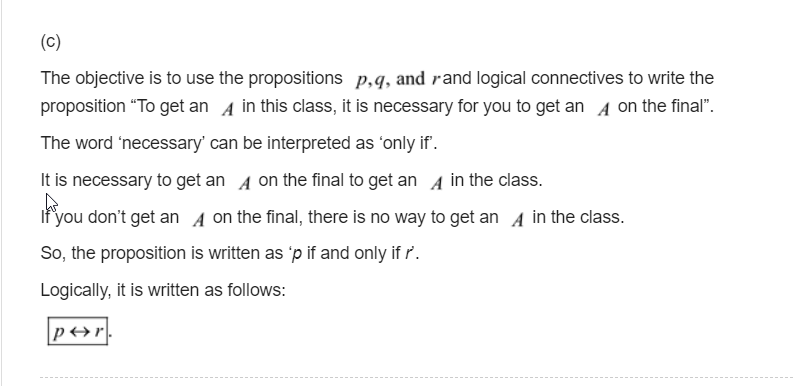
I thought propositions only became "if and only if"
if the conditions were both necessary AND sufficient
stray reef
what's p and what's r and what's with this insistence on not giving things intuitive names
"to get an A in this class, it is necessary for you to get an A on the final" doesn't translate to "A in class <-> A in final"
wild flame
Sec.
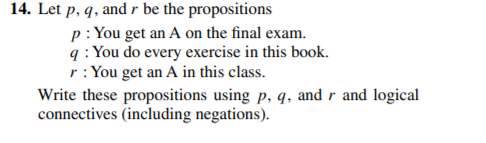
@stray reef
That wasn't my answer. That's the answer I got from chegg (since they don't give the answers of evens in the book)
stray reef
what's the proposition you were asked to write again
"to get an A in this class, it is necessary for you to get an A on the final"?
wild flame
To get an A in this class, it is necessary for you to get
an A on the final.
Yes
would the proper proposition be.
P --- > R?
stray reef
no
stray reef
er
wait
okay first off
math is case-sensitive
A in class -> A in final
r -> p
wild flame
Yeah. But its definitely not a bi-conditional no?
Guess this is a case of chegg being wrong
stray reef
i can assure you that it's not a bi-conditional.
wild flame
Fucking chegg.
stray reef
don't trust everything you see online lol
tacit marlin
Can somebody explain this to me?
I don't understand why we now have (n+1)(n+1)! on the right side
When I look at the question, for my induction step I want to do
= (n+1+1)! - 1 but thats not what they do
sleek swallow
Your last step involves you manipulating the left-hand side in order to obtain something on the right-hand side that would make the entire statement equivalent to P(n+1)
So, you want to get (n+1+1)!-1 on the right-hand side but you gotta do it by manipulation of the left-hand side.
tacit marlin
is the reason they added (n+1)(n+1)! to the right side was because it was added to the left side when we were doing the n to n+1 step?
sleek swallow
Well, think of what P(n+1) is:
$P(n+1) \iff \sum_{k = 1}^{n+1} k.k! = [(n+1)+1]!-1$
In other to get that left-hand side, you need to add (n+1).(n+1)!
vital dewBOT
Abhijeet Vats:
 obtuse phoenix
Could somebody explain this to me? I originally thought it was a Russell’s paradox question but now I’m unsure
 ivory badge
Well, what makes you think it isn’t a set @obtuse phoenix
Or, if you think it is a set, why?
obtuse phoenix
I was thinking it is a set because x is not an element of itself but it is stated that x is an element of s making it part of set S im pretty sure
Which would make T = s?
ivory badge
@obtuse phoenix Well, do you have the axiom (schema) of specification?
faint narwhal
yes
 errant bear
ok, wanted to make sure i wasnt missing anything obv
weary tiger
Everyone who likes to hike has hiked with someone else
$\forall x \exists y (H(x) \implies (T(x,y) \land (x \neq y)) $
vital dewBOT
Skwiid:
 barren apex
Quick question with Big O notation. Do higher big O's hold true if a smaller big O holds true? In other words, if f(x) = O(x^2) is it also true that f(x) = O(x^3)?
Speaking purely in a mathematical definition and not computer science intuition (time complexity)
barren apex
Cool, thanks
weary tiger
sorry 😂
sleek swallow
You don’t need to state x neq y, cos it’s already a part of the definition of T(x,y)
weary tiger
ahh thats the part i was confused about
thank you
oops
$ \forall x \exists y(\lnot{T(x,Tom) \land (x \neq Tom)) $
vital dewBOT
Skwiid:
$ \forall x \exists y(\lnot{T(x,Tom) \land (x \neq Tom)) $
```Compile error! Output:
! Missing } inserted.
<inserted text>
}
l.54 ...sts y(\lnot{T(x,Tom) \land (x \neq Tom)) $
I've inserted something that you may have forgotten.
(See the <inserted text> above.)
With luck, this will get me unwedged. But if you
really didn't forget anything, try typing `2' now; then
my insertion and my current dilemma will both disappear.
Uh looks okay but why is there an ‘there exists y’
weary tiger
oh true
 flat depot
hey I am learning about binary heaps at https://en.wikipedia.org/wiki/Binary_heap#Building_a_heap and ran into a statement that doesn't seem to be true.
The only way this could be true is if it means the number of leaves at height h, rather than number of nodes.

A binary heap is a heap data structure that takes the form of a binary tree. Binary heaps are a common way of implementing priority queues. The binary heap was introduced by J. W. J. Williams in 1964, as a data structure for heapsort.A binary heap is defined as a binary tree ...
weary tiger
u learn about the math behind heaps in discrete math?
flat depot
No but a google search indicated that binary trees are in discrete math
weary tiger
ah
flat depot
so I think this is the right channel
weary tiger
i remember learning about em in data structures but not the math stuff about em 😂
sleek swallow
No u
flat depot
I have a technical interview tomorrow so I'm refreshing myself about the math and I ran into this issue
weary tiger
ahh good luck man, ive applied to 46 internships and got no reply to any of them yet 😦
flat depot
well this is the last thing that I don't understand so if I figure it out I should be good to go
the only thing that makes sense is if it means leaves when it says nodes
sleek swallow
Oh fuck 46 internships? Wtf you’re in uni now right? Where are ya studying?
Jesus that’s a lot
flat depot
should I repost in a more advanced channel?
weary tiger
maybe try a comp sci discord?
flat depot
fair enough
flat depot
@faint narwhal yeah I actually figured it out. I thought it meant number of nodes in a tree of height h
but it meant number of nodes at height h. definitely my mistake
 blissful zenith
how do i write the real numbers in terms of their decimal expansions if we Let f: R->N be defined by: f(x) = the third digit of x after the decimal point
 soft thorn
I mean
What even is the question
Do you actually even need to find a formula for the function?
blissful zenith
yes
 analog dagger
for what
soft thorn
Why?
blissful zenith
write the real numbers in terms of their decimal expansins. Let f: R->N be defined nbyu f(x) equals the third digit of x after the decimal point
@analog dagger
soft thorn
Just use logs
blissful zenith
how
soft thorn
Actually
Let me think of something else
I may of been thinking of something else
But really
What is the question as it is written in your book?
blissful zenith
@soft thorn that is exactly the question
write the real numbers in terms of their decimal expansions. As usual, we do not allow a real number to end in all 9's repeating. if we Let f: R->N be defined by: f(x) = the third digit of x after the decimal point (this is called the michelle function)
i tried to find the michelle function online i could not find it
soft thorn
That doesn't really sound like a full question though
blissful zenith
that is exactly the question i copy pasted it
@soft thorn
write the real numbers in terms of their decimal expansions
blissful zenith
@soft thorn what do you mean
soft thorn
Multiplying the number by 1000 pushes the third digit after the decimal point to the ones place right?
soft thorn
Is there even a formula for this
dapper rose
what, you suggested f(x)=(1000x)%10
soft thorn
Yeah
That's the best I can do
Only problem being calculating mod 10 is not necessarily easy
But
That function does work
 haughty herald
Hi could someone help me with this? I just cant figure out if its partial injection or partial bijection
dapper rose
probably f(x)=floor(1000x)%10+(sgn(x)-1)/2 is better
dapper rose
@blissful zenith round down
blissful zenith
what is sgn?
dapper rose
0 if 0
soft thorn
Meh
blissful zenith
wouldnt 1000xmod10 work
dapper rose
@blissful zenith well for say x=0.0111 we get 1000x%10 = 11.1%10 which I think is 1.1
dapper rose
and uh i don't think this answers the original question
wild flame
I swear to god, Logic is the most infuriating thing
sleek swallow
It's fun lol
 loud basalt
i think hes talking about the rapper ./s
sleek swallow
I like Logic and Discrete Mathematics by Conradie and Goranko
So you can use that if you want
It has a stronger focus on logic, though, since it has been written by Logicians
weary tiger
After 44 applications I got a phone interview 🙏
 still nexus
why is this d and not b?
 gleaming zephyr


