#discrete-math
1 messages · Page 90 of 1
 azure lichen
 unborn mango
Hey guys, i'm doing sets in my discrete math class. Just started it and it's been a while for me. Does it look to you guys like the problem is wrong?
 opal crescent
🤷
 ashen magnet
hi guys
I have -(-inf,0) ∩ Z and i have to list the set
so i did
-(-inf,0) ∩ Z = (0, inf) ∩ Z = Absolute value of Z
Is that wrong? I was told it was wrong without explination
or, would that just be N, for all natural numbers?
i'm a bit confused
 flat tulip
It would be the natural numbers excluding 0 yes
 sour arrow
@ashen magnet
What is -(-∞, 0)? That's not a set I know
ashen magnet
PJS oooh, i forgot to exclude 0.
Kaynex that is an interval. for example, the set (0,inf) would be all N or all numbers from0 to infinite
flat tulip
All real positive numbers
Not necessarily just natural
Natural numbers are a subset tho
ashen magnet
oh ok, that makes sense
but going back to my original answer, would the answer (0, Z) be the right notation? or should i say |Z| and 0 ∉ Z
i get the concepts but notation always gets me
or perhaps, (0, N)?
flat tulip
Natural numbers excluding 0?
ashen magnet
right, but in terms of notation would it be an interval (0, N) or N and 0 ∉ N
flat tulip
(0, N) wouldnt make sense, just say n€N, n=/=0
Ive also seen N* being the set without 0 as well
ashen magnet
yeah i think it stems from an older definition of the natural numbers but i think the more commonly accepted includes 0. i'd have to check on that.
ashen magnet
suppose -((−∞, −5] ∪ (5, ∞) ) ∩ Z
demorgan's (5, inf) ∩ [-5, -inf) ∩ Z
What does one do if the intersection of two intervals is empty??
Would it just be {empty set} ∩ Z = {empty set}
Even if i use associative and ((5, inf) ∩ Z) ∩ [-5, -inf) it still doesn't help :/
Is there a law i am forgetting to apply?
 cold meteor
if (A U A) is a universal set, what is (A n A)?
 hasty cargo
A and A are the same set right?
 stray reef
$A \cup A = A$
 vital dewBOT
Ann:
stray reef
$A \cap A = A$
vital dewBOT
Ann:
hasty cargo
That’s what I was thinking haha
Because the union of two sets includes both sets, however the union of any two set A and A would just be A as the elements in the both sets are the same
The same reasoning for the intersection of both sets, A and A if drawn out on a venn diagram would completely overlap itself and given that A is the universal set, AuA and AnA must also be universal sets
Sometimes I’d just like to call it trivial to avoid the fact I’m horrible at proving it
 acoustic valve
can i get some help with this? im so confused
I know a) is true because
if R is reflexive, it maps everything to itself, and so R of R would also do that but twice, making it reflexive as well.
but i can't figure out b. (I assume c is the same reasoning as a0
 viral stump
try an example for (b)
try the easiest antisymmetric relation you can find
see what happens
stray reef
unfold the definitions of "R is antisym" and "R . R is antisym"
viral stump
extrapolate from there
acoustic valve
i think i got it
so
assuming R . R is not antisym
it'd have a relation aRb and bRa where b != a
but both of those relations have to exist in R
which is a contradiction bc R can't have both of those relations at once due to the definiton of R is antisym, right?
:]
stray reef
you mean a (R . R) b and b (R . R) a
acoustic valve
ye
stray reef
it's easier to prove this directly tho
acoustic valve
but does it work though 👀
stray reef
the argument is kinda shaky. i wouldn't accept that if i were grading homework.
stray reef
it'd have a relation a(R.R)b and b(R.R)a where b != a
but both of those relations have to exist in R
how does this follow? how does it follow that one must have aRb and bRa?
stray reef
a direct proof would begin like this:
assume R is antisym and suppose a(R.R)b and b(R.R)a for some a, b
from a(R.R)b, deduce the existence of c such that aRc and cRb
...
acoustic valve
oooh
then you would do the same for some d b(r.r)d so that brd and dra,
but because r is antisym c must be equal to d and a must equal b
right?
stray reef
- don't mix cases. r and R may very well refer to different things
- no, it does not follow that c=d just because R is antisym.
acoustic valve
oof
 blissful basalt
Hey guys, having a bit of issues with this question. Wondering if I could have some guidance
(Part A)
It wants to "identify which laws you would use"
I would say:
(A - B) is complement law
A U B is commutative
 slow socket
@blissful basalt here this might help u
blissful basalt
@slow socket Yeah thanks, I think Im on the right track
by saying:
(A - B) is complement law A U B is commutative
azure lichen
what is “A - B is complement law” even supposed to mean?
a “law” like this should have another part to the equation
 heady sedge
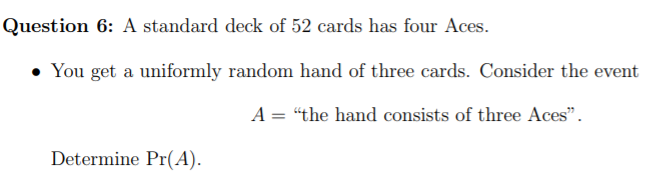
 weary tiger
i think there's a rule against this kind of posting, but at the same time i think this is more of a probabiltiy question?
even if, i thiiiiiiiink the answer is 4×3×2/(52×51×50) all times 3 choose 52
@heady sedge
 obsidian heath
In set theory, a null set (denotes by ø) is in every set? As in: ø is an element of {1,2,3} is true?
I guess it depends on the axioms?
I'm just going to say No, it is not an element of it.
{} is not an element of {1,2,3}
stray reef
indeed {} is not an element of {1,2,3}
{} is, however, a subset of {1,2,3}, and in fact it is a subset of every set
 versed needle
can some1 explain this to me pls DM me https://gyazo.com/b0be32847d9c6e2a4bfd1262587c9fd0

how does 5 sub 8 get to be 101
stray reef
ok
 unborn jetty
how is f: r->z f(x)=[x/2] not injective?
this was the question on the assignment and the answer. it seems like its one to one...
weary tiger
what is the result when x = 1? x = 2?
weary tiger
lol
unborn jetty
oh no we went over it in the slides... wow thats a total failure on my part
weary tiger

azure lichen
well… in what you’ve marked in green there’s parts of C complement
so that can’t be it
oh wait you said left. the intersection of A, B and C is all points which are in all of them
stray reef
the small bit in the middle, yeah
weary tiger
ohokay gotcha
How about this then
if theres A B and a C
Would that be this then
Since I first subtract what B is sharing with A
then what is standing alone from A
then remove that from A
and am left with that bit
azure lichen
I don’t think you’re doing things in the right order
first, calculate the thing in the brackets, the B-A
then, take that away from A, which leaves A unchanged
so you’re left with A
also, why even put a C when there’s only an A and a B involved?
weary tiger
I am told there's an A B and a C
azure lichen
well, the C is irrelevant
weary tiger
Okay I am stuck again
So i have this
And I say that is true
Cause if I assign these values:
A = 1 2 3 4 5 6
B = 5 6 7 8 9 10
C = 9 10 11 12 13
According to my calculations I end up with
A - ( B - C) = 1 2 3 4
(A - B) - C = 1 2 3 4
But I am told it's false?
azure lichen
an example does not prove a theorem
for example:
Theorem Adding a number to itself results in the same as multiplying it by itself
Proof 2+2 = 2*2 = 4
@weary tiger
weary tiger
Then how would I go about proving that statement?
azure lichen
well if it’s false you can’t prove it
a counterexample does disprove a statement
so you can go find one
 cold fjord
Is a geometric proof valid for showing two sets are equivalent?
As in just representing everything as a venn diagram lol
azure lichen
if it’s a rigorous proof and not juts an appeal to common sense
that is, you have to make sure it covers all generality
like: does it also show the case when one set is empty? or included in the other?
a venn-diagram makes some assumptions about the nature of the sets
cold fjord
If a graphical depiction physically shows all possible sets then I would say it's accurate
azure lichen
yes, I would agree
the main issue is that it’s hard to tell if every possibility has been accounted for
cold fjord
For my particular example I'm only working with two sets so it's easier
azure lichen
there’s still a priori a lot of possibilities, like, A could be a subset of B. or vice versa. or one of them could be empty. or both. or they could have empty intersection
etc
there’s so many options and you have to make sure the proof is valid for all of them
for some statements that’s no issue
weary tiger
@azure lichen let me rephrase myself, how would I go about finding out whether it is true or false
cold fjord
I would first do it graphically, Wauner
azure lichen
try to find a counterexample. if you can find one, it’s false. if you can’t, try to prove it’s true
or that
cold fjord
I mean just for me it's easier to visually see rather than picking and choosing elements to put in each set
azure lichen
also, since I recall you having problems doing this stuff correctly, make sure you do the graphical arguments slowly and carefully
with intermediate steps if needed
weary tiger
Ah I understand, thank you for your help
cold fjord
Then you can get an idea on how to make a proof/counterexample based on what you see
I was considering making a graphical representation to show that $(A-B)\cup(B-A)=(A\cup B)-(A\cap B)$ because I think it's true
vital dewBOT
Flip:
cold fjord
But otherwise I'm not sure how to prove that 
weary tiger
@cold fjord
I have tried doing it graphically
I just get kinda confused by it
I may just be looking at it wrong though
cold fjord
If you're just toying around with it and trying to determine for yourself whether it's true or not, draw a venn diagram with three circles, one for each set you're working with
And draw it twice, one for each expression
cold fjord
Yeah exactly
While it may or may not be formal (again this could just give you ideas), you can try shading in the region that represents each rightmost set and then draw the leftmost set around it, if that makes sense lol
weary tiger
Not sure I understand
cold fjord
So for example (A - B) - C, you would maybe draw an outline around the set C and then shade in the region (A - B) without crossing over into C
Then for A - (B - C) you would draw an outline around (B - C) and then shade in A around that outline
Or just shade in each region independently and supershade the overlaps lol
cold fjord
It is ok
weary tiger
So if I were to draw (A - B) - C
I would first find A - B
which is
everything white
right?
cold fjord
Yessir
cold fjord
Ye
weary tiger
Ah I get it then
And then A - (B - C) would be
never mind Im confused lol
B-C would be
this?
cold fjord
B-C is everything in B that isn't shared with C
weary tiger
So this
cold fjord
You're right to do what's in the parenthesis first though
weary tiger
cold fjord
Ye
cold fjord
A - (B-C) will only have elements in A that aren't in the set of B-C
weary tiger
oh right c wouldnt be there either
cold fjord
Mhm
weary tiger
there
cold fjord
That's right yeah
cold fjord
No problem, and if you're being asked to prove or disprove, since they're visually different, you know to go for disproving
weary tiger
Luckily just being asked if t he statement is true or not
So visually I can see it is false
cold fjord
Alrighty lol cool
cold fjord
Can a subset of an infinite set (in both directions) be elements from some upper bound counting down tending towards negative infinity?
 neon pasture
what
cold fjord
Like if $\mathbb{Z}={\ldots, -3, -2, -1, 0, 1, 2, 3, \ldots}$, and $A\subset\mathbb{Z}$, can $A={\ldots, -3, -2, -1, 0, 1, 2, 3, \ldots, a}$
vital dewBOT
Flip:
cold fjord
Yeah totally ignore that last question
What does it mean for an element to be unique?
 dense thicket
in what sense?
element is unique when it is the only one that can satisfy a given proprty
cold fjord
That makes more sense, I was thinking that a unique element is just an element that doesn't have other duplicates within the set, but that's apparently not even a set if it contains the same element twice according to this book lol
dense thicket
well, set {a,a,a,a} = {a}
cold fjord
Also makes sense lol
dense thicket
yeah sets are cool
slow socket
so for the 1st pic
u start from the left and look at (x,y), then u look for something that is (y,z) and see if u have (x,z)
so u have (1,3) then u have (3,1) and u have (1,1) so thats correct
and u keep checking
slow socket
wtf my msg deleted
weary tiger
if aRb then there has to be a bRa too
slow socket
ya u check all of them
is not transitive cuz u have 1,2 and 2,1
but u dont have 1,1
also u have (1,3) and (3,1)
but u dont have (1,1)
(1,3) and (3,1)
(x,y) and (y,z)
then (1,1)
(x,z)
u dont have it
u see it>?
weary tiger
I get your point
but
what I dont understand is
so if I check the first
aRb
which would be 1,2
then why cant bRc be 2,3
slow socket
u have (1,2) u look at what other coord starts with 2
opal crescent
the thing is you could check it
slow socket
aRb = (1,2)
look at wat other coord starts with b
which is bRc = (2,1)
ya u can check that one too
opal crescent
but it's not interesting as a counterexample in our case
(1,2) and (2,3) : and (1,3) is in there
weary tiger
ah I see
opal crescent
that doesn't show the relation isn't transitive
slow socket
u check all of them, so it can also be
aRb = (1,2)
bRc = (2,3)
bRc = (1,3)
weary tiger
so since I know theyre there it wouldnt make sense to check
so I just check (1,2) (2,1)
slow socket
ya check all of them, if 1 of them doesnt work, then is not transitive
opal crescent

 fossil quiver
you can kiss me
weary tiger
Got a test tomorrow and that was the last subject I was struggling with
so hopefully I will do well
slow socket
good luck
fossil quiver
have fun
weary tiger
@fossil quiver sorry my lips are reserved for @slow socket and @opal crescent
weary tiger
50$ and I might consider a peck on the cheek
fossil quiver
that is too much for me
fossil quiver
OK
 worthy thistle
For the Summation(j=0 to 2n), (2j+1) = (2n+1)^2; I don't understand what it means
So when j = 0, (2(0) + 1) = 2(0*2) +1) ^2, so 1=1
But when j=1, 2(1+1) = (2(1*2)+1) ^2 so 4 = 25?
 echo lintel
For every real number x, if x is irrational, then −x is also irrational.
prove w contrapositive
opal crescent
what's x + (-x) for any x ? @echo lintel
opal crescent
myeah, x+(-x) = 0 would imply that 0 is irrational if you assume x irrational and -x rational

weary tiger
lol
 dusk plaza
calculus is child's play
 modest zealot
is the set of an empty set a subset of any set?
{(the 0 with the slash)} a subset of any set?
 glossy adder
the set of integers n such that there exists an integer k such that n=12k+11
modest zealot
sooooo is the set A something like tshi
A = { --- , 11, 23, 34, --- }
to infinity and beyond?
glossy adder
ye
modest zealot
ahhh okay
yea i was confused
when it said there exists an integer k
i thought that A could be any set with 0 elements, 1 element, 2 elements to infinity
weary tiger
also yes the empty set is a subset of every set
modest zealot
ah alright
thanks thanks
wait but its the set of an empty set
{{}} if i understood it correctly is a subset of every set
echo lintel

so... i understand how to turn numbers into binary
where does the 66 = 2^6 + 2^1 come from
 twilit wadi
@everyone can any one explain what is conditional and biconditional statements
 oak creek
dude. there's 11-12k people in the server. don't try pinging everybody
conditional: if p then q; p implies q
biconditional: p if and only if q; if p then q and q then p
try writing it out on a truth table
twilit wadi
@oak creek thanks
@oak creek what is disjunctive normal form and conjunctive normal form
oak creek
disjunctive normal form is a form using disjunctions and conjunctive normal form uses conjunctions 
google is your friend here
twilit wadi
@oak creek thanks
@oak creek feeling little bit difficult to understand these things
 sage island
how do you feel about pings tho
oak creek
issa lot kek
twilit wadi
@oak creek I know truth table
oak creek
you don't have to ping me each message, just send each message please
okay so: can you pull up a truth table for 3 variables p, q, and r?
oak creek
okay so
look at this truth table
DNF is basically
a manner to get the "formula" of the end value
without knowing it
through the truths
so for the first truth value
it can be summarized as: p and q and r
correct?
twilit wadi
it is p or q and r I think
oak creek
that's. not the way you would structure DNF
basically: you would look at all the truth values
and strictly structure them using ands inbetween each
so the first truth would be p and q and r
second would be p and not-q and r
third thruth would be not p and q and r
then you would space each out with "or"
$(p \land q \land r) \lor (p \land \neg q \land r) \lor (\neg p \land q \land r)$
oof
vital dewBOT
Colorodo Brown Stain:
oak creek
so that would be disjunctive normal form
basically, it's a disjunction of conjunctions
twilit wadi
yes it is disjunction of conjunctions
oak creek
do you understand DNF now
oak creek
yeah
 obsidian rampart
list the elements of the state space for flipping three fair coins at once. what is the state space?
im looking through my notes but i cant find it.
sour arrow
I'm guessing that's the event space, it's the set of all possible outcomes
sour arrow
Where's 0.5 come from?
sour arrow
You have a 100% chance of landing heads or tails
obsidian rampart
what
the chances of a single coin are .5 so wouldnt you just multiply the probabilities?
sour arrow
I'm jk of course. No, the set of all possible outcomes is the list of the outcomes
obsidian rampart
ok
sour arrow
Heads, tails, tails is in the event space
obsidian rampart
so like this
sour arrow
Or state space? I've never heard it said like that
obsidian rampart
0 0 1
0 1 0
0 1 1
1 0 0
1 0 1
1 1 0
1 1 1 ```Yeah, that works!
sour arrow
Wow you typed that fast
obsidian rampart
it was either that
or the .5
professor mentioned it briefly in class, but didnt go any further than that.
this actually makes sense now that i think about it lol
 steady axle
Does this server not cover Theory of Computation?

 pastel temple
ok ty for your response but how come (1,0) is a possible pair?
pastel temple
the answer in the textbook is
{(1,0),(1,1),(1,2),(1,3),(2,0),(2,2),(3,0),(3,3),(4,0)}
hasty cargo
0/1
is 0
Which is I dunno subjective but I don’t include 0
But I guess right
since it doesn’t give any remainder
pastel temple
ah i see so its somewhat inverted
hasty cargo
Yeah
pastel temple
a | b, a is the denominator
hasty cargo
Yup
pastel temple
okay how come (2,1) isnt a pair?
hasty cargo
1/2
pastel temple
1/2 is fine no?
hasty cargo
Is not a internet
pastel temple
ouuuuu
pastel temple
1/3 is?
hasty cargo
Bon appetiteeeè
stray reef
no
stray reef
whether or not 0 is considered a NATURAL NUMBER is up to convention
but it is an integer and everyone agrees that it is
stray reef
0 is as much an integer as 4, -17, or 2209
neon pasture
it is
pastel temple
How would you go about solving a problem like this?
What I did was do R = {(a,a),(a,b),(b,b),(b,a)}
is that correct?
And from there check whether it complies with the conditions of a reflexive, transitive, symmetric and/or anti-symmetric relation
stray reef
it's not symmetric tho
just because everyone who visited a also visited b doesn't mean everyone who visited b also visited a
is that correct?
no
what you did is not just incorrect, it's nonsensical
weary tiger
a
twilit wadi
@oak creek conditional statement if then
is it similar to if else statement that we use in programming
 civic dagger
This is a postcondition to a piece of code. If r = FALSE must the other side of the biconditional also be false or does it not matter since this statement only refers to r = TRUE?
stray reef
yes, the other side of the biconditional is false
azure lichen
think of it that way: if the right side was true, then the left must be too
hence if the left is false, right must be false too
twilit wadi
@civic dagger thanks
can you people suggest me any books or online material to read to learn about conditional statements
slow socket
im doing a probability problem
i have "a fair coin is tossed four times, consider the events"
A = {'exactly one of the first two tosses is heads"}
B={'exactly two of the four tosses are heads"}
i found P(B) = 3/8
but idk wat to do
is asking if A and B are independent
is the P(A) = 1/4?
stray reef
no, P(A) is not 1/4
slow socket
how can i do this
steady axle
You flip a coin 2 times, and you have two possibilities. Yes?
It is either heads or tails for each flip
What is the chance one of the first two flips lands on heads?
Does that wording help you better? @slow socket
slow socket
P(A) = 1/2?
 copper ore
is this a good place to ask about showing that a function is big O?
slow socket
@copper ore yes
 golden depot
assuming this is the right spot for a set theory question,
let A be a set s.t |A| = n, n in omega, and s in A, how do I prove that |A{s}| = n - 1?
|A{s}|=n-1 *
|A \ {s}|
 stuck bough
Anyone here know anything about Hamming Code? I am confused as to what they are and how to actually find the codes
 glad oriole
@golden depot what’s omega?
 rare barn
the set of natural numbers I suppose
you want to prove that (A \ {s}) and {s} are disjoint,
and that |{s}| = 1
and then use the additivity of the cardinality
(which you might also need to prove)
@golden depot
ashen magnet
I have a quick question when counting min/max cardinality of the intersection 2 sets
|A| = 10 |B|=15
My answer:
Largest value |A ∩ B|
Consider A ={1,2,3,4,5,6,7,8,9,10}
And B = {1,2,3,4,5,6,7,8,9,10,11,12,13,14,15}
at most 10 elements can be in the intersection
So Largest value |A ∩ B| = 10
Smallest value |A ∩ B|
If A and B are disjoint then |A ∩ B| = 0
Otherwise the smallest possible is 1.
Is my reasoning okay?
sour arrow
Yes
You don't need the line considering the possibility that A and B are not disjoint, since that's not the smallest value
ashen magnet
oh i see. thanks for the feedback
 void valve
$\begin{matrix}\mathbb{R}_+: 1&2&3&4&5&...&n\S: 0.1&0.2&0.3&0.4&0.5&...&0.n\end{matrix}$
vital dewBOT
kjsahd:
void valve
This is probably stupid but is this a valid bijective function to show that R_+ has the same cardinality as the interval 0<x<1 ?
ashen magnet
quick question, if i have 5 slots and 3 can be 3 letter "a"s the amount of words with 3 letter "a"s is 15*26^2, right?
ashen magnet
or rather, 15(25^2) because a is only allowed to appear 3 times in that 5 char string
weary tiger
pretty much
ashen magnet
This is my last question tonight. I really have trouble when it comes to applying it to functions.
I have f: X -> Y
X{1,2,3,4} Y {a,b,c,d,e}
find the number of functions based on the restriction
a) no restriction: 5^4 = 625
b)injective: P(5,3) = 120
c) f(1) = a: C(1,1) * 5^3 = 125
I'm really not sure about that answer c i gave.
I was also thinking C(1,1)*C(5,3) but that gives me 10 which doesn't seem right...
My thinking is one slot is taken as f(1) = a so the total number would just be c(1,1) * 5^3 as it doesn't matter for order and it doesn't have to be injective
weary tiger
well now you only have to consider {2,3,4} since 1 is already assigned as you said
each of the inputs on {2,3,4} have 5 possible outputs, so it's just 5³
ashen magnet
mmm yeah that is what i found to make the most sense. it's just my text book had me confused with some examples having results like c(n,r) * c(n,r) or c(n,r) + c(n,r)
weary tiger
sad
ashen magnet
what's wrong?
slow socket
ur book is sad
ashen magnet
Stop guys, I paid good money for it D:
I get better understandings of concepts on here though.
My professor likes giving strange practice problems I can't find anywhere else. Even in the book. so it's nice getting things cleared up on here
weary tiger
use the definitions
modest zealot
the definitions?
weary tiger
definition of complement
weary tiger
you skipped a step but yeah, that is what the union will be
modest zealot
but how does saying x is eitheri n A or not in A prove that its in the universe
i feel like im missing something here...
weary tiger
because those are the only 2 possibilites that you can have
either it is in A or it is not
modest zealot
do i have to show both inclusions for something like this?
prove its a subset in one way and the other way
weary tiger
$A \cup A^c = { x | x \in A \lor (x \in U \land x \notin A) }$
vital dewBOT
weary tiger
then use distributive laws
modest zealot
hmmmmm ok...
 ivory badge
It's basically saying you can get arbitrarily close to the edge
 craggy gale
it means for any x of S, there exists an open interval centered at x that's entirely contained in S
ivory badge
If you want a concrete example of what it means, if you have (0, 2) then if you have 1.9999, there exists an r (0.000000001 for example) such that (1.9999-0.000000001, 1.9999+0.000000001) is a subset of (0,2)
craggy gale
reverse brackets have more charm tbh
ivory badge
tbh
weary tiger
french notation tbh
ivory badge
I typically use parenthesis because habit but reverse brackets look cooler
craggy gale
(a, b) is ambiguous
weary tiger
lmao ordered pairs
ivory badge
true, but depending on c o n t e x t
modest zealot
oh so its one of those limit things
craggy gale
it could be pair of things
modest zealot
it like approaches that value, but not quite that value
weary tiger
imagine using (a,b) when you're discussing open sets in R^2 
ivory badge
It's not a limit per se, it's saying you can always get closer to the endpoint
ivory badge
Yeah
Closed sets you can take the point at the end and there will be no open set which contains it and is inside the set
modest zealot
(a) Let a, b ∈ R. Show that the interval (a, b) is open.
For example, how would u show that?
ivory badge
Basically it's open if any object within can be covered by an open subset of the original one
So you show it is open either by 1) it's open because they use notation that says "this is open" or 2) it's open because there's always a open subset which covers any number within
modest zealot
lets say we use method 2 (i dont think method 1 is gud enugh)
ivory badge
It's not exactly good but I highly doubt i'm getting all the context of what you have
modest zealot
o
weary tiger
use the definition of openness
craggy gale
take x in (a, b)
(x-a)/2 > 0
(b-x)/2 > 0
the minimum of those two is > 0
it works as the r of the def
modest zealot
like the thing that keeps coming back is limits limits limits
ivory badge
and it forms an open subset ergo (a,b) is open
modest zealot
FK THIS IS SO CONFUZZLIZNLZING
ivory badge
It's not too bad once you "get it"
modest zealot
can u explain it in a dumber way
ivory badge
Definitions of concepts tend to throw people for a loop till they realize what it means
Closed means you can put a definite maximum (and minimum) in this context
open is not closed
You can't say the "maximal value of x < 2"
but you can for x<=2
modest zealot
ok i get that, sets n shit
ivory badge
Closed means "this has a definite endpoint"
modest zealot
but i cant connect that with the definition
ivory badge
The definition says there is no endpoint definitely because you can always get closer (there is always an r such that x+r < Y)
You can't always get closer to 2 in [0,2] because it definitely ends
modest zealot
there will always be some r value, that you can put between a value (x) and a value (b) for example
ivory badge
yep
ivory badge
Take the unit interval (0,1). there's always a lesser value because there is no minimum because 0 is not included
Intervals like this is basically "exploit the properties of real numbers"
modest zealot
ok yup i got part a
its a bit similar to the answer some1 gave above
but we choose r to be (b-x)/2
and r to be (x-a)/2
such that
x+r < b and x-r > a
x is an arbitrary element
and i think that proves openness right?
im basically saying that between x and b, there will always be a value in between no matter what for any x, b
ivory badge
Ye
modest zealot
awesome awesome
ivory badge
That's literally what it means: you can always get closer
ivory badge
Again, no pressure, definitions of "new" concepts tend to throw people for a loop, esp when it's formalizations of things they thought they knew
modest zealot
ye ye
ivory badge
This server tends to be helpful if you have questions, but if you have questions on some specific thing (like problem (a)) they tend to like using #question-whatever
modest zealot
o
naw its k
one more question
how do u negate the statement
i kinda have an idea
but im not sure
ik for sure its something along the lines of
there exists an x in S that for all r less than 0
is that correct for now?
or is it for all r greater than 0
modest zealot
o
ivory badge
yeah it's a bit more in depth as a being the complement of an open* set but uh
weary tiger
there are sets which are both open and klosed
weary tiger
it is mathematics
modest zealot
i always ALWAYS have problems doing negations
because i dont know whether to switch things or not
ivory badge
Basically: there exists some x such that for all r, (x-r,x+r) is not a subset of S if I remember right
modest zealot
for all r greater than 0 or less than 0
ivory badge
Correct me if I'm wrong of course, but I believe it should stay greater than
since ya know
(2, 1) isn't the best thing
My logic is a bit rusty and rough so don't take what I say at face value, actually look at it and make sure
modest zealot
yups will do
weary tiger
remind me of the definition of open
modest zealot
that u can ALWAYS choose an r value
such that x+r will always be less than b and greater than a
weary tiger
right
for all x in the set
but there are no elements in {} in the first place
so it's vacuously true
modest zealot
uh huh...
weary tiger
kek
modest zealot
wait fk it lemme send u the whole problem, im confused as shit
how tf do u do b and c
c i kinda have an idea, but its prob terrible af
im a very confused potato atm
ivory badge
So B isn't that bad, it's just logic stuff so i'll leave that alone for now
So consider (a,b] and the definition of open
Is there any point x such that there exists no r?
modest zealot
when x = b?
that was my original thought
when x = b
u cant do shit
since r > 0
ivory badge
Yep
ivory badge
yeah it's a lot more straighforward than it appears under formal symbols
Personally, I prefer the order of Seeing the formal way -> intuitive explanation -> connect to the formal definition so you can properly understand
modest zealot
i go more like
understand the shit, wut it means, and then start making ideas
modest zealot
aight
 whole sinew
What is discrete math
ivory badge
math but without continuous
whole sinew
waow
weary tiger
lmao
 hexed rune


 ivory badge
h m m
weary tiger

modest zealot
anyone here want to explain relations of a set
and how there are 2^(|A|^2) number of relations of a set A
where |A| represents number of elements
weary tiger
So you're asking how to derive the general formula for the number of relations of a set of a given size?
weary tiger
i mean
consider the definition of relation
Doesn't it depend on whether the set is reflexive etc
AxA has |A|² elements
and a relation is a subset of AxA
so 2^(|A|²) possible subsets
kek
weary tiger
obviously
weary tiger
example of relation?
modest zealot
that proves there r that many elements
weary tiger
wat
do you want me to prove there are |A| * |B| elements in A x B
modest zealot
like for example set A = {1, 2, 3}
wait
nvm
so in a nutshell, a relationship is basically how the function maps to itself
or how the function maps to another function
weary tiger
no
modest zealot
awww fuk
weary tiger
it is a subset of the cartesian product
dense thicket
relation is basically grouping elements that are not distinguishabkle from some point of view
modest zealot
why tf is that useful?
dense thicket
relations have some useful properties
modest zealot
hmmm
so a subset of a cartesian product has properties like reflexive, symmetric, n stuff like that
modest zealot
some relations can be written as a function
dense thicket
yes
modest zealot
oh god lemme c if this clicks in my brian
this is some whack shit
connecting subsets of carteisna products with functions and relations
dense thicket
I mean there are many relations , you can consider two natural numbers being in relation lets say a and b if a is smaller than b
modest zealot
but how tf is that connected to sets?!?!?1
im not understanding the connection between sets and relations
oh wait...
dense thicket
well function is defined by taking element from one set and spitting out element from the other
modest zealot
r sets in relations, usually defined as like real numbers, natural numbers, and stuff like that?
like there r relations in sets like the real number set
sour arrow
Let A = {1, 2, 3}
Let B = {a, b, c}
Some relation could be {(1, c)}
This is a subset of A×B
It essentially says "1 is related to c"
modest zealot
OH
sour arrow
A relation with no added structure is a very loose concept, where a function is much more concrete and we typically work with them instead. A function is a special type of relation.
modest zealot
and for functions, we kinda assume the universe we r working with is usually real numbers
or the set
sour arrow
If you're doing calculus, yes
sour arrow
If you're doing a lot of other math, almost never
modest zealot
w0t
o ic wut u mean
any1 mind explaning how the fuck this everything but reflexive
this shit fucking with my brain hard
sour arrow
Let A = {a, b, c, d}
You can see that's the set above.
Let's think about the relation from A to itself.
This is by definition, a subset of A×A.
According to the picture, this relation is just {(a, a)}
That is, a is related to a.
modest zealot
yes
sour arrow
"Reflexive" means every element is related to itself.
This isn't the case, since b isn't related to b.
modest zealot
i understand the reflexive part, for somethign to be reflexive, every single element of a set must map to itself
sour arrow
Yus yus
sour arrow
Symmetric
If aRb, then bRa
modest zealot
clearly not tho
sour arrow
Where not?
modest zealot
no symmetry whatsoever
WAIT
ITS TRUE
BECAUSE aRb is false
this is some whack logic yo
sour arrow
Every relation aRb has a symmetric relation bRa
This is true, simply because there doesn't exist any aRb relation lel
modest zealot
the picture above, there isnt an element that maps to anything else, which implies symmetry
yes
yes yes
understood
one question
sour arrow
All three follow that logic
modest zealot
for antisymmetry, is the definition like
if a maps b and b maps a, then that implies a = b
azure lichen
Every relation aRb has a symmetric relation bRa
aRb isn’t a relation, it’s a truth value or sth; R is the relation
modest zealot
so like symmetry, antisymmetric, and transitive all have the implication logic
and since the hypothesis or initial statement is false, the whole statement is true
sour arrow
Very nice catch, that is true.
azure lichen
yea, empty truth or whatever it’s called
vacuous truth?
also reminder that a relation is just a subset of the cartesian product
and aRb is really just a shorthand for (a,b) ∈ R
modest zealot
one more question
how come this isnt transitive
clearly
a -> c, and c -> b
which results in a -> b
azure lichen
well, the explanation is wrong, so
stray reef
modest zealot
👀
azure lichen
maybe they meant for the top arrow to go the other way
azure lichen
or sth
modest zealot
but for the sake of the diagram only, its transitive right?
stray reef
the relation as drawn is transitive.
modest zealot
ok if i understand this correctly
A = {a, b, c, d}
for something to be transitive, ALL ELEMENTS have to map to itself
azure lichen
that would be reflexive
modest zealot
i mena reflexive
mbmb
for something to be symmetric
u only need one set of symmetry? like (a maps to b) and (b maps to a)
u dont need symmetry to happen on all the thingies
?
modest zealot
ok so
A = {a, b, c, d}
is there a difference between
a->b and b->a
or
a->b and b->a AND a->c and c->a
like does the thing only NEED one symmetry for it to be identified as symmetric?
azure lichen
well, they’re two different relations
modest zealot
or does it need symmetry on ALL the elements
azure lichen
both are symmetric if that’s all there is to them
but a→b, b→a, a→c is not
because a→c has no counterpart
modest zealot
so as long as there is something like a->b, there needs to be a counterpart
OH
THAT MAKES SO MUCH SENSE YO
if you have it, then u need the reverse, if u dont, then its all good
BRO
THIS MAKES SENSE
azure lichen
in particular, if you don’t have it, then you also can’t have the reverse
modest zealot
yes
azure lichen
(because the reverse would also be an “it”)
modest zealot
so u either have the a->b and b->a or u dont have any at all
azure lichen
aye
modest zealot
cuz if the relation ONLY has a->b, then its antisymmetric
modest zealot
what if it has a->b and like b->c
azure lichen
antisymmetric just means if you hvae a→b then you can’t have b→a
modest zealot
is that antisymmetric?
azure lichen
that wuold be antisymmetric, again assuming nothing else in there
modest zealot
ok ok ok ok
so its one of those things
oh my
this makes so much sense
its the implication condition shit all over again
DEFINITIONS SO FUCKING IMPORTATNTSONGSRG
azure lichen
someone’s learned an important thing about math :P
modest zealot
BROOOOOOOOOOOOOO
I feel like a god now
bow to me u peasants
ok im sry
im out
azure lichen
aight now find relations on the set of natural numbers which are:
-symmetric but not transitive or reflexive
-transitive, but not symmetric or reflexive
-reflexive and transitive but not symmetric
modest zealot
hmmmmm can we assume set A = {a, b, c, d}
or is there another set i shud consider that'll make this easier
stray reef
why don't you try finding relations for all 8 combos of presence/lack of refl, sym and trans?
azure lichen
honestly yea, why not
azure lichen
some you can even find well-known ones
like, ones that you know from primary school
stray reef
we're giving you exercises
modest zealot
oh god
stray reef
well, sascha gave you one, and i extended it
modest zealot
i was NOT prepared for this
azure lichen
yea I just copied an exercise I got when we first learned about equivalence relations
(equivalence relation fulfills all three of reflexive, symmetric and transitive)
modest zealot
👀
modest zealot
-symmetric but not transitive or reflexive
a+b = 5
-transitive, but not symmetric or reflexive
a+b > 5??
-reflexive and transitive but not symmetric
idk
best i can do for now
stray reef
Find eight relations $R_0, R_1, \cdots, R_7$ on the set of natural numbers $\mathbb{N}$ such that the following properties are satisfied: \\
\begin{tabular}{c|ccc}
$i$ & $R_i$ refl & $R_i$ sym & $R_i$ trans \\
\hline
0 & No & No & No \\
1 & No & No & Yes \\
2 & No & Yes & No \\
3 & No & Yes & Yes \\
4 & Yes & No & No \\
5 & Yes & No & Yes \\
6 & Yes & Yes & No \\
7 & Yes & Yes & Yes \\
\end{tabular}
Ann:
modest zealot
oof
hmm
holy shit
what the fuck are those 8 exercises
bro my brain
is gonnna explode
stray reef
do them one at a time 😛
azure lichen
but yea, do them one by one in whatever order
modest zealot
GAAA
stray reef
should you choose to do them, make sure to specify which one you're going for 😛
azure lichen
not really, but check some well-known ones
stray reef
^
azure lichen
like, what relations on ℕ do you know? that are like, common
stray reef
(don't overthink that)
modest zealot
like functions?
azure lichen
no, relations
modest zealot
lmao no lcue
azure lichen
I mean, functions can be seen as relations too
specifically the graph of a function is a relation
(the graph being the set of tuples (x, f(x)) for all x)
but let’s not go too complicated
a = b would be a relation
as an example
stray reef
it's often referred to by its symbol alone if it has a symbol
azure lichen
perhaps the example
azure lichen
=, > and < are all relations
+, -, * … are not
they’re just functions, and binary ones at that so that would make for lousy relations :P
modest zealot
bro wtf math am i studying...