#discrete-math
1 messages · Page 86 of 1
 analog sonnet
 pastel temple
for (B).. is the answer (S/\U)->R or is it R->(S/\U)
 steady axle
@sour arrow Thanks
 worthy thistle
Is that statement "for any two odd integers, there exists a third integer the triple of which is equal to the sum of the first two integers" false because 1+1 =2, 2/3 isn't an integer
so proof by counterexample
 sour arrow
@copper ore
Still need it?
 copper ore
yeah
sour arrow
There's a few obvious simplifications to make right away
¬(p V q) = ¬p ∧ ¬q
As well as
q → p = ¬q V p
So we have on the left,
¬p ∧ ¬q
On the right, (¬q V p) ∧ ¬p
copper ore
im trying to solve left only
but yeah
i tried de morgans law first
and couldn't get any further
¬(p V q) = ¬p ∧ ¬q
q → p = ¬q V p
how?
sour arrow
That's by definition. Definitely worth remembering that one
copper ore
what do you mean?
sour arrow
Try making the truth tables for both if you don't believe me
copper ore
i didn't say i don't believe you lol
i made a truth table already and they have the same true/false values so i know this is solvable
i just want to know what i need to do after de morgans law
idk what you did when you did this: q → p = ¬q V p
what law is that called?
copper ore
ohh
ok
i was gonna do that too but it didn't make sense
wait so you use de morgans law first then implication law?
cause wouldn't de morgans law give me ¬q ^ ¬p
can i get some help ?
anyone
sour arrow
@copper ore
Hey, back. Still want it?
copper ore
hi yes please! 😃
sour arrow
On the left
¬(q V p)
= ¬q ∧ ¬p
Using Demorgan's
On the right
(q → p) ∧ ¬p
= (¬q V p) ∧ ¬p
By using implication law
sour arrow
You can. But first you'll want to work both sides to see "how", then redo your work in terms of working with only one side
Because it's not obvious how they might relate
If you are going to work with only one side, make it the right side
copper ore
what would be the steps if i used the left side, do you know?
sour arrow
¬(p V q)
= ¬p ∧ ¬q
= (¬p ∧ ¬q) V (p ∧ ¬p)
= (¬q V p) ∧ ¬p
= (q → p) ∧ ¬p
copper ore
how do you figure em out so fast @sour arrow do you use a technique?
like i look at my paper of "Rules of Logic" and didn't see any pattern for getting from step step 2 to 3
= ¬p ∧ ¬q
= (¬p ∧ ¬q) V (p ∧ ¬p)
but like i know it's right cause i did a truth table on it
but how did you solve it?
sour arrow
@copper ore
x = x V F
And p ∧ ¬p is false always
I figured it out by simplifying LS and RS until they matched, then I used those steps to go from LS to RS
 golden cairn
My head hurts from proofs, does anyone have a guide that is good for understanding proofs better?
if so can you ping me with it
 sour arrow
g(0) = g(1)
Therefore not one-to-one
sour arrow
If you want to map to n, then use n + 1. All ℕ are mappable
 slow socket
ya but im supposed to prove it or some shit
sour arrow
g(n + 1) = n for all n ∈ ℕ
sour arrow
What is g(n + 1)?
slow socket
is that the inverse?
sour arrow
No, that's g, when we plug in n + 1
g(n) = max{0, n - 1}
g(n + 1) = max{0, (n + 1) - 1}
g(n + 1) = max{0, n}
g(n + 1) = n
slow socket
and why did u plug in n+1, where did u get that
sour arrow
g(n) "usually" returns n - 1
How do you get it to return n? Increase n by 1
If you can see why it works, you can see where I got it
Don't get too bogged down in notation here.
If g(n) = n - 1
Then g(n + 1) = n
copper ore
Can i ask a Q or is it one at a time?
 opaque bone
Isn’t this why we have like... 10 different question channels down below?
copper ore
not all 10 channels down below are for discrete math
only this one is named discrete math
copper ore
 gaunt igloo
Can you tell me why there is no translation invariant measure on an infinite dimensional Hilbert space
copper ore
what
gaunt igloo
😰
copper ore
i thought your question was something related to my question nvm
gaunt igloo
Np
copper ore
anyways, how is hilbert space related to discrete math?
copper ore
can anyone hepl me
 rare barn
so what about this formula
 glad oriole
#❓how-to-get-help is for any sort of question whether its discrete math or not
 cold fjord
Going into discrete math for the first time, any tips on mindset I could have?
Only because it seems substantially different from traditional calcebreometrig
 paper thicket
Hello
Can anyone help with this? Idk how to go on about it
Does making truth tables for each and comparing all the components work?
sour arrow
Sure, but that's probably more work than you need
You want to find all statements equivalent to A → B
By contrapositive, ¬B → ¬A is equivalent
By implication, ¬A V B is equivalent
And V is commutative, so also B V ¬A
That gives C and E.
 modest zealot
(p → q) ∨ (p → r) and p → (q ∨ r)
can anyone help me prove this
like it is kinda obvious intuitively, but dunno how tf to prove it
sour arrow
LS:
= (¬p V q) V (¬p V r)
= ¬p V q V r
RS:
= ¬p V (q V r)
= ¬p V q V r
modest zealot
oOOoohhhhh gotcha
another question, is it logical to negate the other side after negating one side
can you do that to prove stuff?
also, what is the meaning behind implication? how does the truth table work
p q p->q
t t t
t f f
f t t
f f t
like how does having a false p, or false hypothesis make the implication true
sour arrow
@modest zealot
Oh boy you're not the first to ask that. It's a very common question
The algebra is better that way. You'll find, in practice, this ends up being a simpler option than if it were instead false.
modest zealot
is it due to some like convention or something?
to make things easier?
or is there some sort of intuition behind it, because the way I was told was that since the hypothesis is false, any conclusion can be drawn which makes it true regardless of the conclusion
sour arrow
In practice, an implication with a false premise is generally ignored anyway. However, for completeness we still have an option for this. This turns out to be the "least ugly" choice, and the algebra works well.
Also note the symbol has no need to match our English interpretation exactly. Think of it as "implies, but a little different"
modest zealot
p implies q
hmmmm
i feel like the more i think about it, the more convoluted it becomes in my head
 ivory osprey
p implies q does not exclude a r implying q
So, when p is true, you know for sure q is going to be true as well, but when p is false, you can't say whether q is false too, because there might be something else going to cause q to be true
That's how I think of it
modest zealot
interesting
another question
Rewrite the following statement using symbols (meaning: define some statements p
and q and connect them using quantifiers and a ⇒ symbol): Every continuous function f from R to R is
differentiable at every point.
how would you do this?
p - continous function f from R to R
q - differentiable at every point
p -> q?
my gut however, is telling me is supposed to be the other way
q -> p
ivory osprey
p -> q, from the statement, the possibility that a function that's differentiable at every point but is not from R to R exists
But the other way around is not possible
 dapper mirage
don't forget to quantify!
dapper mirage
you can do that with just truth tables
copper ore
im not allowed to use truth tables
dapper mirage
im not 100% on what you mean "by equivalence", but you could be interested in the truth functional form algorithm
dapper mirage
that does sound like you want the truth-functional form algorithm
although, perhaps you mean just by using things like de morgan's laws
copper ore
yeah by de morgans and all that etc
dapper mirage
have you tried using de morgan's laws on it?
dapper mirage
ok, what can you see in there that you could apply de morgan's laws to?
dapper mirage
ok i think that is right so far i need to think a bit tho
dapper mirage
😄
copper ore
you know what i tried doing but i can't seem to figure out how
so i tried to make all the same letters together so i can give them a T or F
using contradiction
or
law of excluded middle
dapper mirage
this is a bit of a tricky one yano xD
modest zealot
ok a followup to the previous question
Rewrite the following statement using symbols (meaning: define some statements p
and q and connect them using quantifiers and a ⇒ symbol): Every continuous function f from R to R is
differentiable at every point.
b) Write the negation of the sentence above using symbols, and then write it in english.
how do you write the negation of
p -> q
if p is every continuous function f from R to R and
q is differentiable at every point
do i take the contrapositive?
copper ore
yea @dapper mirage it is.
dapper mirage
do you have an earlier easier example from your class i can look at to get a better idea what sort of question it is?
dapper mirage
ok i got it to disjunctive normal form at last
im going to have to use ^ for and cba with latex
(¬A ^ ¬B) v (¬A ^ C) v (¬B ^ A) v (¬C ^ A)
does that look like something you can work with? @copper ore
dapper mirage
hmm i dont really think it could be simplified much further...
copper ore
damn ok
dapper mirage
i think what you are supposed to do is look at
(¬A ^ ¬B) v (¬B ^ A) v (¬C ^ A) v (¬A ^ C)
or more explicitly
[(¬A ^ ¬B) v (¬B ^ A)] v [(¬C ^ A) v (¬A ^ C)]
and from there inspect for a specific instance where the statement could be true, and one where it could be false. If it cannot be true then it is a contradiction, if it cannot be false it is a tautology, if it can be both it is a contingency. An informal argument could be:
It could be true simply if the right bracket [] is true, which is true whenever A and C have opposite truth values. So it is at least not a contradiction.
To falsify it, we need both brackets [] to be false. To falsify the right one we need A and C to have the same truth value, either both true or both false. To falsify the left, both (¬A ^ ¬B) and (¬B ^ A) must be false, the only way this can happen is if ¬B is false (law of excluded middle on A) i.e. if B is true. So the sentence can be falsified with A=B=C=T, or B=T and A=C=F. Hence the sentence is not a tautology.
Since it is neither a tautology nor a contradiction it is a contingency.
Again, really this argument really tells us nothing more than a truth table would.
@copper ore i hope this helps, im off to bed now 😃
 tidal minnow
How can I make a proof by contradiction for "√2 ∉ ℕ ∧ √2 ∉ ℚ "?
 neat siren
How do I find the time complexity of: $$ T(n) = 2T(n-2) + O(1) $$
 vital dewBOT
Pastah:
neat siren
I know the pattern is i=1 to whatever and $$ 2^iT(n-2^i) + i $$ where T(1) is achieved when $i$ is $log_2(n-1)$
vital dewBOT
Pastah:
neat siren
oh awit, the reccurence is wrong
neat siren
ok well what i wrote was wrong above but would the time complexity be $O(2^n)$?
vital dewBOT
Pastah:
neat siren
anyhow i guess it is O(2^n)
 dense thicket
@neat siren do you know the first condtion? T(1) or T(0)
neat siren
No, but you could imply it's T(1)=1 or T(0)=1, shouldn't matter since T(n) is a time complexity of a described algorithm
neat siren
for the median of medians algorithm, how is it that finding the median for each of the n/5 groups is O(1)? shouldn't it be O(n)?
 azure lichen
assuming you’re talking about the same algorithm I know, you make groups of size 5
not five equally sized groups
and each of those medians can be found in, I think, 6 comparisons?
for a total of $$6 \left\lceil \frac{n}{5} \right\rceil$$ to find all the medians
vital dewBOT
Sascha Baer:
slow socket
hey i have this statement
"If you water the concrete, then it grows"
i have to find which is true,
the converse, inverse, or the contrapositive
it will be the inverse right?\
slow socket
can someone help?
 weary tiger
@slow socket The converse and the inverse both have the same truth value. The same with the statement and the contrapositive.
In this case, are we assuming that the statement is true? I don't think watering concrete makes it grow.
weary tiger
but the statement "if the concrete grows, than you must have watered it" is vacuously true, because concrete doesn't grow.
Yes. The contrapositive is false in real life.
slow socket
i was thinking it was the inverse
weary tiger
and also the statement "if you don't water the concrete, then it doesn't grow" is also true.
the inverse and the converse have the same truth value
slow socket
so it would be both inverse and converse ?
weary tiger
yes
weary tiger
Well, to put it more eloquently, "If the concrete grows, then you must have watered it."
You can figure this out by taking the contrapositive of the inverse.
slow socket
cool
can i ask another question?
about using De Morgans Law
i got
"Atlanta is a city and California is a city"
it would be
"Atlanta is not a city or California is not a city" ?
weary tiger
well that would be the negation
slow socket
ya i have to use De Morgans Law to write the negation
weary tiger
If you want to transform the statement into another true statement with De Morgan's Law, it would be
It is not the case that Atlanta is not a city or California is not a city.
but if you're looking for the negation, that's correct
slow socket
and it would be true right? cuz one of them is true
slow socket
lol
weary tiger
I live in California and it's a state
slow socket
xd
dw dude, the problem for the concrete i put earlier
i spent an hour thinking concrete grew if u put water on it
modest zealot
guys I don't understand one particular thing
"Every student in this class has taken a course in Java"
U- All People
S(x) = x is a student in this class
J(x) = x has taken a course in Java
How come the solution to this is
(weird looking upside down A)x(S(x) -> J(x))
but not
(weirdlookingupsidedownA)x(S(x) ^ J(x))
weary tiger
@modest zealot I assume by ^ you mean AND?
pretty simple
not everyone is a student in the class
modest zealot
ye
the statement will never be correct because its for all the people that exist, and then stating the two conditions that they are a student AND taken java right?
wait that doesnt make sense
wat
ooohhhh i get it now
nvm
dense thicket
Is cardinality of N^R continuum?
weary tiger
Yes
you know that the cardinality of continuum is 2^Aleph_0
and that card IN=Aleph_0
now
Aleph_0<2^Aleph_0
oh wait no
I'm wrong
lul I made a mistake in my thinking
ok wait
ok the cardinality of N^R
is card P(R), the power set of R
because
well as established
Aleph_0<2^Aleph_0
thus
Aleph_0^(2^Aleph_0)<=(2^Aleph_0)^(2^Aleph_0)=2^(Aleph_0 x 2^Aleph_0)
but here's one thing to know about multiplication of infinite cardinals
if k,l are infinite cardinals
then their product k x l = max(k,l)
so Aleph_0 x 2^Aleph_0=2^Aleph_0
therefore Aleph_0^(2^Aleph_0)<=2^(2^Aleph_0)
to show the other way of the inequality
you have
2<Aleph_0
thus
2^(2^Aleph_0)<=Aleph_0^(2^Aleph_0)
dense thicket
Wait, so you use that power set of X has the cardinality 2^|X|?
is that always the case?
weary tiger
so it seems you didn't study infinite cardinals?
dense thicket
Not much, I heard about it but dont remember
theres so much in set theory to learn
weary tiger
ok
dense thicket
but I do know what you mean later what you wrote
weary tiger
oh ic
ok then explanation is simple
you see
if a,b are two infinite cardinals
then a^b is defined to be the cardinal of the set a^b of all functions from b to a
now
given a cardinal k
what can we say about P(k), the power set of k?
recall that 2={0,1}
recall also that there's a nice bijection between P(X) and 2^X
dense thicket
ohh so 2 means that?
weary tiger
yep
dense thicket
k
weary tiger
0=empty set
1={0}
2={0,1}
3={0,1,2}
etc
now
P(X) and 2^X are in bijection for any set X
if X is empty we're done
otherwise
here's the bijection
vital dewBOT
Scientifica:
weary tiger
$$S\mapsto \chi_S$$
vital dewBOT
Scientifica:
dense thicket
this is chararcteristic?
weary tiger
$\chi_S$ is the characteristic function of $S$
dense thicket
kk
vital dewBOT
Scientifica:
dense thicket
yeah I see
weary tiger
is the same as a function that tells you which elements are in the subset and which are not
so this shows that card P(X)=card 2^X
and by definition
card 2^X=2^(card X)
by definition of cardinal exponentiation
dense thicket
wait,. but when is this function 1 and when 0?
weary tiger
$\chi_S(x)=1\iff x\in S$
vital dewBOT
Scientifica:
weary tiger
it's a pleasure 😃
weary tiger
yay
dense thicket
R^N continuum
weary tiger
I think that's right
dense thicket
N^R aleph? or am I going crazy now?
No its still copnitinum
nvm
if I recall N^N is continuum so its even more continuum
weary tiger
(2^aleph0)^aleph0=2^(aleph0 x aleph0)=2^aleph0=c (where c is continuum)
dense thicket
ye
tomorrow I have final exam from relations and cardinality things, and the things is I need to have about 25% to pass since I owned the first exam, but I feel like I dont know anything about it. Like finding bijections or some shit, even though its only 25% needed
weary tiger
RIP
some cases like the ones we spoke about
it's much easier to do it with cardinal arithmetic than with bijections
also another technique is the Schröder–Bernstein theorem
that's how you show that card P(IN)=card IR
i.e, 2^Aleph0=c
dense thicket
k will reserach, thx
dense thicket
thx 😃
weary tiger
(IN,<=)
dense thicket
instead of minimum
dense thicket
I mean if thats a thing
well founded relation but instead of lack of infimum we have lack of supremum in definition
dense thicket
no thats right, N is well founded
well ordered is well founded and all elemnts are comparable, right>?
weary tiger
oh yes well-ordered is a particular case of well founded
well guess well ordered is a well founded linear order?
dense thicket
yup
dense thicket
guys do you like kuratowski-zorn lemma?
weary tiger
The Axiom of Choice is obviously true, the well-ordering principle obviously false, and who can tell about Zorn's lemma?
that's what Jerry Bona said xD
dense thicket
what does that mean
weary tiger
you sure know axiom of choice?
dense thicket
zorns lemma is equivalent to axiom of choice right?
weary tiger
yes
the thing is
if you think about it
axiom of choice is so intuitive
well-ordering is so counter-intuitive
and we get absolutely no intuition about Zorn's lemma lul
that's what the quote means
dense thicket
ok TRUE
weary tiger
xD
well despite Zorn's lemma being difficult to grasp (at least for me), I still like it
it has wonderful applications
it allows to do maths
like
dense thicket
and why do people call it zorns lemma and not kuratowski lemma or kuratowski zorn lemma?
weary tiger
in algebraic geometry, it's important because then we can speak of maximal ideals anytime we wish
ah dunno
that's more of a history question
dense thicket
kuratowski got cucked
weary tiger
according to Wiki: "Proved by Kuratowski in 1922 and independently by Zorn in 1935"
yeah it's weird
life is unfair lul
maybe there are other reasons
slow socket
This is class is difficult for me
I got my first test in one week
We started doing proofs and is cray
Crazy*
dense thicket
yea, it fucks with your head the first time you see it
but that's the case with every new subject I take
also, if we have set N^N then it means these are all sequences that can take naturals as values, right?
also meanign every function N -> N ?
azure lichen
Zorn has a much cooler name
weary tiger
MAX
azure lichen
it means “anger” in german
weary tiger
lul
azure lichen
and the guy was in fact german
weary tiger
luuuuuuuuuuuuul
azure lichen
or wrath, rather
weary tiger
awch
dense thicket
guys I have a question
azure lichen
question: what is discrete math actually? from what I can tell we kinda had its contents distributed over various subjects
dense thicket
what does * mean here and fin under power set
dense thicket
OK!
azure lichen
as in what the * itself really means
weary tiger
t!wiki discrete
 uncut groveBOT
📖 | ** https://en.wikipedia.org/wiki/Discrete **
Discrete in science is the opposite of continuous: something that is separate; distinct; individual.
Discrete may refer to:
Discrete particle or quantum in physics, for example in quantum theory
Discrete device, an electronic component with just one circuit element, either p...
azure lichen
but that’s what I’ve seen that set called
dense thicket
So I guess a finite set
azure lichen
no, not finite!
weary tiger
t!wiki discrete mathematics
uncut groveBOT
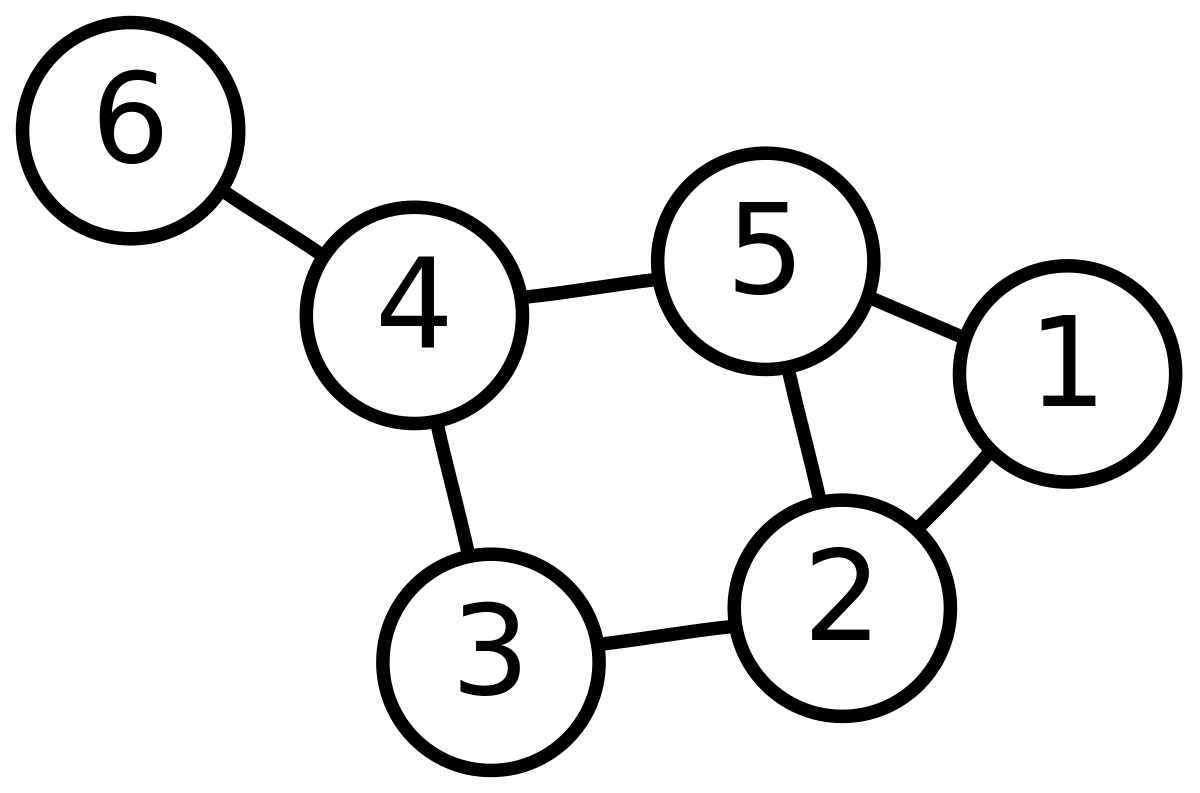
Discrete mathematics is the study of mathematical structures that are fundamentally discrete rather than continuous. In contrast to real numbers that have the property of varying "smoothly", the objects studied in discrete mathematics – such as integers, graphs, and stateme...
azure lichen
it’s a union of infinitely many finite sets
it’s the unions of all “strings” of length 1, 2, 3, …
…it’s nbasically the binary numbers
weary tiger
I think why it's called denoted A^*
it's kind of like
you know
a finite string of length n
azure lichen
- is not a set
azure lichen
yea that makes sense
dense thicket
ohh ok but each natural can be represented as set
weary tiger
$$A^*=\bigcup_{n\in\mathbb N}A^n$$
vital dewBOT
Scientifica:
azure lichen
beat me to it
weary tiger
here $\mathbb N={0,1,2,\dots}$
vital dewBOT
Scientifica:
azure lichen
heresy!
dense thicket
Ok and P_fin(N) ?
azure lichen
finite subsets of ℕ
dense thicket
k
azure lichen
P(N) is the set of all subsets, and the fin indicates finite
dense thicket
also, thats true that |P(N)|=|R|=continuum, right?
weary tiger
y
dense thicket
then P(P(N)) is bigger than continuum?
azure lichen
yea, powerset(X) > X
weary tiger
even in infinte case
weary tiger
y
dense thicket
also if aleph 0 is |N| then aleph1 is continuum?
azure lichen
undecidable
aleph1 is something else
aleph1 is just whatever the second smallest infinity is
but we can’t know whether continuum is the second smallest
for reasons beyond my understanding
dense thicket
and thats an open problem whether there is infinity between |N| and |R|?
dense thicket
k
dense thicket
k
have you ever seen the proof of that being undecidable?
like how does that work
azure lichen
as said, beyond my understanding
it’s just basically… math works out fine either way
weary tiger
advanced set theory
you'll need to pick up a Jech for this one
dunno if he does the proof
here's what I mean by Jech
Set Theory has experienced a rapid development in recent years, with major advances in forcing, inner models, large cardinals and descriptive set theory. The present book covers each of these areas, giving the reader an understanding of the ideas involved. It can be used for ...
one day I'll read it
that's my dream 😍
azure lichen
one of my life goals is staying the heck away from set theory
dense thicket
I wish I understood set theory
weary tiger
no one does
dense thicket
but everyone does better than me
azure lichen
friend of mine decided to do a reading course on axiomatic set theory
and he said I should stay away from it
pain lies that way
weary tiger
beauty lies behind pain :3
dense thicket
btw what do you guys major?
weary tiger
among the few math books that I read from cover to cover: Elements of Set Theory by Herbert B. Enderton
LOVELY
❤
azure lichen
third semester bsc math
weary tiger
gave me orgasm
dense thicket
first here
weary tiger
2nd year masters, majoring in model theory, with applications to dynamics and combinatorics (but I'll try to shift to applications to group theory)
azure lichen
probably gonna drag the bsc out to 8 semesters instead of the usual 6, too many fun things to choose
and I wnana get a broader overview before I start my masters
do more of the “general” classes you know?
there’s too many things
azure lichen
I’m also very interested (but extremely bad) at theoretical physics
so I’m definitely taking classes that help with a deeper understanding of that
weary tiger
like I hate how much general stuff I still don't know
T_T
oh just don't speak about theoretical physics to me lul
gonna be like Kreygasm
azure lichen
diffgeo, functional analysis, I also wanna do sth with group theory (there’s a course for physics masters on group theory and its applications in physics that I’m eyeing)
dense thicket
yeah physics is cool once you understnad it, actually took history of physical sceinces next semester, we'll see if its cool
azure lichen
I had to take some mandatory physics classes
weary tiger
yay group representations are VITAL for physics
azure lichen
which were not really my thing
dense thicket
why is functional analysis a must?
weary tiger
quantum mechanics
azure lichen
cause hilbert spaces are what quantum mechanics breathes, basically
but afaik they also show up in other places
dense thicket
Ive heard its very hard
azure lichen
I saw a poster for a course “mathematical themes in general relativity”, which I’d love to have taken but ofc I’m a few years behind ^^ and they had as prereqs diffgeo I&II and functional analysis I&II
weary tiger
RIP
azure lichen
and idk how you can possibly do those both without doing an extra year
weary tiger
can't
azure lichen
cause each of those courses is 10 credits, and a year is 60
weary tiger
we did those in 1st master year
azure lichen
here they’re both third year bsc courses
weary tiger
I did only one course on functional analysis though
azure lichen
so usually you’d have to pick one or the other
cause you have other things you also have to do
weary tiger
lul F
azure lichen
you have to also do at least seven credits in an applied math core subject
and write a thesis
and go to a seminar
I think that’s about it
weary tiger
tbh doing Riemannian geometry and functional analysis (like
azure lichen
so I think technically you could pull it off but you won’t have time for anything else
azure lichen
better imo to just stick around longer and do a lot of fun stuff
weary tiger
is impressive
azure lichen
I mean I’m amazed at how far I’ve come already
weary tiger
oww
azure lichen
I think I have light shell shock
weary tiger
oof
azure lichen
4h exam on a one year course, almost all or nothing
you could in theory get sth like a 20% bonus thorughout the year
which I more or less had
but everything else came from the exam
weary tiger
RIP
azure lichen
oh I mean I did alright. my worst grade so far but still a respectably high one
I just absolutely sucked at the proofs section
got like 5/20 points there
on a 60 point exam
azure lichen
(one third computations, one third “small proofs” and one third theory from the lecture)
I aced the last bit, got like 2/3s on the computations and the small proofs went horribly
yea and my school’s approach to proofs is a two week intro to logic, proofs and naive set theory and then we just start with the interesting material glhf
(linalg and analysis prof collaborated to get that intro out of the way quickly before starting their actual classes)
oh and let me tell you one thing: cantor-schröder-bernstein is not something you wanna see in week two
azure lichen
I mean I found it alright
I mean the first weeks in analysis and linalg aren’t really very difficult stuff so you have plenty of time to warm up
oh I hear this year’s freshmen got the AoC ⇒ Zorn’s Lemma proof in week two
dense thicket
cantor bernstein is probably the hardest proof ive seen in myu calsses
azure lichen
I think there’s sth of a tradition to put one proof freshmen can’t follow in week two
dense thicket
since I havent seen kuratowski zorn lemma proof
azure lichen
it was kinda funny, in Algebra I (3rd semester) we looked at AoC, Zorn and Well-Ordering and we pretty much just ignored AoC⇒Zorn, and proved Zorn⇒Well-Ordering as homework (Well-Ordering⇒AoC is trivial). then I hear from my friend in first year that they did AoC⇒Zorn ^^
weary tiger
back
oh that's noice
we didn't have any of this stuff lul
I was in a faculty "oriented to applications"
azure lichen
zorn⇒wellorder is kinda nice tbh, so I’d just go do that and then AoC falls out pretty much immediately since you can wellorder and then pick the smallest element in every set
and that’s a choice function
azure lichen
I don’t care for most of algebra but groups and in particular group actions seem really nice
also lie groups
weary tiger
Model Theory + Group Theory= ❤
azure lichen
I wanna learn about lie groups
weary tiger
lie group=differential manifold + group
azure lichen
I know that much
we did a tiiny intro in classical mechanics
just enough to confuse everyone
I’m trying to take methods of mathematical physics II next semester (part I was mandatory, part II isn’t), but idk if I can handle the extra work load
since I’ll be tutoring too
but that’s mostly on lie groups
uncut groveBOT

If you enjoy Michael Rosen videos Please contribute on Patreon so we can continue making more https://patreon.com/invite/wbjmnw or You can browse and buy Mic...
azure lichen
何
weary tiger
noice
azure lichen
but yea I’ll see
if I can handle it great, else I can just drop it
idk how much extra workload tutoring will be
azure lichen
it’s two hours classes + correcting homework
if I end up with a small class, it’ll be fine. if I end up being the most popular tutor somehow I’ll have a problem
(the students can freely change between different TAs)
dense thicket
wait is N^R bigger than continuum?
weary tiger
yes
we proved it earlier
that card N^R=card P(R)
but card P(R)>card R (thx Cantor)
azure lichen
btw why does this channel (along with #foundations) not have a description?
weary tiger
that's what we call discrimination against minorities
azure lichen
yes, I openly discriminate against mods who don’t write channel descriptions :^)
weary tiger
@sudden knot
 sudden knot
hi
weary tiger
hi 😃
azure lichen
or admins I guess if only admins can do that?
sudden knot
u can openly discriminant against me
weary tiger
as he said: "btw why does this channel (along with #foundations) not have a description?"
azure lichen
hi what’s your discriminant
weary tiger
😢
weary tiger
😮
sudden knot
I dunno what to put in it 
weary tiger
t!wiki discrete math
uncut groveBOT
Discrete mathematics is the study of mathematical structures that are fundamentally discrete rather than continuous. In contrast to real numbers that have the property of varying "smoothly", the objects studied in discrete mathematics – such as integers, graphs, and stateme...
weary tiger
t!wiki formal logic
dense thicket
Any help with this one?
I mean if we take chain fron minus infinity to something wouldnt that mean there isnt smallest element?
 pearl basin
Can someone offer some guidance in solving the recurrence relation
T(n) = 10T(n/2) - 16T(n/4) + n
Initial conditions T(1)=1, T(2)=10/3. The textbook gives the hint: For finding a single solution, multiplying your initial guess by c*log_2 (n) may help. (this means nothing to me)
My strategy on easier problems is to make a diagram of the tree of the recursion for a few steps, find the total value on each level of recursion, then find a summation expression for the total value of all the levels of recursion. Usually the top of the sum symbol is log of something. Then if I bring the sum to a closed-form expression and plug it back into the recurrence it works! Then I can plug the initial condition in and solve for the constant.
sour arrow
Let 2ˣ = n. Then,
T(2ˣ) = 10T(2ˣ¯¹) - 16T(2ˣ¯²) + 2ˣ
This is now a linear recurrence. In order to better show it off, let g(x) = T(2ˣ):
g(x) = 10g(x - 1) - 16g(x - 2) + 2ˣ
Can you do that one?
@pearl basin
pearl basin
Yes, I can! That’s brilliant. Though the section of the textbook is about mergesort-like recurrences and doesn’t cover solving them with its characteristic root so I think that’s not what I’m supposed to do.
sour arrow
Hrm. I'm not sure how to go about it then. I'm not up on that.
 shadow dragon
p: Sam had pizza last night.
q: Chris finished her homework.
r: Pat watched the news this morning.
Express, in words, the
statements represented by the following formulas
(p ∧ q) ∨ r
how would you do that one
weary tiger
It's a bit hard to be unambiguous about it.
One or both of the following is true:
- Sam had pizza last night, and Chris finished her homework.
- Pat watched the news this morning.
azure lichen
“Either sam had pizza last night and chris finished her homework, or pat watched the news this morning, or both”
either…or helps with making the scope unambiguous imo
but you have to add an …or both to ensure you don’t mean XOR
slow socket
would the truth table for
p XOR p
be like this
0 1
1 0
?
weary tiger
no, 0 ^ 0 = 0
weary tiger
no, 0 xor 0 is 0
slow socket
why u saying is 0 tho
azure lichen
0 XOR 0 is indeed 0
XOR is defined to be 1 if exactly one of its inputs is 1
if you’re looking for
p q | p?q
0 0 | 1
0 1 | 1
1 0 | 1
1 1 | 0
that would be NAND, also written with ↑
NAND as in “not and”, because it’s equivalent to ¬(p∧q)
slow socket

im asked to verify Modus tollens using truth tables which is [(p -> q) ^ not-q] => not-p
did i do something wrong, cuz is not the same
sour arrow
What you're thinking of is
(p → q) ∧ ¬q ⇔ ¬p
And you're right, you can't prove that because it's not true
Instead
((p → q) ∧ ¬q) → ¬p
Is true if, wherever ((p → q) ∧ ¬q) has a 1, ¬p also has a 1
slow socket
so i can say, is not a tautology?
sour arrow
((p → q) ∧ ¬q) → ¬p
Is a tautology yes
sour arrow
No
((p → q) ∧ ¬q) → ¬p
Being a tautology doesn't mean that
((p → q) ∧ ¬q) and ¬p
have the same truth table
slow socket
it means is always true?
sour arrow
It DOES mean that, whenever ((p → q) ∧ ¬q) is true, then ¬p also is true
slow socket
but is not in my table
sour arrow
Your table isn't done?
sour arrow
You could, and that would give you [1,1,1,1]
Note I didn't say that ((p → q) ∧ ¬q) and ¬p have the same truth table
I said that, whenever ((p → q) ∧ ¬q) is true, then ¬p also is true
¬p can be true when ((p → q) ∧ ¬q) is false
slow socket
sour arrow
Perfect, looks good to me
slow socket
i was thinking that they have to have same values in both
so it doesnt matter if ((p → q) ∧ ¬q) is false and ¬p or
((p → q) ∧ ¬q) is false and ¬p is false
sour arrow
A → B is true, given that when A is true, B is also true
sour arrow
Yus, if you did make it, and you can choose to if you really want to show it off, that column will be true
slow socket
cool, thanks
slow socket
is there any other way to proof this absorption law without using truth tables
[p v (p ^ q)] <=> p
slow socket
too small
slow socket
ya
 near pilot
any ideas? im new to graph theory and my teacher is pretty terrible
i can do part a by showing which edges should be removed on a diagram but idk if there is an algebraic way to do it without using the formula given in part b
 tight marsh
@near pilot You can use fact that tree always have |V| - 1 edges
azure lichen
and of course that any graph with the same vertex set V is contained in the complete graph, so you can actually get that tree with just removing edges
azure lichen
nah, that works for both, if you solve (b) you get (a) for free
near pilot
alright thank you
slow socket
a | b is "NAND" https://cdn.discordapp.com/attachments/238956921581862913/540292656836771871/299175087389802496.png

is there a name for this law?
sour arrow
NAND is "not and"
slow socket
p and (p or q) = p
how does this equal p
weary tiger
equal is sorta like biconditional
p and (p or q) => p
and if we know p, then p and (p or q)
since we've showed both directions of the biconditional, they're equal
slow socket
im confused
weary tiger
Two propositions are equivalent if we can derive the second from the first and the first from the second.
weary tiger
If you can prove the second proposition from the first, and you can prove the first proposition from the second, then they are equivalent.
slow socket
i got
p or (p and q) <=> p
wat i did was use the distributive laws and got
p and (p or q)
and now idk
azure lichen
p and (anything) ⇒ p
for the obvious reason that if you want p and stuff to be true, p must be true
slow socket
ya but i have to prove it
azure lichen
truth table is a proof
azure lichen
what
slow socket
 azure lichen
the heck are “logic laws”, did they just take the logic out of logic
slow socket
lol
azure lichen
man I am glad I never had to go through bullshit like this
a truth table is a valid proof and would take half a minute to write out
azure lichen
so you want to reduce what p and (p or q) ↔ p to 1?
slow socket
so the question is
azure lichen
(I see you make a distinction between ⇔ and \↔, this is a foreign world to me)
slow socket
well the whole question rly is, "Verify the following absorption laws"
p or (p and q) <=> p
p and (p or q) <=> p
<=> means "implies"
azure lichen
no it doesn’t, it means “is equivalent to”
implies is either ⇒ or \→, I don’t understand this “there are two arrows” distinction
I’ve only ever used the double arrows
azure lichen
your amazing table has awfully few things that could be used to reduce the complexity of a statement
slow socket
😦
 west crater
Is this false?
Because it doesn't imply that it was ExP(x) only that it was one of those
azure lichen
this is false, yea. it would have to be and to drop that, not or
- can be true without P(x) ever being true
slow socket
so Sascha u dont know how to do my problem?
azure lichen
if I did I’d have helped you
I could probably figure it out with enough time but I don’t see the value in trying myself sorry
azure lichen
well, early, it’s 9am
six hours eh? that would put you on the atlantic coast of the americas somewhere?
azure lichen
it’s funny how technically you added exactly no new information to my statement and yet you did
slow socket
lol
azure lichen
since “east coast” and “atlantic coast” should be the same thing but the former refers to the east coast of the US
 ashen magnet
hey guys, i've been working on a problem that asks to show ¬((¬p ⇒ ¬q) ∧ (¬q ⇒ p)) is equivalent to ¬p
i can't figure it out, Instead of the equivalence being ¬p i end up with p ∨ T here's what i did. I must be using the wrong approach, overlooking or making a mistake somewhere
vital dewBOT
TendentiousTorturousTopics:
weary tiger
no that's wrong
 sharp raptor
X & true = x
weary tiger
p->q is not equivalent to p and q
p->q is equivalent to not (p and not q)
which is equivalent to (not p or q)
sharp raptor
!p | q == p => q
weary tiger
The standard substitution is $\neg p \vee q$ for $p \implies q$
vital dewBOT
TendentiousTorturousTopics:
ashen magnet
is there any equivalent statement that uses the and operator?? or should i how i approach this problem
change*
sharp raptor
you can use demorgan to turn the or into an and
sharp raptor
for that particular problem
 light path
the truth table for implication is true in 3 possibilities
light path
so you cant just write a single and statement
weary tiger
so therefore p
sharp raptor
keep in mind that
(A | B) & (A | !B) == A
weary tiger
If you rewrite the implications, you get $(\neg p \vee \neg q) \wedge (q \vee \neg p)$
vital dewBOT
TendentiousTorturousTopics:
ashen magnet
i see, my implications were wrong then. i'm going to write it out and see what i come up with
sharp raptor
a=>b
!a | b
!(a & !b)
weary tiger
Your whole expression becomes $\neg((\neg p \vee \neg q) \wedge (q \vee \neg p)) = \neg(p)$ by Nick12's comment
vital dewBOT
TendentiousTorturousTopics:
weary tiger
yeah but it's useless to turn the or into an and if it's stuck inside a negation
vital dewBOT
ixsetf:
weary tiger
hmm are \land and \lor the same as \vee and \wedge?
sharp raptor
lets see
$\vee \land \wedge \lor$
light path
pretty sure yes
vital dewBOT
Nick12:
vital dewBOT
ixsetf:
light path
writing things that way will be easier than trying to use ! => etc
ashen magnet
i reduced the problem to $\ (\neg p \wedge q) \vee (p \wedge \neg q)
i just don't see where to go. The or is messing with me
sharp raptor
$ (\neg p \wedge q) \vee (p \wedge \neg q)$
vital dewBOT
Nick12:
ashen magnet
i see where i messed up
you're right, p has a not
i accidentally gave the second implication's p a not
sharp raptor
have you tried distribution?
ashen magnet
that's what i'm trying now, i see i can try it now that my p has the not it was missing
yup so i get not p and true which i believe is not p, right?
here's what i got then
light path
a good way to check your work is to use a truth table on your first and last steps
if the truth table changes
you changed the meaning of the statement, so you made a mistake somewhere
ashen magnet
I'm not sure i get what you mean. i think the goal was to prove the statement was equivalent to not p without using the table. the final step shows that the statement is indeed equivalent to not p. As such, i'm not sure how there is an error. each step checks out to me after i look it over again
light path
right, I said the truth table is a way to check that your steps are valid
the problem saying not to use the truth table means that you shouldnt use a truth table as a replacement for these steps
using it to check your answer wont matter
ashen magnet
I see. sorry for the confusion
light path
np, gl with your work
ashen magnet
so I have a statement and i want to find the negation. ∀y ∈ Z ∃x ∈ R (x^2 >= y)
I’m thinking ∀y ∈ Z ∃x ∈ R (x^2 < y) but I'm also thinking ∀y ∈ Z ∄x ∈ R (x^2 >= y)
I think it has to be the first one i said because i follows ~(p->q) = p and ~q
Negating statements like these always confuses me. is there any tips or methods on handling these?
sharp raptor
isnt it
∃y ∈ Z ∀x ∈ R (x^2 < y)
iirc
NOT(∀xP(x))↔∃xNOT(P(x))
NOT(∃xP(x))↔∀xNOT(P(x))
 wary salmon
how to prove an irrational number raised to an irrational power can give you a rational number using sqrt(2)^sqrt(2) in a case analysis
tidal minnow
Does anyone have a guideline to becoming a pro in discrete maths?
Didn't pass the exam, so I have 6 months time to get an A
 verbal furnace
Share your exercises.
modest zealot
whats the difference betwene subsets and proper subsets
they seem like the exact same thing...
 ripe cave
Proper subsets of X are subsets of X without the actual set X
modest zealot
could u provide an example? most of the eaxmples ive seen were confusing af
ripe cave
So taka ${0, 1}$
modest zealot
yes
vital dewBOT
Gonzo17:
modest zealot
Mhm
ripe cave
the subsets of this set are $\O, {0}, {1}, {0, 1}$
vital dewBOT
Gonzo17:
ripe cave
The proper subsets are all subsets excluding the actual set ${0, 1}$
vital dewBOT
Gonzo17:
ripe cave
so $\O, {0},{1}$
vital dewBOT
Gonzo17:
ripe cave
Sometimes useful to consider, tbh i haven't seen it a lot
Mostly just making notation shorter
ripe cave
np 
azure lichen
neither. A×B×C creates 3-tuples (a,b,c)
while e.g. (A×B)×C would be a tuple of the form ((a,b), c)
(as in, the elements of those sets)
(have that form)
and since there’s a trivial bijection since all of these we simply don’t care
azure lichen
pretty much
well, it probably ends up mattering with infinite products because there everything goes weird and you suddenly have to mumble “axiom of choice” every time you do something with it
modest zealot
ah okay gotcha
 wanton sable
aren't these just the same thing?
 viral stump
time and space?
no
for example sorting algorithms usually require O(n) space and O(n logn) time
or the easier ones O(n) space and O(n^2) time
where you just swap things around
wanton sable
oh shit its u
👀
thanks jacob tho
i have another question
this is a weird one
V[j][k] gives the number of the last game of the most productive k game stretch
V holds the number of wins christine has had per game in her soccer carreer
basically theyre saying, her latest (call it j) game has had the highest 4 wins in comparison to her j/2 game's highest 4 wins
so, she's at the peak of her career
however they're asking me if she should retire?
it seems pretty obvious that she shouldn't, since her latest 4 games have been her highest scoring games of her career
i don't understand why they're asking such a obvious question  i must be understanding this wrong
wait maybe this is a soccer question
when do soccer players retire
wary salmon
can someone guide me on question c
if L(a) = L(b) then a must equal b even without the union expression
sudden knot
you need the union
the union part allows you to make the deductions that a ≤ b and b ≤ a
or replace ≤ with R
 dusk rain
can someone help me with this proof/give me a starting point?
i think this is supposed to be a proof by contrapositive
sour arrow
Do you know what the contrapositive statement is?
dusk rain
if n is not prime then 2^n -1 is not prime right?
sour arrow
I looked it up. https://math.stackexchange.com/questions/319963/if-2n-1-is-prime-from-some-integer-n-prove-that-n-must-also-be-prime

Mathematics Stack Exchange
I understand the idea of the proof. I just want to make sure I wrote my proof well.
Suppose $n$ is not prime. Then $\exists x,y \in \mathbb{Z}$ such that $n = xy$.
$2^{xy} - 1 = (2^x)^y - 1$
$ =...
dusk rain
oh thanks
 violet heath
slow socket
violet heath
slow socket
lol
 craggy gale
I would say cartesian product tbh
modest zealot
does anyone have time to explain generalized intersections and unions?


 earnest oxide
Display the graph for the following relations:
(a) ρ = { (X, Y ) ∈ A × A | X ∩ Y = ∅ }, where A = P ({1, 2}) could someone explain how i graph a relayion like this
sharp raptor
@wild flame do you still need help?
 wild flame
Yes! @sharp raptor
Mainly to make sure I presented the information properly.
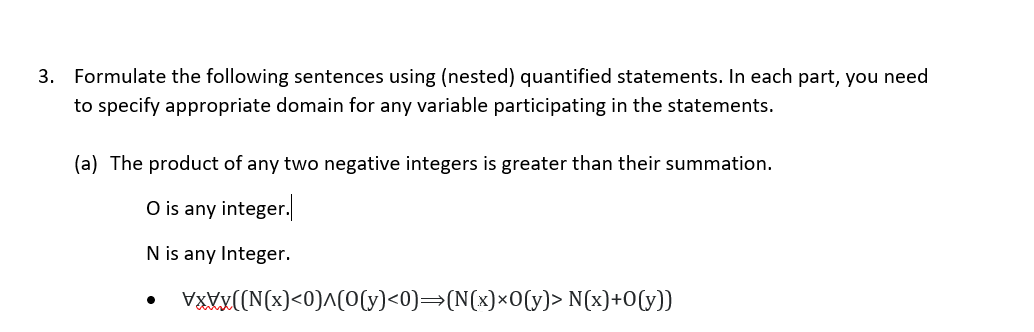
Ws that screenshot the proper way to write my quantified statement? if I' mwrong, don't tell me what the answer is, just tell me why I'm wrong.
sharp raptor
I'm not sure if that's wrong, but afaik a lot of the time quantified vars are presented in an $\exists x \in S$ if S is your set
vital dewBOT
Nick12:
wild flame
file:///C:/Users/mathu/Downloads/Discrete_Math_Long_Assignment_1.pdf