#discrete-math
1 messages · Page 85 of 1
 sour arrow
Density of water:
1000kg = 1m³
1m³ = 261.17 gal, based on google
So
204kg/min × |1m³/1000kg| × |261.17gal/m³|
== 204*261.17/1000
 earnest wigeonBOT
1331967/25000 = 53.27868
sour arrow
@weary tiger
 heavy isle
Hmm shouldn't this go somewhere else... Doesn't seem like a discrete math problem lol
sour arrow
Hah, I guess that's true. Attempt to be more on-topic in the future, @weary tiger
heavy isle
i thought i could go help someone in #discrete-math... my hopes got crushed when i had no idea wtf he was talking about 😂
 verbal furnace
You are gaining experience as a helper.
heavy isle
the thing is that it wasnt a discrete math problem lol
and i dont really stray outside of discrete math
sour arrow
People talk about math I have no idea about all the time
Category theory is fairly popular here and I know none of it
 cerulean tangle
anyone know how to do this probability
Given that exactly one of the dice shows 4, what is the probability that the sum is 7 or 11?
(given two dices are thrown)
 formal coyote
I know how to do it bu i wont:
-model the problem with a proba space
-reformulate that problem in your model using events and that proba
-express those events to prepare a proba calc
-do the proba calc
-interpret the result
 thorn fulcrum
how can u gat 11 with 4 and another dice ?
 burnt osprey

 harsh warren
i’m trying to insert my induction hypothesis into the inductive step claim but i’m stuck here, any help?
 white echo
Multiply your induction hypothesis by 20 and then subtract out what you don't want
harsh warren
i don’t understand
why multiply it by 20?
sorry i think there’s suppose to be a + in between the 4pow(n+1) and 5pow(2n-1)
earnest wigeonBOT
Command disabled
The sever owner has disabled that command in this location.
harsh warren
sorry you really lost me hahaha
white echo
Okay so do you agree that (4-3)4^k = 4^k
harsh warren
yeah
white echo
Now when you expand that you get 4^k+1 -3 * 4^k
That's how you should try get your 4^k+1
For 5^2k-1 you need do do a similar thing except you need to multiply it by 25
So (25-24)(5^2k-1)
harsh warren
wait what do you expand to get 4^k+1 - 3 * 4^k?
white echo
Yeag
That gives us the k+1 wee need
And by our induction hypothesis it's still the original expression hence it's divisible by 21
harsh warren
as in, which expression did you expand to result in 4^k+1 - 3 * 4^k?
white echo
So the expression 4^k + 5^2k-1 = (4-3)*4^k + (25-24)(5^2k-1)
I just split up each part
harsh warren
wait but the expression is 4^k+1 not 4^k
oh god hahaha is there something i’m not seeing
white echo
Now expand out (4-3)*4^k + (25-24)(5^2k-1)
harsh warren
isn’t it just 4^k + 5^2k-1?
harsh warren
16^k - 12^k + 125^2k-1 - 120^2k-1?
white echo
4 * 4^k = 4^k+1
harsh warren
yeah i agree with that expression but what am i suppose to do with that
white echo
So expand out (4-3)*4^k + (25-24)(5^2k-1) and see what you get
harsh warren
i got this 16^k - 12^k + 125^2k-1 - 120^2k-1 ?
white echo
That's not the correct expansion
harsh warren
it’s not????
white echo
4 * 4^k = 4^k+1 not 16^k
3 * 4 ^k is not 12^k
There is no easier way of writing 3 * 4^k
It's just 3 * 4^k
white echo
Almost but 25 * 5^2k-1 = 5 ^2k+1
harsh warren
oh right i’m an idiot
white echo
Now group the 'k' terms and the 'k+1' terms together and notice that that whole expansion is still 4^k + 5^2k-1
Which means that expansion is divisible by 21
harsh warren
i don’t understand why the expression is equivalent to 4^k + 5^2k-1
white echo
Because you just expanded (4-3)*4^k + (25-24) * 5^2k-1
harsh warren
why’d you choose to use the numbers (4-3) and (25-24)?
white echo
Because I know I want 4*4k = 4 ^k+1
But I can't just multiply by 4 without changing the whole thing
So by multiplying by (4-3) I get the 4*4^k
Same story with 25-24
heavy isle
hey guys i was wondering what the current research in graph theory is focusing on?
also what is the best place to find out about the current research being done in mathematics
 fiery pivot
there's a polymath rn on the hadwiger-nelson problem (chromatic number of the plane)
other than that idk about research in graph theory
heavy isle
alright thanks
 thick solstice
The bound just improved recently for that didn't it?
From 4-7 to 5-7
By some biologist XD
 blissful basalt
Hey guys, I have a Discrete Math module next semester for compsci and I was wondering if there are any good books / resources to get started
 primal sun
you will have fun, @blissful basalt !
 stable chasm
Hey guys, i have a question regarding cardinality of sets, can someone help me out?
verbal furnace
Say more.
stable chasm
Okay
soo
Definition about cardinality i read, isn't clicking a bit
We say that two sets A and B have the same cardinality if there is a bijection A -> B
right?
but let's say
We have 2 sets A = {0 , 1, 2} B = {100, 3, 19}
do they have the same cardinality?
verbal furnace
Yes.
 late gust
Well, easiest way is to just form one
stable chasm
but what if it doesn't exist?
late gust
You would have to prove that it doesn't exist
stable chasm
What if there are 2 sets with the same number of elements, but bijection doesn't exist?
verbal furnace
Not possible.
late gust
^what he said
stable chasm
so, if 2 sets have the same number of elements
there must exist a function such that it is surejctive and injective?
late gust
Between the two, yes
 quick karma
Mhm
stable chasm
thanks guys, love u a lot ❤
late gust
you are welcome
stable chasm

late gust
happy christmas or merry holiday or whatever i'm supposed to say now
verbal furnace
You are welcome.
verbal furnace
Hint: geometric sum.
verbal furnace
Try harder.
verbal furnace
Use this: $\sum\limits_{k=0}^nq^k=\frac{1-q^{n+1}}{1-q}$.
 vital dewBOT
 rocky girder
what would q be in this case
 craggy gale
1/2
rocky girder
so q will always be everything that is not the thingy below
craggy gale
what do you mean ?
craggy gale
the index
craggy gale
what is "the other formula" ?
rocky girder
first + last * amount of things/2
but either way
i dont understand what happens here
if n = 0
then it means that it becomes -1?
does that mean that n has to be at least 1?
craggy gale
it's not defined for n=0 here
in standard notations at least
anyway, i think you were talking about that formula
$\sum_{k=0}^nk = \frac {n(n+1)}2$
vital dewBOT
Tuong:
 river plover
join me in voice chat
rocky girder
@craggy gale so n has to be greater than 0
craggy gale
yes
rocky girder
ty
craggy gale
first one looks wrong
craggy gale
looks okay now
rocky girder
i dont get how many n's they want me to try
like should i always try the 3 lowest n's
like in this case n=1
n=2
n=3
rocky girder
yea but like the first step
they want us to check a few n's
but i dont know how many
craggy gale
0, 1, 2 should be enough if you're asked tro check for a few ns
 opal crescent
well not 0 but ye
 desert moss
 sage grotto
Why are you tagging us for that
 magic osprey
!15m
 sage island
ya just ban tbh
sage island
🤷
sour arrow
If they come back with a genuine question, then cool.
sour arrow
@weary tiger
Math
opal crescent
Let $n \in \mathbb{N}, n\geq 2$, you have $6^n = 6^2 * 6^{n-2}$ right?
vital dewBOT
emeric75:
rocky girder
what O.o
opal crescent
but 6^2 = 36 = 9*4
so $6^n = 9\cdot(\underbrace{4\cdot 6^{n-2}}_{\in \mathbb{N}\text{ since }n\geq 2})$
vital dewBOT
emeric75:
rocky girder
yes
6^2 = 36 = 9*4 + 0
thats what i mean
maybe im not understanding you correctly
opal crescent
well here it's a question of proving it for every n >= 2
you wanna list all the cases?
rocky girder
yes i want to show right side = left side
i wrote right and left wrong
lol
left side = right side
opal crescent
that's what i just did 
rocky girder
but your way
is advanced way
like
this is how we do these thingys
i just wrote random numbers
 woeful sigil
Hey
6 = 3 x 2 and 9 = 3 × 3
6^n = 3^n × 2^n
So if n is greater than equal to 2, then 9 divides 6^n
@rocky girder is it clear?
rocky girder
i
opal crescent
j
woeful sigil
k, what's going on?
sour arrow
@rocky girder
Do you understand how
6ⁿ = 9(4×6ⁿ¯²)
rocky girder
no
 somber ember
Discrete math is basically math with clearly separated numbers, it is widely used in computer science
verbal furnace
Cryptography.
somber ember
It's the opposite of continuous math/calculus, where you operate with infinitesimals
When using sums, the math is discrete, when using integrals the math is continuous/calculus
verbal furnace
Partially true.
heavy isle
Hmm you are thinking of finite mathematics @somber ember
Discrete mathematics usually entails a lot more then just that
somber ember
This is how I've been explained what discrete math is, so now I'm kind of unsure
"Discrete mathematics is the study of mathematical structures that are fundamentally discrete rather than continuous. In contrast to real numbers that have the property of varying "smoothly", the objects studied in discrete mathematics – such as integers, graphs, and statements in logic[1] – do not vary smoothly in this way, but have distinct, separated values."
This was the first lines on the Wikipedia page on Discrete math
 pale berry
what's the minimum amount vertices needed such that you can ALWAYS find at least 1 subset of 5 vertices that form a complete graph, or are completely disconnected
quick karma
@pale berry hey emp
The answer would be 1 + whatever the maximum graph size where such a subset cannot be found
So I would guess 17 = (5-1)^2+1
Where an example of a maximal graph at 16 would be 4 fully connected 4 graphs
pale berry
hiya
@quick karma The minimal amount of vertices you need to satisfy the above, but for subsets of 4 vertices is 18 vertices
quick karma
Huh, I'm missing something

Is my first statement correct? That I'm least sure of
No it has to be
What's your thinking?
pale berry
I can rephrase it
we're looking for a graph, where we can always find subgraph of 5 vertices, that is either complete, or whose complement is complete
quick karma
Yeah I think I understand
pale berry
The proof that we need at least 6 to always find a complete subgraph of 3 is:
Suppose a vertex a is adjacent to at least 3 vertices, b, c and d
b can't be connected to c, as that'd mean we'd have complete graph of degree 3 (a,b,c) WTLOG
So b is not adjacent to c and c is not adjacent to d
That leaves one more relation, b and d
quick karma
And C5 shows that in fact it's the minimum. Right
pale berry
C5?
pale berry
🤔
pale berry
that you can find a counter example in a graph of degree 5 indeed shows that 6 is minimal
Because we have to ALWAYS be able to find this 3 way relation
quick karma
Yh
pale berry

An introduction to a beautiful area of combinatorics. More videos at www.youtube.com\randellheyman
Puts it in laymans terms
quick karma
But I'm strugling to think of an example for with 17 vertices for n=4
pale berry
It looks deceiptfully easy
quick karma
Ahah you little bastard
pale berry
uwu
quick karma
So have you got an answer? 😁
pale berry
What would the sum of 2^k * (n choose k) for k=0 to n be?
 normal inlet
im having trouble with solving these and i cant really find anything online that explains it very well
 dapper rose
@pale berry hint: $(1+2)^n$
vital dewBOT
EpicGuy4227:
pale berry
@dapper rose hmmm neat
 sudden brook
Can someone give a logical expression with variables p, q, and r that is true if p and q are false and r is true and is otherwise false.
The solution shows (not p and not q and r)
i'm trying to figure out how they arrived at this answer, thanks for the help
 rare barn
"p is false" is not p
 next valley
^
 radiant bough
cool!
 weary tiger
@sour flax Hi 😃 It'd be preferable to write down your thoughts on the question and what you tried, as I doubt anyone would do the homework in your stead.
 sour flax
Well @weary tiger I did the question successfully!
weary tiger
@sour flax Great!
 fierce willow
Hi guys, preparing for my exam right now but I can't figure out this one simple proof.
Proof by induction that $n^3 \leq 2^n$ for $n \geq 10$.
I have proven the base case for $n=10$, but I'm stuck near the beginning of my induction step.
Assume $k^3 \leq 2^k$ holds true for a $k \geq 10$. Then, $2^k \cdot 2 \geq 2k^3$. From this, $2^{k+1} \geq 2k^3$.
But honestly I'm stuck there 'cause I just can't figure out what to do or where to even look. Other proofs have seemed to work but idk, seems like my head just crashed.
shit accidentally pressed enter, hold up
vital dewBOT
James:
quick karma
You need to expand k^3 and then show that the lower terms aren't greater than k^3
I'm retart
You need to expand (k+1)^3 then ... k^3
weary tiger
what is the negation of n^2>=n^4 n>0
and can the negation be proven with math. induction?
weary tiger
Yes should be true, thx. Where can I find negation rules for the signs
im puzzled why >= beco ms <
sour arrow
They're opposites, in a sense. They have no numbers in common, but each covers all numbers, if that makes any sense
quick karma
@sour arrow @weary tiger actually the negation is n^2 < n^4 for some n > 0
weary tiger
i.e 1 is not possible
quick karma
So the negation is true
Because 2^2 < 2^4
Which is exactly the same as saying that the original statement is false
weary tiger
I just dont get why negation of >= is <
wouldnt it be <= rather?
why does equal go away
quick karma
A<=B is the same as saying A<B or A=B
There's this thing called trichotomy where exactly one of A<B, A=B or A>B holds
So the negation of A<=B is "neither A<B nor A=B"
Which by trichotomy gives us that A>B since the other two cases are ruled out
To be clear, the negation of a statement is a statement that is true exactly when the original is false and vice versa
But A<=B and A>=B can be true at the same time
(When A=B)
So they can't be negations of each other
@weary tiger
 stable wasp
say F1 = a'c'd' + a'bd + acd' and F2 =a'b'c'd' + a'bc'd + a'bcd' + acd
both are simplified boolean function. Is there a way to simplify them both knowing that they will be on the same circuit board? My goal is to simplify the used Gates/IC in a breadboard.
 wanton sable
would anyone know how to find the return value for this?
my understanding is that it might have something to do with logs/exponents
but i'm not sure how to get there
log((4n)^2)^2/4 maybe?
would that be a valid 'return value'
sage island
@wanton sable assuming log base 2 and you're rounding down, yes, assuming integer division so that 3/2 = 1, for example.
sage island
Well may want to be a little careful with i * i / 4 if it equals i * (i / 4) instead of (i * i) / 4
wanton sable
i'm not really sure with the question notation though
is keeping it in the equation format I had okay?
sage island
idk
weary tiger
Why cant x be a subset of C when x is an element of A?
sour arrow
What are C and A?
weary tiger
they are not related at all, excluding than from being a part of a total called U
meaning total U = A+B+C
makes sense?
it can\
For example, $A = {\varnothing}$, $B$ and $C$ are whatever
vital dewBOT
Xaositect:
weary tiger
x is an element of U
that's all info
so x is an element of A and B, but not C. IT is also an element of U
but x is not a proper subset of B here
why?
sour arrow
x isn't a set
You could define a set that contains only x, then that WOULD be a proper subset of B. But that isn't x
weary tiger
But is it so that a set can't be an element of and a propser subset of at the same time?
sour arrow
Careful with your terminology. x is not a set
weary tiger
Disregard that VENN diagram for a second
well
what does an element consist of?
If we say that x is an element of C
and if z is a proper subset of A
z is (2, 4) and A (2 ,4 , 10)
then z is proper subset of A, correct?
sour arrow
Yes. Every element of z is also an element of A
weary tiger
whats the difference between the notations "element of" and "proper subset" then?
sour arrow
A set contains elements.
Let A be a subset of B if every element of A can be found in B
Proper if A ≠ B
Note that subsets are sets. Elements are the things contained in your sets
weary tiger
For example, let $A = {2, 3, 4}$.\
$2$ is an element of $A$, and ${2}$ and ${2, 4}$ are subsets of $A$ (there are 8 subsets in total).\
There is a difference between $2$ (an element) and ${ 2 }$ (a one-element set).
vital dewBOT
Xaositect:
 serene nimbus
Hey guys! Can someone help me with step 2 in this question? ( p => p + 1 )
sage island
tfw using "not greater than or equal to" instead of "less than"
$$2^{n+1}\cdot(n+1)<2^{n+1}\cdot(3n/2)=3\cdot2^n\cdot n$$
vital dewBOT
Simple_Art:
serene nimbus
"!" mean factorial
serene nimbus
exactly
its step 2 that i dont understand
i have i answe but i dont under stand it?
!*
serene nimbus
Oh no, I meant that my teacher gave us an answer to this question but it was fucked up!
Look at what i selected he assumed that ( 2 ^p )* 2! is 3^p
verbal furnace
$2^{n+1}(n+1)!=2(n+1)2^nn!\geq2(n+1)3^n\geq3^{n+1}$.
vital dewBOT
 lean leaf
Is this correct? "If cardinality of A is 0, then A is a null set".
sage island
Well how do you define the null set?
lean leaf
It's an empty set, right?
white echo
They're the same thing
lean leaf
Yes.
white echo
Unless you do measure theory
lean leaf
Hm... not my case.
white echo
But yeah it's correct
lean leaf
Oh, great. Thanks! 
 finite cipher
Hi would someone explain to me about how i should go about doing this? the only information i know is that the symbol over there means 'phi
(a) Construct a truth table for ϕ```you would have columns for P1, P2, not P2, P0
then for P1 implies P2 and P2 implies P1
and the implications together to get the bidirectional
then negate that
then do a column for not P2 disjunct P0
then a column for the conjunction of the bidirectional and the disjunction
finite cipher
@weary tiger so would P1 be like p and P2 be like q respectively?
and P0 would be like r
 cursive flame

This is false since the sum of all degrees of all vertrices in a graph is 2E(edges)
So the sum has to be even not add as the P statement is
Do I have right?
 obtuse minnow
pretty sure that's false.
 viral stump
And Q who knows
obtuse minnow
hold up
viral stump
Maybe they meant Q to be "an arbitrary graph is a tree"
obtuse minnow
oops 😦 didn't catch something. Yeah it's true.
obtuse minnow
If P is always false, the whole statement is true.
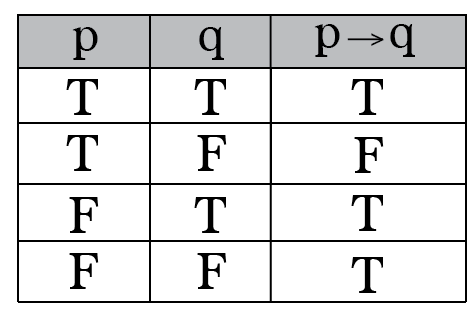
you can just memorize it or ... the way I was told was ... P --> Q is a promise. If P never happens, then the promise wasn't broken.
example: "If one day pigs fly, I'll be happy to buy you a steak dinner."
 obtuse minnow
That works too.
cursive flame
but in this case P is false
obtuse minnow
If P is false. you're looking at the last two rows. And for both p -> q is true.
cursive flame
Yeah I know, ty
obtuse minnow
yar. yw.
cursive flame
I've got another question about induction proof
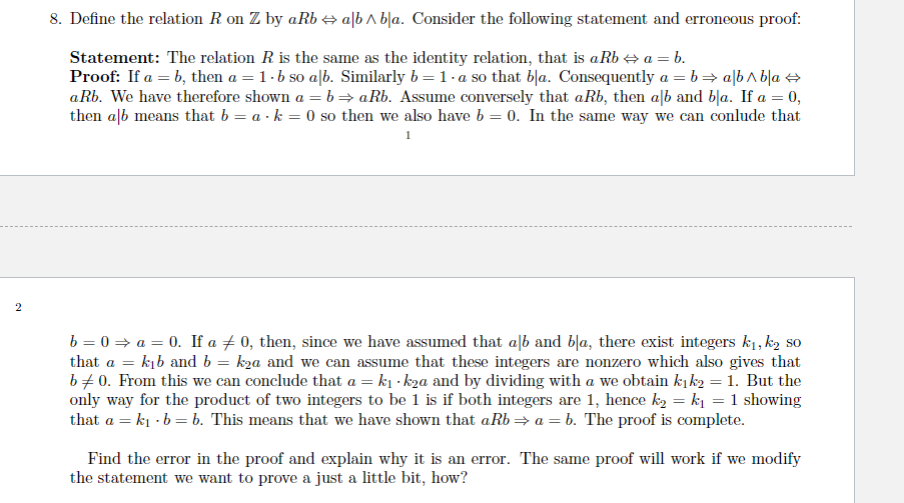
So in this proof, there's an error
I don't know how to do induction proof when it comes to relation
Can someone let me know what the error is in the proof ?
cursive flame
Okay let me try to find it, give me some minutes
If a= 0, then a|b means that b = a · k = 0 so then we also have b= 0.
is it that part?
where B can't be 0 for sure
?
viral stump
No :)
You gotta struggle
Its a very blatant one
If you dont see it go again
More carefully
Reading proofs is an important skill
viral stump
No
Thats what the second part proves
Maybe try to find a counterexample for the claim
So you have an idea of where the mistake must be
cursive flame
Z is all the negative numbers, and when dividing 2 negatives it gives u a positive?
we can't assume a = 0 when it's on Z we are doing the proof for
 sudden knot
there is no division 🤔
I think what salmon said is misleading, or maybe there is mismatch grammar
but ya try to find a counter example
does there exist two integers a,b in Z
such that a|b and b|a
AND
a≠b
cursive flame
first, what is | ?
sudden knot

next valley

next valley
Nope if that's the case b divides a, but a don't divide b
next valley
My hint will be on the identity of k1 and k2
When they talked k1 and k2 are 1. Think from thus sentence and see is that the onpy option for both values k
cursive flame
so k1 and k2 can be -1
next valley
So what that said about a and b
And thus u can find the counterexample of what woog said
cursive flame
a≠b since k1 and k2 can be 1, -1
cursive flame
Thanks
also it says the same proof will work if we change the statement a bit
is that by changing a= b to a≠b
next valley
I would say a = -b or b = -a would be more better than a not equal to b
 narrow escarp
what is \models sign for
 flint kestrel
how do I find a test for the existence of a Hamiltonian Cycle in any reflexive, symmetric graph?
quick karma
exhaustive search, it's NP-complete
flint kestrel
... how stupid
when you think you're getting close and then find out it's NP-complete
 verbal furnace
Since 10a-9b=1 by Bézout's identity, a and b are coprime. By Euclid's lemma a divides c.
Thus true.
@cursive flame ?
cursive flame
I don't got the correct answer, but you probably have right
Can you explain the identity, euclids lemma?
verbal furnace
t!wiki Euclid's lemma.
 uncut groveBOT
cursive flame
uncut groveBOT
cursive flame
Okay I understand euclids lemma, basically if a prime divides 2 integers, then the prime divides first one and prime divides second one
but how did you know that a and b are coprime?
verbal furnace
Use Bézout's identity plus 10 and 9 are coprime.
cursive flame
Alright let me read about Bézout's identity
okay okay, so by knowing that 9 and 11 are 2 coprimes and throyugh bezouts identity it gives us 1, that means gcd(a,b) is also 1 and then we know that a divides b
and eculids lemma says that if a prime divides 2 ints bc in this case they will be divisble as well
cursive flame
Alright thank you so much. I've got another question if you don't bother
verbal furnace
Go ahead.
cursive flame

it says For all non-empty sets A,B, C we have always..
How do you approach these kind of questions?
I know that you should do (x,y) x ∈ A and so on
but that equation seems very long and hard to do it on
I don't know where to start
verbal furnace
$\forall(c, b)\in C\times B, (c, b)\in B\times A \iff c\in B\land b\in A$.
vital dewBOT
verbal furnace
Fix one element like c in C then for all b in B, the couple is in BxA thus all b are in A. Then do the same for c with b fixed.
cursive flame
What do you mean by fix one element like c in C
verbal furnace
$U\times V\subset X\times Y\iff U\subset X\land V\subset Y$.
vital dewBOT
verbal furnace
If you use that then you have proved it.
cursive flame
Alright let me try
serene nimbus
C × B ⊆ B × A <=> C -> B $\subset$ B -> A
vital dewBOT
kanavibes:
vital dewBOT
verbal furnace
Yes.
serene nimbus
But i dont understand it
cuz then i write a truth table i dont get the write answear
Right*
verbal furnace
??
vital dewBOT
$C\times B\subset B\times A\iff (C\subset B\land B\subset A)$.
$C\times B\subseteq B\times A\iff (C\rightarrow B\land B\rightarrow A)$.
vital dewBOT
kanavibes:
serene nimbus
@verbal furnace
verbal furnace
And ?
serene nimbus
is this how to rewrite the left side?
verbal furnace
What is the arrow ?
serene nimbus
arrow is $\subseteq$
vital dewBOT
kanavibes:
weary tiger
guys, how do i do this q when there's a negative
i know how to with positive, but i tried applying the same general formula and got the wrong answer
(changing it to 162 x + (-78y)=12)
im talking about this formula
sour arrow
What's your first solution? @weary tiger
 weak trout
I have a question about the Gentzen System that i posted in questions alpha if anyone can help me I'd appreciate it^^
Also it seems very difficult to find online resources for the topic, maybe it has another name..?
 quiet kraken
{1 ,3 } ⊆ {1,3{1,2} this is true right
 valid heart
Any tips or tricks on how to use Kuratowski's theorem for graphs?
serene nimbus
Hey guys, does someone know how to solve this question?
serene nimbus
@sudden knot
serene nimbus
I need help with the question above...
sudden knot
okay
 light path
too much maths help can lead to dependence, like alcohol its arguably helpful in moderate amounts but in large doses it can be quite harmful
if you ask about every question then when it comes to a test you wont be able to get by without someone to guide you through it
not that theres anything wrong with asking that specific question, but you've been asking about a lot in the past couple days
so I think its worth mentioning
opal crescent
we need this in #❓how-to-get-help #rules 👏🏽 👏🏽 👏🏽
narrow escarp
n different letters form n! permutations
how do wr prove this
i know induction is one way
how else can we do this
what are other ways
sudden knot
@narrow escarp define permutation
narrow escarp
number of arrangements
sudden knot
to me, such a proof would be either induction, or by definition
this depends on the definition
what about number of bijections from a set of n elements to itself
that's a pretty good definition to me
narrow escarp
then again sb asks u to prove that bijection onto itself is n!
i don't see how u can say n! is the definition
induction makes sense, i was just wondering if there were other tricks
sudden knot
there probably are, but they're probably roundabout
induction seems the most natural
light path
An argument could be made that n! is defined inductively, and as a result any proof would need an inductive step.
Of course you could always find an alternate definition, or maybe something else clever to avoid it, but something like that would probably be quite complicated
narrow escarp
oh nice, that sounds like very logical tbh
cursive flame
Is this true or false?:
"lcm(a,b) = ab/gcd(a,b) then this is also true lcm(ax,bx)= x^2lcm(a,b)"
I came to the conclusion false, after doing some test with random ints
also the a,b are positive integers
Can someone confirm that this is false
opal crescent
$$\text{lcm}(ax,bx) = \frac{ax\times bx}{\gcd(ax,bx)} = \frac{x^2ab}{x\gcd(a,b)} = x\frac{ab}{\gcd(a,b)}$$
vital dewBOT
emeric75:
 pearl basin
Can you solve this problem in the same manner as the answer given https://math.stackexchange.com/questions/553690/expected-number-of-steps-in-a-random-walk-with-a-boundary if instead of tails meaning take a step down, it means take two steps down?

Mathematics Stack Exchange
Let's say I am trying to climb a flight of $N$ stairs. Each time I want to take a step, I flip a fair coin. Heads means I take a step up; tails means I take a step down. If I'm at the bottom of the
I think the recurrence relation becomes $$p_n-p_{n-2}=p_{n-2}-p_{n-3}-2$$, but then I don't get the nice telescoping like it does if you only step down one stair, so I'm not sure what to do.
I don't think this is correct, but if instead the recurrence is $$p_n-p_{n-1}=p_{n-1}-p_{n-3}-2$$ then get the answer if I did it correctly 7N^2-3N+2
vital dewBOT
nice_prax:
Compile Error! Click the  reaction for details. (You may edit your message)
light path
quick statement about this problem is that with two steps down/one step up
it will grow exponentially with N
have to sleep soon so cant give a full answer
but keep in mind n+1 is further down
so n+2 is what you should be using instead of n-2
im also not sure why you chose n-3, since I didnt think your version involved a change to the upward direction
the modification also changes the problem less than you are thinking
light path
ill also say I personally find this problem fascinating for some specific reasons
If I remember correctly, you are guaranteed to get an even number for any choice of number of steps, and any number you choose for steps to go back, as long as you choose to go forward by 1 at a time.
Never worked out if it's always even if you can go more than one step forward and a time.
pearl basin
@light path I start with $$p_n=(p_{n-1}+p_{n+2})/2+1$$, and that can be rewritten as $$p_{n+2}-p_n == p_n - p_{n-1} - 2$$ and if you subtract 2 from all of the ns you get $$p_n-p_{n-1}=p_{n-1}-p_{n-3}-2$$
vital dewBOT
nice_prax:
pearl basin
But then I can't take the equations to the base case by substituting the right side of the equation into the left repeatedly, like in that stack overflow where you can bring $$p_n - p_{n-1} = p_1 - p_0 - 2(n - 1)$$
vital dewBOT
nice_prax:
pearl basin
It's also unclear to me what the base case $$p_k$$ is, because both $$p_k$$ and $$p_{k-1}$$ are special cases. The case $$p_k$$ is the same as the 1-step-down problem, and it gives us that $$p_N - p_{N-1} = 2$$, which lets us solve the equation $$pn - p{n-1} = p_1 - p_0 - 2(n - 1)$$. But there's also another special case $$p_{k-1} = (1/2)(p_k + p_{k-2})+1$$ that is different from the other cases, does that screw up the recursion?
vital dewBOT
nice_prax:
pearl basin
Apologies for my inability to use latex
 sick lagoon
Been stuck on this for over a day now. The proof statement is wrong it should be a_n <= 2^(n!)
Have already asked this 2 times here but to no avail so sorry for spamming this will be the last time
 daring linden
@sick lagoon i think your problem is wrong
i've seen this problem before (in engel?) and it uses backward induction
where you suppose $$a_n\geq 2^{n!}$$ for some $$n$$ and prove that $$a_k\geq 2^{k!}$$ for $$1\leq k\leq n$$ - by supposing that the assumption is proved for $$m+1\leq k\leq n$$ and proving it for $$m$$
vital dewBOT
Jazza:
daring linden
woah this isnt mathbot
light path
@pearl basin so tbh the way that I solved both of these problems is different than what is used in the stack exchange post. Since it was late I didn't have time to think about whether the approach used in the stack exchange post would cause problems, but it looks like it does.
The way I used involved labeling the bottom step as step 0, and the step above it 1 etc. I then assign each step a number, call it q_n, so that with each coin flip, the expected value of q_n of the step you are on increases by 1.
For the original problem this gives you $q_n = \frac{q_{n+1}+q_{n-1}}{2} - 1$
vital dewBOT
ixsetf:
light path
So instead of a boundary condition you have a base case
For the sake of getting good results, I'm choosing $q_0=0$.
vital dewBOT
ixsetf:
light path
Well actually you do get a boundary condition for $q_1$, because you can't go below the bottom step, so $q_0=\frac{q_0+q_1}{2}-1$, thus $0=\frac{q_1}{2}-1$, thus $1=\frac{q_1}{2}$, this $q_1=2$.
vital dewBOT
ixsetf:
light path
before calculating the rest, we'll solve for $q_{n+1}$:
$q_n=\frac{q_{n-1}+q_{n+1}}{2}-1$,
$q_n+1=\frac{q_{n-1}+q_{n+1}}{2}$,
$2(q_n+1)=q_{n-1}+q_{n+1}$
$q_{n+1}=2q_n-q_{n-1}+2$, and by shifting $n$ by 1
$q_n=2q_{n-1}-q_{n-2}+2$
vital dewBOT
ixsetf:
light path
thus we have:
$q_2 = 2q_1-q_0+2=2(2)-0+2=6$
$q_3 = 2q_2-q_1+2=2(6)-2+2=12$
vital dewBOT
ixsetf:
light path
note that $q_0 = 0^2+0$, $q_1 = 1^2+1$, $q_2 = 2^2+2$, $q_3 = 3^2+3$
vital dewBOT
ixsetf:
light path
So note that if for $k < n$, $q_k = k^2+k$, then $q_n = 2q_{n-1}-q_{n-2}+2 = 2((n-1)^2+(n-1))-((n-2)^2+(n-2))+2 = 2(n^2-2n+1+n-1) - (n^2-4n+4+n-2) + 2 = 2(n^2-n)-n^2+4n-4-n+2+2 = 2n^2-2n-n^2+4n-4-n+2+2=n^2+n$
vital dewBOT
ixsetf:
light path
This means that $q_n$ is the same as $p_N$ in the original answer, and thus gives the expected value of number of coin flips to reach the $n$th stair.
vital dewBOT
ixsetf:
light path
I have an exam later today so I don't want to spend the time to prove that this isn't a chance occurrence, but the idea is that because for each coin flip the expected value of $q_n$ increases by 1, for any given trial, the expected value of $q_n$ after $k$ flips is $k$, and so you can work out the expected number of coin flips to reach stair $N$ in reverse using the expected value of $q_n$, which is always $q_N$.
vital dewBOT
ixsetf:
light path
This idea can be applied without much change to the case with one up two down.
verbal furnace
More context.
verbal furnace
Mathematical context, it's still not enough (direct sum of what ?).
 slow socket
thats all it is
the chapter, is set operations
these are the sets C = {a,b,y,z} , D = {a, c, k, l, x}
light path
That's not really a standard operation
slow socket
k, what if i have Simga = {a,b}
and i have to find Power set (Sigma)
do i put the empty string?
is it = { λ, {a}, {b}, {a.b}, {b,a}}
or u dont put empty string?
weary tiger
What do strings have to do with set theory?
I think what you're trying to say is empty set ∅ or {}
slow socket
oh so the power set(sigma) has 4 subsets?
cuz 2^n?
2^2
so is {{a}, {b}, {a.b}, {b,a}}
weary tiger
And 𝒫({a, b}) = {{}, {a}, {b}, {a, b}} because sets don't care about the order you put things in.
slow socket
oh, i thought empty set was when u only have numbers
 tame yew
Is anyone here
pearl basin
@light path Thanks! I did it and the equation seems to be the disgusting -(2 z)/((-1 + z)^2 (-1 + z + z^2))
light path
Are you sure thats right? something about that looks a bit off to me.
primarily the function would tend toward 0 as z tends to infinity
pearl basin
that would be correct, this is nonsense
I get the sequence 0 ,2 ,6 ,14 ,28 ,52 ,92 ,158 ,266 ,442 ,728 ,1192 ,1944 ,3162 ,5134 ,8326 ,13492 ,21852 ,35380 ,57270 ,92690 ,150002 ,242736 ,392784 ,635568 ,1028402 ,1664022 ,2692478 ,4356556 ,7049092 ,11405708 ,18454862 ,29860634 ,48315562 ,78176264 ,126491896 ,204668232 ,331160202 ,535828510
light path
that looks about right to me tbh
I can confirm the first 4 are right
the formula you sent me looks different than the sequence
how did you calculate it?
pearl basin
I plugged it into WolframAlpha and that's what it said
I don't know anything about generating functions unfortunately, and this sequence isn't anything I recognize, so I think I have hit the end
light path
how did you get that out of wolfram?
if you want I can also give you a specific method you can use to calculate terms in that sequence
pearl basin
I got the sequence with a python script
light path
ah nice
pearl basin
def f(n):
if (n==0):
return 0
else:
x = max(n-3, 0)
return (2*f(n-1)-f(x)+2)
for i in range(40):
print(f(i),",",end='',flush=True)
BRB class
light path
ok gl
 west crater
q∨(p∧¬q)∨¬p≡(q∨p)∧(¬q∨¬p) do you guys know what law is being applied here?
or laws*
im not sure how they changed the (p∧¬q) to an or statement
sudden brook
how do you guys remember all the laws anyway? do you just keep practicing or have another tip
weary tiger
Anyone good at sets mind helping me out at "questions-n" ?
slow socket
Can someone help me with this question
 fresh oak
Wow nice handwriting
slow socket
Lol
slow socket
How do i find the image of a piecewise function?
sour arrow
The images of each piece
slow socket
Im confused on wat it means by the image
sour arrow
Same thing as the range, if you know what that is
sour arrow
Like, how does interval notation work?
sour arrow
Yes, you can write it in interval notation. Maybe want to throw it up? Use it as an example?
slow socket
so i can just write it like that?
slow socket
Ya is real numbers
sour arrow
That's the codomain, not the image
slow socket
codomain is real numbers?
 somber ermine
can anynone explain how cifras work, julio cesar, english and portuguese?
light path
I have no idea what that question means
 worthy mist
maybe "can anyone explain how ciphers work, julius cesar (referring to the cesar cipher probably?), english and portuguese" ¯_(ツ)_/¯
stable chasm
Hey guys, so i was learning summations, and i came across a proof that i can't quite understand
Can you someone help me clarify it?
 cedar stone
@stable chasm, which part don't you understand?
stable chasm
first, why do we multiply it by r?
And also, one more question
Here, in the definition, why did they write |x| < 1, and not x=0 ?
cedar stone
@somber ermine, Caesar cipher is the simplest encryption. It simply shifts the alphabets some numbers down the alphabet list either to the left or right. So, if you choose a shift of 3 to the right, A becomes D, B becomes E, ...., Z becomes C. So, under Caesar cipher, "hey" is encrypted as "khb" with a shift of 3 to the right.
stable chasm
@cedar stone ?
cedar stone
It's just algebraic manipulation during the proof to get what you want. As long as it is valid, you can do that. Similar idea to how you would add construction lines in geometric proofs.
cedar stone
Well, if you can write a statement in an alternate equivalent form and it will help you prove it, why not? 😅
stable chasm
Oh, so you're saying it's just a guess "let me try if it works" ?
cedar stone
Some proofs are not straight forward like that.
You will see them yourselves after you see more proofs.
stable chasm
but when he gets to the "removing k = n + 1 term and adding k = 0 term"
opal crescent
but yeah when you're not used to it 😄
cedar stone
Ah, it's a nice trick too.
stable chasm
cedar stone
In this section we will formally define an infinite series. We will also give many of the basic facts, properties and ways we can use to manipulate a series. We will also briefly discuss how to determine if an infinite series will converge or diverge (a more in depth discus...
stable chasm
why does he subtract "a" here?
stable chasm
I know about index shift
but the screenshot i sent u is not clear to me
isn't the last term just ar^n+1 ?
why -a ?
opal crescent
$$\sum_{k=1}^{n+1}ar^k = -a+a+\left(\sum_{k=1}^{n+1}ar^k\right)$$
vital dewBOT
emeric75:
opal crescent
you're reincorporating the k=0 term into the sum
(ar^0 = a)
so
$$\sum_{k=1}^{n+1}ar^k = -a+\left(\sum_{\mathbf{k=0}}^{n+1}ar^k\right)$$
vital dewBOT
emeric75:
cedar stone
^^^
cedar stone
In that step, you are adding k = 0 term to summation and removing k = n + 1 term from summation. To keep the statement remains the same, you add their negations.
stable chasm
aghhh i feel so frustrated 😢
opal crescent
honestly it's just a cheap trick
it's literally adding 0
(but adding 0 in a way which allows us to rewrite our sum)
cedar stone
Since for k = 0, you have a and for k = n + 1, you have ar^(n + 1), when you add k = 0 term to summation, you remove a using -a and when you remove k = n - 1 term from summation, you add ar^(n + 1) so that it doesn't change to original statement.
okay
stable chasm
thanx a lot guys




 stable chasm
yeah
vital dewBOT
emeric75:
opal crescent
this notation hides a limit
$$\sum_{k=0}^{+\infty}x^k := \lim_{n\to + \infty} \sum_{k=0}^n x^k$$
vital dewBOT
emeric75:
opal crescent
just the limit of the partial sums as n approaches infinity basically
so now we can use the formula we just showed to start evaluating the limit
$$\sum_{k=0}^{+\infty}x^k = \lim_{n\to + \infty} \frac{x^{n+1}-1}{r-1}$$
vital dewBOT
emeric75:
opal crescent
(assuming r different from 1 ofc)
if r=1, it clearly diverges (from 2nd part of the formula)
so now the fact that the expression diverges or not depends only on that x^(n+1) term
for $x \leq 1$ you can show that $\lim_{n\to\infty}x^n$ doesn't exist
vital dewBOT
emeric75:
opal crescent
and for $x>1$ you can show that $\lim_{n\to\infty}x^n = +\infty$
vital dewBOT
emeric75:
opal crescent
(ie for those two cases the limit diverges)
but for $|x|<1$, $\lim_{n\to\infty} x^n = 0$
vital dewBOT
emeric75:
opal crescent
intuitively that limit seems pretty obvious, if you multiply a number less than 1 by itself a lot of times, it will become very very close to 0
stable chasm
yes
opal crescent
ie, |x|<1 is the only case for which the infinite sum converges
stable chasm
but how is |x| < 1, and x = 0 different?
isn't 0 the only value for x such that |x| < 1 ?
opal crescent
(x is a real number)
cedar stone
^^^
opal crescent
(yeah they should have said that)
cedar stone
in calculus, unless otherwise noted, they r talking about real number unless u r doing complex analysis.
opal crescent
👌
cedar stone
In Number Theory, unless otherwise noted, they are talking about non-negative integers.
stable chasm
oh, thank you a lot
stable chasm
@opal crescent dude, how is -3 mod 10 = 7 ?
 glad oriole
7=10x1-3
 dull obsidian
For a mod c, where a < 0, the answer is a + kc, where k is in the naturtal set and a + kc is like the minimum greater than 0. Which essentially means, you add c to a, until it's greater than 0. In your case, a is -3, c is 10, and k would be 1.
glad oriole
one other viewpoint is that 7+3=0 (mod 10) so just like in our usual numbers we label 7 as -3
magic osprey
numbers by a difference of n under mod n are equal by that mod
7 - 10 = -3
mod(7,10) = mod(-3,10)
sage island
somber ermine
any can explain the functions sigma and tao?
glad oriole
in what context?
somber ermine
i dunno, teacher didnt gave examples
glad oriole
well those letters denote a lot of different things in math so without knowing the context no one can help
somber ermine
nr of divisors of 1 number and some of divisres of 1 number i guess
somber ermine
how to use them
glad oriole
well you'd just apply them ig? I don't think i get what you mean
 west moon
there are many theorems by the chinese. which one?
viral stump
most likely means CRT
viral stump
is it bipartite matching
wiki has an article
In graph theory, a branch of mathematics and computer science, the Chinese postman problem (CPP), postman tour or route inspection problem is to find a shortest closed path or circuit that visits every edge of an (connected) undirected graph. When the graph has an Eulerian c...
somber ermine
i would like an example but i cant find any
viral stump
?
Enjoy the videos and music you love, upload original content, and share it all with friends, family, and the world on YouTube.
 heady sedge
if I had a set of {a,b,c,d,e,f,g} and I wanted to know how many permutations are there that contain {b,g,e} in that order how do i calculate that?
dapper rose
do they have to be next to each other?
weary tiger
oof
dapper rose
treat {b,g,e} as a single element then
weary tiger
hello i need help with discrete math
the question is:
look for positive integers that are not the sum of the cubes of nine different positive integers
verbal furnace
Not clear, there are 2, 3, 4, 5, 6, 7, 10, ... (not 1, 8, 9, ...)
weary tiger
oh hey we meet again :>
but i think the teacher told us to code a program out of it
so.. uhh..
verbal furnace
Hello again, did you change your nickname ?
weary tiger
it was me! the guy who needed help with lstms
weary tiger
can i have more examples?
verbal furnace
You can generate some of them by hand like 1, 8, 1+8, 27, 27+1, 27+8, 27+8+1, ...
weary tiger
so
1, 8, 9, 27 are "sum of the cubes of nine different positive integers"?
im not good with english you see
verbal furnace
The small ones are good.
 ripe cave
I mean, the smallest number which is a sum of 9 distinct positive cubes is $1^3+2^3+\ldots +9^3$
vital dewBOT
Gonzo17:
ripe cave
Unless you meant sum of up to 9 cubes
ripe cave
No, that's just the smallest one
weary tiger
ahh i see
ripe cave
$1^3+2^3+4^3+5^3+6^3+7^3+9^3+11^3+1019^3$ is also a sum of 9 cubes
vital dewBOT
Gonzo17:
weary tiger
wellp
looks like i have to find a way to turn this into code
i have another question
look for positive integers greater than 79 that are not the sum of the fourth powers of 18 positive integers
sooo
$1^4+2^4+\ldots+18^4$
kinda like that?
vital dewBOT
Pana:
verbal furnace
Then I can write it as sum of repetitive 1^4 (or others).
weary tiger
yep
@verbal furnace i tried doing a pseudocode
but i'd like to see how you would code it
verbal furnace
Try the code, no pseudo (you can't test).
weary tiger
this is a fail im sure
im just using a calculator to do my math
and i have no idea what im doing
weary tiger
im so not done
verbal furnace
If $n=\sum_{k=1}^ma_k^3$ with $a_k<a_{k+1}$.
vital dewBOT
verbal furnace
What is the smallest candidate ?
weary tiger
2025
verbal furnace
Yes.
weary tiger
#include <stdio.h>
#include <stdbool.h>
#include <math.h>

bool isTrue(int remaining, int lastnum, int pos){
    if(pos == 9 || remaining < 0){
        return false;
    }

    else if(pos == 8 && remaining == 0){
        return true;
    }

    else{
        for(int i = lastnum; i >= 9-(pos+1); i--){
            if(isTrue(remaining-pow(lastnum,3), i-1, pos+1)){
                return true;
            }
        }
    }
}

bool startCheck(int remaining){
    for(int i = cbrt(remaining); i >= 9; i--){
        if(isTrue(remaining-pow(i,3), i-1, 0)){
            return true;
        }
    }

    return false;
}

int main()
{
    for(int i = 1; i < 10000; i++){
        if(startCheck(i)){
            printf("%d, ", i);
        }
    }

    return 0;
}
@verbal furnace heh
but im not doing that 2nd one
i wanna sleep
its 11:32pm
verbal furnace
The language C doesn't have the type bool.
verbal furnace
#include <stdio.h>
#include <stdlib.h>

int check(int n, int d, int level)
{
    int d3 = d * d * d, r;
    if(n == d3 && level <= 0)
        return 0;
    if(n <= d3)
        return -1; // false
    n -= d3;
    d++;
    while(d <= n) {
        r = check(n, d, level - 1);
        if(r == 0)
            return 0;
        else if(r < 0)
            break;
        d++;
    }
    return 1;
}

int main(int argc, char *argv[])
{
    int n = atoi(argv[1]);
    if(check(n, 0, 9))
        printf("Valid\n");
    else
        printf("Not valid\n");
    return 0;
}
```.There is still room to improve the quality.
 wintry apex
yeet
slow socket
dull obsidian
solid resource to start learning: https://trevtutor.com/discretemath/

Welcome to the main Discrete Mathematics page. To go to a specific course, please click on the one of the links under the Discrete Mathematics tab above. No calculators required for this course! He…
 steady axle
Does simplifying a proposition need to follow order of operations?
Asking to shut a friend up
sour arrow
@steady axle
No such thing as order of operations at that level. There are axioms and rules that show how algebraic simplification is done