#discrete-math
1 messages · Page 25 of 1
 jolly ledge
 vapid drift
omg this is good for practice
jolly ledge
yeah, I found it handy back when I first learnt this stuff
good for checking work definitely
vapid drift
ok i will try do do the second part by myself. one last question what does this mena again ↔
jolly ledge
it means if and only if
in other words
A if and only if B, means that A implies B, and B implies A
it's different from just asserting that A implies B
for example
A is a square implies that it also is a rectangle
but A being a rectangle doesn't necessarily imply that it is a square
but when it comes to <->, it means that it must be true both ways round
vapid drift
so if c is true and (a and b) is true would the if and only if mean T. and if c is false and (a and b) is false then if and only if is true and if c is false and (a and b) is true then the if and only if is false?
vapid drift
jolly ledge
it means if and only if
Are you a teacher?
jolly ledge
vapid drift
so if c is true and (a and b) is true would the if and only if mean T. and if c ...
yep.
 vapid drift
jolly ledge
nope <:kek:751611348340965386>
vapid drift
jolly ledge
nope <:kek:751611348340965386>
You seriously need to become some sort of dgd or tutorial TA. no one explained this to me as fast and as good as you. This is actually crazy
jolly ledge
thanks for the complements, but I ain't rlly at that level yet  would consider being one as I gain more experience. Hope you have a nice day, and GL with those qns
vapid drift
Thank you !!!
 ivory badge
Constructivists in shambles
jolly ledge

ivory badge
((A->0)->0)->A moment
*This is LEM, but you can get A->((A->0)->0) without it
Namely, function application
and that’s A-> - - A
jolly ledge
Geez I'm cracking UP SO BADD RN 
 🤡
🤡
ivory badge
insanely funny
 unique dove
I'm at structures, is a structure a specific type of set or are they separate
 coral parcel
"Structure" is a word with a lot of barely related meanings.
Thus a lot more context is necessary to even understand what you're asking.
 odd garden
Can anyone help me in logistic proofs?

Can the thing in blue considered as “q”?
Because this makes it simpler
 coral parcel
odd garden
Can the thing in blue considered as “q”?
coral parcel
odd garden
Can the thing in blue considered as “q”?
Um, can you find even one single truth assignment where the thing you have circled in true has the same truth value of q?
odd garden
This is not my section’s work
My professor didn’t even send assignments
I’m justbpraxticing
To prepare before
odd garden
<@&286206848099549185>
coral parcel
Hmm, perhaps you didn't see that I responded to your question. I'll repeat it in case Discord is acting up:
Can you find even one single truth assignment where the thing you have circled in true has the same truth value of q?
odd garden
I already told you this is a previous exam
coral parcel
What does that information have to do with what I aksed you?
Can you find even one single truth assignment where the thing you have circled in true has the same truth value of q?
odd garden
I don’t get it
coral parcel
You asked whether (¬p or ¬q) and ¬q can be replaced with q. That must be because you think they have the same truth value. I'm asking you whether you have tried pugging in even one single truth assignment for p and q to check whether your assumption holds in practice.
odd garden
These are laws we follow I don’t think you have to plug in
coral parcel
Do me a favor and try a single choice of values to see whether what you ask is true is even in one single case actually true.
I don't care which choice of truth values you try. But try one.
Tell me which truth assignment you tried and which value you got for (¬p or ¬q) and ¬q and which truth value you got for q. Are they they same?
coral parcel
Apologies, @odd garden. It suddnely strikes me that you might be asking whether you can let (¬p or ¬q) and ¬q be the formula that is called q in some completely different, generally phrased rule?
odd garden
yes she replaced (¬p or ¬q) and ¬q by q
by she i mean my proffesor
not p or q is equivalent to p -> q
coral parcel
Are you talking about the "or directly" sidebar?
That starts by replacing (¬p or ¬q) and ¬q by ¬q --- not by q.
 odd garden
coral parcel
Are you talking about the "or directly" sidebar?
odd garden
coral parcel
Are you talking about the "or directly" sidebar?
Yes
coral parcel
The blue circled thing does not become q. It becomes ¬q.
odd garden
Okay I’m with you
coral parcel
After that, ¬q or p becomes q -> p.
odd garden
So all the “not” inside are removed?
coral parcel
No.
The truth value of (¬p or ¬q) and ¬q is always the same as the truth value of ¬q. Therefore you can replace one with the other.
odd garden
But if you go backwards it doesn’t get the same answer
coral parcel
I don't know how that is equationally justified in whichever (unknown-to-me) system you're using, but it is easy to check with a truth table.
What do you mean by "go backwards"?
odd garden
Like start from q->p
And go on backwards
You will not get back to the blue circled thing
coral parcel
If we accept that the truth value of (¬p or ¬q) and ¬qis always the same as the truth value of ¬q.
Then we must also accept that the truth value of ¬q is always the same as the truth value of (¬p or ¬q) and ¬q.
You can replace one with the other, or the other with one. Both replacements preserve meaning.
odd garden
You know what this course is weird that’s not maths😐
 iron marsh
@odd garden humor me for a second. If you think this isn't math, then what do you consider math to be?
 chilly dew
I’m trying to prove the existence and uniqueness of the transitive reduction of a finite directed acyclic graph
(the transitive reduction of a graph is a graph with the same nodes but a minimal number of edges such that the reachability relation on nodes is the same)
I know in algebra the usual way to prove the existence of some minimal structure is to take the intersection of all objects that satisfy the condition
But I am not sure if graphs G and H (with the same nodes) have the same reachability condition then their intersection does too
I think the answer is most likely no too
I mean heck what am I saying of course the transitive closure exists (either it is the graph or something smaller, the graph is finite so you can just check exhaustively)
The question is how to show uniqueness for direct acyclic graphs
 stray reef
iron marsh
<@324563364359438337> humor me for a second. If you think this isn't math, then ...
stray reef
iron marsh
<@324563364359438337> humor me for a second. If you think this isn't math, then ...
when numbers go brr, obviously.
theyre the kind of person to say "i was good at math until the alphabet came in" unironically
jolly ledge
 devout coral
hey, i need help regarding de-bruijn graphs:
how many k length circuits are there in the de-bruijn graph B(t,n) where n>=1, k>=n,t>=2
the circuits are not necessarily simple
every calculation I can think of is counting twice (or more) some cycles
 cunning mason
*Let S be a set equipped with one or several methods for producing elements of S from other elements of S. A subset X of S is said to be closed under these methods, if, when all input elements are in X, then all possible results are also in X. Sometimes, one say also that X has the closure property. *
^ That is from wikipedia
But when talking about relations and closures, S and X would be relations right?
S could be a relation "equipped" with symmetricity, e.g from (x,y) you can produce (y,x)
and X is closed under symmetry if for any (x,y) in X, then (y,x) in X
is that correct?
 brave rock
No
They are referring to functions specifically.
An example of what they mean is as follows: consider S to be the natural numbers, and its only 'method' will be addition of natural numbers. An example of a subset X closed under this operation is the set of even natural numbers.
We don't usually consider relations to be an example of this kind of thing.
cunning mason
ok
what does this mean?
"As every intersection of reflexive relations is reflexive, this defines a closure. "

i know what is a reflexive closure but i dont understand that sentence
brave rock
This "closure" is not referring to the "closed" that wikipedia was.
This is, as is so often the case, an informal word not being used for a precise meaning.
coral parcel
stray reef
theyre the kind of person to say "i was good at math until the alphabet came in"...
Be nice. We can do without calling anyone "the kind of person [whatever]" to their face.
stray reef
was not exactly a "to their face" moment but point taken
 ember obsidian
the set
$$\bigcap_{S\supset R\text{ reflexive}}S$$
can be used to define the reflexive closure of $R$, in the sense that its the smallest reflexive relation containing $R$, and proving it uses the fact that an intersection of reflexive relations is reflexive. then we can prove
$$R\cup\brc{(x,x):x\in A}=\bigcap_{S\supset R\text{ reflexive}}S$$
hence both sets define the reflexive closure of $R$
@cunning mason
 vital dewBOT
eigenglome
 odd garden
iron marsh
<@324563364359438337> humor me for a second. If you think this isn't math, then ...
odd garden
iron marsh
<@324563364359438337> humor me for a second. If you think this isn't math, then ...
i guess integrals ?
 vital dewBOT
MyFavoriteAccount
 cunning mason
because even for irrational numbers, x-x is rational
brave rock
That's true for any equivalence relation
It's not clear to me what you mean to say there.
For what it's worth, the equivalence classes of S are not easy to describe in a satisfying way.
cunning mason
brave rock
For what it's worth, the equivalence classes of S are not easy to describe in a ...
how would you describe them?
ember obsidian
boytjie said its hard to describe them in a way thats meaningfully different from just saying the definition
cunning mason
is there an equivalence class for each irrational number? And one equivalence class for all rationals?
brave rock
No, there is not a unique equivalence class for each irrational number
for example pi and pi+1 are in the same class. In fact, this holds for both relations.
There is indeed a single equivalence class that contains the rationals
cunning mason
then i have no idea what the answer to "what are the equivalence classes" should be like
brave rock
I'm inclined to agree.
Here's a more precise substitute that you may find helpful in the first exercise:
For the relation $R$ (not $S$) find a set $X \subseteq \bR$ such that every equivalence class of $R$ is of the form $[x]_R$ for \emph{exactly one} element $x \in X$.
vital dewBOT
Boytjie (never-to-be-glomed)
 brave rock
This ought to lead you to a more satisfying description of what the equivalence classes of R are.
cunning mason
brave rock
For the relation $R$ (not $S$) find a set $X \subseteq \bR$ such that every equi...
but R is not even a equivalence relation
4 - 2 is natural but 2 - 4 isnt so its not symmetric
cunning mason
ok
cunning mason
brave rock
For the relation $R$ (not $S$) find a set $X \subseteq \bR$ such that every equi...
what does this mean? That every equivalence class of R has just one element?
brave rock
I wish you'd asked this earlier if there was confusion!
Recall that $[x]_R$ is defined as $\build{y \in \bR}{x R y}$.
vital dewBOT
Boytjie (never-to-be-glomed)
 brave rock
This is NOT saying that every equivalence class of R has only one element, not at all.
I am asking you to find a set of so-called 'representatives' for the equivalence classes of R: a choice of element from each one.
cunning mason
for all equivalence classes of R, there is a unique x in X such that [x]_R can represent that equivalence class?
brave rock
That is what I wrote, yes
cunning mason
brave rock
For the relation $R$ (not $S$) find a set $X \subseteq \bR$ such that every equi...
{x \in R : 0 < x <= 1}
for the integer equivalency class, there is [1],
for the [1.25] equivalncy class, there is [0.25]
etc etc
is it correct?
brave rock
That is correct, that is a nice example of a set of representatives
cunning mason
what about for (c)?

for any real number x, [x] is {x/100, x/10, x, 10x, 100x, 1000x...}
brave rock
Try repeating my exercise for the relation T. You may find it trickier.
cunning mason
brave rock
Try repeating my exercise for the relation T. You may find it trickier.
maybe {x \in R : \forall z in Z( |x-10| < |x*10^z - 10|)}
brave rock
Maybe you can give a simpler characterisation of this set
It's not clear to me at a glance what elements are in it.
cunning mason
brave rock
It's not clear to me at a glance what elements are in it.
all real numbers x such that x is closer to 10 than any x*10^z
for example 50 wouldnt be in since 5 is closer to 10
 fossil mural
do you have an example of a number that is in that set?
cunning mason
5
fossil mural
...oh right yeah 5 works
brave rock
OK sure
Another set that I believe works is $(0.1, 1] = \build{x \in \bR}{0.1 < x \leq 1}$

 fossil mural
it isn't
brave rock
So that would've been a nice way to write that set down.
fossil mural
1 isn't in the set because 10 is closer to 10 than 1 is
fossil mural
1.1 isn't in the set because 11 is closer to 10 than 1.1 is
brave rock
Well there is an issue, which is 20/11 and 200/11 are equal distances from 10, so the uniqueness property that I requested is not satisfied. so in fact neither are in the set of representatives, meaning that their class is not represented.
But anyway, if we exclude one of them then the set ought to be (20/11, 200/11].
@cunning mason you may want to look at the discussion here
cunning mason
brave rock
Another set that I believe works is $(0.1, 1] = \build{x \in \bR}{0.1 < x \leq 1...
how did you come up with this?
ivory badge
Well, you can get any element in R by scaling it right?
brave rock
I think of the equivalence class as just moving the decimal point in a number around
we can set the decimal point to be before the first zero in order to get representatives. That would actually be [0.1, 1) but nevermind.
(0.1, 1] is equally good.
brave rock
brave rock
I think of the equivalence class as just moving the decimal point in a number ar...
What I mean by this is that 0.123 T 1.23 T 0.000123 etc
Whoops, T not R.
There are some details here, such as the fact that 1 = 0.9999... but I believe it works out anyway.
Whoops, you also need to worry about negative numbers. Well I won't go into details.
A true set of representatives would be (-1, -0.1] u {0} u [0.1, 1)
 weary tiger
Can someone explain what is the author doing here? (the highlighted section)


 grand totem
cunning mason
is that correct?
grand totem
cunning mason
is that correct?
Bit late but I'd agree with this. The Wikipedia article is very vague with their definition. To make things a bit more precise:
Fix any set $S$. Let's call a pair $(X,y)$ with $X\subseteq S$ and $y\in S$ a \emph{rule}. We say a set $A\subseteq S$ is \emph{closed} w.r.t a rule $(X,y)$ iff $X\subseteq A$ implies $y\in A$.
Now the vague Wikipedia definition of "a set S equipped with methods for producing elements of S from other elements of S" can be seen as equipping our set $S$ with an entire system of rules $R$, i.e. $R$ is a set of rules or equivalently a subset of $ \mathscr{P}(S)\times S$.
Now given such system $(S,R)$ we of course say $A\subseteq S$ is closed if it is closed w.r.t. all rules in $R$. We're interested in the \emph{least} closed subset of $S$. That set is unique (since it's the least one) if it exists. To show that it does exist one can proceed in more than one way, but the simplest one is to take $\bigcap {A\subseteq S\mid A\text{ is closed}}$ (prove that this is the least closed set).
vital dewBOT
Neverbloom
 grand totem
Your example was the closure of relations. To illustrate, fix a set $S$ and a relation $R$ on $S$ and suppose we're interested in the least equivalence relation containing $R$.
Then this is exactly an instance of the phenomenon above. Our background set is $S\times S$ and our rule set is the union of $${(\varnothing,(x,y))\mid x,y\in S \text{ and } xRy},$$ $${(\varnothing,(x,x))\mid x\in S},$$ $${({(x,y)},(y,x))\mid x,y\in S}$$ and $${({(x,y),(y,z)},(x,z))\mid x,y,z\in S}.$$
vital dewBOT
Neverbloom
 grand totem
Sorry for the monologue but I thought it would be worth mentioning since inductive definitions like that are scattered throughout mathematics but outside of computer sciency literature it isn't really addressed on its own, and even there it's mostly folk knowledge you'd find in random papers or texts.
The only reference that is always included when this does get mentioned is a short paper by Aczel "An introduction to inductive definitions" if you're interested in more.
weary tiger
Anyone wanna chat
jolly ledge
#chill or discussion if it's not related to maths/discrete maths in the case of this channel
 orchid idol
does anyone know where to find like a huge set of counting problems with solutions
weary tiger
orchid idol
does anyone know where to find like a huge set of counting problems with solutio...
this https://www.hmmt.org/www/archive/problems or search for the archive of past problems in math contests
i dont remember if they have solutions tho
 median dew
i want to ask a few questions:
question 1: if we place s balls into s-1 buckets V1, V2,...,Vs-1 that are arranged on a cycle, then there is an index j so that for every 1<=k<=s-1 the buckets Vj,Vj+1,...,Vj+k-1. have together at least k+1 balls.
question 2: by pigeonhole principle, we get that for every 3<=l<=n-2, there are two neighbors of x that together with it from a cycle of length l.
question3:prove mental's theorem using induction on n, but remove only a single vertex each time.
does anyone can deal with?
 thorn bay

I don't understand this notation
why is [r] equal to [r - 1/2]?
oh
I understand now
iron marsh
It's just a definition they game for that funky notation
cunning mason
grand totem
Bit late but I'd agree with this. The Wikipedia article is very vague with their...
what is the point of the y in a rule (X,y)?
a subset A of S is closed w.r.t a rule (X,y) iff A being a subset of X implies y is an element of A?
for example the reflexivity rule (X,y), X would contain all reflexivity pairs, but what is the point of the y
grand totem
The elements of X are the ones that "create" y. Think of X as premises and y as the conclusion. So a single rule is an instance of how to create a new element from old ones.
Hence A is closed under that rule iff when all the premises are in A, then so should be the conclusion.
grand totem
cunning mason
for example the reflexivity rule (X,y), X would contain all reflexivity pairs, b...
No, for reflexivity we'd have empty premises (unlike symmetry and transitivity it doesn't have any premises)
So for a single element x, ( ∅, (x,x) ) would be one instance of reflexivity (and then we do that with all x of the set our relation is defined on)
cunning mason
i understand
cunning mason
grand totem
Bit late but I'd agree with this. The Wikipedia article is very vague with their...
what does "system (S,R)" mean?
grand totem
A set S and a set of rules R on S
 odd prism
If I want to prove ZxZ is countably infinite, can I just enumerate Z to show it is countable? I think there’s a theorem where if A and B are countable infinite, AxB is countably infinite?
 little prism
well you should try proving that theorem
otherwise there isnt really a lot to do
proving that ZxZ is countable is essentially the same proof as showing that AxB is countable
stray reef
odd prism
If I want to prove ZxZ is countably infinite, can I just enumerate Z to show it ...
it's not hard to enumerate Z^2 either
 supple herald
Guys how should I map from R to R^2?
brave rock
You can map from R to R^2 in whichever way you like haha
Tell us the actual question at hand
stray reef
supple herald
Guys how should I map from R to R^2?
send every x ∈ R to (420, 69)
vital dewBOT
flebron

 crude shore
Ah, I think the same inclusion-exclusion logic works.
cunning mason
the correct solution says $T={(X,Y)\in A/S\times A/S:\exists x\in X\exists y\in Y(xRy)}$
 vital dewBOT
MyFavoriteAccount
 cunning mason
but isnt this also valid? $T={(X,Y)\in A/S\times A/S:\forall x\in X\forall y\in Y(xRy)}$
vital dewBOT
MyFavoriteAccount
 cunning mason
they'd have to be equal then since its says "unique", or the exercise is invalid
OK, i checked and since R is compatible, those relations are the same thing
weary tiger
Is it possible to know the number of possible hypergraphs with a n of nodes and m edges? Thinking in the adjacency matrix representation I feel like it should be 2^(mn)/(m!n!) But I'm not sure if I'm not double-counting somehow. Maybe there are row permutations equivalent to column permutations. If there are how would I count this?
brave rock
There are 2^n -1 possible edges, since they are just nonempty sets of vertices. A hypergraph with m edges is then simply a choice of m of these edges. So there are (2^n - 1) choose m such hypergraphs.
I hope the definition I had in mind is the one you did too.
@weary tiger see above
coral parcel
Without a clear statement that we're counnting vertex-labeled graphs, I'd say that overcounts isomorphic hypergraphs.
brave rock
True, I didn't think about isomorphism
coral parcel
And it's hard to correct for the overcounting because the amount of overcounting of each isomorphism class depends on how symmetric it is.
weary tiger
brave rock
There are 2^n -1 possible edges, since they are just nonempty sets of vertices. ...
Whatever the function h(n,m) counting the hypergraphs with n nodes and m edges; h(n,m)=h(m,n) because for any hypergraph we can construct it's dual by assuming each edge is a node in the dual and each node is an edge in the dual connecting the edges in the primary.
I wonder if we can at least derive more properties like this
coral parcel
That might get you a multi-hypergraph, e.g. if you start with two vertices joined by a (two-ended) edge.
weary tiger
What would a two-ended edge be?
coral parcel
An ordinary edge.
brave rock
Indeed the definition I had in mind was a 'simple' hypergraph.
Implicitly I also assumed the vertices were labelled, as tropo pointed out earlier.
coral parcel
Or for a less trivial example, there is exactly one simple hypergraph (in Boytjie's sense) with 2 vertices and 3 edges, but several non-isomorphic ones with 3 vertices and 2 edges.
weary tiger
Hmm, that's true. So there are more constraints in the adjacency matrix.
Or maybe I described the dual wrong. Maybe I have to use the incidences as nodes in the dual
I know there is a way to decribe hyper-graphs as standard bipartite graphs where the first partition represents the hyper-nodes and the second one represents the hyper-edges. The connection between partitions would be the incidence
coral parcel
Yeah, but we need to accept multiple edges before the concept is symmetric under interchanging "nodes" for "edges". If we accept two different nodes that are incident to exactly the same edges, then after dualizing you'd have two edges with the same incident nodes.
Or, alternatively, declare that the ordinary K_2 is not a hypergraph.
weary tiger
coral parcel
Or, alternatively, declare that the ordinary K_2 is not a hypergraph.
Is that the only problematic case?
coral parcel
More like the simplest problematic case.
weary tiger
By definition a hyper-graph is V and E where E \subseteq 2^V. So each e \in E is s.t. e \subseteq V. My intuition is that each e could be represented as a bit-set of size |V| so the list of all those bit-sets would be a bit-map of adjacency. Since, at first there is no constraint I could think of the transpose as just another bit-map, but this time the rows would be the edges and the columns would be the vertices. You pointed out the K2 case. It would be the matrix [[1][1]] with transpose [[1 1]], this transpose would be interpreted as one vertex and two equal edges connecting it. So I guess the constraint is that we cannot have two vertices with exactly the same edges connecting them
Can you think about a problematic case that is not within this pattern?
coral parcel
So I guess the constraint is that we cannot have two vertices with exactly the same edges connecting them
Right, if you're willing to make that restriction, you do get a duality between vertices and edges.
 true shore
How is 8g wrong? It’s the same concept as 8b and I got that one right


How is that wrong as well?
 steep creek
true shore
How is 8g wrong? It’s the same concept as 8b and I got that one right
steep creek
true shore
How is 8g wrong? It’s the same concept as 8b and I got that one right
G should be right
true shore
steep creek
G should be right
How abt second picture
steep creek
true shore
How abt second picture
I’d assume it’s right because the relation is defined by (-1,-2) being an element of S
And it meets the conditions of x being greater than or equal to y
true shore
Yeah I just wanted to make sure I wasn’t being tricked
Like if (-1)S(-2) was a trick question or something
But yea I told them it’s rigt they haven’t emailed me back though
I got a 95 without those points
steep creek
-1S -2 is just saying S contains the pair (-1,-2)
true shore
Right
I know
I knew I had either a 100, 97, or an 87
When I got 95 I was like nah something is not right lol
steep creek
true shore
I knew I had either a 100, 97, or an 87
You should ask your professor then
Always worth getting the most points you can
steep creek
Ahh yeah
true shore
Ty buddy
steep creek
Np
true shore
steep creek
Np
They gave me 2 extra points lol I knew I got a 97 on that test
crude shore
Hi folks 🙂 Let P(n) be the set of partitions of a positive integer n. Is there a nice relation between P(n) and P(n+1)?
vital dewBOT
flebron
There's this relation at least: If $P_k(n)$ is the set of partitions of $n$ into $k$ numbers, then to create $P_k(n)$ we can take $P_{k-1}(n-1)$ and append $\{1\}$ to each partition, and then take $P_k(n-k)$ and add $1$ to each number in each partition. The union of these two sets is $P_k(n)$.
 crude shore
Got what I needed 🙂 Specifically, the generalization of that statement is: Let $A_k(S) = {s + (k,) \mid s \in S}$ be a function that appends $k$ at the end of every partition in a set $S$. Let $P_i(n)$ be the set of partitions of $n$ that use parts of size at least $i$. Then we have $P(n)$, the partition number of $n$, is $P_1(n)$. Furthermore, we have $P_i(n) = {(n)} \sqcup \bigsqcup_{j = i}^{\lfloor \frac{n}{2} \rfloor} A_j(P_j(n - j))$.
vital dewBOT
flebron
 odd garden

can someone explain proof by contraposition in like fortnite terms

i don't understand the thing in black
i understood why we used n=2k but after i'm lost
 vale cairn
odd garden
vale cairn
odd garden
If you don't survive til the last 5, then you don't win the fortnite game. So if you did win the game, you did survive til the last 5
If you play fortnite all day long, then you won't sleep. So if somebody sleeps well, then they aren't playing fortnite all day lol
 cedar spindle
yo fortnite is pretty good
 brazen epoch
I want to understand the summation and do you know any resource that will be helpful and here is an example problem i do not understand

 pure hearth
brazen epoch
I want to understand the summation and do you know any resource that will be hel...
pure hearth
brazen epoch
I want to understand the summation and do you know any resource that will be hel...
also answer to your problem


 opaque sage

can anyone help me with this one
it is combination with repetition but I forgot how to do this

 faint copper
Hi, is this permutation even ? if so why?
Is there a proper definition for it?
 stray reef
faint copper
Hi, is this permutation even ? if so why?
Is there a proper definition for it?
stray reef
faint copper
Hi, is this permutation even ? if so why?
Is there a proper definition for it?
what definition(s) have you seen for the parity of a permutation, and what makes them all improper?
faint copper
If the number of inversions in a permutation is even, the permutation is considered even in parity. If the number of inversions is odd, the permutation is considered odd in parity.
Then the permutaiton in the example is even.
stray reef
faint copper
If the number of inversions in a permutation is even, the permutation is conside...
... you didn't answer my question of "what makes this definition you saw improper", and also i am pretty sure you're wrong about this permutation being even. how many inversions does it have?
i count seven inversions:
(1,2)
(1,3)
(1,4)
(1,5)
(3,4)
(3,5)
(4,5)
which makes this an odd permutation
faint copper
hmm, but I thought an Inversion is a pair elements a,b in the set so that :
a < b and σ(a) > σ(b).
With (1,2), 1 < 2 but not 2 > 5.
Also I don't know how to answer your second question, I am sorry
So if write down σ as a set :
σ =: {(1,2), (2,5), (3,4), (4,3), (5,1)}
I count :
(1,5),(2,3),(2,4),(2,5),(3,4),(3,5),(4,5) also odd inversions, so it is odd 
coral parcel
Looks like Ann was stating inversions by listing the σ(b) and σ(a) rather than the a and b. So her (1,2) inversion is the same as your (1,5).
(When you have the permutation written out as cycles, as here, it is easier to see the parity by looking at detect the length of the cycles, than to go all the way to the definition of inversion. We know in general that a 3-cycle is an even permutation and a 2-cycle is odd, so their product is an odd permutation).
faint copper
I understand now, I probably got tunnel vision and was looking only into the definition , so thank you guys 
vale cairn
The "right" answer is wrong because if you plug in p false and q true you should get true
I agree with yours
jolly ledge
yee


 chilly dew
am I the only one who doesn't see why Backus-Naur form deserves it's own name
it's like, the most reasonable and obvious way to write a production rule
Oh I guess the usage of | is pretty handy
little prism
well how would you want to refer it when talking someone without being able to say a name
chilly dew
refer to what
a particular rule?
I would just say "you can turn any occurence of a substring X into the string Y"
or literally write down X -> Y
little prism
like imagine talking to someone who wants you to build something and you arent sure what exactly they mean. wouldnt it be handy to just be able to tell them "write down what you mean exactly using the BNF" and then for the other person to know what you are talking about and giving you exactly what you want
instead of using some other notation and then having to explain the notatin they are using and so on
chilly dew
I guess it is a standardization, but like for two symbols lol
little prism
are we talking about the same thing? that seems like an incredible oversimplification
coral parcel
I think perhaps "Backus-Naur form" is mainly a way to credit Backus and Naur for the idea (and courage) to use context-free grammars at all to communicate the syntax of an invented language between humans, rather than simply as a theoretical concept for theorizing about the nature of languages in general, and/or analyzing already existing languages.
The particular contributions of the symbols ::= and | and <blah> are not in themselves all that of an intellectual achievement, but you need some hook to hang the name on.
chilly dew
Ah that would make sense
little prism
there are lots of things in math that were born from not very amazing ideas. but its good that they have names. also you cant overstate how much of your thinking now was formed by the way stuff is taught that back then was not known and had to be invented. stuff that is obvious now was far from obvious back then
chilly dew
Yeah, my original motivation to the question was “why did two guys slap their name on this thing that doesn’t really add any additional value to the theory”
little prism
I can't speak for this particular example but most stuff in math is named by someone else
"those people did that thing first, lets call that thing after these people"
coral parcel
Neither of them named the notation themself.
chilly dew
Good on them
 timber barn
Which one is statement and which one is statement function?
 coral parcel
I'd guess that a "statement function" in your context just means a formula that contains a variable that is not bound within the formula itself.
coral parcel
If my interpretation is right, then the exercise wants you to be familiar with the fact that "P(2,n)" isn't true or false until we have decided what "n" means -- but "forall n P(2,n)" does have a truth value that doesn't require us to know an n in advance.
(At the level where you're being asked this, you're most likely not supposed to notice that both of them are really meaningless until we have decided what "P" means.)
chilly dew

is the transition function literally a partial function in that it doesn’t specify what to do (i.e. specifies that you halt) for certain (state, symbol) pairs, even possibly pairs where the state is not a final state?
or is calling it a partial function just emphasizing that it is not defined for certain pairs (state, symbol) when state is a final state
But then it would be more appropriate to call it a partial function on the set Q x Gamma
Reading the definition literally would imply that a Turing machine can halt even when it hasn’t reached a final state, and that just seems weird
 opal crescent
chilly dew
is the transition function literally a partial function in that it doesn’t speci...
opal crescent
chilly dew
is the transition function literally a partial function in that it doesn’t speci...
yes
opal crescent
chilly dew
Reading the definition literally would imply that a Turing machine can halt even...
honestly I prefer the term "accepting state" rather than "final state" for this reason
the goal of a turing machine is to accept or reject words
if your machine couldn't halt on non-final/non-accepting states, then (assuming your word triggers a finite execution on the machine) rejection wouldn't even make sense
it wouldn't even exist
@chilly dew
chilly dew
I see
On the other hand certain presentations (like Sipser’s Intro to ToC”) specify a single accept and a single reject state, and the transition function is total (not partial)
I’m sure it’s computationally equivalent, but that’s the easiest way to think about it imo
opal crescent
yeah there's a metric ton of equivalent-ish definitions for TMs
 nocturne ingot
I recently finished my discrete math course, and the whole concept interested me greatly, seeing as it's summer and my university's logic classes are only available in the spring, are there any online resources which do a good job picking up where discrete left off? Many-valued greatly interest me, but the talk of lattices confuses me
 undone karma
What does the <S> means in this context?
 undone karma
It also appears here. Checked the preliminaries but there is no mention 

 pale epoch
usually this notation is used for generating set
if S is a set of vertices that would be the graph containing S as vertices and edges being all the edges of the original graph that only connect vertices in S
but im just guessing here
 manic ice
whats the topic that you guys have studied that is the hardest? for me i'd say simplex method/big m but what do you all think
 sour oak

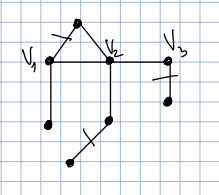
Why is this wrong? v1 and v2 are on a cycle
v(g) >= 3
G is connected
but isn't v3 a cut vertex?
weary tiger
I know nothing about Graph theory but I want to know wdym by overdetermined set of simultaneous eqs? 
sour oak
sour oak
https://i.imgur.com/wCOKBRk.png
https://i.imgur.com/RCXMR5U.png
OK i think i realize the issue here
he uses "any" to mean "all"
I think
 pastel tulip
weary tiger
I know nothing about Graph theory but I want to know wdym by overdetermined set ...
pastel tulip
weary tiger
I know nothing about Graph theory but I want to know wdym by overdetermined set ...
if you have n eqs and m < n unknowns it is overdetermined. there is no guarantee a solution exists
iron marsh
sour oak
https://i.imgur.com/wCOKBRk.png
https://i.imgur.com/RCXMR5U.png
What are cut vertices?
sour oak
iron marsh
What are cut vertices?

but I'm fairly certain he means "all" when he says "any"
weary tiger
pastel tulip
if you have n eqs and m < n unknowns it is overdetermined. there is no guarantee...
uh yeah I see
iron marsh
@sour oak if I am understanding it correctly, the I don't think your example picture was a counter at all
p.s. all and any do not have a similar enough meaning to aasume that.
iron marsh
sour oak
https://i.imgur.com/wCOKBRk.png
https://i.imgur.com/RCXMR5U.png
To make sure I understand it right, what is your disconnector in this set?
sour oak
iron marsh
To make sure I understand it right, what is your disconnector in this set?
v2<->v3
or
if we're talking about the cut
then just v3
iron marsh
So what you claim to be the disconnector of G i s v2, v3 and the edge that connects the two?
sour oak
well the theorem is about cut vertices, so the vertex-disconnector is just v3
iron marsh
My point is is that the things you cut, don't actually satisfy that c(G-X)>c(G), so it doesn't really apply here
sour oak
they do
imagine cutting v3
now you have the connected component v1, v2, and all the unnamed
and the one on the far right
all alone
that's a component in and of itself
sour oak
why not?
sour oak
sour oak
https://i.imgur.com/wCOKBRk.png
https://i.imgur.com/RCXMR5U.png
this has 1 connected component
after removing, there's 2
iron marsh
.....oh, I thought the count was referring to the number of edges and vertices
This makes more sense
sour oak
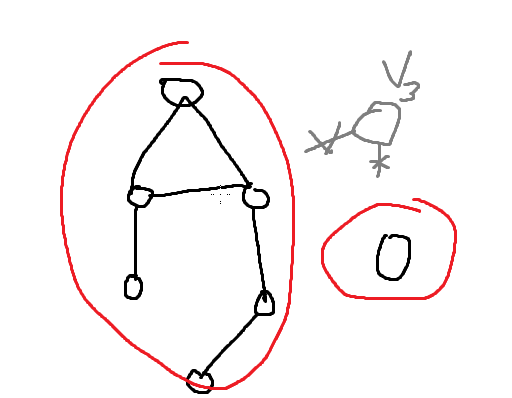 iron marsh
Sorry about that, I got a little confused
sour oak
it's ok, his language is confusing I think
iron marsh
So to clarify, what exactly do we mean by a connected component?
sour oak
also annoyingly he uses \nu for something and v(g) for the number of vertices in a graph
iron marsh
I think I got it, but I wanna make sure
sour oak
"In graph theory, a component of an undirected graph is a connected subgraph that is not part of any larger connected subgraph"(from wikipedia)
basically if u can get from a to b its part of the component
iron marsh
So they are basically parts of the graph that are disconnected from each other?
 iron marsh
Okay I'm with you. So yeah the wording is a little funky, but for "any two vertices of G, there is a two cycle," that means pick any two random (distinct) vertices, and there is always a two cycle between then
I'm with it now
sour oak
sour oak
https://i.imgur.com/wCOKBRk.png
https://i.imgur.com/RCXMR5U.png
what he meant is that all distinct (u,v) lie on a cycle
yeah
that's what I figured
then it makes sense too
iron marsh
sour oak
so here are 3 components
Don't worry, I got it now
That is an interesting claim. Have you tried to prove it yet?
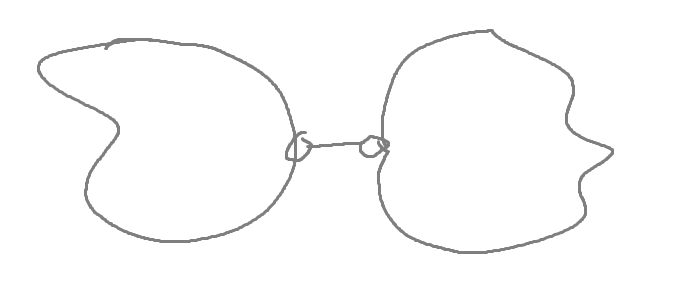 iron marsh
A cut-vertex , would just be a removed vertex right?
sour oak
sour oak
https://i.imgur.com/m2AzVCr.png
so u see it has to look like this
and there can't be an edge between the two blobs(the other part of the graph)
 sour oak
i mean that's just the same thing
it's just that either the left or the right enter the blob
iron marsh
two edges+one vertex and one edge+two vertices seem a bit different, and possibly a noteworthy distinction
sour oak
it is not different, your two edges have a connection somewhere in the blob
i just put it in the blob
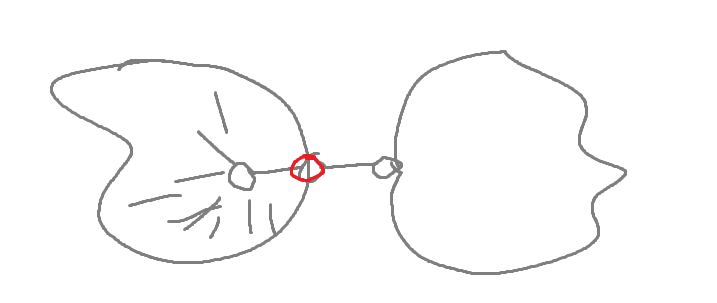 iron marsh
sour oak
it is not different, your two edges have a connection somewhere in the blob
iron marsh
sour oak
it is not different, your two edges have a connection somewhere in the blob
why?
sour oak
you just drew this
i put the one you put in "the middle"
in red
the ones on the left(or right) just go into the blob
it's the same thing basically
iron marsh
Okay sure
sour oak
sour oak
https://i.imgur.com/m2AzVCr.png
so anyways if this isn't the case(there is no cut), then there must be an edge like so:
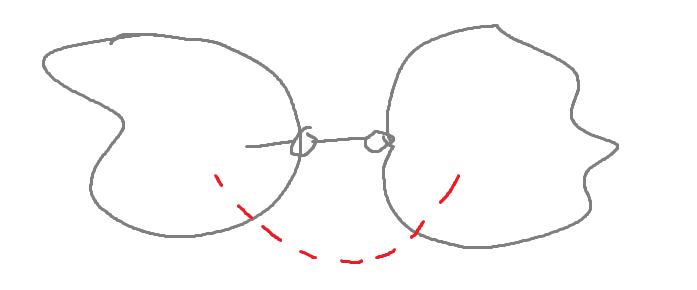
so that's one direction
no cut => there must be such an edge => there is a cycle
iron marsh
I can't say I understand your argumetn
sour oak
sour oak
https://i.imgur.com/wCOKBRk.png
https://i.imgur.com/RCXMR5U.png
the claim is
A connected graph(>3) has no cut vertices <=> all (u,v) have a cycle
sour oak
sour oak
https://i.imgur.com/sxOCIji.png
if there is no cut, then there has to be an edge between the two blobs
which means that there is a cycle for all (u,v)
iron marsh
I see the idea, how would you go about this if there were more than 2 components?
sour oak
the graph is connected so there is 1 component
iron marsh
nvm
sour oak
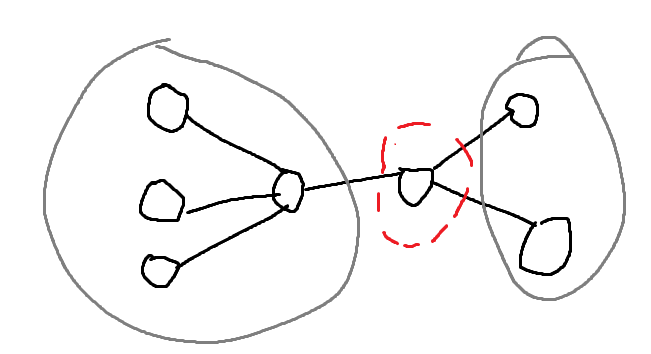
this is how a cut looks like
(in red)
so if there is no cut
there has to be something like this
iron marsh
I understand
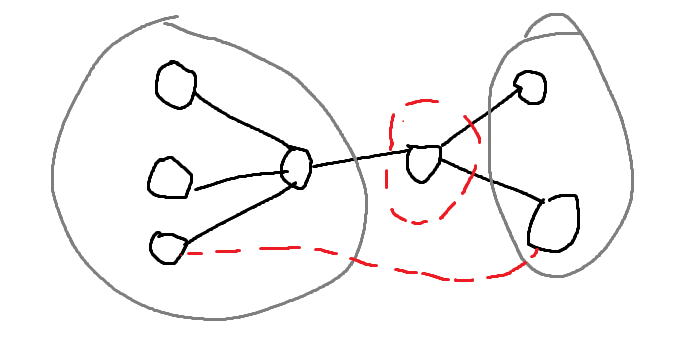 iron marsh
Well, if every (u,v) has a cycle between then, we can view each graph as a collection of sub-cycles. So if we can show this is true for a cycle graph, then it's pretty easy to extend it into the collection
Consider u-v-w be three vertices that connect to each other. And let c_1,c_2,..., c_i be the cycles that (u,v) and (v,w) share. Remove v from the graph. Every c_i has 1 connected component after v is removed. Since v and w are in a cycle, v and w are still connected, so the collection of cycles c_i are all still connected.
We conclude that there are no cut vertices because the graph will always remain connected, no matter what v we remove
There's an even better way to go about this. Assume all (u,v) have a cycle between them in X, and remove a point u_1 from X. Since removing a vertex from a cycle still makes the graph connected every point still connects to every other -> the graph is connected.
You can iron the details, but that idea is definitely more efficient
sour oak
interesting
I think the issue might be that (u, v) can have a cycle like u->v->u
or actually that is not a cycle
sour oak
iron marsh
There's an even better way to go about this. Assume all (u,v) have a cycle betwe...
It has to be insufficient
iron marsh
Not sure what you mean?
I'm trying to show that if we take a connected graph such that all (u,v) are in a cycle (connected is a consequence of this), that even if you remove a vertex, the graph will still be connected, aka no cut vertices.
iron marsh
Absolutely.
sour oak
The proof in the booklet uses induction and all that, so unless he wanted to complicate matters... idk.
iron marsh
Look at individual cycle graphs, call it C_n where n is the number of vertices. If you remove a point on C_n, then that is isomorphic to a path graph
Path graphs are connected.
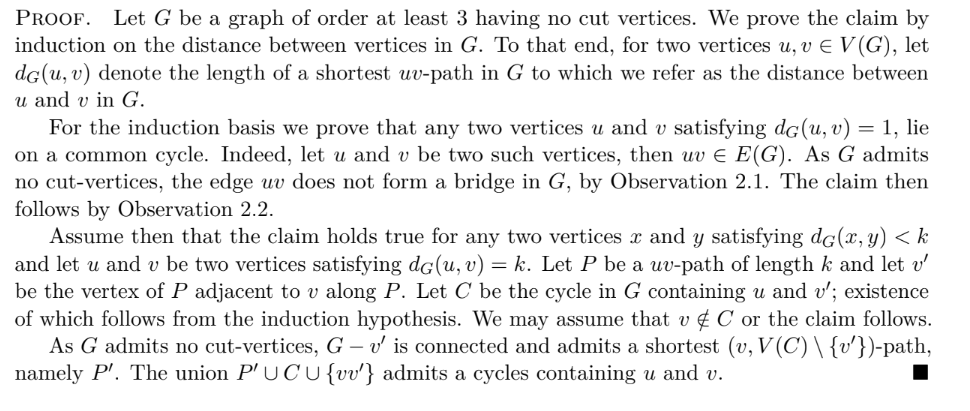
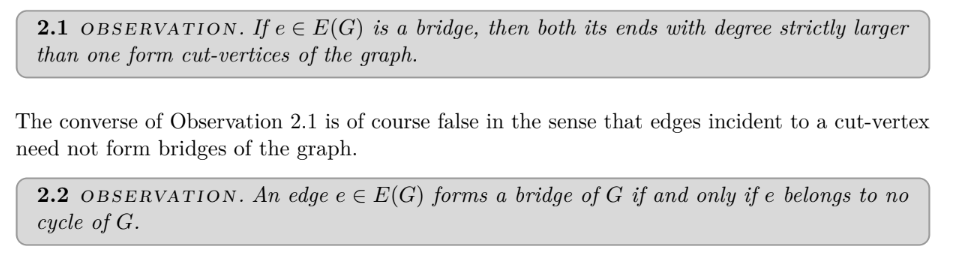 iron marsh
Lovely. Now consider the graph X such that all (u,v) are on a cycle. We know if we remove any vertex, say u_0 for every cycle any points u,v share, there is a path between them (in that cycle), so X\{u_0} is connected
That direction is dond
They may have gone a different way about it, but you don't have to. This way is pretty efficient and it proves exactly what we need to
sour oak
you would agree that any graph with a cut vertex also contains a bridge, and that they overlap?
that is
if (u1, u2) is a bridge, then either u1 is a cut, u2 is a cut, or both in some cases.
hence if there are no bridges... no cuts.
and uh
no cuts -> no bridges
actually that might be incorrect
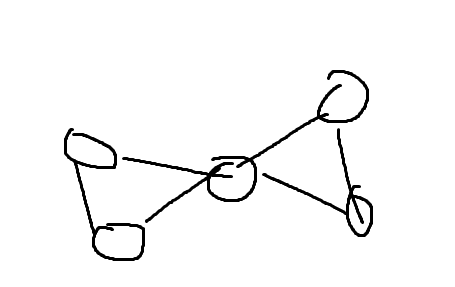
this has a cut vertex, but no bridge.
iron marsh
Not sure what a bridge is to say
sour oak
sour oak
https://i.imgur.com/wCOKBRk.png
https://i.imgur.com/RCXMR5U.png
=>
G has no cut-vertices and at least 3 vertices => assume by contradiction that there are some (u,v) that are not on a common cycle => then there is no back-edge from v to u(even through some other u') =>
- if u has neighbors => u is a cut, since removing it means you cannot get from v to N(v)(neighbors of v)
- if u has no neighbors => v is a cut, since you cannot get from v's neighbors back to u.
=> contradiction to G having no cuts => all(u, v) are in a common cycle
sour oak
iron marsh
Lovely. Now consider the graph X such that all (u,v) are on a cycle. We know if ...
I feel like this is still missing something
iron marsh
Why?
sour oak
Just because there is a path on the cycle doesn't mean all paths are connected, right?
or at least you haven't convinced me of that in the proof
iron marsh
Every two vertices are on a cycle, so every two vertices have a path that connect to them.
sour oak
what if that path was severed by u_0
iron marsh
Since this is true for every two vertices (u,v), the graph must be connected, because a connected graph is one where you can create a path from one vertex to any other
iron marsh
sour oak
what if that path was severed by u_0
Draw a cycle graph and think about why cutting a point doesn't change the fact it is connected
sour oak
I am convinced of this already but the proof seems lacking mathematically
if that makes sense
iron marsh
Short answer, there are two paths between any two distinct points, one with u_0 and one without.
You can formalize the path if you wish.
sour oak
<=
G is has a cycle between all(u,v) => G is connected => if we remove any vertex v, then ?
iron marsh
Then any two points still lie on a cycle in the graph, so there is a path between them that did not contain u_0 (the one we cut) on the cycle
sour oak
that's not necessarily true, what if the only cycle contained u_0?
iron marsh
Yes it is. Draw a dang cycle...
Remove a point.
You can always find a path for two points when (u,v) is excluded
iron marsh
Help me understand what you're not getting please
sour oak
I feel like you're the one not getting me. I'm already convinced by your argument but I feel like if I wrote this proof in a test, for example, I'd get a big fat 0.
Maybe I should just email the prof and see what he says.
iron marsh
Why? It's mathematically sound
You got from point a to point b making no false assumptions, or too many assumptions, and showing all the facts you needed to along the way
This is the basis of a proof. If you do this, you've successfully constructed a proof.
sour oak
Alright.
iron marsh
The argument they gave is over the top and admittedly most of it is completely unnecessary
Which is fine...it's still a proof, just not the most efficient one.
Hell, there may be a better one than what I did, but the one we have is efficient, and I hope it makes sense to you.
 native dragon
sour oak
https://i.imgur.com/6qOQYaO.png
native dragon
sour oak
https://i.imgur.com/6qOQYaO.png
I'm pretty sure that this is a classic proof for whitney's theorem
native dragon
sour oak
=>
G has no cut-vertices and at least 3 vertices => assume by contradiction that...
Also you do realize that even if u, v aren't on a common cycle, there can still be multiple paths from u to v right?
sour oak
native dragon
Also you do realize that even if u, v aren't on a common cycle, there can still ...
Yeah but how is that relevant? Having a path is not enough for there not to be a cut(which is the claim)
native dragon
sour oak
Yeah but how is that relevant? Having a path is not enough for there not to be a...
How is u a cut vertex though
 spark cedar
guys may i ask a question about bfs and dfs
if this channel is not appropriate i can send it from dm
brave rock
It is. In the future I would recommend just asking.
native dragon
spark cedar
guys may i ask a question about bfs and dfs
just ask
spark cedar
Which one is a minimum spanning tree that start from Eskişehir with Breadth First Search algorithm?

i thought it is third one but im not sure i always mix bfs and dfs
there are also distance values between them should i also share it
native dragon
spark cedar
i thought it is third one but im not sure i always mix bfs and dfs
well the third one isn't a tree right? I'm assuming the red edges are the traversed parts
spark cedar
yes red lines mean visited
native dragon

breadth first search means you start from a vertex and visit the verticies closest to it
so the vertex itself, then its neighbors, then neighbors of neighbors, etc
spark cedar
so second one is okay
native dragon
Yeah
 native dragon
spark cedar
what about in dfs
native dragon
spark cedar
what about in dfs
DFS it's sort of like a path where you move to one vertex, and then from that vertex you try to move on to the next vertex
spark cedar
starting from eskisehir
native dragon
I'd say it's the first one
Because it looks like you started from eskisehir and then walked to three other nodes
and then when your path ends
you return to eskisehir and travel the remaining node
spark cedar
yess now i got it
thanks a lot
this topic is related to discrete math right? im sorry if im asking them in a wrong channel
there is also one more term minimum spanning weighted tree, is that mean visiting all nodes with the shortest way
 mossy arch
hey i have a question regarding the wording here

what are all k-tuples with coordinates in {0, 1}, wierd language
opal crescent
it's a binary string with k bits if you want
(x_1, x_2, ..., x_k) with all the x_i's being 0 or 1
@mossy arch
mossy arch
ah
that sounds plausible, so what does that have to do with 'coordinates'
like what is a coordinate
native dragon
mossy arch
hey i have a question regarding the wording here
it's a cube graph
native dragon
mossy arch
that sounds plausible, so what does that have to do with 'coordinates'
the idea that each vertex has a 'name', like for example (0,1) and (1,1)
and you connect each vertex together if their coordinate differs by 1
like (0,1) and (0,0) would be connected
for a k=3 case something like (1,1,1) and (1,0,1) would be connected
mossy arch
but (0,0) and (1,1) are not
native dragon
opal crescent
well hypercube
some sources call it 'cube'
mossy arch
i see thanks
native dragon
mossy arch
but (0,0) and (1,1) are not
no they're not
drawing out the k=3 case you can see why it's called 'cube/hypercube'
mossy arch
it really should not be called a cube if k > 3
thorn bay
I was solving an recurrence relation, I crunched some numbers in python and arrived at a sequence but I can't find a closed form formula
wolfram gives a generating function:

Can I possibly arrive at a closed form solution with this generating function?
iron marsh
native dragon
I'm pretty sure that this is a classic proof for whitney's theorem
Out of curiosity, is there anything wrong with my argument for this?
Short version: For any two distinct points on a cycle, there are exactly two non-intersecting paths (excluding endpoints of course) between them. Therefore, if we remove a vertex, just choose the path without said vertex. For the graph X, every (u,v) has a common cycle, so we can apply the same idea to show there is a path for each one even after removing a vertex.
This was only a proof for the converse btw.
opal crescent
thorn bay
wolfram gives a generating function:
there's a match in OEIS for your sequence https://oeis.org/search?q=4%2C14%2C50%2C178%2C634, the closed form is there
a(n) = a*c^n - b*d^n, a := (5 + sqrt(17))/(2*sqrt(17)), b := (5 - sqrt(17))/(2*sqrt(17)), c := (3 + sqrt(17))/2, d := (3 - sqrt(17))/2.
at least if you want to work it out by hand you can check now
(the OEIS sequence is a little bit shifted compared to yours, starts at 1 instead of 4)
thorn bay
omg thanks a lot
native dragon
iron marsh
Out of curiosity, is there anything wrong with my argument for this?
Short vers...
I mean yeah this is the proof for the converse
the other direction -> if the graph is 2-connected then every (u,v) is in a common cycle is what's trickier
 rose wasp
How would you calculate the number of legal tic-tac-toe states? I can't figure it out
native dragon
btw a graph is 2-connected if the # of vertices you need to delete to disconnect it is at least 2 - hence the same as no cut vertices
native dragon
iron marsh
Out of curiosity, is there anything wrong with my argument for this?
Short vers...
Also I think the formal terminology for paths like these is "internally disjoint"
cause none of the internal vertices intersect
iron marsh
Ah, internally disjoint. That''s definitely better wording, thanks.
 iron marsh
Not a theorem, just the way they defined the edges for V for this particular problem.
 quiet tendon
iron marsh
Not a theorem, just the way they defined the edges for V for this particular pro...
quiet tendon
iron marsh
Not a theorem, just the way they defined the edges for V for this particular pro...
Uhm so it normally doesnt hold?
But i still dont understand why it holds in this case
brave rock
It holds because we defined it that way.
This is like responding to ‘Let a = 2.’ by saying ‘but why does a = 2?’
quiet tendon
brave rock
This is like responding to ‘Let a = 2.’ by saying ‘but why does a = 2?’
But I mean this is like way harder
It may be easy to see for u because u are so knowledgable but I don’t see it
What is so special about this particilar set of vergices
brave rock
quiet tendon
But I mean this is like way harder
No, it's exactly the same.
The vertices alone do not have any edge information.
They are, to repeat, defining what edges exist.
quiet tendon
So what besides the vertices sets makes it to have this property
brave rock
Nothing. Again, they are defining it!
brave rock
Yes
brave rock
Idk how I could make this any clearer. They are defining the graph to have this property.
quiet tendon
My english isn’t that great mb
iron marsh
It's like relations. Usually we are given that xRy if and only if some property of x and y holds.
But that property for x and y is the definition for the relation.
quiet tendon
But thank you guys
iron marsh
But whatever that property is is usually given to us. Not because it was true by some theorem or what not, but because that's what we define to be true.
quiet tendon
Ah i see they give it either like this or in a picture i would assume
 supple geyser
Can someone explain this question to me? I'm very confused
Starting from the recursive definition of set A described below, which element does not belong to this set?
Let A be a set of non-negative integers defined
per:
Base Pitch: 2ЄA, 5ЄA and 8ЄA.
Recursive Step: If xEA and (x+3)EA, then (x+1)ЄA and (x-1)ЄA
The answer must be one of the numbers below:
1
3
4
6
7
iron marsh
Look, at each of the base numbers
2 is in A, 2+3=5 is in A. By the recursive step, 1 and 3 must be in A.
So currently A has 1,2,3,5, and 8
We can continue with the base numbers: both 5 and 5+3=8 are in A, so 4 and 6 are in A.
Technicaly from here, we can do process of elimination since we now know 1,2,3,4,5,6,8
We now know 7 is the problem, but let's try to figure out why. In order to potentially be a new element in A, it must be one number smaller or larger than that element (from the x+1 and x-1).
So let's first check if we can do anything for 6.
Well, 6 is in A...but 9 is not, so we cannot apply the recursive step.
Similarly, 8 is in A, but...11 is not, so we cannot use the recursive step.
We cannot apply the recursive step for 6 or 8, so 7 cannot be in the set.
@supple geyser I hope this was useful to you
jolly ledge
this animation 💀
 weary tiger
bro what the hell bro
quiet tendon
I don't understand this question his method is someone introduced himself to everyone I understood that part but why does that mean his partner will be automatically not introduced to anyone

they aren't introduced together right
oh I think I understand it
quiet tendon
my reasoning is everyone got a different answer so u start with someone being 8 then u know someone has to be 0 and knowing that everyone had a relation with that 8 that dot with no lines becomes 0 if u continue like this someone has to be 7 and someone gets 1 etc.
quiet tendon
why is the amount of edges in a complete graph n choose 2

I understand the other one with the summation of degrees = 2E
brave rock
An edge in K_n corresponds to an unordered pair of vertices
i.e., a choice of two vertices.
brave rock
I mean they are not ordered, so the pair (1,2) and (2,1) are indistinguishable.
This is precisely what n choose 2 counts.
 inner otter
you should also know it is n * (n-1) / 2, since the n vertices connect to each of the other (n - 1) vertices. divide by 2 if it is undirected and there are no loops
quiet tendon
inner otter
you should also know it is n * (n-1) / 2, since the n vertices connect to each o...
ye I understood this one
I know it's equal to nC2
but it's kinda hard to see it from the nC2 part
oh wait I can see it as how many pairs of vertices does there exist too right?
quiet tendon
hey I understand this theorem but it's a bit confusing what A means here I thought it means arrows but that would be incorrect then is it just an arbitary letter?
 native dragon
quiet tendon
hey I understand this theorem but it's a bit confusing what A means here I thoug...
native dragon
quiet tendon
hey I understand this theorem but it's a bit confusing what A means here I thoug...
Isn't |A| just the # of edges?
quiet tendon
oh that might be the case
cuz then u say the degrees of all the in arcs is the number of edges = the number of out arcs which makes sense
and then 2* times the edges = the summation of all the degrees
stray reef
quiet tendon
hey I understand this theorem but it's a bit confusing what A means here I thoug...
A is the set of edges.
by the looks of it.
or i guess arcs since they're directed
that's why it's called A for Arcs
stray reef
native dragon
Isn't |A| just the # of edges?
don't conflate a set with its cardinality
quiet tendon
stray reef
don't conflate a set with its cardinality
but whats the difference by saying it's the cardinality of arcs when u write |A|
native dragon
stray reef
don't conflate a set with its cardinality
oops typo
native dragon
quiet tendon
but whats the difference by saying it's the cardinality of arcs when u write |A|
|A| are how many elements are in A
quiet tendon
stray reef
nothing
are u btw good at doing proofs?
stray reef
you could say that i am, yes.
but why do you need to ask me specifically this specific question?
quiet tendon
I am trying to figure this out
 stray reef
what do you really want? help with a proof problem?
quiet tendon
but it's pretty hard
quiet tendon
stray reef
what do you _really_ want? help with a proof problem?
if u can help me that would be realy nice
stray reef
ok so you're reading through somebody else's proof
quiet tendon
stray reef
ok so you're reading through somebody else's proof
well the question is to proof it
stray reef
- Ignore the proof written in the lower half of the picture. How do I do this question?
- I am reading through the proof written here, but part or all of it doesn't make sense to me.
- I've read and understood the proof here in its entirety. It makes sense to me written out like this, but how could I have come up with it?
- I have something to ask that's not any of the above options, and will now clearly articulate it.
which of these best describes you?
quiet tendon
oh uhm let me see
I think 2. and 3. would hlep me
I don't understand it fully but also how do I come up with it
I was never good at proofs btw

I think he uses this property right

oh wait I tihnk this one
stray reef
ok
then lets first read through the proof carefully step by step
i'll now rearrange it into a neat bullet-pointed list for ease of comprehension
or give my best attempt at doing so
quiet tendon
I do understand some parts tho
stray reef
\begin{enumerate}
\item Assume that $G^{-u}$ and $G^{-v}$ are both trees, and denote their edge sets by $E(G^{-u})$ and $E(G^{-v})$.
\item We have that $|E(G^{-u})| = |E| - d(u)$ and $|E(G^{-v})| = |E| - d(v)$.
\item $G^{-u}$ contains $|V| - 1$ vertices, and is a tree.
\item By point 3, $G^{-u}$ contains $|V|-2$ edges.
\item Points 3 and 4 are also true for $G^{-v}$ verbatim.
\item By points 4 and 5, we have $|E(G^{-u})| = |E(G^{-v})| = |V| - 2$.
\item By points 2 and 6, we have $|E| - d(u) = |E| - d(v)$.
\item By point 7, we have $d(u) = d(v)$, as desired.
\end{enumerate}
vital dewBOT
Ann (glomed)
 stray reef
@quiet tendon please read through this proof and tell me the first line at which you get stuck
quiet tendon
stray reef
ok
quiet tendon
why does that hold?
stray reef
$G^{-u}$ is $G$ with $u$ excised
vital dewBOT
Ann (glomed)
 quiet tendon
ye
stray reef
this means we throw out node $u$ and everything that was connected to it
quiet tendon
but isn't that just G^v?
vital dewBOT
Ann (glomed)
 stray reef
$d(u)$ is the number of edges connected to $u$, and hence the number of edges that get thrown out
vital dewBOT
Ann (glomed)
 stray reef
G is a graph and it has two vertices named u and v yes
G^-u is the result of excising vertex u from graph G
quiet tendon
oh
ahh
so it's saying all the orignial edges
- the edges which belonged to u
and the edges belonging to u are just d(u) because the degrees of it says how many edges were connected to them
oh I think I understand 2 now
stray reef
quiet tendon
and the edges belonging to u are just d(u) because the degrees of it says how ma...
wording kind of sucks, but yes.
quiet tendon
stray reef
wording kind of sucks, but yes.
how do I word it more nicely?
stray reef
d(u) is the number of edges connected to u, so that's how many edges are thrown out.
quiet tendon
oh ye I meant that I think
stray reef
vital dew
**Ann (glomed)**
repeat this instruction
read through this proof and tell me the first line at which you get stuck
quiet tendon
vital dew
**Ann (glomed)**
- shouldn't the vertices be |V| - all the vertices in u
stray reef
it says at the beginning of the problem
quiet tendon
I see
stray reef
Let G = (V,E) be a graph and let u, v ∈ V be two distinct vertices in G.
this unambiguously tells you u and v are in fact individual vertices and not sets thereof.
quiet tendon
ah and if they were sets it would've been said explicitly right?
quiet tendon
vital dew
**Ann (glomed)**
oh I understand it now
but it's just hard for me to come up with these things
stray reef
quiet tendon
ah and if they were sets it would've been said explicitly right?
well, yes... such information is typically given in as clear a fashion as possible
yeah so as for coming up with this
quiet tendon
like how do I get as good as u
stray reef
this particular proof was a counting argument
like, the thing that was crucial to know was that a tree contains one less edge than the number of vertices
quiet tendon
the ones I have seen so far are proof by construction and proof by contradiction
quiet tendon
stray reef
like, the thing that was crucial to know was that a tree contains one less edge ...
well I knew that but it's just sometimes hard to see oh I gotta use it here
stray reef
so perhaps to help yourself come up w/ those better, you could familiarize yourself with some quantitative results
for graph theory specifically
handshake lemma comes to mind
quiet tendon
handshake lemma?
stray reef
sum of all degrees equals twice edge count
stray reef
right
stray reef
i mean i dont have any silver bullets for you
quiet tendon
or theorem
stray reef
its a matter of practice
the more theorems you know (and prove for yourself at least once), the more results you see, the more proofs you read, the better your brain will be at making those connections
stray reef
k
quiet tendon
stray reef
for graph theory specifically
but the thing is these theorems or info that u need are very logical but it's just hard to see like I gotta work to this theorem or smth
stray reef
but if you want to ask me for help then please keep the question itself and your solution and your query separate
so that i dont get confused
quiet tendon
well I tihnk it's just I gotta work to proof this so I think of all the theorems about d(u) and d(v) concercing trees

is that good thinking?
quiet tendon
stray reef
but if you want to ask me for help then please keep _the question itself_ and _y...
ah okay I will do that mb previous time
stray reef
quiet tendon
is that good thinking?
dunno.
giving pointers on how to think about a particular problem post-factum is hard
weary tiger
Is this correct? I have an informal counting based intuition of why it's true but I don't know how to prove it
 quiet tendon
question:

answer:

nodes are vertices btw
I understand the solution
but how do u come up to use contradiction
like how do u see that purely from only knowing the question
brave rock
You don't. Math requires creativity.
quiet tendon
okay but I somehow have to see it right
so say if I give u a set of question can u see what kind of proof u use?
brave rock
If you thought about it for a long time, and tried a lot of different things, maybe you would have thought about this.
brave rock
quiet tendon
so say if I give u a set of question can u see what kind of proof u use?
An experienced mathematician can.
But nobody can solve every possible question.
quiet tendon
so say I give u this

do u go like
okay this question needs contradiction
this needs construction
can u instantly see that?
brave rock
Pretty much, yes.
brave rock
But I have seen all of this before.
quiet tendon
oh for real?
quiet tendon
brave rock
But I have seen all of this before.
are we at the same school?
quiet tendon
brave rock
Pretty much, yes.
and how do u do that
brave rock
quiet tendon
and how do u do that
I think about it, and because I have experience, I realise what the proof is going to look like.
quiet tendon
brave rock
I think about it, and because I have experience, I realise what the proof is goi...
but can u explain your thought process
brave rock
If you want to ask a question, then just ask.
quiet tendon
quiet tendon
I understand the solution
I did
brave rock
But no, I cannot explain how I come up with ideas in general. This is actually a topic of research.
quiet tendon
what does it mean to be a topic of reserach
brave rock
People are actively doing research on how it is that people come up with ideas on how to prove things.
quiet tendon
isn't that just thinking
brave rock
Can you explain how you create thoughts? I think no.
quiet tendon
brave rock
Can you explain how you create thoughts? I think no.
but isn't that using brain
brave rock
OK, then I guess my answer to your question is "I used my brain." Good luck.
quiet tendon
brave rock
OK, then I guess my answer to your question is "I used my brain." Good luck.
no I didn't meant to be like that
I guess that's not what u mean then
quiet tendon
brave rock
OK, then I guess my answer to your question is "I used my brain." Good luck.
can I ask a specific question

 brave rock
Just ask
quiet tendon
for part b
so it's very logical
because if u take 1 path as u are going to v
and returning to u from the other path
u always have an cycle
but is it relay necessary to write all that
brave rock
If that is what your course expects you to do, then yes, it is necessary.
quiet tendon
but I meant like would you write it the same way?
quiet tendon
brave rock
If that is what your course expects you to do, then yes, it is necessary.
as long as the proof is right it's enough
brave rock
quiet tendon
but I meant like would you write it the same way?
Depends on the context. If I were to be explaining it to someone just beginning to learn how to prove things well, then yes I think I would prove it like that. If I were doing it for another reason perhaps I would be less verbose.
quiet tendon
ah okay
well I guess I try to learn it this way then
but it's like so hard to come up with how he wrote by myself
fossil mural
for me at least, i wouldn't immediately see "methods" like contradiction, i would just see the "reason" for why the statement should be true
then once i intuitively understand why the statement is true, i have enough experience writing proofs that i could convert that into a fully written-out argument if i wanted to
quiet tendon
well for me I most of the time would see this is true or not
but to proof it
is a different story
brave rock
If you cannot prove it, then I daresay you don't actually understand why it's true.
So you should try working on that
quiet tendon
oh
I guess that's true

do u know
if I am in this situation
I can choose E H or I right
all of them cost 3
so it shouldn't matter right which I choose
blue ones are permanente
the red ones are temporary
cunning mason
does this relation have a name

or does it represent some property of functions or something
ivory badge
Yep
cunning mason
ok, is it true that f factors through any injective function?
ivory badge
Remember what I said earlier about f(x)=f(y) <- g(x)=g(y)
If g is injective, there’s something you can do with that
*note that the injective g is also R->R, you can’t just take any injection into R of course
brave rock
cunning mason
ok, is it true that f factors through any injective function?
That is indeed true, you can try proving it if you like.
ivory badge
I think we talked some about this yesterday or so?
Though proving this shouldn’t be too hard directly
brave rock
I think MFA has the skills to prove this now, it seems like a good exercise
ivory badge
Indeed, it’s definitely possible with what he could know
cunning mason
is it valid?
 brave rock
Yeah that works, gj
It should be noted that we don't use \mathfrak R for the real numbers, we use \mathbb R.
quiet tendon
hey I tried to do this question

what first came up to me was using contradicition
but why is that not the right choice
oh is it because it's too general, there aren't numbers given for example d(u) >= 2 or smth
and what is meant by components
quiet tendon
stray reef
<@223814276165402625> please read through this proof and tell me the first line ...
I tried to use this strategy but for every proof they are using a different method it looks like
ivory badge
cunning mason
is it valid?
I’ll now suggest going a step further.
Assume f(x)=f(y) -> g(x)=g(y), then prove there is a function h such that g = h o f
cunning mason
ivory badge
I’ll now suggest going a step further.
Assume f(x)=f(y) -> g(x)=g(y), then prov...
is f or g injective?
i didnt fully understand what you were saying yesterday
cunning mason
ok ill try
ivory badge
cunning mason
i didnt fully understand what you were saying yesterday
I definitely had a bit of a rambling train of thought til I cleaned it up
stray reef
quiet tendon
I tried to use this strategy but for every proof they are using a different meth...
what strategy?
ivory badge
cunning mason
ok ill try
Figure it out?
cunning mason
ivory badge
Figure it out?
not yet
is the image of f a subset of the image of g?
isnt h just the identity relation
nvm
ivory badge
cunning mason
is the image of f a subset of the image of g?
No, consider g = constant on 1, f = identity
Buuuut, as a hint in that same vein, ||g^-1(g(x)) contains f^-1(f(x)) [as in, the preimages/fibers/inverse images]||
cunning mason
is it the partition generated by f a refinement of the partition generated by g?
ivory badge
Yeah basically
That’s the implication, after all
Or, to phrase it more suggestively in the direction we’re going, g’s is coarser than f’s
cunning mason
cunning mason
is it the partition generated by f a refinement of the partition generated by g?
what are these partitions called? and from this is it possible to infer that there exists a function h such that g = h \circ f?
ivory badge
cunning mason
what are these partitions called? and from this is it possible to infer that the...
“Partition generated by f” or “equivalence relation generated by f”
And yes, I’m pretty sure it is possible
In fact, there’s a couple different ways you could I believe
 uneven silo
 zinc kettle
problem from my exam:
there are 5 colors A B C D E and a square. We need to color square's corners using these colors. How many distinct ways of coloring there are, considering that a square is considered the same if it's flipped/rotated in some way or its colors differ like this A<->B C<->D
for example: squares $^{AB}{CA},^{CB}{BA},^{BA}{AD}$ are the same but $^{BA}{CA}$ differs
vital dewBOT
ta
 zinc kettle
i dont know the answer but i think some ppl might find it interesting
chilly dew
I came up with the following statement + proof. Does it look good?
Let f, g: S -> S be functions. Consider the following statements:
- There exists an injection
hsuch thatf = h ∘ g. f(x) != f(y)iffg(x) != g(y).- There exists an
hsuch thatf = h ∘ g.
Then it is true that (1) -> (2) and (2) -> (3).
(1) -> (2):
f(x) != f(y) implies that g(x) != g(y) or else f(x) = f(y). Similarly if g(x) != g(y) then f(x) = h(g(x)) != h(g(y)) = f(y) by injectivity.
(2) -> (3):
For each x in im(g) observe that f is constant on the set g^-1(x) by the hypothesis. Thus we can define h: im(g) -> S by sending x to the the single element in the singleton f(g^-1(x)) and clearly f = h ∘ g.
chilly dew
zinc kettle
i dont know the answer but i think some ppl might find it interesting
hints:
- ||do casework on the number of distinct colors in a coloring. the final answer will be
(4c0)*a + (4c1)*b + (4c3)*c + (4c4)*d, wherea, b, c, dare the counts you find for1, 2, 3,and4distinct colors, respectively.|| - ||your cases will have their own subcases, but exploiting symmetry can significantly reduce the overall counting||
chilly dew
chilly dew
I came up with the following statement + proof. Does it look good?
Let `f, g: S...
(Assuming there is no hole in my proof.) I was initially surprised that this was true given that I have never seen it written down anywhere + it is pretty simply stated. But then I realized, no one really cares about if a map factors through another map; usually when we talk about a map factoring through another map the "lifting map" is canonical
ivory badge
chilly dew
(Assuming there is no hole in my proof.) I was initially surprised that this was...
I mean yeah, though whether it factors at all is sometimes useful even if not uniquely, since it can let some things be easier locally
Also, you can get something like
f(x)=f(y)-> g(x)=g(y) as a sufficient condition for some h to exist to factor through
(Not necessarily injective )
chilly dew
ivory badge
Also, you can get something like
f(x)=f(y)-> g(x)=g(y) as a sufficient conditi...
I think you want the other way around but yeah
I realllly wanted a single iff statement but alas
ivory badge
chilly dew
I think you want the other way around but yeah
Nah, since if this implication was false, you most certainly could not get g=hf
ivory badge
chilly dew
I realllly wanted a single iff statement but alas
also g=hf implies the implication hypothesis, so it’s a bit iff-looking
weary tiger
QUESTION:
Where can I find/google the information about a positive integer solution x, y, z to 313(x^3 + y^3) = z^3 ?
https://courses.csail.mit.edu/6.042/spring18/mcs.pdf only mentioned that it has a positive integer solution, and in the solution x, y ,z each have more than 1000 digits.
jolly ledge
,w 313(x^3 + y^3) = z^3
vital dewBOT


 Requested by kiameimon#0
jolly ledge
Requested by kiameimon#0
jolly ledge
,w positive integer solutions for z = cbrt(313) cbrt(x^3 + y^3)
vital dewBOT
 Requested by kiameimon#0
weary tiger
Requested by kiameimon#0
weary tiger
Oh thanks everyone. My online friend googled out here https://math.stackexchange.com/questions/1613119/a-diophantine-equation-with-only-titanic-solutions

Mathematics Stack Exchange
I made a note some time ago that I had read in some book that the equation
$$313(x^3+y^3)=t^3$$
has positive integer solutions, but that these are so large that it would be absolutely hopeless to
zinc kettle
chilly dew
hints:
- ||do casework on the number of distinct colors in a coloring. the final...
in my college we mostly used group theory and burnside lemma to solve this kind of problems. it does involve casework
 wild field
hi guys, I need some help to understand a question, if a set X has 4 elements, how many relations of X are symmetric and unreflexive?
Is It 12?
brave rock
I don't think so, no.
It's not clear, though, if you mean irreflexive, or just not reflexive, as these mean different things. In any case I think you've undercounted a lot!
wild field
brave rock
It's not clear, though, if you mean *ir*reflexive, or just not reflexive, as the...
irreflexive sorry
ivory badge
brave rock
It's not clear, though, if you mean *ir*reflexive, or just not reflexive, as the...
The whole “not x” meaning like “not necessarily x” type naming conventions get me sometimes honestly
brave rock
Me too for sure
chilly dew
zinc kettle
in my college we mostly used group theory and burnside lemma to solve this kind ...
Ah certainly that would be more direct, I figured you were just constructive counting
chilly dew
in the construction at the very end for h, we needed f to be constant on g^-1(x) for it to work, i.e. g(a) = g(b) -> f(a) = f(b)
right? @ivory badge
Oh wait we have our f and g switched lol
sorry for the ping
ivory badge
real
jolly ledge
Complex
 tepid oak
i have a generating function question in help 15 which i am stuck on
 pine canopy
Can someone help me understand what a path-system is?
This is the only explanation
wdym each of its components is a path?
i.e a graph that has multiple connected components? because it doesn't really make sense w/ the theorem
I can't even really think of a graph where d(G) >= n/2 and has 2 separate components?
that has to be impossible
coral parcel
Yes, it must mean connected components.
Note that the theorem doesn't speak about G itself being a path system, but about G[S] being one.
(Where G[S] is probably notation for something like an induced subgraph).
((Edge-induced subgraph, that is)).
pine canopy
hmm
pine canopy
coral parcel
(Where G[S] is probably notation for something like an induced subgraph).
so like without vertices not in its edges
for example
v1-v2-v3
and S = {(v1, v2)}
my graph is
v1-v2 and NOT v1-v2 v3
coral parcel
Yeah -- not that it makes much difference if you view an isolated vertex as a degenerate case of a path.
I wonder if they forgot an assumption about s, such as |S|=s, though.


 pine canopy
coral parcel
I wonder if they forgot an assumption about s, such as |S|=s, though.
pine canopy
coral parcel
I wonder if they forgot an assumption about s, such as |S|=s, though.
oh?
yeah I guess it does make sense, in this case I assumed s=0 but |S| = 4
it still worked out... but maybe it's not sufficient
would it be proper to email my professor to ask about this?
its his notebook...
pine canopy
pine canopy
https://i.imgur.com/c5K0Ek2.png
it still worked however
This theorem seems a bit silly... like you just need so many edges, it is fairly obvious your S will be part of the HC
d(g) >= n/2 is already enough to prove there is a HC
even if you pick |S|=1 , (n+1)/2 means that you need to add at least 1 edge to your graph that already has a HC(which means it visits S)
coral parcel
pine canopy
it still worked however
Consider this, though. The graph has 8 nodes and is 5-regular, but there's no Hamiltonian cycle that includes the red path system.

... despite apparently satisfiying the assumptions of the theorem with s=2.
coral parcel
Or for that matter, this, with n=12, delta(G)=10, s=8, |S|=11.

 neat pasture
yo
can anyone help me with a divide and conquer algorithm
preferably in a dm setting
brave rock
Just ask your question; people who can help will answer.
brave rock
Good luck with that
jolly ledge
 overflow exists
neat pasture
can someone help me draw a DFA
ivory badge
brave rock
Just ask your question; people who can help will answer.
.
Ask questions directly not some weird roundabout asking for help without giving the question
cunning mason

regarding question 5, all the previous exercises are the same for f:A->B and g \circ f :A->C right?
cunning mason
why would there be theorems that apply to the composition of two functions but not to a single function
coral parcel
It's asking for theorems that relates facts about gof to facts about g and/or f.
For example, if f(A)=B and f(B)=C then (gof)(A) = C.
neat pasture
"Draw a DFA for language of binary representations of natural numbers divisable by 2 by not 4. Use at most 5 states and the empty string, 0, 1, 00, 100, etc should be rejected"