#point-set-topology
1 messages · Page 180 of 1
 native raptor
i'm tryna prove that the stereographic projection is a riemannian isometry between the punctured sphere and the complex plane with metric $\frac{4 \lvert dz\rvert^2}{(1+\lvert z \rvert^2)^2)}$
 gentle ospreyBOT
karuna:
native raptor
and maybe i'm just making some stupid error in my computation but it's not working out
ugh lemme try again and see how it goes
 uneven stratus
guys and girls
i can't find an homeomorphism between S² and R³
and i think this is pretty basic stuff
what good reason?
uh?
okay i think i should explain my problem further so maybe someone has another idea
 honest narwhal
Might help lol
uneven stratus
i do'nt even know where to ask about spherical harmonics, but i have some SH coefficients and i want to map them to a 3d euclidean space so i can do some stuff
since i'm looking for a homeomorphism still, this might be the place
i'm not familiar with embedding (i'm still pretty early in topology)
what i have studied so far is like, what are metric spaces and maps. homeomorphism (i may be confusing it with isomorphism, but bear with me) is a mapping from a metric space A to another B given that if a distance between two points p, q in A is less/more/equal to the distance between r, s in A, the distance between h(p) and h(q) in B will still be less/more/equal than h(r) to h(s)
this is my answer without googling it
but according to what you say i may not be looking for a homeomorphism after all
long story short i just want to map two spherical harmonics vectors to r3 in a way that the distance is preserved as much as possible
uhh, i don't think S² is that important for me tbh
because i'm not mapping the surface of a sphere, i'm trying to map spherical harmonics coefficients
just the euclidean metric
spherical harmonics are approximations of functions in S2, which is a subspace of R3, afaik
euclidean metric
am i messing it up doing this?
given a vector of SH coefficients A and B, i say the distance between them is sqrt(dot(A, B))
you're saying that doesn't make sense?
they're two vectors, not functions
they're coefficients that will be multiplied by legendre polynomials to approximate functions on s2
native raptor
oh you're defining this like a riemanninan metric?
an inner product for each tangent space?
uneven stratus
Ok. Then the coefficients are a pretty natural map from these to R^3 right?
if they were 3d vectors, they'd be
but for a 3-band approximation, i have 9d vectors
one for the 1st band, 3 for the 2nd, 5 for the 3rd
hm
okay fine
i'll accept this
oh you're defining this like a riemanninan metric?
@native raptor sorry i totally missed you there
native raptor
i don't really know much about spherical harmonics beyond the fact that they're the eigenvectors of the laplacian lol
honest narwhal
Did someone say eigenvectors of the Laplacian?
uneven stratus
well, they're solutions to laplace's equation
honest narwhal
I have been summoned
uneven stratus
well
idk, i think i can just work in r9 and use some geometric algebra to interpolate the SH coefficients
uneven stratus
i'm the one that's sorry if i confused people in a topology chat with SH stuff
tbh maybe another chat would be more adequate, as ultraproductoid said
but i got useful answers here
thanks
 bright acorn
Given a finite set, is there a way to count the number of possible topologies that may be defined on it?
 river granite
so that's why I couldn't seem to get a general formula when I first studied point-set topo lmao
I thought it was just simple combinatorics and I was being dumb
 dull wave
Is Thomason K-Theory a generalisation of Quillen K-theory? Where by Thomason K-theory for a scheme X I mean the K-theory spectrum of the complicial biWaldhausen category of perfect complexes of finite Tor-amplitude. Proposition 3.10 of Thomason-Trobaugh tells us that for X possessing an ample family of line bundles, that K(X) is homotopy equivalent to the Quillen K-theory spectrum of X
 graceful sequoia
Question from my differential geometry book: Deduce that any 3x3 orthogonal matrix has determinant +-1. I know what orthogonal vectors mean, but I don't understand this question at all.
 gritty widget
one definition of an orthogonal matrix is that its inverse is its transpose
that might be helpful
it's not hard to prove that this is equivalent to the columns of the matrix being orthogonalnormal
dull wave
@graceful sequoia 1 = Det(I) = Det(A A^t)=Det(A)Det(A^t) = Det(A)^2 \implies Det(A) = \pm 1
 ivory dragon
thomason k-theory coincides with quillen as long as your schemes have ample line bundles
as you mentioned
but i dont think it does in general
its perhaps better to see thomason k-theory as a natural progression of waldhausen's work
indeed i believe the famous thomason-trobaugh paper says this explicitly
dull wave
Or of Grothendiecks work
ivory dragon
well sure, the same can be said of all of k-theory
my point is that thomason k-theory is more comparable to waldhausen than quillen
dull wave
Yes
ivory dragon
i believe thomason-trobaugh actually has a section comparing them
quillen vs waldhausen that is
graceful sequoia
ty for replying, ill look more into it
ivory dragon
well youre probably aware of the result that
a quillen-exact category "agrees with" its k-theory spectra (up to homotopy) when considered as a biwaldhausen category
and from this you get
and hence
this tells us that waldhausen vs quillen k theories dont really "disagree"
so much as "reformulate"
at least in "nice" cases
anyway if youre interested in a more direct comparison
i mean theres a bunch of papers on exactly this topic
weibel's "survey of products" is a good place to look
but honestly i think its fairly safe to assume notions coincide "up to intuition"
dull wave
Well I was more concerned with Quillen higher K-theory for schemes, which is only defined for Noetherian schemes afaik
ivory dragon
oh but i mean
i bring up the categorical context since
its the best way to see that waldhausen's S-construction is a generaelization of quillen's Q-construction
(but again calling it a "generalization" feels a bit off since theres really a fundamental conceptual difference that coincides only up to homotopy)
eg you lose quillen devissage
dull wave
Quillen dévisage?
ivory dragon
anyway, thomason's contribution isnt really like, a novel framework in the same way that the S-construction is
indeed
(there do exist sensible devisages for waldhausen stuff, see https://arxiv.org/abs/1811.09564, but quillen's is sadly lost)
dull wave
I'm not sure I understand. Thomason's K-theory is defined in a strictly broader setting than Quillen K-theory, right? What are you saying is lost?
(For schemes)
ivory dragon
sorry, im still thinking categorically
indeed if you restrict your purview to schemes
this isnt an issue
and it is thomasons work that sort of
"tied up" k-theory on schemes
(by which i mean, proving waldhausen's k-theory on schemes was, indeed, a cohomology theory making appropriate adjustments)
still, it's hard to talk JUST about schemes in this context
since thomason's work is like
based around derived categories + intersection stuff
the problem there is that finding a fitting "generalization" of quillen's devisage is.... very very hard
thomason-trobaugh lists this as an open problem i believe
yeah, in 1.11.1
i'm sorry, my explanation here is a bit scattershot
but hopefully this helps contextualize it
basically thomason's k-theory (inheriting from waldhausen's) is "kind of" a generalization of quillen's
but often finding good analogues of results from quillen's k-theory
is very very difficult
because of the fundamental "perspective change" that happens in the "translation"
(the most "convenient" way to "translate" results - the one explicitly described by thomason and based on the theorems i mentioned - loses information by only working up to weak types of equivalence, even if its good enough for intuition)
[side note: i need to learn how to explain this stuff in a better way.]
dull wave
It's alright, I'll think about this more. I'll read the paper and come back and talk more after that, probably in 2-3 weeks
I'm going to go eat, so see you later
graceful sequoia
If e1,e2,e3 constitute a frame, then (e1) * (e2 x e3) = +1. (Dot product of e1 with (e2 x e3)). I managed to do this and then it says: Deduce that any 3x3 orthogonal matrix has determinant +-1.
The rows of the orthogonal matrix are orthonormal, that is they are mutually orthogonal and the norms are = 1 and so they constitute a frame. We know that the determinant of the matrix containing these rows is equal to (r1) * (r2 x r3) which +-1 by the previous part. Is this correct?
graceful sequoia
anyone..? I just need a yes or a no 😛
graceful sequoia
<@&286206848099549185>
 south geode
Your logic seems fine to me!
graceful sequoia
ty
 clever badge
Regarding vector spaces and their duals:
A vector space V with a basis {e_i} gives rise to a dual basis {a_i} for V*
If we change the basis of V to {e'_i} then we will get some corresponding dual basis {a'_i}
Given that V is equipped with a Euclidean structure and that {e_i} and {e'_i} are both orthonormal
Show that the identification of V and V* induced by identifying {e_i} and {a_i} is independent of the choice of basis and in fact coincides with the identification of V and V* given using < . , . >
The solution reads:
(math stuff here) ... hence we conclude that the basis for V and the dual basis for V* transform in the exact same way
this means that identifying V and V* using these basis becomes independent of the choice of the basis as long as theyre orthonormal
_finally the orthonormality also means that a_i e_j =(kronecker delta)^i_j <e_i , e_j > _
dont understand the conclusion in the first italicized paragraph
 small phoenix
There are lots of possible isomorphisms between V and V* -- they are isomorphic after all. One thing you can do is set up an isomorphism between V and V* by mapping the basis of V to the dual basis of V*. However, this isomorphism will depend on the specific basis of V chosen. If you have a Euclidean structure, and you restrict yourself to choosing orthonormal bases of V, then the isomorphism identifying the basis to the dual basis becomes fixed.
clever badge
how are the isomorphisms that map the basis of V to the dual basis of V* defined?
small phoenix
send e_i to a_i and extend linearly.
clever badge
all that i have seen so far is that given {e_i} you construct {a_i} st a_i e_j = d^i_j, this implies they both have lets say n basis vectors and because n is finite they are isomorphic
so if i have a basis for V=R^2 of {<1,1>,<1,2>} how would the normal basis-to-basis isomorphism look?
hmm i think i get what you mean
you can construct everything in V* as a linear combination of {<1,1>,<1,2>}
but wouldnt that break the a_i e_j condition?
small phoenix
you can construct everything in V* as a linear combination of {<1,1>,<1,2>}
@clever badge ^no.
V has {<1,1>,<1,2>} as a basis. Not V*
If you want the dual basis for V*, we can think about that.
but if you call the dual basis vectors a_1 and a_2, then there is an isomorphism of V with V* which sends <1,1> to a_1 and sends <1,2> to a_2
and once I tell you where the basis of V goes under this linear map, then linear map is completely determined.
(that's what is meant by 'extend linearly')
clever badge
i see
but the isomorphism depended on my choice of basis
however if its orthonormal that doesnt happen?
small phoenix
as long as you restrict to the class of orthonormal bases, then the isomorphism between V and V* induced by sending the basis to the dual basis is LOCKED.
clever badge
yes
what i fail to understand is how the isomorphism becomes locked under an orthonormal base
perhaps an example in R^2 would suffice
the way i viewed it was for any vector (a,b) in R^2, identify it with the dual (ax+by)
idk if that works as an isomorphism tho
small phoenix
that doesn't look like the dual basis tho
clever badge
vector sorry
i should be typing this stuff in latex but im kind of tired
@small phoenix what do you mean by 'locked' or 'fixed'?
i assume it means that all isomorphisms for an orthonormal basis are defined in the same way
a family of the same structure of sorts
as opposed to if the basis is not orthonormal then each isomorphism defined by sending the basis of V to V* gives different _______ every time (dont know what to put for ______ but i assume its something)
small phoenix
i mean that there is just one isomorphism.
despite there being many orthonormal bases.
clever badge
so because this is a subclass of isomorphisms defined as sending the basis of V to the basis of V* this means we would also have e_i -> a_i and then we would extend linearly
however i still fail to see how we can have multiple isomorphisms of this type when the basis is not orthonormal 
like in the example of {(1,1),(1,2)}
as opposed to {(1,0),(0,1)}
clever badge
<@&286206848099549185> .
 nimble cipher
Hi, what do open sets look like in the uniform topology? I know the rigorous definition but can't get my head around the idea.
nimble cipher
<@&286206848099549185>
 marsh forge
Which one is that again
nimble cipher
topology induced by the uniform metric.
the uniform metric is defined as $\bar{\rho}(\vb{x},\vb{y})=\sup {\bar{d}(\vb{x},\vb{y})}$ where $\bar{d}$ is the standard bounded metric.
gentle ospreyBOT
emphatic_wax:
 fervent citrus
tbh i thought they were talking about the topology of uniform spaces xd
in which case, the set of open sets of a uniform space $X$ should be exactly
$$\brc{\bigcup_{V\in\mathscr U}\complement_X V(A)~\bigg|~A\in\mathfrak P(X)}$$
(where $\mathscr U$ is the uniform structure of $X$) if I'm not mistaken
gentle ospreyBOT
Tuong:
 tough imp
Can anyone explain wtf is happening in the last part of of the proof of II.5.15 in Hartshorne. He says the conclusion of (5.14) says that $\mathscr{F}(D_+(f)) \cong \Gamma_*(\mathscr{F})_{(f)}$ and I’ve stared at it for a while but it doesn’t make any sense to me whatsoever.
gentle ospreyBOT
Chmonkey:
gritty widget
he means to say $$ X, Y = \lim_{t \to 0} \Bigg[ Y(\varphi_t(p)) - d(\varphi_t)_p(Y(p)) \Bigg], $$ right? otherwise this doesn't really make sense
gentle ospreyBOT
TTerra:
gritty widget
sauce is do carmo riemannian geometry
i've seen the lie derivative before and i'm pretty sure he meant to write what i typed (should be a 1/t in the limit)
but this book is driving me crazy with the notation abuse so i want to be sure
 modest drum
Does someone has a reference for a result that looks like this ?
"Let epsilon>0, M a riemannian manifold and p in M, then the exponential map at p is (1+epsilon)-bilipshitz on some neighborhood of p"
nimble cipher
how do i show something like this $f\circ g=g\circ h$? <@&286206848099549185>
gentle ospreyBOT
emphatic_wax:
tough imp
Why is this in topology and geometry first of all
Second of all, there’s so many things that need to be right for that to even be true, like f,g,h necessarily have to endomorphisms
what does it mean for f to be regular on U? Based on context, we know that we can interpret f as being an element of Frac(A), and then later on they say that v_Y(f) >= 0, so I guess it means that f in A?
If that’s the case then why does such a U even have to exist
😔
nimble cipher
Seems like you’re missing a ton of context
@gritty widget Hi. I am working on Shift Space and Cantor space and show that there is a commutative diagram on them. I showed there is a homeomorphism between the shift space and cantor set
I also need to use the shift map
marsh forge
You have to do it explicitly
Take an arbitrary element of the first system
Compute both maps
Show they are equal
This should be simple for this examplr
 lean swan
@tough imp $K$ is the stalk of $X$ at its generic point. So if we have $f\in K$ that means we can interpret $f$ as an equivalence class of tuples $(V,s)$ with $s\in\mathcal{O}(V)$. $f$ regular on $U$ then means that we can choose $U$ as one of the open subsets $V$ appearing in this equivalence class. Since the affine subsets form a basis we can choose $U$ to be affine. If we interpret all rings $\mathcal{O}(V)$ as subrings of $K$ this simply means $f\in\mathcal{O}(U)=A$. For the second part the logic should be reversed: Since $f\in A$ we have $v_Y(f)\geq0$.
gentle ospreyBOT
leoli1:
 dire rapids
Help please, I am being too stupid with basic diffgeo
gentle ospreyBOT
notwhale:
dire rapids
I feel like this is really stupid question
like just need to say something about Lie derivative and will have such terms
but I lack understanding in this topic tbh
Or is it like this?
Please ping me if someone decides to clarify this to me
 lime sable
https://en.wikipedia.org/wiki/Pullback_bundle
let s: B -> E be a section of the bundle pi: E -> B, and let pi': f*E -> B' be the pullback of pi along f: B' -> B (this is the setup in the article). this article states that the pullback section of a section s of pi is sf, but that's a function B' -> E, which cannot be a right inverse of pi', so it's not a "section." is there a simpler way to construct a pullback section s': B' -> f*E, hopefully in a category with pullbacks?
In mathematics, a pullback bundle or induced bundle is the fiber bundle that is induced by a map of its base-space. Given a fiber bundle π : E → B and a continuous map f : B′ → B one can define a "pullback" of E by f as a bundle fE over B′. The fiber of fE over a point b′ i...
modest drum
yes, that's a abuse of notation
I think that sf means the map sending b' on (b', sf(b')), but as it is the identity on the first coordinate, we just write what the second is
lime sable
thanks!
 hard wind
I'm a bit stuck. I have proven than A is a subset of the closure of B but that's not exactly the problem lol
Please ping me if you have any hints or ideas!
 sweet wing
ok so uh
what definition of closure do you have currently
One definition is intersection of all closed sets containing the set
@hard wind
hard wind
Well, I'd like to use that definition if possible
But i can use neighborhoods too
I used that first definition to prove A is a subset of the closure of B
sweet wing
so the closure of A is the intersection of a bunch of closed sets
Closure of B is closed
hard wind
Part c), the counterexample. Would letting A_j = the interval (1/j, 2) for all natural numbers j do it? My guess is that the union of closures would not include 0, but the closure of the union would include 0.
Thank you
 nimble flower
Suppose I have $x \in \bar{A}$ and I have a countable local base at x. I want to somehow construct a descending sequence of open sets containing x and some $a \in A$. Ie. $U_{i+1} \subset U_i$.
gentle ospreyBOT
silent flower:
nimble flower
I know I can use the open sets in the local base because they contain x and a.
I was thinking about starting with $X$ (the whole space) and repeadately taking the intersection with some arbitrary element in the local base. each iteration would give me an open set with $U_{i+1} \subset U_i$
gentle ospreyBOT
silent flower:
nimble flower
my only worry is ill have $U_i \cap B = {x}$.
gentle ospreyBOT
silent flower:
nimble flower
where B is the arbitrary element of the local base
but wait! that's impossible! because x lies in the closure of A!
huzzah!
lime sable
@modest drum i figured it out. i can use the universal property of the pullback to pull the section back more generally
 stable lance
Does anyone here know how to prove the set ${(x,y,z)\in\mathbb{C}^3; x^2+y^2+z^2=0} \backslash {(0,0,0)}$ is not simply connected?
gentle ospreyBOT
gb214:
 wanton marsh
draw a picture
 burnt spruce
@stable lance half baked guess from procrastinating non-topologist: The projectivization is a smooth quadric in the projective plane, which is a CP^1. So (here I'm unsure, I think this step works though) it's a C^* bundle over that, so its homotopy equivalent to a circle bundle over the sphere. Maybe at that point you can use LES in homotopy groups? No that won't work because S^3 is also a circle bundle over S^2, but S^3 has trivial fundamental group. idk maybe i'm overthinking it lol. 😐 or maybe the question is wrong and its supposed to be simply connected?
stable lance
@stable lance half baked guess from procrastinating non-topologist: The projectivization is a smooth quadric in the projective plane, which is a CP^1. So (here I'm unsure, I think this step works though) it's a C^* bundle over that, so its homotopy equivalent to a circle bundle over the sphere. Maybe at that point you can use LES in homotopy groups? No that won't work because S^3 is also a circle bundle over S^2, but S^3 has trivial fundamental group. idk maybe i'm overthinking it lol. 😐 or maybe the question is wrong and its supposed to be simply connected?
@burnt spruce thank you very much for your attempt. This question was proposed to me initially to prove that set intersected with the sphere is not homeomorphic to the sphere. And the hint was to study the cone minus the origin since they have the same homotopy type. I think projectivization might give me a clue on what to do next, because it's similar to what I'm studying now (complex analytic sets, tangent cones and their relations with the projective spaces).
burnt spruce
@stable lance no problem. curious to hear how you resolve it. i guess that you get from that construction can be described as some O(n) (on P^1), minus the zero section, and maybe that is helpful for calculation. one the other hand, maybe projecting to the S^5 at infinity is more promising (identifying everything with R^6), since in that case it looks like an R^* bundle (over something...), and if that bundle is non-trivial its homotopy equivalent to a nontrivial 2-fold covering, which gives you an element of pi_1?
oh wait, no. i got confused -- thats a R_{>0} bundle, which doesn't help. I think you're saying that identifying that space is the problem you started with anyway.
small phoenix
i don't know how to solve it, but the keyword if you're interested are Brieskorn manifolds. just thought i'd drop that in here in case there was interest.
milnor wrote an orange book on singularities of complex varieties. maybe there's something there.
nimble cipher
How can I define a quotient map from hexagon to torus?
Should I place the hexagon on the origin and find out?
nimble cipher
@limpid vault it’s $f(s,t)=(\cos 2\pi s + \sin 2\pi s, \cos 2\pi t + \sin 2\pi t)$. Am I correct?
gentle ospreyBOT
emphatic_wax:
nimble cipher
@limpid vault ?
spherical
I am actually mapping from cartesian to spherical right?
@limpid vault
i think this could also be a homeomorphism
 fading vale
Can someone explain whats going on here to me?
gentle ospreyBOT
Moth:
fading vale
If it's the latter here I'm not really sure I have intuition for what's going on here >_<
(pls ping if you respond)
fading vale
ok nvm i think i understand it
marsh forge
H_n^CW(X) is supposed to be the homology of the chain complex H_n(X_n, X_n-1)
fading vale
yeah i see
 willow spear
 silent oasis
Hey everyone, I'm currently learning about the Gelfand-Kolmogorov-Theorem (https://ncatlab.org/nlab/show/Gelfand-Kolmogorov+theorem) and I've been wondering why it is only described as a fully faithful functor (as opposed to an equivalence of categories) in the article. Can anybody give an example of a real algebra that is not in the essential image of the functor $C(-, \mathbb{R})$? Any help would be much appreciated.
gentle ospreyBOT
Erder:
silent oasis
(The functor, of course, is going from the compact Hausdorff spaces to the real algebras)
gritty widget
Say X is connected counterexample boom lol
gritty widget
Oh that's an important detail lol
marsh forge
show every point is clopen
tough imp
Uhhh
Okay so
Suppose they were in the same connected component
W
Isn’t U cap W and V cap W a disconnection if W?
tough imp
Tfw you can topology 
gritty widget
based
tough imp
No, i work in Top not Top_*

 coarse kestrel
If every point is open then the topology is the discrete topology right?
gritty widget
POG
hard wind
{0}∪{1/n∣n∈N} in R with the standard topology. Open, closed, both, neither?
Not sure if it's closed or not.
Like... I think it's not closed
 vocal wharf
in R?
hard wind
Yes, with the standard topology
vocal wharf
why do you think it's not closed?
hard wind
Hmm.
Well, only finite unions of closed sets are for sure closed.
This isn't finite, so it's still up in the air.
I also can't think of any way to make its complement out of open sets. Having 0 makes bad things
Wait.... then again, this could be the arbitrary intersection of closed sets.
[-1/n, 1/n] u {0}
So that makes it closed
Yes no maybe so?
vocal wharf
you can characterize closed sets in metric spaces via sequences
hard wind
Okay...
vocal wharf
i.e. a subset of a metric space is closed if all sequences that converge, also converge in that subset
hard wind
Right, and in this case I would say they do
Though this question set is not looking for that reasoning
This is the only question about the standard topology
vocal wharf
you can also write the complement as a union of open sets
hard wind
See, I couldn't figure out how to do that
hard wind
Yes
vocal wharf
so just take the open interval inbetween adjacent points
vocal wharf
who cares
it will be an infinite union
something like (1/(n+1), 1/n) over all naturals
vocal wharf
i mean each of these sets is open, right?
and arbitrary unions of open sets are open
then you add all the stuff left of 0 and right of 1
and that is still open
hard wind
I see. I was just a bit unnecessarily hung up on 0.
vocal wharf
without 0 your set would not be closed
hard wind
Are both of these closed, not open?
I can
I can't see why they are two separate questions
nimble cipher
Hi. How is $f(s,t)=(e^{2\pi is},e^{2\pi it})$ the quotient space from the unit square to the Torus?
gentle ospreyBOT
emphatic_wax:
gritty widget
Looks like there's an i missing somewhere, needs to be periodic along both directions
marsh forge
Its not hard to see that this is the natural map to S1xS1
nimble cipher
So, it is the quotient map? not the homeomorphism, right?
gritty widget
any map identifying points together can't be injective yeah
nimble cipher
Yeah yeah right. Thank you for pointing that out.
How can I extend this to other polygons?
gritty widget
o shit that sounds cool, maybe homotoping things to a square? oh shit or just identify entire sides of polygons as points on the square? very POG
unless you need a very explicit map from the polygons to the torus instead of a composition idk ;-; can't think fricc
nimble cipher
yeah i have a quotient space already but no explicit quotient map
i need to to say that there is a homeomorphism between
nimble cipher
does it also apply for exam a hexagon?
because intuitively i can create a torus from a hexagon but i want to create an explicit quotient map
it's fine i want to extend it from the quotient map from unit square to torus
gritty widget
maybe the composition with turning sides into points will look "explicit" enough? xd
idk
nimble cipher
Yeah I am thinking about that but i will still try to get the map because i still need to prove that it is a quotient map
marsh forge
I think the best approach would be to just compose stuff
So find something hexagon->square
Then use square->torus
Not as satisfying i guess
nimble cipher
Yeah that might work. it is easier to do that. Thank you
nimble cipher
now i just want to show that the square is homeomorephic to hexagon
nimble cipher
^ reject this question haha. in intuition, how is box different from the product topology? how can i imagine it?
marsh forge
one has more open sets
i am not sure it will be easy to visualize
i can give this intuition tho
The correct topology (product) is the minimal one such that all projections $\prod_\alpha X_\alpha\to X_\alpha$ are continuous
gentle ospreyBOT
MaxJ:
 dim meadow
Lol
dim meadow
Actually the correct topology to put on R is the one of all sets of the form (-infty, x)
Hot point set takes
gritty widget
the correct topology to put on any set is the discrete topology
why ever work with a discontinuous function?
perfect for me
dim meadow
Lol
hard wind
I am to find the interior and closure of Z in R with the cofinite topology. The interior is obviously the empty set, and the closure is R? I'm like 98% sure on this one, just want to make sure
Well, the interior needs to be an open set smaller than Z, since Z isnt open itself. Z isn't cofinite, and nothing smaller than Z will be either. Thus empty set. The closure needs to be a closed set (aka finite set) bigger than Z, which is stupid too. Thus R.
I feel pretty good on this one, i mean, the closed sets are just finite sets and R
I think I get it now. Thanks!
nimble cipher
The box topology is bad and the product topology is good.
@limpid vault this makes a lot of sense to me actually haha
hard wind
Does "countable space" mean the topology is countable or the set is countable?
As in the sentence "Find a countable T1 space that is not Hausdorff"
gritty widget
prolly the set is countable
hard wind
That's what I assumed, but I wasn't entirely sure, as the next question says "Find an uncountable topology on a countable set", where he specifically calls it a countable SET, not space
Idk
gritty widget
hm, i'd say it makes sense here to say "set" instead of "space" cuz u have to put the topology on it before u can call it a space
hard wind
Yeah
nimble cipher
hi if $U\times \mathbb{R}$ is open in the topology of $\mathbb{R}\times\mathbb{R}$ does it follow that $U$ is open in $\mathbb{R}$? And why?
gentle ospreyBOT
emphatic_wax:
nimble cipher
On yeah that makes sense! Thank you!
gritty widget
actually, i dont follow. this is "the topology on RxR is the smallest one such that the projections are continuous" right? i can intuitively see that pi^-1(U) shouldn't be open if U is not open to avoid creating many open sets, but i dont know how to make this rigorous
well, the standard topology is weaker, but i would have to do some calculations and stuff
nimble cipher
hi im still struggling with how i can create a homeomorphism between a square and a hexagon
any thoughts?
gritty widget
you're looking for an explicit formula?
gritty widget
i'm assuming u mean a regular hexagon. one way you can intuitively get a homeomorphism is to start from the square, pull out the centers of two opposing sides to get a hexagon, then scale to get it to be regular
it shouldn't be too bad to write down the formula (after writing down an explicit parametrization of a square and a hexagon)
ah hm wait a sec
nvm its harder than that
nimble cipher
I was thinking about that but was not able to do it
do you have any idea how i can do it?
gritty widget
it's just kind of annoying. eg you want to map a portion of a side of the square to a side of the hexagon, so it should be linear on the boundary, but a linear map on sections of the square cannot work, so you have to define it some other way in the inside of the square such that it matches to the linear map on the boundary
what about the map (x,y) maps to (x+x(2-y), y). this maps the unit square to a shape that's a triangle protruding from a square, and i think it's homeomorphic. maybe u can use this to create a homeomorphism to the hexagon EDIT: it should be (x,y) maps to (x(2-y), y) for what i had in mind
nimble cipher
Ohhh yeah that might work. I will just modify this. Thank you so much
gritty widget
ah, i messed it up, but something like that
gritty widget
same parameter?
nimble cipher
perimeter i mean. sorry
gritty widget
mm, not sure, it's probably easier to allow them to have different perimeter
nimble cipher
Okay okay. I will try to do this
(x,y) to (x(2-y), y) is the homeomorphism between square and triangle? @gritty widget
gritty widget
no, homeomorphism from square to the polygon defined by (0,0),(2,0),(1,1),(0,1)
nimble cipher
okay thank you. will try to figure something out. i will use it to say that hexagon is homeomorphic to torus
gritty widget
huh?
nimble cipher
since the square is homeomorphic to torus
and if i can show that hexagon is homeomorphic to square
gritty widget
what do u mean by a torus? (the square is not homemorphic to the torus)
nimble cipher
then the composition of the homeomorphisms is a homeomorphism
it's not? isn't the unit square homeomorphic to torus?
gritty widget
not as far as i know
nimble cipher
yeah we're able to show it in the quotient space
gritty widget
fundamental groups differ
marsh forge
(its not even htpy equivalent)
nimble cipher
okay now i have no choice but to show it directly that hexagon is homeomorphic to torus
marsh forge
its not
gritty widget
lol
nimble cipher
what do you mean it's not?
marsh forge
i think you dont seem to know what homeomorphic means lol
hexagon is not homeo to a torus
(hexagon is homeo to a square)
marsh forge
yes
there is a quotient map from the hexagon to the torus
and also from the square to the torus
but they are not even close to homeomorphic
nimble cipher
yeah sorry about that
now, how can i define this quotient map?
yes
i don't know how to get the hexagon to square tho
nimble cipher
haha that's the only thing missing in the proof
required
in a geometry class
the quotient map construction is killing me
gritty widget
i think you can just split the square into 4, apply (x,y) maps to (x(2-y),y) to each one (after making some appropraite changes), then scale the hexagon by the y-axis
nimble cipher
i think you can just split the square into 4, apply (x,y) maps to (x(2-y),y) to each one (after making some appropraite changes), then scale the hexagon by the y-axis
@gritty widget So I will form the 4 triangles into a hexagon?
nimble cipher
yeah this might work. i will try this
Well if you get a homeomorphism hexagon -> square you’re done
@gritty widget yes. this is the only thing missing from my proof now
if anyone has an idea how to do this please help me 😆
fading vale
im having some trouble coming up w/ a CW complex for (c)
my intution is like one 0-cell, one 1-cell, two 2-cells(?) with one being attached like the torus?
and then the other would be attached like
you have to imagine ballooning it out and then wrapping it around until it looks like a torus w/ the equitorial circle not filled or something and then gluing
but idk if that ones right
_<
(pls ping if u respond)
all distinct?
umm ok
could i keep w/ the pretty simple structure but instead of deforming it just think of it as one two cell?
yeaa
its a little wacky
hm
and then i attach 1 cells along them?
a, b, c?
and a single big 2 cell?
uh wdym
sry i was just drawing up my thing cuz its hard to explain
i was thinking of this structure
hmm
u mean like between the vertices?
okay
ig ill label them like k, l or something and then
marsh forge
Wait what
marsh forge
You can just triangulate it
fading vale
like put a delta complex on it?
marsh forge
Not exactly
fading vale
umm i think im supposed to use cellular homology to solve this cuz its in that section of the book
marsh forge
Yes
A CW complex doesnt actually have to be round
Heres an example
Theres almost certainly a way to do it with fewer cells
But i am lazy
fading vale

fading vale
oh
omg i see what you meant by more cells now i was being really dumb
i ended up w/ 5 instead of 3
marsh forge
But worth noting
marsh forge
You can always brute force a CW structure (on a drawable space)
Just by like
Sectioning stuff off one by one
fading vale
ok ty
marsh forge
I wonder if there is anyone who studies minimal cw structures
fading vale
lmao my physics hw is now covered in disks and tori
fading vale
i doubt this
it involved drawing vague graphs of position and speed
i am in ap physics 1 max
uh decently i guess?
i think theres an appendix on them in more depth
the homology stuff was ok not that i have a big frame of reference lol
no i mean 2.2
not 2.1
marsh forge
Sloth
My homework was
“If I go one mile north from my house, and one mile north from my mothers house, should these be the same vector”
Im not messing w u
fading vale
.
the rigorous and academically challenging environment at uchicago on FULL display rn
yea idk
hatcher has good examples
except for lens spaces those are icky
marsh forge
The correct way to think about cw complexes is via gluing
Which is just via pushouts
Then it becomes easy to build them
What i said
Cw complexes are transfinite pushouts of a specific form
fading vale
press the intuition button until you transcend geometry itself
fading vale
umm i think its like
the attaching map should wrap along commuters
or something
in a way that kills everything once u translate to homology
or uh everything but a
marsh forge
ok ok ok
fading vale
why wouldnt it be?
marsh forge
so first off the geometric intuition is this
you take a bunch of disk boundaries (spheres)
and you lay them out in the n skeleton
this gives you a blueprint for the n+1 skeleton
because you just put the disks in to fillin the boundaries
so if you start w a space just like
draw out the disk boundaries
and ur done
anyway i don't see why your quotient would mess up anything on the CW level
do you agree that, ignoring the 2 cells, everything works out
then do you agree that the maps S^1->X(1)
are still well defined
if a bit weird
then you just glue in
and theres only one way to do it
so ur good
also i think it can be visualized but i know different people have different levels of this
i do think it takes some thinking to like
actually understand doubling-up a gluing
like imagine taking S^1 with generating loop gamma
you can glue in a cell with boundary 2gamma
but its hard to visualize doubling the cell
yeah you get RP^2
hahaha yeah
fading vale
tbh my visual image for things like RP^2 is literally just a sphere with half of it like "transparent" or whatever idek
monkaS
marsh forge
mine is just the circle
w the twisting identification
just imagine playing like
whats that old video game
no
hatcher really assumes you have top tier visualization
uh if you like purely formal stuff
concise
if you like a middle gorund
maybe massey?
he has two books
one is supposed to be better
buti forget which
good luck
i think topology is understood at 3 levels
category memes
visual memes
and algebra memes
yes i think so
fading vale
tbh i think hatcher has helped my visualization tho
marsh forge
yeah i think you can practice visualization
theres one specific example i remember from hatcher
its like the knot one
i think its K_n,m knots in S^3
fading vale
oh god
marsh forge
theres one step that is super painful to visualize
but its trivial once you get it
really?
fading vale
uhhh R^3 - S^1 is like s2 wedge s1 right
i think my strategy was just like blow up the circle to a thin annulus to make it easier to see and then stretch it infinitely up and down to get R^3 - a cylinder
and then u like squish the outer part down to S^2 and squish the inner part into a line
from the poles
makes sense
fading vale
i think my intuition with R^n - some connected subset is almost always like
honest narwhal
Oh yeah it's in Hatcher
fading vale
how can i blow up the removed part really really big so it partitions R^n into two spaces
fading vale
cuz then i can retract the outer onto S^{n-1} and the inner is gonna be something inside that
marsh forge
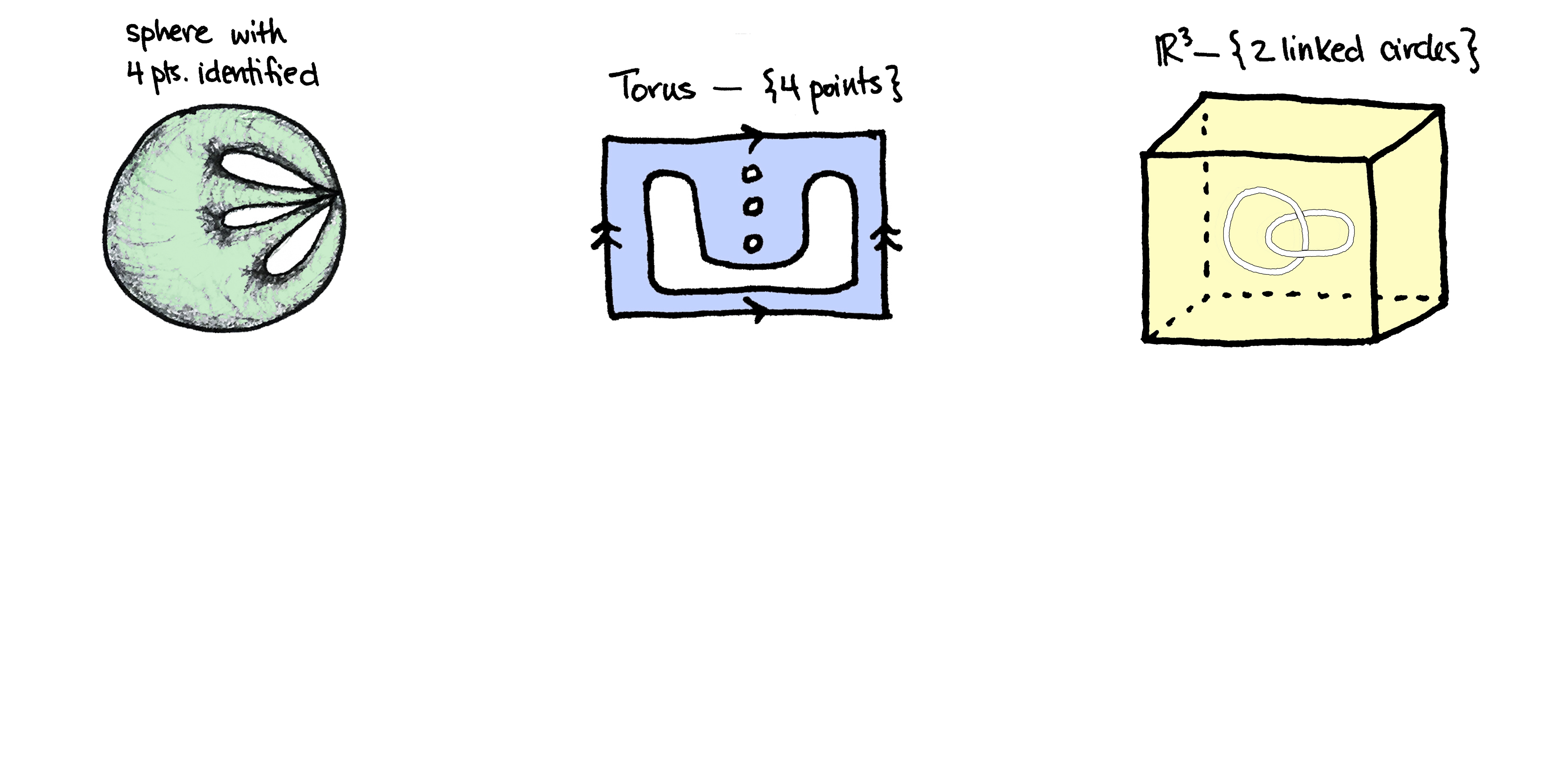
You know the routine. You come across a topological space $X$ and you need to find its fundamental group. Unfortunately, $X$ is an unfamiliar space and it's too difficult to look at explicit loops and relations. So what do you do?
this is a good visualization
different from mine
honest narwhal
Yeah so that example here is good, and you can see formally that it uses HEP
fading vale
i feel like im also bad at cellular homology things too tbh lol
or like sometimes i struggle to figure out how doing different shit or quotients or whatever impacts the attaching map
like this example is S^2 w/ antipodal points on the equatorial circle identified
and its kinda just idk hnn
marsh forge
admittedly like
cellular homology is most useful for hard computations
simplicial is often easier for simple spaces
fading vale

marsh forge
like this example is S^2 w/ antipodal points on the equatorial circle identified
@fading vale it might be useful to like
fading vale
honestly i prolly just need to reread/review later
marsh forge
draw the thing before the quotient
and then identify stuff
and then just do computations rememberin those identifications
fading vale
yea i was kinda trying to do that and its like idk my first thought is that the attaching map would look like umm a^2?
if a is the circle?
marsh forge
hmmm
fading vale
bc we wind around twice
marsh forge
you need 2 one cells
fading vale
o
marsh forge
two points
fading vale
and 2 2-cells
marsh forge
yes
its one of two standard cell structures on S^n
the first is 1 0-cell 1 n-cell
the other is 2 cells of each dimension
almost all sphere problems can be done w one of those two
for example
fading vale
so ig if we have 0-cells v1, v2, one cells a, b, 2-cells U, L then U for example glues along ab, and under the identification that would be umm
maybe it would just be killed?
like b would be a^-1
marsh forge
Exercise: use cellulor approximation theorem to prove $\pi_n S^m$ is trivial, $n<m$
gentle ospreyBOT
MaxJ:
marsh forge
a map X->Y of cw complexes can be taken to be cellular
meaning it maps n-skeletons to n-skeletons
tbh i always have to google the cellular boundary thing
but heres my advice
pretend ur just doing it for a sphere
give the two points different labels
and then just replace the two different algebraic things with the same one
fading vale
hmm
marsh forge
(you need to worry about signs for higher cells)
fading vale
wait um wouldnt the attaching map be just a point?
marsh forge
yes
marsh forge
one skeleton is S^1 v S^1 w the canonical cw structure
and then you just glue
2-cells
fading vale
ty : )
nimble cipher
hi. i am on the brink of giving up on constructing an explicit map. how can i reason that the quotient space on a regular hexagon is homeomorphic to the torus?
<@&286206848099549185>
fading vale
@marsh forge wait 1 quick thing
since our two vertices are identified together wouldnt that make d_1(a) = d_1(b) = v - w = 0?
but doesnt that contradict connectivity
cuz then ker d_1 = Z^2 so H_0 is 0?
nimble cipher
quotient by what?
@gritty widget gluing the opposite sides
nimble cipher
like intuitively i know how to do it. first, i glue on pair of opposite sides, then twist half of the hexagon and then glue the other two pairs
oh i am sorry about that
marsh forge
Sloth what is your image and whats your kernel
gritty widget
are there 2 ways to glue a hexagon by opposite sides?
nimble cipher
tbh idk. i am using the one my professor gave me where we map an edge to the opposite edge
nimble cipher
I made this illustration but from here, idk how to create a map or reason out how it's gonna go
gritty widget
do u know it has to be a torus?
i would have thought it would be more like a klein bottle
nimble cipher
yes. the trick is to glue one pair
then twist half of the annulus formed and glue the other two pairs
gritty widget
i think u need to twist all pairs of opposite sides right?
gritty widget
i would figure it looks like a klein bottle, just based on the fact that twisting the opposite sides of a square gives u a kelin bottle
nimble cipher
i can show you a youtube vid that shows how it's done if you want

This video demonstrate that gluing opposites sides of a hexagon is topologically equivalent to a torus.
gritty widget
ah i see, i was screwing something up
nimble cipher
so it just like as in the square but idk how to account for the twist
gritty widget
ah, it's just like the twist in the square version
nimble cipher
there's a twist for a square?
i only know that its quotient map is f(s,t) = (e^2ipis,e^2ipit)
gritty widget
yah like this https://en.wikipedia.org/wiki/Klein_bottle#Construction
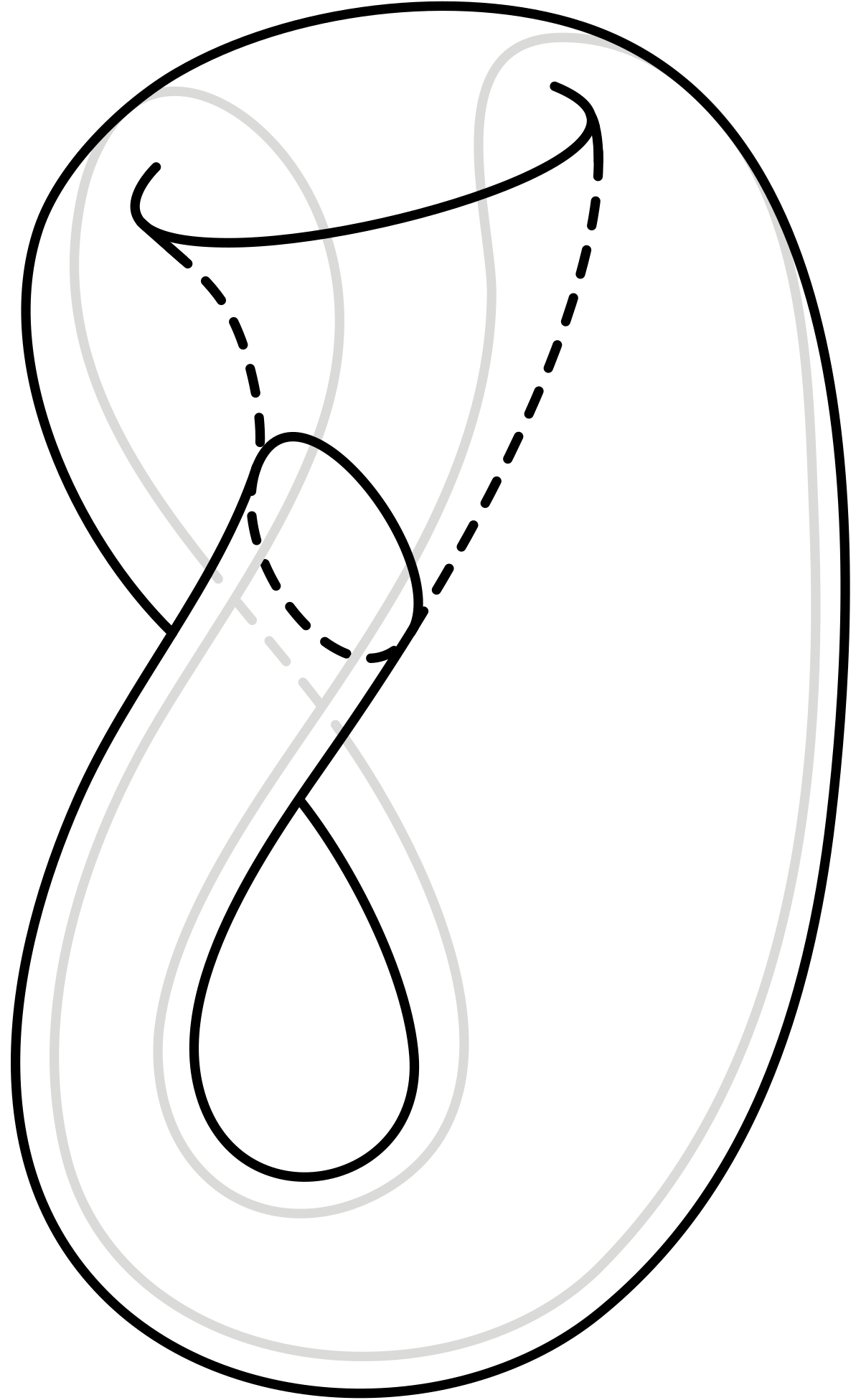
In topology, a branch of mathematics, the Klein bottle () is an example of a non-orientable surface; it is a two-dimensional manifold against which a system for determining a normal vector cannot be consistently defined. Informally, it is a one-sided surface which, if travele...
nimble cipher
Ohh same 180 degree twist
I'm getting it slowly. I just need to adjust the quotient map for the square
and account for the twist somehow. Thank you! Maybe if i run out of time i will just state this
Thank you @gritty widget
 random slate
So I've got a test in Computational Algebraic Geometry tomorrow, and I think I've come up with a pithy description of a Gröbner basis. What do y'all think:
Intuitively, a basis G of I is a Gröbner basis if leading terms of G are "closed" under k[x₁,...,xₙ]-linear combinations of G.
(In other words, you can't combine elements of G and get something with a leading term that you can't make with the ones available in G.)
random slate
Alright well the test is in 40 min so hopefully that's right XD
tough imp
No... they’re stupid and evil
 sleek thicket
@fading vale how's that homology
fading vale
@sleek thicket yes hi
fading vale
oh i didnt see
fading vale
im more confused abt the H_2(X, A) part rn
like. ok we have 0 -> Z -> H_2(X, A) -> Z_2 -> 0
fading vale
lol
fading vale
apparently H_2(X, A) should be Z?
sleek thicket
It could either be Z or Z (+) Z/2Z
fading vale
right
fading vale
hnnnnnnnnnnnn
fading vale
sleek thicket
can we do something galaxy brained like showing it has no 2 torsion
fading vale
that would be based
sleek thicket
So like
Z1(X) is a subset of the free abelian group on the 1 cells
There's only one 1 cell tho
fading vale
uh huh
fading vale
_<
sleek thicket
why isn't H2(X, A) zero lol
fading vale
thonk
fading vale
not if u take
the other 2-cell
im sure its Z like logically
because X/A is just S^2
fading vale
a-ah
sleek thicket
I've been drinking a little
fading vale
lmfao
sleek thicket
Sorry
fading vale
lol its fine
sleek thicket
So [x + Z2(A)] for x in Z2(X)
Now it's clear
Z2(A) is trivial
Actually I think I can prove it directly
fading vale
wouldnt it be Z?
sleek thicket
Without the LES
Why?
The map from 2 cells to 1 cells is injective, right?
It's just doubling?
sleek thicket
But Z2(A) is the kernel of that map
fading vale
maybe im dumb but if Z2(A) is the 2 cycles in A wouldnt it be like nL for any n
where L is the deg 2 attaching map 2-cell
sleek thicket
No, it's only stuff that goes to zero under the map from the 2 cells to the 1 cells
That's what "cycles" means in homological algebra, things in the kernel of the boundary map
sleek thicket
but also I think this is wrong lol
What I wrote
So we have this chain complex for X relative to A right
fading vale

fading vale
uh the relative chains
fading vale
wut
fading vale

sleek thicket
You have the chain complex for A sitting inside the chain complex for X, right?
sleek thicket
The degree 2 part of A is free on one of the 2 cells and the degree 2 part of X is free on both
You just mod out by the one in A
fading vale
_<
sleek thicket
What was the exact problem?
sleek thicket
Ah yeah
Oof
So like
I think this is maybe a little dodgy
We don't really argue that the cell complex for A sits inside that of X in the obvious way
But this is Hatcher so who cares
max would yell at me for even pointing that out probably
fading vale
pain
ok i think i see
im going to sleep on this its 3:23 am for me
ughhhhhhhhhhhhhhh fuck 😭 why do i have too much shit to do
but ty for helping @sleek thicket
fading vale

fading vale
goodn ight
sleek thicket
going back to celeste now
sleek thicket
Yes
 uncut surge
let's say i have two disjoint open sets in my smooth connected manifold, and they're both diffeomorphic to R^n; can i find a single open set that contains both and that is also diffeomorphic to R^n?
This seems like the easiest question in the world but I can't find a good proof or counterexample, lol.
lean swan
Hint for a counterexample: look at the sphere $\mathbb{S}^n$.
gentle ospreyBOT
leoli1:
uncut surge
oh no the top and the bottom hemisphere
oh noooooooooo
thank you
wait no that's no counterexample, i can just take the whole sphere and remove a point on the equator
that's R^n again
there is still a chance!
and i guess i need to add disjointness, yeah
marsh forge
wait what larto
take the upper and lower hemispheres. they are both diffeo R^n. the only open set containing both is the whole sphere
uncut surge
that's what i thought, but if i do that, can i not just take the whole sphere minus a single point on the equator?
marsh forge
oh wait right disjoint
uncut surge
idk if my brain is tired
uncut surge
yeah, that's what i had to add, otherwise the problem is indeed silly
 versed pivot
try connecting the two open sets by a curve on [0,1], and use compactness to cover the curve with small open balls
I haven't though about the details but that's what comes to mind
marsh forge
oh thats a good point
uncut surge
you just have to be careful not to accidentally add any noncontractible parts on the way
marsh forge
tubular neighborhoods should work
uncut surge
aah yeah, you can't even mess it up
you can use tubular neighbourhoods to build a straw from one of them to the other
it's at least easy to see that you'll end up with something conctractible by sucking both sets into the straw, and then a little bit more work and love might give you the existence of a diffeomorphism, too
i was imagining a construction like that but my brain was stuck on weird constructions with geodesics and convex hulls
 mossy oar
Hi, I am trying to make explicit a certain lecture of Riemann's on differential geometry, and also trying to understand why Gauss lemma in differential geometry "inspires" the form of Riemann normal coordinates. Does anyone mind assisting me with this?
mossy oar
Would anyone mind taking a look at my question in questions-epsilon I posted it there
And someone told me to post it in the advanced channel instead
Not sure if it's an analysis question or a geometry questions
 carmine delta
https://www.quantamagazine.org/a-unified-theory-of-randomness-20160802 This is some cool stuff right here

Quanta Magazine
Researchers have uncovered deep connections among different types of random objects, illuminating hidden geometric structures.
 deft creek
is there anyone that can help me understand a question
burnt spruce
https://www.quantamagazine.org/a-unified-theory-of-randomness-20160802 This is some cool stuff right here
@carmine delta As a non-expert (with background in probability theory), this was a sorta readable survey of that stuff: https://arxiv.org/abs/1908.05573 . Baez talks about it here also: https://johncarlosbaez.wordpress.com/2020/09/19/the-brownian-map/
 gusty yew
really stupid quick topology question
If $Y$ is closed in $X$, does it follow that the inclusion mapping $Y$ to $X$ is a closed map?
gentle ospreyBOT
HelixKirby:
honest narwhal
Yeah, if A is a closed subset of Y, then A = Y\cap B for some closed subset B of X. But then intersection of closed sets is closed
gusty yew
If we give $Y$ the subspace topology
gentle ospreyBOT
HelixKirby:
gusty yew
ok, cool
I was trying to show that any projective variety is complete knowing that the whole of $\mathbb{P}^n$ was complete.
gentle ospreyBOT
HelixKirby:
 tight agate
Does anyone have a hint for the following problem: Show that the kodaira dim of a submanifold of a complex torus is non-negative.
Here's what I have so far
complex torus is a lie group, so the tangent bundle is trivial, which implies that the kanonical bundle is trivial
so the canonical bundle of any submanifold will be iso to the determinant bundle of the normal bundle of the submanifold in the torus (adjunction formula)
and to show that the kodaria dim is non-negative, it is sufficient to show that $H^0(M, \det(N_{M/T})^{\otimes m}) \neq 0$ for some m
gentle ospreyBOT
Brofibration:
tight agate
I gueess we also have (by def of normal bundle according to the book im reading) $0 \rightarrow T_{M} \rightarrow T_T \vert M \rightarrow N_{M/T} \rightarrow 0$
gentle ospreyBOT
Brofibration:
tight agate
So $\det N_{M/T} \simeq \det T_T \vert M \otimes \det (T_{M})^*$
gentle ospreyBOT
Brofibration:
tight agate
T is the torus and M is the submanifold btw
 feral copper
Hello ! Denoting as $\mathcal{T}^{p,q}M$ the $(p,q)$-tensor bundle of $M$, what is the homeomorphism $$\mathcal{T}^{p,q}(\mathcal{T}^{r,s}M)\cong\mathcal{T}^{p+q,r+s}M ?$$
gentle ospreyBOT
Matplotlib:
feral copper
I can see the isomorphism on all fibers (local tensor spaces, that is $[\mathbb{R}^{\otimes p}\otimes(\mathbb{R}^\vee)^{\otimes q}]\otimes[\mathbb{R}^{\otimes r}\otimes(\mathbb{R}^\vee)^{\otimes s}]\cong\mathbb{R}^{\otimes (p+r)}\otimes(\mathbb{R}^\vee)^{\otimes (q+s)}$), but what about the global homeomorphism ?
gentle ospreyBOT
Matplotlib:
 cedar pebble
you just have to observe that the local isomorphisms patch nicely
or if you like, that tensor products and duals behave nicely as a global operation for vector bundles
if you represent a vector bundle by its sheaf of sections this is obvious. It is also sort of obvious if you sit down and actually write out what the global isomorphism is doing (it's determined locally, after all)
feral copper
So roughly-speaking, I'm just sending a (p,q)-tensor field and a (r,s)-tensor field to their natural tensor product, covariant and contravariant-wise ?
Oh okay I think I get it !
Thanks for the hints ^^
gentle ospreyBOT
Viburnum:
stable lance
Finally I know how to prove $X={x^2+y^2+z^2=0}$ is not simply connected.
Just posting in case of there's anyone wondering @burnt spruce
It's easier than what I was thinking and sadly doesn't use anything I was studying recently.
First, after a coordinate change, we can turn $X={x^2+y^2=z^2}$ into $Y={xy=z^2}$ since we're working under $\mathbb{C}$.
Then you define a map $f:\mathbb{C}^2-{0}\to \mathbb{C}^3$ given by $f(u,v)=(u^2,v^2,uv)$.
You just need to prove (by the usual way) that $f$ is 2-sheet covering map of it's image $Y$.
gentle ospreyBOT
gb214:
burnt spruce
@stable lance Wait wasn't it that cone without the origin?
Let me try to understand what you wrote.
Oh, okay that makes sense. Haha but it's good that its elementary. (Since when you learn elementary things it means you get a big update on your intuition, imo.)
I guess the usual way is to calculation the differential and check the rank condition?
stable lance
I guess the usual way is to calculation the differential and check the rank condition?
@burnt spruce precisely
burnt spruce
So thanks for sharing.
And I guess you get surjectivity, for instance, by calculating the dimension of a fiber and passing to the projective version? Or maybe there is an elementary argument there also?
stable lance
no, it's easier than that
burnt spruce
This is neat. Not only do you get that its not simply connected but it seems like thats the universal cover.
Okay, yeah I think I see that some algebra chasing would give you surjectivity. Let me write it down to be sure.
stable lance
since you have (x,y,z) you just need to choose the squareroots for x and y
correct
personally I was kinda bumed it didn't use anything I was seeing recently, except for the complex rank theorem
but it's a nice question regardless
burnt spruce
I personally am really pleased that its so elementary. 🙂
I mean, it totally makes sense if someone says to calculate the fundamental group, to try to explicitly construct a cover. Especially since they gave us the equations also.
But it wasn't obvious to me, but now the question is obvious. So I feel like I learned something.
stable lance
by the way, the professor told me to generalize the result for x^n+y^n+z^n.
But it wasn't obvious to me, but now the question is obvious. So I feel like I learned something.
@burnt spruce That's math for ya
burnt spruce
Interesting. And it seems like maybe the loops have to do with square roots in something like the usual way?
Its not obvious to me how to identify a generator of pi_1, although I guess with the cover in hand it can be done by direct calculation.
With something like how you find pi_1 elements from z^2 : C^* -> C^*
burnt spruce
yeah but I mean, what is (a) loop explicitely as a paremetrized curve
stable lance
oh sorry
I think you can just take a path uniting some x and -x and then "projecting" by f
burnt spruce
Yeah I think that's right.
Something like $(e^{i \theta}, e^{i \theta}, e^{i \theta})$?
gentle ospreyBOT
Crustle:
stable lance
yep
burnt spruce
Neat. It's pretty interesting that we can tell that thats a loop around a hole in xy = u^2 even though visualizing that is impossible.
I'd be curious to hear what you come up with for the generalization your prof suggested! I always enjoy learning little concrete bits of geometry. 🙂
stable lance
thank you for your interest and attempt to solve the question
i'll come up with an answer if I manage to solve it
burnt spruce
Sorry I wasn't more help, but I'm glad I got to learn a nice example!
tight agate
Are y'all trying to compute the fundamental group of x^n + y^n = z^n in C^3?
or projective space?
stable lance
If by C* you mean that equivalence relation then yeah
stable lance
right
tight agate
well then you know that the genus of a degree d curve in the projective plane is (d-1)(d-2)/2