#point-set-topology
1 messages · Page 156 of 1
 fading vale
 ember maple
@sleek thicket how do other people usually define affine variety? A tuple k^n for any alg closed field k?
Finitely generated mean (locally at least) it's polynomial with finite indeterminate?
 sleek thicket
An irreducible closed subset of k^n in the zariski topology
Where the closed sets are the zero locii
Finitely generated means quotient of polynomial ring in finitely many variables
See Hartshorne or Gathmann's notes
This definition is weird because it's not classical AG but it's also less abstract than schemes
The structure sheaves are actual functions
ember maple
I'm not that big brain enough to imagine sheaf in general ring which is not polynomial /function
sleek thicket
Well the structure sheaf of an affine schemes is more complicated
It's a big tuple with some local compatibility stuff
 civic kraken
this image must be preserved for all time
 bitter yoke
aren't you a fucking geometer
 honest narwhal
@civic kraken wait what kinda geometry do you do? Your answer will either make us friends or enemies
civic kraken
mostly arithmetic
but im writing my thesis on teichmuller dynamics 
i like geometry in general, but mostly i like number theory
 floral gust
How are the definitions of T_3 and regular different?
 midnight jewel
personally, I’ve learned them to be synonyms, but wikipedia says that T₃ is regular + hausdorff, our definition of regular included hausdorff as a condidion (or rather, that points are closed, which is equivalent in this case)
https://en.wikipedia.org/wiki/Regular_space just see here
In topology and related fields of mathematics, a topological space X is called a regular space if every closed subset C of X and a point p not contained in C admit non-overlapping open neighborhoods. Thus p and C can be separated by neighborhoods. This condition is known as A...
honest narwhal
Okay so yeah that's fine we're friends. That meme I think makes fun of differential geometers anyway
civic kraken
that is correct
floral gust
@midnight jewel In Munkres, regular is defined as following Suppose that one point sets are closed in X. Then X is said to be **regular** if for each pair consisting of a point x and a closed set B disjoint from x, there exists disjoint open sets containing x and B respectively.
If I am correct, does that not imply Hausdorff? (just take the closed set to be another point
midnight jewel
it does
but not everyone takes the points are closed condition to be part of the definition
if you do then regular spaces are always hausdorff
otherwise they may not be
floral gust
In my notes however, I am provided that Regular = T_3 + T_1. Is it possible that the singletons are closed is provided by T_1?
midnight jewel
and T₃ being defined how?
literally none of these words have unambiguous definitions
floral gust
Closed and a point are separable by disjoint neighbourhoods
T_1 being two points can be seperated by neighbourhoods (not necessarily disjoint)
midnight jewel
apparently it’s equivalent (if I’m reading the wiki article correctly) but it’s not obvious to me
ah wait
let y in X and for each x define Oₓ to be an open neighborhood of x not containing y (exists by T₀). then the union of the Oₓ is precisely X\y, and thus {y} is closed
so T₀ already implies that points are closed
floral gust
For me T_0 means given two points atleast one of them has an open neighbourhood that doesnt contain the other.
So by T_0, we might as well have gotten a neighbourhood of y
midnight jewel
doesn’t T₀ mean that each point has a neighborhood not containing the other, but the neighborhoods don’t have to be disjoint?
floral gust
That's T_1 for me
midnight jewel
ah wait
I meant T₁ the whole time
fucking numbers
yes you’re right
just imagine I said 1 every time I said 0
floral gust
In my notes however, I am provided that Regular = T_3 + T_1. Is it possible that the singletons are closed is provided by T_1? Is this correct then
midnight jewel
yes
floral gust
Smh obviously...
midnight jewel
as I just proved
midnight jewel
np
 finite turtle
“how does this relate to upper undergraduate-level geometry”
John H Conway discovered most of these equilibrium honeycombs
The ones I showed are cubic honeycomb
A honeycomb is a space filling tessellation of polyhedra.
Cubic honeycombs, Archimedean and Platonic solids share great relation to subatomic structures. For example the Higgs boson is an E8 (quasicrystal composed only of platonic solids up to the eight dimension).
Everything except for the links was of my own work
I’m working on these honeycombs and making my own honeycomb structures because I’ve envisioned ways to build technology and advancement with these structures. Also for the interest and desire to find a cellular automaton capable of explaining all particle physics and occurrences via functions.
Technology
- Euclidian warping structures
advancements in fiber technology (using genuflecting bipyramids).
Impact safety features with an inverse metamorphose cuboctahedrille
Or other metamorphosis honeycombs
- Agriculture
Agricultural advancements in hydroponic automaton using space filling curves and AI data tracking systems.
Agriculture advancements using topology optimization with circular fields and the phi ratio.
- data compression with space filling curves
Etc.
 ivory dragon
You didn't answer the question.
But either way, if this is as revolutionary as you say it is, I highly recommend you either:
a) get it written up as a paper and published
b) sell the patent to some big company
midnight jewel
quasicrystal composed only of platonic solids up to the eight dimension
that seems like a lot of fancy words without any meanings if you ask me
for one, platonic solids are by definition 3-dimensional
ivory dragon
rather than posting huge walls of links and technoblabble on discord without further elaboration
(also, iirc conway didnt construct the convex uniform polychora, but rather showed that they were the only ones that existed?)
(I believe he did discover the grand antiprism, but I think that's about it)
admittedly, it's uncited, but wikipedia corroborates my claim
though apparently the proof of completeness was due to Möller, not Conway-Guy
rather, Conway-Guy simply enumerated them and demonstrated some basic properties
and either way, I don't see that you're doing any actual mathematics
you seem to be mashing shapes together, which is nice exploration and all
but I haven't seen any, like, mathematical work
you threw out a bunch of buzzwordy terminology, but none that's actually used substantially in the fields involved (geometry, geometric topology, algebraic geometry, algebraic topology)
and I don't see any, like, theorems or claims or statements you've proven about your construction
just that "I made a thing"
and it's great to make things - concrete examples of geometry are quite interesting, and a great opportunity to explore mathematics in a physical manner - but I think you're greatly overestimating the impact and interesting qualities of your work, and it's bordering on mysticism, a la numerology.
but who knows? maybe you're the Cantor to my British Academia, and in a decade, graduate students will be studying your honeycomb constructions
somehow, though, I doubt it, considering I struggle to see why what you're doing is interesting or relevant.
I don't mean this to discourage you, but perhaps don't toot your own horn with such grandiose statements - or, if you do, do it to publishers/big pharma companies rather than to a random math discord.
Trust me, if this actually does have substance, it'll be better for you - and the world - if you communicate it through the conventional avenues for groundbreaking work.
midnight jewel
and work on your presentation cause like… I have no idea what you’re talking about you’re just saying words
ivory dragon
Yeah, perhaps if you explained it using the typical terminology and presentation of the field (or even, you know, mentioned what field your results belonged to), it'd be easier to understand your thesis.
(I'm not trying to gatekeep you or say "if you don't understand the fancy words used by mathematicians, you can't possibly make contributions"; but the fancy words are standardized for a reason: mathematicians understand them and there's no ambiguity.)
(Sadly, that's not the case for the terminology you're using. If you can find some alternate way to explain your findings, then go ahead! But clearly, what you've done above is not adequate; I can't parse any concrete claims, theorems, proofs, or hints at broad relevancy.)
honest narwhal
I'll ping you here because while you should read everything that's being said, this is administrative and thus you have to read it. @finite turtle if you're going to pursue your stuff further without following the recommendations of Namington and Sascha, from now on you are to do it in #chill
finite turtle
I explained the constructs using proper mathematical lexicon. And no, Platonic solids (regular polyhedra) are not restricted to just the 3rd dimension. You are correct, I am just putting shapes together, these shapes however do share relevance to subatomic structures and crystal growth patterns. The mathematics behind these constructs I’ve shared and explained with mathematical lexicon rather then equation.
Most people don’t even know what a tetrahedron is
Sad
It can be a difficult task to estimate the educational background and retention rate of those that view your works. Especially given the retention rate of modern kind is less then that of a nat. speaking this in a simply stupid guide form would astronomically lengthen the explanation into something nobody would read.
I enjoy sharing my works on social media and chatting with others doing similar work.
This is a way for me to connect and meet new people interested in similar subjects, so I will continue to do so.
Sure I’ll do it in #chill
Tell me what’s wrong with my explanation please “This space-filling honeycomb, In Isometric Projection, produces the Rhombitrihexagonal Tiling Pattern.
The matrix is a truncated variant of the Cantic Cubic Honeycomb. It is a uniform matrix composed of tessellated Cuboctahedrons, Square Prisms & Semitruncated Rhombic Dodecahedrons.”
~ Discovery by Abyssal Dionysus ~
Info - Learn more
All the links I posted on words I used above
Showing each component of the matrix individual
finite turtle
Why is there so much negativity towards this?
 umbral surge
lol
 dim meadow
Read Namington's post from earlier
Also listing stuff like "data compression with space filling curves" as an application of your work is an obvious sign of crankery
floral gust
He spread the same stuff on Kik as well and even accredited his work to the works of some crank physicist.
honest narwhal
@finite turtle this is an administrative order, from now on only chill
 steel stag
 tough hamlet
k
 shrewd lagoon
should i learn about topology before i start trying to learn about algebraic geometry? i just wanna get somewhat of an appreciation of it because it seems important
 frigid patrol
I think so
sleek thicket
AG doesn't actually involve any topology, the zariski topologies are fake
cofinite? more like costupid
wait fuck costupid would mean smart fuck fuck
honest narwhal
gg shamrock
honest narwhal
So I know the Zariski topology is there but how often do you do things with it?
midnight jewel
honestly getting to know an “ugly” topology in the wild (in this case: non-hausdorff) is like the only thing that’d interesting me about alggeo
midnight jewel
is this correct?
If $n$ is even, then $\delta c_n = \sum_{i=0}^n (-1)^i c_{n-1} = c_{n-1}$. Thus, for odd $n$, $c_n$ is a boundary, but for even $n$ it can’t be, as that would violate $\delta^2 = 0$
 gentle ospreyBOT
Sascha Baer:
 dire warren
Let X be a locally compact, noncompact Hausdorff topological space and X’ it’s one point compactification. Call such a space “compactification symmetric” if X’ minus {p} is homeomorphic to X for any point p in X’.
What are the compactification symmetric spaces?
 chrome dew
spheres?
 versed pivot
X' doesn't have to be a sphere
at the minimum it can be any compact (connected) manifold, just remove a point to get an X that compactifies to it
dire warren
Wait
Given any compact connected manifold, is M minus any point homeomorphic to M minus any other point?
versed pivot
dire warren
Nice
 fiery hatch
Hello
 errant rover
I feel like there should be a proof that there exists no field structure on R^3 that respects R in the usual way as a subfield, starting by the fact that there is no topological group structure on S^2. I can't quite make it work, any idea? (I want to induce a group structure on S^2 via the multiplication, but actually making multiplication a map S^2 x S^2 -> S^2 doesn't always work, so I want to prove there is something homotopic to it.
floral gust
Is there some intuitive notion of "separability" hidden under the definition of a separable space as having a countable dense subset? I understand the notions of separability supposed to be captured by say like separation of a set or separability axioms. Not sure what sort of separability is being mentioned here.
 merry shale

MathOverflow
It is well known that a separable space is a topological space that has a countable dense subset. I am wondering how is this related to the name 'separable'? Any intuition where the name come from?
floral gust
Thanks!
 thorny flame
I'm have trouble with parts of this problem from Munkres:
I understand the cases for the horizontal line and the vertical line but how can I figure out diagonal lines? Just working on the case for one R_L x R_L should be enough for me to understand the problem.
sleek thicket
Is R_l the topology generated by [a, b)?
thorny flame
Yes
errant rover
@thorny flame if L is a straight line in the plane and it is not vertical, then for every real number a, there is exactly one (x,y) in L such that x = a. This gives a bijection L -> R (think projecting down to the x-Axis). When you send open sets in L through this bijection, what happens to them and how do they look like?
(What you do on the back-end level is you give R a topology by sending open sets from L to R through this bijection. This makes this topology on R homeomorphic to L and this topology is easy to describe)
thorny flame
ah ha! ok that comment kind of helped thank you. I drew a picture out if it helps someone who is stuck
floral gust
Can we make a non-Hausdorff space Hausdorff by defining an equivalence relation such that x ~ y iff there exists a filter which converges to x and y
errant rover
Yep, a space is Hausdorff iff no filter has two limits
And I guess the space you get is actually the Hausdorff reflection, but I'm not quite sure how to prove that
floral gust
Would these definitions be correct?
 vocal wharf
N_x are neighbourhoods of x?
civic kraken
it's easier if u just write out in english what ur trying to say with those symbols
floral gust
@vocal wharf Yes
@civic kraken I am aware but this helps in problem-solving much more (atleast for me). For me, the english definition seems to coincide with this, just double checking.
vocal wharf
the first definition is fine, if the index set i is from is countable
the second i'm not sure 🤔
floral gust
Secondly, is there any difference between metrizable and metric spaces?
vocal wharf
a metrizable topology is one that is induced from a metric
but you may not know that metric
floral gust
So I can use every result on general metric spaces on metrizable spaces?
and vice versa? (so long the result is not dependent on the choice of metric itself)
vocal wharf
yea
floral gust
So anyone has any idea about the second one?
vocal wharf
actually in both statements you would at least need $x \in B_{i}$
gentle ospreyBOT
Lochverstärker:
floral gust
Yes hence the x subscript in B
so B_x_i means for me the set that contains x and is indexed to be i
vocal wharf
ok, for the first line
that's not mentioned in second line?
because then i think it's fine, but it's a different definition of basis than what i'm used to and i cba to prove equivalence now
so someone else can comment
floral gust
Yes B_i merely means sets indexed as i and not necessarily neighbourhoods of x
thorny flame
Ok so I get that the lower limit topology is strictly finer than the standard topology so it must contain open intervals like (a,b). However, how can I construct an open interval (a,b) from intervals of the form [a,b) using infinite unions and finite intersections?
dim meadow
take the union of [x, b) over all x between a and b
@thorny flame
$\cup_{x\in (a, b)} [x, b) = (a, b)$
gentle ospreyBOT
Liquid:
thorny flame
ok so its like x is getting closer and closer to a but never actually touching it. So if we are on the R numbers then it should be an uncountable infinite union?
dim meadow
nah, you can do this with a countable union if you want, but in my case it is a uncountable one yeah
cause I was being lazy
sleek thicket
@thorny flame unions of arbitrary cardinality are okay, but you could take x = a - 1/n if you wanted
dim meadow
^
sleek thicket
Or x being all rational points in (a, b)
sleek thicket
no but I like it better for some reason
dim meadow
haha
sleek thicket
It feels like a thing that could generalize to separable spaces somehow
But you need an order to talk about lower limit
So idk
dim meadow
seperable metric spaces are at most the cardinality of the continuum
thorny flame
man infinity is freaking weird
dim meadow
👀
thorny flame
like everytime i think about it i'm like yeah but no but yeah ok i guess
dim meadow
and there are exactly continuum many of them
sleek thicket
Wait what? That's wild
dim meadow
nah, not so much
sleek thicket
Up to what notion of equivalence? Homeomorphism?
dim meadow
isometry
dim meadow
basically completions are unique
so you need to find the number of possible metrics on a countable set
sleek thicket
And your completion is the completion of the dense subset, got it
dim meadow
and thats the same as the number of maps from N to R
and there are exactly continuum many such maps
that gives you an upper bound
thorny flame
what is continuum?
sleek thicket
Oh yeah, makes sense
Cardinality of the real line
Or the real line itself
Depending on context
dim meadow
yeah
thorny flame
is that just the Card of reals?
sleek thicket
Yee
thorny flame
oooo ok
dim meadow
all compact metric spaces are seperable
so there are exactly continuum many compact metric spaces
(there is an easy lower bound)
(at least for isometry)
haha this is a train of thought I've been talking about for a bit
I should probably stop sharing it lol
sleek thicket
It's neat
dim meadow
I guess something interesting would be showing a lower bound for homeomorphism
sleek thicket
I never really learned about metric spaces, just went straight to general topology
dim meadow
for isometry you just look at 2 point spaces
I'm taking a metric geometry class rn
so I've been thinking about metric spaces quite a bit
sleek thicket
I'm thinking about subsets of R^n
dim meadow
for a homeomorphism lower bound you can probably do some trivial stuff with connected components
hmm
sleek thicket
That seems plausible
I would be surprised if there were countably many homeomorphism classes of subsets of R^n
dim meadow
haha why not something in between
👀
yeah you can look at finite disjoint unions of spheres
n spheres for different n
sleek thicket
Concentric circles at the origin with irrational radii?
dim meadow
oh ok
sleek thicket
Where do you put the spheres?
dim meadow
you can make a bijection to binary expansions
sleek thicket
And stay seperable?
dim meadow
in a funny way
sleek thicket
Sure
sleek thicket
Oh you mean like countable disjoint unions of S^n
dim meadow
no, thats finite
dim meadow
I think youre idea of concentric spheres is good
dim meadow
S^\infty is compact, right?
dim meadow
no
sleek thicket
I don't think about the infinite sphere very much
dim meadow
it's not
dim meadow
haha
sleek thicket
Why doesn't the binary expansion trick work?
Convert 0 to 0 and 1 to Z in homology
Basically
dim meadow
cause each space only has a finite number of spheres
sleek thicket
Why?
dim meadow
cause they are disjoint
sleek thicket
Oh I mean you can't embed it in R^n
But it's still separable
And I think it's still a metric space
dim meadow
and a compact space has a finite number of connected components
sleek thicket
Sorry, were you were working on separable metric space homeomorphism classes or R^n subsets homeomorphism classes?
I was saying it would work for the first
sleek thicket
Ohhh
Sorry
Mb
This is probably dumb, but would it be useful to think about the cantor set? Doesn't every compact metric space show up there somehow? I'm talking about things I don't understand, sorry
dim meadow
Maybe you're thinking of the hilbert cube?
dim meadow
👌
sleek thicket
Ah I just checked Wikipedia™
"any compact metric space is a continuous image of the Cantor set"
That's what I was thinking of
But I don't see how to apply it here
It gives an upper bound but not a useful one I think
Like R^R
dim meadow
so if we can find a countable number of disjoint compact subsets of the plane, we can do something
not disjoint
i mean not homeomorphic
and actually there is an easy way to do this
I'll draw a picture
sleek thicket
Can't you do n circles in a line?
dim meadow
I was thinking you take a circle and put n chords in it
dim meadow
oh cool
sleek thicket
If you put the chords in a certain way at least
dim meadow
and then you make a line of the circles with n chords in it
sleek thicket
Every chorded circle is homotopy equivalent to n circles touching at a point, for some n, which might be bigger than the number of chords
dim meadow
and have the circles get smaller
and do the trick with bijecting onto the binary expansions
dim meadow
it's not too hard
sleek thicket
I think I get it
sleek thicket
Please do, I thought I did but then realized I didn't
Again
Oh I think I have an idea
Put countably many touching circles in [0,1]
Getting smaller
Take a binary sequence
dim meadow
yeah
sleek thicket
Put a point in the middle of the nth circle if there's a 1 in nth spot
dim meadow
same idea
sleek thicket
Are those always not homeomorphic? I think so
I believe something like this works
Cool!
sleek thicket
Yee, I got it
dim meadow
But imagine there is space between the n and n+1st
sleek thicket
Okay so I don't think my example works
Because you can move around the points
They aren't ambiently homeomorphic
But if you have infinitely many, you can pull them all out into the plane
sleek thicket
Can you give it again?
dim meadow
Probably
sleek thicket
Just un-bend them and move the endpoints
Anyways
The endpoints of the chords/arcs line up
dim meadow
Yeah
So you put a bunch of them in a row
With a small amount of space seperating them
So that the infinite amount of them are contained in the unit box
sleek thicket
Yup
dim meadow
(you need to add in a single point to make them compact, but whatever)
sleek thicket
The nth one having n chords?
dim meadow
Yeah
And then you choose a subspace of that
Where a particular binary expansion tells you whether the nth one is there or not
I think that works
dim meadow
Can you draw a picture?
sleek thicket
Because you can tell the circles apart
dim meadow
But it's not a disjoint union
sleek thicket
No I suck at drawing lol
sleek thicket
Yee
Next level of the question would be: can you do it on the line
But I need to get back to other things
Ty for the fun topology problem
dim meadow
Yeah, ttyl
floral gust
Are these two proofs correct?
 gritty widget
Hi, I just started my topology course and I'm having troubles in proving that three topologies are the same generated by three metrics: 1st one being euclidean, 2nd one $d_s\left(a,b\right) = \sum_{i=1}^{n}|a_i-b_i|$ and third one: $ d_m\left(a,b\right) = max_i |a_i-b_i|$. The book says it's because three inequalities, which I don't understand why make the topologies equal: $d_e \leq \sqrt{n} d_m, d_m \leq d_s, d_s \leq \sqrt{n} d_e$. Could someone help me understand and write a proof sketch why those are equal?
gentle ospreyBOT
Godel:
floral gust
What is the criterion by which we understand that two topologies are equal?
gritty widget
Union of all open sets made by those metrics are the same?
bitter yoke
More that the open sets are exactly the same
gritty widget
I suppose we need to show inclusions like every ball d_s is in d_m and vice versa?
bitter yoke
If you know what finer/coarser topology means
I think that the inequalities show that d_e is coarser than d_m and d_m is coarser than d_s and d_s is coarser than d_e
So they must all be the exact same
gentle ospreyBOT
QuickMaffs:
chrome dew
I didn't think equivalent metrics meant they generated the exact same open sets, I thought it just meant they gave the same cauchy sequences
maybe I'm conflating open sets with open balls actually, since same radius open balls with different metrics are different open sets but doesn't necessarily mean they have to coincide in that sense I guess
floral gust
Open balls are the basis elements in a metric topology. They generate the metric topology. Open sets are elements in the topology. (taking the terminology from Munkres)
chrome dew
gotcha, yeah that makes sense
gritty widget
Not sure if that's what you meant, but $\lim_{n \to \infty} p_n = p $ is equivalent to any ball B centered at p contains all points $p_1, p_2, \dots $ besides countable many
gentle ospreyBOT
Godel:
dim meadow
@chrome dew (bilipshitz) equivalence implies homeomorphism trivially
midnight jewel
I didn't think equivalent metrics meant they generated the exact same open sets, I thought it just meant they gave the same cauchy sequences
equivalent metrics also generate the same topology, I’m pretty sure. but if you have two metrics that generate the same topology that doesn’t necessarily mean they are equivalent (e.g. you can equip ℝ with a bounded metric that generates the same topology as the standard one).
 nimble jolt
Terminology varies. Sometimes authors use "strongly/weakly equivalent" to distinguish between homeomorphisms and bilipschitz equivalences.
and sometimes they just use "equivalent" to mean one of these, and they are consistent with that choice.
midnight jewel
not quite sure which channel to put this but since I (might) need it for diffgeo I’ll put it here
let’s say I have a closed injective curve in ℝ². by JCT I know that it has a well-defined interior (a bounded open set whose boundary is the curve). is the following claim true:
if for any two points on the curve, the line connecting them lies in the closure of the interior, then the interior is convex
I know the converse is true cause the closure of a convex set is convex
 west spindle
should be true i think
pick any two points in the interior and connect them with a straight line
 rugged swan
No, take ([0,1]^2\{(0,a), 0<a<1})\{(1,a), 0<a<1} in [0,1]^2
midnight jewel
hm that doesn’t have a closed curve as its boundary though
or, well,
it doesn’t fit into the description of what I have I’m failing to put it in words rn
plus it does actually have convex interior? it just doesn’t satisfy the assumptions
midnight jewel
I defined it
rugged swan
Oh you mean smth like jordan th ?
midnight jewel
JCT is the jordan curve theorem
rugged swan
Ok
midnight jewel
if you have a closed injective curve c in ℝ², then ℝ²\im(c) has a unique bounded connected component, which I termed the interior of the curve
anyway I’m not even sure if I need this
but I think what ann said is correct
you can take two points in the interior, take the line passing through them, and extend the lines in both directions until they hit the boundary. then the two points have a straight line connecting them which lies in the set+boundary, and since straight lines are uniquely defined by two points this is the same line as before
rugged swan
In R^2, I think it's true for bounded sets
midnight jewel
which was part of the condition
 patent escarp
How could I prove that two continuous functions f,g; S^2 -> S^1 x S^1 are always homotopic?
nvm, finally did it
just need to show that any continuous function f: S^2 -> S^1 x S^1 is homotopic to a constant function
floral gust
For a locally finite cover, is it okay if there exists a such that all of its neighbourhoods have a non-empty intersection with no elements in the cover? This would not violate the locally finiteness of the cover right? Only when all neighbourhoods of x have a non-empty intersection with infinite number of elements in the cover?
 digital peak
that violates the "cover" condition
because then a is not in the union of the open sets
floral gust
Thank you!
Does this seem correct? I am not particularly sure about how I arrived at the numbering
midnight jewel
you can’t start with “for each integer n”
because that assumes countability of U
but otherwise the argument works out
floral gust
How about saying. Take U. Find B_n. Index U to be n. The indexing is unique?
floral gust
Like this right?
midnight jewel
the indexing isn’t unique, actually. you can have multiple basis elements in the same U
however, the indexing is well-defined (in the sense that different sets will never get the same index)
floral gust
Oh yes true true. I should have proved the converse then. n = m \implies U_n = U_m
gentle ospreyBOT
QuickMaffs:
floral gust
Does the reasoning over here make sense? Particularly, I am confused about the injection I have built and whether the use of min lets me make an injection.
(The idea is to partition R^2 in 1 by 1 squares )
floral gust
 burnt mirage
I'm becoming aware that (pre)sheaves are a kind of natural pair to manifold structures, in the sense that "attach an algebraic structure to open sets" is similar in spirit to "attach homeomorphisms to R^n to open sets". But why do algebraic geometers care so much about the roots of polynomials? Is it just historical, or is there some deep geometric (or algebraic/categorical) reason why the roots of polynomials are things we should care about?
midnight jewel
I’m trying to understand what this question is exactly asking from me. In particular, I don’t understand what the function from $H_n(X; \Z/p\Z) \to \ker{\dots}$ is supposed to do. In particular, isn’t the function inside the ${ }$ injective?
gentle ospreyBOT
Sascha Baer:
 urban anvil
@burnt mirage varieties are just the historical setting to work on, but in general schemes of finite type over a nice ring (which is what polynomials are) are nice objects to work with
I don't know if you think that's restrictive, but it's similar to asking that manifolds have charts onto R^n as opposed to R^infty
let me maybe be more explicit, I don't know how comfortable you are with these things.
assume our scheme is affine, Spec R -> Spec k
burnt mirage
I have no clue what a scheme is and wiki just makes me surer of that, but I'm trying to figure out the intuition here
urban anvil
that is, R is a k-algebra
finite type is just asking that R is finitely generated as a k-algebra
that is, that it's the quotient of the polynomial ring k[x1,...,xn]
the objects of study in schemes are algebras
its what you get when you map a ring to another ring
burnt mirage
Quotient of the polynomial ring in the same way as a clifford algebra is the quotient of a free algebra? modding out all but finitely many of the higher-degree elements
urban anvil
you don't need a further finiteness restriction like that
just k[x1, ..., xn]/I for some ideal I
by the isomorphism theorem
burnt mirage
you just go to town on the arbitrarily high-degree elements by subtracting elements of the ideal
urban anvil
no need
degree is fine
it's fine to be infinite dimensional as a k-module
the point is guess is that scheme maps are morally ring maps k->R, that is, rings R with the structure of k-algebras, and asking them to be finitely generated algebras is just asking them to be polynomial rings k[x1,..., xn]/I
burnt mirage
I think I'll need a bit [a lot] more time before I get comfortable with that idea, but one possible idea I had for the motivation behind varieties was that most geometric objects could be expressed as varieties
a circle is x^2-y^2-1 = 0, ditto for higher-dimensional spheres; you can take finite unions and arbitrary intersections, allowing you to build e.g. squares and cubes and whatnot, right?
urban anvil
geometric object usually means of finite type, sure
burnt mirage
and in a sense the theory of varieties studies how this construction attaches algebraic meaning to geometric ideas, and what can be done with these constructions
urban anvil
it's a natural condition
burnt mirage
I haven't been weaned off of finite-dimensional things yet ;~;
but is this a proper motivation for studying varieties? studying geometric objects like circles insofar as they're algebraic sets generated by polynomials
urban anvil
sure
they arent as restrictive as it seems
see GAGA
so that complex analytic spaces are actually really close to being complex varieties
burnt mirage
ok, this is great
my initial mental image of a variety was some set of points or a curve in C, which left me really confused as to why people liked doing this stuff...
urban anvil
C is dimension 1 as a complex variety
so smaller (closed) varieties are just finite sets of points, though you do have open sets
a better image is complex analytic spaces in C^n
or better CP^n
but even studying analytic open subsets inside C is quite rich
maybe you haven't seen much of riemann surfaces yet
burnt mirage
only riemannian manifolds
urban anvil
I guess the takeaway is that polynomials seem boring, but observe that vector spaces being geometrically boring doesn't stop differential geometry from existing
honest narwhal
@midnight jewel H_{n-1}(X) may have p-torsion, so your thing may have a kernel. They aren't telling you what the function is but the point of the problem is to find/prove existence of functions which make it work
burnt mirage
riemann surfaces are just the most general spaces in which you can do (single-variable) complex analysis?
honest narwhal
And yeah RS sound super dank
burnt mirage
yeah, i'm pretty interested in learning about this stuff now!
thanks @urban anvil !
honest narwhal
At one point in time I was considering going through Forster but never got around to it
Kinda still wanna do it though
Though atm I've got a lot lmao
midnight jewel
I tried to take a course on RS but it was above my level and I had enough other things to do so I dropped it
midnight jewel
also: today we learned about the christ awful symbols
the name is fitting, I agree
dim meadow
@midnight jewel for the problem you posted earlier, use universal coefficients for homology, then a long exact sequence from the Tor functor
And that does it
midnight jewel
I don’t know anything of what you just said
dim meadow
Do you know the universal coefficient theorem?
midnight jewel
I only barely understand the notation
we pretty much only just started on this stuff
dim meadow
🤷
midnight jewel
he introduced exact sequences last week
dim meadow
I'm not sure how else to do this
midnight jewel
well I was gonna brute-force my way through explicitly finding the maps
midnight jewel
but the objects are fucking hard to understand
dim meadow
Good luck
midnight jewel
I mean the first map is pretty clear
dim meadow
The last thing is really Tor(H_{n-1}, Z/(p))
midnight jewel
I’m gonna wait till after next class
maybe we’re learning about these things now and the exercise was a bit premature
dim meadow
Hopefully
This is definitely a universal coefficients problem
I think this is the intended solution
midnight jewel
lemme check if the theorem came up in bredon before that question
we’re technically following that book but I’m kinda ignoring it
I don’t like it that much
dim meadow

midnight jewel
so we had the statement of this theorem here, but not the proof yet
and a bit after that is this, right before the exercise
dim meadow
That's not universal coefficients
midnight jewel
that last bit looks kinda similar
yea in that case it’s not here because that’s all there is in the “homological algebra” chapter before this exercise
midnight jewel
so is this in some way supposed to be obvious now or what?
dim meadow
Maybe not
midnight jewel
I can barely understand what it even says
midnight jewel
I swear to god this is all so much above me
dim meadow
And in Tor(A, B), if A is free abelian then Tor(A, B) is 0
midnight jewel
I guess one way to learn to swim is to get dropped into the ocean and be told there’s an island 50km to the west
except they forgot to tell me about the island
dim meadow
Notice $Z \otimes H_{n-1}$ is $H_{n-1}$
midnight jewel
yea I don’t really know anything about the tensor product either
gentle ospreyBOT
Liquid:
midnight jewel
but he just said don’t worry and just treat it as “the coefficients come from there instead”
dim meadow
And the induced map will be exactly multiplication by p
midnight jewel
we did so little in algebra I feel like
dim meadow
Oof I fucked up actually
midnight jewel
dw I didn’t even notice
dim meadow
I was computing Tor(Z/(p), H_{n-1})
midnight jewel
I’m not really following anyway
dim meadow
This is more for me tbh
midnight jewel
to be quite honest
dim meadow
midnight jewel
(also, the non-zero integer n is a prime p in the book)
dim meadow
Okay this actually isn't too bad @midnight jewel
I was wrong
You basically consider the chain complex C_n(X)
And take the tensor with the exact sequence
midnight jewel
the one from the top?
dim meadow
You have
midnight jewel
aight
dim meadow
But yeah, this gives you a short exact sequence of chain complexes
midnight jewel
and C_n(X⊗ℤ) = C_n(X)?
midnight jewel
look I don’t know what the tensor product actually does
dim meadow
Look it up lol
midnight jewel
I don’t understand it
dim meadow
So here's the construction
midnight jewel
the notation is all sorts of confusing me
dim meadow
You take the free abelian group on A and B
And quotient out by stuff
One sec
Here
midnight jewel
we were just said to treat Δ_n(X)⊗G as having coefficients in G instead of ℤ
and that was it
dim meadow
Sure
That's fair
And if you take coefficients in Z
Well that's what you're doing already
So it's the same group
You should learn this though
You should definitely know this much if you're learning Algebraic Topology
midnight jewel
yea it wasn’t prerequisite
tensor product is covered in the commutative algebra class
which is parallel and equally optional
and I’m not taking it
dim meadow
That's weird
It should be covered in a abstract Algebra class
Do you know what a module is?
midnight jewel
barely. we covered them but with basically no detail
dim meadow
Oof
midnight jewel
like we did the definitions, and then the theorem about finitely generated modules over PIDs and how to decompose them
and that was it
spent about … 4 hours on the topic?
dim meadow
Eh
midnight jewel
right at the end of algebra 1
dim meadow
That's not so good
midnight jewel
and algebra 2 was exclusively about galois theory
yea I passed algebra with perfect marks but I don’t feel like I learned anything there
the prof was a bit peculiar
I just checked a few years back and yea basically modules aren’t really part of that course
weren’t with that teacher either
and I know that prof, he’s good
so yea basically modules are covered in commutative algebra, which is explicitly not a prereq for algtop
they’re covered at the same time
and com algebra also only requires a basic course in ring theory as its prerqs
for alg top he writes:
You should know the basics of point-set topology.
Useful to have (though not absolutely necessary) basic knowledge of the fundamental group and covering spaces (at the level covered in the course "topology").
Some knowledge of differential geometry and differential topology is useful but not strictly necessary.
Some (elementary) group theory and algebra will also be needed.
dim meadow
That's gross
Tbh I learned all the alg top I know on my own
So probably us undergrad classes are just as bad
midnight jewel
I mean it’s a one year course I assume they’re gonna be able to squeeze in some catchup stuff
midnight jewel
yea so about that
they were supposed to be part of the linalg course but we ran out of time and had to skip the topic, but it was only gonna be a short intro at the very end anyway.
I watched the lectures about them from the previous year on my own, but I didn’t do any of the exercises so my understanding is pretty rusty
but at least in the finite dim case they seemed pretty straightforward tbh
dim meadow
Yeah, vector spaces are the easy case
Cause you're just dealing with free shit
You should do problems from dummit and Foote
sleek thicket
I don't think the explicit construction is actually important, they just have a really useful universal property and satisfy a bunch of good rules
One useful way of thinking about tensor products is that they're a way to transfer operations on the ring to operations on the module. Like, R/I (×)_R M is iso to M/IM, and R[x] (×)_R S is iso to S[x]. Obviously this is incomplete because it doesn't cover the tensor products of two modules but still
dim meadow
@sleek thicket he's thinking about abelian groups, not modules
sleek thicket
Oh sorry lol
dim meadow
So I think the construction is alright if you're only doing the abelian group case
sleek thicket
I stand by what I said about the universal property though
Eh, the construction is still kind of gross
dim meadow
I kinda like free constructions tbh
sleek thicket
I like them because they let you get exactly what you need and nothing more
But once I've done that I don't care about the actual thing itself
sleek thicket
Fair
when I use tensor products I'm just applying abstract properties 90% of the time, but maybe that's because I haven't done enough with them
dim meadow
Apparently theres a k theory and characteristic classes class the same time as when I teach
Kill me
sleek thicket
Preemptively fail all the students?
sleek thicket
I'm taking an AG course this year instead of an AT one (which gets to characteristic classes in the third quarter), and I really wish I was doing AT 😔
Schedule conflicts are the worst
dim meadow
@sleek thicket oh shit I was wrong
sleek thicket
About the timing?
dim meadow
The k theory class is next semester
sleek thicket
Yesssss
dim meadow
🔥 🔥
sleek thicket
Have fun
I've been thinking about a topology thing and not making much progress
Give k^2 and k^2\{(0,0)} the zariski topology
Are they homeomorphic?
Obviously not if k is finite, but what about if k is algebraically closed? If k = the complex numbers?
They aren't isomorphic as varieties, but what if we just think about the topological structure e
And relatedly, is there a homeomorphism k^2{(0,0)< which sends the punctured coordinate axes to two lines whose closures in k^2 don't intersect?
floral gust
Should not the last be false? If uncountable then not second countable and hence not metrizable?
 wanton marsh
are you saying that no uncountable space is metrizable ???
floral gust
@wanton marsh Uncountable coupled with discrete topology
wanton marsh
i'm not very familiar with "second countable" and it looked like you were saying uncountable implies not second countable which then implies not metrizable
so it's the second implication that's wrong ?
floral gust
Oh yeah sorry I confused two notions. Lemme recorrect
midnight jewel
you can give any set with the discrete topology the discrete metric d(x,y) = 1 for x≠y
regardless of cardinality
floral gust
Oh nvm yeah true. I misinterpreted the claim If finite then metrizable <=> discrete as If metrizable then finite <=> discrete
 mortal shell
Hi I do not quite understand the definition of partial derivates on manifolds
Why is the inverse of the coordinate mapping inside the derivative and not outside?
Like why is it D(f \circ x^{-1})(x(p)) and not D(f)(x^{-1} \circ x(p))
Nevermind figured it out was being silly
 fleet trench
i'm trying to prove that given a Lie group $G$ with a bi-invariant metric, the geodesics starting at $e$ are the one-parameter subgroups. my plan is to show that one-param subgroups are geodesics so uniqueness gives us the result. i need to show that for left-invariant vector fields $X$ and $Y$, $\langle X, \nabla_YY\rangle = 0$, and i wanted to get at it by the definition of the levi-civita connection
\begin{equation*}
\begin{split}
2\langle X, \nabla_Z Y\rangle = Z\langle X, Y\rangle + Y\langle X, Z\rangle - X\langle Y, Z\rangle\
+\langle Z, [Y, X]\rangle + \langle Y, [Z, X]\rangle - \langle X, [Y, Z]\rangle
\end{split}
\end{equation*}
since if you set $Z = Y$ you get the $\langle X, \nabla_YY\rangle$ on the left. im not sure how to simplify the right though; i assume i need to use the left-invariance of the vector fields at some point, since without making assumptions about the vector fields i just get that $\langle X, \nabla_YY\rangle = \langle X, \nabla_YY\rangle$ which isn't helpful. do any of yall have any insight that could point me
in the right direction?
gentle ospreyBOT
civic kraken
https://i.imgur.com/Bs6VDA0.png yo wtf is even going on here
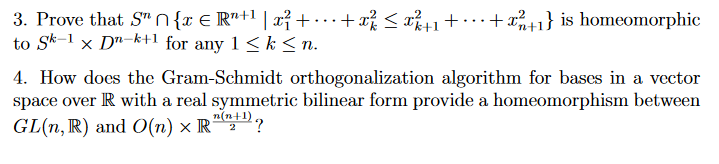

well i got 3 lmao
i know the n(n+1)/2 is somehow encoding information about "we have 1 vector, then 2, then..." and terminates at n vectors
fleet trench
regarding 4, you can treat an element of GL(n) as a set of n basis vectors for R^n (since the elements have to be invertible). by changing them into an orthongal basis, you get an orthogonal matrix back, and i guess the R^n(n+1)/2 part has to do with the way you get to that matrix
civic kraken
yea that's excatly what i'm thinking
the O(n) part is clear
the idea is very similar to 3
fleet trench
yea
midnight jewel
is $\frac{\mathrm{D}}{\mathrm{d}t}$ standard notation for the covariant derivative casue this seems exceptionally ugly
gentle ospreyBOT
Sascha Baer:
fleet trench
yeah it's very standard
you get used to it haha
also if anyone is wondering, i solved my problem; you can use the left-invariance of the metric and vector fields to show that the inner product of left-invariant vector fields is constant. then differentiating along the vector fields gives you zero, so the first three terms in that koszul formula go to zero
gritty widget
Is it true that if d(x,y) is discrete metric on X and d' is an equivalent metric to d then there exists a>0 such that d'(x,y) >= a for all x=/=y in X?
should be, right?
but don't know to justify that
hmm, also I'm not about one thing which might be slowing me down: if we take any x, we can always find a ball such that its open, right? Not sure if my wording is correct, but if we take B(x,a), where a<1 then we have an open set?
Okay, so if d' is equivalent to d then md(x,y) <= d'(x,y) <= Md'(x,y). I had to show that d'(x,y) >= m for some m>0, so it's pretty much definition? Cause for x=/=y md(x,y) is just m?
Thanks, although it feels like cheating since this definition wasn't defined on my topology course, only in the analysis one haha
yup
Oh, also, there was this question that asked whether in Q \subset R every open set is closed. I'm not sure if my reasoning is correct - I think only empty set and Q are open so they also need to be closed. (We can't have a ball in any point in this space because its in R) Is that right?
sleek thicket
There are open sets other than those two
And in fact there are other clopen sets
Look more carefully at the definition of the subspace topology
gritty widget
I get how every point in closed, cause it's a point, and after your answer I feel like every point also might be open, but I have completely no clue how can that be possible.
gritty widget
it means there exists r such that B(0,r) \subset {0}
?
Im using definition taht $U \subset X$ is open if $\forall x \in U \exists r>0 B\left(x,r\right) \subset U$
gentle ospreyBOT
Godel:
gritty widget
in this case U = {0}, so there is only one element x, being 0
sleek thicket
Right
gritty widget
but no matter how small r is there will also be another rational
sleek thicket
Yup
Also, that definition only works if you have a metric. Do you know the definition of the subspace topology? If your class hasn't gotten to that nvm
sleek thicket
So if we think of Q as a subspace of R, what would it mean for {0} to be open?
Your proof above does work, I just think this is a better way to go about it
gritty widget
it means that its either in the intersection of finite open sets or in the sum of any open sets?
sleek thicket
Q is a subspace of R, right?
When is a subset of a subspace open in that subspace?
sleek thicket
If X is a subspace of Y, and U is a subset of X, then U is open in X if there is an open set V of Y such that U = X intersect V
This is the definition of the subspace topology
Anyways, we proved that point sets aren't open in Q, but there could still be more complicated sets which are closed and open
Can you think of any possible examples?
gritty widget
Wait... we proved that point sets aren't open in Q?
you mean that arguemnt that you cant take a ball
because there is alwasya a rational near
sleek thicket
Exactly
gritty widget
I thought that if a set is closed and open then it implies its open
and implies its closed
sleek thicket
That's true
So point sets aren't both closed and open in Q
Because they aren't open
gritty widget
I'm thinking about a set in Q like (0,1]
its closed beacuse of 1
yeah should also be open near 0
sleek thicket
That's not really how open and closed sets work
gritty widget
yes
sleek thicket
Nope
gritty widget
but only elements of Q
sleek thicket
It doesn't contain a ball around 1
sleek thicket
(0, 1] is a a good example of a set which is neither closed nor open
But we're looking for the opposite of that
gritty widget
any (a,b) should be open I think
sleek thicket
I agree
gritty widget
but how is that closed?
sleek thicket
How is it indeed
What do you mean by (a, b)?
That's not a subset of Q, right?
Really we should be looking at (a, b) intersect Q
gritty widget
Yes, my bad
gritty widget
[0,1] intersect Q
gritty widget
yeah, any [a,b] for any a,b in Q
sleek thicket
Ah, but we can be even more general
gritty widget
and whole spcae
sleek thicket
Why are we restricting a and b to Q?
gritty widget
oh yeah, it can also be irrational
No, we can't - we can't take a ball in center a if its irrational, right?
the center has to be in Q
sleek thicket
That's true
But all we need is that the complement of [a, b] intersect Q is open in Q
And that means that for any rational x outside of [a, b], there is a ball centered at x contained in the complement of [a, b] intersect Q
Is that true?
gritty widget
yes
sleek thicket
So [a, b] intersect Q is closed in Q, for any a, b in R
And (a, b) intersect Q is open in Q, for any a, b in R
gritty widget
And you said there ARE closed open sets we haven't mentioned yet?
sleek thicket
There are!
Well I didn't say we haven't mentioned them yet
Just that we didn't notice they were both closed and open
Think about how we could use the thing I posted above about the intervals
gritty widget
handwavy xD
we put a ball in any x in Q in interval above and we notice theres always a radius such taht the ball is still in the interval because there are still continuum rationals between x and a or b. And also complement of [a,b] intersection Q is open so the interval itself is closed
I gotta say, you helped me understand some concepts while doing that, thank you so much. So far I don't really get topology although I had only 2 lectures, it's for sure the hardest course I've taken so far.
gritty widget
In this problem I have to determine if the set $\mathbb{R}^2$ without $\left{ \left(2^{-n}, 1\left) : n \in \mathbb{N}^*\right}$
gentle ospreyBOT
Godel:
Compile Error! Click the  reaction for details. (You may edit your message)
gritty widget
With this metric:
And I thought about one arguemtn for which I think it isnt open, I'll send a pic
wait, nvm, my thing doesn't work
midnight jewel
you haven’t actually said what that set is supposed to be
what do you want to show?
gritty widget
that R^2 without (2^{-n}, 1) for n =1,2,... is/isn't open with this metric
how do I type '' in latex?
\
midnight jewel
you can just use dollar signs to invoke math mode
if that’s the question
like this: $x^2 + 1 = 0$
midnight jewel
I may have misunderstood the question
midnight jewel
I meant the “how do I type in latex” one
gritty widget
oh
yeah I got it, but I remember there was a command for \ in math mode
doesnt matter
midnight jewel
what’s $\N^*$?
gentle ospreyBOT
Sascha Baer:
midnight jewel
oh, it’s \setminus
midnight jewel
and like… \textbackslash in text mode I think
anyway lemme take a look
$d_e$ is the euclidean metric?
gentle ospreyBOT
Sascha Baer:
gritty widget
yes
midnight jewel
aight so that’s the SCNF/paris metric then
gritty widget
so if they lay on different lines going through (0,0) we add euclidean distances form each of the points
midnight jewel
do you know how open balls look in this metric?
gritty widget
its like lines ending with 'normal' balls?
if the radius is biugger than dthe distance to (0,0)
midnight jewel
if I’m understanding you correctly, not quite
so for example let’s say $x = (2,0)$, which points have distance 1 from it?
gentle ospreyBOT
Sascha Baer:
gritty widget
its just going to be from (1,0) to (3,0)
midnight jewel
yea
midnight jewel
it would be an euclidean ball of radius 3 around the origin, and the line from (1,0) to (5,0)
I’ll spare you the drawing
gritty widget
nvm hope you didnt see that
midnight jewel
don’t worry I did
gritty widget
but I get it, issa ball and a line to the right
midnight jewel
yea okay, so now take a point in your set
midnight jewel
it is yea. the interesting points are those which are collinear with one of the (1,2^-n)
for all others you can just take like, a ball of radius (so that it reaches halfway to the origin)
or sth like that
and then you can argue about those that are collinear
and you should be able to give a description of an open set surrounding each point that way
gritty widget
yeah co if they are colinearm only one point that was excluded from our set R^2 will be on the line, so we can calculate the distance to it and tkae that as raidus right?
midnight jewel
yea
or half that, but it doesn’t particularly matter
I like giving myself a bit of “room”
gritty widget
lol
midnight jewel
even if it’s not necessary
gritty widget
ok thanks for the help:)
midnight jewel
np
midnight jewel
@dim meadow I’ve been able to solve the exercise btw
I saw through the matrix after we did the proof of the snake lemma in class (we had seen the statement but I didn’t really grasp it before seing the proof)
midnight jewel
it’s kinda interesting, I think these (algtopo and diffgeo) are the first subjects I’ve had that I both
enjoy and struggle with
it was usually one or the other
struggle with ⇔ not interested in it
but hey, I’d be in the wrong degree if I didn’t want a challenge eh
dim meadow
That's true
Did you tensor in the end and take the induced long exact sequence?
And mod out by the kernel for the first one, and restrict to the image for the last one?
midnight jewel
yea
I didn’t really understand what you meant with the tensoring when you said it but it made sense once I realized what I actually needed to apply the snake lemma
I gotta work through that proof again tho
gotta get used to diagram chasing
dim meadow
 signal venture
How would I approach this: "show that any nonempty open subset of an irreducible topological space is dense and irreducible"?
Say the space is X and the open subset is Y. A proof for irreducibility using the definition would suppose Y is written as a union of proper subsets Y_1 and Y_2, each of which is closed in Y
Being closed in Y means each $Y_i$ is of the form $Y \cap C_i$ for some subsets $C_i$ closed in X
gentle ospreyBOT
Auvera:
signal venture
So I get $Y= Y_1 \cup Y_2 = (Y \cap C_1) \cup (Y \cap C_2) = Y \cap (C_1 \cup C_2)$, which says Y is contained in $C_1 \cup C_2$
gentle ospreyBOT
Auvera:
urban anvil
if your open set wasnt dense, then the closure isn't everything, so closure plus complement is a finite union
so set isnt irreducible
 tawdry knoll
How would one go about proving that the closure of a topological group subgroup is itself a subgroup?
signal venture
@urban anvil that makes sense. How do I prove irreducibility though?
sleek thicket
@signal venture what's the closure of the union of two sets?
signal venture
The union is already closed
signal venture
All good 😂
sleek thicket
So suppose we have U = Z_1 union... union Z_n
All closed in U
Or just U = Z union Z'
What do we know about Z and Z' as subsets of X?
I guess you already said this above
We get closed subsets C and C' of X such that Z = C intersect U and Z' = C' intersect U
Right?
signal venture
Yup
sleek thicket
So then U = (C intersect U) union (C' intersect U)
Yeah?
What can we do with that?
signal venture
Well I factored out U but I'm not sure if there's an alternative
sleek thicket
That's what I was getting at
So U = U intersect (C union C')
What's the relationship between U and C union C'?
signal venture
Lol U is contained in the union. I did all this up there in my attempt at the problem 😂
sleek thicket
Omg I'm sorry
I didn't see that
Well you were almost there
Is the bright side
What does X look like?
Draw a venn diagram bunch of blobs representing the sets on paper
You have U, and C, and C'
How do we cover the bits outside the union of C and C' by a closed set?
signal venture
Hmm. Take compliment of the interior of C union C'?
sleek thicket
How do you know that contains it?
We know X\Int(C union C') = Cl(X \ (C union C')) = Cl(X \ C intersect X \ C')
Wait maybe I'm being dumb, give me a sec
signal venture
Yeah I think this works
sleek thicket
So that will contain X \ C intersect X \ C'
Nvm
You're right
This feels wrong to me
Oh it's because I made a typo
I wrote union instead of intersect
So this might be too small
signal venture
You write X as (C union C') union (X\Int(C union C')). Both sets in the outer union are nonempty and closed
signal venture
If an element isn't in C union C' then it's in the compliment of it, which is contained in X\Int(C union C')
sleek thicket
You're saying X \ (C union C') is contained in X \ Int(C union C')?
signal venture
Yes
signal venture
Haha how come
sleek thicket
It feels too general
We forgot about U
Like, pick and two closed C and C'
You can write X = C union C' union X\Int(C union C')
I think I see the issue
They need to be proper subsets
How do you know X\Int(C union C') is a proper subset of X?
signal venture
Well if it were X then we get Int(C union C') is empty. Not sure what that implies
sleek thicket
Well, the interior is the largest open subset of C union C'
So what would that imply about open subsets of C union C'?
signal venture
The empty set is the only open subset
signal venture
Oh wait U was contained in it, and it's open. I think it's assumed nonempty also
sleek thicket
Oh yeah it should be
signal venture
Yeah it is
sleek thicket
There we go
signal venture
And C union C' is also not X...?
signal venture
Ah right lol
I'm too tired to be doing this haha. I think that's everything though
sleek thicket
Well there's one more step
Since X is irreducible, either C or C' is all of X
And then C intersect U or C' intersect U is all of U
But besides that, you're done
signal venture
Right, that makes sense
Thanks for the help! I'll go through this again from the beginning in the morning
sleek thicket
Np. The core idea is pretty simple: if U is covered by closed sets of U, that lifts to a cover of U by closed sets of X, and then you add in the complement of U
urban anvil
U is dense already
so if you use that you get a cleaner proof
cover U by U-closed sets
their closure is a covering of X
sleek thicket
Oh yeah, that's why I originally said "what's the closure of the union of two sets?"
I shouldn't try and help people with math while getting dinner
urban anvil
hmmm