#point-set-topology
1 messages · Page 149 of 1
 dim meadow
dim meadow
dim meadow
Doesn't locally path connected not imply path connected?
dim meadow
I guess either work
 sleek canyon
but not path connected
dim meadow
Also any bounded subset of the long line is nice I think
dim meadow
It looks like I didn't get any replies except for some guy telling me that my condition seemed very strong
Do you not take manifolds to be second countable?
sleek canyon
i mean, a manifold without second countability
you usually would, yeah
perhaps you should add the discussion on locally path connected metric spaces to the question
it would show that it's interesting
dim meadow
Yeah
dim meadow
The reason I asked the question was because I wanted to show a property that was true for functions R \to R was also true for functions R^n \to R^n
sleek canyon
oh i guess that's answered then
dim meadow
Nah I knew this was true for R by the same argument
It's just easier to apply when your base space is R
dim meadow
Yeah same
dim meadow
@sleek canyon the argument fails if the paths in $X\times Y$ are wild enough
 gentle ospreyBOT
Liquid:
sleek canyon
does it?
dim meadow
I'm not saying the theorem isn't true, I'm just saying the proof could fail
if you don't have paths which get progressively shorter
Like you can construct the function sin(1/x) in this manner
but it's not continuous
so you can't just use any path
dim meadow
What if your space is fucked up and the curves between points get progressively bigger
Or just don't get small
sleek canyon
I'm not seeing why this would be bad
dim meadow
Then the function were defining is not continuous
Because we're defining it by connecting the paths
sleek canyon
oh did you mean like sin(1/x) with an extra point at 0?
that's not path connected is the issue
dim meadow
The issue is that as x gets close to 0 sin(1/x) get close to every point in [-1, 1]
But we can pick a sequence that tends to a single point
But if we connect the paths together we can get sin(1/x)
If we aren't careful about what paths we choose
sleek canyon
i mean in this case you can't connect the path to the final point
and it's because it's not path connected
whenever you can connect it you're fine
dim meadow
Hmm
 frigid arrow
What kind of topology takes some concepts from vector calc and generalize them further? Is that differentialtopology?
I mean like Stokes theorem and so on
frigid arrow
Yeah, I just like vector calc, so I thought I wanted to find a course which generalized that
We have a course with the name analysis on manifolds
"The course deals with fundamental concepts from differential topology, providing a connection between topology and analysis and an understanding of modern geometric reasoning. The topics to be studied are: Manifolds, tangent spaces, differential forms local and global, de Rham cohomology, Stokes's theorem in n dimensions. Topological and geometric applications."
I think that is the most relevant?
 radiant yoke
How do I know that 0 is open in the order topology on N? I was told its something about finite sets having special open sets at their "endpoints" but looking back through the notes I was given for the course it has absolutely no mention of this. Can someone explain this to me
dim meadow
Take the Ray (-\infty, 1)
It is exactly the point 0
@radiant yoke
Every point is open in the order topology on N though
radiant yoke
is that a reasonable ray to take because im using the induced order relation
dim meadow
Yep
radiant yoke
thanks man, i was having trouble doing this without using definitions given from later chapters
 naive flint
prove that in a co-countable space (with uncountable set), every collection of disjoint open sets is countable
i'm not really sure where to begin with this
 keen cliff
well, their complements are countable
if you had an uncountable collection
eventually ur gonna run out of points
@naive flint
keen cliff
yeah so suppose you have an uncountable collection of disjoint nonempty open sets
hmm how do I say this
since they're non empty
pick 1 point in all but one of them, those will form an uncountable set in the complement of the last open set, which is a contradiction
naive flint
well apparently any such collection contains exactly one set
which is trivially countable?
keen cliff
yeah
well I guess mines overkill then
cuz if you had two disjoint
then one open would lie in the complement of the other
but that would imply that the union of their complements (which would be the whole space) is countable
just like
draw a venn diagram
both shaded regions are countable
but apparently the whole space has an uncountable subset
naive flint
well the whole space is uncountable but yes
keen cliff
yea
 west spindle
yes
 lucid turret
Another question: In alg topology, cellular homology, let X be CW-complex, X^n its n-skeleton.
I can understand why:
H_n(X^n, X^n-1) = reduced H^n(X^n/X^n-1) = reduced H^n( V S^n_alpha) = Direct sum of Z_alpha
(Where V is wedge sum over indices alpha and direct sum sums also over alpha)
.
Now in my notes it says ** each Z_alpha has n-dimensional cell e^n_alpha as its generator.**
Is the bold sentence just formal convention where we just call the generator of Z_alpha the same name we gave to the n-cell e^n_alpha OR is this a result of something important I'm missing?
dim meadow
We contruct the chain complex from the free abelian group on the n-cells, so the generators are labeled by the n-cells
lucid turret
Could you be more specific pls
The chain complex in question is (Hn(X^n,X^n-1),d_n) right? Can't see the n-cells anywhere
dim meadow
yeah, each of the Hn(X^n,X^n-1) is the free abelian group on the n-cells
for example if you have 2 n-cells A and B then Hn(X^n,X^n-1) would be all elements of the form nA + mB=mB + nA
lucid turret
But how do I know that? Hn(X^n, X^n-1) is by definition n-th hlgy group of chain complex Cn(X^n, X^n-1) = Cn(X^n)/Cn(X^n-1)
dim meadow
look at Hatcher lemma 2.34
lucid turret
Oh nice
wait still the same problem, we just give the basis elements the same names as we gave to the cells
but it's not a problem I guess so all ok 😄
 frigid patrol
What does it mean " group acts on a space"?
Ex: Z_2 is the only nontrivial group that can act freely on S^n if n is even.
 honest narwhal
So you think of your group as a topological group and you want the map G\times X -> X to be continuous
Usually you're either dealing with a finite group and it's just discrete, or you're dealing with some group that has an obvious topology (e.g. Lie groups)
frigid patrol
It's analogous to group representations?
honest narwhal
Yeah that's a good way to look at it, especially if you have a discrete group
Because then that's just saying you have a group acting on a space via homeomorphisms, while representations are groups acting on vector spaces via linear isomorphisms
 dusty condor
You're looking for the definition of action
An action of a group G on a set X is a map · : G×X→X such that
1·x=x for all x in X (1 is the identity element)
(gf)·x=g·(f·x) for all g,f in G and x in X.
It is said that G acts on X via ·.
G is any group, not necessarily a topological group or a group of morphism and X is any set not only topological spaces.
If you want more properties just ask for them. A continuous action of a topological group on a topological space, a faithful action, a free action (as in your case)...
A free action is an action for which g·x=x → g=1.
dim meadow
Is there an analogy of the homomorphism G -> S_|X| definition of group actions for continuous group actions?
Like some topology you can put on S_|X| or something
 mighty needle
If V is the complement of a closed disk in the interior of D^n, what does the quotient D^n/V look like? I'm tempted to say it's S^n, considering the quotient of D^n by its boundary is S^n, but here it seems like maybe we're crushing a little more
dim meadow
I'm not so sure that it's even hausdorff
sleek canyon
yeah V is not closed so it's not gonna be hausdorff
mighty needle
Hmm. Do you think its contractible anyway?
mighty needle
A smaller D^n
Sorry that wasn't super clear
I'm gluing D^m to a space X via a map f:S^(m-1)->X and I need the homology of the resulting space
sleek canyon
are you sure you don't wanna identify the complement of the interior of the smaller D^n?
mighty needle
I'm thinking I can use the homology of a pair of the new space and the complement of a disk in D^m
sleek canyon
if you take V to be the complement of a smaller - open - ball
then you get Sn
by the same quotient as before
sleek canyon
👍
 feral copper
What does π₁(ℝℙ¹) equal to ?
Considering the short exact sequence 1->ℤ->π₁(ℝℙ¹)->ℤ/2ℤ->1 is there anything we can tell ?
Here I mean ℝℙ¹=𝕊¹/(ℤ/2ℤ)
dim meadow
There's an obvious covering space
Which has trivial fundamental group
If you view RP^1 as a quotient of R^2-0
Wait actually easier
feral copper
As ℝ²-0/ℝ* ?
dim meadow
RP^1 is homeomorphic to S^1
dusty condor
RP¹ is a line with a point at infity. That's a circumference via the stereographic projection
feral copper
1 or 0 you get the idea ^^
dim meadow
🐷
sleek canyon
you can't tell it directly from the exact sequence sadly
you know that it is a 2-fold covering from S1
therefore it must be a compact connected 1-manifold
and so it's S1
you can probably show it directly as well
 gritty widget
🤔 Any thoughts on how to go about some neat, non-Hausdorf topologies on the hyperreals?
 midnight jewel
cofinite/cocountable would be non-hausdorff but not that interesting and would work on the reals as much as the hyperreals
hyperreals have the same cardinality as reals, right?
also, if you just used the topology of the reals
gritty widget
Idk if it's known if they do or don't have the same cardinality. I don't understand enough about it yet.
midnight jewel
that’d be non-hausdorff
like
set it so
an open interval contains all the real points that would be in it, plus any hyperreals between any two reals in it
and only allow reals as the boundary points, with (x,x) still empty
then of course there’d be no disjont open sets to separate ε and 2ε
but that’s a very coarse one :P
gritty widget
lol. Thank you for examples & explanations.
dim meadow
The hyperreals have the same cardinality as the reals but there are other nonstandard models which can have whatever cardinality you want
gritty widget
Do you have a proof? @dim meadow
sleek canyon

Mathematics Stack Exchange
What is the cardinality of the set of hyperreal numbers?
dim meadow
The second part of my statement is the lowenheim skolem theorem
gritty widget
On the other hand, |∗R| is at most the cardinality of the product of countably many copies of R.
Why is this true?
dim meadow
Look at the construction
sleek canyon
gritty widget
Ah. Thank you.
dim meadow
What's the standard proof that an open set of R^n must contain n linearly independent vectors?
Is it that an open set is a submanifold of codimension 0 and thus can't be contained in any subspace of lower dimension?
Or am I just overcomplicating things
sleek canyon
it contains a ball, so it contains the vectors v and v + e_i for some basis e_i (of small norm)
therefore it contains the e_i
dim meadow
I guess that's easier lol
I think I have a problem where I try to use big machinery to solve little problems
And can't think of simple proofs because of that
sleek canyon
sometimes it's nice
to reframe simple stuff as easy consequences of nice results
but sometimes it gets in the way
I feel like it's part of the process of learning math though
it definitely happens to me a lot
when you learn something new in a topic, the old way of looking at things gets blurry
while your brain reconciles it
with the new stuff
frigid patrol
Someone explain local degree to me
frigid patrol
You can break the degree of a map into multiple local degrees
And then sum them up to get the degree
Diagram chasing is so hard

feral copper
Given a path-connected manifold X, and two points x and y in X such that there exists a path g : [0,1] -> X connecting x to y, and such that for any t in ]0,1[, the point g(t) has a neighboorhood V in X that is a (regular) submanifold, let one define the equivalence relation == on X such that a==b iif a and b lie in g([0,1]). Is it true that π1(X)=π1(X/==) ?
With a "drawing", if you consider the lemniscate, it means you can shorten the branches on both sides, as lons as you don't merge them with the crossing point, and it preserves the π1
But in a more general way somehow
sleek canyon
of course not
consider the circle
and a path that goes around once
surely that's a (regular) submanifold
but quotienting out by it will kill the fundamental group
feral copper
No
Quotienting yields a smaller circle
Oh
Yes
I forgot "non closed" path :DDD
Well your example still works
"injective non-closed path" then ?
sleek canyon
take two injective paths that cover the circle
quotient will still be a point
in general your quotient is a single point
for each path connected component
feral copper
Two ? I fixed a path g here
sleek canyon
oh you're quotienting a single one?
then yeah if the path is contractible there's no problem
feral copper
Oh the condition is contractible
 marsh forge
Are homemorphisms able to "unlink" holes
Like are interlinked tori homemorphic to unlinked tori (assume the tori don't intersect)
west spindle
what, like
are you asking whether the union of two unlinked tori is homeomorphic to the union of two linked tori, both considered as subspaces of R^3?
yes
trivially so
they aren't homotopic tho
marsh forge
Yeah that was the intuition I was making sure was right
Stuck on a altop question asking for a def retract of an unlinked genus 2 onto a linked genus 2
For a deformation retract I need to be able to "see" the image in domain right (due to the restriction to identity on the image)
sleek canyon
they are homotopic spaces, just not homotopic embeddings in R^3
honest narwhal
@marsh forge I know where that problem came from 👀
marsh forge
Haha it was cropped out of the source for the pset
Unless you’re also a uchicago student lol
@honest narwhal
honest narwhal
Yup
 gilded shell
Are two points a CW-complex? If yes then CW-complexes can be disconnected right?
dim meadow
Yes
There's a theorem about a cw complex being connected if and only if it's 1 skeleton is connected
If your complex is 0 dimensional it is discrete, and so either a single point or disconnected
gilded shell
Oh!.... Nice! Thank you liquid
frigid patrol
What is the mapping M_f cylinder of a map between spheres f:S^n -> S^n
gilded shell
That's just a hollow cyllinder. Or a sphere with a sphere shaped hole right? I'm not sure what answer you want
frigid patrol
What's the definition?
lucid turret
Question: If X is htpy equivalent to its subspace A, inclusion i: A to X being htpy equivalence, and if f:X -> Y is a map, then maps f and fi:A -> Y induce the same map in homology, right?
lucid turret
Another question: If i_alpha : X_alpha -> Y are inclusions for each alpha, then the corresponding map from disjoint union of X_alpha to Y (inclusion on each summand) induces "sum of arguments" map in homology?
sleek canyon
sure
lucid turret
OK this is not MV related, but is moebius strip with 1 point "in the middle" removed htpy equivalent to S1 v S1 ?
v ... wedge sum
lucid turret
I'm becoming more stupid the longer I keep on trying, thanks a lot wise man
doing math all day really drains your brain
 vocal grail
Anyone know of any examples of two sets in R with the usual metric that are disjoint, but their closures are the same?
sleek canyon
rationals, irrationals
vocal grail
So the closure of irrationals is R?
sleek canyon
yeah
vocal grail
Alright, thanks
midnight jewel
in general, any dense set and its complement
no, wait
any dense set whose complement is also dense
the closure of any dense set is the whole space
vocal grail
thanks
 kindred meadow
I have a feeling that simply connected does not imply locally simply connected (every point has a simply connected local base). But I couldn't come up with an example
Any idea?
sleek canyon
take a space which isnt simply connected or locally simply connected
take the cone
for example the cone over the hawaian earring
kindred meadow
Nice, I forgot about that construction
 brazen portal
idk much about topology so i started reading some intro topology. my big question is, why do we care about topology? what are open sets supposed to model?
 small obsidian
Ultimately, topology is a structure that can model many things. If you can find a way to place that structure on something, then you already know lots about it, since we already know lots about topology
I remember recently seeing a proof that there's infinitely many primes using topology. That was cool, and shows off how powerful the methods can be
Open sets don't become very useful until you introduce the idea of a continuous function
That is, a function that preserves open sets through their inverse image
Gottem
 shadow ermine
@brazen portal have you looked at metric spaces?
brazen portal
to me its just that without motivation, all these arbitrary definitions seem random
small obsidian
The typical thing to do with topology is make shapes with it. Then, you have a concept of "continuity" without needing "distance"
brazen portal
yeah ive seen metric spaces
shadow ermine
most of my understanding as to why topology is useful, is generalising a lot of results from metric spaces
brazen portal
for a more specific example, https://ncatlab.org/nlab/show/Introduction+to+Topology+--+1 Example 3.6, they mention u can "factor" out a continuous function
and then later on, the idea pops up again https://ncatlab.org/nlab/show/Introduction+to+Topology+--+1#ImageFactorization but im not seeing how its useful in any way
shadow ermine
I mean, it's talking about continuous functions between topological spaces, and example 3.6 is specially talking about a point space - which is useful when talking about homotopy stuff, i.e. being able to continuously deform something into something else
R is homotopic to the point space
and homotopy is an equivalence relation, so something homotopic to R is homotopic to {*}
brazen portal
maybe for the second example, its that for any function f:X->Y, u can do the same thing, factor it into a surjection f:X-.f[X], then an inclusion map g:f[X]->Y, and theyre trying to see if there are f,g continuous that work the same way?
ill just read more, im sure the motivation will pop up
shadow ermine
nlab is very category motivated, it may just be bringing up that sort of factorisation because it relates to a more abstract notation
not sure by the example if it's hinting at lifting theorems 
frigid patrol
I remember just last year i was a asking why do arbitrary union of open sets have to be open and why dont arbitrary intersections need to be open
Essentially, why is this the definition of a topology
To answer that you have to see how the definition is used to prove statements. Only then will it start to make sense
west spindle
for me the enlightening moment was proving that it holds in metric spaces
honest narwhal
So, the thing was, I saw that it held in metric spaces and was like
Okay why is that the property of open sets you choose to generalize???
shadow ermine
for me the enlightening moment was proving for metric spaces (X, d) & (Y, d'):
f:X->Y is continuous iff for all open sets V in Y, f^-1 ( V ) is open in X
which then made it completely reasonable to start talking about open sets & images/preimages, because we can describe continuity without necessarily introducing a metric
honest narwhal
Yeah somehow in my mind the reason it makes sense is that in metric spaces, open sets are unions of balls
So preimages of balls... Okay they're not balls but they're unions, and we're chill with that, so the allowable sets should be closed under things that unions of balls are closed under
frigid patrol
Also, the continuity of a function only depends on the topology of the spaces
You can have different metrics generating the same topology and observe that continuity of functions (using the epsilon-delta definition) is unchanged
 random slate
So, wow, this problem is really frustrating me...
Here is the problem and my first solution: https://snag.gy/i9Jwfr.jpg

The feedback I received was "you haven't shown they're equal, you've shown one is a subset of the other"
I've already proven that A is closed iff A = cl(A) and that whenever S is a subset of T, cl(S) is a subset of cl(T)
But I feel like I'm going in circles trying to prove the reverse inclusion
Just to make sure, what I've shown so far is that cl(A) is a subset of the intersection of all closed sets containing A, right? Not the other way around?
And what I've tried to do is to let x be in the intersection of all closed sets containing A, and I need to show that x is in the closure of A ... if x is in A we're done, so we need to try to prove that otherwise x is a limit point of A ... but I get stuck there.
If x is a limit point of A, then any open set containing x should contain another point of A.
Agh, it's all going around in circles. I'm missing something obvious.
frigid patrol
It's very easy. A- bar is a closed set containing A and thus contains the intersection of all closed sets containing A.
random slate
(blank stare)
 tough hamlet
rip
frigid patrol
the intersection is a subset of each of the sets being intersected
random slate
yes @honest narwhal
honest narwhal
So you have two inclusions. One is that the \overline{A} contains the intersection of closed sets containing A, and the other is that the intersection of closed sets containing A contains overline{A}
To make life easy I'll use cl(A) to denote the intersection of closed sets containing A
One sec gotta head out because fire alarm
random slate
So the thing I've shown so far is that the intersection of closed sets containing A contains cl(A), right?
frigid patrol
Yes
random slate
So now I have to show that cl(A) contains the intersection of all closed sets containing A
frigid patrol
Ok
random slate
So I understand that cl(A) is closed and contains A
frigid patrol
Yes
random slate
Oh, here's the "remark that gives a vague outline of the proof"
I would have just accepted that as proof but w/e
. . . OH.
Now I get what I was missing
IT's a property of intersection
A set with property P inherently contains the intersection of all sets with property P
honest narwhal
Is that a problem? If you fix a universe then you take the set of subsets with a given property, their intersection is contained in any one, whatever that property is
A \cap stuff \subset A
That's why I was originally saying well, maybe could be stated better but the idea is there, "intersection of objects" means those objects are sets
Yeah that's probably fair
Lmao, happens to the best of us
Such as me
 humble cloud
a torus a bagel, a human a mouse
honest narwhal
tfw
random slate
@cinder glade It makes sense to me now heh
 cinder glade
Wha-
lucid turret
If I have cohomology ring of CP^n with coefficients in Z and x is generator of H^2(CP^n, Z), how do I know that "x cup x" will be generator for H^4(CP^n,Z) ?
Remind you that H^k(CP^n) = Z for 0<=k<= 2n even and 0 otherwise
dim meadow
Is there a term for the topology induced by all the preimages of open sets from some particular space?
 dire warren
Initial topology?
dim meadow
Thanks
 eternal anvil
Anyone who's done some tqft — is an introductory course in topology and an introductory course in abstract algebra enough to get into some TQFT?
west spindle
here's a fun little problem i just came up with
construct a subset of R^2 that is dense, path-connected and has measure zero

 dim meadow
I think you can generalize to R^n pretty easily using a hyperplane and a Q^n action by translation
honest narwhal
What example did you have in mind? @west spindle
west spindle
oh, mine actually came from a problem someone else had asked about here
mine is the union of all straight lines of the form ax + by = c for a, b, c in Q
midnight jewel
the bisector lines?
west spindle
yup
lucid turret
Hey folks, another question. Let's say I'm calculating homology of RP^n. What is the difference between calculating it with Z coefficients and calculating it with Z/2 (or Z/p) coefficients?
I know the groups end up being different, but what does it tell me?
Which tells me more information about RP^n ?
honest narwhal
So you have the universal coefficients theorem, so knowing Z should, in principle, give everybody
And I'd say it carries more info, but sometimes it's easier to compute with coefficients in fields
For example, you don't have to worry about torsion, and also, when n is even, RP^n isn't an orientable manifold, but there's a notion of orientability wrt a coefficient ring
In particular, everybody is orientable with respect to Z/2, so you can always apply Poincare duality with Z/2 coefficients
That's about as much as I know
dire warren
Denote by H the Hilbert cube [0, 1]^N under the product topology. Is there a continuous map f: [0, 1] -> H such that f(0) = (0, ..., 0, ...) and f(1) = (1, ..., 1, ...)?
What about the box topology?
west spindle
why not f(t) = (t, ..., t, ...)
midnight jewel
yea no, preimage of Prod([0,1/n), n in N) is 0, which is not open but that set is open in the box top
midnight jewel
well that was fun
exercise 3: Let $X$ be a top. space, and let $\Delta$ be the set ${(x,x) } \subset X\times X$. Prove $X$ Hausdorff iff $\Delta$ closed.
I couldn't get anything done, decided to move on.
Exercise 4: Let $X$ be Hausdorff, let $\sim$ be an equivalence relation on $X$. Show $X/\sim$ is Hausdorff iff ${(x,y): x \sim y} \subset X \times X$ is closed.
gentle ospreyBOT
Sascha Baer:
dim meadow
That theorem about the diagonal being closed iff hausdorff is surprisingly useful
Which direction were you having trouble with @midnight jewel
midnight jewel
I couldn't really think of anything, but I only seriously tried myself at hausdorff -> closed
I tried it both directly and by contrapositive
and never really got anywhere
I guess part of it is that I don't really see why it should be true?
dim meadow
Hint: look at the complement. Show you can find an open set around every point in the complement entirely contained in the complement
midnight jewel
that's what I was trying
since closed doesn't really mean much other than "complement is open" in a general space
dim meadow
But it's almost immediate lol
From that
If there is U, V which don't intersect
Then UxV does not intersect the diagonal
midnight jewel
oooh
yea I did not see that
my problem was I was trying to apply hausdorff differently. basically I was thinking "alright, so for a point (z,z) on the diagonal and a point (x,y) not on it, can I find neighborhoods so that the one of the latter doens't intersect the diagonal", but that doens't really work
since you can't take the intersection over the (x,y)-neighborhoods
and thus can't really guarantee anything
dim meadow
Yeah, tbh I'm a bit biased because for some reason I've been assigned this problem like 3 times
midnight jewel
well, let me try my hand at it again and see if I can come up with the other direction myself
and then 4 I assume works rather similarly, cause 3 is almost a special case of it (would be if 4 didn't assume X to be hausdorff)
but first updating #books-old cause a few recs have come in. and no one's recommending any of the books you always hear about
makes you wonder if they're not as popular as it'd seem
dim meadow
Maybe everyone assumes that everyone else is recommending those books
So doesn't bother
midnight jewel
I explicitly say that it's fine (and even preferred) if a book is recommended multiple times
cause then I can make a better description
having seen some different viewpoints
and if multiple people rec it I'll move it to the top of the list
dim meadow
I was going to recommend Hodges model theory book
But I was too lazy to write up a description
midnight jewel
I mean go for it, it'll land right at the bottom in the "I have never even heard of this field" category :P
midnight jewel
okay the other direction was p much the same
just an extra step invoking the definition of the product topology
in order to get back a UxV again
midnight jewel
I don't think you can, no. consider an open set containing both (x,y) and (y,x), then the projections wil both contain both x and y
in particular they won't be disjoint
midnight jewel
I'm "working on it"
as in, I am currently busy procrastinating
no spoilers, I haven't yet spent enough time actually thinking about it
 quiet yacht
Hello, does anyone have any idea how to demonstrate that
With M being a not-empty set, is Hausdorff?
sleek canyon
what's endlich
midnight jewel
yea but then it's just the discrete topology so that's not interesting
therefore, Ox and Oy have nonempty intersection
quiet yacht
Nothing said about M , obly M\U is finite
midnight jewel
therefore (M,O) is not hausdorff, unless M is finite
can I see the whole exercise (I can read german)
midnight jewel
yea so show it's a topology and then use the argument I gave above (which I shall now delete so you at least have to think through it yourself again) to argue that it is not (in general) hausdorff
they don't ask you to show it is Hausdorff after all, they ask you whether it is or not
quiet yacht
Ox being set of only 1 element? Or sets dependant of x?
midnight jewel
the answer being "only if M is finite"
Ox was the arbitrary open set containing x
but reason through it yourself again
quiet yacht
I shall then, thank you for the help
midnight jewel
you might find it useful to rewrite it as $O = {U: U = M \setminus F, F finite} \cup \emptyset$
gentle ospreyBOT
Sascha Baer:
midnight jewel
which is obviously the same
quiet yacht
That one i was unaware of
midnight jewel
should be straightforward to reason that those are the same
vocal grail
Hey, guys, does anyone know of an homeomorphism from [0, 1]/~ to S^1?
sleek canyon
e^{2 pi i x}
midnight jewel
you know, it is really not helpful when you don't specify what ~ is
I mean there's an "obvious" one
but still
vocal grail
~ is an equivalence relation. I am working with quotient topologies. Sorry for not specifying.
And thanks, bird
dim meadow
That wasn't the part that you didn't specify lol
dim meadow
Yep
vocal grail
Alright. So what would be an example of an homeomorphism? I thought of f: [0, 1] -> S^1 where f(x) = (cos(2pix), sin(2pix))
west spindle
do there exist metric spaces not homeo to R^n but in which the heine-borel theorem (compact iff closed & bounded) holds
 bitter yoke
I think discrete topology works?
sleek canyon
Z^n works
dim meadow
Cause you can always bound your metric
dim meadow
True for every compact space
sleek canyon
you shouldn't be able to bound the metric, the morphisms to consider are lipschitz maps
since we are dealing with metric spaces
west spindle
d/(1+d) tho
sleek canyon
maps like that are morphisms of top spaces but not what you'd consider a morphism of metric spaces
since they don't preserve metric space properties like completness
dim meadow
That's cool actually
I've always just thought that boundedness was stupid, but I guess it makes sense in Met
@sleek canyon are you a metric geometer?
 sleek canyon
yeah but you meant isomorphic in Met
because otherwise boundedness doesn't make sense
west spindle
no, i did not.
i meant isomorphic in Top
hence why i said homeomorphic
there's a forgetful functor Met -> Top okay
dim meadow
So if you place a bounded metric on R^n Heine borel actually fails
Maybe a refinement of your question is "which spaces can you place a metric on so that the Heine Borel property holds?"
The most obvious counterexample being the infinite discrete spaces
That makes it a topological question
lucid turret
If I have long exact sequence for pair (X,A), I also have l.e.s. for pair (X,A) in reduced homology groups right?
midnight jewel
so am I right in assuming that topology beyond pointset is just a lot of fancy sounding words? like, I mean "cohomology" come on
 steel needle
I guess there's a bunch of big words in algebraic topology
midnight jewel
I could take algtop next semester, don't know yet
I would have to not take functional analysis
I could also take either of them in my master's
so it's not strictly exclusive
the main reason I'm conflicted tho is because there's gonna be a lecture on 4-manifolds and I have my doubts that I'm ready for it, but it isn't a repeating thing...
so I figure I should prolly take more topology classes alongside it (and I am also definitely taking diffgeo) and hope for the best
4D stuff has always fascinated me, especially after learning some more fun facts about it
(things like the whole exotic R4)
I could totally see myself going down in that direction, but at the same time, mathematical physics also appeals to me and for that, functional analysis would be more useful I suspect
brazen portal
i found this absolute monster of a book http://www.topology.org/tex/conc/dgchaps.html
Search the world's information, including webpages, images, videos and more. Google has many special features to help you find exactly what you're looking for.
steel needle
algtop is pretty fundamental for a bunch of stuff
but so is functional analysis if you wanna do analysis
honest narwhal
The words in AT are there for a reason
steel needle
i don't know if you're ready to do a lot of stuff on 4-manifolds
even though it's cool to get exposed to advanced topics
it's better to make sure all your fundamentals are in check I think
honest narwhal
"In this course we classify 4-manifolds up to diffeomorphism, and use this result to effectively solve the word problem for groups"
lucid turret
Can anyone follow please why a = 1 ?
midnight jewel
i don't know if you're ready to do a lot of stuff on 4-manifolds
I doubt I am. but there might not be another course on it for several years :/ I can't check out the prereqs yet tho, the lecture directory isn't live yet, only a preliminary timetable
steel needle
if you can take alg top and func an I would do that
midnight jewel
I can't take both at the same time. I mean, I technically could but I would burn out rather quickly
basically, I'm already taking diffgeo for sure (10 ects), I have to take an applied subject (7-10 ects) and the geometry course I skipped in my first semester (3 ects). func ana is 10 ects and algtop 8. 4-manifolds is 4. recommended for a semester is 30, I can handle 35
steel needle
getting my arrows mixed up hang on lol
honest narwhal
"I'm already taking diffgeo for sure" so that's your mistake
steel needle
he sounds intersted in diffgeo though
midnight jewel
I am very interested in diffgeo
steel needle
and it's a fundamental course for sure
midnight jewel
have been ever since the intro to it during analysis II
and tbh even before that, I just didn't know it
cause I came to university with the goal of understanding general relativity
and, as it so turns out, diffgeo is right on that path :P
 nimble jolt
diffgeo IS much of that path haha
midnight jewel
I also enjoy topology, but the "algebraic" part of algtop scares me a bit. what kind of algebraic is it anyway? cause I like groups but I have not been able to like the other parts of it (like galois theory, for example)
steel needle
@lucid turret take cohomology of the composition, you get (id x e)* m* = id, apply it to gamma and you get
(id x e)* m*(gamma) = gamma
(id x e)* (a alpha + b beta) = gamma
a gamma = gamma
midnight jewel
yea that says exactly nothing to me :P
okay diagrams could be fun I guess? haven't seen much of those yet tho
steel needle
the point of algebraic topology is getting topological invariants that are algebraic objects
like for example "being connected" is a topological invariant
honest narwhal
Not been able to like Galois theory???? 😡
steel needle
but the invariants of algebraic topology are much richer
they look like
"has fundamental group Z"
nimble jolt
Do you know what diagram chasing is? You have probably come across commutative diagrams before.
honest narwhal
But yeah you should abandon diffgeo, relativity, and do representation theory
midnight jewel
oh we're starting ont he fundamental group like, now
steel needle
yeah that's gonna be good motivation
midnight jewel
we defined it last class
lucid turret
@steel needle ah yes it works that way. do alg top classes tend to be so very hand wavy in other universities too?
nimble jolt
Things get a bit more elaborate in AT
steel needle
it's not hand wavy, it's just that there's always a lot of chasing involved, and you kinda have to do it yourself because explaining it in length is tiresome lol @lucid turret
midnight jewel
we're wrapping up the intro topology class with chapters 0 and 1 from hatcher's algtop book
nimble jolt
enjoy your nightmares of houses with two rooms
midnight jewel
same prof is gonna give algtop next semester so I assume it's gonna feature that book
oh I read that bit in the book, took me a while to realize why the two supportive walls were needed
steel needle
that example is awfully explained
honest narwhal
"houses with two rooms" 😭
midnight jewel
but I figured it out eventually so yay me. and yea, the explanation was not very great
nimble jolt
its common and good, but it's the AT book of choice for algebraic topologists, which makes it not the most gentle.
I learned the basics from lecture notes and then referred to hatcher to fill in gaps later.
honest narwhal
Ehh, the algebraic topologists I know say it's a good AT book for geometric topologists
nimble jolt
okay, but an algebraic topologist is closer to a geometric topologist than I am to either of those things
so much the same from my perspective.
honest narwhal
Allen Hatcher himself was one. I think people in AT prefer Concise and Spanier
midnight jewel
if I'm interested in low- and 4-dimensional topology, then I should look into taking some geometric topology if I can, right?
nimble jolt
spanier is beastly, but yes am sure a reference of choice to many.
honest narwhal
I've also heard that there's a modern Spanier by Tammo tom Dieck
steel needle
oh topological manifolds?
honest narwhal
Geometric topology is basically topology of smooth manifolds when you're not satisfied with homotopy equivalence anymore
steel needle
anyway you probably wanna learn your topology basics (algebraic and differential) before going into that
nimble jolt
oh okay
steel needle
I see
midnight jewel
I get the feeling I'll be catching up on the basics until the end of my master's and then never have gotten anywhere
midnight jewel
I don't know if I will be doing a phd tho
steel needle
oh
steel needle
I mean, if you decide not to do a PhD then you aren't going to do more than scratching the surface anyway
what's the alternative? industry?
midnight jewel
teaching
which is worthwhile doing here, before you interject
not in the states
midnight jewel
becasue I don't live there
honest narwhal
Differential topology doesn't seem to be an "area of research" somehow, like a lot of things that were classically thought of as difftop were dealt with by AT by folk like Milnor and Smale
steel needle
you get funding by being a TA
midnight jewel
I am a TA right now
honest narwhal
So maybe we can say geometric topology is kinda the modern successor?
midnight jewel
but I meant becoming a high school teacher
steel needle
yeah it feels like that daminark
I wonder what the flavor's like
I imagine it's like 2 dimensional topology on steroids
midnight jewel
I very much enjoy teaching
midnight jewel
I mean basically if I can I'd just stay at uni, learn some more things as I go and teach intro level courses
I'd be happy with that
but that's not really a thing
nimble jolt
@midnight jewel same. I think if academia does not work out, I would be happier (despite being poorer) teaching at a good high school than in most industry jobs.
steel needle
there's a bunch of smaller teaching universities
midnight jewel
I am gonna do the teaching diploma on top of my master's and use that time to reflect on whether I wanna go back to math and do a phd or go straigth into teaching
steel needle
where you mostly do calculus and linear algebra and whatnot
nimble jolt
that's true
midnight jewel
(high school teacher here requires a master's degree + a 3 semester diploma)
(so I wanna get that out of the way just so I actually have something)
midnight jewel
I mean doing a phd is going to academia tho
nimble jolt
not really
steel needle
not exactly
honest narwhal
There aren't enough academic positions for that to be true
steel needle
PhDs put you in contact with people in the math world
for many it's a good way to make contacts
and branch into industry
or whatever
honest narwhal
I wish PhD implied academia because then I'd be guaranteed academia 😦
midnight jewel
idk a several year paid position at a university where you do research sounds like academia to me
nimble jolt
you and me both mate
steel needle
pepehands
midnight jewel
even if it's only temporary
nimble jolt
for a phd pay is just a small stipend
I would say my current postdoc is my first "job" in academia
and there is no guarantee of success from this point, the hardest hurdles are still ahead.
honest narwhal
First year or two of your PhD is classes, and then you're doing research but probably semi-coddled by your adviser
nimble jolt
yeah
honest narwhal
And like, for example, I'm getting $23k/year as my stipend
nimble jolt
yeah
honest narwhal
(I don't regret not taking Notre Dame's offer I don't regret not taking Notre Dame's offer I don't...)
nimble jolt
although realistically it is hard to hit the ground running unless you are exceptional
there is a lot of absorbing literature needed in the early stages. the aus system is similar
gritty widget
I hear in Europe, they have to do a masters before a doctorate.
midnight jewel
idk the lowest salary for a first year phd student here is 4k / month
honest narwhal
Gotta find a way to take the union of Notre Dame and Madison. Mostly means Madison but with Notre Dame''s stipend and cost of living
midnight jewel
that is more than "a small stipdend"
honest narwhal
Wait which country are you in exactly?
midnight jewel
switzerland
honest narwhal
Oh that makes more sense
Since I felt in most of Europe getting funding is just LMAOOOOOOOOOOO
nimble jolt
4k a month what currency?
honest narwhal
But really folk I know in Germany make less money than Americans
steel needle
i wonder who that is
honest narwhal
Not on discord
steel needle
oh ok
 midnight jewel
swiss francs, which are at a 1:1 conversion rate with USD (but keep in mind, cost of living in siwtzerland is than in the more expensive cities in the states)
nimble jolt
yep, still though that is a great stipend. tax free?
nimble jolt
ah so taxed, that makes more sense.
midnight jewel
so I doubt it's tax free
honest narwhal
tfw taxed 😦
nimble jolt
My stipend in Australia was a tax exempt 25ish k, roughly 20ish k USD.
honest narwhal
I think take home after taxes in Madison is something like 19-20k?
gritty widget
Go to ND
honest narwhal
Which is doable for the city but also damn that sweet $35k stipend from ND 😦
midnight jewel
also note that the number I listed was the lowest, there's different rates (no information given who exactly gets which rates), the highest is almost twice that
they're still not fantastic salaries, mind. housing in zürich is expensive af, as is food
honest narwhal
brb applying to Zurich
midnight jewel
 midnight jewel
who everyone?
honest narwhal
In general Europeans apparently don't have a good time applying to jobs in America
steel needle
a bunch of them applied this year
midnight jewel
I can tell you I'm not intending to go anywhere near the US currently
steel needle
but applying to PhD should be fine
midnight jewel
not with the current administration, at least
steel needle
I mean I applied from latin america
honest narwhal
Part of it was that a lot of people were already American
midnight jewel
nah I just don't want anything to do with the US, tbh
steel needle
yeah fair I guess people just stay where they are
midnight jewel
if I have to go abroad I'll go to like, vienna. or the UK
steel needle
what's wrong with the US @midnight jewel ?
honest narwhal
So non-America just isn't in your radar as much. When I was worried I was gonna get TKO'd by grad schools I considered applying abroad
steel needle
lol yeah when I got my first rejections I started to put together a canada/europe list
midnight jewel
don't like the current political climate, and all bad things I ever hear about academia come from the US
steel needle
what bad things
honest narwhal
And I toyed with Toronto/UBC/McGIll as well
midnight jewel
like, anything from underpay to abuse to just bad culture
midnight jewel
am I being interrogated rn?
steel needle
Im curious
midnight jewel
I don't have specific things in mind
honest narwhal
But I remember a few grad students told me that you generally don't want to go to Europe until tenure track
midnight jewel
I just hear bad things occasionally and it always seems to come from the states
steel needle
yeah I was told it's easier to go from the US to EU than the other way
midnight jewel
might just be confirmation bias, or demographics bias
steel needle
seems to be the general consensus
midnight jewel
but still
as long as a racist idiot is leading that country I'm not stepping foot in it anyway
honest narwhal
Also the disadvantage of Europe is that you have to deal with the application process twice
You go for a master's (and I think it's harder to get funding for that), and then you have to apply for a PhD
steel needle
yeah the application system isn't as standard and easy as in the US
for foreigners that is
it's very streamlined in the US
honest narwhal
It's sorta nice to have guaranteed funding for 5 years and I'm leaving with a PhD
nimble jolt
assuming you don't discover in your thesis defence that the set of objects that satisfy the assumptions of your theorem is the empty set.
or the set of constant functions or something.
nimble jolt
lol
steel needle
will captain america be able to understand this reference?
midnight jewel
in a lecture on the tensor product, my linalg prof went something like: "so, we've proven a lot of things about the tensor product now, it's now time to show that it actually exists. someone I knew made that mistake in her phd thesis - they proved a chain of really strong inequalities, but in the end it turned out that actually, the smallest number of all of these was already infinite, and so the entire work was worthless. be very careful when you don't get shown any examples"
frigid patrol
Is the plane minus the origin homotopy equivalent to the circle?
frigid patrol
dim meadow
Yeah you just draw a line between every point on S^n and the point you remove
And extend those lines out through the entire R^n
I guess it helps to first look at R^n as an open ball
marsh forge
Can someone explain to me why the following is not a covering space of S^1 v S^1
Basically taking S^1 v S^1 and removing a point on both circles (not the middle point) and sending the four rays to infinity
It seems like it should be a covering space but paths don't seem to list properly bc you can 't return to the middle point
steel needle
how is the covering map defined?
the only nbhd homeomorphic to the middle point in your space is the middle point itself
so if it was a covering it would be of degree 1
so it's a homeomorphism
marsh forge
Ok thats what I thought, covering defined as every point has an evenly covered nbhd
But we have an assortment of theorem about paths being able to be "lifted", I guess I need to double check the hypotheses of those to understand why there isn't a contradiction
bitter yoke
loops do not need to lift to loops
steel needle
you're definitely not evenly covering nbhds @marsh forge
marsh forge
Oh wait that's totally obvious you're right
gritty widget
ugh
How do I prove that H is continuous, where H(x,t)=f(x) (for all t in the unit interval, and f is continuous)
steel needle
by definition?
steel needle
f-1(A) is open
gritty widget
how do I know
steel needle
f is continuous
gritty widget
o yeah im dumb I meant H lol fuck
steel needle
you can describe H-1(A) in terms of f-1(A)
and check that it's open in the product topology
gritty widget
let A be an open set in Y, so H^{-1}(A) is gonna contain (x,t) where x in f^{-1}(A) and t in [0,1]
gritty widget
closure of I
steel needle
im writing I = [0,1]
gritty widget
oh lol
steel needle
another way, the projection p: X x I -> X which takes p(x,t) = x is continuous, notice that H = f p
gritty widget
ok but f-1(A) x I is an open subset of X x I cause f is continuous and I = I
steel needle
yeah
gritty widget
so that should be it yeah sweet
ty papi
I'm currently trying to prove that being homotopic is an equivalence relation so ty cause that just finished the reflexive part lol
steel needle
yeah that's what it looked like
the other two are very graphical
you should try to draw the homotopy as a square
and piece two homotopies together into a new square
etc
if you haven't already
gritty widget
you sound like you know your stuff on this
I'm just doing this as part of a final project in an independent study course
the project is on homotopy groups of spheres and I need a better understanding of homotopy so I'm going through it's properties etc
do you recommend a book for personal study? I'd love to grab a topology read for the summer with some good exercises
what did you do?
steel needle
homotopy groups of spheres are hard
if you wanna work towards a cool result you should aim to understand the hopf fibration
it's not very difficult
people usually learn this from hatcher
but hatcher is a bit weird
gritty widget
I can at least show $\pi_n(S^n)=\mathbb{Z}$
gentle ospreyBOT
Zed:
steel needle
yeah that's definitely the first thing you wanna show
rotman's algebraic topology book is very nice
gritty widget
That's basically the project, the rest will probably be other problems, the open problem for calculating higher groups, and applications, just showing what they are not going into it at all
steel needle
without the confusing stuff in hatcher
yeah the hopf fibration I was mentioning is a description of pi3(S2)
which is Z
so it convincingly shows everyone that the higher homotopy groups aren't trivial
gritty widget
o ye I gotta show 0 < i < n gives ya trivial bois
gritty widget
Rotman tho ok
by the descriptions I'm getting looks like it would be pretty nice!!
steel needle
yeah rotman is a very clear writer
gritty widget
why'd you want to learn topology? you in physics?
steel needle
I'm doing math
interested in AG mainly
the homotopy groups section in rotman is looking quite heavy actually
it's very technical
hatcher's take on it is much easier to digest
anyway the heart of the argument is that pin(Sn)=Z by the freudenthal suspension theorem
and that pij(Sn) = 0 for j < n because maps from Sj to Sn are (or can be deformed to be) not surjective (so they are contractible through the stereographic projection)
gritty widget
algebraic geometry is the memeist name ever
dim meadow
more than geometric algebra?
gritty widget
if H_1(x,t) is continuous, why is H_2(x,t)=H_1(x,1-t) continuous? I tried a bunch of times and I have no clue lol
moving on to transitivity for now
steel needle
it's similar to the second way that I showed above
H_2 can be written as a composition of continuous maps
gritty widget
ohhh and that's provably continuous fo sho
literally just like a(x,t)=(x,1-t) and then H_1(a(x,t))
gritty widget
I finished equivalence relation, doing compositions of homotopic function pairs also being homotopic
gritty widget
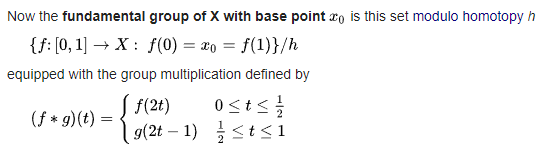



then ff^{-1}(1/2)=f(-1) and ff^{-1}(1)=f(-2) which aren't defined lmao, another problem being that ff^{-1}(1/2) is also f(1) so it's not a function anymore
I must be misunderstanding something
I proved that the constant function for the base point is the identity element but this confuses me because it looks... wrong
even more confusing is that f^{-1}f definitely works
steel needle
it works fine
because of how the domains are written
basically as t goes from 0 to 1/2 you use the homotopy f
and as t goes from 1/2 to 1 you use the homotopy g
so it's putting one after the other
try to compute some examples
to see that it works
with your favorite paths
gritty widget
wait I think it was a misunderstanding of how piecewise functions work when they're made of composite functions
it makes complete sense outside of that tho, I already got how concatenation of paths works
now I'm trying to get why the group operation is defined the exact same way for the nth homotopy group except for the last coordinate
dire warren
Is the space of all symmetric invertible operators on R^2 with eigenvalues in (0,2] connected?
midnight jewel
I don't know, but as far as I can tell, it is if (not only if tho):
-for any pair of eigenvalues λ,μ in (0,2], the set of symm. inv. operators with these ev is connected
-the set of diagonal matrices with entries in (0,2] is connected
both of these sound true to me
midnight jewel
is the set of invertible matrices connected? I know it's open
midnight jewel
wait, not invertible. you need eithet O(2) or SO(2), i'm not quite sure
dire warren
And the ones with positive determinant form another
midnight jewel
okay, so, the diagonal ones are path-connected, that bit is easy
now, for a fixed pair of eigenvalues, the symmetric ones with those eigenvalues are conjugates of those with a matrix in... either O(2) or SO(2), I'm not sure
if it's the latter the statement is true, if the former it isn't
because SO(2) is connected
but O(2) isn't
dire warren
What if they lie in the same component LOL
dim meadow
is the set of invertible matrices not connected?
I'm pretty sure it is
you can show that on any line there are at most n non invertible matrices
which I think gives you that its path connected very easily
@dire warren
Oh nevermind, it definitely can't be path connected
but I don't see why it can't be connected
Oh Gln(C) is path connected
so thats a bit nicer
How about the set of noninvertible matrices though
dire warren
Idk crap about matrixes hahaha
dim meadow
You can do a lot using topology and the eigenvalue functions
Mathematics Stack Exchange
I can see that invertible matrices are a differentiable manifold however I don't know how to show that something is not a differentiable manifold so easily.
Is it ever the case that singular matri...
dim meadow
all norms induce the same topology
you just put the R^{n^2} topology
and take the subspace topology
Actually it's pretty trivial to see the non invertible matrices are path connected
Every non invertible matrix has a path to the origin
dim meadow
Well I think it's a bunch of lines connected at a point
I don't think theres any interaction between the lines
dire warren
Hyperplanes right not lines
dim meadow
We know invertible matrices are dense
but I guess that doesn't preclude there from being hyperplanes
dire warren
Yeah
midnight jewel
well they're also open, but that still doesn't say much
dim meadow
yep
midnight jewel
cause it would be an uncountable union
dim meadow
Well it does actually
midnight jewel
uncountable union of closed sets may be open
dire warren
Err, wouldn’t it be an uncountable intersection
midnight jewel
so it can't be a manifold of full dimension
dim meadow
obv its not a manifold
but the question is if its just a bunch of lines connected at the origin
or if theres more to it
dire warren
I want to believe it’s more
This is interestibg, should I ask it on the big brain server lol
midnight jewel
well, is it path-connected, for one?
dim meadow
yes
midnight jewel
how do we see that?
dim meadow
you can scale a noninvertible matrix to the origin
dire warren
Beautifully explained
dim meadow
so really my intuition behind why I think its just lines
midnight jewel
but now, take $$\begin{pmatrix} x & y \ 0 & 0 \end{pmatrix}$$, that's a whole plane of noninvertible matrices through the origin
gentle ospreyBOT
Sascha Baer:
dim meadow
If you have 2 invertible matrices, then the line determined by them has at most n noninvertible matrices
midnight jewel
ofc that's still a union of lines
dim meadow
take determinant of the line
oh sorry wait a sec
write the line as A(t) + B(1-t)
and take the determinant
its a polynomial in t
dim meadow
which has at most n solutions
midnight jewel
but each of those points may themselves lie in a larger hyperplane
dim meadow
I seem to remember there being less conditions though
midnight jewel
as my example shows it's possible to have planss
midnight jewel
no, take any line in the plane I just defined
dim meadow
What was your example?
midnight jewel
matrices with one row all 0s
midnight jewel
defines a hyperplane of dimension n^2-n
midnight jewel
shame even the simplest example is already in a 4D space
dim meadow
hmm maybe
dire warren
Well we know the hyperplanew can have dimension at most n^2 - 2
If they don’t pass through the origi
Cause If not they would form a n dimensional shape
That prevents the invertivle matrixes from being dense
dim meadow
the invertible matrices are dense
dire warren
Yeah