#point-set-topology
1 messages · Page 148 of 1
 honest narwhal
 shadow ermine
xD ty<3
I took a module called Geometry (metrics) & Topology
and now I'm taking algebraic topology (final year) if that's a good indication on how little I know xD
honest narwhal
Okay yeah in that case go for Rotman. I was just thinking that you might've meant now advanced stuff if you talked about homotopy theory, in which case maybe More Concise or Davis/Kirk or something would've been good
 keen moth
I used concise in my class for a week, didn't help anyone tbh
 pliant dragon
I guess more of a soft question, but what's the cluster point as n goes to infinity?
IE the cluster point of {1,2,3, .... n-1, n}
 steel needle
what's a cluster point
@pliant dragon
do you mean an accumulation point in some bigger space?
 gritty widget
Hey guys, if I have (0, 15) U (20,infty), would my interior points be (0,15)U(20,infty) or (0,infty)?
 midnight jewel
the former
16 is not even in that set
so it could not be an interior point
as a general rule, the union of (finitely many!) open sets is open
and for an open set, the interior points are the set itself
pliant dragon
@steel needle I guess limit point would be a similar definition
gritty widget
thanks @midnight jewel
midnight jewel
you know @steel needle this is actually more obnoxious than whatever is even going on
now all of my channels have unread messages because o fyou
there is for whole server which is good enough for me since it’s currently all freakout anyway
what even happened? a guy I know told me they were kicked here
 loud heart
What changes and what remains the same if we equip every group with the discrete topology?
 small obsidian
Changes and stays the same between the discrete and what?
What's the other option?
loud heart
compared to leaving the groups as is (without any additional structure)
small obsidian
You are legit talking about algebraic groups, oh gotchya
If you can relate the topology to the group structure, then you've gained a lot.
If the topology doesn't do anything with the group, then you have at least gained the theorems behind topology.
Discrete topologies capture absolutely nothing though
loud heart
ah cool
 torn spade
Im trying to find a proof for a set S being closed iff the set equals its closure
 keen cliff
what's your definition of closure
torn spade
but the definition of closure i have is: $ \overline{\rm S} = S \cup \partial S $
 gentle ospreyBOT
NTK:
keen cliff
and boundary?
torn spade
is the collection of boundary points, which in turn are are points so that every neighborhood $ U(x,\epsilon ) $ contains at least one point of set S and one point of the complement of set S
gentle ospreyBOT
NTK:
torn spade
so ive been looking it up for a while and most proofs just use "the closure of a set S is the smallest closed set so that S is its subset"
keen cliff
well the goal will be to show that a closed set contains its limit points then
cuz then the boundary of S will be a subset of S
torn spade
agh im not sure have i seen what limit points mean, we only talked about accumulation points
keen cliff
x is a limit point of S if there exists a sequence in S that has limit x
or
could be the same thing 
keen cliff
lame
torn spade
lol
like i dont understand what "exists a sequence in S that has limit x" means
"Given a set S, we say a point P is a limit point of S if every neighborhood of P (not including the point P itself) always contains points in S, no matter how small the neighborhood is."
this is what i saw online. but this is the definition i have for accumulation points
keen cliff
ok then they're the same thing
keen cliff
perhaps try contrapositive?
steel needle
the definitions have subtle differences sometimes
make sure to use the ones you are using in class
torn spade
Ok i fell asleep and now im back at doing this
So to restate: set S is closed iff it equals its closure
Im trying to work this from left to right first
So assuming that S is closed, i'll try to prove that it equals its closure.
 frigid patrol
Closure is the smallest closed set containing the set
torn spade
we haven't had that definition in our lectures/slides so im not going to use it, i'd need to prove it first anyways @frigid patrol
but i got a proof together, someone can review it
gentle ospreyBOT
NTK:
torn spade
really took me 1.5 hours to get to this point jesus
torn spade
Yea thats why p much
I saw proofs that used your definition but as i said, i had to/wanted to use this
- i couldve left some words out of there but this is my literal 3rd week in real analysis so i want it to be clear as possible mainly for my own sake
torn spade
Yeah
The fact that it took me 1.5h to do this tells smth about my knowledge and experience in this topic lol
torn spade
Yeh lol
gritty widget
hey guys can anyone verify this is a correct proof?
Statement: Let $f: S^1 \to S^1$ be an even map, that is, $f(z) = f(-z)$. Then, $\text{deg}(f)$ is even
proof: conside the lift $\tilde{f}: I\to S^1$ where $I = [0, 1]$. Then, $\tilde{f}|{[0, 1/2]}$ and $\tilde{f}|{[1/2,1]}$ are equivalent maps that can be reparmeterized to maps $I\to S^1$. So, their composition is the sum of the degrees and so is even
steel needle
looks fine
more than the sum of degrees I would say twice the degree of any of them
although that's implied
midnight jewel
Well, so far topology class is rather boring (we're proving, at a ridiculosuly slow speed, that the ε-δ notion of continuity on R from Analysis is equivalent to the open sets one we want to look at in this class, we've already done that in analysis)
frigid patrol
Yea
midnight jewel
Intuitively, a topology being finer than another defines a partial order. Can we use Zorn to find a "maximally fine nontrivial (ie not discrete)" topology on any set?
I assume so, it seems very similar to the proof of existence of maximal ideals
frigid patrol
Ultafilters!
 smoky meteor
Can I have a bit of help understanding the K-Topology $\mathbb{R}_K$? I understand its basis $\mathcal{B}$ containing all open sets $(a,b)$ for $a,b\in\mathbb{R}$, but what do the sets of the form $(a,b)-K$ look like? I'm not even sure what that notation is describing tbh
gentle ospreyBOT
em:
steel needle
post context
smoky meteor
Er, where $K={\frac{1}{n} : n\in \mathbb{Z}_+$
gentle ospreyBOT
em:
steel needle
post definition of R_K
smoky meteor
Munkres, top of page 82
steel needle
ok so its the topology with basis (a,b) and (a,b) - K
smoky meteor
"Let K denote the set of all numbers of form (above), let B be the collection of all open intervals (a,b) along with all sets of form (a,b)-K, This topology generated is the K-Topology"
yea
sorry
steel needle
ask yourself this
what happens if (a,b) doesn't contain 0?
what does (a,b) - K look like?
is it anything new?
what happens if it does contain 0?
smoky meteor
I'm sorry, I don't understand specifically what (a,b)-K is. Is it all of the open intervals (a-k,b-k) for all elements k\in K?
smoky meteor
🤔 so we just remove all reciprocals of naturals from every interval
steel needle
yeah
smoky meteor
ohhh
gimme a minute to think about it
so, if your interval contains zero, you get a ton of lil holes in the neighborhood of zero
on the positive side
steel needle
yeah if your interval contains 0 you get something that isn't open in the usual topology
because it has 0 and no open interval around it
smoky meteor
does a open interval have to have every point in it
so like, (-1,3) but without the element 2 isn't an open interval?
steel needle
no, but it's an open set
smoky meteor
ye
steel needle
cuz around every point in the interval you can find a smaller interval
so it's an open of the standard topology
smoky meteor
riight. so you can't find one that contains zero in the (a,b)-K because you literally can't end on the pos side of zero
neato
one: open interval, not open set
(a,b)-K are all open sets
sorry im new at this
steel needle
I mean
I meant open set in the standard topology
not in the new one
but I think you get the idea
smoky meteor
oki
steel needle
we have some new open sets whijch are the ones that contain 0
and no intervals around it
 lucid turret
Could anyone help me with adjunction spaces?
keen moth
@lucid turret what's an adjunction space?
gritty widget
In mathematics, an adjunction space (or attaching space) is a common construction in topology where one topological space is attached or "glued" onto another. Specifically, let X and Y be topological spaces with A a subspace of Y. Let f : A → X be a continuous map (called t...
@lucid turret your question is vague. Please make clear what you'd like help with concerning adjunction spaces
lucid turret
Is it true that spaces (X coprod Y) x I / (a,t) ~ (f(a),t) and (X cup_f Y) x I are homeomorphic? f:A to Y is continuous map, A subspace of X. cup_f is adjoint space
Coprod meaning disjoint union
 fierce valley
no
lucid turret
Wot about X/~ x I and (X x I)/~ ? We identify (x,t)'s with same t's only based on identification in X
fierce valley
no
lucid turret
Rip. Why tho
fierce valley
because im a three time fields medalist thats why
listen to what im saying
you speak too much
gritty widget
@lucid turret couldn't find "adjoint space" concerning general topology on internet or some books
how do you define X \cup_f Y?
btw Munkres seems to use both (X coprod Y) x I / (a,t) ~ (f(a),t) and (X cup_f Y) x I as being by definition the same thing
Pic taken from Munkres' Elements of Algebraic Topology, Chapter 4 page 210
Also don't care about what Divinité Hantée said. He's a troll and was banned 
frigid patrol
What's the question
gritty widget
@frigid patrol Maxwell's question (scroll up):
"Is it true that spaces (X coprod Y) x I / (a,t) ~ (f(a),t) and (X cup_f Y) x I are homeomorphic? f:A to Y is continuous map, A subspace of X. cup_f is adjoint space"
 mighty needle
Just to make sure I'm not losing my mind, the quotient space (S^1xS^1)/(S^1x{pt}) is homeomorphic to just S^1, correct?
pt is a point on S^1
steel needle
no
look at it like this
S1 x S1 is a torus
then you take a single circle S1 x pt
and squish it
it's gonna be a torus with a single circle squished into a point
mighty needle
hmm, okay I'll think about that more then.
But the fact that what I said was incorrect actually makes my life easier, so that's good. Thanks!
midnight jewel
This is probably well-known (it’s e.g. found in Proofs from the Book), but a really nice proof of the infinitude of primes that was on our homework sheet today. Needs only very basic notions of point set topology (essentially definitions of open & closed sets and bases of a topology)
keen moth
This was assigned for my topology homework when I took it a few years ago. Now that same professor is teaching point-set again this semester
@midnight jewel do you go to a university in chicago?
If so, there's a good chance we go to the same school
midnight jewel
never stepped foot in North America
midnight jewel
also @keen moth as I mentioned, this proof is well-known
and cool
so it’s not surprising to see it elsewhere
frigid patrol
@midnight jewel what's the proof for c
midnight jewel
If the union was finite, then it would be a closed set, since finite unions of closed sets are closed.
However, then its complement would be open.
Its complement is {-1,1}
But all open sets in this topology are infinite
thus, it must be an infinite union
(the complement is {-1, 1} because every other number is either prime or has a prime divisor by definition of what a prime is)
frigid patrol
Euclid's argument is better
It's actually the best kind of argument:
Not technical,
Short,
Intuitive
midnight jewel
Is it though? In Euclid we build a secuence of primes which must be infinite.
In this proof we show that the sieve of erastothenes cannot be generated by finitely many numbers using a topological contradiction
I don't really see the connection
Note, the version of Euclid's proof I'm referring to is the (imo simpler) contradictionless one, that is:
Given a finite list P of primes, take their product and add one. Then this number must have a prime factor not in P. Add that factor to the list.
(fun fact: it is unknown whether this algorithm generates all primes)
midnight jewel
you misunderstood the algorithm, then
you don’t take the next number as a prime
you state that it has a prime factor not in the list
(in fact it only has prime factors not in the list, but one’s enough)
the actual sequence I was referring to that we don’t know if it generates all primes specifically always takes the smallest one
https://oeis.org/A000945 this sequence
 austere meadow
Hello, I am interested in learning more about this topology thingy, I've had recently a large assignment about it, but it's really a new thing for me, is it ok if i ask what's a, uh, ball, in a metric topology? I've been asked to draw a ball of radius 1, and uh, i really don't know what it is really (i'm not really asking for help, just to know more about what's a ball in this particular case, since its something new for me, if i need to go to a #help-1 like channel, then i will :) )
midnight jewel
a ball of radius 1 is the set of all points which have distance <1 from a given point. Distance being determined by the metric function of your metric space
e.g. in R with the standard metric it's just open intervals of length 2 with the chosen point in the middle, in R^2 with the standard metric it's circles of radius 1, but with other metrics it's other shapes
e.g. a diamond (1-norm) or a set of rays emanating from 0 (SNCF metric)
 warm hedge
What's the difference between a metric and a norm?
 west spindle
a norm is something you can put on a real or complex vector space
metric is a more general concept
however, if you have a normed vector space then the natural metric to put on it is d(x,y) = ||x - y||
midnight jewel
let $X$ be your space
a norm is a function $X \to [0,\infty)$ which gives every element in $X$ a magnitude $||x||$
a metric is a function $X^2 \to [0, \infty)$ which gives every pair of elements in $X$ a distance $d(x,y)$
you can always make a metric out of a norm by defining $d(x,y) = ||x-y||$
gentle ospreyBOT
Sascha Baer:
midnight jewel
both have to fulfill a certain number of properties of course
for one, norms pretty much only make sense on vector spaces
west spindle
\| or \Vert for norm bars 😛
midnight jewel
thanks
west spindle
compare: $||x|| ||y||$ vs $\Vert x \Vert \Vert y \Vert$
gentle ospreyBOT
Ann:
midnight jewel
they have to fulfill
\begin{enumerate}
\item $|x| = 0$ if and only if $x = 0$ (positive definite)
\item $|\alpha x| = |\alpha| |x|$ (homogenous)
\item $|x + y| \leq |x| + |y|$ (triangle inequality)
\end{enumerate}
fuck wrong dollar signs
west spindle
single dollars 😛
gentle ospreyBOT
Sascha Baer:
west spindle
and #2 is more properly called absolutely homogeneous
or absolute homogeneity
bc homogeneous w/o qualifiers would be ||ax|| = a||x||
though of course we all know the triangle inequality is the most important 😛
midnight jewel
metrix meanwhile have to fulfill
\begin{itemize}
\item $d(x,y) = d(y,x)$ (symmetric)
\item $d(x,y) = 0$ if and only if $x=y$ (positive definite)
\item $d(x,z) \leq(x,y) + d(y,z)$ (triangle inequality)
\end{itemize}
…
brain
west spindle
wrong way around in the triangle ineq
gentle ospreyBOT
Sascha Baer:
midnight jewel
I noticed
west spindle
space between \leq and d
west spindle
the bot sees \leqd and doesn't know what to do with it 😛
midnight jewel
I do have a brain
 west ocean
👀.
warm hedge
Thank you for the answers
west ocean
You are welcome.
loud heart
Can you deformation retract a square to two perpendicular line segments intersecting at a point?
loud heart
what if the line segments intersect off center?
west spindle
i don't see how that changes anything? the space you're retracting onto is homeomorphic to the union of the square's diagonals
 random slate
Can I potentially get a critique on whether this proof I think I'm done with seems correct?

 fervent citrus
What do $\bigcap A$ and $\bigcup A$ mean?
gentle ospreyBOT
Tuong:
random slate
The intersection and union, respectively, of all the sets in $\mathcal{A}$
gentle ospreyBOT
DMAshura:
fervent citrus
How would you justify with more details that the intersection of all of the sets in A is indeed the element of A indexed by min(I)?
It feels like you wanted to talk about min(A), the minimum of A for the inclusion relation
random slate
I'm not really sure how I could show that in more detail. Like it seems obvious from how the sets were constructed. :/ If A_n contains "everything up to n" and you intersect two of them, you should have the one with fewer elements.
Like at what point do you assume that something like that is apparent rather than having to prove something that should seem basic
And I've never heard of using "min" for an inclusion relationship, though I suppose that makes sense
...and I suppose I could note that $A_0 \subseteq A_1 \subseteq A_2 \subseteq \cdots \subseteq A_\infty$.
gentle ospreyBOT
DMAshura:
fervent citrus
Also, would max(I) still be infinity even if infinity isn't in I?
*in the case I is unbounded
when you write A_max(I), it feels like it's an element of A (because max(I) should be an element of I)
if A was everything but N, the union would be N but wouldn't be an element of A
Oops nevermind
'misread something
 timber pasture
these proofs are perfectly adequate
random slate
@timber pasture -- do I not need to be more detailed in how I know that the intersections and unions are mins/maxes?
timber pasture
depends on who you're writing it for
if you wanted to be safe you could note that WLOG Ai1 subseteq Ai2 subseteq ...
or even just scrA is totally ordered by subseteq
fervent citrus
Actually I'm still puzzled, is max(I) an element of I?
random slate
This is for graduate level, but technically the class is Intro to Proofs and we're just looking at topology as a way of practicing proof writing with an unfamiliar subject
timber pasture
no, it's the max in (N union {inf}, <=)
grad level mathematicians or grad level not-mathematicians?
random slate
As in I'm taking a graduate level class
And yeah, shit, I see that the max may be an issue now
timber pasture
just replace it with sup
random slate
. . . hah. I could.
timber pasture
ez clap
timber pasture
i guess if you're being specifically marked on your carefulness then you should pay a little more lip service to the nature of the min and the sup here
random slate
The only thing that makes me wary is how I've written $\mathcal{A}=\left{A_{i_1},A_{i_2},A_{i_3},\ldots\right}$
gentle ospreyBOT
DMAshura:
random slate
Because it makes it seem like $\mathcal{A}$ has to be infinite
gentle ospreyBOT
DMAshura:
random slate
And it might be finite
But yeah I can definitely be more explicit
And the subset inclusion really helps me organize how I'd say it, so thanks.
timber pasture
in the (2) version the subset-chain thing would be written like "A is totally ordered by the subseteq relation, that is, for any a,b in A either a subseteq b or b subseteq a"
you would probably find the (1) version more convenient though when you do that you should explicitly write $\bigcap_{i\in I}A_i$ instead of $\bigcap\mathcal A$ so as to be less confusing
gentle ospreyBOT
tubular:
timber pasture
in your case it makes sense because it's a good way to state that everything takes some particular form
and while it is applicalbe in general, you can sometimes be overcomplicating proofs if you use method (1) when method (2) could have sufficed
random slate
https://snag.gy/of0n4G.jpg Here's my revision for (a)

I feel a lot better about this
random slate
Thank you. That's absolutely something I care about, so it means a lot.
honest narwhal
This is in... sharp contrast to how I write
I'm lazy af
I remember in my measure theory class someone turned in a 6 page pset while mine was a page, we ended up with the same grade and the guy was like wuuuuut
random slate
Hah wow
honest narwhal
Recently it has started to change since I now email all psets so I'm less allergic to having equations on their own line
(When I had to print them out I would have each of my solutions be a single massive paragraph)
honest narwhal
A Baire-1 function is a pointwise limit of continuous functions
random slate
Is there a special name for a topology that permits arbitrary intersections of open sets?
honest narwhal
Alexandroff space
random slate
. . . of course it's named after some guy
honest narwhal
They're actually kinda cool, the data of an Alexandroff space is the same as that of a... Pre-order?
If you assume the space is T_0, then it's the same as the data of a partial order
random slate
Oh hey that actually makes sense given my examples!
Since my open sets are totally ordered!
honest narwhal
Something like that. Let's restrict to the T_0 case since I'm happier with partial orderings
So you have an Alexandroff space and define U_x to be the intersection of open sets containing x. That's open by assumption
And then you say x≤y if U_x\subset U_y
And this is our pre-ordering. The condition that the space is T_0 is precisely the statement that this is a partial order: x≤y and y≤x => x=y
timber pasture
i was the short proof guy in my classes
and i had a friend a year above who was the 12 page guy
random slate
I would rather err on the side if verbosity if it means clarity
steel needle
I live on conciseness on the edge of unreadability
I routinely get taken 10% off because my stuff is too concise
AMA
 celest sparrow
how much do you get taken off because you're being too concise
random slate
You might have a future in writing real analysis books then
timber pasture
i try to be clear but i work a lot at paring down my arguments once they're on the page
frigid patrol
I write long homeworks, hand written and stapled 6 pages
I'm old fashioned that way
None of that latex business
steel needle
6 pages isnt long
my psets nowadays are regularly around 6 pages
and I'm super concise
:(
also handwritten gross
honest narwhal
You're less concise than me lmao. I think my TAs just end up being thankful that my psets are quick to grade, also I choose the stuff I don't really prove so that if you read my statement it sounds right in your head
It's a narrative of true statements where you're like oh this implies this implies that yeah okay
Even though "implies that" requires a ton of justification
keen moth
I require my students to explain why 3n(n+1) is divisible by six if they haven't done so on a previous assignment
midnight jewel
if I write a longer thing I tend to factor out certain lemmas n stuff and do them before or after the actual main proof
like just mark an implication with a star and then at the end be like “proof of star”
so I can focus on the big picture first
steel needle
the solution I've found to my nagging TA who demands proof of obvious shit is to use footnotes
which is simultaneously clear and slightly passive aggressive
midnight jewel
until you want to put a footnote after an equation and notice that it looks like this: https://xkcd.com/1184/
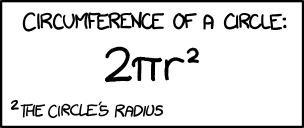
Assume r' refers to the radius of Earth Prime, and r'' means radius in inches.
midnight jewel
you know what annoys me in latex though?
you have to do
$$equation,$$
as desired.
rather than
$$equation$$,
as desired.
…actually I could’ve left that for illustrative purposes I guess
but it was a bit big
steel needle
oh I wouldn't know, I don't use $$ $$
midnight jewel
it makes sense why you have to do it, but it feels so wrong to put punctuation into an equation
steel needle
I use \begin{align}
midnight jewel
well, I don’t want to put punctuation into mathmode
you don’t put text into mathmode
midnight jewel
you have to for correct typesetting, but yea if you have font fuckery it might look wrong and you have to do that
otherwise the comma lands on the next line and looks bad :P
steel needle
i usually don't put comma between formula and "as desired"
midnight jewel
but grammar!
midnight jewel
also I tend to write my stuff in German, where that would be required
German requires a comma before subordinate clauses, always
(unless they begin the sentence, ofc)
steel needle
oh
midnight jewel
but even in English, I would want to put one
now, while we’re on the topic of topology
I’m currently stuck on a problem :P
I have to show that $\overline{A} \times \overline{B} = \overline{A \times B}$. I’ve already shown $\supseteq$
gentle ospreyBOT
Sascha Baer:
midnight jewel
but I don’t really know where to start on the other direction
I’ve also shwon that the product of two closed sets is closed, but apparently I was acutally supposed to conclude that from this exercise… I needed it in the other part though
there I considered the closure as the intersection of all closed supersets containing A×B
and could show it with only one hand-waved equation
which I’m actually not quite sure about
is this statement true?
$$\bigcap_{x} A_x \times \bigcap_{y} B_y = \bigcap_{x, y} A_x \times B_y$$
or if not equality then at least $\supseteq$?
(x and y range over some index set)
gentle ospreyBOT
Sascha Baer:
midnight jewel
should be true I think, yea
but anyway, that’s not really the point here; I think I’ve unhandwaved that now
I just don’t really know where to start to show $\overline{A} \times \overline{B} \subseteq \overline{A \times B}$
gentle ospreyBOT
Sascha Baer:
timber pasture
don't use $$-$$, use \[-\]
midnight jewel
honestly, I hate those
I use either $$ or \begin{align/align*/equation} depending on what I need
there’s really no reason to prefer one over the other apart from aesthetics
and \(, \[ are just … weird
timber pasture
the double dollar signs are archaic tex and they will not play nicely with the formatting extensions latex adds to the typesetting system
midnight jewel
never ran into issues
I know they’re tex
literally 100% of my math formatting issues are the align environment adding too much whitespace
anyway I had a topology question so latex’s not really what I wanna discuss here now
west spindle
cl(A) x cl(B) subset of cl(A x B)? is that what you wanted to show?
midnight jewel
yes
west spindle
hmmm
midnight jewel
I need to show equality, I’ve already shown subset in the other direction
west spindle
no assumptions on the spaces A and B are subsets of?
midnight jewel
pretty much all I know about the product topology is that all the pairs O₁×O₂ where O₁ open in X and O₂ open in Y form a basis to the product topology
west spindle
yeah ok so mm
let's see
let (a,b) in cl(A) x cl(B)
thus a in cl(A) and b in cl(B)
midnight jewel
the only idea I had was I could try and do a case distinction depending on whether a, b are in the boundary or the interior
but that turns ugly
cause it’s three cases to consider
west spindle
for every open set U in X containing a, U intersect A is nonempty
midnight jewel
one is trivial though
west spindle
for every open set V in Y containing b, V intersect B is nonempty
midnight jewel
that uses nothing about closure does it, that’s just basic set theory, right?
or am I missing sth
west spindle
so far it's unfolding the defn of closure
for every open set $W \subseteq X \times Y$ that contains $(a,b)$, there exists an open rectangle $U_0 \times V_0$ s.t. $(a,b) \in U_0 \times V_0 \subseteq W$
gentle ospreyBOT
Ann:
midnight jewel
(I’m gonna go catch my tram but I’ll read what you’re writing dw if I’m not responding for a bit)
west spindle
but $(U_0 \times V_0) \cap (A \times B) = (U_0 \cap A) \times (V_0 \cap B) \neq \varnothing$
gentle ospreyBOT
Ann:
west spindle
therefore we have that $W \cap (A \times B) \neq \varnothing$
gentle ospreyBOT
Ann:
midnight jewel
uh, that "any" should need some qualifier for sure
since this is eg definitely wrong foe W the empty set
 west spindle
yw
 bold path
Can I induce all Riemannian metrics by Euclidean metrics?
bold path
damn i really should have checked wikipedia given thats what i was looking for, it literally says it in the first line
thanks
steel needle
👌
 gilded shell
For any set S does there exist a topological space Y they satisfies this?
We write X, for a topological space with base set S. We write C(X,Y) for the of continuous functions from X to Y.
For any set S does there exist a function F:X-> C( X,Y) is injective? So basically where the set of continuous functions determines the topology?
Maybe this trivially true by choosing some discrete topology or by some characteristic function but I'm not seeing it.
steel needle
just choose Y = X and F(x) = f: X -> {x}
i don't see how it determines the topology in any way
oh are you asking for F continuous?
then I guess it kinda does
no it kinda does determine the topology
yes it does
gilded shell
X is a variable, Y is fixed
steel needle
it's continuous too
gilded shell
But you mean the set
steel needle
yeah I mean the set
gilded shell
The set has no topology tough
steel needle
well if you want to vary X then you need the coarsest topology
uhh or the finest one?
it's either the trivial or the discrete topology
Y = S with one of those
gilded shell
That computes
steel needle
the trivial one I think
gilded shell
Yes
steel needle
so if you want a fixed Y for all X then you need the trivial topology
and this doesn't say anything
it's more interesting to fix X
Y discrete doesn't work i think
unless I have it backwards
Y discrete is bad because there's few functions in C(X,Y)
in particular if Y is discrete and X is trivial then only the identity is continuous
and you do not have an injection X -> C(X,Y)
no
cuz that's the point
it does
it's a continuous injection
you want it to be continuous as well
otherwise it doesn't make sense
yes
I assume so
but yeah you don't get anything
ifyou allow X to vary
you only get information on the set S
maybe you get that X has to be finer than Y
if the injection is reasonable
but dunno
seems like an odd question anyway
gilded shell
Yeah, i messed up the phrasing, sorry. Meant to say X|->C(X,Y) which is very different but oh well nvm. Thanks tough
 wind sierra
Just a question about the name of a mathematical... object? More like a concept.
Anyway, the metric that tells you the least number of squares a rook must go through on a chessboard to go from one square to another one is called the taxicab metric. Is there a name for the metric that does the same, but on a hexagonal grid? I mean, if such a metric even exists.
small obsidian
Yeah, you could definitely make such a metric. Why do you want it?
steel needle
you couldn't
it's not linear
you can't tile a hexagon with hexagons
in R^2 i mean
if you mean as a distance function for a discrete set of points then sure
wind sierra
@small obsidian Well, I was wondering if such a metric had a name, just like the taxicab metric is called... the taxicab metric.
steel needle
the taxicab metric has a name cuz it's a metric on R^2
small obsidian
Wat? You can tile hexagons
steel needle
and I guess it's convenient
you can't tile a hexagon with hexagons
so linearity won't work
you can check it yourself as an exercise
try to define a metric in R^2 based on the hexagonal tiling
wind sierra
So, umm... does it have a special name or not?
 eager sage
you can tile a triangle with triangles, which is very similar and very interesting as well
small obsidian
I'm confused. Which axiom doesn't hold? What's linearity?
eager sage
triangles and hexagons are similar in that the centers of hexagons in a hexagonal grid form a triangular grid
the way i'd start trying to figure out a metric for the hexagonal grid is to travel along the borders of triangles in a triangular grid
steel needle
The point is not every function is a metric
The triangle thing might work
I dont see obvious problems
eager sage
the question I have as a chess player is, on a hexagonal grid what precisely differentiates a rook from a bishop? the fact that each intersection of tiles has only 3 tiles around it means that you can't have "diagonals" in the same way as on a chessboard
motion on a hexagonal board is really interesting though, regardless
actually, this is an interesting way to demonstrate a weird type of 60-degree-grid orthogonality
bishops would be significantly less powerful on a board like this, than on a square chessboard, but it's a thought at least
wind sierra
Just to make things clear, I'm talking about an infinite hexagonal grid on a plan, in which you stand at the center of a hexagon and can move to another one only if they share a common edge. Like I said, like chess but on a different kind of board.
I know that rooks on a chessboard are only one of the many ways to visualize the taxicab metric, but I need to know the name for the metric that you can get on this type of grid instead. If such a metric exists at all, I mean, it seems to me that you're still debating that.
eager sage
i believe it should be possible for a metric to exist but i don't know if there's a name for it
wind sierra
Oh. I assumed this problem was already a well-studied one, so I thought someone had to have given it a name.
 warm junco
oof.... if i played chess on that kind of board, if you let rooks move in any straight line along cells which have adjacent edges, they become queen like.... obviously that isn't good.... and you cant go diagonal
but there's 2 solutions
one is that rooks can move along "straight" lines of precisely two colors... don't know what this would mean for bishops tbh...
but the simpler and much more reasonable solution is this
in a square
you have two bidirectional motions
that are perpindicular to each cell edge
and diagonal, which traverse along the lines which connect corners....
How about a rook may move in one of 3 directions, defined as perhaps the white on black or grey on black as i believe any rook can cross any color but they would have different motions on a black tile
as for the bishop
what would one do with a bishop? Well just as squares have those diagonal bisecting directions, a hexagon has 3 bisecting directions
and with 3 tile colors
you are left with a grey bishop
a white bishop
and a black bishop
@wind sierra @eager sage
I think this would make for a VERY interesting 3 person chess game
or a 2 person, forming a diamond shape instead
heck, chinese checkers board shape and you can have 6
I'd love to make this actually, don't know where this convo came from but thanks for the idea :)))
oh wait... it's been done.... but they made it so that rooks have the 6 directions... i think that's way too powerful
LOL
wind sierra
Pinging me is useless, I don't even know what you're talking about. 😆 Honestly, I'm not even asking this for myself.
A friend of mine sent me a message today, saying: "I'm creating my own RPG system and wanted to use the words 'taxicab metric' to describe the way characters move on the grid, can I do that?", and I was like "Sure, I guess, if the grid is like that of a chessboard", and then he said "Nevermind, I'm making my grid hexagonal so I guess it has another metric. Hey, does it have its own name or can I still call it 'taxicab metric' in the manual?", and I was like "Dude, I don't even like math, but I'll be asking in a certain server I know".
And that's why I wrote here.
wind sierra
Then I read that people here weren't even sure it was possible to build a metric on a grid like that, and the only relevant article on the topic I could find online dates back to 1976 and I can't even download it.
I didn't think a concept as simple as this would actually be largely unexplored... at this point, I guess my friend is free to come up with his own name for this metric. I hope he comes up with something stupid and silly, so when this topic suddenly becomes a hot topic in research in 20 years, everyone will be forced to use the name he chose.
midnight jewel
I remember a homework exercise about metrics on different grids
warm junco
actually, you can do a metric circle in honeycomb metrics
not in 2dimensional math
but perhaps.... in 3
except the dimensions are not orthognal
it'd be complicated
actually hell.... if a taxicab metric circle is like 1/sintheta plus cos theta
what aboutchanging the period
hmmm
or..... ah yes, use a tetrahedron
no
scratch that
i dunno but i nede to do homework, i think ill ponder this later
wind sierra
Anyway, even though I still hate math with a passion, I'm a bit curious about the stuff you were talking about earlier: can you actually create a metric on a hexagonal grid (with the points of the space being the vertices of the grid), by defining the distance between two points to be the least number of edges you must travel on in order to go from the first point to the second one?
Because if you can't, all this talk about giving it a name would be pointless. Though the honeycomb metric is a cute name. I like it. 💜
warm junco
in taxicab they do it by projecting the vector onto the axis
there's square syymetry there anways
and happens to be that absolute values also create squares
easy and cool
however, i think there might be a way
it might involve something a little more complex
instead of 2d
some sort of 3d
where if you go up or you go down, you can then turn right (or left) respectively and end up back in the middle
in other words, if you go "up" and turn right, you end up going right and down
so equilateral
in math, usually up has no correlation to right, and right no correlation to down
however here they are both
AND YET you can still go right without going up or down
so it's like instead of having a y axis on an x axis, you have a y1 and y2 pointing out at 60 degrees
i think then that if you project any vector onto the surrounding directions of movement you can find it
i thiiiink
wind sierra
...Couldn't I just check whether the triangle inequality holds to know if the stuff I defined above is a metric? Distance being 0 iff the two points are the same and symmetry are obviously true already.
warm junco
the thing is deciding which y axis to use to define your distance
or if you should use a y at all
you have to define which sector you are in
theres 6 sectors
sextors? hextors? idk
steel needle
it's definitely a metric on the vertices
any graph induces a metric on its vertices in that way
it's not unexplored
it's just not very interesting
wind sierra
Well, that's why math is boring. Everything you can actually do and understand on your own always turns out to be uninteresting to everyone else.
wind sierra
Yeah, and with the current status of math research, that would mean spending 80 years of your life to advance mathematics one inch forward with some new lemma nobody's ever going to use. Math is now so big that everything my little mind is capable of thinking of has already been thought by somebody else.
wind sierra
I admit that if you're a super-genius only five years would be enough. I wish I were like you. Anyway, thanks for your answer. I kinda suspected that, but it's cool to have my idea confirmed by someone else who knows more on the topic than I do.
wind sierra
If you say so. Anyway, we can't talk about this here because this is the topology channel, and now that I know that stuff is actually a metric I have no more questions on that matter.
eager sage
if anyone wants to talk more about hexagonal grid board games dm me
i’ve got experience designing board games on hexagonal boards and i love talking about it
frigid patrol
Is it the case that every single vertex that is neither the top or bottom is identified?
frigid patrol
Can someone help me see why the second Homology group of this lens space is 0?
 brisk shadow
yo i dont get topology
i have no intuition for anythign
i will give an example
so I have the definition of a limit point:
[ \begin{array}{l}{\text { 3.1.1 Definition. Let } A \text { be a subset of a topological space }(X, \mathcal{T}) . \text { A point }} \ {x \in X \text { is said to be a limit point (or accumulation point or cluster point) of }} \ {A \text { if every open set, } U \text { , containing } x \text { contains a point of } A \text { different from } x}\end{array} ]
gentle ospreyBOT
89_87:
brisk shadow
nice
and this example:
[ \mathcal{T}={X, \emptyset,{a},{c, d},{a, c, d},{b, c, d, e}}, \text { and } A = {a,b,c} ]
gentle ospreyBOT
89_87:
brisk shadow
X = {a,b,c,d,e}
anyways
clearly b,d,e are our limit points
a,c are not
this makes sense
also the next example states that discrete topologies have no limit points --- this makes sense also, because they have a singleton for each x \in X.
so I get that too
then they claim without any reasoning that the limit points of [a,b) are all x \in [a,b]
which makes sense based on how i think of limit points
but I thought the standard topology on an interval S in this case would be the set of open intervals (a,b), a<b, for all x \in (a,b)
and that doesn't seem to agree with this definition of limit points at all
because the e-ball or whatever you want to call it here around an element has elements not in the e-ball for other elements or whatever
idk i dont get this subject friends
life is rough
brisk shadow
anyways if someone here can help me debug my broken brain i'd greatly appreciate it!
frigid patrol
X is R right?
brisk shadow
yeah
frigid patrol
The open set U is open in R
Any open set containing b intersects [a,b)
Any open set containing a intersects (a,b)
There for they are both limit points of [a,b)
brisk shadow
[ \begin{array}{l}{\text { 3.1.4 Example. Consider the subset } A=[a, b) \text { of } \mathbb{R} . \text { Then it is easily verified }} \ {\text { that every element in }[a, b) \text { is a limit point of } A . \text { The point } b \text { is also a limit point of }} \ {A .}\end{array} ]
gentle ospreyBOT
89_87:
brisk shadow
[ \mathcal{T}={X, \emptyset,{a},{c, d},{a, c, d},{b, c, d, e}}| ]
gentle ospreyBOT
89_87:
brisk shadow
I want find closure({b})
so closure({b}) is limit points \cup {b}
so we want points which always share a set with b, right?
so in this case I look at {b,c,d,e}
c \in {c,d}so that's out
d \in {c,d} so also out
so closure b = {b,e}
something like closure({a,c}) would be all elements which are always in the same open sets as either one of "a" or "c"
so {a}, {d},{c},{b},{e} all work
and closure {a,c} would be X
ok i got it i think cool
brisk shadow
So to prove \mathbb{Q} is dense in \mathbb{R}
[you suppose there is x \in \mathbb{R} - \bar \mathbb{Q} ]
so then there is some open interval (a,b) \in R such that x \in (a,b)
wait not in R
in \mathbb{R} - \bar \mathbb{Q}
and every interval of the reals contains a rational according to this book, which seems like cheating here?
hmm
but anyways that's a contradiction
honest narwhal
Shit I thought that was you and wondered why you forgot this stuff when you're supposed to be the person who loves point-set
See, I've heard at some point that you didn't know TeX but I also heard that you were past first year of undergrad
And the latter dominates my conception of you, so I keep forgetting you don't know TeX
brisk shadow
lmaooo
i've had this pfp for like half a year now
hmm
i have absolutely no attachment to this pfp
yeah i just don't want to confuse others
lmao
tfw u suddenly become a brainlet
painful
2nd
steel needle
wtf
brisk shadow
tbh tho
as soon as I type this stuff out in a public forum I realize quickly that it's really easy before anyone even responds
I guess it's like rubber ducking code or whatever
honest narwhal
Jan's talking to himself
brisk shadow
So the finite closed topology:
is this another word for the finite complement topology
or is this a topology where the open sets are the complements of the elements in the finite complement topology
ok the former I think
but then I get questions asking about like
[ A={1,2,3, \ldots, 10} ]
gentle ospreyBOT
89_87:
brisk shadow
which is not an open set in the finite complement topology I don't think?
hmm ok I think I figured it out
wind sierra
@honest narwhal I'm here.
gentle ospreyBOT
Darisal:
wind sierra
Yeah, but it's hard to understand what's the point of knowing this. Covering maps look completely useless to me, starting from the fact that the definition of a covering space looks totally random and unnecessarily complicated.
honest narwhal
So, the initial motivation is that covering spaces have a lot to do with the fundamental group
wind sierra
Yeah, I know. If I'm not wrong, my book uses covering spaces to prove that the fundamental group of S^1 is Z. But that's pretty much it, it's the only useful application of covering spaces I've seen in the whole book. And even that seems unnecessary, because the fact the fundamental group of S^1 should be Z looks so obvious to me, that I can't comprehend why one can't prove it without using a concept as difficult as covering spaces.
honest narwhal
There's a lot more to it, you actually have that covering spaces of a space correspond to subgroups of the fundamental group
And it's not so much that you can't prove it without reference to covering spaces so much as that I don't think there's a way to do it which is strictly easier, like you still have to show that any map S^1 -> S^1 is homotopic to one of the form z^n and the idea of saying alright, I can think of such a path instead as one of the form e^{i\alpha(t)} and then show that homotopy downstairs depends precisely on basepoints upstairs is exactly covering spaces
And also covering spaces just happen to be important for much more general reasons so it sorta becomes the best candidate for how to present it.
wind sierra
Hmm, I see. Studying this stuff is just very hard for me because I feel like I have no intuition of why covering spaces are needed in the first place... and then there's the fact the theorems are so difficult, yeah. That covering-spaces-correspond-to-subgroups thing has a huge and super-detailed proof, if I'm not wrong. And I don't know how to keep all of that in my mind.
Especially if you consider that proof is 1% of all there is to say about covering spaces, and that itself is only 1/4 of the whole subject (other topics are fundamental groups, curves and differential geometry). And I can't even remember my own cellphone number...
honest narwhal
Yeah AT is gonna involve a bunch more stuff lmao. Tbh I never really learned the subject properly, I know it in bits and pieces. I never had a class that really went through all the details about pi_1/covering spaces/Van Kampen so while I think I know most of the theorem statements, I don't know the proofs
And I think about the stuff more in reference to fancier concepts
e.g. covering spaces are fiber bundles with discrete fibers, you have the LES of homotopy groups, free actions, etc. is how I keep it in my head
wind sierra
Oh, you're so lucky. I have to study all theorems and am supposed to remember all the proofs. I've got to study almost 400 pages, it's crazy.
honest narwhal
The stuff my AT class did cover was like, Whitehead's theorem, homology/cohomology
Hurewicz
Poincare duality
And my professor wasn't always that great at explaining + it was a 9:30AM class so I wasn't always perfect about attending.
Which book are you using for this class by the way?
wind sierra
I call it a 'book' but I'm actually studying on my professor's notes. I wish I had an actual book about covering spaces or other related topics.
honest narwhal
Hatcher seems to be the standard book but I don't like it that much somehow
Rotman is sorta easy and good for spelling out all the point-set topology details
Bredon's also less handwavy I think, and is more advanced (also includes stuff on differential topology/smooth manifolds)
Concise is rough
wind sierra
Aw, thank you for your help. Now I've got to go, but I'll try looking for those books.
steel needle
The fundamental group is a very important invariant
And characterizing it by coverings is very convenient
Example: the uniformization theorem in complex analysis says the all riemann surfaces have either the disk, sphere or complex plane as universal cover
@wind sierra
Which means they are all realized as quotients of these by discrete groups
covering spaces may look daunting, but one thinks of them in this way: a covering space is a quotient by a discrete group
you can be very explicit about this of course, the correspondence between coverings and the fundamental group tells you that the quotient M/G of the universal cover by the discrete group G will have fundamental group G
another result that comes to mind: a non orientable connected manifold has a double cover which is an orientable connected manifold
so you may work on its orientable cover
as for the technical details: the lifting properties are the central result
you should focus on looking at the lifting lemmas first
they are the main tool to build the rest of the theory
west spindle
sutherland's Introduction to Metric and Topological Spaces is good
lucid turret
Yeah pls hint on how to easily prove this?
steel needle
it's what you obtain if you quotient only the inner points of the sphere
and leave a circle intact
(the right part)
lucid turret
WELL visually it makes sense
 chrome locust
What do you think about Gamelin? @frigid patrol
frigid patrol
Is that a book?
loud heart
Given a covering map p:E->B and E simply connected with no restriction on B other than it's covered by E, can we say p is a homeomorphism?
trying to think of a counter example...
maybe B is some nasty disconnected space
 fleet trench
consider the projection of a helix going around the z axis of R^3 onto the unit circle
the helix is simply connected and the projection is a covering map but it isn’t bijective
loud heart
can I think of that as R^1 wrapping around the circle a bunch?
steel needle
why would p be a homeomorphism
yes you can
that's the best example
every good top space has a universal cover p: E -> B
with E simply connected
and a local homeo
and they are only homeos when B is simply connected
steel needle
yeah
any non simply connected manifold and its universal cover is an example
e.g. RP2 and the sphere
torus and R^2
etc
lucid turret
Hey, I'm in trouble again. Consider ctous map f:X -> Y, it's easy to get homo of hlgy groups H_n(f). How do I get homo of reduced homology groups tho??? 😦
lucid turret
Ah I have possibly figured this bullshit out. The map f:X->Y induces morphism of augmented chain complexes C(X), C(Y), where for n = -1 I take identity Z -> Z
If someone knows what I'm talking about pls comment
steel needle
it does
lucid turret
Ty. Lazy prof at it again
gentle ospreyBOT
89_87:
brisk shadow
does this just mean that if a set is closed, the complement of that set has an open neighbourhood for every point?
ok yes i think so nice
west spindle
the complement of a closed set is open
gentle ospreyBOT
89_87:
brisk shadow
is this not just the definition of connectedness? like, straight up?
hmm i think maybe they want me to prove it from the "X, \emptyset" are only clopen subsets definition
idk how
I guess A would be open
and A^c = B would be open
so A is closed?
is that all?
 gloomy plover
That's one direction, but it makes sense
Now you have to prove the other direction
brisk shadow
ok so i proved disjoint $A,B$, with $A \cup B = X$ implies $X$ is disjoint, so now I need to show X is disjoint implies there exists disjoint $A,B$, with $A \cup B = X$.
gentle ospreyBOT
89_87:
brisk shadow
X is disconnected *
sry
but wait, so A is disconnected $\implies$ X, \emptyset are the only clopen sets $\implies$ there exists A, B as above
which is what I just showed
so I need to go the other way
and show A \cup B = X for disjoint A,B implies that X, \empty set are not the only clopen sets
which I already did too?
idgi dude 😦
gloomy plover
What you wrote in that piece of latex is precisely flipped
You assumed A, B disjoint open sets with union X and proved X is disconnected
Wait, am I being stupid here?
Yes I am
I'm sorry for the confusion
What you wrote is correct
brisk shadow
no it's all good, what i wrote was not a clear proof initially at all, thanks for your help tho!
brisk shadow
hello ok
gentle ospreyBOT
89_87:
Compile Error! Click the  reaction for details. (You may edit your message)
brisk shadow
i am new to this topic
I know continuous maps are continuous iff the inverse map brings open sets to open sets
and you get elements in a topology though (arbitrary?) union of the basis elements
gentle ospreyBOT
89_87:
brisk shadow
which is one direction i think
to go the other way, that is , to show that the inverse map brining basis elements to open sets in T, is more confusing for me
because I'm new to these types of proofs
can you split up a function of unions into a union of functions?
like, f(A \cup B) = f(A) \cup f(B)
?
i think it would follow from that immediately but idk if that's legal
gilded shell
That's not true
Imagine a function that is always 1
Where the domain is {0,1}
And choose B={0}
brisk shadow
ah
Can someone help me understand compactness?
My book says "The formal definition is that a space is a compact whenever it is the subset of a union of an infinite number of open sets then it is also a subset of a union of a finite number of these open sets"
or like elsewhere i've seen "every infinite cover permits a finite subcover" i think
and I know compact sets in R are sets which are closed and bounded
midnight jewel
what do you mean with understand? do you want intuition for which spaces are compact and which aren’t?
brisk shadow
yeah i guess
midnight jewel
or do you not understand the definition itself?
the definition is technical
there ar emany equivalent definitions if you e.g. demand X to be a metric space
this definition is just one that worked for all more specific spaces and generalizes well to topology
the “every open cover admits a finite subcover” one I mean
another one is via the finite intersection property, but that seems even more technical
if X is a metric space, then all the following are equivalent (and some more). Not all of these need X to be metric but I know they’re all true in that case
- Every open cover of X admits a finite subcover
- For every family F of closed sets in X, if all finite subsets of F have nonempty intersection, the intersection over all of F is also nonempty (finite intersection property, this one’s general too)
- Every function from X to ℂ is bounded
- Every function from X to ℝ takes on min and max
- Every sequence in X has a convergent subsequence
- X is complete and for every ε>0, there exists an N such taht N balls of radius ε cover X
the last one’s the only really intuitive one imo
- Every infinite subset of X has a limit/accumulation point
brisk shadow
(im not ignoring you im just working though some problems at the same time)
this is a great answer though, thanks
i really appreciate it
midnight jewel
the general intuition is that compact spaces are “small”
compact is something like the analogue of “finite” in topology
also “closed and bounded” extends to ℝⁿ
not just ℝ
brisk shadow
ah
that is very useful to know
so why do we need the infinite cover part — can we not just say that a compact space has a finite cover and leave that out?
midnight jewel
ℝ has a finite cover: {ℝ}
the point there is that no matter how stupid you try to make your cover, you can still achieve it with finitely many of them
finite covers themselves aren’t particularly interesting, every space has them
it’s much more interesting that even in, say, an uncountable cover of [0,1] (say, arbitrarily small intervals centered around every point), there is a finite subset of them that covers it all
brisk shadow
ahhhh
 )
)
 gilded shell
Ok, good luck : )
midnight jewel
take [0,1] again, and here’s an attempt at covering it:
for n∈ℕ, take the intervals (1/n, 1]
now, there’s an issue
the point 0 isn’t covered yet
so we have to put sth around it, say, [0,ε)
but now for some k∈ℕ, 1/k < ε, and so we can just take [0,ε) ∪ (1/k, 1] and that’ll cover it all
and no matter what else you try, it’ll always play out like that
so in a sense, the point is “even with very small open sets, you can still cover it with finitely many”
but because a general top. space has no notion of “size” except for inclusion, this is the best we got
brisk shadow
ah, alright — I think I get it now.
midnight jewel
now you can ask a question :P
gilded shell
Also check this if you feel like it https://www.drmaciver.com/2015/03/topological-compactness-is-an-induction-principle/
@brisk shadow
Thanks, i think i figured it out though
Induction is also connected to topological connectedness i think
steel needle
compactness in practice means that local properties become global easily
as in, if you can prove things in small neighborhoods, cover your space in finitely many of these, and you can probably extend your property to all the space
midnight jewel
that’s essentially what that blog post’s about
steel needle
nice
midnight jewel
does anyone have a “favourite” proof of Tychonoff’s theorem in the general case (not restricted to countable products)? I wanna get a second look at it
we did a proof in class but it was a bit weird, imo
I mean, I guess that’s to be expected since any proof of it has to invoke AoC in some way
it shouldn’t require too heavy topological machinery (e.g. no algebraic topology or what not, I’m still in intro to pointset)
it looks like we did the one that was OP’s favourite in this thread: https://mathoverflow.net/questions/26416/what-is-your-favorite-proof-of-tychonoffs-theorem

MathOverflow
Here is mine. It's taken from page 11 of "An Introduction To Abstract Harmonic Analysis", 1953, by Loomis:
the other ones mentioned there (e.g. the ultrafilters one) all use stuff I’m not familiar with (e.g. ultrafilters)
(though actually we did briefly cover filters in analysis)
loud heart
Can I "quotient" a cube by identifying all vertices connected by a line?
west spindle
what do you mean exactly
you want to quotient by an equivalence relation, and the relation "x ~ y iff x=y or x and y are both vertices of the cube and are connected by an edge" isn't one
west spindle
then the whole thing collapses to a single point
bc you can always connect two points within the cube by a line segment
loud heart
ah good, thanks
what would be a good way to visualize this?
I was trying to think of actually pinching a cube together
west spindle
are you thinking of identifying the 8 vertices of the cube & nothing else
bc then i think you get something like... a 3-sphere with six blobs removed? just going off the analogy one dimension lower
it's a 3 manifold with boundary a wedge sum of six 2-spheres
loud heart
yes
for some reason I was thinking it would be like a higher dimensional torus since you can think of gluing endpoints as getting a circle then basically taking the product of 3 circles
 sleek canyon
Gluing the whole edge would be that
Like
You have to identify opposite faces
Not just the 8 pts
Not sure what it is
In dim2 its a sphere @west spindle ?
sleek canyon
To get a torus I mean
Okay I see what you mean by sphere with blobs removed
Does look like that
 iron socket
Oke
 dim meadow
Is a function $f:X \times Y \to Z$ continuous iff for every continuous $g:X \to X \times Y$ and $h:Y \to X\times Y$ we have $f \circ g$ and $f \circ h$ is continuous?
gentle ospreyBOT
Liquid:
dim meadow
Oof
gentle ospreyBOT
Liquid:
dim meadow
Yeah
Hmm
I don't really see how I would do that
I was able to prove this is true in R^n but only through the fact that you can kind of emulate limits with curves
That's good
keen cliff

dim meadow
What's a counterexample?
keen cliff
ok
dim meadow
@gritty widget why is it false?
dim meadow
I don't think such a function exists
Assuming the discrete topology on {1, 2}
@gritty widget is that what you're assuming?
Cause if you take the preimage of an open set in R it splits into open sets in R\times 1 and R \times 2.
Assuming each restriction of the function is continuous
Maybe if you impose the indiscrete topology on {1, 2} it would work
I guess I'm content if it works for sufficiently nice spaces
Assuming it does
Not really
I get your intuition but I would like to think that if you prod your function with enough functions then you should be able to say whether or not it's continuous.
That would be nice
Thanks
dim meadow
just did
I've actually never posted on math stack before
and had to make an account just for this
small obsidian
Good luck, that place can be a bit of a gauntlet
But there's some very smart people there if you have a good question
dim meadow
@gritty widget I think if the space {1/n} \cup 0 imbeds in X and Y you can make a limit argument
does that make sense?
sleek canyon
yeah if you have that, then your function will be continuous on sequences
dim meadow
In metric spaces we have that sequential continuity = continuity
sleek canyon
yeah
dim meadow
and that space imbedding really just means that theres at least one convergent sequence which achieves it's limit in your space
which, if not true makes every function continuous
I think
at least in sufficiently nice spaces
sleek canyon
yeah it works immediately
for metric spaces which contain a converging sequence
okay no
hang on
it's more subtle
cuz you need to connect the points of the sequence
by whatever connects them in the space
sleek canyon
but continuity is local so i'd imagine it still works
dim meadow
If your spaces X and Y are path connected (and normal) then you can define a map from your sequence in X to the sequence {1/n} union 0 in R, and then use the tietze extension theorem to extend that to a map from X to \mathbb{R}
And then you can use the path connectedness of X \times Y to define a map from \mathbb{R} to X \times Y which when restricted to [0, 1] looks like you're connecting the sequence you want to converge with line segments
@gritty widget that's my idea right now
And all metric spaces are normal so this works for all metric spaces that are path connected
@sleek canyon what do you think?