#point-set-topology
1 messages · Page 147 of 1
 raven garnet
If $C = U_1 \cap U_2$ where $U_1, U_2$ are non-empty disjoint open subsets, then $ (U_1 \cap C_1), (U_2 \cap C_2)$ must be a pair of disjoint open subsets.. oh wait I see, you can't say they are nonempty
 gentle ospreyBOT
Puerøsola:
 fleet trench
wait, would just a proof by induction be okay? or would countable vs uncountable infinities mess it up
fleet trench
nah, this is just for an arbitrary topological space
which kinda makes me think there might be a counterexample (since i could find proofs online that assumed hausdorff space/closed sets, lol)
raven garnet
I just searched it up in category theoretic terms

Mathematics Stack Exchange
Given a descending sequence of sets
$$
F_1\supset F_2\supset\cdots F_n\supset\cdots
$$
in which each $F_i$ is connected. I wonder if the limit set
$$
F=\bigcap_{i=1}^\infty F_i
$$
is still con...
Pretty random counter example xD
I'm bad at coming up with examples and counter examples
raven garnet
@echo mountain what's your question?
 echo mountain
so i am trying to study topology and idk where to start
what do you normally study first
raven garnet
Start with the definitions
raven garnet
Any idea what direction you want to go? What's your background?
raven garnet
What year are you in?
 frigid ruin
wikipedia might be good for overview
and u can just skip or research parts you don't understand
raven garnet
Wiki is sort of ok, I wouldn't want to learn anything from there to start though
Research is hard xD
raven garnet
I have books
frigid ruin
yeah if you're willing to spend time go for textbook
echo mountain
the basics
frigid ruin
textbooks usually have recommended books in it
raven garnet
which textbook?
echo mountain
sorry 400 pages
raven garnet
http://library.adamwalsh.name/$/qezvF This can give you a very gentle introduction
and the chapters are laid out sensibly
raven garnet
Many study metric spaces first
Before topology, even
The book I linked above does it in that order
There are also a good number of exercises for self study there iirc
raven garnet
What do you mean?
 daring mirage
If given a series of points ( xyz ) is there a practical way to create a volume from all the points? What might I want to research for figuring out how to do this?
For example MatLab has these funtions: https://www.mathworks.com/help/matlab/ref/boundary.html
This MATLAB function returns a vector of point indices representing a single conforming 2-D boundary around the points (x,y).
 merry shale
You'r trying to compute their convex hull?
 humble cloud
I think its similar to one 3b1b question....
t!yt the hardest problem on the hardest test 3b13
 honest apexBOT
📽 | Yeat, no videos were found!
humble cloud
t!yt 3b1b hardest problem
honest apexBOT
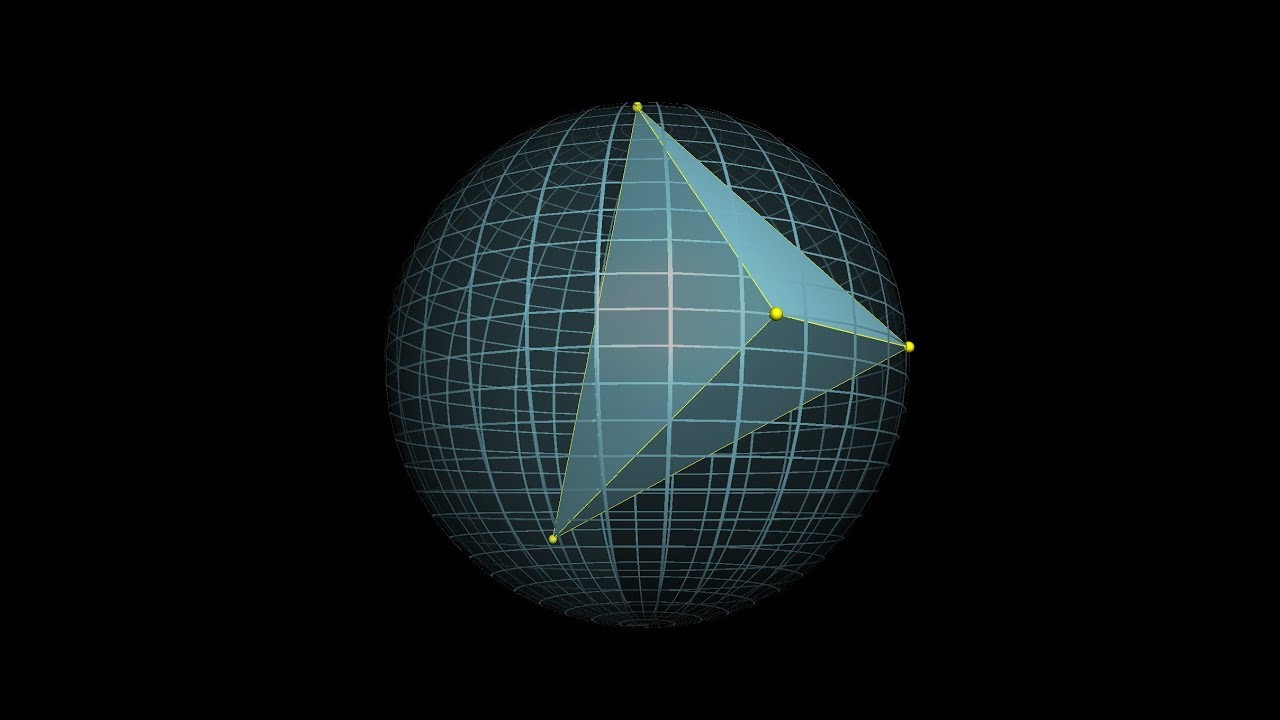
A difficult geometry puzzle with an elegant solution. Practice more problem-solving at https://brilliant.org/3b1b Solution to the puzzle mentioned at the end...
humble cloud
something similar to that, but not bounded by a sphere and with arbitrary amount of points (3d only)
merry shale
t!wiki convex hull
honest apexBOT

In mathematics, the convex hull or convex envelope or convex closure of a set X of points in the Euclidean plane or in a Euclidean space (or, more generally, in an affine space over the reals) is the smallest convex set that contains X. For instance, when X is a bounded subse...
 frigid patrol
Can someone explain to me why every continuous map from X to [0,1] is homotopic to 0?
 dreamy valley
You can construct the homotopy directly (e.g. h(x,t) = (1-t)f(x)).
 steel needle
in general any function into a convex set is homotopic to a point because of that same reason
or any set that is homotopic to a point
for example a hemisphere
frigid patrol
If the identity map Y -> Y is homotopic to 0, does that imply that any continuous map X-> Y is homotopic to 0?
If so how?
steel needle
compose the function with the homotopy between the identity and 0
frigid patrol
Say H is the homotopy from id:Y->Y to 0:Y->Y.
Let f:X->Y be continuous.
Then H(f) = H(id ° f) = H(id) ° H(f) = 0 ° H(f) = 0.
 worn yoke
t!yt 3b1b Sneaky Topology
honest apexBOT

Solving a discrete math puzzle using topology. Want more fair division math fun? Check out this Mathologer video https://youtu.be/7s-YM-kcKME (Seriously, Mat...
 sonic laurel
🤯
worn yoke
I literally was on youtube when That came up
 half umbra
@honest narwhal hello Mr topology man what should I know before diving into topology
Should I put a topology book on my wishlist? If so which one?
Pls ping when responding
steel needle
Munkres
If you dont like munkres, then Sims or whatever
You dont need much but people often learn topology of R first
 honest narwhal
Munkres is supposed to be decent, yeah
half umbra
noo I've been avoiding getting into calculus rather unfortunately
I'm taking AP calculus AB right now but I find this AA book too interesting to want to get further ahead in calc :(
honest narwhal
Ah, yeah so the thing about point-set topology is that a lot of it is really meant to generalize certain ideas that you first see in rigorous calc/analysis
In principle you don't need anything at all to start Munkres, like I'm pretty sure he starts off with "what's a set?", but it's gonna be boring
steel needle
Which algebra book?
honest narwhal
Like, he'll define a continuous function and you'll be like "Kewl, so?"
half umbra
Third book I'll read that starts with "what's a set"
@steel needle Judson do you know it
steel needle
No idea
half umbra
It's an open text
steel needle
I like rotman and artin
half umbra
The title is Abstract Algebra: Theory and Applications
 still aspen
 torpid path
He’s back 
fleet trench
hey, i've got a quick question about connectedness. in class, we proved that a space $X$ is connected if $\forall x, y\in X, \exists U\subset X$ such that $U$ is connected and $x, y\in U$. is that an iff, or just one-way? it seems like it should be bidirectional, at least for a finite set, but does it hold in general?
gentle ospreyBOT
interstellar_:
steel needle
it's iff
fleet trench
nice, thanks!
steel needle
one direction is trivial, taking U = X. for the other direction, note that being in the same connected component is an equivalence relation
fleet trench
ahh okay that makes sense
 mystic ridge
How many topological holes does a T-shirt have?
honest narwhal
So, I think you'd have to be careful about what that means. It's not a closed surface so I don't think "genus" is quite applicable here
You can think about it as S^2 with 4 disks removed, but I'm not sure what the formal topological definition of that is
mystic ridge
Apparently cylinders don't constitute closed surfaces?
But I could recall straws having a genus of 1
honest narwhal
A cylinder has boundary, namely a disjoint union of circles
As for genus, I guess we can try to compute its homology and see
Or just give it a cell decomposition, same thing
mystic ridge
Haven't delved into topology that much besides seeing videos like https://www.youtube.com/watch?v=M0M3srBoTkY&list=PLa6IE8XPP_gnTQcD8qgl72tgrhIsQYvQM

Viewers like you help make PBS (Thank you 😃) . Support your local PBS Member Station here: https://to.pbs.org/donateinfi What does your brain look like when ...
and a couple of 3b1b ones
but it certaintly seems interesting
honest narwhal
Oh wait I'm dumb actually
Cylinder is homotopy equivalent to the circle
So the circle has a 0-cell and a 1-cell, meaning its Euler char is 0
So now if we define genus of any space to be such that 2-2g is the Euler char, then yeah genus of the circle, and thus the cylinder, is 1
I had given a cell structure on the cylinder, and for some reason I felt like it had to satisfy the condition of a simplicial complex that the vertices uniquely determine a face
So my structure was something like, 8 0-cells, 12 1-cells, and 4 2-cells
Which works, gives the same answer, but also fuck
mystic ridge
genus 1 if we're talking about a strawlike cylinder right
honest narwhal
Yeah, formally S^1\times [0,1]
I guess we can compute now the genus of a shirt
But it'll be harder
No obvious space that it's homotopy equivalent to and I feel the cell structure is trickier
mystic ridge
All this work just to figure out how many holes a shirt has, lol
merry shale
I'd say it's of homotopy type of a sphere whitout 4 points, if that's worth anything
steel needle
surely the answer is simply 4
merry shale
Well maybe it has a lot of small holes cause the fabric is weird
Depends on the model
frigid patrol
A cylinder is a spere with 2 disks removed. So does it have 2 holes?
steel needle
Yes
Any nice space comes from a bunch of holes in a simply connected space
But there are strange holes
Like in RP2
frigid patrol
So how do you get the torus from a simply connected spaced by removing holes
steel needle
you get it from R2
holes are created when you wrap it on itself
just how the circle has one hole from wrapping R on itself
frigid patrol
But that's a different kind of hole than removing disks
steel needle
sure
 inner knoll
frigid patrol
inner knoll
frigid patrol
Drugs?
 gilded shell
Ignorant question here so maybe ignore. If i study all topological embeddings from the n-sphere to a topological space. And say two functions are equivalent if i can deform one into the other continuously.
Is the number of equivalence classes exactly the number of holes of dimension n?
Is it the same by definition, or after doing some thinking?
 obtuse meteor
It's not the same
There is something related though. You're looking for fundamental groups
Consider though for your counterexample, embeddings of S1 into the 2D plane with a disk removed. There are infinitely many ways to embed S1 into this space
steel needle
it's generated by one way though
namely, you might expect that it will be a free abelian group generated by each hole
but the homotopy and homology groups may be something quite strange
for example you can have torsion, in the first groups of RP2
or any nonorientable surface
obtuse meteor
Yeah the torsion is weird. Generally if you ignore torsion the nth homotopy group gives the n-dimensional holes
So long as n< m where m is the dimension of the space
Higher than that things get weird
merry shale
How do you visualize a func from S2 to a space?
 west ocean
Maybe color map.
humble cloud
u,v paramteric equations and colors for the direction on the plane?
gilded shell
@obtuse meteor
Oops, sorry I wasn't here. I realized there were some flaws with what I said. But in your example. There are an infinity equivalent ways to embed S1 in R2\Disk. Embedding implies injectivity, so no crossovers. Therefore I'm confused?
If you ignore orientability, then there should only be two ways not? Either the loop of S1, goes aroud the disk, or it doesn't. That's it.
 noble lava
Oof
Anyone mind helping me out?
Show that if (βX,ι) is a Stone-Čech compactification then ι is injective.
Where X is T_3.5
dreamy valley
one way to try to approach this is to use the universal property of the stone-cech compactification: if f: X --> K is a continuous map, where K is compact, then there is a (unique) map g: BX --> K with f = gi
to show that i is injective, then, it suffices to find, for any distinct x, y in X, a compact space K and map f such that f(x) != f(y). for this you can use the T_{3.5} condition
dreamy valley
definitions are pretty op :P
noble lava
yeyeye
😛
Wait tychonoff seperates a point and a closed space, so I should construct a space that contains one point and doesn't the other?
Or am I to use the 3.5 ->3->2->1->0 thing?
steel needle
points are closed
dreamy valley
i would use the 3.5 axiom together with yeah, that
dreamy valley
describe the separation function you have got to me precisely
noble lava
g:X->R cont, g(x1) = 1, g(x2) = 0
dreamy valley
ah -- is it clear that T_{3.5} also allows you to choose g to have bounded image?
dreamy valley
[0,1], the closed interval
noble lava
Ok
dreamy valley
(it would be very strong to have a continous function out of X landing in the two-point set {0,1}, since every connected component of X has to go to one of the two points)
so you have g: X --> [0,1] continuous with g(x_1) = 1 and g(x_2) = 0
dreamy valley
no
i'm not certain whether that should be possible in general, but it doesn't matter for this application
noble lava
Oh ok
Then I'm stuck
😭
Do I do something like that?
Wait the containment should be equality
steel needle
you don't need the inverse image to be the point
you just need f(x) = 0, f(y) = 1
f continuous
 noble lava
So you're saying to change the codomain of my separation function?
 arctic radish
is this the right spot to look for help with topology
 small obsidian
Sure! Ask away
arctic radish
ok lemme look at a problem for a while longer and ill come back here when i end up not being able to solve it
👍
steel needle
lol
small obsidian
I guess he got it
arctic radish
nah just trying to go thru textbook and understand topology
its hard for me to grasp ngl
ill definitely be back with the problem at some point tho
arctic radish
topology without tears
im just relatively new to proofs as a whole
and i have little brainpower at my disposal
steel needle
looks like an odd book
small obsidian
I went through that one as well, I learned a lot
 gritty widget
did you cry
 turbid pasture
he cried only to sue for false advertisement
gritty widget
I was considering doing something similar
there's this cereal that says on the package "Love it or it's free!"
I've always felt like it's just a mediocre cereal, like all breakfast cereals
it's basically stale bread chunks covered with sugar in milk as a way to survive
so I was hoping I could just tell them this and get it free on a consistent basis
small obsidian
Yeah about the same. Entry into higher math is like that
What are you studying topology for?
arctic radish
our calc 3 class got to the end of our textbook so our professor is like "and this is to go even further beyond"
so we're doing some starting topology stuff
small obsidian
Oh cool, that's neat
Do complex analysis if you're into applied math. That's a genuinely fun one.
arctic radish
alright so if i have a convergent sequence x1, x2, x3... xn in X (where (X,d) is a metric space)
if we let x,y be elements in X and suppose that the limit as n goes to infinity of xn is equal to both x and y
how should i show that x = y
small obsidian
I believe it's enough to know that it's a metric space
I can look up the proof, lol
arctic radish
given that it's a metric space, is that because of distance?
small obsidian
Yeah, you can show that the distance between the two limit points must be zero
It seems to be more of a "real analysis" type of proof though
fleet trench
you can probs use the fact that metric spaces are necessarily hausdorff
steel needle
the idea is to note that sequences eventually get arbitrarily close to their limits
so pick N such that the terms of the sequence are |x-y|/2 away from x at most
then they're all at least |x-y|/2 away from y
and so they can't converge to y
(for any fixed y =/= x)
 kindred meadow
It follows from d(x, y) =0 implies x=y
 worldly coral
Assume that the limits are different, and take a disjoint pair of open balls around them (like jacobian said d(x,y)/2). Then since xn converges you can find an n >= N such that xn is in one of the balls, and you can also find a xn for n>= N' that is in the other one (for all n>= N and N' respectively). Then you can see the contradiction when you choose the larger N, since xn will be in both balls even though we assumed they are disjoint.
arctic radish
ok if we let x be a set and a subset U in x is called cofinite if U^c has only finitely many elements
let X = R be the set of all real numbers, let tau be the collection of subsets which contains the nullset, R, and every cofinite subset
how would I show that tau defines a topology on R
worldly coral
just show that it satisfies the axioms of a topological space
Closed under infinite union, closed under finite intersections and that it contains the whole and empty set
so you got the whole set and the empty set already by definition
arctic radish
ok
worldly coral
you could show that every intersection of a cofinite set is a co finite set
and every union is one
and then just use some induction
from threre
hint use De Morgans laws
frigid patrol
What does it mean for a subset of a topological space to be discrete?
raven garnet
The subspace topology is the discrete topology probably
steel needle
means that every point is isolated
frigid patrol
Ok thanks
gritty widget
Righto simple question - got me a semigroup generated by two matrices, namely
=tex A=\begin{bmatrix}0 & 1 \ 1 & 2\end{bmatrix}, B=\begin{bmatrix}1 & 3 \ 0 & 1\end{bmatrix}
Eh, it works
 violet pendantBOT
Command disabled
The sever owner has disabled that command in this location.
raven garnet
Sure
violet pendantBOT
Command disabled
The sever owner has disabled that command in this location.
gentle ospreyBOT
Jichael Mackson:
Compile Error! Click the  reaction for details. (You may edit your message)
gritty widget
What's the command for this thing anyway?
raven garnet
Just type the tex normally
gritty widget
Ugh, I hate machines making decisions for me
gritty widget
Yes, yes
Want to show that my semigroup doesn't accumulate to I in GL(2,C) - what do
Well - I know this is already true
Just wanting to check my hunch before I rail someone over this.
raven garnet
Wtf is accumulating a semigroup?
gritty widget
So I generate ya?
gritty widget
Yees
gritty widget
Okay, it's defined by the orbit of a given transform on the upper half plane
Bear with me
raven garnet
Seems legit
If we are determining whether or not something is an accumulation point, needs to be specific
gritty widget
Oh found it
Kk
PGL(2,C) fyi and I'm going to give it topology with the following metric.
...
,$ \chi_0(f,g)=\text{sup}_{z\in\bar{\mathbb{C}}} \chi (f(z),g(z)), \ (f,g\in\text{PGL}(2,\mathbb{C}))
Heh.
gentle ospreyBOT
Jichael Mackson:
gritty widget
,$ \chi(z,w)=\dfrac{2|z-w|}{\sqrt{1+|z|^2}\sqrt{1+|w|^2}}, \quad \chi(z,\infty)=\dfrac{2}{\sqrt{1+|z|^2}}, \quad, z,w\neq \infty
gentle ospreyBOT
Jichael Mackson:
gritty widget
👍
So:
,$ \exists f_n \in \langle A,B \rangle : \chi_0(f_n,I_2) \to 0, n\to \infty??
gentle ospreyBOT
Jichael Mackson:
raven garnet
mutters I need a coffee before I can read that
gritty widget
I might just simplify life and turn up the fudge factor to 11 and say map using a in PGL(2,C), f:a -> b, b is some vector in R^8, use taxicab metric plox
I legit just thinking in terms of matrix multiplications and seeing that you can't arrive a multiple of I_2 or even an approximation since entries are always going to increase or stay the same in just the top right entry - blowing this out of the water.
@raven garnet Anywho, pung me if you're ready
I got this entire place mooted
raven garnet
Sure
frigid patrol
Does this mean direct product of groups?
It's called the rational homotopy group
steel needle
it means tensor product
you basically change the coefficients from Z to Q
because now you have a Q module
that is, a Q vector space
instead of a Z module
that is, an abelian group
steel needle
maybe
towards the end
you usually see it in commutative algebra
after a course in groups, rings, fields
artin has modules I think?
then you'll see it
oh it doesn't
you won't
frigid patrol
Libgen, tho that ToC is from Pearson's website
sonic laurel
No, I mean how do you like it?
frigid patrol
Haven't started it
steel needle
for commutative algebra atiyah&macdonald
after you do artin
what about server lore @sonic laurel
sonic laurel
Any spicy lore?
sonic laurel
Who started this server anyway
sonic laurel
Did they start the other servers too?
It seems like this server is a part of a bigger network of subject servers
steel needle
yea
arctic radish
ok i have no idea how to do
this
heres my question from earlier
i don't really understand how to go thru the proof
someone walk me thru step by step and hold my hand and whisper nice things in my ear
arctic radish
wait actually
im just gonna ask my professor if we can just apply demorgans laws
we havent gone over it in class but yeah
small obsidian
You need demorgan for this, yeah
Also note that a topology need only be closed by finite intersection, which is important here
steel needle
you just check the axioms
if some sets are missing only finitely many points, then their union surely is too
if two sets are missing finitely many points, their intersection is missing the union of them, which is finite
and you're done
gritty widget
Damn it
arctic radish
i kinda understand all of them except for the intersection of two cofinite sets on x
oh wait nvm
arctic radish
im actually bumbus
the complement of the union being the intersections of complements of the two elements is kind of unintuitive
how should i visualize that
 nimble hornet
if K subset of Y subset of X, how do we know that that there is an open cover V of K in X such that each open set in V is open relative to Y?
steel needle
the open sets of Y are exacty the intersections of open sets in X with Y
by definition of the subspace topology
frigid patrol
A and B are every where dense does not imply A n B is every where dense
Ex: Q and Q + r where r is irrational are everywhere dense. But their intersection is empty.
Is this correct?
frigid patrol
OH
I realize where my proof requires B is open
If B is open then A n B is everywhere dense
I gave a "proof" for A n B is everywhere dense, but that's clearly wrong as we just said
But now I see where in my proof I can apply that B is open
steel needle
nice
frigid patrol
Is continuous imageof regular space regular?
Discrete space is regular
Indiscrete is not
Any map to indiscrete is continuous
So it's false
 plain glen
fleet trench
plain glen
fleet trench
@verbal prairie if you restrict the domain of pi-tilde to pi(U), it is equal to pi-inverse (the inverse is well-defined since pi is a homeomorphism over pi(U))
@plain glen wrong channel (and really wrong server, lol). assuming the fields in part a) are the E and B fields, you can pull em out the same way you do normally, using A^0 as the electric scalar potential and A^i as the magnetic vector potential
hop on over to the physics server if you have more questions
 verbal prairie
@fleet trench ah thank you very much
fleet trench
no problem!
frigid patrol
Is the quotient map from the cylinder to the Mobius strip given by first flattening the cylinder so that it's a rectangle, then identifying 1 pair of oppostie edges by a twist, a covering?
frigid patrol
It's not
merry shale
Flattening it to a rectangle is not an homeomorphism
frigid patrol
Obviously
frigid patrol
How do you cover the klien bottle with the plane?
steel needle
can you?
ah
Mathematics Stack Exchange
I'm trying to find the universal covering space of the Klein bottle.
I know that $\mathbb R^2$ covers the Klein bottle , but I don't know how to prove, I found this proof on internet:
Someone know...
arctic radish
does topology without tears by SA Morris have any actual solution set anywhere
frigid patrol
Roses are important in algebraic topology
Aww who knew math could be so poetic
🏵
arctic radish
hey guys, so im working thru some of the problems in this book
these should all not be topologies, right?
- union of {c} and {b}. {c,b} is not in tau 1
- intersection of {b,d,e} and {a,b,d} is not in tau 2
- union of {a,b,c} and {d,e,f} is not in tau 3
gritty widget
Last one, isn't the union of {a,b,c} and {d,e,f} just X itself?
(and thus in the topology by the first element)
@arctic radish
gritty widget
yw
gritty widget
(a) is true, which means (b) is false.
gritty widget
Remember the difference between set membership and subsets
Well, yes. X and empty set are members of all topologies on X
{X} is the 1-element set containing X
arctic radish
that makes sense, but what's the difference between {X} and X
gritty widget
As above :)
arctic radish
aren't they both just subsets of {a,b,c,...}
gritty widget
X is a set with 6 elements in this case.
{X} has only 1 element
X is a subset of {a,b,c,d,e,f}
{X} is not a subset of {a,b,c,d,e,f} -- because the subsets of that look like {a,c,f} for example
gritty widget
good plan
arctic radish
topology is def not my calling oof
gritty widget
Many are called, few are chosen
sonic laurel
Which book are you working through?
arctic radish
topology without tears by sa morris
there isnt an official solution set as far as i can see
steel needle
fast reason why RP2 cannot cover klein without using curvature?
it follows because compact coverings are finite, and therefore the sphere would cover klein
which it can't
steel needle
you need to check that the differences |xn - xm| are eventually as small as desired
so for a fixed error bound e, you need to show that after some N < n,m, you have |xn - xm| < e
in this case $|x_n - x_m| = \sum_{i=n+1}^m \frac{1}{i!}$
gentle ospreyBOT
jacobian:
steel needle
or something
so you essentially wanna prove that the tail $\sum_{i=N}^\infty \frac{1}{i!} $ is small
gentle ospreyBOT
jacobian:
 dreamy yew
how does one learn topology?
merry shale
Eating doughnuts
 languid cedar
eating coffee mugs and drinking doughnuts
merry shale
"Let (X,d) be an edible metric space"
"Everytime someone ate it he could have ate it in a finite number of bites"
 meager pagoda
how many bites does it take to get to the center of a metric space @merry shale
 west zodiac
So, I'm letting C be a closed set, but I'm having trouble constructing a countable open cover for it.
Can anyone give any hints (but not answers!)
dreamy valley
i assume you have the picture where each point of C gets separated from x by an open set? use the countable basis at x to "join up" the open sets over points of C.
(sorry if this is too much hint :\ )
west zodiac
That's possible?
Because I didn't see how to use that countable basis to join stuff up.
Guess I'll try again in a bit.
dreamy valley
ok good luck :D
west zodiac
Hmm, no, I still don't see how to join up the open sets.
I'm also not sure what's so special about countability in this instance.
dreamy valley
let {B_n} be a countable basis at x. for any y in C, there's a k(y) and an open set U_y containing y such that B_{k(y)} and U_y are separated. Let U_n be the union of the U_y for y \in {y : k(y) = n}.
west zodiac
k is just some arbitrary integer-valued function, right?
dreamy valley
yeah (constructed via choice, even)
merry shale
Let A be a conpact convex of the plane R^2. Let A_epsilon be the union of all balls of size epsilon centered in A. I need to prove that lebesgue(Aepsilon) = a+bepsilon+cepsilon^2 and find the right constants
My conjecture is that a= lebesgue (A), b= "perimeter" of A and c = 2pi
But i have no idea how to prove it
dreamy valley
i do not believe these are the right constants for the circle, even :p
as to how to prove it, i would construct a map from the annulus of radius epsilon around the convex set to some "nice" set that you know the area of, such that you can take the determinant of your map (or just cleverly construct your map to have determinant one)
(i am not quite sure this works yet, i am still puzzling through details, to be clear)
merry shale
What determinant? It wouldn't be a linear map i think
dreamy valley
jacobian determinant / determinant of the derivative
the thing you need to take to relate the integrals :P
merry shale
I checked my constants for polygons and if the thing is flat you need to put twice the perimeter
And there's like a thing doing a single turn inside that annulus
That gives a 2pi
Maybe i just take the characteristic of Aepsilon, integrate it, do a change of variables from x y to r theta wrt some point in the thing
Take the inside out by linearity of integral
(The lebesgue(A) part)
dreamy valley
that seems reasonable
 thick stratus
/me gets shot multiple times
 kindred tree
what is the best way to learn topology (where u find information , where to start, when to do what )
gritty widget
Yo. I haven't been here for the longest of whiles. is this the place to talk about manifolds, charts and algebraic topology?
well nevermind. hadn't seen the channel description
west ocean
Just ask.
torpid path

turbid pasture
ok so I was looking at some online lectures
by fredric Schuller on YouTube. it's about math for physicists. very brief overview of topology
when it came to the fundamental group he just said that the fundamental group of the sphere was the trivial group because any closed loop could be deformed to the point and so on
I see this intuitively, but what would the proof look like?
basically how do you prove a topological space is simply connected
 drifting ruin
You first prove that any path is homotopy equivalent to a non-surjective one. Then you can just puncture the sphere at some point not in the image of the path and observe that the resulting space (R2) is contractible
turbid pasture
the idea of showing that every path is homotopy equivalent to a non surjective path is to guarantee that you can always puncture the sphere at some point for each path?
thanks btw
gritty widget
Can someone tell me the prequesites for learning topology?
I half mastered calc II and some real and complex analysis.
I also know some set theory and logic.
But I can't recognize half of the stuff I see here beyond 3blue1browns topology videos.
languid cedar
as long as you know what a set is you should be fine
gritty widget
@steel needle I love math and I think about it every minute. I think in math. As I mature, my math matures. But I am more exposed to the gödelian way of thinking as opposed to munkres.
gritty widget
With reference to gödel
gritty widget
I dont know really. Just being focused on consistency and rigorously proving everything. It may be the only way of thinking for all I know, being that i am not exposed to much else.
steel needle
that's nonsense please don't call it "godelian"
steel needle
just read munkres man lol
gritty widget
Ok. Thanks :)
honest narwhal
Or just read ch1 of Bredon. 60 pages and you know more point-set than you need
steel needle
xd
verbal prairie
Why is X{x} closed?
Tf
And if it's infinite wouldn't it be in the topology here, hence open. Is it clopen then?
 floral barn
What's the topology in the above question?
languid cedar
arbitrary, you have to prove that it's the discrete topology
well not quite arbitrary
you're given that every infinite subset of X is open
floral barn
Oh, I was confused by the way you had ordered your posts @verbal prairie
@verbal prairie and what's "T" ?
languid cedar
a topology on X
you can't use that the complement of an open set is closed
or at least not directly
because otherwise you'd just use that {x} is open
so it's probably using the closure/limit point definition of a closed set
languid cedar
well one way of doing this problem
let A be an infinite set such that X\A is also infinite
then A and X\A are both open
let a be an element of A
then {a} U (X\A) is infinite and hence an open set
thus the ({a} U (X\A)) intersect A is {a} and hence all the singleton sets of elements of A are open
and do similarly for X\A
since the union of A and X\A is X, all singleton sets of elements of X are open
and then the last step is in there
so this proves it
but I don't see how it gets straight off that X\ {x} is closed
wait nvm
I think it is just closure definition
the only point not in X\ {x} is {x}
so you just need to prove that x isn't a limit point of X \ {x}
 mighty needle
I think that's the same as showing that {x} is open
languid cedar
yeah I think you're right nvm :^)
idk
I'll just leave it at the above proof I guess
@verbal prairie where did you get the solution from?
verbal prairie
stackexchange
So I need to show X \ {x} is closed, which would mean {x} is open
To show X \ {x} is closed, I need to show that every neighborhood of x contains at least one element other than x?
languid cedar
no
 fervent citrus
there are multiple ways of proving that seomthing is closed
languid cedar
that would make x a limit point of X \ {x}
which would mean that X \ {x} isn't closed
verbal prairie
Ah yeah right
languid cedar
unfortunately if you do try to do it this way it just boils down to showing that {x} is open so you're stuckl
verbal prairie
hehe
fervent citrus
is X the whole space or just a subset of the whole space here ?
verbal prairie
Whole
fervent citrus
weird
verbal prairie
Mathematics Stack Exchange
Let $X$ be an infinite set with a topology $T$, such that every infinite subset of $X$ is closed. Prove that $T$ is the discrete topology.
I have somewhat of an answer but I don't think it's enoug...
"X∖{x} is infinite, hence closed" apparently, that's some established fact then
mighty needle
Here's another method:
Given any x in X, we can construct an infinite set A that contains x whose complement is also infinite. Think about how you might do this, it's not so hard. Since (X-A) U {x} is still infinite, it's open. Then [(X-A) U {x}] Intersect A is just {x} and the intersection of two open sets is open. Since every singleton is open, we have the discrete topology
Sorry about formatting, I'm new to this discord
languid cedar
ya this is the method I gave
mighty needle
Ah, you're right, didnt see that
verbal prairie
And what do you guys think on this?
Whether they are topologies on R
Not even sure about what closed interval with irrational boundaries is
Is that even a thing? And how ( ) would be different from [ ] here
gritty widget
You're studying topology and you don't know the difference between () and []?
verbal prairie
I do
If the boundary is irrational though
What does [] with irrational boundaries mean?
languid cedar
same thing
mighty needle
The same thing it means with rational boundaries
verbal prairie
I mean what's the difference between (irrational,irrational) and [irrational,irrational]?
verbal prairie
So an [edit:]irrational can be thought of as a final number included in the boundary?
Ah I see
Don't think that's obvious
*irrational
verbal prairie
I do know that, but I don't think it's obvious with irrationals
languid cedar
definition doesn't say anything about a or b except that they're real
verbal prairie
Okay, I see, thank you
verbal prairie
Does this say that T contains every subset of X and they are all closed?
verbal prairie
Or no, rather T is such a topology that every subset of X is closed?
And that means every subset of X is open in T
turbid pasture
every subset is closed
you are tasked to prove that every subset is open too
if A is a subset of X, and A* is its complement
by assumption A* is closed and therefore A is open
so every set is open
and closed
verbal prairie
Yes, I'm just bad at understanding where the sets are sort of, are they elements of T or subsets of X
verbal prairie
Ah, okay, I was just checking if I understood right
turbid pasture
but when it says that every subset is closed, it's talking about subsets of X
with respect to the topology T
verbal prairie
T defines such a topology that makes every subset of X closed?
I think I understood
turbid pasture
yes, by assumption
turbid pasture
👌
verbal prairie
Can I do it like: X-{x} for any {x} in X is inf. hence closed, then X-(X-{x})={x} is open and is in the topology. And now any subset of X can be obtained from a union of singleton subsets of its elements and it will be open and hence in T.
turbid pasture
yeah that's it I believe
verbal prairie
👌
verbal prairie
I wonder if point-set topology is supposed to be understood visually/intuitively in some way or are you just supposed to be a logic machine that can derive true statements out of the givens?
honest narwhal
So, the definition of a topology is very general and most topological spaces are garbage set collections that no one with any taste cares about
A lot of point-set along those lines, like the counterexamples stuff, is gonna be not visual because the spaces just aren't ones you can "see", e.g. non-Hausdorff
Some stuff are theorems which hold in X level of generality that include metric spaces in which case you can see what's going on and it may or may not guide the proof in the general case
verbal prairie
Thanks for explaining 👌
 sharp dove
Fun problem from u/WaltWhit3 on r/math: Given a closed unit disk with a hair (closed unit interval) attached at every point, is there a quotient map onto the solid cylinder ?
I think I found a round about solution to this that I’ll write up later
steel needle
i wanna say no
the open sets at the hairs look different than the open sets in the cylinder
sharp dove
Well the question isn’t whether they are the same space it’s wether you can quotient one to get the other 
steel needle
well the answer isn't that they aren't the same space it's that they locally look very different
sharp dove

small obsidian
What's the theorem they're proving?
I can recognize topology without tears from a mile away, I guess
verbal prairie
Heh
So why would that be true (what's in yellow)?
Because there's always at least empty intersection, so or can be coupled with anything?

small obsidian
I'm thinking about it. If A = X then the set is obviously closed, so ignore that case
 digital peak
but if p in X \ (A u A') then p not in A
small obsidian
p ∈ X so there is an open set containing it. But U ∩ A = {p}?
digital peak
then p not in U n A
small obsidian
That might be referencing a theorem I'm not remembering
verbal prairie
Okay, what about?
 frosty sundial
Q is clearly contained in Q-bar. therefore if q is not in Q-bar then q is not in Q.
 ebon bluff
Hello! New to the server, with a network topology question. I was unsure whether to address this to the question-channels or here, but seeing as the question-channels specifically call for math questions, and as I figure that my question is more science than math, I reasoned that this would be the appropriate section, so here goes: I am a neurotoxicologist working with a huge dataset of time-lapse microscopy images of neuronal culture exposed to a specific pharmaceutical agent. These images can be abstracted to 2-dimensional graphs where the neuronal cell bodies represent vertices and neurites represent edges. In recent years the neurotox field has started looking at network topology as a proxy for functional neuronal circuitry, where the reasoning is that given that some brain areas naturally exhibit small-world network topology, the pharmacological perturbation of this topological feature would allow us to infer that the compound in question could alter functional neuronal circuitry. With this in mind, I was wondering whether I could--from the aforementioned microscopy images--infer small-world network degree?
When answering, please assume that I am an idiot, but that I am willing to learn.
Also note that the aforementioned previous work related to this has been performed using very rigorous, and hence extremely time-consuming methodology. I am trying to see if I can work out a simple high-throughput method for first-pass screening purposes.
steel needle
not sure what you are asking
if you are interested in the topic maybe you should find a textbook on it
I don't think people here know much about it
sharp dove
I think you would be better off asking this question to a professor who does research on computational neuroscience. Maybe you can get away with asking it on math stack exchange or math overflow, but I highly doubt you will get a satisfactory response here.
ebon bluff
Actually, it helped to just write out the question.
I just needed to know whether it was possible in principle, and it turns out it is, so thanks!
 ivory tusk
thank urself 
 ancient shell
are there examples of open sets in R that are not of the form (a,b), or countable unions/intersections of it?
gritty widget
In mathematics, a base (or basis) B for a topological space X with topology T is a collection of open sets in X such that every open set in X can be written as a union of elements of B. We say that the base generates the topology T. Bases are useful because many properties of...
ancient shell
oo thx
 round stump
If you take a cone and cut off its base and top vertex then is it homeomorphic to a cylinder with its two bases cut off? @keen cliff oracle me
 keen cliff
yes
round stump
Is something being homeomorphic closely related to an isomorphism in group theory?
round stump
Okay, cheers
keen cliff
@round stump the general idea is that continuous functions are the maps that preserve the structure of topological spaces
well maybe for topological stuff it seems a bit backwards
instead of the image of opens being open
you have preimage of opens are open
but homeo means the inverse is continuous
meaning forward image of open is open
but now this gives you that for every element in the topology of domain, maps to an element of topology of codomain
and vice versa
this is a bijection in the topologies, a 1-1 correspondence
keen cliff
so they're homeomorphic because this function is a relabelling of the open sets of one space to the other
round stump
How would you show that there is a bijection though?
round stump
Oof
Bad woog
We had to show that we could map each point on that restricted cylinder to the restricted cone, made me think it was homeomorphic which then led to me thinking of an isomorphism since it’s group theory but not sure how to actually do the question 😂
keen cliff
well you can get within ε of the tip of the cone for all ε
but at that slice of the cone the circle still has Nonzero radius
so you can look at the map by mapping slices of the cylinder to slices of the cone
near the top the slices are narrower but that's no problem in topology
@round stump
round stump
Alrighty, I’ll try when I get home with my paper. Cheers again 
keen cliff
 errant rover
@round stump Do you know something about categories?
 stray moss
I know some stuff, although you didn't ask me
errant rover
Your question about homeos for top-spaces being like isos between groups is exactly the right question to ask
If you know what isomorphisms in general categories are, then it is immediately clear why homeos are defined the way they are
And not just saying "a bijective continuous function" which would resemble the group theory definition, but is actually just wrong
errant rover
Well roughly speaking a category is a collection of objects where you say what kind of structure a morphism has to have
For example the category Grp that consists of groups and group homomorphisms between them
An isomorphism is nothing else than a morphism that has a two-sided inverse, and this in turn is already enough to follow that two isomorphic objects behave "the same" in this specific category
Then it's clear why a homeomorphism is defined the way it is! A continuous bijection is not enough because there are continuous bijections that don't have a continuous inverse. In the category of topological spaces, noncontinuous maps are not allowed, so technically speaking you don't have an inverse
This is not needed in group theory for example, because if you have a bijective group homomorphism, then its inverse map is always a group homomorphism
Mhm, I think linear algebra is the right place for that question
 ruby fulcrum
errant rover
ruby fulcrum
errant rover
For group theory, the correct definition of a group isomorphism would be "An isomorphism between groups is a group homomorphism that has a two sided inverse, which is also a group homomorphism", it just LUCKILY HAPPENS TO BE that its the same as "bijective group homomorphism"
Hope that answers your question to isomorphisms and homeos 😄
 midnight jewel
iirc that holds for any category morphisms, no?
as in if a morphism is bijective, then its inverse is a morphism in the other direction
i recall proving sth like that in the beginning of our algebra class when we did categories for a momennt
round stump

What is a morphism generally @errant rover ?
I've not studied this formally, just stuff i've picked up
stray moss
A video I made on the topic
Or videos, rather
Skip to around 8:00 for the definition
@round stump
round stump
I've watched some of your videos they're pretty good
stray moss
Thank you!
errant rover
@midnight jewel nope
What you prove in algebra is that if a function is bijective then its inverse is bijective
And in the case of groups/rings etc. (almost everything algebraic), if you have a bijective structure-preserving map then the inverse is also structure-preserving
midnight jewel
no, that we proved a year earlier in analysis
errant rover
However this is not always the case (e.g. topological spaces), where you have a structure-preserving bijection but the inverse is not structure-preserving
midnight jewel
oh, yea, I did indeed misremember the assignments
errant rover
So the thing that happens technically is that you have a bijection that doesn't have an inverse (because the inverse FUNCTION is not a morphism in your category)
midnight jewel
it was merely two specific examples
(morphism in the category of sets is isom. iff it is a bijective map; function between two rings is isom. iff it is a bij. ring hom)
but that was long enough ago that I must've overgeneralized it in my memory
interesting to hear that counterexamples exist, excited to learn about it next semester in topology, I guess
errant rover
So these are examples of bijections that are not isomorphisms
Sometimes you even have isomorphisms that are not bijections
midnight jewel
I mean strictly speaking isomorphisms don't even have to be functions, do they?
the hom-sets of a category could be just about anything
though I don't know any examples where they're not functions
errant rover
Yes, but there are examples where an isomorphism is function-like but not bijective
In the Homotopy category (which is like topological spaces but you consider two spaces to be the same if they can be deformed into one another), the space with one point and the real line are isomorphic
But certainly none of the morphisms (which are equivalence classes of maps) are close to having a bijection in it
midnight jewel
how do you deform the point back into the line?
presumably you’d have to be able to do that, too, right?
errant rover
Think of the one point space as the origin in R
Then the map R -> point that sends every point to 0 and the map point -> R that sends 0 to 0 are inverses up to homotopy
You can look at the process like letting every point flow to 0 with such a speed that they all arrive at the point after 1 second
So the farther away the point, the faster it moves towards 0
midnight jewel
R→0 is no issue to me whatsoever, gthe problem I have is that 0→R doesn’t really seem to be … doable? unless, which is much more likely, I’m misunderstanding what the map has to achieve
like that map you described only embeds into R
errant rover
Well the process 0->R is like blowing up the point into a line
I agree that it feels a bit odd
You just do your progress backwards
midnight jewel
well, discord decided to crap itself again, perhaps this message will get through at some point, I guess I’ll go back to my audiobook
oh, that did go through
ah I think I have an idea of how to make sense of it, thinking back to how we looked at homotopies in complex analysis
↑is what I was trying to send
errant rover
Is your problem maybe that a point can only map to one point at once
So the deformation as a "map" can't really be realized
midnight jewel
we treated them essentially as continuous functions with two inputs, γ(s,t), where γ(0,t) describes one curve (parametrized by t) and γ(1,t) describes the other curve; and I guess a point would just be a function γ(x,t) such that for all t (and a fixed x), it spits out the same value
I guess that can be generalized to arbitrary dimensions by adding more parameters
is that the right way to look at it?
(I’ve not yet had topology, but have come across some topological ideas before in the analysis classes)
(going back to my audiobook but I’ll check in again later)
errant rover
Yeah thats just what a homotopy is
You usually stay with one parameter
As two parameters is kind of a homotopy of homotopies
I mean two time parameters
midnight jewel
ah, yea, we were looking at homotopies between curves in ℂ, so there’s wher ethe second parameter comes in
midnight jewel
having slept over it I think I now actually understand your example @errant rover
the issue was I missed the thing where {0} and ℝ were representatives of the same equivalence class. so the point was really that there’s a surjective homomorphism from ℝ to the one-point set (which is not {0}∈ℝ but just a separate thing), and another surjective homomorphism from the one-point set to {0}, and since {0} and ℝ are in the same homotopy class, this counts as an isomorphism between the classes [ℝ] and [{x}].
Correct?
yesterday I had completely misunderstood the premise and thought that the homotopy was supposed to be an isomorphism between {0} and ℝ
verbal prairie
How to show this?
errant rover
Do it for one space first
Get an epsilon such that the epsilon-Ball lies in the neighborhood of a
And an epsilon' such that the epsilon'-Ball lies in the neighborhood of b
What do you do to guarantee that one of the balls lies in both neighborhoods?
meager pagoda
projection maps are continuous and hence preimages preserve closure, then if your proj is also closed you should have both ways?
@honest narwhal
closed means image of closed is closed
verbal prairie
@errant rover take the smallest of the two
verbal prairie
(radius of one of the balls - distance from the center of the ball to C)/2 do it for two balls and take delta to be the smallest
verbal prairie
Why is that?
All sets in T are infinite, so there's always some non-empty intersection?
keen cliff
ya so if you intersect any two open sets
their complement will be a union of two closed (finite) sets
meaning the intersection contains all but finitely many points, so it is non empty
(cuz the "all" is infinite )
verbal prairie
Thank you
 pliant dragon
Want to make sure I'm not overthinking this one
If X={a,b,c,d} And S3 = {A subset of P(x): card(A) =3} would S3 just be c here?
 storm bough
pliant dragon
storm bough
pliant dragon
You're right. Totally missed the notation
So would it be 2^3 here
And then writing those out essentially
west ocean
$S_3={A\subset X,|, #A=3}\subset\mathcal{P}(X)$.
gentle ospreyBOT
 sleek forum

sharp dove
@verbal prairie Do you mean the induced metric like on a submanifold of a Riemannian manifold?
or an induced metric on a subspace of a metric space?
In the latter case, since the metric is just a nice map d:SxS---> R, the metric induced on C\subset S is just the restriction of d to CxC.
In the former, you essentially do the same thing on tangent spaces. If N\subset M is a submanifold, T_p N is a subspace of T_p M for every p\in N so you just restrict the inner product on the whole tangent space to this subspace.
 crude scaffold
i am creating some terrain and i am looking for some help with math functions, i have something that is working already, but im wounding if there is a function for this kind of wave
or is there anywhere i can look where functions like these are documented?
steel needle
just do piecewise functions
 wraith cradle
@crude scaffold how about (sin(x)+1)^2
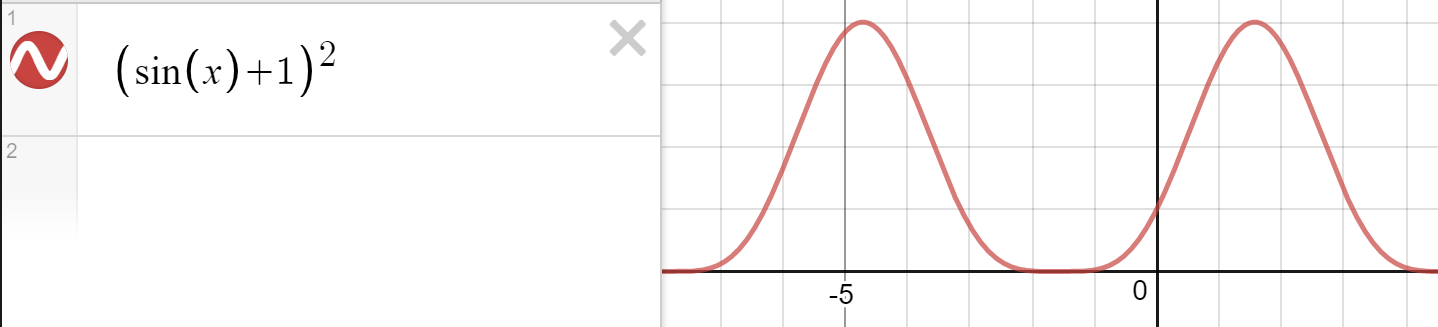
then using higher even powers will make the effect more drastic
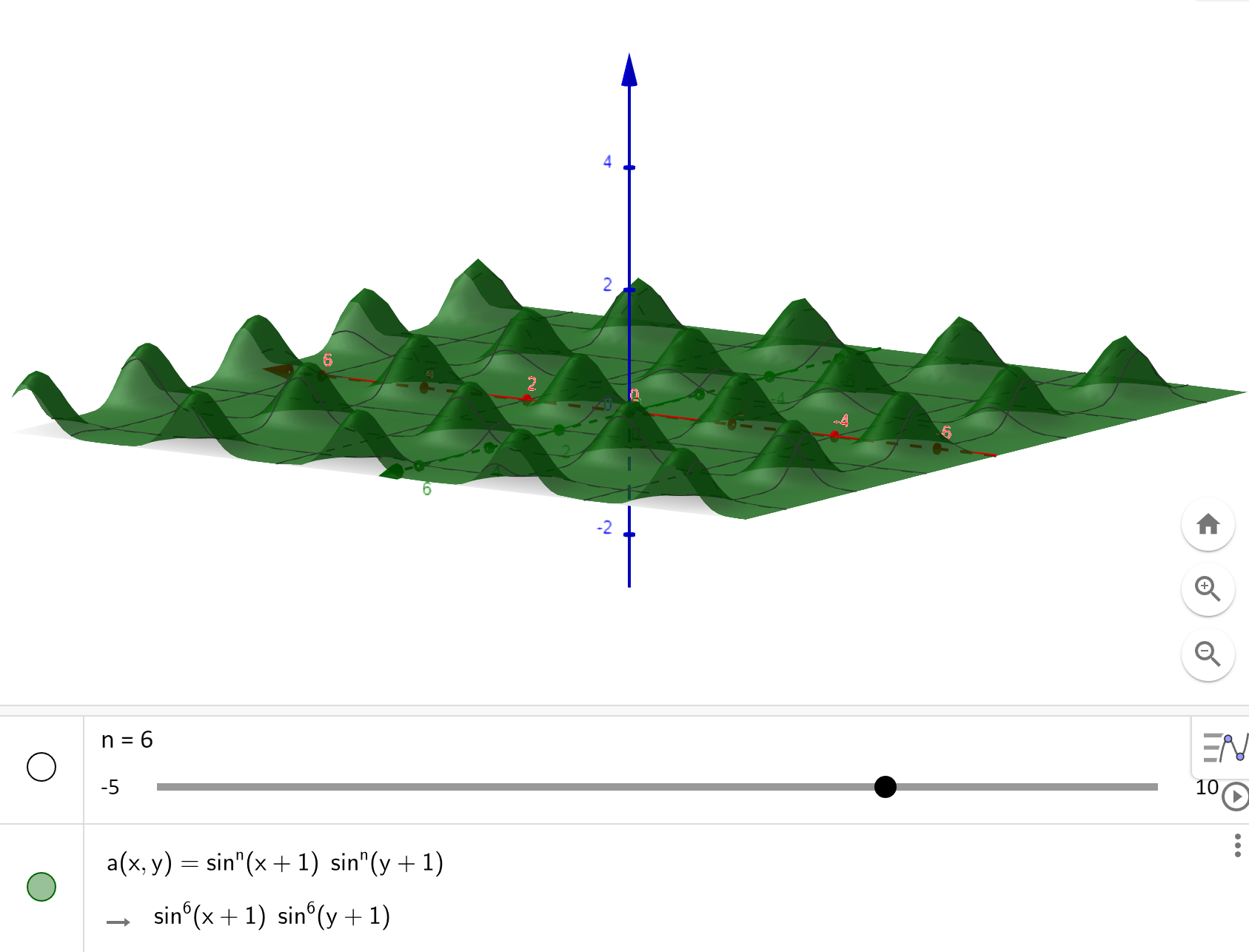 wraith cradle
the top screenshot is desmos, the bottom is GeoGebra
crude scaffold
thanks
wraith cradle
np @crude scaffold
this might be worth playing around with too if you want clear sliders https://www.desmos.com/calculator/dqs7ahccpn

Desmos Graphing Calculator
 golden owl
digital peak
golden owl
digital peak
it's a one-dimensional punctured donut
crude scaffold
@wraith cradle heres the terrain iv programmed to use these math function <3, cheers for the help
https://www.youtube.com/watch?v=OVCJAfAICiI&feature=youtu.be
 crude scaffold
i think i need much longer wavelengths to get better effects
i also cant figure out for the life of me how i would go about implamenting rivers
maybe i could check if the terrain is z height, then cut a big chunk out, idk how that would look
 zinc tinsel
Is this impossible because of the axiom that says you can only have finite intersections?
 tawny smelt
i think you’re confusing the meaning of infinite here
it just refers to the size of the subsets not how many intersections is allowed
because you can consider the intersection between the set of non-negative reals (the positive numbers including 0) and the non-positive reals (the negative numbers including 0)
this is the intersection of two infinite sets but their intersection is {0} which is a finite set and hence not on omega
zinc tinsel
so
because the intersection is a set that is not open (does not belong to the topology)
small obsidian
A topology can be closed under the intersection of infinite sets.
A topology need not be closed under infinitely many intersections
zinc tinsel
whats the discrete topology of X if X={}
gritty widget
Ye
zinc tinsel
Is that the powerset?
gritty widget
Yup
gritty widget
Yup
X is in there {} is in there, finite unions and intersections etc.
Universes most trivial topology
west zodiac
Can someone check my understanding of 2-homology here?
zinc tinsel
Ok
verbal prairie
I see
sleek forum
gritty widget
Hey guys one question
In a given set A= (a , {a,b})
is {a,b} a subset of A?
or you have to strictly have
a subset B={{a,b}}
wich contains the element-set {a,b}
would {a,b} be a subset of A or you have to define B ?
Oh fuck
just answered my own question that been searching for hours in a stack exchange post
mb
thx for the help anyways
 keen moth
Yup
 heavy ether


 uncut surge
Yeah, sure
You only need to consider whether the statement is true for points a which lie in U; if the point is not in U, you don't care
Instead, you could write: "For all U in O and for all a in U: There exists an N in the natural numbers so that..."
mighty needle
So a topological space X is Hausdorff iff it's diagonal is closed in the product topology on X x X.
Does this generalize to a higher dimensional product?
i.e. X is hausdorff iff the diagonal {x,x,...x} is closed in the product topology on X x X x ... X?
I actually only need this one way and (closed implies hausdorff) and I believe it's true at least in this direction:
Given x and y distinct in X, consider the point (x,y,y, ... , y) in X^n. It's off the diagonal so it's contained in a basis element U_1 x ... U_n of the product topology
But we can construct a smaller neighborhood since y is in each U_i, i>1. One of the form U_1 x V x V x ... x V, where y is in V. U_1 and V are our desired disjoint neighborhoods of x and y in X.
Oh, V should probably just be the intersection of the U_i, i>1
I think this works?
gritty widget
@mighty needle I think the step "But we can construct a smaller neighborhood since y is in each U_i, i>1. One of the form U_1 x V x V x ... x V, where y is in V. U_1 and V are our desired disjoint neighborhoods of x and y in X." is not clear enough
well one thing to not forget
you assume that the diagonal is closed
this means that outside the diagonal is open
so actually (x,y,y,...,y) is contained in a basis element U_1 x ... x U_n that is itself a subset of the complement of the diagonal
which means you can assume that U_1 x ... x U_n does not contain ANY element of the diagonal
now indeed as you said it would be a nice idea to pick
gentle ospreyBOT
Scientifica:
gritty widget
ofc U_1 x V x ... v X is an open subset that does not intersect the diagonal
can you conclude from this that U_1 cap V is empty?
btw not only I think the other way round works (iff), but maybe the iff works even if you take an arbitrary (infinite) product, with the product topology
didn't verify
if the proof would still hold
mighty needle
right, thanks for verification
gritty widget
it's a pleasure 😃
never thought of this generalization
thx for sharing the idea 😉
mighty needle
I needed to show that the Zariski topology on A^n(k) was not the product topology, and this was the first thing that came to mind
gritty widget
Oh ic that's NOICE
keen moth
@mighty needle hehe that's how I solved that problem too. The main idea is that varieties in A^1 are finite sets so the product of a finite set with some variety in A^{n-1} can not be the entire diagonal
 shadow ermine
Any suggestions on an Algebraic topology/Homotopy stuff, book? o:
honest narwhal
For a general book on algebraic topology, Rotman seems pretty good