#point-set-topology
1 messages · Page 92 of 1
 white oxide
 tame arrow
Is the $B^4 = \partial S^3$ a typo? From https://arxiv.org/abs/1710.11562


arXiv.org
Consider a dihedral cover $f: Y\to X$ with $X$ and $Y$ four-manifolds and $f$ branched along an oriented surface embedded in $X$ with isolated cone singularities. We prove that only a slice knot can arise as the unique singularity on an irregular dihedral cover $f: Y\to S^4$ if $Y$ is homotopy equivalent to $\mathbb{CP}^2$ and construct an expli...
 gentle ospreyBOT
Light Yagami

 umbral panther
Why do you think it’s a typo?
The boundary of the 4-ball is the 3-sphere
This paper makes bad choices, sometimes using D for the 4-disk and sometimes B, worse, letting each be a lower dimensional subset of the other. But in this case with the dimension listed, it seems consistent in the quoted paragraph
 gaunt linden
But shouldn't that be \partial B^4 = S^3?
umbral panther
Oh, yeah
 fierce lily
Can someone help me explain why any basis element containing b1 must contain points of the ai sequence?

 rancid umbra
fierce lily
Can someone help me explain why any basis element containing b1 must contain poi...
rancid umbra
fierce lily
Can someone help me explain why any basis element containing b1 must contain poi...
a basis element containing b1 = (2,1) is of the form (x,y) with x < b1 < y
what are the only elements less than b1 with this ordering?
fierce lily
rancid umbra
a basis element containing b1 = (2,1) is of the form (x,y) with x < b1 < y
what...
only ai element, but must there be a point in (x,y) containing b1 because any open set containing b1 must contain a basis element about b1?
rancid umbra
could u be more clear?
fierce lily
rancid umbra
could u be more clear?
I mean if there is a set Z, and we pick a one point set {1}, then any open set containing 1 do not need to contain other elements from Z. But for this question, we have b1, why a basis element containing b1 of the form (x, y) can tell that the element less than b1 is in (a, b)?
That is, why the only elements ai less than b1 can conclude that ai must be contained in basis element containing b1?
rancid umbra
the basis elements in the order topology are of the form (x,y) and [a1,z) where x < y and z > a1 are in {2} x Z_+
consider any basis element (x,y) or [a1, z) containing b1
in the first case, we must have x < b1 < y
but the only elements less than b1 are the ai’s (by definition)
so x must be equal to an for some integer n
now for any m > n, x = an < am < b1
the second case reduces to the first case by considering (a1,z)
rancid umbra
fierce lily
Can someone help me explain why any basis element containing b1 must contain poi...
what book is this from btw?
fierce lily
rancid umbra
what book is this from btw?
I search MIT open courseware and type topology, then there occurs the class and the textbook they use is the book written by James munkres.
fierce lily
rancid umbra
now for any m > n, x = an < am < b1
then what if m=n? there will no be the basis element around b1 in this case?
And it only happens when we can determine that it is the order topology?
rancid umbra
fierce lily
then what if m=n? there will no be the basis element around b1 in this case?
u have control over m. u don’t want to choose m <= n because it doesn’t allow you to draw any conclusions
and no, the basis element (x, y) contains b1 by assumption
fierce lily
rancid umbra
u have control over m. u don’t want to choose m <= n because it doesn’t allow yo...
I just noticed that n is infinite, so in that case, there must have ai in (x,y) containing b1 right?
rancid umbra
n is a finite number
b1 and a1 are also both elements of X; they do not contain each other
rancid umbra
rancid umbra
and no, the basis element (x, y) contains b1 by assumption
(x,y) is an interval here, not a point in X
fierce lily
rancid umbra
n is a finite number
what i mean is that there are infinite ai
Z+ has infinite elements
rancid umbra
fierce lily
what i mean is that there are infinite ai
yes
intuitively, any neighborhood of b1 must contain at least one ai (countably infinitely many actually) since b1 has no immediate predecessor
what i detailed above explains why
fierce lily
if we assume that prodcut of U1 and V1 to be B1, product of U2 and V2 to be B2, but it seems that we don't figure out B3 that is the subset of B1 intersects B2? Do we need to find out a B3 here, if we need , how can we find that B3 in this case?

or we can just write (U1 intersect U2) times (V1 intersect V2) to be B3?
rancid umbra
fierce lily
or we can just write (U1 intersect U2) times (V1 intersect V2) to be B3?
yes, because the intersection of finitely many open sets is open
also, this is better known as the box topology
the product topology is defined a bit differently. but in some cases they generate the same topology
 lusty trench
The product topology is best defined using the subbasis of cylinders.
 earnest ibex
For the cellular boundary formula in Hatcher, the degrees $d_{\alpha beta}$ in $d(e^n_\alpha)=\sum d_{\alpha \beta} e^{n-1}_{\beta}$ are only defined up to a sign, right? Will it have any impact in computing homology?
gentle ospreyBOT
ImHackingXD

 unreal stratus
I believe basically they all are well-defined up to the choice of sign of e_a, e_b in the homology
 radiant holly
I think it is not possible everytime.
unreal stratus
The inverse is also a homeomorphism and sends compact sets to compact sets
radiant holly
unreal stratus
The inverse is also a homeomorphism and sends compact sets to compact sets
But every compact space not Hausdorff
unreal stratus
I am using the definition that the preimage of a compact set is compact
i guess there are different definitions
radiant holly
I mean X={1,2,3} and Y={a,b,c} T|X={X,{},{1},{2},{1,2} and T|Y={Y,{},{a},{b},{a,b}
f(1)=a
f(2)=b
f(3)=c
f:X--->Y homeomorphism but not proper because (Y,T|Y) not Hausdorff @unreal stratus
earnest ibex
unreal stratus
I believe basically they all are well-defined up to the choice of sign of e_a, e...
Yeah exactly, so the choice of sign won´t matter to compute the cellular homology right?
fierce lily
rancid umbra
yes, because the intersection of finitely many open sets is open
I can know that it is open, but it equals B1 intersects B2, is there a requirement that we must find a proper subset B3?
lusty trench
earnest ibex
Yeah exactly, so the choice of sign won´t matter to compute the cellular homolog...
The geometric operation that flips the sign of e_a is replacing its attachment map with one that has the reverse orientation. But this also flips the sign of e_a in any equation involving cellular boundaries.
unreal stratus
earnest ibex
Yeah exactly, so the choice of sign won´t matter to compute the cellular homolog...
It won't as long as you're consistent
lusty trench
So, algebraically, that's no different from leaving e_a intact, and instead replacing e_a with -e_a as a generator of the corresponding cellular chain group.
unreal stratus
The way I like to think about the cellular boundary formula is that like
You have a perfectly defined differential from the usual construction
And this formula arises when we identify like H_n(X_n, X_{n-1}) with the free group on the cells, which involves some choices of generators
Having made those choices, you can make everything consistent and it all works out nicely
rancid umbra
fierce lily
I can know that it is open, but it equals B1 intersects B2, is there a requireme...
it doesn’t need to be a proper subset
fierce lily
rancid umbra
it doesn’t need to be a proper subset
Then if x belongs to intersection of B1 and B2, can we just write it trivially satisfies condition of basis? since it seems that B1 intersect B2 trivially be the subset of B1 intersect B2.
What I mean is the second condition seems unnecessary here because we in fact can just let B3=intersectoin of B1 and B2 if B3 need not be proper subset
 radiant holly
unreal stratus
i guess there are different definitions
radiant holly
unreal stratus
i guess there are different definitions
Oh sorry I understand now
Thanks
lusty trench
I think a better way to phrase 2) is to say that, given any finite subset F of B, there exists another subset (possibly infinite) S of B such that \bigcap F = \bigcup S.
Actually, it works for 1) as well, considering the case where F is empty.
Much more elegant than mentioning points when they're unnecessary.
fierce lily
Can I conclude that U is open in Y implies that U belongs to topology on Y?
 radiant holly
fierce lily
Can I conclude that U is open in Y implies that U belongs to topology on Y?
radiant holly
fierce lily
Can I conclude that U is open in Y implies that U belongs to topology on Y?
I think yes because X={1,2,3} and T|X={X,{},{1},{2},{1,2}} and let (A,T|A) subset (X,T|X) be. And A={1,2} T|A={A,{},{1},{2}} Let U={1} be mean U open in (A,T|A) and (A,T|A) open in (X,T|X) and U open in (X,T|X) and U belongs to topology (A,T|A)
mean why not? lol
radiant holly
radiant holly
I think yes because X={1,2,3} and T|X={X,{},{1},{2},{1,2}} and let (A,T|A) subse...
you try every open in (A,T|A) but every time belongs to topology on (A,T|A) and every open in (A,T|A) open in (X,T|X)
 next crystal
fierce lily
What I mean is the second condition seems unnecessary here because we in fact ca...
next crystal
fierce lily
What I mean is the second condition seems unnecessary here because we in fact ca...
Its not unnecessary because B1 intersect B2 may not be a basis element. For example take the topology on R^2 generated by open circles. The intersection of two circles B1 and B2 may not be another circle, so B3 cant just the intersection.
Sometimes we can just let B3 be B1 intersect B2 thoigh for example if we use open rectangles instead of circles, then the intersection of two basis element rectangles is another basis element (rectangle)
In your original question in the image its the case that B3 can be B1 intersect B2 but its not always the case for bases of other topologies
rancid umbra
fierce lily
Then if x belongs to intersection of B1 and B2, can we just write it trivially s...
yes, B1 intersect B2 is B3.
this is how munkres uses the subset symbol:
 fierce lily
next crystal
Its not unnecessary because B1 intersect B2 may not be a basis element. For exam...
fierce lily
next crystal
Its not unnecessary because B1 intersect B2 may not be a basis element. For exam...
I just noticed that union of basis element might not be the basis element. so open set is not necessarily the basis element
gaunt linden
As a main example to keep in mind, the set of all open disks in R^2 form a basis for the usual topology,
But the union or intersection of two disks is not generally a disk (though it is open alright).
unreal stratus
In my view the more helpful definition of basis is just "something generating the topology under unions"
Then munkres' thing is an equivalent reformulation
 glossy wagon
Hello, is the identity a covering projection?
Any homeomorphism I guess, but then f^-1(x) is just a singleton set so then how can there be a correspondence between Pi_1(A, x) and the members of f^-1(x)?
nvm I guess there doesn't have to and I was drawing wrong conclusions
unreal stratus
glossy wagon
Hello, is the identity a covering projection?
Yes
 gritty widget
So Im pretty sure that the unique smallest topology is the topology generated by the subbasis whose collection is the union of all T_a
I just don't exactly know how to proceed with the "smallest" argument
 rancid umbra
if you have any other topology containing all T_a, then it contains the subbase you suggested
unreal stratus
What you said it correct by definition
Like the topology generated by it is by definition the smallest one containing those
rancid umbra
alternatively, you could look at the intersection of all topologies containing all of the T_a’s
gritty widget
gotcha, thanks potato and c
rancid umbra
that’s same idea can be used for the second part
gritty widget
unreal stratus
Like the topology generated by it is by definition the smallest one containing t...
Weirdly enough, this result wasn't specified for some reason 
 dim perch
tpolomgy
 jaunty summit
ignore the crossed square stuff. how do i construct the commutative square in the bottom diagram?

clearly there is some sort of canonical way to define it (or else it would be stated), but i dont know what it is
i know what homotopy fibers are
dim perch
so the difficult arrow is pi_1 F(X) -> pi_1 F(f), right (since the rest are all the canoncal map from homotopy fiber to domain)
and for that one, you should try extending the above diagram by adding in homotopy fibers everywhere, using the fact that e.g. the induced map F(g) -> F(a) (together with the canonical maps F(g) -> C and F(a) -> A) makes everything commute
 obtuse meteor
For Meyer-vietoris computations that aren’t nice (Aka no zeros) but where the boundary maps are sort of computable, how do you do it in a way which isn’t ad-hoc and annoying
Or are we just stuck in the scenario of being sad
umbral panther
It can be pretty arbitrary. If you take arbitrary maps from A to B and C and form the homotopy pushout, you get a MV sequence realizing those maps from A to B and C
radiant holly
what is pointed space?
unreal stratus
A pointed space is a space along with a point in the space
umbral panther
The point of things like spectral sequences is to isolate the hard parts of the calculation from the easy parts
radiant holly
unreal stratus
A pointed space is a space along with a point in the space
how? can you give me a example
radiant holly
unreal stratus
Idk like any pair (X,x) where x is in X
(X,x) is space isn't it?
unreal stratus
X is a space and x is a point in X
radiant holly
unreal stratus
X is a space and x is a point in X
oh okay mean (X,T|X) topological space and x is a point in X (X,x) pointed space
radiant holly
unreal stratus
usually people just write X for the space (X,T|X) in yoru notation
but x never a topology mean (X,x) never a topological space it is any space
unreal stratus
this is a different use of pairs
radiant holly
thanks
 gentle girder
radiant holly
(X,x) is space isn't it?
gentle girder
radiant holly
(X,x) is space isn't it?
X is the space. it comes equipped implicitly with a topology. (X,x) is a space further equipped with the data of a point in X
jaunty summit
dim perch
and for that one, you should try extending the above diagram by adding in homoto...
ty
obtuse meteor
umbral panther
It can be pretty arbitrary. If you take arbitrary maps from A to B and C and for...
Sorry I meant to say I know the boundary maps I just don’t know how to do the Z-linear algebra bc I am stupid
umbral panther
Yeah, you reduce to linear algebra, which can be implemented on a computer. Basically you just do it. Sometimes there is an issue that there are names that give better answers, which is something the computer cannot see. But usually the answer is to describe more algebraic structure
rancid umbra
could i get a hint as to why there is no retract from the mobius band to its boundary?
the boundary is a circle, so i don't think arguing via fundamental groups is going to work
is the intuition that i would have to rip the interior of the mobius band in order to do this?
 opaque scroll
rancid umbra
the boundary is a circle, so i don't think arguing via fundamental groups is goi...
opaque scroll
rancid umbra
the boundary is a circle, so i don't think arguing via fundamental groups is goi...
You can argue using fundamental group or homology, but you need to think about the induced map of the inclusion.
rancid umbra
opaque scroll
You can argue using fundamental group or homology, but you need to think about t...
right, so i think i’ve made some progress. the induced homomorphism from the inclusion acts like multiplication by 2
because if a loop goes around the boundary circle once, you can kind of pull the graph down to the center circle and it will have the same homotopy class as the map that goes around the center circle twice
where’s the punch line?
im not quite seeing why this is bad
oh wait, pi(r)(2) = 1, so pi(r)(2) = pi(r)(1+1) = 2pi(r)(1) =1 = pi(r)(1) means that pi(r)(1) is 0
um
now pi(r) is the trivial homomorphism by induction
but this is bad because pi(r) should be surjective
rancid umbra
pi(r)(1) has order 2 in Z but no element of Z has order 2
would somebody mind verifying this?
opaque scroll
rancid umbra
where’s the punch line?
If there was a homotopy retract what would the induced map of the inclusion be
rancid umbra
opaque scroll
If there was a homotopy retract what would the induced map of the inclusion be
i said it above
opaque scroll
rancid umbra
i said it above
I'm not sure I totally follow, but the fact that there is no homomorphism from Z -> Z that maps 2 to 1 is correct.
rancid umbra
opaque scroll
I'm not sure I totally follow, but the fact that there is no homomorphism from Z...
going half way around the boundary gives you one full loop, which you can pull down to the center circle. completing the traversal around the boundary gives you another loop around the center circle
so the homotopy class of the map going once around the boundary is the same as the homotopy class of the map going twice around the center circle
or rather, if you travel twice around the center circle, you can map one full loop to half of the boundary and another full loop to the other half by pulling the loop around the center apart in a slinky-like fashion
earnest ibex
lusty trench
The geometric operation that flips the sign of e_a is replacing its attachment m...
Thank you, and @unreal stratus too
unreal stratus
np
lusty trench
np
jaunty summit
do hopf fibrations have any applications outside of computing the homotopy groups of spheres
jaunty summit
rancid umbra
could i get a hint as to why there is no retract from the mobius band to its bou...
i think you can prove this using a klein bottle
if you could retract the mobius strip to its boundary i think it would imply that a klein bottle retracts to a circle
due to how a klein bottle can be decomposed into 2 mobius strips who intersect at their boundaries
dim perch
insofar as the homotopy groups of spheres are fundamental to many structures in math, the hopf fibration shows up all over the place
iirc the quaternionic hopf fibration was used critically in milnor's first construction of exotic 7-spheres
lusty trench
jaunty summit
do hopf fibrations have any applications outside of computing the homotopy group...
The Hopf fibration is just nice. It tells you what the quotient space G/H is, when G = SU(2) and H a compact uniparametric subgroup. It's also one of the easiest examples of how the Leray-Hirsch theorem fails when its conditions aren't met. (Not much of an “application”, I know, but...)
jaunty summit
dim perch
iirc the quaternionic hopf fibration was used critically in milnor's first const...
interesting. just looked up exotic spheres and im a bit surprised that such constructions even exist in the first place
jaunty summit
lusty trench
The Hopf fibration is just nice. It tells you what the quotient space G/H is, wh...
low key i skipped fiber bundles entirely when i learned alg top but they keep on showing up
i only know them in a differential context (eg. tangent vector bundles)
lusty trench
Algebraic topology provides very elegant and powerful tools for studying fiber bundles. I did my master's thesis on a differential geometry problem by 1) reducing it to a problem about vector bundles, 2) ditching differential geometry and calculus, 3) using algebraic topology (more specifically, obstruction theory) to solve the problem.
jaunty summit
ive noticed how its one of the most widely applicable fields of math so im not surprised
lusty trench
Also, fiber bundles are essential for studying equivariant cohomology. See: Borel construction.
jaunty summit
this shit crazy

 alpine nest
I have no idea what it is or even what it's related to, but just instinctively I'm hating this notation
jaunty summit
me actively avoiding anything remotely complicated in category theory because the notation is weird
 ebon galleon
alpine nest
I have no idea what it is or even what it's related to, but just instinctively I...
ebon galleon
alpine nest
I have no idea what it is or even what it's related to, but just instinctively I...
Trust me, it's much better than some older notation people used for categories.
"Ah yes, I should use script T, script H, script K, and script R for different categories of topological spaces (in my chosen font, they all look the same)"
nLab goes a bit overboard with some of their names, but generally I think the consensus is that it's better to use a bit longer, actually descriptive, names for categories
ebon galleon
ebon galleon
Trust me, it's much better than some older notation people used for categories.
...
(not a joke btw; by the time you get to the end of the paper I find it hard to keep track of what's what)


 lusty trench
jaunty summit
this shit crazy
lusty trench
jaunty summit
this shit crazy
Needless to say, don't try to learn from nLab. Learn from a more reasonable source, like Tu's “Introductory Lectures in Equivariant Cohomology”.
 pearl holly
ebon galleon
(not a joke btw; by the time you get to the end of the paper I find it hard to k...
pearl holly
ebon galleon
(not a joke btw; by the time you get to the end of the paper I find it hard to k...
Lmao
Reminds me of this
 dim perch
pearl holly
Reminds me of this
dim perch
pearl holly
Reminds me of this
this is a certified peter may monent
only way i can tell it's probably not him: no horrifying diagram models for spectra
 alpine bolt
Does a topological space in general deformation retract onto its interior? and I guess is ( H_{i}(int(X)) \cong H_{i}(X) )?
gentle ospreyBOT
AdamCM
 alpine bolt
where $X$ is a finite CW complex say
lusty trench
What do you mean by “its interior”? Any topological space is open in itself...
gaunt linden
If we're talking interior relative to some ambient space, then consider this.
 dim perch
I can think of a variant of this problem: nonempty subspaces need not have nonempty interiors
 tough imp
pearl holly
Reminds me of this
tough imp
pearl holly
Reminds me of this
Dude what the actual fuck
gaunt linden
On the other hand I think a manifold with boundary ought to deformation retract into (but not onto) its interior.
rancid umbra
gaunt linden
On the other hand I think a _manifold with boundary_ ought to deformation retrac...
mobius band doesn't
lusty trench
If we think of the Möbius band as an I-bundle over S^1, doesn't it deformation retract into the section consisting of each I's midpoint?
rancid umbra
like the center circle?
lusty trench
Oh, that's a simpler way to phrase it, yes.
rancid umbra
yes it does
gaunt linden
Sorry, I momentarily forgot what "retract" even is.
rancid umbra
i perpetually don't even know
gaunt linden
A retraction is required to be the identity on its image.
pearl holly
tough imp
Dude what the actual fuck
Sup chmonkey
jaunty summit
whats a textbook that covers double mapping cylinders?
also, when is a double mapping cylinder a pushout?
unreal stratus
dim perch
this is a certified peter may monent
lol lol was about to say this
i find his stuff too hard to pass like that
rancid umbra
who was the guy that used to come in here spewing shit about lattices and semi-lattices
jaunty summit
fuck order theory
pearl holly
jaunty summit
also, when is a double mapping cylinder a pushout?
I think this is supposed to be like a homotopy pushout right? In that case it is an actual pushout iff both of the maps are cofibrations and all spaces are nices right?
jaunty summit
pearl holly
I think this is supposed to be like a homotopy pushout right? In that case it is...
yeah its a homotopy pushout
i guess theres an obvious way to verify equality via homeomorphism
dim perch
pearl holly
I think this is supposed to be like a homotopy pushout right? In that case it is...
I thought it was enough for all objects to be cofibrant and only of the maps to be a cofibration?
pearl holly
Yeah true my bad
dim perch
it ees what it ees
dim perch
pearl holly
I think this is supposed to be like a homotopy pushout right? In that case it is...
also one riff on this--it's an actual colimit of the original diagram if nice enough, but it's definitely always a colimit of some homotopy equivalent diagram
(one usually first defines homotopy colimits essentially as colimits of cofibrant replacements of the diagram)
 sonic crane
So, the set of subsets we call the subbasis is not itself a basis for a topology right?
Which is kind of weird
Im using munkres
Oh i see ok. Yeah i guess cuz it just says its a set of subsets whose union is X
So its pretty versatile
The topology generated by the subbasis has as a basis the collection of finite intersections of elements of the subbasis, right?
Ok thanks. The utility is that its just another way of describing a certain topology ? For example, can describe the standard topology on R by using the collection of open rays as a subbasis , instead of describing it using the standard basis of collection of (a,b)
Ok
Do u have any other comments about it?
Considering you just said “sure”
Oki
pearl holly
i am eat white dots (am pacman)
dim perch
𝔦 𝔠𝔩𝔬𝔰𝔢 𝔪𝔶 𝔢𝔶𝔢𝔰 𝔞𝔫𝔡 𝔰𝔢𝔦𝔷𝔢 𝔦𝔱
𝔦 𝔠𝔩𝔢𝔫𝔠𝔥 𝔪𝔶 𝔣𝔦𝔰𝔱𝔰 𝔞𝔫𝔡 𝔟𝔢𝔞𝔱 𝔦𝔱
𝔦 𝔩𝔦𝔤𝔥𝔱 𝔪𝔶 𝔱𝔬𝔯𝔠𝔥 𝔞𝔫𝔡 𝔟𝔲𝔯𝔫 𝔦𝔱
𝔦 𝔞𝔪 𝔢𝔞𝔱 𝔡𝔬𝔱𝔰 𝔞𝔪 𝔭𝔞𝔠𝔪𝔞𝔫
ebon galleon
(It relates to the existing conversation about pacman)
 craggy cedar
Let (X,T) be a path connected space. I wanted it to be true that Every x\in X had to have some nbhd U such that U can be embedded in R^alpha for some ordinal alpha, but the trivial topology on a sufficiently large set is a counterexample. It seems probably true that with enough separation it's true, but how much separation is required (eg, does X being T4 do the trick)?
 merry geode
How do I compute EX -> BX for X = CP^n
 fading vale
CP^n is not a lie group for n at least 2 so I'm not sure what this means
umbral panther
It’s not a group for n=1, either
But it is a group for n=oo
merry geode
Me smh
Sorry, I confused with H_(C*)^(n+1)(CP^n).
I heard E(C^*)^k is some quotient of (C^\infty)^k, but this notion is rather imprecise. How do I make it precise
umbral panther
If G acts freely on X and H acts freely on Y, then GxH acts freely on XxY. Thus for any models of EG and EH, their product is a model of E(GxH)
This reduces to k=1
EC* has model C^oo - 0
C^n - 0 / C* = P^n-1
C^n - 0 is 2n-2 connected so C^oo - 0 is contractile
lusty trench
umbral panther
It’s not a group for n=1, either
But it is a group for n=oo
A honest to goodness group or a group object in the homotopy category (or whatever it's called)?
umbral panther
It’s easy to make it an honest to goodness monoid. There are many values of oo, some of which yield easy groups. I’m not sure about the simplest one
lusty trench
Or, right, we could take the multiplicative group C(x) \ {0} and quotient it by the subgroup C \ {0}, right?
But C(x) isn't countable dimensional, because there are uncountably many irreducibles in C[x], all of which we need to invert... So C(x) \ {0} isn't a CW complex...
merry geode
umbral panther
EC* has model C^oo - 0
C^n - 0 / C* = P^n-1
C^n - 0 is 2n-2 connected so C^oo - ...
May I ask why does EC* have model C^oo - 0
lusty trench
EG must satisfy two conditions: it's contractible and G acts freely on it.
Now, C^oo \ {0} is contractible for the reason that @umbral panther said. And C^* acts freely on it by rescaling.
 sly geyser
wait how is an open set defined for [0, 2pi) anyway?
 rancid umbra
union of things like [0,ep) for 0 < ep < 2pi and (x,y) for 0 < x < y <= 2pi
you can think of this as either the subspace topology on [0,2pi) inhereted from R or as the order topology on the set [0,2pi) in isolation
they are both the same in this context
sly geyser
rancid umbra
you can think of this as either the subspace topology on [0,2pi) inhereted from ...
but [0, 1) isn't open in R?
rancid umbra
it is not
sly geyser
oh wait....
rancid umbra
but [0,1) = [0,2pi) intersect (-infty,1)
sly geyser
(I'm new to topology, sorry) yeah I just read the definition of subspace
rancid umbra
so it is open in the subspace top
sly geyser
I thought it was just a subset S equipped with the all the open sets in X that are subsets of S lol
it seems to be a bit more than that
wait so shouldn't (x, 2pi) where 0<=x<2pi (and the whole set) be open sets too then?
rancid umbra
yes, i missed those edge cases, whoops
sly geyser
sly geyser
I thought it was just a subset S equipped with the all the open sets in X that a...
Is there a reason for not defining subspace in this way though?
rancid umbra
yes. you want the subspace topology to be the smallest topology such that the inclusion map into the ambient space is continuous
if you work through what this means in terms of open sets, you can "derive" the subspace topology
rancid umbra
sly geyser
I thought it was just a subset S equipped with the all the open sets in X that a...
also, some points just wouldn't be in any open sets if you define it like this. for example, what open set in [0,2pi) would contain 0?
sly geyser
oh hmm I just read that on wikipedia and I think I see the link between the two
basically by doing f^-1(U) on the inclusion map you're literally just doing S ∩ U
I see

going back to this
what's the problem with having points both close to zero and 2pi?
wouldn't that just be [0, x) U (y, 2pi)?
well technically they say neighbourhood... (that's beside the point though)
oh wait....
rancid umbra
you would have to map things close to (1,0) in the upper half plane to 0 in [0,2pi)
where would you have to map points close to (1,0) in the lower half plane?
sly geyser
I see the problem
the problem is that even though [0, x) is open, f[[0, x)] isn't
so it isn't bicontinuous
merry geode
lusty trench
Now, C^oo \ {0} is contractible for the reason that <@693471342724644985> said. ...
Ahh, I see. Thank you eduardo and bw!
 honest shore
Guys, whats there after learning homotopy, homology and cohomology
lusty trench
There are many ways you could go: obstruction theory, cohomology operations, equivariant techniques, spectral sequence stuff, etc.
 iron kite
K-theory, characteristic classes…
merry geode
Is hodge theory relevant
lusty trench
Hodge theory is more complex geometry / algebraic geometry, right?
merry geode
Hmm
 cedar pebble
it is but it's a natural place to apply things about cohomology to studying geometry
merry geode
Btw how do you endure computing equivariant cohomology without handwaving
Handling EG sounds like 
lusty trench
If you only need to compute finitely many equivariant cohomology groups, then you can use a finite approximation to EG. Replace the requirement that EG be contractible with merely m-connected for large enough m.
And then your approximation can be a manifold or some other relatively tractable space.
cedar pebble
a lot of it comes down to knowing about the cohomology of BG, localization formulas, etc
lusty trench
Tu's book is a good place to start. Anderson-Fulton is good too, but a bit more demanding, I think.
At least if your intuition comes from manifolds, rather than from combinatorics, Young tableaux, etc.
merry geode
lusty trench
If you only need to compute finitely many equivariant cohomology groups, then yo...
Then, how do you compute churn class there?
lusty trench
The Borel construction is functorial. If E -> X is your G-equivariant vector bundle, then you apply the Borel construction to it, getting an ordinary vector bundle F(E) -> F(X), where F(X) = EG x^G X.
And the equivariant Chern classes of E are the ordinary Chern classes of F(E).
merry geode
Oh, that's actually simple
merry geode
I retract that back
c_1(EG x^G E)
And then the space X may become difficult to describe by itself
So you pullback/pushforward from somewhere, and then
Yeag handwaving is too easier
lusty trench
It's not like I understand this stuff suuuper well, but in the examples I've seen (and sometimes worked through), X was usually a nice space, like a manifold.
merry geode
Yeah, it's simply that I just encountered a case where X = barM_{0,k}(P^4, d)
lusty trench
Oh, okay. But then the problem is the fact that you're working with complicated moduli spaces, not equivariant cohomology itself.
merry geode
Wouldn't the computation be largely the same?
jaunty summit
no way
 dim perch
honest shore
Guys, whats there after learning homotopy, homology and cohomology
dim perch
honest shore
Guys, whats there after learning homotopy, homology and cohomology
i reccomend that, after a study of classical homotopy (e.g. understanding essentially all of haynes miller's 18.905-906 notes), if you're interested in further study, you learn about stable homotopy
to understand a lot of the most modern problems in homotopy theory, one wants to learn how spectra, and in particular the complex bordism spectrum, work
jaunty summit
honest shore
Guys, whats there after learning homotopy, homology and cohomology
ive been reading through a lot of whiteheads and r browns stuff on crossed modules. would recommend
the paper "van kampen theorems for diagrams of spaces" has been particularly useful
seems like a lot of the ground in this area has already been covered in the 80s but some of the results are like really powerful
lusty trench
Is that Brown as in Brown representability, or as in the one who's very enthusiastic about groupoids?
 slate bane
We have the fact that if Y<X, Y is connected and Y<W<Closure(Y), then W is connected.
I was wondering, is this true also for X=R^n and replacing "connected" with "convex"?
The closure of a convex set is convex, but the proof I know can't be equally used for any such W
opaque scroll
slate bane
The closure of a convex set is convex, but the proof I know can't be equally use...
I guess just think about Y = (0, 1)^2 the open square.
slate bane
Oh well, my bad, thank you lol
dim perch
anybody here know if people have written about fadell-neuwirth fibrations for equivariant manifolds
radiant holly
X={1,2,3} and T|X={X,{},{1},{2},{1,2} ve Y={a,b,c} and T|Y={Y,{},{a},{b},{a,b}} and let f:X--->Y homeomorphism be and h:[1,2]--->X continuous function and
let h(1)=1
h(2)=2 be now
let g:[1,2]---->Y continuous function
g(1)=a
g(2)=b my question (X,T|X) homeomorphic to (Y,T|Y) mean topological isomorphism h is homotopic to g isnt it? ı see functions on same space everytime. ı not see homotopic functions on homeomorphic spaces ı think h is homotopic to g because nothing not change this spaces topological isomorphism
ebon galleon
radiant holly
X={1,2,3} and T|X={X,{},{1},{2},{1,2} ve Y={a,b,c} and T|Y={Y,{},{a},{b},{a,b}} ...
A few problems with this.
- h and g, as you wrote them, are not fully defined (you need to define them on all real numbers in [1,2], not just 1 and 2);
- no matter how you try to do that, you can't define these h and g on all of the interval [1,2] in a way so that these maps are continuous. This is because your codomain is discrete but [1,2] is connected, so any function to a discrete space must be constant. Be careful that you are defining maps that make sense and are actually continuous, rather than just writing something down and calling it continuous.
- homotopy is a relation on maps with the same domain and codomain. Even though X and Y are homeomorphic, you can't ask whether a function h: A --> X and g: A --> Y are homotopic. I agree that f is a homeomorphism though, so what you could as is whether fh and g are homotopic since then they are both functions A --> Y (in your case A would be [1,2] - at least, if your maps made sense)
(Also note that, even though X and Y are homeomorphic, this notion of one map being homotopic to another map after composing with a homeomorphism depends on your choice of homeomorphism. In general, there may be several homeomorphisms between two spaces, and defining a relation like this will typically depend on your choice of homeomorphism)
radiant holly
ebon galleon
A few problems with this.
1) h and g, as you wrote them, are not fully defined ...
thanks
🫡
gritty widget
i am not able to see how the cofinite topology on R would make it a topological group under usual addition
so i just check the continuity of RxR -> R x,y to xy^-1 right
now i did this via checcking the inverse image of closed sets is closed or not
so here any closed set can only be a finite set
and the inverse image in R^2 of a finite set under the map x-y is just a bunch of parallel lines
so i am not able to show that this bunch of parallel lines is closed
opaque scroll
A hint might be that a space is Hausdorff iff the diagonal in RxR is closed
gritty widget
with the cofinite topology in the product
cofinte topolgy is not hausdorf right
cause like the open sets can only differ at finitely many points
okay so or more context this was the original question


and this is the hint
opaque scroll
Bad hint I guess...
gritty widget
so does cofinite topology work?
opaque scroll
It is not a topological group
gritty widget
yeah
i dont even know what the other irrational flow one even is
i was considering a topology on R where bais is of the form [a,b)
then i think it a topological group
uhhhh
we get like a semi closed strip in R^2 as an inverse image of [a,b)
ok i think its open
so its cts
what do u think @opaque scroll?
opaque scroll
gritty widget
what do u think <@581774454091415553>?
Seems reasonable, haven't thought it through myself.
gritty widget
ok thank you, im dropping this book
umbral panther
It is an axiom of a topological group that the inverse is continuous. But it is not continuous in the lower limit topology
 gritty widget
umbral panther
It is an axiom of a topological group that the inverse is continuous. But it is ...
gritty widget
umbral panther
It is an axiom of a topological group that the inverse is continuous. But it is ...
oh nvm youre right i got the orientation of the strip wrong
yeah i guess it insnt open
 grave solstice

what would the topology be here?
compact-open? I am not very familiar with topologies on function spaces
or maybe just pointwise? idk
it may be the same, as I said I'm not very familiar with them xD
rancid umbra
gritty widget
ok thank you, im dropping this book
what book is it?
lusty trench
grave solstice
compact-open? I am not very familiar with topologies on function spaces
Yes, compact-open. It ends up being this. Write a nonzero real number as sr, with |s| = 1 and r > 0. A continuous homomorphism f : R^x -> C^x has the form f(sr) = s^k e^(z log(r)), for k \in {0,1} and z \in C.
Now, to establish that a sequence of group homomorphisms f_n converges uniformly in compact subsets of R^x, it suffices to establish that f_n converges uniformly in compact neighborhoods of the identity, I think. (I'm still not sure about this step.)
And, if we identify f with the pair (z,k), then this is just saying that (z_n, k_n) converges in the usual way, considered as a sequence in C x {0,1}.
Oh, right. It shouldn't matter. For any compact neighborhood K of R^x that we take (works because R^x is locally compact), f_n converges uniformly in K if and only if (z_n, k_n) converges the usual way.
grave solstice
I see, thanks
I was really cought in the topology didn't realize you can just express this continuous maps in an explicit manner
lusty trench
Works because we're talking about group homomorphisms only.
grave solstice
lusty trench
Works because we're talking about group homomorphisms only.
and continuous, yes
lusty trench
Oh, right.
 lusty trench
Ah, I have no clue about p-adic stuff. Sorry.
grave solstice
well 1+qZ_p (here the group operation is multiplication ofc) is isomorphic to Z_p, as topological groups. If I'm not mistaken
actually, the left is topologically cyclic
lusty trench
Mmm... What would be the dense cyclic subgroup of 1 + qZ_p? Would it be the powers of 1+q?
grave solstice
a continuous homomorphism 1+pZ_p-->C_p^x (assuming p odd for simplicity) is completely determined by the image of e^p, for example
grave solstice
lusty trench
Mmm... What would be the dense cyclic subgroup of 1 + qZ_p? ~~Would it be the po...
e^q works
because like (e^q)^n=e^(nq) and Z is dense in Z_p so you will get everything of the type e^(sp) with s in Z_p (I'm using continuity of exp)
lusty trench
Oh, nice!
grave solstice
and e^(p^n)-->1 as n-->infty so f(e^p)^(p^(n-1)) should go to 1? lol
I wonder if they made a typo, and the image should be the additive group C_p
grave solstice
grave solstice
I wonder if they made a typo, and the image should be the additive group C_p
sorry if the right were additive I think this would be continuous homomorphisms Z_p-->C_p, this space is homeomorphic to C_p (you send 1 to whatever constant etc)
lusty trench
If it's supposed to be analogous to the previous situation, then it's very likely that they're right and the codomain is C_p^x.
grave solstice
grave solstice
and e^(p^n)-->1 as n-->infty so f(e^p)^(p^(n-1)) should go to 1? lol
yeah, but this left me a bit clueless
Since such a function is completely determined by the value of f(e^p)=y then maybe we can say that the space of such functions is homeomorphic to the space { y in C_p such that for all k in Z (y^k)^(p^n)-->1 as n-->infty }
since that is the only obstruction to continuity, I think
It is worth noting that $\C_p^\times \cong p^\Q\times W\times U_1$ where $W$ is the group of all roots of unity of order prime to $p$ and $U_1={x\in \C_p : |x-1|<1}$
gentle ospreyBOT
croqueta3385
 grave solstice
both topologically and as groups
in any case, I think the log still gives an isomorphism C_p^x -->C_p
sry no, it's not an isomorphism
grave solstice
grave solstice
Since such a function is completely determined by the value of f(e^p)=y then may...
I think this property means that if f(e^p)=p^r · w · u then r should be zero and w=1
so the image should just be an element of U1, which is what we wanted
rancid umbra
so, i have a question about the dunce cap space. here is the problem statement and relevant info:

i am trying to follow this solution:

what is meant by, "... a map which we can write a + a - a" ?
 hexed steppe
the boundary of the disk is glued to S1 along 3 arcs
two of the arcs have the same orientation, the third has the opposite
rancid umbra
i get that from the arrows, but what do the + and - signs mean (other than orientation) and how do they obey those homotopy rules that the solution uses? i guess, how should i interpret a + a - a as a map?
and how would you decide when to use different symbols for different attachments?
do you use the same letter for things which get identified to the same thing and a different letter for others?
hexed steppe
rancid umbra
i get that from the arrows, but what do the + and - signs mean (other than orien...
the +/- are the orientation
the addition operation is concatenation
rancid umbra
uh
i thought those were for orientation
is the concatenation symbol kind of implicit here?
hexed steppe
like a+b means concatenation of a and b
-a means a run in reverse
so if you want its a + a + (-a)
rancid umbra
okay, cool
hexed steppe
not sure this notation is standard im just inferring
hexed steppe
rancid umbra
and how would you decide when to use different symbols for different attachments...
yeah i guess
you either draw a picture of the dunce cap and try to write down the quotient structure
or you try to draw a picture of the space with that quotient structure
but i think most people think in terms of drawings first
and the details of the math second
maybe the thing that is unclear is that you really care about the homotopy class(es) of the attaching map(s)
so using a single symbol is suggestive of the fact that these are the same map
it might be a good exercise to try parametrizing the boundary of the disk/triangle
and writing down f explicitly
rancid umbra
i guess im trying to visualize the attatching map as a loop on the torus
i think of the red circle as the domain circle

i can kind of see why the a between 2 and 3 when concatendated with -a is homotopic to just staying on the red line
is that what is meant by a + (-a) homotopic to 0? like, on that arc of the circle, you are path homotopic to the identity (just stauing on the red arc)?
rancid umbra
here is a cool video of the dunce cap being realized with a piece of fabric and some zippers
https://youtu.be/34j4CppfRTA?si=ZW-x5EAB0SVqcAB1
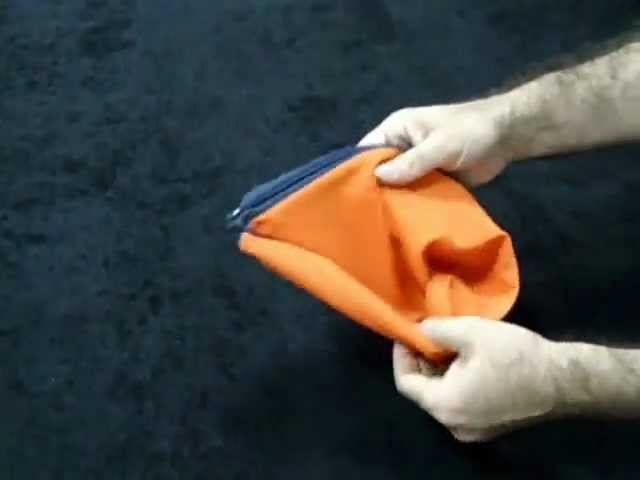
We present the topological dunce hat, discovered by Zeeman in 1964, made with cloth and two zippers. More information in http://topologia.wordpress.com/2011/10/20/topologia-con-cremalleras/
hexed steppe
not sure i can comment on your picture as its been a while since i thought about these things, but it should be a general fact that a loop concatenated with its reversal is nullhomotopic
rancid umbra
right, but here, you interpret it as a path homotopy
not a loop
so the segment [2..3..1] is path homotopic to the identity on that arc
rancid umbra
just a homotopy where the end points of the paths don't have to map to the same thing
hexed steppe
idk about your picture
but the dunce cap thing
the vertices of the triangle all get identified
rancid umbra
yes, that would correspond to the loop passing through its initial point on the circle three times
hexed steppe
ok you are right
rancid umbra
alr. i just wanted somebody to bounce this idea off of
thank you. this gives me some more confidence and direction
hexed steppe
it removes some confidence from me
rancid umbra
eh?
hexed steppe
rancid umbra
is the orientation for -a backwards?
rancid umbra
so, the suspended arrow (not the one on the base of the dunce cap), it has to like, curl out of the screen towards you so that the orientation matches up. then you continuously stretch the dunce around the base of the dunce cap and lay the boundary around
rancid umbra
hexed steppe
is the orientation for -a backwards?
yes. starting at 1, the purple path is going clockwise around the minor circles
hexed steppe
mm ok
rancid umbra
and at 3 it goes anti-clockwise around until it gets back to 1
rancid umbra
alr neat
rancid umbra
yea. its easy to see now that the whole concatenation (attaching map) is homotopic to the identity, since you can deform this map into the red major circle
hexed steppe
right
rancid umbra
and then you can use question 9 to finish it off
since it will be homotopy equivalent to D^2, which is contractible
thank you for talking this through with me. that was deeply satisfying
slate bane
Hi, I can't find an argument for this fundamental group
We have the infinite union of shperes of R^3 with radius 2^(-n) together with the plane z=0
rancid umbra
how are the spheres touching?
like, in a line? or a spiral/circle?
well, i don't think that matters actually
slate bane
Sorry, spheres centered at (0,0,0) with radii 2^(-n)
slate bane
How would you do it? I can't seem to use Van Kampen
rancid umbra
im just kind of visualizing it. you can straighten out any loop going over any of the spheres and then kind of drag it back to the starting sphere by doing that finitely many times
loops going around spheres can be dragged and smushed to the north pole of the largest sphere that the loop bounds
slate bane
Oh yes, visually it's clear to me, I was struggling to find a formal argument
rancid umbra
ah. i am unfamiliar with the van kampen theorem
rancid umbra
rancid umbra
i have messed this up a bit. the previous torus not accurately depict the attaching map. here’s the fix
The 1-skeleton of the dunce cap is a circle, so to attach a 2-cell, one needs the first third of the boundary of D^2 to travel around the circle from a base point once counter-clockwise, once again counter-clockwise, and the once more clockwise. but this attaching map is obviously homotopic to the identity, since this is the same as taking the first third of the boundary around once and then mapping the rest to the base point.
the attaching map should actually look similar to this on the torus:

the base point is marked in black and the curve starts at blue angle 0, red angle 0, both blue and red circle oriented counterclockwise
 wispy veldt
sly geyser
why do we use neighbourhoods anyway?
wispy veldt
sly geyser
why do we use neighbourhoods anyway?
sometimes its good to have the set of all neighborhoods be a filter, also it makes certain definitions easier to talk about (ex: local compacntess)
 scenic trellis
i dont see why the middle column is split exact here  (on page 5: https://www.math.purdue.edu/~arapura/preprints/sheaves2.pdf)

where the col exact seqs are defined as
 rancid umbra
how is concatenation of loops defined when you take a loop in X to mean a map from S^1 into your based space
usually its defined from the unit interval into your space, but you require that the path is the base point at 0 and 1
 scarlet turtle
a loop is a special kind of path, so if you know how to concatenate paths then you also know how to concatenate loops
viewing the loop as a map from S^1 into X is the same as viewing it as a map from [0, 1] into X, but you require that the values at 0 and 1 agree
rancid umbra
then how do you define the concatenation of two maps from S^1 to X
scarlet turtle
e.g. taking half of the circle to correspond to the first loop, and then the other half of the circle to correspond to the second loop
rancid umbra
so you can define it on the wedge sum of two circles?
scarlet turtle
well yes, but you can also define the concatenation to also be a loop from S^1 into your space
on [0, pi] (this is supposed to correspond to the arc of the circle), do your first loop. then on [pi, 2pi], do your second loop
slate bane
rancid umbra
then how do you define the concatenation of two maps from S^1 to X
Equivalently define them as maps from [0,1] to X with same initial and end point, and apply to these two maps the definition of concatenation of paths you already know (it is well defined as the end point of the first is trivially the initial point of the second)
rancid umbra
so S^1 —> S^1/(i ~ -i) as a quotient, then then go from that wedge sum
scarlet turtle
you dont need to quotient or wedge sum anything
you can define it on S^1 (or [0, 1] for that matter)
slate bane
Although to be more precise you would need two maps from the pointed spaces (S1,a0) and (X,x0) I guess
rancid umbra
yes
to both
i think its more convenient not to have to go back to [0,1] and making sure that the paths have the same start and end points in some cases
like, for instance, to show that a loop I —> S^1 is homotopic to the identity, you have to show that its homotopic x |-> exp(2pi i x) and then quotient anyway
scarlet turtle
rancid umbra
i think its more convenient not to have to go back to [0,1] and making sure that...
possibly, but if you already have a good definition for path concatenation then you may as well take it for loops as well
any reasonable definition of concatenating loops will be equivalent to it anyway
rancid umbra
i was just trying to see if i could avoid quotienting my homotopy when viewing it as a map from I x I to S^1 and instead just work with a homotopy S^1 x I —> S^1 instead
radiant holly
ebon galleon
A few problems with this.
1) h and g, as you wrote them, are not fully defined ...
mean it is not possible?
because if it is possible we cant ask whether function h: A --> X and g: A --> Y are homotopic
 opaque scroll
 cold estuary
Is this banach fixed point theorem
cold estuary
Is this banach fixed point theorem
Yes, assuming |f| means the sup of the distance between x and f(x) say least
 worthy olive
What does it mean for an element $q \in S_{n}(X)$?
gaunt linden
Context?
worthy olive
N chains of a group
I have a textbook that says all elements that can be modeled as the sum of an integer (which is 0 for all but a finite number) times a singular n simplex
gentle ospreyBOT
CJ_:)
 worthy olive
(Absurd “q” notation because idk how to import Greek letters)
white oxide
That it is a formal linear combination of n-simplexes presumably? Didn't you define S_n(X) or is the definition above used in the same context as S_n(X)?
worthy olive
white oxide
That it is a formal linear combination of n-simplexes presumably? Didn't you def...
The book I was using defined S_n(X) as that
And idk how to think about linear combinations of singular simplexes
white oxide
worthy olive
And idk how to think about linear combinations of singular simplexes
Okay yeah, I also struggled with that when I first encountered it and I don't think there even is a satisfying answer
My personal answer to that was that it's just a functor that happens to assign groups in a homotopically invariant way which behaves very nicely. It's in some way an arbitrary construction and more homological algebraic than geometric in origin
Homology is often formally dual to cohomology, where things like de rham cohomology is a lot more natural and geometrically intuitive construction
radiant holly
X={1,2,3} and T|X={X,{},{1},{2},{1,2} and Y={a,b,c} and T|Y={Y,{},{a},{b},{a,b}} f,g:X--->Y continuous function now let f(1)=a f(2)=b f(3)=c and g(1)=a and g(2)=b g(3)=c be H:X x I --->Y cont. function and H(1,0)=f(1) H(1,1)=g(1) mean f is homotopic to g by definition isn't it?
radiant holly
thank you bro
 radiant holly
 night heron
Who pinged me
night heron
Who pinged me
me but not problem
night heron
Oh I see
unreal stratus
white oxide
Okay yeah, I also struggled with that when I first encountered it and I don't th...
Tbh ig it more sense conceptually to me if you view them as simplicial abelian groups
Then there are no weird linear combinations of different dimensions ig
 empty grove
worthy olive
What does it mean for an element $q \in S_{n}(X)$?
empty grove
worthy olive
What does it mean for an element $q \in S_{n}(X)$?
S_n(X) is by definition the abelian group whose elements are formal linear combinations of the singular n-simplices in X
So that's what any element q looks like
worthy olive
empty grove
So that's what any element q looks like
Yes, but how do you interpret the idea of a linear combination of singular simplices
That was the question
Kerr gave a pretty satisfactory answer
white oxide
unreal stratus
Tbh ig it more sense conceptually to me if you view them as simplicial abelian g...
At one point there was darkness, but then I discovered the universal property of free objects and saw that if I made any group out of simplices, the free abelian one is the most natural. So it is what it is
unreal stratus
white oxide
At one point there was darkness, but then I discovered the universal property o...
Oh no I mean like
How you go to the chain complex structure etc lol
And adding different dims
white oxide
unreal stratus
Oh no I mean like
wdym?
unreal stratus
Idk lol what I was saying is irrelevant tbf
Since i realise now that the question was about the individual groups
Lol
white oxide
To "sell" simplicial homology, or really most homologies which arent conjured up by derived dark magic: having simplices of any dimensions and the alternating sum differential justified is enough to sell having some notion of complex of groups
But the free abelian group can feel a bit random without the algebra
 jolly umbra
Let $C_n(X) = {\sigma: \Delta^n \to X \colon \sigma \text{ is continuous}}$, the set of singular $n$-simplices.
gentle ospreyBOT
mayer-vietorUs
 jolly umbra
$S_n(X) = { f: C_n(X) \to \mathbb{Z} \colon \text{ for all but finitely many } q \in C_n(X), f(q) = 0 }$, the group of $n$-chains.
gentle ospreyBOT
mayer-vietorUs

 prime elbow
Is there any relation between metric space and finite closed topology?
rancid umbra
both are hausdorff
tangentially, that is really the only property you needed for your proof in #real-complex-analysis just now
prime elbow
rancid umbra
both are hausdorff
tangentially, that is really the only property you needed for...
In infinite set X, is finite closed topology has Hausdorff property?
prime elbow
But I am asking about how these two Topology are comparable?
opaque scroll
prime elbow
But I am asking about how these two Topology are comparable?
A topology coming from a metric will always be finer than the cofinite topology, so there's that
Same is true if you replace "coming from a metric" with "Hausdorff"
prime elbow
opaque scroll
A topology coming from a metric will always be finer than the cofinite topology,...
But in that case all closed sets must be finite?
opaque scroll
prime elbow
But in that case all closed sets must be finite?
In which case?
prime elbow
opaque scroll
In which case?
If metric space is finer than co-finite Topology
opaque scroll
So the fact that a metric space is finer, means any finite set is closed, but not necessarily the other way around
prime elbow
Are they different meaning of all closed sets is finite and all finite set is closed?
opaque scroll
Yes, for example in R all finite sets are closed. But there are closed sets that are not finite (e.g. [0, 1])
prime elbow
prime elbow
Are they different meaning of all closed sets is finite and all finite set is cl...
I think yes
prime elbow
opaque scroll
Yes, for example in R all finite sets are closed. But there are closed sets that...
Yes
In finite topology, all closed set is finite but not all finite set is closed?
No it has both
But if they have both properties then how metric space is finer than co-finite Topology?
opaque scroll
prime elbow
But if they have both properties then how metric space is finer than co-finite T...
A topology T is finer than a Topology T' if any open set in T' is also an open set in T
prime elbow
opaque scroll
A topology T is finer than a Topology T' if any open set in T' is also an open s...
Yes I was confused with property
opaque scroll
In the cofinite topology a set is open iff it is cofinite.
In a metric Topology cofinite sets are open, as well as a bunch of other sets
prime elbow
Let U be open in co-finite topology it implies U complement is finite.
Thus U is open in metric topology.
Is it correct?
opaque scroll
Yes
prime elbow
To show no non-empty finite subset of R is open in standard metric topology.
If any finite subset of R is open then let x in that set.
For x, there exists an open interval (a,b) such that x in (a,b) and it is subset of that finite set.
But (a,b) is not a finite set.
Is it correct?
 kindred cairn
If they were open they would contain small open balls which are infinite so yea
Also you know finite sets are closed so they cannot be open because the only open and closed sets are the whole space and the empty set
 final grotto
Is every subset of a discrete topology open?
gaunt linden
Yes, that's the defining property of "discrete topology".
prime elbow
kindred cairn
Also you know finite sets are closed so they cannot be open because the only ope...
Okay, thank you
unreal stratus
final grotto
Is every subset of a discrete topology open?
Btw, perhaps slightly pedantic but presumably you mean "every subset of a discrete space"
I mean it's unambiguous but sounds a bit weird to my ears as stated
 hearty condor
Fun topology fact: you can easily define the closed sets version of a basis for every topological space.
It is immediately useful.
lusty trench
A basis of open sets of a topology on X is a set B of subsets of X such that, for every finite subset F of B, there exists a subset S (not necessarily finite) of B such that \bigcap F = \bigcup S.
A basis of closed sets of a topology on X is a set B of subsets of X such that, for every finite subset F of B, there exists a subset S (not necessarily finite) of B such that \bigcup F = \bigcap S.
... Right?
Else I don't see what the analogue would be.
 tender halo
lusty trench
Else I don't see what the analogue would be.
tender halo
lusty trench
Else I don't see what the analogue would be.
a basis of open sets is a collection of open sets whose unions generate the open sets, a basis of closed sets is a collection of closed sets whose intersections generate the closed sets
a natural example (that is, somewhat more natural than an open basis) is that zero-sets are a basis for the topology of a regular space
 tawdry valve
Eduardo was listing the necessary conditions for the set of unions of basis open sets (resp intersections for basis of closed) to form some topology, ie not every collection of subsets generates a topology by unions, but with those assumptions it does (when you define the empty union to be the empty set and empty intersection to be the whole set)
rather than fixing a topology and asking if some collection is a basis
fading vale
in Thurstons notes he specifies the coefficients for dehn surgery as being (n1, n2) such that, for the associated diffeomorphism of the torus T^2 -> T^2, when we postcompose with the inclusion into the solid torus S to get T^2 -> S, the kernel is generated by (n1, n2)
This might be a stupid question but does this agree with the usual definition where the coefficients are defined by saying that the meridian m maps to n_1 m + n_2 l?
Because it seems like it just isnt? given the 2nd definition, the kernel of the associated transformation should be i think (n1, b) where b is given by choosing some a, b such that a n1 - b n2 = 1
 red yoke
The first definition says the preimage of the meridian is n1 m + n2 l right 
fading vale
red yoke
The first definition says the preimage of the meridian is n1 m + n2 l right <:pa...
well not necessarily, it just imposes that the coefficient of l is n2
right?
at least a priori
red yoke
Generated by (n1, n2) means generated by n1 m + n2 l right
fading vale
Like if we assume that m is sent to n1 m + n2 l, then since the associated matrix on H_1 should be invertible its clear that l must go to, say a m + b l, where a * n2 - b * n1 = 1 (or -1, it doesnt really matter). Then when we compose with the inclusion into S, the meridians die, and m should go to n2 l, with l going to b l. So if we write this as a map Z^2 -> Z it should send (k1, k2) to k1 n2 + k2 b
fading vale
red yoke
Generated by (n1, n2) means generated by n1 m + n2 l right
I think thurston means n1 l + n2 m
but lets just swap it to be consistent
and say n1 m + n2 l
If we send m to n1 m + n2 l, then n1 m is going to go to n1 n2 in Z = H_1(S). if we send l to, say, a m + bl, for whatever values of a and b work, then n2 l is going to go to n2 b in Z
er possibly we want n1^2 + n2 b due to a conventions mismatch
But either way it doesnt seem like this should live in the kernel to me
red yoke
fading vale
well not necessarily, it just imposes that the coefficient of l is n2
Why not
fading vale
i dont see why it should a priori
red yoke
The kernel of T² → S¹ is generated by the meridian
So the kernel of T² → T² → S¹ is generated by the preimage of the meridian
Since T² → T² is a homeomorphism
fading vale
i mean like maybe it does given that this agrees but like, given that after you pass to S, the meridinal component of the image of m vanishes regardless, it doesnt matter immediately what you send it to
red yoke
I still don't get your point
Another thing is that the former definition should fully describe the Dehn surgery
Since the homeomorphisms preserving the meridian extend to the solid torus
While I don't see how that holds for the latter
fading vale
red yoke
I still don't get your point
Sorry i realized i am illiterate and was misinterpreting your point, yes i agree which is why im confused
like traditionally, you say that (n1, n2) specifies the image of the meridian
thurston is saying that (n1, n2) specifies the preimage
I guess these are just for sure not equivalent i feel
red yoke
Oh hm is it possible that the latter definition glues it like solid torus ← T² = T² → manifold
While the former definition does the opposite
red yoke
red yoke
While I don't see how that holds for the latter
That would resolve this
fading vale
im not sure what you mean by the opposite
red yoke
Manifold ← T² = T² → solid torus
fading vale
Ah
Maybe?
i feel like theres no way his definition of a (p, q) surgery is different throughout the entire book and swapping the order of everything seems to be the only logical way to resolve that so i think u have to be right
he says to do it the opposite way but like
it has to be that lol
maybe this actually resolves some issues i have with things right after this as well
red yoke
fading vale
in Thurstons notes he specifies the coefficients for dehn surgery as being (n1, ...
Well he apparently also mentions the post-composition with T² → solid torus
red yoke
red yoke
Manifold ← T² = T² → solid torus
So I just assumed it was this
fading vale
well i kind of filled that in for him the actual wording of what he says is "A dehn surgery is when you glue out a neighborhood and glue it back in. You can do this many ways. The generator of the kernel of the inclusion map pi_1(T^2) -> pi_1(solid torus)..."
Thank u arki  that was helpful
red yoke
Imma go be eepy 
hearty condor
lusty trench
A basis of open sets of a topology on X is a set B of subsets of X such that, fo...
Yup. Said otherwise given a basis of a topology you can take the complement of every element and the axioms of the basis to generate the closed sets. The conditions to make a family of sets a basis is that:
a. The union of all elements give the space
b. If two elements are in the basis then for every element in their intersection there is a basis element subset of it containing it.
Taking the complements means
a. The intersection of all elements of a basis give the empty set
b. If an element is in the union then something that contains it contains the union.
I mean it is trivial to check that the element wise complement of the topology obtained via the basis gives the closed sets version of the same topology. ( Contains ∅ and X, since the topology contains arbitrary unions of elements of the basis this contains their complement i.e arbitrary intersections of the complements of basis elements, same with finite intersections of basis elements and finite union of the complements of those basis elements.)
This becomes immediately useful when comparing topologies given via closed sets
And its a useful tool to go between the two since every basis for the open sets generates a complementary basis for the closed sets and vice versa
Also
Fun tidbit
All sorts of metastructure remains well behaved as a consequence of the boolean nature of the power set.
Tidbit 2: Try and find a basis that satisfies both sets of axioms.
hearty condor
Tidbit 3: fun exercise to prove the metastructure thingy using the joy of category theory
Tidbit 4: As an application look into proving the inherited topology of projective space coincides with the union topology defined on a chain via closed sets.
fading vale
New thruston question  : so given a link L in S^3 one can take a finite cover associated to it. Thurston says that you can canonically compactify this cover by adding in circles. Intuitively this makes sense but I havent been able to find a rigorous proof of it
Does anyone have a source (or an explanation off the top of their head)
 hollow vault
With the Munkres book for topology what chapter would you consider the essential chapters to learn for learning topology
prime elbow
in standard topology R, Z makes discrete topology with respect to subspace topology, right?
 haughty ledge
prime elbow
in standard topology R, Z makes discrete topology with respect to subspace topol...
haughty ledge
prime elbow
in standard topology R, Z makes discrete topology with respect to subspace topol...
yeah that sounds correct
rancid umbra
hollow vault
With the Munkres book for topology what chapter would you consider the essential...
i would suggest chapters 2 - 6, additionally chapter 1 if you want to strengthen your background in set theory (i found chapter 1 helpful for understanding arguments with ordinals and recursion)
tender halo
hollow vault
With the Munkres book for topology what chapter would you consider the essential...

dont be one of the people this paragraph is written for, topology is a beautiful subject that is worth learning well
 stuck sorrel
I am only interested in the first half of Munkres, cuz I don’t know how alg topology is applied in statistics
 thin scarab
stuck sorrel
I am only interested in the first half of Munkres, cuz I don’t know how alg topo...
thin scarab
stuck sorrel
I am only interested in the first half of Munkres, cuz I don’t know how alg topo...
i mean here's a whole ass book about it
https://arxiv.org/pdf/2308.10825
it looks like the basic idea is you inflate your data points into n-1 dimensional balls of various sizes until the homology pops out at you
🤓

at some point in the course of growing the balls the homology is "born" and later it "dies"
"6.1.3: Homotopy Shomotopy"
lusty trench
As much as I love algebraic topology, what uses does this have from a data scientist's point of view, though?
merry geode
I did hear topological data analysis is useful for analyzing types of data.
I guess anything to give useful meaning to a data helps?
thin scarab
apparently "homology persistence" can be used to predict financial crises and stuff?
merry geode
Wh
thin scarab
idk the book mentions some stuff along those lines, just skim chapter 5
lusty trench
Sounds big if true. I remain skeptical, though.
merry geode
I think H^0 is likely the most useful, as analyzing clusters.
opaque scroll
lusty trench
As much as I love algebraic topology, what uses does this have from a data scien...
I mean perstistent homology is an invariant of data that isn't really measured in any other way.
And of course having invariants that can discriminant different groups of data is useful in all sorts of settings
thin scarab
thin scarab
apparently "homology persistence" can be used to predict financial crises and st...

these are persistence landscapes. i.e. they measure how long each homology class "lives"
lusty trench
opaque scroll
I mean perstistent homology is an invariant of data that isn't really measured i...
That's fine from a purely mathematical point of view. From an engineering point of view, however, that's not sufficient justification to use it.
opaque scroll
lusty trench
That's fine from a purely mathematical point of view. From an engineering point ...
I mean the justification would come down to the specific case.
I guess the question is whether TDA would be more efficient / more accurate than alternative methods.
For example the first thing that comes up when I search is someone using it to distinguish people with diabetes from people without, by the homology of various data collected from them
lusty trench
If the data you're analyzing comes from physical measurements (say, in your example, scanning a patient's pancreas), then I believe TDA is much more likely to be useful. After all, you're not pulling a metric for the ambient space out of thin air.
merry geode
I did hear TDA labs are effectively converted into AI labs.
opaque scroll
lusty trench
If the data you're analyzing comes from physical measurements (say, in your exam...
Yes I agree. But even if you pull the metric out of thin air, if it gives results it gives results. (I don't know if it does it doesn't or if the jury's still out)
 solemn oar
thin scarab
solemn oar
thin scarab
What book is this if you don't mind?
hearty condor
thin scarab
these are persistence landscapes. i.e. they measure how long each homology class...
Pretty neet.
 real notch
What kind of topological separation properties do we have for ordinals in the order topology?
prime elbow
In discrete metric space, all convergent sequences are ultimately constant sequence, right?
unreal stratus
prime elbow
In discrete metric space, all convergent sequences are ultimately constant seque...
Yes, exactly.
red yoke
real notch
What kind of topological separation properties do we have for ordinals in the or...
T5 at least?
prime elbow
unreal stratus
Yes, exactly.
In R^n, if x_k converges to x and y_k converges to y then how can I show that x_k + y_k tends to x + y.
And here they defined convergence by metric d.
unreal stratus
Idek what T6 means
prime elbow
unreal stratus
which metric?
They didn't mention it
unreal stratus
Sure, how about we assume the one I had
real notch
red yoke
Probably not T6 though
I hate numbering these things (because I don’t know em )
unreal stratus
Hm I think we need to find some nice notation
prime elbow
unreal stratus
Sure, how about we assume the one I had
Yes but is it not true for all metrics?
unreal stratus
Well it is true for any of the standard ones yes
prime elbow
Any hint?
real notch
red yoke
Probably not T6 though
 ordinals are funky
unreal stratus
Try to estimate the difference and use triangle inequality i think
red yoke
Probably more the fact that T6 explicitly involves R
tender halo
red yoke
Probably more the fact that T6 explicitly involves R
it doesnt have to
normal + every closed is G_delta is equivalent
umbral panther
But that’s defined in terms of countability, which isn’t going to work well with ordinals
T_4 is defined in terms of R, yet does apply to ordinals
red yoke
T4 can also be formulated without R or countability though
 real granite
Perhaps this is one for one of the analysis channels, but I was wondering on the best way to show that this is a metric on the reals.
Positivity and symmetry are obviously true. For triangularity, I just multiplied the required inequality through by $(|x-y|+1)(|y-z|+1)(|x-z|+1)>0$ and made some cancellations to show that this is a metric if and only if $$|x-z| \leq |x-y| + |y-z| + 2|y-z| |x-y|.$$ This condition is obviously true, as $|.|$ is a metric on $\bR$ and $2|y-z| |x-y| \geq 0$. Therefore $d$ is a metric on $\bR$.
 gentle ospreyBOT
Douglas
 unreal stratus
There's a generalisation I can write up
Consider $\phi: [0,\infty) \to [0,\infty); t \mapsto \frac{t}{1+t}$, so that this metric is $d = \phi \bar{d}$ where $\bar{d}$ is the usual metric. $\phi$ is strictly increasing e.g. by calculus. symmetry and positive-definiteness areobvious. for the triangle inequality we ned to show $\phi(|x-y|) \le \phi(|x-z|) + \phi(|y-z|)$. but $\phi(|x-y|) \le \phi(|x-z| + |y-z|)$ as$\phi$ is increasing, so it's enough to show $\phi(a+b) \le \phi(a) + \phi(b)$. This is another fine computation e.g. by noting $\phi'' < 0$
gentle ospreyBOT
potato
 unreal stratus
like $t \mapsto \phi(a)+ \phi(t) - \phi(a+t)$ maps $0 \mapsto 0$ and has derivative $\phi'(t) -\phi'(a+t) < 0$ since $\phi'' < 0$
gentle ospreyBOT
potato
 unreal stratus
I guess this is overkill for this specific example, perhaps, but it shows you can systematise things somewhat
like if phi is subadditive and increasing then thisworks
real granite
gentle osprey
**potato**
shouldn't the second derivative be positive (so that the function itself is convex)?
actually why does the second derivative even factor into it?
you can just say |x-y| ≤ |x-z| + |z-y| for the standard metric
then since phi is increasing, order is preserved
oh wait i see the issue
yeah without the second derivative you can't "distribute" phi in the way we want to
but yh that looks like convexity to me
lusty trench
No, the second derivative being negative is right.
real granite
lusty trench
No, the second derivative being negative is right.
Elaborate...?
Convex means $\phi(tx+(1-t)y)\leq t\phi(x)+(1-t)\phi(y)$ for any $t\in[0,1]$, and this is true if (and only if?) $\phi''(x)>0$, right?
gentle ospreyBOT
Douglas
 lusty trench
Yes, that's the definition of convex function. But what phi'' < 0 is the correct condition that makes potato's argument work.
real granite
lusty trench
Yes, that's the definition of convex function. But what phi'' < 0 is the correc...
How does $\phi''(x)<0 \implies \phi(a+b)\leq \phi(a)+\phi(b)$?
gentle ospreyBOT
Douglas
 lusty trench
Notice that $\phi'$ is a decreasing function, because $\phi'' < 0$. Then $\phi(b) - \phi(0) = \int_0^b \phi'(t) , dt$ is greater than $\phi(a+b) - \phi(a) = \int_a^{a+b} \phi'(t) , dt$. But $\phi(0) = 0$.
gentle ospreyBOT
Eduardo León
 unreal stratus
I fixed $a$ and considered $t \mapsto \phi(a)+\phi(t)-\phi(a+t)$. To show this is $\ge 0$, it's enough to show it has derivative $\ge 0$. but the derivative is $\phi'(t) - \phi'(a+t)$. and this is positive as you can write it as $t\phi''(c)$ for some $c$ between $a$ and $a+t$
gentle ospreyBOT
potato
 unreal stratus
this is of course equivalent
anyway note $\phi(t) = \frac{t}{1+t} = 1 - \frac{1}{1+t}$ so $\phi'(t) = \frac{1}{(1+t)^2}>0$ and $\phi''(t) = -\frac{2}{(1+t)^3}<0$
gentle ospreyBOT
potato
 prime elbow
I think it is not correct
 next crystal
prime elbow
I think it is not correct
next crystal
prime elbow
I think it is not correct
Yeah should be E\{x}
opaque scroll
I think it varies a bit from author to author. I've also seen some people distinguish between limit point and accumulation points
tawdry valve
I think the most common convention though is that the above definition (every neighborhood of x meets E) is for an adherent point, and the definition (every neighborhood of x meets E\{x}) is for a limit/accumulation point. The term "adherent point" is often forgotten though, since a point being adherent to E is exactly the same as it being in the closure of E. In most setups people will say "x is in E closure" rather than "x is an adherent point of E"
alpine nest
Yeah, which is why I think it makes more sense for "limit point" to mean something diffferent than "a point in the closure"
On the other hand the particular distinction of being a limit point only matters very occasionally, typically when talking about limits of functions
prime elbow
But I don't want to continue with this definition
fierce lily
Can someone give me some ideas about this question?( it seems that proving A is basis is not a solution.)

 slender glen
the thing to note is that A cannot contain its boundary
why not?
then this implies A is open. why?
radiant holly
fierce lily
Can someone give me some ideas about this question?( it seems that proving A is ...
let (X,T|X) a topological space be and (A,T|A) subset of (X,T|X) and X={1,2,3} and T|X={X,{},{1},{2},{1,2}} A={1,2} T|A={A,{},{1},{2}} and every x open in U mean U={1,2} and yes U subset of A, and yes A open in X.
gentle girder
you seem to really like this example
rancid umbra
fierce lily
Can someone give me some ideas about this question?( it seems that proving A is ...
no need for boundary stuff. a union of open sets is open
radiant holly
rancid umbra
no need for boundary stuff. a union of open sets is open
yes but question say "show"
radiant holly
gentle girder
you seem to really like this example
yes ı guess
rancid umbra
radiant holly
yes but question say "show"
i’m not giving a full answer, just a hint/suggestion for a more simple approach
radiant holly
rancid umbra
i’m not giving a full answer, just a hint/suggestion for a more simple approach
oh okay
radiant holly
radiant holly
let (X,T|X) a topological space be and (A,T|A) subset of (X,T|X) and X={1,2,3}...
but ı think we not need information on about U. Because question say "show that A is open in X and A subset of X"
rancid umbra
what r u trying to do?
radiant holly
fierce lily
Can someone give me some ideas about this question?( it seems that proving A is ...
@rancid umbra
rancid umbra
yes. r u trying to prove that statement?
gentle girder
radiant holly
<@293135813418418177>
but you can’t prove it by giving an example
also the example you gave was not enlightening at all
please for your own sake have another example of a topological space in mind
fierce lily
radiant holly
let (X,T|X) a topological space be and (A,T|A) subset of (X,T|X) and X={1,2,3}...
does every x open in U refers to {1} and {2} are all open in U?
rancid umbra
examples with subsets of euclidean spaces (like R^n) or metric spaces are usually less cumbersome to write out and easier to understand
rancid umbra
fierce lily
does every x open in U refers to {1} and {2} are all open in U?
i wouldn’t pay attention to this atm
radiant holly
gentle girder
but you can’t prove it by giving an example
ı know but ı just give me a idea
gentle girder
fierce lily
Can someone give me some ideas about this question?( it seems that proving A is ...
specifically you’re gonna use (a bit cheekily) that the union of open sets is open
fierce lily
rancid umbra
no need for boundary stuff. a union of open sets is open
Do you mean A equal union of U?
rancid umbra
fierce lily
Do you mean A equal union of U?
yes
union of all U’s that you get from the hypothesis of the statement
fierce lily
rancid umbra
union of all U’s that you get from the hypothesis of the statement
if x in at least one of U, then x must be in A. and if x in A, then it must lie in one of U(has given in question)
rancid umbra
i think that explanation makes sense.
you are saying that $$A = \bigcup_{x \in A} U_x$$ where $U_x$ is the set such that $x \in U_x \subseteq A$, correct?
gentle ospreyBOT
c squared

 proven comet
I think I just proved something, but I am not sure, maybe it doesn't make sense at all. If x is in Rk and y is in Rl the product of any two neighborhouds of both will be a neighborhoud of (x,y) in R(k+l)
gentle girder
yes
proven comet
gentle girder
yes
Great to know, thanks
real granite
$x_n \to x$ if $\forall U\ \text{open} \subseteq \bR\ \text{s.t.}\ x \in U,\ \exists n_0 \in \bN\ \text{s.t.}\ n>n_0 \implies x_n\in U$.
Is that the correct statement of the topological definition of convergence?
gentle ospreyBOT
Douglas
 unreal stratus
Yes, for R
real granite
unreal stratus
Yes, for R
Okie. Also, what happens if you omit openness from the definition?
unreal stratus
Well then it breaks
And like then it has nothing to do with the topology
Like if this holds for all subsets then take U = {x}
real granite
unreal stratus
And like then it has nothing to do with the topology
What if it's "open or closed", therefore avoiding issues with sets that are neither open nor closed?
unreal stratus
{x} is closed
real granite
That is true
fierce lily
If there is a topological space X={a, b, c}, Can I say topology={X, empty} is coarser than any other topology on X?
and topology={X, empty, {1}, {1,2}} is finer than topology={empty, X, {1,2}?}, just by determine if one is the subset of the other?
real granite
fierce lily
If there is a topological space X={a, b, c}, Can I say topology={X, empty} is co...
Google says the trivial topology is the coarsest topology
fierce lily
real granite
Google says the trivial topology is the coarsest topology
Ok, then if we have two topology that contains different element and not subset relation, it will not be comparable right?
ex: {X, empty, {2}} and {X, empty, {1}, {2,3}}
gentle girder
it's the same as the subset relation
so like these aren't comparable because neither is a subset of the other
fierce lily
gentle girder
so like these aren't comparable because neither is a subset of the other
OK, I understand, really appreciate that
real granite
The discrete topology leads to all subsets being open because we can pick $0<r≤1$ and therefore $B_r (x_0) ={ x_0 }$ which is necessarily in the given subset.
Is that correct?
gentle ospreyBOT
Douglas
 real granite
Because we can define a metric space's topology as $U\in\tau$ if $\forall x_0\in U,\ \exists r>0\ s.t.\ B_r(x_0) \subseteq U$
gentle ospreyBOT
Douglas
 unreal stratus
real granite
The discrete topology leads to all subsets being open because we can pick $0<r≤1...
unreal stratus
real granite
The discrete topology leads to all subsets being open because we can pick $0<r≤1...
Well
what you mean is the discrete metric
In the discrete topology, all subsets are open by definition
But yes agreed
"the discrete metric induces the discrete topology"
real granite
unreal stratus
what you mean is the discrete *metric*
I mean, what I said is true if we assume the discrete topology is metrizable right?
(and it is metrizable)
Like what I've said is circular but I haven't actually confused metric and topological spaces I don't think
unreal stratus
Well you take discrete topology and then talked about a metric
jaunty summit
is the 2 skeleton of a K(G, 1) always homotopy equivalent to some presentation complex of G
like obviously theres a weak equivalence
 languid patrol
jaunty summit
is the 2 skeleton of a K(G, 1) always homotopy equivalent to some presentation c...
languid patrol
jaunty summit
is the 2 skeleton of a K(G, 1) always homotopy equivalent to some presentation c...
no, you can always glue in 2-spheres which doesn't impose any relation on \pi_1 which you make contractible in the 3 skeleton
so it doesn't have to have anything to do with a presentation
languid patrol
jaunty summit
like obviously theres a weak equivalence
if your K(G, 1) has the homotopy type of a CW complex then the two notions agree
umbral panther
languid patrol
no, you can always glue in 2-spheres which doesn't impose any relation on \pi_1 ...
Those count as trivial relations. You can add trivial relations to the presentation
jaunty summit
basically any sort of trivial glueing of 2 spheres can be accounted for i think
 median sand
This is silly, but I'm blanking for some reason: if X,Y are second countable, why should XxY be second countable? If U_n,V_m are bases of X,Y, then every basic open set UxV is a union of some U_nxV_m, but that doesn't mean the collection {UxV} is countable, isn't its cardinality P(N)?
opaque scroll
median sand
This is silly, but I'm blanking for some reason: if X,Y are second countable, wh...
If S is countable, then S^2 is also countable
grave solstice
median sand
This is silly, but I'm blanking for some reason: if X,Y are second countable, wh...
you can write the basic open sets as unions of U_n x V_m. Any other open set can then be written as unions of basic open sets. You can like unfold the unions then to express it as a union of the U_n x V_m
median sand
opaque scroll
If S is countable, then S^2 is also countable
Yes, but if every UxV is the union of some UnxVm, doesn't that mean there are P(N) many of them? There are N-many UnxVm in total, but each UxV is the union of some, not all, so its cardinality should be P(N), no?
opaque scroll
median sand
Yes, but if every UxV is the union of some UnxVm, doesn't that mean there are P(...
Okay, I just misunderstood what you were confused about. But like croq said, UnxVm is a basis for the topology
If (x, y) is in UxV, then there is x in Un < U and y in Vm in V, so (x, y) in UnxVm < UxV
median sand
opaque scroll
If (x, y) is in UxV, then there is x in Un < U and y in Vm in V, so (x, y) in Un...
Yeah, it's better to do it this way, I don't think the successive pulling out of unions works exactly.
opaque scroll
median sand
Yeah, it's better to do it this way, I don't think the successive pulling out of...
It works just fine
Like Union_m UxVm = Ux(union_m Vm)
so
Union_n Union_m UmxVm = (union U)x(union V)
It's just the standard argument for why the x in Um < U is equivalent to being a basis
median sand
opaque scroll
It works just fine
Like Union_m UxVm = Ux(union_m Vm)
so
Union_n Union_m UmxVm ...
I think my problem is I tried to show the collection of all UxV is countable, which I don't think it should be. Got all turned around.
opaque scroll
Yeah, if you choose Y to be the one point space, then that would just be saying that any second countable topology is countable
languid patrol
median sand
I think my problem is I tried to show the collection of all UxV is countable, wh...
Second countable doesn’t mean every basis is countable, just at least one is
that’s the important distinction
real granite
unreal stratus
Well you take discrete topology and then talked about a metric
You as in me or you as in one?
If the former, then that's why I brought up metrizability
white oxide
As long as you meant "discrete topology" as in "the topology induced by the discrete metric" it makes sense. Under the "behold! power set" definition of the discrete topology, which is the more usual usage, its a bit awkward
unreal stratus
real granite
You as in me or you as in one?
You
real granite
white oxide
As long as you meant "discrete topology" as in "the topology induced by the disc...
former
idk the power set thing
white oxide
topology as in, a set of all open sets
real granite
idk if its normal to teach it this way but my topology module does metric spaces before topological spaces
white oxide
the discrete topology is then just taking all the subsets
real granite
oh right yh i see what you mean
white oxide
Yeah usually thats done in analysis
real granite
my uni is v weird w analysis
we effectively have three (arguably four) modules that do basic analysis
three in first year and one in second year
and i think they should all juast be condensed into one so that we can move onto big boy stuff sooner
white oxide
thats a bit odd, yeah
here its real analysis, topology light + multivariable and whatever else that didnt fit into the first semester, measure theory and DEs and lastly complex analysis, which is optional end of the analysis I-IV sequence
real granite
real granite
we effectively have three (arguably four) modules that do basic analysis
we have "calculus I", "sequences and series", "real analysis" as separate modules spread across two yyears
the fourth is calculus II which is vector calc
but the first three could be merged into a single module
real granite
white oxide
here its real analysis, topology light + multivariable and whatever else that di...
yeah i get the impression my university leaves students at least a year out of step with what others are doing
another oddity is that we dont do special relativity (optional) until third year, but apparently most maths students would study that in first year if they choose to
white oxide
what does special relativity have to do with here?
real granite
not much as it concerns my question
but i mention it bc its another example of my uni doing weird stuff w teaching
lusty trench
What's the gentlest introduction out there to spectra and generalized cohomology theories? (I'm familiar with the basics of equivariant cohomology, but from a more pedestrian geometric standpoint. Not from the spectra POV.)
I'm intrigued by statements such as
Integers only have primes p. The sphere spectrum has primes "p", "really p", "really really p", "really really really p", ..., and "p by any means".
From here: https://mathoverflow.net/questions/433863/why-the-sphere-spectrum-is-more-correct-than-mathbbz

MathOverflow
One may argue that $\mathbb{S}$ is more correct than $\mathbb{Z}$. Can anyone make it more explicitly? For example, what information will be lost if we work in $\mathbb{Z}$ instead of $\mathbb{S}$?
merry geode
Wow this is neat
 radiant hedge
Hey, im trying to show by contradiction that (0,1] is connected under the subspace topology.
I know that path connectedness implies connectedness but I'm trying to show that (0,1] is compact in the following way:
cedar pebble
lusty trench
What's the gentlest introduction out there to spectra and generalized cohomology...
I mean generally you want to learn about complex oriented cohomology theories and chromatic stuff I guess
unironically the nlab has very good notes on this from an actual graduate course on stable homotopy theory https://ncatlab.org/nlab/show/Introduction+to+Cobordism+and+Complex+Oriented+Cohomology
umbral panther
The gentlest intro is Adams, but that won’t take you that far
radiant hedge
Let (U,V) be a seperation of (0,1]. This means that $U \cup V = (0,1]$ and $U \cap V = \emptyset$
gentle ospreyBOT
Sai
 radiant hedge
I am trying to show a contradiction. Could I have a hint possibly?
cedar pebble
Lurie has some course notes on chromatic homotopy theory that are good. Also Adams is of course good, as is Kochman
merry geode
Looking into https://math.stackexchange.com/questions/137764/what-are-e-infty-rings#138677, I guess e-infty ring is a standard infinite category stuff.

Mathematics Stack Exchange
I've been working with DG-algebras for the last year, and was able to obtain using them some nice commutative homological algebra results.
However, I keep hearing about a (more general???) concept...
cedar pebble
lusty trench
I'm intrigued by statements such as
> Integers only have primes p. The sphere s...
Lurie has a gentle lecture that explains this sort of statement in a little more detail https://www.youtube.com/watch?v=FYnHPF5pL4c
Conference on 100 Years of Noetherian Rings
Topic: Abstract Algebra in Homotopy-Coherent Mathematics
Speaker: Jacob Lurie
Affiliation: Frank C. and Florence S. Ogg Professor; IAS School of Mathematics
Date: June 20, 2023
Emmy Noether was a central figure in the development of abstract algebra in the early 20th century. Her ideas were profoundl...
merry geode
Hmm what would be the chromatic part of this?
cedar pebble
merry geode
Hmm what would be the chromatic part of this?
of what?
merry geode
Like, chromatic homotopy theory.
umbral panther
Chromatic is the part that has multiple primes over p
cedar pebble
the chromatic story is what comes out of studying complex oriented cohomology theories and their parameterization in terms of formal groups
you get something called the chromatic filtration on spectra
merry geode
umbral panther
Chromatic is the part that has multiple primes over p
Ah, cool!
umbral panther
You don’t need E_oo rings to get the chromatic story. You can build Morava E-theory without it. I’m not sure you can build Morava K-theory without it. Morava did, but he’s sloppy
merry geode
I guess those arise from going infinite. (Tho I need to study what prime is in this context)
Morava E-theory sounds more complex, is it actually less complex
lusty trench
Thank you, @cedar pebble and @umbral panther .
cedar pebble
merry geode
I guess those arise from going infinite. (Tho I need to study what prime is in t...
you have more "fields" in the setting of ring spectra than you do for ordinary rings
umbral panther
E-theory is complicated in some ways, but easier to construct
merry geode
Hmmm
umbral panther
Regular K-theory (with coefficients localized to (p)) is E(1). Mod p, that’s K(1). But it’s no longer a commutative ring
cedar pebble
Morava E-theory and Morava K-theory are tightly related to each other, Morava K-theory is what plays the role of (skew) fields here
merry geode
Ahhhh
merry geode
cedar pebble
Morava E-theory and Morava K-theory are tightly related to each other, Morava K-...
When I learned skew fields, it feels like division rings.
cedar pebble
yeah that's basically it
cedar pebble
every nonzero element being invertible is equivalent to every module being free
this gives you the notion of skew fields
merry geode
Yeah
cedar pebble
you can make the same definition for ring spectra
merry geode
Ah, is it defined from modules being free?
cedar pebble
every nonzero homogeneous element of E*({x}) being invertible is equivalent to every graded module over E*({x}) being free
in other words every E-module in spectra is free
this is what it means for a ring spectrum E to be a "field"
merry geode
Hmm, what is E^*({x})?
cedar pebble
the E-cohomology ring of a point
merry geode
Ohhhhhhhhh
cedar pebble
classically if you have two skew fields K and K' you say that K and K' have the same characteristic iff K\otimes K' is nonzero
you can do the same thing for fields in the sense of spectra
merry geode
Hm, but E^* is a ring, not categorical analogue with mult in categorical settings, right
cedar pebble
E and E' have the same characteristic iff E\wedge E' is nonzero (smash product plays the role of tensor product)
cedar pebble
merry geode
Hm, but E^* is a ring, not categorical analogue with mult in categorical setting...
yeah I mean you can extract a graded ring by taking E-cohomology but you can work with the spectrum directly too
merry geode
$E \wedge E'$
gentle ospreyBOT
Absta
 cedar pebble
classically the only characteristics are 0 and p for p prime
you can also ask which characteristics you get in the setting of spectra
and it turns out that you have many more
merry geode
I'm sorry for asking much but could you clarify what E-cohomology is?
cedar pebble
any spectrum represents a generalized cohomology theory
$E^n(X)=\pi_0\mathrm{Maps}(X,\Omega^\infty\Sigma^nE)$
gentle ospreyBOT
nGroupoid
 merry geode
Ahh, I guess I confused spectrum with something else
I guess (generalized) cohomology theory could be easier to handle in some sense.
cedar pebble
if you have a cohomological field E (so a ring spectrum which is a (skew) field in the sense I mentioned) then K=E^0({x}) is a (skew) field in the classical sense
and then the possible characteristics are like
if K has char 0 then E has the same characteristic as the Eilenberg MacLane spectrum HQ
so char 0 is not so interesting
if K has char p then the situation is more interesting
merry geode
cedar pebble
if you have a cohomological field E (so a ring spectrum which is a (skew) field ...
Just to check, we do not have E^(-1) (i.e., trivial) right?
cedar pebble
not necessarily
you can have periodic cohomology theories
like complex K-theory KU is 2-periodic
 cedar pebble
(every homogeneous element is invertible)
if K has char p the funny thing you can do is look at the classifying space X=B(Z/pZ)
merry geode
Ah welp, homogeneous. elements.. then different. I guess I need to study in detail to confidently speak something about it
cedar pebble
and then ask about E*(X) as an E*({x})-module
if E*(X) has infinite rank over E*({x}) then E has the same characteristic as the Eilenberg Maclane spectrum HF_p
but E*(X) could also have finite rank over E*({x}), it turns out it can only have rank p^n for some n
then you say that E has height n and E has the same characteristic as the Morava K-theory K(n)
so to specify the characteristic of a cohomolgical field E you either just have char 0, or you have to specify a prime p and a height n
this is what explains remarks like "Integers only have primes p. The sphere spectrum has primes "p", "really p", "really really p", "really really really p", ..., and "p by any means".
cedar pebble
you can set K(0)=HQ and K(\infty)=HF_p and then the K(n)'s are interpolating between char 0 and char p
merry geode
So we have infinitely many primes over p
cedar pebble
yeah
merry geode
But prime "splitting" behavior itself does not seem that complicated, at least.
No {p, q} kind of funky stuff
cedar pebble
it's all nicely labeled by height
merry geode
Indeed, considering the module (perhaps length of a module? Or rank, my memory ah you said rank )
cedar pebble
the height here is coming from the heights of formal groups
like the Morava K-theories (and any complex oriented cohomology theory E) are related to formal groups, the height of E is the height of its formal group
cedar pebble
it can be difficult to compute with but it satisfies some nice universal properties
cedar pebble
Z is the initial ring, S is the initial ring spectrum
merry geode
Idk how to put sphere spectrum in computer 
cedar pebble
what people often do is study something like S one prime at a time, and one height at a time
merry geode
In which settings does these usually arise?
Like typical algebra cannot be done easily with this one, I imagine
cedar pebble
I mean you sort of can
it's often harder than the classical setting but there are nice things you can say
merry geode
But but you are supposed to compute
Oh!
Well anyway, I mean
Is this alg geo thing?
cedar pebble
I mean you have to ask the right sort of questions
this doesn't come up so much in algebraic geometry although it is sometimes related
usually these things are most useful to questions in topology themselves
merry geode
Oh so Algtop can go 
cedar pebble
the Morava K-theories have been used recently by Floer theory people
merry geode
Wolfram never works
cedar pebble
this is like symplectic topology stuff
specifically they were proving cases of Arnold's conjecture
cedar pebble
but yeah in principle if you wanted to compute something like the stable homotopy groups of spheres you like
work one prime at a time
and then over each prime you work one height at a time
heights 0 and 1 are pretty classical, everything through height 2 is more or less understood
homotopy theory at height 1 is pretty nice, like if you're working K(1)-locally there is a lot you can say
merry geode
What kind of stuff do you prove with these?
umbral panther
You compute homotopy groups of spheres. A lot of things can be reduced to them. The Adams spectral sequence, which might be in his book computes the localized at 2 homotopy groups of spheres in terms of the Steenrod algebra. I guess you can glimpse the heights there
You can build lots of counter examples using the Steerod algebra. For example, Atiyah and Hirzebruch produced torsion classes in cohomology that cannot be algebraic cycles. Totaro redid this and strengthened it using more modern technology. chromatic-ish
Adams considered the geometric operation of turning a vector bundle into a bundle spheres. The structure group for homotopy bundles of spheres is close to the stable homotopy groups of spheres. So he considered a map from O to S. Simpler U to S. The homotopy groups of U are torsion free, so they’re easy. But their images are torsion of differing ranks. He made some conjecture about the ranks. This is the first chromatic layer. This produces infinitely many families, in degrees multiples of 2(p-1). That is a sort of wave length, hence the chromatic metaphor
merry geode
Hmmm, I see.
lusty trench
Turning a vector bundle into a bundle of spheres... Somehow reminds me of the Thom space stuff in Milnor-Stasheff.
dim perch
@opaque zodiac you know how like
 opaque zodiac
no
dim perch
"classical" homotopy theory can be viewed as the study of spaces up to some version of homotopy equivalence
opaque zodiac
I know what a G-space is and I broadly understand homotopy equivalence but I don't acutally know anything about how the ideas interact
opaque zodiac
now I know we're in the same time zone
dim perch
i
you know, if you know @molten dirge well enough, then you might take from context that I'm at the university he graduated from for his phd
anyways!
sometimes you have a group
and it acts
opaque zodiac
dim perch
~~you know, if you know <@314555008798687234> well enough, then you might take f...
I only know @molten dirge via the internet
I guess you both got your PhD's from twitter though, right?
dim perch
the short story is that there's two "obvious" options for the veresion of spaces in equivariant homotopy theory--homotopy types with a G-action, or topological spaces with G-action modulo equivariant homotopy (up to me slightly lying in the usual way)
 molten dirge
Incidentally I encountered someone from the Topos Institute yesterday in the wild, turns out they’re real
and by the wild i mean a rationalist meetup
dim perch
the problem--on topological spaces with G-action, it turns out maps modulo equivariant homotopy are enough to get the entire homotopy type of the point-set fixed points of your topological G-spaces, which is not an invariant of the underlying homotopy type and its G-action
hence two notions of G-spaces, the "naive" one and the "genuine" one
opaque zodiac
right okay
dim perch
we've managed to phase out the word "naive" in favor of "Borel" (so-named after "borel-equivariant cohomology''), but "genuine" has unfortunately stuck around