#groups-rings-fields
406252 messages · Page 684 of 407
 zealous flame
 coral shale
associativity axiom is always automatically inherited into the subgroup since we use the same binary operation but with restricted domain. It won't be very helpful
You have only used identity and inverses
zealous flame
oh
so by using binary operation on this subset you get 0+(3+(-3))=0 and 3+0+(-3)=0
zealous flame
idk i jsut used associativity
coral shale
coral shale
associativity axiom is always automatically inherited into the subgroup since we...
.

 delicate orchid
basic process of elimination tells us we need to use closure
coral shale
'For all a, b, c in G we have a # (b # c) = (a # b) # c'
In the original group
This must also hold in any subset of the original group
So that's why associativity won't help
So yes, use closure.
So far, if
3is in our subgroup, we know
{0, 3, -3} is a subset of the subgroup
zealous flame
so using binary operations on 0+3=3, 0+(-3)=-3 and 3+(-3)=0 which shows us that for all elements within the subset 3, using binary operation leads to another element in the subset 3
coral shale
You think this set is closed under addition?
zealous flame
yeah
 tiny pagoda
what element can we get with the operation that isn't here
delicate orchid
try 3+3
coral shale
It is not --- you have not considered some important combinations
zealous flame
delicate orchid
try 3+3
wait we are allowed to do that
zealous flame
this is a game changer
coral shale
Yes, the binary operation maps from G x G to G
: G x G -> G
We are always allowed to combine the same element
zealous flame
delicate orchid
why would we not be allowed
i was under the impression that we couldn't use the same numver twice
coral shale
: G x G -> G
a # b is a member of G for all a, b.
But there is nothing saying a and b cannot be equal
zealous flame
i suppose its jsut the way i interpreted closure when my lecturer wrote it up
coral shale
Well you know now
zealous flame
thanks
coral shale
Groups are not meant to be completely foreign objects
They are meant to mimic things we are familiar with
And generalise
zealous flame
this has been better than studying at glasgow
coral shale
Alright so back to the thing
{-3, 0, 3} is a subset
utilizing closure, what can you conclude?
delicate orchid
glasgow is meant to be good for maths 
coral shale
We must have 3+3, -3 + -3, ... anything else...?
zealous flame
the subset is closed for all values that are multiples of 3
coral shale
delicate orchid
glasgow is meant to be good for maths <:KEK:586240877358350341>
(where are u at if u dont mind me asking? im at bristol 👀)
delicate orchid
wtffff
coral shale
nice
delicate orchid
coral shale
(where are u at if u dont mind me asking? im at bristol 👀)
nottingham... for now
zealous flame
delicate orchid
glasgow is meant to be good for maths <:KEK:586240877358350341>
its horrible
coral shale
So {3n : n in Z} must be a subset of our subgroup
zealous flame
yeah
delicate orchid
zealous flame
the subset is closed for all values that are multiples of 3
correct btw, it's 3Z
coral shale
Do you notice anything special about 3Z?
zealous flame
each value switches from even to odd?
coral shale
no
more like - with respect to the group axioms
We already have a group
Check?
Closure --- any two multiples of 3 add to make a multiple of 3
identity - 0 is in it
inverses --- ?
associativity --- (as said above, this is always inherited)
zealous flame
not to the power -1
coral shale
are inverses
zealous flame
yeah
zealous flame
yup
coral shale
So to reiterate what we did
We started with Z
We considered what must happen if 3 is in a subgroup
And then we tried constructing what is 'the smallest' subgroup containing 3
And ended up with 3Z
Note there could be larger subgroups that contain 3Z
But does this help give you an idea how to construct subgroups?
You consider 'what if an element is in it'
and use the group axioms
zealous flame
yeah this helps
delicate orchid
like, for example, try and construct the smallest subgroup containing 5
or if you're feeling brave, construct the smallest subgroup of 3Z containing 6
zealous flame
altright i'll give those a go
delicate orchid
both processes are very similar to what we've already done
coral shale
Ok and back to the main topic
what are the cosets of 3Z
Note left and right cosets are the same in this case
because we have an abelian group
n + 3Z = 3Z + n
zealous flame
ah
coral shale
Remember my above definition
gH = {gh : h in H}
zealous flame
yeah
coral shale
here we have addition
so I write g + H or H + g instead
{g + h : h in H} = {h + g : h in H}
So we have g + H = H + g
This definitely happens whenever we have an abelian group G (but isn't the only case when this happens)
zealous flame
interesting
coral shale
in general
if gH = Hg for any g
we call H 'normal'
and this will come up to be a very important concept
So for now
Try figuring out what the left cosets of 3Z are
There are only a few of them (hopefully you can see why if you try)
..., -2 + 3Z, -1 + 3Z, 0 + 3Z, 1 + 3Z, 2 + 3Z, 3 + 3Z, 4 + 3Z, ...
zealous flame
coral shale
so I write g + H or H + g instead
alright so the one above was just the right one
coral shale
g + H is left coset
H + g is right coset
In this case they are equal, so we just call it 'coset'
zealous flame
ah ok
coral shale
coral shale
..., -2 + 3Z, -1 + 3Z, 0 + 3Z, 1 + 3Z, 2 + 3Z, 3 + 3Z, 4 + 3Z, ...
So to figure out the cosets, you need to figure what these are
A lot of elementary group theory stuff is all about 'unravelling' definitions
As long as you understand the definitions, it becomes straightforward (so really try to get to know them)
zealous flame
oh ok
coral shale
You should figure out which each of them are
zealous flame
ok
coral shale
For example, 0 + 3Z = {0 + h : h in 3Z} = {0 + 3n : n in Z} = 3Z
Now try a few others
zealous flame
ok i'll have a go at 1+3z first
coral shale
delicate orchid
nottingham... for now
transferring? 👀
delicate orchid
PhD will occur elsewhere
coral shale
oh wow
besta luck - what you thinking doing it in
I kinda want to but I don't feel I'm up to it 
delicate orchid
coral shale
besta luck - what you thinking doing it in
representation theory
coral shale
I should've taken rep theory this year. big dumb
delicate orchid
imagine having a course on it 
coral shale
rip
zealous flame
i found that for the first few i tried every even n gave out a prime for example when i did 1+3(4)=13
delicate orchid
prime numbers tend to be odd
zealous flame
tru
delicate orchid
I don't think that's quite what you were supposed to look for though 
zealous flame
that as the only pattern ive noticed so far
coral shale
You're not really meant to notice a pattern
you should just list the elements of the set
zealous flame
oh
coral shale
(or give the set builder notation)
Eg.
1 + 3Z = {..., -2, 1, 4, 7, 10, ...}
But what you need to hopefully notice is some of these cosets are the same
zealous flame
oh yeah
 dull root
I have a quick sanity check question: Q(\sqrt(pi)) = Q(pi, \sqrt(pi)) right as field extensions and Q(pi + \sqrt(pi)) is an intermediate field of the one on left
 next obsidian
Yes
coral shale
between Q and it?
next obsidian
I agree
coral shale
F : K : M
K is an intermediate field?
dull root
I mean that Q \subset Q(pi + \sqrt(pi)) \subset Q(\sqrt pi)
coral shale
yh ok
 latent anvil
coral shale
F : K : M
K is an intermediate field?
latent anvil
coral shale
F : K : M
K is an intermediate field?
yep
coral shale
Q(pi), Q(x), I see no difference 
dull root
we def do not have that the field is actually equal right, since I don't see a way to get pi from Q(pi + \sqrt pi)
coral shale
You are talking about the intermediate equalling Q(rt pi) ?
dull root
yes
coral shale
likely not but lets see...
coral shale
coral shale
Q(pi), Q(x), I see no difference <:uwucat:606547033691521057>
Oh wait this joke might be useful
You might as well call rt pi = x since its transcendental (can show isomorphism)
I would find it easier to work with x 🤔
We want to check if Q(x) === Q(x + x^2)
If I'm not mistaken
latent anvil
that's equivalent yep
latent anvil
Yeah Alex we're talking about if they're equal
coral shale
God I can't see how lel
latent anvil
it should be true
next obsidian
Oh
coral shale
i feel like shouldnt as well.
x^2
Can we construct this on the right
probably not...
next obsidian
I don’t think they’re equal if you consider Q(x + x^2) inside of Q(x)
latent anvil
I agree
coral shale
sorry i shoulda used =, not === lel
next obsidian
I think it becomes impossible due to the fact that I think Q(x + x^2) doesn’t have any homogeneous things
latent anvil
Ah yeah that makes sense
next obsidian
You need a Z-grading to make sense of it, but it should be true
next obsidian
Hmm
latent anvil
what's 1/(x^2 + 1)'s graded parts?
next obsidian
That’s true, but you could consider the part of Q(x) which is graded
And then intersect
Maybe?
dull root
I see ty, More generally is it true that Q(x^n + x) a strict subset Q(x)?
latent anvil
sure
next obsidian
And you can probably just intersect Q(x) and Q(x + x^2) with it
Idk, I guess in the end I don’t see how you can get x inside of Q(x + x^2) is the point
But maybe I’m wrong
latent anvil
Me too
next obsidian
It surely feels wrong
latent anvil
But I can't think of a proof
next obsidian
Okay this might be insanely dumb but
latent anvil
So we would get an expression x q(x^2 + x) = p(x^2 + x)
For q(t) a nonzero polynomial
Then
Oh
Look at highest degree
On each side
next obsidian
Is Q[x + x^2] -> Q[x] faithfully flat?
next obsidian
next obsidian
Is Q[x + x^2] -> Q[x] faithfully flat?
If this is true, then their fraction fields cannot be equal
latent anvil
Suppose they were equal, then x = p(x^n+x)/q(x^n+x) for polynomials p, q with rational coefficients, q nonzero
Do you see why?
Q(x^n + x) is all rational functions in x^n + x
Multiplying out we see that x q(x^n + x) = p(x^n + x)
If p has degree a and q has degree b, the degree of the left hand side is nb + 1 and the degree of the right hand side is n a
These are different mod n so they can't be equal
next obsidian
Unless n = 1 of course, in which case they agree
latent anvil
Oh yeah lol
next obsidian
sham do you wanna learn perfectoid spaces
next obsidian
I don’t actually think you need that much AG
latent anvil
lol
next obsidian
It looks like mainly just a shit ton of commutative algebra
but it’s weird commutative algebra
latent anvil
are we meeting at 2pm in the math lounge today?
next obsidian
Oh huh
latent anvil
Rip
latent anvil
Yeah fair enough
latent anvil
Sg
 shell brook

dull root
If I pick any x \in C, is there a way to see the degree of extension [Q(x) : Q(x^2 - x)] is a finite, or is this not the case
latent anvil
it feels like it's just a degree 2 extension
yeah
f(t) = (t^2 - t) - (x^2 - x) is the minimal polynomial of x over Q(x^2 - x)
So it's degree 2
Does that make sense?
next obsidian
Wait but if x is in C, is it not possible that Q(x) = Q(x^2 - x)?
Like if x = 1 or something dumb
latent anvil
Ah I didn't read that part, I thought x was transcendental
The proof is still basically valid
latent anvil
The degrees are 1 or 2 bc the min poly divides my f(t)
next obsidian
Yeh
dull root
yep, i see it now..
dull root
Can anyone check if my following argument is correct.
I want to show that Q(2^(1/3), i 3^(1/2)) is a field which does NOT contain i.
- We can see Q(2^(1/3), i 3^(1/2)) is a degree 6 extension.
- If i was in the field, then 3^(1/2) must in in the field since we can just divide i3^(1/2)/i to see sqrt 3 is in the field.
- We would have that Q(\sqrt 3, i) is a subfield of Q(2^(1/3), i 3^(1/2)).
We have a contradiction since Q(\sqrt 3, i) is a degree 4 extension
 chilly ocean
??
3^1/2 is in a field by definition
also thhis field is subset of real numbers so its obvious
dull root
chilly ocean
3^1/2 is in a field by definition
Why is that the case? i 3^(1/2) is in the field, but it is not clear from that that 3^(1/2) is in the field if i is not in it
 bright marsh
quick question, if theres a function f mapping from A to B with identical operation, where f(xy) = f(x)f(y), does this imply that A is a subgroup of B?
chilly ocean
ok I read it differently
dull root
bright marsh
quick question, if theres a function f mapping from A to B with identical opera...
What's identical operation?
bright marsh
o they have the same binary operation
dull root
Maybe I am not understanding it correctly, but what if G = Z and A = {0,1}. The map f: A \to Z given by f(0) = 0, f(1) = 1 does what you want but is not a subgroup?
nvm.. I didn't understand it correctly
 lapis trail
Polynomial over a field is a PID.  or
or 
 sharp sonnet
degree function turns it into euclidean domain and thus PID
 chilly radish
This is actually also an iff
lapis trail
Ah yes. Thanks
 subtle ivy
um ok
bright marsh
but yea i was seraching something along the lines of relating subgroups with a homomorphism function
tyty
 south patrol
I suppose one way to interpret this is that we can view one group G as 'embedded' into another group H when we have an injective homomorphism φ:G -> H (with such a map called an embedding). By the first iso theorem we have that im φ is isomorphic to G and so we have a subgroup of H isomorphic to G, hence the idea of it being an embedding, and with this in place we can view a subgroup as being the special case with the map being the (set-theoretic) inclusion
bright marsh
is there a trivial example that shows two finite groups of same order aren't isomorphic
coral shale
K4
C4
delicate orchid
S_3 C_6
 west violet
Hi, I had a quick question about tranpositions and 3 cycles
how would one get (acb)(acd) from (ab)(cd)?
as in , knowing (ab)(cd) , write it as a product of 3-cycles
Is there some type of formula?
For reference, this is the proof that I encountered this case in

 tribal moss
It's much easier to think of this in the other direction: evaluate (abc)(acd) and write it down as a product of disjoint cycles.
Once you know they are equal, equality works both ways.
west violet
oh yeah ik the other direction but i was just curious if there was any way
like if i was given on a test : write (ab)(cd) as the product of 3 cycles
what would my approach be
tribal moss
If you're asking how does one get the idea to write (acb)(acd) in the first place, I imagine it goes like this:
"Hmm, I wonder how much of the alternating group I can generate by combining 3-cycles. Let's try to multiply some 3-cycles together in simple combinations and see what they produce ... hey, this one gives two separate transpositions, cool!"
west violet
Ok, thanks. I guess it's just brute force 😭
south patrol
Perhaps one way of thinking is that we know we can form 3-cycles from products of 2-cycles and so we can, say, insert two copies of a 2-cycle to force 3-cycles
So (a, b)(a, c) (a, c) (c, d) for example, which we know becomes (c, b, a) (d, a, c) lol i was lucky and got the exact same thinf
But eh like yes it is also just brute force
subtle ivy

i think i am missing something obvious, but shouldnt the trace of f be a matrix over R, not an element of R?
is "trace A" supposed to mean trace of left multiplication by A or something?
sharp sonnet
hm? trace of a square matrix is the sum of the diagonal elements, trace of a linear operator is the trace of its matrix representation
 terse crystal
subtle ivy
i think i am missing something obvious, but shouldnt the trace of f be a matrix ...
terse crystal
subtle ivy
i think i am missing something obvious, but shouldnt the trace of f be a matrix ...
AE_ijB=Σ(a_pi b_jq)E_pq
Where E_ij is the matrix which only the element in the i-th row j-column 1 other elements zero
So the trace is $\sum_{i,j}a_{ii}b_{jj}=\sum_{i}\sum_{j}a_{ii}b_{jj}=(\sum_{i}a_{ii})(\sum_{j}b_{jj})=tr(A)tr(B)$
 cloud walrusBOT
Cogwheels of the mind
 terse crystal
$AE_{ij}B=\sum_{p,q}a_{pi}b_{jq}E_{pq}$
cloud walrusBOT
Cogwheels of the mind

 inland otter
Right so I had a question about valuations, say I have a valuation $\nu$ on a field of fractions $K=Frac(R)$, is it always true that the valuation ring is (isomorphic to) the localization at a prime ideal of R?
I had to prove it's true for $Q= Frac(Z)$, but the p-adic valuations are litterally all the valuations I know of so idk whether the result holds in general
cloud walrusBOT
dadaurs
 next obsidian
I don't think this is true. Take a DVR R, then it only has to primes, 0, and its maximal ideal
All you need to do then is find a single valuation ring of K = Frac(R) which is not equal to R, and I think this should be possible
In fact, there's a really obvious example with Q, look at Z_(p) the localization of Z at a prime ideal (p)
inland otter
oh yeah I didnt recall that Z_(p) is local, ty
 unreal portal
Answer key says the answer is D, but couldn't G be the group Z_12, in which case all the even elements of Z_12 form a subgroup of order 6?
 delicate orchid
oh god sylow theorems
first sylow theorem guarantees elements of order 2, 3, 4
order 12 is just the group itself
process of elimination it has to be 6 but I don't like that answer
unreal portal
isn't elements with a given order different from subgroups of a given order
delicate orchid
you can take the cyclic subgroup generated by an element of a certain order and obtain a subgroup of that order
delicate orchid
yes but what if G isn't cyclic
sharp sonnet
i think A_4 is the example
unreal portal
oooh right
sharp sonnet
you misunderstood the question
delicate orchid
is A_4 abelian
sharp sonnet
there are examples with subgroups of order 6
unreal portal
yeah, that's what confused me
sharp sonnet
but also counterexamples
sharp sonnet
🤔
delicate orchid
since when is A_4 abelian
sharp sonnet
where is my list of small order groups
delicate orchid
sorry am I losing my mind here
sharp sonnet
its not, you are right
delicate orchid
just take C_4^3
delicate orchid
A_n
is like the least abelian you can possibly get (specifically they're "perfect" groups)
delicate orchid
A_3 is just C_3 so yes
delicate orchid
C_p is cyclic of order p
delicate orchid
using additive notation
delicate orchid
I use multiplicative notation for abelian groups
it's just easier when 90% of the time they're just going to be shoved straight into a module over a field
which already has a +
sharp sonnet
a module over a field 🤨
delicate orchid
yup
 lethal dune
so what's the conclusion?
lethal dune
unreal portal
Answer key says the answer is D, but couldn't G be the group Z_12, in which case...
of this?
sharp sonnet
not every group of order 12 has a subgroup of order 6
misunderstanding of original question
wew gave a correct counterexample probably
lethal dune
I'm kinda confused as there are only two possible groups of order 12 , Z12 and Z6xZ2, both of which has a subgroup of order 6?
talking about abelian groups
delicate orchid
well for a start A_4 is another group of order 12 so that's false
assuming you mean abelian
 delicate orchid
no
we went over that
I'm fairly convinced C_4 x C_4 x C_4 works
alternatively write C_12 as the isomorphic product C_3 x C_4 and then it's clear
lethal dune
delicate orchid
I'm fairly convinced C_4 x C_4 x C_4 works
C4xC4xC4 has order 4^3?
lethal dune
delicate orchid
alternatively write C_12 as the isomorphic product C_3 x C_4 and then it's clear
that's isomorphic to Z12 or Z6xZ2 so it still holds
delicate orchid
is it? is it really?
delicate orchid
lethal dune
< (1, 0) > subgroup of order 6?
subgroup of which group
lethal dune
C6xC2
delicate orchid
ah fuck this I'm googling it
lethal dune
or your C2xC2xC3 in which case, we take (1, 0, 1)
delicate orchid
lethal dune
or your C2xC2xC3 in which case, we take (1, 0, 1)
yeah you're right
completely correct
lethal dune

delicate orchid
I was just operating on the principle that the question wasn't wrong
lethal dune
@unreal portal .
sharp sonnet
lmao, very nice
i think wews original answer is what whoever made the question wanted
but they didnt want to google list of groups
or they forgot to remove abelian
delicate orchid
yeah removing abelian it's just A_4
delicate orchid
loch I have no idea how to classify groups if they're not abelian
sharp sonnet
i mean abelian ones
delicate orchid
true
sharp sonnet
to see the question doesnt work
sharp sonnet
you classify all groups using representation theory
unreal portal
oh that's epic
sharp sonnet
maybe you heard of it
delicate orchid
nope
lethal dune
delicate orchid
loch I have no idea how to classify groups if they're not abelian
almost all subgroups are some product of Z2 so yeah
it's impractical to classify all non-abelians
delicate orchid
yeah just put a lil Z3 on that thing
lethal dune
let me show you what I mean
delicate orchid
sharp sonnet
you classify all groups using representation theory
I know that you can classify certain semi direct products like this but general groups hell no sister 💅
sharp sonnet
i just know it plays a big role
also we knew the character table of monster group before we managed to construct it
and stuff like that
lethal dune

Mathematics Stack Exchange
In Algebra: Chapter 0, the author made a remark (footnote on page 82), saying that more than 99% of groups of order less than 2000 are of order 1024.
Is this for real? How can one deduce this resu...
delicate orchid
constructing the character table might as well be constructing the groups lets be honest lol
lethal dune
here you go
delicate orchid
ok it's not up to isomorphism but still
delicate orchid
lethal dune
https://math.stackexchange.com/questions/241369/more-than-99-of-groups-of-order-...
wouldn't surprise me - there are SO many groups of order 2^k
and one day I aim to understand why
delicate orchid
sylow memes I presume
lethal dune
since 2 is the smallest ...
meh it's kinda informal argument
you can check the cites
sharp sonnet
you already get a big number of abelian groups just by classification
in the example in the post you get powers of 2 up to 2^10
lethal dune
for 2^n it's just the number of partitions
lethal dune
so almost exponential, just abelian groups
 sharp sonnet

MathOverflow
Related to A000679 (Number of groups of order $2^n$), how many non-Abelian groups of order $2^n$ are there?
 sharp sonnet
 jaunty glacier
Yea I know the first theorem of isomoprhism but I don't understand which homomorphism gives that
lethal dune
sharp sonnet
the quotient basically turns x to 0, so try that
 runic hemlock
I'm struggling with this exercise... Let $M$ be a flat module over a commutative ring $A$ with unity. Then $M$ is faithfully flat if and only if $M\otimes_A \kappa(\mathfrak{m})\neq 0$ for all maximal ideals $\mathfrak{m}$. Here $\kappa(\mathfrak{m})=A/\mathfrak{m}$ is the residue field at $\mathfrak{m}$.
I know that $M$ is faithfully flat if and only if $M\otimes_A N\neq 0$ for any nonzero module $N$, but this stronger version eludes me.

 chilly ocean
Cool problem
chilly ocean
runic hemlock
I'm struggling with this exercise... Let $M$ be a flat module over a commutative...
I remember in atiyah macdonald there are like 5 equivalent definitions of faithfully flat. I think it might be harder to show the converse direction with the definition you gave
But the goal is to show that for all m,M tensor k(m) nontrivial implies M tensor N nontrivial for all A-modules N
runic hemlock
Yeah
I proved it for finitely generated modules (because then you can use Nakayama).
But the general case seems harder
chilly ocean
That is super important lemma that i forgot and need to review lol
chilly ocean
runic hemlock
Every module is a filtered limit of its finitely generated submodules
I dont know what that means
filtered limit?
runic hemlock
Filtered colimit, sorry
chilly ocean
Still not sure what this means
runic hemlock
It let's you take limits of modules, it's pretty nice
chilly ocean
I guess the filtered part
runic hemlock
Look it up I guess
runic hemlock
Well because I proved the problem for finitely generated modules. Now take the filtered system of finitely generated submodules of N, and tensor it with M. The limit is M tensor N, and all the maps are still inclusions (because M is flat) . As all of the modules in the new system are nonzero, so is M tensor N.
Okay I think this is a solution, but thanks anyway.
 spice whale
what's the correspondence theorem used for
next obsidian
Is this the one relating sub-things of a quotient to those containing the thing you quotient by?
If so, it’s used so insanely often, just keep learning algebra and you’ll see it used over and over. I can’t point to any specific instance that stands out, but you will use it many a time
chilly ocean
can someone explain this solution to me

i dont get the second sentence at all
i think i get the first sentece beacuse that all their is too choose from in the group?
south patrol
If all elements are mapped to 1,the image is 1
and so since it's a surjection G' = {1}
Which is impossible
chilly ocean
south patrol
If all elements are mapped to 1,the image is 1
what do you mean by this
i need help woth this sentence
It cannot be that ker φ = G since then imφ = {1G′}, contradicting the assumption that
φ surjects onto a nontrivial group.
 agile pine
do you understand why this follows?
ker φ = G since then imφ = {1G′}
south patrol
If the kernel = G, then that means all elements are mapped to 1
chilly ocean
yes
agile pine
since we're assuming that \phi is surjective, then imφ = G', right
agile pine
but that then implies G' is the trivial group, contradicting our assumption that G' is nontrivial
 maiden heath
Can anyone explain why representations with the same character are isomorphic? I've read the definition and proof, but I was wondering if there was a watered down explanation?
chilly ocean
agile pine
since we're assuming that \phi is surjective, then imφ = G', right
actually i dont seem to understand this
if phi is surjective we want everything in the codomain to be mapped
right?
agile pine
if a map is surjective, then its image is equal to its codomain
that makes sense right
chilly ocean
hmmm
agile pine
convince yourself that this is true
this is an equivalent characterization of surjectivity
chilly ocean
okay
chilly ocean
agile pine
but that then implies G' is the trivial group, contradicting our assumption that...
how does that imply this tho
agile pine
agile pine
do you understand why this follows?
> ker φ = G since then imφ = {1G′}
because of this
the image of \phi is {1_G'} since we're assuming in this case that its kernel is all of G, and we also know by surjectivity that the image is equal to the codomain, thus these two facts together imply that G' = image{\phi} = {1_G'}
chilly ocean
OHHH wait
i think i get it
so if kernel is G that means everything gets mapped to 1
agile pine
exactly
chilly ocean
so we literally have 1 thing left to choose from
yes
so then now that we have G ruled out
it has to be 1
and theres a rule right that if kerphi = 1 its injective
agile pine
yep you got it
agile pine
no worries glad you got it
chilly ocean
why does this hold..
 spice whale
next obsidian
Is this the one relating sub-things of a quotient to those containing the thing ...
spice whale
next obsidian
Is this the one relating sub-things of a quotient to those containing the thing ...
it states that for a homomorphism f from G to H there's a bijective correspondence between subgroups of G containing the kernel and subgroups of H
terse crystal
chilly ocean
why does this hold..
Otherwise it becomes smaller
next obsidian
In which case this is just the same statement as what I said when combined with the first isomorphism theorem
chilly ocean
I can't see why..
terse crystal
If r_2 is not zero then it’s smaller than d_1, contradict to the choice of that element d_1y_1+…
chilly ocean
I see tq
chilly ocean
what is the quickest way to prove that a subgroup is normal?
like say i choose subgroup of D4 right
i chose {1,r,r^2,r^3}
how would i know its normal
im bad at creating homomorphisms
fuck
when you mean this, do you mean that every element in my subgroup would map to 1 ?
tribal moss
In this case, you can represent each element of D4 as a matrix (i.e. a transformation of R²) and use its determinant.
 winter solstice
My books says "give a set that exactly has one element, it has precisely one operation on it and that operation makes it into a group, a trivial group". I am confused, is it all sets with one element is a group? That cannot be true right unless the only element is an identity?
tribal moss
Oh, but even easier: Your subgoup contains fully half of the elements of the group. This means that there is just one left coset and one right coset other than the subgroup itself -- which means that left and right cosets are necessarily equal, so the subgroup is normal.
next obsidian
winter solstice
My books says "give a set that exactly has one element, it has precisely one ope...
That’s the only way to put an operation on a set with 1 element
chilly ocean
tribal moss
Oh, but even easier: Your subgoup contains fully half of the elements of the gro...
i didnt know you could do that ?
is that a therem or something?
tribal moss
winter solstice
My books says "give a set that exactly has one element, it has precisely one ope...
It's something of a special case: every subgroup of index 2 is automatically normal.
(whoops, sorry for misping, that was an answer to Par).
chilly ocean
index is just the number of left cosets right?
coral shale
yes (or equivalently, the number of right cosets)
chilly ocean
how do we get 2 in this case?
coral shale
I haven't seen the Q
tribal moss
chilly ocean
what is the quickest way to prove that a subgroup is normal?
(here and the following two posts)
For a finite group the index is simply the size of the group divided by the size of the subgroup, since all cosets have the same size.
chilly ocean
wait wait
cant we just do
ghg^-1 is in H for all g and h
is that a typo then

this is the solution
wouldnt it be r^k
chilly ocean
i wanted the easiestr way
on the head lol
but the thing i underlined isnt that supposed to be r^k
tribal moss
No.
chilly ocean
really?
tribal moss
If you flip the square over, then rotate it 90° clockwise and flip it back again, the net result is that it has rotated 90° counterclockwise.
chilly ocean
when we flip is it about the vertical axis
tribal moss
The gorup ends up the same (that is, isomorphic) no matter whether the axis is vertial, horizontal or diagonal, as long as it's the same axis you use for each flip.
tribal moss
Sure it is - since r^4=e you have r^{-k} = r^{4-k}.
winter solstice
next obsidian
That’s the only way to put an operation on a set with 1 element
Wow, even though this is simple, I never actually thought about it before. The only map operation would be the identity map with makes any set with one element a group. I don't know why I find that fascinating. Thanks.
tribal moss
r^j looks like it's a typo.
chilly ocean
ohh okay thanks
why does he do both tho
do we have to show r^k and r^-k?
to prove normality
tribal moss
In principle you need to prove that ghg^-1 is in H for every h in H and every g in G. However, as a shortcut you can get away with only doing it for enough g's that the ones you have tried generate G -- and a dihedral group is generated by the primitive rotation and one reflection.
coral shale
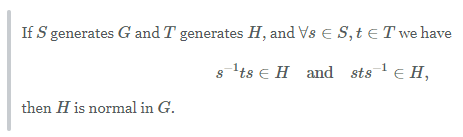
I have this saved as a 'weaker' check
(forall g in G) gH = Hg
is another way of writing the statement also
This might not be 'quicker' but could be 'simpler' to think about
Again, the thing about generators holds.
aH = Ha
bH = Hb
->
(ab)H = a(bH) = a(Hb) = (aH)b= (Ha)b = H(ab)
So we can just check
(forall g in a set of generators) gH = Hg
tribal moss
Right. So we could just have checked srs^-1 and rrr^-1.
coral shale
tribal moss
Oh, but even easier: Your subgoup contains fully half of the elements of the gro...
I think I like this the best for this example. (More explicitly:)
Let H =< G, 2|H| = |G|.
Let a in G - H. Clearly aH = G - H = Ha, else a in H
Let h in H. Clearly hH = H = Hh
H must be normal
winter solstice
Any suggestion on this. Let {a, b, c} be distinct objects, let G be the set of all permuations of {a, b, c}. Define a operation on G to be an iteration(first one permutation and the the other). I need to show G is group and not an abelian group. There should be 3! maps in G right? Let say f_1,...,f_6. would the iteration be take a given element in G say f_j and then compose it with every other map in G?
How do I even start to show this is a group?
tribal moss
If you mean that the operation is function composition of permutations, then it's a group all right, but is is not abelian.
winter solstice
on right, that was a mistake, the book says show it is a group and that it's not a abelian group.
tribal moss
You're probably supposed to simply check the parts of the definition of what a group is one by one.
It's a "check that you've grasped the definitions" exercise, not a "be clever and puzzle out a solution" exercise.
winter solstice
oh I see, my bad.
chilly ocean
It’s my understanding that for every unitary square matrix U (with complex entries), there exists a unitary matrix V such that V^2 = U. Is there a simple formula for such a V in the case of a 2 by 2 unitary matrix U?
dull root
Quick question regarding definitions. If I have a polynomial p \in K[x]. Its splitting field L, is the field extension of K in which p can be factored into the form (x-a_1)(x-a_2)...(x-a_n) where a_1,...a_n are all the roots of p. Is this the same as saying L = K(a_1,a_2,...,a_n)?
tribal moss
chilly ocean
It’s my understanding that for every unitary square matrix U (with complex entri...
Even for 1×1 you run into the problem that there's no continuous square root. This makes it difficult to have an explicit formula in the higher-dimensional cases, because several different branch choices need to be made consistently.
tribal moss
dull root
Quick question regarding definitions. If I have a polynomial p \in K[x]. Its spl...
Yes, more or less -- the main tripping point is that in general the a_i's come into existence together with L. So once you have the splitting field, L = K(a_1,...,a_n) will be a true statement, but you can't use that as a definition of L a priori.
Alternatively you can fix an algebraic closure of K and work in that -- then the a_i's are all there, and L = K(a_1,...,a_n) will work for picking out L as a subfield of that algebraic closure.
coral shale
yh that is a result as opposed to the definition in my course

(You can think of the roots existing in an algebraic closure of K, otherwise it doesn't make sense to adjoin them)
dull root
How do I see then that [K(a_1,...a_n): K] = [K(a_1,...a_n): K(a_1,...a_n-1)] [K(a_1,...a_n-1): K(a_1,...a_n-2)] ... [K(a_1): K] is bounded above by n!. It is clear [K(a_1): K] is bounded above by n, and I think [K(a_1,a_2): K(a_1)] is bounded above by n-1, but I don't see it clearly. There is a trivial n^n bound, but this is stronger
 chilly ocean
tribal moss
Even for 1×1 you run into the problem that there's no _continuous_ square root. ...
chilly ocean
tribal moss
Even for 1×1 you run into the problem that there's no _continuous_ square root. ...
I mean if the issue is choosing positive or negative square roots then you can always choose the positive square root.
tribal moss
No, they're complex square roots.
 toxic zephyr
is it alright to just say that $\bR[x]$ is a ring with $+{\bR[x]},\cdot{\bR[x]}$ so the subset $I$ is an abelian group over $+{\bR[x]}$ if we can show that $+{\bR[x]}$ is a binary operation on $I$?
 cloud walrusBOT
nix

 patent crescent
I had a proof in class that said if the order of a group G was pq for some primes pq with p > q
then <p> was a normal subgroup of G
But is this not true if p is prime but q is not prime?
lethal dune
toxic zephyr
is it alright to just say that $\bR[x]$ is a ring with $+_{\bR[x]},\cdot_{\bR[x]...
not just a binary operation, but satisfies all the axioms. Alternatively you show that (I, +) is a subgroup of (R[x], +)
lethal dune
patent crescent
But is this not true if p is prime but q is not prime?
no, for example take A4, |A4| = 12 = 3*4 but <(123)> is not a normal subgroup of A4
patent crescent
lethal dune
no, for example take A4, |A4| = 12 = 3*4 but <(123)> is not a normal subgroup of...
but p > q
patent crescent
hmm alright, thanks
subtle ivy
patent crescent
hmm alright, thanks
yeah what ryu said. the number of p-subgroups must be 1 mod p and divide q. but the only number congruent to 1 mod p and dividing q if q<p is 1, so that there is only subgroup. i think it's the second sylow theorem that says there is one p-subgroup iff that subgroup is normal.
 desert dome
Hi, I am trying to prove Q is not free as an abelian group. I am kinda confused as should I treat Q as a Z-module? The ring is not specified
lethal dune
desert dome
Hi, I am trying to prove Q is not free as an abelian group. I am kinda confused ...
show that Q cannot have a basis, or any 2 element is LD
desert dome
lethal dune
show that Q cannot have a basis, or any 2 element is LD
Thanks! Should I treat Q as Z module or just any R module?
lethal dune
Z modules, as you are trying to show it's not free "abelian" group
desert dome
lethal dune
Z modules, as you are trying to show it's not free "abelian" group
Sorry I don't get it.. what if R is Q or R is some ring of integers? I don't see how it violates Q being an abelian group
latent anvil
The term "free abelian group" means "free Z module"
desert dome
Ah I didn't know that... Thank you! I'll look it up
patent crescent
Does every group that has an order divisible by 3 have a subgroup of order 3?
This is true by Cauchy's right?
But I looked online and there were a bunch of questions saying to prove that, except when the group is abelian
next obsidian
lethal dune
show that Q cannot have a basis, or any 2 element is LD
Oh this is so much simpler than my proof
Well… it’s more down to earth
My proof is to use the universal property of free objects to show 1/2 exists in Z
 median pawn
What does that have to do with K[x] not having unique maximal ideals?

I don't understand the explanation
next obsidian
Loca is equivalent to saying that the non-units form an ideal
Namely if m is the unique maximal ideal, m is the set of non-units
median pawn
I see, thanks!
next obsidian
BTW
This is how to show if A is local, so is A[[x]]

Although you get a better statement by just classifying maximal ideals of A[[x]], the fact that A local => A[[x]] follows from that
median pawn
Wait, how?
next obsidian
For a power series
F(x) = Sum_0^infinity a_nx^n
F is invertible iff a_0 is a unit
median pawn
RIght, yes
next obsidian
So now
median pawn
So if the constant terms come from the unique maximal ideal of A
median pawn
Great!
next obsidian
And the general statement
The maximal ideals of A[[x]] are of the form (m,x)
Where m is a maximal ideal of A
I forget how exactly to prove this, maybe you localize at m?
To reduce to the local case?
I kinda forget lol
median pawn
Idk either lol
next obsidian
But anyway
This may one day be useful
Particular if you ever learn enough commutative algebra to care about complete local Noetherian rings
Because this shows that class of rings is closed under taking formal power series
But that’s a story for another day 
chilly ocean
next obsidian
Because this shows that class of rings is closed under taking formal power serie...
Another day has passed
I am curious what you mean by closed under taking formal power series
next obsidian
If A is a Noetherian complete local ring, then so is A[[x]]
next obsidian
Well no
chilly ocean
but not
next obsidian
It’s very similar
chilly ocean
and atiyah macdonald supposed to fo over completed rings
i know rings have norms also
next obsidian
In the case of a local ring with maximal ideal m
say that |a| = 1/n where n is the largest n such that a in m^n
So a and b are close if their difference is in a large power of m
(Note that this is like the p-adics)
To be complete wrt this topology is to say that Cauchy sequences in this topology have a unique limit
Aka if you have a Cauchy sequence {a_n} there’s some a such that a - a_n is in m^n+1
Or m^n
Whatever, it doesn’t matter
It’s equivalent to saying that power series “in m” exist
Aka if you have a sequence of element a_n where a_n is in m^n
Then the power series Sum_0^infinity a_n exists
Where that’s the limit of the partial sums Sum_0^k a_n
chilly ocean
So we pretty similar to analysis notion besides a couple of big facts like focusing on powers of the maximal ideal
next obsidian
Yeah I guess so
If you’re familiar with p-adics i think most people find it easiest to frame it like that
chilly ocean
I should be more familiar
next obsidian
But I am not, so I pretend complete local rings are power series rings
chilly ocean
Yeah
next obsidian
And try to prove theorems for those first
chilly ocean
the first time i saw power series rings was iwasawa algebra
next obsidian
And then use the idea
chilly ocean
like 7 weeks ago
next obsidian
Lol
chilly ocean
next obsidian
So a and b are close if their difference is in a large power of m
Yeah this right here is just referencing p-adic metric
I wonder the motivation for this though
Why care about complete rings other than number theory
I dont know any other contexts they would show up unless you are deciding to formalize something that already uses power series
next obsidian
The main motivation is via the Cohen Structure Theorem
Let’s just state the nicest case
If (A,m,k) is a Noetherian local complete ring containing a field, then A ≈ k[[x1,…,xn]]/I where n is the number of generators of m
If A is also regular, then I = 0
 sturdy marsh
hurb
next obsidian
So if you take eg a non-singular variety and then take the completion of its local rings, it looks like a power series over the field you’re over
And when you want to prove stuff, this often lets you reduce to the case of power series over fields (or if you don’t contain a field, a very very nice ring)
And we actually understand power series very well, it’s almost like working with polynomial rings
And polynomial rings over fields are practically the most well understood rings
sturdy marsh
chilly ocean
I dont know any other contexts they would show up unless you are deciding to for...
this is also kinda the motivation
power series rings let you do the arguments you see in complex anal/Riemann surfaces over more general schemes
next obsidian
Formal deformations 
sturdy marsh
also that
I dont think ive ever seen someone motivate power series using the structure theorem lmfao
next obsidian
I didn’t motivate power series with those
They asked why bother with complete rings outside of a NT context
next obsidian
chilly ocean
Why care about complete rings other than number theory
.
sturdy marsh
O fair
next obsidian
Motivating power series rings with the structure theorem is so ass-backwards hahahahaha
sturdy marsh
yeah I misread
sturdy marsh
sturdy marsh
hurb
which is why I said this
 desert dome
Could anyone explain why being a free abelian group means it's free Z module? Doesn't being any R-module requires to be an abelian group first? I am so confused.. sorry
next obsidian
A Z-module is exactly an abelian group!
If you’re a Z-module you’re an abelian group by definition
And if G is an abelian group, we need to define scalar multiplication by Z
So what should n•g be where n is in Z, and g is in G?
desert dome
g+ g+... + g for n times
next obsidian
Yup
And this turns G into a Z-module, and actually it’s the only way to do so!
Because you’re forced to have 1•g = g
And then by distributivity
n•g = g + … + g (n-times)
desert dome
Ah I see. Just to confirm: If it is a Z-module, it has to be abelian. If it is an abelian group, we can always define such operation to make it a Z-module
next obsidian
Yup
And crucially the last thing is unique!
There’s only way to make it a Z-module
Otherwise like the two processes wouldn’t be inverse
desert dome
I see. Thank you!!
next obsidian

 foggy merlin
Mathematics Stack Exchange
I know they are important in abstract algebra, but why do people study them? Why are they so important to study? Do they make certain things easier to understand?
Is the first dude spitting fax or no? Opinions?
next obsidian
Eh
He’s right that things are usually about finitely presented modules, and the thing about coherence makes sense as well as this allows the sort of stability on finite presentation you need
But it’s often a really harmless assumption, and without it you become mired in ridiculous statements with hypotheses you will never verify unless you are in a situation which is finite generation plus Noetherianity
It seems like a person with Uber specific needs and a very nonstandard view of things because they like constructive commutative algebra
My take is that if you end up needing whatever the hell that guy’s doing that requires ditching the Noetherian hypotheses and throwing coherence plus finite presentation everywhere, you can just learn it when you get there
For the rest of us 99.99% of people, Noetherian is just fine
sharp sonnet
my first question would be what is an example of the "new" framework that doesnt fit into the noetherian
e.g. whats a coherent ring that is not noetherian
next obsidian
K[x1,…]
sharp sonnet
idc about that one 
but ye, what chmonkey said
if your only argument is "but you can build a more general theory"
i dont think that is enough
next obsidian
I think the (main) argument here is for people interested in constructive commutative algebra
If you define Noetherian as usual you can’t constructively show Z is Noetherian or some shit
So it’s a really dumb notion
And constructive commutative algebra has “useful” applications beyond just being an exercise for people uncomfortable with the law of the excluded middle, there’s some logic thing about it idrk
But if you can prove stuff constructively you get stuff for free or something, I’m not too sure it’s something about the internal logic of some topos or something, Moth knows a little about it
The thing is this is a hyperspecific reason, almost nobody is doing this stuff because they’re fine just doing normal commutative algebra
 waxen hedge
(What is a coherent ring ?)
next obsidian
One that is a coherent module over itself
sharp sonnet
ok maybe there is more to this then
next obsidian
And what’s that you ask?
sharp sonnet
but it still sounds mostly like "i think this is the correct way to do mathematics"
next obsidian
It’s a finitely generated module such that all finitely generated submodules are finitely presented
It is very rarely used because coherent = finitely presented = finitely generated over a Noetherian ring
Which is why eg Hartshorne only defines a coherent sheaf over a (locally) Noetherian scheme
sharp sonnet
my experience is that slapping noetherian condition on things makes arguments easier
i wouldnt want to lose that
next obsidian
The main benefit to coherent modules is that they’re stable under more stuff, whereas finitely presented stuff aren’t. And when A is a coherent ring, finitely presented = coherent anyway
So it’s just a very technical condition for non-Noetherian settings nobody really actually cares about
waxen hedge
Well you often end up with non-noetherian rings in algebraic geometry
waxen hedge
So it can be useful to have less strong assumption
waxen hedge
next obsidian
It depends on what you’re doing
Yes ofc
next obsidian
And you can get around these things with a variety of methods
Like Noetherian approximation
I think ultimately saying Noetherian rings are unimportant is just plain false though
They’re important because they imply amazing things and are a very robust class of rings stable under tons of operations, and almost all rings of interest are Noetherian anyway
 robust pollen
I think this fits here better than the category theory channel. My question is: How is that true? The obvious linearization of the group case definitely leads to a category of modules with monoidal product induced by the coproduct. I don't get it.

(source is "Quantum categories, star autonomy, and quantum groupoids" by Day and Street btw)
 shy turtle
Hello.
Suppose I have groups S ↣ G such that S is a normal subgroup of G. Suppose also some additional structure (maybe an ordering) lets me choose a representative c ∈ C ∈ G/S. I reckon then every element splits one way like so: g = cs. How do I call this situation?
For example, suppose G = ℤ (with addition), S = 2ℤ, so that G/S has two elements — even and odd numbers. Choose elements {0, 1} as representatives. Now every number can be split as either 0 + 2n or 1 + 2n.
tribal moss
What does the fancy arrow between S and G mean here?
shy turtle
A group homomorphism that is one to one with respect to the underlying sets. I edited my previous message to make it clear.
tribal moss
Okay, thanks. (I've just seen $\hookrightarrow$ with that meaning).
cloud walrusBOT
Troposphere
 shy turtle
Yes, it is the same — other literature (maybe older literature, I am not sure) has these arrows with forked tail instead of hooks and I like them more because they are symmetric. They also go well with the arrows onto (epic) that look like so: ↠.
tribal moss
On the other hand, the forked tail looks to me like it wants to symbolize that there are two different point at the left end that go to the same right end -- exactly the opposite of what you really mean. :-)
Anyway, I don't think I've heard a fancier word for your situation than "(system of) canonical representatives" for the cosets.
shy turtle
Is there any literature that mentions this?
tribal moss
M. Artin just calls them "representative elements", which is not much better.
 devout crow
shy turtle
Hello.
Suppose I have groups _S ↣ G_ such that _S_ is a normal subgroup of _G_....
devout crow
shy turtle
Hello.
Suppose I have groups _S ↣ G_ such that _S_ is a normal subgroup of _G_....
In mathematics, particularly in combinatorics, given a family of sets, here called a collection C, a transversal (also called a cross-section) is a set containing exactly one element from each member of the collection. When the sets of the collection are mutually disjoint, each element of the transversal corresponds to exactly one member of C (t...
this might be what you're looking for?
shy turtle
Yes!
I am a bit disappointed that there is no special name for a «smallest» or «the most central» transversal. I reckon it may be defined relative to a given minimal generating set, by choosing «the most easily generated» element from each co-set. An example would be {0; 1} as above.
Another example: given a matrix M: V → V' with kernel K = M⁻¹ (0) a line, the subspace orthogonal to K is a transversal that is «the most central» geometrically.
devout crow
i guess often (e.g. R/Q) there is no "obvious" cross-section (i like cross-section more than transversal) so that's probably why it's not mentioned
but you can call them canonical like troposphere mentioned if they're clearly the nicest ones
chilly ocean
Can we say a Kernel is a homomorhpism that maps multiple objects of a Group C to a single object of Group D?
delicate orchid
a kernel is a subset of the domain, not a function
chilly ocean
It's not a morphism?
delicate orchid
Moldilocks reacted with

 hidden haven
Either you are making a basic mistake in the definition of kernel which wew pointed out or you are making a more complicated mistake in cat theory 
chilly ocean
Wait oh
Kernel is a set of objects in Group C being mapped to a single object of Group D, where it's a subgroup of C?
delicate orchid
Ker : $Hom(G, H) \rightarrow P(G)$ trollololol it was a function the WHOLE time
cloud walrusBOT
Wew Lads Tbh (201 🍇) ✓
 chilly ocean
Aaaaa
hidden haven

hidden haven
No he is trolling
chilly ocean
Okay xd
shy turtle
There are some functions called kernels. Like say here: https://en.wikipedia.org/wiki/Positive-definite_kernel.
hidden haven
delicate orchid
Ker : $Hom(G, H) \rightarrow P(G)$ trollololol it was a function the WHOLE time
You can view it as the inclusion of the subset instead of the subset itself, and the benefit of that is that then you can define it using a universal property
delicate orchid
why would I do that
hidden haven
It's very important in homological algebra
delicate orchid
oh yeah nevermind diagrams look cool, I'm convinced
hidden haven
delicate orchid
fr though I can see why it would be useful to have a universal property definition
for some wacky objects


 wooden ember
When you want to calculate the characteristic of the quotient of a polynomial ring is it common practice to calculate characteristic in some evaluated ring instead?
so like if i want to calculate the characteristic of Z[t]/(t-2)
then i just note it's 3 in Z[i]/(i-2)
terse crystal
No
wooden ember
and that the two rings must have the same characteristic
terse crystal
Its characteristics is 0
wooden ember
hmm why dont they have the same characteristic then
i thought it sounded wrong
but i cant see where im going wrong in applying third iso theorem
terse crystal
The characteristics of D[x]/I is characteristic of D
wooden ember
terse crystal
The characteristics of D[x]/I is characteristic of D
yeah that makes sense (at least directly for a linear poly)
terse crystal
Characteristics of a domain is the smallest positive integer n such that n1=0
wooden ember
idk it just seemed to me like Z[t]/(t-2) is iso to Z[i]/(i-2)
wooden ember
wooden ember
idk it just seemed to me like Z[t]/(t-2) is iso to Z[i]/(i-2)
i cant figure out why this is wrong
i mean take the ideal J=(t^2+1, t-2) and I=(t^2+1) then we get Z[t]/J iso to (Z[t]/I)/pi(J) with pi the projection Z[t] -> Z[t]/I
terse crystal
wooden ember
idk it just seemed to me like Z[t]/(t-2) is iso to Z[i]/(i-2)
Yeah, so? Their characteristics are both 0
How did you get 3
terse crystal
Not multiplication
wooden ember
yeah loooool
terse crystal
Yeah addition
wooden ember
haha thanks
terse crystal
Lol, np
tribal moss
It's not completely moronic:
If 3 = -(i+2)(i-2), that would prove that 3 is in the ideal (i-2) and therefore the characteristic of Z[i]/(i-2) would be 3.
Actually -(i+1)(i-2) is not 3 but 5, so what we get is that the characteristic of Z[i]/(i-2) is really 5.
However Z[i]/(i-2) is not isomorphic to Z[t]/(t-2) because i²=-1 even before you quotient out an ideal, whereas t² is just t² to begin with.
In Z[t] you just have -(t+2)(t-2) = -t²+4 which does not say anything about 3 or 5.
wooden ember
tribal moss
It's not completely moronic:
If 3 = -(i+2)(i-2), that would prove that 3 is in t...
wait yeah youre right
wooden ember
tribal moss
However Z[i]/(i-2) is not isomorphic to Z[t]/(t-2) because i²=-1 even before you...
but where does my earlier argument fail then ?
wooden ember
wooden ember
i mean take the ideal J=(t^2+1, t-2) and I=(t^2+1) then we get Z[t]/J iso to (Z[...
this
tribal moss
In this case the projection of J is (5,0).
And Z[t]/(t-2) is just Z.
So (Z[t]/I)/pi(J) is Z/(5) too. But that doesn't tell you about the characteristic of Z[t]/I.
wooden ember
tribal moss
It's not completely moronic:
If 3 = -(i+2)(i-2), that would prove that 3 is in t...
how do you see that the projection of J is (5,0) though without this argument
tribal moss
Z[t]/(t-2) means that pi(t-2) = 0, or in other words pi(t)=pi(2)=2.
wooden ember
no but im projecting on Z[t]/(t^2+1)
tribal moss
Oh, sorry, I read you the wrong way around.
Z[t]/(t²+1) is indeed Z[i].
But then what does your argument say about Z[t]/(t-2) when (t-2) is neither I nor J?
wooden ember
oh right it only tells me about Z[t]/(t^2+1, t-2)
yeah okay
thanks
good thing this discord is here to catch my dumb mistakes lol
 void cosmos
Are there 2 diff integers in Z/60
Such that ax=b mod 60 and bx=a mod 60?
x not being 1 or -1
foggy merlin
Do you have any restrictions on x, a, or b?
Apart from that
Which of the 2 are to be chosen and which is fixed (I assume x is fixed and you're asking about finding a and b)
foggy merlin
next obsidian
I think the (main) argument here is for people interested in constructive commut...
Is that true though? do you not show that it is noetherian by showing it's a euclidean ring or sth if I remember correctly?
next obsidian
Constructively
foggy merlin
Is euclidean division not considered to be constructive?
Or am I misremembering sth.
You show that Z is a PID with it
 wraith obsidian
Does anyone know what the notation (I:x) means where I is an ideal of a commutative ring R and x in R?
(context)

Never seen it before.
(also: the paper is very interesting in general. https://www.researchgate.net/publication/255588550_An_Elementary_Characterization_of_Krull_Dimension)
sharp sonnet
is it not just ideal quotient? or if x is an element its ${y\in R : yx \in I}$
cloud walrusBOT
Lochverstärker
 void cosmos
Are there 2 diff integers in Z/60
void cosmos
void cosmos
Are there 2 diff integers in Z/60
Help please
chilly ocean
void cosmos
x not being 1 or -1
Um
I think not
im not sure if mental math is correct
but you need x= 60ka+a^2,60hb+b^2
where k,h are different integers
and this is for any a,b right?
oh woops
other way
any x there are a and b
tribal moss
Is x given or can we choose that? There are several x satisfying x² == 1 (mod 60), and then you can pick an arbitary a and set b=ax.
And you can find further solutions by requiring x² == 1 only modulo some of 3,4,5, and then choose a so it is 0 under the same moduli where x²==1 doesn't hold.
wraith obsidian
sharp sonnet
is it not just ideal quotient? or if x is an element its $\{y\in R : yx \in I\}$
Oh, okay, thanks! Never heard of „ideal quotient“ until now, just of fractional ideals.
sharp sonnet
i think this appears in context of primary decompositions
and there is some geometric interpretation
coral shale
Rubik's Cube
zealous flame
quick question, I'm not really understanding that the union of 2 subgroups of a group not necessarily make the union a subgroup of the group
latent anvil
do you know about the klein four group?
 small bison
have you heard from our lord and savior K_4?
latent anvil
yep
in both cases the point is basically "the union of two cyclic subgroups of order 2 is definitely not going to add anything"
you're gonna miss out on the product of them
wraith obsidian
zealous flame
quick question, I'm not really understanding that the union of 2 subgroups of a...
if I may add some intuition, think of vector spaces instead and ask yourself why the x axis \cup the y axis won't give you a subvectorspace of ℝ².
With groups and subgroups it's essentially (I might even say literally b/c vector spaces are abelian groups) the same thing
wraith obsidian
(meant ℝ², sorry)
zealous flame
wraith obsidian
if I may add some intuition, think of vector spaces instead and ask yourself why...
thank you for taking the time out fo your day to help me although I dont know what a subvector space is or what vectors involvement with groups are( yet) as we only started group theory 3 weeks ago and i'm still in first year , however after a while I did come to a conclusion that the reason why it doesn't work, i'm not too sure if this is correct but what i thought is , what if i have a union between 2 subgroups in which one of the subgroups is contained in the other, for example lets say I have K {1,2,3,4,5,6,7,8,9} and L{1,2,3,4} the union of these 2 subgroups would just be K and so its not really a new subset as K has already been established to exist and so that's why I think it doesnt work
wraith obsidian
Oh, so do you do group theory before linear algebra?
I'm not familiar with the curricula around the globe so I don't know what your prerequisites are 😅
zealous flame
wraith obsidian
Oh, so do you do group theory before linear algebra?
I'm not familiar with the c...
we did a little bit of matrices but yeah university of glasgow is not very good for maths from what i've gathered
we did basic matrix addition adn subtraction
wraith obsidian
ah, so you won't be familiar with the „geometric“ or abstract algebra approach to linear algebra then, that's fine tho
zealous flame
not really although 3blue1brown(this man has single handedly gotten me this far without dropping maths) uses it a lot
 coarse stag
Isnt d always one?

because Q adjoin theta contains theta so a polynomial over Q adjoin theta should have the polynomial x-theta
so why isnt d always one?
next obsidian
This is regarding the lowest degree polynomial with coefficients in Q
It’s not very clear as written, because like you said if we allow the polynomial to have coefficients in the number field, then x - theta always works
 frank haven
Does anyone know if isomorphism preserves quotient? I mean this in the sense that if $G/H\cong F/N$ is it true that $G\cong F$ and $H\cong N$ on their own?
cloud walrusBOT
llspacebarll
 tribal moss
Definitely not. For example Z/2Z = C_2 = C_2/{0}, but Z is not isomorphic to C_2, nor is 2Z isomorphic to 0.
frank haven
right, that makes sense
tribal moss
We don't even have the naive converse. 2Z and 3Z (as additive subgroups of Z) are isomorphic, but Z/2Z and Z/3Z are not isomorphic.
About the only thing we can say is that if f : G -> F is an isomorphism and f(H)=N, then G/H is isomorphic to F/N ...
next obsidian
You cannot even say when given G, H, what C exists such that C/H ≈ G