#groups-rings-fields
406252 messages · Page 585 of 407
 oblique river
yes
 ancient night
How to differentiate between the two?
oblique river
they are literally the same polynomial
ancient night
Which object would preserve the computational details?
oblique river
you can use a polynomial to define a function on R
I dont know what you mean "computational details"
(x+1)^2 and x^2 + 2x + 1 are the same polynomial
they are exactly the same and there is no difference between them
ancient night
A polynomial decomposition may enable more efficient evaluation of a polynomial. For example,
$${\begin{aligned}&x^{8}+4x^{7}+10x^{6}+16x^{5}+19x^{4}+16x^{3}+10x^{2}+4x-1\={}&\left(x^{2}-2\right)\circ \left(x^{2}\right)\circ \left(x^{2}+x+1\right)\end{aligned}}}{\displaystyle {\begin{aligned}&x^{8}+4x^{7}+10x^{6}+16x^{5}+19x^{4}+16x^{3}+10x^{2}+4x-1\={}&\left(x^{2}-2\right)\circ \left(x^{2}\right)\circ \left(x^{2}+x+1\right)\end{aligned}$$
can be calculated with only 3 multiplications using the decomposition, while Horner's method would require 7.
 cloud walrusBOT
JohnDark
Compile Error! Click the  reaction for more information.
(You may edit your message to recompile.)
 ancient night
Should I introduce my hand-crafted algebraic structure for describing the details of polynomial evaluation?
Or can I refer to some available algebraic structure that can be rarely used but still present in literature
oblique river
I'm not sure what kind of algebraic structure you are looking for
do you mean like "a polynomial ring but where you can do composition"?
ancient night
And where the degree of a polynomial would reflect the power of factors instead of monomials
oblique river
ancient night
Thank you!
oblique river
it's not really in common use anymore but if you're just talking about composition of polynomials
I would just say "composition of polynomials"
ancient night
I have to do some proofs about the new notion of degree
oblique river
"new" notion?
ancient night
Because polynomials with high exponents of factors can be relatively easy to compute in non-expanded form
oblique river
yes I certainly agree that factoring polynomials can be useful
oblique river
did I do anything? 
ancient night
Yes, you clarified me the border between what is at least initially taught to be polynomial and what it actually is
oblique river
oh ok :)
 chilly ocean
a polynomial is a sequence with finite support with terms in a ring
ancient night
Oh, that's what confused me the most. In Russian not a single grown person will ever say something like this. I perceive it as a substitution of the definition by its model.
We usually accompany such things with "can be thought of", "can be intuitively understood as", "can be modeled by" etc
In English I encounter such things very often and it makes me cry because often I end up not getting the definition that is just ``true". Let it be Bourbaki-style (like definition of a function), but objectively and in all cases true
Classes (proper classes + sets) = ❤️
cry from the heart
chilly ocean
ancient night
Oh, that's what confused me the most. In Russian not a single grown person will ...
 oblique river
that was fast
ancient night
@chilly ocean And I thank you for your intentions! It is admirable that you help people here
MIPT's lectures have spoiled me
@chilly ocean And thank you too
chilly ocean
intuitively a polynomial can be written in form an x^n + ... + a1 x + a0
So you can think this as an infinite sequence which is always 0 after some terms
(a0, a1, ..., an, 0, 0, 0, ...)
so here x = (0,1,0,0,...) and x² = (0,0,1,0,0,...) and a0 = (a0, 0, 0,...)
 unique juniper
:o
chilly ocean
You are welcome. I mean, saying that "in Russian not a single grown person will ever say something like this" is wrong in all possible senses. Literally every algebra textbook on russian defines polynomials in that way (and it would be completely strange if they not)
ancient night
I mean that is a definition
Bourbaki-style with all its shortcomings
But still a definition
unique juniper
russian looks cool
ancient night
It is, meaning that it is understood through contrived models

Mathematics Stack Exchange
I know Nicolas Bourbaki "is the pseudonym of a group of (mainly) French mathematicians who publish an authoritative account of contemporary mathematics." But what characterizes "Bourbaki's style in
(without implied negative connotation)
chilly ocean
And which mathematical definitions is not "Bourbaki-style" on your flavor?
ancient night
"In mathematics, a group is a set equipped with a binary operation that combines any two elements to form a third element in such a way that conditions called group axioms are satisfied, namely associativity, identity and invertibility." It is natural to talk about groups as sets endowed with such structure.
P.S. I think we go off-topic so we should chat in DM.
unique juniper
what is bourbaki style lol?
ancient night
@unique juniper I've sent a link
unique juniper
ok ill read it
ancient night
I perceive it as a social construct with some polysemy (existence of several meanings caused by contiguity of semantics)
unique juniper

chilly ocean
ancient night
"In mathematics, a group is a set equipped with a binary operation that combines...
It's strange that it is not a Bourbaki-style definition for you, regarding that this is literally definition which the Bourbaki gave.
ancient night
Yes, because it works for such concepts
 old lava
it's not literally the definition bourbaki gave, since I doubt bourbaki wrote in english

ancient night
But it is bad idea to say that bee is a set of 2 wings, a body and some other things that would not differentiate a bee from a fly or some other insect or currently existing sorts of bees
chilly ocean
Ok, you think too broadly for me
ancient night
Haskell and FP does nasty things to imagination
chilly ocean
I see
 cursive temple
In jacobson it is an exercise to show that if a^2 = 1 for all elements in a group, then the group is abelian. After this it is asked if the same holds for when a^3 = 1 for all a in the group. It turns out that this does not necessarily hold. What about when the condition a^n = 1 holds for all elements a in our group for some n > 3?
The counterexample in the a^3 = 1 case is this

Apparently its called a heisenberg group
old lava
pretty sure it only holds for a^2 = 1
cursive temple
For primes you can just expand on this idea with the heisenberg group i think
Yeah im inclined to agree
In mathematics, the Heisenberg group
    H


{\displaystyle H}
, named after Werner Heisenberg, is the group of 3×3 upper triangular matrices of the form
        (


              1


    ...
Wikipedia gives it in that case
 slender sable
can anyone guide?

 carmine fossil
Are you considering matrices over C or R?
 warm holly
Is a dimension of a basis of $S_3={M \in M_3(K) : M^t=M}$ (subspace of squre matrices $3\times 3$ over a field $K$) 4?
cloud walrusBOT
Dаniil
 carmine fossil
You have {E_11,E_22,E_33,E_12+E_21,E_13+E_31,E_23+E_32} as a basis for that
Where E_ij is a matrix with everything except the (i,j)th Element being 0 and that element being 1
warm holly
so of dimension 6?
carmine fossil
Yes
carmine fossil
In general it's n^2+n/2
slender sable
carmine fossil
Are you considering matrices over C or R?
in general...for the option a is it true or false?
carmine fossil
Where n is the size of matrix
warm holly
nice thank you
carmine fossil
a is true,mb
warm holly
oh i'm stupid I considered an element of a basis E_11+E_22+E_33 thats why i had 4 instead of 6
carmine fossil
Should be only c,I think
warm holly
of course on diagonal elements can differ
slender sable
carmine fossil
Should be only c,I think
yes coz its never the same?
carmine fossil
I think it's always the same
slender sable
no..its never the same..after you apply row transformation to get echloen form..its never the same
carmine fossil
mb
A is true
Take A^-1=-A
B is definitely true
Av=0 implies A^2v=0
D is weird since 0 is not seen as an eigenvector and that always satisfies
slender sable
cool
carmine fossil
I guess it's D then
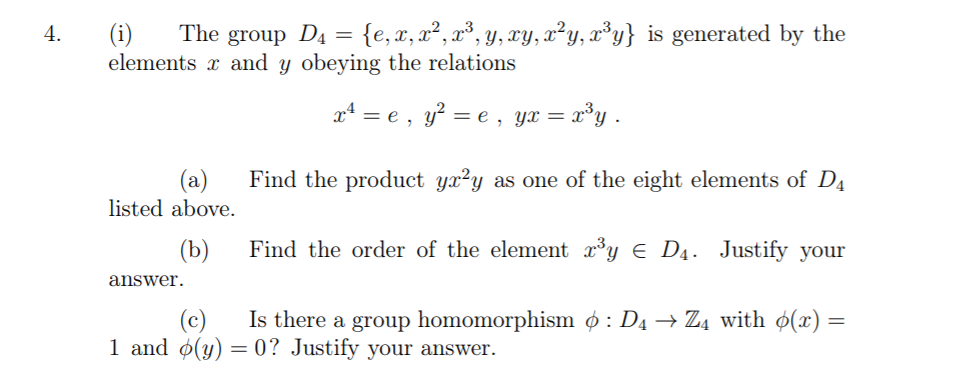
 hot lake
what's confusing about it ?
 oak perch
yxxy = xxxyxy = xxxxxxyy --> ?
hot lake
do you know what a group homomorphism is
 tepid thunder
yes sir
hot lake
do you know what Z4 is
hot lake
yeah
so if you know that phi(x)=1 and phi(y)=0, do you think that determines phi completely ?
is it possible to know what phi(x²) is from that information ?
hot lake
well you can try pulling as much information as you can from what you are given
tepid thunder
so phi(x^2) would be 1
tepid thunder
I am confused again
chilly ocean
its okay
 delicate bloom
tepid thunder
all integers mod 4
delicate bloom
tepid thunder
all integers mod 4
a group is more than just a set like 'integers mod 4' you also need to specify the binary operation, which is addition
tepid thunder
the question does not state the binary operation
oh, okay my bad i didnt read the last bit
delicate bloom
tepid thunder
so phi(x^2) would be 1
I'm assuming that's why you're saying this, so phi(x*x) = phi(x)+phi(x)
tepid thunder
yea that is
I just got confused cause like a few questions before hand I was multiplying as it had the binary operation of multiplication
thank you
delicate bloom
yeah, as a hint you can derive a contradiction by playing with the generating relations a little
or maybe not, I might have made a mistake lol
 languid meteor
hey all, im looking at the quotient group dZ/nZ and I know that it's generated by d + nZ. What I can't immediately accept is that the order of d + nZ is n/d. How can I prove that there isnt a smaller integer that sends d + nZ to zero?
zero here being nZ
carmine fossil
n should divide kd,where k is the smallest number that sends d+nZ to 0
kd=na
k=(n/d)a
languid meteor
ah, perfect thank you!
 outer monolith
Hi, i'm a little bit confused for the notation used in finite fields. For example, I see the symbol:
$(\mathbb{F}_2^4)^4$, what do the 2, inner 4 and outer 4 refer to?
$(\mathbb{F}_2^4)^4$
cloud walrusBOT
Daddy
 outer monolith
I assume the 2 refers to elements taking the values 0 or 1? (i.e, binary of length 4 perhaps?)
 golden pasture
huh ive never seen this before
could give context
do you mean like
$$\mathbb F_{2^4}^4$$
cloud walrusBOT
ari 十年生死两茫茫,不思量,自难忘。

 golden pasture
hm could send where you seen that
outer monolith
M is an MDS matrix
golden pasture
huh
outer monolith
minimum distance separable matrix
golden pasture
cloud walrus
**ari 十年生死两茫茫,不思量,自难忘。**
i suspect it is actually this, the 4d vector space over F_16
outer monolith
maybe this is too computer scienc-y
basically it is a matrix that is applied to a 16-bit number
a b c d are 4 bit numbers
languid meteor
If we have if |G| = 155, x,y in G with |<x>| = 5 and |<y>| = 31 and <x> intersection <y> = e do we know that |<x,y>| = 5*31 = 155?
I cant find anything about the order of a generating set
oblique river
yes but for much simpler reasons. the order of <x,y> must divide 155 because it's a subgroup. but the order is clearly larger than 31 since x isn't in <y> and therefore it must be 155
languid meteor
oh god, of course. Thank you
 kindred mist
Is there a way to show using exact sequences that for any ring $R$, module $M$ and submodule $N$ that $M/N\bigoplus N\cong M$? Is it even true? I was trying to show that the exact sequence: $0\to N\to M\to M/N\to 0$ splits, but I can't seem to find a way. The canonical projection $\pi$ is surjective and thus has a right inverse map but idk if it has a right inverse homomorphism (I believe that is equivalent to the statement that $M/N\bigoplus N\cong M$).
cloud walrusBOT
𝓒𝓸𝓾𝓷𝓽𝓪𝓫𝓵𝓮

 next obsidian
This isn't true
 final pasture
M = Z/4Z and N = Z/2Z as Z-modules is a counter-example, no ? @kindred mist
 hidden haven
Also M=Z, N=2Z
next obsidian
As you've noted, the projection map splits set theoretically
but it will not always split as a module map
hidden haven
M/N is Z/2Z but direct sum N would give Z/2Z + Z
kindred mist
final pasture
M = Z/4Z and N = Z/2Z as Z-modules is a counter-example, no ? <@!697311884193562...
N isnt a submodule of M?
hidden haven
Ye
next obsidian
A related thing
One could attribute this to the fact that the object you can put in the middle of this exact sequence
0 -> N -> ? -> M/N -> 0 up to isomorphism isn't unique
this leads to the notion of Ext which classifies, up to isomorphism, the various objects which can fit inside there
 sturdy marsh
 vestal snow
Is there a quick way of doing this using the colimit definition of stalks?

It's pretty straightforward using the explicit construction
But I'm trying to get better at category theory arguments
chilly ocean
can someone give me an example of reducible polynomial with no root ?
hidden haven
(x^2+1)^2 over R
hidden haven
That has 0 as a root
 obsidian sleet
🤨
next obsidian
vestal snow
Is there a quick way of doing this using the colimit definition of stalks?
I think this is going to be hard
The category you’re taking the colimit over has to be in Ab, because you’re taking a colimit of modules over different rings
vestal snow
That's what I was thinking too
next obsidian
But you can in general describe how a colimit of modules over a system (A_i) is a module over the colimit of the A_i, and you could maybe do this by means of the fact that a module structure is a map of the form
I hope I have this right, but it’s like
A (x)_Z M -> M
In Ab
This describes left multiplication by scalars
So I think you can take the module structure for the various M_i in terms of
A_i (x)_Z M_i -> M_i
And try to take colimits and get a map A (x)_Z M -> M
vestal snow
That seems too much work lol
next obsidian
Yeah, it’s not really worth it IMO
vestal snow
I think I'll just go with the concrete way
next obsidian
I’ve thought about this sort of thing for far too long
I think it’s not worth it at all
vestal snow
When does AG get difficult in terms of actual problems instead of just difficult because of abstractness?
vestal snow
next obsidian
Around II.3 of Hartshorne
Which is...?
next obsidian
💤
vestal snow

You should read Vakil like a novel Chmonkey
Once you're done with Hartshorne
so you can help me
next obsidian
Vakil is even less like a novel than hartshorne
Idk what novel has you stop twice a page to fill in the details
It’s like an evil madlib
vestal snow
So far, its been pretty good at communicating the intuition behind things
next obsidian
¯_(ツ)_/¯
vestal snow
For example, stalks were pretty weird when I encountered them in Liu, but Vakil's motivation of it through differentiable functions drove the point home for me
golden pasture
honestly learning about schemes in context of complex surfaces helps a lot for intuition
unique juniper

the last paragraphy
g(X) is the polynomial obtained by removing multiple factors
i dont really see how the splitting the field for g and the product of p(x)'s would be the same
and why g(x) is seperable
what if there was a root of multiplicity >2?
unique juniper

vestal snow
Do an example
What is the splitting field of (x-sqrt(2))^2 and the splitting field of x-sqrt(2) over Q?
unique juniper
yes its the same Qroot 2
i mean tho
like
what happens if p1 has distinct linear factors?
then g wont contain any of those
what about then?
so for example
$(x - x_1)^2(x - x_2)$
cloud walrusBOT
Yes ツ
 unique juniper
g would be x-x1
then the splitting field wouldnt be the same
?
assumiing x2 isnt in F(x1)
 rustic crown
no, in this case g would be (x-x1)(x-x2)
unique juniper
but g is obtained by removing multiple factors?
rustic crown
only remove the redundant part
unique juniper
wdym?
rustic crown
you want to find a polynomial which has same splitting field as p_1 . p_2 ... p_n
and which has no repeated roots.
rustic crown
yep
 rustic crown
lol
unique juniper
thank you XD
rustic crown
vestal snow
What is the splitting field of (x-sqrt(2))^2 and the splitting field of x-sqrt(2...
also this is kinda bad to say since sqrt(2) isn't in Q.
unique juniper
i understood what they meant
 daring ibex
Okay so i'm rereading this proof and i realized i didn't understand one step

I don't understand how they got to $\sum_{c \mid d} \psi(c) = d$
cloud walrusBOT
urdurdus
 daring ibex
As far as i understand, what this result is saying that if $d \mid p -1$ implies $\psi(d) = d$
cloud walrusBOT
urdurdus
 daring ibex
cloud walrus
**urdurdus**
daring ibex
cloud walrus
**urdurdus**
so doesn't this mean that this reduces to $\sum_{c \mid d} c = d$
cloud walrusBOT
urdurdus
 daring ibex
but you can pull a d out of the left hand side which leads to this being completely preposterous 
daring ibex
daring ibex
As far as i understand, what this result is saying that if $d \mid p -1$ implies...
or well at least what the first few lines show
hot lake
well if you have a set A and a function f : A -> B, then A is the disjoint union of the f-1({b}) for b in B
here A = U(Z/pZ), f(x) is the order of x
and B is the set of divisors of d
and f-1({c}) has size psi(c) be definition of psi
so the size of U(Z/pZ) is the sum of the psi(c)
daring ibex
hot lake
well if you have a set A and a function f : A -> B, then A is the disjoint union...
only if surjective tho, right?
hot lake
oh wait they have various d
daring ibex

rustic crown
cloud walrus
**urdurdus**
no its saying psi(d) = phi(d)
hot lake
in total it has sum for c dividing d of psi(c) elements
and proposition 4.1.2 says that there are d elements of order dividing d
so sum for c dividing d of psi(c) = d
hot lake
pick A = the elements satisfying x^d = 1
daring ibex
yeah
hot lake
aka the elements whose orders divide d
hot lake
classify the elements of A according to their order
for each c dividing d, look at the set of elements of A of order exactly c
that set has size psi(c)
hot lake
very
delicate bloom
you could say psi=phi in that step if you take an element of order d there and look at its powers x^1, x^2, ..., x^d which are necessarily distinct
if one of those has power c that divides d, then it has order d/c
unique juniper

chilly ocean
is there a way to divide f by g to find gcd(f,g) ?
 golden pasture
use euclidean algorithm
delicate bloom
there are a few tricks to make your life easier by hand probably just noticing some patterns
chilly ocean
 unique juniper
oof
delicate bloom
I directly factored it cause I think they designed it to be done that way
$f = (x^3-1)(x^2+2x+2)$ and $g=4(x^4+4)$
cloud walrusBOT
Merosity
 delicate bloom
at this point I guess $(x^4+4)=(x^2+2x+2)(x^2-2x+2)$ since we need to make 0 in the middle and 4 on the last term
cloud walrusBOT
Merosity
 delicate bloom
nothing more to check cause they're both irreducible by eisenstein and the other poly factors as (x-1)(x^2+x+1)
chilly ocean
what's the benefit for long division ?
 sinful mirage
does this seem right?

I tried to write out all multiplications explicitly and I am not sure whether what I wrote is right or not 
chilly ocean
chilly ocean
what's the benefit for long division ?
the benefit is we can write uf+vg in a shorter form. nothing more. their gcd(f,g)=1
delicate bloom
chilly ocean
the benefit is we can write uf+vg in a shorter form. nothing more. their gcd(f,g...
but I just explained why the gcd is x^2+2x+2
chilly ocean
delicate bloom
but I just explained why the gcd is x^2+2x+2
😄 I have actually crossed those common term to make long division ...
 winter vigil
a quick question, is $\mathbb{R}$ an algebra ?
cloud walrusBOT
Otoro
 hidden haven
Algebra over what ring? 
chilly ocean
{0}
winter vigil
so basically, Im looking at the derivation of an algebra, trying to link this back to the derivation of a point, cause I couldnt get it yet
so I was trying to look at some simpler examples to get the idea
chilly ocean
||space of vector fields / tangent vectors on a smooth manifold||
unique juniper

i dont get this part :3
specifically why there are that many elements equal when restricted
hidden haven
What's H?
You have those equalities because it doesn't matter if you restrict a function in steps or in one go
unique juniper
yes i understand those equalities
now
but
not the part under it
H is a subgroup of the codomain
hidden haven
It seems that H has to be a previously defined subgroup
Oh I'm guessing it's the set of tuples (sigma, tau) that agree on the intersection of K1 and K2?
 hidden haven
Right
So rephrasing that sentence, it's saying that given an automorphism sigma on K1 intersection K2, there are |Gal(K2/K1 \cap K2)| many extensions of it to automorphisms of K2
unique juniper
yes
hidden haven
Have you seen any relevant theorems on extending field homomorphisms?
unique juniper
probably
hidden haven
This just follows from K2/(K1 cap K2) being Galois really
You can induct on the number generators
So assume the extension is generated by one element alpha
unique juniper
hmmmmmmm
hidden haven
Then alpha can map to any root of sigma (minimal polynomial of alpha)
And each gives a unique extension, and the number of roots will be equal to the degree of alpha since it's a Galois extension
unique juniper
hidden haven
This just follows from K2/(K1 cap K2) being Galois really
how do we know this?
K2/K1 cap K2/F
hidden haven
Yeah, K2 is galois over F
unique juniper
k2 is galois over F but not K1 cap k2 ?
hidden haven
So must be galois over intermediate fields
unique juniper
oh
yeah my bad XDD
but tbh i dont understand what you wrote afterwards xD
and how that helps
hidden haven
Which part?
unique juniper
everything after you saying k2/k1capk2 is galois
unique juniper
any thereom
what theorems are you using?
or want to use?
Let me actually be clearer about my struggles
hidden haven
If you have F[alpha]/F (any extension) and a homomorphism phi from F to some E, and phi(minimal polynomial of alpha over F) has a root beta in E, then theres a unique extension of phi to a homomorphism from F[alpha] to E sending alpha to beta
unique juniper
well yes
I understood that there are |Gal(K_2/ K_1 cap K_2)| many T in Gal(K_2 / F) that will fix K1capK2 but not why they are equal to sigma with the restriction
hidden haven
oh
so instead of fixing K1 cap K2, think of them as extending the identity function
instead you can extend the restriction of sigma
another way to view it is that any T whose retriction is the same as sigma's, is sigma composed with some element whose restriction is identity
hidden haven
hidden haven
another way to view it is that any T whose retriction is the same as sigma's, is...
try to see this
unique juniper
sso uhh
there are |Gal(K_2/ K_1 cap K_2)| many taos that are the identity when restrictyed to k1capk2
yes?
hidden haven
yep
 unique juniper
hidden haven
another way to view it is that any T whose retriction is the same as sigma's, is...
unique juniper
hidden haven
another way to view it is that any T whose retriction is the same as sigma's, is...
wdym by the last half??
hidden haven
lol
unique juniper
my brain cannot understadns this at alll
hidden haven
unique juniper
there are |Gal(K_2/ K_1 cap K_2)| many taos that are the identity when restricty...
so call this subgroup N
unique juniper
okie
hidden haven
Then any T that has the same restriction as sigma, will be in sigma N
Because T = sigma (sigma inv) T
hidden haven
right so the set of T that have the same restriction as sigma
is just the coset sigma N
and that has the same cardinality as N
 hidden haven

unique juniper
you are the king!
hidden haven

vestal snow
@next obsidian about the problem we were discussing last night, is it possible to define a category where the objects are of the form (R, M) where R is a ring and M is an R-module and morphisms are (f,g) where f:R -> R' is a ring morphism and g:M -> M' is an abelian group morphism with the property that g(rm)=f(r)g(m)?
And then think of F_p as an O_{X,p} module by taking the colimit in this category
The colimit's existence would need to be verified
But that's easy
I guess my question is that will $(F_p, O_{X,p})$ be the colimit in this category of $(F(U),O_X(U))$ as $U$ ranges over all open sets containing $p$?
cloud walrusBOT
Have a Banana, Bitch
 vestal snow
I'm asking this because the remark in this exercise seems to suggest viewing $(F_p, O_{X,p})$ as the colimit
cloud walrusBOT
Have a Banana, Bitch
 vestal snow

 latent anvil
So morphisms like you want are morphisms M -> f^* M' where f*M' is the restriction of scalars
This makes me think of like
Hmm
next obsidian
really makes you think
 tight otter
im trying to show that $x^4+3x+3$ is irreducible in $\mathbb{Q}(\sqrt{21})$ but i keep running into barriers
cloud walrusBOT
panoramatopia
 tight otter
i know the polynomial doesnt have any real roots so if it were reducible it would have to be factored into quadratics
next obsidian
Maybe use the fact that complex roots would come in conjugate pairs
you could try to compute the complex roots and then see something about how it would have to factor as a product of quadratics or something
In general, I've had success with these sorts of things by using analysis, and looking at how it operates in C
Also, if Z[sqrt{21}] is a UFD you could try to appeal to Gauss's lemma or something?
tight otter
we did some poking around and found that Z[sqrt(21)] wasn't a UFD, so we tried that
expanding it out using conjugate roots is not very friendly either

rustic crown
Z[sqrt(21)] isn't a UFD, but the ring of integers of Q(sqrt(21)) is
it has the integral basis 1, (1+sqrt(21))/2
but it could get sad if 3 gets ramified
i think i have a much simpler way tho
lemme think about it
golden pasture
can't you eisenstein on the prime p=(3-sqrt(21))/2
that proves irreducibility
(note that p^2=(3))
essentially you complete the field WRT the prime then the polynomial is irreducible in the completion by drawing newton polygon (a fancier way of saying "effectively by eisenstein")
rustic crown
golden pasture
can't you eisenstein on the prime p=(3-sqrt(21))/2
no right.. 3 just ramified you want the constant to stay outside (p)^2
golden pasture
the p-adic valuation of the last 2 coefficients in this case is 2
it works cuz if your poly is irred in completion, it is irred in your base field
and good thing about completions is checking irreducibility is basically trivial
this is the entire proof :D
 delicate bloom
wait I don't think this works cause 3 ramifies, the newton polygon I have in mind looks different
like it goes from 0 to 4 not 3 on the horizontal axis
and right at where 2 is, above that is a possible valuation, so it could be two polynomials with the same slope
like for instance x^4 - 21 would be a reducible polynomial with the same newton polygon to give an example
tight otter
i think i figured out a solution
if it factors into quadratics then u could have $x^2+3x+3=(x^2+ax+b)(x^2-ax+c)$ and by vieta's formulas u get $-a^2+b+c=0$, $a(c-b)=0$, and $bc=3$.
cloud walrusBOT
panoramatopia
 tight otter
then either $a=0$ or $b=c$. if you have the former then $b=-c$ and $-c^2=3$ which isn't possible given that $a,b,c$ are all real. If it's the other way then you get $b,c=\sqrt{3}\not\in\mathbb{Q}(\sqrt{21})$
rustic crown
cloud walrus
**panoramatopia**
a(c - b) = 3 😶
cloud walrusBOT
panoramatopia
 tight otter
rustic crown
a(c - b) = 3 😶
tight otter
rustic crown
a(c - b) = 3 😶
fugg you're right
this is so sad!
o well
to office hours i go! 
this small problem part is legit like the hardest problem i've had this whole term
i have no idea why
spent like two hours this evening spitballing solutions with classmates and we barely got anywhere
hidden haven
I miss being able to solve problems together with classmates in college discussion areas 
Not that we did that very often but
tight otter
yeh i spent the first two terms of this year starting all my homework at the last minute and never interacting with my classmates and it made me very depressed and stressed all the time so this term im trying to engage more 
 snow flint
daring ibex
snow flint
daring ibex
panoram nice pfp
unique juniper
so uhhhh
whats the difference between seperable extension
and galois closure?
seperable extensions are galois
hot lake
no ?
hot lake
I don't know where you are seeing that
unique juniper
well
hot lake
a galois extension is an extension that is normal and separable
but not every separable extension is normal
and hence we do need different words
latent anvil
Q(cube root of 2)/Q is separable but not galois
 latent anvil
I'm not sure what this is supposed to show in reference to your claim
It seems to show that a galois extension is normal and separable
unique juniper
yes
latent anvil
And is the splitting field of a separable polynomial
But you're claiming that we can go the other direction
unique juniper
 latent anvil
A separable extension might not be a splitting field
See Q(cuberoot 2)/Q
The minimal polynomial x^3 - 2 does not split
Q(cuberoot 2) only contains real numbers, but the other two roots of x^3 - 2 are not real, so they don't lie in Q(cuberoot 2), so the poly doesn't split
It is
unique juniper
nvm
unique juniper
yes mb
latent anvil
also why do up keep deleting things lol
unique juniper

latent anvil
there's nothing to be ashamed of or anything
everyone on this server has misunderstand something and said incorrect things about math before
I've done it today
anyways, do you get the distinction now?
A separable polynomial might not split after eg adjoining only one of its roots
unique juniper
daring ibex
le me forgetting what an isotropy group is has arrived
and also me thinking that everything in a quotient ring is an ideal 
it happens
vestal snow
There is an easy way to extend the notion of presheaves to categories which do not necessarily have an underlying set structure, but is it possible to do it for sheaves?
latent anvil
Yeah, this is the idea of a "grothendieck topology"/"site"
You give a category enough data to know what collections of maps are "coverings" of an object
Ends up being important in AG
vestal snow
I think you misunderstood
Like say we have an arbitrary category C and a topological space X
Then is there a way to define a sheaf which sends open sets in X to objects in C
Such that things glue together uniquely (axioms of a sheaf)
From what I understand, you said that instead of a topological space X, we start with some other weird grothendieck topology/site
 steady axle
How is the set of transitive actions of a group on n points 'same as' subgroups of index n?
golden pasture
delicate bloom
like it goes from 0 to 4 not 3 on the horizontal axis
oops i cant couint HAHAHAH
but newton polygon stuff still works for ramified p adic fields
 golden pasture
what do you mean by {R\0}(a+bi)
 pine patio
so like for each a,b we have {R\0}(a+bi) as an orbit
but then 2a,2b and a,b should have the same orbit
im trying to say that for numbers of the form a+bi where a,b are not 0, the orbit is {r(a+bi): r is in R\0}
latent anvil
vestal snow
I think you misunderstood
Ah yeah I totally did, sorry
You replace the unique gluing stuff with what's called the equalizer condition
If you have a presheaf $\mathcal{F}$ on $X$ it says that for any open set $U$ and any cover ${U_i}{i\in I}$ of $U$ the diagram
$$
\begin{tikzcd}
\mathcal{F}(U) \arrow[r] & \prod{i\in I} \mathcal{F}(U_i)\arrow[shift left=1]{r} \arrow[shift right=1]{r} & \prod_{(i, j)\in I^2} \mathcal{F}(U_i\cap U_j)
\end{tikzcd}
$$
is an equalizer diagram
cloud walrusBOT
shamrock
 latent anvil
Meaning that the first object and it's map into the second object is an equalizer of the next two maps
Implicitly we're assuming that these products exist, but you can just as easily include that as part of the sheaf condition
The first map is the one induced by the universal property of the product and all the restriction maps U -> Ui
The second one is a little weird
For the top map, the map from Π_k F(U) into the (i, j)th factor first projects out into Ui and then restricts. The bottom map projects onto Uj instead and then restricts
If you think about what an equalizer is in set/Ab/ring, you'll see that this condition encodes that any family of sections on the cover (an element of the product) which agree on intersections is the restriction of a unique section of U
vestal snow
I get how uniqueness of gluing follows from the diagram, but how does existence follow?
latent anvil
Do you know what the concrete construction of an equalizer is?
We have an isomorphism from F(U) to that which commutes with the restriction maps in an appropriate way (draw out a triangle)
This isomorphism is a bijection between elements of F(U) and gluing data (ie tuples of sections on each Ui which agree on overlaps)
 hidden haven
What's V4?
 viscid pewter
Z2^2
pine patio
{e, (12)(34), (13)(24), (23)(14)}
latent anvil
the group of symmetries of a nonsquare rectangle
viscid pewter
so you know what conjugation in S4 does, right?
pine patio
yes
viscid pewter
ok, so the conjugation has to map those double-transposition permutations to double-transposition permutations
pine patio
yes
viscid pewter
so what are all the double-transposition perms in S4
pine patio
(12), (13), (14), (23), (24) (34)
oh lol
u didnt mean transpositions
those are the elements in V4
viscid pewter
what are all the permutations, in S4, that are the composition of two disjoint transpositions
pine patio
(12)(34), (13)(24), (14)(23)
pine patio
yes
viscid pewter
so any conjugation has to map V4 to V4
pine patio
yes
viscid pewter
ez
viscid pewter
yes
pine patio
so |StabV4|x |OrbV4| = |size of set of subgroups of S4|
pine patio
i googled and apparently it's 30
viscid pewter
isn't it just: |StabV4|x |OrbV4| = |size of S4|
pine patio
but S4 is acting on the set of subgroups of S4
pine patio
 pine patio
im blind
yes size of G, sorry
can u verify that stab(sym(1,2,3)) = sym(1,2,3) for the next part?
pine patio
pine patio
here
viscid pewter
that sounds right
pine patio
ok thanks
pine patio
how do u know that directly
viscid pewter
so just intuitively the different versions of S3 will be on {1, 2, 3}, {1, 2, 4}, {1, 3, 4}, {2, 3, 4}
pine patio
yes
pine patio
viscid pewter
so just intuitively the different versions of S3 will be on {1, 2, 3}, {1, 2, 4}...
so is this the orbit then
viscid pewter
not exactly
the orbit will be the set of symmetric groups on those sets
if you see what i mean? if i'm right?
pine patio
yes so sym(of those)
viscid pewter
{Sym{1, 2, 3}, Sym{1, 2, 4}, Sym{1, 3, 4}, Sym{2, 3, 4}}
pine patio
yes
 green stone
where are you looking at group actions from? is that d&f?
viscid pewter
doesn't look like it
green stone
dummit and foote
viscid pewter
d&f is a popular abstract algebra textbook
pine patio
do u recommend it?
viscid pewter
it's quite good
pine patio
how does armstrong compare
viscid pewter
no clue, lmao, d&f is the only one i know
pine patio
i have it but i havent read armstrong
green stone
i know a really bad one by Beachy & Blair
pine patio
ok then i'll try to get my hands on d&f
viscid pewter
if you want
pine patio
my lecture notes are written badly so it'll be good to have a proper textbook
green stone
you can't expect too much from lecture notes yeah.
vestal snow
latent anvil
This isomorphism is a bijection between elements of F(U) and gluing data (ie tup...
So if $(x_i){i\in I}$ agree on intersections, then we can consider the inclusion map from the sub-(group/ring/module/etc) generated by $(x_i){i\in I}$ to $\prod_{i\in I} F(U_i)$ and this must factor through the equalizer, which is F(U).
cloud walrusBOT
Have a Banana, Bitch
 latent anvil
I think I agree with this, but it's not what I was thinking of
I think was thinking that the equalizer is $E = { (x_i) \in \prod_{i\in I} \mathcal{F}(U_i) : x_i|{U_i\cap U_j} = x_j|{U_i\cap U_j}}$
cloud walrusBOT
shamrock
 latent anvil
The equalizer of two maps is the subset/submodule/etc on which they agree
So we have an isomorphism from F(U) to this making a certain triangle commute, and commutativity of the triangle tells us that the isomorphism is given by restricting onto each component
 hidden haven
Leave smallest for now, are there any n's that you know will work?
pine patio
8
hidden haven
Right, but you can tighten that further
Think of C_2 as a group that acts on a 2 elt set
pine patio
i dont think s4 works
hidden haven
so that product C2 x C2 x C2 will be a triple of 3 permutations which each act on 2 elt sets
pine patio
what do u mean by elt
hidden haven
can you think of this as an action on a single set with <8 elements?
final pasture
element
pine patio
6?
hidden haven
yeah, how?
hidden haven
hidden haven
so that product C2 x C2 x C2 will be a triple of 3 permutations which each act o...
like just that it embeds into S6, thinking from this you should be able to reason through it
pine patio
hmm i can see how it embeds into but i think my reasoning is still cloudy
hidden haven
So let's say the element of C2xC2xC2 is (a, b, c)
a, b and c all act on 2 element sets (say {1,2}, {3,4}, {5,6} respectively)
Then you can have the triple act on the 6 element set {1,2,3,4,5,6} with a acting on the first 2 things, b on the next 2 and so on
More concretely, it is the subgroup generated by (12), (34), (56) of S_6
hidden haven
hidden haven
Then you can have the triple act on the 6 element set {1,2,3,4,5,6} with a actin...
This was all intuition, but you can also check that the subgroup I've given is isomorphic to that product
final pasture
(why can't it be embedded in S_5 ? 🤔)
hidden haven
It will need sylows theorems probably
final pasture
oh wait
I think I got an elementary argument
(C_2)^3 is generated by 3 elements and every element in (C_2)^3 is of order 2
I think we can list fairly easily order 2 permutations of S_5 (like maybe just say that they must be product of disjoint transposition ? Not entirely sure if this is true), and prove that we can't have 3 of them that don't "overlap" in a such way that every element in the subgroup generated is still of order 2
Ok that sounded better in my head

 gritty sparrow
There is a unique sylow 2 subgroup of S5 up to isomorphism and (note that 8 is the highest power of 2 in 120) and (1234) and (13) will henerate a group of order 8 that is not C2xC2xC2
final pasture
yeah that works too, I was thinking that we could do it without invoking Sylows theorems, but nvm 
 low surge
final pasture
I think we can list fairly easily order 2 permutations of S_5 (like maybe just s...
low surge
final pasture
I think we can list fairly easily order 2 permutations of S_5 (like maybe just s...
think that works
hidden haven
final pasture
I think we can list fairly easily order 2 permutations of S_5 (like maybe just s...
I was trying something similar, I think you can first prove that it will contain something of the type (12)(34) because any transpositions that have non trivial intersections will compose to give order 3, so most you can fit is 2 transpositions. Then if you have (12)(34), anything else in the embedding of order 2 fixes 5, because otherwise the product of that with (12)(34) won't have order 2.
Also very wordy lol
final pasture
low surge
think that works
I feel like that should work, but I think we should be able to reduce the work that needs to be done by hand a bit 🤔
final pasture
hidden haven
I was trying something similar, I think you can first prove that it will contain...
yeah something like that ^
hidden haven
hidden haven
I was trying something similar, I think you can first prove that it will contain...
Once you know that some element is fixed, it should be easy (you reduce to S4)
low surge
you need 3 order 2 generators so must be transpositions. S5 has 5 things you can permute, so by pigeonhole principle, two of the generating transpositions must overlap at some element (choosing 3 trnaspostions = 6 things). WLOG say (12)(23)=(231), but all elements order 2 so contradiction?
hidden haven
Not necessarily transpositions
hidden haven
(12)(34) has order 2
hidden haven
(12)(34) overlaps (13)(24) but their product is order 2
low surge
hmmm
hidden haven
So you'll need slightly more justification
But yeah I think if you compose (12)(34) with any transposition involving 5 you run into trouble, but I'm not sure what happens if its a transposition involving 5 along with another disjoint transposition
final pasture
I feel like there's must be a slick way of handling all these cases properly, because the way we're putting it rn leaves a lot of hand checks if one wants to write down the argument properly
final pasture
that's a bit too slick 
maybe involving signature of the permutations somewhere ? To quote mirza, "I'm currently throwing everything I know at the problem rn and hope that solves it"
hidden haven
Perhaps
low surge
final pasture
maybe involving signature of the permutations somewhere ? To quote mirza, "I'm c...
i might be wrong again but that might work
doesnt A5 have size 60 which isnt a multiple of 8
final pasture
order 2 permutation doesn't imply even signature
(12)(34) isn't in A_5 but has order 2
final pasture
yes this lol
final pasture
Hey you spoiled me, I was still drawing 
hidden haven
Embedding into S5 is possible iff embedding into S5 is
hidden haven
Because you can have at most 2 transpositions in the embedding, so you must have something of the form (12)(34). Now suppose you have something else of order 2 that moves 5. There are 3 cases (wlog)
- (15) - gives an order 6 product with (12)(34)
- (15)(34) - order 3
- (15)(23) - order 5
So 5 is fixed by everything in the embedding
delicate bloom
golden pasture
but newton polygon stuff still works for ramified p adic fields
yeah but it doesn't work in this case because of the other stuff I said
hidden haven
hidden haven
Because you can have at most 2 transpositions in the embedding, so you must have...
@pine patio
golden pasture
delicate bloom
yeah but it doesn't work in this case because of the other stuff I said
wait why tho
ohh icic
delicate bloom
cool cool 😎
also technically doesn't matter but I think you wrote your newton polygon backwards left to right
but maybe that's also a convention people just do cause f(x) and x^n f(1/x) both are reducible/irreducible
delicate bloom
yeah that was also what I tried when I saw the problem and was sad it failed too 😢 no p-adic to the rescue lol
golden pasture
sad
rustic crown
I converted the problem to showing a degree 8 polynomial was irreducible over Z, but didn't know how to do that.
delicate bloom
spooky lol
green stone
maybe eisenstein's criterion?
delicate bloom
nah, newton polygon is a stronger version of eisenstein basically
green stone
but you can use a shift and sometimes that works
delicate bloom
I tried shifting, didn't find anything
rustic crown
sage: M = matrix(QQ, [
....: [0, 0, 0, -3, 21, 0, 0, 0],
....: [1, 0, 0, -3, 0, 21, 0, 0],
....: [0, 1, 0, 0, 0, 0, 21, 0],
....: [0, 0, 1, 0, 0, 0, 0, 21],
....: [1, 0, 0, 0, 0, 0, 0, -3],
....: [0, 1, 0, 0, 1, 0, 0, -3],
....: [0, 0, 1, 0, 0, 1, 0, 0],
....: [0, 0, 0, 1, 0, 0, 1, 0]
....: ])
sage: M.characteristic_polynomial()
x^8 - 84*x^6 + 6*x^5 + 2652*x^4 + 252*x^3 - 36279*x^2 - 7920*x + 196947
If this polynomial is irreducible, then [Q(sqrt(21) + alpha):Q] will be 8
which would mean that sqrt(21) is not in [Q(alpha):Q]
so [Q(sqrt(21), alpha):Q(alpha)] = 2 which would then say [Q(sqrt(21), alpha):Q(sqrt(21))] = 4.
modulo 2 that polynomial is (x^4 + x + 1)^2 and modulo 3 its x^8
sadly the constant term is divisible by 9
rustic crown
rustic crown
If this polynomial is irreducible, then [Q(sqrt(21) + alpha):Q] will be 8
(sage does say its irreducible, but idk why without complete bash)
rustic crown
mod 2 tells me that if it reduces both factors have degree 4, but i don't know how to extract more information
golden pasture
i think you can newton polygon here right
lemme actually recap newton polygon make sure i didnt mess up
golden pasture
ahh i see the issue
newton polygon tells us the roots of this polynomial has valuation 1/4
which only lets us conclude that we can factor it like (deg 4)(deg 4)
 next obsidian
Newton polygon :O
I only know of those in how you can write Puiseux series solutions to stuff
Which is pretty sick
delicate bloom
oh are you talking about factoring elements of the algebraic closure of F((X)) or something?
green stone
golden pasture
it is hard for him and easy for computers
is there a stable algorithm for determining irreducibility?
irreducibility over polynomials with rational coefficients that is
golden pasture
stable in what sense
gritty sparrow
green stone
is there a stable algorithm for determining irreducibility?
There are algorithms for some fields, I don’t know what you mean by stable though
golden pasture
If you can embed to C
the solution is simple for computers
conceptually what you do is
You compute the roots numerically
the put the roots α^i in a lattice
and run some fast lattice reduction like LLL
next obsidian
delicate bloom
oh are you talking about factoring elements of the algebraic closure of F((X)) o...
I meant like, taking a polynomial f(x,y) and solving for y locally in terms of x
It’s like uh, implicit function theorem or w/e
golden pasture
the algorithm is polynomial in the degree and number of bits for poly
green stone
ah i see
delicate bloom
next obsidian
I meant like, taking a polynomial f(x,y) and solving for y locally in terms of x
oh interesting, how does the newton polygon help with that
next obsidian
Uh, you can basically determine you get the thing because you look at the slope of something. You know you’ve solved it when it gets flat iirc
It’s in the first section of “lectures on resolution of singularities” by Kollár
And I think you can find the original paper by Newton
golden pasture
golden pasture
newton polygon tells us the roots of this polynomial has valuation 1/4
btw mero i figured why newton poly didnt work
cuz newton poly only tells us the valuation of roots
so valuation in the prev case is 1/2 and deg is 4, so we can have deg 2*deg 2
sad
next obsidian
This is a super shit explanationbex
delicate bloom
yeah, exactly
next obsidian
Because I read it like 7 months ago
golden pasture
newton poly works for any hensellian fields anyways
delicate bloom
next obsidian
Uh, you can basically determine you get the thing because you look at the slope ...
sounds reasonable what you're saying I think I kind of have an idea to make it work
next obsidian
Okay cool lmao
delicate bloom
well plausible, I don't know what you're actually saying haha
next obsidian
Like I remember you worked in stages and you basically assumed WLOG that you had some point on the y-axis
Okay, this is not gonna go anywhere lmfao
chilly ocean
is there a fast way to find galois group of x⁴-p over Q?
hidden haven
The roots are ±r and ±ir where r is the 4th root of p. Assuming p is not a square (equivalently irreducibility by Eisenstein), you adjoin r which is a degree 4 extension, and that doesn't contain any imaginaries so you adjoin i next to get Q(r, i)
This is a degree 8 extension and I think the Galois group is D_4
Yes it's D_4
 simple valley
do I understand correctly that the only semidirect product $\bZ_7 \rtimes \bZ_5$ is the direct product?
cloud walrusBOT
mniip
 simple valley
the only Z_5 -> Aut(Z_7) = Z_6 is 0 because of order reasons
rustic crown
yep
and in general there is a theorem than any group of order n such that gcd(n, phi(n)) = 1 is cyclic which is pretty cute 
(i hope Z_5 means Z/5Z... idk much about p-adics)
 lunar coyote
what kind of proof is this?

 tough raven
lunar coyote
what kind of proof is this?
tough raven
lunar coyote
what kind of proof is this?
A correct one?
lunar coyote
tough raven
A correct one?
i meant like is it contraposition
rustic crown
not a complete one since part (b) is missing
rustic crown
tough raven
The last sentence is for part (b).
nah its the other direction
lunar coyote
is this proof by contraposition?
rustic crown
lunar coyote
i meant like is it contraposition
so you know that A => B is equivalent to proving not B => not A
lunar coyote
yeah
 young coyote
if and only if, bidirectional proof
rustic crown
A <=> B is same as proving not B <=> not A
lunar coyote
how comes it's only proved in one direction?
don't you have to prove it in both directions?
rustic crown
they did prove both directions!
first 2 lines are not B => not A and last line is not A => not B
young coyote
Since they didn't summarize these conclusions, it may have been unclear that they had done it on both directions. (One of the downsides of being a bit too terse.)
lunar coyote
yeah i think i get it now
unique juniper

i dont understand exactly
whats going on
"for any tao in H the elements (tao)(sigma) run over H as sigma runs over H, It follows that (tao)(alpha) = alpha"
Is it just that
tao x whole group = the same group?
thats what they mean?
so its fixed by anything in H
cloud walrusBOT
det
 rustic crown

chilly ocean
is there an usual notation for minimal polynomial of some algebraic element w over a field K? i just been writting p_K w
 solemn rain
J_a
rustic crown
chilly ocean
is there an usual notation for minimal polynomial of some algebraic element w ov...
i usually use min_K(w) or m_K(w) or p_K(w) like you said. But yea ig its just nicer to write let p_K(w) be the minimal polynomial of w over K... that's what I usually did in my exams.
 languid moss
Would anyone be interested in self-studying Algebra with me? Since I never took it as an undergrad. I'm looking for two or three so I can keep up and motivate me in learning the material. Not sure what book but I spoke with with the professor at my graduate school and he said is certain he will be using dummit and foote. Please DM or just ping if you are interested 🙂
hidden haven
chilly ocean
is there an usual notation for minimal polynomial of some algebraic element w ov...
Same as det, but (min_K(w))(x) when you want to specify that it is a polynomial in x  makes the notation more fun
rustic crown
lol i just write min_K(w) = f in K[x].
hidden haven
Not as fun tho
rustic crown
that's evil bro 😳
hidden haven
Do you want hanny to enjoy grading?
rustic crown
lol
hanny doesn't call minimal polynomial minimal polynomial, but instead calls minimal polynomial irreducible polynomial.
hidden haven
hanny is just avoiding defining more things because he thinks your batch is gonna fail the course anyway
rustic crown

 frank fiber
hidden haven
frank fiber
hidden haven
Probably that if g1 ~ g2 and h is any other element then hg1 ~ hg2 (and same for right mult)
carmine fossil
Shouldn't it be more like
h1~h2 and g1~g2 then h1g1~h2g2?
hidden haven
Yeah that'd make sense
carmine fossil
Ok,It probably follows from that
 carmine fossil
Let's say hg1~hg2 and g1h~g2h for all g1~g2
Then h1g1~h2g1 and h2g1~h2g2 and you are done
tough raven
g1h1 ~ g1h2 ~ g2h2
 nova plank
No, Buncho didn't do it right
Well, he did after editing it to make my sully look silly.
hidden haven
nova plank
So the definitions are equivalent. Yall so smart. Both got the definition right.
tough raven
hidden haven
Raghuram failed to snipe <:smugsmug:812884290282848266>
Yes
Was wondering if I should delete
hidden haven
tough raven
tough raven
g1h1 ~ g1h2 ~ g2h2
Anyway
I feel like this patter occurs fairly often
In a sort of "changing multiple things can be done one component at a time"
And the one place it doesn't work is topology
 twilit pawn
if I have a finite field $F_q$, and I have $f \in F_q[T]$ of degree $d$, do I know the size of $F_q[T] / (f)$?
cloud walrusBOT
doubledual
 twilit pawn
been way to long since I thought about these things lol
is it just q^{d-1} with a division algorithm argument?
hidden haven
q^d
 sturdy mirage
tough raven
sturdy mirage
tough raven
It won't be a field if f is reducible, but it should still be a vector space with the same dimension and cardinality.
(and ring)
final pasture
Hi, I need some help with a linear algebra exercise, I've been stuck for a few weeks now 
So let $(b_1, \cdots, b_n)$ and $(c_1, \cdots, c_n)$ be basis for a vector space $V$, and $m \in [![1, n-1]!]$.\
I want to show that there exists a $\sigma \in \mathfrak{S}n$ such that:\
$$(b_1, \cdots, b_m, c{\sigma(m+1)}, \cdots, c_n)$$
and
$$(c_{\sigma(1)}, \cdots, c_{\sigma(m)}, b_{m+1}, \cdots, b_n)$$
are both basis of $V$
cloud walrusBOT
Shika-Blyat
 final pasture
showing that I can pick vectors of (c_1, .., c_n) to complete (b_1, .., b_m) isn't hard, the hard part is to show that I can always do it while making (b[m+1], ..., bn, remanining ci's) a basis
twilit pawn
notation question: is sigma a permutation here?
final pasture
yes
twilit pawn
ok gotcha
ok so I believe I see how to do this
I'm pretty sure that if you choose your c_{sigma(i)} so that the top set is a basis, the bottom set is also forced to be a basis
chilly ocean
top set and bottom set 😳
final pasture
you have B' = (1,0), (1,1) which is a basis
but C' = (0,1), (0,1) is definitely not a basis
twilit pawn
hmmm ok
final pasture
chilly ocean
top set and bottom set 😳

twilit pawn
I was doing an argument in my head lemme just write it out and see what went wrong
final pasture
hi det 
twilit pawn
you could write $c_{\sigma(i)}$ ($1 \leq i \leq m$) in terms of the top basis
cloud walrusBOT
doubledual
 twilit pawn
oh i see where I messed up lol
I was trying to use linear independence of the c's to do something
final pasture
Also I tried to write it with matrixs:
Let $A = (a_1, \cdots, a_n)$ and $B = (b_1, \cdots, b_j)$.\
The matrix of $A$ in $A$ is obvsly:\
$$\begin{pmatrix}
1 & \cdots &0 \
\vdots &\ddots &\vdots\
0 &\cdots &1\
\end{pmatrix} = I_n$$
and say $B$'s matrix in $A$ is:\
$$\begin{pmatrix}
\lambda_{1, 1} & \cdots & \lambda_{1,n} \
\vdots &\ddots & \vdots \
\lambda_{n,1} &\cdots & \lambda_{n, n}\
\end{pmatrix}$$
What I want to know is how to pick $m$ columns of the first matrix and swap them with $m$ columns of the second matrix without changing the fact that both matrix are inversible
cloud walrusBOT
Shika-Blyat
 twilit pawn
ok so how about this
for each c_i, there are 3 possibilities
$c_i$ is in the span of $b_1, ..., b_m$
cloud walrusBOT
doubledual
 twilit pawn
$c_i$ is in the span of $b_{m+1}, \dots, b_n$
cloud walrusBOT
doubledual
 twilit pawn
or $c_i$ is in neither span
cloud walrusBOT
doubledual
 twilit pawn
I think it doesn't matter which side you put it on in the last case
you'll get two linear independent lists
final pasture
I'm not convinced by that🤔
First it's not clear that after adding the ci's that are in the span of b1, ., bm, you don't get new cj's that are in the new span
so you'd probably want to apply this process until that doesn't happen anymore
🤔
and even after that, if you add a new ci that is in none of the 2 new spans, you could get remaining cis that are also in the span
I'm not really clear sry lol
twilit pawn
nah it's ok
when you add a ci, you shouldn't be able to reach a new cj that you weren't already reaching before, because the cs are a basis
so let's try and break down the argument a little here
where know where to put the cs in the first two cases
so we just do that, and move onto cs falling into case 3
final pasture
it's not even clear that after doing that we still have a basis though
twilit pawn
if it's a linearly independent list that's enough
final pasture
like in the first 2 cases, we don't have any choices about where to put the cis
twilit pawn
im only going to force the lists to be LI
final pasture
yeah ok
twilit pawn
so we assign the cs which are forced. the other cs are still not in the span of anything
so we take one and put it in the first list if there's room
maybe that forces some cs into the other list
that should be ok
at no step are the spans going to overlap
and you have finitely many vectors so this process should terminate
this is a sketchy sketch, but im pretty sure it works
you could write it out as an algorithm and I think it would be pretty clear actually
final pasture
I feel like this shouldn't work, but I'll try to find a counter-example before asserting it doesn't
final pasture
twilit pawn
so we assign the cs which are forced. the other cs are still not in the span of ...
So first I think this is wrong
let A = (0,0,1), (0,1,0), (1,0,0) and B = (1,0,0), (1,1,1), (0,2,1)
let's say we take A1 = (0,0,1), (0,1,0) and A2 = (1,0,0)
since (1,0,0) € A2, we add (1,0,0) in A1 and clearly, all the remaining elements of B are in the span of A1
rustic crown
twilit pawn
at no step are the spans going to overlap
spans of what are not going to overlap?
twilit pawn
yeah ok you are correct
rustic crown
as soon as you add a single ci, the spans will overlap i think
final pasture
that isn't a problem here, but the claim just like that is wrong
twilit pawn
ok so let's see if we can still save this type of approach
we add things that are forced
and maybe more things are forced
we don't want any c vector to be in the span of both, so we have to see if that's the case
final pasture
oh that should definitely work, just putting forced stuff every time it is forced, then do some arbitrary choice, check if anything is forced, do the forced stuff, and repeat
like if the exercise is right
twilit pawn
yeah exactly
final pasture
then this must work
twilit pawn
so i think the only thing to check is that this process never causes a c vector to be in both spans
final pasture
The hard part is to show that at any point of the process, we can't have an arbitrary choice that leads to a situation where this process can't end
twilit pawn
there are finitely many vectors, it will terminate
final pasture
ofc
I mean can't end as we can't complete the families with the remaining vectors without losing linear independance
twilit pawn
right
final pasture
final pasture
then this must work
(so actually this doesn't need to work, maybe only some arbitrary choices work)
twilit pawn
yeah im with you on that
final pasture
(oh also is this the right channel for linalg questions or was #linear-algebra more appropriate ?)
twilit pawn
it's fine there isn't other discussion here rn
it's a subtle enough question in my humble opinion
nova plank
No, it's not fine! Boo shika
final pasture
le french hater has arrived
final pasture
twilit pawn
it's fine there isn't other discussion here rn
ok thanks 
twilit pawn
ok now that i actually got paper and started writing things, my confidence this works has gone up
final pasture
I'm not convinced it doesn't work, but if I had to bet, I'd probably bet the naive algorithm I described earlier doesn't work, yeah
wait
does "has gone up" mean it augmented ?
twilit pawn
ok i'm going to write the full argument carefully
this is an inductive construction, and we can assume choices have been made so that the following happens
if $B_1 = (b_1, \dots, b_m, c_{\sigma 1}, \dots, c_{\sigma k})$, and $B_2 = (b_{m+1}, \dots, b_n, c_{\sigma m+1}, \dots, c_{\sigma j}$
cloud walrusBOT
doubledual
