#groups-rings-fields
406252 messages · Page 424 of 407
 chilly ocean
 stone fulcrum
Feel free to post it
chilly ocean
so this is a new base
this is polynomial in standard base
standard base
or basis whatever, not sure how u say it hahah
 somber bramble
basis
chilly ocean
this is relation
matrix
equation
so what i'm wondering
does T represent a matrix which maps v to e?
oh and x1'-x4' represents values in new basis
coefficents
like the matrix maps x1' to e0, etc..
is that correct? 😛
stone fulcrum
There's a few transformations going on here.
-There's a transformation that maps the standard basis to your polynomial.
-There's a transformation that maps the new basis to your polynomial.
-There's a transformation that maps your standard basis to your new basis.
As we just discussed, matrix multiplication preserves each matrix's action on a vector, so we can use that here.
(Map from new basis to old basis)×(map from old basis to polynomial) = (map from new basis to polynomial)
Think of it like a trip.
(Going from A to B) × (going from B to C) = (going from A to C)
stone fulcrum
None of this answers your question exactly because I'm not sure what you might be looking for here
chilly ocean
i just gave the rest of info to put it into concept
but what i'm wondering
matrix T basically tells the vector x1'-x4' how to map itself into standard basis?
for example it maps v0 into e0
stone fulcrum
I don't know what x1' is
chilly ocean
aye
aight that's all i wanted to know
😃
thank you so much @stone fulcrum @somber bramble both of u 😃
stone fulcrum
Np. Feel free to ask if you have anything else!
 steep quest
does anyone have any recommendations for resources on magmas?
 oblique river
it probably depends on what you want to learn about them. as far as I know, magmas aren't something that people just study for the heck of it
somber bramble
consider a geology book
 raw moth
go to that slovakian city
 sick acorn
@chilly ocean which group do you want to show is not cyclic? (Z/8Z)* or (Z/nZ)* (in general)?
if former, you might recall something about the order of generators of cyclic groups
 gilded marsh
how u type that word?
somber bramble
what word
chilly ocean

somber bramble
what, “geology”?
somber bramble
g-e-o-l-o-g-y
gilded marsh
hmmm
tell me pls
i know only little thing only
like...
font 1
font 2
font 3
/only
 chilly canyon
From Lang :
What's the sense of aE ?
Is it
$$\mathfrak{a} E = \lbrace ax, (a,x)\in \mathfrak{a}\times E \rbrace$$
 cloud walrusBOT
Matplotlib:
oblique river
yes that's correct
it's just the things in E that are a multiple of something in a
somber bramble
wouldn’t that just be a
since ideals are closed under multiplications with elements from the ring
oblique river
for example, let's say R = Z and E = Z x Z and a = (2), then aE = (2)(Z x Z) = {2y | y in E}
somber bramble
oh wait
oblique river
which is just the submodule {(2x, 2y)} of Z x Z
oblique river
correct.
chilly canyon
Okay, thanks 😃
But then, isn't his map weirdly-defined ?
The first one, not the induced
Like, for a class a in E/a and x in E, what is a.x ?
Is this the set {b.x, b in a} ?
oblique river
the idea is like
pick a lift of a to R
then multiply by x, now you get something in E
but oh wait, our lift of a wasn't totally canonical
it's only defined up to an element of a
so "ax" is only defined up to an element of aE
another way to think about it is just like
the map is:
lift a to E
oops fuck mistake
lift a to R
lift a to R, multiply by x, and then look at the image under the quotient map E --> E/aE
another way to say it using your notation is
if a in E/a then let's call that coset a + a
then a.x = the coset (ax + aE) in E/aE
 daring wolf
non zero elements of GF(4) in GF(16) in terms of powers of alpha where GF(4) is a subfield of GF(16)
anyone know what are the non-zero elements?
oblique river
GF(4) and GF(16) are fields
all fields have a "0"
and everything else is, well, not zero
 covert vector
is α a generator of GF(16)*
if so then should be α^5
to be a generator of GF(4)*
cuz |GF(16)*| = 3×5 and |GF(4)*| = 3
daring wolf
yea alpha is a generator
but that's all that exercise asked o.o
so is that all the non-zero elements?
alpha^5?
@covert vector
covert vector
and what it generates
daring wolf
sorry if this is silly >< but how do we find what it generates? @covert vector
daring wolf
yea but no other info was given
if we multiply itself we might very well never get back to 1
covert vector
but it's finite
covert vector
and it's a field
meaning if you ever got into a cycle
you can multiply by inverse
to get 1
covert vector
np
daring wolf
totally forgotten about it
 cedar gate
In k[x]/(x^n), is x^(n+1)=0 or =x? I cant convince myself either way
Actually x^(n+1) = x*x^n, so it's in the ideal generated by x^n, so I suppose it should be 0
somber bramble
sounds right
 timber bay
i'm just gonna put this here while I work on my other problems. I'm not sure exactly how to prove that first part. Thinking itll be some field properties or something
hopefully this other stuff im doing will give me some insight
oblique river
do you want a hint?
oblique river
I think that talking about the minimal polynomial is kind of a red herring
instead, look at the extension of F generated by alpha, F(alpha)
what is its degree over F?
F(alpha^2) is clearly a subfield of F(alpha). What could the relationship between those two fields be?
timber bay
i have to go. be back in a few minutes
well we know that the extension is odd degree, right? i'm not sure how to actually find the degree.
oblique river
what is the relationship between degree of minimal polynomial and degree of the extension?
timber bay
theyre the same
oblique river
well it better not be 2
because degree is multiplicative
since you have a tower F(alpha) / F(alpha^2) / F
the degree of F(alpha) / F(alpha^2) divides the degree of F(alpha)/F
can you write down a polynomial with coefficients in F(alpha^2) that alpha satisfies
timber bay
why do we say F(alpha) is over F(alpha^2)? theyre both just over F, not necessarily over each other, right?
oblique river
because F(alpha^2) is contained in F(alpha)
that's all it means to be a field extension
timber bay
oh okay so if we have an extension Q(beta), then Q(beta^2) is under Q(beta) right?
oblique river
always
timber bay
just to make sure i understand it right
these field extensions are really tricky for me to grasp
oblique river
as is Q(beta^2 + 3*beta + 5)
being a field extension just means one field is a subset of the other
timber bay
any combination
oblique river
that's it
timber bay
yeah
oblique river
beta^2 is contained in Q(beta)
and thus Q(beta^2) is contained in Q(beta)
in the same way that Q(sqrt(2)) is contained in Q(4th root of 2)
because sqrt(2) = (4th root of 2)^2
there's nothing happening "under the rug" here
timber bay
yeah that makes sense
so the degree of F(alpha^2) is the same as F(alpha)?
and [F(alpha):F(alpha^2)] = 1?
oblique river
that's what you're trying to prove
subfields usually don't have the same degree
Q(sqrt(2)) / Q does not have teh same degree as Q(4th root of 2) / Q
timber bay
arent they both 2?
oblique river
what is the minimal polynomial of 4th root of 2 over Q
timber bay
x^4-2?
oblique river
what is the degree
timber bay
oof
shh
lol
im just still thinking of degree as the num of elements in the basis. and i only see those two extensions as having 2 element baseis
so we know there is an f(x) in F such that f(alpha) =0 but its not right to say that F(alpha) = 0
oblique river
degree is the number of elements in a vector space basis
which is different than the number of field generators you need
Q(4th root of 2) requires 4 elements in a vector space basis; one possibility is {1, 2^(1/4), 2^(1/2), 2^(3/4)}
that should probably not be your first reflex when you see degree
timber bay
okay i get that F(alpha)/F(alpha^2) must be odd btw
oblique river
I think about field extensions all the time and I basically never ever need to use a basis
oblique river
so part of what you have to do now is practice using other notions :)
like sometimes bases are useful
but these are fields, not just vector spaces
you need to be thinking in terms of properties of them as fields, not just properties as vector spaces
oblique river
for example: thinking about this problem in terms of bases will get you nowhere
timber bay
thanks for helping me realize that
oblique river
because we don't even know what the degree of any of these things are!
just that F(alpha) / F i sodd
let's go back to F(alpha) / F(alpha^2)
can you find a polynomial with coefficients in the base field that is satisfied by alpha
that will give you a bound on the degree of F(a) / F(a^2)
(here by bse field I mean F(a^2))
oblique river
yes
degree of extension F(a) / F is exactly equal to the degree of the minimal polynomial of a over F
timber bay
if thats true and we know F(a)/F = odd, and that F(a^2) is a subfield of F(a) then isnt that enough to say that F(a^2)/F is odd? since theyre multiplicative
oblique river
(that should be something you've proven already)
timber bay
and an odd times an even is an even
oblique river
what you want to do is prove that F(a^2) is equal to F(a)
just saying that the degree is odd isn't enough
timber bay
i think the notation is throwing me off a lot
yeah i just didnt realize we had already proven the first part of a
part a
oblique river
oh, yeah
timber bay
practically
oblique river
yes we have done that
because F(a^2) is contained in F(a) so by multiplicativity of degrees, F(a^2) / F has odd degree, and thus the min poly of a^2 over F has odd degree
timber bay
yeah exactly
oblique river
the second part is slightly more interesting
timber bay
anything to do with simple extensions?
i assume no since we dont assume deg is finite
timber bay
it says in the question to not assume the field extensions are finite degree
that's why i figured it wouldnt have to do with simple extensions
oblique river
the question you linked me said nothing about that
also, it tells you alpha is algebraic, which automatically emans that F(alpha) / F is finite
maybe E / F isn't finite but who cares? we aren't dealing with E at all
timber bay
oh sorry i was looking at the other question i was working on
oblique river
in any case, you were right that simple extensions aren't relevant here haha
timber bay
lol
oblique river
let's go back again to F(a) / F(a^2)
can you find a polynomial with coefficietns in F(a^2) that has a as a root
timber bay
i struggle with finding polynomials with this sort of stuff
i think you helped me last week i think you understand lol
oblique river
the fact that this problem is abstract (i.e. no actual numbers) is helpful here. don't get confused.
we literally have nothing to use to solve this problem
except for alpha and oddness
timber bay
great!
oblique river
myh point is that there really aren't that many possible things we could write down
timber bay
yeah
oblique river
so i'm not sure what to say other than to just giv eyou the answer here
timber bay
wait a second
oblique river
ok
timber bay
kind of want to think about it
oblique river
ok
the only thing you should focus on right now is "can you find a polynomial with coefficietns in F(a^2) that has a as a root"
(for this problem at least)
that is how you are going to solve this
let me at least give you a roadmap for the rest of the problem: let's say that we got lucky and found a quadratic polynomial over F(a^2) that had a as a root
that would mean that the degree of the minpoly of a over F(a^2) was either 1 or 2
(cuz the minpoly would have to divide whatever polynomial we wrote down)
but we know it can't be 2, cuz 2 is even... so therefore it's 1, and thus F(a) = F(a^2)
timber bay
so by coeff in F(a^2) that means the coeff is an integer or a combination of alpha^2?
i assume something like x-a^2 wouldn't work
or x^2-a^2
i know x-a wont work because a is not in F(a^2)
oblique river
I just mean that the coefficients of the polynomial you write down are allowed to be any element in F(a^2)
timber bay
yeah
oblique river
you're write that x-a^2 doesn't work, because the only solution to that is x = a^2
timber bay
its hard for me to understand exactly what that means
oblique river
and a is not equal to a^2
F(a^2) is a set of things
F(a^2)[x] is the polynomial ring over that
your polynomial should be an element of that
also you already said the right answer
it's x^2 - a^2
that's a polynomial
of degree 2
its coefficients are 1, 0, and a^2
all of which belong to F(a^2)
timber bay
okay
timber bay
so rational numbers are in F(a^2) as well?
not that its relevant just trying to understand it
timber bay
hmm
oblique river
but F certainly contains 0 and 1
I mean, any field contains every integer
it's jsut that some of them might be equal to each other... like p = 0 in F_p
I have to go in a minute, hopefully you can finish this off yourself
using the outline I gave
oblique river
np and gl
timber bay
i appreciate the help
timber bay
maybe a dumb question but is the algebraic closure of something algebraically closed?
 thorny slate
yeah
cuz it's an algebraic extension
so if something is algebraic over it it's algebraic over the base field
timber bay
need to find the basis and degree of this extension field.
I feel like the degree is 9 but im not sure about the basis
it appears that each element has a minpoly of degree 3, and each have different minpoly's so that's how I get the 9
thorny slate
you can give it a nicer form
since you suspect the degree is 9 I imagine you already started to do that
timber bay
but im not sure about the basis. I thought it was 1, 2^(1/3), 2^(2/3), 6^(1/3) etc
i imagine itd be the same as Q/(a degree 9 poly)
thorny slate
yeah that's not how you do it
if you do this properly you would get 27
because you need the products of them
but many of those are going to depend on each other
so there's redundancy
why did you think it'd be 9?
timber bay
because it seems as if the min poly for each of the elements has degree 3
thorny slate
nope
consider this
the minimal polynomial of i is x^2+1, of degree 2
the minimal polynomial of -i is the same, degree 2
and yet R(i, -i) / R = 2
another case, think sqrt(2) and 6rt(2)
what's [Q(sqrt(2), 6rt(2)) : Q]?
you would think 12 because the minimal polynomials are degree 2 and 6
but sqrt(2) = 6rt(2)^3
timber bay
at first i thought the degree would be 3 but thered not be enough elements to form a basis
since there's 3 elements youd need 4 elements in the basis?
thorny slate
huh
you know the degree of https://media.discordapp.net/attachments/496784958430380033/540668796310913044/unknown.png
is divisible by 3
 timber bay
yeah i was thinking the basis would look like (1, 2^1/3, 6^1/3, 24^1/3
thorny slate
because it includes an extension Q(3rt(2)):Q
of degree 3
maybe this would help
split it up
timber bay
makes sense
thorny slate
into multiple extensions
timber bay
i dont think any of them are extensions of each other, are they?
thorny slate
[Q(rt(2), rt(6), rt(24)):Q(rt(2), rt(6))] [Q(rt(2), rt(6)): Q(rt(2))] [Q(rt(2)):Q]
and calculate each one directly
if you do this then you can just multiply the degree of the minimal polynomials that you find
the subtlety is that it's the minimal polynomials over the intermediate extensions
so for example the minimal polynomial of rt(6) over Q(rt(2))
and not just over Q
 untold sapphire
using the good old tower law
thorny slate
you should notice how it works when computing it like that
timber bay
wouldn't each extension have degree 3?
thorny slate
compute them
timber bay
or two maybe
im not sure how you would compute that exactly
weve never done that in class
thorny slate
you find the minimal polynomial
and its degree
each extension is of the form [F(a):F]
the degree is the degree of a
untold sapphire
each time you extend the base field, you express the polynomial as a polynomial over the extension
is the key part to the calculation
timber bay
i don't know how to find the minimal polynomial of something like Q(rt(2),rt(6):Q(rt(2))
unless its just 2
or 1?
untold sapphire
how about trying to figure out a polynomial that has the roots you want, and then trying to see if it's reducible
untold sapphire
what about $x^6 - 1$
cloud walrusBOT
bdobba:
untold sapphire
?
untold sapphire
oh wait sorry it's not 6th root
cloud walrusBOT
bdobba:
untold sapphire
idk if it's right I'm just playing about with it
untold sapphire
is rt cube root?
timber bay
yea
untold sapphire
oh
I'm not saying your wrong, if none of them are extensions of the other then that gives you 9 elements yeah
but you need to check that
cloud walrusBOT
bdobba:
timber bay
i looked at the factoring of (x^3-24)(x^3-6)(x^3-2) and none of them had factors that also had zeroes of 2^(1/3), 6^(1/3), 24^(1/3)
that's square root
untold sapphire
yes it is! sorry
timber bay
lol
untold sapphire
yeah I suppose it must be 6 then
untold sapphire
I can't think of a single element that generates $2^(1/3), 6^(1/3)$
untold sapphire
$2{^(1/3)}, 6^{(1/3)}$
so if that's the case yeah it's 9
I forgot Galois theory was tough lol
sorry if I wasn't loads of help
untold sapphire
I got a really good mark in the exam but I don't know how tbh
timber bay
lol
untold sapphire
ah ok, what part doesn't click?
untold sapphire
because the conceptual stuff is worth learning even if some of the computations (like this one) are tough
ok so basically
we want to have roots to everything in our field
Generally that's where this problem first arises
So if we come across equations like $x^2 + 1 = 0$
cloud walrusBOT
bdobba:
untold sapphire
We want to add elements to our field so we can solve it
untold sapphire
so we literally just add add the elements (the roots) that has the properties we want
in that case we add two elements $r_1, r_2$ such that $r_1^{2} + 1 = 0$
cloud walrusBOT
bdobba:
untold sapphire
and the same for $r_2$
cloud walrusBOT
bdobba:
untold sapphire
and it turns out if we add those elements to our field, and they satisfy the relationship that r_1 and r_2 do, we get the complex numbers over the reals
cloud walrusBOT
bdobba:
untold sapphire
ok, fair enough
That's basically all a field extension is doing, but just with other roots
timber bay
yeah
its all the fairly complex applications that i dont get
this was my hw
i just finished it
i dont understand 3 that well but kind of do
but finished the others
untold sapphire
one thing to note with 3, if you suppose that the intermediate field E isn't an algebraic extension, then F can't be either
so they all sort of have to build on each other to be algebraic, because each field contains the roots of a subfield
Also if it makes you feel any better
timber bay
oh that makes sense
cloud walrusBOT
bdobba:
timber bay
im not familiar with that notation
untold sapphire
over $\text{Gal}_{\mathbb{Q}}({\mathbb{Q}})$
cloud walrusBOT
bdobba:
untold sapphire
the bar means every single possible extension
untold sapphire
It's just another way of writing The Extension
timber bay
wait is that not closure?
untold sapphire
yeah the bar is closure
The Gal just means it's a Galois extension, which is a field extension with some nice properties
untold sapphire
nope
timber bay
interesting
untold sapphire
so don't feel too bad 😃
 pale quarry
Can anyone help translate this to an english statement, where all values are integers?
∃m, ∀n, ∃k, n=mk
 versed crescent
there exists an integer m, such that for all integer n, there exists integer k, such that n = mk?
timber bay
@untold sapphire apparently 24^(1/3) = 2(3^(1/3)) and 3^(1/3)*2^(1/3) = 6^(1/3) so at most our minpoly has degree 6
untold sapphire
Huh, fair enough
 signal tusk
Hey does anyone have a book suggestion (that I can find online) for introductory group theory?
thorny slate
rotman's "a first course in abstract algebra"
stone fulcrum
I enjoyed Fraleigh's abstract algebra, it was fairly easy.
 wise grove
Aluffi, just skip all the category theory
 solemn yew
Hey. I've just started with group theory and I'm struggling with a question. I can't figure out how to show that integers modulo n are closed under modular multiplication
Where n is a prime
In particular, I'm stuck of showing closure under group operation
There are a couple of other hiccups, but this is the foremost
 solar wyvern
@solemn yew so you're trying to show (Z/pZ)*is a group right?
even if n \neq p closure shouldn't be an issue
somber bramble
closure is pretty much by definition, since you take thr product and then modulo them back into the set
solar wyvern
do you...not know quotient groups yet
somber bramble
(or, if you've defined it via equivalence classes, then it'll always be in one of the equivalence classes)
solemn yew
not yet
 solemn yew
i see @somber bramble
somber bramble
you don't need that knowledge to talk about integers mod p
you can simply define it as a group by itself
 somber bramble
One can be literally at the beginning of the class
solemn yew
this is pretty much the first chapter of the book im using @solar wyvern
somber bramble
integers mod p is like the second example of groups
solar wyvern
do you know what a group is
solar wyvern
what's a group
solar wyvern
probably
somber bramble
it is
solar wyvern
so a coset of a group is just this:
choose a subset (usually a subgroup) H ⊂ G,
then its coset aH (fora ∈ G) is the set of elements {ah:h ∈H}
somber bramble
honestly I don't think explaining quotient groups is productive
you're overloading information
they didn't ask for it
solemn yew
but is knowledge of cosets and quotient groups necessary to show this set is a group under the operation?
solemn yew
yes
solemn yew
i can see that closure is trivial because of the way the operation is defined
solar wyvern
might want to show that explicitly nonetheless
somber bramble
it's like i'm asking about how to add fractions and you start talking about fraction fields
solar wyvern
how do u have fractions without fraction fields...unless you just straight localize
somber bramble
you don't but you don't need to know them do do it
solemn yew
i had a similar question
the book im using defines the set U(n): {a: a is an integer less than n, such that a and n are coprime}
solar wyvern
unusual notation, typical group
solemn yew
im confused in showing closure in this set too
operation is modular multiplication
i take 2 elements a and b that lie in U(n)
then what exactly do i have to show?
somber bramble
show that ab is in U(n) too
solemn yew
(ab)mod n is coprime to n and less than n?
somber bramble
where ab is the modular multiplicatopn
solar wyvern
ab mod n < n
solemn yew
the latter is obvious
solemn yew
how do i show the former?
somber bramble
no, with ab I means modular mult, so in this case ab mod n
solemn yew
yes i got that
somber bramble
oh but you also need to show coprimality ye
solar wyvern
what happens if they're not coprime @solemn yew
solemn yew
let me see
solar wyvern
yeah, good idea is to just explicitly do a bunch of examples with modular arithmetic if you're not familiar
did you show a,b always coprime for n=p?
solemn yew
one more thing: (ab) in this case is [(a mod n)*(b mod n)] mod n right?
solar wyvern
not really much to show I mean but do you know that
solar wyvern
that's how multiplication is defined on the group @solemn yew
$$(a \mod n)(b \mod n) = ab \mod n$$
so you're basically showing this is well defined
cloud walrusBOT
flimflam:
somber bramble
p usually stands for prime number
solemn yew
ok
somber bramble
just useful shorthand, not a formal definition
solar wyvern
yeah with group stuff p often used to mean prime, q often used for some prime power p^n
solemn yew
to show closure, we need to prove that ab mod n and n and coprime
solar wyvern
also maybe you don't care about this right now, but the notation U(n) means units of Z/nZ, i.e., (Z/nZ)*, but if you don't know about rings don't worry about it now i guess.
solemn yew
i can't figure it out... any other hint? i can't see what the contradiction should be if I assume they aren't coprime
i think i see...
suppose ab mod n and n aren't coprime, let x be their prime factor (idk if smallest is necessary here) then ab mod n = ab-x(n) [by division algorithm]
x divides ab and x divides n
that means x divides a or x divides b [by euclid's lemma]
but since a,n are coprime and b,n are coprime, this is a contradiction
does this seem correct?
somber bramble
I don’t understand the line with the division algorithm, but the last step is definitely what you have to do
I personally would say that if x divides ab mod n, then x also divides ab
which I believe is true, right?
actually now I’m unsure
solemn yew
for me, it's not intuitively obvious how that is
somber bramble
oh yea since it’s a factor of n
solemn yew
so i had to write it out
by the division algorithm line, i meant: when we divide ab by n, we get a quotient and a remainder
the formalization is called the division algorithm i guess
somber bramble
yea so ab = (ab mod n) + mn, for some integer m
and since x|n and x|(ab mod n), we have x|ab
and then x|a or x|b, provided x is prime
this is probably the same thing?
solemn yew
i guess so
solemn yew
thanks a lot for your help! @somber bramble (im not gonna tag Katzen, they might be busy!)
solemn yew
yes...
solemn yew
but you stuck around to help me!
somber bramble
I’m lying in bed
being as unbusy as I can possibly be
enjoying my two weeks of vacation
somber bramble
yea I’mma watch some classic doctor who now
finally getting around to watching those
only about 50 years behind
chilly ocean
This seems like it is self explanatory but I have to proof it
I mean we know that from the axioms of a group that e must exist
cedar gate
Subgroup
chilly ocean
yeah
cedar gate
Just show that the set containing the identity satisfies the group axioms
somber bramble
yea I mena it’s a very easy theorem
somber bramble
literally just checking that {e} is a group and that it’s a subset of G
a lot of theorems are really simple
that doesn’t make them unimportant
chilly ocean
alright
somber bramble
I mean there’s a really important theorem in analysis that states you can’t fly from Los Angeles to Buenos Aires without crossing the equator
(it doesn’t literally state that but you know)
(intermediate value theorem, if it wasn’t clear)
 fringe nexus

 north tide
No, the answer is gcd(m, n).
chilly ocean
To show any group with 3 elements myst be the same group table we would just show that any group wtih three elements in its group table must be cyclic (S^k| k in Z) right?
chilly ocean
do you guys have examples of infinite groups under multiplication?
somber bramble
the complex numbers of the form $e^{i\theta}$ form a group under multiplication
cloud walrusBOT
Sascha Baer:
somber bramble
obviously the multiplicative group of any infinite field (such as reals without 0) is an infinite group
the set of all invertible matrices with coefficients in an infinite field (e.g. ℝ) would be a multiplicative and non-commutative group
similar to my first example, the unit quaternions also form a group under multiplication, but unlike the unit complex numbers this one is not commutative
chilly ocean
thanks my dude
solemn yew
So there's a question. I'm mostly having trouble with understanding the notation
In the group Z, find: (a) <8,14>; (b) <8,13>; (c)<6,15>; (d)<m,n>; (e)<12,18,45>. In each part, find an integer k such that the subgroup is <k>.
I'm on basics of subgroups right now
What does <8,13> mean?
one more thing: the book I'm using (Gallian's Contemporary Abstract Algebra) uses <a> to mean the cyclic group generated by a (not sure if this is standard notation, thought I should clarify in any case)
chilly ocean
re: infinite groups
are there infinite groups where there is an element with finite order?
solemn yew
yes
solemn yew
2 x 2 matrices with non zero determinants, (01,10)
order of this element is 2
i hope this is correct
thank you very much! @covert vector
covert vector
np
chilly ocean
example of infinite group with ele of finite order?
chilly ocean
oh i didnt notice sorry
chilly ocean
thanks my dude
solemn yew
also identity element will have order 1 for any group, so that's a trivial example too
np
 simple agate
when you're proving that, say G, is a group in an exam, do you explicitly show the existence of an identity or should closure and inverses suffice?
covert vector
@fresh lodge wrong channel, use #prealg-and-algebra
@simple agate yes
and associativity
of the operation, if it is not obvious
simple agate
ok, thanks. I typically leave it out when writing notes and didn't want to cost myself marks on an exam
covert vector
obvious as in like, it's a known operation like + or *
but for example i could give an example
simple agate
associativity is usually easy since we generally work with matrices so I can claim it's inherited and don't have to prove it lol
covert vector
let X be a finite set, P(X) its power set
the collection of all subsets
let (P(X), Δ) be the structure in question
AΔB = (A\B) U (B\A)
show this is a group
here it's not obvious but yes Δ, symmetric difference of sets, is an associative operation
simple agate
so is the operation you defined the disjoint union?
covert vector
no
if it were disjoint union, there wouldn't be inverses
cuz things could only get bigger
simple agate
oops my bad I understood it wrong
covert vector
try to find the inverses, closure should be obvious
and maybe I shouldn't have given the identity
simple agate
really puts the abstract in abstract algebra. I'm thankful my assignment questions are generally matrices or working with real numbers
covert vector
:P
it's a decent exercise!
except for associativity
that's arguably very painful
but if you want practice try it out
simple agate
I'll give it a shot if I finish my homework for this week 😄 thanks
covert vector
np!
also
you don't actually need X to be finite
X can be any set, even infinite
and it checks out, the proof
this gives examples of infinite groups that are reasonable to grasp
simple agate
sorry I also had another quick question - do you know whether there's a specific name for defining a group as say, "G is generated by a, b with a^4 = b^2 = (ab)^2 = e"
my lecturer gave no real explanation to this yet it's in our assignment. I tried looking online but can't find much on it
covert vector
that's called a presentation of a group
somber bramble
(that’s D8 isn’t it?)
simple agate
D_4 I think
somber bramble
same thing
simple agate
which is order 8
simple agate
can I generate the full cayley diagram just from those equations?
covert vector
yes
somber bramble
I wasn’t quite sure if it was Dwhichever or Z4×Z2
simple agate
ok thanks, just wanted to know that before I start trying to write it out. it's a lot of work lol
covert vector
ya
simple agate
is D_4 isomorphic to S_4 which is isomorphic to Z2 x Z2?
maybe I'm thinking of the klein four-group idk
somber bramble
no, no, no
simple agate
I'm terrible at remembering this stuff lol
somber bramble
wait that was only two questions
S_4 has order 24
so that’s right out
and Z2xZ2 is abelian
simple agate
isomorphic to a subset of S_4 maybe is the right way to say
somber bramble
and of order 4
that it should be because S_4 can be seen as the rotations of a cube and D_4 as the symmetries of a square, and you can represent those on a cube
by rotating the cube and flipping it over
(isomorphic to a subset makes no sense, btw)
simple agate
which can be represented by 2 elements of S_4 right
somber bramble
(isomorphic to a sub__group__)
simple agate
sorry that's what I meant
I think you can prove that D_n is isomorphic to a subgroup of S_n for all n right?
somber bramble
dunno but I wouldn’t be surprised, afaik all finite groups are subgroups of some S_n
simple agate
ooh ok. do you have any suggestions on a book for like a second exposure to group theory?
somber bramble
I’m still only just through my first so no ^^
and it wasn’t even a dedicated group theory class
simple agate
I aced my 1st year abstract algebra class which says a lot about the quality of the class lol
stone fulcrum
What did they teach?
simple agate
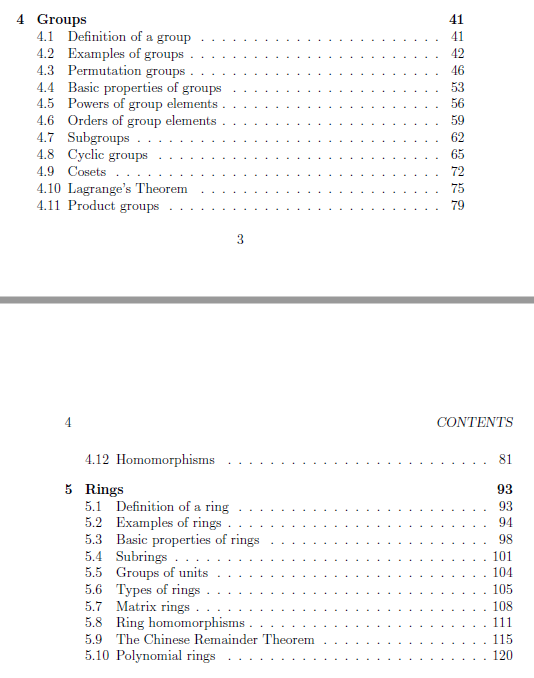
basics of group homomorphisms, cyclic groups, cosets, lagrange's theorem, ring homomorphisms and ending with its application to the chinese remainder theorem
somber bramble
that seems like awfully little, that’s about half as much as we did in ours
simple agate
we never studied any general groups or structures though. it was all super basic and easy examples
excuse the terrible screenshot https://i.imgur.com/4kCqZBU.png
 somber bramble
ours was roughly in three thirds:
-first we did a very tiny intro to category theory and a few other fundamental things like zorn’s lemma; then a bunch of stuff on ring theory starting with the integers and then general rings. e.g. polynomial rings, fraction fields, PIDs and UFDs, first isomorphism theorem
-then we had a large chunk on groups, going through all the definitions and a lot of examples, quotient groups, group actions, isomorphism theorems
-finally we did a bit on field extensions, and on modules, but both were super shallow
in the end I’m left a bit dissatisfied with everything, I don’t think I learned anything well
simple agate
that would be a graduate class here 👀 who was that aimed towards?
covert vector
lol @simple agate every finite group is isomorphic to a subgroup of S_n for some n
somber bramble
3rd semester undergrad
somber bramble
I mean teh very basic definitions of rings, groups and fields were already handled in linalg and analysis
covert vector
we didn't do any zorns
simple agate
I guess that makes sense lol thanks woog
somber bramble
but basically no interesting examples beyond the real numbers (fields) and matrices & polynomials (rings)
but bsically, we had all seen the definitions and worked with them before
but we hadn’t had any of the theory
like, linalg was all over arbitrary fields
complete with “this one thing only works if the field is not of characteristic 2”
I forgot where that was relevant. there was one proof I remember where it was “let V be a vector space over a field 𝕂 where 0≠2, then”
and analysis of course started with the axioms of the reals
which are a superset of field axioms
simple agate
my analysis class was shockingly easy and it feels wrong
somber bramble
mine was literally purgatory
I wonder if I’ll ever have an exam like that again. I hope not
simple agate
this covers all of analysis for my undergrad programme https://i.imgur.com/p3qku8r.png


 simple agate
you clearly go to a way better school than I do lol
somber bramble
statistically speaking, yes I do
unless you’re at one of the top universities in the US or the UK
simple agate
I go to KCL in London. it used to have a good reputation, maybe not so much anymore
somber bramble
afaik only oxbridge has higher ratings than ETH Zürich
(among UK schools)
but yes, I am very happy with my programme so far
simple agate
oh wow that's impressive. I wasn't aware that there were schools that good in continental europe (including switzerland)
somber bramble
In the 2019 edition of the QS World University Rankings ETH Zurich is ranked 7th in the world (3rd in Europe after Oxbridge)[5], and is also ranked 10th in the world by the Times Higher Education World Rankings 2018 (4th in Europe after Oxbridge and Imperial College London)[6].
it’s a good school
and, more importantly for practical purposes: it’s piss easy to get into it, and not expensive either
(note: living in zürich on the other hand, is very expensive)
simple agate
it sounds incredibly intimidating compared to the standard of work I'm used to lol
somber bramble
For Swiss students, ETH is not selective in its undergraduate admission procedures. Like every public university in Switzerland, ETH is obliged to grant admission to every Swiss resident who took the Matura.
oh I hear a lot of “you’re insane” when I tell them I study there
(Matura being what you get if you go through the whole 12 years of education [the last 3 of which are optional])
simple agate
the whole UK/US university monopoly never made sense to me when you're paying them (not to mention greatly overpaying)
somber bramble
ETH has a lot of foreign students for good reasons I reckon
but you have to be able to afford living in switzerland
simple agate
admission should be standardised and not have random/biased factors
somber bramble
well, there’s stipends
but still
they state on their website that while there’s practically no mandatory costs to study at ETH (tuition is like 600/semester? but it got raised recently idk how much it is now. still, nothing compared to other places), you need around 16k to 26k to survive (that’s swiss fracns, which is more or less equivalent to US dollars)
and I think those are reasonable numbers
simple agate
wow that's expensive
somber bramble
Zürich is one of the most expensive cities in the world, and it honestly doesn’t get much better evenif you commute from farther away
I managed to get a really cheap room (500/month) rather close to the school, but it’s in a tiny flat without a living room and only a tiny kitchen and bathroom
the room itself is nice tho
sharing the flat with two others
simple agate
london is similar. I live ~30 miles outside of central london and commute in, however when you factor public transport costs, it's really no cheaper due to the rising costs around london
somber bramble
usually you’re looking more at 700-800
and like 1000+ for studios
and ETH has next to no student housing
as in, it does have a bunch, but not nearly enough to keep up with demand
so it’s constantly full
and getting a room there is basically black market business
simple agate
do you have a campus or is it more of a collection of buildings in the city?
somber bramble
both
there’s two campuses
one is a proper campus
and the other’s one proper uni building + a scattering of houses
near the city center
like actually within 300m or so of central station
haupbahnhof being central station
simple agate
I'm jealous of those huge US campuses with appropriate student housing onsite
somber bramble
anything red belongs to ETH, dark red is the main building
dark grey is stuff belonging to a different university
I like the central location, it’s nice
simple agate
very similar to London. reminds me of LSE a bit, they have a bunch of buildings densely scattered
somber bramble
Höngg is a proper campus tho
simple agate
that's pretty
somber bramble
there’s a shuttle bus (~15-20 mins) between the two
Höngg is mostly physics, chem, bio, architecture and exams
^^
simple agate
what language is generally used for your university?
somber bramble
undergrad is about 50/50 German English, master’s courses are all english
first year was all german, this year it was about 50/50
simple agate
ooh that's interesting that they use both
 quiet cave
I had to follow an abstract algebra course in German...
cloud walrusBOT
D1richlet:
somber bramble
yes (though I don’t knwo what group U(26) is so that’s all I can say)
unless it’s the group of unitary matrices in 26 dimensions
but that seems unlikely
cloud walrusBOT
D1richlet:
 sacred rapids
U(26) is the set of numbers relatively prime to 26
somber bramble
⟨5⟩ isn’t 2
is it?
well, actually I don’t know
come to think of it ^^
but how can there only be 12 numbers relatively prime to 26 when there are infinitely many primes?
oh is it like, the numbers relatively prime to 26 as a subgroup of Z/26Z?
somber bramble
in which case, ⟨5⟩ would be (5, 25, 21, 1)
oh I just don’t know the notation
it may well be
so that‘s not 2, but 4
you can’t just stop at 21, to get closure you have to get going until you get to 1
cloud walrusBOT
D1richlet:
sacred rapids
Because 3.12 asks for an element of infinite order, so the group cannot be finite, but I can’t figure out why
somber bramble
oof uh… I’d be surprised if it did not hold but I’d have to think through why it holds
oh yea hm
wait hold on, no, I don’t think it’s the same
hm lemme think through what that group there is
so the think you’re quotienting out is elements of the form (n6,n9)
to get Z6 × Z9 you’d have to mod out elements of the form (n6,m9)
for any two m,n
sacred rapids
Well suppose g has infinite order and is of the form (a,b)
Then 54(a,b)=(54a,54b) is not the identity
somber bramble
well, (a,b)+⟨6,9⟩
I like writing that stuff explicitly
keeps me from being confused
^^
so hang on, in the quotient, (a,b) = (c,d) if there exists an n, such that a+6n = c and b+9n = d
sacred rapids
Yeah
somber bramble
so to find an element of infinite order, you’ll have to find one such that as you add it to itself, you’ll never get that identity to hold
sacred rapids
Ohhhhh I think I got it
Because we’re modding out (6,9), (12,18), etc
then anything coprime to 2 or 3 should have infinite order
but I’d need to show that
Like (1,5)
somber bramble
I would actually assume all that’s needed is for the second element to be sufficiently larger than the first
so that it grows faster than 9n when the first grows as 6n
then you’d only have to check the first few elements before it’s clear you won’t get the identity
right?
like by the time you add (1,5) to itself six times, it’s (7, 35), which is already way beyond reach
so you’ll never be able to get it to the form (1+6n, 5+9n)
precisely because the two n have to be the same
 bleak finch
If |G| = 44 then G is not simple.
Proof. By Sylow's 3rd n_11 = 1 mod 11 and n \ 4. So n_11 = 1. By Sylow's 2nd the unique subgroup S_11 must be normal.
This seems too simple. What did I forget?
timber bay
Am I wrong in my understanding when I say that you can't have an ideal generated by a constant without it being the whole ring?
for a
somber bramble
no, as in you’re not wrong
timber bay
okay good
timber bay
which is still trivial
somber bramble
and an ideal containing 1 contains the whole ring
timber bay
so if f(x) = 0 then the ideal is only the zero poly, and when f(x) = c, its the whole ring
somber bramble
(note that this would not be the case if F wasn’t a field, e.g. in ℤ[x], the ideal generated by 2 isn’t all of ℤ[x])
timber bay
yeah okay cool
timber bay
I'm not exactly sure how to prove part a. I think I understand b pretty well. I'm feeling itll be using the properties of an isomorphism. But there's likely a more nuanced approach.
oh it just wants us to test the elements doesnt it
oof
you know any well defined proofs out there? i never really understood how to prove something is well defined, and we only have done it like once
not exactly sure what that means
you have to show that phi(xy) = phi(x) phi(y)
that's simple, is that all i would have to do for it to be well def?
so it just follows from field properties
well nevermind
how does it being well defined imply its an iso?
im not familiar with that terminology
sorry
hmm
i need to think about that some more
but what youre saying makes sense logically
thanks
 rapid tusk
 same tbh
timber bay
what
 outer solar
Could someone help me study? Im honestly so completely lost in my class rn. Im a bit behind and just absolutely confused by everything all the time.
 scenic harness
@outer solar help you how?
outer solar
I'm reviewing the online notes and trying to do homework but honestly abstract algebra is so abstract that I am having trouble even getting base concepts. I guess id appreciate going over the notes with someone along with the hw and just reviewing it together and seeing if it can be reworded more simply or something?
(Also in terms of going over the hw I in no way intend to get too much help. The kind of questions I would ask would be so general that it just tells me the vague direction to head for)
untold sapphire
You're better off breaking it down and posting the specific parts you don't understand here
You're more likely to get help that way
 tulip barn
Or ask about the specific concepts you're having trouble with.
outer solar
Okay thank you. I guess I'll see best how to word them and post them in a bit. Thank you!
 random crag
@timber bay well defined just means that it basically is what you think it is. So if you’re calling it a function, then it is indeed a function
do you still need help with the other questions as well?
scenic harness
Well, if you assume it to be a subgroup then of course it's a subgroup.
Try to prove that the set defined in Definition 41 is a subgroup instead.
outer solar
AH! I gotcha. We know by the problem and the definition that the centralizer is the equation. We have to prove that such an equation can only result in a subgroup of G, given the relationship g (element of) G, right?
scenic harness
Not sure I understand correctly but yes, I hope.
For example: "the centralizer is the equation."
The centralizer isn't the equation. The centralizer is all elements of G that obey the equation.
outer solar
yes that is what i meant more properly worded. the centralizer is defined by the RHS of the equation."
somber bramble
I mean basically you just need to show that whenever two elements fulfill that equation, their product does too, and same for the inverse
outer solar
okay i think i get it. Thanks!
timber bay
@random crag Just saw your message. If part c is clear to you, some pointers would be nice
covert vector
@timber bay if ξ is a field isomorphism, then ξ(xy)=ξ(x)ξ(y)
pick x=y=something nice
timber bay
what is this supposed to show me @covert vector
what am i supposed to show with picking a nice x and y
covert vector
if x=y=√2, then ξ(√2)²=ξ(2) = 2, since 2 is rational
timber bay
ohhhh
okay
so you know ξ(2) = 2 because ξ(1) = 1 and you know this because ξ is an isomorphism
and then you can just bring out a power of 2 on both sides and get that ξ(sq(2)) = +/- sqrt(2)
stone fulcrum
No, we are looking for ξ that preserve Q. That is, ξ(Q) = Q for any member of Q
√2 is not a member of Q, so we don't know what ξ(√2) is
covert vector
yes it's correct
idk what kaynex is on about 
well like, I do but we're past that
stone fulcrum
@timber bay
Your reasoning is correct! I forgot that ξ(2) = 2 naturally. I suppose this isn't something to think about when the base field is Q
stone fulcrum
But you are looking for automorphisms that preserve the base field. A better example might be the extension from Q[√2] to Q[√2, √3]. In this, ξ(√2) = √2
 whole basalt
Hey y'all.
Do you think this is clear enough?
Specifically, is it clear enough that I'm not claiming that a single example like this proves that 3 is prime in Z 😛
stone fulcrum
Is this a video?
stone fulcrum
Yeah it's very clear to me
... I mean I already know the concept though so EHHhhh
But I like the examples, makes it concrete
whole basalt
Cool
I'm trying to make sure that for just about every tip I publish, I have either a diagram or an example
whole basalt
Perhaps a note of "Since we've found a counterexample."
Here's another one for an analysis concept. (Yeah I know this is the algebra chat but I don't want to just go to another channel just to paste it :P)
solar wyvern
@whole basalt post group version of cauchy stuff
actually I'll post it later, @spark plank remind pls
you might like actually
whole basalt
...there's a group version of Cauchy stuff?
somber bramble
let’s say G is some group, any group, and we’ll interpret its operation as addition.
does there exist a field F such that G is a vector space over F?
(I will not consider F_un a valid answer)
solar wyvern
you mean like a group ring F[G]? @somber bramble