#groups-rings-fields
1 messages · Page 233 of 1
 hushed flume
 delicate orchid
so if you're able to move one into another, you have to be able to fix some terms in the cycle, which is impossible
hushed flume
and (412)-->4123
delicate orchid
I'll worry about that later
hushed flume
if am choosing between two elements to add to each k cycle sometimes I get the same cycle
 rocky cloak
I feel like this is easier to do directly than by induction
hushed flume
rocky cloak
I feel like this is easier to do directly than by induction
yes that's what I thought too
delicate orchid
agreed, induction is a REALLY dumb way of doing this
but that's what was asked of me
hushed flume
the professor basically says that it's the rigorous way of doing it
but I understand the formula intuitively
delicate orchid
the professor is full of shite.
hushed flume
I won't sleep if I don't understand how to do it with induction
delicate orchid
the general conjugacy class size formula is proven directly
hushed flume
literally
delicate orchid
hushed flume
and (412)-->4123
I think if we restrict ourselves to just looking at cycles in S_k then there is exactly one way (minus the, quite literal, edge cases) to generate each cycle in S_k+1
hushed flume
hm yeah i guess
but other than just adding the new element somewhere how else would I do it
I feel like I have to show that I'm going to get k+1 more cycles than I'm supposed to
delicate orchid
I think your way is better than my idea of adding something already not in the tuple to the end and then accounting for cyclic permutaions of everything
hushed flume
yes but I'm still stuck
delicate orchid
hushed flume
I feel like I have to show that I'm going to get k+1 more cycles than I'm suppos...
yeah ok, since our method double counts adding things to the beginning and the end - just don't allow yourself to add things to the end
so there are only k places to add things, not k+1
hushed flume
no wait you misunderstood me
it chose k in the first place
but even if you don't add to both edges you still get (k+1) more cycles than you are supposed to
delicate orchid
how
delicate orchid
I said we're restricting our cycles to S_k
actually that's a point, are we inducting on n as well? or is n fixed
rocky cloak
I guess if you have to do it by induction:
In a cycle (x1, ..., xk) there are n-k things you could insert, into k spaces. And in hindsight any of the k+1 elements could have been inserted. So that's a change by a factor of (n-k)k/(k+1)
Then you just have to check that
(k-1)! * (n choose k) * (n-k)k/(k+1) gives you the desired formula
delicate orchid
I'm asking if we can assume the number of k-cycles for S_m with m < n
hushed flume
its for k-cycles of Sn where k<n
delicate orchid
so that's a no then
hushed flume
yeah I guess
delicate orchid
rocky cloak
I guess if you have to do it by induction:
In a cycle (x1, ..., xk) there are n...
this is a smart way to bypass needing to check for double counting
"is the formula you get by naively putting things in correct"
delicate orchid
is it encased in the tomb of the labrythine statement "in hindsight any of the k+1 elements could have been inserted"
because I have no idea what that means
rocky cloak
(x1, .., xk+1) could have been obtained by adding any of the xis to a k-cycle
So that's an overcounted by a factor of k+1
delicate orchid
I mean dividing by k+1 would account for it cause you spin it around by a k+1 cycle
ah so both sources of over counting we were thinking about are actually the same source
hushed flume
I don't quite understand it could you explain it again?
hushed flume
rocky cloak
I guess if you have to do it by induction:
In a cycle (x1, ..., xk) there are n...
what does this mean exactly?
delicate orchid
that "in hindsight" phrasing is still tripping me up
hushed flume
I undestand the k(n-k) part but I don't understand the justification for dividing by k+1
delicate orchid
hushed flume
what does this mean exactly?
we're dividing by k+1 because, if we start with a k+1-tuple (x_1, ... x_k+1) then this could have been achieved from just appending x_1 to (x_2, ..., x_k+1), or x_2 to (x_1, x_3, ... ,x_k+1)
so on all the way up
so there are k+1 ways to make each k+1-doodad
delicate orchid
and then (k-1)!*(n choose k)*(n-k)k/(k+1) does indeed simplify down into what we want
hushed flume
wait I just realised I don't know how to induct on n either
hushed flume
hushed flume
wait I just realised I don't know how to induct on n either
nevermind I'm tripping
 wide brook
Since the extension contains only one root of the irreducible polynomial x^3-3 the only automorphism is the identity map. And it’s unique, got it! I’m having doubts about whether $ /mathbb{Q}(sqrt[3]{3}) $ is a splitting field or no. It contains all the roots of the irreducible polynomial x^3-3 but not all the roots of (x^2-3)(x^3-3). Based on which of these polynomials we decide?
rocky cloak
wide brook
Since the extension contains only one root of the irreducible polynomial x^3-3 t...
It does not contain all the roots of x^3 - 3, only one of them.
wide brook
rocky cloak
It does not contain all the roots of x^3 - 3, only one of them.
Ah sorry I meant this extension $ /mathbb{Q}(sqrt[3]{3},i) $
With the i
rocky cloak
wide brook
Ah sorry I meant this extension $ /mathbb{Q}(sqrt[3]{3},i) $
I see, well I still don't think that contains all the roots of x^3 - 3
 wide brook
rocky cloak
I see, well I still don't think that contains all the roots of x^3 - 3
wide brook
rocky cloak
I see, well I still don't think that contains all the roots of x^3 - 3
Am i doing something wrong here?
rocky cloak
wide brook
Am i doing something wrong here?
Where does the sixth root come from?
(3^(1/3))^2 = 3^(2/3)
If that's the confusion
wide brook
Oh shit! It’s a freaking typo. I was losing my mind here. Sigh* anyways…….So sqrt(3) is not in this extension(but it’s in the roots) and I’m using the irreducible x^3-3 to show that the extension is not a splitting field, got it! Thanks for the assistance, appreciate it
 hollow mica

in lemma 1 it looks like they don't assume integral domains to be unital
But then in lemma 2 don't you need integral domains to be unital for the statement to be true?
Like to even speak of "invertible elements" you need a unity
 dire siren
hollow mica
But then in lemma 2 don't you need integral domains to be unital for the stateme...
dire siren
hollow mica
But then in lemma 2 don't you need integral domains to be unital for the stateme...
they say "integral domain with identity"
hollow mica
ooh I can't read thanks
 wispy light
Let $F,G,H \in k[x,y,z]$ be homogeneous polynomials of degree $n+1$ such that $xF + yG + zH = 0$. Is it obvious that there exist homogeneous polynomials $A,B,C \in k[x,y,z]$ of degree $n$ such that the following equation holds?
$$F , dx + G , dy + H , dz = \begin{vmatrix} dx & dy & dz \ x & y & z \ A & B & C \end{vmatrix}$$
We may assume that $k$ is of characteristic $0$ or even algebraically closed if necessary.
 cloud walrusBOT
Eduardo León
 wispy light
Alternatively, is it obvious that $A,B,C$ have no common factors if and only if $F,G,H$ have no common factors?
cloud walrusBOT
Eduardo León

 cobalt heath
Note that terms of F, G, H divisible by xyz can be considered separately, so we may reduce to the case where no terms have all of x, y, z.
Then, put z = 0, x = 0, y = 0 to see how the other terms work.
For instance, x F[z=0] + y G[z=0] = 0, from which one can show F[z=0] = yC, G[z=0]= xC, etc.
Think characteristic 0 would be required, otherwise you can have F = yz, G = zx, H = xy for char 3.
 languid trellis
I've been thinking about this exercise for a little while now and I'm completely stuck. Can someone give me a small hint in the right direction please? (FYI Thm. 2.18 is "finite subgroups of the multiplicative groups of fields are cyclic", which they prove by considering x^exp(G) - 1 = 0, and pointing out that it has at most expG solutions in G, and ex.5 is "if the order of a finite field is even, then it is char 2, and p-1 | |F| - 1".
 cobalt heath
You can compute the product from F^* cyclic, I think
 vivid tiger
languid trellis
I've been thinking about this exercise for a little while now and I'm completely...
vivid tiger
languid trellis
I've been thinking about this exercise for a little while now and I'm completely...
Note: if q=p this is Wilson's theorem
languid trellis
cobalt heath
You can compute the product from F^* cyclic, I think
I was thinking something along the lines of WLOG a1 generates F*, then writing a_j in terms of a1 or something
languid trellis
vivid tiger
Note: if q=p this is Wilson's theorem
Wilson's theorem is the next exercise 🙂
but yes I do see it
vivid tiger
languid trellis
Wilson's theorem is the next exercise 🙂
Strange
languid trellis
(I see that it's wilson's theorem, not how to prove it)
cobalt heath
languid trellis
I was thinking something along the lines of WLOG a1 generates F*, then writing a...
Yeah, you can do that
Can you compute the product under the settings?
vivid tiger
Well.
Is this just vieta?
Actually you only wanted a hint so I'll shut up
or use the magic of spoiler tags
note that i might be wrong. whether this is just vieta is left to you
||x^{q-1}-1 has x a root for all x besides 0. Then the product is -1/1=-1||
languid trellis
it'll be a1a2a3...a^{q-1} = a1a1^2a1^3 etc..., = a1^{1+2+3+...+q-1}. Now consider the equation a1^{1+2+3+...+q-1} + 1 = 0
vivid tiger
in general i see F_q and then look at the secret polynomial
vivid tiger
and this successfully gets me like all of the properties of it.
languid trellis
cobalt heath
Oh, the hint said "proof of.."
dyi
 vivid tiger
I like my proof better
cobalt heath
Yeah, maybe it is talking about f(x) = x^expG - 1
vivid tiger
languid trellis
dyi
The hintier part comes from the way Lang writes this proof: ||roots of a^m - 1||
also guys why do y'all keep using exp G
cobalt heath
Still, hard to spot
languid trellis
cobalt heath
Yeah, maybe it is talking about f(x) = x^expG - 1
Yeah, in this context x^expG + 1 = 0
vivid tiger
gimme gimme gimme
cobalt heath
languid trellis
Yeah, in this context x^expG + 1 = 0
Huh?
cobalt heath
I don't think it will change
vivid tiger
cobalt heath
I don't think it will change
It will. Only one of those two options works
cobalt heath
Welp, I dunno.
vivid tiger
What are you trying to do here? You have a pooynomial.
You could try to express the thing you want as a polynomial and hope it obviously has a root.
cobalt heath
languid trellis
well because we're solving ..... + 1 = 0
I do not understand this part, wdym here?
languid trellis
we want to show a1a2...a{q-1} = -1. so, a1a2...a{q-1} + 1 = 0
vivid tiger
So, do you remember the construction of F_q?
languid trellis
who are you asking sorry
vivid tiger
The construction is why I do what I do every time I am asked a question about F_q
cobalt heath
languid trellis
we want to show a1a2...a{q-1} = -1. so, a1a2...a{q-1} + 1 = 0
Ah. I guess the "nifty proof" is quite difficult to think of, I dunno how to give a hint about it
Brute-force computation is easier to achieve
languid trellis
hm
vivid tiger
cobalt heath
Brute-force computation is easier to achieve
huh???
so F_q is defined as?
splitting field of X^{q-1}-1 over F_p where q=p^n
cobalt heath
vivid tiger
huh???
Imo, it is easier to just compute the product.
vivid tiger
cobalt heath
Imo, it is easier to just compute the product.
how do you do that
cobalt heath
languid trellis
it'll be a1a2a3...a^{q-1} = a1a1^2a1^3 etc..., = a1^{1+2+3+...+q-1}. Now conside...
You do it like this
vivid tiger
i don't understand
vivid tiger
vivid tiger
splitting field of X^{q-1}-1 over F_p where q=p^n
so like now do you see it
Oh, wait since F_q is cyclic you could try 1+2+...q-1
That's what you meant?
languid trellis
I suppose to compute the product we could pair up multi inverses and use that finite fields have char p
So any multiplicative subgroup is a multiple of p-1
Which is congruent to -1 mod p
Something like this
vivid tiger
you want -1 in F_q
oh but -1 in F_p \subset F_q
I definitely think this is harder and feel that you will feel that the one line proof is staring you in the face
languid trellis
And The one liner starts with 'consider x^m +1 = 0 in F_q'?
vivid tiger
Do you want me to answer?
The start of the one liner has been written by at least one of the three us 
(why is ":cheeky:" on the physics server?)
wispy light
cobalt heath
Note that terms of F, G, H divisible by xyz can be considered separately, so we ...
Thanks.
cobalt heath
languid trellis
I suppose to compute the product we could pair up multi inverses and use that fi...
Pair up..?
Isn't there straightforward way of just computing it?
dire siren
that's already pretty straightforward
but the characteristic is not relevant
after pairing, we are left with the elements of order 2, but -1 is the only one
 short spire
languid trellis
dyi
short spire
languid trellis
dyi
Can you provide the statement of theorem 2.17?
languid trellis
dire siren
after pairing, we are left with the elements of order 2, but -1 is the only one
This is what I ended up doing after thinking about it a bit more
cobalt heath
Oh. Did not know that is so straightforward
languid trellis
Characteristic is slightly relevant though I feel because for char F neq 2, F* has even order so an element of order 2 exists
Whereas if char F = 2, F* is odd, so I'm not sure we csn say anything about having elements of order 2
languid trellis
short spire
Can you provide the statement of theorem 2.17?
Polys of degree n have at most n roots in F
cobalt heath
languid trellis
Whereas if char F = 2, F* is odd, so I'm not sure we csn say anything about havi...
The hint mentions Exercise 5
For when q is even
languid trellis
cobalt heath
The hint mentions Exercise 5
Exercise 5 says |F| even implies char F = 2
Oh wait I see. Even in the char 2 case after we pair up multi Inverses, we have ajak left over which must be it's own inverse and hence equal to -1 even if aj or ak aren't equal to -1
I beliebe
cobalt heath
Yeah, so it should work out either way.
dire siren
good point with char 2
short spire
languid trellis
Polys of degree n have at most n roots in F
Oh I get it now. I am sorry.....
 orchid iron
Hi,
Does anyone know of a reading group based on Dummit and Foote's abstract Algebra?
(Active/Inactive anything is fine)
Please share link/invite if you do?
 pseudo sierra
Hello can anyone help me understand what an elementary divisor and rank is and its relationship to the smith normal form? I know what a rank is in linear algebra but not in the context of this question that I assume is more abstract algebra

Given a matrix A, i calculated its Smith Normal Form
And i am being asked to determine the elementary divisors & rank of this

Based on the fundamental theorem of finitely generated modules in PID an elementary divisor and rank is defined like this

Does the “di” have anything to do with the d1, …, dl entires of the smith normal form?
delicate orchid
pseudo sierra
Does the “di” have anything to do with the d1, …, dl entires of the smith normal...
They’re exactly the entries in the smith normal form
Moreover, if we stop crying and recognise that R/(0) = R the same holds true even for those columns which are all 0s
And the number of such 0s is the rank
languid trellis
short spire
Oh I get it now. I am sorry.....
Lol
vivid tiger
languid trellis
And The one liner starts with 'consider x^m +1 = 0 in F_q'?
Okay so here's my solution
x^{q-1}-1 has every element but 0 as a root
By vieta the product of roots is -1/1=-1
 dull ginkgo
Sup chat
vivid tiger
languid trellis
Exercise 5 says |F| even implies char F = 2
well this is literally just because even F would have to be F_{2^n}
dull ginkgo
What are we trying to do
vivid tiger
and those are extensions of the char 2 field Z/2Z
vivid tiger
dull ginkgo
What are we trying to do
the product of all the things is (F_q)^× is -1
proof: vieta
vivid tiger
dull ginkgo
proof: each is a solution to x^q - x
x^{q-1}-1
yes
we have the same mind
a melding of the minds
 vivid tiger
oh shit
(-1)^(q-1) (-1/1)= (-1)^q
so we do indeed have to use that if q is even then 1=-1
dull ginkgo

-1 = 1 mod 2 lol
But yeah, you can use Vieta's formulas or just, go right off the poly shit
I need to make note of what exercises I have basically done already in this chat ahead of time
because I know damn well when I get to it I'm gonna draw blanks
this happens a lot more than it should
@vivid tiger I actually think pretty much every proof of this kind of circles back to polynomials lmao
vivid tiger
dull ginkgo
<@363718156377784321> I actually think pretty much every proof of this kind of c...
that is indeed due to the definition of F_q
languid trellis
Vietas formula are coeffs interms of roots right
I only half know what it is
But that's a nice solution xela
dull ginkgo
I tried proving it another way and just cycled back to F_q^x being cyclic
 rotund aurora
You can prove it by the formula $\sum_{d\mid n} \phi(d)=n$
cloud walrusBOT
croqueta3385
 rotund aurora
well it's pretty much the same
vivid tiger
languid trellis
But that's a nice solution xela
$\prod_i(x-r_i) = X^n + (-1)^{n-i} E_i(r) X^{n-i}$ where $E_i(x) = \sum_{\sigma \in S_n} \frac{1}{i!} \prod_{j \le i} x_{\sigma(j)} =$ elementary symmetric polynomials
cloud walrusBOT
Xela
 languid trellis
vivid tiger
$\prod_i(x-r_i) = X^n + (-1)^{n-i} E_i(r) X^{n-i}$ where $E_i(x) = \sum_{\sigma ...
languid trellis
vivid tiger
$\prod_i(x-r_i) = X^n + (-1)^{n-i} E_i(r) X^{n-i}$ where $E_i(x) = \sum_{\sigma ...
Symmetric polynomials are the next section
AAAAAAĄAAAA
delicate orchid
languid trellis
Symmetric polynomials are the next section

 barren sierra
Symmetric polynomials 🔥🔥
vivid tiger
languid trellis
Symmetric polynomials are the next section
you don't need any fancy properties here
define the elementary symmetric polynomials via Viéta's formulas
note that they are
x1+x2+...xn
x1x2+x1x3+...x2x3+...
etc
that is, sum of single products, sum of double products, sum of triple products, etc.
note that they are fixed by S_n acting in the obvious way
languid trellis
delicate orchid
https://tenor.com/view/kitty-gif-27687064
i was never gone sweaty
languid trellis
vivid tiger
you don't need any fancy properties here
I'll reconsider this when I get a proper introduction to sym polys, but I appreciate your time
dull ginkgo
@languid trellis did Jacobson show F^X is cyclic?
languid trellis
dull ginkgo
<@499308115813072896> did Jacobson show F^X is cyclic?
what do you mean by F^X
vivid tiger
languid trellis
I'll reconsider this when I get a proper introduction to sym polys, but I apprec...
so you don't need even that, you just need the first and last. it's where the well known fact that for a quadratic the sum of roots is -b/a and the product is c/a
it is as simple as the constant term of \Prod (X-r_i) being (-1)^n \Prod r_i
 alpine pasture
What does the notation G>H (or G<H) mean, where G and H are groups?
vivid tiger
H ≤ G usually means H is a subgroup of G, and H \lhd G means H is a normal subgroup of G
do note that while $\le$ is transitive, $\lhd$ isn't
cloud walrusBOT
Xela
 vivid tiger
it instead obeys the "tower law" thing that many things in algebra obey: if $K < H < G$ and $H \lhd G, K \lhd G$, then $K \lhd H$
cloud walrusBOT
Xela
 alpine pasture
thank you
cobalt heath
vivid tiger
define the elementary symmetric polynomials via Viéta's formulas
What is Vieta's formula? I was never introduced to it.
vivid tiger
vivid tiger
$\prod_i(x-r_i) = X^n + (-1)^{n-i} E_i(r) X^{n-i}$ where $E_i(x) = \sum_{\sigma ...
this
so for an n degree polynomial
dull ginkgo
Oh my god jacobson leaves the newton identities as an exercise
of course he does
why wouldn't he
vivid tiger
the product of roots is (-1)^n a_0/a_n
where we are saying a_n x^n + ... a_0
the sum of roots is - a_{n-1}/a_n
and the sum of double products is + a_{n-2}/a_n
and the sum of triple products is -a_{n-3}/a_n
so like for example in x^3+3x^2+7x+2
the sum of roots is -3
cobalt heath
vivid tiger
this
Ahhh, idk why was not named in my lec
vivid tiger
the sum r_1r_2+r_2r_3+r_1r_3 = 7
and so on
glad i don't have to keep explaining because this specifically is annoying to type
cobalt heath
dull ginkgo
Oh my god jacobson leaves the newton identities as an exercise
Hell is newton's identities?
vivid tiger
vivid tiger
the sum r_1r_2+r_2r_3+r_1r_3 = 7
so like these things are invariant under the obvious action of S_n
so they are called elementary symmetric
they are elementary in the sense that every polynomial is a polynomial in the elementary symmetric ones
cobalt heath
vivid tiger
one other kind of symmetric polynomial
That be annoying
vivid tiger
so there's also the power sum symmetric polynomials
1+1+1+1...1
x1+x2+...xn
x1^2+x2^2+...xn^2
etc.
now these generate as a ring the symmetric polynomials over the ratioanls
The ring of symmetric polynomials over ℚ in n variables equals ℚ [p_1,...,p_n] where p_i is the ith power symmetric polynomial in n variables
There's another kind.
The complete homogenous symmetric polynomials
$h_k = \sum_{1 \le i_1 \le i_2 ... \le i_k \le n} X_{i_1} ... X_{i_k}$
cloud walrusBOT
Xela
 cobalt heath
cloud walrus
**Xela**
cobalt heath
cloud walrus
**Xela**
Is this symmetric?
cobalt heath
Ah, it's vieta + power sum
vivid tiger
We also have that
vivid tiger
cobalt heath
Ah, it's vieta + power sum
...it is?
I didn't see that
maybe I need to look at it?
cloud walrusBOT
Xela
 vivid tiger
cobalt heath
Vieta is basically one with i1 < i2 < .. < ik, iirc
vivid tiger
cobalt heath
Vieta is basically one with i1 < i2 < .. < ik, iirc
yes, choose k out of n without double counting
power sum is i1=i2=...=ik
here we say ≤
this is a good observation
so then isn't this literally the sum?
cobalt heath
Yeah, I missed that something
vivid tiger
Right and vieta and power sum are both homogenous
vivid tiger
cobalt heath
Yeah, I missed that something
So did I, but you missed it closer
cobalt heath
I mean, methought i1 < i2 < i3 or i1 = i2 = i3 <=> i1 <= i2 <= i3 lol
Wish my brain functions
vivid tiger
So like Newton's identities are some relation or whatever between elementary symmetric and power sum symmetric
There's also some similar relation that =0 for elementary symmetric and complete homogenous symmetric
and like combinatorics can be done
vivid tiger
cobalt heath
I mean, methought i1 < i2 < i3 or i1 = i2 = i3 <=> i1 <= i2 <= i3 lol
methinks "methought" is spreading.
 sonic coral
does anyone know what the smallest positive integer n for which there is a transitive subgroup of S_n that has not been realized as a galois group
i believe it’s 23 with M_23 being the group in question but i figured id ask
 hardy musk
i'm trying to think up proofs of elementary facts about free inverse semigroups, but i'm having a lot of trouble with the word problem here
for instance: how do i show that abb*a* is not equal to baa*b*?
i get the sense (from what little ive read) that getting a sense of structure in a free inverse semigroup is difficult, but even just playing with basic toy words i don't really see how something can be done
ping me as much as youd like
 untold garnet
I would guess that it is equivalent to finding some inverse semigroup H with two elements x,y such that xyy*x* not equal to yxx*y*.
 torpid knot
the lemma seems extremely obvious but im not sure what substitutions to specifically make to prove it

op nvm found smth online for it
 terse crystal
an abelian group A is direct sum of n many cyclic groups Z/p^ei Z where 1<=i<=n (p a prime number e1,…,en positive integers)
How can we calculate how many subgroups of order p^r there are ?
(if it’s hard to solve the general case I am particularly interested in the case where r=e1+…+en -1, namely number of index p subgroups)
rocky cloak
terse crystal
an abelian group A is direct sum of n many cyclic groups Z/p^ei Z where 1<=i<=n ...
The case r = e1 + ... + en - 1 is pretty straight forward at least.
Since any subgroup of order p^r is the kernel of a surjective map to a group of order p.
The only map A -> Z/p that isn't surjective is the 0 map, so we're looking at |Hom(A, Z/p)| - 1 surjective maps. And to maps have the same kernel if one is the other but composed with an automorphism of Z/p. So that's an overcounted by a factor of p-1.
There are p maps from Z/p^ei to Z/p, so |Hom(A, Z/p)| = p^n
In total (p^n - 1)/(p-1) subgroups
terse crystal
rocky cloak
The case r = e1 + ... + en - 1 is pretty straight forward at least.
Since any ...
Thanks a lot
If I understand your method correctly, can we generalize that
The number of index p^r subgroups is |epimorphisms from A to Z/p^rZ|/|Aut(Z/p^rZ)|?
Oh shit… should it be
Σ|{ epimorphisms from A to B}| /|Aut(B)| where the sum is over all distinct order p^r abelian groups B…?
delicate orchid
sonic coral
i believe it’s 23 with M_23 being the group in question but i figured id ask
I’d say this is correct, all the other sporadics have been shown to be Galois
I’d be very surprised if there’s one acting on fewer than 23 elements
terse crystal
And I have another question. Abelian group A is Z/p^e1Z oplus … oplus Z/p^enZ, e1>=…>=en
subgroup B of A, is isomorphic to Z/p^f1Z oplus … oplus Z/p^fmZ, f1>=…>=fm
We have partitions λ=(e1,e2,…,en)
μ=(f1,…,fm). Is it necessary that young tableaux of λ contains entirely young tableaux of μ?
rocky cloak
terse crystal
Oh shit… should it be
Σ|{ epimorphisms from A to B}| /|Aut(B)| where the sum is ...
Yes, it would be that. Which quickly becomes a very tedious computation. So for bigger index you might want to switch to a different method
terse crystal
rocky cloak
Yes, it would be that. Which quickly becomes a very tedious computation. So for ...
I see, thank you
 topaz gale
Question about euclidean rings and their valuations. I'm having a hard time solving problems concerning them, so any insights would be much appreciated.
So let say we have an euclidean ring R where the only inversible elements in R are 1 and -1. If a is an element of minimal valuation from all the non inversibles elements of R*, then R/<a> is isomorphic to Z/2Z or Z/3Z.
So I start by constructing a set E=min{phi(a) | a in R, a non inversible}. This set is non-empty by hypothesis, and thus has a minimal element. Say /phi(s)=min(E) where s is non-inversible.
Here's where I'm not sure how to proceed. If R is euclidean, can I say that R/<a> is also euclidean, and check the valuation there? Otherwise, I say, R is euclidean, so I can divide here, and so there exists q,r in R such that a=qs+r with r=0 or phi(r)<phi(s). I can then deduce a couple of things : if r=0, then a=qs and thus s|a. If r is not 0, then r is inversible, otherwise we would have phi(r) >= phi(s) by the minimality of phi(s), a contradiction.
From here I'm not sure where to go. Should I work in the quotient, and if so, how so?
rocky cloak
topaz gale
Question about euclidean rings and their valuations. I'm having a hard time solv...
Remember that you assumed the only invertible elements to be 1 or -1. So if r is invertible, then it must be either 1 or -1
 glass zealot
probably stupid question, but why do free abelian groups exist? doesn't the commutativeness imply relations between the generators which makes it non-free?
rocky cloak
rocky cloak
Remember that you assumed the only invertible elements to be 1 or -1. So if r is...
Use this to deduce what the cosets of <a> can be
glass zealot
i.e <a,b | ab=ba> shouldnt be a free group no?
rocky cloak
glass zealot
probably stupid question, but why do free abelian groups exist? doesn't the comm...
It's 'free (abelian group)' not 'free group which is also abelian'.
In general you can thing 'free X' as an X with no relations beyond the definition of X.
So a free abelian group is an abelian group with no added relations
 south patrol
It is an unfortunate coincidence of terminology lol
south patrol
glass zealot
probably stupid question, but why do free abelian groups exist? doesn't the comm...
I should also jokingly add that the trivial group and Z are both free groups and abelian :)
rocky cloak
south patrol
It is an unfortunate coincidence of terminology lol
I think 'commutative graded ring' is even worse 
glass zealot
rocky cloak
So a free abelian group is an abelian group with no added relations
ahh lol
alright thanks
south patrol
rocky cloak
I think 'commutative graded ring' is even worse <:bleakkekw:913344117981999125>
Actually i talked to my advisor about this since it is unfortunate in more than one way
Lol
Well like
Graded rings are not graded objects in the category of rings
That is unfortunate enough kinda lol
topaz gale
rocky cloak
Use this to deduce what the cosets of <a> can be
Okay, so I get that if r is invertible, then it must be either be 1 or -1. I'm not quite sure how to use this to deduce what the cosets of <a> can be in this context.
Should I just plug it back in the euclidean division formula?
rocky cloak
topaz gale
Okay, so I get that if r is invertible, then it must be either be 1 or -1. I'm n...
The cosets of <a> are of the form
<a> + r
for some r. So how many cosets could there be?
topaz gale
I would say only two, right? <a> + 1 or <a> - 1?
I feel like I'm missunderstanding something
So yeah, if I plug it back into the euclidean division formula, I have three choices :
(i) a = qs
(ii) a = qs + 1
(iii) a = qs - 1
So in the quotient, a can only be 0, 1, or -1.
Is that correct?
rocky cloak
topaz gale
I would say only two, right? <a> + 1 or <a> - 1?
There is also <a> + 0.
But yeah, that's right. There are at most 3 cosets, so R/<a> is a ring with at most 3 elements
topaz gale
Getting closer here! Thank you for sticking with me!
So I would suppose now that what left to be seen is under which conditions 1 and -1 are showned to be the same (mod 2) or distinct (mod 3)?
rocky cloak
Yes, so that's a question of whether 2 is in <a> or not
topaz gale
Perfect, thank you for the help!!
barren sierra
rocky cloak
I think 'commutative graded ring' is even worse <:bleakkekw:913344117981999125>
wait what's the issue with this?
rocky cloak
barren sierra
wait what's the issue with this?
A commutative graded ring is a graded ring where
ab = (-1)^|a||b| ba
when a and b are homogenous
barren sierra
yea I know
rocky cloak
Hence, not commutative
 hidden wind
oh my god i’ve completely neglected my abstract algebra course
exam i believe coming up very soon
a lot of catching up to do
 celest furnace
rocky cloak
A commutative graded ring is a graded ring where
ab = (-1)^|a|\|b| ba
when a and...
celest furnace
rocky cloak
A commutative graded ring is a graded ring where
ab = (-1)^|a|\|b| ba
when a and...
wtf 💀
 next obsidian
rocky cloak
A commutative graded ring is a graded ring where
ab = (-1)^|a|\|b| ba
when a and...
next obsidian
rocky cloak
A commutative graded ring is a graded ring where
ab = (-1)^|a|\|b| ba
when a and...
no this is graded commutative
I think
I swear there is a difference
hidden wind
commutative graded ring vs graded commutative ring?
next obsidian
Yes
barren sierra
hidden wind
commutative graded ring vs graded commutative ring?
I forgot about this as well 😭😭😭
Math is awful
celest furnace
barren sierra
Math is awful
Real
 frank cosmos
is this proof that if Aut(G) is cyclic then G is abelian correct?
Suppose Aut(G) is cyclic. By the previous exercise, the set of inner automorphisms is a subgroup and hence cyclic as well, say generated by $c_x$ where $c_x g=x g x^{-1}.$ Let $y \in G.$ Then $c_y=(c_x)^n$ for some $n \in \mathbb{Z}.$ Thus for all $g \in G, ygy^{-1}=x^n g x^{-n} \implies g=y^{-1}x^n g x^{-n}y=c_{y^{-1}x^n}g$ thus $y=x^n.$ So $G$ is cyclic and thus abelian.
cloud walrusBOT
Hello1
 next obsidian
Why does that final thing imply y = x^n?
It isn’t true that c_e = c_y^-1x^n => e = y^-1x^n
A priori
Also don’t think it’s true at all
frank cosmos
you're right it just shows that y^-1x^n is in the center
do you think i can fix this into something correct
barren sierra
Inn(G) is cyclic
You got that first step correct
Can you think of some subgroups / quotients of G that are isomorphic to Inn(G)?
Off the top of my head idk a way to repair the proof you have
But maybe there's a way
dull ginkgo
barren sierra
Can you think of some subgroups / quotients of G that are isomorphic to Inn(G)?
||Are you suggesting to use Inn(G) ~= G/Z(G)?||
next obsidian
frank cosmos
do you think i can fix this into something correct
Yes
What if y = x^n-1
What do you conclude
Then you get more stuff in the center
next obsidian
And you can then conclude all inverses in the center
So GG
What if y = x^n-1 lol
Then what do you get to conclude
frank cosmos
dosent n depend on y
 you’re so right
frank cosmos
you’re so right
frank cosmos
smart
next obsidian
But then you’re kinda hozed
frank cosmos
ye
next obsidian
Because of this dependency of n on y
frank cosmos
i thought i cooked
next obsidian
Also you could never conclude G was cyclic
Take G non cyclic abelian and then InnG is cyclic
(Trivial)
barren sierra
barren sierra
Can you think of some subgroups / quotients of G that are isomorphic to Inn(G)?
Think about what I said here @frank cosmos
frank cosmos
barren sierra
Can you think of some subgroups / quotients of G that are isomorphic to Inn(G)?
ok this should be G/Z
probably
so that is cyclic
barren sierra
And what if G/Z is cyclic 👀
cloud walrusBOT
Hello1
 barren sierra
No
frank cosmos
frank cosmos
you're right it just shows that y^-1x^n is in the center
so then $y=x^n z$ and we're done commutativity e
zz
cloud walrusBOT
Hello1
 barren sierra
Uhhh it's a little hard to follow what you've written
Let's be very direct
You know G/Z is cyclic
I give you x and y in G
Show me xy = yx explicitly
I think what you have is ok but it's hard to follow (as evidenced by your uncertainty as well)
 lucid wigeon
I'm trying to understand Quotient Rings built from Polynomial Rings but I'm struggling with some examples I see. How is <x+a> an Ideal of K[x] for $K = \mathbb{Z}/7\mathbb{Z}$? How is x an Ideal of $\mathbb{R}[x]$? Neither seems to absorb multiplication by all elements of their parent Ring. Are these invalid examples or what am I missing?
cloud walrusBOT
StackCanary
 celest furnace
I think you are a little confused by notation. (x+a) is, by definition, the smallest ideal containing x+a. <x+a>, which I think you mean as the abelian subgroup generated by x+a, is not an ideal, or even a ring
lucid wigeon
celest furnace
I think you are a little confused by notation. (x+a) is, by definition, the smal...
Apologies for being careless with notation. The example I'm referencing is specifically $K[x]/\left<x^2 + a\right>$ from https://math.stackexchange.com/questions/2054968/when-quotient-ring-is-a-field. I forgot the square

Mathematics Stack Exchange
Let $K = \mathbb{Z}/7\mathbb{Z}$. For what values of $a$ quotient ring $K[x]/\left<x^2 + a\right>$ is a field?
I tried to use the bruteforce method here.
Since we are quotienting by $\left&...
cloud walrusBOT
StackCanary
 celest furnace
So yeah a major abuse of notation would be also witting <x^2+a> as the smallest ideal containing x^2+a
So one is a subgroup and the other is an ideal, try to use the () notation instead to make it more clear
But in general for elements a_1,…,a_n, (a_1,…a_n) is the smallest ideal containing the ai
Meaning the intersection of all ideals containing the ai
He writes “since we are quotienting by a polynomial of degree 2, every equivalence class in the quotient ring can be represented by a linear polynomial of the form ax + b”
I think this is where you were getting confused?
Well maybe I should’ve asked this before but what do you think <x> is?
lucid wigeon
Well now I'm not sure how to interpret the <> notation. There's a lot of notations going on. I'm confused about what is and isn't an Ideal and what defines an Ideal. I thought they had to absorb multiplication by all elements of their parent Ring. Quotient/Factor Rings can only be constructed from Ideals, correct?
celest furnace
Yes exactly. S, a sub ring of R, is an ideal if r*x is in S for all r in R
And yes quotient and factor rings can only be constructed from ideals
lucid wigeon
So R[x]/x is a simpler example. x doesn't seem to be an Ideal of R[x] but perhaps it's notation for x as the generator via modulus? x itself isn't the Ideal though, right?
celest furnace
Yes exactly
People are just abusing notation.. in this case x would actually be the ideal (x) = {p(x) * x for p(x) in R[x]}
It would be more correct to write R[x]/(x)
lucid wigeon
Ah ok now that makes sense! So would R[x]/xR[x] also be an ok notation? I'm new to the () notation.
lucid wigeon
Wonderful, thank you for clarifying. In the end, notation turns out to be the problem. A simpler solution than I thought. Much appreciated.
celest furnace
Yep notation can be a pain lol
When people get lazy you get stuff like this https://media.discordapp.net/attachments/1150849425288208394/1232139785817292881/image.png?ex=662a5958&is=662907d8&hm=e86fd6c72d43114944f00788687bb6924e66adb4a2539a1daa975b8514f437ce&

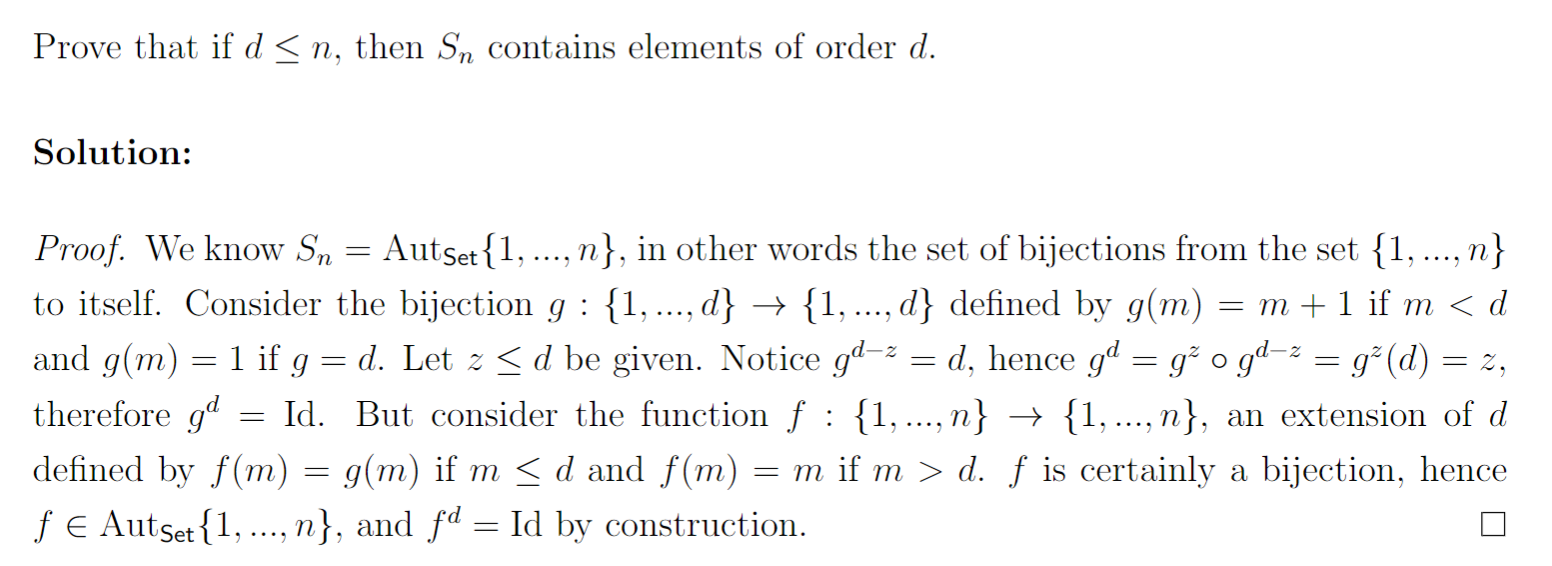
 tame fable
 exotic verge
https://i.imgur.com/ki4qIcB.png
exotic verge
https://i.imgur.com/ki4qIcB.png
is hard to read
maybe add some more whitespace?
exotic verge
uhh i meant more like the content
 chilly radish
exotic verge
https://i.imgur.com/ki4qIcB.png
chilly radish
exotic verge
https://i.imgur.com/ki4qIcB.png
You didn't prove the order is d
You only proved it divides d
exotic verge
do you mean d divides the order?
nvm what i said doesn't make sense
but im not sure what you mean
oh I have to show for any m less than d f^m does not equal the id?
 summer path
can you not just write it out in cycle notation?
 molten rivet
I think I've figured out how to solve this problem, but I don't see how F not having characteristic 2 is relevant. My argument is just induction on the degree of f:
If f has degree 1, clearly the splitting field of g has degree at most 2.
If f has degree n, we let alpha be a root of f in its splitting field, so that f=(x-alpha)h for some h. Then, the polynomial h(x^2) has a splitting field of degree at most 2^(n-1)(n-1)! by the induction hypothesis, call it K. Since g=(x^2-alpha)h(x^2), g splits over the extension K(sqrt(alpha)). Since sqrt(alpha) has degree at most 2n, [K:F] is at most 2^nn!.
I never used the fact that F doesn't have characteristic 2 here. Is there something in my logic that breaks down for fields with characteristic 2?

 eager willow
molten rivet
I think I've figured out how to solve this problem, but I don't see how F not ha...
eager willow
molten rivet
I think I've figured out how to solve this problem, but I don't see how F not ha...
in characteristic 2 g(x) = f(x^2) = (f(x))^2 so the splitting field is the same as that of f(x), which has degree at most n!, but clearly this is less than 2^n * n!
molten rivet
eager willow
in characteristic 2 g(x) = f(x^2) = (f(x))^2 so the splitting field is the same ...
Ok, thank you
exotic verge
is this the correct way to go about the proof?

i cant see a way through without a bunch of casework
 lusty marlin
exotic verge
is this the correct way to go about the proof?
lusty marlin
exotic verge
is this the correct way to go about the proof?
Seems fine
 tough raven
celest furnace
People are just abusing notation.. in this case x would actually be the ideal (x...
tough raven
celest furnace
People are just abusing notation.. in this case x would actually be the ideal (x...
Personally I do this but it's always because I got tired of writing the parentheses.
tough raven
eager willow
in characteristic 2 g(x) = f(x^2) = (f(x))^2 so the splitting field is the same ...
That's not true unless the coefficients of f lie in F_2.
tough raven
molten rivet
I think I've figured out how to solve this problem, but I don't see how F not ha...
I'd rather phrase it as [K : F(α)] <= 2^{n-1}(n-1)!, [F(sqrt(α)) : α] <= 2 so [K F(sqrt(α)) : F) <= 2^n n! so [K F(sqrt(α)) : F] <= 2^n n! since [F(α) : F] <= n.
tough raven
molten rivet
I think I've figured out how to solve this problem, but I don't see how F not ha...
As far as I can see, this remains true in characteristic 2.
If the coefficients of f are squares (e.g. if F is perfect), we can write f(X^2) = g(X)^2 where the coefficients of g are the square roots of those of f.
Then as @ datorangeguy pointed out, you get a stronger bound n! on the degree of the splitting field of g. But the original bound should still hold.
tough raven
exotic verge
oh I have to show for any m less than d f^m does not equal the id?
Yes, exactly.
tough raven
summer path
can you not just write it out in cycle notation?
Also this
tough raven
exotic verge
i cant see a way through without a bunch of casework
You can simplify the casework by the following:
if g commutes with any x, y it commutes with xy and x^{-1}. (Exercise.)
So if something commutes with the generators x, y, it commutes with the entire group D_n.
Thus you can take just the equations
x^i y^j commutes with x
x^i y^j commutes with
instead of all k, m.
In fact, you can further simplify this to
y^j commutes with x
x^i commutes with y
(why?).
Beyond this I think it's better to actually do the casework.
chilly radish
exotic verge
oh I have to show for any m less than d f^m does not equal the id?
That would do yea
 crystal vale
Since we have G which is generated by x and G is finite so if |G| = n , where n is composite number then there must exist a subgroup of order of a, where 1<a<n, where a is divisor of n, which contradicts that there is non-trivial Subgroup
Is it correct?
If I want to show that H is a subgroup of G such that if Ha≠Hb then aH ≠ bH. Then H is a normal subgroup of G.
Ha≠Hb implies aH ≠ bH, means if ba^(-1) not in H then b^(-1)a not in H.
I want to show that gHg^(-1) is a subset of H for all g in G.
If g is in H then it is done.
If g does not belong to H and let gHg^(-1) not in H, then take b=g and a^(-1)=hg^(-1) then b^(-1)a not in H which implies that g^(-1)gh^(-1) not in H. It contradicts that H is a subgroup.
Is it correct?
 pastel pier
is a binary operation always closed ?

here it says H is closed if its a binary operation
so G Is assumed to be closed by birth ?
if a binary operation is defined on a Set, then its closed under that binary operation ?
but then its not a binary operation aswell, look at the definiton

i could include 💀 , i am not a mathematician
crystal vale
pastel pier
but then its not a binary operation aswell, look at the definiton
They define binary operation image in G so yes G is closed under operation
 stark helm
Can anyone tells me how can I know if there is a root on unit circle?
 dire siren
@stark helm the coefficients are symmetrical, so to solve p(z)=0 you can divide by z^2 and make the substitution t=z+1/z
you end up with a quadratic in t
oh, funnily the polynomial is just (z^2-z+1)^2
 random pasture
I feel like i keep missing some equivalence

 jagged gate
random pasture
I feel like i keep missing some equivalence
jagged gate
random pasture
I feel like i keep missing some equivalence
wdym ? what have you got right now ?
 topaz solar
random pasture
I feel like i keep missing some equivalence
topaz solar
random pasture
I feel like i keep missing some equivalence
What have you tried
delicate orchid
random pasture
I feel like i keep missing some equivalence
3 implies 1 and 2 trivially, now use the fact that if z is invertible we have some z' such that zz' = 1 - take the norm of both sides of that expression to show 1 => 2. 2 => 3 is also quite straightforward, for a hint: when is x^2+y^2 = 1? And then we're done as we have 1 => 2 => 3 => 1
topaz solar
delicate orchid
3 implies 1 and 2 trivially, now use the fact that if z is invertible we have so...
Time to !nosols wew
delicate orchid
by my standards that's practically opaque
stark helm
Can someone tell me how to determine if a and b are constructible?
 delicate orchid
see if the field extenstion has degree equal to a power of 2
if it doesn't, then you know that they aren't constructable
if it does then you'll need to show/disprove that it can be constructed out of quadratic extenstions
which, given the cube roots, is probably unlikely
stark helm
delicate orchid
if it doesn't, then you know that they aren't constructable
for a, I can clearly see that 7+5*sqrt(2) is in tower(sqrt(2)), but the cube root implies that its adjoining root of next tower is of degree 3, so it is not surd implies not constructible, is that true?
topaz solar
Surd is a weird word
But uhh you went up Q -> Q(\sqrt 2) -> Q(\sqrt 2, a) = Q(a) as extensions right?
stark helm
topaz solar
But uhh you went up Q -> Q(\sqrt 2) -> Q(\sqrt 2, a) = Q(a) as extensions right?
how will you argue this one?
topaz solar
???
What do you mean
[Q(sqrt 2)/Q] is 2, and [Q(a)/Q(sqrt 2)] sure looks like 3 to me
cloud walrusBOT


 Requested by wewladstbh
delicate orchid
Requested by wewladstbh
delicate orchid
Ermmm… what the deuce?
topaz solar
By evil sorcery
This is 1+sqrt(2)
I hate cube roots
Most constructible number alive
delicate orchid
It actually is as well. Wtaf
topaz solar
Yeah, stacking roots is awful always
b is definitely not though since ya know
Please don’t be :3:3:3
delicate orchid
I don’t trust anything anymore
delicate orchid
,w minimal polynomial sqrt(1+4^(1/3)/2)
cloud walrusBOT
 Requested by wewladstbh
delicate orchid
Requested by wewladstbh
delicate orchid
We’re all good…
topaz solar
The trick was [Q(a)/Q(root 2)] was secretly 1….
sonic coral
delicate orchid
if it doesn't, then you know that they aren't constructable
where does this result come from?
delicate orchid
Wikipedia
topaz solar
sonic coral
where does this result come from?
Definition of constructible things is coming from quadratics or whatever right?
Stacking 2’s
delicate orchid
Well the proper definition is that it’s the stuff you can make with straight edge and compass
And it takes some work to show that you can’t get cubic shit
topaz solar
Who cares about geometry fr
delicate orchid
Agreed
topaz solar
But yeah showing that the constructions are the same as the good definition is nontrivial
However: I’m assuming they have at least something to work off of
Before asking that question
sonic coral
wait so if i wanted to know if roots of a polynomial were constructible, could i check if the galois group was a power of 2?
topaz solar
Mfw not every extension is Galois
delicate orchid
topaz solar
Mfw not every extension is Galois
Who caare
But you just need to check the degree
If it’s not a power of 2 there’s no chain of quadratic extenstions because that’s how primes work
sonic coral
i see okay
 topaz solar
a is
cobalt heath
,w min poly sqrt^3(7 + 5 sqrt(2))
cloud walrusBOT

 cobalt heath
Oh wow
topaz solar
cobalt heath
,w min poly sqrt^3(7 + 5 sqrt(2))
,wolf (1+sqrt 2)^3 - 7 - 5 sqrt 2
Foiled again by decimal approximation
cloud walrusBOT

 Requested by sharp2229
topaz solar
Requested by sharp2229
topaz solar
Yep
stark helm
topaz solar
a is
you mean a is constructible? Can you tell me how you will argue that a is constructible?
and also why b is not constructible?
topaz solar
I will not write the proof for you
topaz solar
stark helm
you mean a is constructible? Can you tell me how you will argue that a is constr...
Look at what was written above
cobalt heath
I do wonder how one could "prove" 7 + 5 sqrt(2) is cube of something
topaz solar
Finding the cube
cobalt heath
Physically construct a cube of side length 1 + sqrt(2)
Measure volume
???
Not profit because it cannot be exact 🫠
stark helm
topaz solar
Look at what was written above
I think a is constructible while b is not, because we can know cube root of 4 is not constructible, so the stuffs in square root not constructible implies b not constructible, while a can be argued by radical extension( since all surds are constructible)
stark helm
Does anyone know how to solve this question?

 chilly ocean
bust out your compass and straightedge
sonic coral
does this work?
 topaz solar
stark helm
I think a is constructible while b is not, because we can know cube root of 4 is...
topaz solar
stark helm
I think a is constructible while b is not, because we can know cube root of 4 is...
Well you can’t construct cube roots, this one just happens to work as square roots
stark helm
topaz solar
Well you can’t construct cube roots, this one just happens to work as square roo...
so a is not constructible, because it is a cube root of a constructible root right?
dull ginkgo
x^3 - 2x^2 + 5x + 1
stark helm
topaz solar
Because it’s equal to 1 + sqrt 2
ok I think I should suppose that stuff equals a+b*sqrt(r) first
stark helm
dull ginkgo
x^3 - 2x^2 + 5x + 1
do you mean the question I gave?
stark helm
dull ginkgo
x^3 - 2x^2 + 5x + 1
I can see that it does not have rational root
but is that adequate to prove here? I am somewhat doubting on it because it seems to let x^2=x here
 winter shore
What were (are?) the motivating examples for introducing associative algebras? I've see them a couple of times pop up so I'm wondering if they appear naturally somewhere
dull ginkgo
stark helm
but is that adequate to prove here? I am somewhat doubting on it because it seem...
Maybe try to eliminate the square term via a shift
wait show it has no constructable root
Hmm
stark helm
dull ginkgo
Maybe try to eliminate the square term via a shift
i think I can see it now, because x not rational, not constructible root of this polynomial of degree 3
dull ginkgo
stark helm
i think I can see it now, because x not rational, not constructible root of this...
Yeah
stark helm
then sqrt(r) not constructible implies r not constructible as well
dull ginkgo
I think?
random pasture
how exactly can i prove that rs can't be a cube if r and s aren't both cubes
 stark helm
does anyone know how to determine if it is constructible? I think cos(7.5) constructible, so square root(1-sin(7.5)^2) is constructible, then we know sin(7.5) construtible. but how can we know if sin(7) is not constructible?
 topaz solar
random pasture
how exactly can i prove that rs can't be a cube if r and s aren't both cubes
topaz solar
random pasture
how exactly can i prove that rs can't be a cube if r and s aren't both cubes
what have you tried
winter shore
winter shore
What were (are?) the motivating examples for introducing [associative algebras](...
bump
 dim widget
stark helm
does anyone know how to determine if it is constructible? I think cos(7.5) const...
dim widget
stark helm
does anyone know how to determine if it is constructible? I think cos(7.5) const...
Are you going to go through and ask every homework question in this forum?
 steel wolf
Is there standard notation for a representation. Like how the cross product algebra is a representation of so(3)
random pasture
topaz solar
what have you tried
I tried representing r and s as products of irreducible elements
and then assuming neither is a cube
in order to examin what happens when you multiply them together
oh i see
Is it that by the definition of irreducibility, no irreducible element can be a cube?
dim widget
random pasture
Is it that by the definition of irreducibility, no irreducible element can be a ...
Yes
random pasture
dim widget
Yes
So based on that, and the idea that products are unique up to associates, I can confirm that rs can't be a cube if one of the two isn't a cube>
stark helm
dim widget
Are you going to go through and ask every homework question in this forum?
this is actually our practice problems
dim widget
stark helm
this is actually our practice problems
sounds like you should practice them
stark helm
dim widget
sounds like you should practice them
then do you think my argument for sin(7.5) constructible correct? And how can I know if sin(7) is constructible or not?
dim widget
stark helm
then do you think my argument for sin(7.5) constructible correct? And how can I ...
You didn’t give an argument, you just said cos(7.5) is constructible
stark helm
dim widget
You didn’t give an argument, you just said cos(7.5) is constructible
I know that cos(60) is constructible, and given any angle, its bisector is constructible
60->30->15->7.5
delicate orchid
surprise!
hidden wind
composite numbers are weird sometimes
delicate orchid
the PSL(2,4) one isn't so bad to see - it has a natural action on {0,1,x,1+x,\infty} which gives an isomorphism to A_5
PSL(2,5) is the bizarre one
dim widget
stark helm
I know that cos(60) is constructible, and given any angle, its bisector is const...
yes this is a good argument
hidden wind
delicate orchid
the PSL(2,4) one isn't so bad to see - it has a natural action on {0,1,x,1+x,\in...
it would be nice if i could make sense of klein's work on the icosahedron but eek i am so lost
stark helm
dim widget
yes this is a good argument
then I can know that sin(7.5) construtible by wrting cos(7.5)=sqrt(1-sin(7.5)^2)
stark helm
dim widget
yes this is a good argument
then how can I show that sin(7) not construtible?
hidden wind
hidden wind
it would be nice if i could make sense of klein's work on the icosahedron but ee...
how tf do you go from the rotations of the icosahedron to here's a general solution to the quintic 😭
dim widget
stark helm
then how can I show that sin(7) not construtible?
Do you know galois’ theorem on constructible numbers?
stark helm
dim widget
Do you know galois’ theorem on constructible numbers?
I know galois's, but don't know how it applies to construtible
stark helm
dim widget
Do you know galois’ theorem on constructible numbers?
do you mean tower of field?
dim widget
stark helm
do you mean tower of field?
I guess? It should be that the real and imaginary parts of a number a are constructible if and only if Q(a) is an iterated quadratic extension
Or more simply if Q(a) is not of degree 2^n then a is not constructible
stark helm
dim widget
Or more simply if Q(a) is not of degree 2^n then a is not constructible
Then how can it apply to angle?
dim widget
stark helm
Then how can it apply to angle?
you should think about that
hint: consider the number a = cos(7) + i sin(7)
hidden wind
delicate orchid
the PSL(2,4) one isn't so bad to see - it has a natural action on {0,1,x,1+x,\in...
ok seing these referred to as "exceptional" and "exotic" isomorphisms i think i will just drop trying to make sense of this until some hypothetical future
stark helm
dim widget
hint: consider the number a = cos(7) + i sin(7)
i only know number a can be written as e^i(7 degree)
dim widget
stark helm
i only know number a can be written as e^i(7 degree)
what is the galois group of that extension?
stark helm
dim widget
what is the galois group of that extension?
Q(a) over Q
dim widget
stark helm
Q(a) over Q
yes
 alpine iron
guys can anyone help me with these questions
 stark helm
dim widget
yes
stark helm
dim widget
yes
okay, then a^2-1=0
dim widget
alpine iron
guys can anyone help me with these questions
you have to at least indicate which ones you have tried and what you have trouble with
dim widget
stark helm
okay, then a^2-1=0
no
alpine iron
okay so q2
stark helm
dim widget
no
a^2 not equals 0? I am considering the norm of a should be sin(7)^2+cos(7)^2
dim widget
stark helm
a^2 not equals 0? I am considering the norm of a should be sin(7)^2+cos(7)^2
the norm and the square are different
But you're right that the norm is 1
stark helm
dim widget
the norm and the square are different
oh it should be a*conjugate(a)=1
dim widget
stark helm
oh it should be a*conjugate(a)=1
yes but this doesn't help you find the galois group
so what is true is that a^{365} - 1 = 0
but that is not the minimal polynomial of a since it is not irreducible...
maybe you know something about cyclotomic fields?
stark helm
dim widget
so what is true is that a^{365} - 1 = 0
I think I can write it as e^i(7) while e^i180=-1, , so I need to multiply a 180 times such that 180 divides 7k
it can have a^180+1=0
dim widget
stark helm
it can have a^180+1=0
surely, but this is still not irreducible
did you learn about cyclotomic polynomials in class?
dim widget
alpine iron
okay so q2
it's insulting to people who care about math to try to get them to do your homework while you show no effort
stark helm
dim widget
did you learn about cyclotomic polynomials in class?
I didn't
stark helm
dim widget
hmmm
and this class is actually not abstract algebra
dim widget
stark helm
and this class is actually not abstract algebra
what is this class
stark helm
dim widget
what is this class
its name is abstract mathematics
dim widget
ok
well can you tell me an algebraic number which you have shown in class is not constructible, and how you have shown this?
stark helm
dim widget
well can you tell me an algebraic number which you have shown in class is not co...
this one is definitely algebraic, but it is not constructible because cube root of 4 is not( by using RRT), then we can know stuffs in square root not constructible, then b is not constructible
 dim widget
stark helm
this one is definitely algebraic, but it is not constructible because cube root ...
dim widget
stark helm
this one is definitely algebraic, but it is not constructible because cube root ...
what is RRT?
stark helm
dim widget
what is RRT?
rational root thm
dim widget
stark helm
rational root thm
how does the rational root theorem tell you that it is not constructible
stark helm
dim widget
how does the rational root theorem tell you that it is not constructible
x=cube root 4, x^3=4, x^3-4=0, suppose x=m/n and by rrt I know that m divides 1, n divides 4, so rational root can be positive or negative(1,2,4), but plugging them will not let polynomial be 0
dim widget
stark helm
x=cube root 4, x^3=4, x^3-4=0, suppose x=m/n and by rrt I know that m divides 1,...
this doesn't explain why the number is constructible or not
this just tells me that x^3 - 4 is irreducible
which is good
but you're REALLY using something else, no?
stark helm
dim widget
this doesn't explain why the number is constructible or not
i am actually consider that for a cubic polynomial, if we have constructible numbers root, then we have rational root, but it doesn't have rational root, so roots are not constructible
dim widget
stark helm
i am actually consider that for a cubic polynomial, if we have constructible num...
okay, why is this true?
it is not only for cubic polynomials!
stark helm
dim widget
okay, why is this true?
it is a cubic poly with rational coefficient, and I consider a tower of field Q subset of T1 subset... and I proved before that cubic polynomial with rational coeff has sum of roots equals rational numbers, therefore I consider two cases: if we have root of form a+bsqrt(r), then we have another root a-b*sqrt(r), the sum of rational roots tells me that there must exist one rational root at least. The second case is trivial case, all three roots in Q
stark helm
dim widget
okay, why is this true?
since all surds are constructible
dim widget
stark helm
since all surds are constructible
i don't know what that means and it sounds racist
dim widget
stark helm
it is a cubic poly with rational coefficient, and I consider a tower of field Q ...
what if the roots are all irrational?
stark helm
dim widget
i don't know what that means and it sounds racist
surds are constructible should make sense, because surds should refer to elements in a tower of field, which is starting from Q and keep adjoining square root such that Q subset of T1... And r in Q constructible, square root of construtible are still construtible
 tardy hedge
stark helm
dim widget
what if the roots are all irrational?
tardy hedge
stark helm
dim widget
what if the roots are all irrational?
three roots sum is rational, so how can three roots be all irrational?
dim widget
stark helm
three roots sum is rational, so how can three roots be all irrational?
you'd be surprised! it can easily happen
dim widget
stark helm
three roots sum is rational, so how can three roots be all irrational?
e.g. X^3 - 3, or X^3 + 2X^2 + 2 have this property
for three random irrational numbers you can consider \pi, -3\pi, 2\pi.
stark helm
dim widget
you'd be surprised! it can easily happen
ok, I know that, I can have two -sqrt(2) and one 2sqrt(2)
but then I need to know if constructible numbers are surds
I mean if these two terms are the same
dim widget
stark helm
but then I need to know if constructible numbers are surds
well they are
you should prove this! think about what x-coordinates you can get by intersecting circles with circles and lines
delicate orchid
alpine iron
okay so q2
consider the fact that (2a)^2-2a = 0
delicate orchid
any algebraic combination of x^3+x is going to be degree at least 3, x has degree 1
celest furnace
What about like 1/(x^3+x)?
delicate orchid
I ain't even got shit to say on that one...
rocky cloak
celest furnace
How to show x is not in k(x^3+x)
Might be a bit of a cheat, but k(x^3 + x) is the field of fractions k[x^3 + x], which is a UFD. Hence by Gauss lemma t^3 + t - x^3 - x is irreducible over k(x^3 + x) iff it is irreducible in k[x^3 + x]. It clearly doesn't have any roots in k[x^3 + x], but x is a root.
Hence k(x) / k(x^3 + x) is a degree 3 extension.
rocky cloak
delicate orchid
any algebraic combination of x^3+x is going to be degree at least 3, x has degre...
This is basically this argument, just first moving to k[x^3 + x]
rocky cloak
And I guess the same reasoning shows that k(f) cannot equal k(x) unless f has degree 1, 0 or -1.
delicate orchid
oh yeah, just extend the valuation lol
stark helm
dim widget
you should prove this! think about what x-coordinates you can get by intersectin...
I think all intersection of points on surd plane will always generate equation with surd coeff, and therefore we can know any geometric construction on surd point should be surd point as well, so we know every constructible points in this plane has surd coordinates, so every constructible numbers are surd
celest furnace
rocky cloak
Might be a bit of a cheat, but k(x^3 + x) is the field of fractions k[x^3 + x], ...
Fantastic argument! Just amazing
dire siren
celest furnace
How to show x is not in k(x^3+x)
assume x = f(x^3+x)/g(x^3+x), for some polynomials f,g in k[t], say m=deg(f) and n=deg(g)
then f(x^3+x) = x*g(x^3+x)
the degree of LHS is 3m
the degree of RHS is 3n+1
hollow mica
In PIDs people say that “to divide is to contain”, i.e that b | a iff (a) is contained in (b)
I don’t see where this breaks down for general commutative rings with unit
if (a) is contained inside (b) then a is an element of (b) so b | a
and if b | a then a = bc for some c and thus (a) = (bc) and for any r we have (bc)r = b(cr) which is an element of (b) and thus (a) is a subset of (b)
nowhere did we use the PID property
rocky cloak
hollow mica
nowhere did we use the PID property
That is correct. For principal ideals, containment is the same as one being a multiple of the other.
So the only thing special about PID is that all ideals are principal.
dire siren
hollow mica
In PIDs people say that “to divide is to contain”, i.e that b | a iff (a) is con...
The saying "to divide is to contain" is not about that.
In a Dedekind domain, the ideals factor uniquely into prime ideals, and so we can talk about divisibility of ideals. And it turns out that an ideal I divides an ideal J if and only if I contains J.
stark helm
dim widget
okay there are easier ways
i have an idea here, n is construtible iff n is a multiple of 3, because if n mod 3 is not 0, it should be 1 or 2, and 1 and 2 both should be constructible at the same time, so it can't. hence degree 7 is not able to be constructible
 vocal fern
Let R be a UFD such that every invertible element is a cube. Let r, s ∈ R, and suppose
that every element of R which divides both r and s is invertible. Show that if rs is a cube,
then r and s are cubes.
Proof:
Suppose rs is a cube, but r = p0p1 · · · pk and s = q0q1 · · · ql are not cubes for irreducible elements pi, qj . Then none of pi, qj are cubes, implying that they are not invertible. However, gcd(r, s) = pa1 pa2 · · · pam qb1 qb2 · · · qbn for some a1, . . . , am ∈ {1, . . . , k} and b1, . . . , bn ∈ {1, . . . , l}. But since each of these irreducibles divide both r and s, they are invertible; a contradiction.
is this an adequate? i feel like its missing something
sonic coral
Let F = F_{5^6} be the finite field with size 5^6. Suppose that α ∈ F^{×} and the multiplicative
order of α is 31.
How can i determine [F(α) : F]?
i think it would be at most 6 but not much other than that
dire siren
sonic coral
Let F = F_{5^6} be the finite field with size 5^6. Suppose that α ∈ F^{×} and th...
isn't it just 1?
dull ginkgo
I am going to go back to proving if every element has an n >1 such that x^n = x that the ring is commutative eventually
It’s just hard as fuck and I get stuck every time
 coral spindle
sonic coral
Let F = F_{5^6} be the finite field with size 5^6. Suppose that α ∈ F^{×} and th...
coral spindle
sonic coral
Let F = F_{5^6} be the finite field with size 5^6. Suppose that α ∈ F^{×} and th...
Remember that the group of units of a finite field is cyclic. So what is the order of the generator of the group of units of F_{5^6}? Think from there.
dire siren
but doesn't a∈F imply F(a)=F?
sonic coral
the order of the generator would be 31 right
oh i think i see
since alpha is in the multiplicative group of the field, it’s in the field, so [F(a) : F] is one
rocky cloak
sonic coral
since alpha is in the multiplicative group of the field, it’s in the field, so [...
Surely the problem is supposed to be to determine
[F5(a) : F5] right?
exotic verge

is this the same as saying
a^2 + b^2 is congruent to 3c^2 in mod 4?
well they're equivalence classes so I mean all a,b,c such that
or am I misreading?
celest furnace
exotic verge
a^2 + b^2 is congruent to 3c^2 in mod 4?
Precisely right sir
exotic verge
celest furnace
Precisely right sir
thx
 tidal slate
I feel like this should be easy but I'm still struggling. Why is the following true: Let $M$ be a right $M_n(R)$-module and denote $R^n_{\text{col}$ by $n$ column vectors in $R$, viewed as a left module over the matrix ring. If $E_{11}$ denotes the matrix whose $(1, 1)$ entry is $1$ and zero else, why is $$M \otimes_{M_n(R)} R^n_{\text{col}} \cong ME_{11}?$$
cloud walrusBOT
havrebra
Compile Error! Click the  reaction for more information.
(You may edit your message to recompile.)
 rocky cloak
tidal slate
I feel like this should be easy but I'm still struggling. Why is the following t...
rocky cloak
tidal slate
I feel like this should be easy but I'm still struggling. Why is the following t...
Notice that R^n_col = Mn(R)E11
tidal slate
oh oops, thanks
 thorn monolith
What are the necessary and sufficient conditions for the reversibility of an element in the ring R[x]/x^n and how to prove it?
rocky cloak
thorn monolith
What are the necessary and sufficient conditions for the reversibility of an ele...
Notice, that anything that is a multiple of x will be nilpotent, hence not invertible.
Things that are not a multiple of x will be of the form r + xf, which if we divide by r can think of as simply 1 + xf. Now think about geometric series.
hidden wind
i just realized my abstract algebra exam is in a week 
been a while since last i were in a situation like this
tough raven
Me with multiple exams in the next three days 💀.
thorn monolith
i'm trying to find inverse element for $1+x+x^2 \in F_2[[x]]$. i think it is $\sum\limits_{n = 0}^{\infty}x^{3n}+x^{3n+1}$ (checked that for small $n$) but idk how to prove that correctly...
cloud walrusBOT
qwert
 rocky cloak
thorn monolith
i'm trying to find inverse element for $1+x+x^2 \in F_2[[x]]$. i think it is $\s...
rocky cloak
thorn monolith
i'm trying to find inverse element for $1+x+x^2 \in F_2[[x]]$. i think it is $\s...
You can just multiple them together and see what you get.
You know how to multiply by 1, x, and x^2 separately I'm sure. Then you just add them together and collect like terms
thorn monolith
yeah thx
hidden wind
hidden wind
been a while since last i were in a situation like this
situation being i have completely neglected this course and i’ve little idea what i’m even supposed to know
sonic coral
rocky cloak
Surely the problem is supposed to be to determine
[F5(a) : F5] right?
i don’t think so?

it’s question 6
rocky cloak
sonic coral
i don’t think so?
Typos are possible. But I guess it could just be a trick question
sonic coral
we will see when he releases solutions
for question 5, is it enough to just use the fundamental theorem to get two normal subgroups, so that their intersection is normal, and then use the fundamental theorem again
exotic verge
hidden wind
situation being i have completely neglected this course and i’ve little idea wha...
D: i didnt know ur in an actual class
whats ur syllabus
hidden wind
good question, i will have to figure that out just about right now
ok it is definitely more than i can cover in one week haha
the standard first course in group theory is no problem but there is also quite a bit of, ring, field and galois theory
 plush pulsar
is it necessary for rings to have two-sided distributivity, i.e. for elements $a, b, c \in R$, where $R$ is a ring with binary operations $+$ and $\times$, should $R$ satisfy both of the below two properties,
$$(a + b) \times c = a \times c + b \times c$$
$$(a \times b) + c = (a + c) \times (b + c)$$
or just one of them is enough for $R$ to be called a ring?
cloud walrusBOT
tommy
 plush pulsar
yeah
i haven't seen it in any of the examples i've encountered so far
is it not required
i know
this doesn't make sense
so, does that mean we only consider one-sided distributivity?
yeah sorry!
oh actually no
this is a question i have
it is not some homework
and i did not know how to frame it properly
but, it basically boils down to what i've asked above
yes
so, in essence, the binary operations + and * are behaving as they would in algebra
thank you!!
thorn monolith
rocky cloak
Notice, that anything that is a multiple of x will be nilpotent, hence not inver...
what about geometric series? i didnt get it
sonic coral
rocky cloak
Typos are possible. But I guess it could just be a trick question
if the problem was as you thought? how would you approach it?
rocky cloak
thorn monolith
what about geometric series? i didnt get it
Have you ever seen a formula for 1/(1 - x) ?
thorn monolith
yeah but its for infinite series
chilly ocean
convergence is something made up by the analysts to prevent you from having fun
dull ginkgo
rocky cloak
Have you ever seen a formula for 1/(1 - x) ?
what if x is nilpotent :troll:
frank cosmos
isnt B just contained in the kernel and not actually the kernel itself?

obviously we can get this map because A is abelian so B is normal
but shouldnt the "equivalent" homomorphism be from A/ker
 last spoke
If G is finite abelian with |G| > 2, then |Aut(G)| is even.
I found this pretty easy but I think the way I proved it was 'excessive' (i.e. invoking something unnecessarily powerful). Here's what I said:
Finite abelian means it's a direct product of Zq's with q a prime power. It suffices to check just for a (Zq)^k 'factor' of G (since the automorphisms of this factor that fix the rest of G form a subgroup of Aut(G)), where we know that Aut((Zq)^k) = GLn(Fq), which has even order except in the excluded case n = 1, q = 2. By Lagrange then the entire group Aut(G) must have even order.
The way I think I 'cheated' was invoking the fact that |GLn(Fq)| is even, which hasn't been mentioned yet in the text, altho the GL's have in general. Is there some other straightforward way of showing that |Aut(G)| is even for finite abelian groups without invoking the structure theorem like I did?
frank cosmos
it suffices to show that everything except except one nontrivial element in Aut(G) is not its own inverse, and the other thing is its own inverse
er hmm thats not good here
oh wait just show Aut(G) has subgroup order 2 lol
frank cosmos
frank cosmos
isnt B just contained in the kernel and not actually the kernel itself?
bumping this
frank cosmos
also, my book defines m to be an exponent of a group G if $g^m=e \forall g$ and then for an abelian group $A$ with exponent $m,$ the group $\text{Hom}(A,\mathbb{Z}_m)$ to be its dual. but dosent this depend on the choice of m?
cloud walrusBOT
Hello1
 delicate orchid
the dual Hom(A, Z) obviously has kernel Z_m because it's exponent m, and it depends on the choice of A not m
m is unique given a fixed group
frank cosmos
the dual is Hom(A,Z/mZ)
m is not the smallest exponent necessiarly, but anything such that g^m=e for all g
delicate orchid
sorry yeah, the kernel is mZ
delicate orchid
frank cosmos
m is not the smallest exponent necessiarly, but anything such that g^m=e for all...
well that's dumb
"lets take something well defined and make it ill defined"
what the scallop
frank cosmos
ok i think this does make sense, pls tell me if its wrong. Suppose $A$ has smallest exponent $m.$ Suppose $A$ also has exponent $m_1.$ Then $m \vert m_1$ and for any $\phi \in \text{Hom}(A,\mathbb{Z}/\mathbb{Z}m_1),$ for all $a \in A, \phi(a)$ has order dividing $m$ thus $\phi(A)$ is contained in the unique subgroup of order $m$ in $\mathbb{Z}_{m_1}.$
cloud walrusBOT
Hello1
 frank cosmos
so the dual group is well defined?
delicate orchid
cloud walrus
**Hello1**
 frank cosmos

 indigo vale
any recommended resources for me to learn/relearn abstract algebra? books preferred
frank cosmos
lol how


 frank cosmos
suppose G acts on S with 1 orbit, and k elements in G stabilize each s \in S. Then why is k*|S|=|G|
south patrol
This is a special case of the orbit-stabiliser theorem
But one way to prove it directly is as follows: fix any s in S and then consider the function G -> S sending g |-> g.s. You can check that preimage of each point is of size k and that this function is surjective
frank cosmos
how does this follows from a-s
south patrol
This is immediate from the statement of orbit stabiliser
frank cosmos
you are right lol
i solved 99% of the exercise, everything except this step, and when reading the sol it glossed over this part as trivial
glad too know it is
south patrol
Dw
sonic coral
subgroups which are conjugate correspond to isomorphic sub fields right
 warped fable
Not just any isomorphism -- that's boring. Conjugate subgroups correspond to sub-extensions related by an automorphism of the ambient extension
sonic coral
okay, so if i wanted to determine the number of isomorphism classes of sub fields by looking at a subgroup lattice, the normal subgroups would correspond to their own class of subfield, and if subgroups A and B were conjugate, then their corresponding fields would be in the same class ?
tough raven
frank cosmos
also, my book defines m to be *an* exponent of a group G if $g^m=e \forall g$ an...
Yes. If you continue to deal with it, you may want to think of it as the "m-dual".
crystal vale
to show if G is finite cyclic group, then the subgroup {g: g^n=1} where n divides the |G|. then this subgroup is cyclic of order n.
we know subgroup of cyclic group is cyclic but how i show that it has order n.
since G is cyclic group so there is an element of order n, say g.
we have result that n= summation of all {co-prime number to d, where d is divisor of n}. so subgroup order is bounded by n, and g belongs to subgroup so at least it has n elements, is it correct?
maybe this one is easier but i don't know easier way
rocky cloak
crystal vale
to show if G is finite cyclic group, then the subgroup {g: g^n=1} where n divide...
I'm unsure what you're asking. Are you trying to show that if G is cyclic and n divides |G|, then G has a subgroup of order n?
crystal vale
rocky cloak
I'm unsure what you're asking. Are you trying to show that if G is cyclic and n ...
 rocky cloak
crystal vale
rocky cloak
crystal vale
I see, I'm not sure I totally follow your argument for why it has at most n elements. But you could argue that it has exponent n, or just explicitly reason about what the elements are in terms of the generator of G.
crystal vale
rocky cloak
I see, I'm not sure I totally follow your argument for why it has at most n elem...
Let H be the given subgroup. Then any element which is in H, its order divides n, say d. The number of elements of order d is the Euler function (d)( G is a cyclic group), so the order of H is n(taking summation of all d divides n).
rocky cloak
crystal vale
Let H be the given subgroup. Then any element which is in H, its order divides n...
I see, yeah that works
crystal vale
Any other way to show that in a finite cyclic group, there are exactly m elements which satisfy x^m =1, where m divides| G |?
orchid iron
Hello
There is this Heisenberg group that comes up in Group theory,i learnt it has its origins in Quantum mechanics(explaining the Uncentrianity principle in different forms).So could someone outline how does it arise in physics or in case there is some place in mathematics when it does arise naturally,hint or give reference towards that as well?
dim widget
warped fable
Not just any isomorphism -- that's boring. Conjugate subgroups correspond to sub...
It does turn out to be the same thing
which is an important part of Galois theory
any abstract isomorphism of fields extends to an automorphism of any galois over field containing both of them
dim widget
sonic coral
okay, so if i wanted to determine the number of isomorphism classes of sub field...
yes
warped fable
dim widget
It does turn out to be the same thing
Good point, yes.
I forgot about that.
 glad osprey
crystal vale
Let H be the given subgroup. Then any element which is in H, its order divides n...
glad osprey
crystal vale
Let H be the given subgroup. Then any element which is in H, its order divides n...
Can't you just argue that if an element has order > n, then it by definition can't be in H?
last spoke
@orchid iron the 'finite field' version of the heisenberg group comes up naturally in the classification of p-groups of small order (in particular it's one of two possibilities for non-abelian groups of order p^3)
crystal vale
glad osprey
Can't you just argue that if an element has order > n, then it by definition can...
Yes
 cinder fox
crystal vale
Any other way to show that in a finite cyclic group, there are exactly m element...
cinder fox
crystal vale
Any other way to show that in a finite cyclic group, there are exactly m element...
Let $x\in G$, then there $\exists m\in\mathbb{Z}$ s.t. $g^m = x$.
$\Rightarrow \exists 0\leq k<n$ s.t. $m\equiv k[n] \Rightarrow \exists p\in\mathbb{Z}$ s.t. $m=k+pn\Rightarrow x=g^m=g^{k + pn}=g^{k}.g^{pn}=g^{k}$
So we conclude that the only elements in $<g>$ are $g^0, g^1, g^2, ..., g^{n-1}$.
I think it's obvious to see that $0,1,2,...,n-1$ is exactly $n$ elements.
cloud walrusBOT
VirtualCode
 cinder fox
I haven't touched group theory in months but I remember this is how we proved it in class
Well really the definition we used for the order of an element $g$ in a group $G$ wasn't the number of elements in the generated group, but literally $|<g>|=n \Leftrightarrow (g^n=1_G$ and $\forall 0\leq k<n, g^k\neq 1_G)$
cloud walrusBOT
VirtualCode
 cinder fox
So we kind of cheated
crystal vale
cloud walrus
**VirtualCode**
I don't understand how I can conclude that there are exact m solution for x^m =1
crystal vale
cloud walrus
**VirtualCode**
By taking x=1 ?
cinder fox
crystal vale
I don't understand how I can conclude that there are exact m solution for x^m =1
Oh sorry, I misread 🤦♂️
I thought it was about the order of the generated subgroup $|<g>|$
cloud walrusBOT
VirtualCode
 cinder fox
I guess this can be proved by showing that those two sets are identical somehow though
frank cosmos
can i get a small hint on showing that groups of order p^2*q have a normal sylow subgroup, and are solvable
er. all sylow subgroups are normal
i think it suffices to show that there is only one of each
but i dont know how
celest furnace
Try showing that there is only one Sylow q subgroup
frank cosmos
how?
celest furnace
Have you tried using the Sylow theorems
frank cosmos
yes
celest furnace
Where did you get stuck?
frank cosmos
i dont know what the intersection of sylow subgroups look like
celest furnace
Don’t do that
frank cosmos
so like suppose there are (q+1) sylow q subgroups
celest furnace
Just try to show there is only 1 with the theorems 2 and 3
Here I’ll give you a hint. You know that nq = 1 mod q so nq = 1+kq. Then you know that nq divides p^2 and I think you can use this to show that q divides p^2-1
 long obsidian
Are we able to call Z[x] the single variable polynomial ring over the integers a sub algebra of R[x,y] the two variable polynomial over the reals?
It's just confusing cause if I multiply (1/2) by (x+1) we aren't in Z[x]
frank cosmos
what is n
celest furnace
What are they álgebras over? Z?
celest furnace
frank cosmos
what is n
Sorry nq is a variable = the number of Sylow subgroups
frank cosmos
i see. how do you know it divides p^2?
long obsidian
celest furnace
What are they álgebras over? Z?
Idk if You're responding to me but Z[ x] is an algebra over Z while R[x,y] is an algebra over R.
I guess R[x,y] is also a Z algebra so in that since Z[x] is a subalgebra
celest furnace
long obsidian
Idk if You're responding to me but Z[ x] is an algebra over Z while R[x,y] is an...
It would be correct to say that Z[x] is a Z-subalgebra of R[x,y]
It would not be correct to say it is an R-subalgebra because it’s not even an R algebra
frank cosmos
frank cosmos
i see. how do you know it divides p^2?
?
orchid iron
last spoke
<@857498516665139211> the 'finite field' version of the heisenberg group comes ...
Thank you very much,i see
celest furnace
frank cosmos
?
So, you are going want to break it up into two cases: one where q > p and the other where p < q. Notice in one of these cases if nq divides p^2 then there aren’t a lot of options for nq
frank cosmos
q<p is easy, since i have a theorem saying if H has index smallest prime dividing |G| it is normal
i dont get why nq divides p^2
celest furnace
Well now either nq = p or p^2 right
celest furnace
frank cosmos
i dont get why nq divides p^2
This is just a Sylow theorem
frank cosmos
oh not in my book
i guess it is obvious from the proof though
hmm ok but now
this dosent seem to be a contradiction
its possible for p=kq+1
for some k
ah so this is where the q>p comes in
then we get q=p+1
contradiction!
very nice
last spoke
q = p+1 is possible
last spoke
ya
 rapid tinsel
Let x and y be non-zero elements in an integral domain such that x^2 = zy^2 for some z. Is it true that z is also a square? Surely this is false for a horrible non-UFD but I can't seem to come up with a counterexample
delicate orchid
rapid tinsel
Let x and y be non-zero elements in an integral domain such that x^2 = zy^2 for ...
factor x^2 and y^2 into a product of primes, each exponent must be even, hence each exponent of each prime in the factorisation of z must also be even, so z is a square
I think this works
rapid tinsel
But in general u don't have prime factorisation?
delicate orchid
oh right THAT'S what you were asking about
chilly radish
delicate orchid
factor x^2 and y^2 into a product of primes, each exponent must be even, hence e...
They said non ufd
Can't you read
rapid tinsel
XD ahahha
delicate orchid
chilly radish
Can't you read
alright mate back off fucking hell
chilly radish
delicate orchid
alright mate back off fucking hell
It's just banter mate calm down
delicate orchid
I thought they wanted a proof for UFDs and were asking a second question
chilly radish
Anyways
rapid tinsel
Chilllll 😄
chilly radish
It's just jokes
 void cosmos
rapid tinsel
Let x and y be non-zero elements in an integral domain such that x^2 = zy^2 for ...
void cosmos
rapid tinsel
Let x and y be non-zero elements in an integral domain such that x^2 = zy^2 for ...
think about any Z[sqrt(p)] for some good p
you can probably find good counterexamples there
-p
rapid tinsel
I can't find a counter-example for p = -3
void cosmos
maybe try p=-5
delicate orchid
we gotta go craazzzyyy
rapid tinsel
I was playing around with these haha
void cosmos
that's not a UFD either
delicate orchid
,w -3 mod 4
cloud walrusBOT
 Requested by wewladstbh
chilly radish
Requested by wewladstbh
chilly radish
It's not a ufd
rapid tinsel
^ nvm
chilly radish
Since it's not rhe ring of integers of Q(sqrt(-3))
rapid tinsel
rapid tinsel
-3 isn't, that's why we have 3rd roots of unity
Yah dis XD
chilly radish
UFDs are integrally closed
void cosmos
im not your average american
delicate orchid
what's the funny list with -167 (might be -163 I forget) in it then. Is that Q(sqrt(-n))
rapid tinsel
So yah, any obvious counterexamples?
rapid tinsel
delicate orchid
what's the funny list with -167 (might be -163 I forget) in it then. Is that Q(s...
It's class number 1 fields
It has nothing to do with integrally closed
 tribal moss
Can we just wing it? Let x and y be two independent transcendentals and see which subring of C x, y, and x²/y² generates?
chilly radish
rapid tinsel
It has nothing to do with integrally closed
UFDs are integrally closed always
delicate orchid
thanks boss
rapid tinsel
Surely there must be something obvious I'm missing 😭
tribal moss
More concretely, take x=ln2, y=ln3, and the ring of all integer combinations of {x^ny^m | n>=0, m>=0 or n>=2,m in Z }.
rapid tinsel
Lmao
void cosmos
that's pretty good
rapid tinsel
Is there like a more natural example that's not constructed just to break this
void cosmos
ig you won't like it unless you come up with it
rapid tinsel
hahahhaa
void cosmos
so the advice is just to try Z[somehtings]